
• Skip to primary navigation
  • Skip to main content
  • Skip to primary sidebar
  • Father's Day
  • Recipes
  • Free Tutorials
  • Sign Up
  • About Liz

Sugar Geek Show logo

menu icon
go to homepage
  • Father's Day
  • Recipes
  • Free Tutorials
  • Sign Up
  • About Liz
subscribe
search icon
Homepage link
  • Father's Day
  • Recipes
  • Free Tutorials
  • Sign Up
  • About Liz
×
Home

Blog

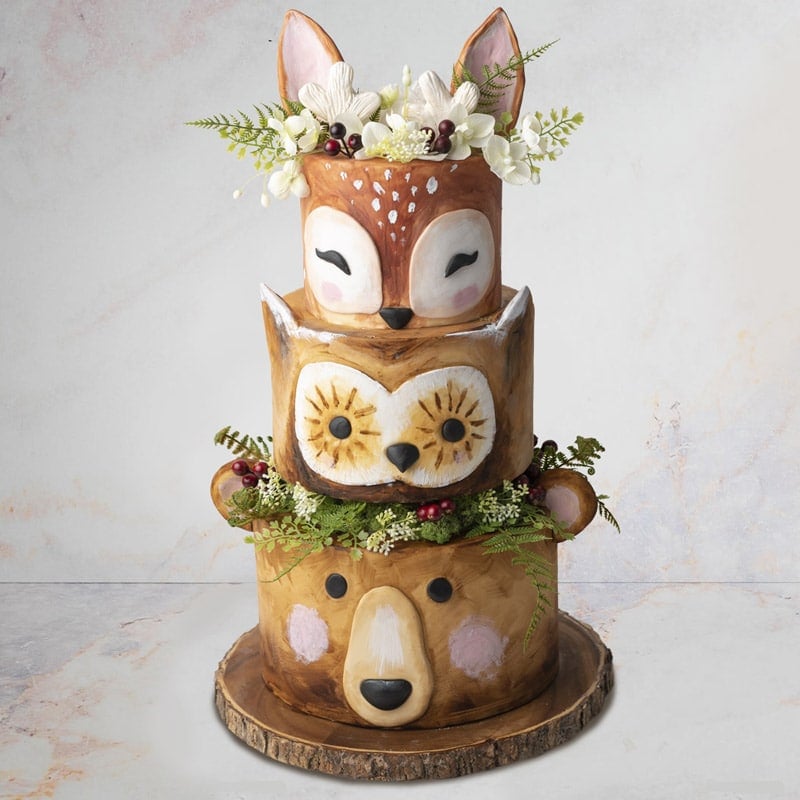
Cake decorated to look like bear, owl and deer faces

November 1, 2022 Paid Video

Woodland Baby Shower Cake

Skill level: Intermediate

Learn how to create this wonderful woodland animal baby shower cake! Liz Marek breaks down all the steps in the process of making each tier, including how to make the bear, owl and deer's details, how to create the cake topper ears and how to trim and arrange the foliage.

40:20 Minutes of Instruction

What You Will Learn

  • How to make a Woodland-themed baby shower cake
  • Learn how to easily sculpt and detail the bear, owl and deer faces
  • How to trim and arrange artificial foliage and how to work with cake dummies

Tutorial Chapters

  1. Covering The Bottom Tier In Fondant0:37
  2. Making The Bear Ears 6:34
  3. Painting The Bear Tier 7:24
  4. Adding The Bear Ears 9:39
  5. Making The Bear's Face 11:01
  6. Covering The Owl Tier In Fondant 14:00
  7. Making The Owl Ears And Face 14:49
  8. Decorating The Owl Tier 18:43
  9. Making The Deer Ears 21:04
  10. Decorating The Deer Layer 22:56
  11. Making & Adding The Antlers 29:03
  12. Making The Spacer 30:51
  13. Stacking & Decorating 36:28
  14. Finishing Touches 38:36

Downloads

Materials List

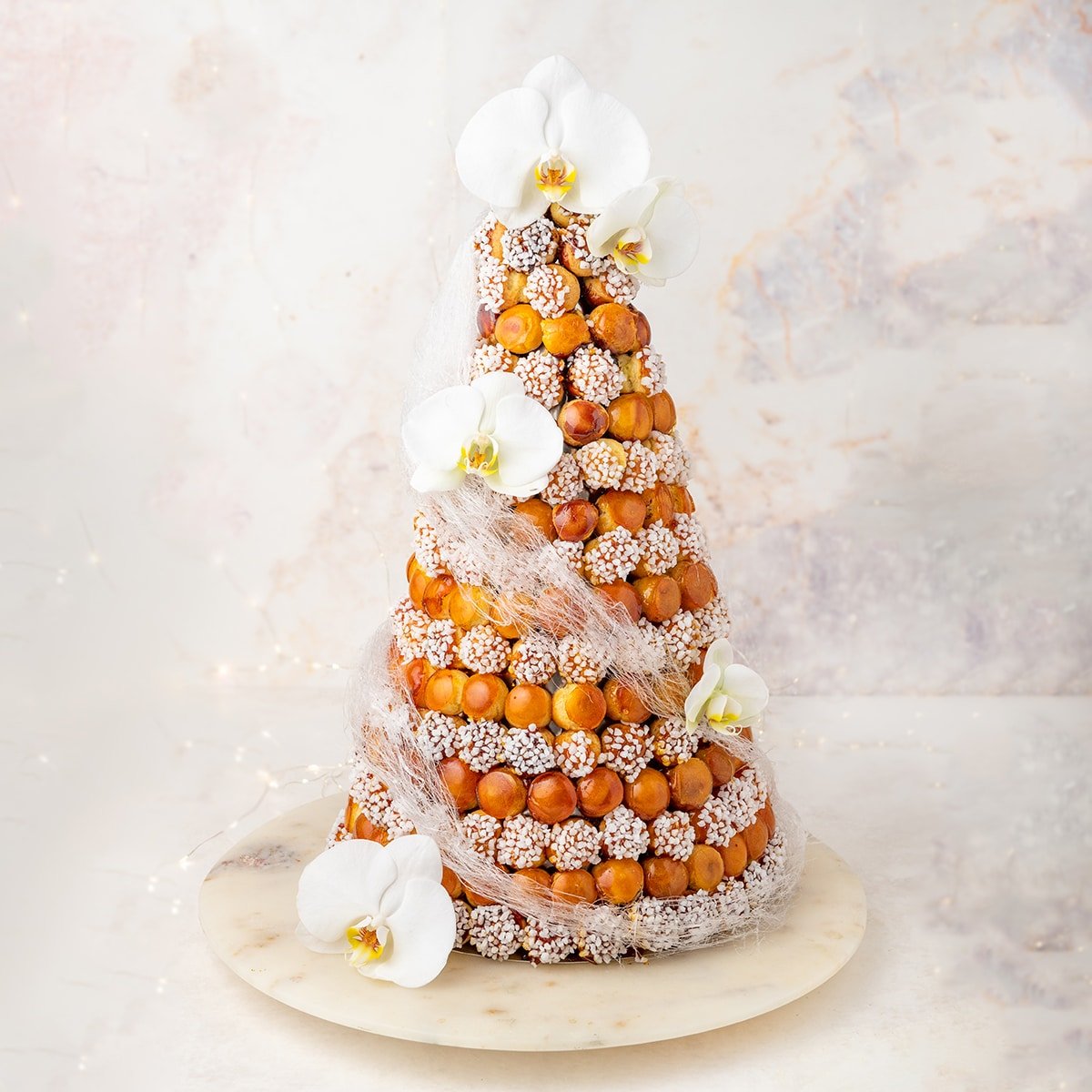
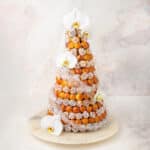
wedding cream puff tower stacked on top of a marble plate in front of white background

October 28, 2022 Pastries

Croquembouche

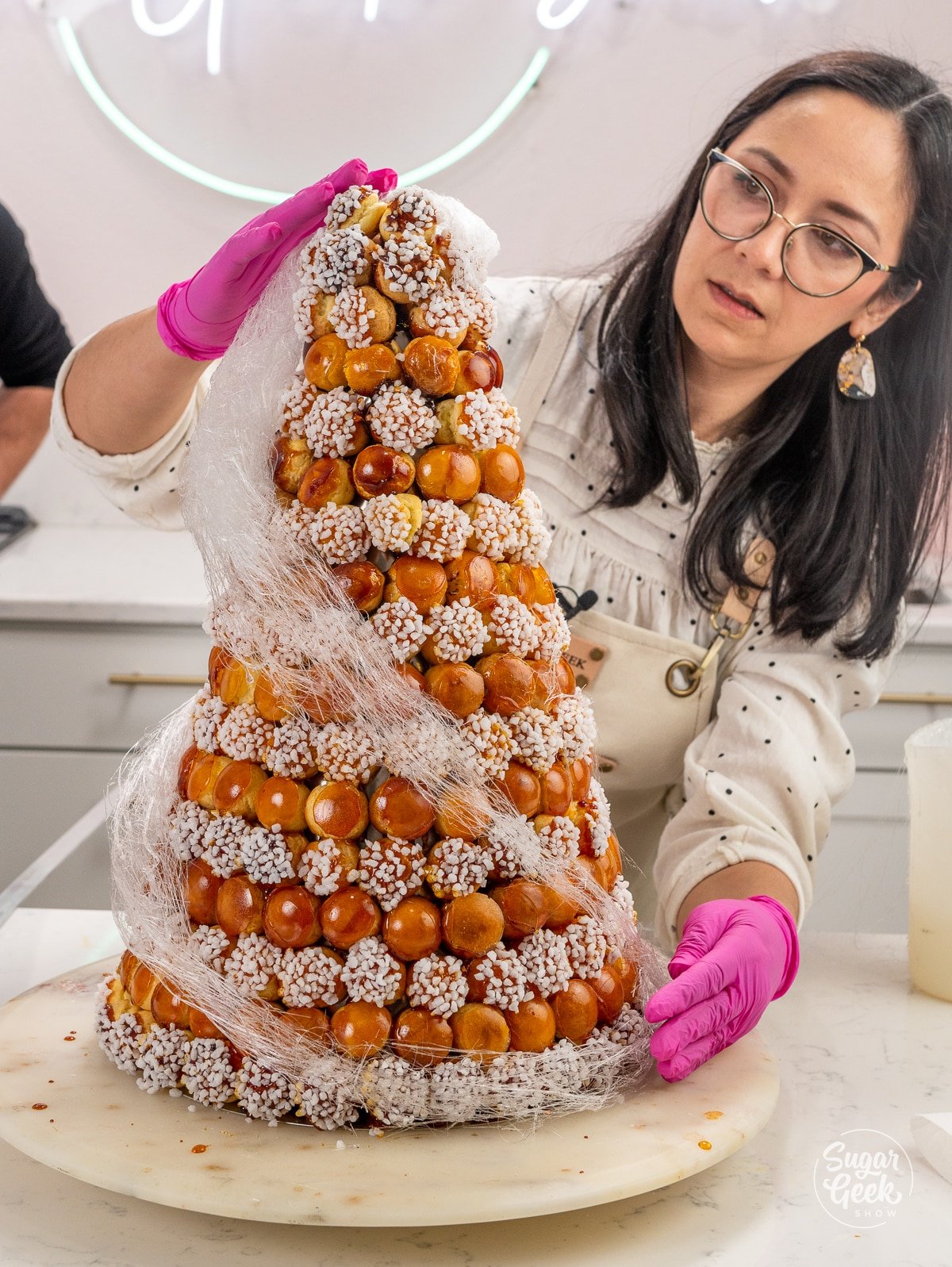
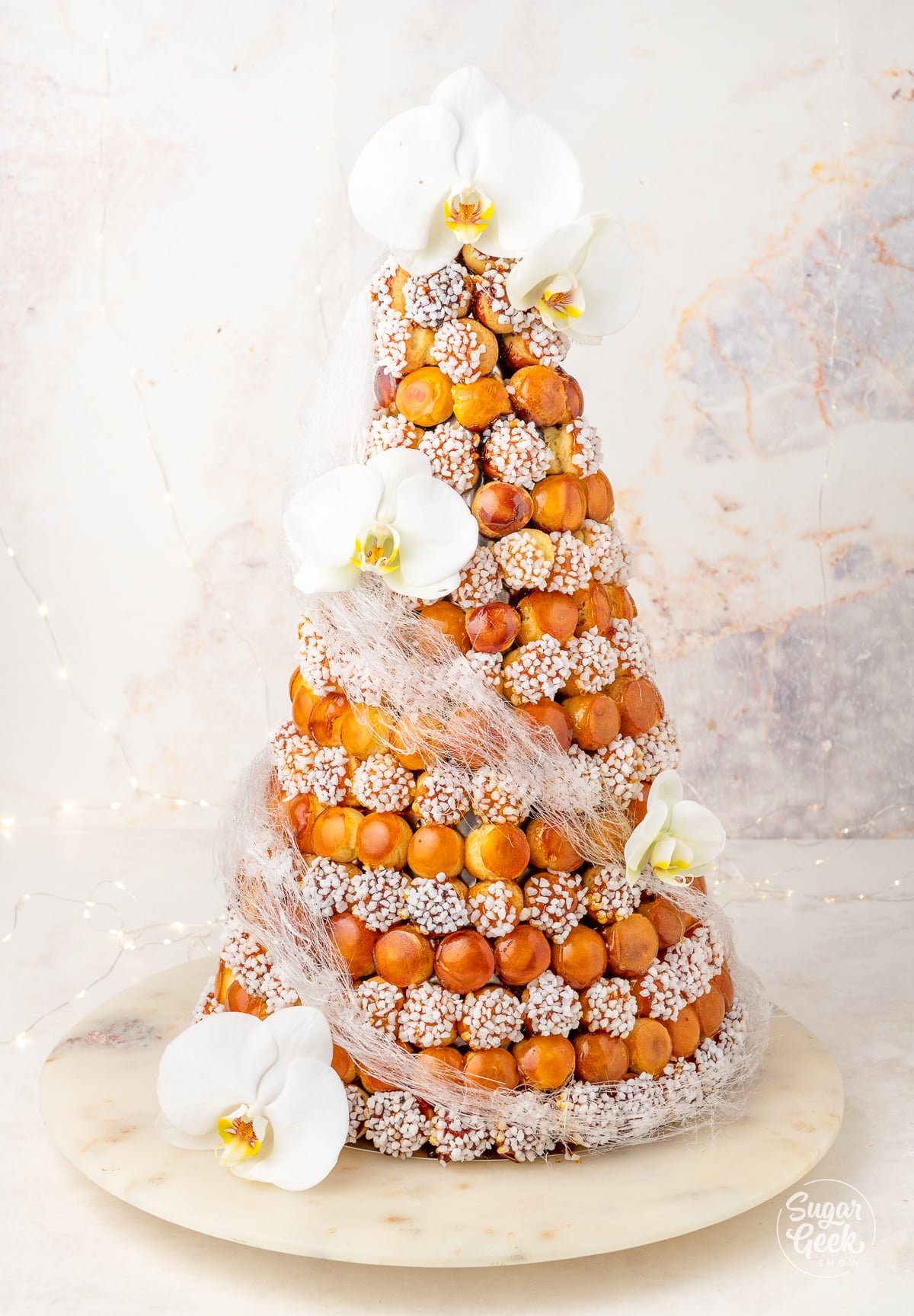
A classic French Croquembouche is the ultimate show-stopping dessert for a special occasion. Homemade cream puffs filled with sweet vanilla pastry cream are held together by fresh caramel to make an elegant cream puff tower. Decorate with some beautiful sugar art and flowers for a sky-high celebration.wedding cream puff tower stacked on top of a marble plate in front of white background

Chef Christophe Rull is here to teach you how to make pate a choux, assemble the croquembouche with all the tools you need, and top it off with some elegant flower and sugar art decoration. It's a classic French celebratory recipe that can make for a great alternative to wedding cake!

Table of contents

  • Special Ingredients and Substitutions
  • Making a Croquembouche
    • Tips Before Starting
    • Making Pâte à Choux
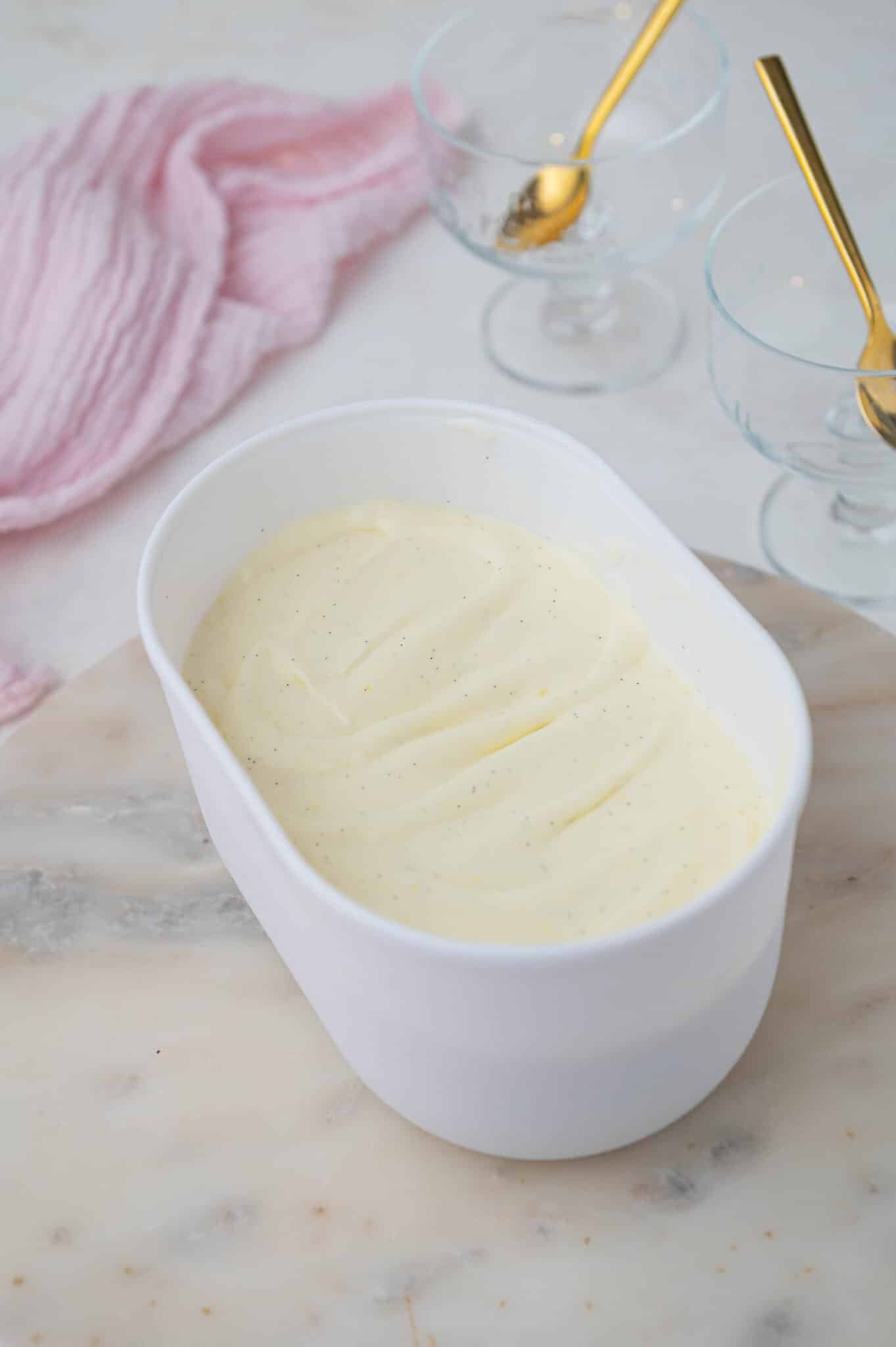
    • Making Pastry Cream
    • Filling the Cream Puffs
    • Making the Caramel
    • How to Stack a Croquembouche
  • Serving the Croquembouche
  • FAQ
  • Related Recipes

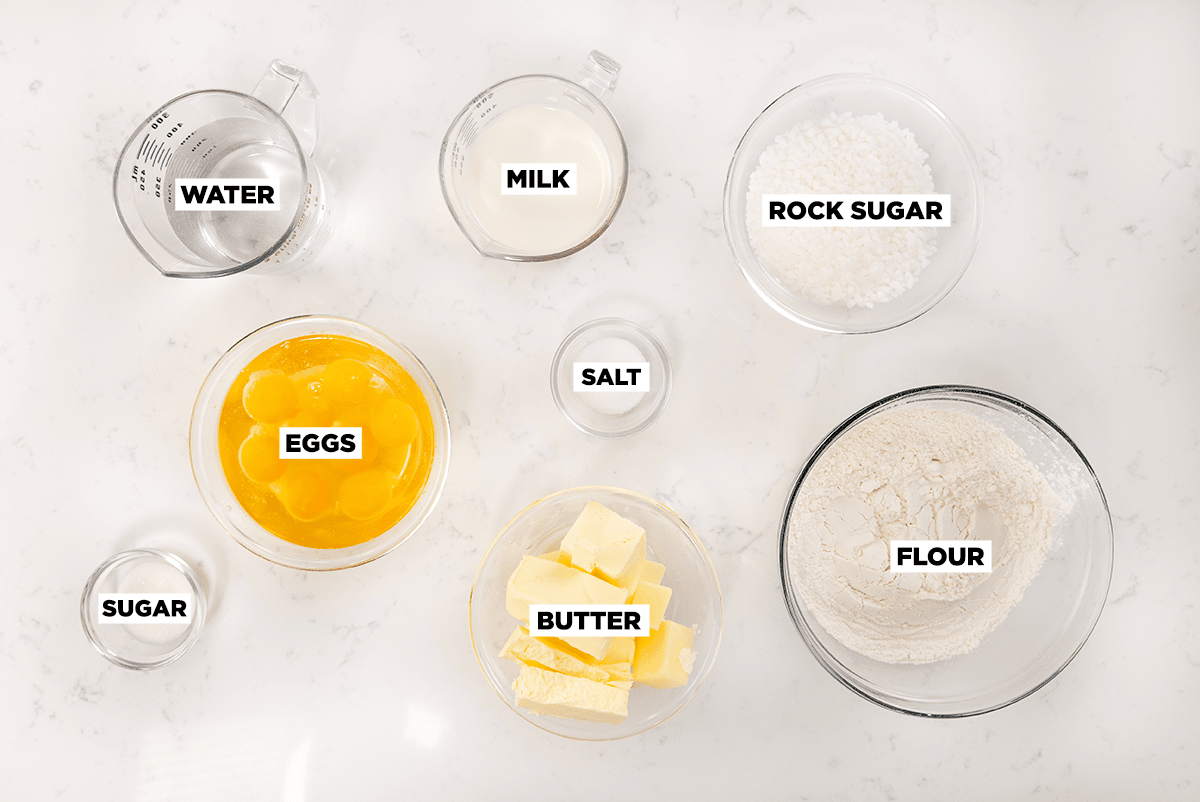
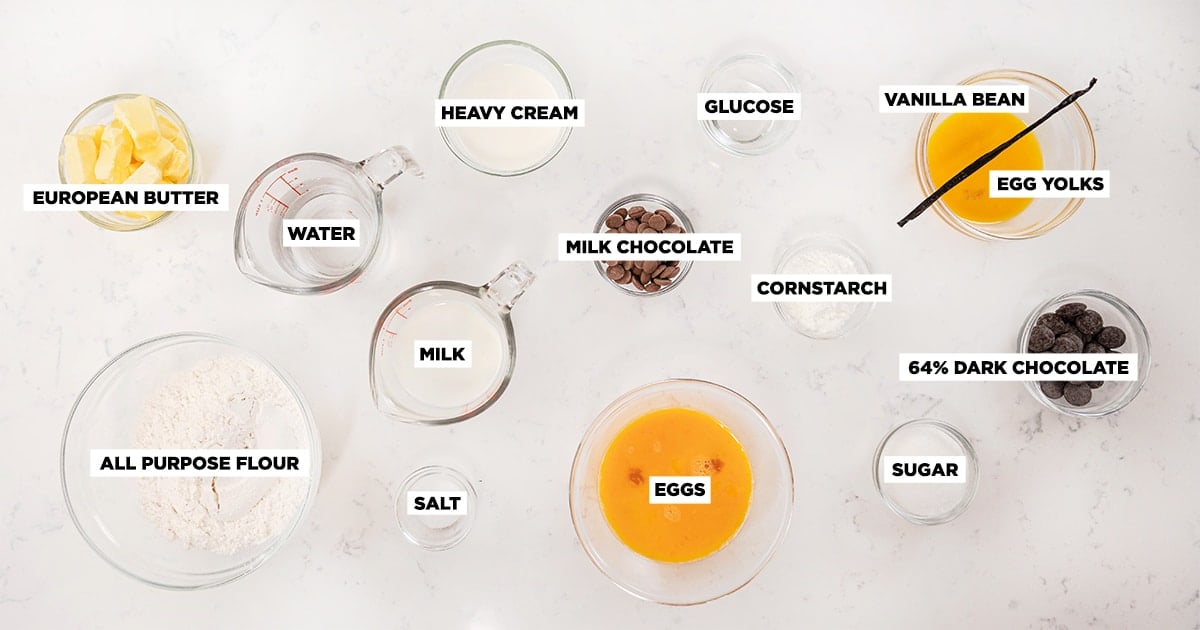
Special Ingredients and Substitutionsbowl of ingredients for a croquembouche on a table

Vanilla Bean: We are adding a vanilla bean to our pastry cream because it's what will give it the most flavor, plus I think it looks the most natural when you see the vanilla specs inside the pastry cream. They are a little more expensive and can be hard to find so you can also use vanilla bean paste or vanilla extract.

Glucose: Glucose is very similar to corn syrup. It's a sweetener that adds moisture to any recipe. It's more commonly found in commercial kitchens, but if you can't find glucose you can easily substitute it for corn syrup. 

Cornstarch: We are going to be using cornstarch as our thickening agent for our pastry cream. Cornstarch is typically used to thicken creams, jams, or sauces. You can get cornstarch at your local grocery store!

Rock Sugar: Rock sugar is sugar that's made of much thicker granules. We will be dipping our pate a choux in it for decoration and added sweetness!

Making a Croquembouche

This 18" tall croquembouche with about 250 cream puffs took about 5 hours in total to make. We had two people helping fill, dip, and assemble the cream puffs. 

It is possible to make this croquembouche all in one day, but you can also make the pate a choux and pastry cream ahead of time. Just make sure to avoid refrigerating the filled cream puffs overnight, or they will get soggy.woman wearing pink gloves using hands to assemble a croquembouche

Tips Before Starting

  • This pate a choux recipe is enough to make about 64 cream puffs, but you will need to make multiple batches depending on what size croquembouche you're making. 
  • 200-250 2" cream puffs are enough for an 18" tall, 10" wide croquembouche, so you will need about 4 batches of this recipe for that size. 
  • We are using a croquembouche mold from Matfer, but you can use any kind of mold or even make your own! 
  • It's best to use a heavy bottom pot rather than a nonstick pot for pâte à choux because you want your dough to stick to the bottom when drying.
  • To make the choux ahead of time, you have two options: Place the choux dough in multiple pastry bags and chill them overnight, then pipe, bake, fill, and assemble on the same day. OR bake the cream puff shells the day before, store them in an airtight container at room temperature overnight, then crisp them up in a 350°F oven for 5 minutes the next day before filling, and assembling. 

Making Pâte à Choux

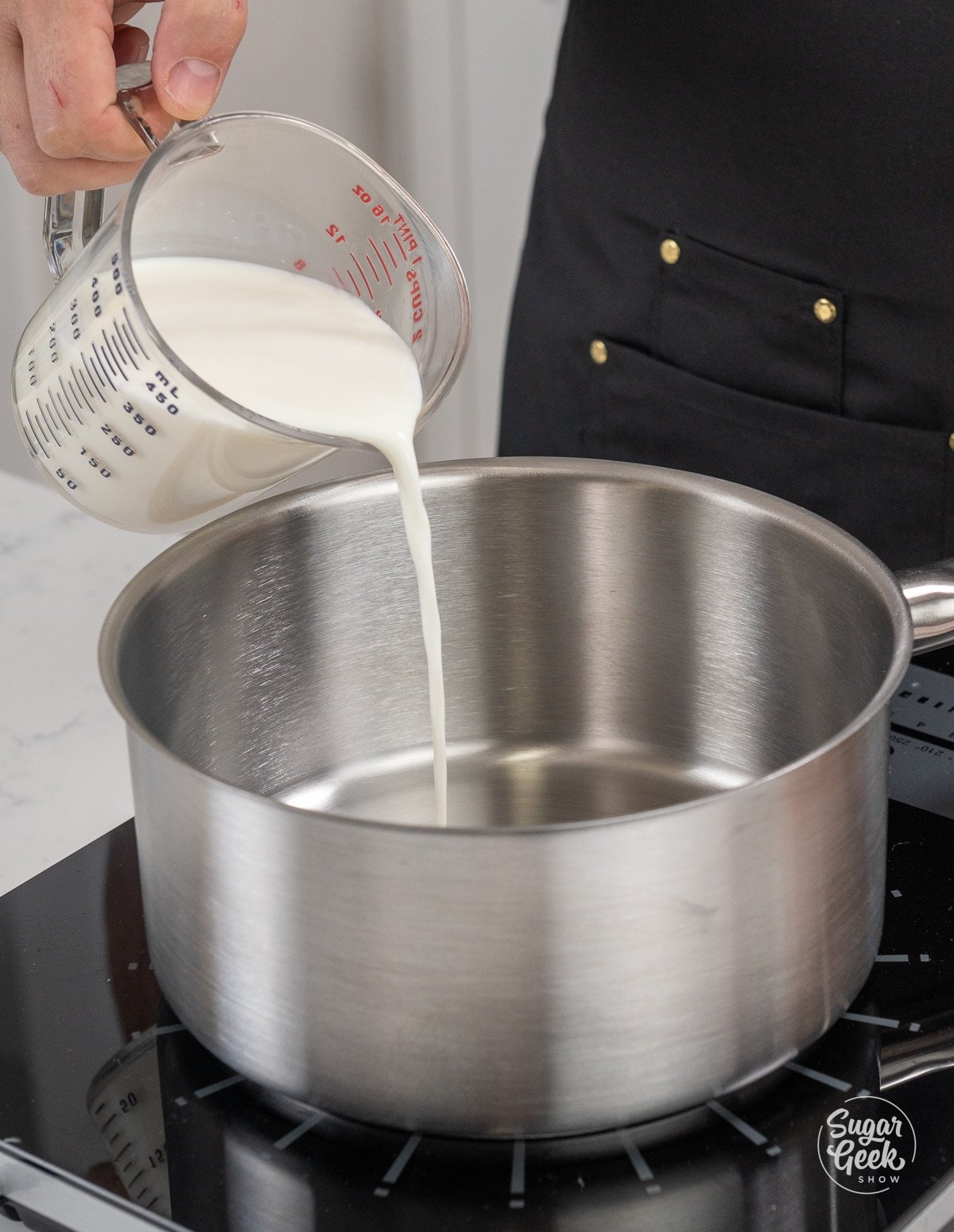
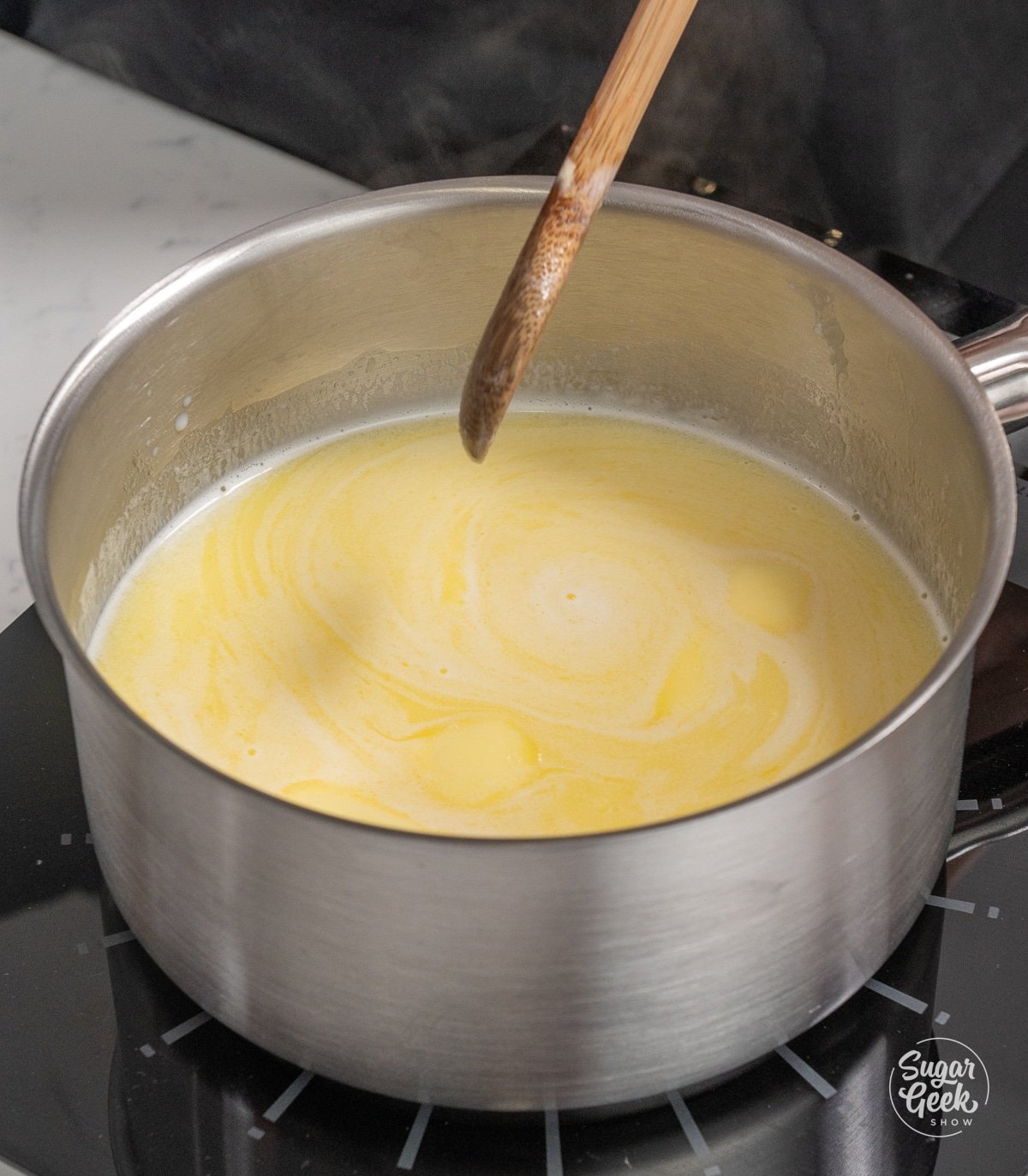
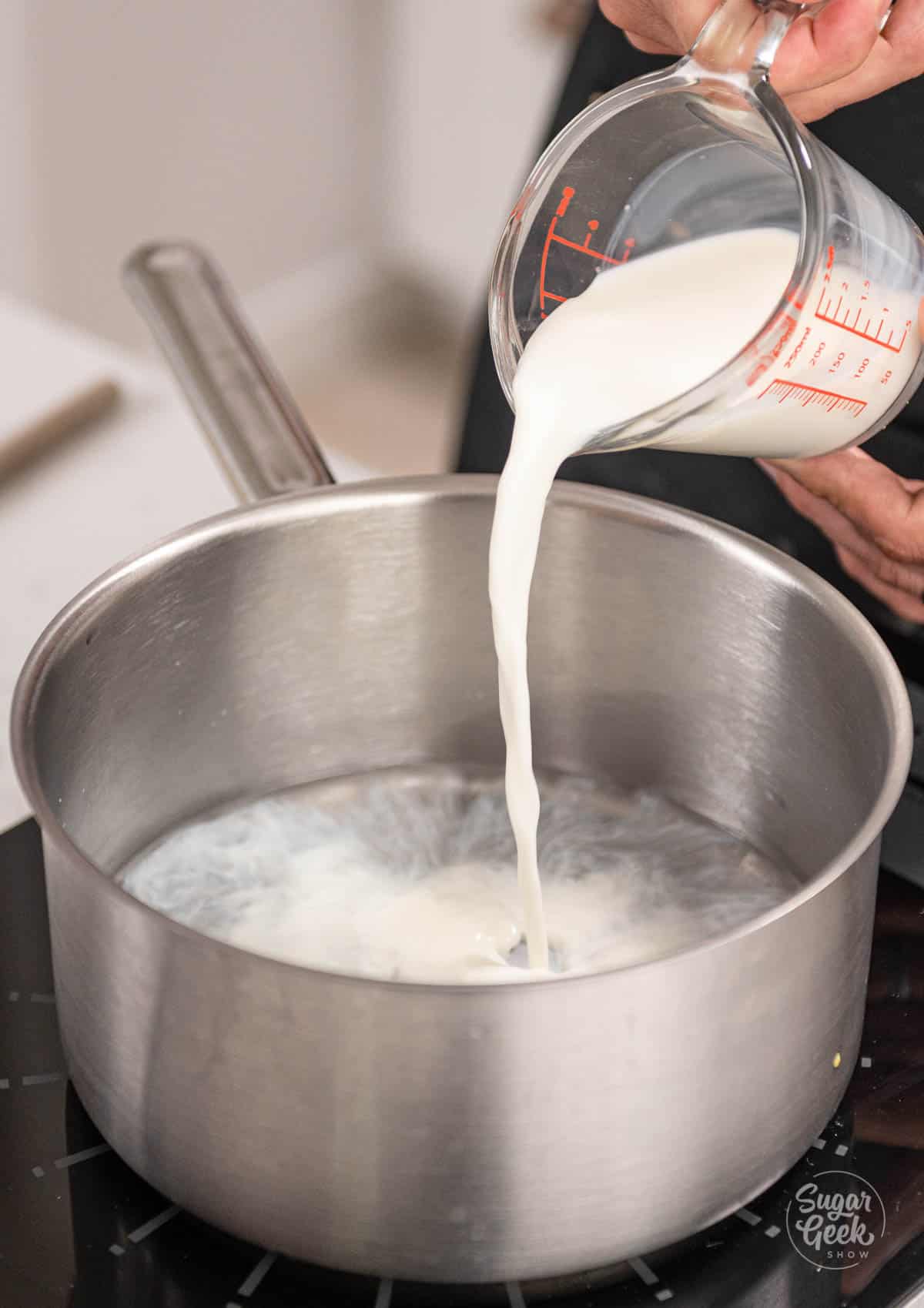
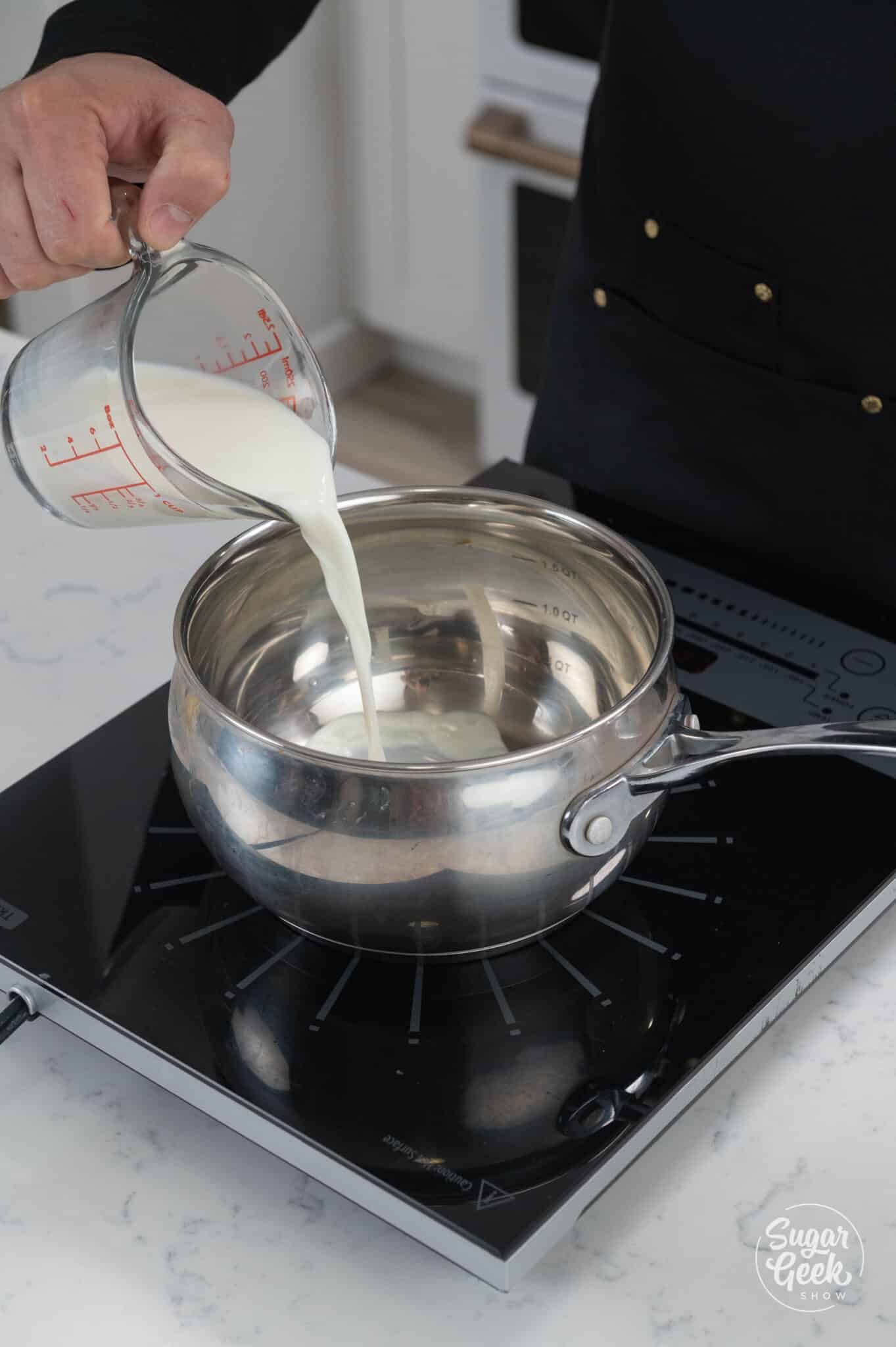
  1. Add your milk, water, salt, sugar, and butter to a medium saucepan and bring it to a boil. The butter should be melted at the same time the milk starts to boil, so remove the pot from the heat to let the butter melt if needed. hand adding a container of milk to a metal saucepanmetal pot of melted butter and milk with a wooden spoon
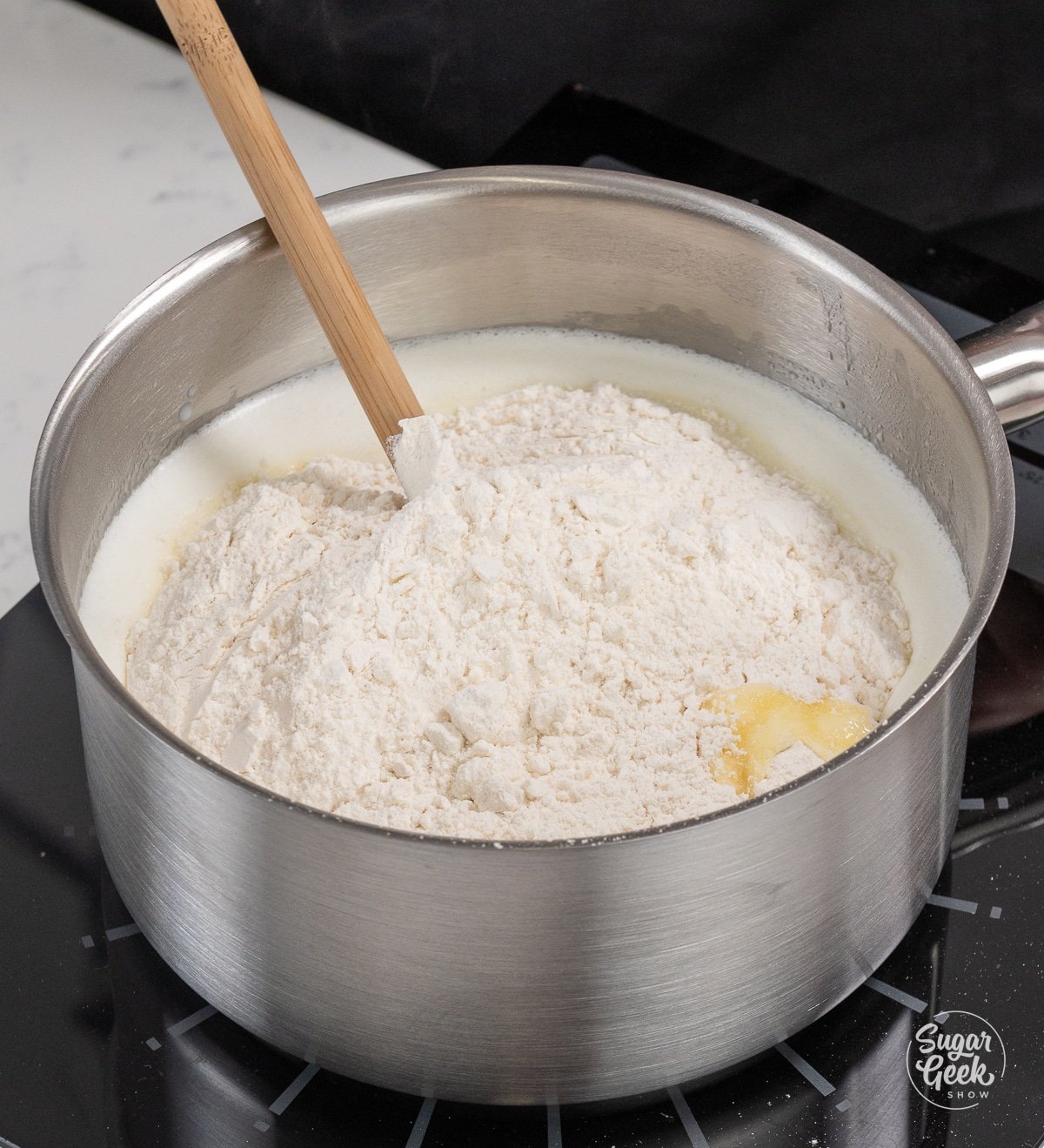
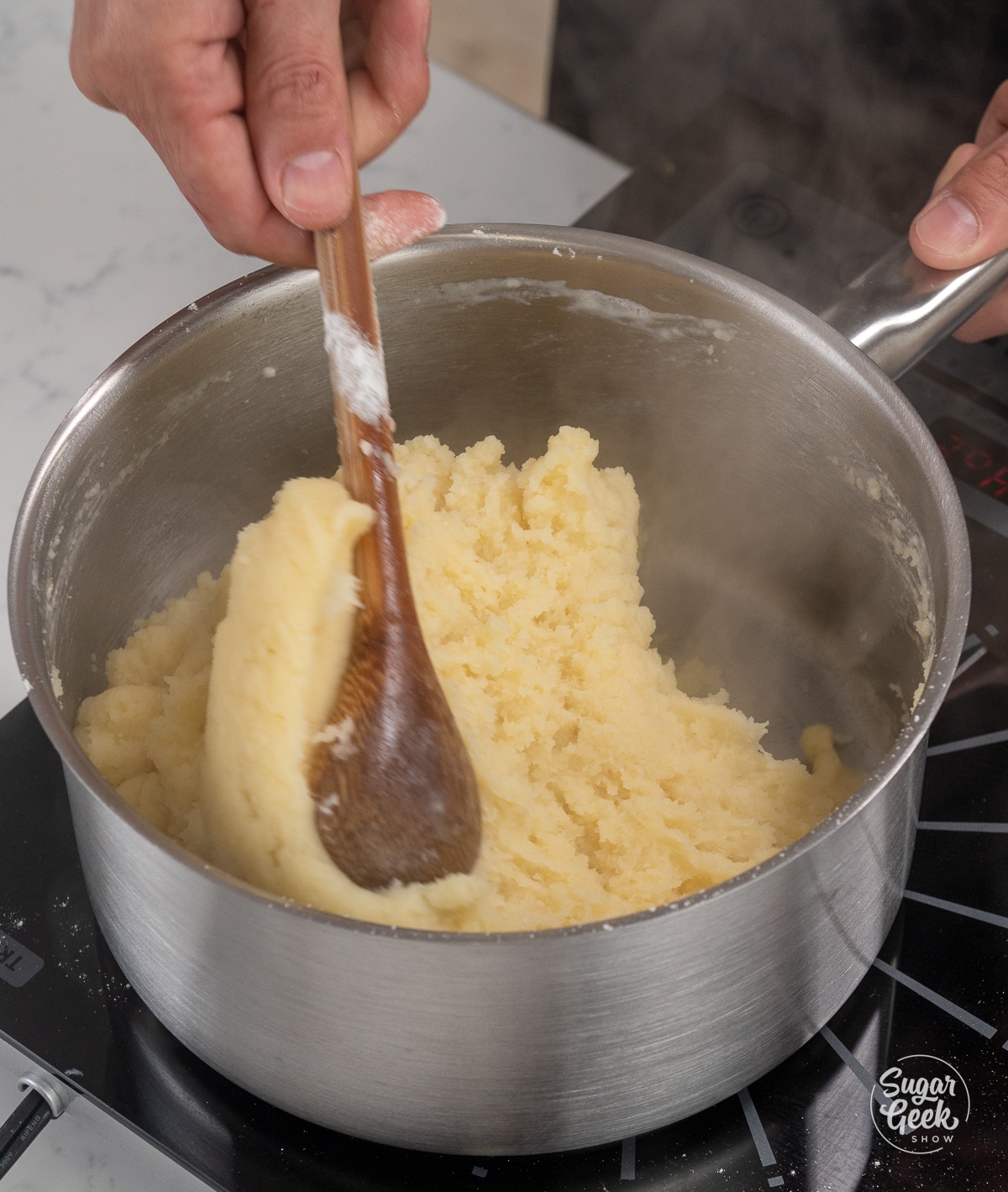
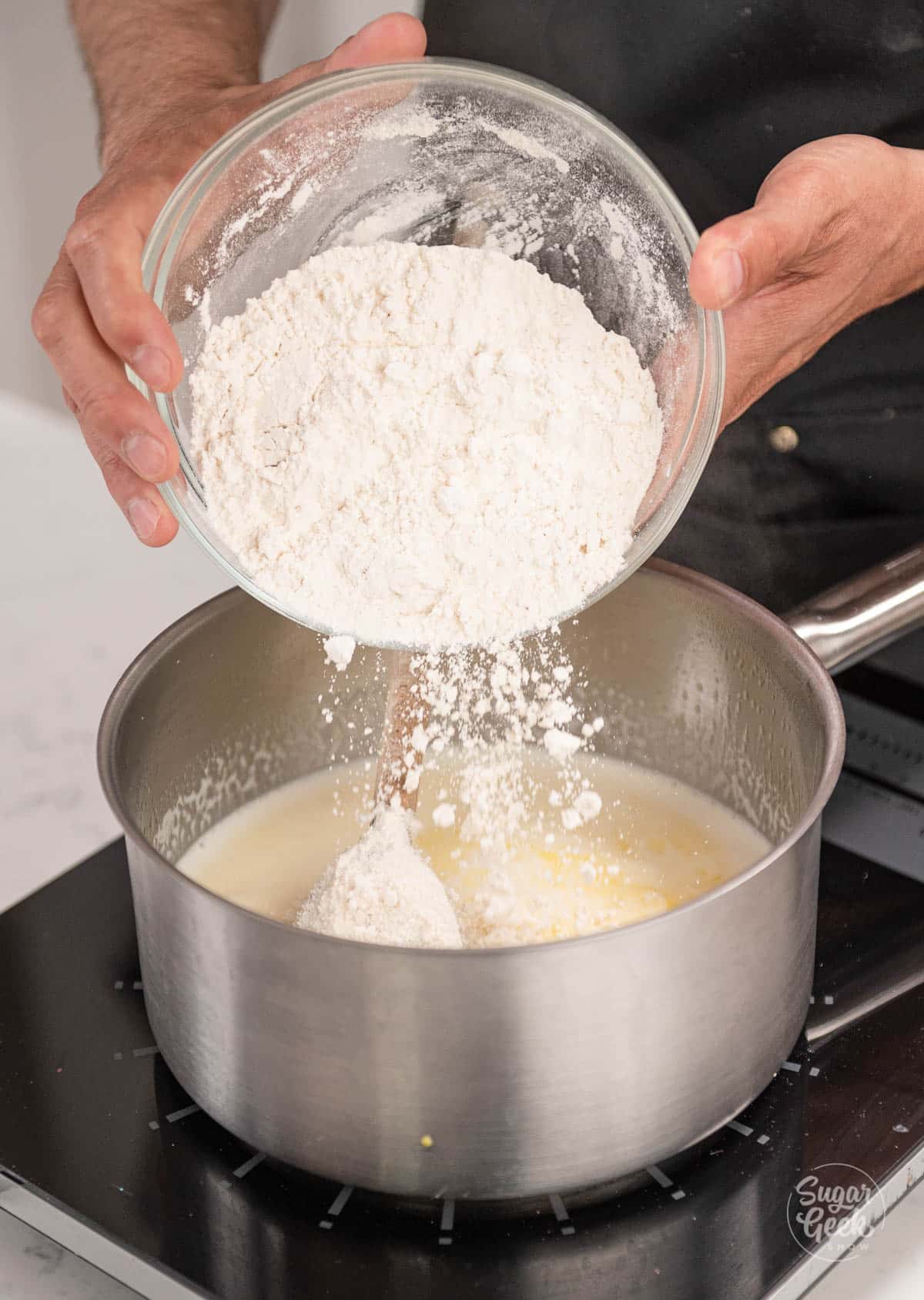
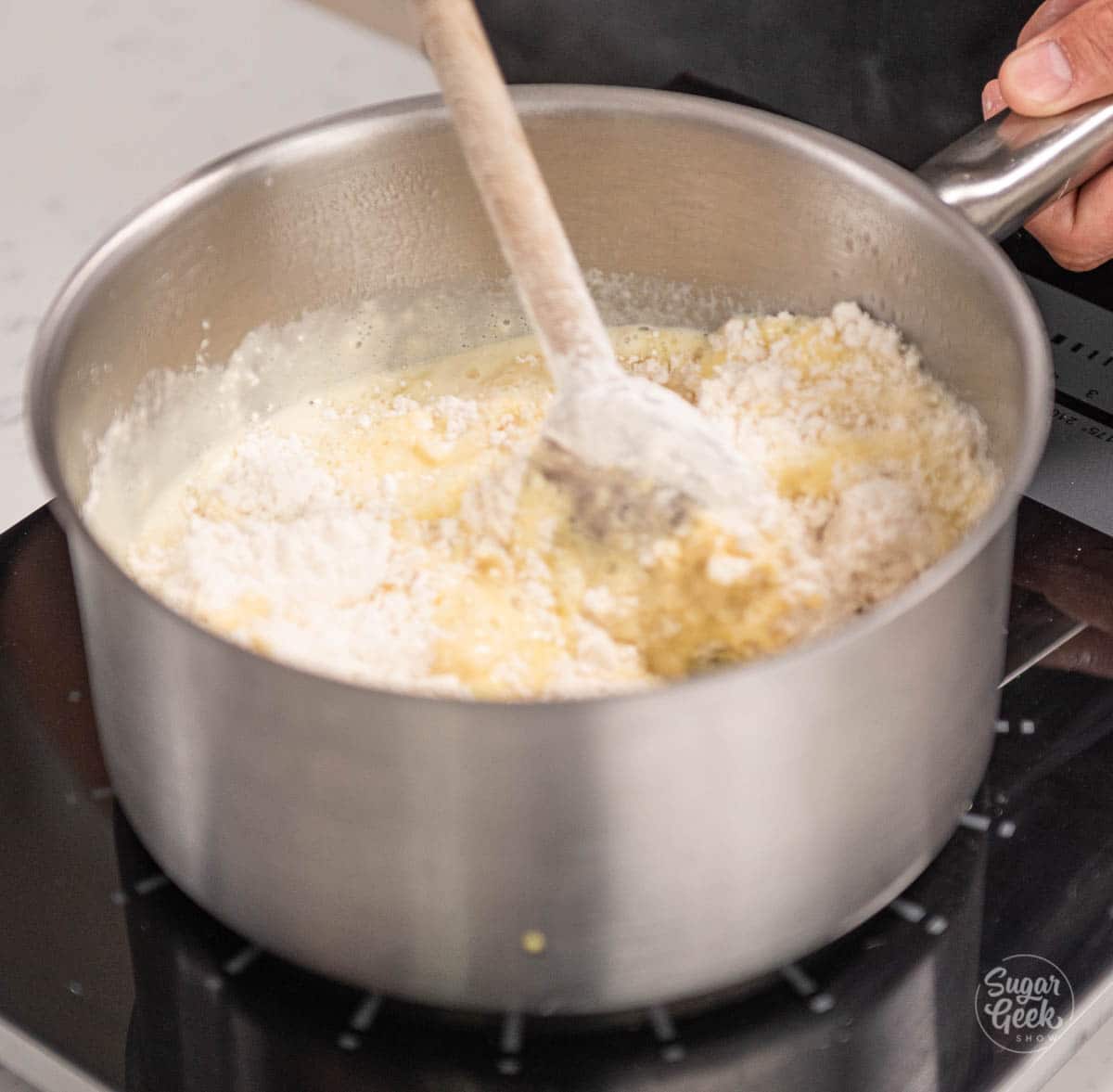
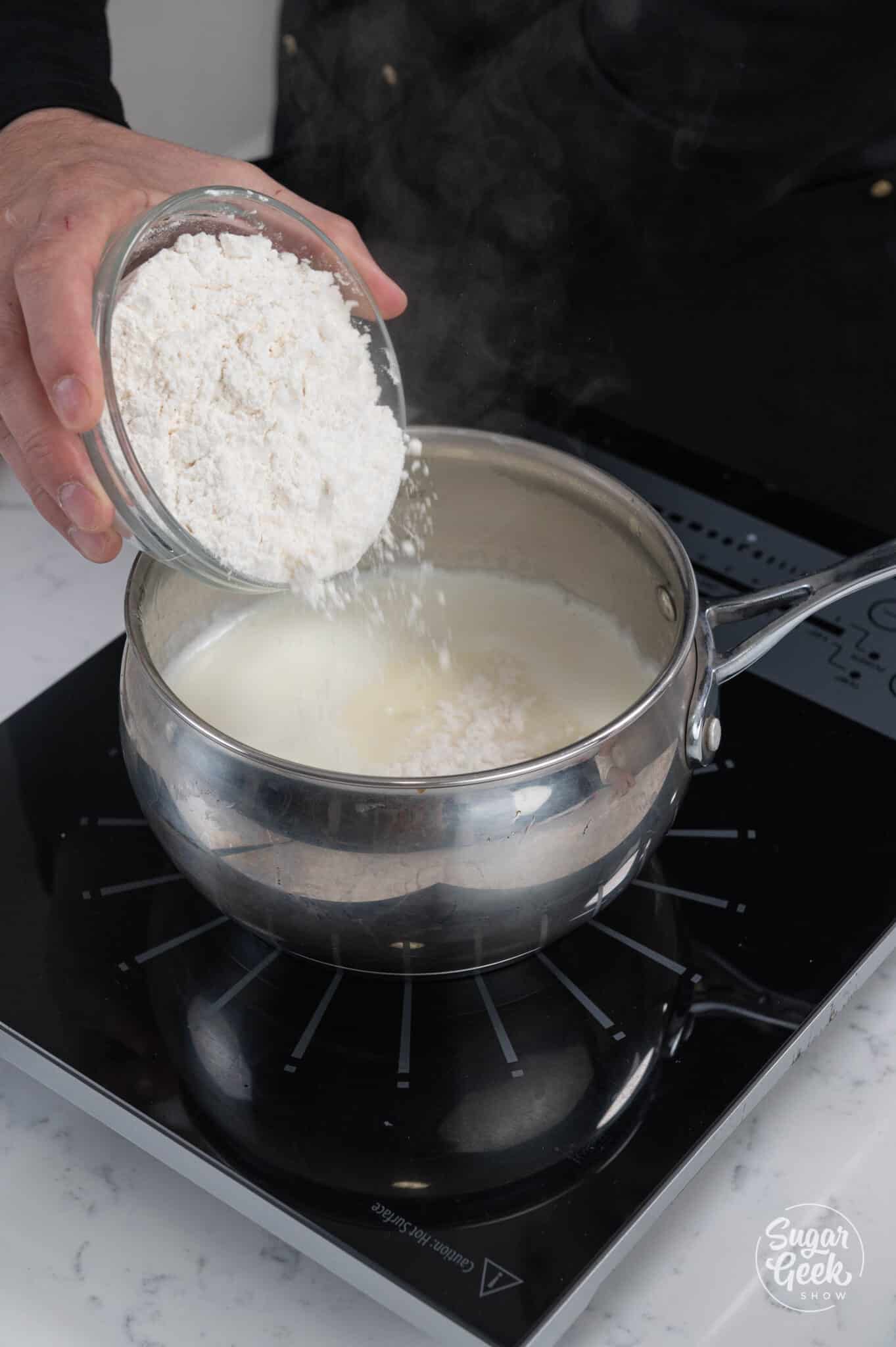
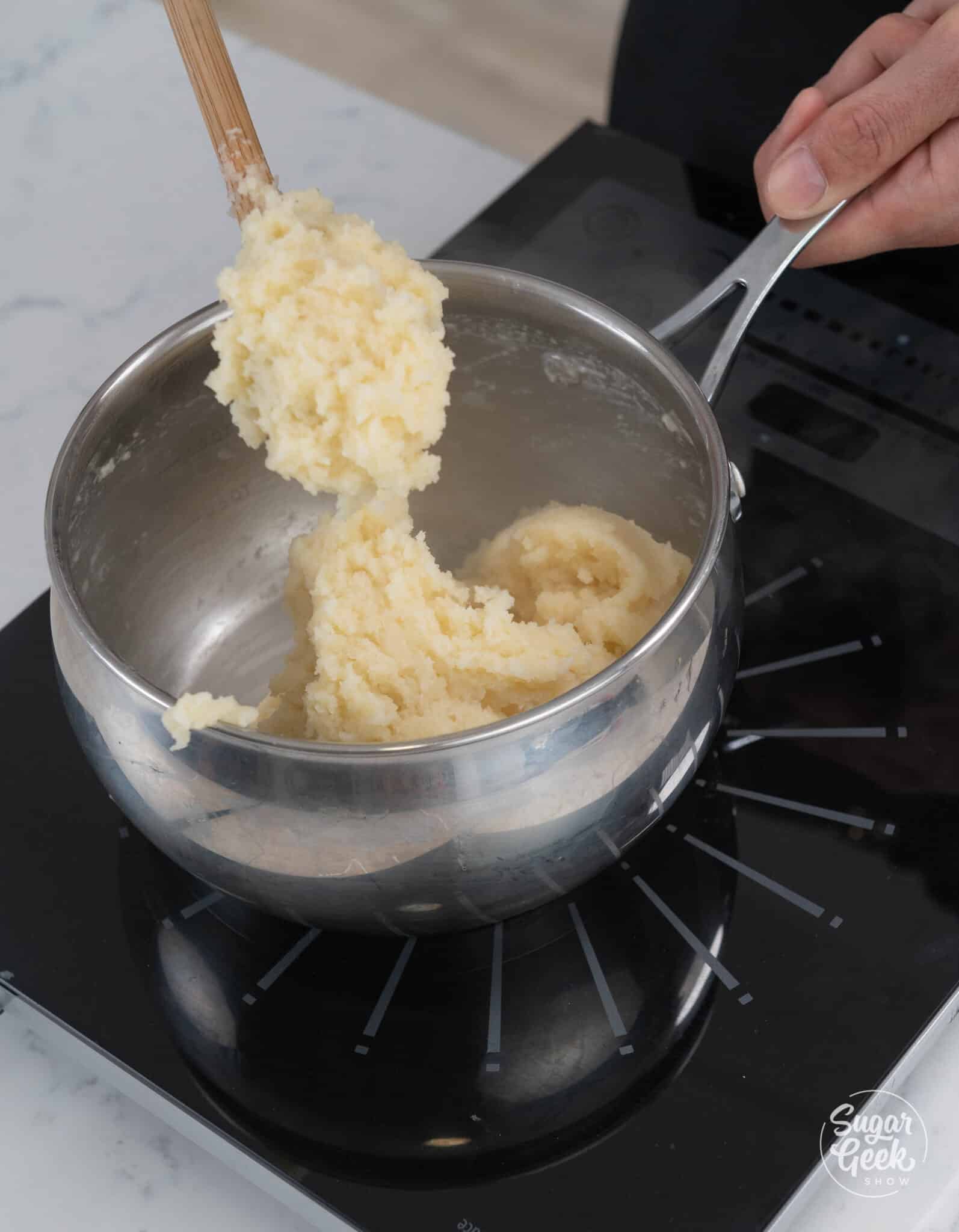
  2. Once your milk mixture is boiling and the butter has completely melted, take your pot off the heat, add in your sifted flour, and mix together until it looks like mashed potatoes. It is best to use a wooden spoon, but a spatula is fine too.wooden spoon stirring flour into a metal pot of choux dough ingredients
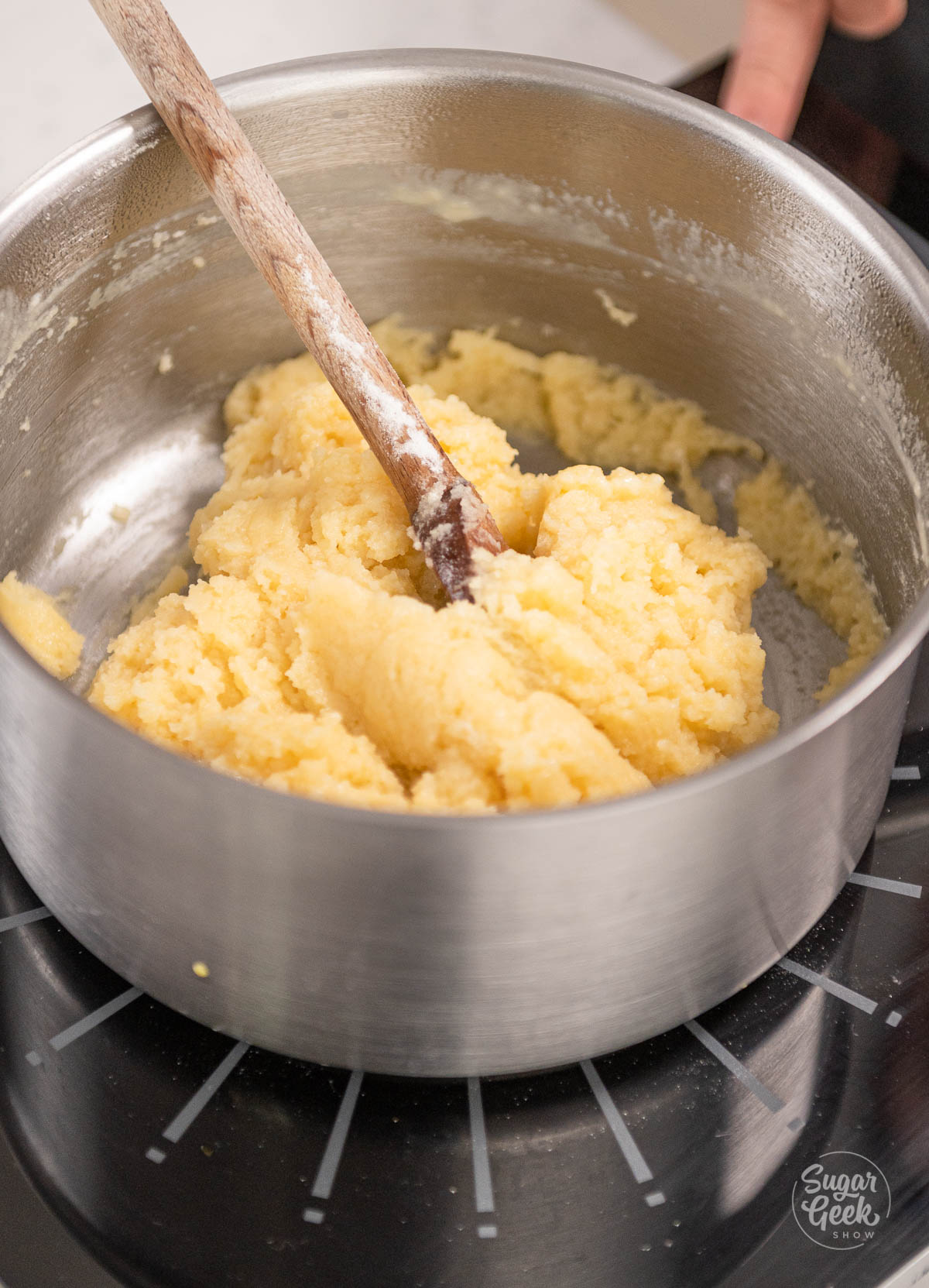
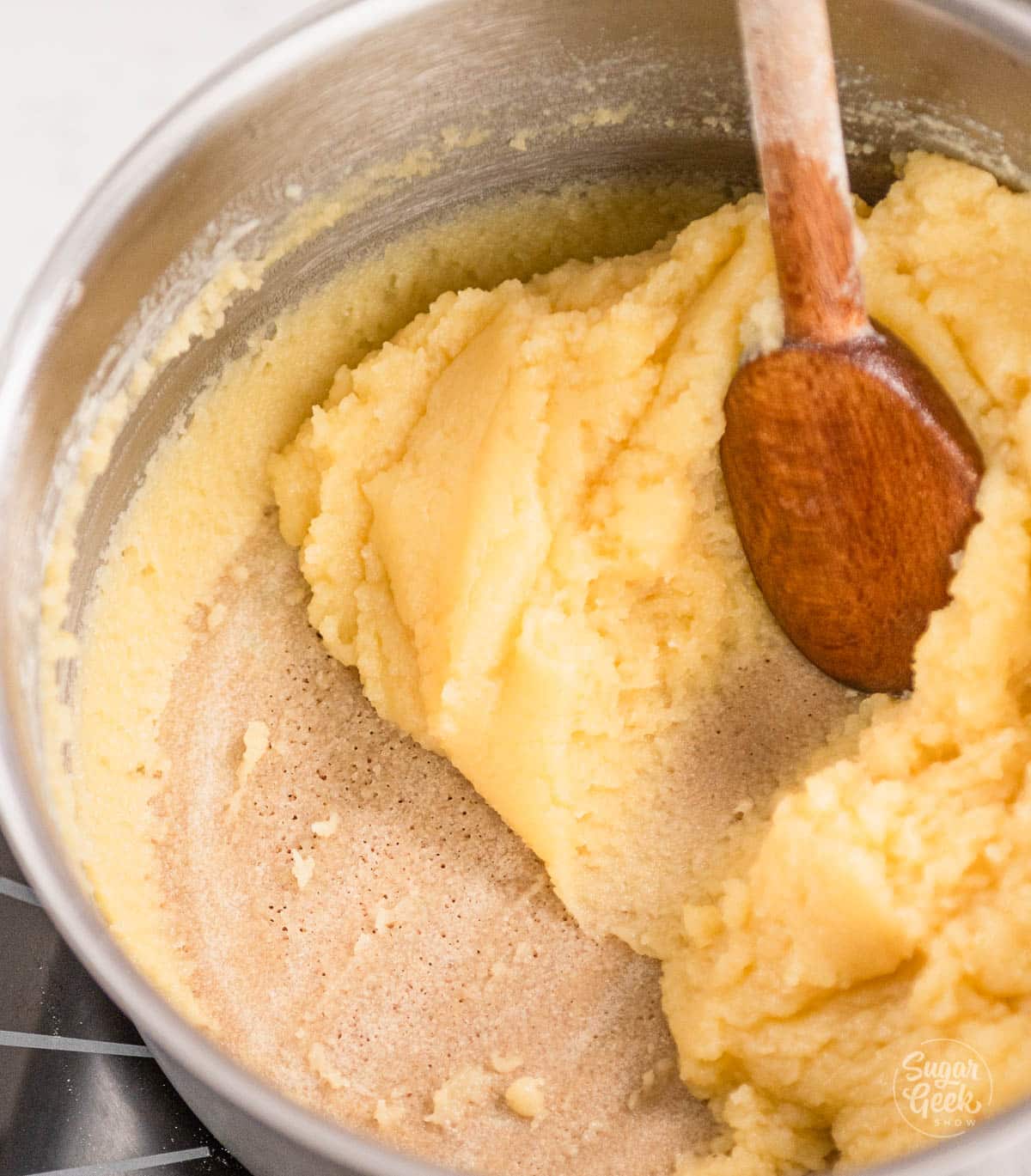
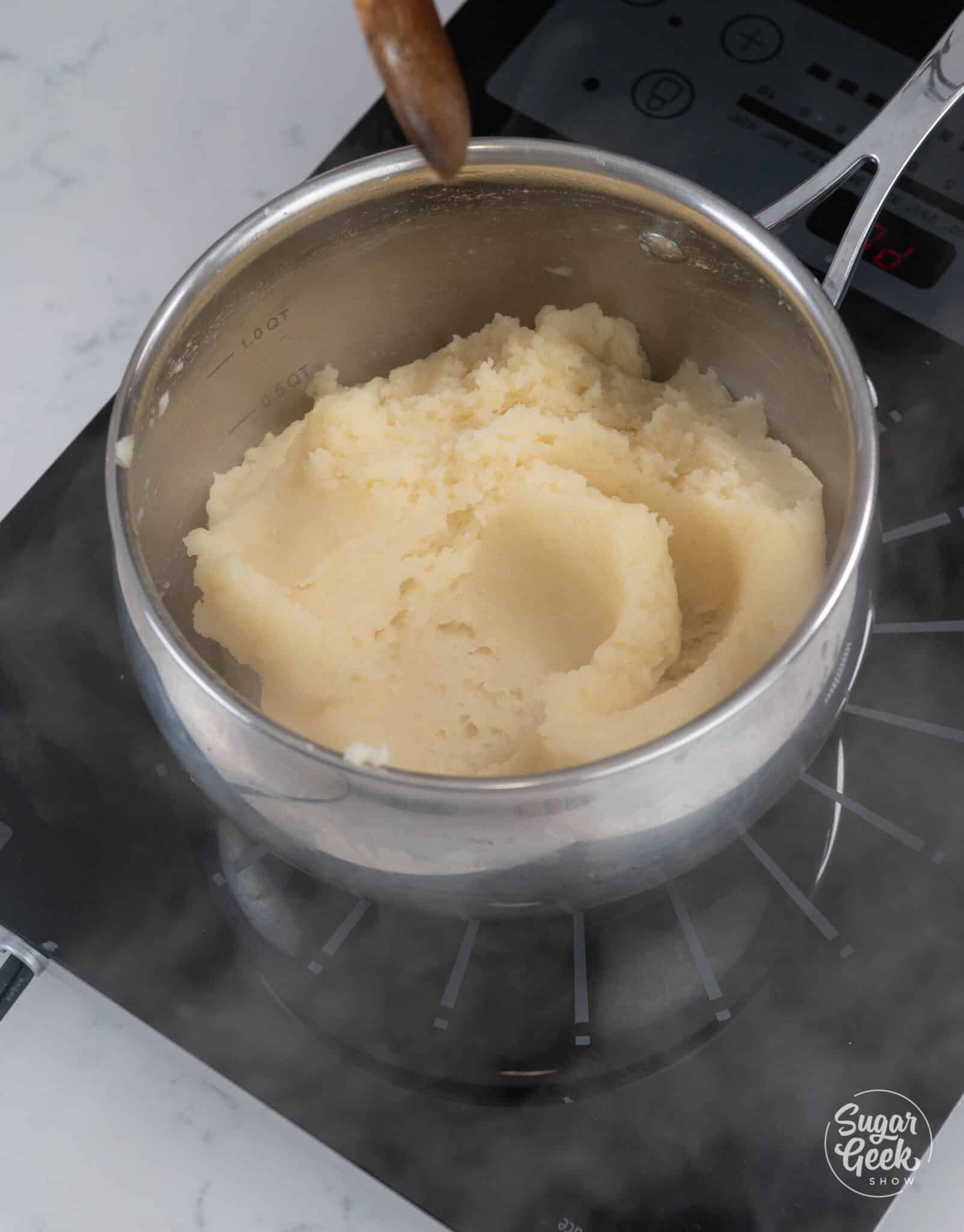
  3. Turn the heat back on to medium-high and continue to stir and keep it moving to dry out the dough.wooden spoon stirring choux dough in a metal pot
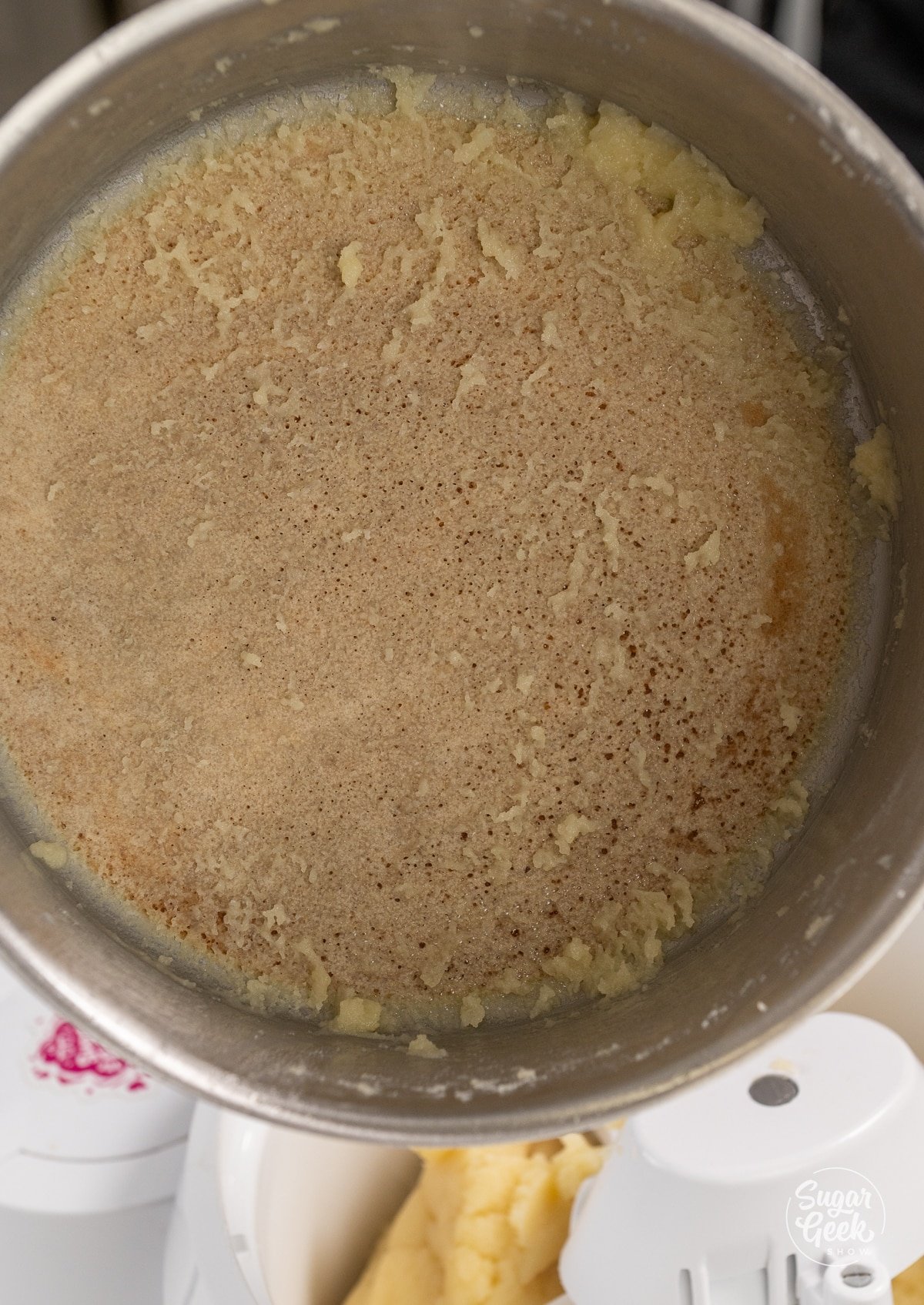
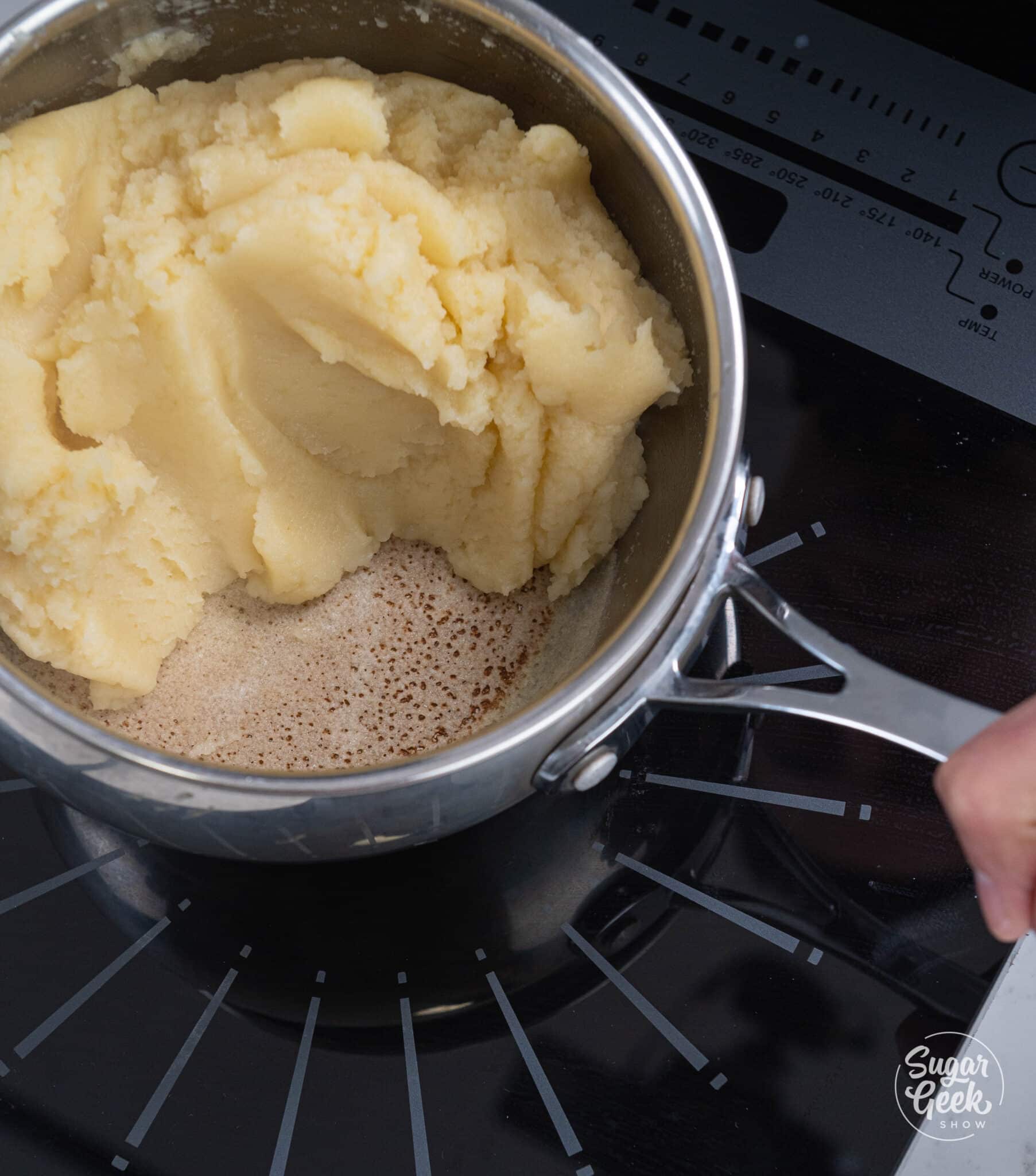
  4. Once you see a browning layer on the bottom of the pan the dough is dry enough. This is important, as it will help your cream puffs "puff" and ensure that they have a hollow center for the cream filling.bottom of a saucepan with a layer of browned pate a choux dough
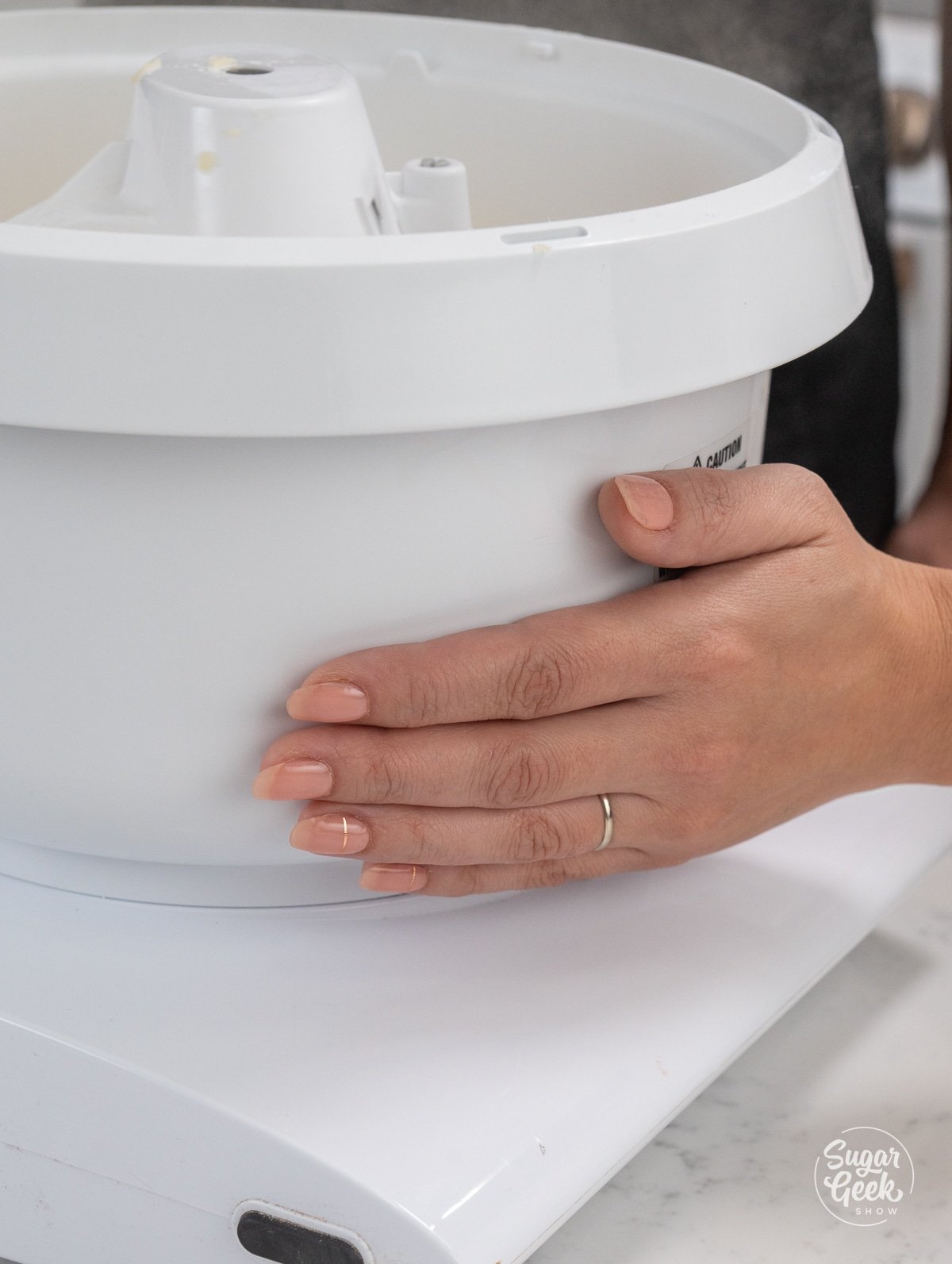
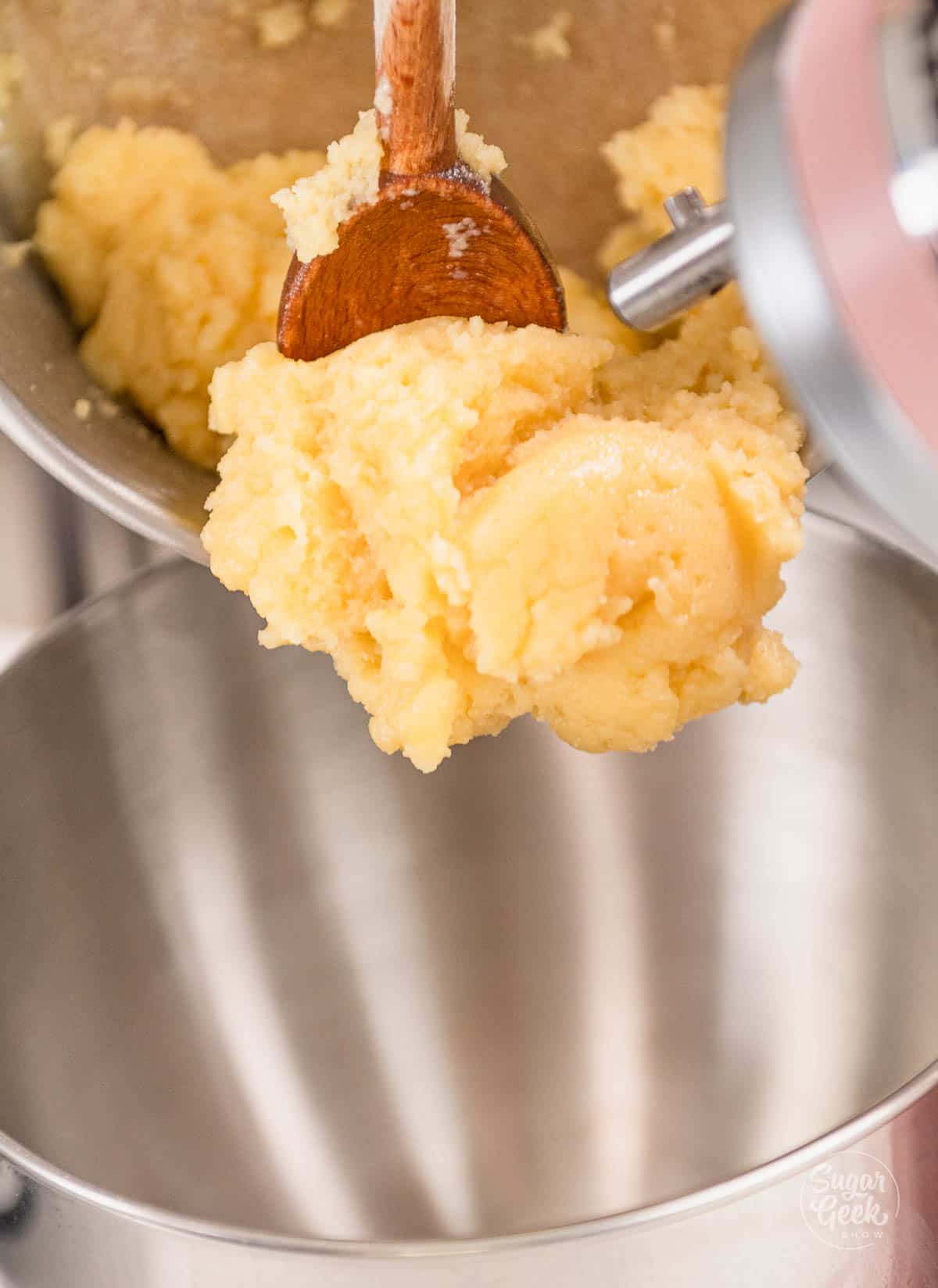
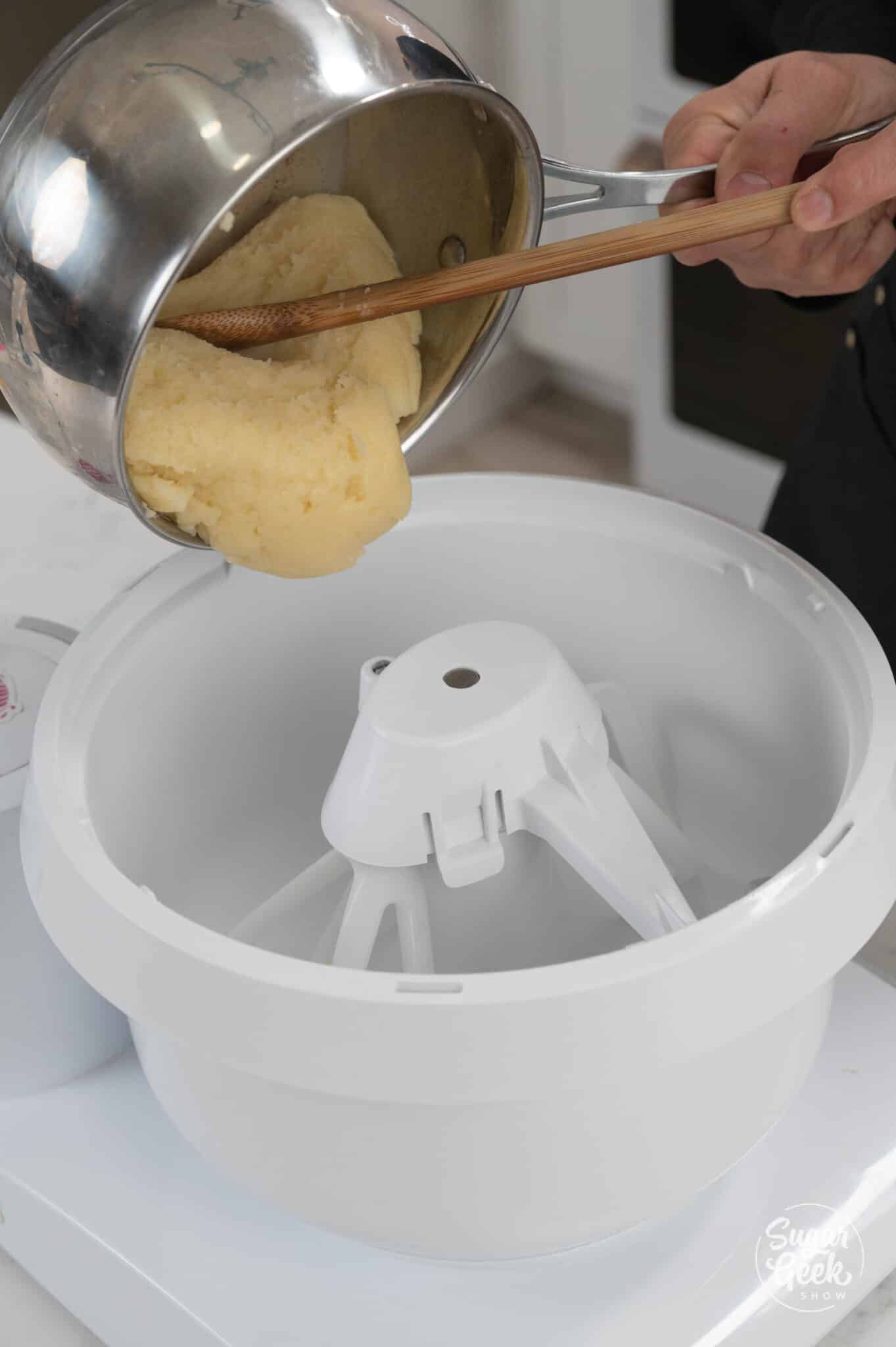
  5. Put the dough into the bowl of a stand mixer with the paddle attachment and begin to mix on medium speed to cool it down, this should take about 30 seconds to 1 minute. When you can place your hand on the side of the bowl without it feeling too hot, it's done.hand touching the side of a stand mixer bowl
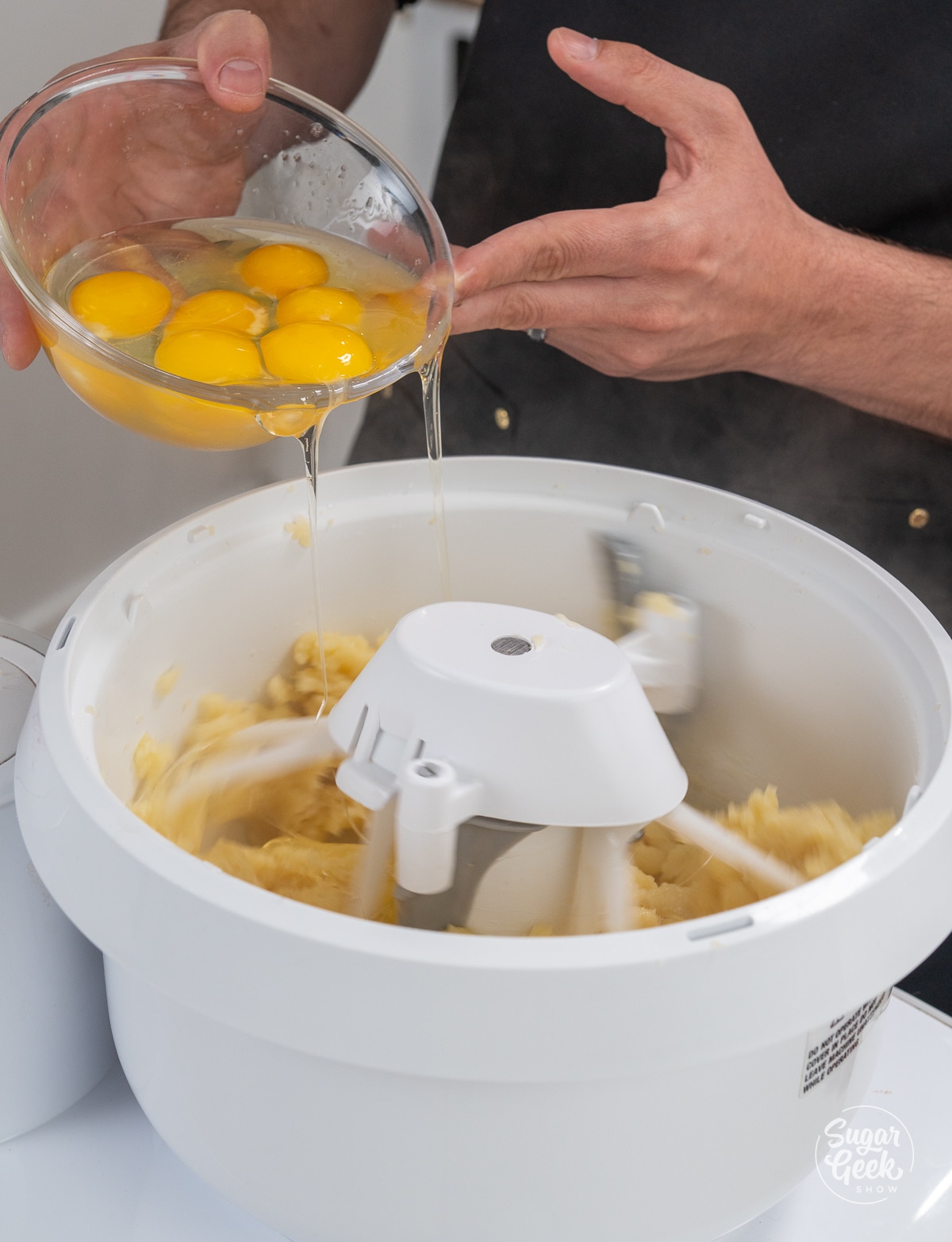
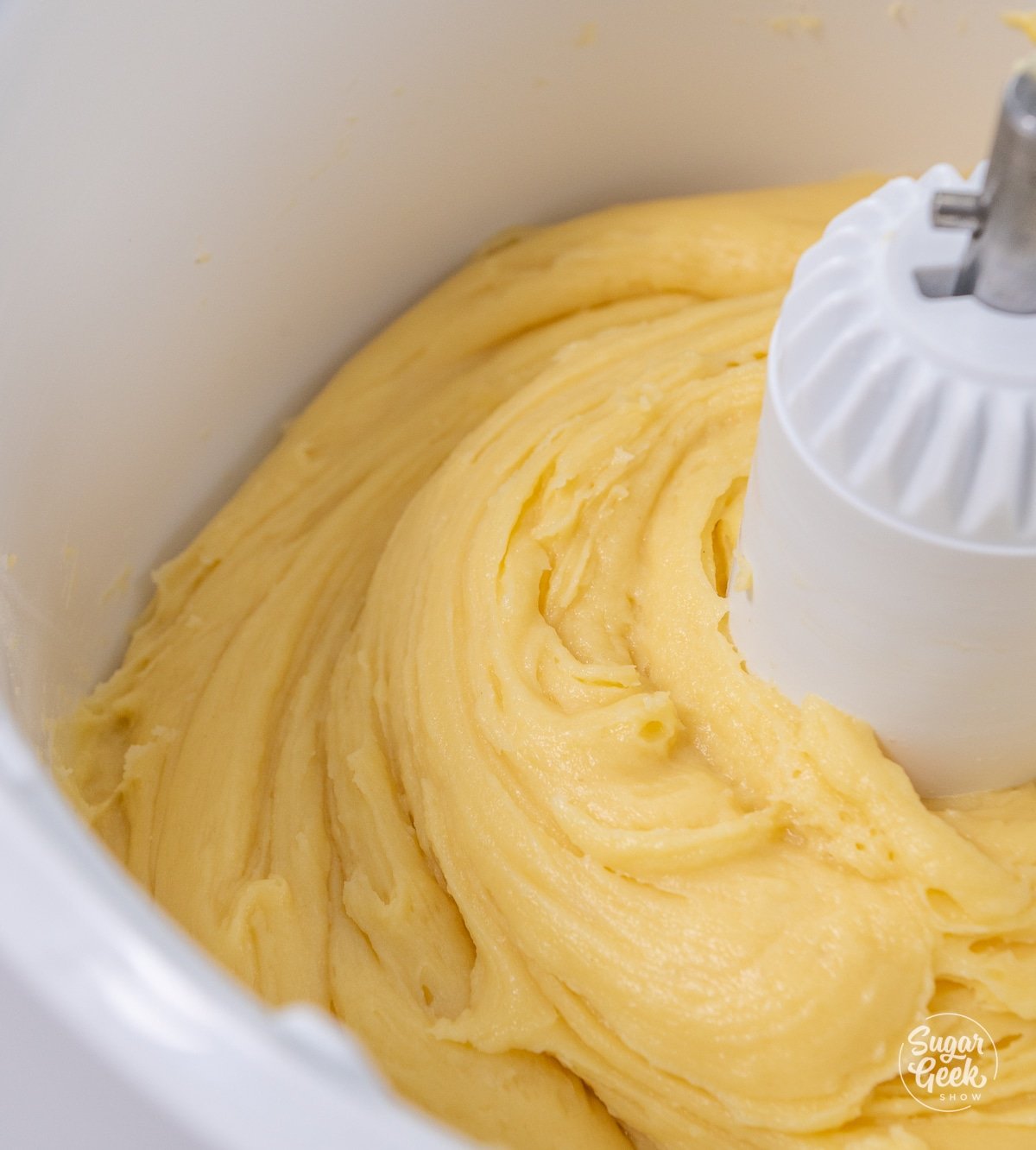
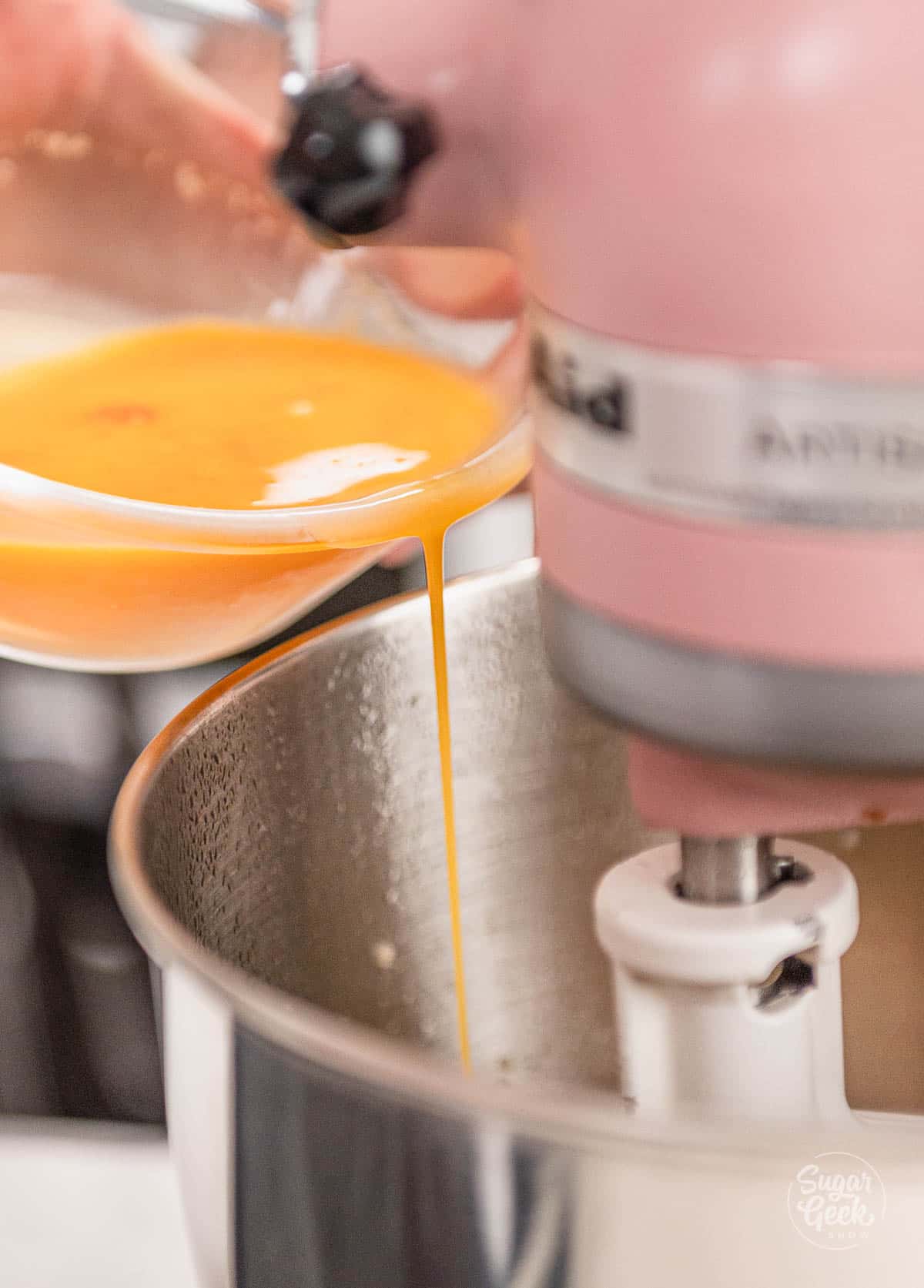
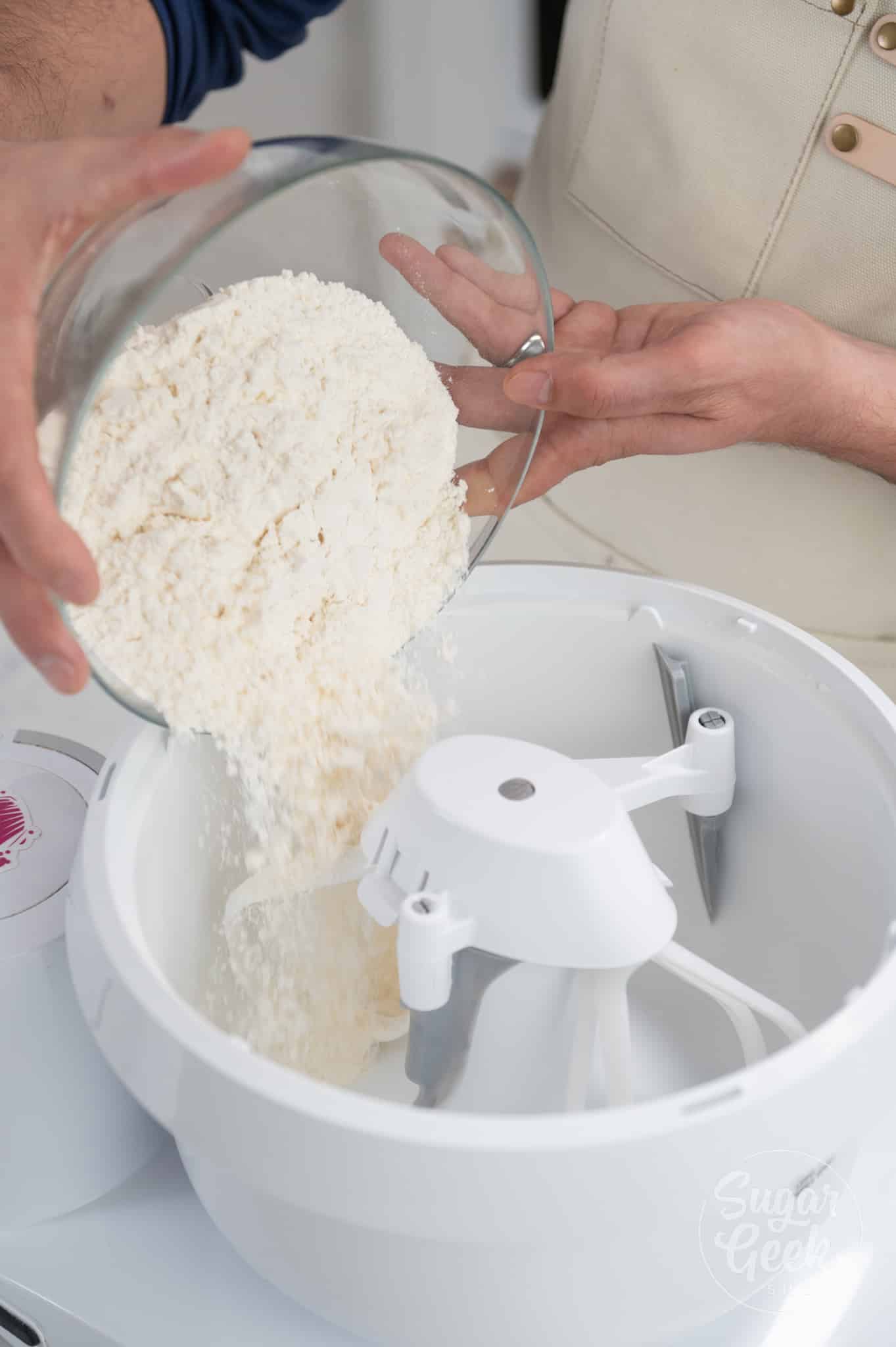
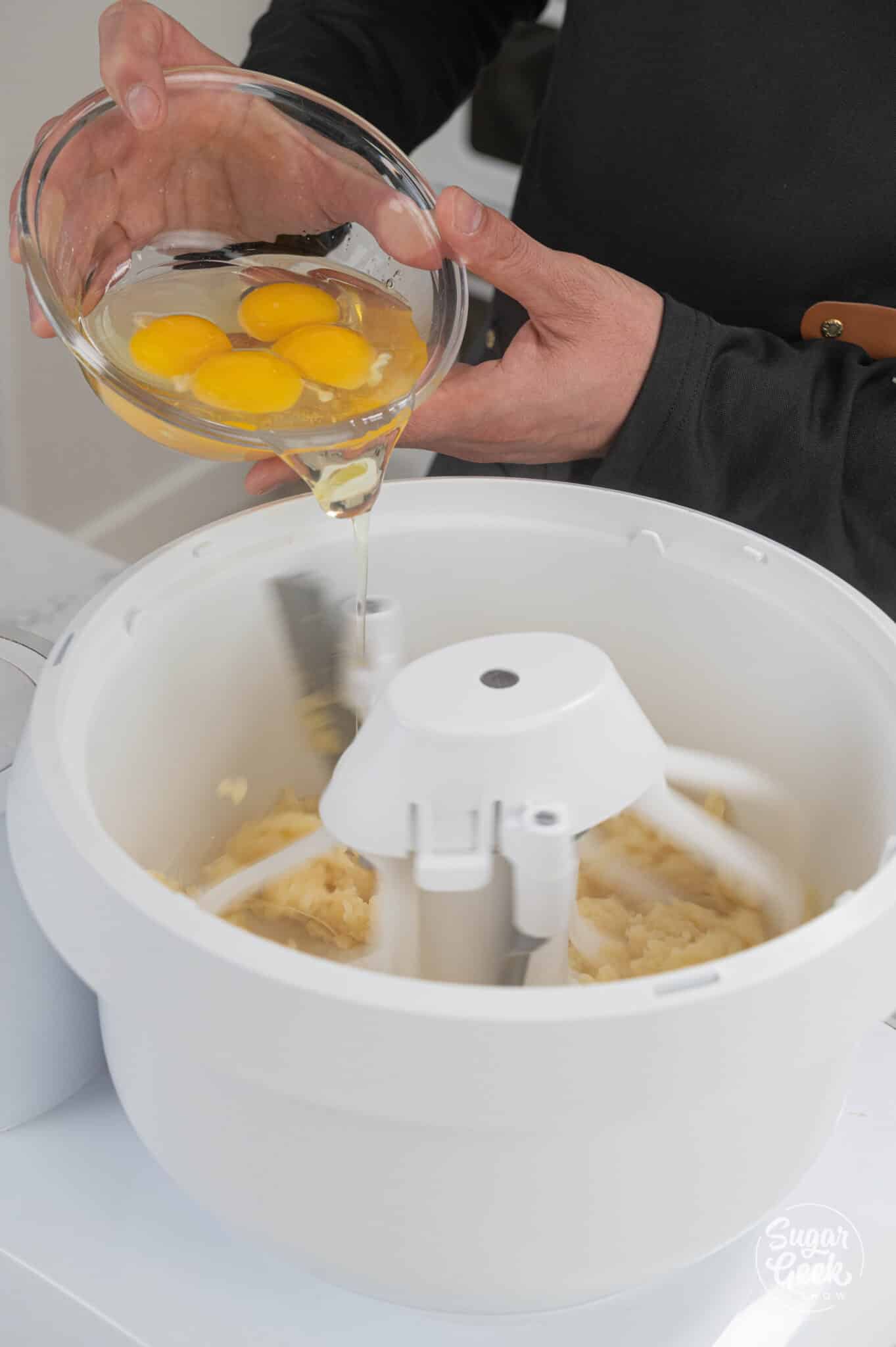
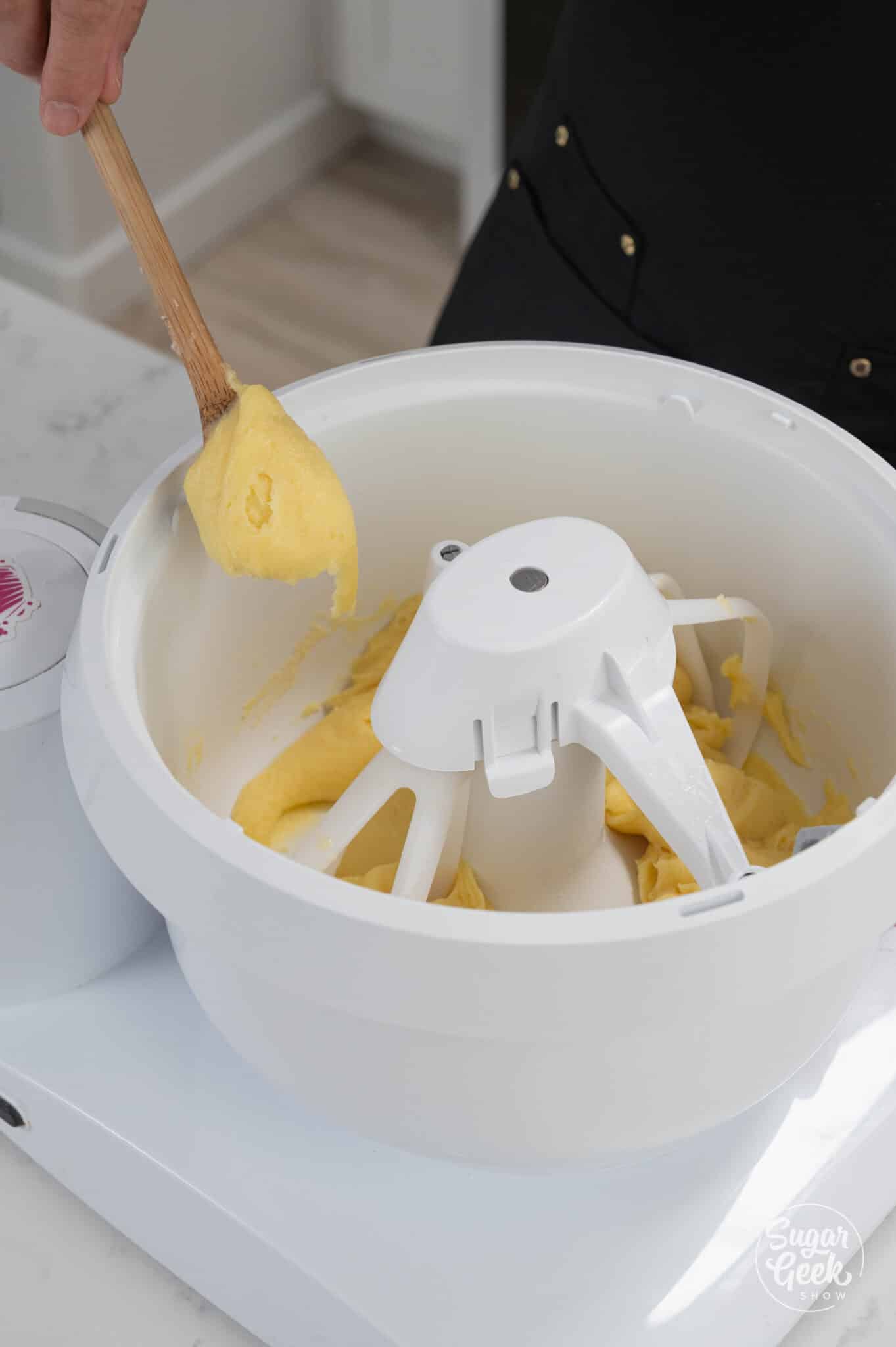
  6. Slowly add in your eggs one at a time while mixing on low. Mix until the dough slowly falls in a v-shape off of your paddle. hands adding a bowl of eggs into a white stand mixer bowlfinished pate a choux dough in a stand mixer bowl
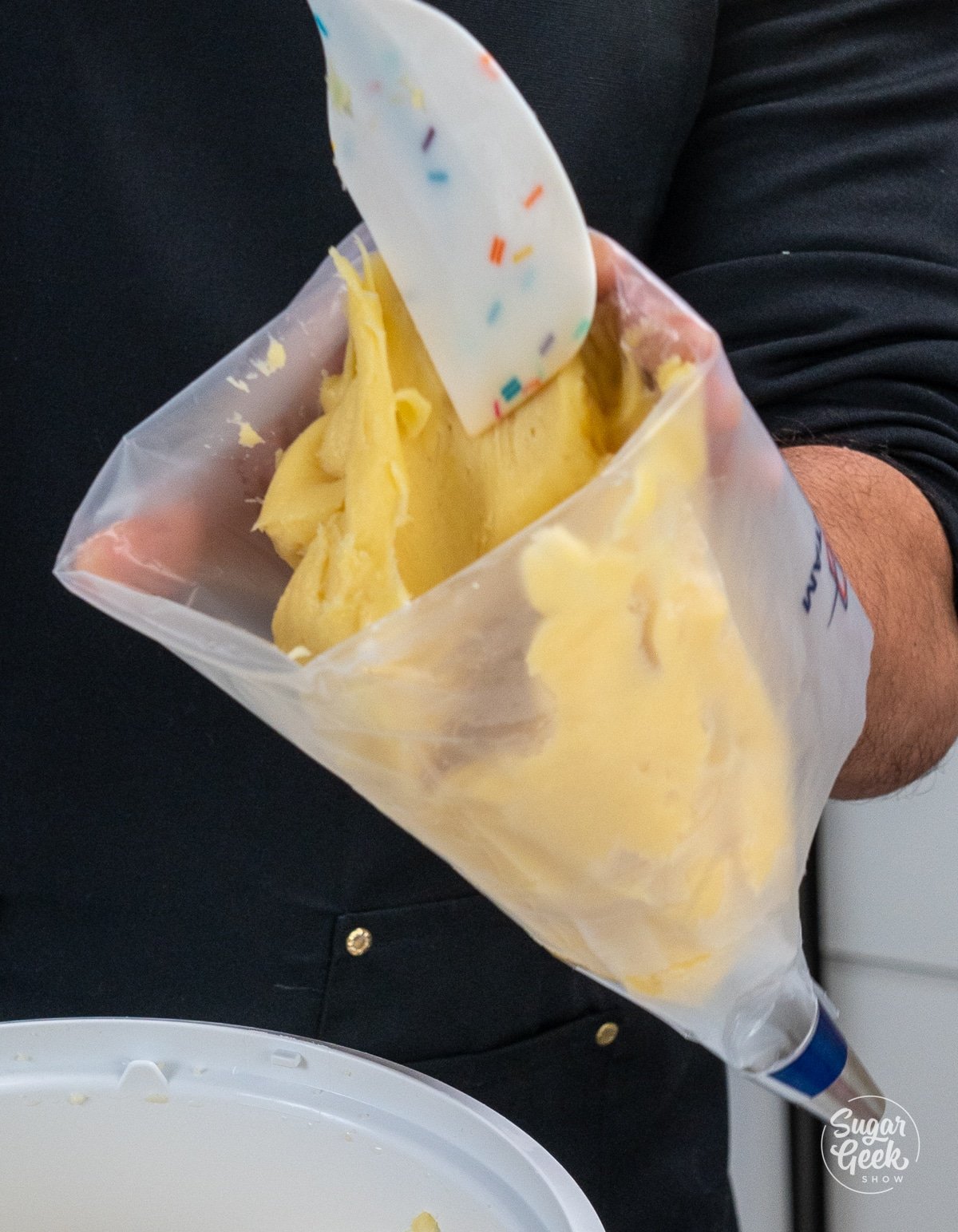
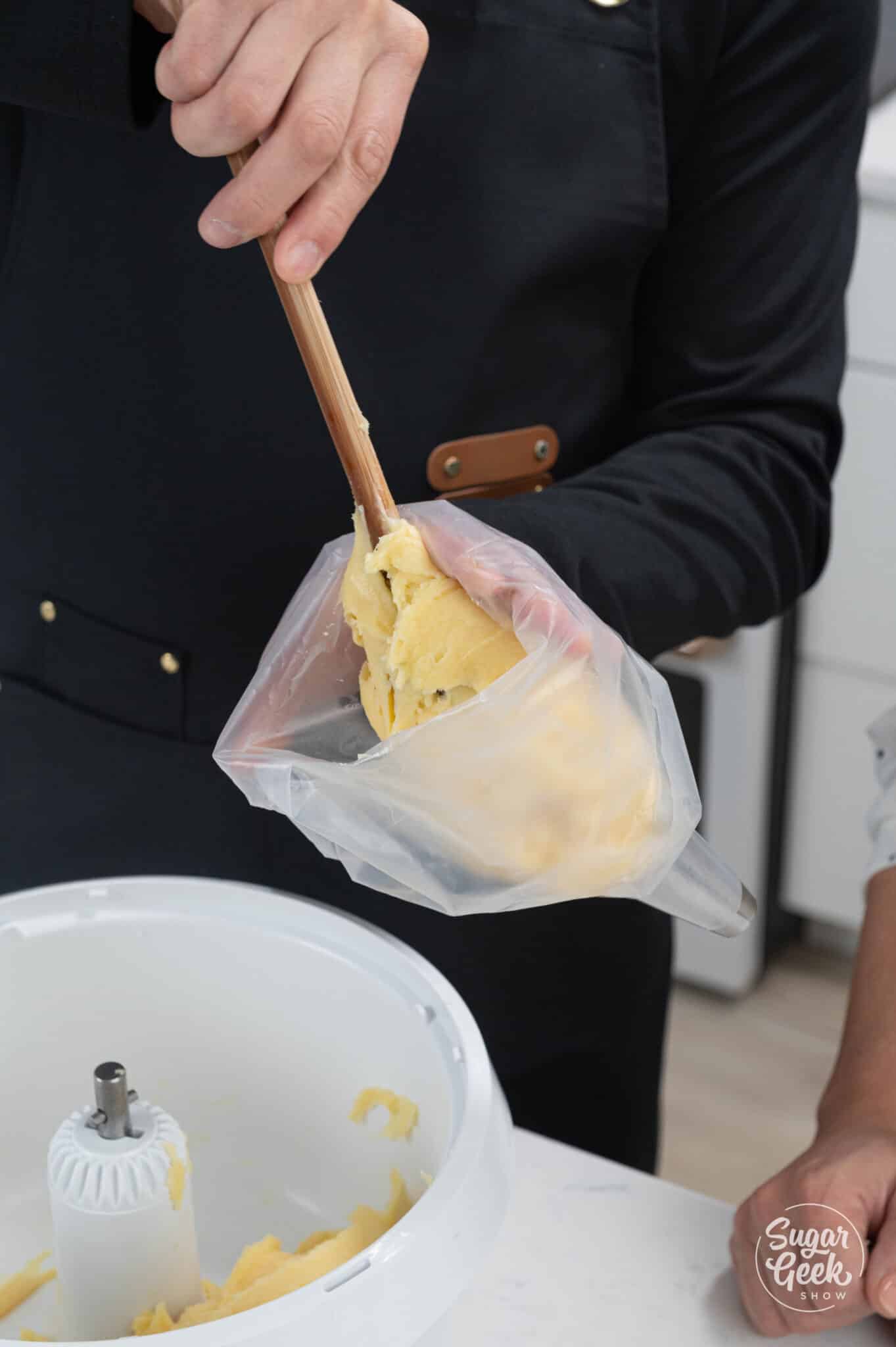
  7. Prepare a pastry bag with a small metal round piping tip. Fill the piping bag with the pate a choux batter. hands holding a spatula to fill a pastry bag with choux dough
  8. Prepare a baking sheet pan with parchment paper. Chef Christophe is using a "silpain" baking mat on a cookie sheet for maximum airflow and evenly-baked cream puffs. 
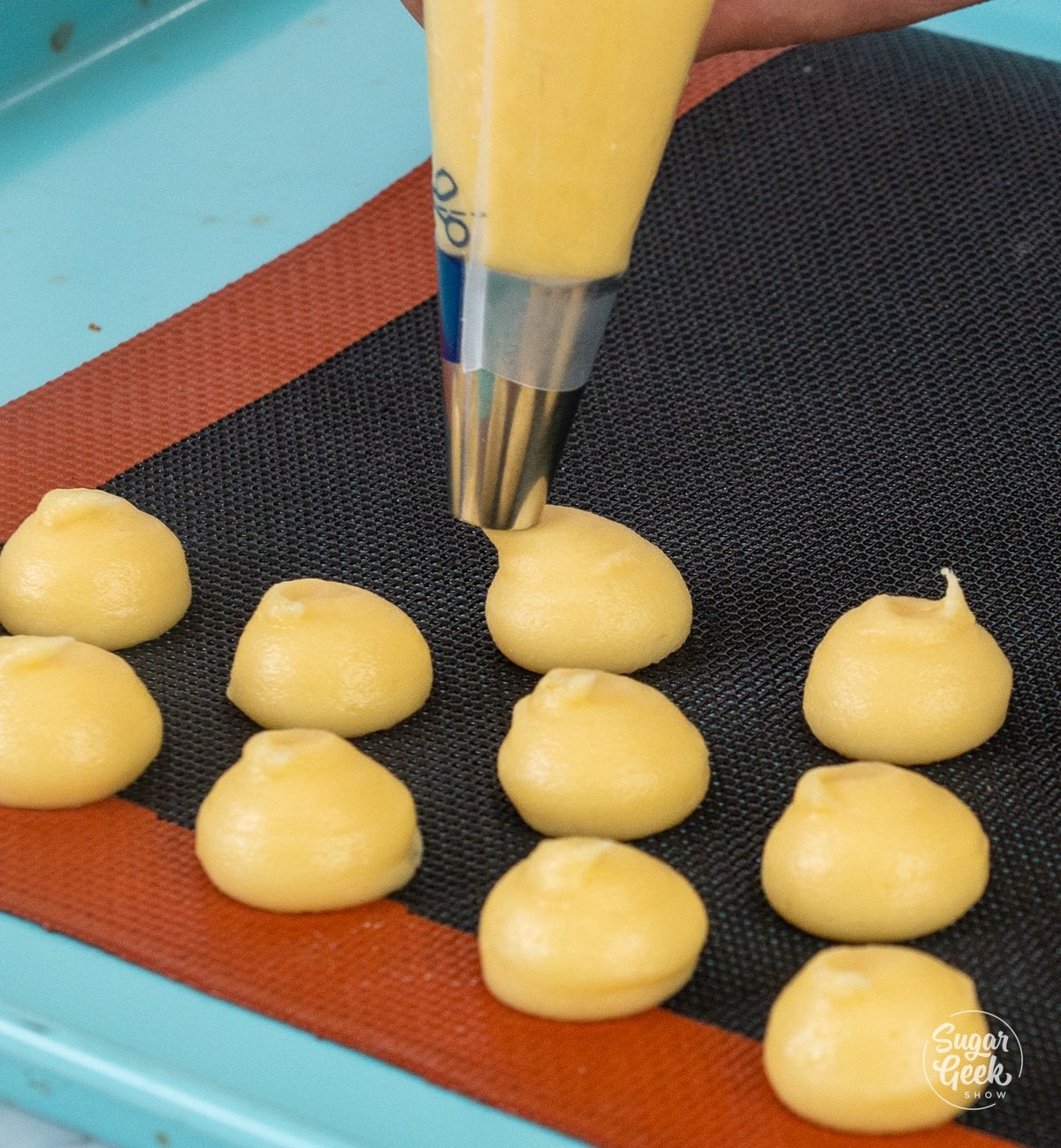
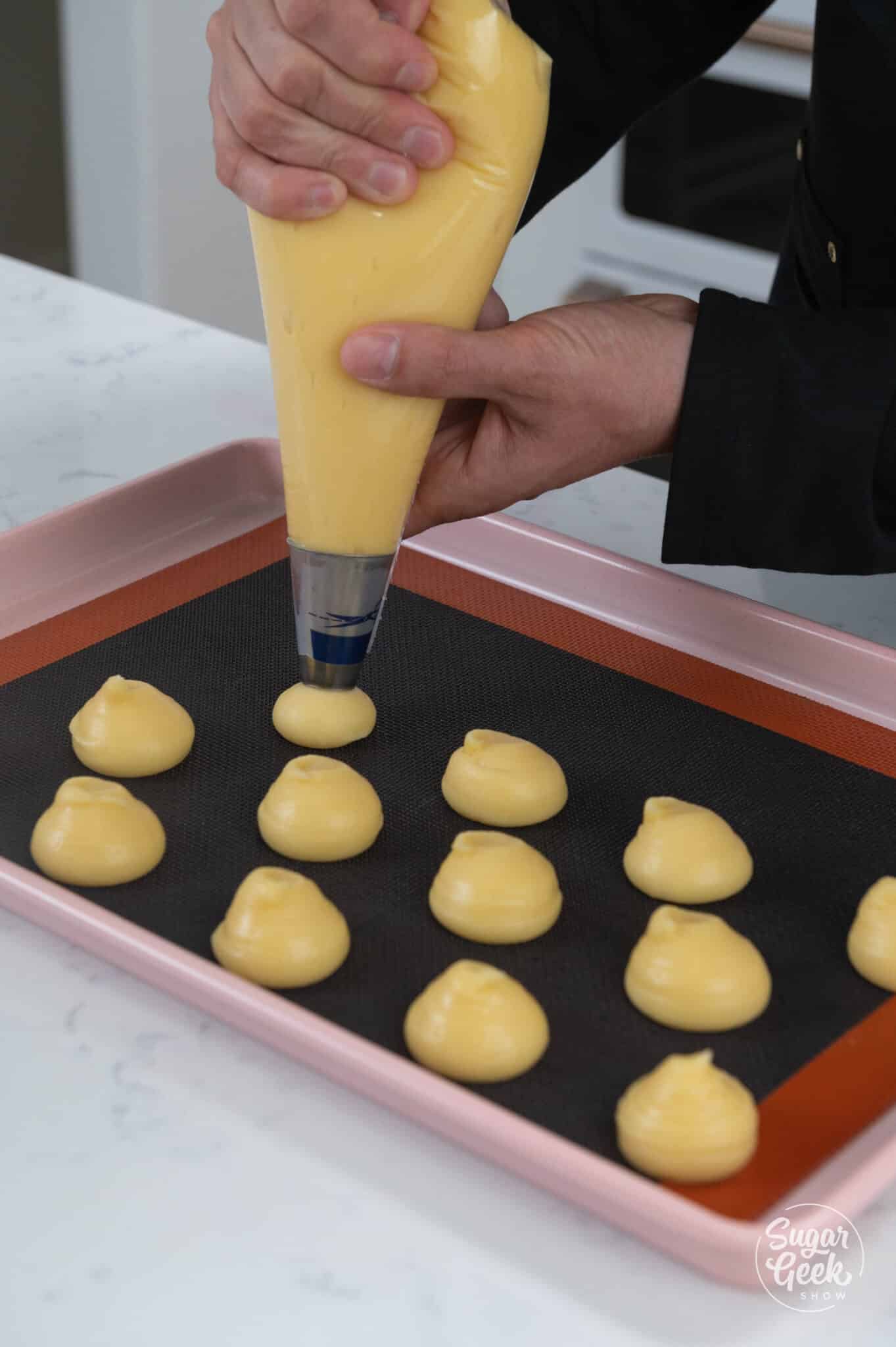
  9. Pipe the pâte à choux rounds slightly smaller than your desired final size (about 1-inch), as they will "puff" and expand in the oven.Piping choux dough into small round spheres on a baking sheet pan.
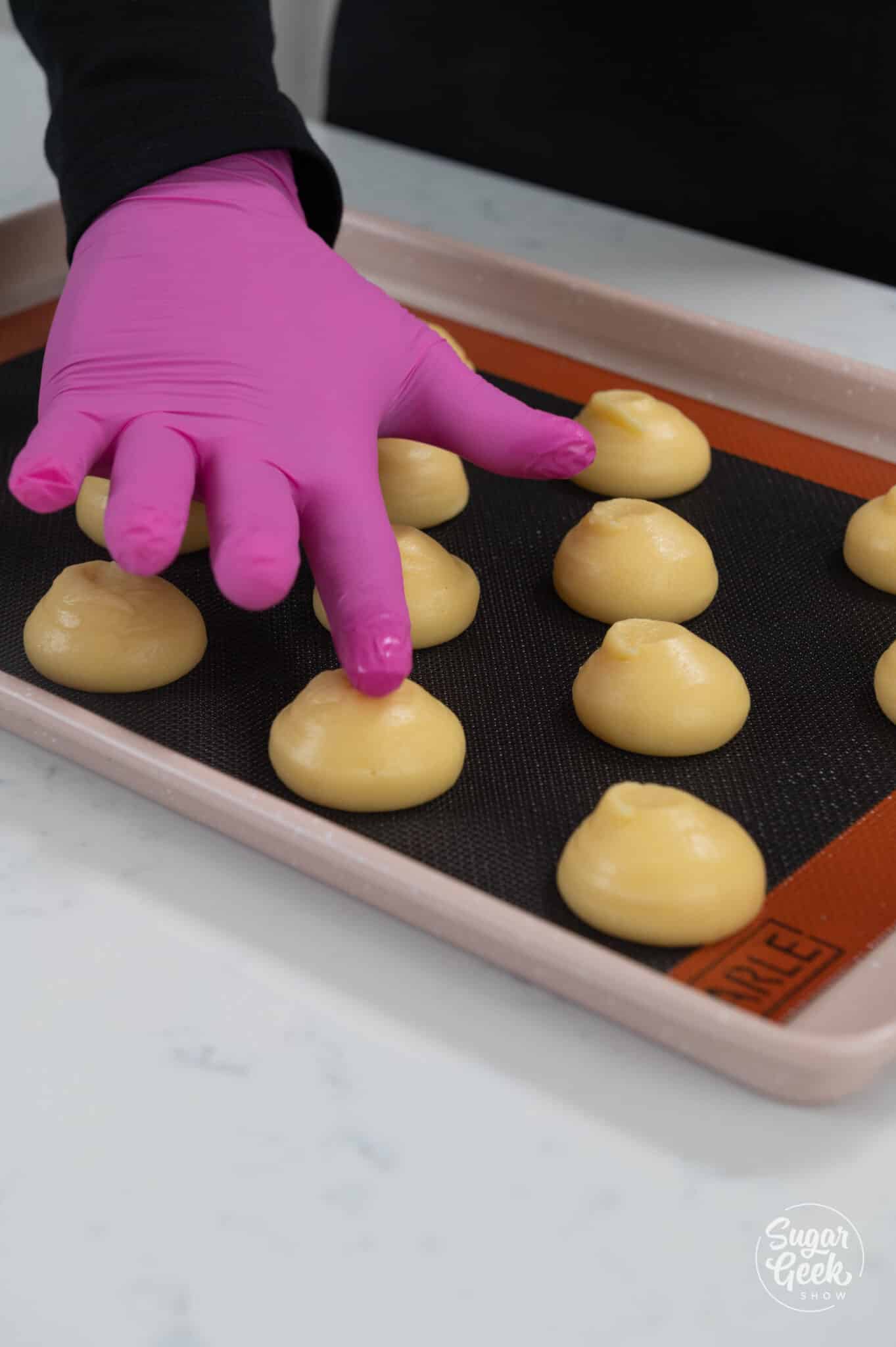
  10. Gently smooth the pointy top of the cream puff with a damp fingertip.gloved finger touching the top of an unbaked cream puff to remove the point
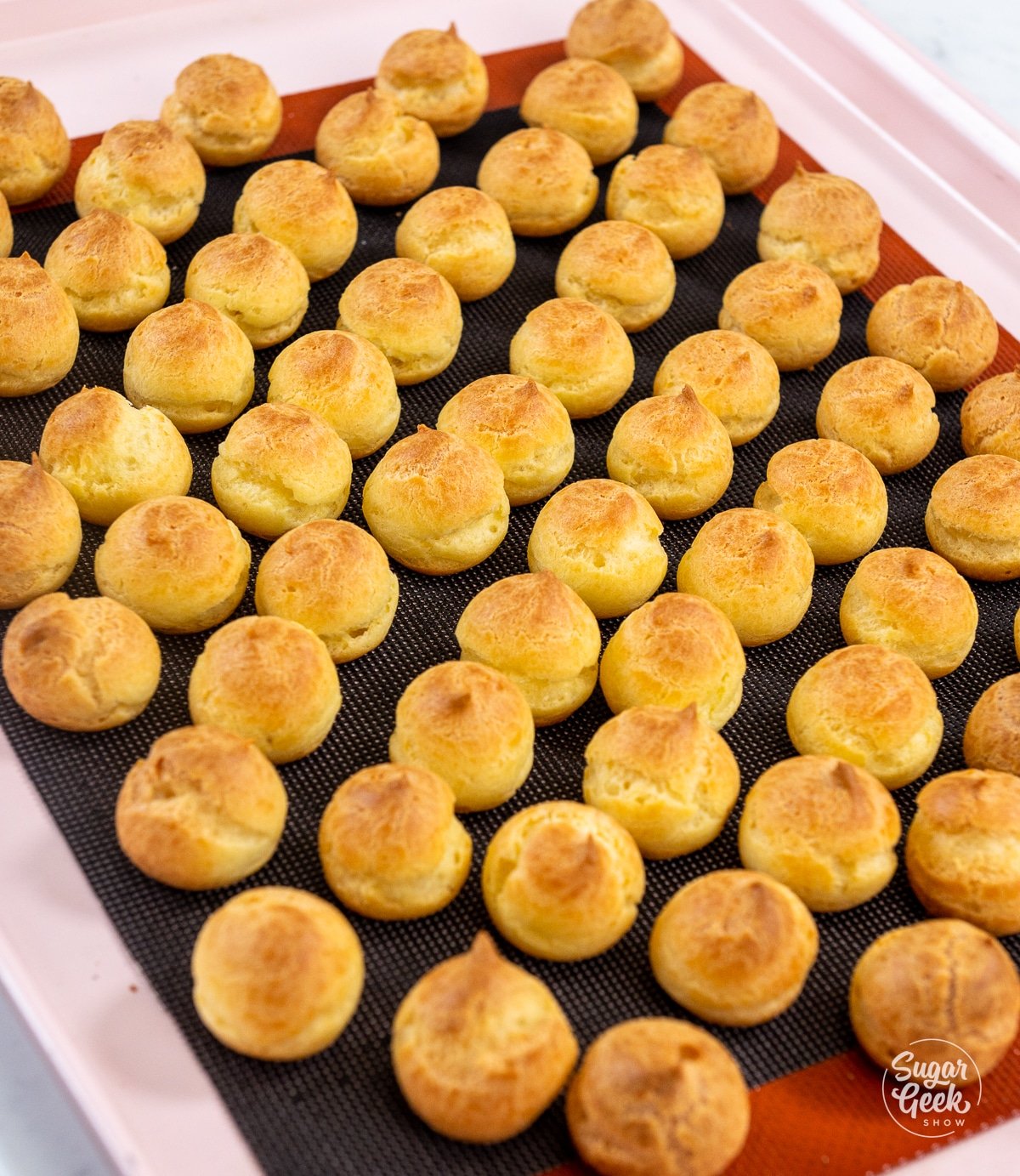
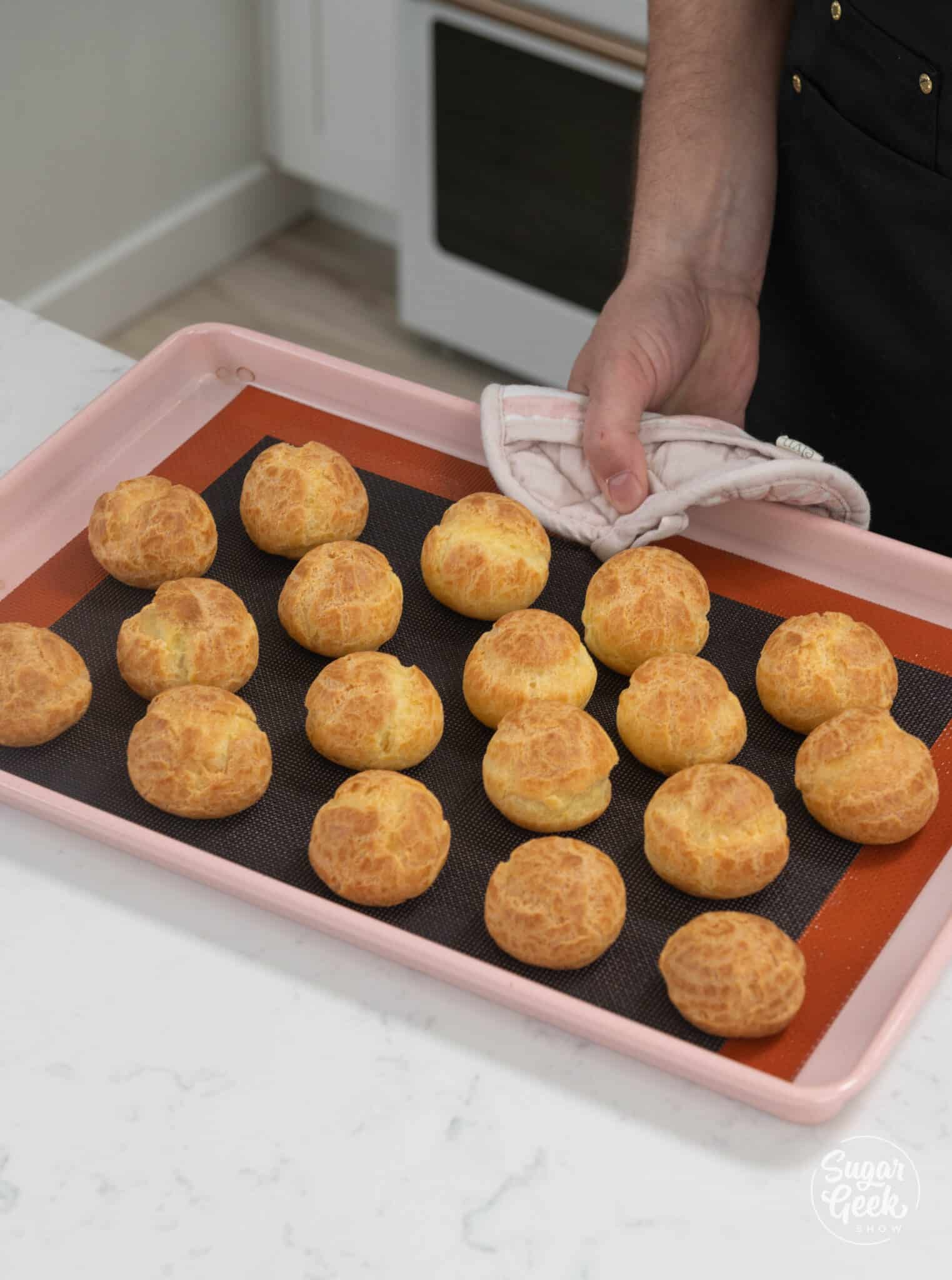
  11. Bake the cream puffs at 350°F for 25-30 minutes until golden brown. Do not open the oven door or your cream puffs could collapse.sheet pan of baked cream puff shells
  12. Cool the cream puffs completely to room temperature on a wire rack, for about 30 minutes.

Making Pastry Cream

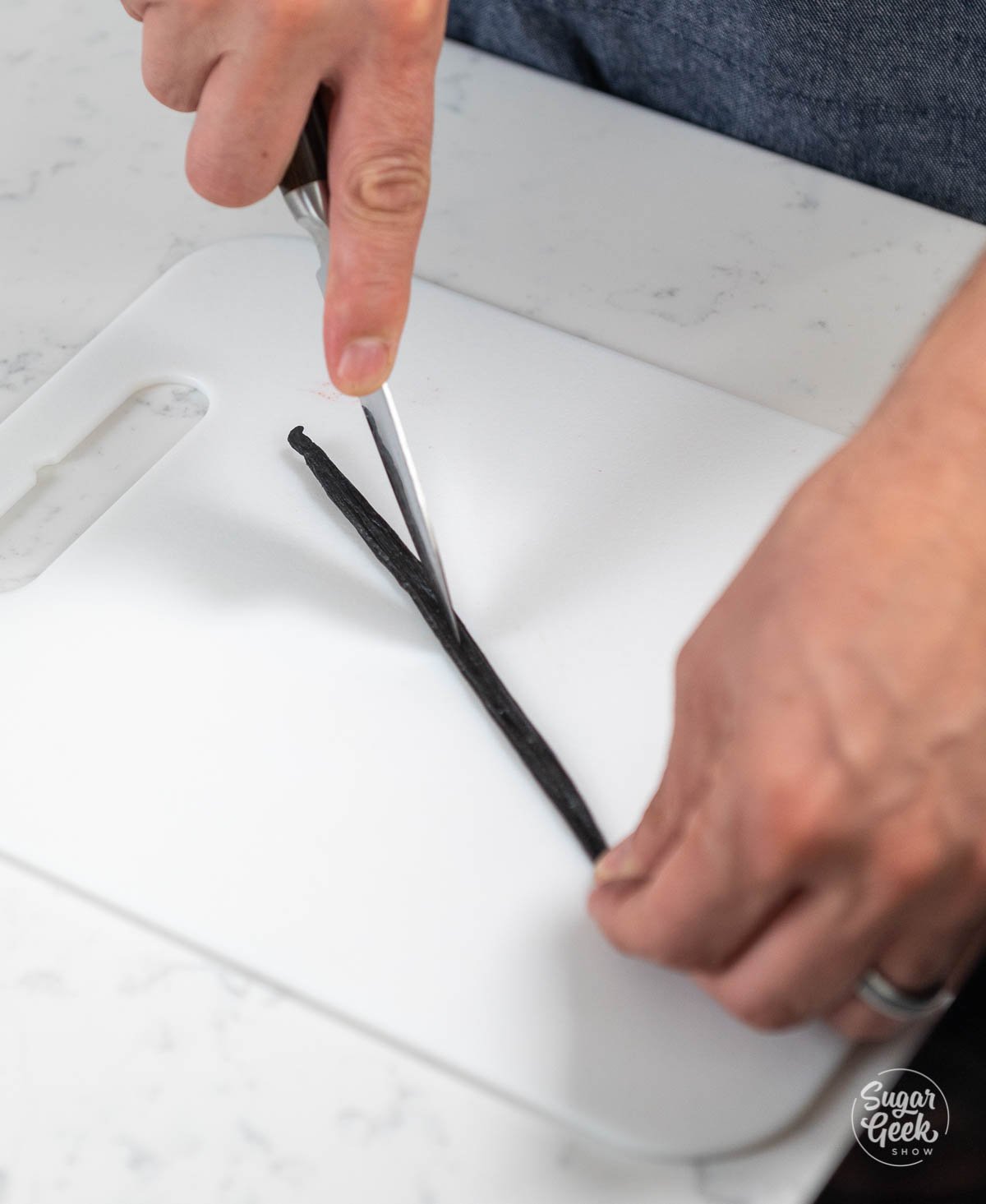
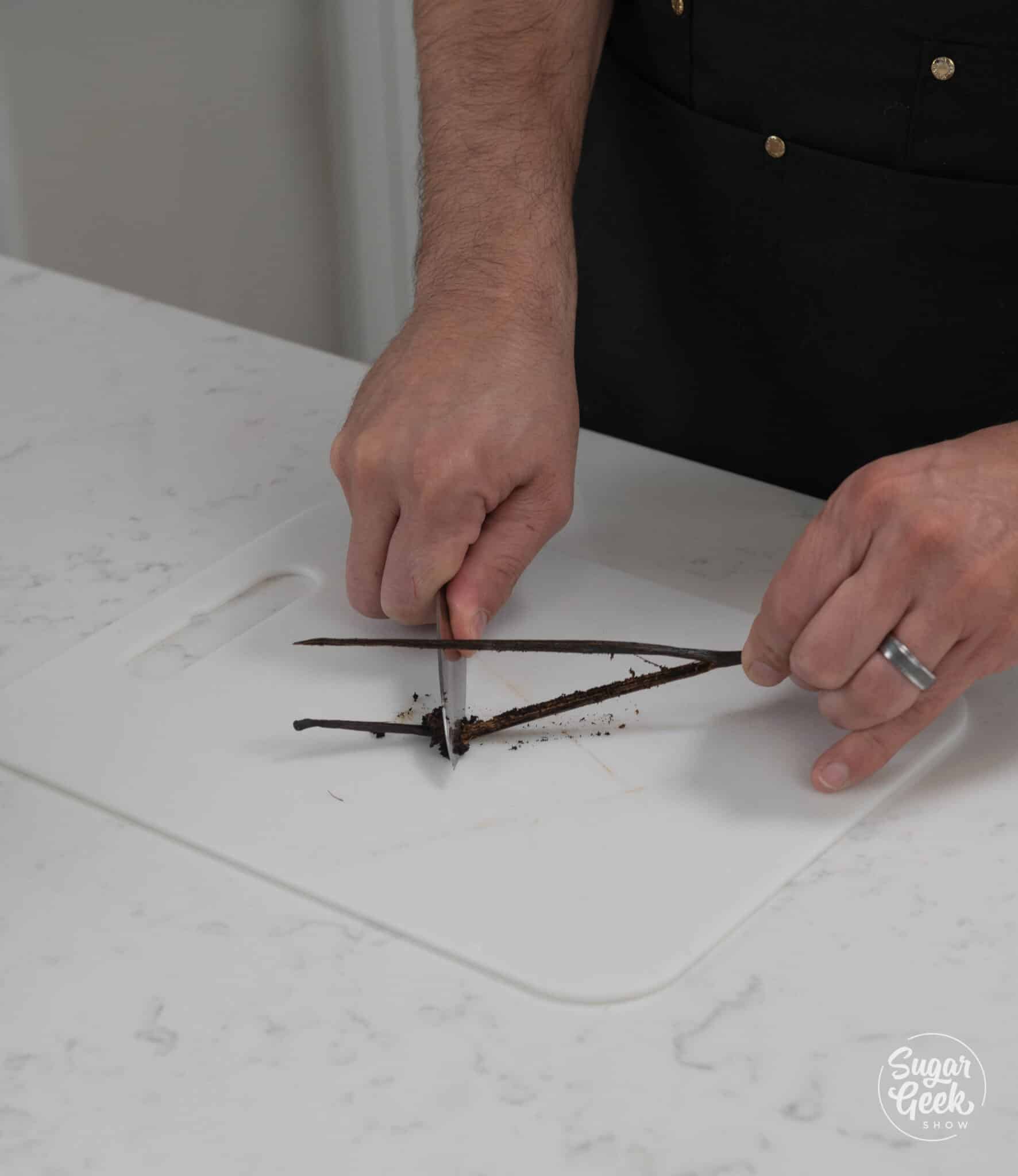
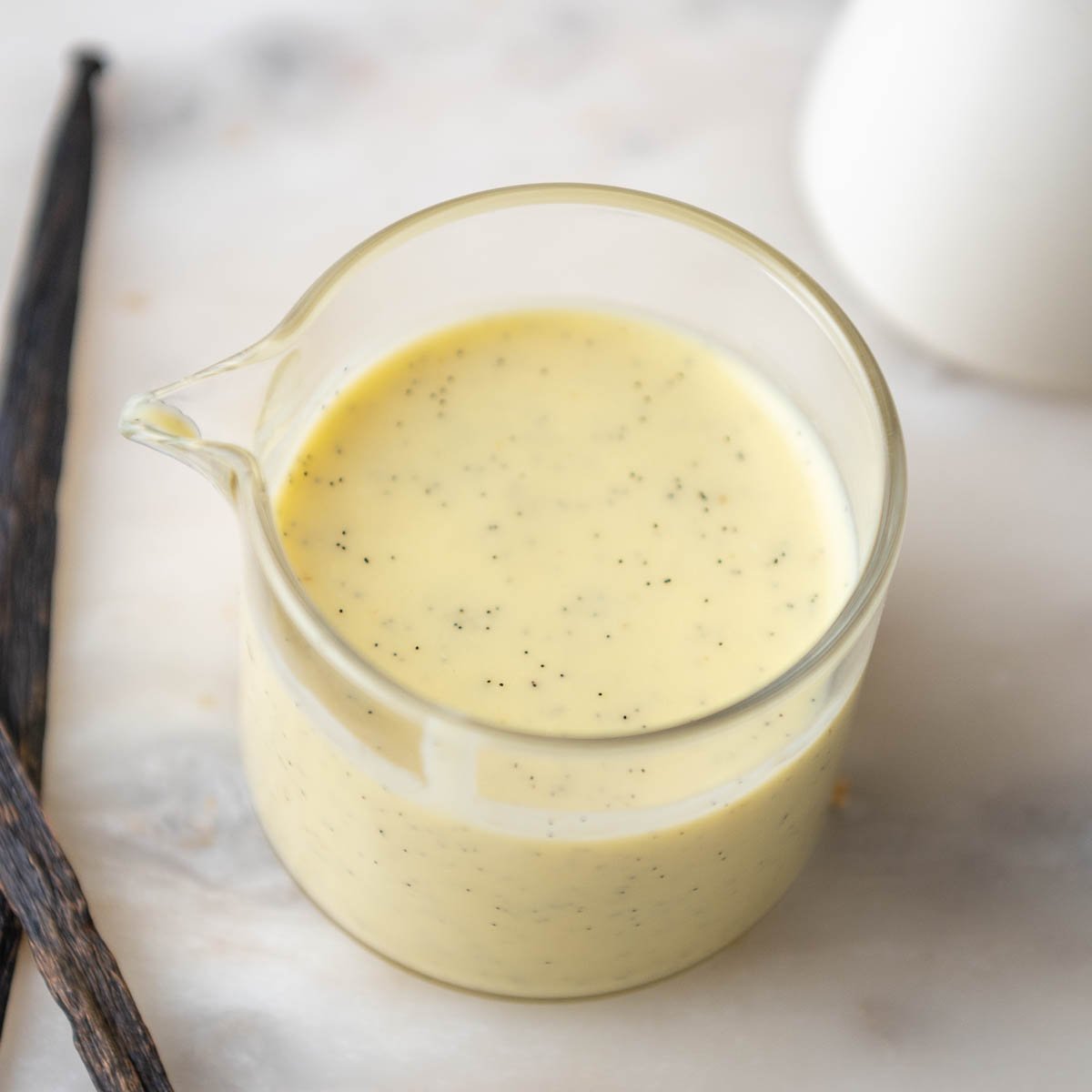
  1. Scrape out the vanilla pods by using a small knife to cut down the center of the bean, then use the back of the knife to gently scrape the pods out. (Only use the pods on the inside, do not use the skin of the bean.)cutting open a vanilla bean pod
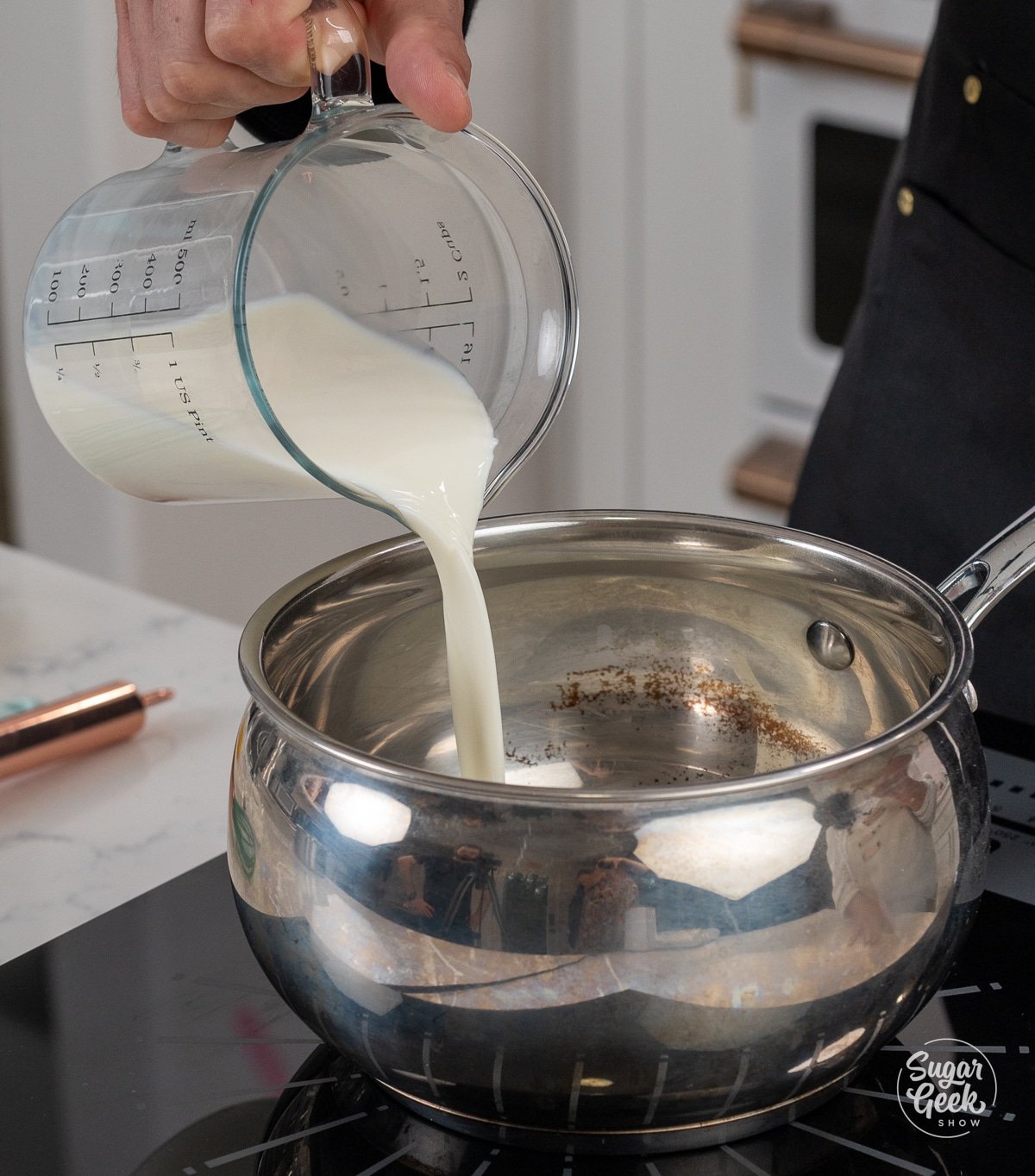
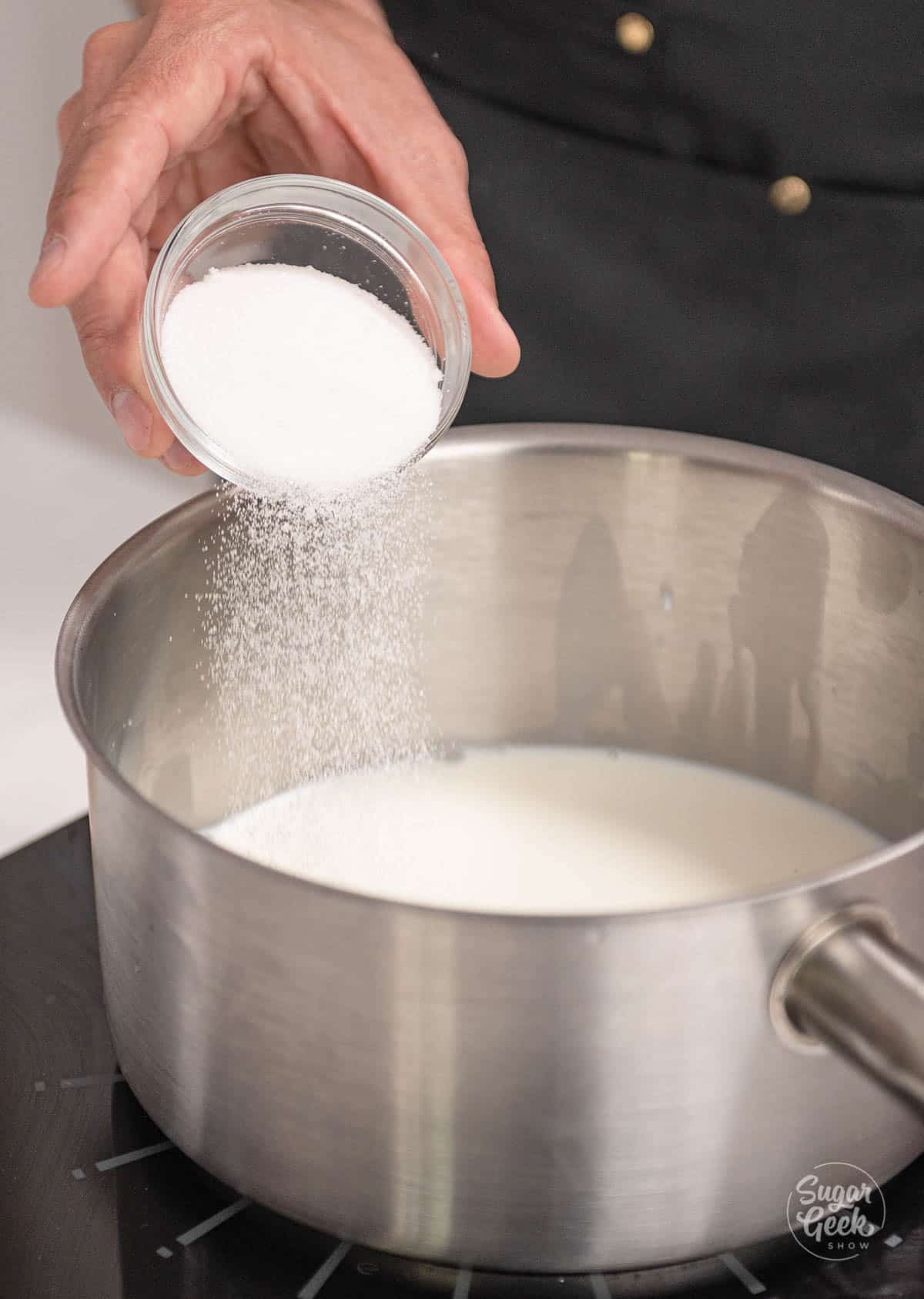
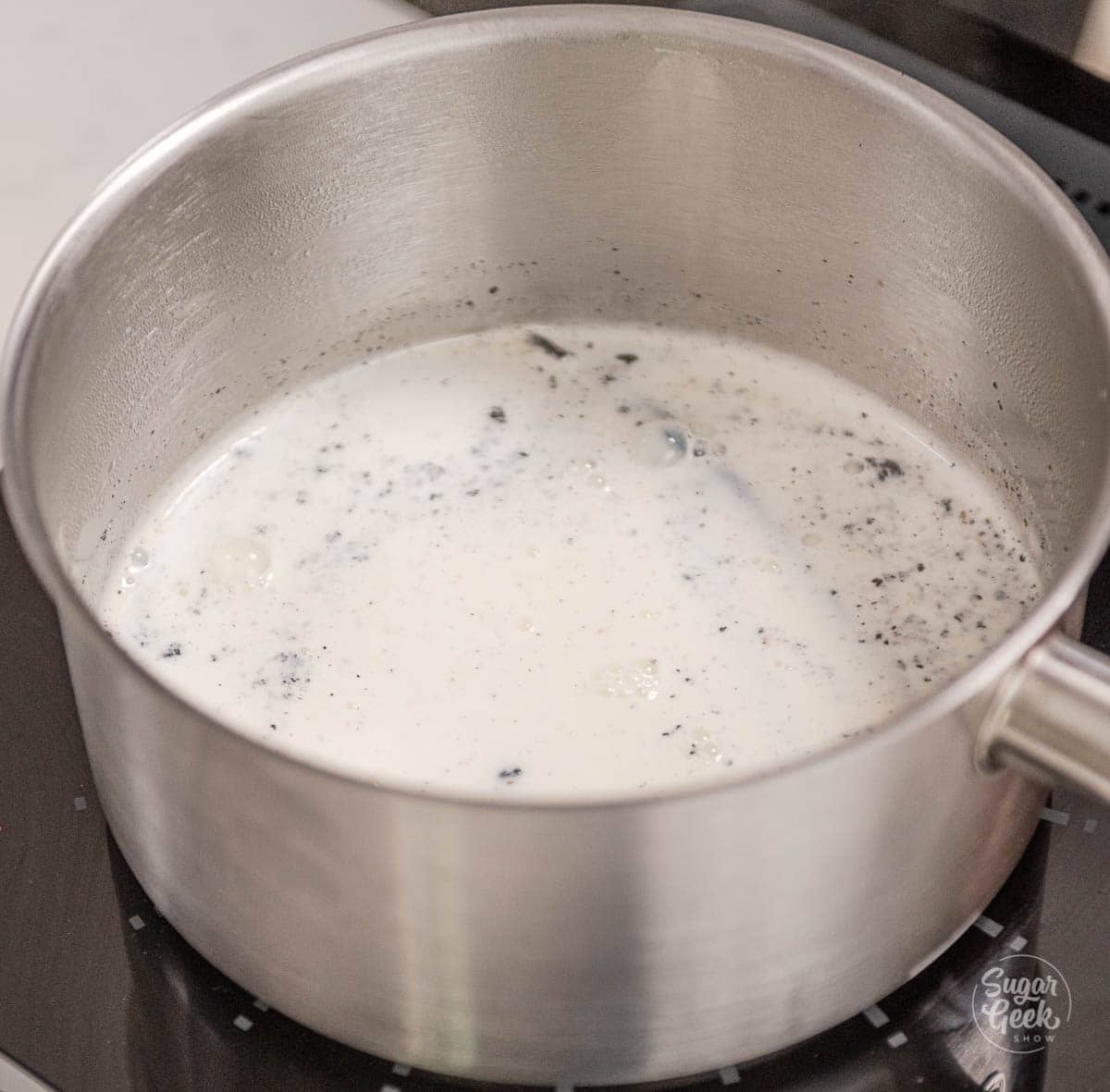
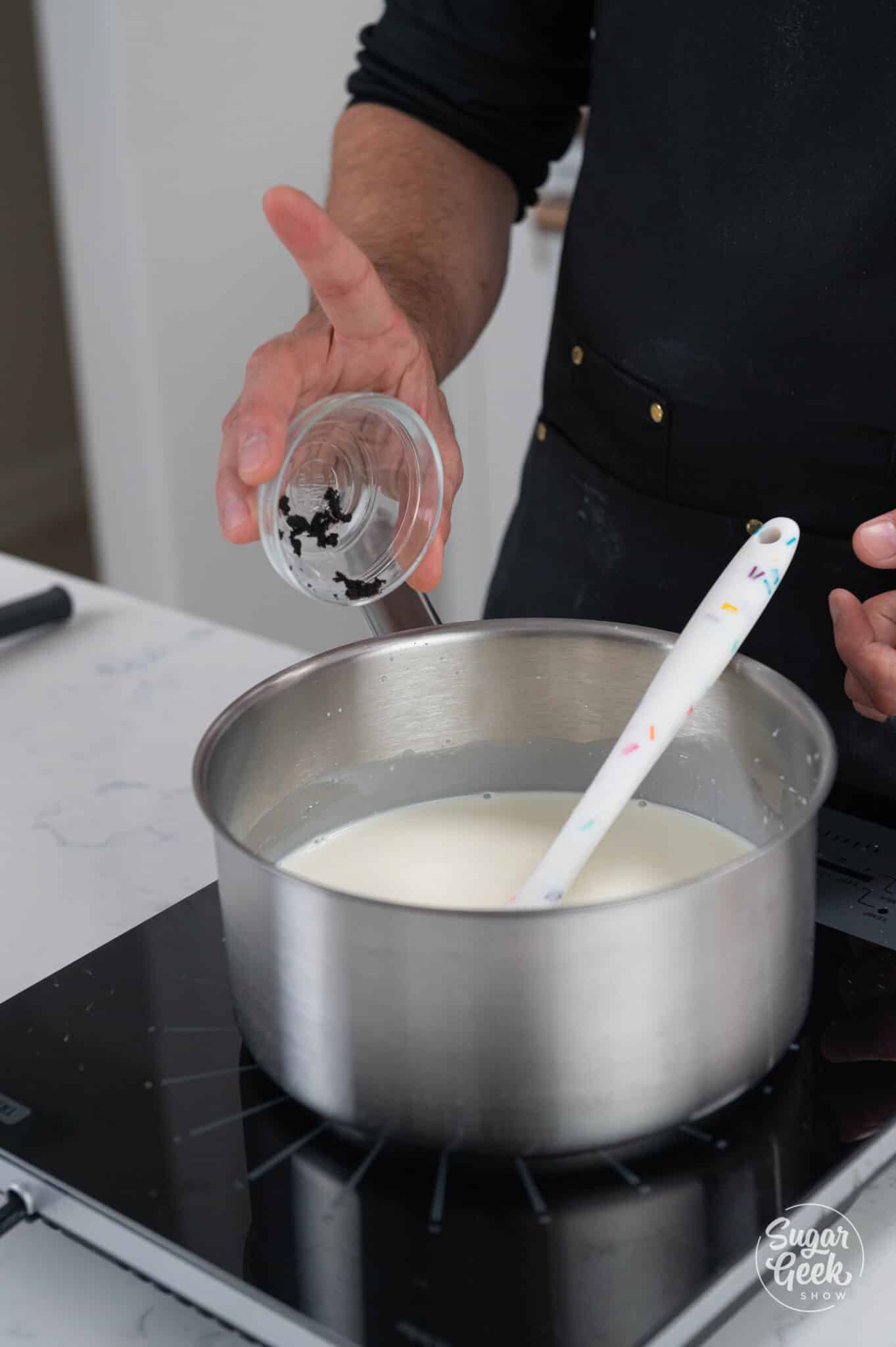
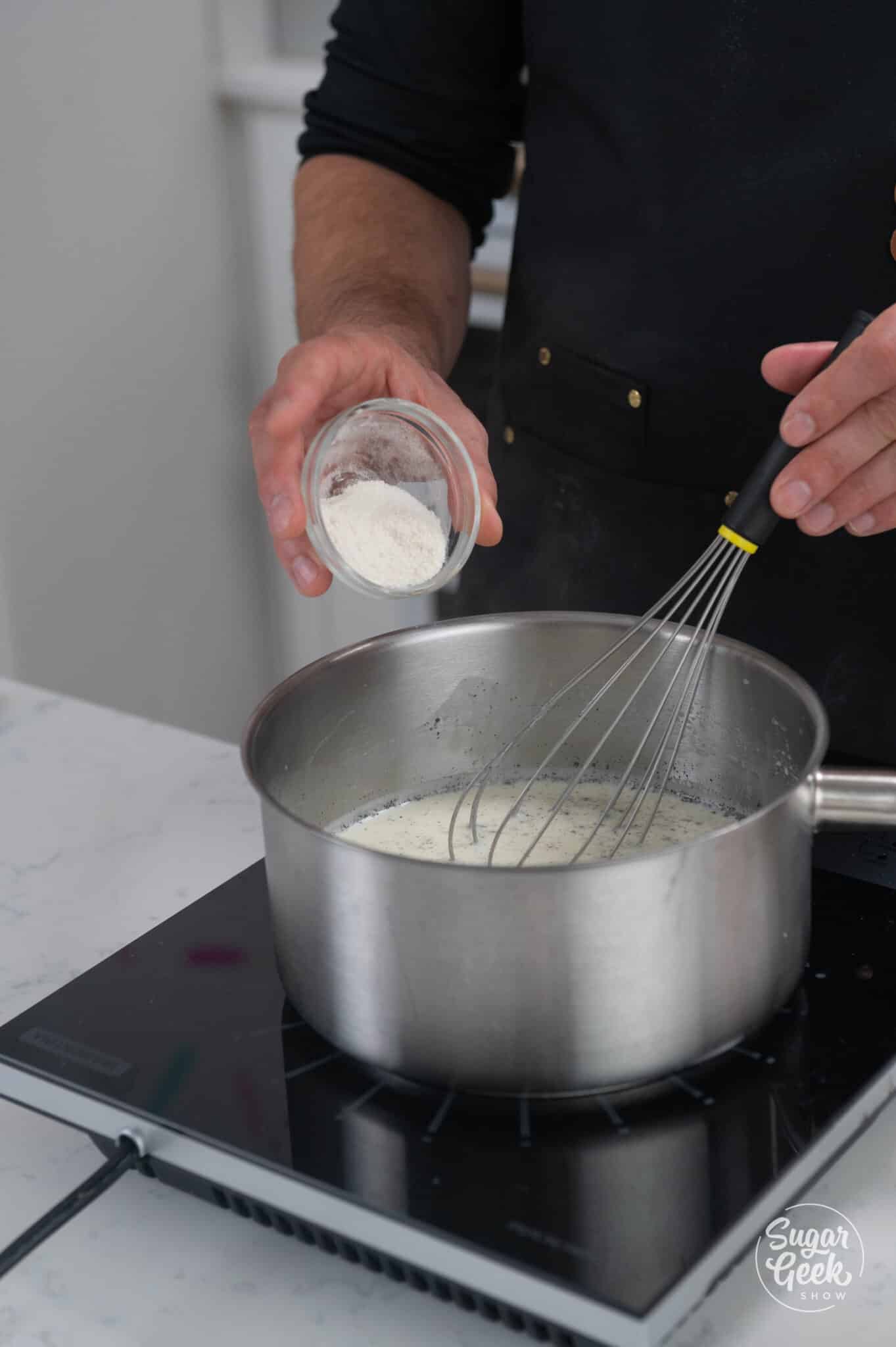
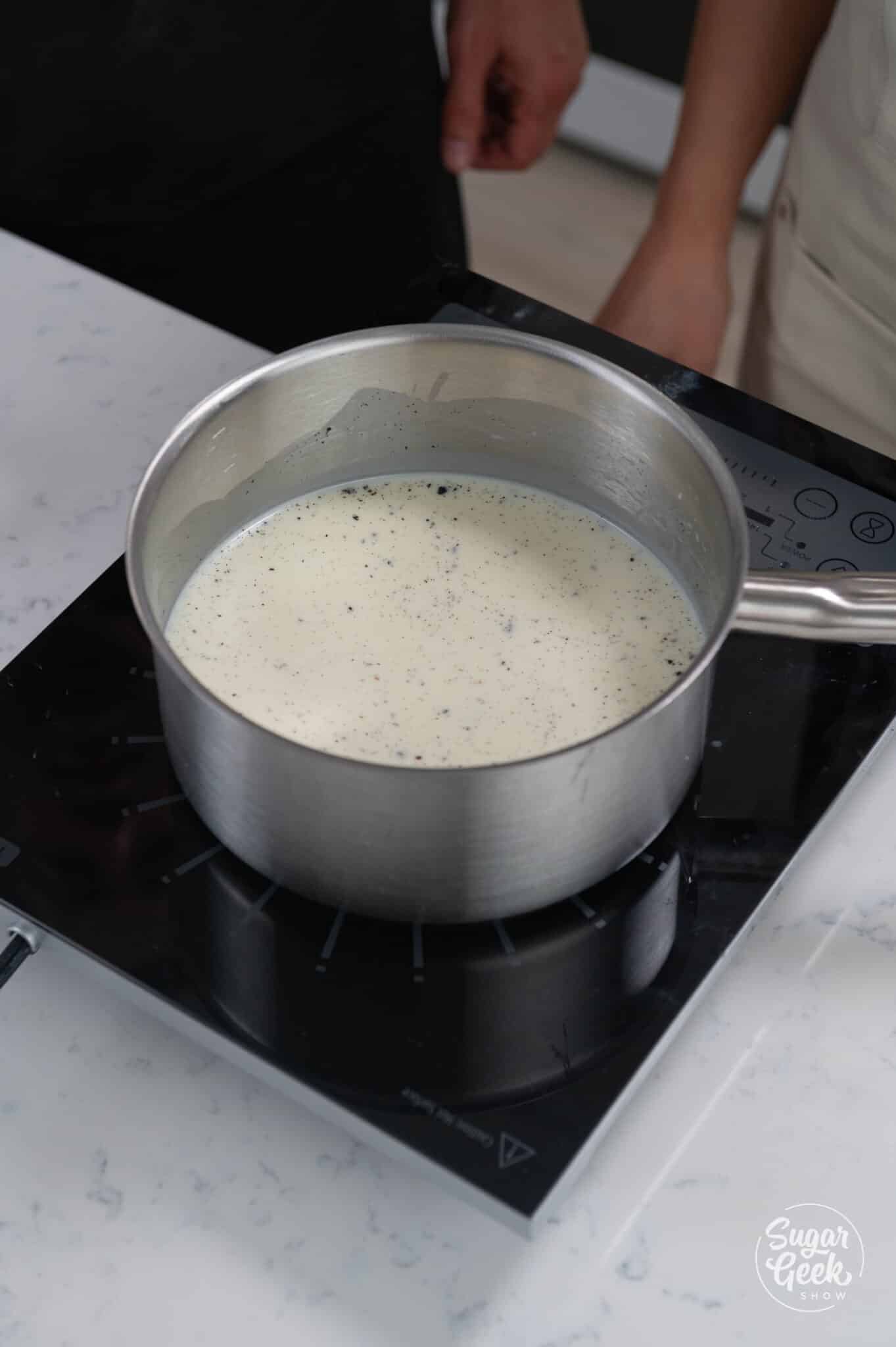
  2. Add your milk, scraped vanilla bean, and half of the sugar into a large saucepan over medium heat and bring it to a boil.hand adding container of milk into a metal saucepan
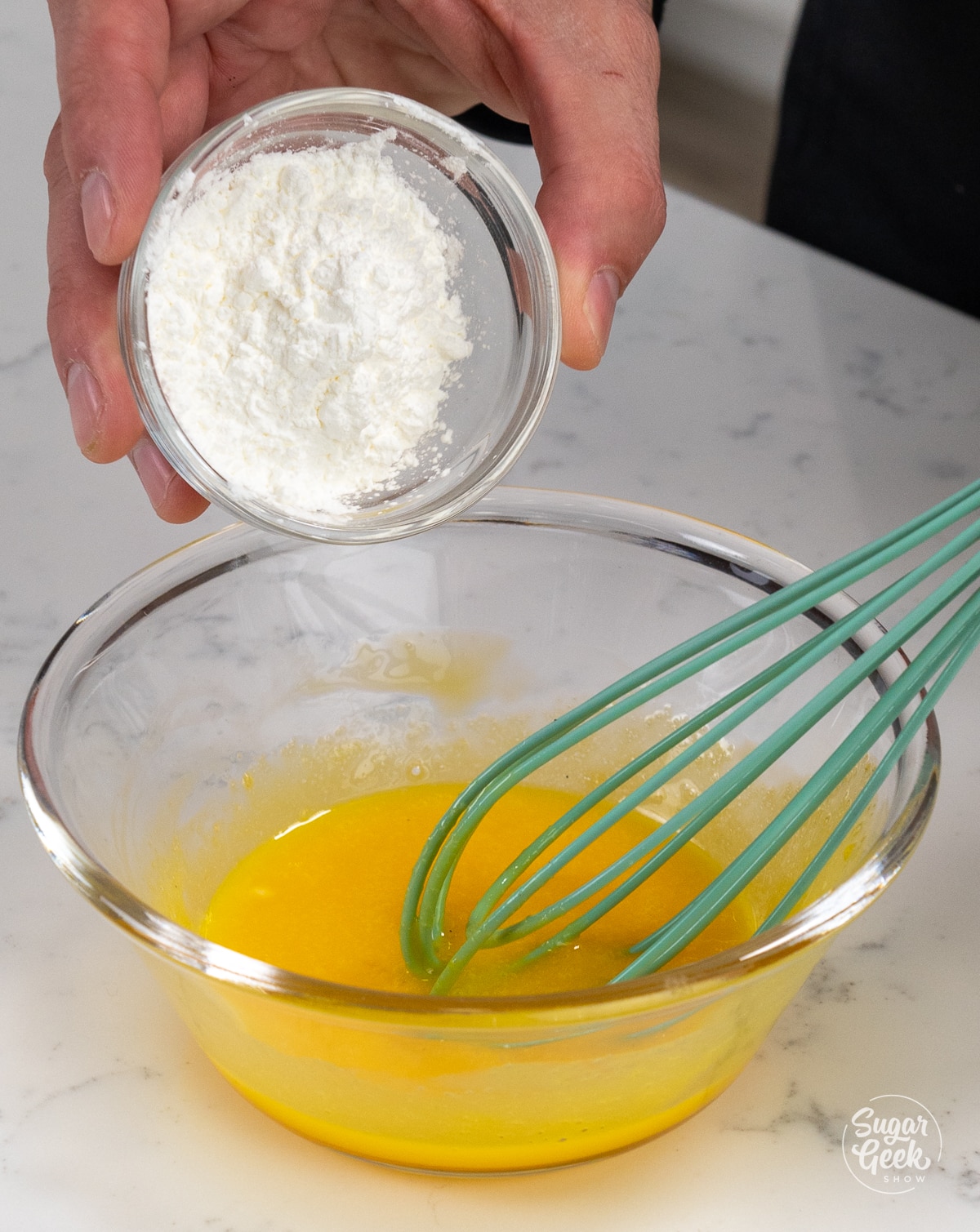
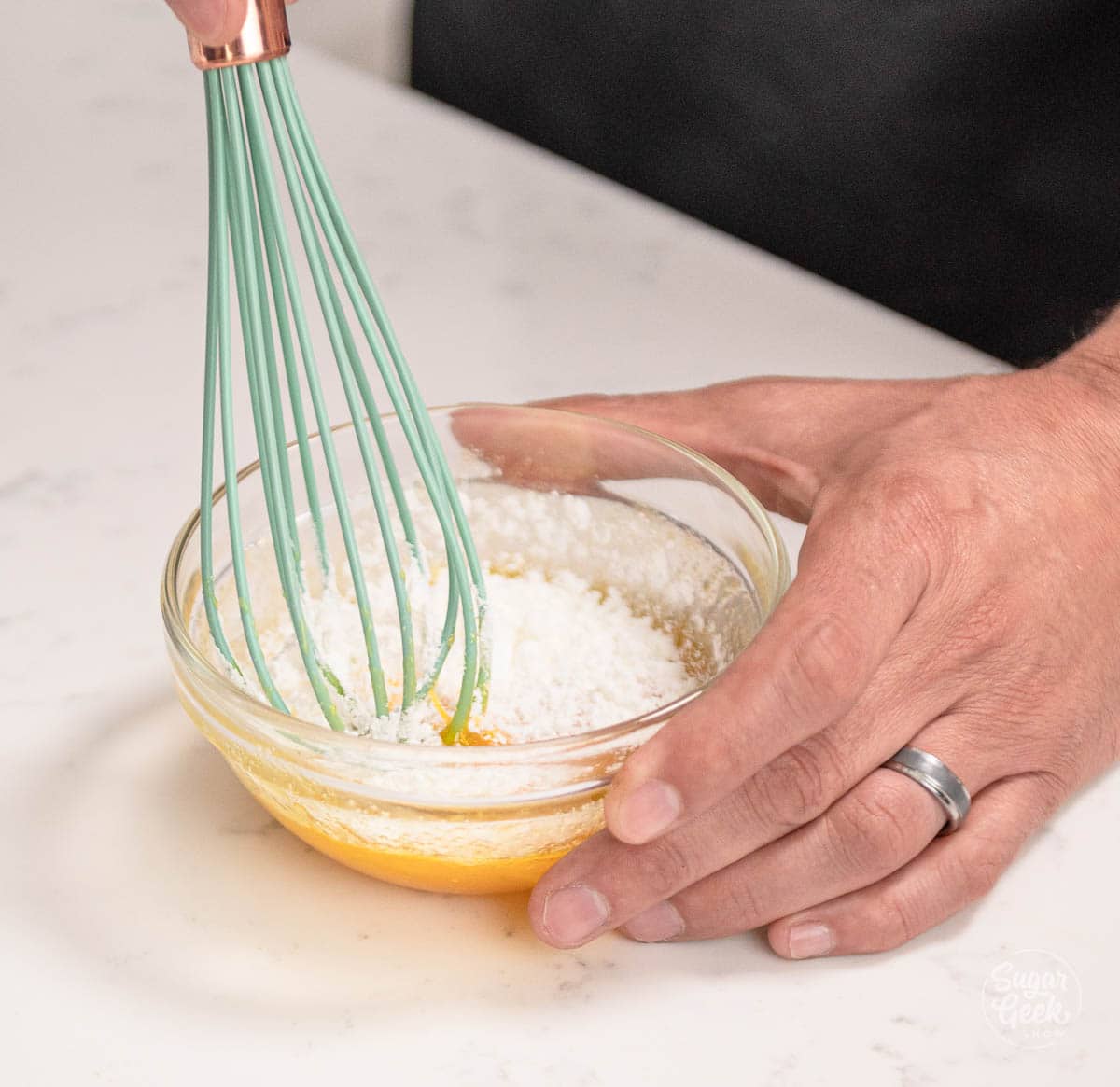
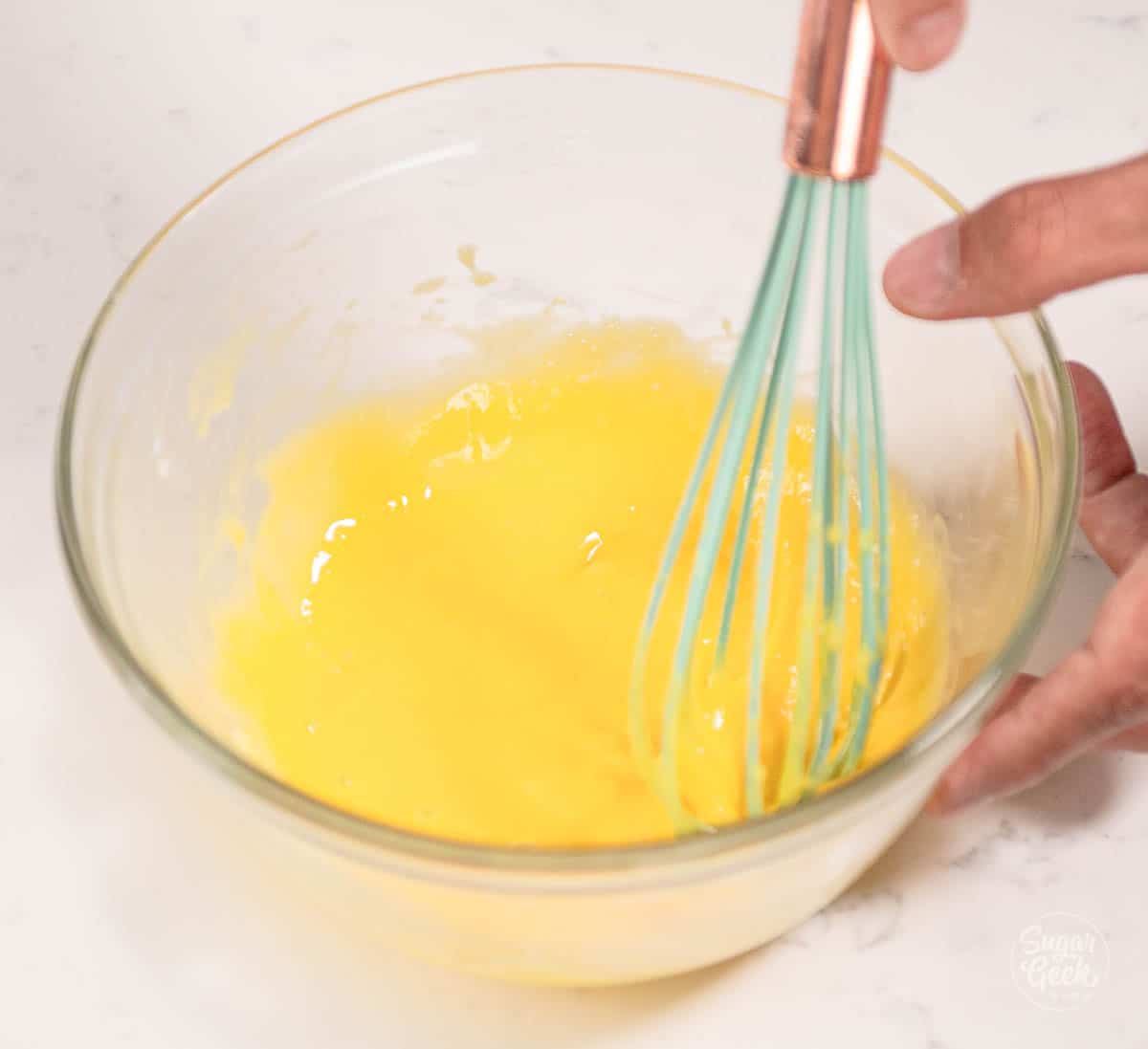
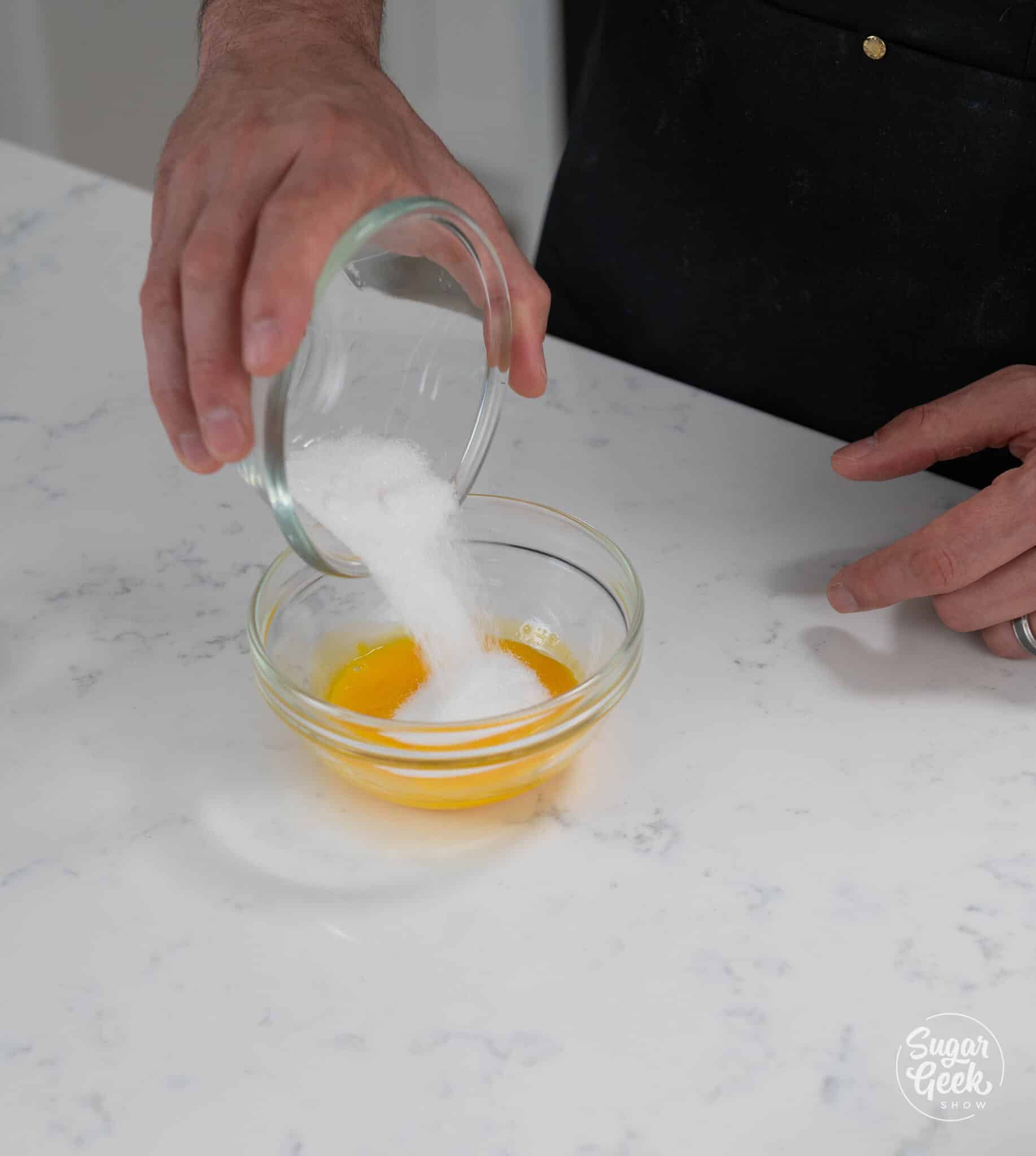
  3. Add your egg yolks, cornstarch, and the other half of the sugar into a large mixing bowl and whisk them together.hand adding a small bowl of cornstarch to a large bowl of egg yolks
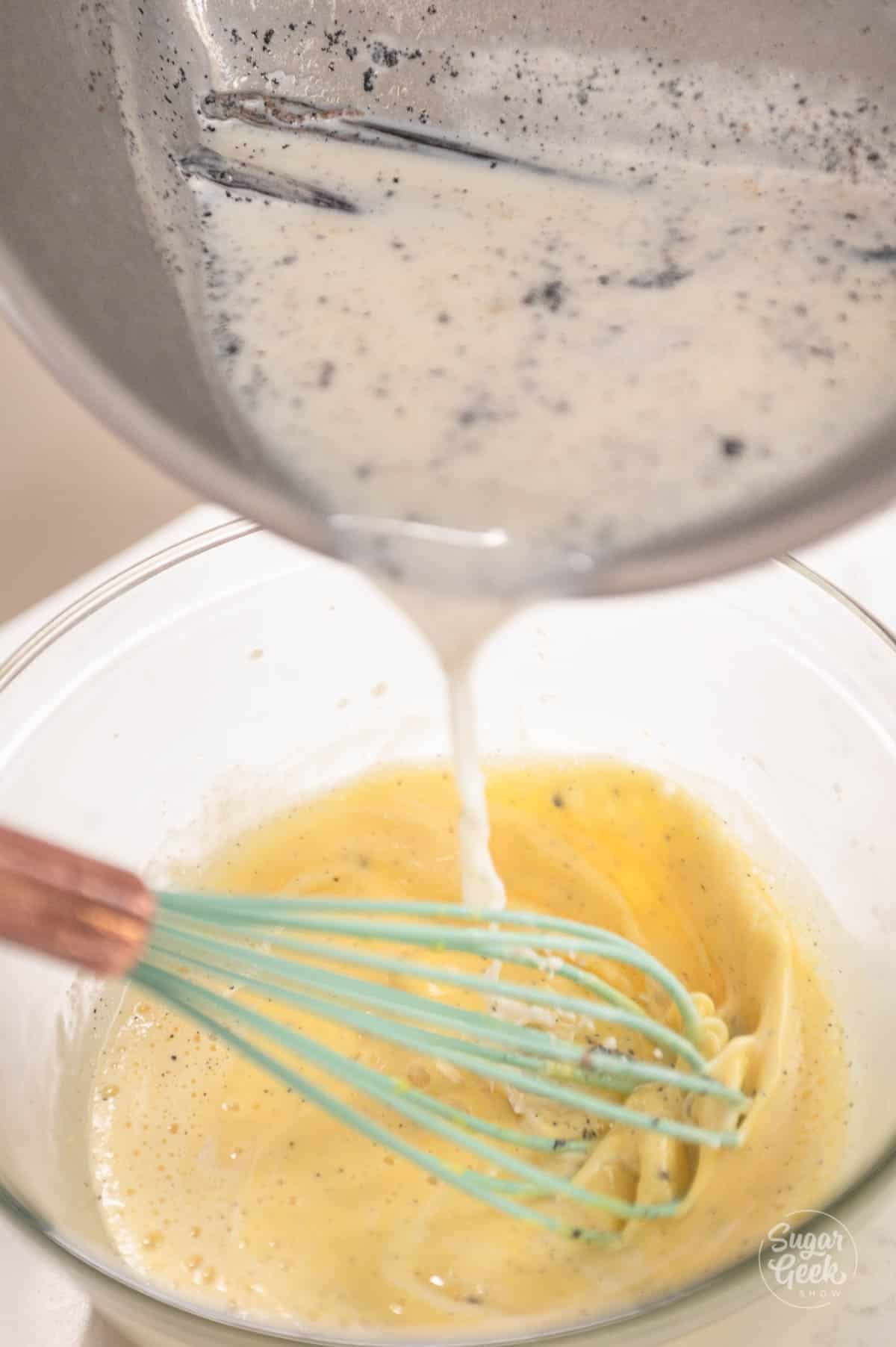
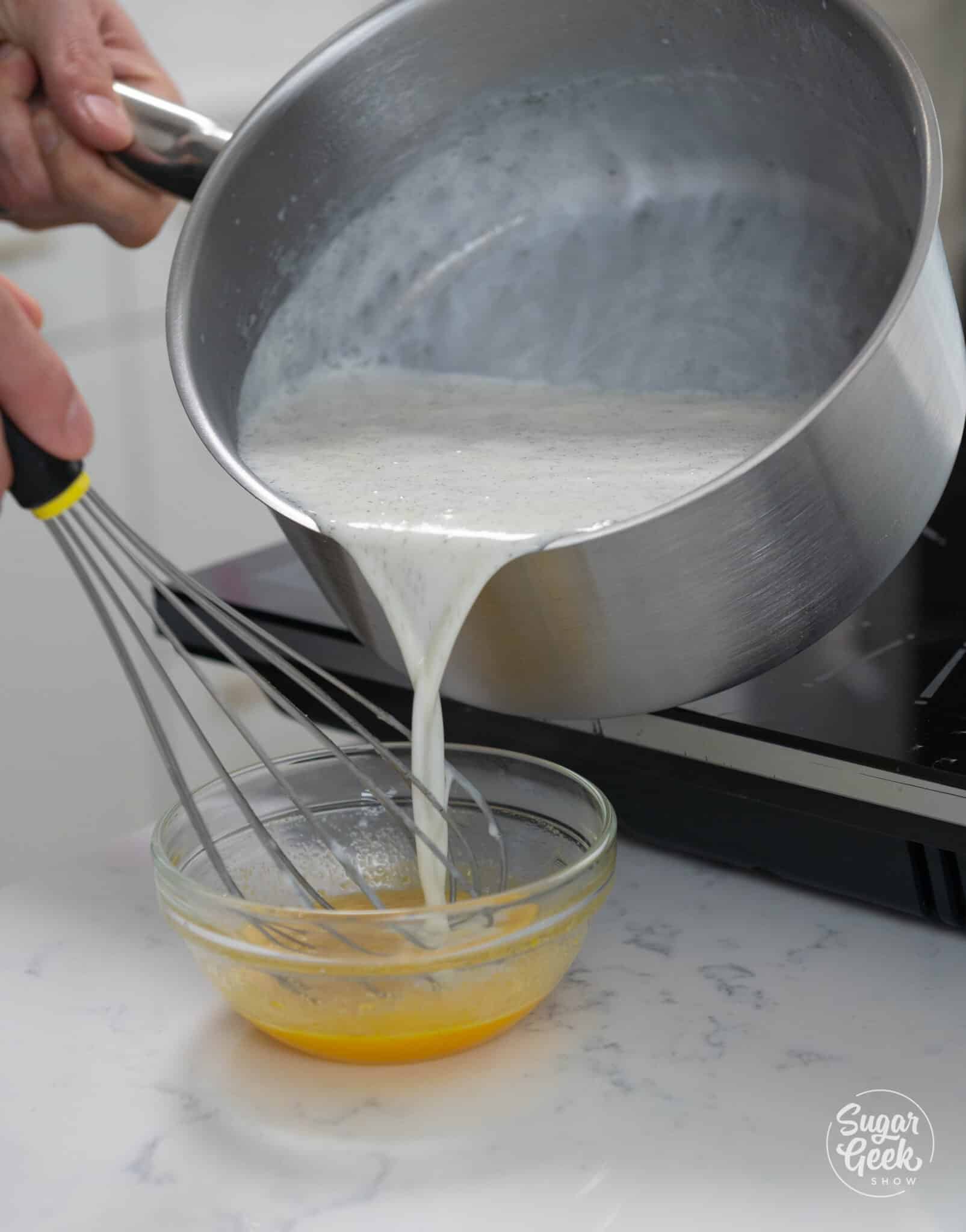
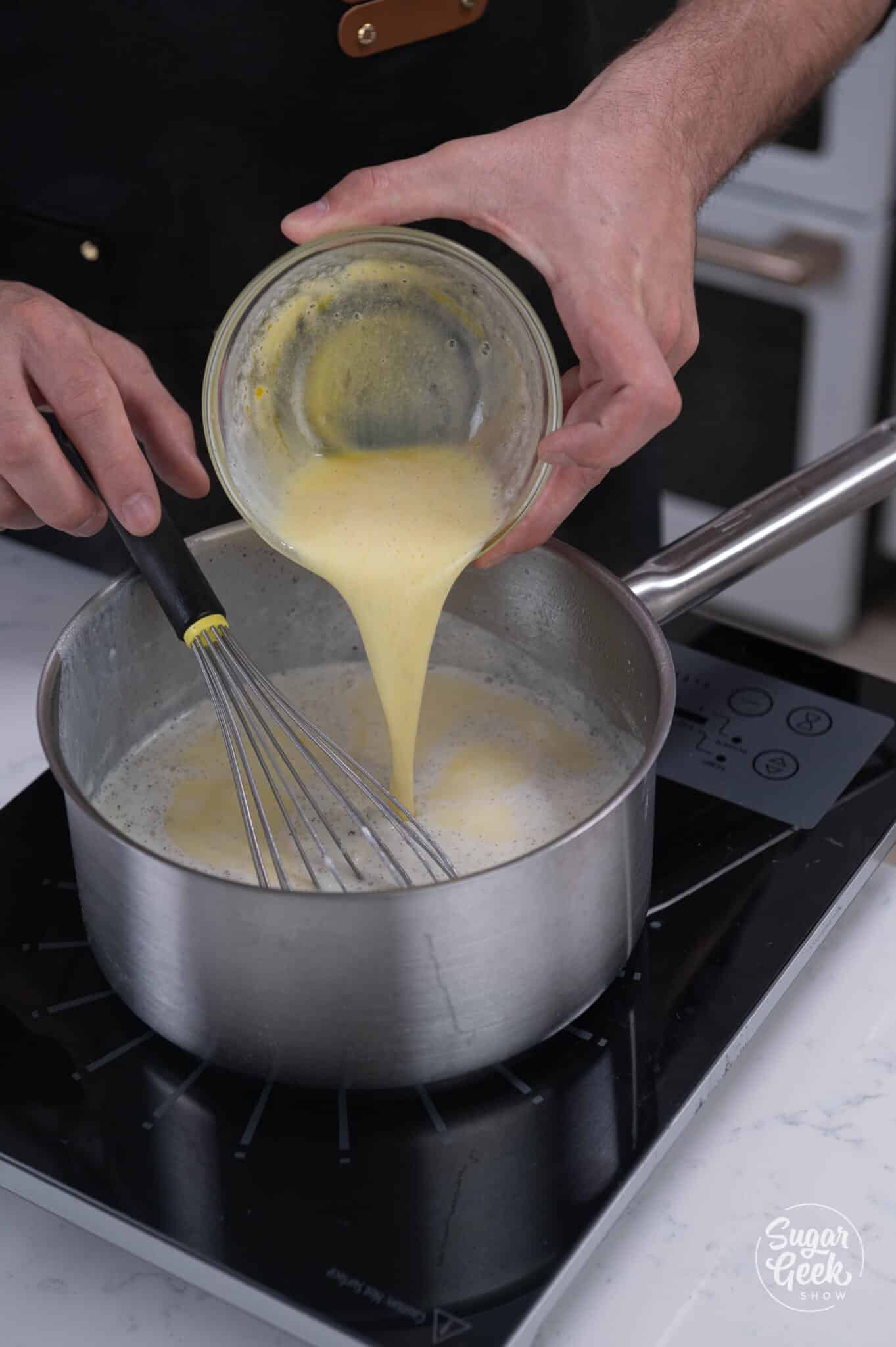
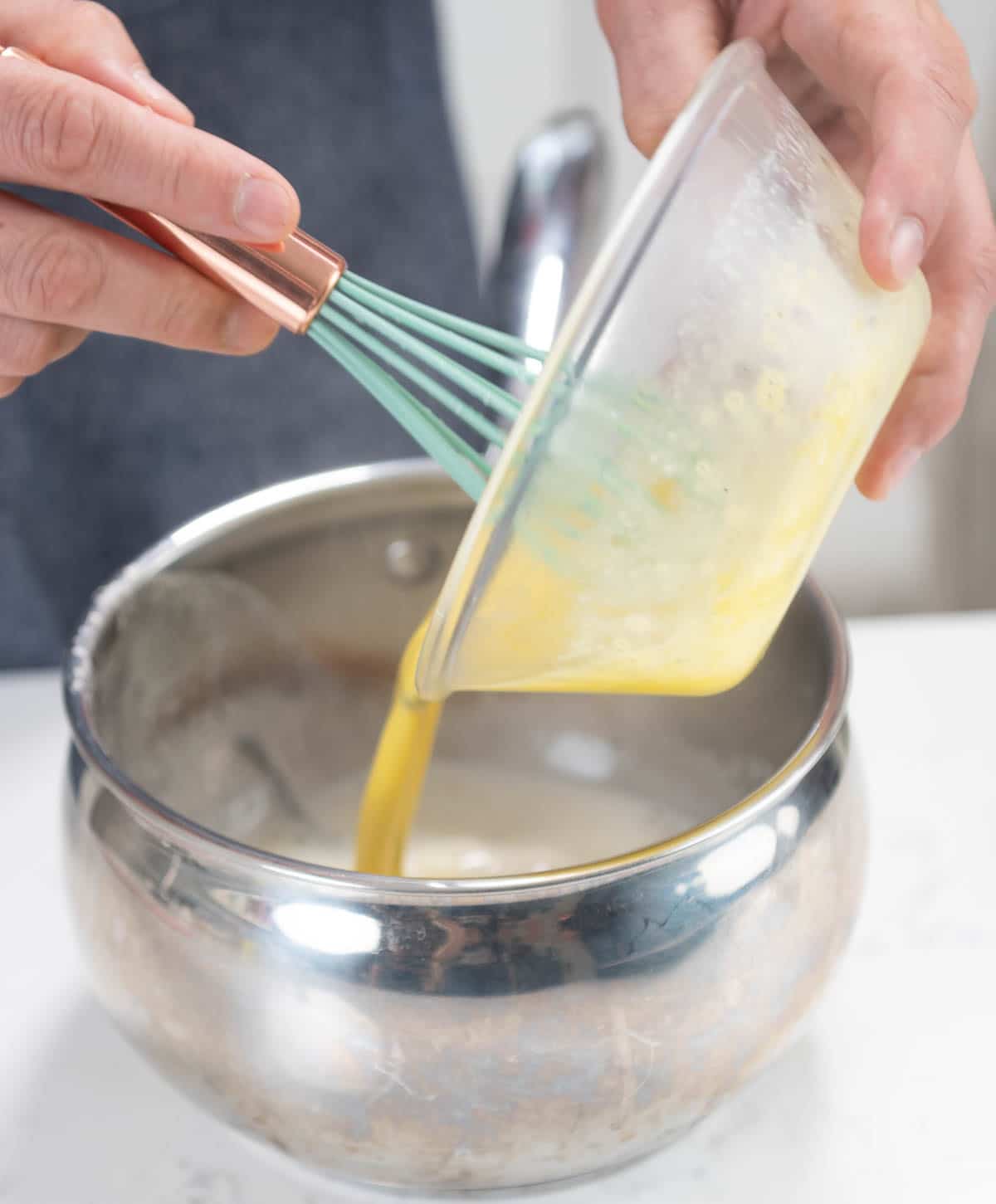
  4. Pour some of the hot milk into the egg mixture to temper it. Pro-Tip: Tempering your yolks helps them reach the same temperature as your milk mixture. This makes it so all the ingredients mix together properly and don't curdle.pouring a pan of hot milk into a bowl of egg yolks with a blue whisk
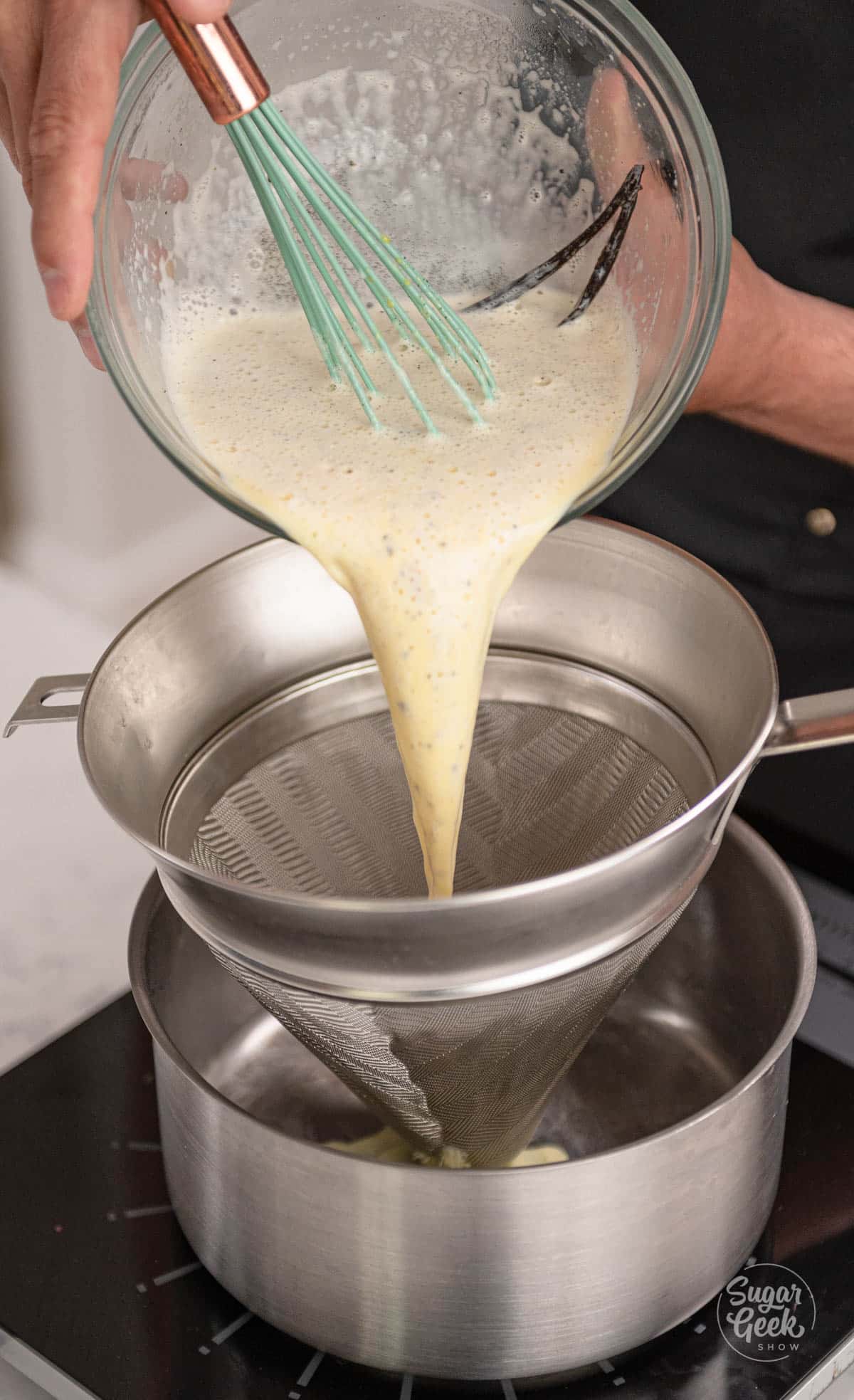
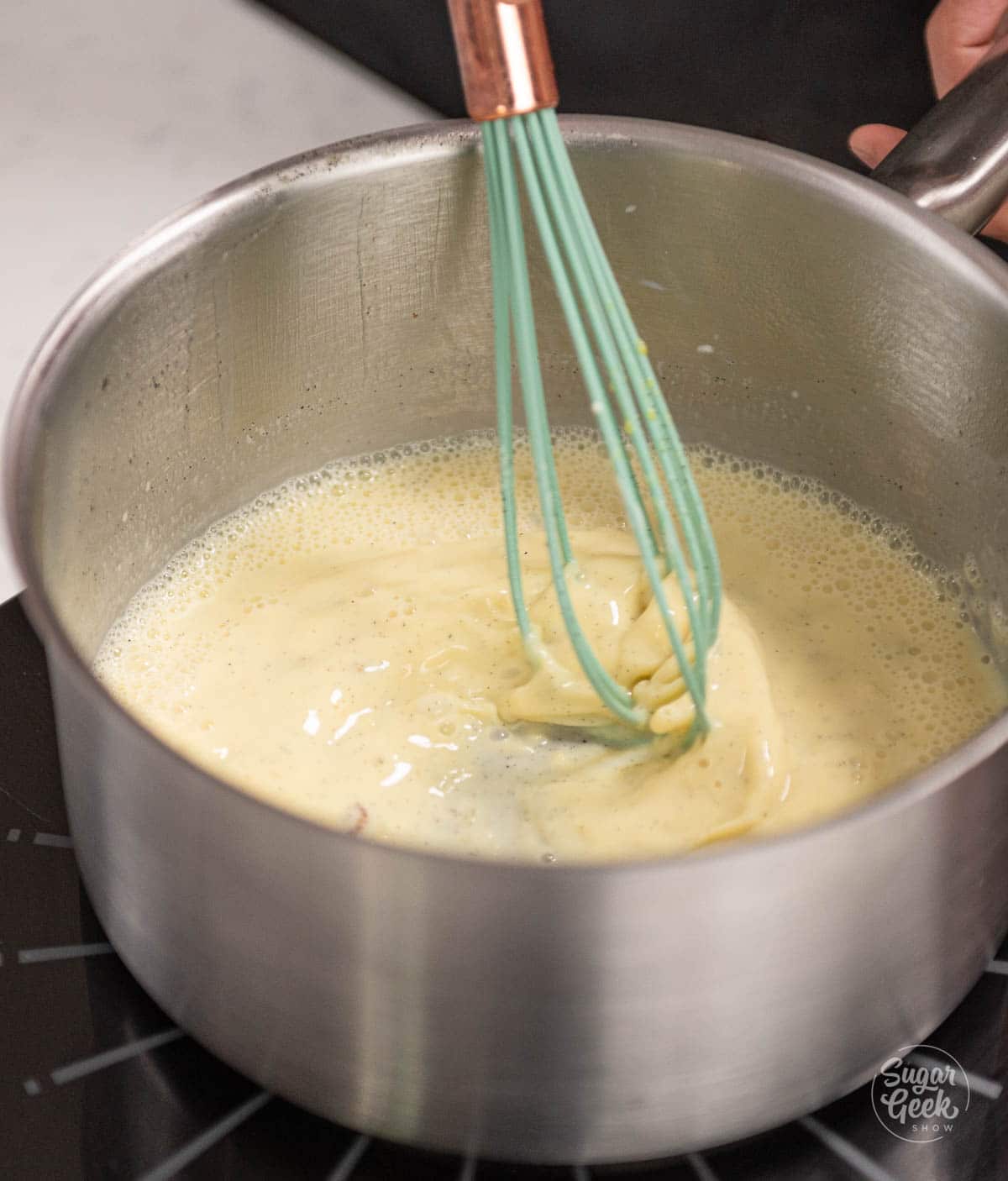
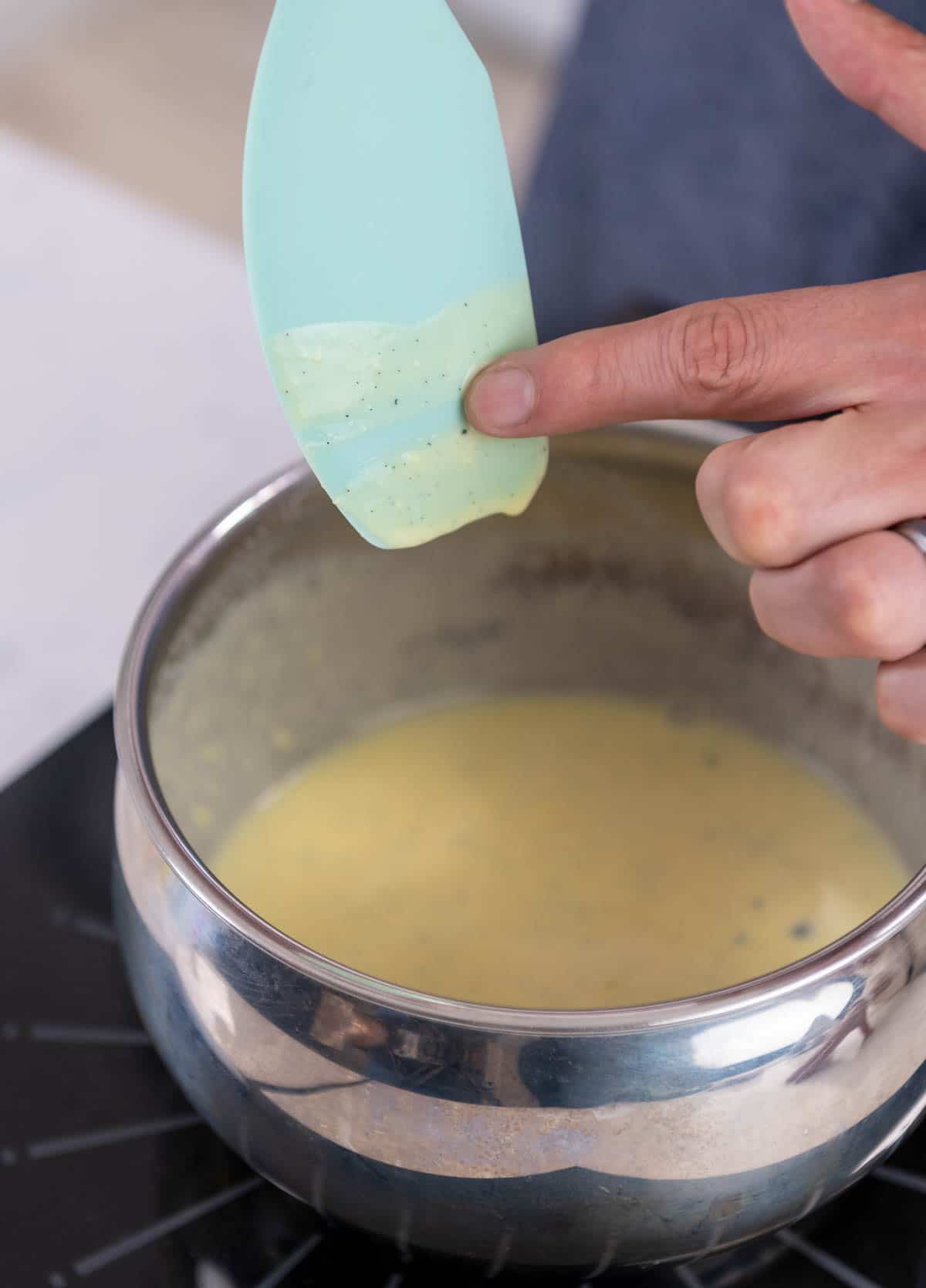
  5. Then put everything back together into the pot and boil for about 1 minute until the mixture starts to thicken. Whisk constantly to prevent lumps.bowl of thin pastry cream pouring back into a metal saucepan
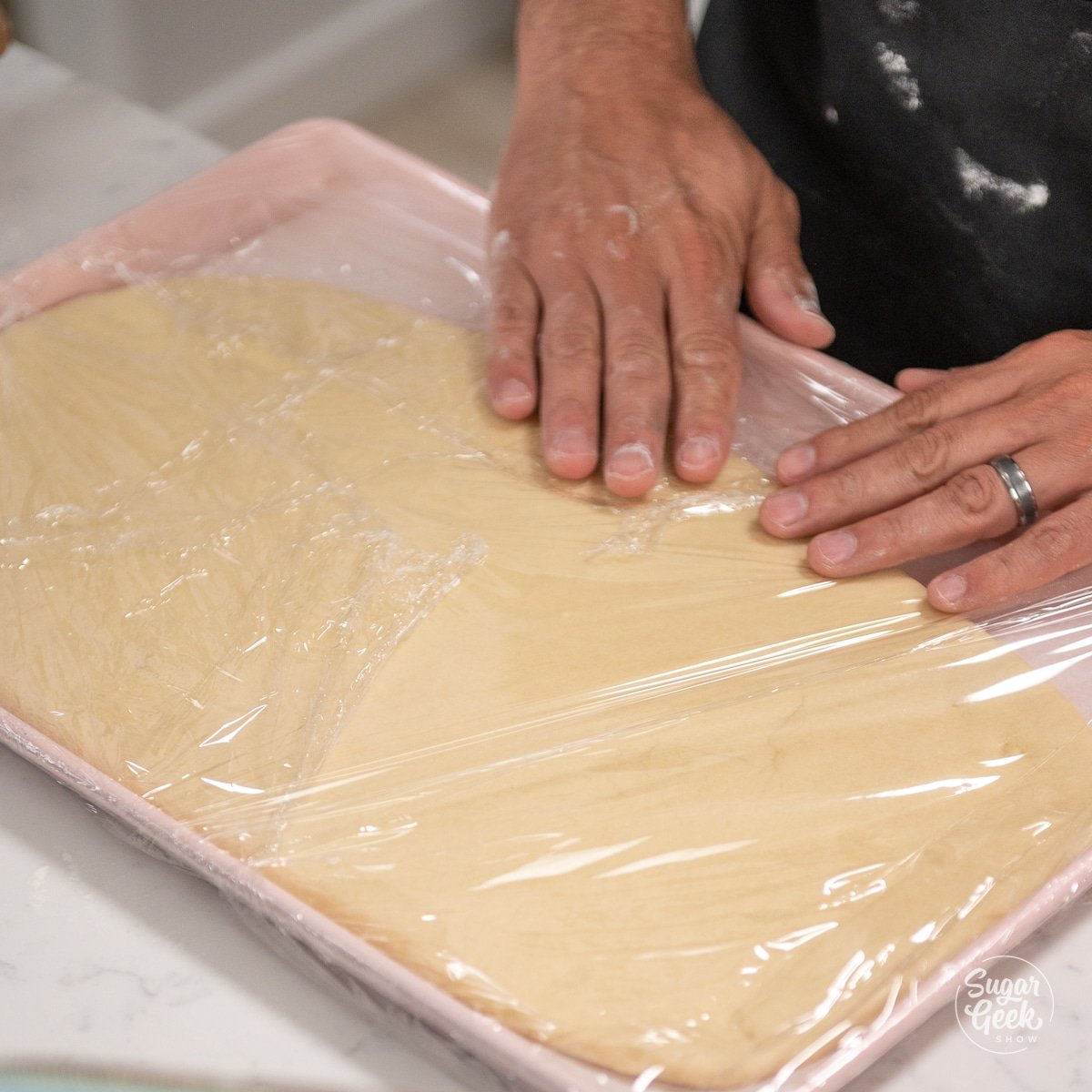
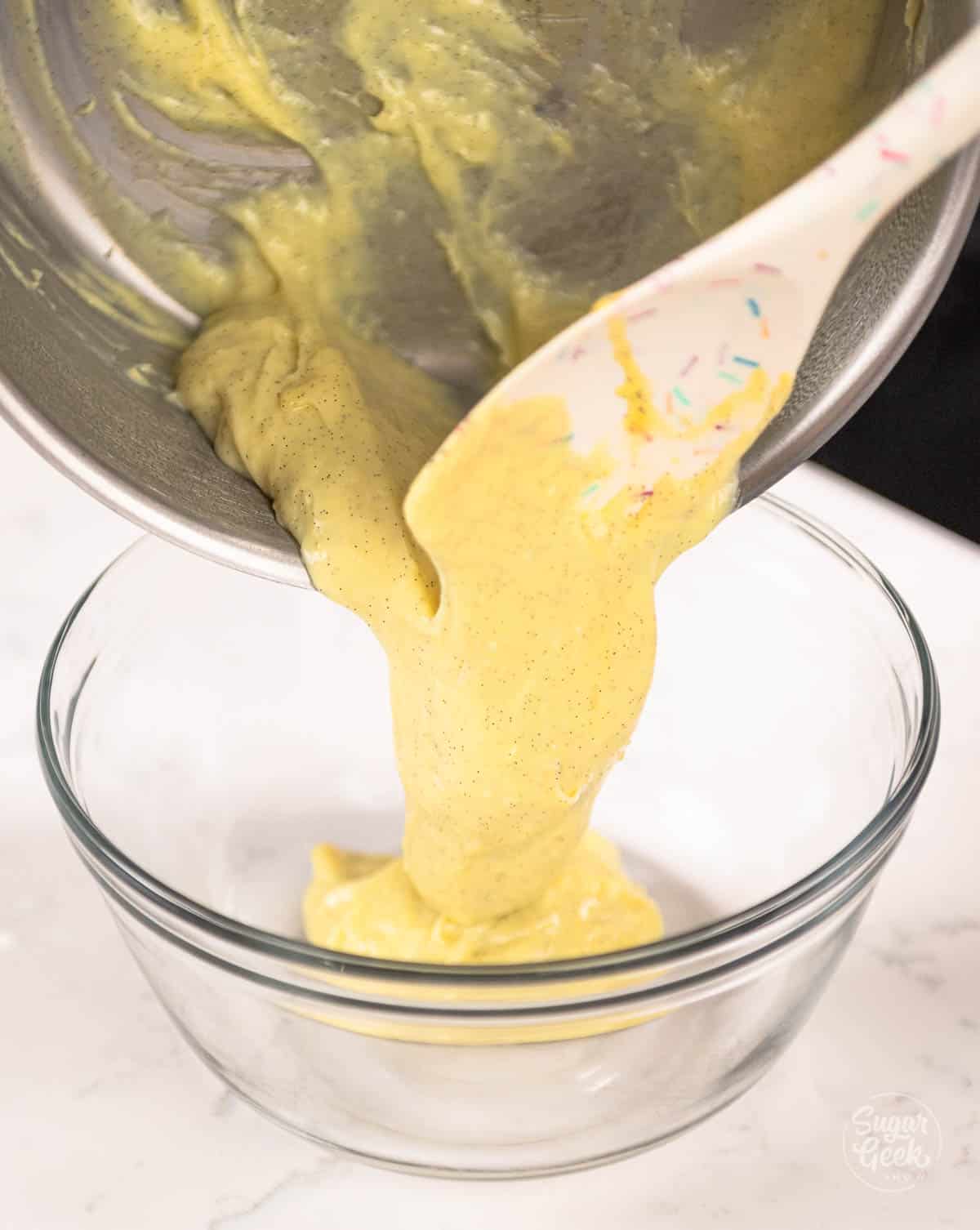
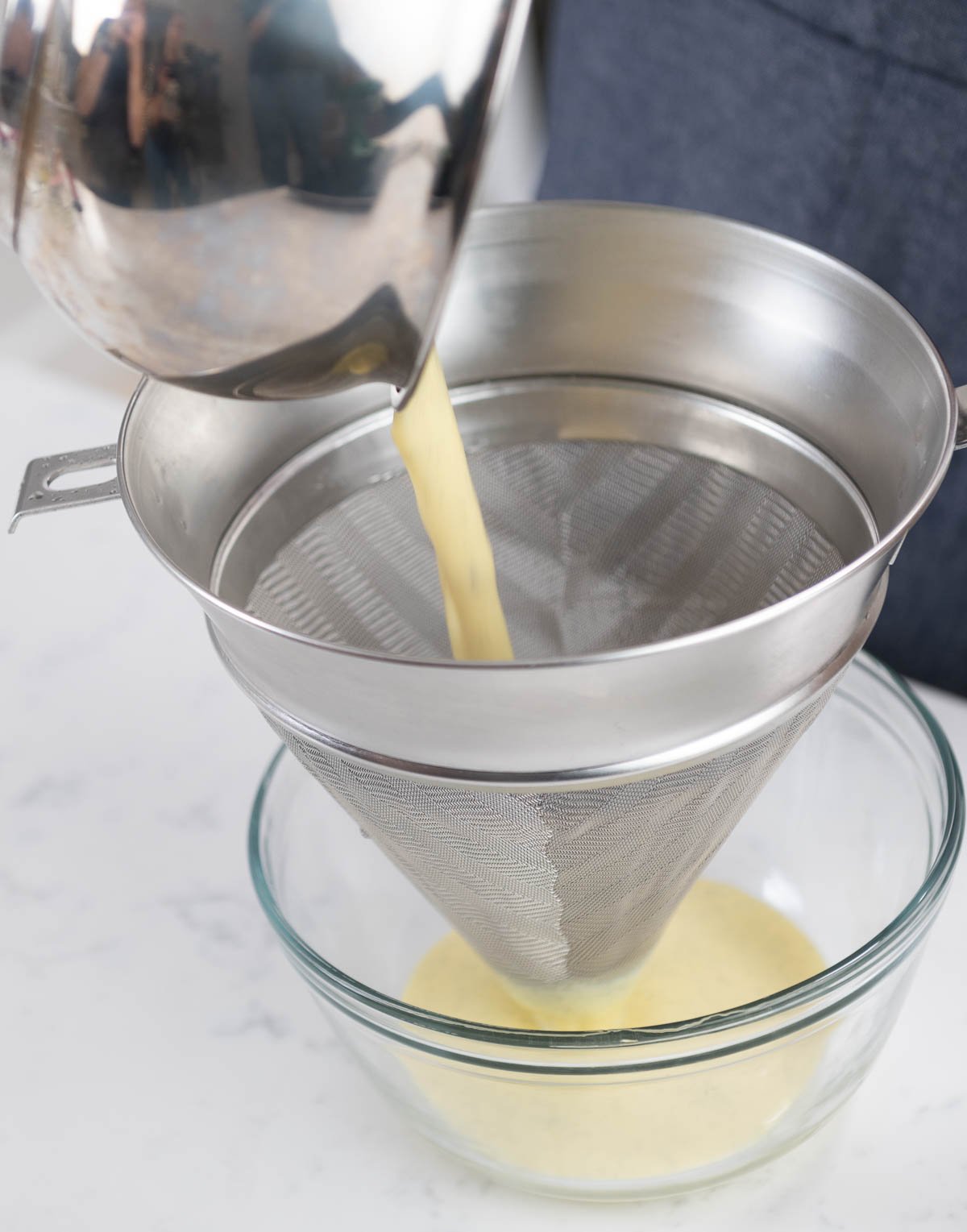
  6. Pour your pastry cream into a bowl, cover it with plastic wrap and refrigerate until you are ready to use it. Pro-tip: To cool pastry cream down quickly, lay down some plastic wrap on a sheet pan, spread the pastry cream out into a thin rectangular shape, and wrap it fully before chilling. pastry cream wrapped in plastic wrap and shaped into a rectangle

Filling the Cream Puffs

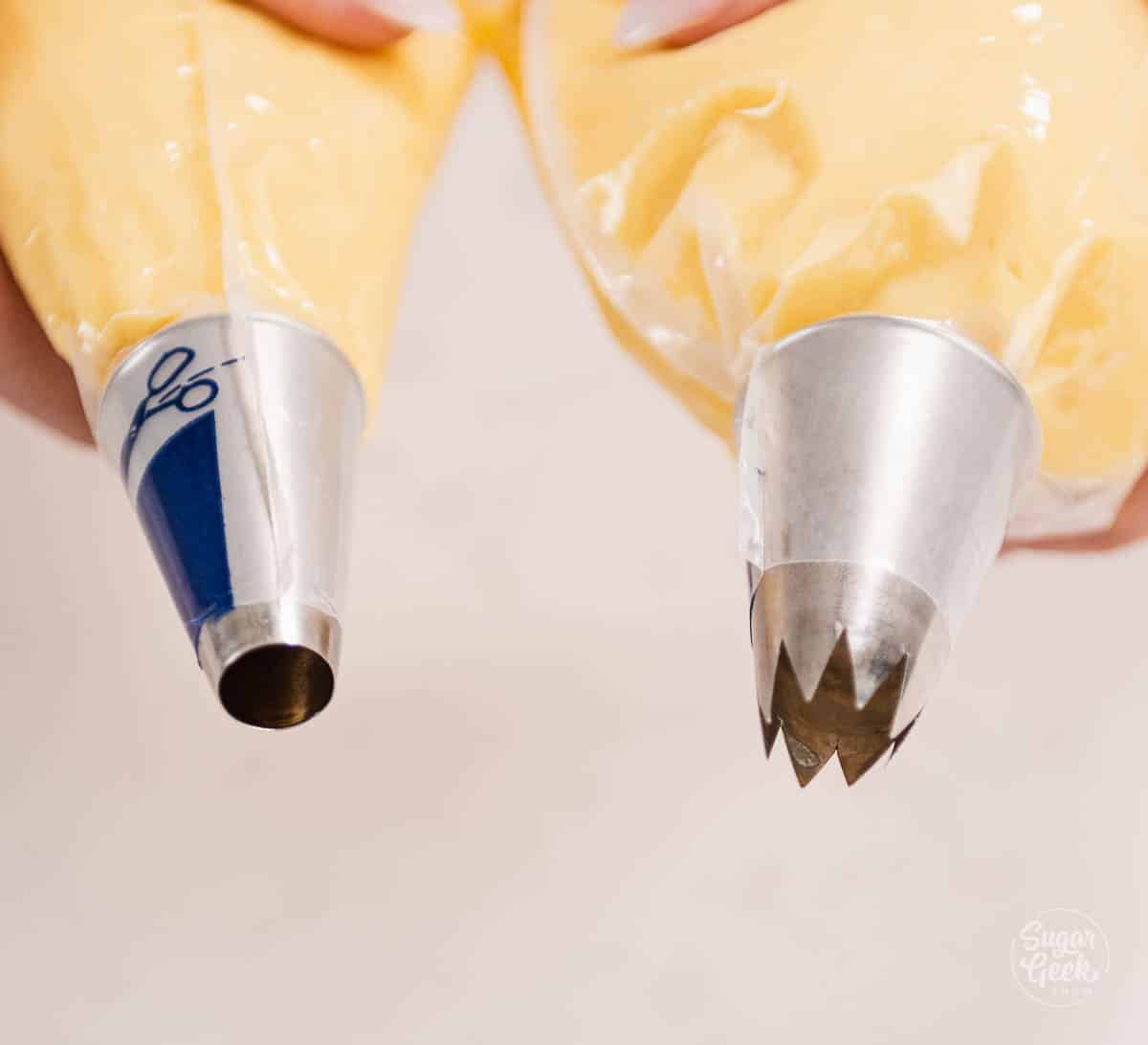
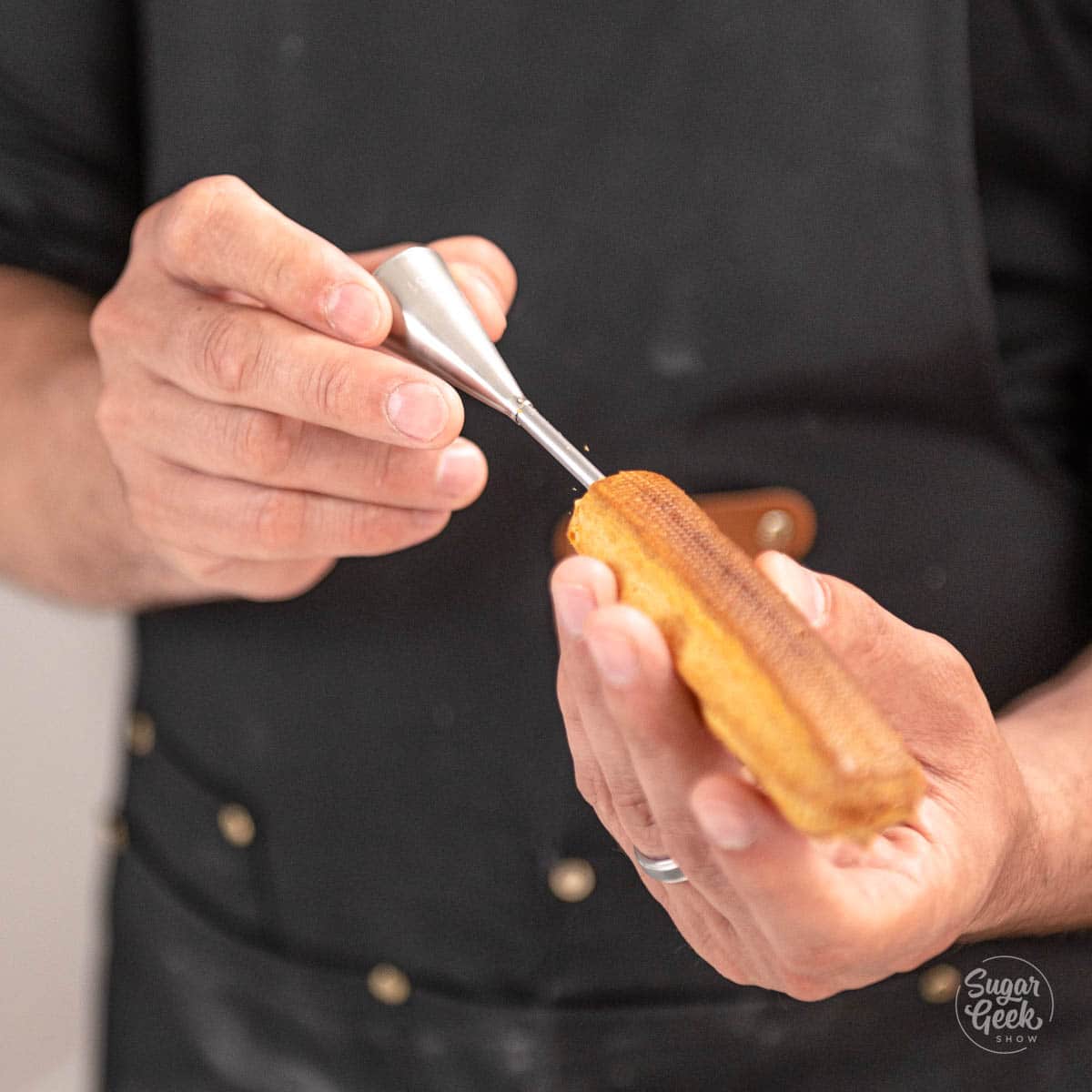
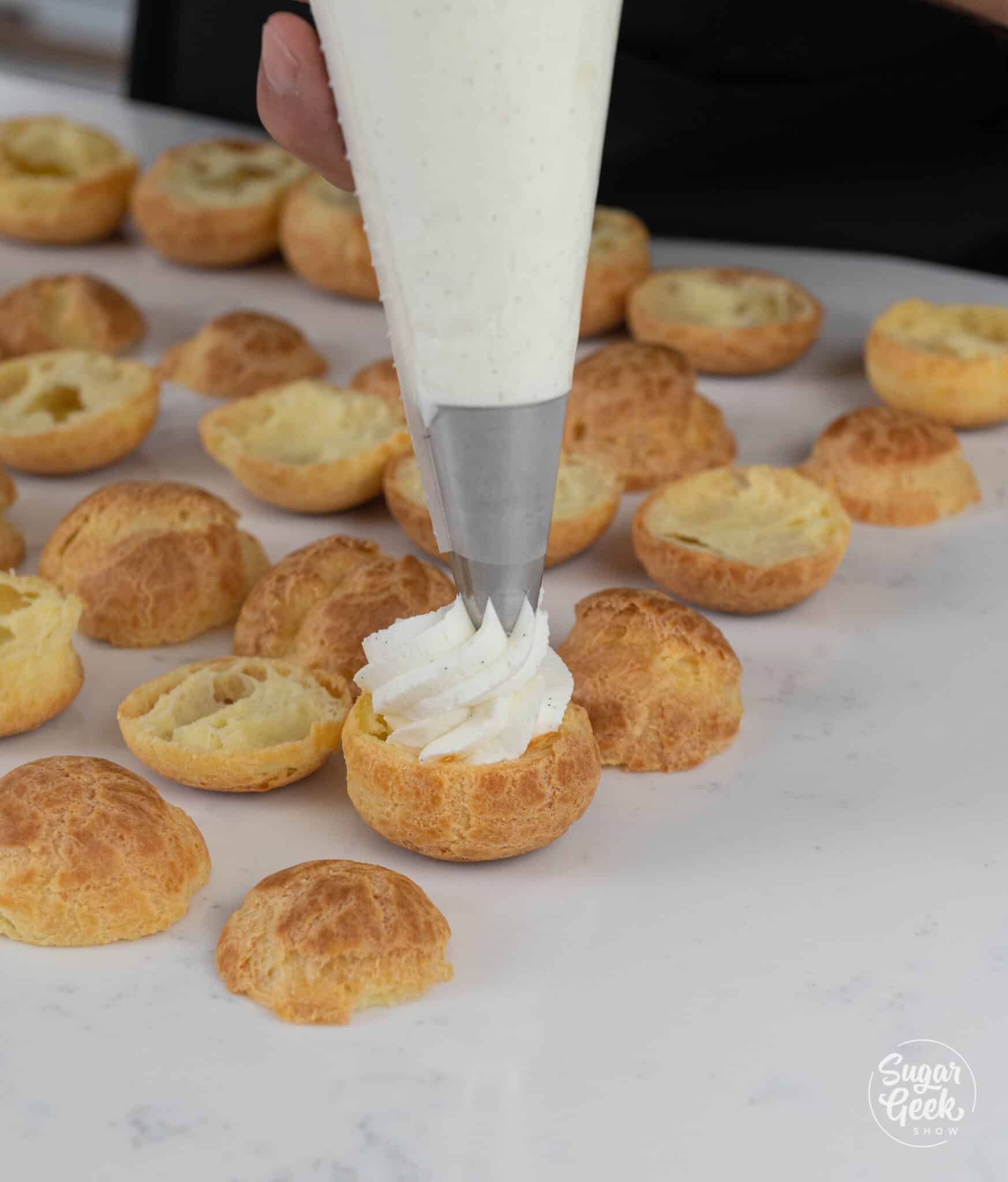
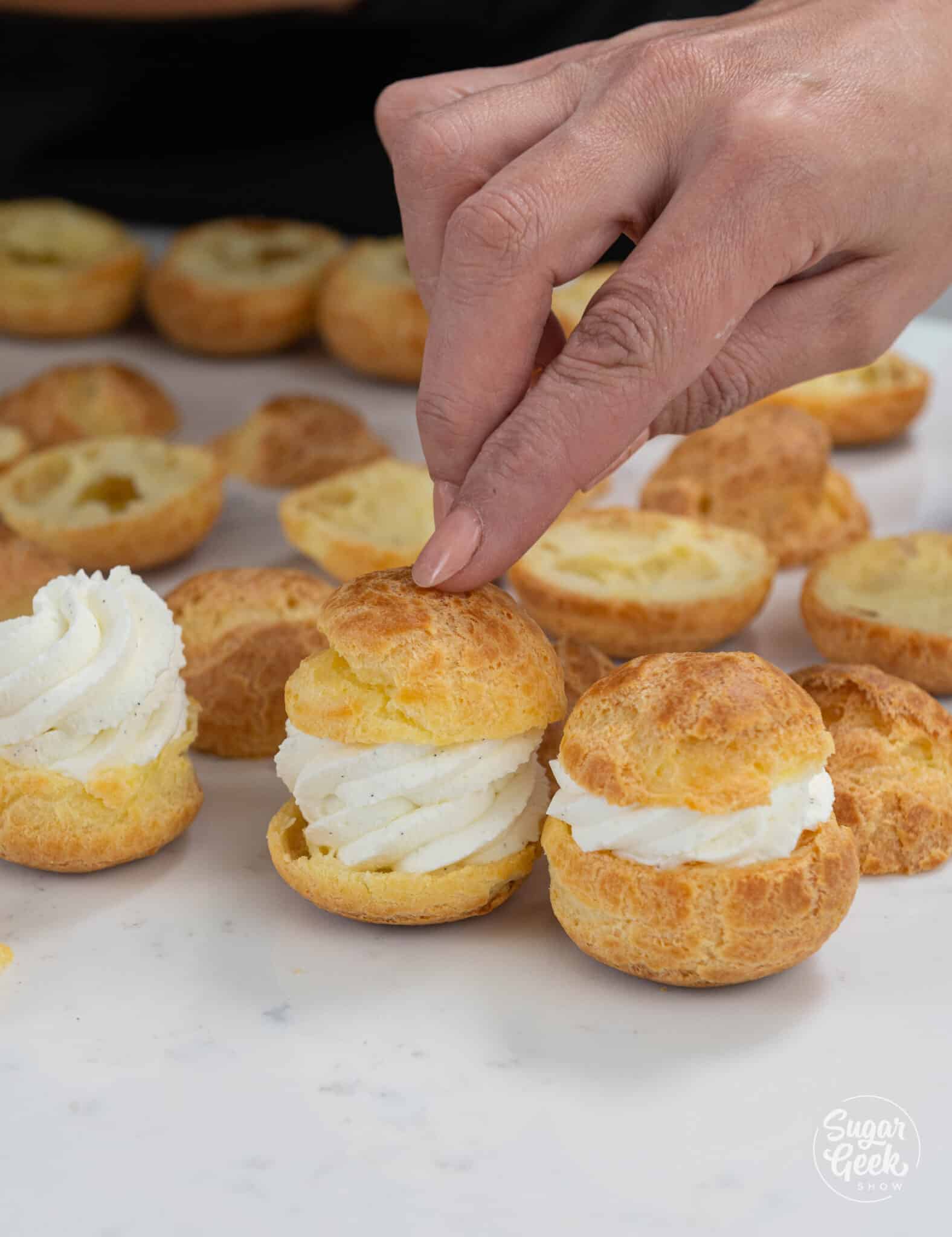
  1. Poke a small hole into the center of each pate a choux using a small round metal piping tip.hand pressing a small hole into the bottom of a cream puff with a piping tip.
  2. Fill your piping bag with the pastry cream. Pro Tip: Use a metal filling tip to easily fill your pate a choux.hand holding a pastry bag while a spatula fills it with pastry cream.
  3. Fill each cream puff with pastry cream and scrape the bottom over the edge of a small container so that it is clean. Hand holding a cream puff shell while a pastry bag and long tip fills it with cream.
  4. Set the cream puffs aside while you make your caramel.hand scraping a cream puff against the side of a small bowl to remove excess filling.

Making the Caramel

  1. Microwave the glucose for about 30 seconds to make it liquid.
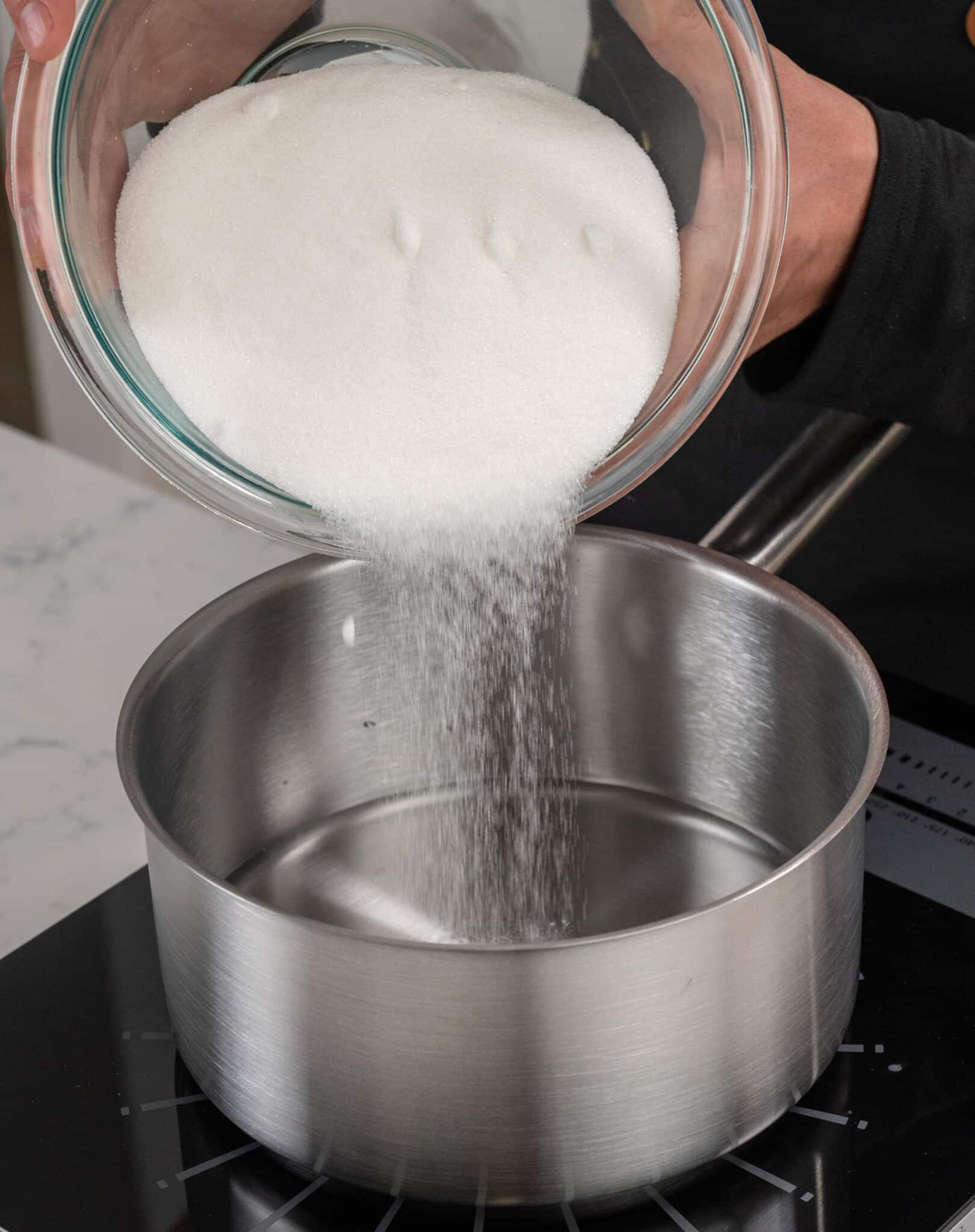
  2. Add the water, glucose, and sugar to a small pot, then attach a candy thermometer and bring it to a boil over medium-high heat.hands pouring a bowl of sugar into a large metal saucepan
  3. Stir the mixture once when it comes to a boil, and then do not stir it again to avoid crystalization.
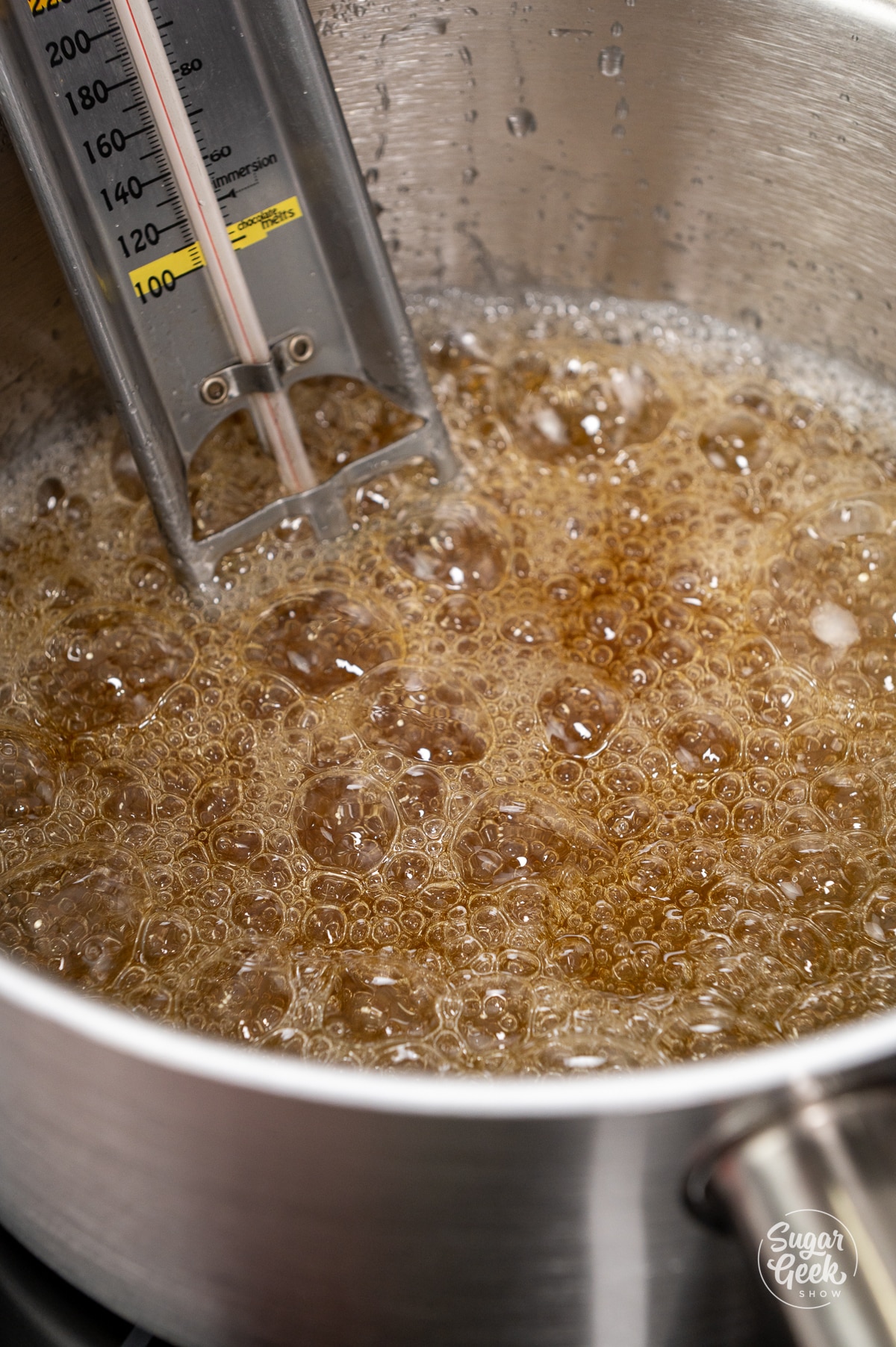
  4. Cook the mixture until it reaches a medium brown caramel color, or about 345°F (174°C). Pro Tip: the darker the color of your caramel is, the more bitter it will taste. Based on your preference you can stop cooking the caramel once you have reached your desired color.candy thermometer in a pot of bubbling caramel
  5. Place the pot of caramel into a bowl of ice water to cool down faster.

How to Stack a Croquembouche

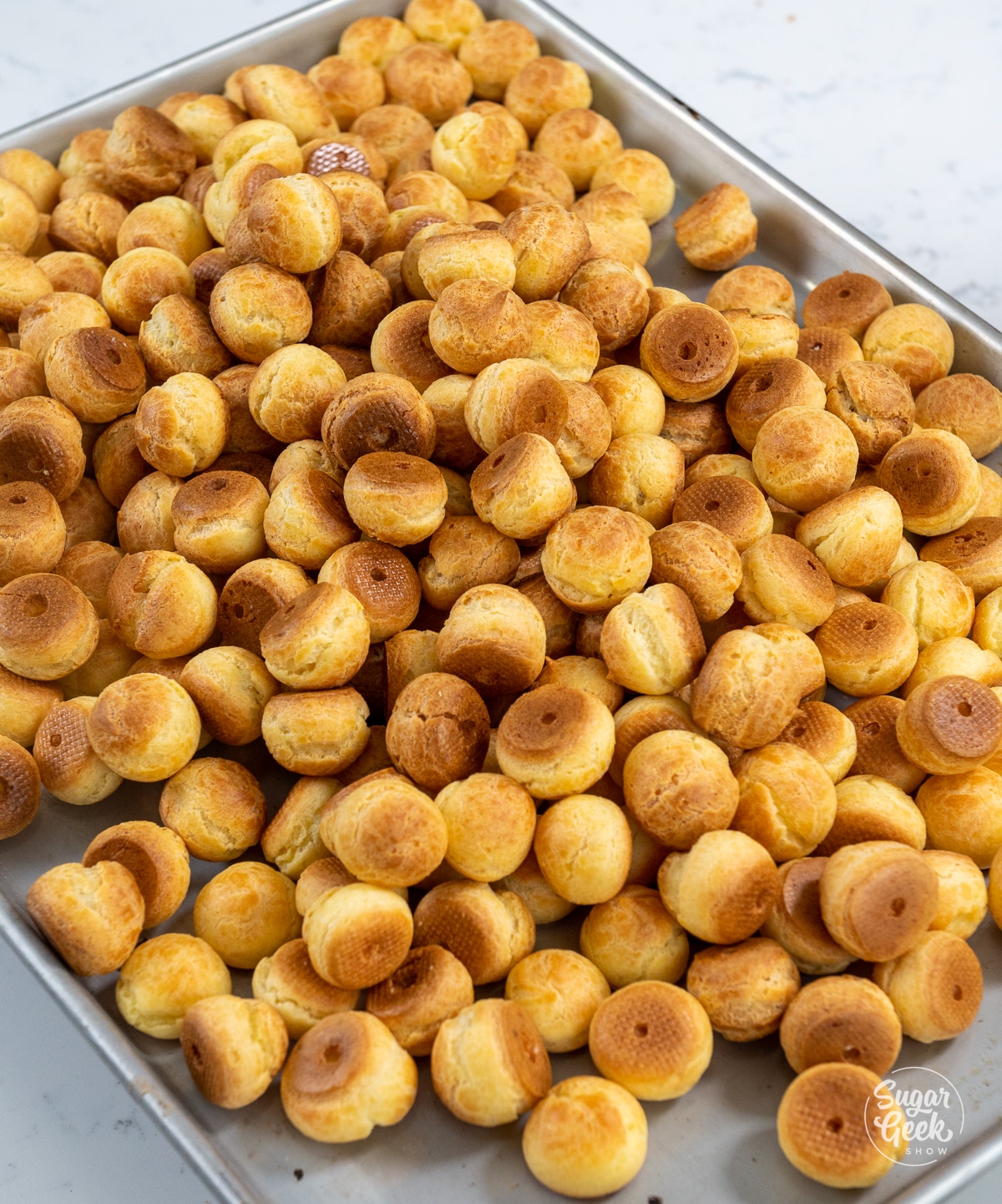
  1. First, prepare your workstation with the filled cream puffs, finished caramel, the metal cone, gloves, and silicone sphere molds or a prepared baking sheet to let the caramel set. We are dipping about half of the cream puffs in rock sugar to make a decorative pattern, but that is optional. You want to work quickly with the caramel so you don't have to keep reheating it. pile of filled cream puffs on a baking sheet
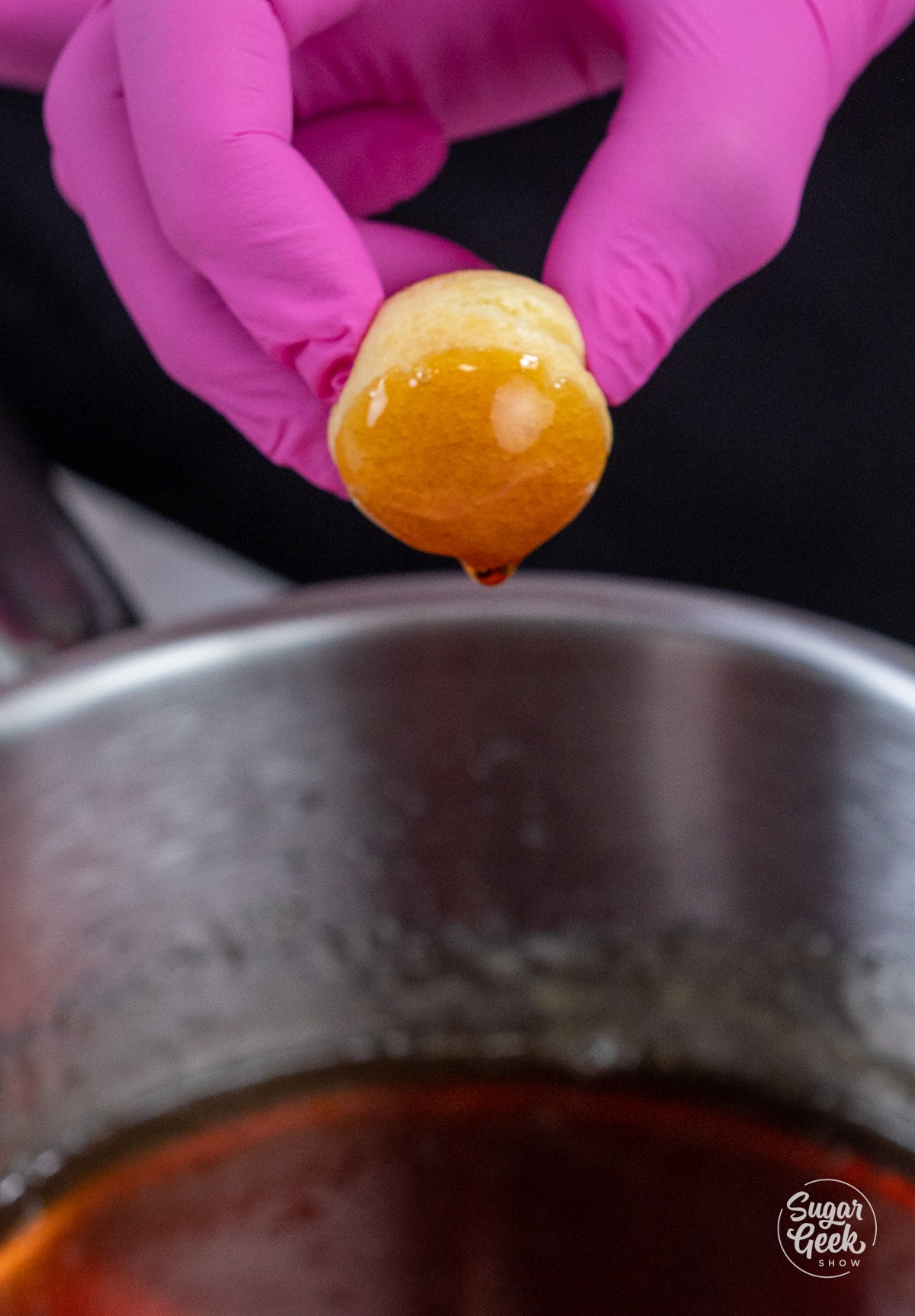
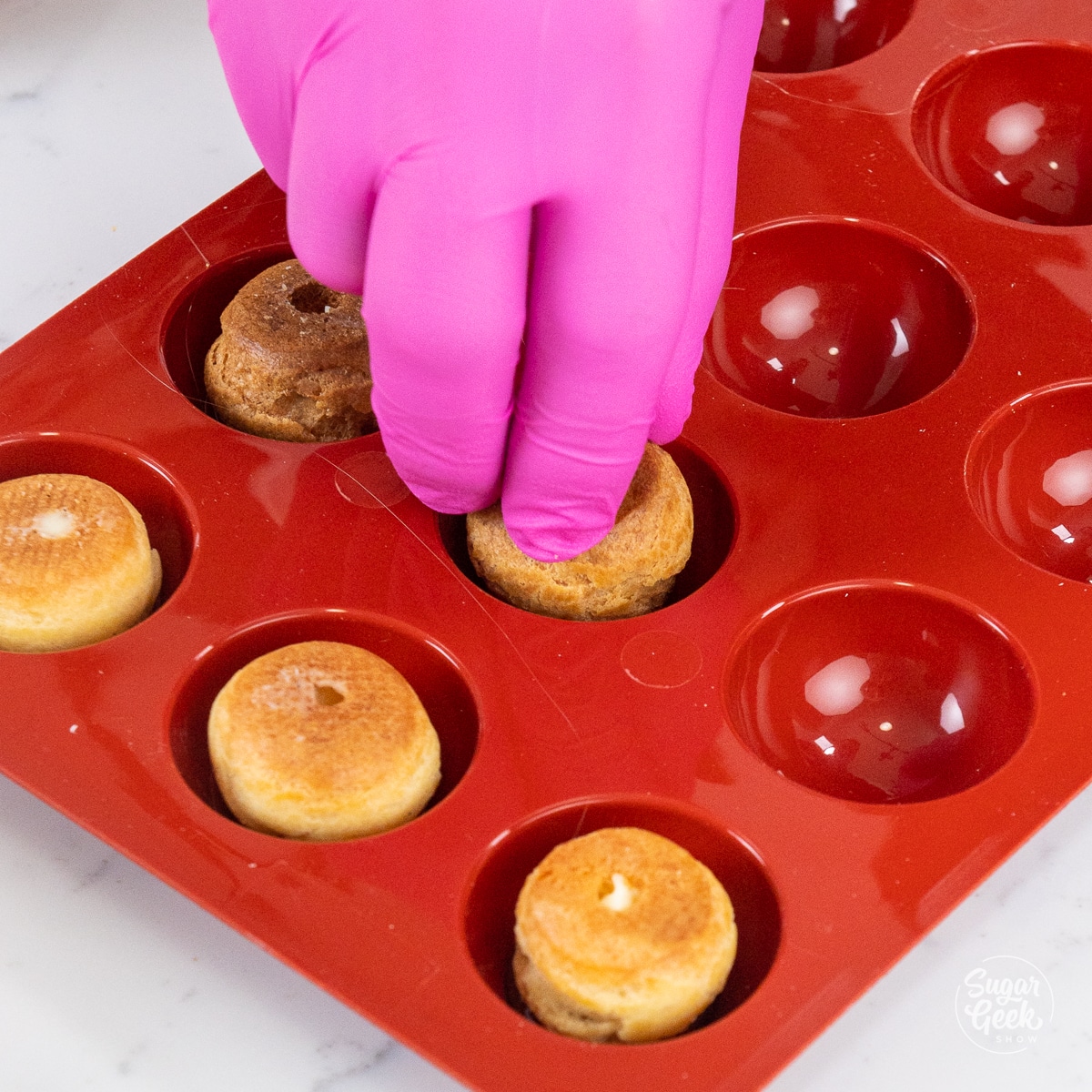
  2. Carefully dip the top of each cream puff in hot caramel and place it upside down into a silicone sphere mold while the caramel sets. You can also place them on a sheet pan instead of a sphere mold, but your caramel may not be as evenly distributed. gloved hand dipping the top of a cream puff in caramelhand placing a cream puff dipping in caramel upside down in a silicone sphere mold
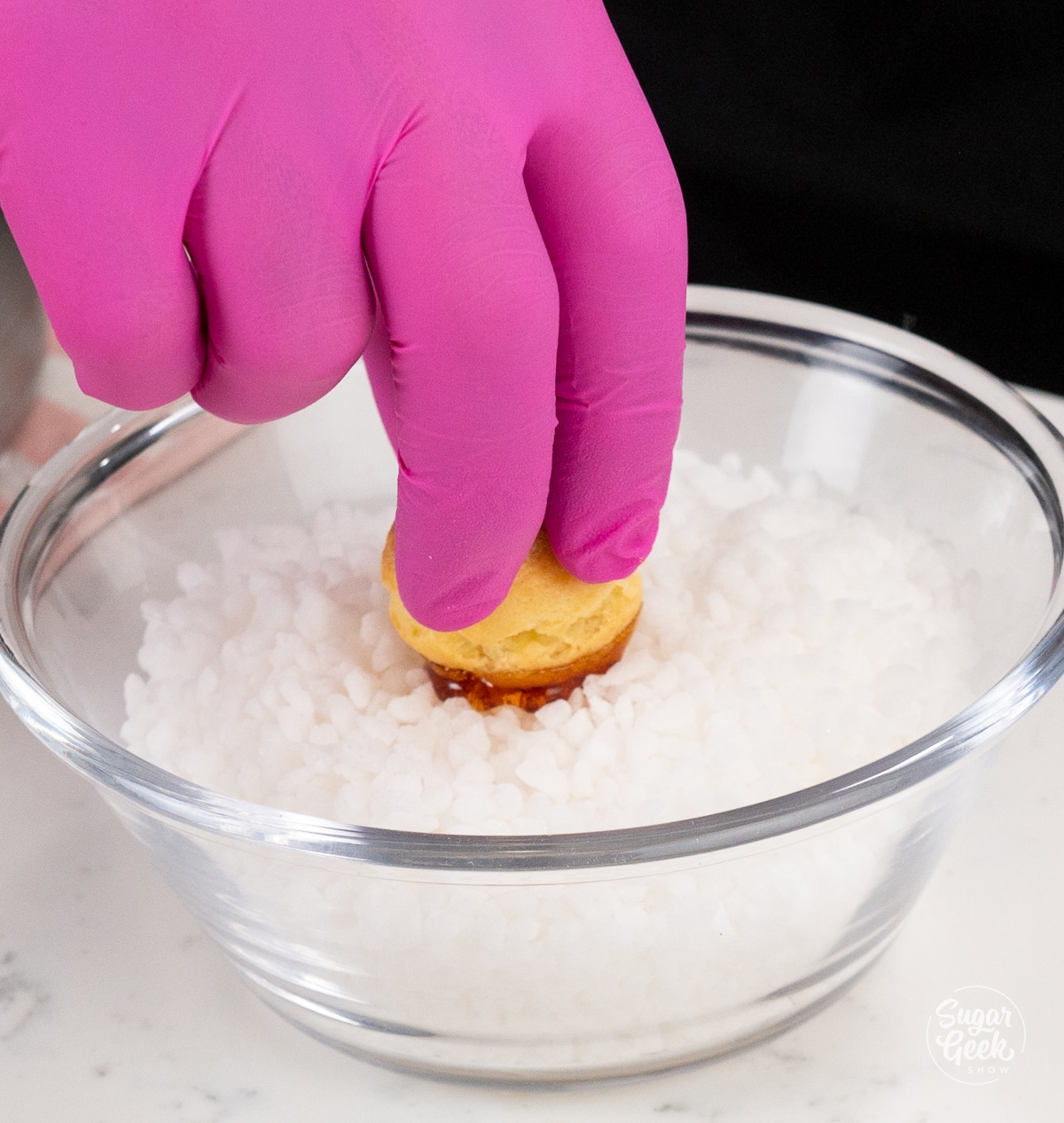
  3. Dip about half of the cream puffs in caramel and then rock sugar, and leave the other half with just plain caramel. hand dipping the top of a cream puff in rock sugar
  4. When the caramel gets thicker, place it back on the stove over low heat to make it warm again.
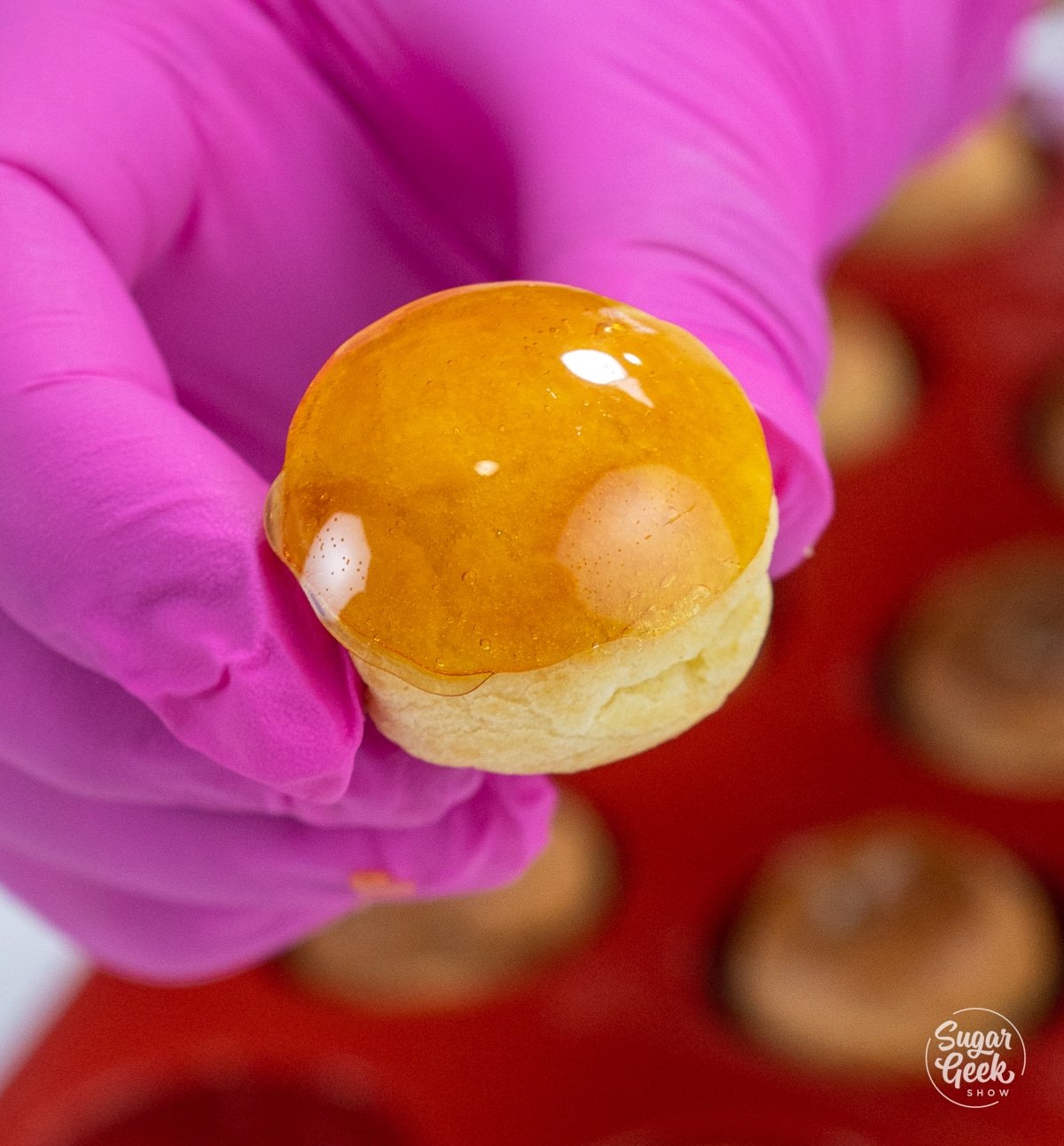
  5. Continue dipping all of the cream puff tops in caramel and let the caramel cool. gloved hand holding a cream puff with hardened caramel shell on top
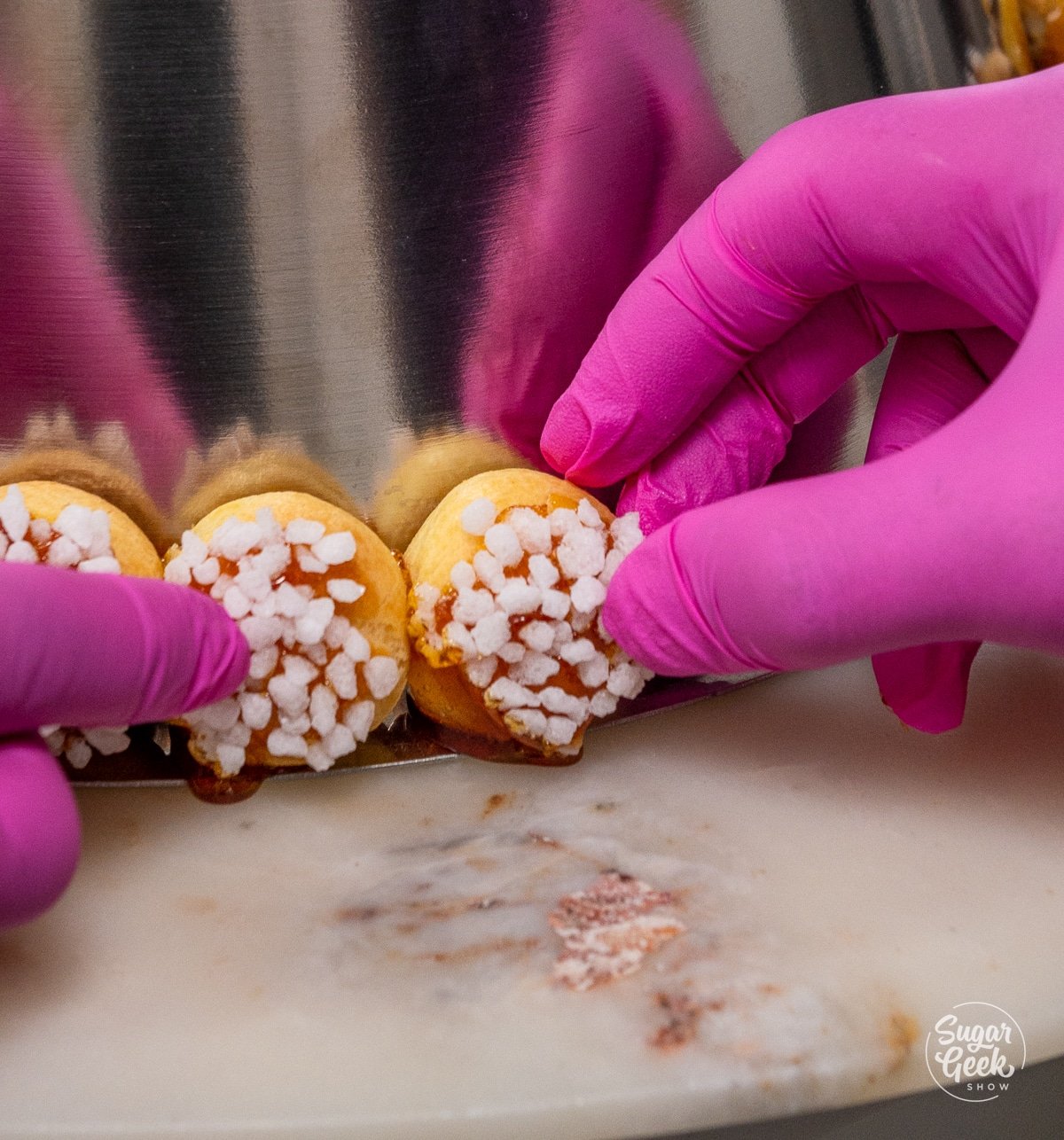
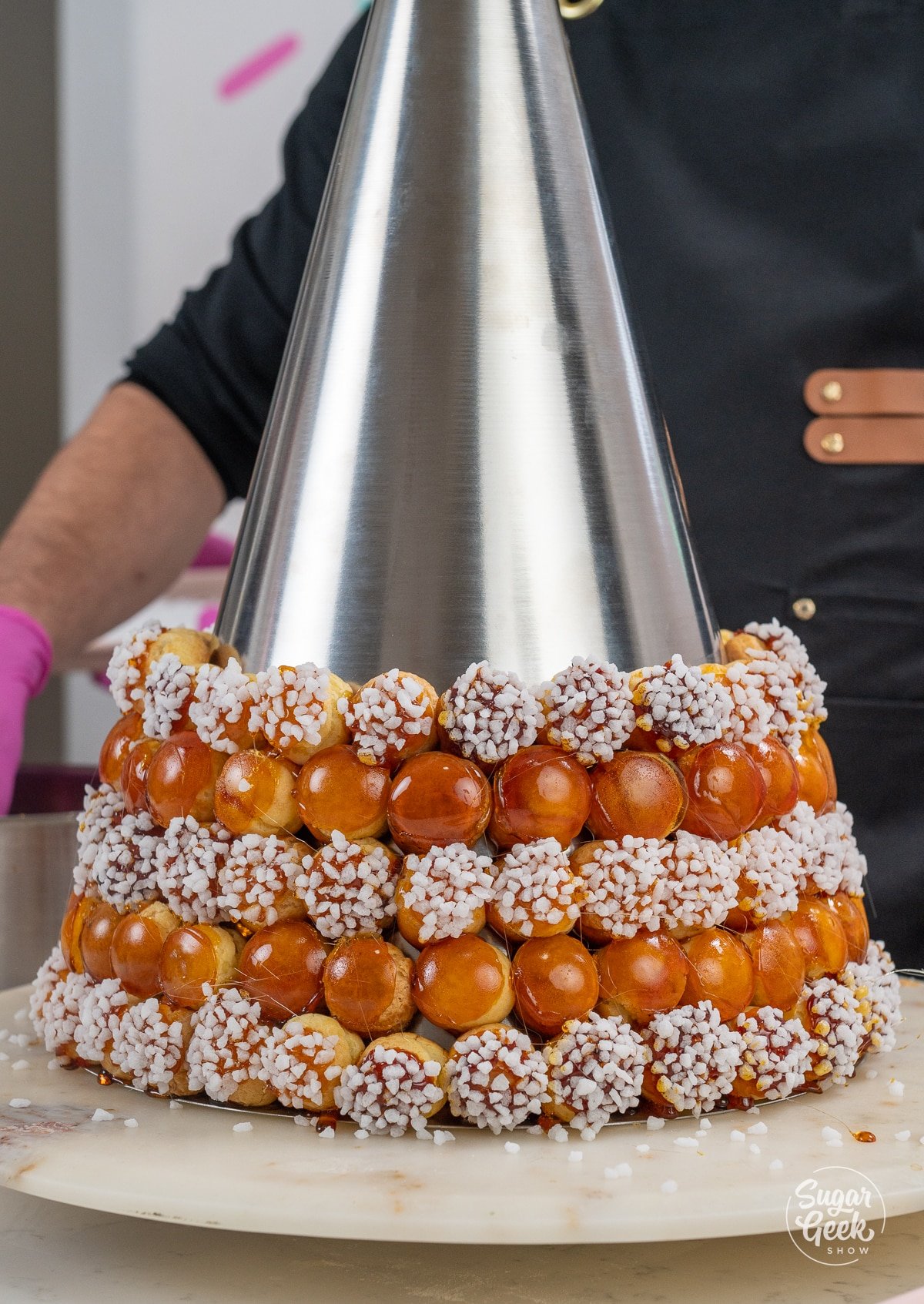
  6. For the first layer of the croquembouche, dip one side of each cream puff in the caramel sauce and immediately place it onto the cone, starting at the bottom. Stick the sides of the cream puffs to each other and wrap them around the cone.hand assembling cream puffs on the bottom layer of a metal cone
  7. For the next layer, dip the side and bottom of the puff in caramel and glue it to the cream puff side and the cream puff below.Cream puffs lined up in a pattern in rows along the outside of a metal cone
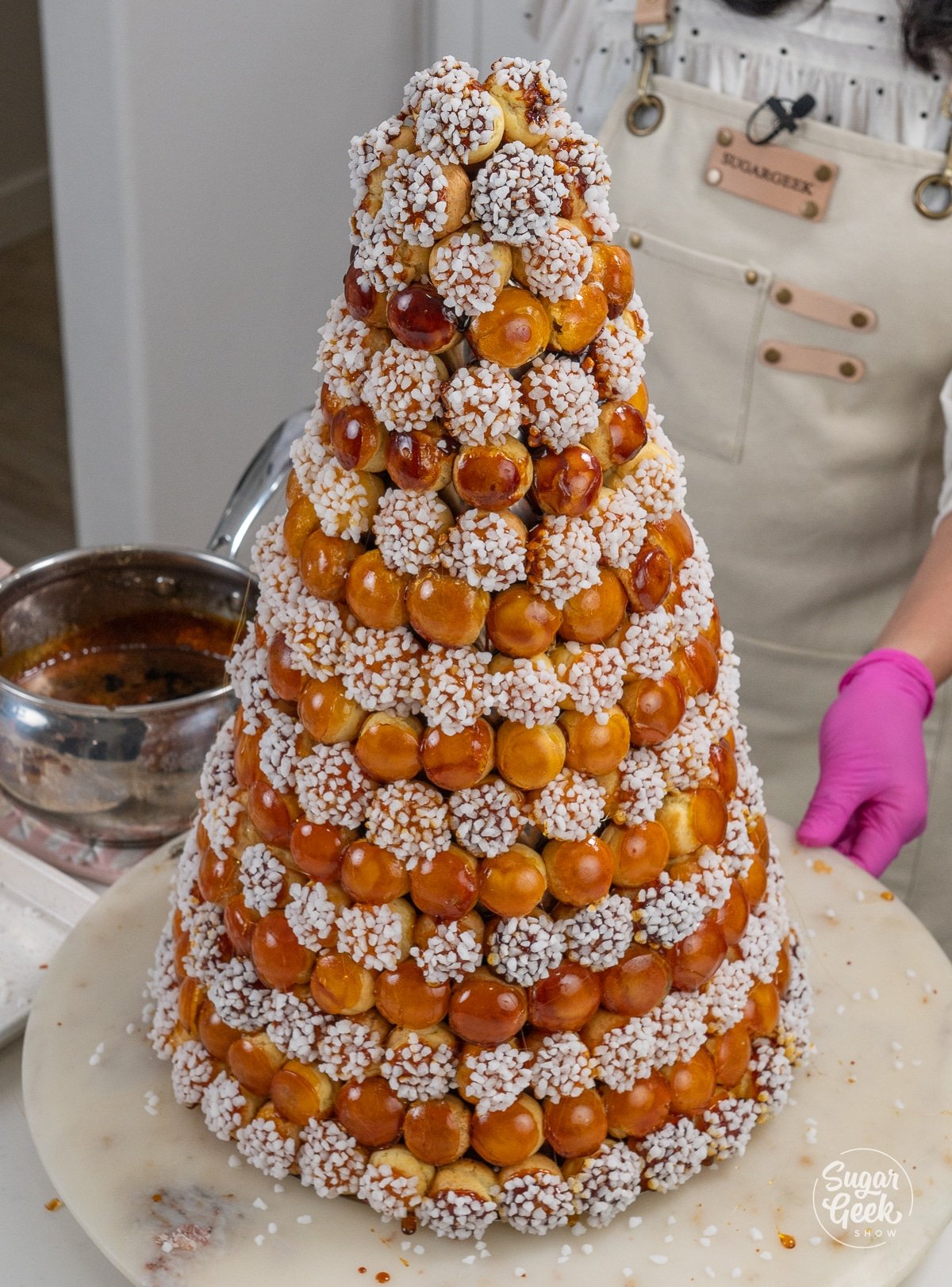
  8. Continue this process up the top of the croquembouche.croquembouche of white and brown cream puffs organized in a pattern
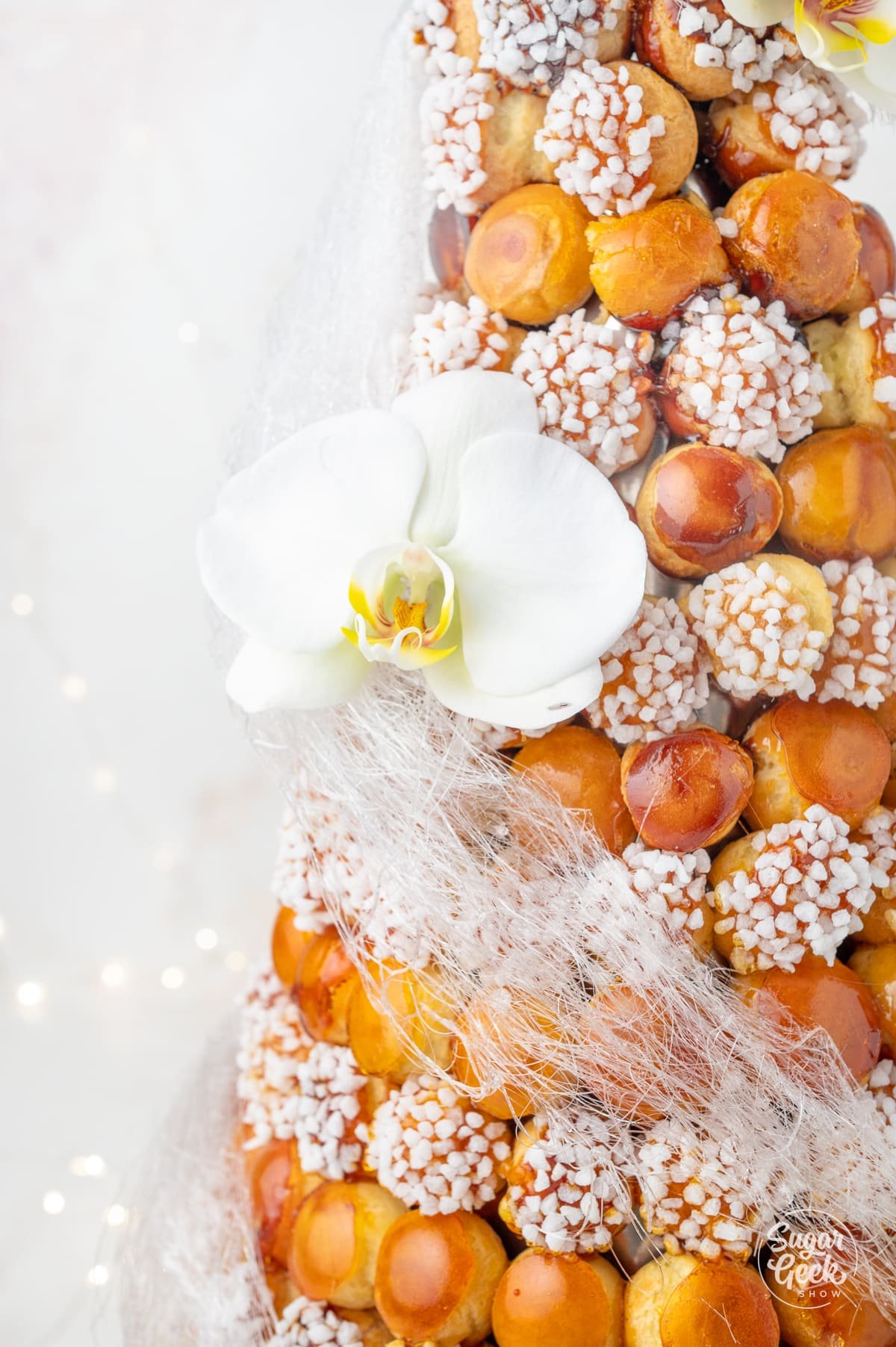
  9. Decorate with fresh orchids, spun sugar, or candles! patterned croquembouche with spun sugar and a white orchid on the side

Serving the Croquembouche

It can be kind of tricky to serve a croquembouche since the caramel hardens and can become sharp. Here are a few tips for serving successfully. 

  • Prep your filling and pate a choux dough ahead of time, then assemble your croquembouche the day you're going to serve it. 
  • Serve a croquembouche by cutting the cream puffs out with a knife, or using two forks to pry out each cream puff. 
  • Make sure to start at the top when serving! 
  • Leave the croquembouche on the cone while traveling.
  • Don't leave a croquembouche sitting out for longer than 5 hours.croquembouche cream puff tower decorated with spun sugar and orchids

FAQ

What is croquembouche made from?

Hundreds of tiny cream puffs filled with pastry cream are glued together with caramel in a cone shape to make a croquembouche. 

What is the English translation for croquembouche?

"Croque en bouche" in France translates to something that "crunches in the mouth" in English.

How do you eat a croquembouche?

Serve a croquembouche within 5 hours of assembling it. Use a knife or two forks to pry each cream puff out of the cone. Be careful when cutting into the caramel, as it may be sharp. 

Can I refrigerate a croquembouche?

It is not recommended to refrigerate a croquembouche because the cream puffs will start to get soggy from the pastry cream. It's best to make the pate a choux dough and pastry cream a day ahead, and then bake, fill, make the caramel, and assemble on the day of serving. 

How long can a croquembouche sit out?

A croquembouche can last for about 5 hours, so it's best to assemble it when you're ready to serve. The pastry cream inside of the cream puffs is not shelf stable, and the caramel will start to absorb the moisture in the air and get soggy.

How tall is a croquembouche?

Our croquembouche is 18" tall and 10" wide at the base and took about 250, 2" cream puffs. You can make a croquembouche in any size that you like! You can make fewer cream puffs if you make larger ones, but it may be more difficult to get them to stick together. 

Is croquembouche a wedding cake?

A croquembouche is a popular French dessert alternative to cake for weddings, baptisms, communions, and special occasions.

Related Recipes

Cream Puff Recipe

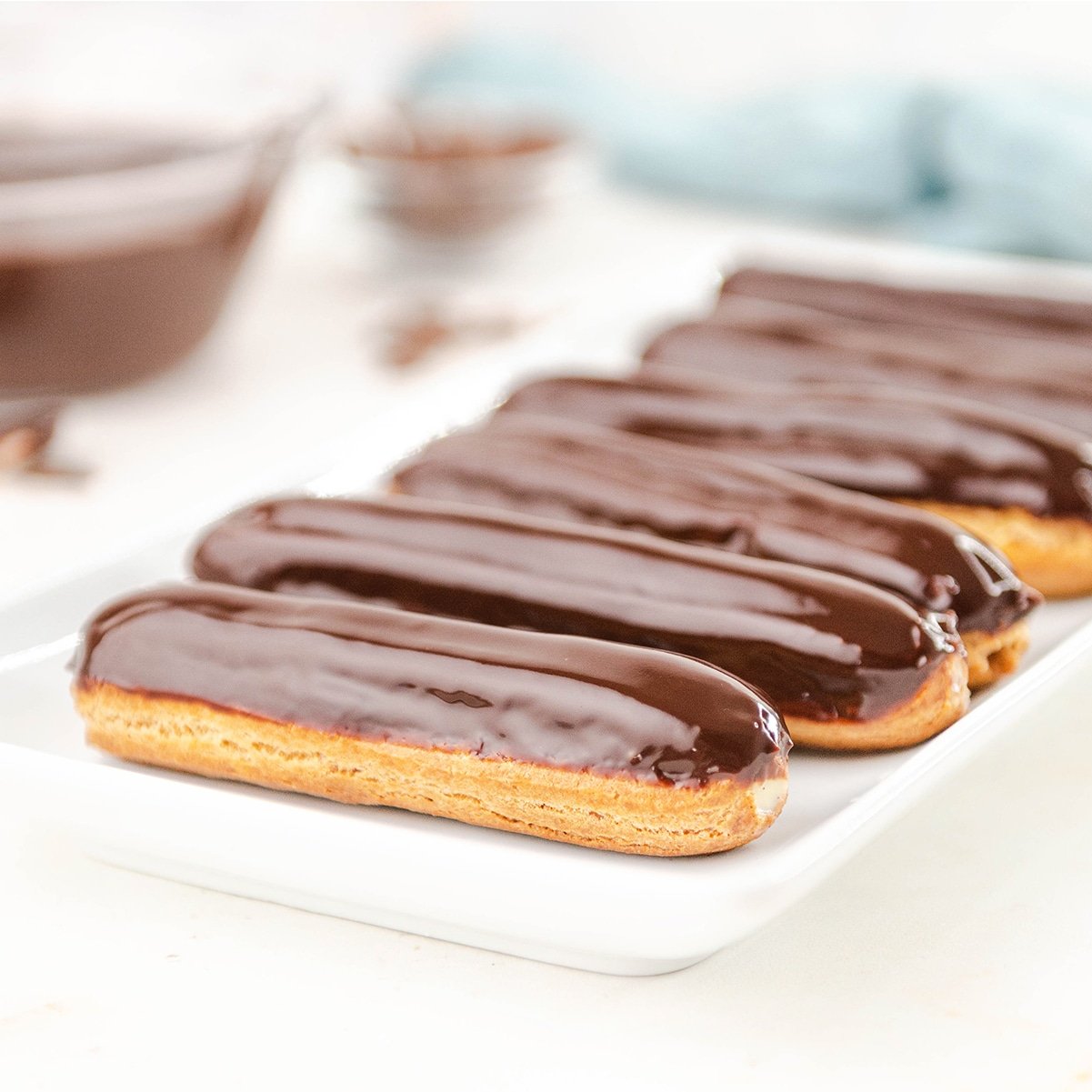
Eclair Recipe

Profiteroles

Naked Wedding Cake Tutorial

Recipe

wedding cream puff tower stacked on top of a marble plate in front of white background
Print Recipe
4.67 from 3 votes

Croquembouche

This super elegant Croquembouche looks almost too pretty to eat, but is just as delicious. This tower of cream puffs filled with vanilla bean pastry cream is held together with sweet and crunchy caramel and topped with spun sugar.
Prep Time3 hours hrs
Cook Time1 hour hr
Resting Time1 hour hr
Total Time5 hours hrs
Course: Dessert
Cuisine: French
Servings: 64 cream puffs
Calories: 142kcal
Author: Liz Marek

Equipment

  • 1 Stand mixer with the paddle attachment optional
  • 1 Candy thermomer for the caramel
  • 3 Pastry bags
  • 1 Croquembouche mold We are using an 18" tall, 10" wide croquebouche mold from Matfer, but you can use any kind of mold. 

Ingredients

Pâte à Choux

  • 320 grams whole milk
  • 320 grams water
  • 12 grams salt
  • 12 grams granulated sugar
  • 280 grams unsalted butter European butter like Plugra works best
  • 360 grams all purpose flour
  • 200 grams large eggs

Pastry Cream

  • 300 grams whole milk
  • 2 whole vanilla beans seeded
  • 100 grams egg yolks
  • 80 grams granulated sugar
  • 40 grams cornstarch

Caramel

  • 300 grams water
  • 100 grams glucose melted
  • 1000 grams granulated sugar

Instructions

Making Pâte à Choux

  • Note: This pâte à choux recipe is enough to make about 64 cream puffs. We did about 4 batches to make about 250 in total for an 18" high croquembouche.
    We made them in batches so as to not overwhelm our mixer. You will need to make multiple batches depending on what size croquembouche you’re making, the size of your cream puffs, and how much filling you use.
  • Add your milk, water, salt, sugar, and butter to a medium saucepan and bring it to a boil. The butter should be melted at the same time the milk starts to boil, so remove the pot from the heat to let the butter melt if needed. 
  • Once your milk mixture is boiling and the butter has completely melted, take your pot off the heat, add in your sifted flour, and mix together until it looks like mashed potatoes. It is best to use a wooden spoon, but a spatula is fine too.
  • Turn the heat back on to medium-high and continue to stir and keep it moving to dry out the dough.
  • Once you see a browning layer on the bottom of the pan the dough is dry enough. This is important, as it will help your cream puffs "puff" and ensure that they have a hollow center for the cream filling.
  • Put the dough into the bowl of a stand mixer with the paddle attachment and begin to mix on medium speed to cool it down, this should take about 30 seconds to 1 minute. When you can place your hand on the side of the bowl without it feeling too hot, it's done.
  • Slowly add in your eggs one at a time while mixing on low. Mix until the dough slowly falls in a v-shape off of your paddle. 
  • Prepare a pastry bag with a small metal round piping tip. Fill the piping bag with the pate a choux batter. 
  • Prepare a baking sheet pan with parchment paper. Chef Christophe is using a "silpain" baking mat on a cookie sheet for maximum airflow and evenly-baked cream puffs. 
  • Pipe the pâte à choux rounds slightly smaller than your desired final size (about 1-inch), as they will "puff" and expand in the oven.
  • Gently smooth the pointy top of the cream puff with a damp fingertip.
  • Bake the cream puffs at 350°F for 25-30 minutes until golden brown. Do not open the oven door or your cream puffs could collapse.
  • Cool the cream puffs completely to room temperature on a wire rack, for about 30 minutes.

Making Pastry Cream

  • Scrape out the vanilla pods by using a small knife to cut down the center of the bean, then use the back of the knife to gently scrape the pods out. (Only use the pods on the inside, do not use the skin of the bean.)
  • Add your milk, scraped vanilla bean, and half of the sugar into a large saucepan over medium heat and bring it to a boil.
  • Add your egg yolks, cornstarch, and the other half of the sugar into a large mixing bowl and whisk them together.
  • Pour some of the hot milk into the egg mixture to temper it. Pro-Tip: Tempering your yolks helps them reach the same temperature as your milk mixture. This makes it so all the ingredients mix together properly and don't curdle.
  • Then put everything back together into the pot and boil for about 1 minute until the mixture starts to thicken. Whisk constantly to prevent lumps.
  • Pour your pastry cream into a bowl, cover it with plastic wrap and refrigerate until you are ready to use it. Pro-tip: To cool pastry cream down quickly, lay down some plastic wrap on a sheet pan, spread the pastry cream out into a thin rectangular shape, and wrap it fully before chilling. 

Filling the Cream Puffs

  • Poke a small hole into the center of each pate a choux using a small round metal piping tip.
  • Fill your piping bag with the pastry cream. Pro Tip: Use a metal filling tip to easily fill your pate a choux.
  • Fill each cream puff with pastry cream and scrape the bottom over the edge of a small container so that it is clean. 
  • Set the cream puffs aside while you make your caramel.

Making the Caramel

  • Microwave the glucose for about 30 seconds to make it liquid.
  • Add the water, glucose, and sugar to a small pot, then attach a candy thermometer and bring it to a boil over medium-high heat.
  • Stir the mixture once when it comes to a boil, and then do not stir it again to avoid crystallization.
  • Cook the mixture until it reaches a medium brown caramel color, or about 345°F (174°C). Pro Tip: the darker the color of your caramel is, the more bitter it will taste. Based on your preference you can stop cooking the caramel once you have reached your desired color.
  • Place the pot of caramel into a bowl of ice water to cool down faster.

How to Stack a Croquembouche

  • First, prepare your workstation with the filled cream puffs, finished caramel, the metal cone, gloves, and silicone sphere molds or a prepared baking sheet to let the caramel set. We are dipping about half of the cream puffs in rock sugar to make a decorative pattern, but that is optional. You want to work quickly with the caramel so you don't have to keep reheating it. 
  • Carefully dip the top of each cream puff in hot caramel and place it upside down into a silicone sphere mold while the caramel sets. You can also place them on a sheet pan instead of a sphere mold, but your caramel may not be as evenly distributed. 
  • Dip about half of the cream puffs in caramel and then rock sugar, and leave the other half with just plain caramel. 
  • When the caramel gets thicker, place it back on the stove over low heat to make it warm again.
  • Continue dipping all of the cream puff tops in caramel and let the caramel cool. 
  • For the first layer of the croquembouche, dip one side of each cream puff in the caramel sauce and immediately place it onto the cone, starting at the bottom. Stick the sides of the cream puffs to each other and wrap them around the cone.
  • For the next layer, dip the side and bottom of the puff in caramel and glue it to the cream puff side and the cream puff below.
  • Continue this process up the top of the croquembouche.
  • Decorate with fresh orchids, spun sugar, or candles! 

Video

Notes

Baking Tips:
  • Purchase a kitchen scale if you don't already have one to make the best recipes. One cup of flour can vary from scoop to scoop depending on how packed the flour is, its humidity, and the type of flour, which can ruin your recipe.
  • Practice Mise en Place (everything in its place) which means you measure everything before you start mixing so you don't accidentally forget something or add any ingredients out of order. 
Serving a Croquembouche: 
  • Prep your filling and pate a choux dough ahead of time, then assemble your croquembouche the day you're going to serve it. 
  • Serve a croquembouche by cutting the cream puffs out with a knife, or using two forks to pry out each cream puff. 
  • Make sure to start at the top when serving! 
  • Leave the croquembouche on the cone while traveling.
  • Don't leave a croquembouche sitting out for longer than 5 hours.
Croquembouche Assembly Tips: 
  • This 18" tall croquembouche with about 250 cream puffs took about 5 hours in total to make. We had two people helping fill, dip, and assemble the cream puffs. 
  • We are using a croquembouche mold from Matfer, but you can use any kind of mold. 
  • It is possible to make this croquembouche all in one day, but you can also make the pate a choux and pastry cream ahead of time.
Pate a Choux Tips: 
  • Use a heavy bottom pot when making the choux dough so that the dough can stick to the bottom. A nonstick pan will be hard to determine when your dough is dried out properly. 
  • Avoid refrigerating the filled cream puffs overnight, or they will get soggy.
  • To make the choux ahead you have two options: 
    • One: Place the choux dough in multiple pastry bags and chill them overnight, then pipe, bake, fill, and assemble on the same day.
    • Two: Bake the cream puff shells the day before, store them in an airtight container at room temperature overnight, then crisp them up in a 350°F oven for 5 minutes the next day before filling, and assembling. 
*This post may contain affiliate links which means if you click on them, I might get a few pennies.

Nutrition

Serving: 1cream puff | Calories: 142kcal | Carbohydrates: 24g | Protein: 2g | Fat: 5g | Saturated Fat: 3g | Polyunsaturated Fat: 0.3g | Monounsaturated Fat: 1g | Trans Fat: 0.1g | Cholesterol: 39mg | Sodium: 85mg | Potassium: 28mg | Fiber: 0.2g | Sugar: 18g | Vitamin A: 164IU | Calcium: 18mg | Iron: 0.4mg
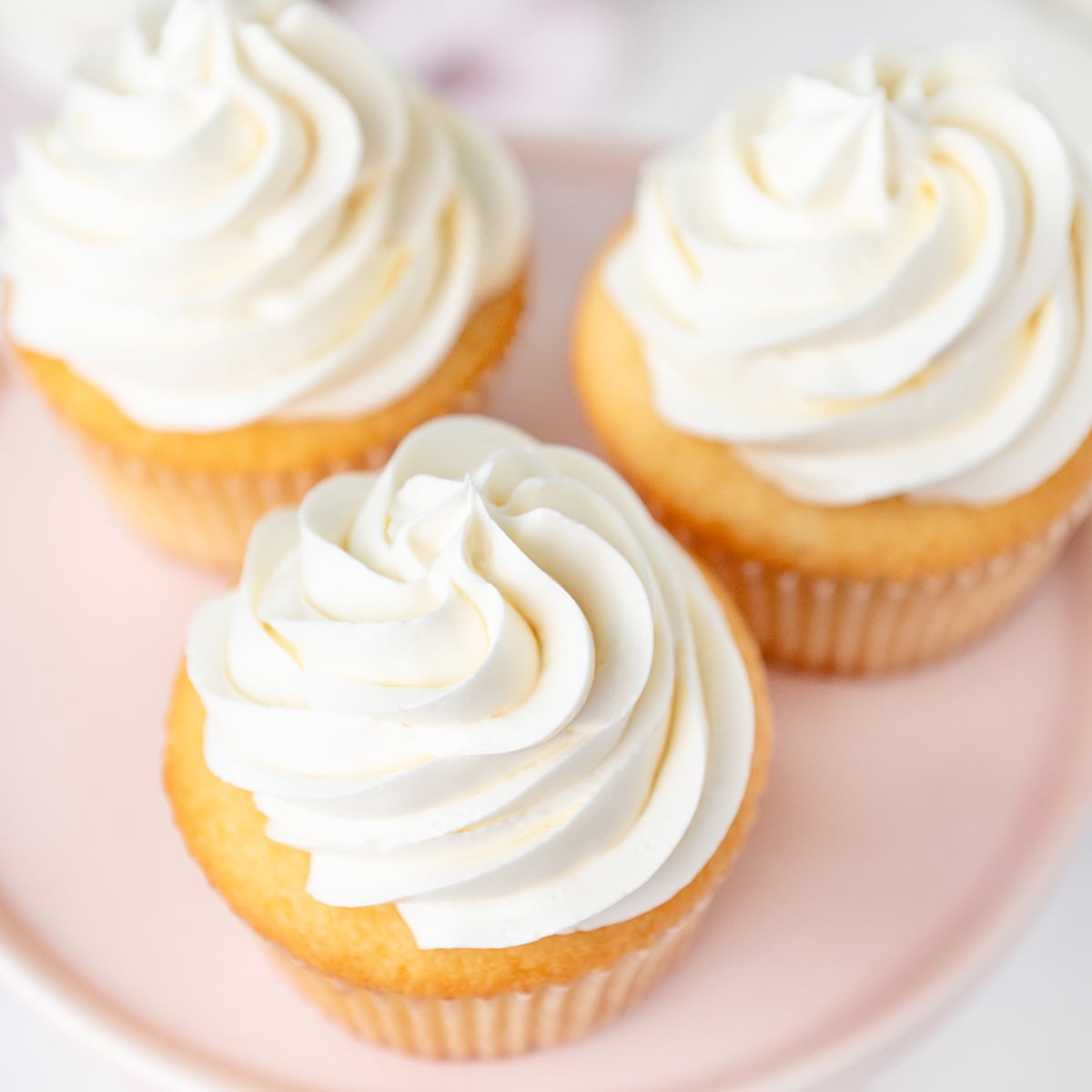
Swirls of swiss meringue buttercream on vanilla cupcakes on a pink plate.

October 28, 2022 Frosting and Icing

Swiss Meringue Buttercream

Swiss meringue buttercream is the frosting I reach for when I want something that tastes elegant rather than just sweet, with a silky, cloud-like texture that is unlike anything you can buy at the store. It is less sweet than American buttercream, more stable than whipped cream, and has a smooth, melt-in-your-mouth quality that makes every cake taste more professional. It pairs beautifully with my vanilla cake or vanilla cupcakes for a combination that never fails.

Swirls of swiss meringue buttercream on vanilla cupcakes on a pink plate.

Quick Glance: Swiss Meringue Buttercream

  • Recipe Name: Swiss Meringue Buttercream
  • Why You'll Love It: This is the frosting that professional bakers use on wedding cakes and high-end celebration cakes. It is silky, not too sweet, and stable enough to pipe, stack, and refrigerate without losing its texture.
  • Time and Difficulty: 25 minutes active + 10 minutes cooling | Intermediate
  • Main Ingredients: Fresh egg whites, granulated sugar, unsalted butter, vanilla extract, salt
  • Method: Double boiler to cook egg whites and sugar, whipped to stiff meringue, butter whipped in gradually
  • Texture and Flavor: Incredibly light and silky with a subtle sweetness and rich buttery flavor. Much less sweet than American buttercream.
  • Quick Tip: Cool your meringue completely before adding butter. Warm meringue melts the butter and turns your buttercream into soup.
ChatGPT
Google AI
Perplexity
Grok
Add us as a trusted site on Google
[feast_advanced_jump_to]

Why This Recipe Works

Swiss meringue buttercream gets its silky texture from a process called the Swiss method, which involves cooking egg whites and sugar together over a double boiler before whipping them into a meringue. This is different from Italian meringue buttercream, which uses a hot sugar syrup poured into already-whipping egg whites, and from easy buttercream, which skips the cooking entirely.

Cooking the egg whites with the sugar serves two purposes. First, it dissolves the sugar completely, which is what gives SMBC its smooth, non-gritty texture. American buttercream made with powdered sugar always has a slightly grainy finish by comparison. Second, it gently pasteurizes the egg whites so they are safe to eat in their uncooked meringue form.

The meringue needs to cool to room temperature before the butter goes in because fat and heat do not mix well. Butter that is too warm will melt into the meringue instead of emulsifying with it, which is why chilling the meringue for 10 minutes is a non-negotiable step. When the butter is added correctly at the right temperature, the proteins in the meringue trap tiny air bubbles throughout the fat, creating that signature light, whipped texture.

The final step of switching to the paddle attachment and mixing on low for 15 to 20 minutes is what separates a good SMBC from a great one. The paddle pushes out air bubbles and gives the buttercream an ultra-smooth, almost satin-like finish that is perfect for sharp edges and detailed piping.

Swiss Meringue Buttercream Ingredients

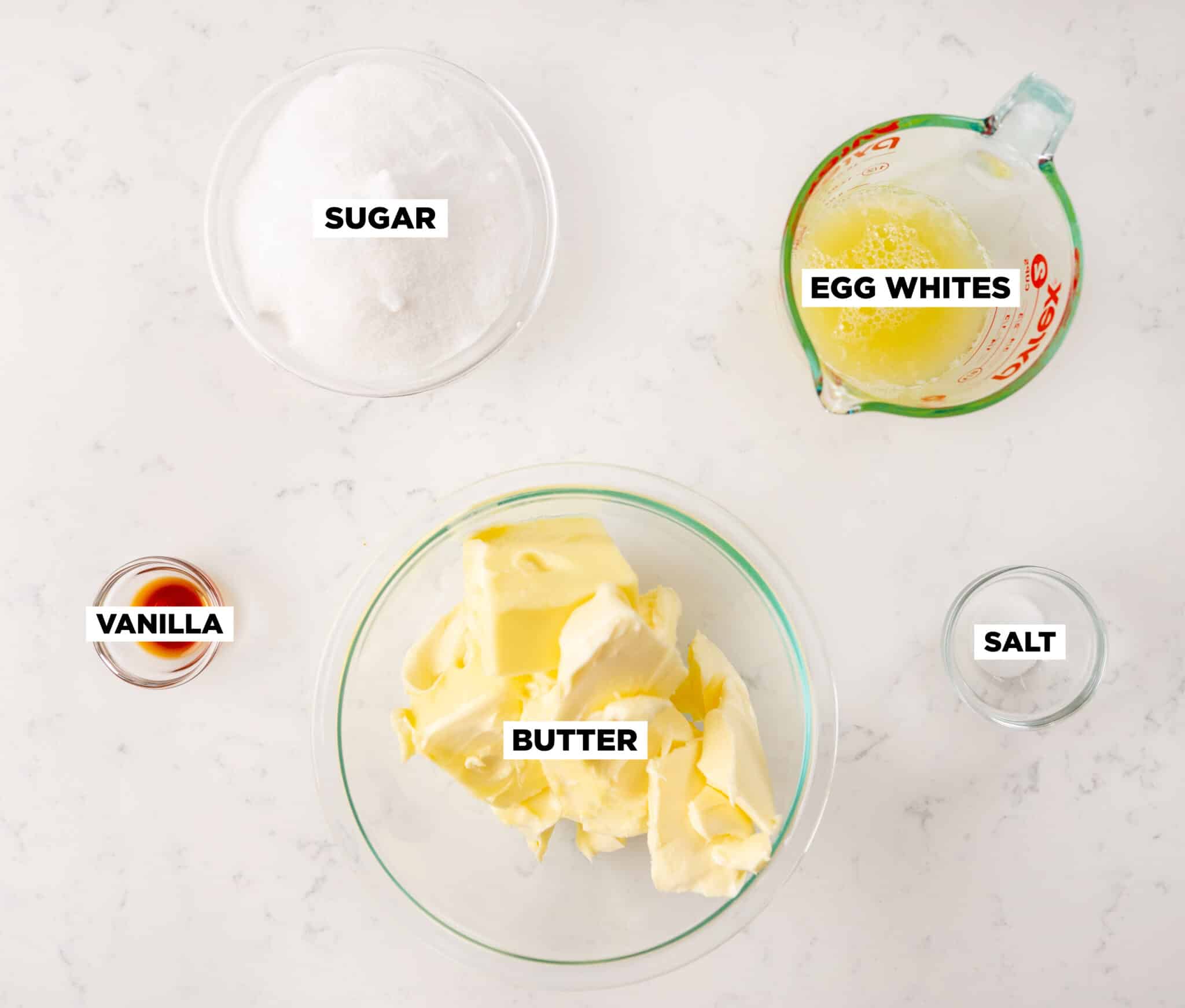
Here is everything you need to make Swiss meringue buttercream. Five ingredients, and each one plays a specific role.

Swiss meringue buttercream ingredients

Fresh egg whites create a more stable meringue than carton egg whites. Separating eggs yourself gives you the best results. The leftover egg yolks can be used for Boston cream pie or creme brulee so nothing goes to waste.

Granulated sugar dissolves into the egg whites over the double boiler and is what gives SMBC its smooth, non-gritty texture. Do not substitute powdered sugar here.

Unsalted butter must be at room temperature, soft enough to dent easily with your finger but not greasy or melting. This is the most important ingredient to get right. Cold butter will not emulsify into the meringue and warm butter will melt it. Salted butter can be used but will affect the flavor and you should omit the added salt.

Vanilla extract is the primary flavor of Swiss meringue buttercream, so quality matters. A good vanilla bean paste or pure vanilla extract makes a noticeable difference. Nielsen Massey is a great brand that uses sustainable practices.

Salt balances the sweetness and enhances the butter flavor. Do not skip it.

Swiss Meringue Buttercream Step-By-Step

PRO TIP: Wipe your bowl out with white vinegar first. A very clean metal bowl works best because meringue whips up more easily in metal than plastic.

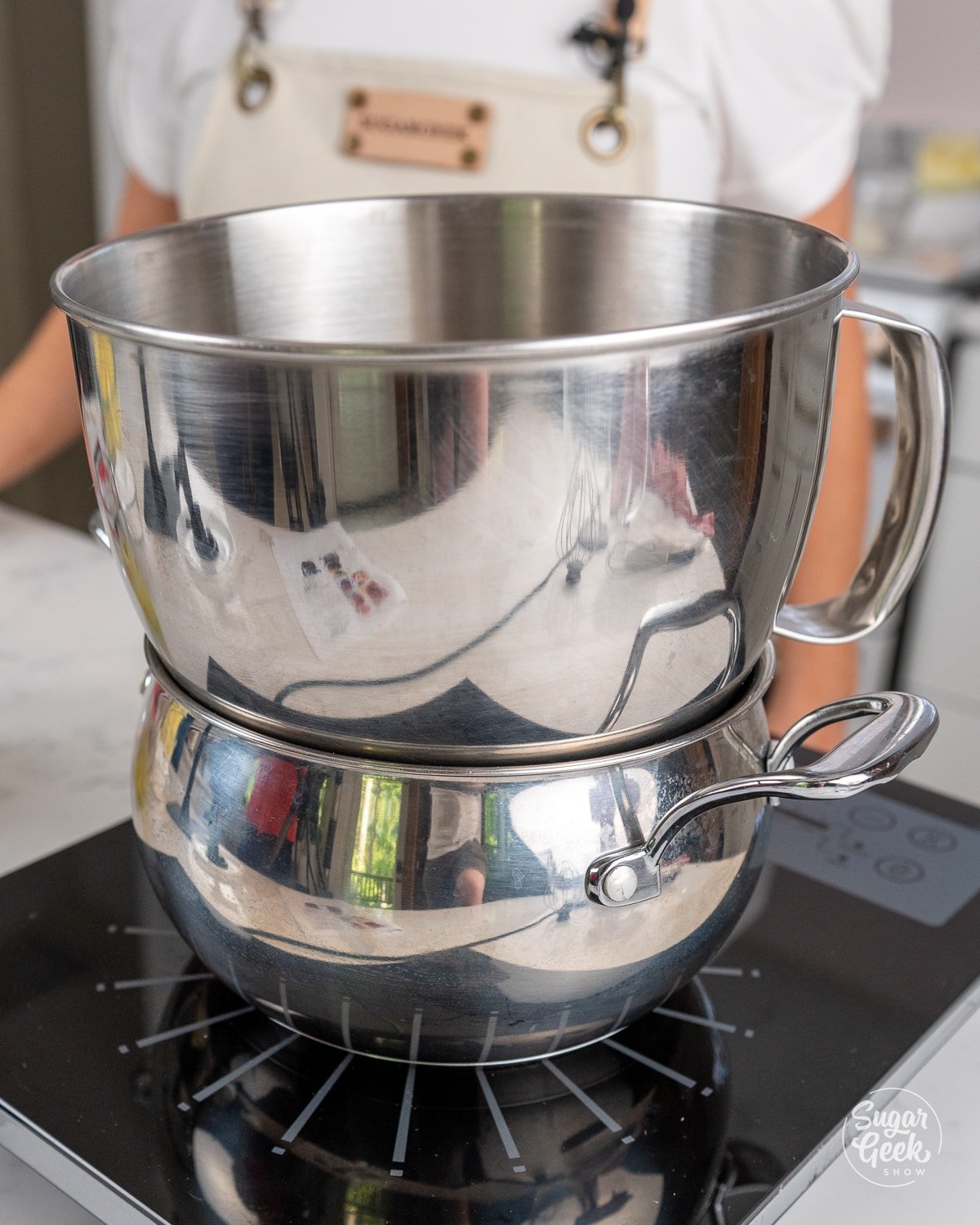
Picture of a metal stand mixing bowl on top of a pot of simmering water.
  1. Set up your double boiler. Fill a large pot with about 2 inches of water and bring it to a simmer. Place the metal bowl of your stand mixer on top of the pot. The water should not touch the bottom of the bowl.
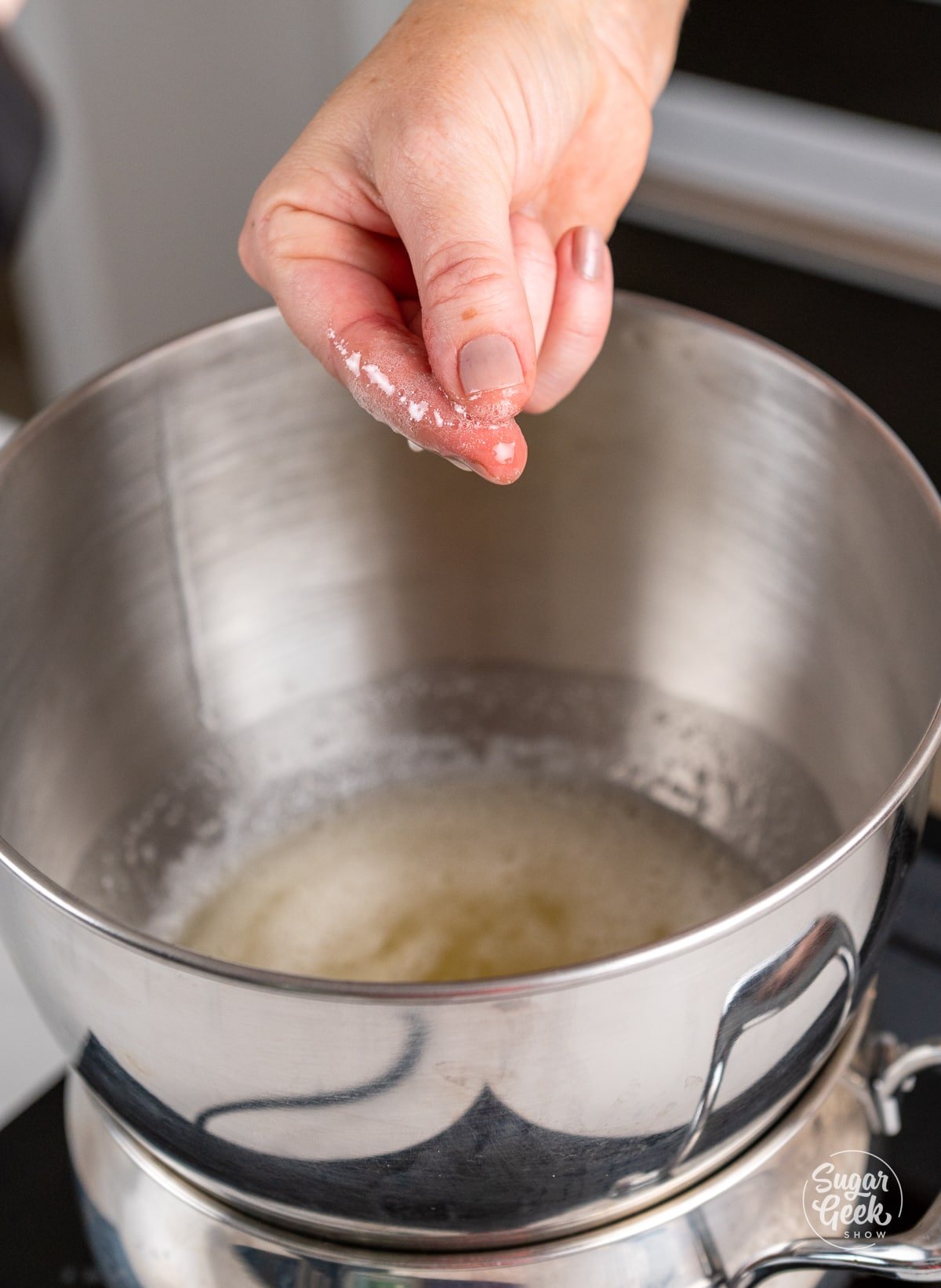
Hand rubbing egg whites between fingers over the bowl of a stand mixer.
  1. Combine and cook. Whisk together the egg whites, sugar, and salt in the mixing bowl.

    Cook the egg white mixture until it reaches 110 degrees, whisking constantly along the sides of the bowl to distribute the heat evenly. If you do not have a thermometer, rub a bit of the mixture between your fingers. When you can no longer feel any sugar granules, it is done.
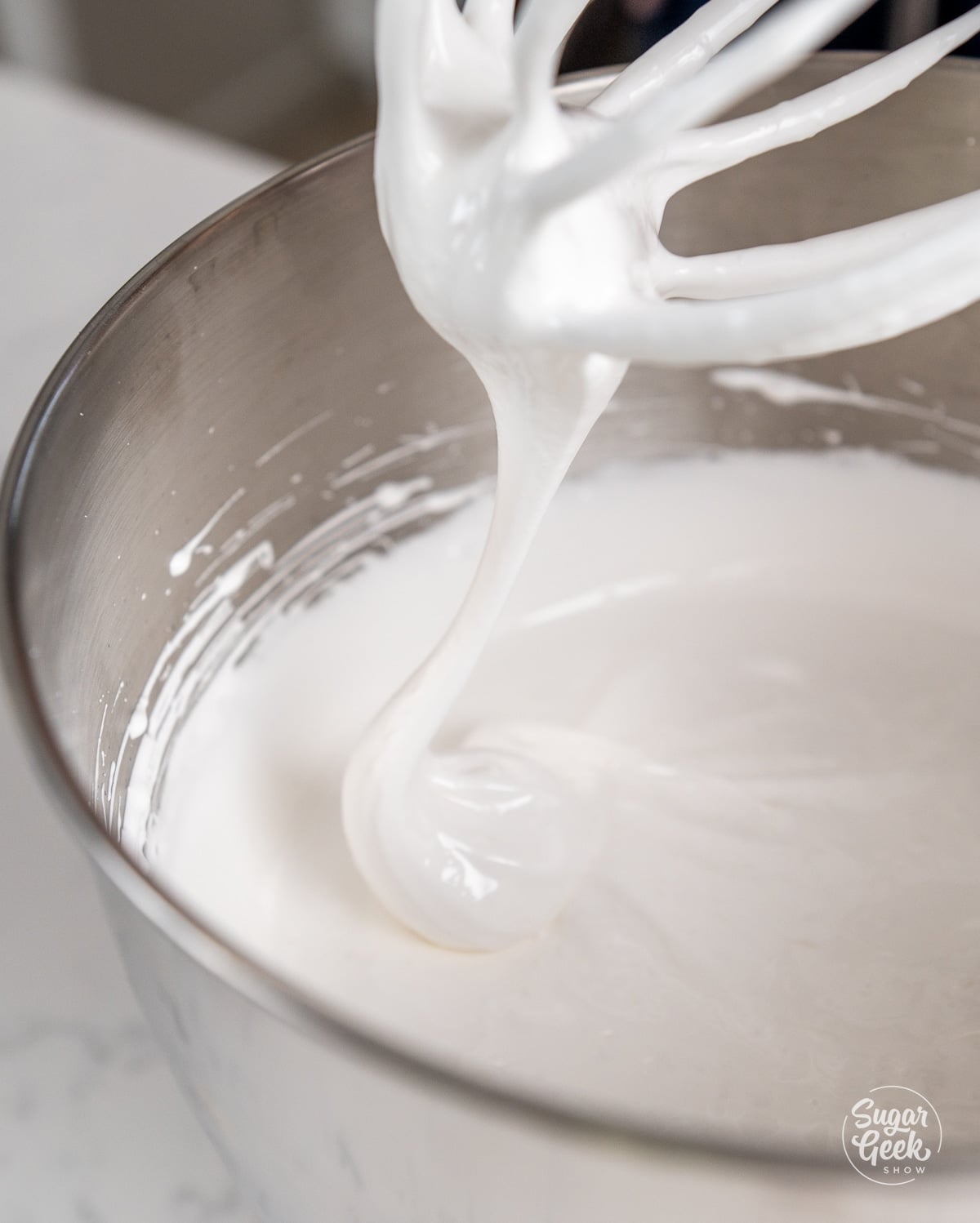
Close up of Swiss meringue on a whisk attachment above the bowl of a stand mixer.
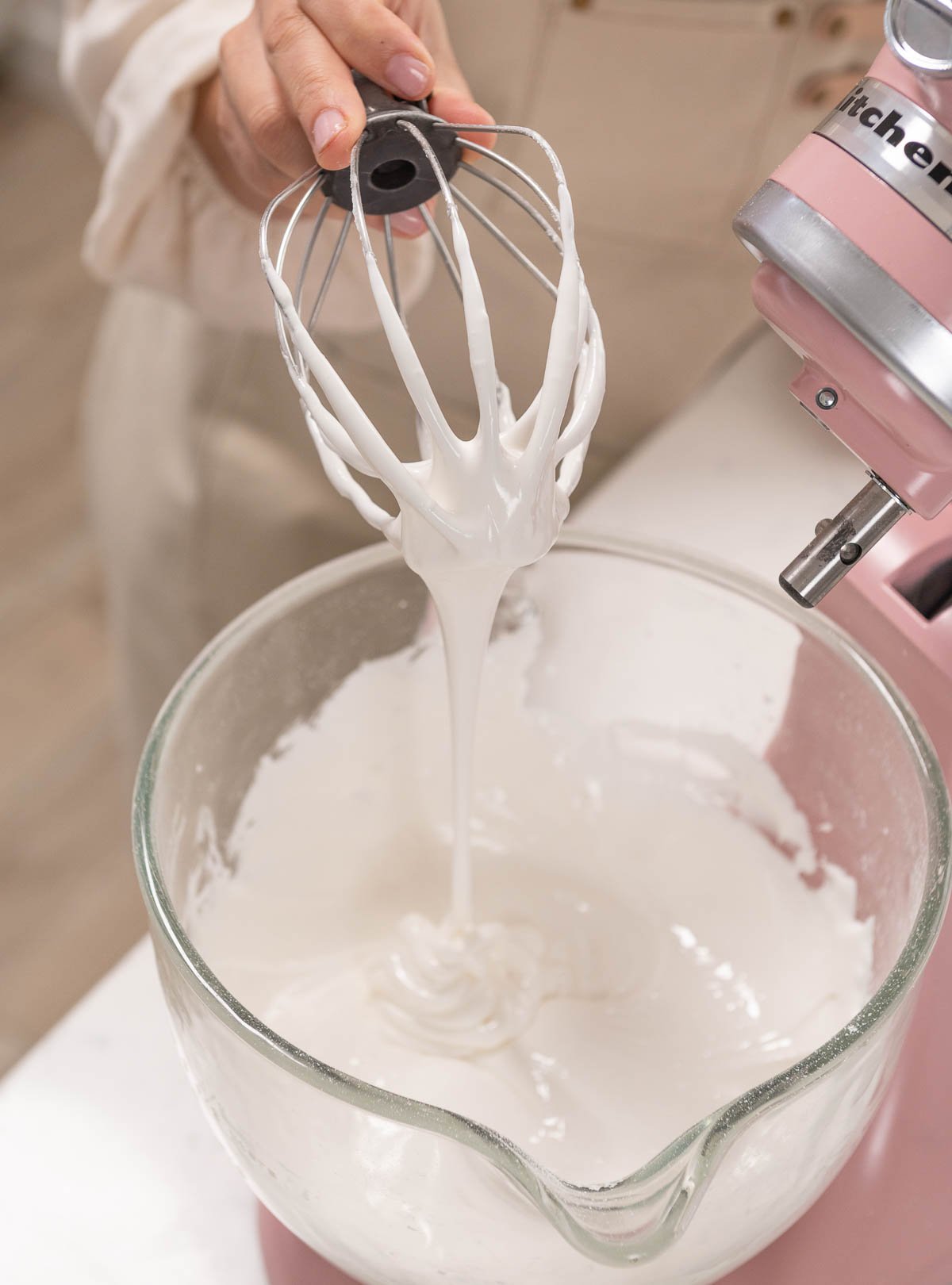
  1. Whip the meringue. Remove the bowl from the heat and transfer it to your stand mixer with the whisk attachment. You can use a hand mixer and a large bowl if needed, but it will take considerably longer. Whip on medium-high speed for 10 to 15 minutes until you reach glossy, stiff peaks. The meringue should be bright white and hold a firm shape.
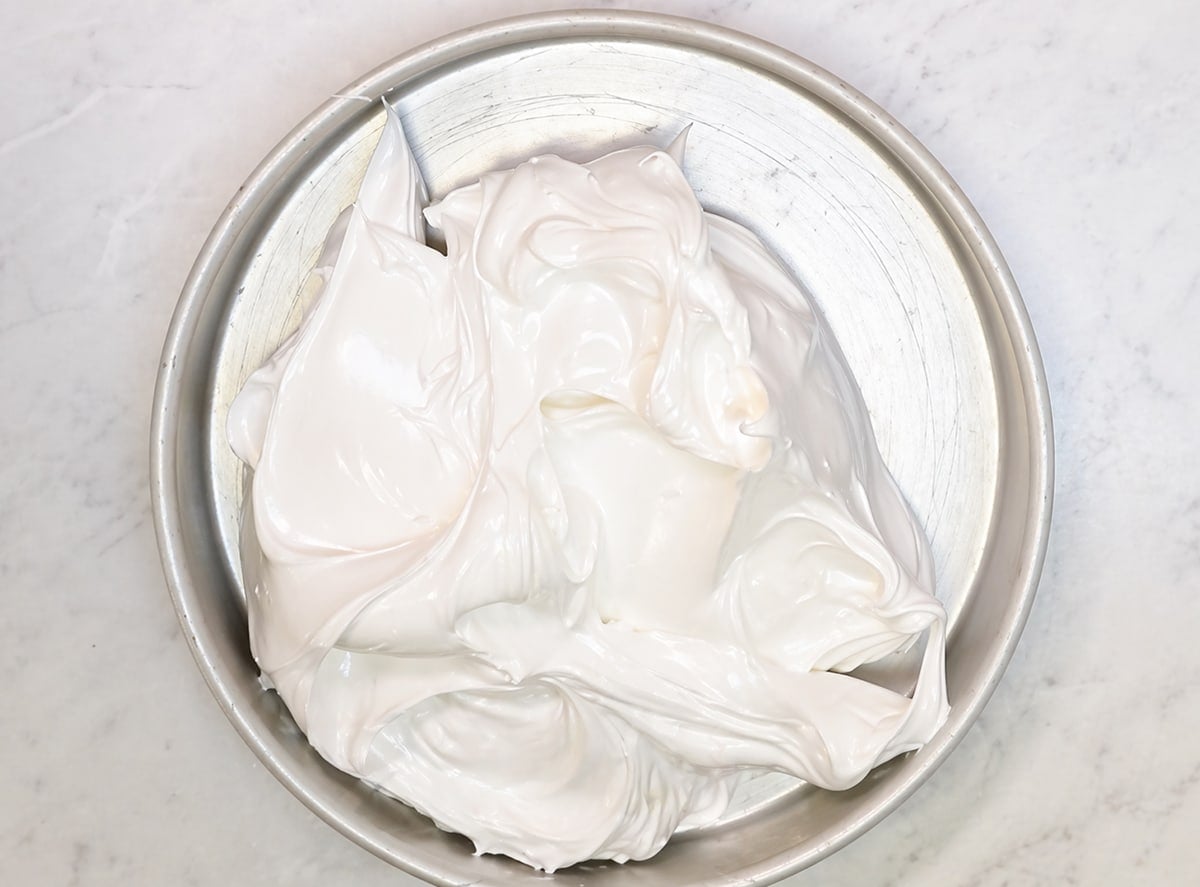
Meringue in a cake pan shot from above.
  1. Cool the meringue. Pour the meringue into a shallow dish and refrigerate for about 10 minutes to cool it to room temperature. You can also leave it in the bowl and refrigerate, but it will take longer to cool. Do not skip this step. Warm meringue will melt your butter and turn your buttercream into soup.
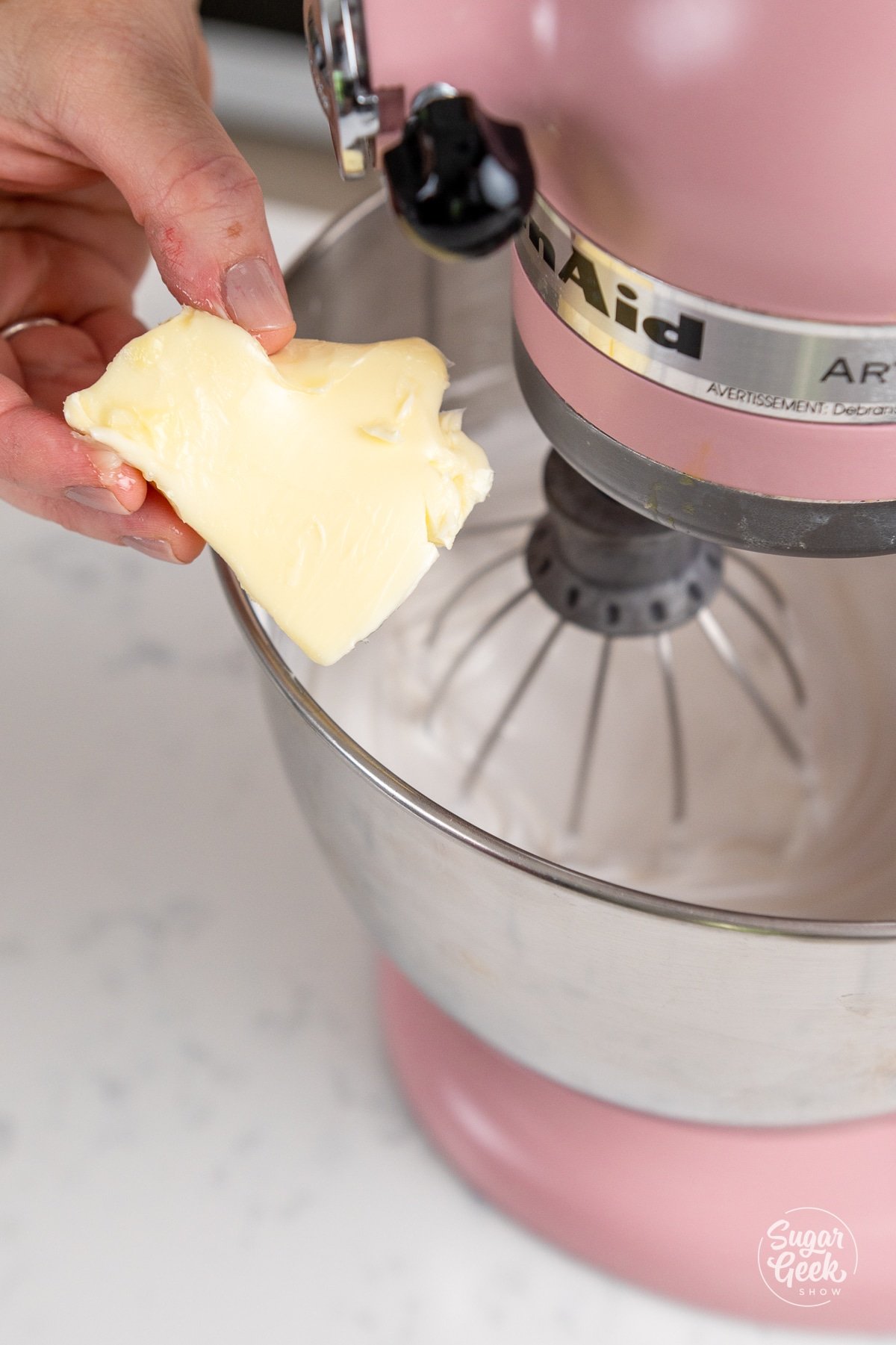
Hand adding butter into a bowl of whipping meringue in the bowl of a stand mixer.
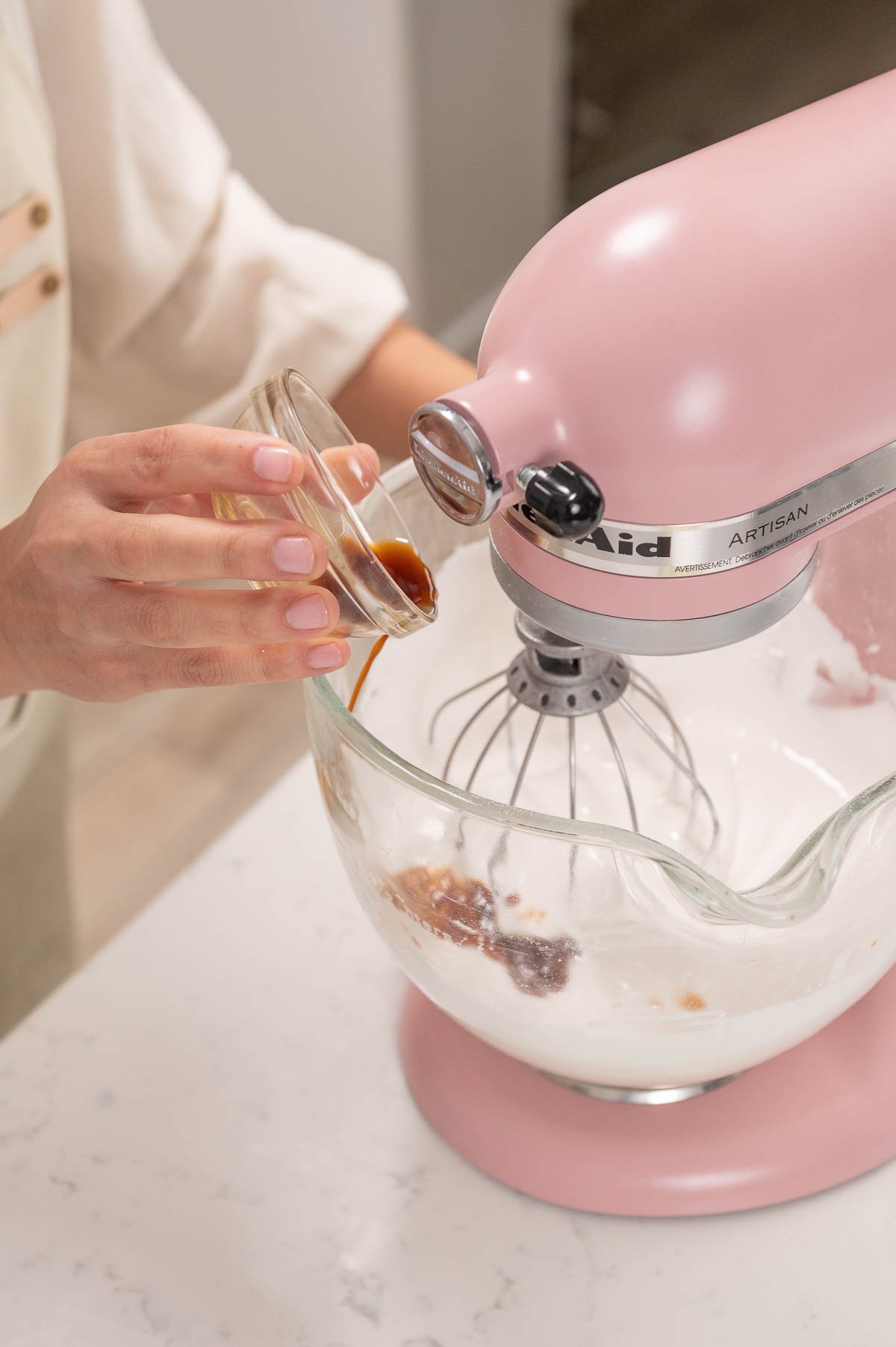
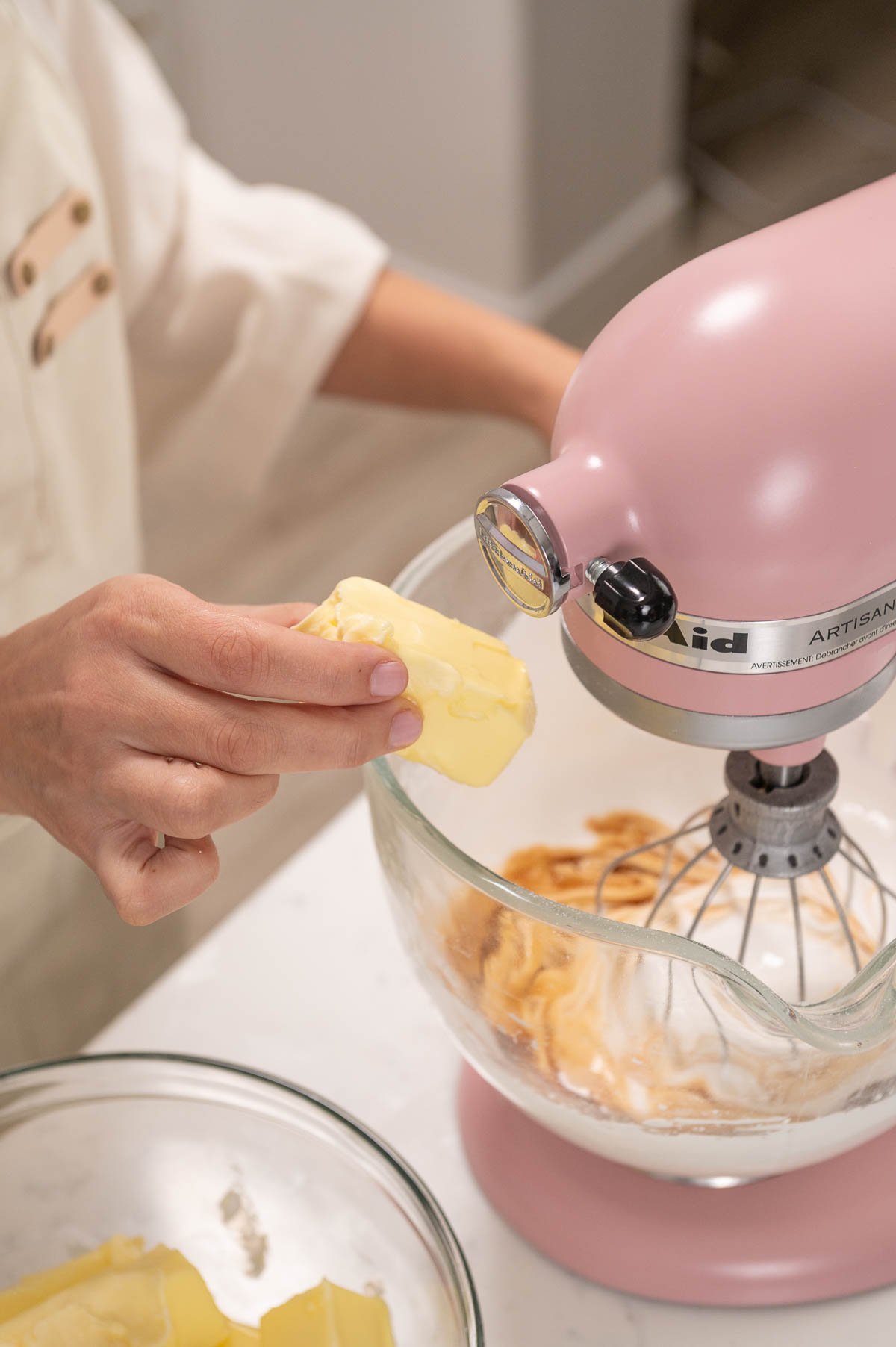
  1. Add the butter. Once the meringue is cooled, return it to your stand mixer with the whisk attachment. Add the room-temperature butter and vanilla and mix until fully combined.
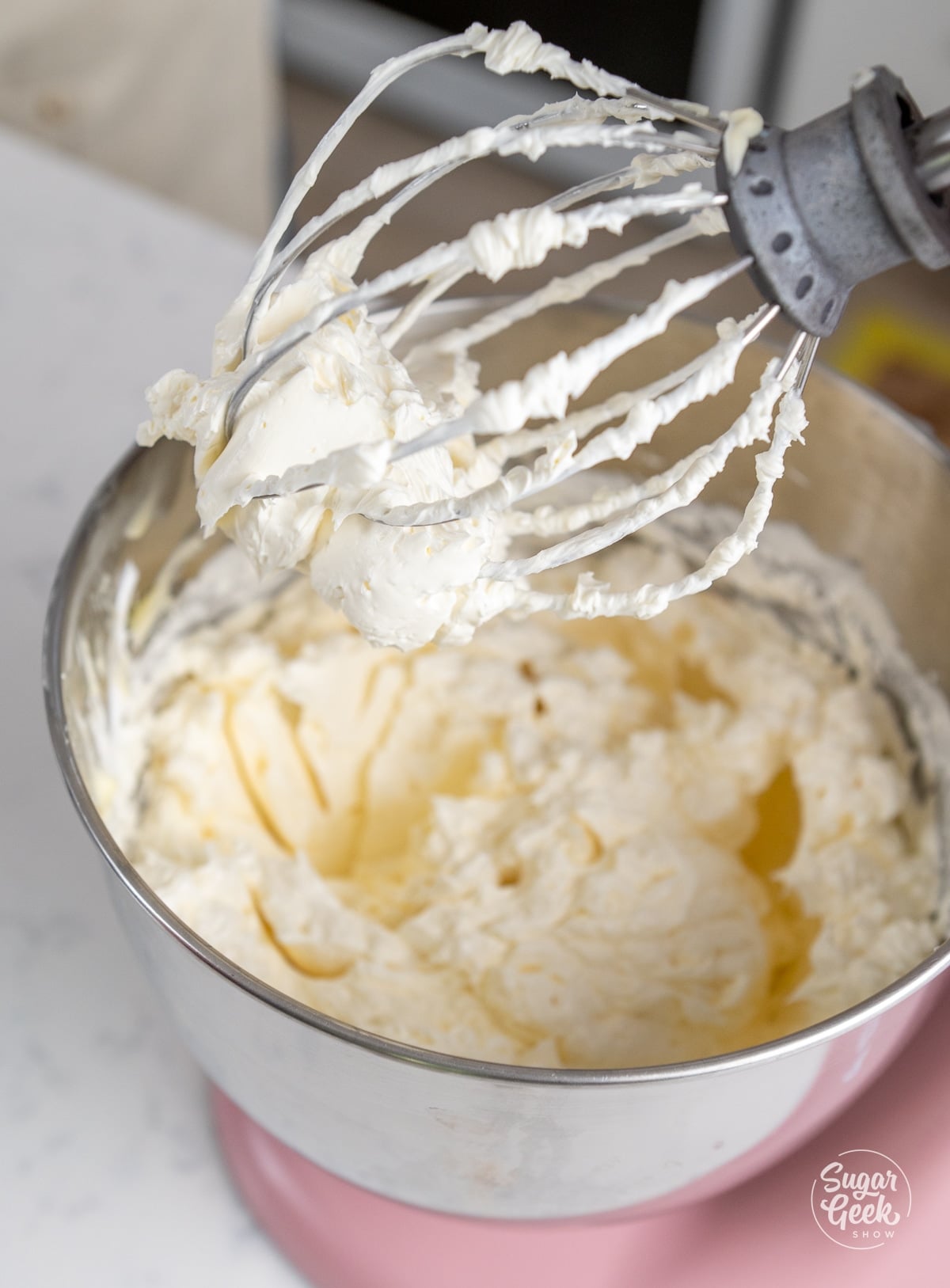
Close up of whipped swiss meringue buttercream on a whisk in the bowl of a stand mixer.
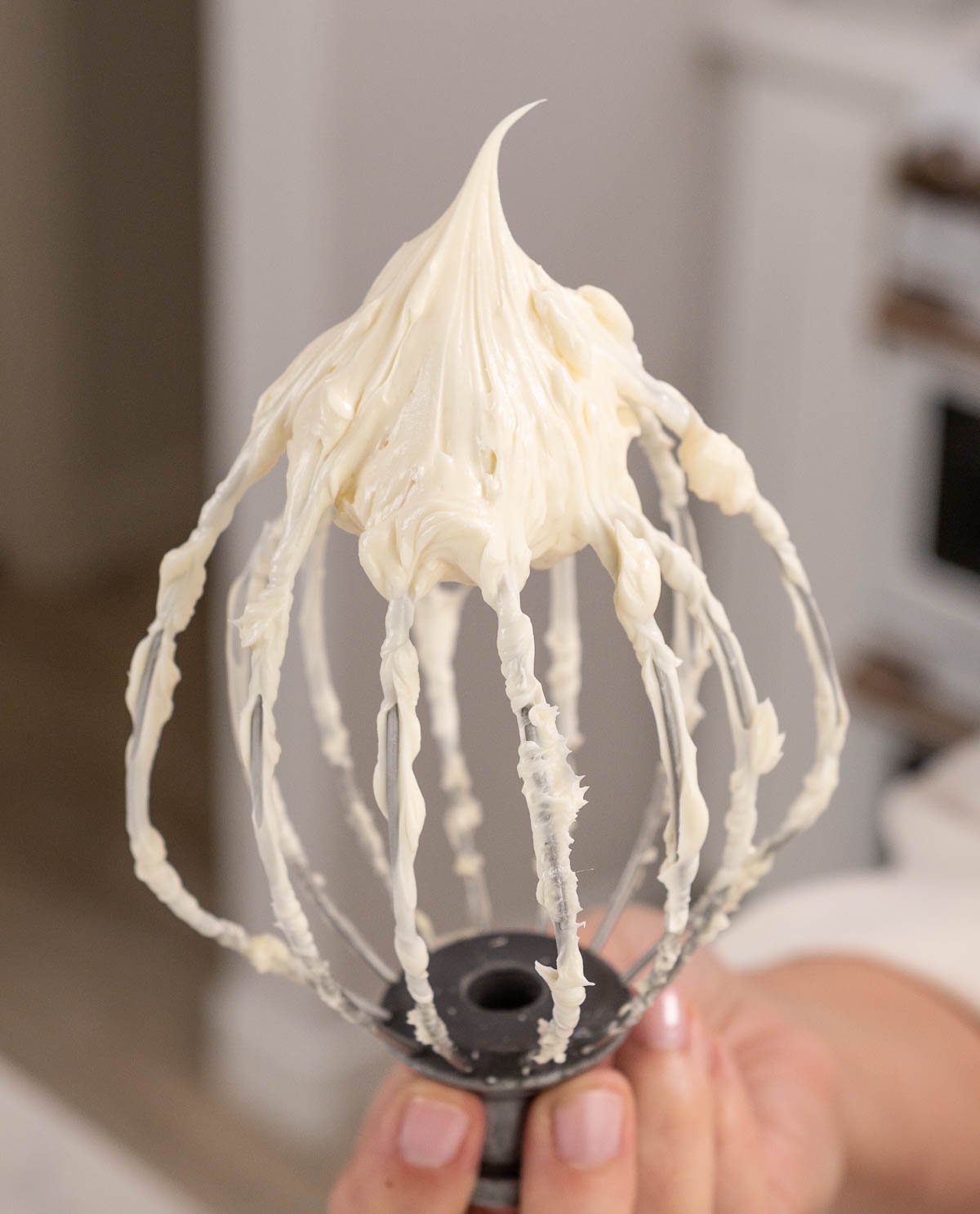
  1. Whip until fluffy. Whip the buttercream on medium-high speed until it is white, fluffy, and no longer tastes buttery. This takes 8 to 10 minutes. Pro tip: add a drop or two of violet gel food coloring to counteract the yellow from the butter and make your buttercream brighter white.
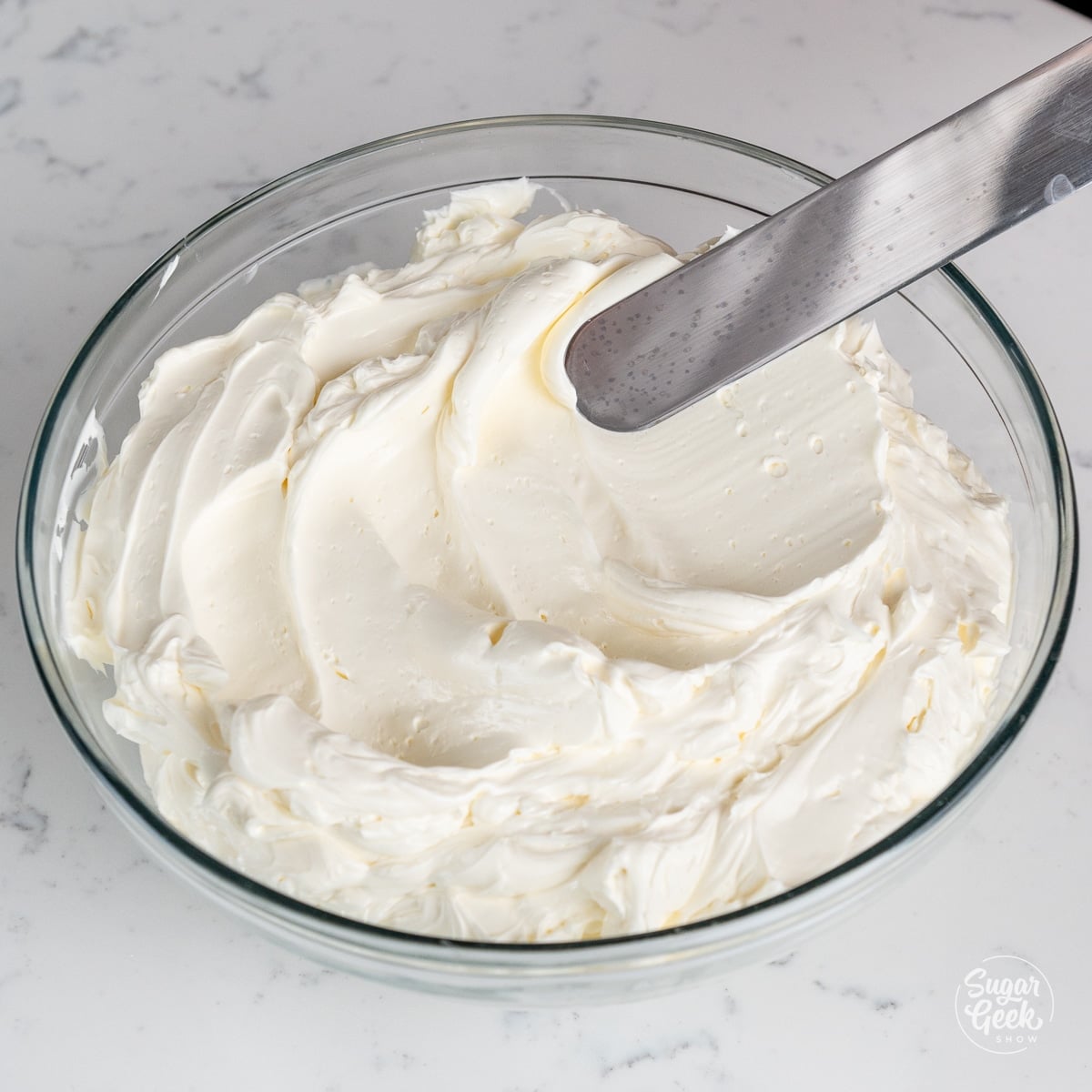
Swiss meringue buttercream in a clear bowl with a spatula.
  1. Finish with the paddle. Switch to the paddle attachment and mix on low speed for 15 to 20 minutes. This removes air bubbles and creates an ultra-smooth, silky texture. This step is optional but if you want that perfectly creamy, professional finish, do not skip it.

Batter & Frosting Calculator

Cake Batter and Frosting Calculator

Select an option below to calculate how much batter or frosting you need. Adjust the servings slider on the recipe card to change the amounts the recipe makes.

Choose a pan type

Choose a cake pan size
(based on 2" tall cake pan)

Choose a cake pan size
(based on 2" tall cake pan)

Choose a cake pan size
(based on 2" tall cake pan)

Cupcake Tin Size

Choose number of pans

Cups of Batter Needed

8 cups

Cups of Frosting Needed

5 cups

Note: measurements are estimated based off the vanilla cake recipe using standard US cake pans and sizes. Measurements used are for 2" tall cake pans only. Your results may vary. Do not overfill cake pans above manufacturer's recommended guidelines.

This recipe makes enough to frost and fill a two-layer 8-inch cake or frost about 24 cupcakes. Store leftovers in an airtight container in the fridge for 1 week or freeze for up to 6 months.

Common Mistakes To Avoid

Using carton egg whites. Carton egg whites are pasteurized at high heat which denatures some of the proteins and makes them harder to whip into a strong, stable meringue. Fresh egg whites from whole eggs give you a much more reliable result.

Any fat in the bowl. Even a trace of fat from egg yolk or residue will prevent your egg whites from whipping properly. Wipe your bowl and whisk with white vinegar before starting to remove any grease.

Not cooking to the right temperature. The egg white and sugar mixture needs to reach 110 degrees, and all sugar granules need to be fully dissolved. Under-cooking leaves a gritty texture in the finished buttercream.

Adding butter to warm meringue. This is the most common failure point. If the meringue is still warm when the butter goes in, the butter melts and the buttercream looks like soup. Cool the meringue to room temperature before adding any butter, no exceptions.

Butter that is too cold. Cold butter will not emulsify smoothly into the meringue and will leave lumps. Your butter should be soft enough to press your finger into easily but still holding its shape.

Stopping too soon. SMBC goes through a curdled, broken-looking stage before it comes together. Many people panic and stop at this point thinking it has failed. Keep mixing. It will come together into a smooth, fluffy buttercream within a few minutes.

Skipping the paddle step. The whisk incorporates air, which gives you volume. The paddle removes excess air, which gives you smoothness. If you want a truly silky finish for sharp-edged cakes, the 15 to 20 minutes on the paddle makes all the difference.

Swiss Meringue Buttercream FAQs

Can you use Swiss meringue buttercream under fondant?

Yes. SMBC is one of the best frostings to use under fondant because it creates a smooth, firm surface when chilled. Frost your cake, refrigerate it until the buttercream is firm, then apply your fondant over the cold surface for the cleanest finish.

What is the difference between Italian buttercream and Swiss meringue buttercream?

Both are meringue-based buttercreams, but they use different methods. Swiss meringue heats the egg whites and sugar together over a double boiler before whipping. Italian meringue buttercream pours a hot sugar syrup into already-whipping egg whites. Italian is considered slightly more stable and has a firmer texture. Swiss is a bit easie

Will Swiss meringue buttercream melt?

SMBC is more heat-stable than American buttercream but it will soften in very warm temperatures. It holds up well in air-conditioned environments and is stable enough for tiered cakes and wedding cakes. In high heat or direct sun, any butter-based frosting will eventually soften.

Can you put Swiss meringue buttercream in the fridge?

Yes. Store it in an airtight container in the fridge for up to 1 week. When you are ready to use it, bring it back to room temperature and re-whip it with the paddle attachment until smooth and fluffy again.

How long can you leave Swiss meringue buttercream out?

A frosted cake can sit at room temperature for up to 2 days in a cool environment. For longer storage, refrigerate the cake and bring it to room temperature before serving.

Can you make this into Swiss chocolate buttercream?

Yes. Once your buttercream is finished, fold in melted and cooled dark chocolate to taste. The exact ratios depend on how chocolatey you want the final result, so start with a small amount and add more until you reach your desired flavor.

Can you color Swiss meringue buttercream?

Yes. Use gel food coloring rather than liquid for the most vibrant results. Add color after the buttercream is fully whipped and mix until evenly distributed. Adding a tiny drop of violet gel helps neutralize the yellow from the butter and gives you a truer white base to start from.

More Frosting Recipes To Try

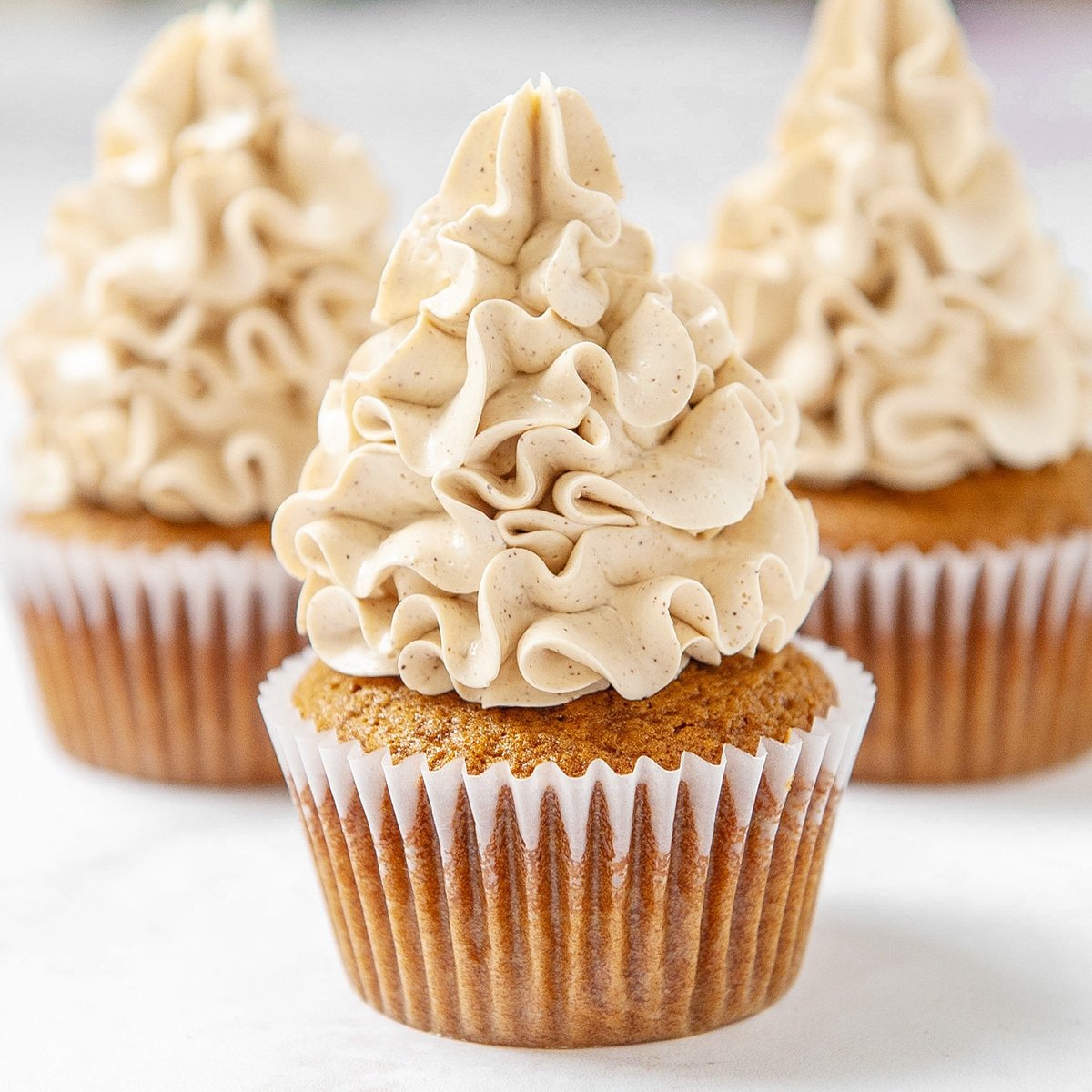
  • close up of brown sugar swiss meringue buttercream on a cupcake
    Brown Sugar Swiss Meringue Buttercream
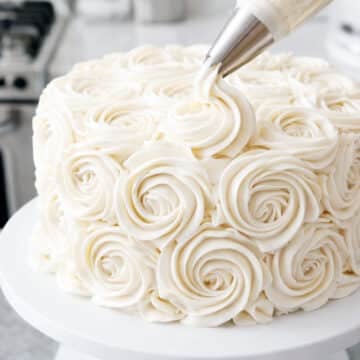
  • Piping easy buttercream rosettes onto a cake using a 1M star piping tip
    Easy Buttercream Frosting
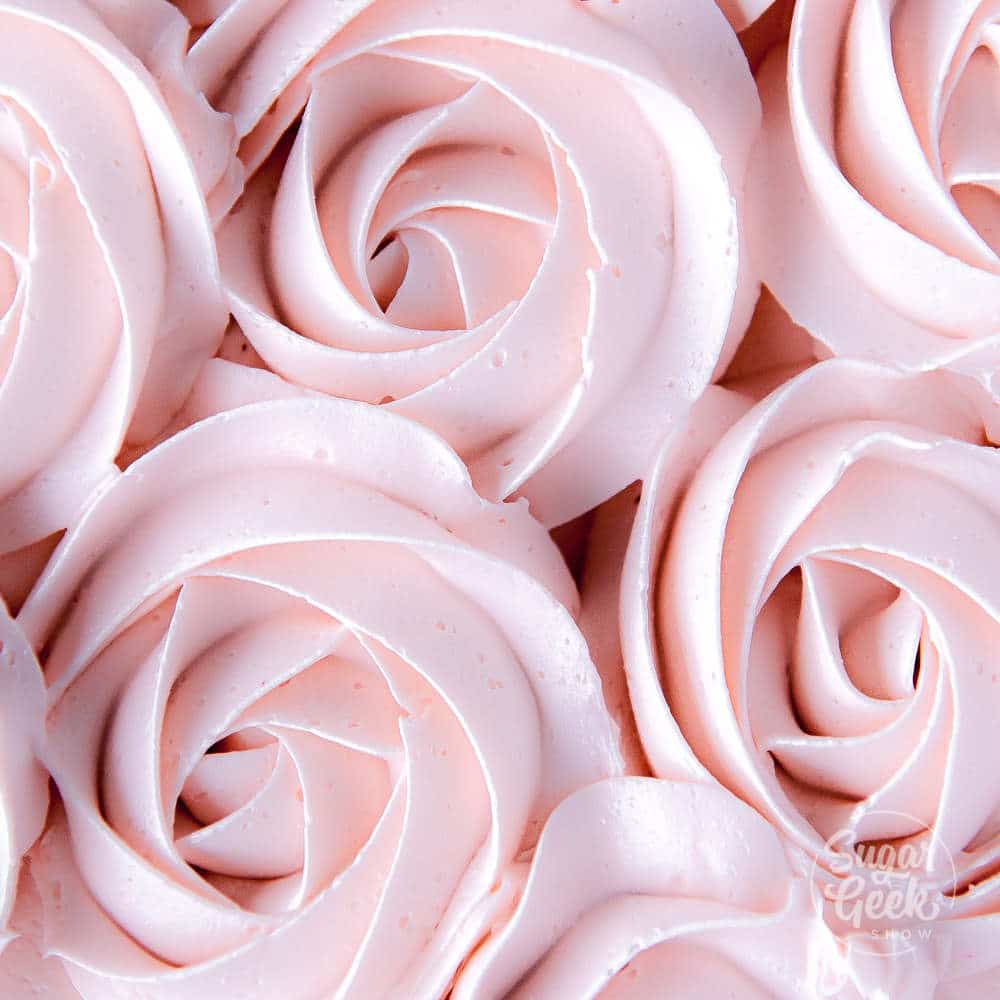
  • Close up of pink Italian meringue buttercream piped into rosettes.
    Italian Meringue Buttercream
  • chocolate swiss meringue piped onto a cake
    Chocolate Swiss Meringue Buttercream


Leave Me A Review
⭐️⭐️⭐️⭐️⭐️

If you tried this Swiss Meringue Buttercream Recipe or any other recipe on my blog, please leave a 🌟 star rating and let me know how it goes in the comments. I love hearing from you!

Recipe

Swirls of swiss meringue buttercream on vanilla cupcakes on a pink plate.
Print Recipe
4.84 from 124 votes

Swiss Meringue Buttercream (SMBC)

Swiss meringue buttercream comes together with just 5 ingredients and is amazingly delicious. The smooth and silky texture melts in your mouth but is stable enough to use for wedding cakes and birthday cakes. Add some fresh fruit puree, lemon extract, or chocolate to customize your SMBC and pair it with your favorite chocolate cake, vanilla cupcakes, or Funfetti cake.
Prep Time15 minutes mins
Cook Time10 minutes mins
cooling10 minutes mins
Total Time25 minutes mins
Course: Dessert
Cuisine: French
Servings: 8 cups
Calories: 141kcal
Author: Liz Marek

Equipment

  • 1 stand mixer with the whisk and paddle attachments

Ingredients

Swiss Meringue Buttercream Ingredients

  • 8 ounces fresh egg whites about 8
  • 16 ounces granulated sugar
  • 24 ounces unsalted butter room temperature. You can use salted butter, but it will affect the taste and you need to leave out additional salt
  • 2 teaspoons vanilla extract
  • ½ teaspoon salt
US Customary - Metric

Instructions

Making Swiss Meringue Buttercream

  • Fill a large pot with about 2 inches of water and bring it to a simmer.
  • Place the metal bowl of your stand mixer on top of the pot of water to create a bain-marie (or double boiler). The water should not touch the bottom of the bowl.
  • Whisk together the egg whites, sugar, and salt in the mixing bowl. Pro-tip: Wipe your bowl out with white vinegar before making the meringue. A very clean metal bowl will work best for this as the meringue is easier to whip up in metal rather than plastic.
  • Cook the egg white mixture until it reaches 110ºF (43ºC) and constantly whisk the sides of the bowl to distribute the heat evenly. If you don't have an instant-read thermometer, when you can no longer feel any sugar granules in the egg whites with your finger, it's done.
  • Remove the bowl from the heat and transfer it to your stand mixer with the whisk attachment. You can use a hand mixer and a large bowl to mix your meringue, it will just take a lot longer to mix.
  • Whip the egg and sugar mixture on medium-high speed for 10 to 15 minutes, or until you reach glossy, stiff peaks. 
  • Pour your meringue out into a shallow dish and refrigerate it for about 10 minutes to cool the meringue to room temperature. You can also put your entire bowl of meringue into the fridge, but it will take longer to cool. If you don't cool the meringue it will melt your butter and then you'll have buttercream soup.
  • Once your meringue is cooled, put it back in your stand mixer bowl with the whisk attachment. 
  • Add the room-temperature butter, vanilla, and mix until it's all combined. 
  • Whip the buttercream on medium/high speed until it is white, fluffy, and doesn't taste buttery, this can take 8-10 minutes. Pro-Tip: To counteract the yellow in your buttercream, add a drop or two of violet food color gel to make it whiter.
  • Switch to a paddle attachment and mix it on low speed for 15-20 minutes to make the buttercream very smooth and remove air bubbles. This isn't required, but if you want really creamy frosting, you do not want to skip it!
  • This recipe is enough to frost and fill a two-layer 8" x 2" cake, or frost about 24 cupcakes. Store any leftovers in an airtight container in the fridge for 1 week, or freeze for up to 6 months.

Video

Notes

Bring all your butter to room temperature before starting. It should be soft enough to press your finger into easily but still holding its shape. This is the most important step for success.
Wipe your bowl and whisk with white vinegar before you start to remove any grease or residue. Even a tiny amount of fat will prevent your egg whites from whipping properly.
Do not add butter to warm meringue. Cool the meringue in the fridge for 10 minutes first. Warm meringue will melt the butter and turn your buttercream into soup.
If your buttercream looks curdled or broken, keep mixing. It goes through an ugly stage before it comes together. Give it another 5 minutes and it will smooth out.
To make your buttercream whiter, add a tiny drop of violet gel food coloring to neutralize the yellow from the butter.
To re-use refrigerated buttercream, bring it to room temperature and re-whip with the paddle attachment until smooth and fluffy again.
This recipe makes enough to frost and fill a two-layer 8-inch cake or frost about 24 cupcakes.
Store in an airtight container in the fridge for up to 1 week or freeze for up to 6 months.


Nutrition

Serving: 4oz | Calories: 141kcal | Carbohydrates: 9g | Fat: 11g | Saturated Fat: 7g | Cholesterol: 30mg | Sodium: 34mg | Potassium: 11mg | Sugar: 9g | Vitamin A: 355IU | Calcium: 4mg
{ "@context": "https://schema.org", "@type": "WebPage", "name": "Swiss Meringue Buttercream", "url": "https://sugargeekshow.com/recipe/swiss-meringue-buttercream/", "description": "How to make silky smooth Swiss meringue buttercream using the double boiler method, with troubleshooting tips and flavor variations.", "about": [ { "@type": "Thing", "name": "Meringue", "sameAs": "https://en.wikipedia.org/wiki/Meringue" }, { "@type": "Thing", "name": "Buttercream", "sameAs": "https://en.wikipedia.org/wiki/Buttercream" }, { "@type": "Thing", "name": "Egg white", "sameAs": "https://en.wikipedia.org/wiki/Egg_white" }, { "@type": "Thing", "name": "Bain-marie", "sameAs": "https://en.wikipedia.org/wiki/Bain-marie" }, { "@type": "Thing", "name": "Butter", "sameAs": "https://en.wikipedia.org/wiki/Butter" }, { "@type": "Thing", "name": "Vanilla extract", "sameAs": "https://en.wikipedia.org/wiki/Vanilla_extract" }, { "@type": "Thing", "name": "Emulsion", "sameAs": "https://en.wikipedia.org/wiki/Emulsion" }, { "@type": "Thing", "name": "Cake decorating", "sameAs": "https://en.wikipedia.org/wiki/Cake_decorating" }, { "@type": "Thing", "name": "Confectionery", "sameAs": "https://en.wikipedia.org/wiki/Confectionery" }, { "@type": "Thing", "name": "Pasteurization", "sameAs": "https://en.wikipedia.org/wiki/Pasteurization" } ] }
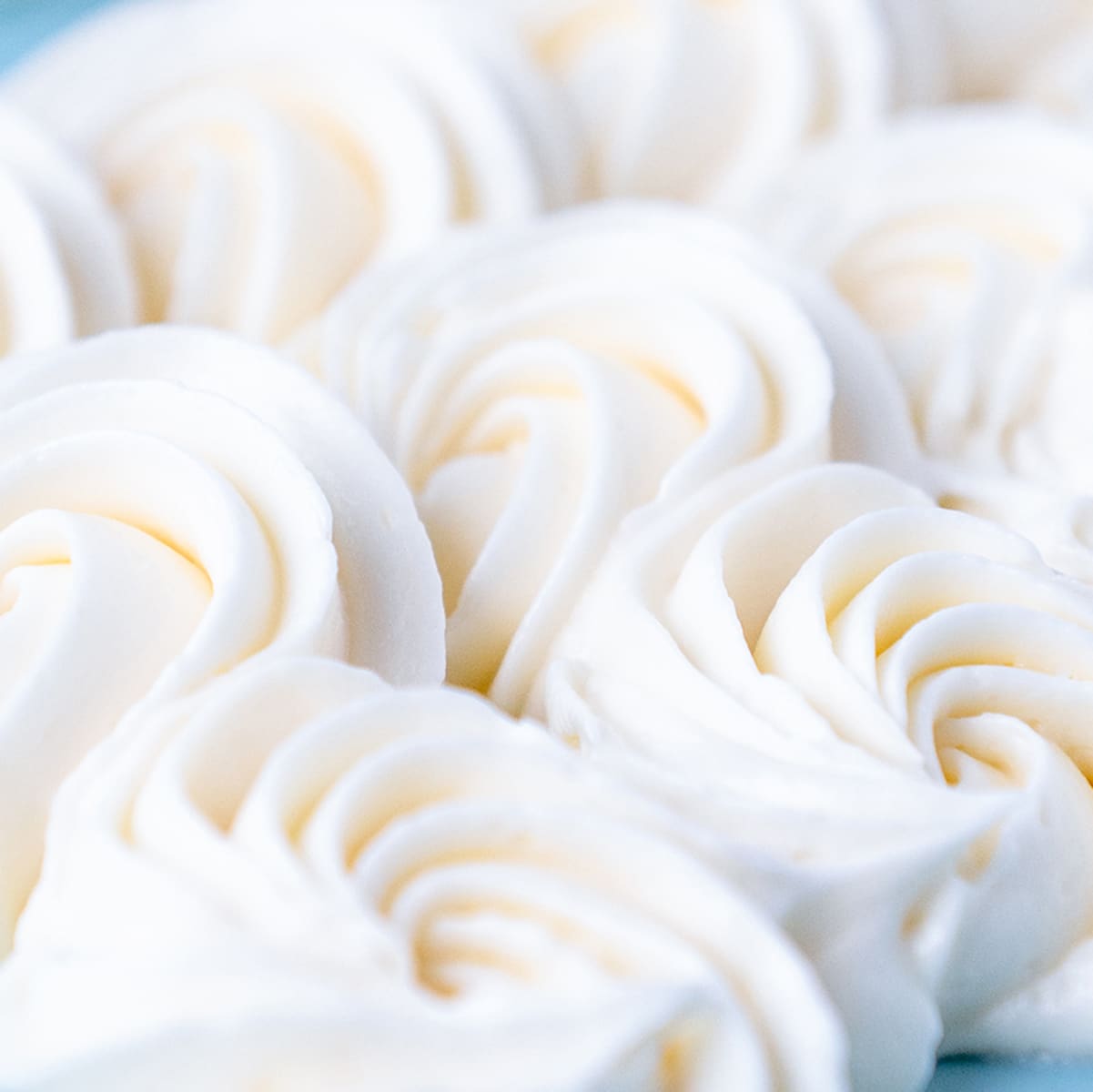
Close up of American buttercream rosettes

October 19, 2022 Blog

American Buttercream Recipe

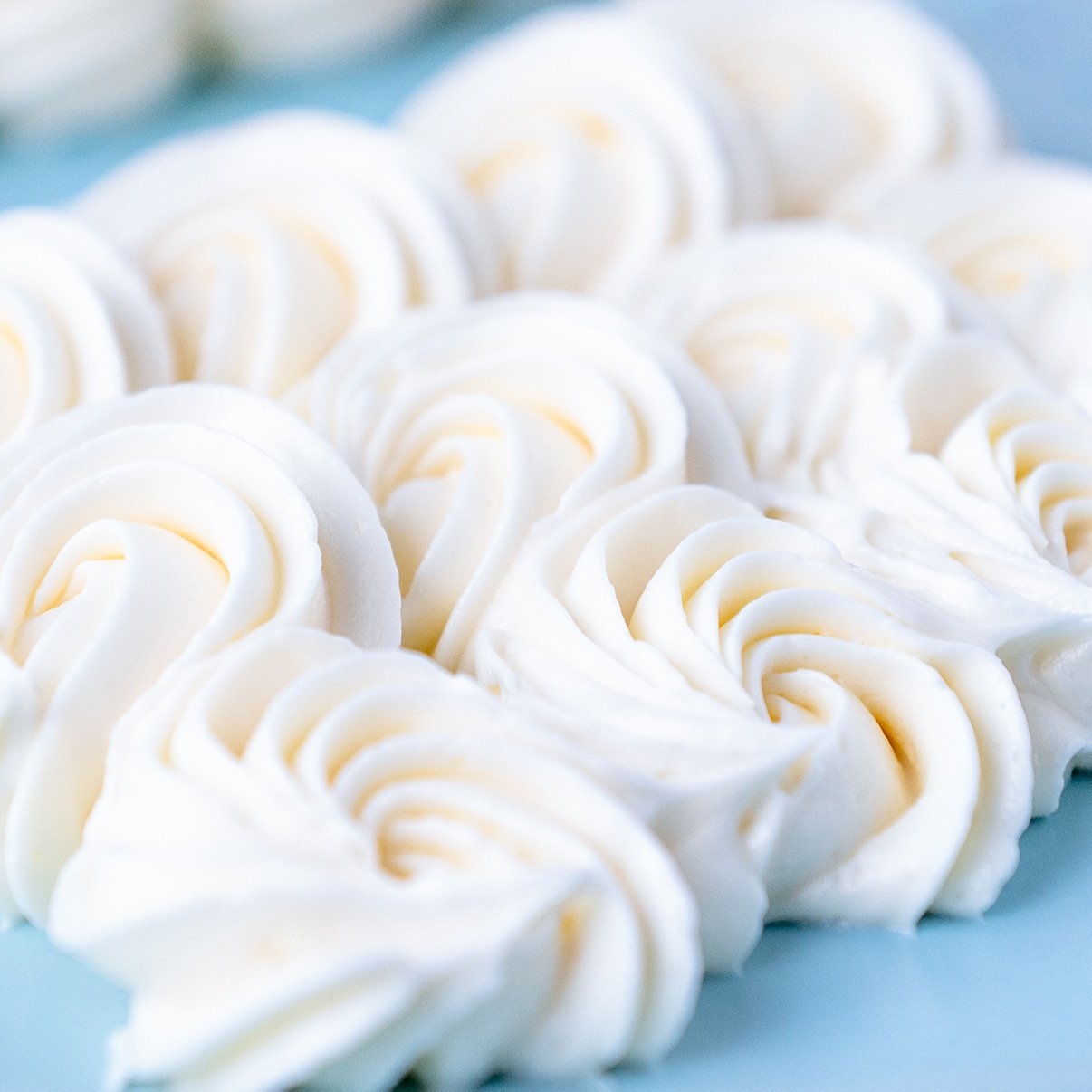
American buttercream is the easiest frosting you will ever make and one of the most versatile. Five ingredients, less than 15 minutes, and you get a sweet, creamy frosting that is stable enough for warm weather, pipes beautifully, and works under fondant. I use this on everything from funfetti cake to easy chocolate cake, and it has been my go-to recommendation for beginner bakers for years.Piped rosettes of American buttercream on a blue background

Quick Glance: American Buttercream Recipe

  • Recipe Name: American Buttercream Recipe
  • Why You'll Love It: Sweet, creamy, and incredibly stable, this is the easiest frosting you will ever make with just five ingredients and 15 minutes
  • Time and Difficulty: 5 minutes | Beginner-friendly
  • Main Ingredients: Unsalted butter, powdered sugar, heavy cream, clear vanilla extract, salt
  • Method: Beat butter until smooth, add powdered sugar gradually, add cream and vanilla, whip until fluffy
  • Texture and Flavor: Light, sweet, and creamy with a classic vanilla flavor that pipes beautifully and holds its shape
  • Quick Tip: Always use butter at room temperature. Cold butter creates lumps that are nearly impossible to smooth out once the sugar is added
ChatGPT
Google AI
Perplexity
Grok
Add us as a trusted site on Google
[feast_advanced_jump_to]

Why This Recipe Works

American buttercream gets its structure from the ratio of powdered sugar to butter. Powdered sugar dissolves into the butter fat and forms a stable crystalline network that holds its shape at room temperature. This is why American buttercream is significantly more heat stable than meringue-based frostings like Swiss meringue buttercream or Italian meringue buttercream, which rely on protein foam that softens quickly in warm temperatures.

Adding hot heavy cream rather than cold cream is intentional. The heat helps the cream emulsify into the butter and sugar more smoothly, which gives the finished frosting a lighter, fluffier texture. Cold cream can cause the butter to seize slightly and produce a denser, less airy result.

Whipping the butter on its own before adding any sugar is what gives American buttercream its pale, fluffy appearance. The mixer incorporates air into the butter during those first 2 to 3 minutes, and that aerated base is what makes the finished frosting light rather than dense and heavy. Skipping this step results in a noticeably heavier frosting that is harder to pipe.

The final step of switching to the paddle attachment and mixing on low is what takes this buttercream from good to great. The whisk adds air, which gives you volume. The paddle removes excess air, which gives you a smooth, velvety finish that is much easier to work with when frosting a cake cleanly.

American Buttercream Ingredients

American buttercream only uses five ingredients but each one matters. Here is what they do and what you can substitute if needed.

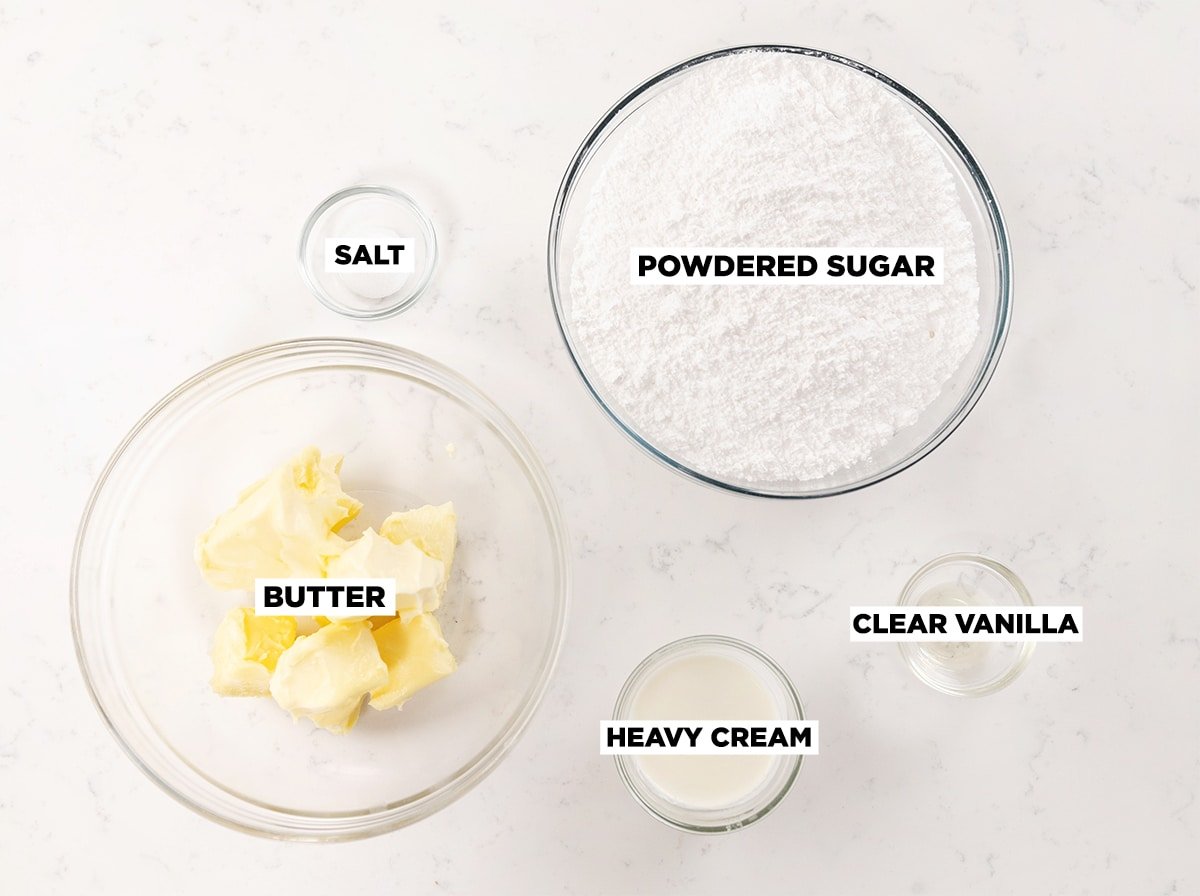
American buttercream ingredients in bowls shot from above.

Unsalted Butter: The base of the frosting and what gives it richness and body. Use high-quality butter for the best flavor. I like Plugra or Irish butter, but Darigold is a great budget-friendly option. Make sure it is fully at room temperature before you start. For a more heat-stable version, replace half the butter with high-ratio shortening. For dairy-free buttercream, use a plant-based butter substitute.

Powdered Sugar: Also called confectioners sugar or icing sugar, this is what gives American buttercream its structure and sweetness. Always sift it before adding to avoid lumps. Add it one cup at a time so it incorporates smoothly without a cloud of sugar flying everywhere.

Heavy Cream: A small amount of cream thins the buttercream to the right consistency and makes it fluffy. You can substitute whole milk, water, or a non-dairy creamer if needed. Add it gradually until you reach the consistency you want. I heat mine up for 1 minute to emulsify the frosting.

Clear Vanilla Extract: Adds classic vanilla flavor without adding color. This is important if you want a bright white frosting. If color is not a concern, regular vanilla extract works just as well and has a slightly richer flavor.

Salt: A small amount of salt balances the sweetness and rounds out the flavor. Without it the frosting can taste one-dimensional. Do not skip it.

How to Make American Buttercream Step-By-Step

Just 15 minutes of your time and you'll have the smoothest, tastiest American buttercream of your life!

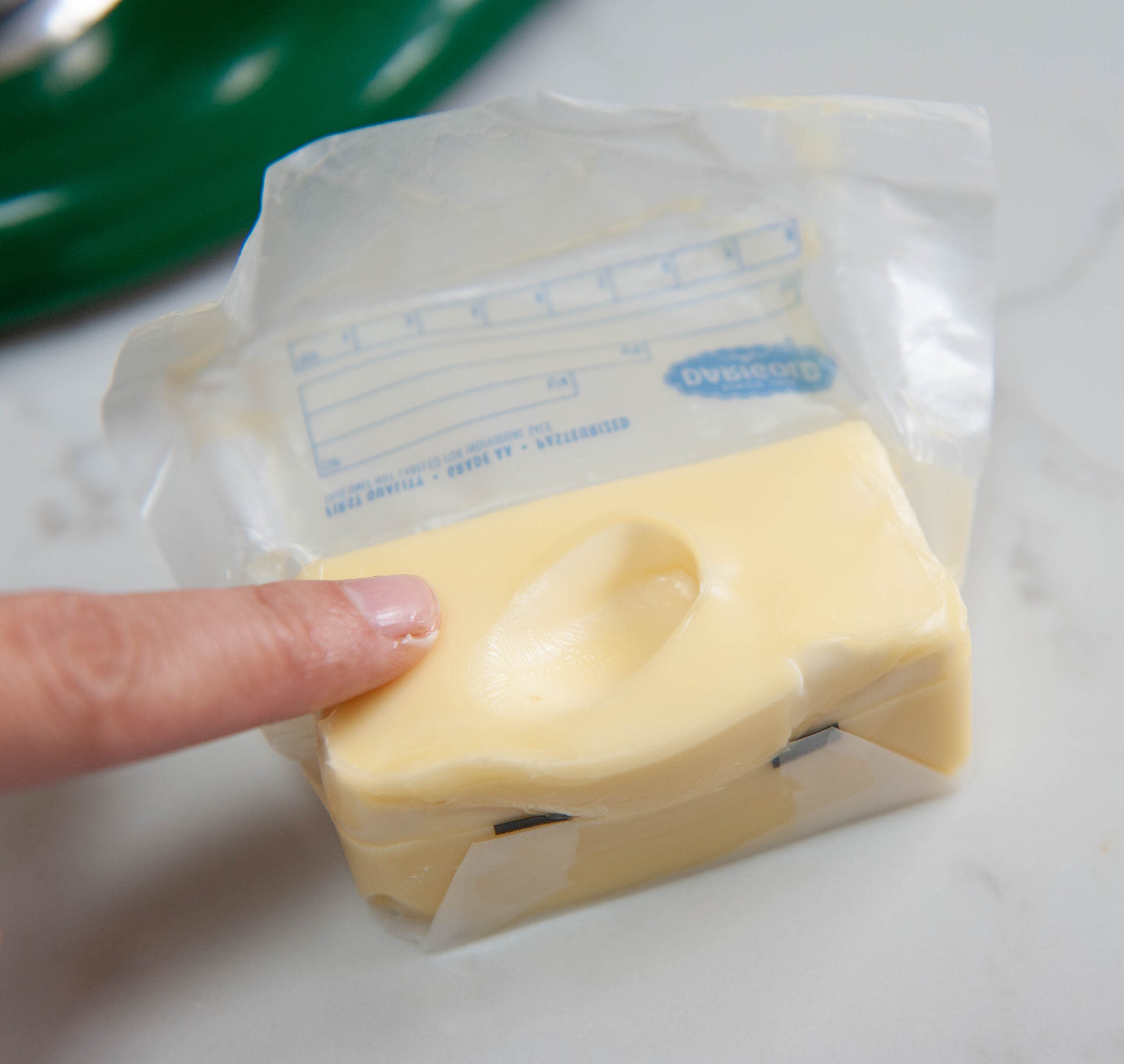
Finger pressing into a softened block of butter with its wrapper unwrapped on a white countertop.
  1. Make sure your butter is fully at room temperature before you start. It should be soft enough to press a finger into easily but not greasy or melted. If it is too cold, you will get lumps. If it is too warm, the frosting will be too soft to pipe.
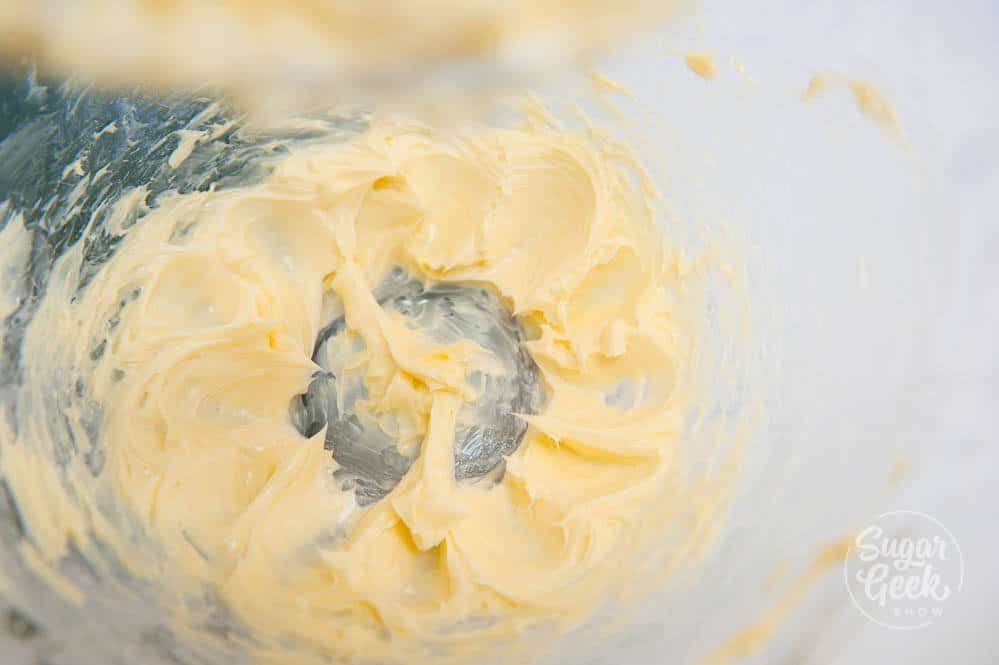
Creamed softened butter in the bottom of a glass stand mixer bowl.
  1. Place the softened butter in the bowl of your stand mixer with the whisk attachment. Mix on medium speed until the butter is completely smooth, pale, and fluffy, about 2 to 3 minutes. Scrape the bottom and sides of the bowl well. Any unmixed butter at the bottom will show up as lumps later.

EXPERT TIP: You can also replace half the butter with vegetable shortening to make it more stable in the heat.

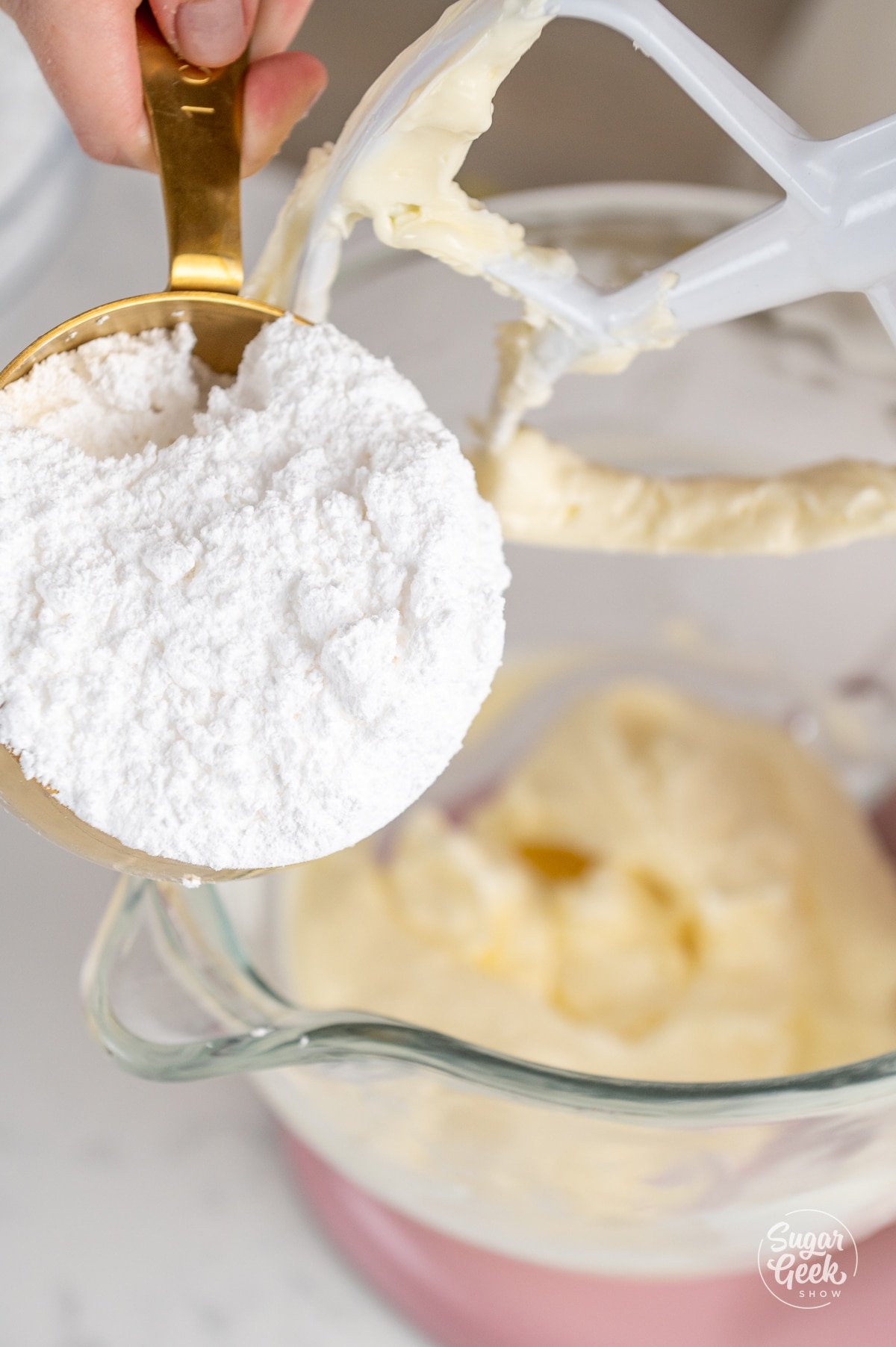
Hand adding a cup of powdered sugar to the stand mixer bowl.
  1. Add the powdered sugar one cup at a time on the lowest speed. Adding it all at once creates a cloud of sugar and makes it harder to incorporate evenly. Mix until smooth after each addition before adding more.
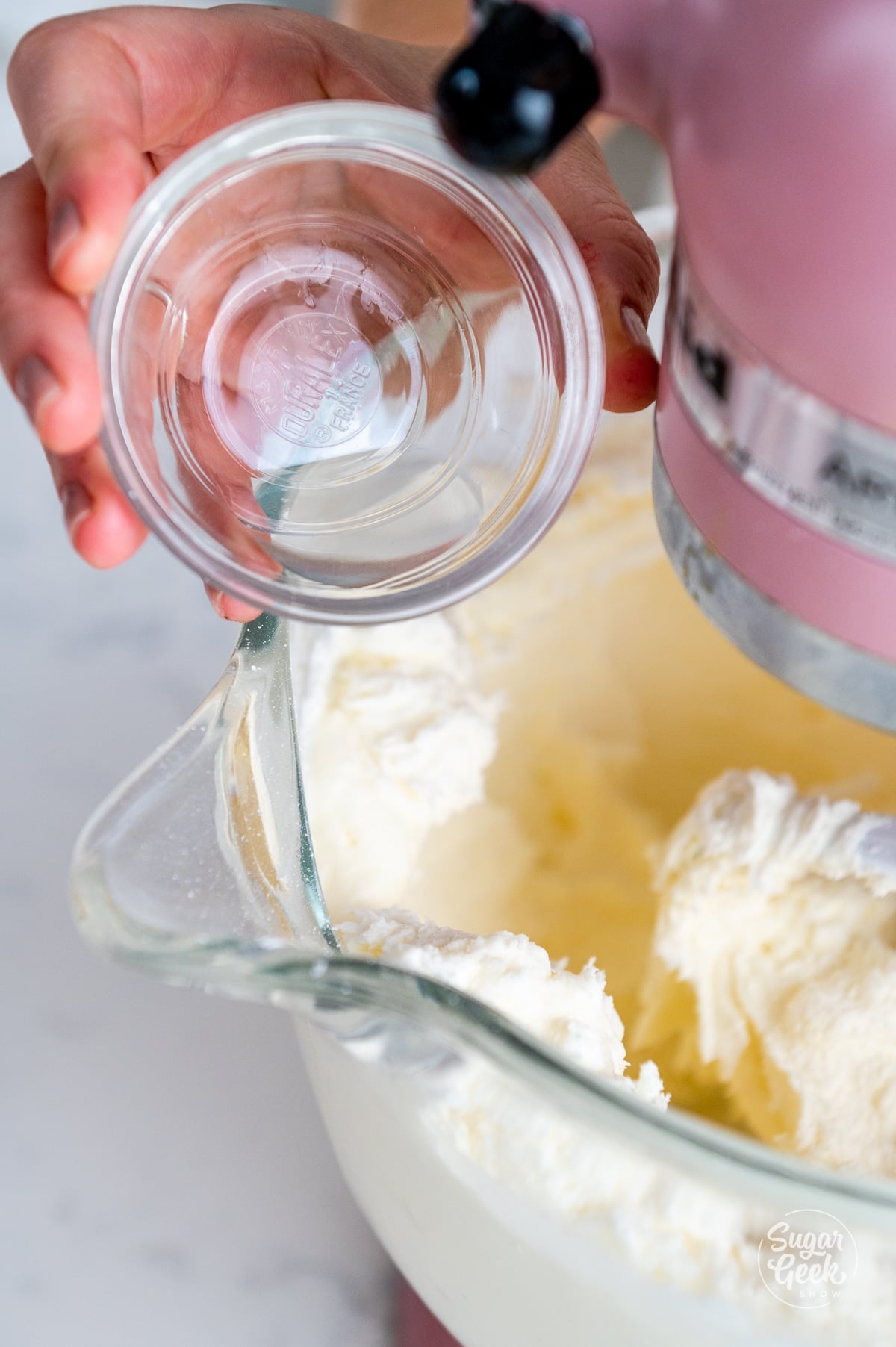
Hand adding clear vanilla to the stand mixer bowl.
  1. Add the salt, clear vanilla extract, and hot heavy cream. If the buttercream looks too thick or dry, add a little more cream one tablespoon at a time until it reaches the right consistency.
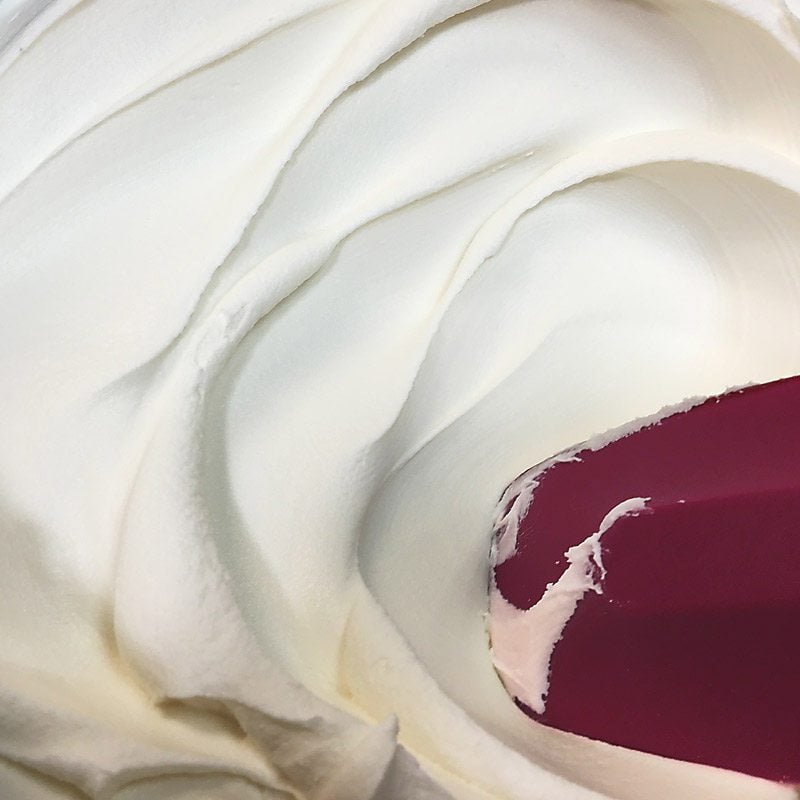
Close up of American buttercream in a bowl with a red rubber spatula.
  1. Increase the speed to high and whip for 2 to 3 minutes until the buttercream is light, fluffy, and bright white. It should look smooth and hold a peak when you lift the whisk.
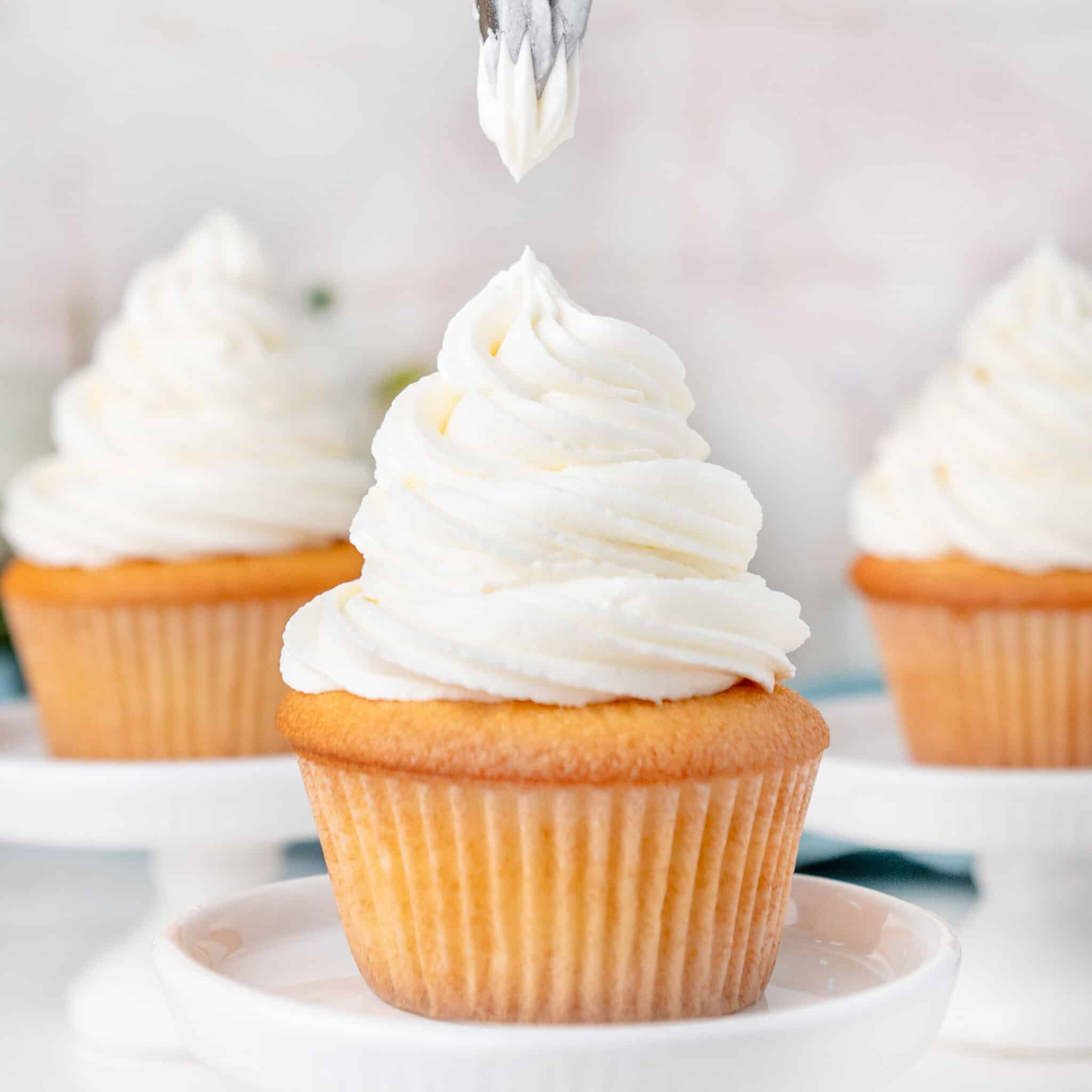
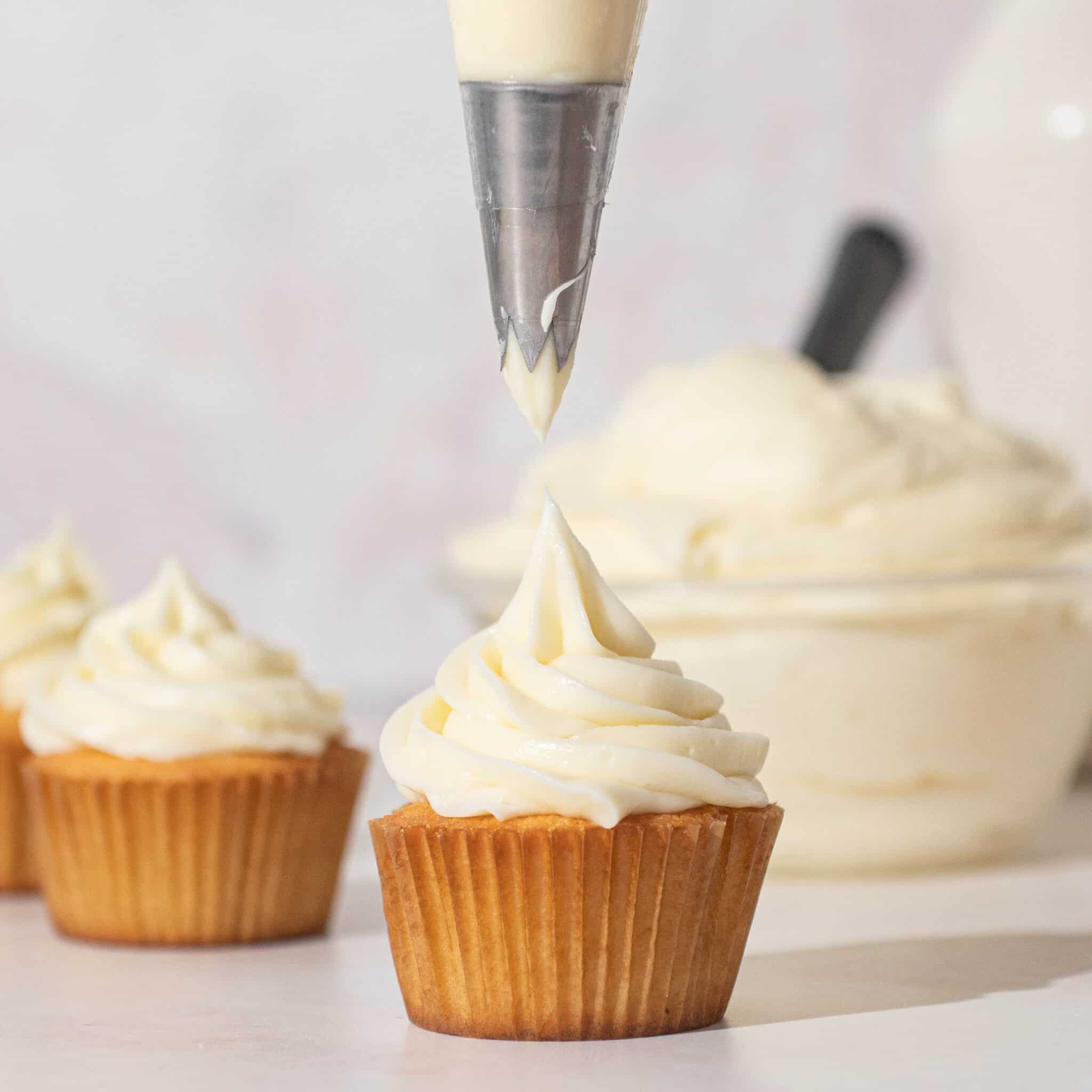
piping american buttercream onto a cupcake.
  1. Cover the bowl with plastic wrap until you are ready to use it. American buttercream can sit at room temperature for a few hours. For longer storage, keep it in an airtight container in the fridge for up to two weeks or freeze for up to three months. Bring it back to room temperature and mix on low before using.

EXPERT TIP: If the buttercream looks curdled or separated, Scoop out about one cup of the buttercream and microwave it for 10 to 15 seconds until just melted. Pour it back into the mixing bowl while the mixer is running on low. It will come back together quickly.

Batter & Frosting Calculator

Cake Batter and Frosting Calculator

Select an option below to calculate how much batter or frosting you need. Adjust the servings slider on the recipe card to change the amounts the recipe makes.

Choose a pan type

Choose a cake pan size
(based on 2" tall cake pan)

Choose a cake pan size
(based on 2" tall cake pan)

Choose a cake pan size
(based on 2" tall cake pan)

Cupcake Tin Size

Choose number of pans

Cups of Batter Needed

8 cups

Cups of Frosting Needed

5 cups

Note: measurements are estimated based off the vanilla cake recipe using standard US cake pans and sizes. Measurements used are for 2" tall cake pans only. Your results may vary. Do not overfill cake pans above manufacturer's recommended guidelines.

This recipe makes 8 cups of frosting, enough to frost and fill three 8-inch cake layers or frost about 24 cupcakes. Store leftovers in an airtight container in the fridge for up to 2 weeks or freeze for up to 3 months. Bring to room temperature and mix on low before using.

What Are The Different Types of Buttercream?

  • American buttercream (ABC) is made with powdered sugar, butter, and liquid. It's very sweet, creamy, and the most stable in warm temperatures due to the high amount of sugar.
  • Swiss meringue buttercream (SMBC) is made by combining meringue with whipped butter and extracts. This buttercream is light, soft, and not very sweet. My Easy buttercream is an easy mock-Swiss buttercream recipe.
  • Italian meringue buttercream (IMBC) is made by pouring boiled sugar into whipping meringue. This produces a very stable and light buttercream frosting that's not very sweet, but it is a little bit trickier to make. 
  • French buttercream is made with egg yolks or whole eggs in a meringue base. It's similar to a custard or pastry cream, is not as sweet, and has a richer flavor compared to some of the other buttercreams.
  • German buttercream is made by combining pastry cream, butter, and powdered sugar. It's very rich, silky, and not too sweet.
  • Flour buttercream or boiled milk frosting like Ermine frosting is an old-fashioned type of buttercream. It's made by cooking flour and sugar with milk to make a sweet vanilla bean paste, then whipping that with butter and extracts.

Add a little clear vanilla and some crushed cookies and this becomes the frosting on my cookies and cream cake, it tastes just like the filling inside a real Oreo.

Common Mistakes To Avoid

  • Using cold butter. This is the most common mistake. Cold butter will not fully incorporate with the sugar and you will end up with a lumpy, uneven frosting that no amount of mixing will fix. Set your butter out at least an hour before you start.
  • Adding all the powdered sugar at once. Dumping in all the sugar at once makes it impossible to incorporate smoothly and creates a huge mess. Add it one cup at a time on the lowest speed and let it fully mix in before adding more.
  • Using regular vanilla instead of clear. If you want a bright white buttercream, you need clear vanilla extract. Regular vanilla turns the frosting yellow or ivory, which is fine for some cakes but makes it difficult to achieve true colors when tinting.
  • Not scraping the bowl. Unmixed butter and sugar likes to hide at the bottom of the bowl. If you do not scrape the bowl well between additions you will have lumps in your finished frosting. Scrape down often.
  • Over-whipping on high speed. Whipping on high for too long pumps too much air into the frosting and creates large air bubbles that are hard to smooth out on a cake. Whip on high for just 2 to 3 minutes, then switch to the paddle on low to smooth it out.
  • Adding too much cream at once. A little cream goes a long way. If you add too much the frosting becomes too loose to pipe. Add it one tablespoon at a time and stop when you reach the right consistency.
  • Not adjusting for the climate. In hot or humid weather, standard American buttercream can get soft and slippery. If you are decorating in summer or a warm kitchen, replace half the butter with high-ratio shortening to give it more stability.

American Buttercream FAQs

Does American buttercream melt in the heat?

American buttercream is the most heat-stable of all the buttercreams because of its high sugar content. Sugar is hygroscopic and absorbs moisture rather than releasing it, which keeps the frosting from breaking down as quickly as egg-based buttercreams. That said, it can still soften in extreme heat. If you are decorating in a hot kitchen or serving the cake outdoors in warm weather, replace half the butter with high-ratio shortening for extra stability.

What is the difference between buttercream and American buttercream?

American buttercream is one of type of the many buttercreams out there. The word buttercream is a general term for any frosting made with butter as a base. American buttercream is the simplest version, made with just butter, powdered sugar, and a liquid. Other styles like Swiss meringue buttercream and Italian meringue buttercream are made by whipping butter into a cooked meringue base, which makes them lighter and less sweet but more time-consuming to prepare.

What is American Buttercream made of?

American buttercream is made with unsalted butter, powdered sugar, heavy cream, vanilla extract, and salt. That is it. The simplicity is what makes it so easy to pull off even for complete beginners, and you can customize the flavor and color with just a few small tweaks.

Which buttercream is best for wedding cakes?

It depends on the look and setting. American buttercream is very stable and great for piping intricate decorations, which is why it is popular for wedding cakes with lots of detail work. For a smoother, less sweet finish, Swiss meringue or Italian meringue buttercream are excellent choices. If the wedding is outdoors in warm weather, American buttercream with some shortening mixed in or a high-ratio shortening based frosting will hold up best.

Can buttercream be made ahead of time?

Yes. American buttercream keeps well in an airtight container in the fridge for up to two weeks, or in the freezer for up to three months. When you are ready to use it, let it come fully to room temperature and then mix on low speed until it is smooth and creamy again. It may look separated at first but it will come back together.

How do I get the air bubbles out of my buttercream?

Switch to the paddle attachment on your stand mixer and mix on the lowest speed for 10 to 15 minutes. This slowly pushes the air out and gives you a dense, smooth frosting that is much easier to get a clean finish with on a cake. It is one of the best tips I have for getting a really professional-looking result.

Why is my buttercream grainy?

Grainy buttercream is almost always caused by powdered sugar that has not fully dissolved. Make sure you sift the powdered sugar before adding it and add it slowly on low speed. If it is still grainy after mixing, try adding a splash of cream and mixing for a few more minutes. The extra liquid helps the sugar fully dissolve.

How do you make your frosting white?

Use clear vanilla extract instead of regular vanilla, and make sure your butter is very pale and well-whipped before adding the sugar. Whipping the butter for a full 2 to 3 minutes before anything else is added turns it from yellow to almost white. Adding a tiny drop of violet food gel can also neutralize any remaining yellow tones and make the frosting appear brighter white.

How do you get vibrant buttercream colors?

Always use gel food coloring rather than liquid. Liquid coloring adds too much water to the frosting and can affect the consistency. Gel gives you much more intense color with just a small amount. For very deep colors like red or black, start with a chocolate buttercream base to cut down on how much coloring you need. Let the colored buttercream sit for 15 to 20 minutes after mixing as colors often deepen as they rest.

More Frosting Recipes You'll Love

  • chocolate fudge frosting on a cupcake
    Chocolate Fudge Frosting
  • Piping cream cheese frosting onto a cupcake.
    Cream Cheese Frosting Without Powdered Sugar
  • Piping squiggle of chocolate buttercream
    The BEST Chocolate Buttercream Frosting
  • Piping easy buttercream rosettes onto a cake using a 1M star piping tip
    Easy Buttercream Frosting

Leave Me A Review
⭐️⭐️⭐️⭐️⭐️

If you tried this American Buttercream Recipe or any other recipe on my blog, please leave a 🌟 star rating and let me know how it goes in the comments. I love hearing from you!

Recipe

Close up of American buttercream rosettes
Print Recipe
4.86 from 146 votes

American Buttercream

This classic American buttercream recipe is the frosting that most people think of when they hear the word, "buttercream." It's sweet, creamy, very stable in hot temperatures, and the easiest buttercream to make. Perfect for frosting your cakes or cupcakes, piping flowers on a wedding cake, and using under fondant.
Prep Time10 minutes mins
Mixing10 minutes mins
Total Time20 minutes mins
Course: Dessert
Cuisine: American
Servings: 8 cups
Calories: 1226kcal
Author: Liz Marek

Ingredients

American Buttercream Ingredients

  • 24 ounces unsalted butter room temperature
  • 40 ounces powdered sugar
  • 3 teaspoons clear vanilla extract
  • 1 teaspoon salt
  • 5 ounces heavy whipping cream heated until very warm
US Customary - Metric

Instructions

American Buttercream Instructions

  • Make sure your butter is fully at room temperature before you start. It should be soft enough to press a finger into easily but not greasy or melted. If it is too cold you will get lumps. If it is too warm the frosting will be too soft to pipe.
  • Place the softened butter in the bowl of your stand mixer with the whisk attachment. Mix on medium speed until the butter is completely smooth, pale, and fluffy, about 2 to 3 minutes. Scrape the bottom and sides of the bowl well. Any unmixed butter at the bottom will show up as lumps later.
  • Add the powdered sugar one cup at a time on the lowest speed. Adding it all at once creates a cloud of sugar and makes it harder to incorporate evenly. Mix until smooth after each addition before adding more.
  • Add the salt, clear vanilla extract, and hot heavy cream. If the buttercream looks too thick or dry, add a little more cream one tablespoon at a time until it reaches the right consistency.
  • Increase the speed to high and whip for 2 to 3 minutes until the buttercream is light, fluffy, and bright white. It should look smooth and hold a peak when you lift the whisk.
  • If the buttercream looks curdled or separated: Scoop out about one cup of the buttercream and microwave it for 10 to 15 seconds until just melted. Pour it back into the mixing bowl while the mixer is running on low. It will come back together quickly.
  • If you want to remove air bubbles: Switch to the paddle attachment and mix on the lowest speed for 10 to 15 minutes. This pushes out the air and gives you an incredibly smooth, velvety finish that is much easier to work with when frosting a cake.
  • Cover the bowl with plastic wrap until you are ready to use it. American buttercream can sit at room temperature for a few hours. For longer storage, keep it in an airtight container in the fridge for up to two weeks or freeze for up to three months. Bring it back to room temperature and mix on low before using.

Video

Notes

  • For the best results, use high-quality butter like Plugra, Irish butter, or Darigold. You can also use dairy-free butter if needed.
  • For a more stable buttercream that holds up in hot or humid climates, replace half of the butter with high-ratio shortening. Crisco will also work, though high-ratio shortening gives the best results.
  • You can also make this recipe with a combination of butter and shortening from the start. Use 12 ounces of butter and 12 ounces of shortening for a buttercream that is both flavorful and more heat stable than an all-butter version.
  • Heavy cream can be substituted with whole milk, water, or non-dairy creamer if needed.
  • If your buttercream looks too dry, add more cream one tablespoon at a time until you reach the right consistency.
  • If your buttercream looks curdled or separated, remove about 1 cup and microwave it for 10 to 15 seconds, then pour it back into the mixing bowl and mix until smooth.
  • To remove air bubbles, switch to the paddle attachment and mix on low for 10 to 15 minutes.
  • This recipe makes enough to frost and fill three 8x2 inch cake layers or 24 cupcakes.
  • Store in an airtight container in the fridge for up to 2 weeks or in the freezer for up to 3 months. Bring to room temperature and mix on low before using.

Nutrition

Serving: 1ounce | Calories: 1226kcal | Carbohydrates: 142g | Protein: 1g | Fat: 75g | Saturated Fat: 48g | Polyunsaturated Fat: 3g | Monounsaturated Fat: 19g | Trans Fat: 3g | Cholesterol: 203mg | Sodium: 308mg | Potassium: 42mg | Sugar: 139g | Vitamin A: 2386IU | Vitamin C: 0.1mg | Calcium: 34mg | Iron: 0.1mg
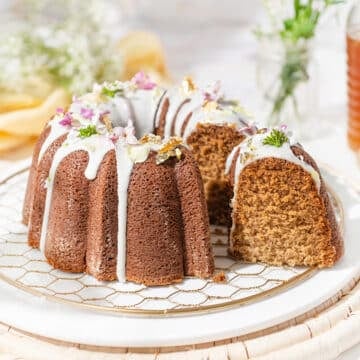
honey bundt cake on a platter

October 19, 2022 Bundt Cakes

Easy Honey Cake Recipe

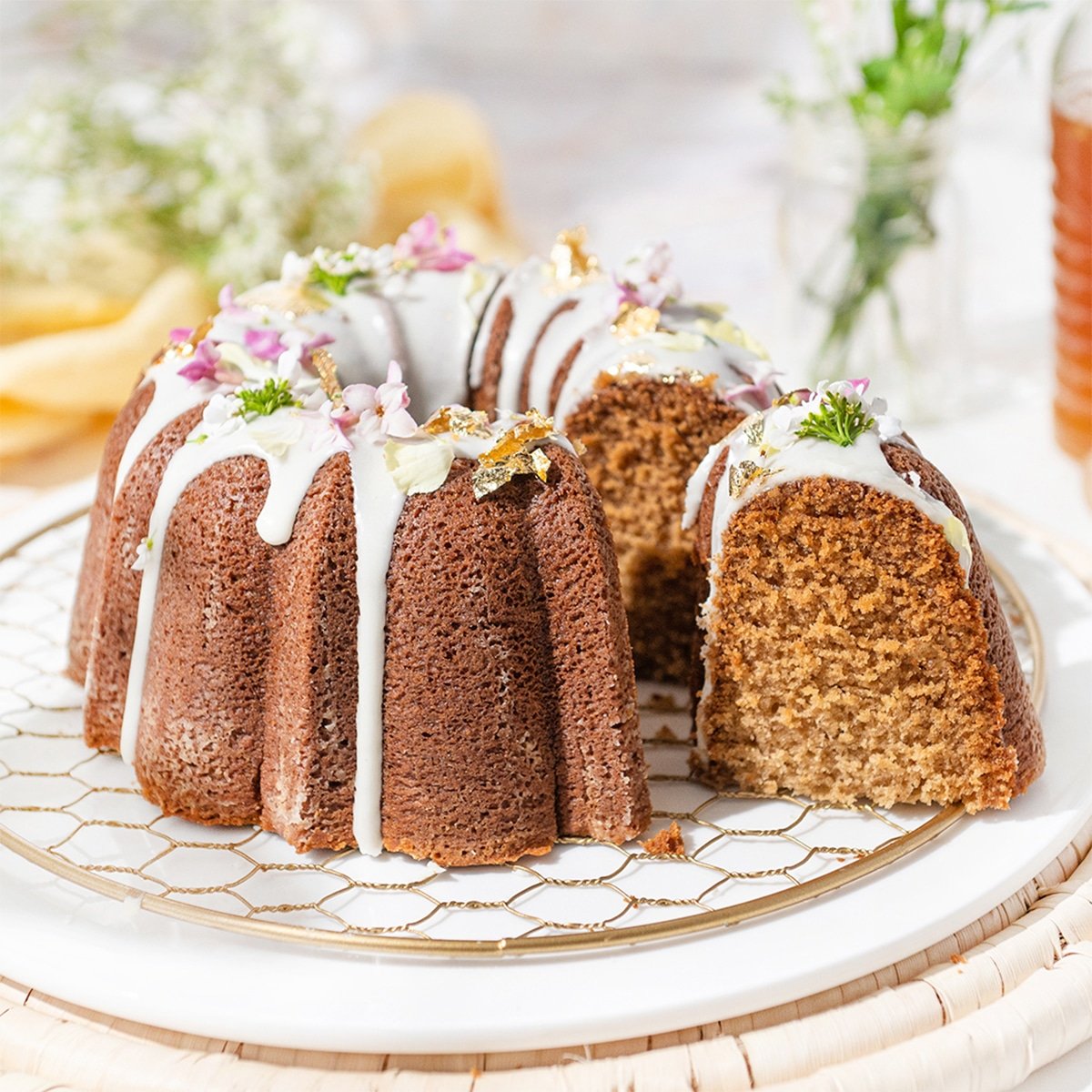
This is a delicious honey cake recipe with lots of honey flavor. Its moisture and full flavor come from real honey and brown sugar, with a slightly acidic taste from the buttermilk. Top it off with an orange and honey glaze and serve it with a cup of coffee or tea. Great for special occasions like mother's day, birthdays, afternoon tea, or just a fall afternoon.honey bundt cake on a platter

Because honey is a natural humectant, this cake stays moist for days making it the perfect make-ahead dessert. Make sure you use wildflower honey for the most flavorful honey cake. For even more honey flavor you can make a simple honey syrup with 2 ounces of honey and 2 ounces of water. Bring it to a boil and let it cool. Brush the honey mixture over the finished bundt cake before adding the orange glaze. 

Table of contents

  • Honey Cake Ingredients
  • How to Make Honey Cake
    • Making the Honey Bundt Cake
    • Making the Honey Glaze
  • Tips For Baking From Scratch
  • FAQ
  • Related Recipes

Honey Cake Ingredients

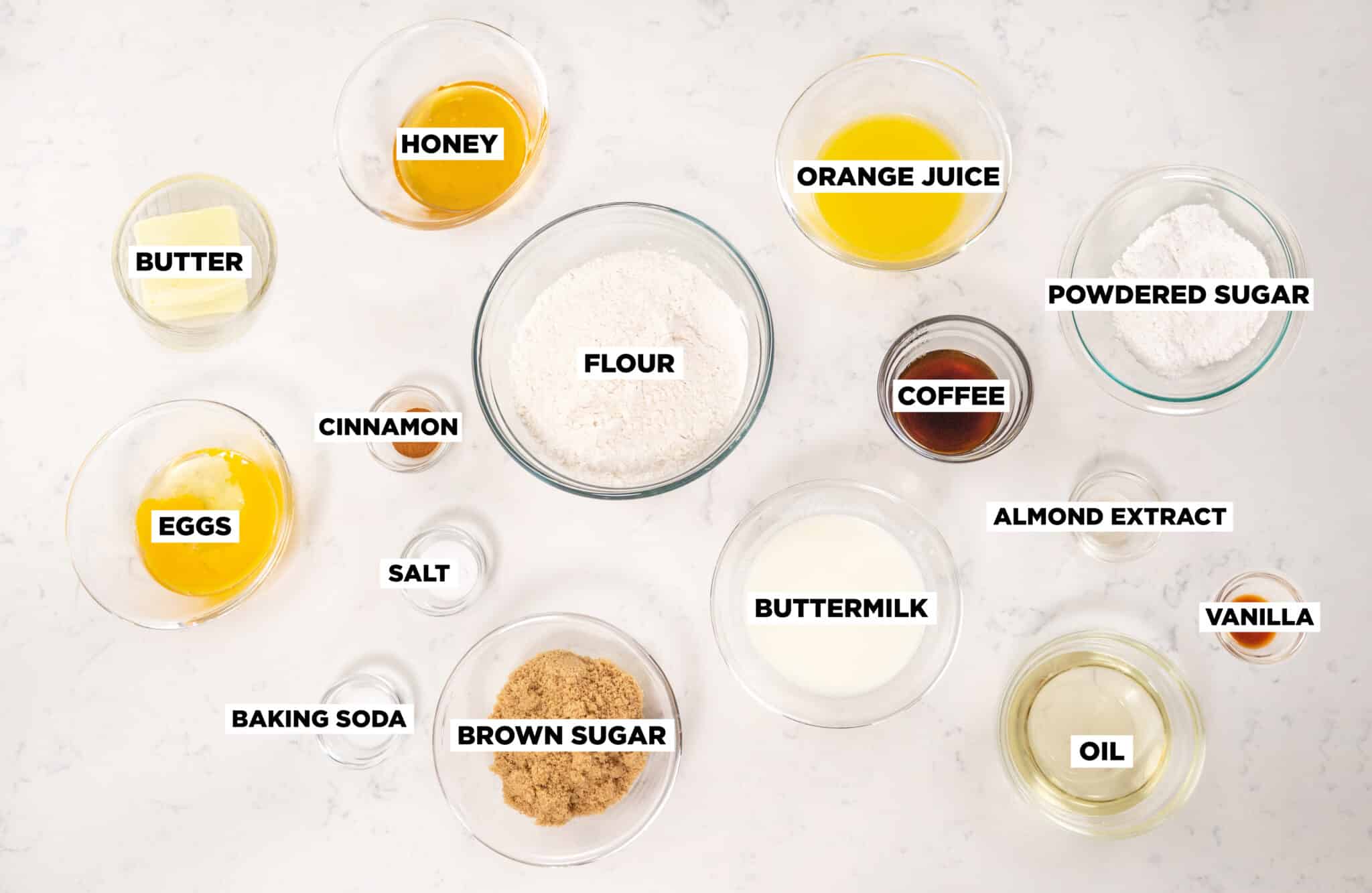
honey cake ingredients.Honey is the most important ingredient, of course! I like using wildflower honey or raw unfiltered honey for the richest flavor.

Brown sugar adds rich, nutty, full flavor to this cake recipe. The brown sugar and honey create enough sweetness so that no granulated sugar is needed. Dark brown sugar or light brown sugar will work for this recipe.

Buttermilk adds a tang to this recipe and reacts with the baking soda to help the cake rise. If you don't have buttermilk on hand, you can make some with regular milk and vinegar or lemon juice, almond milk, sour cream, or greek yogurt. Check out my buttermilk substitute blog post for more options. 

Coffee is an important ingredient for adding depth and flavor to this recipe. No, it will not make your cake taste like coffee, it enhances the flavors in the cake. You can use warm water if you don't want to use coffee. Some recipes call for orange juice, but I love the richness that coffee adds.

How to Make Honey Cake

This honey cake recipe comes together very quickly but does need to cool for at least 2 hours after baking, so you want to plan ahead. I like a simple powdered sugar glaze on top, but cream cheese frosting would also pair very well.

Making the Honey Bundt Cake

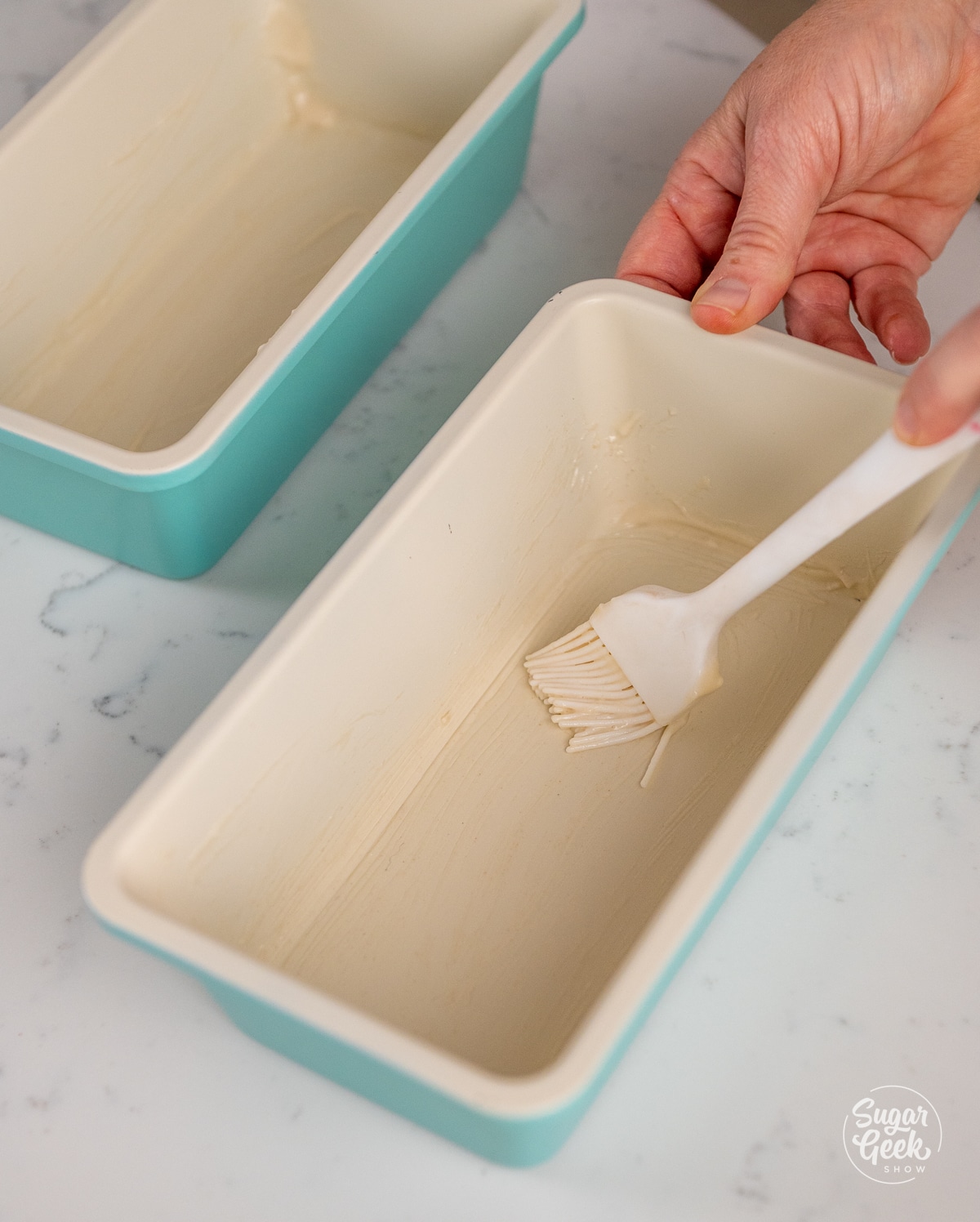
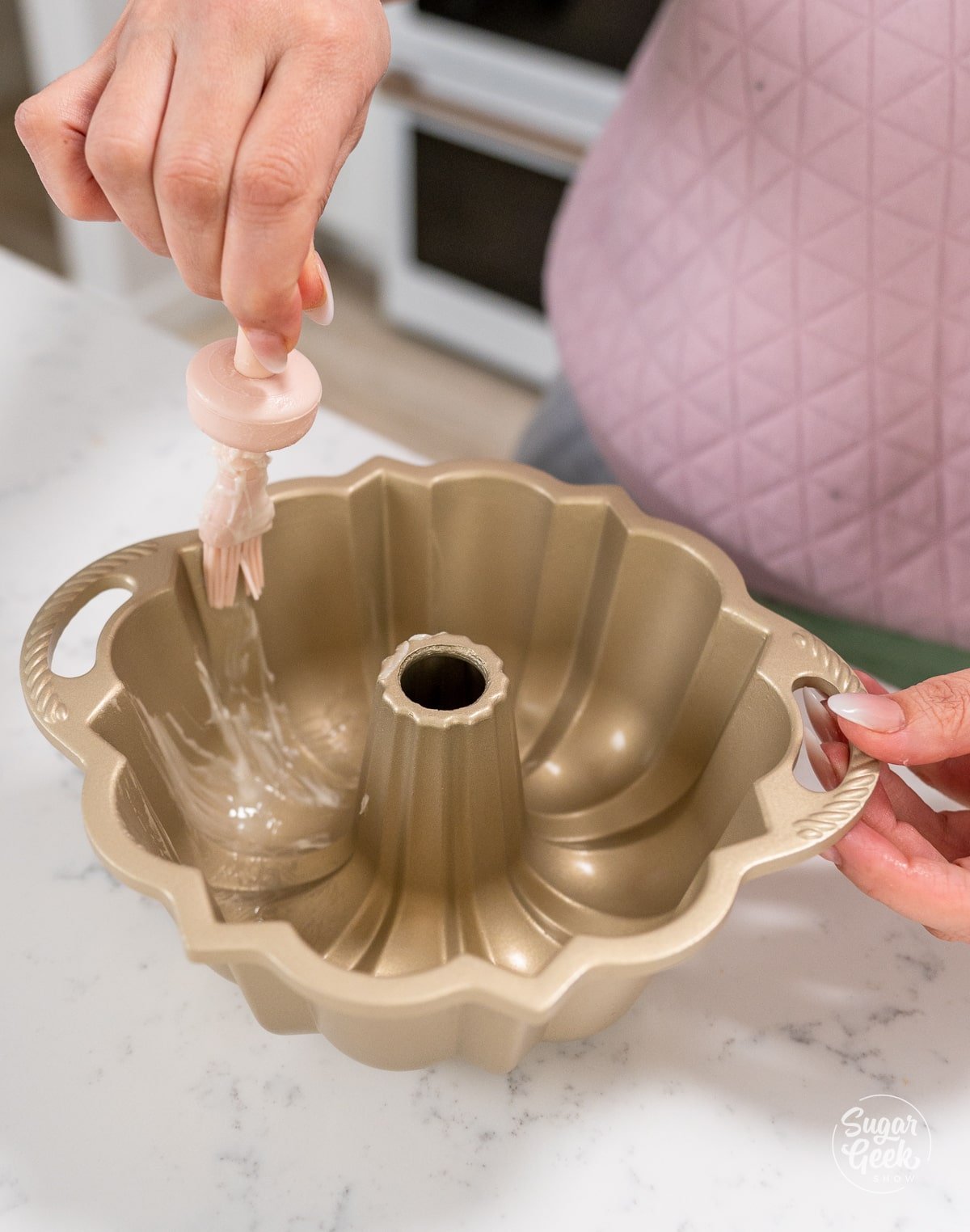
  1. Preheat the oven to 335°F (170°C) and grease a bundt pan with cake goop or your preferred pan release. Don't forget about the center and sides of the pan! You can use a loaf pan or cake pan if you prefer, just adjust your baking time. hand brushing cake goop into a bundt cake pan.
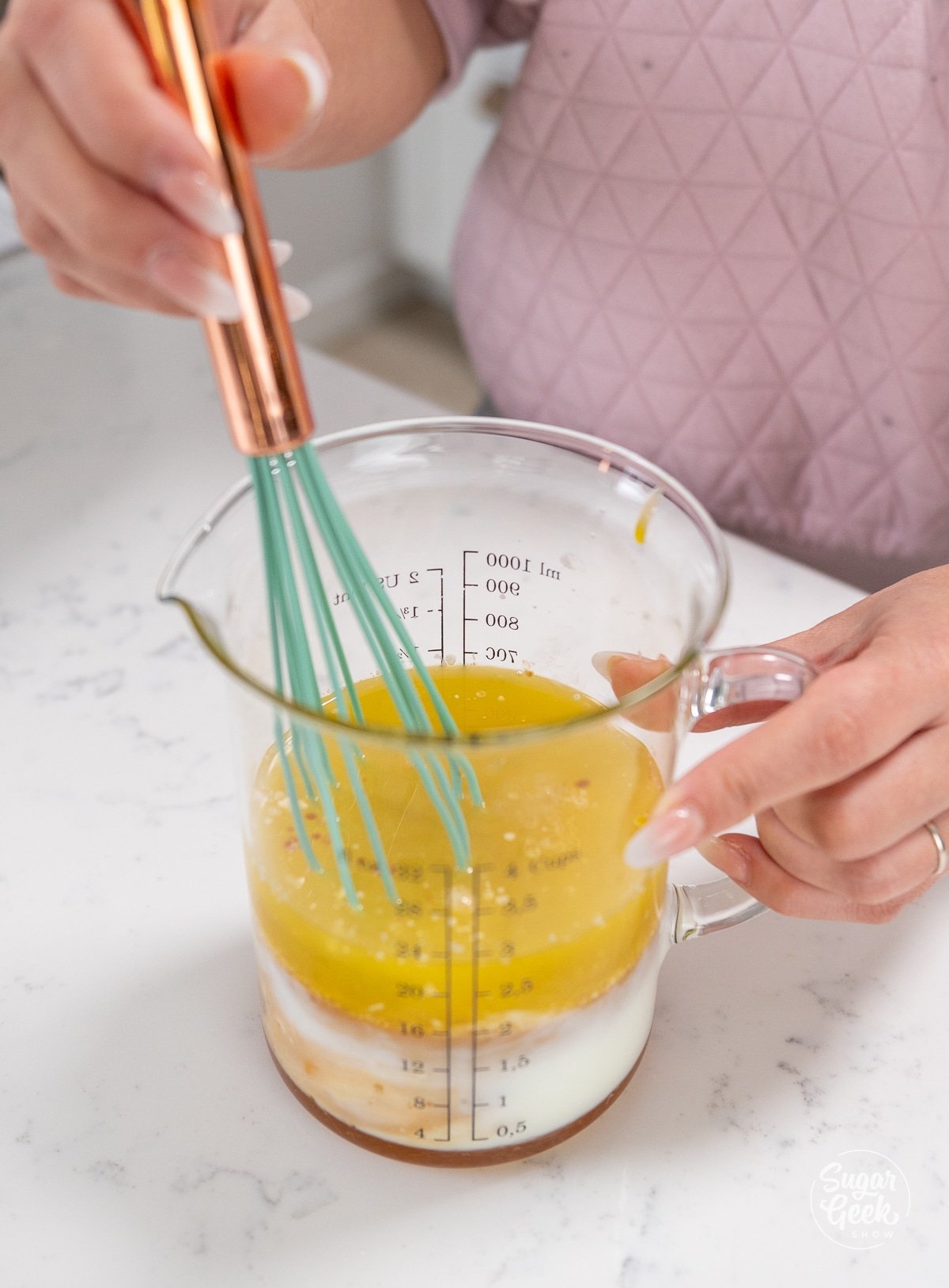
  2. Pour the buttermilk, eggs, melted butter, oil, coffee, vanilla extract, almond extract, and honey into a large measuring cup and whisk to combine. whisking honey cake wet ingredients in a large measuring cup.
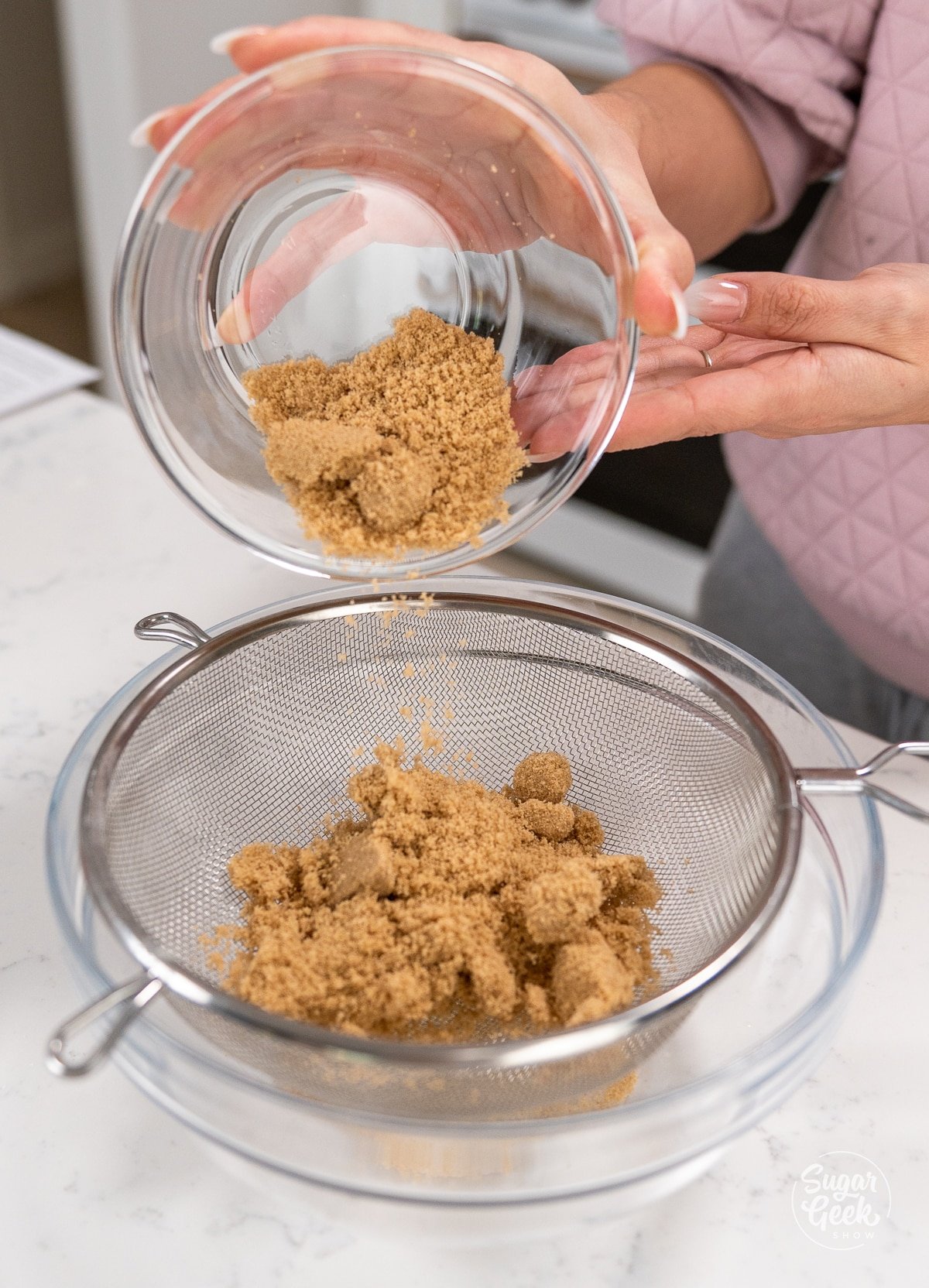
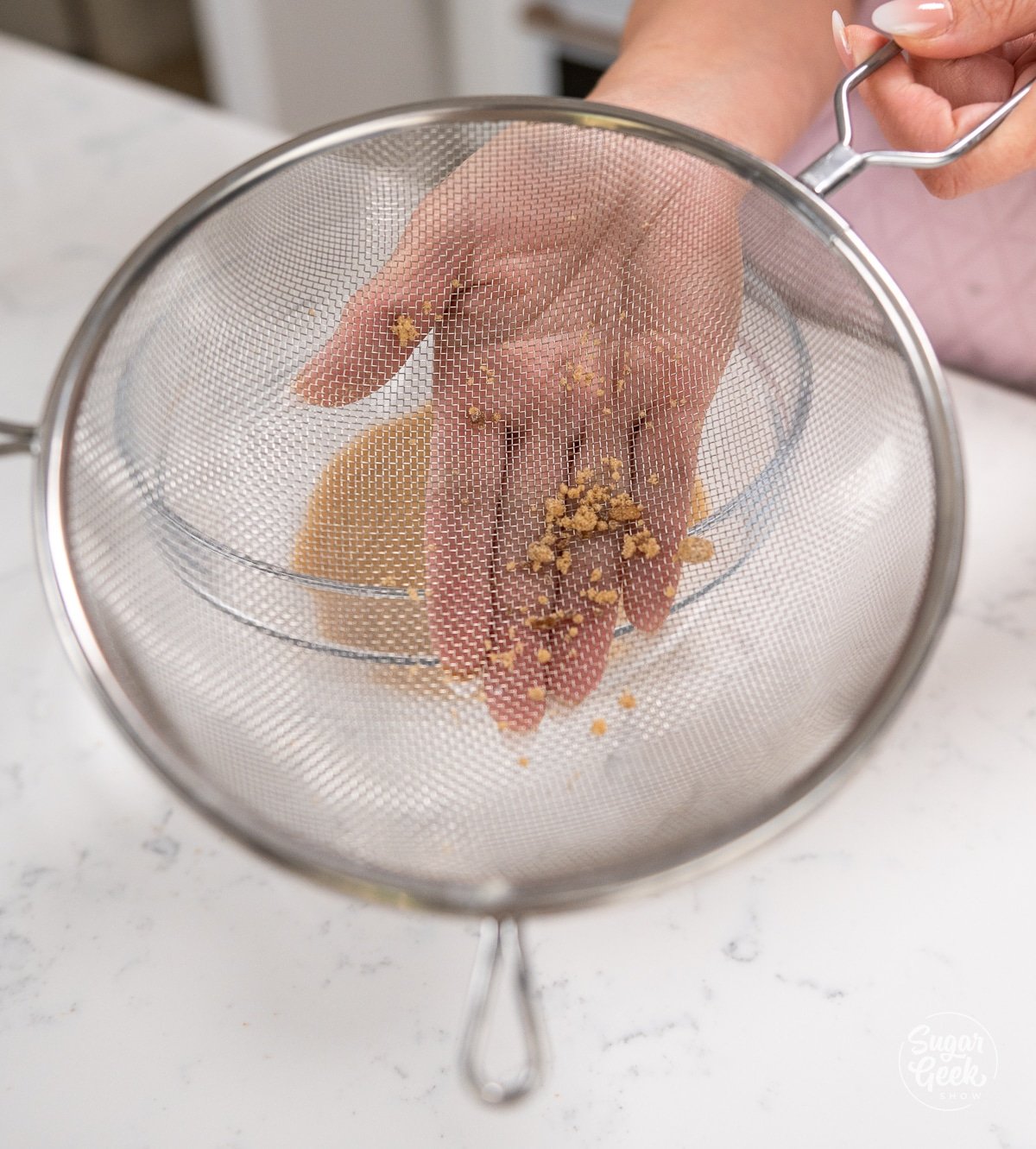
  3. Place a fine mesh strainer over the bowl of your stand mixer and sift the brown sugar to remove the lumps. There might be a few fine crumbs that you need to remove. This will ensure that there are no clumps of brown sugar in the batter.hands sifting brown sugar into a stand mixer bowl. hand showing clumps from sifting brown sugar.
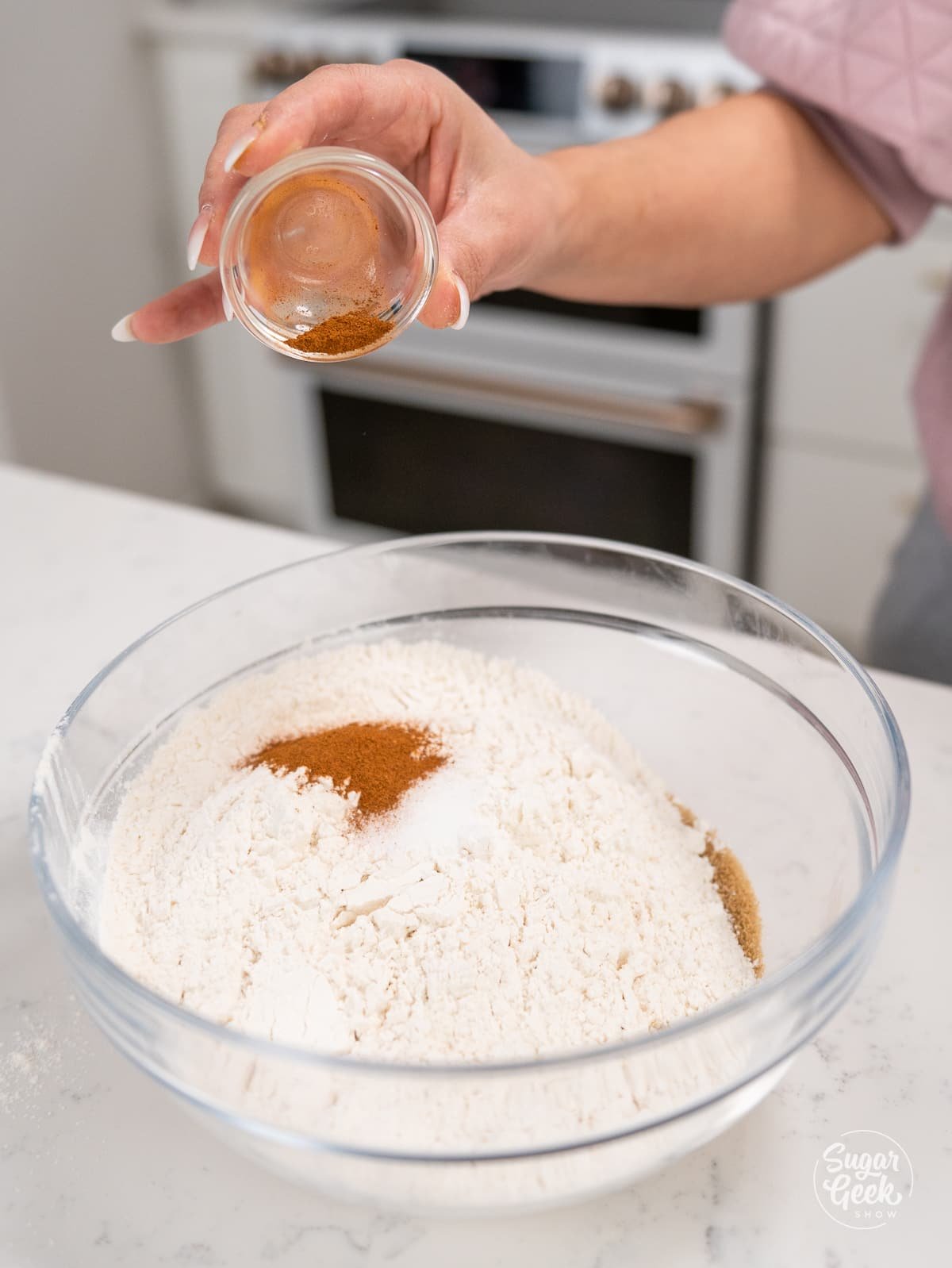
  4. Add the flour, baking soda, salt, and cinnamon to the brown sugar in the bowl of your stand mixer with the paddle attachment and mix for a few seconds to combine. You can also use an electric hand mixer or a whisk. hands adding honey cake dry ingredients to a bowl.
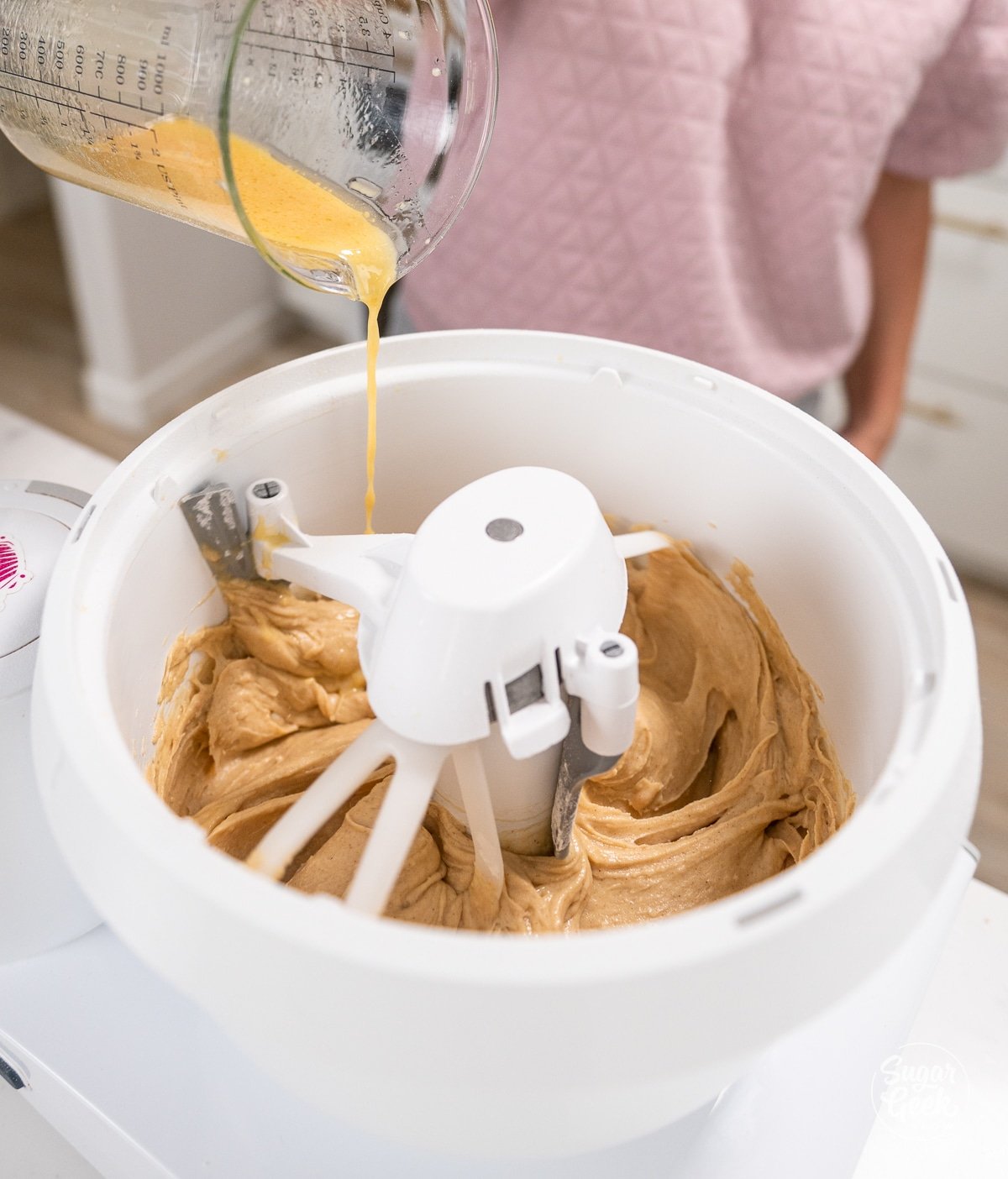
  5. Slowly pour the wet ingredients into the dry ingredients while mixing on medium speed until the batter is just combined.mixing the honey cake batter in the stand mixer.
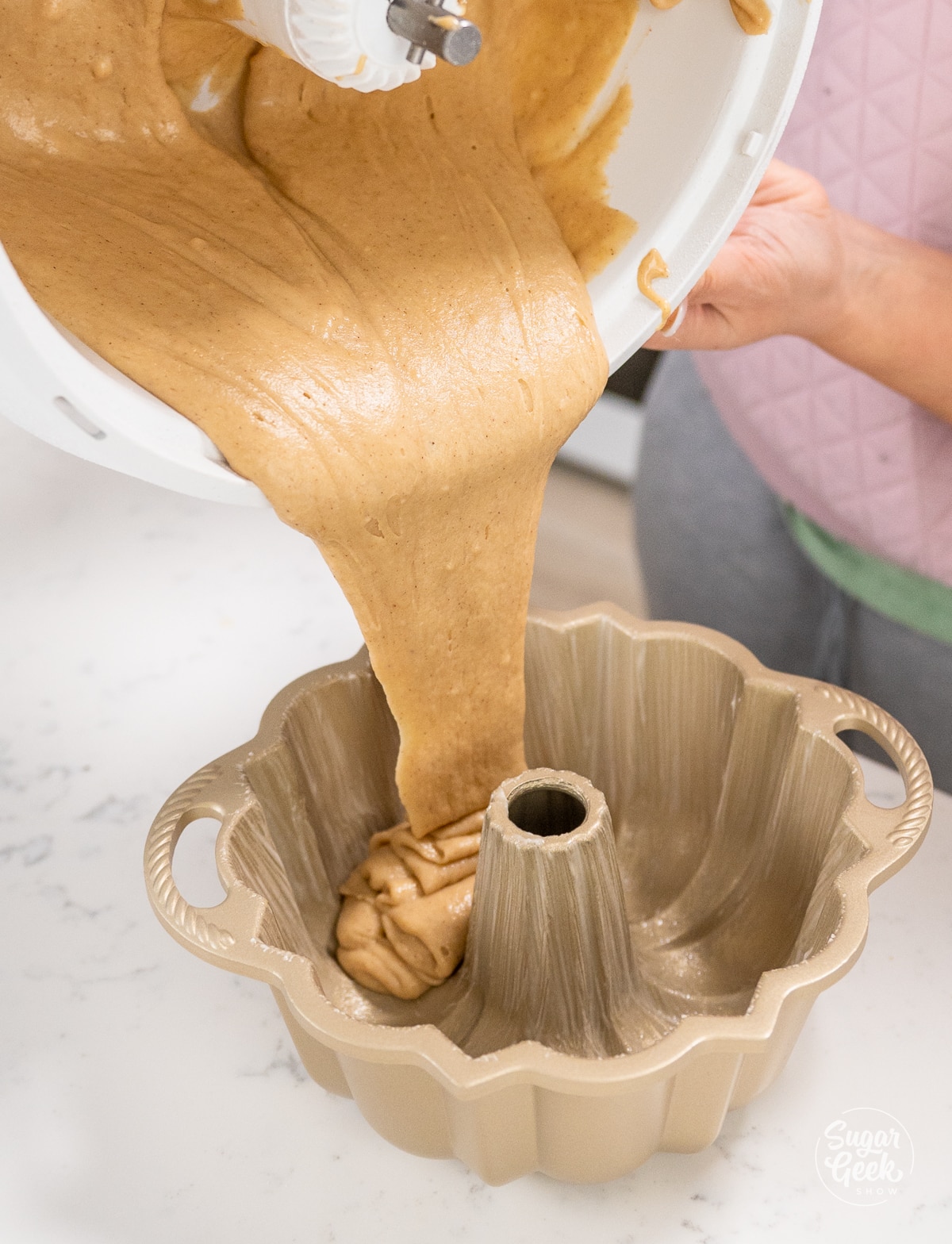
  6. Pour the cake batter into the prepared pan and fill it up ⅔ of the way full. If your bundt pan doesn't have handles, place it on a baking sheet.pouring honey cake batter into a bundt pan.
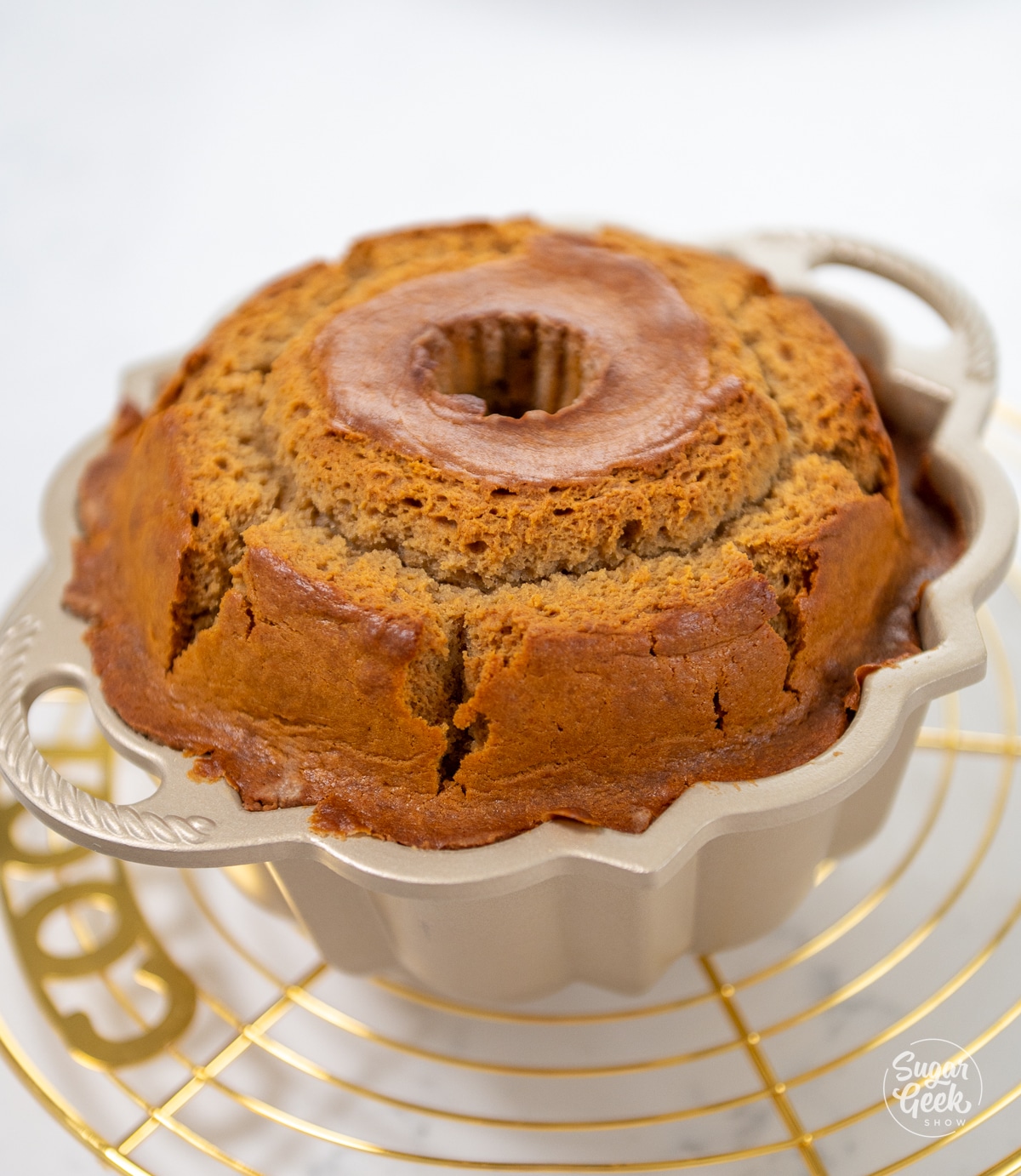
  7. Bake the cake in the oven for 45-50 minutes or until it is golden brown and a toothpick comes out clean.Baked honey cake on a cooling rack.
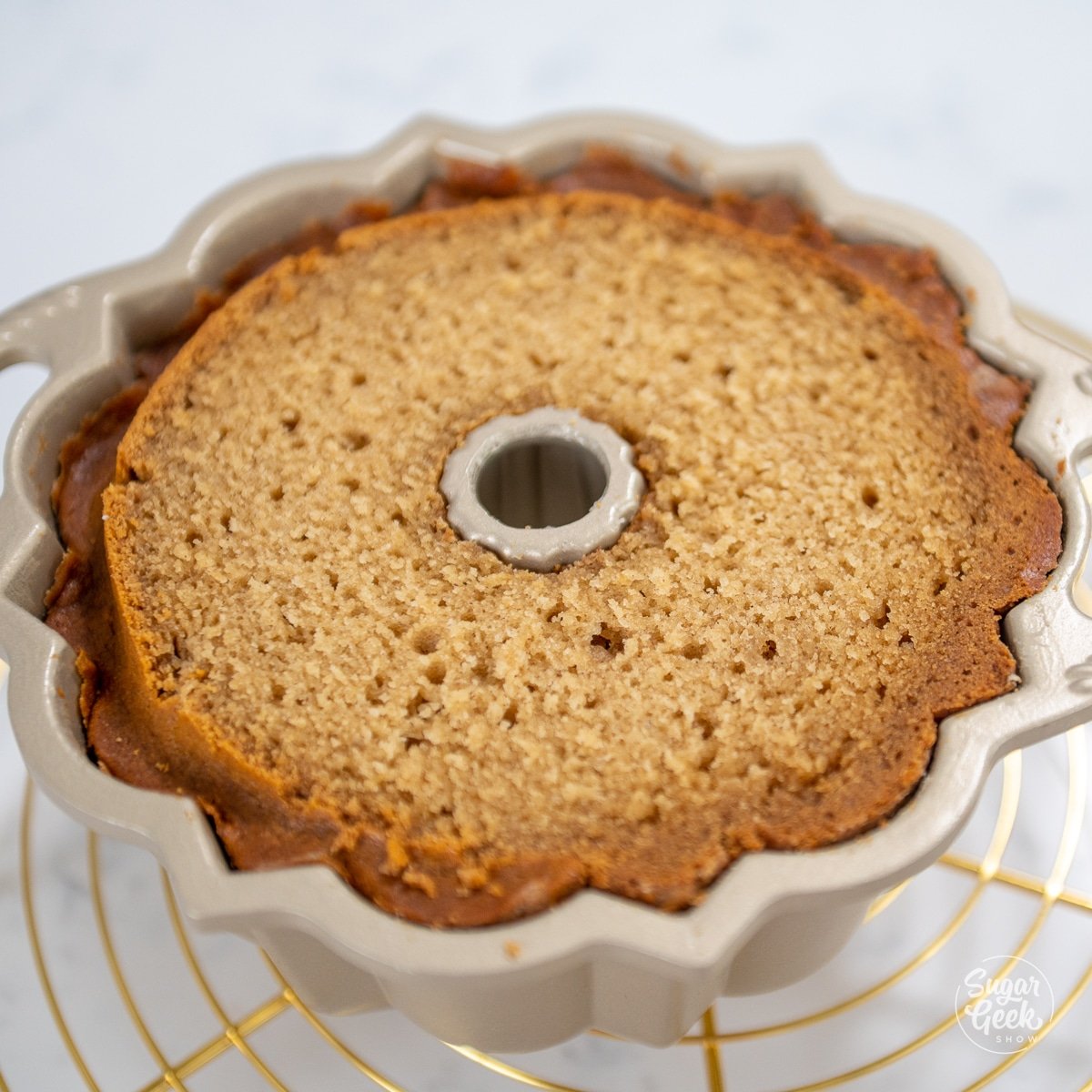
  8. Rest the cake in the pan for 15 minutes and cut off the top so that it's level with the pan. Save it for snacking!picture of honey bundt cake with dome cut off in pan.
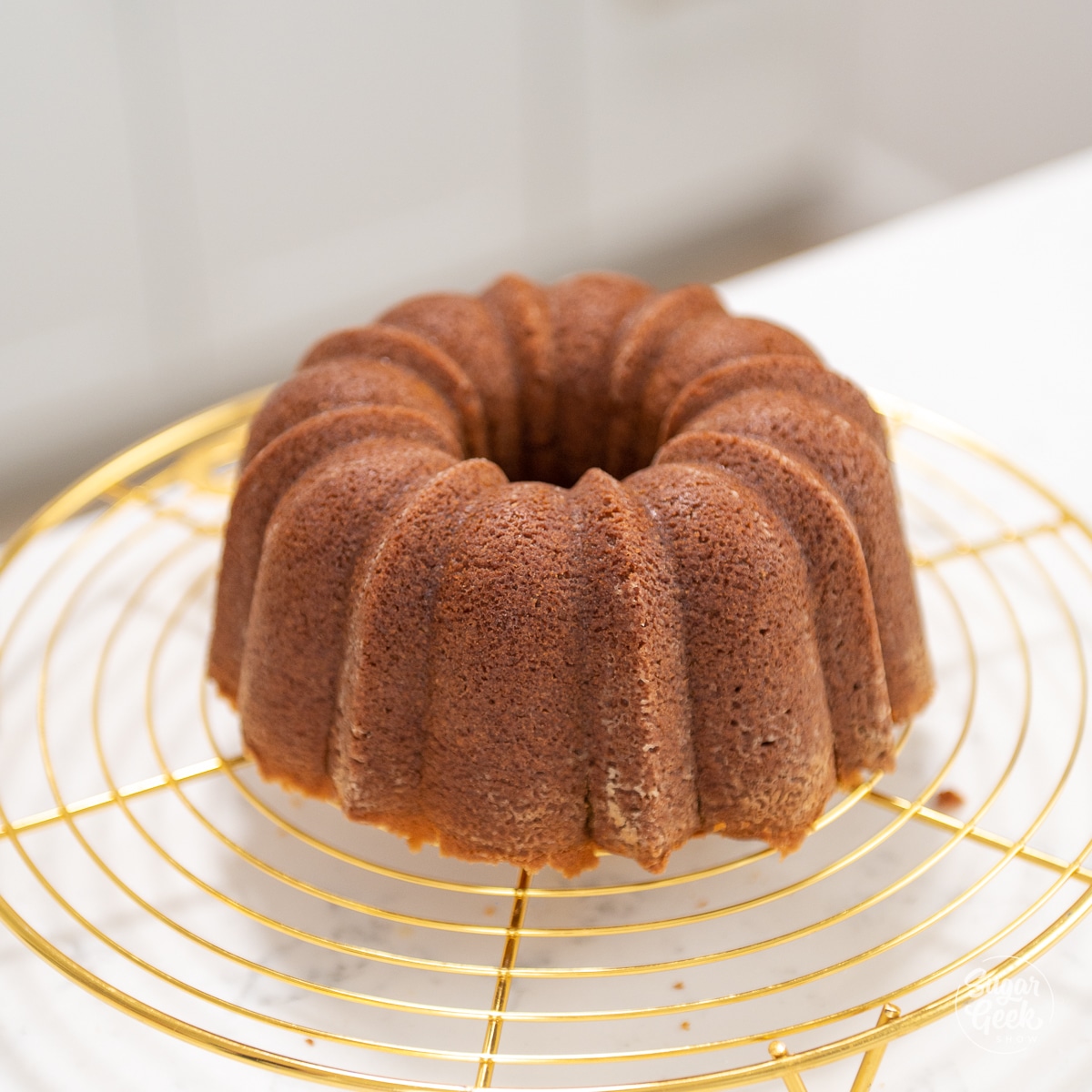
  9. Place a wire rack on top and flip the cool cake upside down then remove the pan. Cool the cake for about 2 hours before adding the glaze. honey bundt cake flipped out onto cooling rack.

Making the Honey Glaze

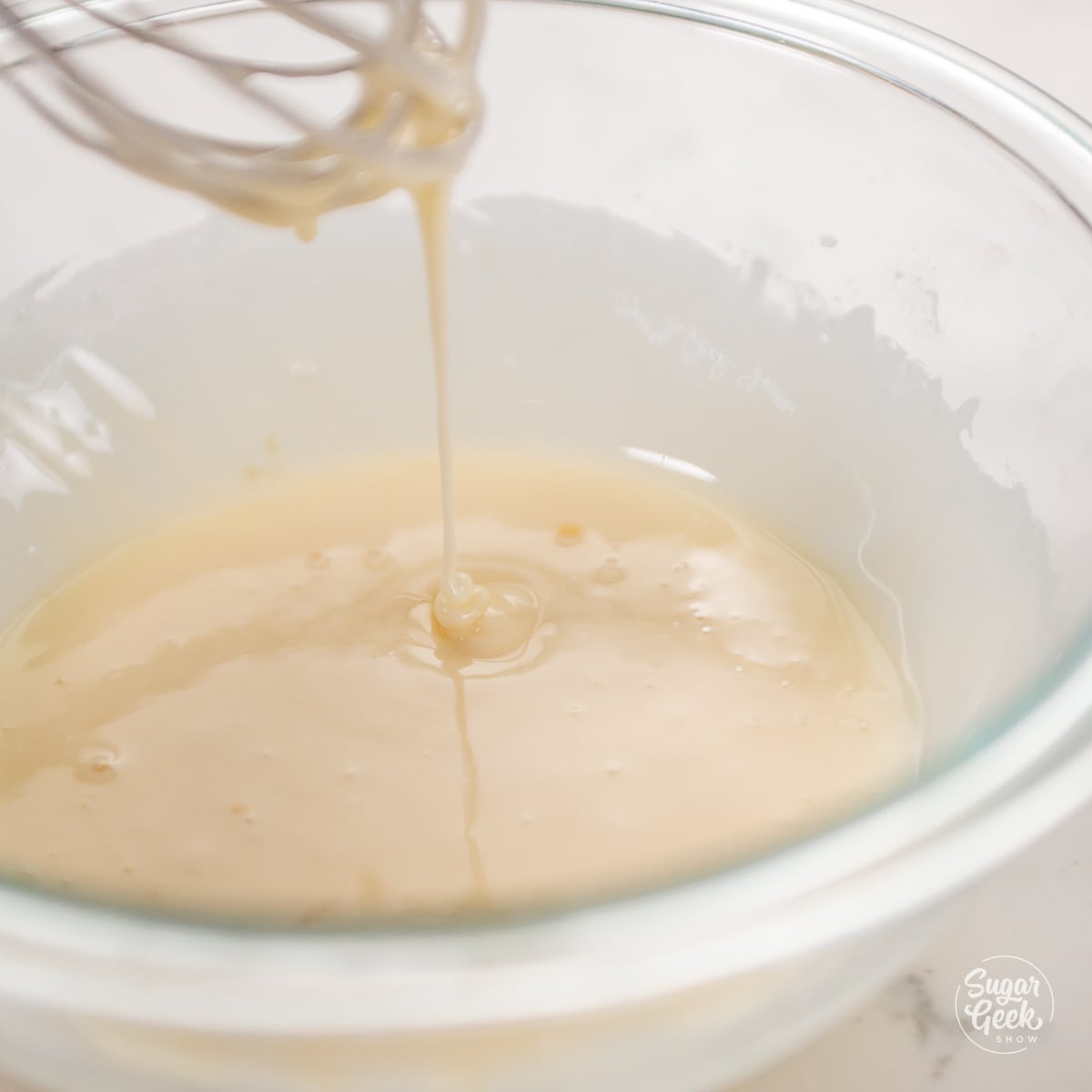
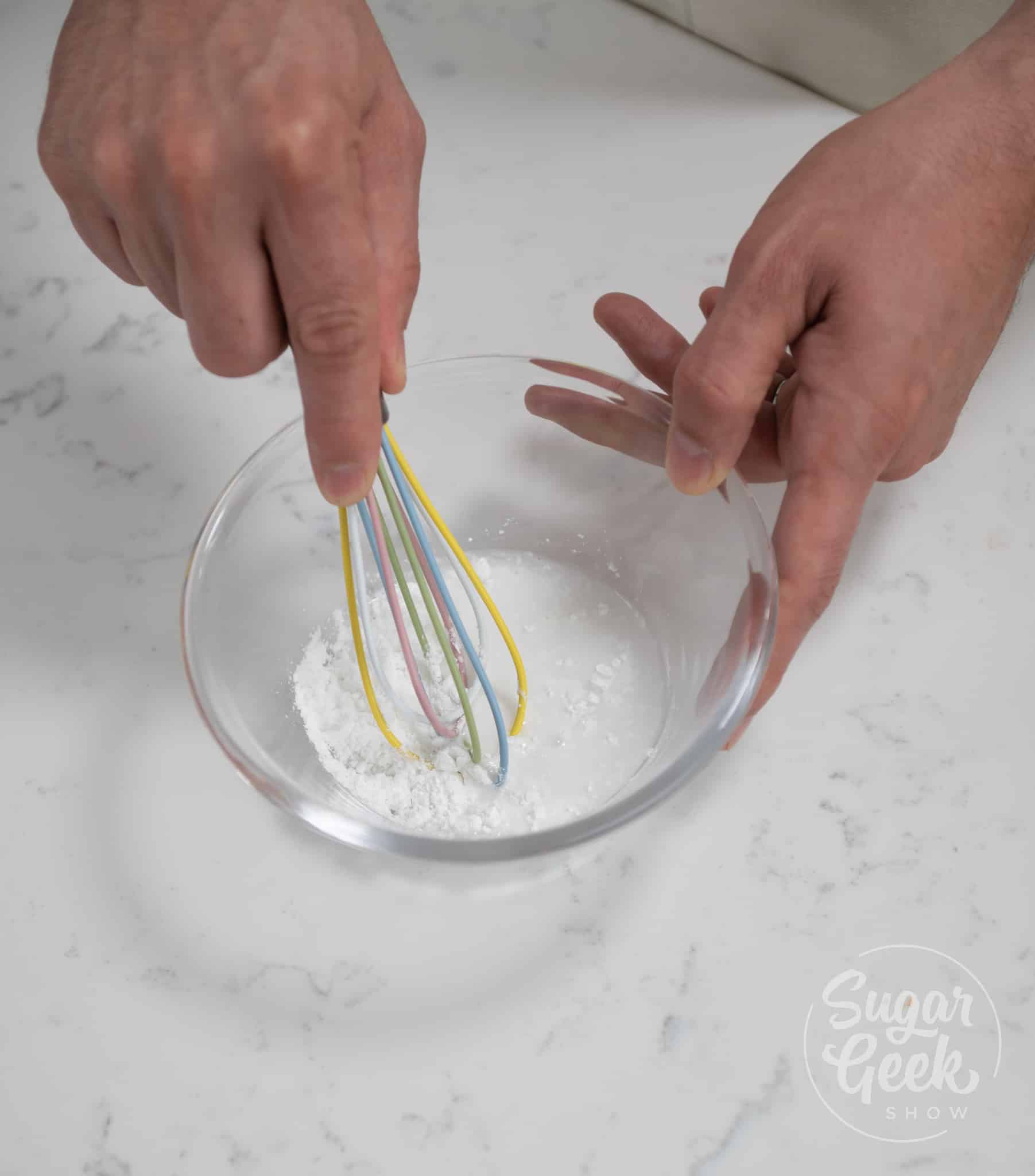
  1. Combine the powdered sugar, melted butter, orange juice, and honey in a large bowl with a whisk. Add a little bit of orange zest if you like a brighter flavor.whisking the honey, orange juice and powdered sugar in a bowl.
  2. To make the glaze more opaque, add a few drops of white food coloring and mix it together.
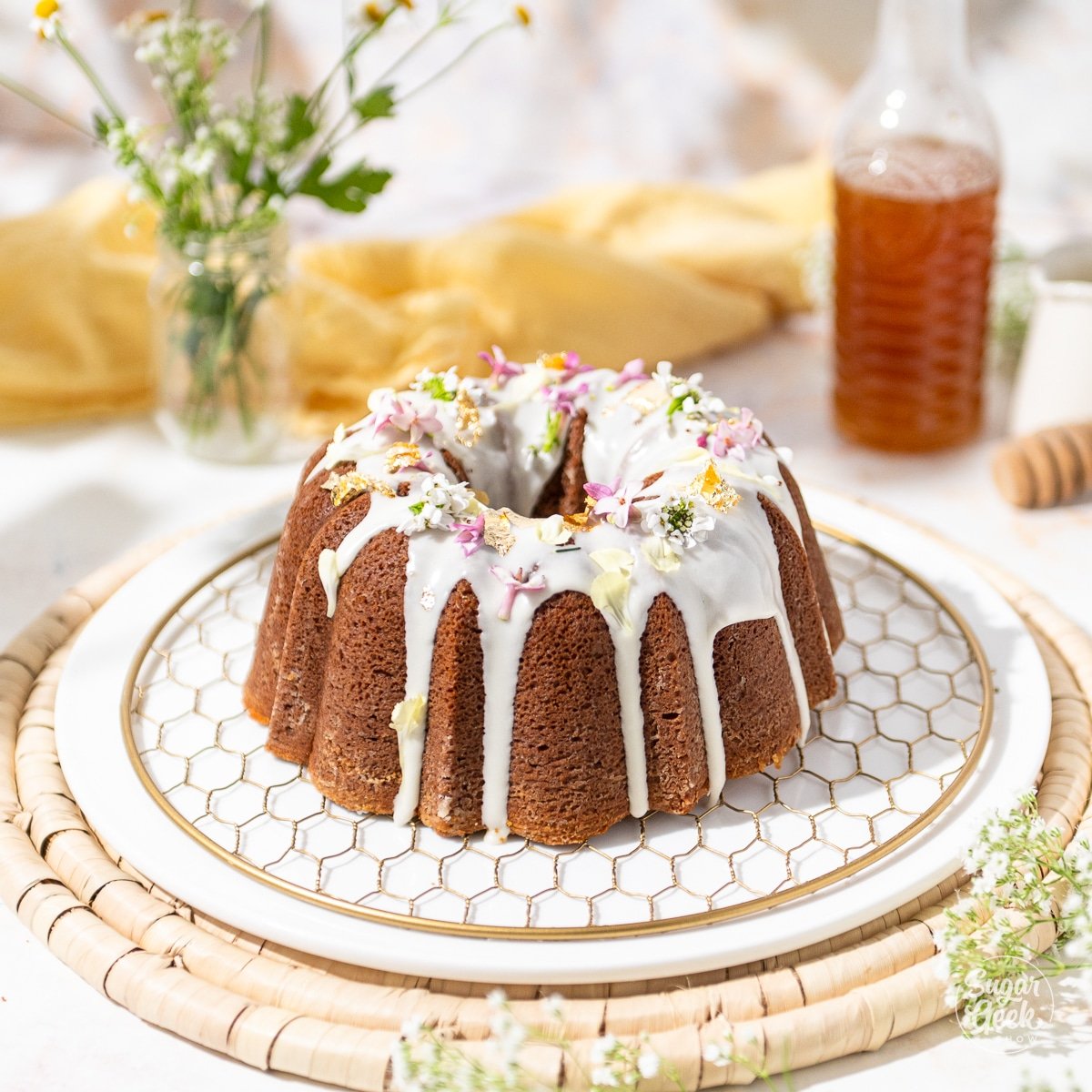
  3. Place the cake on a wire rack and drizzle the glaze on top of the cake and let it drip down the sides. 
  4. Decorate the cake with some fresh flowers, honey, and gold leaf, or leave it plain. This cake is best served immediately but can be refrigerated and covered in plastic wrap for up to 3 days.finished honey bundt cake.

Tips For Baking From Scratch

*This post may contain affiliate links which means if you click on them, I might get a few pennies.

I suggest purchasing a kitchen scale if you don't already have one to make the best cake recipes. One cup of cake flour can vary from scoop to scoop depending on how packed the flour is, its humidity, and the type of flour, which can ruin your cake recipe.

Practice Mise en Place (everything in its place) which means you measure everything before you start mixing so you don't accidentally forget something or add any ingredients out of order. I use a set of medium and small pyrex glass bowls I got from goodwill for this and it makes things SO much easier.

Room temperature ingredients are very important to baking. Warm the buttermilk and eggs until they are room temperature or slightly warm. Cool the melted butter and coffee to room temperature. If all of your liquid ingredients are at the same temperature, they will emulsify better to make a smooth batter. 

FAQ

What does honey do to cakes?

Compared to traditional granulated sugar, honey helps cake retain more moisture, and adds a richer color and deeper flavor. When honey is heated in a cake, it creates a chemical browning effect called the Maillard Reaction.

Can I bake this honey cake in a different pan?

Yes, this recipe can be baked in a bundt pan, a loaf pan, or even two 8" cake pans.

Where did honey cake originate?

Honey cake is popular in Greece, Russia, and Ukraine. The original recipe is a sweet cake that's often eaten on the Jewish holiday, Rosh Hashanah (Jewish New Year).

Related Recipes

Apple Galette

Easy Caramel Apples

Chocolate Texas Sheet Cake

Pumpkin Spice Cake

Recipe

honey bundt cake on a platter
Print Recipe
5 from 1 vote

Honey Cake Recipe

This honey cake recipe is made with real honey and only needs ONE bowl! This is a very moist cake but is stable enough for use in a layer cake, bundt cake, or shaped cake pan.
Prep Time5 minutes mins
Cook Time45 minutes mins
Chilling Time2 hours hrs
Total Time2 hours hrs 50 minutes mins
Course: Dessert
Cuisine: American
Servings: 12 servings
Calories: 408kcal
Author: Liz Marek

Equipment

  • 1 Stand mixer with paddle attachment
  • 1 6" bundt cake pan

Ingredients

Honey Cake

  • 8 ounces buttermilk slightly warm
  • 2 large eggs slightly warm
  • 4 ounces unsalted butter melted, not hot
  • 2 ounces vegetable oil or canola
  • 2 ounces coffee slightly warm
  • 1 teaspoon vanilla extract
  • 0.5 teaspoons almond extract
  • 2 ounces wild flower honey
  • 15 ounces all-purpose flour
  • 6 ounces brown sugar sifted to remove lumps
  • 1.5 teaspoons baking soda
  • 1.5 teaspoons salt
  • 1.5 teaspoons ground cinnamon

Honey Orange Glaze

  • 8 ounces sifted powdered sugar
  • 2 Tablespoos orange juice
  • 1 teaspoon honey
  • 2 drops white food coloring
US Customary - Metric

Instructions

Honey Cake

  • Preheat the oven to 335°F (170°C) and grease a bundt pan with cake goop or your preferred pan release. Don't forget about the center and sides of the pan! You can use a loaf pan or cake pan if you prefer, just adjust your baking time. 
  • Pour the buttermilk, eggs, melted butter, oil, coffee, vanilla extract, almond extract, and honey into a large measuring cup and whisk to combine. 
  • Place a fine mesh strainer over the bowl of your stand mixer and sift the brown sugar to remove the lumps. There might be a few fine crumbs that you need to remove. This will ensure that there are no clumps of brown sugar in the batter.
  • Add the flour, baking soda, salt, and cinnamon to the brown sugar in the bowl of your stand mixer with the paddle attachment and mix for a few seconds to combine. You can also use an electric hand mixer or a whisk. 
  • Slowly pour the wet ingredients into the dry ingredients while mixing on medium speed until the batter is just combined.
  • Pour the cake batter into the prepared pan and fill it up ⅔ of the way full. If your bundt pan doesn't have handles, place it on a baking sheet.
  • Bake the cake in the oven for 45-50 minutes or until it is golden brown and a toothpick comes out clean.
  • Rest the cake in the pan for 15 minutes and cut off the top so that it's level with the pan. Save it for snacking!
  • Place a wire rack on top and flip the cool cake upside down then remove the pan. Cool the cake for about 2 hours before adding the glaze. 

Making the Honey Glaze

  • Combine the powdered sugar, melted butter, orange juice, and honey in a large bowl with a whisk. Add a little bit of orange zest if you like a brighter flavor.
  • To make the glaze more opaque, add a few drops of white food coloring and mix it together.
  • Place the cake on a wire rack and drizzle the glaze on top of the cake and let it drip down the sides. 
  • Decorate the cake with some fresh flowers, honey, and gold leaf, or leave it plain. This cake is best served immediately but can be refrigerated and covered in plastic wrap for up to 3 days.

Notes

  1. This honey cake recipe comes together very quickly but does need to cool for at least 2 hours after baking, so you want to plan ahead.
  2. Bring all your ingredients to room temperature or even a little warm (eggs, buttermilk, butter, etc) to ensure your batter does not break or curdle. 
  3. Use a scale to weigh your ingredients (including liquids) unless otherwise instructed (Tablespoons, teaspoons, pinch etc). Metric measurements are available in the recipe card. Scaled ingredients are much more accurate than using cups and help ensure the success of your recipe. 
  4. Practice Mise en Place (everything in it's place). Measure out your ingredients ahead of time and have them ready before you start mixing to reduce the chances of accidentally leaving something out.
  5. If you do not have buttermilk to make the cake, you can use one of my buttermilk substitutes.
  6. I like using wildflower honey or raw unfiltered honey for the richest flavor.
  7. You can use warm water if you don't want to use coffee.

Nutrition

Serving: 1serving | Calories: 408kcal | Carbohydrates: 65g | Protein: 5g | Fat: 14g | Saturated Fat: 6g | Polyunsaturated Fat: 2g | Monounsaturated Fat: 5g | Trans Fat: 0.3g | Cholesterol: 53mg | Sodium: 466mg | Potassium: 104mg | Fiber: 1g | Sugar: 38g | Vitamin A: 313IU | Vitamin C: 0.1mg | Calcium: 49mg | Iron: 2mg
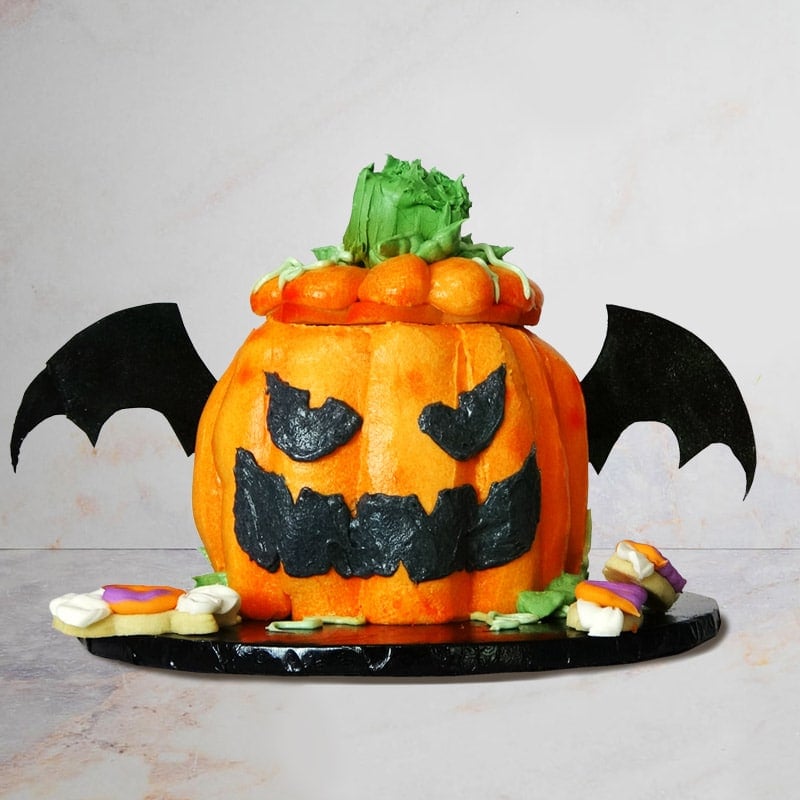
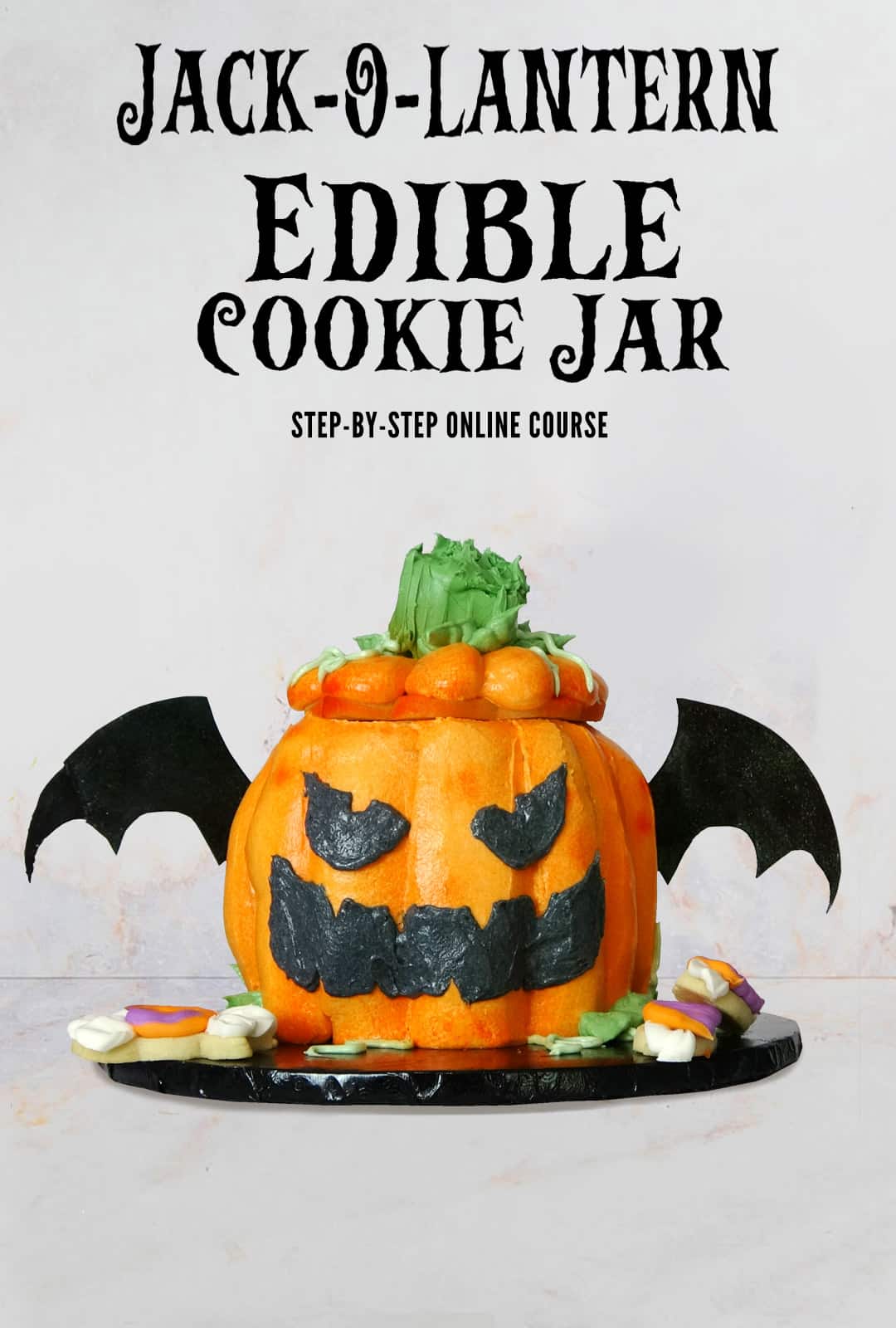
Cookies stacked to look like a jack-o-lantern

October 15, 2022 Course Preview

Jack-O-Lantern Edible Cookie Jar Tutorial

Skill level: Intermediate

Guest instructor Mik Nuzzi is back with another cookie creation. This spook-tacular Jack-O-Lantern not only is a cookie jar that holds delicious delicacies inside, it's ALSO a cookie! Mik provides all the tips and tricks needed to create this 3D cookie masterpiece.

In this tutorial, you will learn how to shape, bake and stack the cookies together, how to create the candy-shaped cookies, how to pipe and ice the Jack-O-Lantern, how to create the edible bat wings and how to create the cookie jar lid.

1:12:11 Minutes of Instruction

What You Will Learn

  • Learn how to create a 3D Jack-O-Lantern cookie jar... out of cookies!
  • How to bake, create and stack the cookies into a fun pumpkin shape
  • Learn how to color your icing to a cohesive color scheme
  • How to create the edible bat wings and mini-candy cookies

Cookies stacked into a Jack-O-Lantern cookie jar

Tutorial Chapters

  1. Making The Cookie Dough 2:31
  2. Rolling Out The Cookie Dough 5:58
  3. Cutting Out & Baking The Cookies 8:25
  4. Making The Wafer Paper Bat Wings 15:43
  5. Making The Royal Icing 20:18
  6. Coloring The Royal Icing 23:06
  7. Assembling The Cookie Jar 26:42
  8. Decorating The Candy Cookies 32:55
  9. Making Green Royal Icing 38:11
  10. Making The Pumpkin Stem 40:05
  11. Making The Buttercream 44:10
  12. Coloring The Buttercream 49:15
  13. Making The Cookie Jar Lid 53:16
  14. Decorating The Cookie Jar 55:34
  15. Adding The Stem To The Lid 1:00:57
  16. Airbrushing The Lid And Jar 1:02:51
  17. Making Black Buttercream 1:05:33
  18. Adding The Face 1:06:06
  19. Adding The Final Decorations 1:07:41

Downloads

Materials List

Cookie Template 01

Cookie Template 02

Bat Wing Template

Buttercream Recipe

Sugar Cookie Recipe

Royal Icing Recipe

Cookies stacked to look like a jack-o-lantern

October 15, 2022 Paid Video

Jack-O-Lantern Edible Cookie Jar

Skill level: Intermediate

Guest instructor Mik Nuzzi is back with another cookie creation. This spook-tacular Jack-O-Lantern not only is a cookie jar that holds delicious delicacies inside, it's ALSO a cookie! Mik provides all the tips and tricks needed to create this 3D cookie masterpiece.

In this tutorial, you will learn how to shape, bake and stack the cookies together, how to create the candy-shaped cookies, how to pipe and ice the Jack-O-Lantern, how to create the edible bat wings and how to create the cookie jar lid.

1:12:11 Minutes of Instruction

What You Will Learn

  • Learn how to create a 3D Jack-O-Lantern cookie jar... out of cookies!
  • How to bake, create and stack the cookies into a fun pumpkin shape
  • Learn how to color your icing to a cohesive color scheme
  • How to create the edible bat wings and mini-candy cookies

Tutorial Chapters

  1. Making The Cookie Dough 2:31
  2. Rolling Out The Cookie Dough 5:58
  3. Cutting Out & Baking The Cookies 8:25
  4. Making The Wafer Paper Bat Wings 15:43
  5. Making The Royal Icing 20:18
  6. Coloring The Royal Icing 23:06
  7. Assembling The Cookie Jar 26:42
  8. Decorating The Candy Cookies 32:55
  9. Making Green Royal Icing 38:11
  10. Making The Pumpkin Stem 40:05
  11. Making The Buttercream 44:10
  12. Coloring The Buttercream 49:15
  13. Making The Cookie Jar Lid 53:16
  14. Decorating The Cookie Jar 55:34
  15. Adding The Stem To The Lid 1:00:57
  16. Airbrushing The Lid And Jar 1:02:51
  17. Making Black Buttercream 1:05:33
  18. Adding The Face 1:06:06
  19. Adding The Final Decorations 1:07:41

Downloads

Materials List

Cookie Template 01

Cookie Template 02

Bat Wing Template

Buttercream Recipe

Sugar Cookie Recipe

Royal Icing Recipe

October 13, 2022 Pastries

Eclair Recipe

This eclair recipe is a simple classic French dessert that balances sweet, rich, soft, and crunchy all in one gorgeous bite! They are slightly crisp on the exterior, coated in shiny dark chocolate, and filled with sweet, rich pastry cream. The dark chocolate glaze gives an elegant shine and balanced flavor. 

The foundation of the perfect chocolate eclair is a light and airy classic French dough. Pâte à choux is a basic recipe that is the base for many delicious French pastries: cream puffs, savory gougères, churros, cruller donuts, beignets, gnocchi, profiteroles, and more. Homemade eclairs are the best because you get to enjoy them immediately while they're still crisp, you will never buy one from the store again! 

The same pastry cream and chocolate combination that fills these éclairs is exactly what goes inside my homemade boston cream pie, just stacked between cake layers instead of piped into choux pastry.


Table of contents

  • Eclair Ingredients
  • How to Make Eclairs
    • Making the Pâte a Choux
    • Making the Vanilla Pastry Cream
    • Making the Chocolate Ganache Glaze
    • Filling and Glazing the Eclairs
  • Storing the Eclairs
  • Tips for Baking From Scratch
  • FAQ
  • Related Recipes

Eclair Ingredients

Eclair ingredientsButter: European butter will result in better pastries and flavor because it has a higher fat content (83%) than American butters. More fat, less water equals more flavor and better baking results. Regular grocery stores usually carry one brand or another of European butter, even some of your more common American brands will have a line of butter that has a higher fat content, those are usually labeled "European style", just check the back of the package for the fat percentage. In this recipe Chef Christophe prefers to use Plugra brand European butter.

Vanilla Bean: Scraping a fresh vanilla bean will give your pastry cream a fragrant strong authentic vanilla flavor, plus the small seeds add a gorgeous look to the smooth pastry cream. If you don't have a bean, that is okay, and vanilla extract or vanilla bean paste will work as well.

Chocolate: The high-quality chocolate and dark (64%) flavor contribute to the shiny finish of the dessert and the balance of flavor. The slight bitterness of the chocolate goes well in contrast to the sweet pastry cream filling.

Salt: Even the smallest pinch of salt can set your pastry apart from the rest. It enhances all flavors and highlights the sweetness of a pastry. 

Eggs: Use large, fresh eggs. Eggs are the backbone of this dough, without them, they won't "puff". 

How to Make Eclairs

You first want to make and chill the pastry cream, then make the eclair shells and let them cool. The shells cool fairly quickly and then you can begin filling the eclairs with pastry cream. The chocolate ganache glaze comes together easily and it does need to still be slightly warm for dipping consistency, so it works best to have the eclairs filled and ready to glaze as soon as the glaze is finished.

Making the Pâte a Choux

  1. Preheat the oven to 360°F and prepare two sheet pans with parchment paper or a "silpain" baking mat.
  2. Add the milk, water, salt, sugar, and butter to a medium saucepan and bring it to a boil. It is important to make sure that the butter is melting at the same rate the milk is heating so that the milk doesn't boil before the butter is melted. Slowly moving it around with a wooden spoon helps distribute the heat evenly. 
    hand adding milk to a saucepan.
  3. Once the mixture has come to a boil, turn off the heat and sift in the flour.
    hands adding flour to saucepan.
  4. Begin stirring immediately with a wooden spoon, and continue to stir for 1 minute until the flour is fully incorporated, it will look a lot like mashed potatoes. 
    stirring choux mixture in saucepan with a wooden spoon.
  5. Turn the heat back on medium-high and continue to stir and keep it moving to dry out the dough.
    spoon stirring cooking choux mixture in a saucepan.
  6. Once you see a browning layer on the bottom of your saucepan, the dough is dry enough and you can remove it from the heat.  This is important, as it will help your eclairs "puff" and ensure that they have a hollow center for the cream filling.
    showing the browning layer on the bottom of the saucepan.
  7. Put the dough immediately into the bowl of a stand mixer with the paddle attachment and begin to mix to cool it down, this should take about 30 seconds. When you can place your hand on the side of the bowl without it feeling too hot, it's done.
    spooning the cooked choux mixture into a stand mixer bowl.
  8. Add the eggs one at a time, letting each egg incorporate fully before the next. The dough should be fully combined with no spots of dry flour, and stiff enough to hold its shape but pull to a soft peak when picking up the spoon. 
    hand pouring eggs into stand mixer bowl.
  9. Prepare a piping bag with a large star or large round tip. Fill the piping bag with the dough. I prefer a star tip for pretty lines on top of my eclairs.
    piping bags with round and star tips.
  10. Pipe the pâte à choux in equal-length tubes, onto a lined baking sheet, about 3-4" long, and 2" apart. Pro-Tip: Use a cake smoother or a ruler to pipe your eclairs uniformly.
    piping the choux dough into uniform lengths on a silpain mat.
  11. Gently smooth the top of the eclair with a damp fingertip.
  12. Bake the eclair shells at 360°F for 25-30 minutes until golden brown. 
    baked eclair shells on a sheet pan.
  13. Cool the eclair shells completely on a wire rack for about 30 minutes.

Making the Vanilla Pastry Cream

  1. Place your milk, scraped vanilla bean seeds, vanilla bean pod, and half of your sugar in a medium-sized pot over medium heat and bring it to a boil.
    hand pouring sugar into saucepan with milk.
    saucepan with milk, vanilla bean seeds and vanilla bean pod.
  2. Add your egg yolks, the other half of the sugar, and the cornstarch to a separate large bowl.
    hand mixing cornstarch into eggs in a bowl.
  3. Whisk your yolk mixture together to form a ribbon texture.
    egg, sugar and cornstarch mixture whisked to ribbon texture.
  4. Once your milk mixture comes to a boil, pour half of the mixture into the yolk mixture and whisk together. This is called tempering your yolks. 
    pouring half the milk mixture into the egg mixture.
  5. Pour the rest of the milk mixture into the egg yolks and whisk together. 
  6. Pour the entire mixture back into the pot through a strainer to remove the vanilla fibers, and boil everything for about 1 minute, whisking constantly.
    hands pouring the mixture back into the saucepan through a sieve.
    whisking the strained pastry cream mixture over heat for an additional minute.
  7. Pour your pastry cream into a bowl and cover it with plastic wrap touching the cream to avoid forming a skin. Refrigerate it for at least 30 minutes before using it to let everything set up.
    pouring the cooked pastry cream into a bowl to cool.

Making the Chocolate Ganache Glaze

  1. Heat the glucose in the microwave for about 15 seconds until it is very liquid.
  2. Add the glucose and cream to a small saucepan over the stove, stir with a spatula and bring it to a simmer over medium heat.
    adding cream to a saucepan.
  3. Fill a large measuring cup with the chocolate and pour the cream mixture over the top in 2 portions, mixing after each. 
    pouring warmed cream over chocolate in a bowl.
    pouring second portion of cream over chocolate mixture.
  4. Blend the chocolate glaze with a whisk, if it is separated or "broken" you can use an immersion blender to bring it back together. 
  5. At a temperature of around 100°F or 38°C the chocolate glaze is ready to go. 
    checking the temperature of the chocolate mixture.

Filling and Glazing the Eclairs

  1. Fill a pastry bag with the prepared pastry cream. Christophe used a special tip designed to fill pastries, but any piping tip with a narrow round tip will work. 
    hand showing filling piping tip.
  2. Poke a hole in each end of the eclair shell and insert the piping tip, fill slowly on each side until the pastry cream begins to push back out the hole. This ensures the shell is full. If you are using a regular piping tip you can poke small holes in the bottom of the pastry shell and fill it from there.
    hands using piping tip to poke a hole in the eclair shells.
    hand showing holes poked in eclair shells for filling.
    hand filling eclair shell with pastry cream.
  3. Check the temperature of the ganache. At around 100°F or 38°C it is a good consistency to coat the top of the eclair without being too thick or too thin and running off the eclair. 
  4. Carefully dip the top of the filled eclair evenly in the chocolate, about to the middle of the eclair, set aside on a pan for the glaze to set while you dip the rest of your eclairs.
    hand dipping eclair into chocolate ganache.
    hand with freshly dipped eclair.
    finished eclairs.

Storing the Eclairs

Eclairs are meant to be eaten the same day as they are made. The moisture of the filling will cause the choux to soften and lose its crunch. So the sooner you can serve the eclairs, the better. If you have leftover filled eclairs, store them in an airtight container in the fridge, they will be soft, but still delicious. 

If you need to store the baked eclair shells, once they have fully cooled, wrap them well in plastic wrap and store at room temperature, unfilled. They can also be frozen if you do not plan to use them in the next day or so. If your eclair shells have softened they can be crisped up in a 350°F oven for 5 minutes. 

Another option if you don't plan to serve your eclairs the same day is to pipe and freeze the pate a choux dough to be baked and filled as needed. Just place them on a baking sheet and let them thaw slightly and bake as directed.

Tips for Baking From Scratch

*This post may contain affiliate links which means if you click on them I might get a few pennies.

I suggest purchasing a kitchen scale if you don't already have one to make the best scratch recipes. One cup of flour can vary from scoop to scoop depending on how packed the flour is, its humidity, and the type of flour, which can ruin your recipe. All of Chef Christophe's recipes are measured in grams, and a scale is necessary.

Practice Mise en Place (everything in its place) which means you measure everything before you start mixing so you don't accidentally forget something or add any ingredients out of order. I use a set of medium and small pyrex glass bowls I got from goodwill for this and it makes things SO much easier.

FAQ

What is the difference between an eclair and a cream puff?

Eclairs and cream puffs are both made from the same choux pastry dough, but the difference is the shape and the filling. Eclairs have a long, rectangular shape and are filled with pastry cream and topped with a chocolate glaze. Cream puffs are round and can be filled on the inside or sliced in half and filled

Do you have to refrigerate eclairs?

After filling the eclairs, they must be refrigerated and can last up to 2-3 days in an airtight container. If you're baking the shells ahead of time, they do not need to be refrigerated until filling.

Can I make eclairs ahead of time?

Yes, you can bake your eclair shells ahead a few different ways. Pipe your dough onto a baking sheet and freeze it, then let them thaw out and bake whenever you're ready to fill and serve them. Or you can bake your eclair shells and freeze them, then refresh them in the oven by baking at 350°F for 5 minutes until they're crisp again. Whatever you do, don't fill them and keep them in the fridge or freezer for too long because that will make your eclairs soggy.

What is pâte à choux?

Pâte à choux (also known as Choux dough) is a delicate French pastry dough used for cream puffs, eclairs, savory gougères, churros, cruller donuts, beignets, gnocchi, profiteroles, and more. Choux dough is a cross between dough and batter and is a staple in pastry.

Why do I need to use a wooden spoon? 

Using a wooden spoon for choux is recommended because it provides a strong handle to move the stiff dough around the pot. Using a silicone spatula may be too flexible and won't mix and dry the dough as efficiently. Also, this is what French chefs recommend and I am not going to argue with a French chef. 

Why are my eclairs soggy? 

If they did not bake long enough they can become soft as they cool because not enough moisture was baked out of them. Also, if the dough was not dried properly it will remain soft when baked. If you fill them too far in advance the shell will become soft from the moisture in the filling. 

What else can I fill eclairs with?

In this recipe, we fill the eclairs with pastry cream, you could flavor your pastry cream with caramel, chocolate, or lemon. You can fill eclairs with many different things, a simple vanilla whipped cream, bavarian cream, chocolate mousse, or almond filling.

Related Recipes

Pastry Cream

Chocolate Mousse

Cream Puffs

Profiteroles

Recipe

Print Recipe
5 from 1 vote

Eclair Recipe

Pâte à choux may sound intimidating, but a classic French eclair is surprisingly easy to make at home! Made with just 5 ingredients, this basic recipe is the perfect next step in choux pastry. Fill the pastry shells with a smooth and rich pastry cream, balanced with a simple chocolate glaze for an impressive dessert.
Prep Time40 minutes mins
Cook Time1 hour hr
Cooling Time30 minutes mins
Total Time2 hours hrs 10 minutes mins
Course: Dessert
Cuisine: French
Servings: 18 eclairs
Calories: 339kcal
Author: Liz Marek

Equipment

  • 1 Stand mixer with paddle attachment
  • 1 Piping Bag
  • 1 Round piping tip or star tip

Ingredients

Pâte a Choux

  • 160 grams milk
  • 160 grams water
  • 4 grams salt
  • 6 grams granulated sugar
  • 140 grams unsalted butter European (like Plugra)
  • 180 grams all purpose flour
  • 200 grams eggs

Pastry Cream

  • 750 grams milk
  • 1 whole vanilla bean
  • 300 grams egg yolk
  • 120 grams granulated sugar
  • 60 grams cornstarch

Chocolate Ganache Glaze

  • 200 grams heavy cream
  • 180 grams dark chocolate 64%
  • 40 grams glucose

Instructions

Making the Pâte a Choux

  • Preheat the oven to 360°F and prepare two sheet pan with parchment paper or a "silpain" baking mat.
  • Add the milk, water, salt, sugar, and butter to a medium saucepan and bring it to a boil. It is important to make sure that the butter is melting at the same rate the milk is heating so that the milk doesn't boil before the butter is melted. Slowly moving it around with a wooden spoon helps distribute the heat evenly. 
  • Once the mixture has come to a boil, turn off the heat and sift in the flour.
  • Begin stirring immediately with a wooden spoon, and continue to stir for 1 minute until the flour is fully incorporated, it will look a lot like mashed potatoes. Turn the heat back on medium-high and continue to stir and keep it moving to dry out the dough.
  • Once you see a browning layer on the bottom of your saucepan, the dough is dry enough and you can remove it from the heat.  This is important, as it will help your eclairs "puff" and ensure that they have a hollow center for the cream filling.
  • Put the dough immediately into the bowl of a stand mixer with the paddle attachment and begin to mix to cool it down, this should take about 30 seconds. When you can place your hand on the side of the bowl without it feeling too hot, it's done.
  • Add the eggs one at a time, letting each egg incorporate fully before the next. The dough should be fully combined with no spots of dry flour, and stiff enough to hold its shape but pull to a soft peak when picking up the spoon. 
  • Prepare a piping bag with a large star or large round tip. Fill the piping bag with the dough. I prefer a star tip for pretty lines on top of my eclairs.
  • Pipe the pâte à choux in equal-length tubes, onto a lined baking sheet, about 3-4" long, and 2" apart. Pro-Tip: Use a cake smoother or a ruler to pipe your eclairs uniformly.
  • Gently smooth the top of the eclair with a damp fingertip.
  • Bake the eclair shells at 360°F for 25-30 minutes until golden brown. 
  • Cool the eclair shells completely on a wire rack for about 30 minutes.

Making the Vanilla Pastry Cream

  • Place your milk, scraped vanilla bean seeds, vanilla bean pod, and half of your sugar in a medium-sized pot over medium heat and bring it to a boil.
  • Add your egg yolks, the other half of the sugar, and the cornstarch to a separate large bowl.
  • Whisk your yolk mixture together to form a ribbon texture.
  • Once your milk mixture comes to a boil, pour half of the mixture into the yolk mixture and whisk together. This is called tempering your yolks. 
  • Pour the rest of the milk mixture into the egg yolks and whisk together.
  • Pour the entire mixture back into the pot through a strainer to remove the vanilla fibers, and boil everything for about 1 minute, whisking constantly.
  • Pour your pastry cream into a bowl and cover it with plastic wrap touching the cream to avoid forming a skin. Refrigerate it for at least 30 minutes before using it to let everything set up.

Making the Chocolate Ganache Glaze

  • Heat the glucose in the microwave for about 15 seconds until it is very liquid.
  • Add the glucose and cream to a small saucepan over the stove, stir with a spatula and bring it to a simmer over medium heat.
  • Fill a large measuring cup with the chocolate and pour the cream mixture over the top in 2 portions, mixing after each. 
  • Blend the chocolate glaze with a whisk, if it is separated or "broken" you can use an immersion blender to bring it back together. 
  • At a temperature of around 100°F or 38°C the chocolate glaze is ready to go. 

Filling and Glazing the Eclairs

  • Fill a pastry bag with the prepared pastry cream. Christophe used a special tip designed to fill pastries, but any piping tip with a narrow round tip will work. 
  • Poke a hole in each end of the eclair shell and insert the piping tip, fill slowly on each side until the pastry cream begins to push back out the hole. This ensures the shell is full. If you are using a regular piping tip you can poke small holes in the bottom of the pastry shell and fill it from there.
  • Check the temperature of the ganache. At around 100°F or 38°C it is a good consistency to coat the top of the eclair without being too thick or too thin and running off the eclair.
  • Carefully dip the top of the filled eclair evenly in the chocolate, about to the middle of the eclair, set aside on a pan for the glaze to set while you dip the rest of your eclairs.

Video

Notes

  • The Pan: It's best to not use a nonstick pan when making pate a choux. It's easier to see when the dough has dried enough when it sticks to the bottom of the pan and is brown.
  • Using a Scale: I suggest purchasing a kitchen scale if you don't already have one to make the best scratch recipes. One cup of flour can vary from scoop to scoop depending on how packed the flour is, its humidity, and the type of flour, which can ruin your recipe. All my cake recipes (except doctored box mixes) use a scale.
  • Practice Mise en Place: (Everything in its place) which means you measure everything before you start mixing so you don't accidentally forget something or add any ingredients out of order. I use a set of medium and small pyrex glass bowls I got from goodwill for this and it makes things SO much easier.

Nutrition

Serving: 1Eclair | Calories: 339kcal | Carbohydrates: 28g | Protein: 8g | Fat: 22g | Saturated Fat: 12g | Polyunsaturated Fat: 2g | Monounsaturated Fat: 7g | Trans Fat: 0.3g | Cholesterol: 257mg | Sodium: 139mg | Potassium: 204mg | Fiber: 1g | Sugar: 13g | Vitamin A: 744IU | Vitamin C: 0.1mg | Calcium: 108mg | Iron: 2mg
close up of pumpkin cheesecake bars on a plate

October 6, 2022 Brownies and Bars

Pumpkin Cheesecake Bars

These delicious pumpkin cheesecake bars are made with a buttery graham cracker crust and two layers of cheesecake and pumpkin filling. Warm spices, tangy cream cheese, and a beautiful swirl on top make for the perfect fall dessert. close up of pumpkin cheesecake bars on a plate

I love pumpkin pie, but I wanted an easy recipe that served and traveled well. This recipe incorporates all of the best parts of pumpkin pie, creamy cheesecake, and a no-stress crust. Graham cracker crust with a touch of cinnamon comes together in a snap. These pumpkin cheesecake bars are a huge hit with teachers and class treats! 

Table of contents

  • Ingredients
  • How to Make Pumpkin Cheesecake Bars
    • Making the Graham Cracker Crust
    • Making the Cheesecake Layer
    • Making the Pumpkin Layer
  • FAQ
  • Related Recipes

Ingredientsbowls of ingredients for pumpkin cheesecake bars on a table

Canned Pumpkin: You can roast your own sugar pumpkins to make homemade pumpkin purée , but canned is available year-round. I have tested a lot of brands and find that Libby's has the best flavor and is not too watery. You do want to make sure that you get pure canned pumpkin, not pumpkin pie filling, which comes in a similar-looking can. 

Cream cheese: It is tangy and adds creaminess and smooth tartness to desserts, but not too much that overpowers the mild warm flavors of pumpkin and spices. It bakes really well at a similar consistency as the pumpkin so the bars have a smooth cohesive texture, creating those lovely layers and swirls on top. 

How to Make Pumpkin Cheesecake Bars

The baked pumpkin spice cheesecake bars will have to set for a minimum of 3 hours, so it's important to plan ahead for this recipe. I recommend making the cinnamon graham cracker crust first, then the cheesecake filling while the crust is freezing, and finally the pumpkin filling while the cheesecake layer is freezing.

Making the Graham Cracker Crust

  1. Preheat your oven to 325°F and place a sheet pan on the lower rack of the oven. Fill the pan halfway up with boiling water to create a water bath. This is to add moisture to the oven and keep the cheesecake from drying out. You will not place the cheesecake bars into this water bath but on the rack above it.hand pouring boiling water out of a container to a sheet pan in the oven
  2. Line a 9x12x2 inch pan with parchment paper. The butter in the graham crust layer should keep it from sticking, but you can lightly spray it if. hands placing a sheet of parchment paper into a 9x12 sheet pan
  3. Grind the graham crackers and cinnamon in a food processor to a sandy crumb.ground up graham crackers in a food processor
  4. Then add the melted butter to the crumbs and pulse until combined. The crumbs should hold their shape when you squeeze them in your hand. bowl of melted butter pouring into a food processor with graham crackershand holding squished graham cracker crumble mix
  5. Pour the graham cracker crumbs into the prepared pan and press it evenly across the bottom of the pan. Use a measuring cup to press it down firmly and an offset spatula to press the edges neatly.hands holding offset spatula, pressing graham cracker crust into the edges of a pan
  6. Freeze the pan for about 20 minutes to set the crust. The cream cheese layer will spread cleaner on a cold crust. 

Making the Cheesecake Layer

  1. Bring the cream cheese and eggs to room temperature. They will come together easier if they are not cold right from the fridge. 
  2. Add the cream cheese to the bowl of the stand mixer with the paddle attachment. Mix on low speed until smooth and even for about one minute, do not over-mix the cream cheese. hands holding a bowl of cream cheese over a stand mixer
  3. Add the sugar, vanilla, and eggs one at a time while mixing on low until just combined.bowl of eggs being poured into a stand mixer
  4. Pour about ¾ of the cheesecake mixture over the frozen crust and gently spread it evenly with an offset spatula. Be careful not to pick up any crumbs from the crust. hands pouring a bowl of cheesecake batter over a graham cracker crust in a pan
  5. Reserve the rest for the pumpkin layer, and about ¼ cup of the cheesecake mixture for the swirl topping.cheesecake batter pouring from a white bowl into a smaller clear bowl
  6. Place the cheesecake layer into the freezer for 30-40 minutes.hands holding a pan full of spread out white cheesecake batter

Making the Pumpkin Layer

  1. Next, add the pumpkin puree, cinnamon, nutmeg, and cloves to the remaining cheesecake batter and whisk until combined. hand holding a clear bowl of nutmeg over a bowl of orange pumpkin pureehand holding a whisk mixing a bowl of pumpkin pie batter
  2. Evenly distribute the pumpkin cheesecake mixture on top of the frozen cheesecake layer and spread evenly with an offset spatula. Use gentle pressure to not disturb the layers of cheesecake. hand holding an offset spatula spreading pumpkin pie batter
  3. Drizzle the remaining cheesecake mixture across the top of the pumpkin layer in horizontal lines. Gently run the tip of a skewer vertically across the drizzled lines to create a swirl pattern.hand drawing horizontal white lines of cheesecake batterhand holding a skewer making a pattern on top of pumpkin bars
  4. Bake the pumpkin cheesecake bars for 35-40 minutes on the rack above the water bath. Bake until the cheesecake is set around the edges and still has a slightly stiff jiggle in the center. The internal temperature should reach 150°F. Overbaked cheesecake will crack as it cools. hands placing a baking pan with pumpkin cheesecake bars into the oven
  5. Then, cool the bars on a wire rack until you can handle them, and refrigerate for about 3 hours until cold. If you are going to chill overnight make sure to wrap it in plastic wrap to avoid the top of your cheesecake from drying out.  hands in pot holders holding a pan of pumpkin cheesecake bars
  6. Using a knife, loosen the edges of the cheesecake around the pan. Cut them into evenly sized squares and clean the knife between cuts to ensure a nice clean cut. To store them, place them in an air-tight container or wrap with plastic wrap and refrigerate them. For longer storage, freeze them for up to 3 months.pumpkin cheesecake bars laid out on a wooden board

FAQ

Why did my cheesecake crack? 

If the cheesecake has been overbaked, it will contract as it cools and pulls cracks in the top of the cheesecake. This is why it's important to take the cheesecake out of the oven when it is just barely set or a very slight jiggle still remains. You can test the center with a knife and it should come out clean. Like any custard containing eggs, they expand with heat, and the proteins contract as it cools, so the more it is cooked, the tougher it becomes. If this is your first time making a cheesecake you can use a thermometer to check the center. When it reads 150ºF, the cheesecake is done.

How long can I store cheesecake bars? 

These need to be refrigerated because of the egg and dairy content. They will keep in the fridge for 4 days, or wrap them in an airtight container and freeze for up to 3 months. That makes this dessert great to make in advance for special occasions! Once the bars are cool I like to use plastic wrap on the surface of the cheesecake to avoid a skin forming, refrigeration tends to dry out baked goods, so proper wrapping is important.

How do you cleanly cut a cheesecake bar?   

 You will get the best results when cutting cold cheesecake. I like to use a ruler to mark where I am going to make my cuts so that my squares are even. Using a clean knife, cut in one even pass. Clean off the knife between cuts with a warm rag, or dipped in hot water, to keep the knife from picking up crumbs as it drags through the bars. 

Can I customize these pumpkin cheesecake bars?

Yes! Don't have graham crackers handy? Try a gingersnap crust or any other crunchy cookies that would make a good crumb. Try adding 2 teaspoons of cocoa powder to the cheesecake layer or throwing some chocolate chips on top.
If you already have pumpkin spice mix in your cabinet, you can add 2 teaspoons of that and omit the individual spices. Try adding caramel sauce to the cheesecake drizzle on top. The top swirl is an optional step, you can skip it altogether or get creative with your decoration on top. These make a great Halloween or Thanksgiving dessert.

Related Recipes

Classic Cheesecake Recipe

Homemade Cherry Cheesecake

Pumpkin Pie Recipe

Pumpkin spice cake

Apple Pie

Recipe

close up of pumpkin cheesecake bars on a plate
Print Recipe
5 from 2 votes

Pumpkin Cheesecake Bars

Creamy layers of tangy cheesecake and sweet pumpkin on top of a cinnamon-spiced graham cracker crust make the ultimate fall dessert! Make those perfect straight layers and a beautiful swirl on top.
Prep Time20 minutes mins
Cook Time40 minutes mins
Chilling Time3 hours hrs
Total Time4 hours hrs
Course: Dessert
Cuisine: American
Servings: 12 bars
Calories: 477kcal
Author: Liz Marek

Equipment

  • 1 stand mixer with the paddle or electric mixer
  • 1 9"x12" pan
  • 1 Sheet pan for the water bath

Ingredients

Graham Cracker Crust

  • 2 cups crushed graham crackers about 10 crackers
  • ½ cup unsalted butter melted
  • 2 teaspoons cinnamon

Cheesecake Filling

  • 1 ¼ cups granulated sugar
  • 4 cups cream cheese room temperature
  • 4 large eggs room temperature
  • 1 teaspoon vanilla extract

Pumpkin Filling

  • 1 can pumpkin puree
  • 1 teaspoon cinnamon
  • 1 teaspoon nutmeg
  • ¼ teaspoon cloves
US Customary - Metric

Instructions

Graham Cracker Crust

  • Preheat your oven to 325°F and place a sheet pan on the lower rack of the oven. Fill the pan halfway up with boiling water to create a water bath. This is to add moisture to the oven and keep the cheesecake from drying out. You will not place the cheesecake bars into this water bath but on the rack above it.
  • Line a 9x12x2 inch pan with parchment paper. The butter in the graham crust layer should keep it from sticking, but you can lightly spray it if. 
  • Grind the graham crackers and cinnamon in a food processor to a sandy crumb.
  • Then add the melted butter to the crumbs and pulse until combined. The crumbs should hold their shape when you squeeze them in your hand. 
  • Pour the graham cracker crumbs into the prepared pan and press it evenly across the bottom of the pan. Use a measuring cup to press it down firmly and an offset spatula to press the edges neatly.
  • Freeze the pan for about 20 minutes to set the crust. The cream cheese layer will spread cleaner on a cold crust. 

Making the Cheesecake Layer

  • Bring the cream cheese and eggs to room temperature. They will come together easier if they are not cold right from the fridge. 
  • Add the cream cheese to the bowl of the stand mixer with the paddle attachment. Mix on low speed until smooth and even for about one minute, do not over-mix the cream cheese. 
  • Add the sugar, vanilla, and eggs one at a time while mixing on low until just combined.
  • Pour about ¾ of the cheesecake mixture over the frozen crust and gently spread it evenly with an offset spatula. Be careful not to pick up any crumbs from the crust. 
  • Reserve the rest for the pumpkin layer, and about ¼ cup of the cheesecake mixture for the swirl topping.
  • Place the cheesecake layer into the freezer for 30-40 minutes.

Making the Pumpkin Layer

  • Next, add the pumpkin puree, cinnamon, nutmeg, and cloves to the remaining cheesecake batter and whisk until combined. 
  • Evenly distribute the pumpkin cheesecake mixture on top of the frozen cheesecake layer and spread evenly with an offset spatula. Use gentle pressure to not disturb the layers of cheesecake. 
  • Drizzle the remaining cheesecake mixture across the top of the pumpkin layer in horizontal lines. Gently run the tip of a skewer vertically across the drizzled lines to create a swirl pattern.
  • Bake the pumpkin cheesecake bars for 35-40 minutes on the rack above the water bath. Bake until the cheesecake is set around the edges and still has a slightly stiff jiggle in the center. The internal temperature should reach 150°F. Overbaked cheesecake will crack as it cools. 
  • Then, cool the bars on a wire rack until you can handle them, and refrigerate for about 3 hours until cold. If you are going to chill overnight make sure to wrap it in plastic wrap to avoid the top of your cheesecake from drying out.  
  • Using a knife, loosen the edges of the cheesecake around the pan. Cut them into evenly sized squares and clean the knife between cuts to ensure a nice clean cut. To store them, place them in an air-tight container or wrap with plastic wrap and refrigerate them. For longer storage, freeze them for up to 3 months.

Video

Notes

  • If your crust is stuck in the pan, gently warm the bottom of the pan to loosen the crust. 
  • The best investment you can make when you're getting started with baking is a digital kitchen scale! Weighing your ingredients will help you avoid cake failure. Using a kitchen scale for baking is super easy and gives you the best results every single time. 
  • Practice Mise en Place (everything in its place). Measure out your ingredients ahead of time and have them ready before you start mixing to reduce the chances of accidentally leaving something out.
  • If you don't have a second oven rack, you can place a cooling rack in the water and place your cheesecake on top so it's not in the water. You can also wrap your cheesecake pan in aluminum foil to prevent water from getting inside.

Nutrition

Serving: 1bar | Calories: 477kcal | Carbohydrates: 39g | Protein: 8g | Fat: 33g | Saturated Fat: 19g | Polyunsaturated Fat: 2g | Monounsaturated Fat: 9g | Trans Fat: 0.2g | Cholesterol: 149mg | Sodium: 356mg | Potassium: 226mg | Fiber: 2g | Sugar: 28g | Vitamin A: 6738IU | Vitamin C: 2mg | Calcium: 110mg | Iron: 2mg
Piping squiggle of chocolate buttercream

October 3, 2022 Blog

The BEST Chocolate Buttercream Frosting

This homemade chocolate buttercream frosting recipe is very creamy, light, and super easy to make. A good quality cocoa powder, pasteurized egg whites, powdered sugar, and butter create a fluffy buttercream that pairs well with chocolate cupcakes, vanilla cake, or classic yellow cake. If you've never made an egg-based frosting before, your life is about to change for the better.Piping squiggle of chocolate buttercream

This frosting is like a mock-Swiss meringue buttercream. Instead of cooking egg whites and granulated sugar, we're skipping that step and using powdered sugar and pasteurized egg whites. It's super creamy and fluffy, is perfect for frosting cakes and cupcakes, and can be left at room temperature for up to 24 hours. 

Table of contents

  • Chocolate Buttercream Ingredients
  • Making Chocolate Buttercream
  • Using Chocolate Buttercream
  • Tips For Success
  • FAQ
  • Related Recipes

Chocolate Buttercream Ingredientschocolate buttercream ingredients

This delicious frosting comes together with just 6 simple ingredients. No surprise here, there is a lot of butter in this "butter" cream recipe, so it's best to use high-quality butter. Unsalted butter is best for baking so that you can control the amount of salt in the recipe. Just a pinch of salt will go a long way.

Many meringue-based frostings use eggs as a key ingredient. Pasteurized egg whites are heat treated and are safe to eat without cooking and normally come in a carton. If you only have fresh eggs, I suggest making my chocolate Swiss meringue recipe.

Making Chocolate Buttercream

  1. Place the pasteurized egg whites, powdered sugar, and cocoa powder into the bowl of your stand mixer. You MUST use pasteurized egg whites for this recipe, not raw. Pasteurized egg whites are heat-treated (like milk) so they are safe to eat.
    hand adding pasteurized egg whites to cocoa powder and powdered sugar in a bowl.
  2. Attach the whisk attachment and mix on high for 1 to 2 minutes to dissolve the sugar.
    photo of mixed egg whites, cocoa powder and powdered sugar.
  3. Add the vanilla, salt, and softened butter in small chunks. Whip on high until light and fluffy, about 8-10 minutes. Once it tastes like ice cream and not butter, it's done. You can also use a large bowl and mix with an electric mixer by hand, just mix for longer to get the right consistency.
    hand adding chunks of softened butter to the stand mixer.
  4. To avoid curdled and separated buttercream, remove about 1 cup of buttercream and melt it in the microwave for 10-15 seconds. Pour it back into the whipping buttercream to bring it all together and make extra creamy frosting.
    Hand removing a portion of the buttercream mixture into a small bowl.
  5. Switch to the paddle attachment and mix on low speed for about 10 minutes to remove the air bubbles and create very smooth buttercream. This is optional but will make it extra creamy. This buttercream is stable at room temperature for 24 hours, will last refrigerated for up to two weeks, or frozen for up to 6 months. 
    chocolate buttercream mixing in a stand mixer.

Using Chocolate Buttercream

  • This recipe is great for frosting cupcakes. 2F and 1M piping tips are my favorite.
    piping frosting onto a chocolate cupcake.
  • This makes about 6 cups of frosting and is enough frosting to frost and fill two 8" x 2" cakes or three 6" x 2" cakes.
  • This chocolate buttercream isn't very stable in high temperatures. I like to replace some of the butter with shortening to make it more stable, or use this recipe as a filling for my cakes, and frost the outside with chocolate ganache.
    chocolate buttercream frosting rosettes

Tips For Success

  • Is this your first time decorating a cake? Watch my free video tutorial on how to decorate a cake for the first time.
  • Use a kitchen scale to weigh your ingredients for the best results. Baking is a science!
  • A stand mixer works best, but you can also use a hand-held electric mixer. If you use a hand-mixer then you may need to mix for longer to achieve the same consistency.
  • Room temperature ingredients are important so that your ingredients mix together properly.

FAQ

Why does my chocolate buttercream look curdled or broken?

With any homemade frosting, it's important to have all of your ingredients at room temperature or a little warm to create an emulsion. When some of the ingredients are cold, your ingredients won't emulsify together and will cause your buttercream to break. Fix this by melting about 1 cup in the microwave until it's barely melted and pouring it back into your whipping buttercream. This will heat up the rest of the ingredients enough to bring them all together to make the buttercream smooth and glossy.

Can you make chocolate buttercream frosting with melted chocolate?

Yes, instead of using cocoa powder, you can melt down about 4 ounces of chocolate, cool it to about 80°F, and add it to your finished buttercream. Be careful to not add your chocolate when it's too hot or it'll melt the butter in the frosting. The better the chocolate the better tasting the buttercream will be. I personally love Valhrona or Cacao Barry chocolate.

Why does my chocolate buttercream get darker overnight?

Oxidation causes chocolate buttercream to sometimes get darker overnight. If you want your buttercream to be even darker, combine your cocoa powder with a little of your butter and melt it in the microwave. Let it cool to 80°F and add it to your buttercream. This will make your buttercream much darker. You can also up the amount of cocoa powder in your buttercream and use a special dark or dutched cocoa powder.

Is this a crusting chocolate frosting recipe?

This frosting is not a crusting buttercream, but it will get pretty hard in the fridge when the butter sets up. If you want a crusting buttercream, American buttercream with melted chocolate or cocoa powder will be your best bet. The heavy cream and lots of butter will lead to crusting and create a sweeter buttercream that is great in hot or humid areas.

Will this chocolate buttercream hold up under fondant?

Yes, this chocolate buttercream is great under fondant as long as you chill your cakes. It will go on super smooth on your cake and is delicious paired with my homemade marshmallow fondant recipe (LMF).

Can I freeze this chocolate buttercream?

This buttercream will last in an airtight container frozen for up to 6 months or refrigerated for 2 weeks. When you're ready to use it, mix it on medium speed with the paddle attachment, microwave about 1 cup until it's just barely melted, and pour it back into the buttercream to make it smooth.

Related Recipes

Chocolate Swiss Meringue Buttercream

Death By Chocolate Cake

Vanilla Cake From Scratch

Easy Vanilla Buttercream

Chocolate Macarons

Recipe

Piping squiggle of chocolate buttercream
Print Recipe
4.99 from 55 votes

Chocolate Buttercream Frosting

This chocolate frosting is an easy recipe that comes together in 20 minutes and tastes like chocolate ice cream! It's based on my easy mock-Swiss meringue vanilla buttercream and is perfect for frosting wedding cakes, filling birthday cakes, using under fondant, and swirling on cupcakes.
Prep Time20 minutes mins
Total Time20 minutes mins
Course: Dessert
Cuisine: American
Servings: 6 cups
Calories: 874kcal
Author: Liz Marek

Equipment

  • 1 stand mixer with the whisk and paddle attachments

Ingredients

  • 6 ounces pasteurized egg whites (¾ cup)
  • 24 ounces powdered sugar (5 cups)
  • 3 ounces cocoa powder (⅓ cup)
  • 24 ounces unsalted butter (2 ½ cups) softened
  • 1 Tablespoon vanilla extract
  • 1 teaspoon salt
US Customary - Metric

Instructions

  • Place the pasteurized egg whites, powdered sugar, and cocoa powder into the bowl of your stand mixer with the whisk attachment and mix on high for 1 to 2 minutes to dissolve the sugar.
  • Add the vanilla, salt, and softened butter in small chunks and whip on high until light and fluffy, about 8-10 minutes. Once it no longer tastes like butter, it's done.
  • If your buttercream looks curdled, remove about 1 cup of buttercream and melt it in the microwave for 10-15 seconds until it is barely melted. Pour it back into the whipping buttercream to bring it all together and make extra creamy frosting.
  • Switch to the paddle attachment and mix on low speed for about 10 minutes to remove the air bubbles and create very smooth buttercream. This is optional but will make it extra creamy.
    This buttercream can be left at room temperature for 24 hours, refrigerated for up to two weeks, or frozen up to 6 months. 

Video

Notes

  • You MUST use pasteurized egg whites for this recipe, if you don't have pasteurized egg whites then you can use my chocolate Swiss-meringue recipe instead. Pasteurized egg whites are heat-treated (like milk) so they are safe to eat, raw egg whites are not. You can also pasteurize your own egg whites. 
  • You can also use a large bowl and mix with an electric mixer by hand, just mix for longer to get the right consistency.
  • After refrigerating or freezing, always re-whip your buttercream before use. I melt one cup of the buttercream and mix it back in while whipping on high to make it creamy again. 
  • Instead of using cocoa powder, you can melt down about 4 ounces of real chocolate, cool it to about 80°F, and add it to your finished buttercream.
  • If you want a more rich chocolate flavor, you can add more cocoa powder! You can also increase the powdered sugar for a sweeter frosting, but I wouldn't recommend adding less sugar.

Nutrition

Serving: 1g | Calories: 874kcal | Carbohydrates: 82g | Protein: 5g | Fat: 63g | Saturated Fat: 40g | Cholesterol: 163mg | Sodium: 437mg | Potassium: 162mg | Fiber: 3g | Sugar: 74g | Vitamin A: 2054IU | Calcium: 30mg | Iron: 2mg
Cake decorated to look like dia de los muertos

October 1, 2022 Course Preview

Dia de los Muertos Cake Tutorial

Skill level: Intermediate

Guest instructor Jennifer Reese is back with a festive Dia de los Muertos cake that's sure to impress. In this course, Jennifer breaks down how to create edible pom-pom's complete with tassels and edible fuzzy texture, how to create a beautiful wafer paper marigold using paper flower techniques, how to create the vibrant, colorful sarape tier using fondant with stitched detailing and how to create and decorate the sugar skull.

1:30:29 Minutes of Instruction

What You Will Learn

  • Learn how to create a Dia de los Muertos tiered cake
  • How to create the vibrant sarape tier with fondant and stitched details
  • Learn how to create an edible marigold flower out of wafer paper
  • How to make edible pom-poms and arrange them into a festive flourish on the cake

cake decorated to look like dia de los muertos with sugar skull

Tutorial Chapters

  1. Making The Royal Icing Snow 0:58
  2. Making The Pom Poms 4:50
  3. Adding The Texture To The Pom Poms 9:29
  4. Putting The Pom Poms Together 12:45
  5. Making The Tassels 17:25
  6. Painting The Marigolds 19:50
  7. Curling The Petals 24:35
  8. Putting The Flowers Together 30:08
  9. Pouring The Chocolate Skull 34:12
  10. Unmolding The Chocolate Skull 41:56
  11. Painting The Sugar Skull Design 44:45
  12. Preparing The Serape Tier 49:40
  13. Making The Colored Strips 53:21
  14. Painting The Colored Strips 59:48
  15. Paneling The Serape Tier 1:06:40
  16. Detailing The Serape Tier 1:17:12

Downloads

Materials List

Marigold Printable Template

Marigold SVG Template

Cake decorated to look like dia de los muertos

October 1, 2022 Paid Video

Dia de los Muertos Cake

Skill level: Intermediate

Guest instructor Jennifer Reese is back with a festive Dia de los Muertos cake that's sure to impress. In this course, Jennifer breaks down how to create edible pom-pom's complete with tassels and edible fuzzy texture, how to create a beautiful wafer paper marigold using paper flower techniques, how to create the vibrant, colorful sarape tier using fondant with stitched detailing and how to create and decorate the sugar skull.

1:30:29 Minutes of Instruction

What You Will Learn

  • Learn how to create a Dia de los Muertos tiered cake
  • How to create the vibrant sarape tier with fondant and stitched details
  • Learn how to create an edible marigold flower out of wafer paper
  • How to make edible pom-poms and arrange them into a festive flourish on the cake

Tutorial Chapters

  1. Making The Royal Icing Snow 0:58
  2. Making The Pom Poms 4:50
  3. Adding The Texture To The Pom Poms 9:29
  4. Putting The Pom Poms Together 12:45
  5. Making The Tassels 17:25
  6. Painting The Marigolds 19:50
  7. Curling The Petals 24:35
  8. Putting The Flowers Together 30:08
  9. Pouring The Chocolate Skull 34:12
  10. Unmolding The Chocolate Skull 41:56
  11. Painting The Sugar Skull Design 44:45
  12. Preparing The Serape Tier 49:40
  13. Making The Colored Strips 53:21
  14. Painting The Colored Strips 59:48
  15. Paneling The Serape Tier 1:06:40
  16. Detailing The Serape Tier 1:17:12

Downloads

Materials List

Marigold Printable Template

Marigold SVG Template

Chocolate cupcake recipe with moist chocolate cake and smooth chocolate buttercream frosting, liner peeled back to show soft crumb

September 30, 2022 Cupcakes

Moist Chocolate Cupcake Recipe

This chocolate cupcake recipe makes incredibly moist, rich, and fluffy cupcakes topped with smooth chocolate buttercream. If you have struggled with dry cupcakes or ones that sink in the middle, this guide will show you exactly how to get soft, bakery-quality results every time.

You will learn how to properly mix your batter, how to keep cupcakes moist for days, and how to enhance chocolate flavor using one simple ingredient.

Chocolate cupcake recipe with moist chocolate cake and smooth chocolate buttercream frosting, liner peeled back to show soft crumb

Quick Glance: Chocolate Cupcake Recipe

  • Recipe Name: Chocolate Cupcake Recipe
  • Why You'll Love It: Ultra moist, rich chocolate flavor, beginner-friendly
  • Time and Difficulty: 30 minutes | Easy
  • Main Ingredients: Cocoa powder, buttermilk, oil, espresso powder
  • Method: Cream, mix, bake, frost
  • Texture and Flavor: Soft, fluffy, deep chocolate flavor
  • Quick Tip: Espresso powder enhances chocolate flavor without tasting like coffee
ChatGPT
Google AI
Perplexity
Grok
Add us as a trusted site on Google
[feast_advanced_jump_to]

Why This Is My Favorite Chocolate Cupcake Recipe

This chocolate cupcake recipe is based on my classic chocolate cake but simplified for everyday baking. The cupcakes stay soft for days, have a balanced crumb, and are easy enough for beginners to master.

This is one of the first recipes I ever taught my daughter to make, and she was only five years old at the time. That alone tells you how approachable and reliable this recipe is.

After years of testing chocolate cupcakes, this version consistently delivers the best results. The combination of oil, buttermilk, and brown sugar creates a soft crumb that stays moist without feeling greasy.

The espresso powder is the key detail. It does not make the cupcakes taste like coffee. It simply deepens the chocolate flavor so the cupcakes taste richer and more intense.

Chocolate Cupcake Ingredients

One of the best things about this chocolate cupcake recipe is that it uses simple, everyday ingredients you probably already have at home. The only optional ingredient is espresso powder, which enhances the chocolate flavor but is not required for great results.

chocolate cupcake ingredients.

  • Oil - Keeps the cupcakes moist for longer than butter alone. You can substitute melted butter, but the cupcakes will be slightly less moist
  • Buttermilk - Adds tenderness and slight acidity. You can make a buttermilk substitute if you don't have buttermilk on hand
  • Espresso Powder - Enhances chocolate flavor. You can substitute instant coffee or leave it out
  • Brown Sugar - Adds moisture and depth from molasses. You can use all white sugar plus a teaspoon of molasses if needed
  • Cocoa Powder - Provides chocolate flavor. Dutch-process gives a darker, richer taste
  • Eggs - Provides structure and richness
  • Flour - Gives the cupcakes stability

Chocolate Cupcake Recipe Step-by-Step

cupcake pan with white cupcake liners.
  1. Preheat your oven to 350°F and line your cupcake pan with paper liners so the cupcakes release easily after baking.
place cold eggs in a glass of warm water for 10 minutes to warm them up
  1. Warm your buttermilk slightly in the microwave and bring your eggs to room temperature by placing them in a glass of hot water for about 5 minutes so the batter mixes smoothly and evenly.

    Room temperature ingredients help create a smoother batter and improve texture.
buttermilk, oil, and vanilla extract in a bowl with a whisk
  1. In a bowl, combine the buttermilk, oil, and vanilla extract and set the mixture aside.
hand adding cocoa powder to other dry ingredients in a bowl.
  1. In a separate bowl, whisk together the flour, cocoa powder, baking soda, baking powder, salt, and espresso powder until evenly combined.
creamed butter and sugar in a stand mixer bowl
  1. In your mixer, cream together the butter, white sugar, and sifted brown sugar until the mixture becomes light and fluffy.

    Proper creaming adds air into the batter and is the key to fluffy cupcakes.
close up of butter and egg mixture after creaming
  1. Add the eggs one at a time while mixing on low speed, allowing each egg to fully incorporate before adding the next.
flour and cocoa powder mixture being added into the cupcake batter in the stand mixer
buttermilk mixture being added into the chocolate cupcake batter
  1. Gradually add one-third of the dry ingredients, followed by one-third of the wet ingredients, continuing to alternate until everything is just combined.
finished chocolate cupcake batter in the stand mixer.
hand using a cupcake scoop to scoop batter into a cupcake liner.
  1. Fill each cupcake liner halfway full to allow proper rising without overflowing.

EXPERT TIP: Filling liners too full causes cupcakes to collapse after baking.

hand placing cupcake pans into oven.
  1. Bake the cupcakes for 18 to 20 minutes or until the centers are set and a toothpick inserted comes out clean.
2 trays of baked chocolate cupcakes.
  1. Remove the cupcakes from the oven and allow them to cool completely on a wire rack before frosting.

Best Frostings for This Chocolate Cupcake Recipe

This chocolate cupcake recipe pairs well with a variety of frostings, depending on the flavor you want:

  • Chocolate Buttercream Frosting for a rich, double chocolate flavor
  • Vanilla Buttercream Frosting for a classic and balanced taste
  • Cream Cheese Frosting for a slightly tangy contrast
  • Strawberry Buttercream for a lighter, fruity option

If you are not sure which to choose, chocolate buttercream is always the most popular option with this chocolate cupcake recipe.

close up of finished chocolate cupcakes with chocolate buttercream frosting on a white plate

Common Mistakes To Avoid

  • Overmixing the batter, which makes the cupcakes dense
  • Overbaking, which dries them out
  • Skipping espresso powder, which reduces chocolate flavor depth
  • Filling liners too full, which causes collapse
  • Frosting cupcakes before they are completely cool

⭐️⭐️⭐️⭐️⭐️ Reader Review

Wow! I made these for my husband's work team. He and I ate a couple of cupcakes before I delivered them to his work . . . you know, to test and make sure everything turned out well. Oh my gosh, we almost decided to keep them all at home! They are so good! I went over the top and filled the cupcakes with fudge and iced them with vanilla buttercream. But the chocolate cake part itself really, ahem, takes the cake. I even had them refrigerated and they were still moist and yummy. I'll be baking those again soon. 🙂 Thank you so much for sharing this recipe.
- Genevieve

Final Thoughts

This chocolate cupcake recipe is simple, reliable, and produces consistent results every time. Once you understand the small details like proper mixing and ingredient balance, you will be able to make perfect cupcakes without guessing.

Chocolate Cupcake Recipe FAQs

What makes this chocolate cupcake recipe moist?

This chocolate cupcake recipe uses oil, buttermilk, and brown sugar to create a soft crumb that stays moist for days.

Can I use this chocolate cupcake recipe to make a cake instead of cupcakes?

Yes, you can bake this chocolate cupcake recipe in cake pans. You will need to increase the baking time to about 30 to 35 minutes depending on the size of your pans.

Why are my chocolate cupcakes dry when I follow a chocolate cupcake recipe?

Chocolate cupcakes usually turn dry from overbaking or adding too much flour. Measure carefully and check your cupcakes early.

Can I skip the espresso powder in this chocolate cupcake recipe?

Yes, but the chocolate flavor will not be as rich or deep without it.

More Recipes You'll Love

  • Vanilla cupcakes on a white stands decorated with white buttercream and pink sprinkles.
    Moist Vanilla Cupcake Recipe
  • Easy chocolate cake recipe slice on a white plate with cake in the background.
    Easy Chocolate Cake Recipe
  • closeup of vanilla cake with vanilla buttercream slice on a white plate
    Vanilla Cake Recipe
  • close up of ganache drizzling into a bowl
    The Best Chocolate Ganache Recipe
  • Piping easy buttercream rosettes onto a cake using a 1M star piping tip
    Easy Buttercream Frosting
  • stabilized whipped cream
    Stabilized Whipped Cream Frosting
  • chocolate swiss meringue piped onto a cake
    Chocolate Swiss Meringue Buttercream
  • chocolate fudge frosting on a cupcake
    Chocolate Fudge Frosting

Leave Me A Review
⭐️⭐️⭐️⭐️⭐️

If you tried this Chocolate Cupcake Recipe or any other recipe on my blog, please leave a 🌟 star rating and let me know how it goes in the comments. I love hearing from you!

Recipe

Chocolate cupcake recipe with moist chocolate cake and smooth chocolate buttercream frosting, liner peeled back to show soft crumb
Print Recipe
4.87 from 82 votes

Moist Chocolate Cupcake Recipe

The ultimate moist chocolate cupcakes with tons of rich chocolate flavor thanks to buttermilk, brown sugar, and a touch of oil. These chocolate cupcakes have a very moist crumb and bake up with a nice little dome that's perfect for a swirl of chocolate buttercream frosting!
Prep Time20 minutes mins
Cook Time20 minutes mins
Total Time40 minutes mins
Course: Dessert
Cuisine: American
Servings: 24 cupcakes
Calories: 128kcal
Author: Liz Marek

Ingredients

Chocolate Cupcakes

  • 8 ounces all-purpose flour
  • 5 ounces granulated sugar
  • 3 ounces brown sugar
  • 3 ounces cocoa powder
  • 1 teaspoon baking soda
  • ½ teaspoon baking powder
  • 2 large egg room temperature
  • 10 ounces buttermilk hot
  • 4 ounces unsalted butter softened
  • 4 ounces vegetable oil
  • 2 teaspoon vanilla extract
  • 1 Tablespoon espresso powder (optional)
  • ½ teaspoon salt
US Customary - Metric

Instructions

Chocolate Cupcakes

  • Preheat your oven to 350ºF and prepare your cupcake pan with paper liners.
  • For the best results, warm the buttermilk in the microwave (roughly 100ºF), bring the butter to room temperature, and warm the eggs in hot water for 5 minutes. Warm ingredients will create an emulsion and a smoother batter.
  • Combine the buttermilk, oil, and vanilla together and set it aside.
  • Whisk together the flour, cocoa powder, baking soda, baking powder, salt, and espresso powder in a mixing bowl and set it aside.
  • Cream together the butter, white sugar and sifted brown sugar in your stand mixer with the paddle attachment until light and fluffy. If you don't have a stand mixer, you can use the whisk attachment and a hand mixer, but I would mix the rest of the ingredients by hand to avoid overmixing. 
  • Add in the eggs one at a time while mixing on low, letting the first one mix in before adding the second. Scrape the bowl to be sure that everything is mixed well.
  • While mixing on low speed, add ⅓ of the dry ingredients, followed by ⅓ of the wet ingredients. Alternate two more times until just combined.
  • Fill your cupcake liners ½ to ⅔ of the way full. This recipe makes about 24 cupcakes.
  • Bake the cupcakes at 350°F for 18-20 minutes until set. Do not over bake.
  • Cool completely on a cooling rack before frosting.

Video

Notes

This chocolate cupcake recipe is designed to be simple, reliable, and incredibly moist, even for beginner bakers.
For the best results, make sure all your ingredients are at room temperature before mixing. This helps create a smooth batter and ensures even baking.
Do not skip the espresso powder unless necessary. It will not make your cupcakes taste like coffee, but it will deepen the chocolate flavor significantly.
Be careful not to overmix the batter once you combine the wet and dry ingredients. Overmixing can lead to dense cupcakes instead of a soft and fluffy texture.
Fill your cupcake liners only halfway full. Overfilling can cause the cupcakes to rise too high and collapse after baking.
Bake just until the centers are set. Overbaking is the most common reason cupcakes turn out dry.
These cupcakes pair well with chocolate buttercream, vanilla buttercream, cream cheese frosting, or strawberry buttercream depending on your preference.
These cupcakes pair well with chocolate buttercream, cream cheese frosting, or even strawberry buttercream for a flavor variation.

Nutrition

Serving: 1cupcake | Calories: 128kcal | Carbohydrates: 19g | Protein: 3g | Fat: 5g | Saturated Fat: 3g | Polyunsaturated Fat: 0.3g | Monounsaturated Fat: 1g | Trans Fat: 0.2g | Cholesterol: 27mg | Sodium: 115mg | Potassium: 108mg | Fiber: 2g | Sugar: 10g | Vitamin A: 160IU | Calcium: 30mg | Iron: 1mg
scoop of ice cream on top of crepes suzette

September 28, 2022 Recipe

Homemade Crepe Suzette Recipe

Crêpes Suzette is one of the most famous French desserts made from homemade crepes and a delicious caramelized sauce made of butter, sugar, orange juice, orange zest, and Grand Marnier. Flambé it right before serving to enjoy that amazing orange flavor. The alcohol burns off quickly leaving the caramelized orange sauce behind. My mouth is watering just thinking about it again.scoop of ice cream on top of crepes suzette

I was extremely happy to learn from our resident pastry chef, Christophe Rull, this is an extremely easy crepes suzette recipe. I always had it in my mind they would be very hard and you had to have a special crepe pan. The batter comes together in a flash and we just used a regular non-stick pan. My favorite part was adding the cinnamon to the flambé and wow what a show!plate of crepes suzette with orange slices

A crêpe is a little like thin pancakes but it does not contain any baking powder. The texture is light, spongy, and a little chewy with crispy outer edges. Crêpes can be savory or sweet and make wonderful containers for all kinds of crêpe fillings like ham and cheese, bananas and Nutella, or berries and whipped cream.

Table of contents

  • Crêpe Suzette Ingredients
  • How to Make Crêpes Suzette
    • Making the Crepes
    • Making the Orange Sauce (beurre suzette)
  • Tips For Making Your First Crêpes Suzette
  • FAQ
  • Related Recipes

Crêpe Suzette Ingredientsbowls of ingredients for crepes suzette

Crêpes Suzette does contain alcohol so if you're serving to kids, you should leave out the alcohol. They make the perfect dessert for brunch or dinner parties and are often served warm with a scoop of vanilla ice cream!

You can replace orange juice with tangerine juice and you can substitute the rum with orange liqueur to make the delicious syrup.

Bread flour has a high protein content so it creates a crêpe that holds up well to being dipped in the sauce and flambéed. If you do not have bread flour, you can use all-purpose flour.

How to Make Crêpes Suzette

There are a few steps to making crepe suzette. First, you make the crepe batter, then cook the crepes, make the caramel sauce, and finally flambé the crepes in the sauce.

Making the Crepes

  1. First, we need to brown the butter. Add your unsalted butter to a large pot over medium heat. The butter will cook down, so it's best to start with more butter than you'll need for the crepes. (This step is optional but browning the butter adds amazing flavor. If you don't want to brown your butter, just melt it.)brown butter in a shallow stainless steel pan
  2. Continue cooking the melted butter until it has browned and smells rich and nutty.brown butter bits
  3. Set the butter aside to cool.
  4. Combine your milk, eggs, sugar, salt, brown butter, and flour in a tall measuring cup or a large bowl and blend with an immersion blender until it is a smooth batter. (Or you can do this in the blender). Pro-tip: You can make the crêpe batter a day in advance and store it covered in the fridge, but it should be room temperature before you use it.pouring crepe batter ingredients into a tall containermixing crepe batter with an immersion blender
  5. Preheat a large skillet (non-stick) over medium heat (170ºF) for 5 minutes.
  6. Coat the pan with a little butter. (You do not need much butter but you should coat the pan in butter after cooking each crepe.)coating a skillet with butter
  7. Pour about ¼ cup of batter into the center of the pan and use your wrist to swirl the batter around the pan to make an even layer. Make sure there is enough batter to coat the base of the pan.pouring crepe batter into a nonstick skillet
  8. Let the crêpe cook until it is golden brown on the bottom. You can check by lifting one side of the crêpe to see underneath. The edges of the should be a little crispy.spatula underneath a crepe on a pan ready to be flipped
  9. Loosen the edges of the crêpe with your spatula then flip the crêpe over with your hands or the spatula.cooked crepe flipped over in a pan
  10. Let it cook a few more minutes and then remove the crêpe to a plate. That's it! In my opinion, easier and faster than a pancake.pile of cooked crepes on a plate
  11. Continue cooking crepes this way with the remaining batter.

Making the Orange Sauce (beurre suzette)

  1. Add the sugar to a large saucepan over medium-high heat.adding sugar to a large skillet
  2. Move the sugar around the pan to melt it evenly until you have a nice caramel.cooking sugar to become a caramel
  3. Add your butter to the pan and stir.adding butter to a skillet of caramel
  4. Add in your orange juice and orange zest.adding orange juice to a skillet of caramel
  5. Reduce the mixture until the sauce thickens.reducing orange sauce in a skillet
  6. Fold your crêpes into quarters and place the folded crepe into the orange sauce four at a time (or however many your pan fits).adding crepes to a pan of orange sauce
  7. Flip the crepes over and cook until the sauce almost completely disappears.flipping over crepes in an orange saucepan of cooked down crepe suzette sauce
  8. Reduce the heat to medium-low.adding grand marnier to a skillet of crepes
  9. Add your Grand Marnier and here comes the fun part, ignite the alcohol with a kitchen torch! Be very careful to not burn yourself.flambeing crepes suzette
  10. You can also sprinkle on a little cinnamon which also ignites and makes a fun show if done in full view of the guests.sprinkling cinnamon into fire over a pan of crepe suzette
  11. Once the alcohol burns off you can serve your crepe suzette with some orange segments, powdered sugar, the leftover sauce, and of course, a scoop of vanilla ice cream. Even a candied orange peel would be pretty!plate of crepes suzette with orange slices
  12. Repeat this process for the remaining crepes.

Tips For Making Your First Crêpes Suzette

  • Preheat your pan properly as crêpe batter sticks to cold pans.
  • If your crêpe gets brown too quickly, reduce the heat a little.
  • If you don't have an immersion blender or a blender, you can use a hand whisk.
  • You can double the sauce recipe and make it separate from the crepes and pour it over the finished crepes before serving.plate of crepes suzette with orange slices

FAQ

Can I make the crepe batter ahead of time?

Yes, store the batter covered in the fridge for up to two days. Some say the crepes are even better after chilling the batter and letting it rest.

Can I make the crepes ahead?

Yes, you can store them flat in a Ziploc bag in the fridge with parchment in between. You can even freeze leftover crepes.

Where did Crepes Suzette originate?

Some say that the name of the dish Crêpes Suzette was named after French actress Suzanne Reichenberg by Monsieur Joseph, owner of Restaurant Marivaux. Others say it was accidentally created in Paris by Henri Charpentier for the Prince of Wales when a waiter poured the sauce too close to a candle and caused it to ignite! However it was made though, it is now a beloved dessert.

What is the difference between crepes and pancakes?

Crepes do not have any baking powder so they are thin, flat, and have a more rubbery texture. They can be sweet or savory and they are meant to be eaten by filling them with other ingredients like your favorite fruits, whipped cream, ham, cheese, mushrooms, etc. Pancakes are thick and fluffy and are usually served with butter, syrup, and sometimes berries. Pancakes are not usually savory.

What do you drink with Crêpe Suzette?

A nice sweet white wine or mimosa goes perfectly with this classic French dessert.

Related Recipes

Caramel Sauce

Apple Turnovers

Brown Butter Pancakes

Homemade Sticky Buns

Easy Bagel Recipe

Recipe

scoop of ice cream on top of crepes suzette
Print Recipe
4.50 from 2 votes

Crepe Suzette

These French Crepes Suzette are made with a rich, buttery orange liquor sauce. In this easy recipe, learn how to make perfect crepes from scratch in less than 30 minutes and a carmelized sauce that is to die for. Enjoy them for a special breakfast, or top them with ice cream for a decadent dessert.
Prep Time10 minutes mins
Cook Time20 minutes mins
Total Time30 minutes mins
Course: Breakfast, Dessert
Cuisine: French
Servings: 8 crepes
Calories: 225kcal
Author: Liz Marek

Equipment

  • 1 Immersion blender

Ingredients

Crepes

  • 10 ounces milk (1 ¼ cups)
  • 6 ounces eggs (3 eggs)
  • 1 ounce brown butter (2 Tbsp)
  • ½ ounce granulated sugar (5 tsp)
  • 1 ½ teaspoons salt
  • 4 ounces bread flour (or All purpose flour) (1 cup)
  • 1 teaspoon rum (or Grand marnier) optional

Orange Sauce

  • 2 ounces melted butter (4 Tbsp)
  • 3 teaspoon granulated sugar
  • 9 ounces orange juice (1 cup)
  • 1 half orange zest
  • 3 tablespoon Grand Marnier
US Customary - Metric

Instructions

Making the Crepes

  • First, we need to brown the butter. Add your unsalted butter to a large pot over medium heat. The butter will cook down, so it's best to start with more butter than you'll need for the crepes. (This step is optional but browning the butter adds amazing flavor. If you don't want to brown your butter, just melt it.)
  • Continue cooking the melted butter until it has browned and smells rich and nutty.
  • Set the butter aside to cool.
  • Combine your milk, eggs, sugar, salt, brown butter, and flour in a tall measuring cup or a large bowl and blend with an immersion blender until it is a smooth batter. (Or you can do this in the blender).
    Pro-tip: You can make the crêpe batter a day in advance and store it covered in the fridge, but it should be room temperature before you use it.
  • Preheat a large skillet (non-stick) over medium heat (170ºF) for 5 minutes.
  • Coat the pan with a little butter. (You do not need much butter but you should coat the pan in butter after cooking each crepe.)
  • Pour about ¼ cup of batter into the center of the pan and use your wrist to swirl the batter around the pan to make an even layer. Make sure there is enough batter to coat the base of the pan.
  • Let the crêpe cook until it is golden brown on the bottom. You can check by lifting one side of the crêpe to see underneath. The edges of the should be a little crispy.
  • Loosen the edges of the crêpe with your spatula then flip the crêpe over with your hands or the spatula.
  • Let it cook a few more minutes and then remove the crêpe to a plate. That's it! In my opinion, easier and faster than a pancake.
  • Continue cooking crepes this way with the remaining batter.

Making the Orange Sauce (beurre suzette)

  • Add the sugar to a large saucepan over medium-high heat.
  • Move the sugar around the pan to melt it evenly until you have a nice caramel.
  • Add your butter to the pan and stir.
  • Add in your orange juice and orange zest.
  • Reduce the mixture until the sauce thickens.
  • Fold your crêpes into quarters and place the folded crepe into the orange sauce four at a time (or however many your pan fits).
  • Cook until the sauce almost completely disappears.
  • Reduce the heat to medium-low.
  • Add your Grand Marnier and here comes the fun part, ignite the alcohol with a kitchen torch! Be very careful to not burn yourself.
  • You can also sprinkle on a little cinnamon which also ignites and makes a fun show if done in full view of the guests.
  • Once the alcohol burns off you can serve your crepe suzette with some orange segments, powdered sugar, the leftover sauce, and of course, a scoop of vanilla ice cream. Even a candied orange peel would be pretty!
  • Repeat this process for the remaining crepes.

Video

Notes

  • Preheat your pan properly as crêpe batter sticks to cold pans.
  • If your crêpe gets brown too quickly, reduce the heat a little.
  • If you don't have an immersion blender or a blender, you can use a hand whisk.
  • You can double the sauce recipe and make it separate from the crepes and pour it over the finished crepes before serving.
  • If your crepes are sticking to the bottom of the pan, you're either not using enough butter or your pan is too hot.
  • You can store the batter covered in the fridge for up to two days. Some say the crepes are even better after chilling the batter and letting it rest.

Nutrition

Serving: 1crepe | Calories: 225kcal | Carbohydrates: 21g | Protein: 6g | Fat: 12g | Saturated Fat: 7g | Polyunsaturated Fat: 1g | Monounsaturated Fat: 3g | Trans Fat: 0.4g | Cholesterol: 106mg | Sodium: 549mg | Potassium: 166mg | Fiber: 0.5g | Sugar: 10g | Vitamin A: 502IU | Vitamin C: 16mg | Calcium: 64mg | Iron: 1mg
strawberry buttercream on a chocolate cupcake

September 22, 2022 Blog

Fresh Strawberry Buttercream Recipe

This is the best strawberry buttercream recipe made from real strawberries! Thick strawberry puree made from fresh or frozen berries mixed into creamy easy vanilla buttercream frosting. This recipe pairs well with lemon cake, vanilla cake, strawberry cake, or even chocolate cupcakes.strawberry buttercream on a chocolate cupcake

The trick to this strawberry buttercream is getting the strawberry puree to the right consistency by reducing it. The longer the berries are reduced, the thicker they will become and the more flavor will be concentrated. When strawberries are fresh, juicy, and warmed by the sun, there's nothing like it, but frozen strawberries are a wonderful alternative that give the same real strawberry flavor.

I absolutely love this buttercream paired with my vanilla cupcake recipe.

Table of contents

  • Strawberry Buttercream Ingredients
  • How to Make Strawberry Buttercream
    • Making the Strawberry Puree
    • Making the Strawberry Buttercream
  • FAQ
  • Related Recipes

Strawberry Buttercream Ingredientsbowls of ingredients for strawberry buttercream

Strawberries: If you have fresh berries available then this is a great way to use them and save that seasonal flavor. If not, frozen berries are just as good because they are picked at the peak of ripeness and flash frozen. The freezing process starts to break down the berries, so as they thaw they will release their juices and break down quicker in the reduction process. Freeze-dried strawberries won't work as well in this buttercream, because the butter will prevent the strawberries from rehydrating and releasing their flavor. 

Pasteurized Egg whites: Pasteurized egg whites are heat-treated (like milk) so they are safe to eat. They usually come in a box carton in the egg aisle. If you don't have pasteurized egg whites then you can use my Swiss Meringue Buttercream recipe instead. Note that undercooked egg whites are not recommended for pregnant women just to be on the safe side.

Butter: Using good quality, real butter is best, but you can substitute it with margarine, vegan butter, or vegetable shortening. I can't guarantee the taste will be the same, but you can use whatever is your preference! You can also mix the strawberry puree into any of my buttercream recipes, like Swiss meringue buttercream, American buttercream, and even cream cheese frosting. piping bag piping a swirl of strawberry buttercream on top of a chocolate cupcake

How to Make Strawberry Buttercream

I recommend making the strawberry puree a day ahead, or at least 2 hours ahead so that it has time to cool. The buttercream can be made ahead of time as well, but it comes together quickly so I like to make it when you're ready to use it. You can use store-bought strawberry preserves instead of homemade strawberry puree for an easy version of this recipe. It won't have the exact same flavor, but will still be delicious!

Making the Strawberry Puree

  1. Place the fresh or frozen whole strawberries and sugar in a saucepan and cook over medium heat for 10 minutes, this will break down the berries and release the juices.hands adding frozen strawberries to a pot.pot of cooking strawberries.
  2. Add the lemon juice, lemon zest, and salt. Stir to combine. 
  3. Using an immersion blender, blend until the berries are a smooth consistency and there are no large chunks of strawberries. You can also pour the mixture into a food processor if you don't have an immersion blender.Pot of cooked strawberries being blended with an immersion blender.
  4. Return the berries to low heat and continue to reduce until the excess water has evaporated and you have reached a thick consistency, this can take up to 20-25 minutes. Stir occasionally to prevent burning on the bottom of the pan. For this buttercream, we want a thick strawberry jam consistency with an intense strawberry flavor. blended strawberry mixture slowly simmering in a pot.
  5. Cool the puree completely before adding it to the buttercream, or it will melt the butter. The puree can be stored in an airtight container in the fridge for up to a week or in the freezer for 6 months. Pro-tip: Make the reduced strawberry puree during strawberry season and freeze it to use during the winter.spoonful of strawberry puree
  6. You will only need about a cup of strawberry puree for this frosting. I like to use the rest as a filling, on top of ice cream, or in my fresh strawberry cake or doctored box mix strawberry cake recipes.

Making the Strawberry Buttercream

  1. Place the egg whites and powdered sugar in the bowl of a stand mixer. Using the whisk attachment, combine the ingredients on low speed and then whip on high speed for 1 to 2 minutes to dissolve the powdered sugar.pouring pasteurized egg whites into a glass bowlclose up of egg whites and powdered sugar in a mixing bowl
  2. Add in the salt and vanilla extract.
  3. Add the softened butter in chunks and whip with the whisk attachment for 8 to 10 minutes until it no longer tastes like butter. It will look curdled at first but this is normal, just keep whipping. adding butter to buttercream mixtureclose up of whipped buttercream
  4. If your buttercream continues to look curdled, remove about ⅓ cup of buttercream and melt it in the microwave for 10-15 seconds until it is barely melted. Pour it back into the whipping buttercream to bring it all together.pouring melted buttercream back into the mixer
  5. Switch to the paddle attachment and mix on low for about 10 minutes to remove the air bubbles and create super smooth buttercream. This is optional but will make it extra creamy. close up of mixed buttercream
  6. Add about 1 cup (8 oz) of room temperature strawberry puree and lemon zest to the buttercream and mix until combined. You can add additional strawberry puree a quarter cup at a time until your desired flavor is reached. The more puree you add the less structure the buttercream will have.strawberry puree being added to a bowl of vanilla buttercream in a stand mixer
  7. This buttercream has fresh fruit in it, so make sure it stays refrigerated. This recipe makes enough frosting to cover and fill an 8-inch layer cake. Store excess buttercream in the fridge for 2 weeks or freeze it for up to 6 months. Defrost the buttercream in the fridge and re-whip it before using.clear bowl filled with strawberry buttercream

FAQ

Why is my strawberry buttercream splitting? 

The buttercream splits because it's too cold. Take out ⅓ cup of the buttercream and melt it in the microwave until it's just melted and then whip it back in. That little bit of warm butter helps it all come together again.

Can I cover this buttercream with fondant? 

YES! I do it all the time, just make sure to chill your cakes until the buttercream is firm to the touch before applying fondant. It goes great with my homemade marshmallow fondant too! Check out my video on how to cover a cake in fondant.

Can I use other berries? 

Yes, you can use whatever berry you prefer or your favorite fruits, just follow the same process in the puree. 

Are pasteurized egg whites safe to eat? 

Yes! Pasteurized egg whites are heat-treated (like milk) so they are safe to eat. They usually come in a box carton in the egg aisle. If you don't have pasteurized egg whites then you can use my SMBC recipe instead. Note that undercooked egg whites are not recommended for pregnant women just to be on the safe side.

How can I use this homemade strawberry frosting?

This frosting is great to use with almost any flavor of cake, cupcake, or cake pop and is perfect for piping. For more information on how to frost and decorate your first cake, you can watch my free tutorial on how to decorate your first cake.

Related Recipes

Fresh Strawberry Cake

Lemon Velvet Cake

Moist Vanilla Cake From Scratch

Easy Chocolate Cake

Recipe

strawberry buttercream on a chocolate cupcake
Print Recipe
4.88 from 16 votes

Strawberry Buttercream

This strawberry buttercream made from real strawberries is sweet, bursting with fresh strawberry flavor, and has the slightest hint of lemon. It is perfect for stacking cakes, is great under fondant, and is so easy to make!
Prep Time15 minutes mins
Cook Time20 minutes mins
Chilling Time2 hours hrs
Total Time2 hours hrs 35 minutes mins
Course: Dessert
Cuisine: American
Servings: 6 cups
Calories: 993kcal
Author: Liz Marek

Equipment

  • 1 Large saucepan
  • 1 Stand mixer with paddle and whisk attachments optional

Ingredients

Strawberry Puree

  • 32 ounces fresh or frozen strawberries 6 cups
  • 4 ounces granulated sugar ½ cup
  • 2 teaspoons lemon zest
  • 1 Tablespoon lemon juice
  • ¼ teaspoon salt

Strawberry Buttercream

  • 8 ounces strawberry puree room temperature, 1 cup
  • 1 teaspoon lemon zest
  • 8 ounces pasteurized egg whites room temperature
  • 16 ounces powdered sugar 1 pound
  • 16 ounces unsalted butter 1 pound
  • ½ teaspoon salt
  • 1 teaspoon vanilla extract
US Customary - Metric

Instructions

Making the Strawberry Puree

  • Place the fresh or frozen whole strawberries and sugar in a saucepan and cook over medium heat for 10 minutes, this will break down the berries and release the juices.
  • Add the lemon juice, lemon zest, and salt. Stir to combine. 
  • Using an immersion blender, blend until the berries are a smooth consistency and there are no large chunks of strawberries. You can also pour the mixture into a food processor if you don't have an immersion blender.
  • Return the berries to low heat and continue to reduce until the excess water has evaporated and you have reached a thick consistency, this can take up to 20-25 minutes. Stir occasionally to prevent burning on the bottom of the pan. For this buttercream, we want a thick strawberry jam consistency.
  • Cool the puree completely before adding it to the buttercream, or it will melt the butter. The puree can be stored in an airtight container in the fridge for up to a week or in the freezer for 6 months. Pro-tip: Make the reduced strawberry puree during strawberry season and freeze it to use during the winter.
  • You will only need about a cup of strawberry puree for this frosting. I like to use the rest as a filling, on top of ice cream, or in my fresh strawberry cake or doctored box mix strawberry cake recipes.

Making the Strawberry Buttercream

  • Place the egg whites and powdered sugar in the bowl of a stand mixer. Using the whisk attachment, combine the ingredients on low speed and then whip on high speed for 1 to 2 minutes to dissolve the powdered sugar.
  • Add in the salt and vanilla extract.
  • Add the softened butter in chunks and whip with the whisk attachment for 8 to 10 minutes until it no longer tastes like butter. It will look curdled at first but this is normal, just keep whipping. 
  • If your buttercream continues to look curdled, remove about ⅓ cup of buttercream and melt it in the microwave for 10-15 seconds until it is barely melted. Pour it back into the whipping buttercream to bring it all together.
  • Switch to the paddle attachment and mix on low for about 10 minutes to remove the air bubbles and create super smooth buttercream. This is optional but will make it extra creamy.
  • Add about 1 cup (8 oz) of room temperature strawberry puree and lemon zest to the buttercream and mix until combined. You can add additional strawberry puree a quarter cup at a time until your desired flavor is reached. The more puree you add the less structure the buttercream will have.
  • This buttercream has fresh fruit in it, so make sure it stays refrigerated. This recipe makes enough frosting to cover and fill an 8-inch layer cake. Store excess buttercream in the fridge for 2 weeks or freeze it for up to 6 months. Defrost the buttercream in the fridge and re-whip it before using.

Notes

Important Things To Note Before You Start
  1. If you want a quick and easy version of this frosting, you can use store-bought strawberry preserves instead of homemade strawberry puree. It won't have the same flavor, but will still be delicious!
  2. The best investment you can make when you're getting started with baking is a digital kitchen scale! 
  3. Practice Mise en Place (everything in its place). Measure out your ingredients ahead of time and have them ready before you start mixing to reduce the chances of accidentally leaving something out.

Nutrition

Serving: 1cup | Calories: 993kcal | Carbohydrates: 110g | Protein: 6g | Fat: 62g | Saturated Fat: 39g | Polyunsaturated Fat: 3g | Monounsaturated Fat: 16g | Trans Fat: 2g | Cholesterol: 163mg | Sodium: 377mg | Potassium: 314mg | Fiber: 4g | Sugar: 102g | Vitamin A: 2241IU | Vitamin C: 113mg | Calcium: 51mg | Iron: 1mg
Cake with royal icing transfer of a frog on lily pad

September 15, 2022 Paid Video

Royal Icing Transfer Frog Cake

Skill level: Intermediate

Guest instructor Mik Nuzzi from Mik & Cookies joins us today teaching a lovely frog-themed cake. In this tutorial, Mik breaks down how to make and transfer royal icing designs onto cakes. Featuring a delightful frog on a lily pad, daisies and cute little mushrooms, this technique is sure to impress party-goers and guests.

There's a lot to cover in this tutorial, so let's get our tools together and let's get started!

1:07:51 Minutes of Instruction

What You Will Learn

  • How to combine cookie and cake decorating techniques to make unique royal icing transfers
  • Learn Mik's tips and tricks to get royal icing to look amazing
  • How to make small and large transfers
  • Learn how to make a frog on a lily pad, daisies and mushrooms

Tutorial Chapters

  1. Making The Royal Icing 4:56
  2. Coloring The Royal Icing 14:42
  3. Making The Small Transfers 30:13
  4. Making The Frog Topper 45:18
  5. Adding The Small Transfers 59:52
  6. Adding The Frog Topper 1:01:59

Downloads

Materials List

Color Formulas Guide

Daisy & Mushroom Transfer Template

Frog Transfer Template

Icing Consistencies Guide

Royal Icing Recipe

Storing Transfers Guide

Transfer Dry Time Guide

Transfer Guide

Cake with royal icing transfer of a frog on lily pad

September 15, 2022 Course Preview

Royal Icing Transfer Frog Cake Tutorial

Skill level: Intermediate

Guest instructor Mik Nuzzi from Mik & Cookies joins us today teaching a lovely frog-themed cake. In this tutorial, Mik breaks down how to make and transfer royal icing designs onto cakes. Featuring a delightful frog on a lily pad, daisies and cute little mushrooms, this technique is sure to impress party-goers and guests.

There's a lot to cover in this tutorial, so let's get our tools together and let's get started!

1:07:51 Minutes of Instruction

What You Will Learn

  • How to combine cookie and cake decorating techniques to make unique royal icing transfers
  • Learn Mik's tips and tricks to get royal icing to look amazing
  • How to make small and large transfers
  • Learn how to make a frog on a lily pad, daisies and mushrooms

Cake with royal icing transfer of a frog on lily pad

Tutorial Chapters

  1. Making The Royal Icing 4:56
  2. Coloring The Royal Icing 14:42
  3. Making The Small Transfers 30:13
  4. Making The Frog Topper 45:18
  5. Adding The Small Transfers 59:52
  6. Adding The Frog Topper 1:01:59

Downloads

Materials List

Color Formulas Guide

Daisy & Mushroom Transfer Template

Frog Transfer Template

Icing Consistencies Guide

Royal Icing Recipe

Storing Transfers Guide

Transfer Dry Time Guide

Transfer Guide

September 14, 2022 Breakfast

Apple Turnover Recipe

This apple turnover recipe is made with homemade rough puff pastry dough and a sweet crisp apple filling with added notes of honey and vanilla. These buttery, melt-in-your-mouth flaky pastries will remind you of freshly made croissants.

Executive pastry chef, Christophe Rull, is back to show us how to make this apple turnover recipe. These delicious puff pastry apple turnovers are buttery, flaky, and the perfect balance of sweet and acidic from the apple filling. A turnover is very similar to a hand pie or fresh apple pie but is traditionally made with puff pastry instead of pie dough.

Table of contents

  • Apple Turnover Ingredients
  • Making Apple Turnovers From Scratch
    • Making Rough Puff Pastry
    • Laminating the Dough
    • Making Apple Filling
    • Assembling the Turnovers
  • FAQ
  • More Apple Desserts

Apple Turnover Ingredients

Gala apples work best because they're crisp and mellow in flavor, and their natural sweetness requires less sugar to be added to the recipe. You can use granny smith, honey crisp, golden delicious, or any apples that you prefer.

European butter (like Plugra) has a higher fat content which makes it creamier and more flavorful. Using a higher quality butter will make a super flaky puff pastry dough. Just make sure to use COLD butter.

Vanilla beans have the best flavor, but you can also use vanilla extract or vanilla bean paste, I recommend using Nielsen Massey vanilla.

High Gluten Flour (like bread flour) contains more proteins and develops more gluten which helps your dough rise more evenly. You can use all-purpose flour if that's all you have.

Honey adds some extra sweetness and moisture to our apple filling. It has a distinct flavor that goes really well with apples and will give them a sweet taste!

Cornstarch is going to help to thicken our apple filling in this recipe. Mixing cornstarch and a liquid will make a slurry that will thicken jams, compotes, and other fillings.

Making Apple Turnovers From Scratch

This recipe goes over how to make rough puff pastry dough, laminate the dough, make the apple filling, and assemble apple turnovers from scratch. You can simplify this recipe by buying canned apple pie filling and store-bought puff pastry sheets to skip the lamination process. It may not be "quite" as flaky and buttery, but will still be delicious!

Making Rough Puff Pastry

  1. Add the flour, salt, cold water, and melted butter into the bowl of your stand mixer. Mix on low speed with the paddle attachment for 1-2 minutes until the ingredients are just combined.bowl of flour being added to stand mixer.
  2. Cut the cold butter into cubes and add it to the mixer.adding cold butter cubes to the bowl of a stand mixer.
  3. Mix again on low speed until the butter is barely combined with the dough. Make sure to not over mix, we want to see pieces of butter in the dough (this will create the crunch and flakiness). picture of dough mixed inside stand mixer.
  4. Place the dough onto the table and shape it into a rectangle with your hands.hands holding kneaded dough.
  5. Wrap the dough in plastic wrap and refrigerate it for about 2 hours until it's firm to the touch. picture of plastic wrapped dough.

Laminating the Dough

  1. Once the dough is chilled, flour the work surface, take the dough out of the fridge, and roll it out in a long rectangle that is about 24″ long and 8″ wide.picture of rolled out dough.
  2. Give it the first book fold by folding each end towards the middle making sure the ends meet. hands folding dough.
  3. Fold the dough in half along the seam to close the ends like a book. (Hence the term book fold.) Turn it a quarter of a turn so that the dough is now facing lengthwise.hands folding dough.
  4. Repeat steps 1-3 once more by rolling out the dough to do a second book fold. If your dough is bouncing back at the edges and is not rolling out easily, your gluten needs to relax. Wrap the dough and put it back in the refrigerator for an hour and try again. Also if your dough is too soft and warm, put your dough back in the fridge for 30 minutes.
  5. Once your second book fold is completed, wrap and rest your dough for 30 to 60 minutes in the fridge.hands holding wrapped dough.

Making Apple Filling

  1. Peel and cut your apples into small cubes.
  2. Add the honey, sugar, and vanilla to a medium saucepan.hand adding honey to saucepan.
  3. Cook the mixture over medium heat for about 3 minutes or until it reaches a light blonde color. If you want an extra rich flavor, you can substitute some of the honey and sugar for brown sugar.picture of sugar and honey mixture cooking in saucepan.
  4. Add in the butter and apples and stir the mixture together.hand adding bowl of apples to saucepan.
  5. Cook over medium heat for about 10-15 minutes or until the apples are slightly soft and translucent. Don't overcook the apples here, you want to avoid them getting too mushy when they bake later.
  6. Combine the cold water and corn starch in a small bowl and add it to the apple mixture. Pro-Tip: Use equal parts of Clear Jel instead of corn starch for a more translucent and shiny apple filling.hand using whisk to whisk together cornstarch and water.hand pouring bowl of cornstarch into filling mixture.
  7. Cook for about 1 more minute on medium heat, then remove it from the heat. It will continue to thicken as it cools. If you like a more tart apple filling, you can add a few tablespoons of lemon juice.spatula covered in apple filling mixture.
  8. Pour the apple filling into a medium bowl and cover it with plastic wrap so it's touching the surface of the filling. This is to prevent a film from forming on top.hand placing plastic wrap on top of filling.
  9. Refrigerate the apple filling for about an hour or until it's cooled down to room temperature. This can be made ahead of time and refrigerated for up to a week or frozen for a month.

Assembling the Turnovers

  1. Once your dough is chilled, cut it in half. Then roll one half out in a long rectangle that is about 24″ long and 8″ wide. One batch of this rough puff will make about 12 apple turnovers.hand dusting sheet of rolled dough with flour
  2. Place the dough onto a baking sheet lined with parchment paper.hands placing rolled dough onto baking sheet.
  3. Use a 4-inch ring to cut three or four equal circles out of the dough. You can also use a sharp knife or a pizza cutter if you don't have a circle. This dough cannot be rolled out again, but if you slice up the rest of the dough into strips, twist them, and bake them with some butter and a cinnamon sugar mix for delicious cinnamon sticks.hand cutting circles with a cutter out of dough.
  4. Repeat with the other half of the dough.
  5. Dock the dough circles with a fork so that they don't overdevelop in the oven.hand using a fork to dock the dough circles.
  6. Mix an egg and water together in a small bowl and use a pastry brush to brush the egg wash halfway around the outside of the circle.hand using a pastry brush to brush egg was around the outside of the dough circle.
  7. Scoop about 1 Tablespoon of apple filling into the center of the dough and fold it in half.hand using a small scoop to scoop apple filling into center of dough.
  8. Gently press the turnover on the edges to make a good connection with the egg wash. Touch the dough as little as possible to avoid heating up the butter too much.hand gently pressing the dough closed
  9. Dip a 3 ½-inch ring in flour and press down to glue the edges together. Cut through to make a clean line, then remove the excess. This is optional, but it will make the turnovers extra pretty.hand dipping a circle cutter in flour. hands cutting off excess dough with a circle cutter.
  10. Place the turnovers on a lined baking sheet and brush them with egg wash. Egg wash makes the dough golden and shiny when baked.hand using a pastry brush to brush turnover with egg wash.
  11. With an Exacto blade or a sharp knife, gently score a few small slits on the top of each turnover. This shouldn't cut through the dough but make a beautiful shell pattern and extra flaky layers.Hand using an exacto knife to cut a shell pattern on top of the turnover.
  12. Bake at 350°F for 30-35 minutes until they are flaky and golden brown.
  13. Set the turnovers aside on a wire rack to cool completely and brush with simple syrup for extra shine (optional).finished apple turnovers.apple turnover with a bite taken.

FAQ

What pastry is apple turnover made with?

Apple turnovers are made with puff pastry dough or sometimes pie dough. Store-bought pastry sheets will work, but homemade puff pastry or rough puff will give the best crunch texture and flaky crust.

How do you keep apple turnovers from getting soggy?

Keep your baked apple turnovers in an airtight container stored at room temperature to avoid added moisture. They will last for about 3-4 days. If you want to make them ahead of time, you should assemble them, freeze them, then bake them the day you need them for ultimate freshness. 

What is the best apple to use for apple turnovers?

Gala apples are perfect for this recipe due to their mild sweetness. Granny smith apples and golden delicious apples are also good because they hold their crispness well when cooked, but have a more tart flavor. 

Can you freeze apple turnovers? 

Yes, you can assemble them, freeze the unbaked turnover, and bake it when you're ready to serve. Frozen turnovers will last for up to 2 months.

Why is it called Apple Turnover?

Puff pastry is folded (or turned) over to enclose the apple filling.

More Apple Desserts

Apple Cake

Simple Apple Filling

Apple Tart

Apple Galette

Easy Caramel Apples

Recipe

Print Recipe
5 from 8 votes

Apple Turnover Recipe

The best apple turnovers are made with homemade puff pastry dough and a warm honey apple filling. Make your own from scratch, or use pre-made sheets of puff pastry and skip the lamination process for an easy recipe. They are simple to prepare and perfect to make ahead of time for an event or a special breakfast!
Prep Time30 minutes mins
Cook Time30 minutes mins
Total Time1 hour hr
Course: Breakfast
Cuisine: French
Servings: 12 turnovers
Calories: 359kcal
Author: Liz Marek

Equipment

  • 1 4" round cutter optional
  • 1 3 ½" round cutter optional

Ingredients

Rough Puff Pastry

  • 170 grams cold water
  • 50 grams melted unsalted butter
  • 12 grams salt
  • 340 grams high gluten flour bread flour (AP is okay too)
  • 230 grams European unsalted butter cold and diced

Apple Filling

  • 400 grams fresh apples gala
  • 80 grams granulated sugar
  • 80 grams honey
  • 40 grams unsalted butter
  • 1 whole vanilla bean or 1 tablespoon extract

Instructions

  • This recipe goes over how to make rough puff pastry dough, laminate the dough, make the apple filling, and assemble apple turnovers from scratch. You can simplify this recipe by buying canned apple pie filling and store-bought puff pastry sheets to skip the lamination process. It may not be "quite" as flaky and buttery, but will still be delicious!

Making Rough Puff Pastry

  • Add the flour, salt, cold water, and melted butter into the bowl of your stand mixer. Mix on low speed with the paddle attachment for 1-2 minutes until the ingredients are just combined.
  • Cut the cold butter into cubes and add it to the mixer.
  • Mix again on low speed until the butter is barely combined with the dough. Make sure to not over mix, we want to see pieces of butter in the dough (this will create the crunch and flakiness). 
  • Place the dough onto the table and shape it into a rectangle with your hands.
  • Wrap the dough in plastic wrap and refrigerate it for about 2 hours until it's firm to the touch. 

Laminating the Dough

  • Once the dough is chilled, flour the work surface, take the dough out of the fridge, and roll it out in a long rectangle that is about 24″ long and 8″ wide.
  • Give it the first book fold by folding each end towards the middle making sure the ends meet. 
  • Fold the dough in half along the seam to close the ends like a book. (Hence the term book fold.) Turn it a quarter of a turn so that the dough is now facing lengthwise.
  • Repeat steps 1-3 once more by rolling out the dough to do a second book fold. If your dough is bouncing back at the edges and is not rolling out easily, your gluten needs to relax. Wrap the dough and put it back in the refrigerator for an hour and try again. Also if your dough is too soft and warm, put your dough back in the fridge for 30 minutes.
  • Once your second book fold is completed, wrap and rest your dough for 30 to 60 minutes in the fridge.

Making Apple Filling

  • Peel and cut your apples into small cubes.
  • Add the honey, sugar, and vanilla to a medium saucepan.
  • Cook the mixture over medium heat for about 3 minutes or until it reaches a light blonde color. If you want an extra rich flavor, you can substitute some of the honey and sugar for brown sugar.
  • Add in the butter and apples and stir the mixture together.
  • Cook over medium heat for about 10-15 minutes or until the apples are slightly soft and translucent. Don't overcook the apples here, you want to avoid them getting too mushy when they bake later.
  • Combine the cold water and corn starch in a small bowl and add it to the apple mixture. Pro-Tip: Use equal parts of Clear Jel instead of corn starch for a more translucent and shiny apple filling.
  • Cook for about 1 more minute on medium heat, then remove it from the heat. It will continue to thicken as it cools. If you like a more tart apple filling, you can add a few tablespoons of lemon juice.
  • Pour the apple filling into a medium bowl and cover it with plastic wrap so it's touching the surface of the filling. This is to prevent a film from forming on top.
  • Refrigerate the apple filling for about an hour or until it's cooled down to room temperature. This can be made ahead of time and refrigerated for up to a week or frozen for a month.

Assembling the Turnovers

  • Once your dough is chilled, cut it in half. Then roll one half out in a long rectangle that is about 24″ long and 8″ wide. One batch of this rough puff will make about 12 apple turnovers.
  • Place the dough onto a baking sheet lined with parchment paper.
  • Use a 4-inch ring to cut three or four equal circles out of the dough. You can also use a sharp knife or a pizza cutter if you don't have a circle.
    This dough cannot be rolled out again, but if you slice up the rest of the dough into strips, twist them, and bake them with some butter and a cinnamon sugar mix for delicious cinnamon sticks.
  • Repeat with the other half of the dough.
  • Dock the dough circles with a fork so that they don't overdevelop in the oven.
  • Mix an egg and water together in a small bowl and use a pastry brush to brush the egg wash halfway around the outside of the circle.
  • Scoop about 1 Tablespoon of apple filling into the center of the dough and fold it in half.
  • Gently press the turnover on the edges to make a good connection with the egg wash. Touch the dough as little as possible to avoid heating up the butter too much.
  • Dip a 3 ½-inch ring in flour and press down to glue the edges together. Cut through to make a clean line, then remove the excess. This is optional, but it will make the turnovers extra pretty.
  • Place the turnovers on a lined baking sheet and brush them with egg wash. Egg wash makes the dough golden and shiny when baked.
  • With an Exacto blade or a sharp knife, gently score a few small slits on the top of each turnover. This shouldn't cut through the dough but make a beautiful shell pattern and extra flaky layers.
  • Bake at 350°F for 30-35 minutes until they are flaky and golden brown.
  • Set the turnovers aside on a wire rack to cool completely and brush with simple syrup for extra shine (optional).

Video

Notes

Important Things To Note Before You Start
 
1. Bring all your ingredients to room temperature or even a little warm (eggs, buttermilk, butter, etc). 
2. Use a scale to weigh your ingredients (including liquids) unless otherwise instructed (Tablespoons, teaspoons, pinch etc). Metric measurements are available in the recipe card. Scaled ingredients are much more accurate than using cups and help ensure the success of your recipe. 
3. Practice Mise en Place (everything in it’s place). Measure out your ingredients ahead of time and have them ready before you start mixing to reduce the chances of accidentally leaving something out.
4. Gala apples are perfect for this recipe due to their mild sweetness. Granny smith apples and golden delicious apples are also good because they hold their crispness well when cooked, but have a more tart flavor. 
5. To make turnovers ahead of time, you can assemble them, freeze the unbaked turnovers, and bake them when you're ready to serve. Frozen turnovers will last for up to 2 months.

Nutrition

Serving: 1turnover | Calories: 359kcal | Carbohydrates: 37g | Protein: 4g | Fat: 22g | Saturated Fat: 14g | Polyunsaturated Fat: 1g | Monounsaturated Fat: 6g | Trans Fat: 1g | Cholesterol: 57mg | Sodium: 539mg | Potassium: 46mg | Fiber: 2g | Sugar: 16g | Vitamin A: 684IU | Vitamin C: 2mg | Calcium: 10mg | Iron: 0.4mg

September 14, 2022 Recipe

Strawberry Crunch

Learn how to make strawberry crunch to use as decoration for cakes, cupcakes, or on top of your favorite ice cream. Shortbread cookies, freeze-dried strawberries, and melted butter are all you need, but adding a little strawberry emulsion gives it that authentic flavor.

These strawberry shortcake crumbles will remind you of the classic strawberry shortcake ice cream bars you got from the ice cream truck as a kid. The best part was always the vanilla and strawberry crunchies on the outside of the bar, so why not have a whole bowl of them?!

Table of contents

  • Strawberry Crunch Ingredients
  • How to Make Strawberry Crunch
  • How to Use Strawberry Crunch
  • FAQ
  • Related Recipes

Strawberry Crunch Ingredients

strawberry crunch topping ingredientsVanilla shortbread cookies have a high butter content and stay crunchy while they stick to the cake. Many other recipes use golden Oreos and vanilla pudding mix, but I like the flavor of shortbread or vanilla wafers. I use Keebler because they're easy to buy at the grocery store, but you can use your preferred brand of cookies. Or you can make your own shortbread cookies, just leave the lemon out of my recipe.

Freeze-dried strawberries work best for this recipe, but you can always use strawberry jello if you can't find any.

Strawberry emulsion is not required for this recipe but it adds a sweet strawberry flavor. You can also use strawberry puree or strawberry extract. I like LorAnn oil's strawberry emulsion.

How to Make Strawberry Crunch

  1. First, add the vanilla shortbread cookies to a food processor and chop them until they're broken into very small crumbs. If you don't have a mixer, you can cut them up with a knife or put them in a Ziploc bag and grind them with a rolling pin or mallet. Don't worry if your crumbs aren't all uniform, but break up the bigger pieces with your hands.hands adding shortbread cookies to a food processor.
  2. Then add the strawberry emulsion to the cookies and blend until it's combined. If you don't have emulsion, you can skip this step or use strawberry extract.hand adding strawberry emulsion to the food processor.
  3. Transfer the mixture to a separate large mixing bowl. The strawberries and cookies blend differently, so I do not recommend mixing them in the blender all at once.pouring the food processed shortbread cookies into a large glass bowl.
  4. Add the freeze-dried strawberries to a food processor and chop them until they're broken into very small crumbs. Add the strawberries to the bowl with the cookie crumbs. Pro-Tip: Blend your freeze-dried strawberries straight from the bag and work quickly, as they tend to absorb moisture in the air and will become gummy in your food processor.hands pouring freeze dried strawberries into a food processor.
  5. Next, add the melted butter to the large bowl and stir with a whisk to combine the mixture and break up any big crumbs. That's it!hand pouring melted butter into a bowl with food processed shortbread cookies and freeze dried strawberries.
  6. Store the strawberry crunch topping in a large Ziploc bag or an airtight container in the fridge or freezer for about up to a month, however, they're best used within 1 week.

How to Use Strawberry Crunch

  • Add it as a topping to strawberry ice cream
  • Stir it into yogurt
  • Strawberry hot chocolate bombs with white chocolate
  • Roll it onto a vanilla ice cream sandwich
  • Decorate the sides of a cake
  • Sprinkle it on top of cupcakes

My favorite way to use strawberry crunch is with my homemade strawberry crunch cake. Use a doctored box cake mix to create two delicious white cake layers, and add a little bit of strawberry reduction to make a strawberry layer for the middle. I like using my easy buttercream recipe, but whipped cream or cream cheese frosting would also be delicious. Push the strawberry crumble on the sides and the top of the cake to make an irresistible summer treat.Photo of strawberry crunch cake.

FAQ

Why is my strawberry crunch sticky?

If your strawberry crunch crumbles are sticky, you either added too much butter, or it wasn't sealed and absorbed some of the moisture in the air. Spread it onto a baking sheet and bake it at 350°F for 5 minutes to dry it out.

Can I use fresh strawberries for strawberry crunch?

Freeze-dried strawberries will make your life a lot easier than fresh strawberries for this recipe. If you only have fresh berries, you can dry them yourself.

What is strawberry crunch made of?

Strawberry Crunch, or Strawberry Shortcake Crumble, is a mixture of ground-up shortbread cookies, freeze-dried strawberries, and butter. This nostalgic topping is perfect when sprinkled over ice cream, mixed into yogurt, or used to decorate cakes and cupcakes.
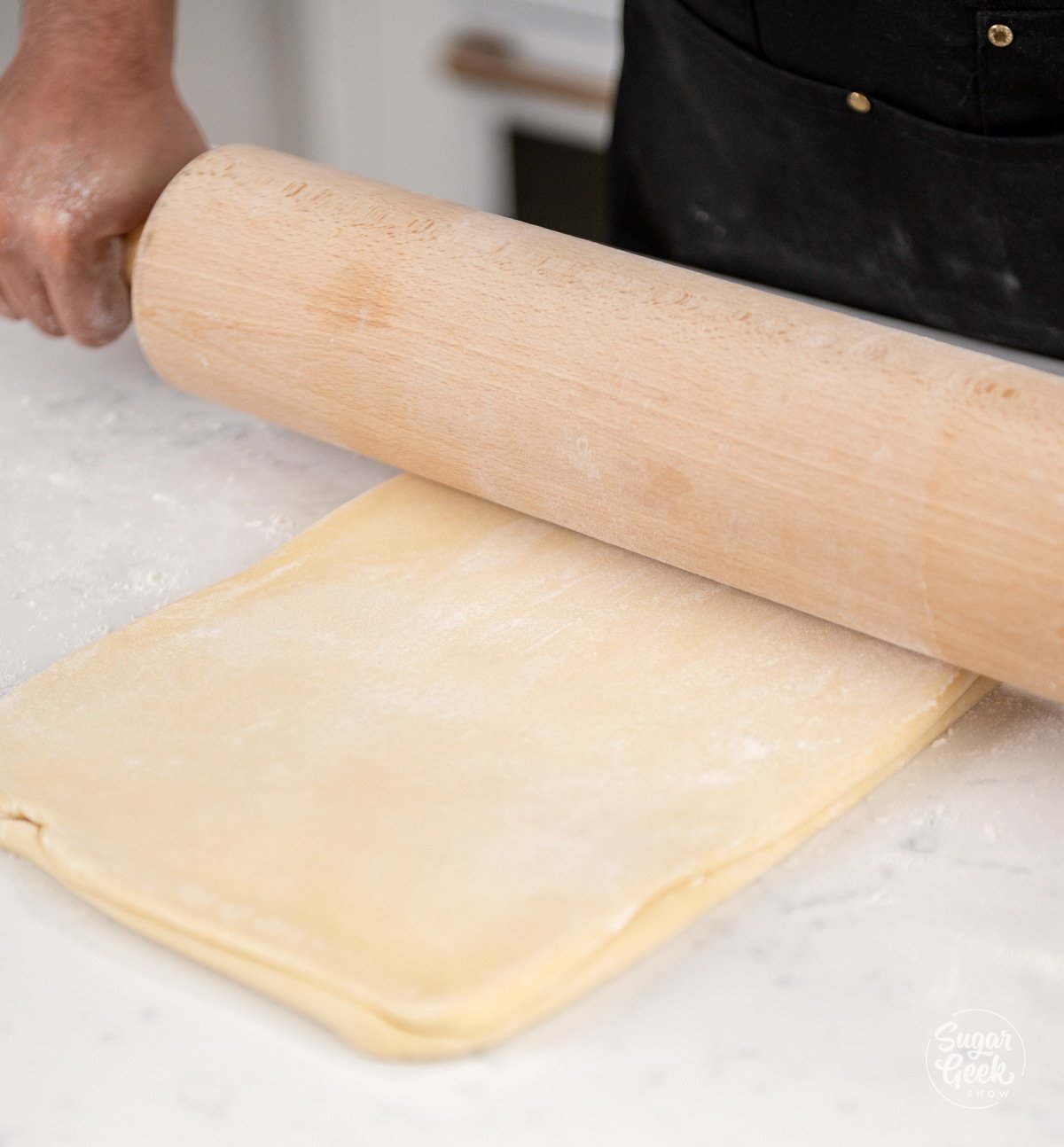
Related Recipes

Strawberry crunch cake recipe

Fresh strawberry cake recipe

Moist & fluffy vanilla cupcake

Recipe

Print Recipe
5 from 5 votes

Strawberry Crunch Recipe

You only need 10 minutes and 4 simple ingredients to make this quick homemade strawberry crunch recipe. This crunchy topping is a great addition to many dessert recipes like pies, ice cream, cakes, cupcakes, or even yogurt.
Prep Time5 minutes mins
Cook Time5 minutes mins
Total Time10 minutes mins
Course: Dessert
Cuisine: American
Servings: 5 cups
Calories: 1683kcal
Author: Liz Marek

Equipment

  • Food processor or knife

Ingredients

  • 1 ounce freeze-dried strawberries (1 cup)
  • 8 ounces shortbread cookies (2 ½ cups)
  • ½ teaspoon strawberry emulsion optional
  • ¼ cup melted unsalted butter (4 Tbsp)
US Customary - Metric

Instructions

  • First, add the vanilla shortbread cookies to a food processor and chop them until they're broken into very small crumbs. If you don't have a mixer, you can cut them up with a knife or put them in a Ziploc bag and grind them with a rolling pin or mallet. Don't worry if your crumbs aren't all uniform, but break up the bigger pieces with your hands.
  • Then add the strawberry emulsion to the cookies and blend until it's combined. If you don't have emulsion, you can skip this step or use strawberry extract.
  • Transfer the mixture to a separate large mixing bowl. The strawberries and cookies blend differently, so I do not recommend mixing them in the blender all at once.
  • Add the freeze-dried strawberries to a food processor and chop them until they're broken into very small crumbs. Add the strawberries to the bowl with the cookie crumbs. Pro-Tip: Blend your freeze-dried strawberries straight from the bag and work quickly, as they tend to absorb moisture in the air and will become gummy in your food processor.
  • Next, add the melted butter to the large bowl and stir with a whisk to combine the mixture and break up any big crumbs. That's it!
  • Store the strawberry crunch topping in a large Ziploc bag or an airtight container in the fridge or freezer for about up to a month, however, they're best used within 1 week.

Notes

Important Things To Note Before You Start
  1. The best investment you can make when you're getting started with baking is a digital kitchen scale! 
  2. Practice Mise en Place (everything in its place). Measure out your ingredients ahead of time and have them ready before you start mixing to reduce the chances of accidentally leaving something out.
  3. You can freeze strawberry crunch in a plastic bag to keep it for months. 

Nutrition

Serving: 1cup | Calories: 1683kcal | Carbohydrates: 170g | Protein: 13g | Fat: 105g | Saturated Fat: 48g | Polyunsaturated Fat: 21g | Monounsaturated Fat: 27g | Trans Fat: 2g | Cholesterol: 122mg | Sodium: 1165mg | Potassium: 591mg | Fiber: 6g | Sugar: 68g | Vitamin A: 1613IU | Vitamin C: 346mg | Calcium: 49mg | Iron: 13mg

September 14, 2022 Cake

Strawberry Crunch Cake

This Strawberry Crunch Cake is based on the classic strawberry crunch ice cream bars. It comes together with a few simple ingredients using my easy doctored box cake mix recipe, real strawberries, shortbread cookies, and a batch of easy buttercream. Cover it in a layer of homemade strawberry crunch topping to make a beautiful layer cake!

The best part of this recipe is using a cake mix for dependability and ease. You can make this cake from scratch by using my homemade white velvet cake and fresh strawberry cake as well. You will need to make a strawberry reduction for either recipe you use, so make it ahead of time. 

Table of contents

  • Strawberry Crunch Cake Ingredients
  • Making Strawberry Crunch Cake
    • Making Strawberry Reduction
    • Making Cake Layers
    • Making Strawberry Crunch
    • Assembling Strawberry Crunch Cake
  • Tips For Success
  • FAQ
  • Related Recipes

Strawberry Crunch Cake Ingredients

ingredients for strawberry crunch cake.Strawberries: I am using strawberries in 3 ways for this recipe. Fresh (garnish), frozen (reduction), and freeze-dried (crunch). I use thawed frozen berries to slightly speed up the reduction process. The cell walls of the frozen berries have already broken down, so once the heat is applied it can get right to evaporating water and intensifying flavor.

Strawberry Emulsion: This is an optional ingredient, but I really like the distinct strawberry flavor it gives the cake and crumbles. It adds a little extra pop of color, smells amazing, and tastes like my favorite ice cream bar would taste. Combined with real strawberries it enhances the natural flavor. 

Box Cake Mix: A doctored cake mix that is well-used by bakers all over the world that produces a delicious cake that tastes almost like scratch. The dependability of the mix allows additions like the strawberry puree and it still bakes great. This is why I chose to use a box mix for this cake, so I could use one recipe of cake and still get 2 different flavors of cake. It saves time and stress. I like Duncan Hines white cake mix as a base, but any brand will work. 

Shortbread Cookies: Shortbread cookies have a high butter content and stay crunchy while they stick to the cake. Many other recipes use golden Oreos and vanilla pudding mix, but I like the flavor of shortbread or vanilla wafers. You also save time by not having to scrape Oreos. I use Keebler because they're easy to buy at the grocery store, but you can use your preferred brand of shortbread cookies. Or you can make your own shortbread cookies, just leave the lemon out of my recipe.

Making Strawberry Crunch Cake

Starting one day ahead for this recipe is a good idea. The reduction should be made far enough in advance that it has time to fully cook and cool before using it in the cake mix. Then make the cakes, chill them, make the strawberry crumble, make the buttercream, and decorate.

Making Strawberry Reduction

  1. Defrost the strawberries or chop up your fresh strawberries. 
  2. Add the strawberries and sugar to a heavy bottom saucepan and stir them together.hand adding sugar to a pot with strawberries.
  3. Cook over medium heat until they begin to break down and release their juices. pot of cooking strawberries.
  4. Add in lemon zest, juice and salt and turn off the heat. hand adding lemon extract to a pot with cooking strawberries and lemon zest.
  5. Blend the berries until smooth using an immersion blender. If you do not have one, carefully pour the berries into your blender. Pot of cooked strawberries being blended with an immersion blender.
  6. Over low heat, bring the berries back to a simmer and allow them to reduce by about half (20-30 minutes).blended strawberry mixture slowly simmering in a pot.
  7. Stir occasionally to prevent the berries from burning. The reduction should look like tomato sauce, not watery. 
  8. Let it cool before using. Reserve ¼ cup of the reduction to be used in the strawberry cake layer. If you are making the reduction ahead, cover it with plastic wrap and refrigerate until you are ready to use it. It can be kept in the refrigerator for up to a week or in the freezer for up to 3 months.pouring strawberry puree into a glass bowl to cool.

Making Cake Layers

  1. Prepare 3 six-inch round cake pans with cake goop or parchment paper. hands brushing cake goop into a cake pan with a pastry brush.
  2. Add the white cake mix, flour, sugar, salt, sour cream, melted butter, milk, egg whites, and vanilla into the bowl of a stand mixer with the paddle attachment and mix for 2 minutes on medium speed. hand pouring a box of white cake mix into a stand mixer bowl.
  3. Divide the batter into 2 of the 3 prepared pans, if you are using a scale each pan should hold about 17 ounces (or 3 cups) of batter. Leave the remaining third of the batter in the mixing bowl.cake pan with cake batter being weighed on a scale.
  4. Add ¼ cup of the strawberry reduction and the (optional) ½ teaspoon of strawberry emulsion to the reserved batter and stir until combined. Add a drop of red food coloring (optional) to counteract the berries turning slightly purple when they bake. hand mixing strawberry puree and emulsion into cake batter.
  5. Pour the strawberry cake batter into the third prepared pan.pouring strawberry cake batter into prepared pan.
  6. Bake the cake layers at 335° for 30-35 minutes or until a toothpick inserted comes out clean. The strawberry cake may finish before the white cakes. The added liquid changes the chemistry slightly.hands placing baked white cakes on a cooling rack.
  7. Let the cakes cool until you can touch them (about 10 minutes) and flip them out onto a cooling rack until completely cooled.hands flipping out a baked cake from the cake pan.
  8. Wrap in plastic wrap and flash freeze for up to an hour before layering the cake. 

Making Strawberry Crunch

  1. Add the shortbread cookies to the food processor bowl. Pulse until medium crumbs are formed. Don't worry if your crumbs aren't all uniform, but break up the bigger pieces with your hands. hands adding shortbread cookies to a food processor.
  2. Add the strawberry extract or emulsion to the cookie crumbs and pulse until small crumble pieces are formed and place them in a separate large bowl. Be careful not to create a fine texture, or it will not be crunchy.hand adding strawberry emulsion to the food processor.
  3. Add the freeze-dried strawberries to the food processor and pulse until the crumbs are roughly the same size as the shortbread crumbs. Add the strawberry crumbs to the shortbread crumbs. Pro-Tip: Blend your freeze-dried strawberries straight from the bag and work quickly, as they tend to absorb moisture in the air and will become gummy in your food processor. hands pouring freeze dried strawberries into a food processor.
  4. Add the melted butter to the bowl of crumbs and mix until the butter is evenly distributed and the crumbs are evenly saturated. Set aside while you layer your cake. hand pouring melted butter into a bowl with food processed shortbread cookies and freeze dried strawberries.
  5. If you plan to use the crumbs at a later time, store them in an airtight container or Ziploc bag, they are shelf stable for a week. Or keep them in the freezer to avoid them going stale.  hand holding finished strawberry crunch topping.

Assembling Strawberry Crunch Cake

  1. Starting with a trimmed white layer of cake, smooth a thin even layer of easy buttercream frosting over the cake, and then pipe a dam of buttercream around the edge. You can use any frosting that you like for this cake, whipped cream or cream cheese frosting would also be delicious.hands trimming the dome off a layer of white cake.piping a buttercream dam around a layer of cake.
  2. Spread about 3 tablespoons of strawberry reduction in the center of the dam. hands pouring strawberry puree onto a cake layer with a buttercream dam.
  3. Spread another layer of buttercream on the bottom of the strawberry layer of cake and place it on top. This seals the cake to avoid the strawberry reduction from soaking into the cake layer. hands spreading buttercream onto the bottom of the strawberry layer of cake.
  4. Continue the same layering process with the strawberry flavor cake and then again with the top layer of white cake. hands adding strawberry puree to the next layer of cake.
  5. Give the whole cake a crumb coat to seal and set the buttercream and chill it in the fridge for 15 minutes. hands crumb coating the stacked cake with buttercream.
  6. Frost the cake with the final even coat of buttercream and smooth.hands using a bench scraper to smooth the sides of the cake.
  7. Holding the cake over a sheet pan or large bowl of strawberry crumble, gently coat the sides of the entire cake. You will want to do this while the buttercream is still "sticky," if it is too cold the crumb will have a harder time sticking to the cake. hands pressing strawberry crunch to the outside of the cake.
  8. I used a pastry ring to guide where I wanted the crumble to go on top of the cake. I did not want any crumbles to fall where I was going to pipe dollops, as they would lift off. Sprinkle strawberry crunch crumbles on the top center of the cake. a hand sprinkling strawberry crunch into a ring on top of the cake. hands removing the ring from the top of the cake.
  9. Using a fluted tip, pipe buttercream dollops around the top edge and place a cut strawberry in each dollop. hands placing a strawberry onto buttercream dollops on top of the cake. picture of finished strawberry crunch cake.

Tips For Success

  • Is this your first time decorating a cake? Watch my free video tutorial on how to decorate a cake for the first time.
  • Use a kitchen scale to weigh your ingredients for the best results. Baking is a science!
  • I used a stand mixer to make my cakes but you can also use a hand-held electric mixer. If you use a hand-mixer then you may need to mix for longer to achieve the same batter consistency.
  • Room temperature ingredients are important. Make sure your dairy and eggs are slightly warm and your butter is melted but not hot so that your ingredients mix together properly.

FAQ

Can I make a scratch cake instead of using a box mix? 

Yes! I recommend using my White Velvet Cake for the white layers and my Strawberry Cake for the middle layer. You will need to make Strawberry Reduction for either recipe you use, so make it ahead of time. I chose a box mix for this cake because I actually wanted to mimic the flavors of the ice cream bar, which uses some artificial colors and flavoring. 

Can I use fresh strawberries for strawberry crunch?

The advantage of freeze-dried berries for the crunch is that they are already crunchy, fresh berries are going to be great for the reduction and the decor, but they will make the cookies in the crunch soggy. If you do not have freeze-dried strawberries, you can use about 3 tablespoons of strawberry jello powder, just omit the strawberry emulsion.

What is strawberry crunch made of?

Strawberry Crunch, or Strawberry Shortcake Crumble, is a mixture of ground-up shortbread cookies, freeze-dried strawberries, and butter. This nostalgic topping is perfect when sprinkled over ice cream, mixed into yogurt, or used to decorate cakes and cupcakes.
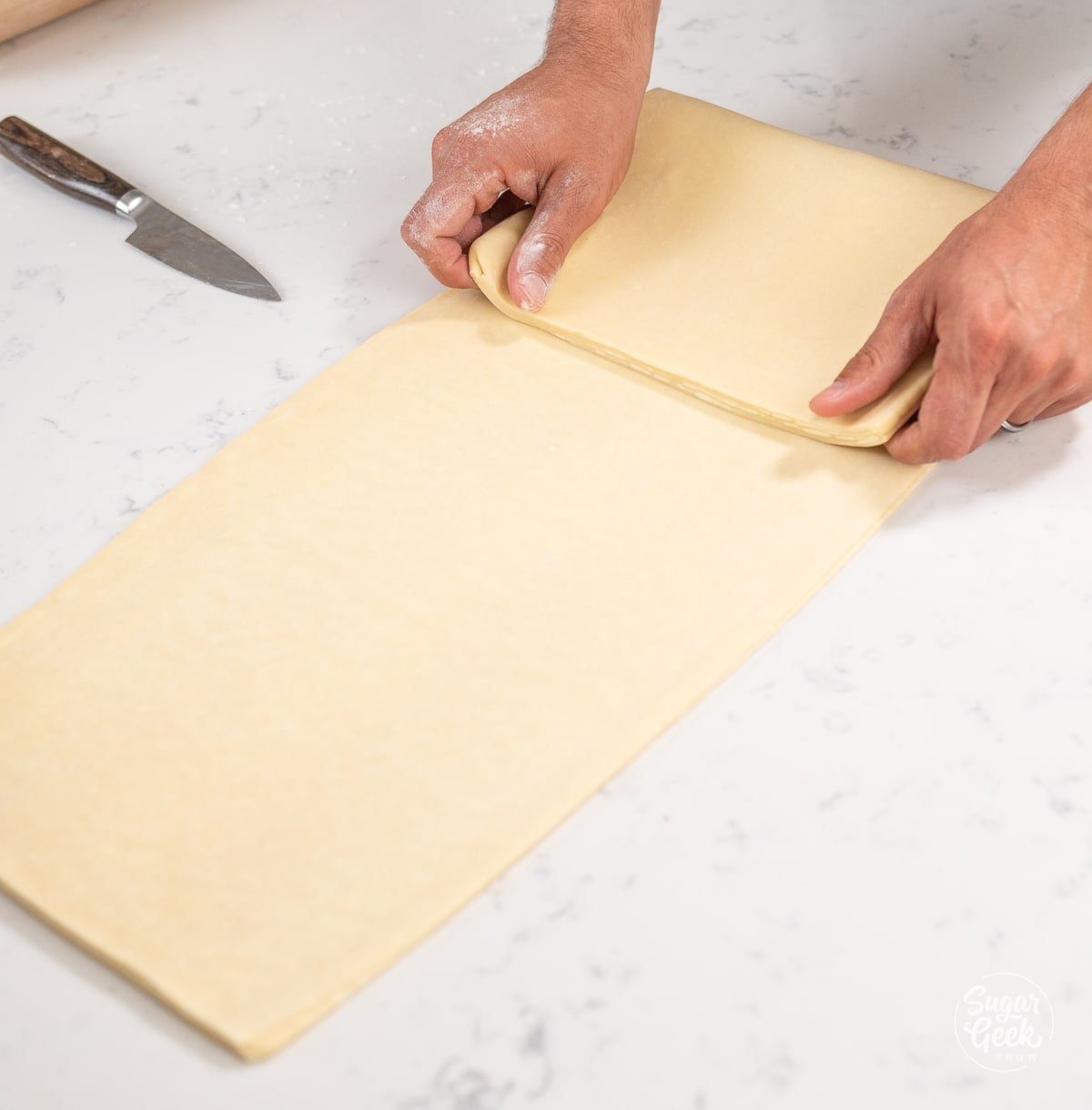
Related Recipes

Fresh strawberry cake recipe

Doctored Strawberry Cake

Freeze Dried Strawberry Cake

White Velvet Buttermilk Cake

Recipe

Print Recipe
4.72 from 28 votes

Strawberry Crunch Cake

Can you hear the ice cream truck music in your head? Slicing into this fragrant strawberry crunch cake will bring you right back to those summer days! Strawberry, vanilla, and nostalgia are all stacked up in an amazing cake!  
Prep Time20 minutes mins
Cook Time50 minutes mins
chilling15 minutes mins
Total Time1 hour hr 25 minutes mins
Course: Dessert
Cuisine: American
Servings: 8 cups
Calories: 901kcal
Author: Liz Marek

Equipment

  • 3 6" x 2" pans
  • Food Processor or blender optional
  • Stand Mixer optional

Ingredients

Cake Layers

  • 1 box white cake mix duncan hines
  • 5 ounces all purpose flour (1 cup)
  • 7 ounces granulated sugar (1 cup)
  • ¼ teaspoon salt
  • 9 ounces sour cream (1 cup) room temperature
  • 4 ounces unsalted melted butter (½ cup)
  • 8 ounces milk (1 cup) room temperature
  • 4 large egg whites room temperature
  • 1 teaspoon vanilla extract
  • 2 ounces strawberry reduction ¼ cup
  • 1 drop red food coloring optional (for the strawberry layer)
  • ½ teaspoon strawberry emulsion optional (for the strawberry layer)

Strawberry Reduction

  • 36 ounces fresh or frozen strawberries (5 cups) thawed
  • 4 ounces granulated sugar (½ cup)
  • 2 teaspoons lemon zest
  • 1 Tablespoon lemon juice
  • 1 pinch salt

Strawberry Crunch

  • 1 ounce freeze-dried strawberries (1 cup)
  • 8 ounces shortbread cookies (2 ½ cups)
  • ½ teaspoon strawberry emulsion (or extract) optional
  • ¼ cup unsalted melted butter
US Customary - Metric

Instructions

Strawberry Reduction Instructions

  • Defrost the strawberries or chop up your fresh strawberries. 
  • Add the strawberries and sugar to a heavy bottom sauce pan and stir them together.
  • Cook over medium heat until they begin to break down and release their juices. 
  • Add in lemon zest, extract and salt and turn off the heat. 
  • Blend the berries until smooth using an immersion blender. If you do not have one, carefully pour the berries into your blender. 
  • Over low heat, bring the berries back to a simmer and allow them to reduce until about half (20-30 minutes).
  • Stir occasionally to prevent the berries from burning. The reduction should look like tomato sauce, not watery.
  • Let it cool before using. Reserve ¼ cup of the reduction to be used in the strawberry cake layer. If you are making the reduction ahead, cover it with plastic wrap and refrigerate until you are ready to use it. It can be kept in the refrigerator for up to a week or in the freezer for up to 3 months.

Strawberry Crunch Cake Instructions

  • Prepare 3 six-inch round cake pans with cake goop or parchment paper. 
  • Add the white cake mix, flour, sugar, salt, sour cream, melted butter, milk, egg whites, and vanilla into the bowl of a stand mixer with the paddle attachment and mix for 2 minutes on medium speed. 
  • Divide the batter into 2 of the 3 prepared pans, if you are using a scale each pan should hold about 17 ounces (or 3 cups) of batter. Leave the remaining third of the batter in the mixing bowl.
  • Add ¼ cup of the strawberry reduction and the (optional) ½ teaspoon of strawberry emulsion to the reserved batter and stir until combined. Add a drop of red food coloring (optional) to counteract the berries turning slightly purple when they bake. 
  • Pour the strawberry cake batter into the third prepared pan.
  • Bake the cake layers at 335°F for 30-35 minutes or until a toothpick inserted comes out clean. The strawberry cake may finish before the white cakes. The added liquid changes the chemistry slightly.
  • Let the cakes cool until you can touch them (about 10 minutes) and flip them out onto a cooling rack until completely cooled.
  • Wrap in plastic wrap and flash freeze for up to an hour before layering the cake. 

Strawberry Crunch Instructions

  • Add the shortbread cookies to the food processor bowl. Pulse until medium crumbs are formed. Don't worry if your crumbs aren't all uniform, but break up the bigger pieces with your hands. 
  • Add the strawberry extract or emulsion to the cookie crumbs and pulse until small crumble pieces are formed and place them in a separate large bowl. Be careful not to create a fine texture, or it will not be crunchy.
  • Add the freeze-dried strawberries to the food processor and pulse until the crumbs are roughly the same size as the shortbread crumbs. Add the strawberry crumbs to the shortbread crumbs. Pro-Tip: Blend your freeze-dried strawberries straight from the bag and work quickly, as they tend to absorb moisture in the air and will become gummy in your food processor. 
  • Add the melted butter to the bowl of crumbs and mix until the butter is evenly distributed and the crumbs are evenly saturated. Set aside while you layer your cake. 
  • If you plan to use the crumbs at a later time, store them in an airtight container or Ziploc bag, they are shelf stable for a week. Or keep them in the freezer to avoid them going stale. 

How to Assemble the Strawberry Crunch Cake

  • Starting with a trimmed white layer of cake, smooth a thin even layer of easy buttercream frosting over the cake, and then pipe a dam of buttercream around the edge.
  • Spread about 3 tablespoons of strawberry reduction in the center of the dam. 
  • Spread another layer of buttercream on the bottom of the strawberry layer of cake and place it on top. This seals the cake to avoid the strawberry reduction from soaking into the cake layer. 
  • Continue the same layering process with the strawberry flavor cake and then again with the top layer of white cake. 
  • Give the whole cake a crumb coat to seal and set the buttercream and chill it in the fridge for 15 minutes. 
  • Frost the cake with the final even coat of buttercream and smooth. 
  • Holding the cake over a sheet pan or large bowl of strawberry crumble, gently coat the sides of the entire cake. You will want to do this while the buttercream is still "sticky", if it is too cold the crumb will have a harder time sticking to the cake. 
  • I used a pastry ring to guide where I wanted the crumble to go on top of the cake. I did not want crumble to fall where I was going to pipe dollops, as they would lift off. Sprinkle strawberry crunch crumbles on the top center of the cake. 
  • Using a fluted tip pipe buttercream dollops around the top edge and place a cut strawberry in each dollop. 

Video

Notes

Important Things To Note Before You Start
  1. The best investment you can make when you're getting started with baking is a digital kitchen scale! Weighing your ingredients will help you avoid cake failure. Using a kitchen scale for baking is super easy and gives you the best results every single time. 
  2. Practice Mise en Place (everything in its place). Measure out your ingredients ahead of time and have them ready before you start mixing to reduce the chances of accidentally leaving something out.
  3. Need more help with making your first cake? Check out my how to decorate your first cake blog post. 
  4. Make sure all of your cold ingredients (e.g. butter, eggs, milk) are at room temperature or a little warm. Why? Because we want to create an emulsion and allow the ingredients to fully mix together. 
  5. Make your own pan release (cake goop!) The best pan release ever! 
  6. Chill your cakes before frosting and filling. You can cover a frosted and chilled cake in fondant if you wish. This cake is also great for stacking!
  7. You can buy pre-made strawberry shortcake crunch if you don't want to make your own.

Nutrition

Calories: 901kcal | Carbohydrates: 140g | Protein: 11g | Fat: 35g | Saturated Fat: 18g | Polyunsaturated Fat: 4g | Monounsaturated Fat: 9g | Trans Fat: 1g | Cholesterol: 68mg | Sodium: 812mg | Potassium: 456mg | Fiber: 5g | Sugar: 84g | Vitamin A: 817IU | Vitamin C: 124mg | Calcium: 245mg | Iron: 4mg
spoon dripping chocolate glaze on a profiterole

September 12, 2022 Pastries

Profiteroles Recipe

This classic profiteroles recipe is a staple in French pastry and is a great recipe to follow if this is your first time making pâte à choux. Each delightful bite-sized frozen treat is a crisp pastry shell filled with a scoop of homemade vanilla bean gelato and topped with a warm chocolate sauce. If you're a fan of cream puffs and ice cream sandwiches, then you will love this recipe.spoon dripping chocolate glaze on a profiterole

This profiterole recipe is courtesy of our Executive Pastry Chef, Christophe Rull, who will walk you through the basics of making pâte à choux. It's important to have crisp pastry shells with your choux recipes because a soggy profiterole isn't as good as a fresh one. Make the dough and freeze it ahead of time, or bake the choux buns in advance and fill them with vanilla ice cream when you're ready to serve!

Table of contents

  • Profiteroles Ingredients
  • Making Homemade Profiteroles
    • Making the Cream Puff Shells
    • Making the Gelato
    • Making the Chocolate Sauce
  • FAQ
  • Related Recipes

Profiteroles Ingredientsingredients for profiteroles laid out on a table

Vanilla beans give the ultimate flavor, but you may use vanilla paste or extract if you'd like.

Ice Cream Stabilizer is exactly what it sounds like. It keeps water crystals small and soft, making the gelato denser and smoother. This will help the gelato hold its consistency under frozen temperatures. We are using cremodan 30 in this recipe, but you can leave it out if you do not have it.

Glucose is widely used in Europe over corn syrup, but some glucose is made from different plant sources while corn syrup is made from corn starches. It can be hard to find glucose, so you can use corn syrup and it will have the same effect. It's used to keep the chocolate glaze soft when you put it in the freezer, so you don't have a hard bite of chocolate with your profiterole.

Glucose Powder is used to sweeten and stabilize the gelato. Since this gelato is a cream base, it does not need any more moisture which is why we are using powder over corn syrup.  

64% Dark Chocolate will result in the best flavor for your chocolate sauce. You can use any type of chocolate you'd like, or even store-bought sauce if that is easier. The percentage you see on the chocolate package is the percentage of actual cocoa in it. The higher the percentage, the darker the chocolate. If you prefer milk chocolate, that would be delicious too!

Making Homemade Profiteroles

This choux pastry recipe comes together quickly, but try to plan ahead if you're making all of these components from scratch. The gelato base needs time to chill before churning it, the chocolate sauce needs time to cool before pouring it, and the cream puffs need time to cool down before filling them. Make the gelato first (preferably a day ahead), then the pastry shells, and finally the chocolate ganache sauce when you're ready to serve.profiteroles with ice cream and chocolate glaze

Making the Cream Puff Shells

  1. Add the milk, water, salt, sugar, and butter to a medium saucepan, then bring it to a boil. It is important to make sure that the butter is melting at the same rate the milk is heating so that the milk doesn't boil before the butter is melted. Slowly moving it around with a wooden spoon helps distribute the heat evenly. milk pouring into a pot over a stove
  2. Once the mixture has come to a boil, turn off the heat and add the sifted flour all at once. flour pouring into a pot of milk over the stove
  3. Begin stirring immediately with a wooden spoon, and continue to stir for 1 minute until the flour is fully incorporated, it will look a lot like mashed potatoes. combined ingredients for pate a choux, looks like mashed potatoes
  4. Turn the heat back on to medium-high heat and continue to stir and keep it moving to dry out the dough.pâte à choux cooking in a pot over the stove
  5. Once you see a browning layer on the bottom of the pan, the dough is dry enough and you can remove it from the heat. pâte à choux drying out in a pot over the stove with brown on the bottom of the pot
  6. Put the dough immediately into the bowl of your stand mixer with the paddle attachment and begin to mix to cool it down, this should take about 30 seconds.pouring pâte à choux into a stand mixer bowl
  7. Add the eggs one at a time, letting each egg incorporate fully before the next. Mix on low until the dough is fully combined with no spots of dry flour, and stiff enough to hold its shape, but pull to a soft peak when picking up the spoon. pouring eggs into pâte à choux in a stand mixer bowlfinished pouring eggs into pâte à choux dough
  8. Prepare a pastry bag with a large round tip, Christophe is using an Ateco 809 tip. Fill the piping bag with the dough.pâte à choux going into a piping bag
  9. On to a prepared baking tray, pipe the pâte à choux rounds slightly smaller than your desired final size, as they will "puff" and expand in the oven. Chef Christophe is using a "silpain" baking mat, but parchment paper will work as well.piping cream puff dough onto a baking sheet
  10. Gently smooth the top of the cream puff with a wet finger.gloved finger touching the top of an unbaked cream puff to remove the point
  11. Bake at 350°F (176°C) for 25-30 minutes until golden brown. Let them cool on a wire rack to room temperature for about 30 minutes.baking tray of finished golden cream puffsbottom of a golden brown baked cream puff

Making the Gelato

  1. Add the milk, cream, half of the sugar, glucose powder, and the vanilla bean to a medium saucepan over the stove, stir with a spatula and cook it over medium heat until the mixture reaches 80°C (175°F).adding vanilla bean seeds to a pot of milk
  2. Mix about half of the remaining sugar into the ice cream stabilizer, and stir it together well to avoid lumps. We're using cremodan 30, but you can leave it out if desired.
  3. At 80°C (175°F), add the sugar and stabilizer mixture to the pot and whisk constantly.adding ice cream stabilizer to a pot of milk
  4. Mix together the rest of the sugar (¼ of the total sugar) into the egg yolks.pouring sugar into a bowl of egg yolks
  5. Bring the milk mixture to a simmer and turn off the heat.pot of simmering milk
  6. Add about 1 cup of the hot milk mixture to the eggs and stir it together until combined. This is called tempering the eggs and will help prevent lumps in your gelato.pot of steaming milk being poured into a small bowl of eggs
  7. Add the egg and milk mixture back into the pot and cook over medium heat until it reaches 83°C (181°F). Stir around the bottom and sides of the pan in a figure-eight shape to prevent burning.pouring tempered eggs into a pot of steaming milk
  8. Pour the ice cream base into a medium bowl and place it in the refrigerator for 1 hour until completely cooled, or place it in an ice bath to cool it down faster.pouring ice cream base into a bowl on top of an ice bath
  9. Add ice and ice cream salt around the outside of your ice cream machine bowl. I'm using a Bosch universal plus stand mixer with an ice cream attachment in the center.pouring ice cream salt on top of ice into an ice cream maker
  10. Pour the base in the center and mix on high for about 20 minutes until the ice cream is thick. Churn the cooled-down ice cream base in an ice cream machine.pouring ice cream base into an ice cream makerspatula with homemade gelato in an ice cream maker

Making the Chocolate Sauce

  1. Heat the glucose in the microwave for about 15 seconds until it is very liquid.
  2. Add the glucose and milk to a small saucepan over the stove, stir with a spatula and bring it to a simmer over medium heat.pouring a container of milk into a pot over the stove
  3. Fill a large measuring cup with the chocolate and pour the milk mixture over the top. Wait for about 1 minute until the chocolate melts.pouring hot milk over chocolate in a mixing cup
  4. Blend the chocolate sauce with an immersion blender until smooth and fully combined. You can use a whisk if that's all you have.mixing chocolate glaze with an immersion blender
  5. Refrigerate the sauce until it's completely cold, about 30 minutes.
  6. Fill a pastry bag with the sauce and snip off the tip.

Assembling the Profiteroles

  1. Take your gelato (or ice cream) out of the freezer to start warming up so that it's easy to scoop.oval bowl filled with vanilla gelato
  2. Slice the fully cooled cream puff in half with a serrated knife, this will avoid crushing the hollow shell. serrated knife cutting through a cream puff
  3. Place a small scoop of ice cream on the bottom half of the cream puff and add the top lid.placing a scoop of gelato onto the bottom of a cream puff
  4. Keep the profiteroles on a baking sheet and move them in and out of the freezer as you're assembling to keep the ice cream from melting.
  5. Pipe the chocolate sauce on top when you're ready to serve.profiteroles with ice cream and chocolate glaze
  6. Freeze the profiteroles in an airtight container for 1-2 days.

FAQ

What is the difference between a cream puff and a profiterole?

The main difference is the filling. Cream puffs are typically filled with vanilla pastry cream or whipped cream, while profiteroles are filled with ice cream and topped with a chocolate glaze.

Can I make profiteroles a day ahead?

Yes, pipe your choux dough into balls and freeze them on a sheet pan, then let them thaw out and bake when you're ready to serve. You can also bake them, store them in an airtight container and re-crisp them in the oven before filling.

How long will profiteroles keep?

 Once you fill them with ice cream, freeze them right away and they can keep up to 1-2 days.

How do you keep profiteroles crisp?

Sadly profiteroles are made with pate a choux which tends to go soggy once refrigerated or frozen. After baking, make sure to let them cool fully on a wire rack so that they dry out. Before filling them, you can re-crisp cream puffs by placing them in a 350°F oven for 5 minutes on the day you intend to use them.

Why didn't my profiteroles puff?

The eggs must then be added little by little, while you beat the batter as vigorously as possible, both to incorporate them and to add air to help it rise. The dough also needs to be dried enough so that they develop a hollow inside.

Related Recipes

Cream Puffs

Apple Tart

Creme Anglaise Recipe

Caramel Sauce

Recipe

spoon dripping chocolate glaze on a profiterole
Print Recipe
No ratings yet

Profiteroles Recipe

Learn how to make classic profiteroles with homemade choux pastry balls, creamy vanilla gelato from scratch, and a soft chocolate glaze. Profiteroles can also be filled with pastry cream or whipped cream and topped with a caramel sauce or a dusting of powdered sugar. Use store-bought ice cream and pre-made chocolate sauce for easy profiteroles on a hot summer's day.
Prep Time1 hour hr
Cook Time30 minutes mins
Chilling Time3 hours hrs
Total Time4 hours hrs 30 minutes mins
Course: Dessert
Cuisine: French
Servings: 36 profiteroles
Calories: 130kcal
Author: Liz Marek

Equipment

  • emersion blender optional
  • Piping Bags
  • Silpain baking mat optional

Ingredients

Cream Puff Shells Ingredients

  • 160 grams whole milk
  • 160 grams water
  • 4 grams salt
  • 6 grams granulated sugar
  • 140 grams unsalted butter European, like plugra
  • 180 grams all-purpose flour sifted
  • 200 grams large eggs

Vanilla Gelato Ingredients

  • 500 grams whole milk
  • 170 grams heavy cream
  • 130 grams granulated sugar
  • 30 grams glucose powder
  • 4 grams ice cream stabilizer cremodan 30
  • 1 whole vanilla bean
  • 30 grams egg yolks

Chocolate Sauce Ingredients

  • 220 grams whole milk
  • 120 grams glucose
  • 180 grams 64% dark chocolate

Instructions

Making the Cream Puff Shells

  • Add the milk, water, salt, sugar, and butter to a medium saucepan, then bring it to a boil. It is important to make sure that the butter is melting at the same rate the milk is heating so that the milk doesn't boil before the butter is melted. Slowly moving it around with a wooden spoon helps distribute the heat evenly. 
  • Once the mixture has come to a boil, turn off the heat and add the sifted flour all at once. 
  • Begin stirring immediately with a wooden spoon, and continue to stir for 1 minute until the flour is fully incorporated, it will look a lot like mashed potatoes. 
  • Turn the heat back on to medium-high heat and continue to stir and keep it moving to dry out the dough.
  • Once you see a browning layer on the bottom of the pan, the dough is dry enough and you can remove it from the heat. 
  • Put the dough immediately into the bowl of your stand mixer with the paddle attachment and begin to mix to cool it down, this should take about 30 seconds.
  • Add the eggs one at a time, letting each egg incorporate fully before the next. Mix on low until the dough is fully combined with no spots of dry flour, and stiff enough to hold its shape, but pull to a soft peak when picking up the spoon. 
  • Prepare a pastry bag with a large round tip, Christophe is using an Ateco 809 tip. Fill the piping bag with the dough.
  • On to a prepared baking tray, pipe the pâte à choux rounds slightly smaller than your desired final size, as they will "puff" and expand in the oven. Chef Christophe is using a "silpain" baking mat, but parchment paper will work as well.
  • Gently smooth the top of the cream puff with a wet finger.
  • Bake at 350°F (176°C) for 25-30 minutes until golden brown. Let them cool on a wire rack to room temperature for about 30 minutes.

Making the Gelato

  • Add the milk, cream, half of the sugar, glucose powder, and the vanilla bean to a medium saucepan over the stove, stir with a spatula and cook it over medium heat until the mixture reaches 80°C (175°F).
  • Mix about half of the remaining sugar into the ice cream stabilizer, and stir it together well to avoid lumps. We're using cremodan 30, but you can leave it out if desired.
  • At 80°C (175°F), add the sugar and stabilizer mixture to the pot and whisk constantly.
  • Mix together the rest of the sugar (¼ of the total sugar) into the egg yolks.
  • Bring the milk mixture to a simmer and turn off the heat.
  • Add about 1 cup of the hot milk mixture to the eggs and stir it together until combined. This is called tempering the eggs and will help prevent lumps in your gelato.
  • Add the egg and milk mixture back into the pot and cook over medium heat until it reaches 83°C (181°F). Stir around the bottom and sides of the pan in a figure-eight shape to prevent burning.
  • Pour the ice cream base into a medium bowl and place it in the refrigerator for 1 hour until completely cooled, or place it in an ice bath to cool it down faster.
  • Add ice and ice cream salt around the outside of your ice cream machine bowl. I'm using a Bosch universal plus stand mixer with an ice cream attachment in the center.
  • Pour the base in the center and mix on high for about 20 minutes until the ice cream is thick. Churn the cooled-down ice cream base in an ice cream machine.

Making the Chocolate Sauce

  • Heat the glucose in the microwave for about 15 seconds until it is very liquid.
  • Add the glucose and milk to a small saucepan over the stove, stir with a spatula and bring it to a simmer over medium heat.
  • Fill a large measuring cup with the chocolate and pour the milk mixture over the top. Wait for about 1 minute until the chocolate melts.
  • Blend the chocolate sauce with an immersion blender until smooth and fully combined. You can use a whisk if that's all you have.
  • Refrigerate the sauce until it's completely cold, about 30 minutes.
  • Fill a pastry bag with the sauce and snip off the tip.

Assembling the Profiteroles

  • Take your gelato (or ice cream) out of the freezer to start warming up so that it's easy to scoop.
  • Slice the fully cooled cream puff in half with a serrated knife, this will avoid crushing the hollow shell. 
  • Place a small scoop of ice cream on the bottom half of the cream puff and add the top lid.
  • Keep the profiteroles on a baking sheet and move them in and out of the freezer as you're assembling to keep the ice cream from melting.
  • Pipe the chocolate sauce on top when you're ready to serve.

Notes

Important Things To Note Before You Start
1. Bring all your ingredients to room temperature or even a little warm (eggs, buttermilk, butter, etc). 
2. Use a scale to weigh your ingredients (including liquids) unless otherwise instructed (Tablespoons, teaspoons, pinch etc). Metric measurements are available in the recipe card. Scaled ingredients are much more accurate than using cups and help ensure the success of your recipe. 
3. Practice Mise en Place (everything in it’s place). Measure out your ingredients ahead of time and have them ready before you start mixing to reduce the chances of accidentally leaving something out.
4. What is the difference between cream puffs and profiteroles? Cream puffs are typically filled with vanilla pastry cream or whipped cream, while profiteroles are filled with ice cream and topped with a chocolate glaze.
5. Profiteroles are made with pate a choux which tends to go soggy once refrigerated or frozen. After baking, make sure to let them cool fully on a wire rack so that they dry out. Before filling them, you can re-crisp cream puffs by placing them in a 350°F oven for 5 minutes on the day you intend to use them.

Nutrition

Serving: 1profiterole | Calories: 130kcal | Carbohydrates: 14g | Protein: 2g | Fat: 7g | Saturated Fat: 4g | Polyunsaturated Fat: 0.4g | Monounsaturated Fat: 2g | Trans Fat: 0.1g | Cholesterol: 46mg | Sodium: 68mg | Potassium: 72mg | Fiber: 0.4g | Sugar: 7g | Vitamin A: 249IU | Vitamin C: 0.03mg | Calcium: 41mg | Iron: 1mg
photo of cream puffs filled with whipped cream

September 7, 2022 Pastries

Cream Puff Recipe

This cream puff recipe is a simple classic French dessert that balances sweet, rich, soft, and crunchy all in one fluffy little bite! They are slightly crisp on the exterior, soft and chewy on the inside, and filled with a sweet light vanilla bean whipped cream or pastry cream. Chef Christophe shows us how to make and elevate this simple elegant dessert at home. photo of cream puffs filled with whipped cream

The foundation of the perfect cream puff is a light and airy classic French dough. Pâte à choux is a basic recipe that is the base for many delicious French pastries: eclairs, savory gougères, churros, cruller donuts, beignets, gnocchi, profiteroles, and more. Homemade cream puffs are the best because you get to enjoy them immediately while they're still crisp, you will never buy one from the store again!  

If you love the pastry cream filling in these cream puffs, the same silky custard goes between the cake layers in my boston cream pie recipe.


Table of Contents

  • Cream Puff Ingredients
  • Making Homemade Cream Puffs
    • Making the Pâte à Choux
    • Making the Whipped Cream
    • Filling the Cream Puffs
  • Storing Homemade Cream Puffs
    • Storing Baked Cream Puff Shells
    • Storing Cream Puff Dough
  • Tips For Baking From Scratch
  • Related Recipes 
  • FAQ

Cream Puff Ingredientsphoto of cream puff ingredients

European butter will result in better pastries and flavor because it has a higher fat content (83%) than American butter. More fat and less water equal more flavor and better baking results. 
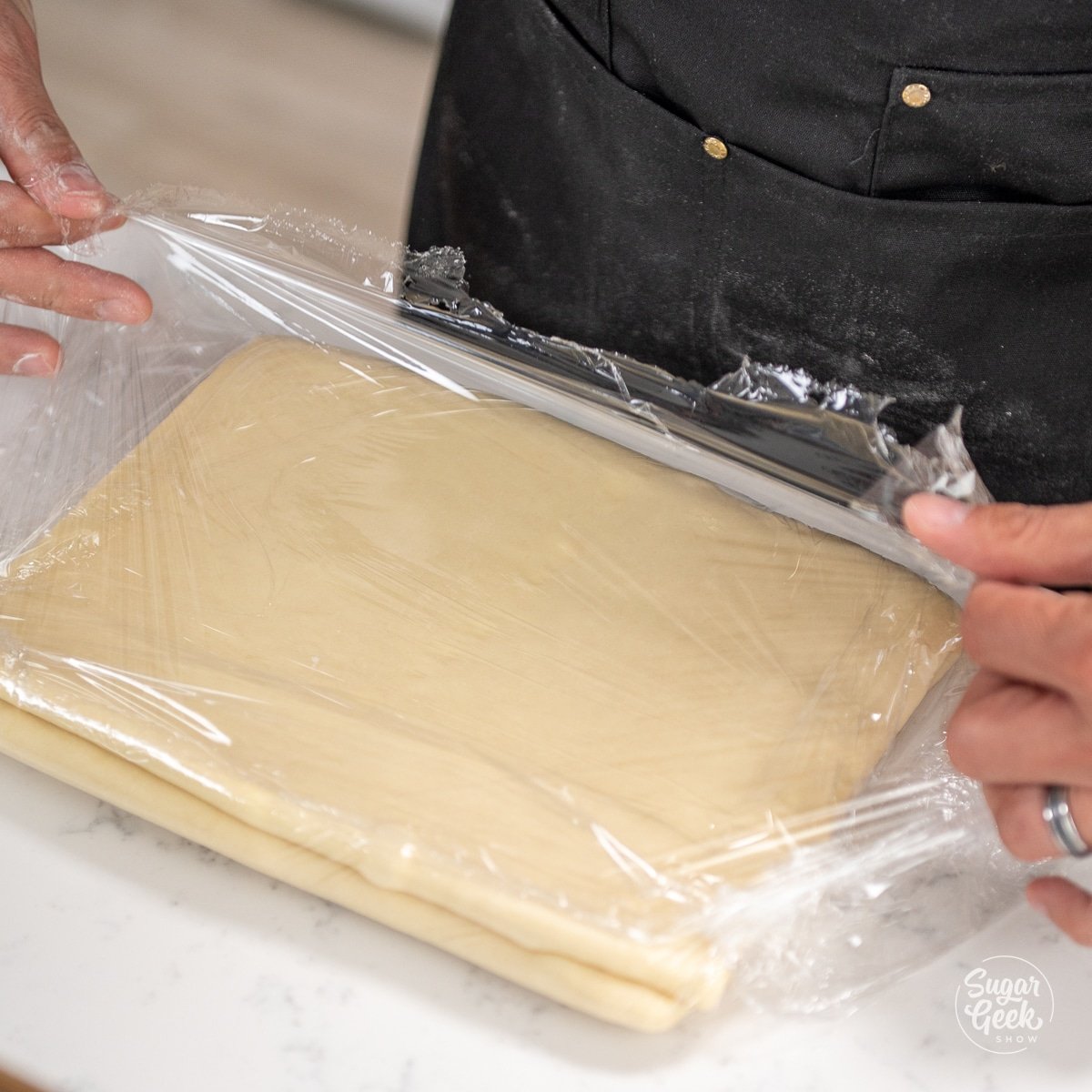
Whole milk is ideal for this recipe due to its fat content. In some recipes, lower fat milk will work fine, but when working with classic French recipes it's best to use what is recommended for the best results. 

Salt, even the smallest of pinches, can set your pastry apart from the rest. It enhances all flavors and highlights the sweetness of a pastry. 

Eggs are the backbone of this dough, without them, they won't "puff". 

Making Homemade Cream Puffs

Classic cream puffs come together in a few stages, make the pâte à choux first, pipe it, bake the shells, and make the whipped cream filling while the shells cool. You can also fill the cream puffs with pastry cream, just make it ahead of time so that it has time to cool as well.

Making the Pâte à Choux

  1. Add the milk, water, salt, sugar, and butter to a medium saucepan and bring it to a boil. It is important to make sure that the butter is melting at the same rate the milk is heating so that the milk doesn't boil before the butter is melted. Slowly moving it around with a wooden spoon helps distribute the heat evenly. 
    milk pouring into a pot over a stove
  2. Once the mixture has come to a boil, turn off the heat and add the sifted flour. 
    flour pouring into a pot of milk over the stove
  3. Begin stirring immediately with a wooden spoon, and continue to stir for 1 minute until the flour is fully incorporated, it will look a lot like mashed potatoes. 
    combined ingredients for pate a choux, looks like mashed potatoes
  4. Turn the heat back on to medium-high heat and continue to stir and keep it moving to dry out the dough.
    pâte à choux cooking in a pot over the stove
  5. Once you see a browning layer on the bottom of your saucepan the dough is dry enough and remove it from the heat. This is important, as it will help your cream puffs "puff" and ensure that they have a hollow center for the cream filling.
    pâte à choux drying out in a pot over the stove with brown on the bottom of the pot
  6. Put the dough immediately into the bowl of your stand mixer with the paddle attachment and begin to mix to cool it down, this should take about 30 seconds. When you can place your hand on the side of the bowl without it feeling too hot, it's done.
    pouring pâte à choux into a stand mixer bowl
  7. Add the eggs one at a time, letting each egg incorporate fully before the next. The dough should be fully combined with no spots of dry flour, and stiff enough to hold its shape, but pull to a soft peak when picking up the spoon. 
    pouring eggs into pâte à choux in a stand mixer bowl
    finished pouring eggs into pâte à choux dough
  8. Prepare a piping bag with a large round tip, Christophe is using an Ateco 809 tip. Fill the piping bag with the dough.
    pâte à choux going into a piping bag
  9. Pipe the pâte à choux rounds slightly smaller than your desired final size (about 2-inches), as they will "puff" and expand in the oven. Chef Christophe is using a "silpain" baking mat on a cookie sheet, but parchment paper will work as well.
    piping cream puff dough onto a baking sheet
  10. Gently smooth the top of the cream puff with a damp fingertip.
    gloved finger touching the top of an unbaked cream puff to remove the point
  11. Bake the cream puffs at 350°F for 25-30 minutes until golden brown. 
    baking tray of finished golden cream puffs
  12. Cool the cream puffs completely to room temperature on a wire rack, for about 30 minutes. 
    bottom of a golden brown baked cream puff

Making the Whipped Cream

  1. Split the vanilla pod in half with a sharp knife and scrape the beans. Add the beans to the heavy cream and mix briefly so the beans distribute evenly. 
    knife slicing through a vanilla bean to remove the seeds
  2. Place a strainer directly over your mixing bowl and strain the cream and vanilla beans to remove the larger fibers from the cream.
    pouring the cream into a strainer over a stand mixer bowl
  3. Add the powdered sugar to the cream in the mixer. 
    adding powdered sugar to whipped cream in a stand mixer bowl
  4. Whip the cream on medium-high speed with the whisk attachment for about 5 minutes until medium to stiff peaks. Keep the whipped cream cold until you are ready to use it. 
    spatula of finished whipped cream

Filling the Cream Puffs

  1. Fill a pastry bag with the prepared whipped cream. Christophe chose a star tip, but any larger tip will do. 
    plastic piping bag pushed into a piping tip to create a seal
  2. Slice the fully cooled cream puff in half with a serrated knife, this will avoid crushing the hollow shell. You can also insert a piping tip into a small hole on the bottom of the cream puff and fill the cream puffs in the center.
    serrated knife cutting through a cream puff
  3. Pipe a generous amount of whipped cream into the bottom half and gently place the top on, do not squish them down so you can still see the beautiful filling. 
    piping bag piping whipped cream onto a cream puff
    finger pushing the lid of a cream puff on top of whipped cream
  4. Sift a light dusting of powdered sugar on top. 
    photo of cream puffs filled with whipped cream

Storing Homemade Cream Puffs

Cream puffs are meant to be eaten the same day as they are made. The moisture of the filling will cause the cream puff to soften and lose its crunch. So the sooner you can serve the cream puffs, the better.

Storing Baked Cream Puff Shells

Cool them completely, wrap them well in plastic wrap, and store them at room temperature. They can also be frozen if you do not plan to use them in the next day or so. If your cream puffs have softened they can be crisped up in a 350°F oven for 5 minutes.

Storing Cream Puff Dough

If you don't plan to serve your puffs the same day, pipe and freeze the cream puff dough to be baked and filled as needed. Just place them on a baking sheet and let them thaw slightly and bake as directed. If you have leftover filled cream puffs, store them in an airtight container in the fridge, they will be soft, but still delicious. cream puff cut in half to show a golden hollow inside

Tips For Baking From Scratch

*This post may contain affiliate links which means if you click on them I might get a few pennies.

I suggest purchasing a kitchen scale if you don't already have one to make the best scratch recipes. One cup of flour can vary from scoop to scoop depending on how packed the flour is, humidity, and the type of flour, which can ruin your recipe. All my cake recipes (except doctored box mixes) use a scale. All of Chef Christophe's recipes are measured in grams, and a scale is necessary.

Practice Mise en Place (everything in its place) which means you measure everything before you start mixing so you don't accidentally forget something or add any ingredients out of order. I use a set of medium and small pyrex glass bowls I got from goodwill for this and it makes things SO much easier.

Related Recipes 

Pastry cream

Lemon curd

Chocolate mousse

Mille-Feuille

FAQ

What is the difference between an eclair and a cream puff?

Eclairs and cream puffs are both made from the same choux pastry dough, but the difference is the shape and the filling. Eclairs have a long, rectangular shape and are filled with pastry cream and topped with a chocolate glaze. Cream puffs are round and can be filled on the inside or sliced in half and filled.

Do you have to refrigerate cream puffs?

After filling the cream puffs, they must be refrigerated and can last up to 2-3 days in an airtight container. If you're baking the shells ahead of time, they do not need to be refrigerated until filling.

Can I make cream puffs ahead of time?

Yes, you can bake your cream puffs ahead a few different ways. Pipe your dough onto a baking sheet and freeze it, then let them thaw out and bake whenever you're ready to fill and serve them. Or you can bake your cream puff shells and freeze them, then refresh them in the oven by baking at 350°F for 5 minutes until they're crisp again. Whatever you do, don't fill them and keep them in the fridge or freezer for too long because that will make your cream puffs soggy.

What is pâte à choux?

Pâte à choux (also known as Choux dough) is a delicate French pastry dough used for cream puffs, eclairs, savory gougères, churros, cruller donuts, beignets, gnocchi, profiteroles, and more. Choux dough is a cross between a dough and a batter and is a staple in pastry.

Why do I need to use a wooden spoon? 

Using a wooden spoon for choux is recommended because it provides a strong handle to move the stiff dough around the pot. Using a silicone spatula may be too flexible and won't mix and dry the dough as efficiently. Also, this is what French chefs recommend and I am not going to argue with a French chef. 

Why are my cream puffs soggy? 

If they did not bake long enough they can become soft as they cool because not enough moisture was baked out of them. Also, if the dough was not dried properly it will remain soft when baked. If you fill them too far in advance the shell will become soft from the moisture in the filling. 

What else can I fill cream puffs with?

In this recipe, we fill the cream puffs with chantilly cream, which is a sweet whipped cream. You can fill cream puffs with many different things, a simple vanilla pastry cream, bavarian cream, chocolate mousse, ice cream, or even lemon curd. You can drizzle the top with chocolate ganache or dust with cocoa powder as well.

Recipe

photo of cream puffs filled with whipped cream
Print Recipe
5 from 1 vote

Cream Puff Recipe

Pâte à choux may sound intimidating, but cream puffs are surprisingly easy to make at home! Made with just 5 ingredients, this basic recipe is a perfect intro to choux pastry. Fill them with a smooth and sweet whipped cream for the perfect compliment to the crisp cream puff.
Prep Time30 minutes mins
Cook Time30 minutes mins
Cooling time30 minutes mins
Total Time1 hour hr 30 minutes mins
Course: Dessert
Cuisine: French
Servings: 32 cream puffs
Calories: 72kcal
Author: Liz Marek

Equipment

  • 1 wooden spoon
  • 1 Piping Bag
  • 1 Piping tip
  • 1 Silpain baking mat or parchment paper

Ingredients

Cream Puff Ingredients

  • 160 grams whole milk
  • 160 grams water
  • 4 grams salt
  • 6 grams granulated sugar
  • 140 grams unsalted butter European butter (Plugra)
  • 180 grams all-purpose flour sifted
  • 200 grams large eggs

Whipped Cream Ingredients

  • 1 whole vanilla bean or 1 teaspoon vanilla extract
  • 480 grams cold heavy whipping cream
  • 65 grams powdered sugar
US Customary - Metric

Instructions

Making the Pâte à Choux

  • Add the milk, water, salt, sugar, and butter to a medium saucepan and bring it to a boil. It is important to make sure that the butter is melting at the same rate the milk is heating so that the milk doesn't boil before the butter is melted. Slowly moving it around with a wooden spoon helps distribute the heat evenly. 
  • Once the mixture has come to a boil, turn off the heat and add the sifted flour. 
  • Begin stirring immediately with a wooden spoon, and continue to stir for 1 minute until the flour is fully incorporated, it will look a lot like mashed potatoes. 
  • Turn the heat back on to medium-high heat and continue to stir and keep it moving to dry out the dough.
  • Once you see a browning layer on the bottom of your saucepan the dough is dry enough and remove it from the heat. This is important, as it will help your cream puffs "puff" and ensure that they have a hollow center for the cream filling.
  • Put the dough immediately into the bowl of your stand mixer with the paddle attachment and begin to mix to cool it down, this should take about 30 seconds. When you can place your hand on the side of the bowl without it feeling too hot, it's done.
  • Add the eggs one at a time, letting each egg incorporate fully before the next. The dough should be fully combined with no spots of dry flour, and stiff enough to hold its shape, but pull to a soft peak when picking up the spoon. 
  • Prepare a piping bag with a large round tip, Christophe is using an Ateco 809 tip. Fill the piping bag with the dough.
  • Pipe the pâte à choux rounds slightly smaller than your desired final size (about 2-inches), as they will "puff" and expand in the oven.
  • Gently smooth the top of the cream puff with a damp fingertip.
  • Bake the cream puffs at 350°F for 25-30 minutes until golden brown. 
  • Cool the cream puffs completely to room temperature on a wire rack, for about 30 minutes. 

Making the Whipped Cream

  • Split the vanilla pod in half with a sharp knife and scrape the beans. Add the beans to the heavy cream and mix briefly so the beans distribute evenly. 
  • Place a strainer directly over your mixing bowl and strain the cream and vanilla beans to remove the larger fibers from the cream.
  • Add the powdered sugar to the cream in the mixer. 
  • Whip the cream on medium-high speed with the whisk attachment for about 5 minutes until medium to stiff peaks. Keep the whipped cream cold until you are ready to use it. 

Filling the Cream Puffs

  • Fill a pastry bag with the prepared whipped cream. Christophe chose a star tip, but any larger tip will do. 
  • Slice the fully cooled cream puff in half with a serrated knife, this will avoid crushing the hollow shell. You can also insert a piping tip into a small hole on the bottom of the cream puff and fill the cream puffs in the center.
  • Pipe a generous amount of whipped cream into the bottom half and gently place the top on, do not squish them down so you can still see the beautiful filling. 
  • Sift a light dusting of powdered sugar on top. 
  • Cream puffs are meant to be eaten the same day as they are made. The moisture of the filling will cause the cream puff to soften and lose its crunch. So the sooner you can serve the cream puffs, the better. If you don't eat them all, store them in an air tight container in the refrigerator for 2-3 days.

Video

Notes

Storing Baked Cream Puff Shells: Cool them completely, wrap them well in plastic wrap, and store them at room temperature. They can also be frozen if you do not plan to use them in the next day or so. If your cream puffs have softened they can be crisped up in a 350°F oven for 5 minutes.
Storing Cream Puff Dough: If you don’t plan to serve your puffs the same day, pipe and freeze the cream puff dough to be baked and filled as needed. Just place them on a baking sheet and let them thaw slightly and bake as directed. If you have leftover filled cream puffs, store them in an airtight container in the fridge, they will be soft, but still delicious. 
Chef Christophe is using a "silpain" baking mat on a cookie sheet to create the perfect golden cream puffs, but parchment paper will work as well.

Nutrition

Serving: 1cream puff | Calories: 72kcal | Carbohydrates: 7g | Protein: 2g | Fat: 4g | Saturated Fat: 3g | Polyunsaturated Fat: 0.3g | Monounsaturated Fat: 1g | Trans Fat: 0.1g | Cholesterol: 33mg | Sodium: 60mg | Potassium: 23mg | Fiber: 0.2g | Sugar: 2g | Vitamin A: 151IU | Calcium: 12mg | Iron: 0.4mg
close up of french apple tart on a blue plate

September 2, 2022 Pies And Tarts

Apple Tart Recipe

This Apple Tart Recipe is made with a tender pâte sucrée crust, filled with soft, nutty almond cream, and topped with fresh, crisp apples, sweet caramel sauce, and toasted almonds. Make the full recipe for two delicious apple tarts, or cut it in half for one.

This apple tart is made with two of Chef Christophe Rull's favorite fall recipes, a decadent almond cream, and a melt-in-your-mouth pâte sucrèe. The crisp apples layered on top add a sweet flavor and crunchy texture that make for a classic French apple tart.


What's In This Blog Post?

  • Apple Tart Ingredients
  • Making the Apple Tart
    • Making The Pâte Sucrèe
    • Making The Tart Shell
    • Making The Almond Cream
    • Assembling The Apple Tart
    • Decorating The Apple Tart
  • Frequently Asked Question
  • Related Recipes

Apple Tart Ingredients

Apple Tarte ingredient photo

Gala Apples work best for this recipe because they have a sweeter flavor. You can use any apples you like depending on how sweet or tart you want your apples to be. 

Almond flour retains more moisture and also adds a nuttier flavor to the dough, which is what we want for this recipe. 

European butter is great for making doughs because the fat percentage is higher and water content is lower which makes the tart flakier and gives it a richer flavor. If you can't find European butter in your local store you can use any butter that you have available. 

Vanilla Beans are great to use because they give the ultimate flavor without adding extra sugar or alcohol content. If you don't have vanilla beans, vanilla bean paste or extract will work just fine. 

Rum enhances the flavors of this recipe but you can use another type of liqueur or leave it out if you wish.

Making the Apple Tart

The first thing you want to do is make the tart dough because it needs at least 2 hours to chill. You can make this and shape the shells ahead of time, but I'd recommend making the almond cream when you're ready to assemble and bake the tarts so that it stays soft enough to pipe.

Making The Pâte Sucrèe

  1. Add the softened butter and powdered sugar in the bowl of your stand mixer with the paddle attachment and mix on low speed until combined. I'm using my Bosch universal plus mixer, but you can use a large bowl and an electric mixer if you prefer. I wouldn't recommend using a food processor for this recipe.
    hand adding bowl of powdered sugar to stand mixer bowl.
  2. Add the fresh vanilla bean seeds and continue to mix until incorporated.
    hands holding a knife covered in vanilla to scrape and add vanilla to the bowl.
  3. Next, slowly add the eggs and continue to mix on low until combined, scraping the bowl as needed. 
    hand pouring eggs into bowl of stand mixer.
  4. Add the almond flour and mix for a few seconds then add the flour and salt.
    hand adding almond flour to bowl of stand mixer.
  5. Once all the ingredients have been added, continue mixing on low for 15 seconds until all ingredients are just combined and a dough starts to form. Be careful not to overmix.
    picture of dough on spatula
  6. Shape the dough into a rectangle and place it onto a piece of plastic wrap. Pro Tip: Forming the dough into a rectangle helps all parts of the dough chill evenly. Refrigerate for about 2 hours or until it becomes firm to the touch. 
    hands wrapping dough in plastic wrap.

Making The Tart Shell

  1. Once the dough is chilled, take it out of the fridge about 30 minutes before rolling it out. Room temperature dough will roll out more easily. Remove it from the plastic wrap and cut it in half, setting one half aside.
    hands using a knife to cut tart dough in half.
  2. Flour your surface and roll out one-half of your dough using a rolling pin until it is about ⅛ inch thick. 
    hands using rolling pins to roll dough.
  3. Next, gently place the 6" tart ring on your rolled dough to use it as a guide. This perforated tart shell ring allows the tart to bake more evenly because the heat is well distributed. You can also use any fluted tart shell ring with a removable bottom if you prefer.
  4. Using a sharp knife, cut about 2 inches out from your tart ring (about 10 inches). This will give you enough dough to cover the bottom and sides of your ring with a little extra. 
    hand using knife to cut circular shape out of tart dough.
  5. Repeat with the other half of your dough.
  6. Use your fingers to gently press the dough into the tart pan. Work your fingers around the shell slowly making your way towards the bottom taking care to not press too hard or tear the dough.
    hands firmly pressing dough into tart shell.
  7. Use a knife to trim the excess dough from the top of your shell. Pro Tip: Hold the knife facing away from the tart shell and glide it flat along the top edge of the ring while using your other hand to turn the tart ring. This makes it easy to cut and leaves a super smooth top edge!
    hand using knife to cut excess off the top of the tart ring.
  8. Make sure the bottom edge of the tart shell is at a 90-degree angle with the ring; this will shrink as the dough bakes and will leave you with a straighter edge.
    showing the bottom of the tart shell
  9. Place your tart rings on a baking sheet with parchment paper.
  10. Refrigerate the tart rings while you make the almond cream.

Making The Almond Cream

  1. First, add the sugar and butter into the bowl of your stand mixer and mix on low speed with the paddle attachment until smooth. 
    hand pouring bowl of sugar into stand mixer bowl.
  2. Add the vanilla bean and mix for 10 seconds, scrape the bowl, and then continue to mix for another 10 seconds. 
  3. Next, add your eggs one at a time and mix until fully incorporated, scraping the bowl if needed.
    hand adding bowl of eggs into stand mixer bowl.
  4. Then add the almond flour and mix for a few seconds, add the rum, and continue mixing on low speed until the mixture is smooth. 
    hand adding almond flour into stand mixer bowl.
  5. Prepare a piping bag with a metal round tip and fill the bag with the almond cream.
    hand scooping almond cream into piping bag

Assembling The Apple Tart

  1. Preheat the oven to 360°F (162° C).
  2. Pipe the almond cream into your chilled tart shells using a spiral motion filling about ⅓ of the way up, then set it aside. Pro Tip: To form a perfect spiral, start from the center of the tart and slowly move outwards using a spiral formation. 
    hand using piping bag to pipe almond cream.
  3. Peel and core the apples, then cut them in half so that they're face down on the cutting board. Slice them into thin slices with a small pairing knife, removing any leftover seeds or core pieces from the slices. Pro Tip: Keep your slices uniform in size so that they bake evenly and soak them in lemon juice so that they don't brown.
    hands using knife to cut apples into slices.
  4. Place the apple slices nicely inside the tart on top of the almond cream, layering them slightly and fanning them into a circle in the tart shell. 
    Hands placing apple slices nicely into tart.
  5. Brush melted butter on top of the tart dough and apples using a pastry brush.
    hands brushing melted butter on to apple tart.
  6. Sprinkle a thin layer of brown sugar to help give the apples a hint of caramel flavor.
    hands sprinkling brown sugar on top of tart.
  7. Bake the tarts at 360°F (162° C) for about 30 minutes or until the tart crust looks golden brown.
    picture of baked apple tarts.
  8. Set the tarts aside on a cooling rack for about 30 minutes.

Decorating The Apple Tart

  1. Make a simple syrup out of corn syrup and water by mixing them together and bringing them to a boil, then cool it down. Brush the glaze over the top of the tart for a little extra sweetness and shine. You can also melt some apricot preserves and use that to brush over the top.
    hand brushing simple syrup onto apple tart.
  2. Drizzle or pipe some caramel (store-bought or homemade) in a circle around the tart.
    Hand using piping bag to pipe caramel around tart.
  3. Add some chopped toasted almonds along the caramel design. 
    hands adding toasted almonds to tart.
  4. Place a medium bowl that's slightly smaller than your tart on top so that everything but the top edge is covered. Sift some powdered sugar around the edge of the tart. Remove the bowl, and you will be left with an even line of powdered sugar dusted along the edge of the tart. 
    hand sifting powdered sugar with sifter on top of tart.
  5. These apple tarts are best served immediately and with a scoop of vanilla ice cream on top. They can be stored for up to a week in the fridge and are should be eaten within 1-2 days after being baked.
    picture of sliced tart
    picture of decorated tart

Frequently Asked Question

What kind of apple works best for an apple tart?

Gala apples work best for an apple tart because they are on the sweeter side but are still firm enough to hold their shape while baking. You can use granny smith apples if you like a more acidic and tart flavor, or a combination of apples if you prefer. Pink lady, honey crisp, or golden delicious apples are also good options.

What type of dough is best for an apple tart?

A traditional pâte sucrèe (or sweet dough) is the perfect crust for an apple tart because it has a nice flaky crunch and will melt in your mouth. It's different from the classic pie dough that uses cold butter and flour because it contains eggs and sugar and is similar to a shortbread cookie. There is also no need to egg wash like you would a typical pie dough, it will brown evenly in the oven.

How do you cut apples for apple tart?

Peel and core the apples and remove any seeds, then cut them in half so that they're face down on the cutting board. Slice them into very thin slices with a small pairing knife and make sure the slices are as even as possible so that they bake well.

Can I make these apple tarts in advance?

Yes, to make these in advance, make the dough and shape the tart rings, then freeze them. Fill and bake the tarts when you're ready to serve. These apple tarts are best served within a day or two after baking.

What is the difference between pies and tarts?

While pies and tarts both often include some sort of fruit or custard and a buttery crust, they are fundamentally different. Tarts only have a bottom crust and it is usually a thicker sweet pastry crust rather than a pie crust or puff pastry crust. Additionally, a tart looks cleaner and more refined than a traditional rustic pie.

Related Recipes

Lemon Tart

Apple Filling

Apple Galette

Fresh Apple Cake

Recipe

Photo of finished Apple Tarte
Print Recipe
No ratings yet

Apple Tart Recipe

This apple tart recipe is the perfect alternative to the traditional apple pie. Make the buttery pate sucrèe a day ahead, then fill it with the almond cream and fresh apples when you're ready to bake and serve. Elevate your fall dessert cookbook with this elegant French-style tart.
Prep Time45 minutes mins
Cook Time15 minutes mins
Chill Time2 hours hrs
Total Time3 hours hrs
Course: Dessert
Cuisine: French
Servings: 2 6-inch tarts
Calories: 2537kcal
Author: Liz Marek

Equipment

  • 2 8-inch Tart Rings

Ingredients

Pâte Sucrée ( Sweet Doug)

  • 300 grams All Purpose Flour
  • 150 grams Powdered Sugar
  • 150 grams European Unsalted Butter American butter is okay too
  • 75 grams Eggs
  • 40 grams Almond Flour
  • 3 grams Salt

Almond Cream

  • 100 grams Unsalted Butter
  • 100 grams Granulated Sugar
  • 100 grams Almond Flour
  • 100 grams Eggs
  • 8 grams Rum optional
  • 1 fresh Vanilla Bean or 1 teaspoon of vanilla extract

Decoration

  • 2 large Gala Apples (or apples of your choice)
  • 30 grams Toasted Almonds Optional (for decoration)
  • 10 grams Caramel Sauce Optional (for decoration)
  • 10 grams Powdered Sugar Optional (for decoration)
  • 30 grams corn syrup Optional (for glazing)
  • 30 grams water Optional (for glazing)

Instructions

Making The Pâte Sucrée

  • Add the softened butter and powdered sugar to the bowl of your stand mixer with the paddle attachment and mix on low speed until combined.
  • Add the fresh vanilla bean seeds and continue to mix until incorporated.
  • Next, slowly add the eggs and continue to mix on low until combined, scraping the bowl as needed. 
  • Add the almond flour and mix for a few seconds then add the flour and salt.
  • Once all the ingredients have been added, continue mixing on low for 15 seconds until all ingredients are just combined and a dough starts to form. Be careful to not overmix.  
  • Place the dough onto a piece of plastic wrap and shape it into a rectangle. Pro Tip: Forming the dough into a rectangle helps all parts of the dough chill evenly. Refrigerate for about 2 hours or until it becomes firm to the touch. 

Making The Tart Shells

  • Once the dough is chilled, take it out of the fridge for about 30 minutes before rolling it out. Room temperature dough will roll out easier. Remove it from the plastic wrap and cut it in half, setting one half aside.
  • Flour your surface and roll out one-half of your dough using a rolling pin until it is about ⅛ inch thick. 
  • Next, gently place the 8" tart ring on your rolled dough to use it as a guide. This perforated tart shell ring allows the tart to bake more evenly because the heat is well distributed. You can also use any fluted tart shell ring with a removable bottom if you prefer.
  • Using a sharp knife, cut about 2 inches out from your tart ring (about 10 inches), this will give you enough dough to cover the bottom and sides of your ring with a little extra. 
  • Repeat with the other half of your dough, or chill it to use another time.
  • Use your fingers to gently press the dough into the tart pan. Work your fingers around the shell slowly making your way towards the bottom taking care to not press too hard or tear the dough.
  • Use a knife to trim the access dough from the top of your shell. Pro Tip: Hold the knife facing away from the tart shell and glide it flat along the top edge of the ring while using your other hand to turn the tart ring. This makes it easy to cut and leaves a super smooth top edge!
  • Make sure the bottom edge of the tart shell is at a 90-degree angle with the ring, this will shrink as the dough bakes and will leave you with a straighter edge.
  • Place your tart rings on a baking sheet with parchment paper.
  • Refrigerate the tart rings while you make the almond cream.

Making The Almond Cream

  • First, add the sugar and butter into the bowl of your stand mixer and mix on low speed with the paddle attachment until smooth. 
  • Add the vanilla bean and mix for 10 seconds, scrape the bowl, and then continue to mix for another 10 seconds. 
  • Next, add your eggs one at a time and mix until fully incorporated, scraping the bowl if needed. 
  • Then add the almond flour and mix for a few seconds, add the rum and continue mixing on low speed until the mixture is smooth. 
  • Prepare a piping bag with a metal round tip and fill the bag with the almond cream.

Assembling The Apple Tart

  • Preheat the oven to 360°F (162° C).
  • Pipe the almond cream into your chilled tart shells using a spiral motion filling about ⅓ of the way up, then set it aside. Pro Tip: To form a perfect spiral, start from the center of the tart and slowly move outwards using a spiral formation. 
  • Peel and core the apples, then cut them in half so that they're face down on the cutting board. Slice them into thin slices with a small pairing knife, removing any leftover seeds or core pieces from the slices. Pro Tip: Keep keep your slices uniform in size so that they bake evenly and soak them in lemon juice so that they don't brown.
  • Place the apple slices nicely inside of the tart on top of the almond cream, layering them slightly and fanning them into a circle in the tart shell. 
  • Brush melted butter on top of the tart dough and apples using a pastry brush. 
  • Sprinkle a thin layer of brown sugar to help give the apples a hint of caramel flavor.
  • Bake the tarts at 360°F (162° C) for about 30 minutes or until the tart crust looks golden brown.
  • Set the tarts aside on a cooling rack for about 30 minutes.

Decorating The Apple Tart

  • (optional) Make a simple syrup out of corn syrup and water by mixing them together and bringing them to a boil, then cool it down. Brush the glaze over the top of the tart for a little extra sweetness and shine. You can also melt some apricot preserves and use that to brush over the top.
  • Drizzle or pipe some caramel (store-bought or homemade) in a circle around the tart.
  • Add some chopped toasted almonds along the caramel design. 
  • Place a medium bowl that's slightly smaller than your tart on top so that everything but the top edge is covered. Sift some powdered sugar around the edge of the tart. Remove the bowl and you will be left with an even line of powdered sugar dusted along the edge of the tart. 
  • These apple tarts are best served immediately and with a scoop of vanilla ice cream on top. They can be stored for up to a week in the fridge and are should be eaten within 1-2 days after being baked.

Video

Notes

Important Things To Note Before You Start
1. Bring all your ingredients to room temperature or even a little warm (eggs, buttermilk, butter, etc). 
2. Use a scale to weigh your ingredients (including liquids) unless otherwise instructed (Tablespoons, teaspoons, pinch etc). Metric measurements are available in the recipe card. Scaled ingredients are much more accurate than using cups and help ensure the success of your recipe. 
3. Practice Mise en Place (everything in it’s place). Measure out your ingredients ahead of time and have them ready before you start mixing to reduce the chances of accidentally leaving something out.
4. Gala apples work best for an apple tart because they are on the sweeter side but are still firm enough to hold their shape while baking. You can use granny smith apples if you like a more acidic and tart flavor, or a combination of apples if you prefer. Pink lady, honey crisp, or golden delicious apples are also good options.

Nutrition

Serving: 1tart | Calories: 2537kcal | Carbohydrates: 276g | Protein: 43g | Fat: 147g | Saturated Fat: 70g | Polyunsaturated Fat: 6g | Monounsaturated Fat: 30g | Trans Fat: 4g | Cholesterol: 594mg | Sodium: 1532mg | Potassium: 415mg | Fiber: 14g | Sugar: 145g | Vitamin A: 3650IU | Vitamin C: 4mg | Calcium: 258mg | Iron: 11mg

cake sculpted to look like a bust portrait of the Virgo astrological sign

September 1, 2022 Course Preview

Virgo Portrait Showpiece Tutorial

Skill level: Intermediate

Liz Marek creates a fantasy-inspired portrait of the Virgo sign. Learn how to sculpt and detail the Virgo's face using edible materials like modeling chocolate and fondant, without having to use a chocolate skull mold. Liz breaks down how to create the facial features (please note: you will need to pour isomalt eyes using a mold if you want the eyes to be edible) including the nose, cheeks, eye lids, ears and lips.

Liz showcases how to make edible flowers from wafer paper and how to arrange them into a beautiful flower laurel for the portrait.

There's a lot to cover in this tutorial, so let's get our tools together and let's get started!

1:30:34 Minutes of Instruction

What You Will Learn

  • How to create a fantasy-inspired portrait from edible materials, no skull molds required
  • Learn how to sculpt the facial features including the nose, cheeks, lips, and ears
  • How to create realistic hair
  • Learn how to create the edible flower arrangements and wooden bark
  • How to paint makeup onto the Virgo's face with petal dust

Cake sculpted to look like a portrait

Tutorial Chapters

  1. Building The Structure 0:15
  2. Adding Bulk To The Head 4:55
  3. Adding Bulk To The Chin 6:46
  4. Measuring The Face 8:05
  5. Sculpting The Eye Socket And Face 8:57
  6. Sculpting The Chin 12:00
  7. Adding The Eyes 12:41
  8. Sculpting The Mouth 15:05
  9. Sculpting The Nose And Detailing 20:25
  10. Defining The Jaw & Skull 27:47
  11. Adding & Shaping The Ears 31:49
  12. Building Up The Body & Neck 37:05
  13. Coloring & Rolling The Fondant 43:23
  14. Adding The Fondant 44:37
  15. Detailing The Fondant 45:21
  16. Covering The Neck In Fondant 53:15
  17. Adding The Tree Texture 54:45
  18. Detailing The Eyes And Face 59:48
  19. Contouring The Face 1:05:05
  20. Adding The Eyelashes And Details 1:07:09
  21. Adding The Hair 1:10:05
  22. Making The Leaves And Flowers 1:17:20
  23. Making The Flower Crown 1:22:19
  24. Adding The Flower Crown 1:28:10

Downloads

Materials List

Leaf Template

cake sculpted to look like a bust portrait of the Virgo astrological sign

September 1, 2022 Paid Video

Virgo Portrait Showpiece

Skill level: Intermediate

Liz Marek creates a fantasy-inspired portrait of the Virgo sign. Learn how to sculpt and detail the Virgo's face using edible materials like modeling chocolate and fondant, without having to use a chocolate skull mold. Liz breaks down how to create the facial features (please note: you will need to pour isomalt eyes using a mold if you want the eyes to be edible) including the nose, cheeks, eye lids, ears and lips.

Liz showcases how to make edible flowers from wafer paper and how to arrange them into a beautiful flower laurel for the portrait.

There's a lot to cover in this tutorial, so let's get our tools together and let's get started!

1:30:34 Minutes of Instruction

What You Will Learn

  • How to create a fantasy-inspired portrait from edible materials, no skull molds required
  • Learn how to sculpt the facial features including the nose, cheeks, lips, and ears
  • How to create realistic hair
  • Learn how to create the edible flower arrangements and wooden bark
  • How to paint makeup onto the Virgo's face with petal dust

Tutorial Chapters

  1. Building The Structure 0:15
  2. Adding Bulk To The Head 4:55
  3. Adding Bulk To The Chin 6:46
  4. Measuring The Face 8:05
  5. Sculpting The Eye Socket And Face 8:57
  6. Sculpting The Chin 12:00
  7. Adding The Eyes 12:41
  8. Sculpting The Mouth 15:05
  9. Sculpting The Nose And Detailing 20:25
  10. Defining The Jaw & Skull 27:47
  11. Adding & Shaping The Ears 31:49
  12. Building Up The Body & Neck 37:05
  13. Coloring & Rolling The Fondant 43:23
  14. Adding The Fondant 44:37
  15. Detailing The Fondant 45:21
  16. Covering The Neck In Fondant 53:15
  17. Adding The Tree Texture 54:45
  18. Detailing The Eyes And Face 59:48
  19. Contouring The Face 1:05:05
  20. Adding The Eyelashes And Details 1:07:09
  21. Adding The Hair 1:10:05
  22. Making The Leaves And Flowers 1:17:20
  23. Making The Flower Crown 1:22:19
  24. Adding The Flower Crown 1:28:10

Downloads

Materials List

Leaf Template

closeup of blueberry filling in a glass jar with a spoon and blueberries in the background

August 19, 2022 Blog

Blueberry Pie Filling

This homemade blueberry pie filling is perfect for easy pies, blueberry hand pies, cheesecake topping, and cake filling! Use fresh or frozen blueberries, add some fresh lemon to make the blueberry flavor pop, and use Clear Jel for extra shiny filling. This is so easy you will never open a can of grocery store pie filling again!

closeup of blueberry filling in a glass jar with a spoon and blueberries in the background

Blueberry season is one of the best things summer brings, fresh berries! My blueberry patch is bursting with sweet blueberries and this pie filling captures the berries' best flavor. During berry season I like to can this filling and save it on the shelf for the winter months when I crave a bit of summer sunshine. It also makes a delicious gift. Can you tell I need all of the reasons to use up my blueberries?

Table of contents

  • Blueberry Filling Ingredients
  • Making the Blueberry Pie Filling
  • Using the Blueberry Pie Filling
    • Making Blueberry Pie
    • Making Blueberry Hand Pies
    • Using Blueberry Cake Filling
  • FAQ
  • Related Recipes

Blueberry Filling Ingredients

blueberry pie filling ingredients

Blueberries: You can use fresh blueberries or frozen, which are picked at the peak of their season, and flash frozen to preserve their flavor. Using frozen berries makes this filling versatile and available all year long. If you have access to wild blueberries those would be wonderful too! If you are using freshly picked berries make sure to wash them and remove the little stems and leaves that remain. If you want to save your berries for later, learn how to make them last longer in the fridge with my berry wash recipe. 

Clear Jel: It is a superior version of cornstarch because it tolerates higher temperatures and works well with all types of ingredients including acidic ones. Plus it makes your blueberry filling extra shiny! You can use cornstarch if that's what you have, the measurement is the same.

Lemon juice: The acid of the lemon juice adds a brightness to the blueberry flavor and helps preserve the bright purple color of the berries. A little lemon zest gives the filling depth of flavor.

Salt: Salt makes all the flavors come alive in a sweet berry filling! It will make the sweetness of the berries taste even sweeter. 

Making the Blueberry Pie Filling

  1. Whisk water and Clear Jel (or cornstarch) together in a small bowl to make a slurry and set it aside.whisking cornstarch slurry in a bowl.
  2. Place the blueberries and butter in a large pan over medium high heat and cook for about 1 minute. Pro tip - I like using frozen blueberries because they are always very ripe and tasty, and there's no need to defrost them.hand adding butter on a spatula to fresh blueberries in a pot.
  3. Add the sugar, water, and salt to the pan and stir them together. hand adding sugar to cooking blueberry mixture in a pot.
  4. Pour the Clear Jel (or cornstarch) mixture into the pan and cook on medium-high heat for 2-3 minutes until the mixture begins to bubble and thicken.adding cornstarch slurry to cooking blueberries and stirring with a spatula.
  5. Cook for 1 more minute to make sure the Clear Jel (or cornstarch) is fully cooked. Remove the mixture from the heat and add the lemon juice and zest. Pro-tip - Cornstarch doesn't like acid, so it's best to add the lemon after your cornstarch has cooked out a bit.hand adding lemon juice to cooking blueberry pie filling.
  6. Once it has thickened, remove the filling from the heat and pour it into a cake pan or heatproof bowl and cover with plastic wrap to avoid forming a skin. Store the blueberry filling in an airtight container for about 2 weeks in the refrigerator or freeze it for 6 months. Clear Jel will continue to thicken as it cools.overhead shot of blueberry filling in a stainless steel pot with a wooden spoon and yellow napkin to the side
  7. Use this recipe to make a 9" pie, make hand pies, or half the recipe to use as a cake filling.jar of finished blueberry pie filling.

Using the Blueberry Pie Filling

Making Blueberry Pie

If you would like to use this filling for pie, make sure the filling has cooled and your pie dough is prepared and ready to use. This recipe is enough to fill a standard 9-inch pie shell.

For fruit pie or berry pies I prefer to use my flaky pie crust recipe, it's my favorite pie crust, and I use the mealy dough for custard-style pies.

  1. Roll the prepared dough to about ¼" thick and line your pie plate, dock the dough lightly to avoid bubbles while baking.mealy pie dough recipe
  2. Fill the lined pie plate with the cooled blueberry filling.
  3. If desired, cover the pie with a full top crust and cut vents or designs in the top. You can learn how to make a lattice crust in my pie crust video. 
  4. Bake the pie at 425°F for 15 minutes and then reduce the temperature to 350°F and continue to bake for another 30-40 minutes. The crust should be golden and the filling bubbling. Pro-tip: Bake your pie on a baking sheet or a piece of foil to prevent the filling from spilling over.
  5. Allow your blueberry pie to cool completely before serving, about 2-3 hours, or your filling will be runny. Serve with a scoop of vanilla ice cream on top! blueberry pie with lattice top.

Making Blueberry Hand Pies

For Hand pies, prepare your hand pie dough according to the recipe. Hand pies come in all shapes and sizes and are great with homemade pie filling.

  1. Roll your dough to ¼" thick.rolling out pie dough
  2. Cut out the shape and size of hand pie you desire, I made mine from 6" round circles of dough. cutting 6" circles of pie dough
  3. Scoop about 2 Tablespoons of filling into the center of the pie dough round.filling hand pies with fruit filling
  4. Brush an egg wash to moisten the edge of the dough, and then fold it in half over the filling and crimp the dough closed. crimping the edge of a hand pie with a fork
  5. Poke some vents in the top of the hand pie or the filling will burst out of the seams.close up of hand pies on a blue baking sheet with parchment paper
  6. Bake the hand pies at 400°F for 15 minutes until they are golden brown.Photo of finished hand pies

Using Blueberry Cake Filling

Cut this recipe in half if you're making this blueberry filling for a cake. You'll also want to prepare your cake so that your cake layers don't slip around or ooze out the sides of cakes.

  1. Make sure your blueberry filling is fully cooled down to at least room temperature before you use it.
  2. Pipe a dam of buttercream around your cake layer and spread a thin layer of your blueberry filling inside. The buttercream keeps the filling from oozing out the sides of the cake.
  3. Keep your blueberry filling layer thin. No more than ¼" thick.
  4. If you want more blueberry flavor, you can mix some of the blueberry filling in with buttercream or even whipped cream. Not only does it make a gorgeous purple color but it tastes delicious.
  5. This blueberry filling is the same one I bake into my sourdough blueberry focaccia for the jammy, sliceable pockets between layers of dough.

For more information on how to frost and decorate your first cake, you can watch my free tutorial on how to decorate your first cake. In this cake tutorial, I show how to bake perfect cake layers, how to stack, crumb coat, make the perfect final coat of buttercream, and how to decorate.

FAQ

How do you make blueberry pie filling less runny?

Be sure to cook your blueberry filling for 1 minute after it begins to bubble, stirring constantly so that the filling properly thickens. The filling will continue to thicken as it cools so if you want to test, put a small amount on a spoon and freeze it for a couple of minutes. This will cool down the filling quickly and you will be able to assess if it needs more Clear Jel.

How do I store my blueberry filling? 

The blueberry filling will stay fresh in the refrigerator for about two weeks or 6 months in the freezer. You can also try canning your blueberry filling!

What is the best thickener for fresh blueberry pie?

I prefer to use Clear Jel in my fruit fillings because it reacts well with heat and acid. It also makes my filling extra glossy. Cornstarch works great as well, it just doesn't have the same shine and if added in the wrong order can react with the lemon juice causing a breakdown in the molecules. Flour is another method of thickening fruit filling, but it definitely does not cook clear, has a tendency to clump, and is not friendly to the gluten intolerant. 

Related Recipes

Lemon Blueberry Buttermilk Cake

Hand Pies

Classic Cheesecake

Homemade Apple Filling

Lemon Curd

Recipe

close up of homemade blueberry filling in a clear jar with a spoon
Print Recipe
4.73 from 22 votes

Blueberry Pie Filling

How to make the best homemade thick blueberry filling in just 30 minutes. Perfect for blueberry pie, hand pies, cheesecakes, and even cake filling!
Prep Time15 minutes mins
Cook Time10 minutes mins
Total Time25 minutes mins
Course: Dessert
Cuisine: American
Servings: 4 cups
Calories: 344kcal
Author: Liz Marek

Equipment

  • 1 medium saucepan

Ingredients

Blueberry Filling

  • 32 ounces blueberries fresh or frozen (no need to thaw)
  • 2 ounces unsalted butter
  • 12 ounces water or lemon juice
  • 4 ounces white sugar
  • ½ teaspoon salt
  • 2 ounces Clear Jel (or 2 oz cornstarch)
  • 2 ounce cold water for the Clear Jel
  • 4 Tablespoons lemon juice
  • 2 teaspoons lemon zest optional
US Customary - Metric

Instructions

Making the Blueberry Pie Filling

  • Whisk water and Clear Jel (or cornstarch) together in a small bowl to make a slurry and set it aside.
  • Place the blueberries and butter in a large pan over medium high heat and cook for about 1 minute. Pro tip - I like using frozen blueberries because they are always very ripe and tasty, and there's no need to defrost them.
  • Add the sugar, water, and salt to the pan and stir them together. 
  • Pour the Clear Jel (or cornstarch) mixture into the pan and cook on medium-high heat for 2-3 minutes until the mixture begins to bubble and thicken.
  • Cook for 1 more minute to make sure the Clear Jel is fully cooked. Remove the mixture from the heat and add the lemon juice and zest. Pro-tip - Cornstarch doesn't like acid, so it's best to add the lemon after your cornstarch has cooked out a bit.
  • Once it has thickened, remove the filling from the heat and pour it into a cake pan or heatproof bowl and cover with plastic wrap to avoid forming a skin. Store the blueberry filling in an airtight container for about 2 weeks in the refrigerator or freeze it for 6 months. Clear Jel will continue to thicken as it cools.
  • Use this recipe to make a 9" pie, make hand pies, or cut the recipe in half to use it as a cake filling.

Making Blueberry Pie

  • If you would like to use this filling for pie, make sure the filling has cooled and your pie dough is prepared and ready to use. This recipe is enough to fill a standard 9-inch pie shell.
  • For fruit pie or berry pies I prefer to use my flaky pie crust recipe, it's my favorite pie crust, and I use the mealy dough for custard-style pies.
  • Roll the prepared dough to about ¼" thick and line your pie plate, dock the dough lightly to avoid bubbles while baking.
  • Fill the lined pie plate with the cooled blueberry filling.
  • If desired, cover the pie with a full top crust and cut vents or designs in the top. You can learn how to make a lattice crust in my pie crust video. 
  • Bake the pie at 425°F for 15 minutes and then reduce the temperature to 350°F and continue to bake for another 30-40 minutes. The crust should be golden and the filling bubbling. Pro-tip: Bake your pie on a baking sheet or a piece of foil to prevent the filling from spilling over.
  • Allow your blueberry pie to cool completely before serving, about 2-3 hours, or your filling will be runny. Serve with a scoop of vanilla ice cream on top!

Video

Notes

Important Things To Note Before You Start
  1. The best investment you can make when you're getting started with baking is a digital kitchen scale! 
  2. Using a kitchen scale for baking is super easy and gives you the best results every single time. 
  3. Practice Mise en Place (everything in its place). Measure out your ingredients ahead of time and have them ready before you start mixing to reduce the chances of accidentally leaving something out.
  4. If you want extra shiny, beautiful filling, use Clear Jel instead of cornstarch. This is what bakeries use in their fruit fillings. 
  5. Make sure to cook your filling for 1 minute after it begins to bubble to ensure it's fully thickened and the Clear Jel is cooked.
  6. Cornstarch doesn't like acid, so it's best to add the lemon after your cornstarch has cooked out a bit.

Nutrition

Serving: 4ounces | Calories: 344kcal | Carbohydrates: 62g | Protein: 2g | Fat: 12g | Saturated Fat: 7g | Polyunsaturated Fat: 1g | Monounsaturated Fat: 3g | Trans Fat: 0.5g | Cholesterol: 30mg | Sodium: 390mg | Potassium: 196mg | Fiber: 6g | Sugar: 51g | Vitamin A: 478IU | Vitamin C: 29mg | Calcium: 23mg | Iron: 1mg
close up of spoon dipped in creme anglaise in a clear container

August 19, 2022 Blog

Crème Anglaise Recipe

This Crème anglaise recipe (also known as "English cream") is a sweetened vanilla sauce. Similar to pastry cream, crème anglaise is a staple for pastry chefs and is a classic French dessert sauce. Its smooth and creamy texture and rich flavor from a fresh vanilla bean pair perfectly with a chocolate soufflé, on top of fresh fruit, or to elevate any simple dessert.spoon dipped in creme anglaise

My favorite part of this crème anglaise recipe is adding the little black flecks of vanilla bean or "sparkles" as Chef Christophe calls them. Crème anglaise is often referred to as pouring custard and is fairly easy to make. Get that creamy richness without any lumps with just a few tips and tricks.

Table of contents

  • Crème Anglaise Ingredients
  • Making the Crème Anglaise
  • FAQ
  • Related Recipes

Crème Anglaise Ingredientsclose up of creme anglaise

To make crème anglaise you only need four ingredients: milk, sugar, eggs, and vanilla.

Fresh vanilla beans add a special quality to this crème anglaise recipe and really make the flavor come alive. Don't have a vanilla bean? No problem! You can substitute with 1 teaspoon of vanilla bean paste or a high-quality vanilla extract. Nielsen Massey makes really great vanilla bean products and focuses on sustainable environmental practices.

Milk is the primary ingredient in this recipe. Some recipes use half milk and half cream, but the more traditional method calls for milk only.

Making the Crème Anglaise

  1. First, cut your vanilla bean in half lengthwise and carefully scrape the seeds out with a knife. If you don't have fresh vanilla bean pods, you can use 1 teaspoon of pure vanilla extract instead.
    cutting open a vanilla bean pod
  2. Add the milk, vanilla bean seeds, half the sugar, and the vanilla pod into a medium saucepan and cook over medium heat. Pro-tip: use a heavy saucepan to help prevent the milk from burning.
    vanilla bean pod and seeds in a saucepan with milk
  3. Bring the milk to a simmer and then remove it from the heat. We are not trying to boil the milk, just heat it enough to infuse it with the vanilla flavor.
  4. Whisk the egg yolks with the rest of the sugar in a large bowl to break them up.
  5. Add ⅓ of the hot milk mixture into the egg yolks, then whisk to combine. This will temper the eggs just enough so that they don't curdle when you add them to the hot milk.
    adding hot milk to egg mixture
  6. Add the egg yolk mixture back into the saucepan and cook it over medium-low heat.
    adding egg mixture into cream mixture in a saucepan
  7. Whisk the mixture constantly until it begins to gently bubble and thicken. Be very careful not to overheat the mixture. 
  8. Cook the mixture to 83°C (180°F) or "a la nappe." When the mixture is thick enough to coat the back of a spoon and you can drag your finger across the center without the sauce dripping, it's ready. I like to use an instant-read thermometer from ThermoWorks.
    testing the thickness of creme anglaise
  9. Strain the sauce through a fine sieve into a clean bowl to remove the vanilla fibers.
    straining creme anglaise
  10. Cover it with plastic wrap and make sure that the plastic wrap is touching the top of the sauce to avoid a skin forming. If you want to serve the crème anglaise hot, heat it over a bain-marie to keep it warm. Or, if you want to serve it cold, you can cool it down faster using an ice bath. This recipe will last in an airtight container for up to 5 days in the refrigerator.
    close up of creme anglaise vanilla sauce
  11. Serve it with your favorite dessert, I love crème anglaise with a homemade chocolate soufflé.
    creme anglaise pouring on top of chocolate souffle

FAQ

How long will crème anglaise keep in the fridge?

This crème anglaise recipe will last in an airtight container for up to 5 days in the refrigerator. Make sure to cover it with plastic wrap covering the surface to avoid a skin developing on the top.

What does crème anglaise go with?

Crème anglaise is a great addition to pudding, soufflé, peaches, pancakes, fruit tarts, berries, cobblers, bread pudding, chocolate mousse, or really any dessert.

Do you serve crème anglaise hot or cold?

This crème anglaise recipe is very versatile and can be served either hot or cold. You can store it in the fridge and serve immediately, or gently heat it up over a bain-marie while constantly mixing. Don't microwave or overcook the sauce, or the eggs could curdle.

Do I have to use a wooden spoon to make crème anglaise?

Some chefs believe that crème anglaise is best made with a wooden spoon. I think that a silicone spatula works just as well, but you can use a wooden spoon if you'd like. I'd avoid using a whisk for this recipe though because you don't want to create any air bubbles.

Is crème anglaise safe to eat?

Yes, crème anglaise should be cooked to 83°C (180°F), which is the temperature of pasteurization, making the eggs safe to eat.

What is the difference between crème anglaise and custard?

Custard typically has a thicker consistency, while this crème anglaise recipe is pourable and won't set up the same way a custard will. It translates to "English cream" and is more comparable to a vanilla sauce.

Related Recipes

Chocolate Soufflé

Apple Galette

Crème Brûlée

Chocolate Lava Cake

Recipe

Print Recipe
5 from 1 vote

Crème Anglaise Recipe

It only takes 4 ingredients and 15 minutes to make a smooth and creamy crème anglaise from scratch. This is a great recipe to try if it's your first time making this classic French vanilla custard sauce. Serve it hot or cold to make your favorite desserts even more delicious.
Prep Time5 minutes mins
Cook Time10 minutes mins
Total Time15 minutes mins
Course: Dessert
Cuisine: French
Servings: 2 cups
Calories: 231kcal
Author: Liz Marek

Equipment

  • fine mesh strainer

Ingredients

Crème Anglaise

  • 250 grams whole milk
  • 60 grams egg yolks
  • 30 grams granulated sugar
  • 1 whole vanilla bean

Instructions

Making the Crème Anglaise

  • First, cut your vanilla bean in half lengthwise and carefully scrape the seeds out with a knife. If you don't have fresh vanilla bean pods, you can use 1 teaspoon of pure vanilla extract instead.
  • Add the milk, vanilla bean seeds, and the vanilla pod into a medium saucepan with half the sugar and cook over medium heat. Pro-tip: use a heavy saucepan to help prevent the milk from burning.
  • Bring the milk to a simmer and then remove it from the heat. We are not trying to boil the milk, just heat it enough to infuse it with the vanilla flavor.
  • Whisk the egg yolks with the rest of the sugar in a large bowl to break them up.
  • Add ⅓ of the hot milk mixture into the egg yolks, then whisk to combine. This will temper the eggs just enough so that they don't curdle when you add them to the hot milk.
  • Add the egg yolk mixture back into the saucepan and cook it over medium-low heat.
  • Whisk the mixture constantly until it begins to gently bubble and thicken. Be very careful not to overheat the mixture. 
  • Cook the mixture to 83°C (180°F) or "a la nappe." When the mixture is thick enough to coat the back of a spoon and you can drag your finger across the center without the sauce dripping, it's ready. I like to use an instant-read thermometer from ThermoWorks.
  • Strain the crème anglaise through a fine sieve into a clean bowl to remove the vanilla fibers.
  • Cover it with plastic wrap and make sure that the plastic wrap is touching the top of the sauce to avoid a skin forming. If you want to serve the crème anglaise hot, heat it over a bain-marie to keep it warm. Or if you want to serve it cold, cool it down faster using an ice bath.
  • This recipe will last in an airtight container for up to 5 days in the refrigerator.

Notes

Important Things To Note Before You Start
  1. Practice Mise en Place (everything in its place). Measure out your ingredients ahead of time and have them ready right before you start mixing to reduce the chances of accidentally leaving something out.
  2. Fresh vanilla beans add a special quality to crème Anglaise and really make the flavor come alive. Don't have a vanilla bean? No problem! You can substitute with 1 teaspoon of vanilla bean paste or a high-quality vanilla extract.
  3. Milk is the primary ingredient in this recipe. Some recipes use half milk and half cream, but the more traditional method calls for milk only.

Nutrition

Serving: 57grams | Calories: 231kcal | Carbohydrates: 22g | Protein: 9g | Fat: 12g | Saturated Fat: 5g | Polyunsaturated Fat: 1g | Monounsaturated Fat: 4g | Cholesterol: 339mg | Sodium: 62mg | Potassium: 221mg | Sugar: 21g | Vitamin A: 635IU | Calcium: 193mg | Iron: 1mg
finished raspberry filling in a mason jar.

August 17, 2022 Blog

Raspberry Cake Filling

This raspberry cake filling recipe is perfect for cake layers. It's thick enough to stay put but doesn't lose that smooth texture. You can even use it as a cupcake filling, make fresh raspberry macarons, or mix it into Swiss meringue buttercream to make raspberry buttercream.

finished raspberry filling in a mason jar.

Did you know you can use this recipe with different fruit puree mixtures to make different flavors? Blackberries, strawberries, marionberries, the list goes on. Just switch up the lemon for other spices that might compliment the mixture. Sometimes I even add in some pure vanilla extract to make a raspberry and cream kind of flavor. You can also swirl the seedless raspberry filling into vanilla cake or bundt cake to make a raspberry swirl cake.

Table of contents

  • Raspberry Cake Filling Ingredients
  • Making the Raspberry Cake Filling
  • Using the Raspberry Cake Filling
  • FAQ
  • Related Recipes

Raspberry Cake Filling Ingredients

raspberry filling ingredients.Fresh or frozen raspberries will work for this recipe! If you've got a lot of fresh raspberries to use up, make a big batch of this fruit filling and freeze it to use later. If you don't have fresh raspberries then it's really more cost-efficient to buy them frozen. Bonus: frozen berries are picked at the peak of ripeness and are always very sweet and delicious!

Lemon zest and lemon juice will add some brightness and flavor to your raspberry filling that is lost during cooking. Don't worry, your filling won't taste like lemons.

ClearJel is similar to cornstarch but stays clear when it's cooked and keeps a smooth consistency even when cooked at high temperatures. If you don't have ClearJel you can substitute with equal parts corn starch.

Making the Raspberry Cake Filling

  1. Add your raspberries and sugar to a medium-sized saucepan over medium heat.hand pouring sugar onto raspberries in a pot.
  2. Heat your raspberry puree until it begins to bubble. Increase the heat to medium-high heat if needed.raspberries bubbling while being cooked in a pot.
  3. Protip - If you would like seedless raspberry cake filling, then strain your mixture through a fine mesh strainer to remove the seeds, and then return the mixture to the saucepan and bring it back to a bubble. raspberry filling being strained into a bowl to remove the seeds
  4. In a small bowl, combine the water and the ClearJel (or cornstarch) and mix until smooth. Don't just add the ClearJel or cornstarch directly to the hot liquid or you'll end up with lumps of thickener in your filling.hands whisking water and cornstarch together.
  5. Add your ClearJel mixture (or cornstarch slurry) to the hot liquid and mix for one more minute to thicken the mixture.hand pouring cornstarch slurry into cooked raspberries in a pot while stirring.
  6. Add in the lemon juice and lemon zest and continue cooking for one more minute.hand pouring lemon juice into raspberry mixture in a pot.
  7. Transfer the mixture to a heat-proof container and cover it with plastic wrap (so that it's touching the surface) and allow it to cool to room temperature or place it into the refrigerator to cool before using it. Pro tip - If you pour the raspberry filling onto a sheet pan or cake pan and place it into the fridge, it will cool faster.cooling raspberry filling in a cake pan

Using the Raspberry Cake Filling

If you're making this raspberry filling for a cake, you'll want to prepare your cake so that your cake layers don't slip around or the filling doesn't ooze out the sides of cakes.

  1. Make sure your raspberry filling is fully cooled down before you use it.
  2. Pipe a dam of buttercream around your cake layer and spread a thin layer of your raspberry filling inside. The buttercream keeps the filling from oozing out the sides of the cake.
  3. Keep your raspberry filling layer thin. No more than ¼" thick.
  4. If you want more raspberry flavor, you can mix some of the raspberry filling in with buttercream or even whipped cream. Not only does it make a gorgeous pink color but it tastes freaking delicious! hand holding spoon pouring raspberry filling into bowl of buttercream
  5. You can use the leftover raspberry filling for donuts, cupcakes, thumbprint cookies, homemade hand pies, or just freeze the raspberry mixture in an airtight container to use later!finished raspberry filling in a mason jar.

For more information on how to frost and decorate your first cake, you can watch my free tutorial on how to decorate your first cake. In this cake tutorial, I show how to bake perfect cake layers, how to stack, crumb coat, make the perfect final coat of buttercream, and how to decorate.

FAQ

Does raspberry filling need to be refrigerated?

Fresh fruit filling should be refrigerated but because of the high concentration of sugar, the filling can be at room temperature for 6-8 hours with no issue.

How long does raspberry filling last?

If you aren't going to use your raspberry filling within 7 days it should be frozen for up to 6 months.

Can you use raspberry jam as a cake filling?

Yes, you can! Raspberry jam is basically the same as this raspberry filling recipe. Just keep in mind that jam is very sweet and sometimes not as flavorful as homemade raspberry filling so make sure you like the flavor before you use it on your cake.

Can I use this to make raspberry donut filling?

Yes! This filling is perfect for filling donuts. With a rubber spatula, scoop the cooled filling into a piping bag fitted with a medium-sized round tip. Push the tip into the donut and squeeze the filling into the donut.

Where can I buy raspberry cake filling?

No time to make your own raspberry filling? You can buy pre-made, shelf-stable filling from places like smart foods service (cash and carry), most cake decorating stores, or even online. These are the same fillings I used to use when I worked at Safeway way back in the day.

Related Recipes

Rose Cake with Raspberry Filling

Pistachio Cake with Raspberry Filling

Lemon Raspberry Cake

Strawberry Macaron Recipe

Easy Buttercream

Recipe

finished raspberry filling in a mason jar.
Print Recipe
4.91 from 146 votes

Raspberry Cake Filling

Homemade raspberry cake filling is a simple recipe to make and pairs perfectly with my lemon cake, vanilla cake, angel food cake, or even chocolate cake. All you need is five ingredients!
Prep Time5 minutes mins
Cook Time5 minutes mins
Total Time10 minutes mins
Course: Dessert
Cuisine: American
Servings: 12 oz
Calories: 128kcal
Author: Liz Marek

Ingredients

Raspberry Filling Recipe

  • 12 ounces fresh or frozen raspberries
  • 5 ounces sugar
  • 1 whole lemon zest
  • 1 Tablespoon fresh lemon juice
  • 1 ounce water
  • 2 tablespoon Clear Jel or cornstarch
US Customary - Metric

Instructions

Making the raspberry filling

  • Add your raspberries and sugar to a medium-sized saucepan over medium heat.
  • Heat your raspberry puree until it begins to bubble. Increase the heat to medium-high heat if needed.
  • In a small bowl, combine the water and the ClearJel (or cornstarch) and mix until smooth. Don't just add the ClearJel (or cornstarch) directly to the hot liquid or you'll end up with lumps of thickener in your filling.
  • Add your ClearJel mixture (or cornstarch slurry) to the hot liquid and mix for one more minute to thicken the mixture.
  • Add in the lemon juice and lemon zest and continue cooking for one more minute.
  • Transfer the mixture to a heat-proof container and cover it with plastic wrap (so that it's touching the surface) and allow it to cool to room temperature or place it into the refrigerator to cool before using it.
    Pro tip - If you pour the raspberry filling onto a sheet pan or cake pan and place it into the fridge, it will cool faster.

Using the raspberry filling

  • Make sure your raspberry filling is fully cooled down before you use it.
  • Pipe a dam of buttercream around your cake layer and spread a thin layer of your raspberry filling inside. The buttercream keeps the filling from oozing out the sides of the cake.
  • Keep your raspberry filling layer thin. No more than ¼" thick.
  • If you want more raspberry flavor, you can mix some of the raspberry filling in with buttercream or even whipped cream. Not only does it make a gorgeous pink color but it tastes freaking delicious.
  • You can use the leftover raspberry filling for donuts, cupcakes, thumbprint cookies, homemade hand pies, or just freeze the raspberry mixture in an airtight container to use later!

Notes

Protip - If you would like seedless raspberry cake filling, then strain your mixture through a fine mesh strainer to remove the seeds, and then return the mixture to the saucepan and bring it back to a bubble.
Fresh or frozen raspberries will work for this recipe! If you've got a lot of fresh raspberries to use up, make a big batch of this fruit filling and freeze it to use later. If you don't have fresh raspberries then it's really more cost-efficient to buy them frozen. Bonus: frozen berries are picked at the peak of ripeness and are always very sweet and delicious!
Lemon zest and lemon juice will add some brightness and flavor to your raspberry filling that is lost during cooking. Don't worry, your filling won't taste like lemons.
ClearJel is similar to cornstarch but stays clear when it's cooked and keeps a smooth consistency even when cooked at high temperatures. If you don't have ClearJel you can substitute with equal parts corn starch.

Nutrition

Calories: 128kcal | Carbohydrates: 33g | Protein: 1g | Fat: 1g | Saturated Fat: 1g | Sodium: 1mg | Potassium: 45mg | Fiber: 2g | Sugar: 30g | Vitamin A: 10IU | Vitamin C: 9mg | Calcium: 8mg | Iron: 0.2mg
Cake sculpted to look like a Converse shoe

August 15, 2022 Course Preview

Converse Shoe Cake Tutorial

Skill level: Intermediate

Liz Marek breaks down how to create this hyper-realistic shoe cake based on the iconic Converse All-Star design. In this tutorial, you will learn how to create a Converse shoe cake under a time crunch, using techniques that speed up the process, like taking an actual shoe and disassembling it and making molds of the various pieces and parts to create a realistic recreation.

Liz breaks down how to mold the pieces, how to re-create the shoe in edible materials, how to adjust the shoe when parts don't quite line up, how to achieve the various colors needed in modeling chocolate, and how to get the weathered look on the shoe which makes it look worn and used.

The clock is ticking, so let's get our tools together and let's get started!

1:17:49 Minutes of Instruction

What You Will Learn

  • How to create a realistic Converse shoe cake
  • Learn how to decorate a cake under a time-crunch using techniques like disassembling and molding parts from a real shoe
  • How to color-match from an existing object
  • Techniques for adding weathered and worn details to the shoe

Tutorial Chapters

  1. The shoe template 0:22
  2. Molding the shoe 2:21
  3. Molding the shoe sides 5:01
  4. Unmolding the shoe pieces 11:39
  5. Cutting the cake 15:38
  6. Frosting the cake 18:26
  7. Shaping the cake 19:35
  8. Coloring modeling chocolate 21:58
  9. Making the sole 35:55
  10. Smoothing the buttercream 37:59
  11. Testing the molds 40:19
  12. Molding the heel 44:15
  13. Unmolding the sole 45:03
  14. Covering in ganache 45:58
  15. Making the side sole and toe 50:55
  16. Making the black panels 53:40
  17. Making the white toe 57:12
  18. Paneling the cake 57:59
  19. Making small details 1:00:36
  20. Adding the panels 1:02:27
  21. Making stitches and details 1:03:47
  22. Adding shoelaces 1:05:04
  23. Making the back rainbow 1:08:17
  24. Detailing the base 1:09:55
  25. Adding the details 1:11:47
  26. Logo and final details 1:14:04

Downloads

Materials List

Shoe Template 01

Shoe Template 02

Shoe Template 03

Shoe Template 04

Converse Edible Image Template

Cake sculpted to look like a Converse shoe

August 15, 2022 Paid Video

Converse Shoe Cake

Skill level: Intermediate

Liz Marek breaks down how to create this hyper-realistic shoe cake based on the iconic Converse All-Star design. In this tutorial, you will learn how to create a Converse shoe cake under a time crunch, using techniques that speed up the process, like taking an actual shoe and disassembling it and making molds of the various pieces and parts to create a realistic recreation.

Liz breaks down how to mold the pieces, how to re-create the shoe in edible materials, how to adjust the shoe when parts don't quite line up, how to achieve the various colors needed in modeling chocolate, and how to get the weathered look on the shoe which makes it look worn and used.

The clock is ticking, so let's get our tools together and let's get started!

1:17:49 Minutes of Instruction

What You Will Learn

  • How to create a realistic Converse shoe cake
  • Learn how to make a cake under a time-crunch using techniques like disassembling and molding parts from a real shoe
  • How to color-match from an existing object
  • Techniques for adding weathered and worn details to the shoe

Tutorial Chapters

  1. The shoe template 0:22
  2. Molding the shoe 2:21
  3. Molding the shoe sides 5:01
  4. Unmolding the shoe pieces 11:39
  5. Cutting the cake 15:38
  6. Frosting the cake 18:26
  7. Shaping the cake 19:35
  8. Coloring modeling chocolate 21:58
  9. Making the sole 35:55
  10. Smoothing the buttercream 37:59
  11. Testing the molds 40:19
  12. Molding the heel 44:15
  13. Unmolding the sole 45:03
  14. Covering in ganache 45:58
  15. Making the side sole and toe 50:55
  16. Making the black panels 53:40
  17. Making the white toe 57:12
  18. Paneling the cake 57:59
  19. Making small details 1:00:36
  20. Adding the panels 1:02:27
  21. Making stitches and details 1:03:47
  22. Adding shoelaces 1:05:04
  23. Making the back rainbow 1:08:17
  24. Detailing the base 1:09:55
  25. Adding the details 1:11:47
  26. Logo and final details 1:14:04

Downloads

Materials List

Shoe Template 01

Shoe Template 02

Shoe Template 03

Shoe Template 04

Converse Edible Image Template

close up of edible monstera leaves

August 14, 2022 Blog

Edible Leather

This is the recipe I use to make my edible leather, realistic leaves, flowers, mermaid tails, and dragon wings. Just brush this over your wafer paper or even just use it on its own to make a slightly flexible gelatin sheet that doesn't crack.

This is similar to the product flexique but is not as flexible. If you want something that will be super loose like fabric you can try using that product instead.

You can add floral wire to the painted wafer paper while it's still wet. Don't forget to paint over the wire to keep the wire from lifting off the wafer as it dries. Wire can be used to bend the wafer into shapes like petals, dragon wings, butterfly wings, leaves etc.

Birthday cakes are one of my favorite things to make and this castle cake with a dragon cake topper is the perfect sort of cake to make for the little king or queen's birthday. Learn how to make a dragon cake topper with posable wings, isomalt dragon fire, all the little details on the castle, how to hand-letter fancy monograms and more!

butterfly cake

How To Make Edible Leather

  1. Sprinkle the gelatin over the cool water and then mix until it's just combined. Don't overmix
  2. Allow the gelatin to bloom for 5 minutes
  3. Melt the gelatin in the microwave in 15 second increments, stirring in between, until the mixture is fully melted and you don't see any grains of gelatin
  4. Allow the mixture to sit for 5-10 minutes so that the foam rises to the top
  5. Scoop the foam off the surface of the gelatin with a spoon and discard it. Your gelatin mixture should look fairly clear at this point and not cloudy.
  6. You can now add color to the mixture and paint it directly onto wafer paper or you can leave it clear and then paint it after it dries. I put the wafer onto plastic wrap before painting so that I can easily remove it after it dries.
  7. The wafer paper will take at least a few hours to dry depending on the humidity in your area.

Recipe

close up of edible monstera leaves
Print Recipe
5 from 3 votes

Edible Leather

How to make an edible leather mixture that you can brush on wafer paper or use on it's own to make flexible gelatin sheets that can be used for leaves, dragon wings, leather, etc.
Prep Time5 minutes mins
Total Time5 minutes mins
Course: Dessert
Cuisine: American
Servings: 1 serving
Calories: 60kcal
Author: Liz Marek

Ingredients

  • 4 oz cool water
  • 18 grams powdered gelatin
  • 10 grams vegetable glycerine
US Customary - Metric

Instructions

  • Sprinkle the gelatin over the cool water and then mix until it's just combined. Don't overmix
  • Allow the gelatin to bloom for 5 minutes
  • Melt the gelatin in the microwave in 15 second increments, stirring in between, until the mixture is fully melted and you don't see any grains of gelatin
  • Allow the mixture to sit for 5-10 minutes so that the foam rises to the top
  • Scoop the foam off the surface of the gelatin with a spoon and discard it. Your gelatin mixture should look fairy clear at this point and not cloudy.
  • You can now add color to the mixture and paint it directly onto wafer paper or you can leave it clear and then paint it after it dries.
  • The wafer paper will take at least a few hours to dry depending on the humidity in your area.

Video

Notes

If your gelatin mixture starts to get thick, you can reheat it for 10 seconds to melt it again. 
Store the leftover gelatin in the fridge for up to 7 days. 

Nutrition

Serving: 1serving | Calories: 60kcal | Protein: 15g | Fat: 0.02g | Saturated Fat: 0.01g | Monounsaturated Fat: 0.01g | Sodium: 41mg | Potassium: 3mg | Calcium: 13mg | Iron: 0.2mg
Slice of red velvet cake with cream cheese frosting on a white plate.

August 12, 2022 Cake

Red Velvet Cake Recipe

This is what a TRUE authentic classic red velvet cake with cream cheese frosting tastes like. Soft, moist, buttery, and far better than any grocery store cake. It's a true Southern classic perfect for weddings, birthdays, holidays, or that red velvet-obsessed person in your life. Pair it with my cream cheese frosting and you've got the most-requested cake on my client list for over a decade.

close up of red velvet cake slice

Quick Glance at the Recipe: Red Velvet Cake Recipe

  • Recipe Name: Red Velvet Cake Recipe
  • Why You'll Love It: True velvety texture, real red velvet flavor (not just chocolate cake with red dye), and the perfect tangy cream cheese frosting to go with it.
  • Time and Difficulty: 10 minutes prep, 30 to 40 minutes bake. Beginner-friendly. One-bowl mixing.
  • Main Ingredients: All-purpose flour, sugar, cocoa powder, eggs, oil, buttermilk, vinegar, butter, red food coloring, cream cheese, powdered sugar.
  • Method: One-bowl method. Add the wet ingredients to the dry ingredients in the mixer. Bake, cool, and frost with cream cheese.
  • Texture and Flavor: Velvety soft crumb with a tangy buttermilk-cocoa flavor that tastes a little like chocolate but mostly like its own thing. Pairs perfectly with tangy cream cheese frosting.
  • Quick Tip: Use super red gel food coloring for the brightest, most beautiful red color.
ChatGPT
Google AI
Perplexity
Grok
Add us as a trusted site on Google
[feast_advanced_jump_to]

What Makes This Red Velvet Cake Different

I spent a lot of time researching the actual history of American red velvet cake before I landed on this recipe. There are a thousand "red velvet" recipes online, and most of them are just chocolate cake with red dye, which misses the point entirely. Real red velvet has a tangy buttermilk-and-cocoa flavor that's its own thing, with just a hint of chocolate. The texture is what matters most: velvety soft, almost cloud-like, finer than a chocolate cake's crumb.

The recipe I landed on uses the one-bowl method, which couldn't be easier. You whisk the wet ingredients in one bowl, the dry in your stand mixer, then dump the wet into the dry and mix on medium for about a minute. That's it. You have to actively try to mess this up.

For the topping, I pair red velvet with my cream cheese frosting without powdered sugar for the smoothest, most flavorful version (no starchy aftertaste, just pure tangy cream cheese). If you want something more traditional and old-school, ermine frosting is actually the original Southern pairing for red velvet cake before cream cheese frosting became standard. Both work beautifully.

A few things make this version different from most red velvet recipes you'll find:

  • One-bowl mixing. No creaming butter, no separating eggs, no folding. Whisk, dump, mix.
  • Holds up for stacking and fondant. This is the cake I use for tiered wedding cakes and fondant-covered designs because the texture stays sturdy enough to handle.
  • Real red velvet flavor, not chocolate cake in disguise. The buttermilk-vinegar-cocoa combination is what gives this cake its distinctive tang.
  • Velvety texture that's softer than a typical butter cake. The lactic acid in the buttermilk breaks down the gluten so the crumb stays tender.
  • Vibrant red color without dumping in half a bottle of dye. A high-quality concentrated gel like Americolor Super Red goes a long way.

Red Velvet Cake Ingredients

The ingredient list is short. The trick is using the right TYPE of each one (real cultured buttermilk, natural cocoa powder, gel food coloring, not the bargain-bin equivalents). I always recommend weighing your ingredients with a digital kitchen scale for the most accurate results.

ingredients for red velvet cake and cream cheese frosting
  • All-purpose flour. AP flour gives this cake its sturdier-than-a-typical-velvet texture, which is what lets it hold up to stacking and fondant. Cake flour would make it too delicate. Don't substitute.
  • Granulated sugar. Standard white sugar. Sweetens the cake and adds structure when whisked into the dry mix.
  • Cocoa powder. Natural unsweetened cocoa powder (not Dutch-processed). The acidity of natural cocoa is what reacts with the baking soda and vinegar to create the tangy red velvet flavor AND the natural red tint. Dutch-processed cocoa is alkalized and won't give you the same chemistry.
  • Salt and baking soda. Standard leavening and seasoning. Baking soda is the only leavener in this recipe; it reacts with the buttermilk and vinegar to create rise.
  • Eggs. Two large eggs at room temperature. Cold eggs will shock the melted butter and break the emulsion.
  • Vegetable oil. Keeps the cake moist for days. Any neutral oil works (canola, grapeseed, sunflower). Avoid olive oil because the flavor comes through.
  • Buttermilk. Real cultured buttermilk gives this cake its distinct tangy flavor and velvety texture. The lactic acid breaks down the gluten and tenderizes the crumb. No buttermilk? Make a buttermilk substitute by adding 1 Tablespoon of vinegar to regular milk and letting it sit until it curdles.
  • White vinegar. Sounds odd in a cake, but it's essential. The vinegar boosts the baking soda's lift and helps brighten the natural red pigment in the cocoa.
  • Unsalted butter (melted). Adds rich flavor and a soft, almost custardy crumb. Make sure it's melted and slightly cooled, not hot, before mixing in.
  • Vanilla extract. Real vanilla extract or vanilla bean paste. Imitation vanilla tastes flat in something this delicate.
  • Red food coloring (gel). I prefer Americolor Super Red because it doesn't have an aftertaste, which matters when you're using a full Tablespoon. Liquid food coloring is too watery and won't give you a vibrant color without throwing off the recipe.
  • Cream cheese. Full-fat block-style cream cheese (not the spreadable kind in tubs). Softened to room temperature so it whips smoothly without lumps.
  • Powdered sugar. Sweetens the frosting and gives it body. Sift it before adding to avoid lumps.

Why Natural Cocoa, Buttermilk, And Vinegar Matter (The Science)

This is why the original red velvet was actually red without food coloring, and why most modern copycats can't quite hit the flavor.

Two chocolate cakes comparing the difference between natural and dutched cocoa powder.

Natural cocoa and the anthocyanin reaction. Cocoa beans contain anthocyanin, a pigment that's also in red cabbage, blueberries, and (yes) red velvet's natural color. Anthocyanins' color depends on pH. Below pH 4 it reads red. Above pH 7 it goes purple, then blue, then almost colorless. Natural cocoa powder sits around pH 5 to 6 naturally. Add an acid (buttermilk + vinegar), and you push the pH below 4, which is where the anthocyanin turns visibly reddish in color. That's the chemistry behind the ORIGINAL red velvet color. No food coloring needed.

Why Dutch-processed cocoa breaks this. Dutch-processed (or "alkalized") cocoa is treated with potassium carbonate to neutralize its acidity, which makes it darker, smoother, and less bitter. Great for chocolate cakes. Terrible for red velvet. With the acid stripped out, the anthocyanin sits at neutral pH and reads as muddy brown. You can dump in all the food coloring you want and the cake will still look duller than it should. (For the full breakdown of when to reach for one or the other, see my post on natural vs Dutch processed cocoa powder.)

The buttermilk + vinegar + baking soda combo. Three jobs at once. The acids (buttermilk + vinegar) react with the baking soda to create the rise (no other leavener in this recipe). The lactic acid in the buttermilk breaks down some of the gluten in the flour, which is what gives you the velvety, fine crumb. And the acids drop the batter's pH below 4, which keeps the natural anthocyanin in the red zone instead of letting it shift purple-brown.

So the three "weird" ingredients (natural cocoa, vinegar, buttermilk) are doing six things together: leavening, tenderizing, flavor, color chemistry, structure, and tang. Pull any one, and the cake stops being red velvet and starts being a slightly off chocolate cake. The rest is just technique.

How To Make A Red Velvet Cake Step-By-Step

Before you start mixing: eggs, buttermilk, butter, and cream cheese all need to be at room temperature before you start. Cold ingredients are the fastest way to break a cake batter or curdle a frosting. While they warm up, grease three 8-inch cake pans with cake goop and preheat the oven to 335º F.

Red velvet cake liquid ingredients in a measuring cup.
  1. Whisk the wet ingredients together. In a medium bowl, whisk the eggs, oil, buttermilk, vinegar, melted butter, vanilla, and red food coloring until smooth. Set aside.
Red velvet cake dry ingredients in a glass stand mixer bowl.
  1. Combine the dry ingredients in your stand mixer. Add the flour, sugar, cocoa powder, salt, and baking soda to the bowl of your stand mixer with the paddle attachment. Mix on low for a few seconds to combine.
Mixing red velvet cake ingredients in a green stand mixer.
  1. Add the wet to the dry and mix. With the mixer on low, slowly pour the wet ingredients into the dry. Once incorporated, increase to medium speed and mix for about a minute until the batter is smooth and uniform. Stop and scrape the bowl thoroughly to make sure nothing is hiding at the bottom.
Red velvet cake batter in three cake pans
  1. Divide and bake. Pour the batter evenly between the three prepared cake pans. Bake at 335º F for 35 to 40 minutes, until the centers feel firm, the dome bounces back when lightly touched, and a toothpick comes out clean.

PRO TIP: If your batter looks pinkish-brown instead of vibrant red, your food coloring is the problem (cheap brand or liquid instead of gel), not the recipe. Add another teaspoon of Americolor Super Red and mix again. Better to over-color the batter than wait and be disappointed when the baked cake comes out muted.

Red velvet cake layer in a cake pan.
  1. Cool the cakes. Let the cakes cool in the pans for 10 minutes, then turn them out onto a wire rack to finish cooling. If you're stacking the same day, pop the layers in the freezer for an hour to firm up. Otherwise, wrap them in plastic and freeze for up to a week.
close up of cream cheese frosting
  1. Make the cream cheese frosting. Whip the softened butter in your stand mixer with the whisk attachment until smooth. Add the softened cream cheese and combine on low until lump-free. Add sifted powdered sugar one cup at a time on low speed, then mix in the vanilla and salt just until smooth. Don't over-mix or the frosting will curdle.

PRO TIP: Wrap the cake layers in plastic while they're still slightly warm (not hot) before they go into the freezer. The trapped steam re-absorbs into the crumb and seals in moisture, so the layers come out of the freezer day-of-decorating better than the day you baked them. This is the single best thing you can do for a cake that needs to travel.

three layers of doctored red velvet cake with buttercream
  1. Assemble and decorate. Stack the chilled cake layers with cream cheese frosting between each layer, then crumb coat and frost the outside. Chill the finished cake before serving for clean slices.
Decorated red velvet cake on a white cake platter.
  1. Chill the finished cake before serving for clean slices. (Watch the video in the recipe card below for the full assembly walkthrough.)

PRO TIP: Over-mixed cream cheese frosting goes soupy and loose because cream cheese has a lot of moisture and breaks down with too much whipping. Mix on LOW once the cream cheese goes in. If your frosting still ends up soft, refrigerate it for 30 minutes and re-whip briefly on low before using.

Cake Batter and Frosting Calculator

This recipe makes approximately 12 cups of cake batter, which is enough for three 8-inch layers, two 9-inch layers, two 10-inch layers, one half-sheet pan (12x18), or about 36 cupcakes. It also makes about 6 cups of cream cheese frosting, which is enough to fill and frost a 3-layer 8-inch cake or generously frost 24 cupcakes. Adjust the servings slider on the recipe card if you need to scale up or down.

Cake Batter and Frosting Calculator

Select an option below to calculate how much batter or frosting you need. Adjust the servings slider on the recipe card to change the amounts the recipe makes.

Choose a pan type

Choose a cake pan size
(based on 2" tall cake pan)

Choose a cake pan size
(based on 2" tall cake pan)

Choose a cake pan size
(based on 2" tall cake pan)

Cupcake Tin Size

Choose number of pans

Cups of Batter Needed

8 cups

Cups of Frosting Needed

5 cups

Note: measurements are estimated based off the vanilla cake recipe using standard US cake pans and sizes. Measurements used are for 2" tall cake pans only. Your results may vary. Do not overfill cake pans above manufacturer's recommended guidelines.

A Quick History Of Red Velvet Cake

Red velvet didn't start as a Southern thing, and it definitely didn't start with food coloring. The original recipe goes back to the late 1800s, when "velvet" was a marketing term for cakes with a finer crumb than the dense pound cakes most people were baking at home. Add buttermilk, vinegar, and natural cocoa to a "velvet" cake, and you get a faint reddish-brown tint from a chemical reaction in the cocoa itself. No dye involved. That's the original.

The bright-red version we recognize today comes from John A. Adams, who ran Adams Extract, a Texas food coloring and flavoring company. In the 1940s, during a sugar shortage, his company started promoting a red food-colored cake recipe to sell more dye and extract. Recipe cards went in every bottle of food coloring, and the recipe took off. The Waldorf-Astoria in New York famously served a version (the "Waldorf-Astoria red cake") that further cemented the bright red look in the public imagination.

Then Steel Magnolias happened in 1989. The red velvet armadillo groom's cake in that movie is the single biggest reason red velvet became the unofficial Southern wedding cake. If your grandma started making red velvet in the late 80s or early 90s, you can probably blame that armadillo. I actually got to re-create that famous armadillo cake early in my cake decorating career, and of course, used this red velvet cake recipe.

So the cake is part 1880s velvet-crumb chemistry, part 1940s food coloring marketing, part 1989 movie moment. All three matter, but the chemistry is what you actually taste.

What Red Velvet Actually Tastes Like

Real red velvet has a tangy flavor. It shouldn't taste like vanilla cake, and it shouldn't taste like chocolate cake. The buttermilk and vinegar are doing the heavy lifting here, with the cocoa sitting quietly in the background. If your bite tastes like a chocolate cake with red dye, the recipe used too much cocoa. If it tastes like a vanilla cake that happens to be red, it's just a vanilla cake colored red.

Real red velvet lands in between. Subtly tangy, faintly chocolatey, with a velvety crumb and a cream cheese frosting that tastes like it was always meant to be there.

Common Red Velvet Cake Problems To Avoid

  • Measuring by cups instead of weight. Cup measurements vary by up to 50 percent depending on how you scoop, which is enough to throw off the entire recipe. Use a kitchen scale for accurate results every time.
  • Skipping the room temperature step. Cold eggs, cold buttermilk, or cold butter will cause the batter to break and curdle. Set everything out at least an hour before mixing, or speed it up by warming the buttermilk in the microwave for 20 seconds and the butter for 10 seconds at a time until soft.
  • Using cheap or liquid red food coloring. Liquid food coloring is too watery and won't give you a vibrant red, especially after baking. Use a concentrated gel like Americolor Super Red (my preferred, no aftertaste) and add more if the batter looks pinkish-brown.
  • Using Dutch-processed cocoa instead of natural. This recipe relies on the natural acidity of regular unsweetened cocoa to react with the baking soda and vinegar. Dutch-processed cocoa is alkalized and breaks the chemistry. Stick with natural cocoa.
  • Skipping the vinegar. It seems like an odd ingredient but it's essential. The vinegar activates the baking soda for proper rise and helps the cake develop its signature red velvet flavor and color.
  • Substituting regular milk for buttermilk. Buttermilk is what gives red velvet its tangy flavor and tender crumb. If you don't have any on hand, make a quick substitute with vinegar and regular milk, but don't skip the cultured tang entirely.
  • Over-mixing the batter. A minute on medium speed is plenty. Over-mixing develops too much gluten and gives you a tough, rubbery cake instead of a velvety one.
  • Cake sinks in the middle. Almost always under-baked. Ovens vary a lot, so don't trust the timer alone. Press the center lightly with a finger. If it springs back, it's done. If it leaves a dent, give it 3 to 5 more minutes.

Why Did My Red Velvet Cake Come Out Brown, Not Red?

This is the single most common red velvet question I get, and there are three real culprits.

The food coloring. This is the answer 80 percent of the time. Liquid food coloring (the McCormick squeeze bottles in the grocery store baking aisle) is mostly water and not concentrated enough to survive an oven. The color washes out. Use a gel like Americolor Super Red. If you're trying to go all-natural with beet juice or pomegranate concentrate, expect a muted reddish-pink, not a vivid red. Natural alternatives can't compete with concentrated gel for vivid color, full stop.

The cocoa. Dutch-processed cocoa is the silent killer of red velvet color. It's alkalized, so the anthocyanin pigment in the cocoa stays in its brown-purple state instead of shifting red. Check the label. If it says "Dutch-processed," "alkalized," "European-style," or "rouge cocoa," that's the wrong cocoa for this recipe. You want plain "natural unsweetened cocoa powder" (Hershey's, Ghirardelli natural, etc.).

Over-baking. If you pull the cake even 5 minutes past done, the red darkens to maroon, then to brown. Red velvet wants to come out the moment a toothpick is clean, no later. Better slightly under than slightly over.

If your cake came out brown and you used a gel coloring AND natural cocoa AND didn't overbake, the issue is usually that you used less gel than the recipe calls for. Add more next time. The amount in this recipe is calibrated for a vivid, classic red velvet color.

Tiering Red Velvet For Wedding Cakes

Red velvet is the unofficial Southern wedding cake (thanks again, Steel Magnolias), and it's been on my wedding cake order list for over a decade. But tiering red velvet has one real complication: cream cheese frosting is not naturally stable enough for a stacked tier in warm weather. Here's how to make it work. If you've never built a tiered cake before, my full how to make a wedding cake guide walks through the whole process from baking the layers to delivering the finished cake.

  • Chill the cake layers FIRM before stacking. Cream cheese frosting holds shape when it's cold and goes soft when it warms. Cold layers (refrigerated overnight or freezer for 1 hour) give you a stable base to build on.
  • Refrigerate between every step. Fill the tier, refrigerate 30 minutes. Crumb coat, refrigerate 30 minutes. Final coat, refrigerate 1 hour minimum before stacking the next tier on top. This is slow but non-negotiable for stability.
  • Use dowels in every tier. Bubble tea straws or wood dowels spaced 6 inches inside the perimeter of the next tier up. For tall stacks, a central sharpened dowel through the entire stack down to the cake board. My how to stack cakes tutorial walks through the doweling pattern with step-by-step photos.
  • Consider switching to white chocolate cream cheese frosting for tiered cakes. White chocolate stiffens the frosting as it cools, which makes tiered structures more stable. Beat 4 ounces of melted (and cooled) white chocolate into the cream cheese frosting after the powdered sugar. Same flavor, way more stability.
  • For outdoor weddings above 80º F or high humidity, swap to American buttercream-tinted to match. Cream cheese frosting will sweat and slump in hot, humid conditions. An American buttercream that's been tinted off-white with a tiny bit of brown to mimic cream cheese is the trade for stability. Most wedding guests can't tell the difference under fondant or buttercream florals.
  • Transport chilled. Always. Cake box, non-slip mat, back-seat floor of the car (the coolest spot), AC running. Cream cheese frosting that warms up in transit slumps fast.

For a more delicate cousin of this recipe that's specifically designed for wedding work, see my white velvet buttermilk cake. Same buttermilk technique, more refined crumb.

Make-Ahead, Storage, And The Event-Day Plan

Red velvet is the cake people make ahead because it travels to events. Here's the matrix.

  • Cake layers, refrigerator. Wrap tightly in plastic. Up to 5 days.
  • Cake layers, freezer. Wrap tightly in plastic and a layer of foil. Up to 3 months. Thaw overnight in the fridge in the wrapping (condensation forms on the foil, not the cake).
  • Cream cheese frosting, refrigerator. Airtight container. Up to 1 week. Re-whip briefly on low before using.
  • Cream cheese frosting, freezer. Airtight container. Up to 3 months. Thaw overnight in the fridge, then re-whip.
  • Frosted assembled cake, refrigerator. Covered cake dome or loose plastic. Up to 4 days. Bring to room temperature 30 to 60 minutes before serving so the frosting softens.
  • Frosted assembled cake, freezer. Flash-freeze unwrapped for 1 hour, then double-wrap in plastic and a layer of foil. Up to 1 month. Thaw overnight in the fridge inside the wrap.

Make This Red Velvet Cake Recipe Your Own

The base recipe is the launchpad for a whole family of cakes.

  • Ermine frosting instead of cream cheese. Ermine is the original Southern frosting for red velvet, used long before cream cheese became the default. Boiled milk frosting, light as whipped cream, less sweet than American buttercream. My ermine frosting recipe walks through it. Switch to this for an authentic vintage red velvet experience.
  • White chocolate cream cheese frosting. Beat 4 ounces of melted-and-cooled white chocolate into the cream cheese after the butter, before the powdered sugar. Stiffer, richer, ideal for tiered cakes.
  • Red velvet cupcakes. Same batter, line a cupcake pan, fill ⅔ full, bake at 335º F for 18 to 25 minutes. Yields about 36 cupcakes.
  • Red velvet sheet cake. Pour the full batter into a greased half-sheet pan (12x18), bake at 335º F for 30 to 35 minutes. Frost in the pan, slice, serve.
  • Red velvet bundt. Pour the full batter into a greased 12-cup bundt pan, bake at 325º F (slightly lower) for 50 to 60 minutes. Drizzle with cream cheese glaze (thinned cream cheese frosting) instead of frosting.
  • 2-layer home version. If three 8-inch layers is more cake than you need, scale every ingredient down by one-third (or see the recipe card notes for exact amounts) and bake in two 8-inch pans. Same method, more reasonable for a home dessert.
  • Red velvet cake balls. Crumble a baked layer into the cream cheese frosting until it forms a dough. Roll into balls, dip in white chocolate. The recipe that built a thousand bakery cake balls.
  • Pink velvet. Skip the cocoa, swap the red food coloring for pink. My pink velvet cake uses this approach for baby showers and bridal showers.
  • Green velvet. Same swap with green food coloring. My green velvet cake is the St. Patrick's Day version.
  • No food coloring at all. If you want the authentic-1880s natural-red version, skip the dye, use a high-quality natural cocoa, and accept that the cake will be a muted reddish-brown instead of vivid red. The flavor is the same. The color is just honest.

Final Thoughts

Red velvet has been on the menu at every cake business I've ever worked at, and it's one of the recipes I keep going back to for clients who say they "don't really like red velvet." Most of the time, they've only ever had the chocolate-cake-with-dye version, and once they taste a real red velvet with that tangy buttermilk-and-cocoa flavor, they get it. If you've been disappointed by red velvet before, I'd bet on this recipe to convert you.

The chemistry is the part that hooked me. A pH-sensitive pigment, a careful acid balance, a flour that's been alkalized or not, a 1940s marketing campaign that turned a faint reddish-brown cake into a bright red icon, a movie that turned the cake into a Southern wedding tradition. There's more story in red velvet than almost any other dessert on this site.

If you love this and want to branch out into the velvet family, my white velvet buttermilk cake uses the same buttermilk technique with a softer, more delicate flavor profile. Same tender crumb, totally different cake.

Red Velvet Cake FAQs

Can I leave out the red food coloring?

Yes. You'll get a muted reddish-brown cake instead of a vivid red, but the flavor stays the same. This is what red velvet looked like before the 1940s. Some bakers prefer it.

Can I leave out the cocoa powder?

You can, but then it's not red velvet anymore. It's a buttermilk cake with red food coloring. The cocoa is doing real flavor and chemistry work, not just adding color.

Can I use kefir instead of buttermilk?

A reader asked this. Kefir is fermented and acidic like buttermilk, so it should work as a 1:1 swap. Texture might be slightly different but the chemistry will still trigger. I haven't tested it personally.

Should I add coffee like some recipes do?

You don't have to. Some red velvet recipes add a quarter cup of strong coffee to deepen the chocolate notes. It works, and it doesn't taste like coffee in the finished cake. But the original red velvet style is buttermilk-and-vinegar forward with just a hint of cocoa. Adding coffee tips the flavor toward chocolate cake territory, which is the opposite of what real red velvet is doing. Skip it unless you specifically want a more chocolate-forward version.

Why does my cream cheese frosting keep going soupy?

Over-mixed cream cheese breaks down and releases moisture. Mix on LOW once the cream cheese goes in, just until smooth. If it's already soft, refrigerate 30 minutes and re-whip briefly.

More Velvet Recipes To Try

  • close up of green velvet cake slice on a white plate
    Green Velvet Cake
  • lemon layer cake slice with lemon curd filling and buttercream on a white plate
    Lemon Velvet Cake Recipe
  • slice of pink velvet cake with whipped cream frosting and fresh raspberries on a white plate
    Pink Velvet Cake
  • white velvet cake recipe
    White Velvet Buttermilk Cake

Leave Me A Review
⭐️⭐️⭐️⭐️⭐️

If you tried this Red Velvet Cake Recipe or any other recipe on my blog, please leave a 🌟 star rating and let me know how it goes in the comments. I love hearing from you!

Recipe

Slice of red velvet cake with cream cheese frosting on a white plate.
Print Recipe
4.89 from 656 votes

Red Velvet Cake

Real red velvet cake with the perfect velvety texture, tangy buttermilk-and-cocoa flavor, and a smooth cream cheese frosting. Holds up to stacking and fondant for tiered cakes.
Prep Time10 minutes mins
Cook Time30 minutes mins
Chilling time1 hour hr
Total Time1 hour hr 40 minutes mins
Course: Dessert
Cuisine: American
Servings: 24 servings
Calories: 643kcal
Author: Liz Marek

Ingredients

Red Velvet Cake Ingredients

  • 21 ounces all-purpose flour
  • 21 ounces granulated Sugar
  • 3 Tablespoons cocoa powder
  • 1 teaspoon salt
  • 1 ½ teaspoon baking soda
  • 3 large eggs room temperature
  • 6 ounces vegetable oil
  • 12 ounces buttermilk room temperature
  • 1 ½ Tablespoon white vinegar
  • 9 ounces unsalted butter melted but not hot
  • 2 teaspoons vanilla
  • 1 Tablespoon red food coloring gel food coloring

Cream Cheese Frosting Ingredients

  • 18 ounces cream cheese softened
  • 12 ounces unsalted butter softened
  • 1 teaspoon vanilla extract or orange extract
  • ½ teaspoon salt
  • 40 ounces powdered sugar sifted
Makes: 8inch0 x 0inch round, 2inch height
US Customary - Metric

Instructions

  • Before you begin: All refrigerated ingredients (eggs, buttermilk, butter, cream cheese) must be at room temperature or slightly warm before starting. Cold ingredients break the batter and curdle the frosting. Grease three 8-inch cake pans with cake goop and preheat the oven to 335º F before you begin mixing.

Red Velvet Cake

  • Whisk the wet ingredients together. In a medium bowl, whisk the eggs, oil, buttermilk, vinegar, melted butter, vanilla, and red food coloring until smooth. Set aside.
  • Combine the dry ingredients in your stand mixer. Add the flour, sugar, cocoa powder, salt, and baking soda to the mixer bowl with the paddle attachment. Mix on low for a few seconds to combine.
  • Add the wet to the dry and mix. With the mixer on low, slowly pour in the wet ingredients. Once incorporated, increase to medium speed and mix for about 1 minute until smooth. Stop and scrape the bowl thoroughly.
  • Divide and bake. Pour the batter evenly between the three prepared pans. Bake at 335º F for 35 to 40 minutes, until the centers feel firm, the dome bounces back when lightly touched, and a toothpick comes out clean.
  • Cool the cakes. Cool in the pans for 10 minutes, then turn out onto a wire rack to finish cooling. For same-day stacking, pop the layers in the freezer for 1 hour to firm up. Otherwise, wrap and freeze for up to a week.

Cream Cheese Frosting

  • Place the softened butter in the bowl of your stand mixer with the whisk attachment. Mix on low until smooth and lump-free.
  • Add the softened cream cheese and combine on low until smooth and completely homogeneous. Scrape the bowl to make sure it is all incorporated.
  • Add the sifted powdered sugar one cup at a time, mixing on low to avoid throwing powdered sugar out of the bowl.
  • Add the vanilla extract and salt and mix until just combined and smooth. Do not over-mix.
  • Assemble and decorate. Stack the chilled cake layers with cream cheese frosting between each layer. Crumb coat, chill, then frost the outside. Refrigerate before serving for clean slices.

Video

Notes

Ingredient notes:
  • Bring all your refrigerated ingredients (eggs, buttermilk, butter, cream cheese) to room temperature or even slightly warm before mixing. Cold ingredients break the batter and curdle the frosting.
  • Use a kitchen scale to weigh your ingredients including liquids. Cup measurements vary too much for consistent results.
  • Practice mise en place. Measure everything out before you start mixing so you don't accidentally leave something out.
  • Chill your cakes before frosting and filling. Cold cakes are easier to handle and the cream cheese frosting holds firmer when applied to chilled layers. This recipe also covers beautifully under fondant.
  • If you don't have buttermilk, use one of my buttermilk substitutes. One Tablespoon of vinegar in a cup of regular milk, sat for 5 minutes, works perfectly.
  • For red food coloring, I prefer Americolor Super Red because it doesn't have an aftertaste, which matters when you're using a full Tablespoon. Other concentrated gels work too if you don't notice the taste.
  • Use natural unsweetened cocoa powder, NOT Dutch-processed. Dutch cocoa breaks the chemistry that gives red velvet its color and flavor.
Pan options:
  • Three 8-inch cake pans is the recommended size (the wedding-cake build).
  • Two 9-inch pans work; bake for 35 to 40 minutes since the layers will be a bit thicker.
  • Two 10-inch pans work for a wider, slightly thinner cake; bake for 30 to 35 minutes.
  • Cupcakes: line a cupcake pan, fill liners ⅔ full, bake at 335º F for 18 to 25 minutes. Yields about 36 cupcakes.
  • Half-sheet pan (12x18): pour the full batch into a greased pan and bake for 30 to 35 minutes.
  • 12-cup bundt pan: bake at 325º F for 50 to 60 minutes.
Scale down to a 2-layer home version (if you don't need the wedding-cake yield): cut every ingredient in the cake AND the frosting by one-third. The simpler math: 14 oz flour, 14 oz sugar, 2 tablespoon cocoa, 1 teaspoon salt, 1 teaspoon baking soda, 2 eggs, 4 oz oil, 8 oz buttermilk, 1 tablespoon vinegar, 6 oz butter, 1 teaspoon vanilla, 1 tablespoon Americolor Super Red. Frosting: 12 oz cream cheese, 8 oz butter, 1 teaspoon vanilla, ¼ teaspoon salt, 26 oz powdered sugar. Bake in TWO 8-inch pans at the same temp for 35 to 40 minutes. Same method, smaller cake.
Make-ahead and storage:
  • Cake layers: wrap tightly in plastic and refrigerate up to 5 days or freeze up to 3 months before assembling.
  • Cream cheese frosting: refrigerate in an airtight container for up to a week, or freeze for up to 3 months. Re-whip briefly before using.
  • Frosted assembled cake: refrigerate covered for up to 4 days. Bring to room temperature 30 to 60 minutes before serving.
  • Frosted cake in freezer: flash-freeze unwrapped for 1 hour, then double-wrap. Up to 1 month.
Substitutions:
  • Ermine frosting for cream cheese: the original Southern frosting. See the recipe linked in the body.
  • White chocolate cream cheese frosting for tiered cakes: beat 4 oz melted and cooled white chocolate into the cream cheese before the powdered sugar.
  • Buttermilk: 1 Tablespoon of vinegar in 1 cup regular milk, sat 5 minutes.
  • Orange extract in place of vanilla in the frosting: use ½ teaspoon orange extract instead of 1 teaspoon vanilla for a brighter, slightly citrusy cream cheese that pairs beautifully with red velvet.
  • No food coloring at all: cake will be muted reddish-brown instead of vivid red. Flavor is the same.
Critical do-nots:
  • Don't substitute Dutch-processed cocoa for natural cocoa. The chemistry won't work.
  • Don't use liquid food coloring or skip the food coloring if you want a vivid red color.
  • Don't use cold ingredients. Everything must be at room temperature.
  • Don't over-mix the batter or the frosting.
  • Don't skip the vinegar even though it sounds weird. It's what activates the baking soda.


Nutrition

Serving: 1serving | Calories: 643kcal | Carbohydrates: 93g | Protein: 5g | Fat: 29g | Saturated Fat: 18g | Polyunsaturated Fat: 1g | Monounsaturated Fat: 8g | Trans Fat: 1g | Cholesterol: 100mg | Sodium: 309mg | Potassium: 100mg | Fiber: 1g | Sugar: 73g | Vitamin A: 963IU | Calcium: 52mg | Iron: 1mg
picture of apple gallette

August 3, 2022 Blog

Apple Galette

This easy apple galette recipe features a flaky pie crust, perfectly cooked apple filling, and a drizzle of homemade dulce de leche. Subtle notes of honey in the warm apple filling create a burst of flavor in every bite. Serve it with a scoop of vanilla ice cream on top and share it between two, or devour it all yourself!

picture of apple gallette

Chef Christophe Rull is back to show us how to make this beautiful, easy dessert from scratch. You don't even need a pie pan to make this recipe. Make the pie dough, apple filling, and dulce de leche ahead of time and assemble when you're ready to eat!

What's In This Blog Post

  • Ingredients
    • Apple Galette Dough Ingredients
    • Apple Filling Ingredients
  • Is An Apple Galette A Pie?
  • Tips For Baking From Scratch
  • Making an Apple Galette
    • Making the Galette Dough
    • Making the Apple Filling
    • Making the Dulce de Leche
    • Assembling the Galette
  • FAQ
  • Related Recipes

Ingredients

Apple Galette Dough Ingredients

apple galette dough ingredients

Apple Filling Ingredients

apple filling ingredients

Condensed milk: This ingredient is optional but totally worth it to make homemade dulce de leche.

Apples: I like using Gala apples for my galette because they're crisp and mellow in flavor, and their natural sweetness requires less sugar to be added to recipes.

Butter: Any butter will work for this recipe, but I like to use European butter, or "Plugra" because it's extra creamy and has a higher fat content of 82%. Using a higher quality butter will lead to even better pie dough. Just make sure you have COLD butter.
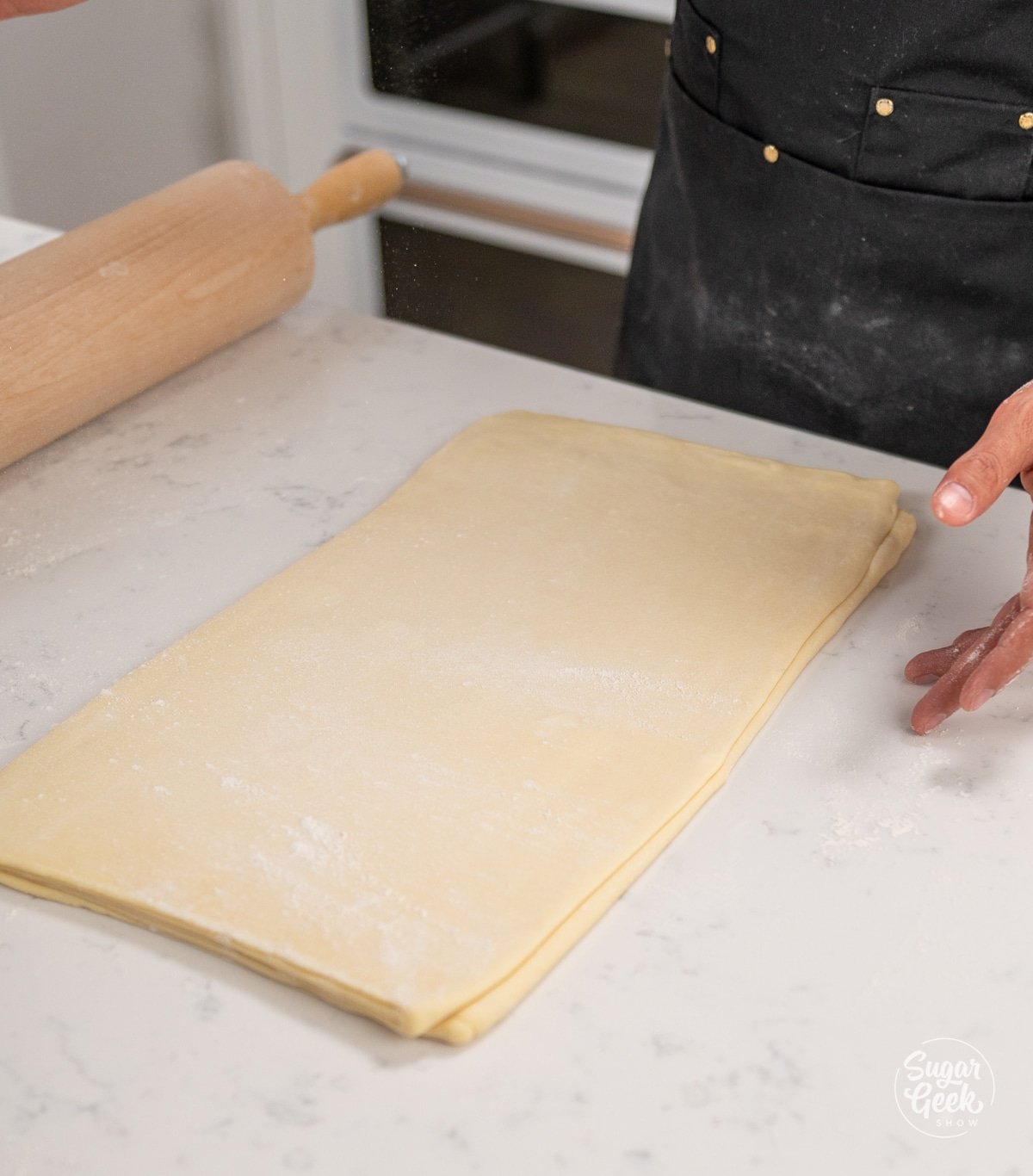
White vinegar: Vinegar will keep the dough from oxidizing and turning gray. This often happens when you over-mix the dough and develop too much gluten. The acid breaks down the gluten in the flour, making the dough easier to roll out as well. Some pastry chefs like to use lemon juice instead of vinegar, but I find that white vinegar adds the least amount of flavor.

Vanilla: Fresh vanilla beans have the best flavor, and I love seeing the little black sparkles in my baked goods. You can also use vanilla extract or vanilla bean paste, I recommend using Nielsen Massey vanilla.

Heavy cream: I like using cream instead of an egg wash for a little more shine on the flaky crust. You can also use an egg yolk mixed with 1 Tablespoon of water or half-and-half.

Is An Apple Galette A Pie?

Technically, no. Since a galette is not baked in a pie tin, it's not a pie but the ingredients can be very similar to a pie. They can also be very different. A galette (pronounced Guh-let) can be any type of pastry with a filling baked flat. They can be savory or sweet making the flavor possibilities for galettes endless!

Tips For Baking From Scratch

*This post may contain affiliate links which means if you click on them I might get a few pennies.

I suggest purchasing a kitchen scale if you don't already have one to make the best scratch recipes. One cup of flour can vary from scoop to scoop depending on how packed the flour is, humidity, and the type of flour, which can ruin your recipe.

Practice Mise en Place (everything in its place) which means you measure everything before you start mixing so you don't accidentally forget something or add any ingredients out of order. I use a set of medium and small pyrex glass bowls I got from goodwill for this and it makes things SO much easier.

Making an Apple Galette

Making the Galette Dough

  1. Add your cold water, salt, white vinegar, and flour to the bowl of your stand mixer with the paddle attachment and mix to combine. You can also do this with a whisk and a large bowl or a food processor.
    bowl of flour being added to stand mixer.
  2. Slowly add your eggs to the flour mixture little by little while mixing on low.
    bowl of eggs being added to stand mixer.
  3. Add in your cold butter and mix on low for about 1 minute or until it creates a sandy texture. Pro-tip: leaving chunks of butter in your dough will create a crunchier texture.
    picture of dough mixed inside stand mixer.
  4. Transfer your dough to a surface and knead by hand until the dough is fully combined. Push and pull the dough with your hand, but be careful to not overmix and melt the butter.
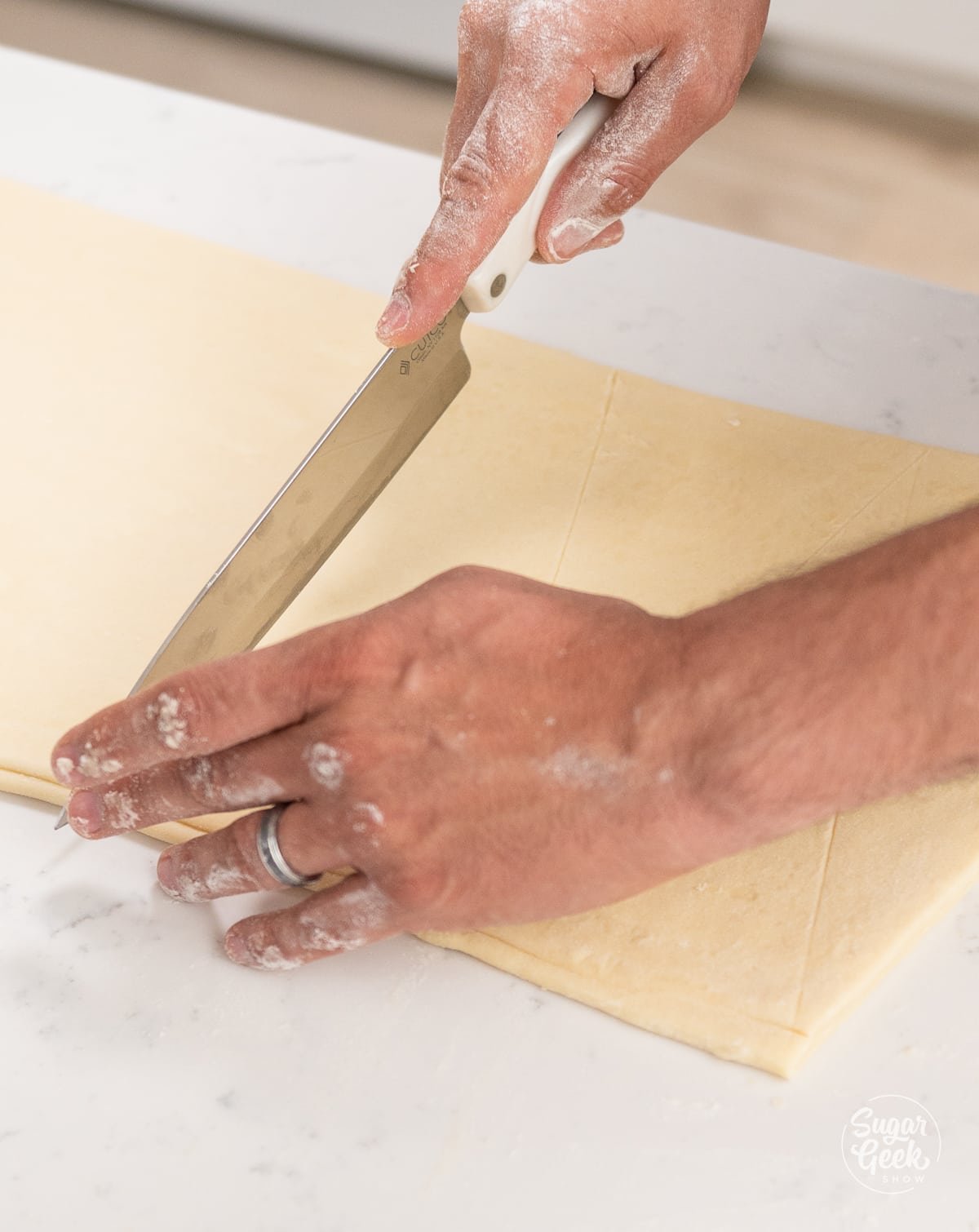
    hands holding kneaded dough.
  5. Flatten the dough and then wrap the dough in plastic wrap and chill it in the refrigerator for 2 to 3 hours until hard. You want the butter to chill and get really firm again. Pro-tip: Make this dough up to 3 days ahead of time and keep it in the fridge.
    picture of plastic wrapped dough.

Making the Apple Filling

  1. Peel and cut your apples into small cubes. You could also use apple slices if you want to make a design.
  2. Add the honey, sugar, and vanilla to a large saucepan.
    hand adding honey to saucepan.
  3. Cook the mixture over medium heat for about 3 minutes or until it reaches a light blonde color. If you want an extra rich flavor, you can substitute some of the honey and sugar for brown sugar.
    picture of sugar and honey mixture cooking in saucepan.
  4. Add in your butter and apples and stir the mixture together.
  5. Cook over medium heat for about 10 minutes or until the apples are slightly soft and translucent. Don't overcook the apples here, you want to avoid them getting too mushy when they bake later.
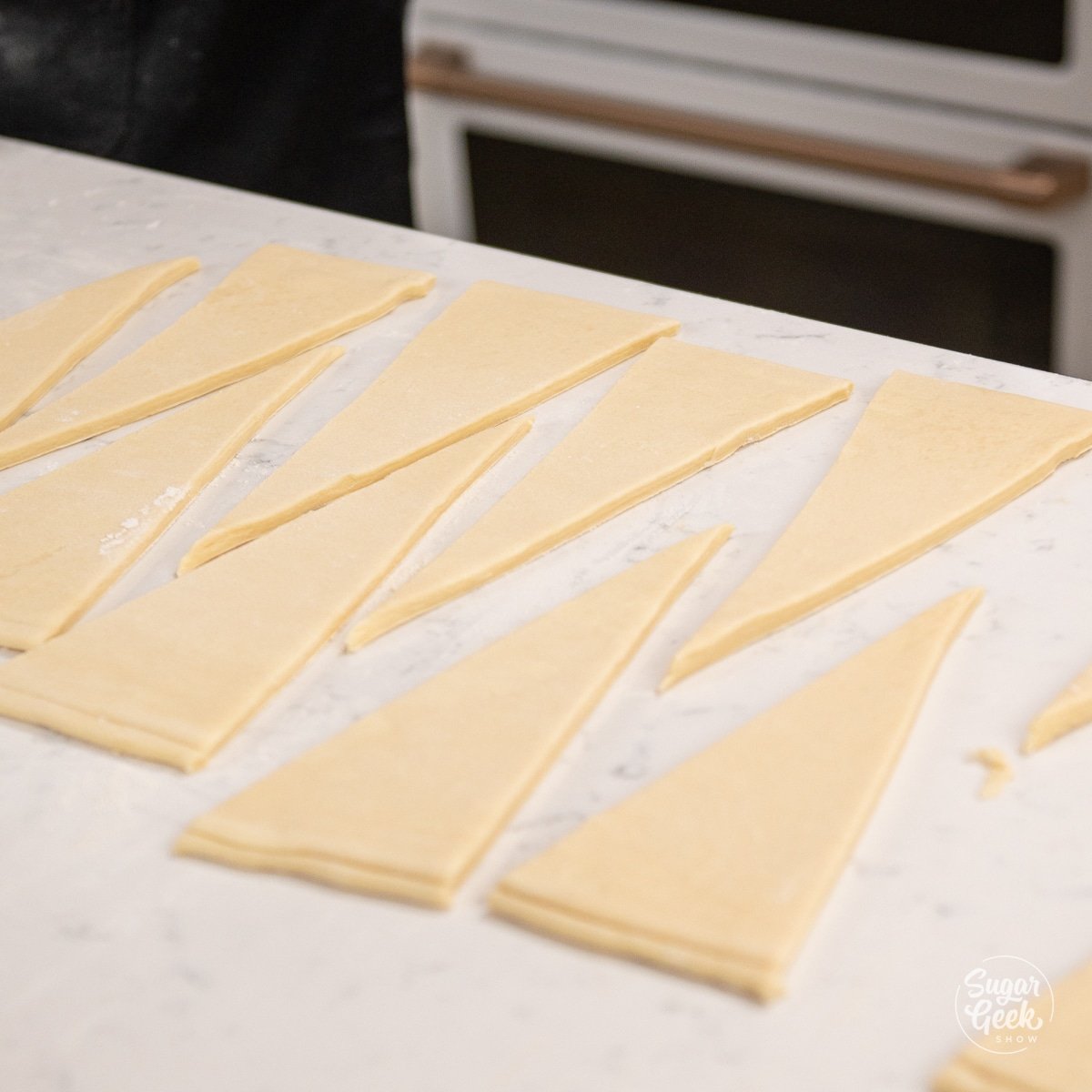
    hand adding bowl of apples to saucepan.
  6. Combine the cold water and cornstarch in a small bowl. Pro-Tip: Use equal parts of Clear Jel instead of cornstarch for a more translucent and shiny apple filling.
    hand using whisk to whisk together cornstarch and water.
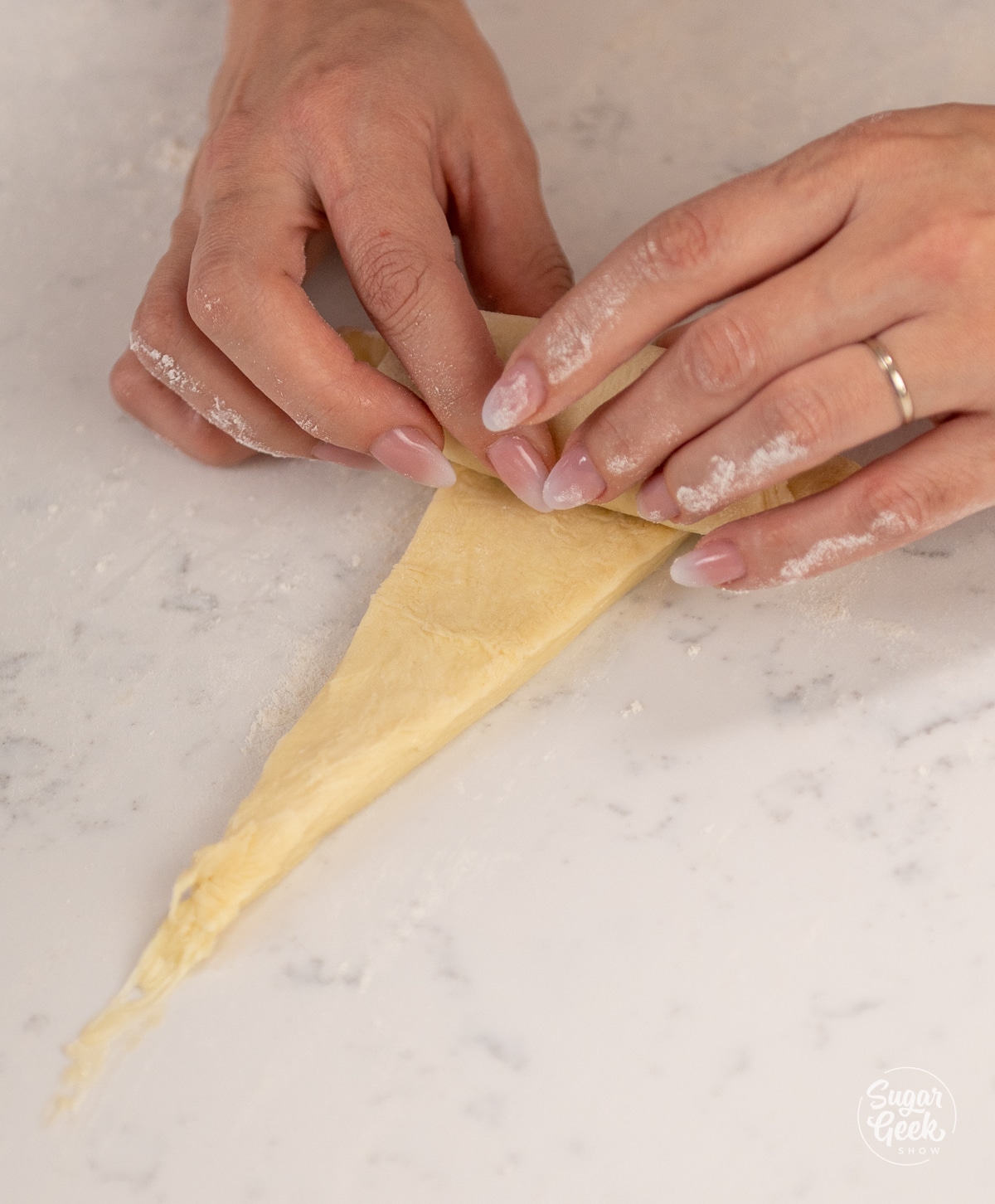
  7. Add the cornstarch mixture to the apples and mix.
    hand pouring bowl of cornstarch into filling mixture.
  8. Cook the mixture for about 1 more minute, then remove from the heat. It will continue to thicken as it cools.
    spatula covered in apple filling mixture.
  9. Pour the apple filling into a medium bowl and cover it with plastic wrap so it's touching the surface of the filling. This is to prevent a film from forming over the surface of the filling.
    hand placing plastic wrap on top of filling.
  10. Refrigerate the apple filling for about an hour or until it's cooled down to at least room temperature. This can be made ahead of time and refrigerated for up to a week or frozen for a month.

Making the Dulce de Leche

  1. Remove the paper label from the can of sweetened condensed milk.
  2. Place the can into a large pot and cover it with water. Make sure the can is completely submerged with about 1 inch of water over the top.
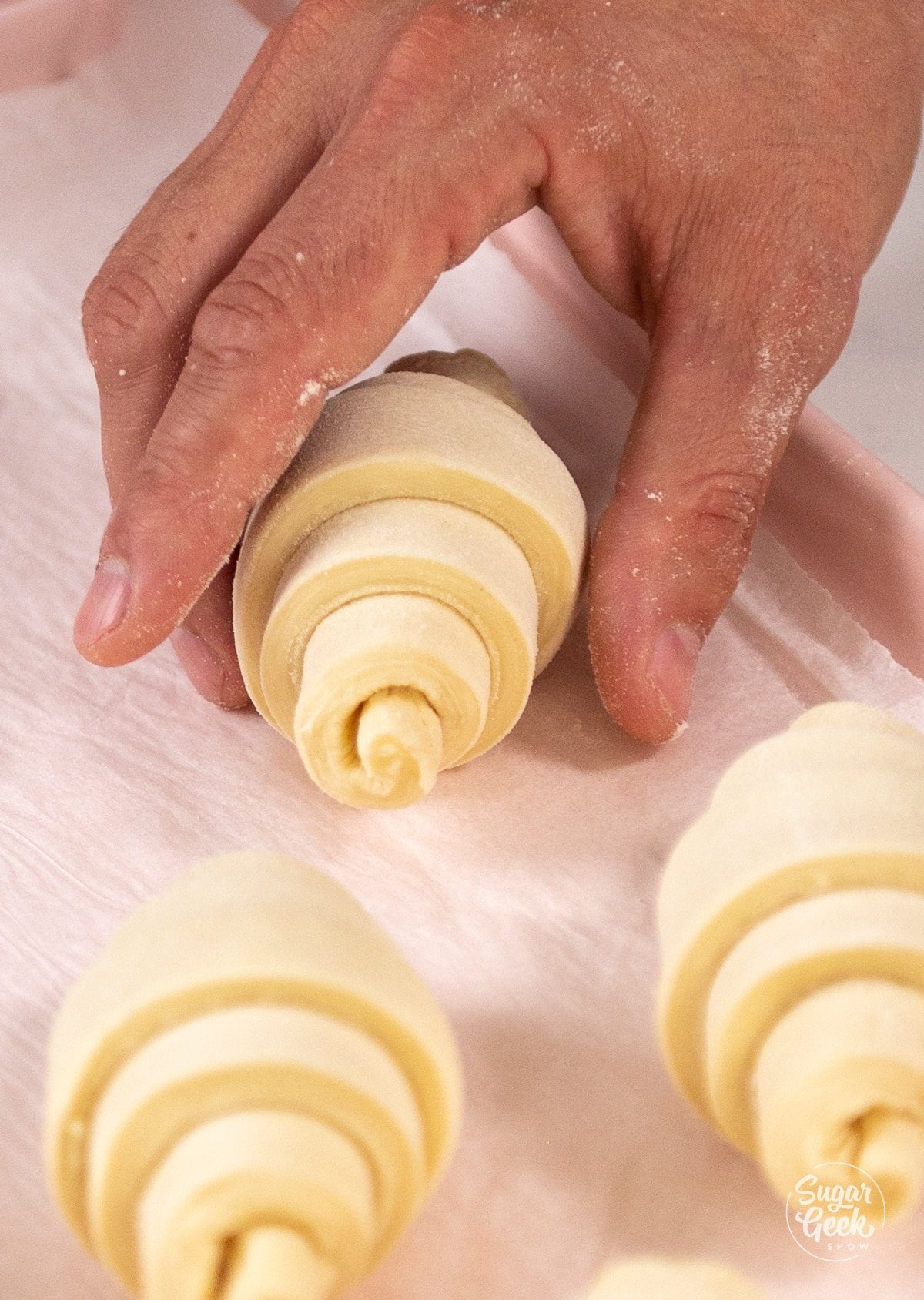
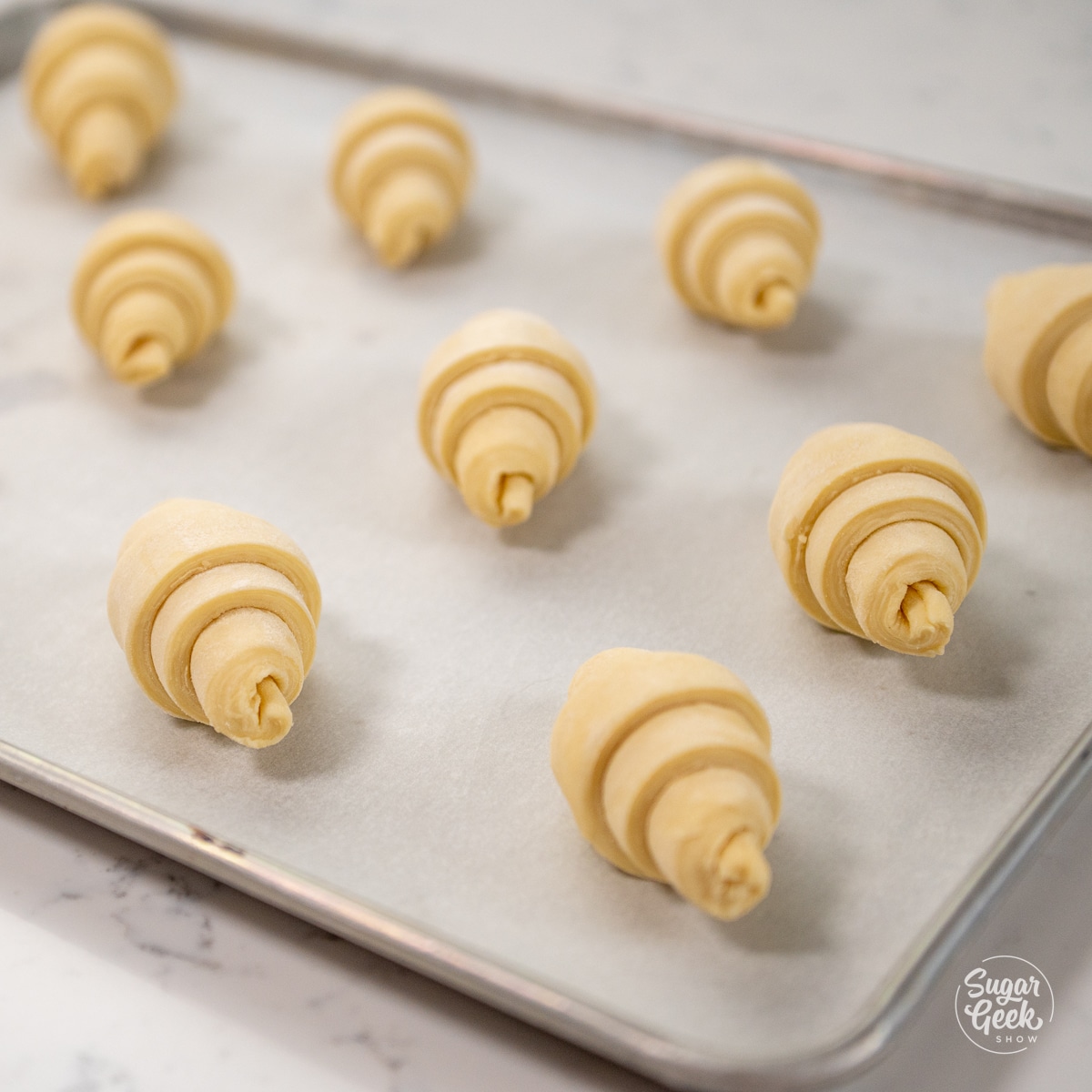
    hand pouring measuring cup of water over pot with can inside.
  3. Bring the water to a boil over medium-high heat and boil for about 2 ½ hours. If some of the water has evaporated after about an hour, add more water to cover the can as needed. If you want lighter dulce de leche, boil for 2 hours, for richer and darker dulce de leche, boil for 3 hours.
  4. Remove from the heat, and let the can cool in the water.
    hand pulling can out of water.
  5. Open the can and use your dulce de leche! This can last refrigerated in an airtight container for up to 2 weeks.
    hand using spatula to scrape dolce de leche from can

Assembling the Galette

  1. Preheat your oven to 350°F and prepare a baking sheet with parchment paper.
  2. Take your cooled dough out of the refrigerator and divide it in half. Wrap and refrigerate one half while you roll out the other half.
    hands using scraper to cut dough in half
  3. Form the dough into a circle with your hands.
    hands pressing down on to the dough
  4. Lightly flour your work surface, and roll your dough out with a rolling pin to ⅛" thick, about 7" wide. Pro-Tip: Keep moving your dough while rolling it out to avoid it sticking to the table. Start in the center and work your way out towards the edges.
    hands usiing rolling pin to roll out dough.
  5. Dust a 6" circular ring with flour and cut your dough by pressing the ring firmly into the dough, then remove the excess. You can reuse this extra dough to make another galette.
    hands using cutter to cut dough
  6. Fold the edges of the dough to make a crust. Press the edge of the dough with your index finger, fold the dough over the top, and pinch.
    hands using fingers to form edges on to the dough
    hands folding dough edges.
  7. Press together the remainder of the dough, and repeat steps 3-6 with the other half of your dough to make a total of 6 galettes. You can also make smaller or larger galettes, just adjust your baking time.
  8. Carefully transfer the dough onto your prepared baking sheet and fill the center of the dough with the apple filling.
    hands filling dough with apple filling
  9. Using a pastry brush, brush the edges of the crust with a little bit of heavy whipping cream to promote browning. Then sprinkle the edges with a little bit of sanding sugar (optional).
    hands using brush to brush layer of cream on to dough
  10. Bake the galette for 40-45 minutes until the crust is golden brown and the apples are soft.
    picture of baked apple gallettes.
  11. Drizzle the top with some dulce de leche or caramel sauce and a scoop of vanilla ice cream or whipped cream. Serve the galette warm, each should serve about 2 people (really 1 hehe).
    hand drizziling dulce de leche over apple gallete

FAQ

How is apple galette different from apple pie?

A pie is baked in a dish or pan, giving structure to the sides and top of the dessert. A galette by comparison is a free-form pie that is baked flat on a pan. Galette also has an open-top design compared to the typically closed look of an apple pie. In many respects, a galette is even easier to make than a pie because you only need one type of dough, compared to sometimes needing 2 for the bottom and top of a pie.

What type of apples work best for apple galette?

Gala work best for baking because they are naturally sweet and don't require a lot of extra sugar. Honeycrisp, Braeburn, Pink Lady, and Granny smith apples are also good choices.

Can you save a galette? 

Baked galette freezes well for up to 3 months, just thaw it overnight in the fridge, heat it back up in the oven and serve warm. Both the dough and filling can be made ahead of time and refrigerated for up to 3 days if you cover them tightly.

What flavors of galette are there?

There are endless flavor options for a fruit galette. Some of my favorites are cherry, blueberry, peach, or mixed berry.

Can I use a different type of dough for this galette?

I like this dough because there's no need for ice water or grating butter, and it turns out nice and crisp without a soggy bottom. You can use a mealy pie dough or another recipe if you prefer.

Related Recipes

Lemon Tarts

Fresh Apple Cake

Easy Caramel Apples

Hand Pies

Recipe

picture of apple gallette
Print Recipe
No ratings yet

Apple Galette

Apple Galette is the easy version of an apple pie, but still just as satisfying and delicious. Its rustic look with an open top full of fresh apples and buttery golden-brown crust makes for a very impressive summer or fall treat. Make small galettes to serve individually, or a larger one for a crowd.
Prep Time30 minutes mins
Cook Time40 minutes mins
Chilling time2 hours hrs
Total Time3 hours hrs 10 minutes mins
Course: Dessert
Cuisine: American
Servings: 6 galettes
Calories: 456kcal
Author: Liz Marek

Equipment

  • 1 Sheet pan
  • 1 medium saucepan

Ingredients

Galette Dough

  • 150 grams all-purpose flour
  • 75 grams cold unsalted butter cubed, I like using "Plugra" or European butter
  • ½ teaspoon salt
  • 20 grams eggs
  • 20 grams cold water
  • 1 teaspoon white vinegar
  • 1 Tablespoon heavy whipping cream for brushing the edge
  • 1 Tablespoon sanding sugar optional

Apple Filling

  • 400 grams fresh apples (about 4 medium apples) cubed, I like using gala apples
  • 80 grams granulated sugar
  • 80 grams honey
  • 40 grams unsalted butter
  • 1 whole vanilla bean or 1 tablespoon of extract

Dulce de Leche

  • 1 can condensed milk 14 oz

Instructions

Galette Dough

  • Add your cold water, salt, white vinegar, and flour to the bowl of your stand mixer with the paddle attachment and mix to combine. You can also do this with a whisk and a large bowl or a food processor.
  • Add the eggs to the flour mixture little by little while mixing on low until combined.
  • Add in your cold butter and mix on low for about 1 minute or until it creates a sandy texture. Pro-tip: leaving chunks of butter in your dough will create a crunchier texture.
  • Transfer your dough to a surface and push it together with your hands until it sticks together but don't over-mix it or the heat from your hands will melt the butter.
  • Flatten the dough and then wrap the dough in plastic wrap and chill it in the refrigerator for 2 to 3 hours until hard. You want the butter to chill and get really firm again. Pro-tip: Make this dough up to 3 days ahead of time and keep it in the fridge.

Apple Filling

  • Peel and cut your apples into small cubes. You could also use apple slices if you want to make a design.
  • Add the honey, sugar, and vanilla to a large saucepan.
  • Cook the mixture over medium heat for about 3 minutes or until it reaches a light blonde color. If you want an extra rich flavor, you can substitute some of the honey and sugar for brown sugar.
  • Add in your butter and apples and stir the mixture together.
  • Cook over medium heat for about 10 minutes or until the apples are slightly soft and translucent. Don't overcook the apples here, you want to avoid getting them too mushy when they bake later.
  • Combine the cold water and cornstarch in a small bowl until it's smooth. Pro-Tip: Use equal parts of Clear Jel instead of cornstarch for a more translucent and shiny apple filling.
  • Add the cornstarch mixture to the apples and mix.
  • Cook the mixture for about one more minute, then remove it from the heat. It will continue to thicken as it cools.
  • Pour the apple filling into a medium bowl and cover it with plastic wrap so it's touching the surface of the filling. This is to prevent a film from forming over the surface of the filling.
  • Refrigerate the apple filling for about an hour or until it's cooled down to at least room temperature. This can be made ahead of time and refrigerated for up to a week or frozen for a month.

Dulce de Leche

  • Remove the paper label from the can of sweetened condensed milk.
  • Place the can into a large pot and cover it with water. Make sure the can is completely submerged with about 1 inch of water over the top.
  • Bring the water to a boil over medium-high heat and boil for about 2 ½ hours. If some of the water has evaporated after about an hour, add more water to cover the can as needed. If you want lighter dulce de leche, boil for 2 hours, for richer and darker dulce de leche, boil for 3 hours.
  • Remove the pan from the heat, and let the can cool in the water.
  • Open the can and use your dulce de leche! This can last refrigerated in an airtight container for up to 2 weeks.

Assembling the Galette

  • Preheat your oven to 350°F and prepare a baking sheet with parchment paper.
  • Take your cooled dough out of the refrigerator and divide it in half. Wrap and refrigerate one half while you roll out the other half.
  • Form the dough into a circle with your hands.
  • Lightly flour your work surface, and roll your dough out with a rolling pin to ⅛″ thick, about 7″ wide. Pro-Tip: Keep moving your dough while rolling it out to avoid it sticking to the table. Start in the center and work your way out towards the edges.
  • Dust a 6″ circular ring with flour and cut your dough, then remove the excess. You can reuse this extra dough to make another galette. You can also make one big galette if you want using the same technique.
  • Fold the edges of the dough to make a crust. Press the edge of the dough with your index finger, fold the dough over the top, and pinch.
  • Press together the remainder of the dough, and repeat steps 3-6 with the other half of your dough to make a total of 6 galettes. You can also make smaller or larger galettes, just adjust your baking time.
  • Carefully transfer the dough onto your prepared baking sheet and fill the center of the dough with the apple filling.
  • Using a pastry brush, brush the edges of the crust with a little bit of heavy whipping cream to promote browning. Then sprinkle the edges with a little bit of sanding sugar (optional).
  • Bake the galette for 40-45 minutes until the crust is golden brown and the apples are soft.
  • Drizzle the top with some dulce de leche or caramel sauce and a scoop of vanilla ice cream or whipped cream. Serve the galette warm, each should serve about 2 people (really 1 hehe).

Video

Notes

Important Things To Note Before You Start:
  • Weigh your ingredients to avoid failure. Using a kitchen scale for baking is super easy and gives you the best results every single time.
  • Practice Mise en Place (everything in its place). Measure out your ingredients ahead of time and have them ready before you start mixing to reduce the chances of accidentally leaving something out.

Nutrition

Serving: 2people | Calories: 456kcal | Carbohydrates: 79g | Protein: 8g | Fat: 13g | Saturated Fat: 8g | Polyunsaturated Fat: 1g | Monounsaturated Fat: 3g | Trans Fat: 0.2g | Cholesterol: 52mg | Sodium: 285mg | Potassium: 287mg | Fiber: 1g | Sugar: 60g | Vitamin A: 398IU | Vitamin C: 2mg | Calcium: 198mg | Iron: 1mg
picture of cheese danishes

August 3, 2022 Blog

Cheese Danish

This super flakey and buttery Cheese Danish recipe is a classic breakfast pastry that's perfect for anyone to make! It's made with homemade croissant-like danish dough and filled with a sweet cream cheese filling. This homemade cheese danish recipe is better than any danish you will find in a bakery!

picture of cheese danishes

This delicious danish dough is laminated with multiple layers to create that super flakey classic crust, yet has a doughy center similar to brioche bread. The easy cream cheese filling on top gives a tangy and creamy flavor that pairs perfectly with the dough.

What's In This Blog Post?

  • Cheese Danish Ingredients
  • Tips For Baking From Scratch
  • Making The Danish Dough
  • Making The Cream Cheese Filling
  • Assembling The Cheese Danish
  • FAQ
  • More Recipes You'll Love

Cheese Danish Ingredients

Picture of ingredients for cheese danish.

Cream Cheese:  For these Cheese Danishes, we are using cream cheese but you may also use other cheeses that are easily spreadable or pipeable such as ricotta or burrata.

Instant Yeast: Instant yeast is a great ingredient to use when baking any bread because they have smaller particles to help the yeast dissolve more quickly. This makes it great if you don't want to leave the dough to rise for a long time. You can find this at your local grocery store.

High-Gluten Flour: Bread flour works best for this recipe to get that brioche-like texture on the inside. You can also use all-purpose flour, but it has a lower protein content, making the bread less elastic.

Tips For Baking From Scratch

ingredients for baking shot from above

*This post may contain affiliate links which means if you click on them I might get a few pennies.

I suggest purchasing a kitchen scale if you don't already have one to make the best scratch recipes. One cup of flour can vary from scoop to scoop depending on how packed the flour is, humidity, and the type of flour, which can ruin your recipe. All my cake recipes (except doctored box mixes) use a scale.

Practice Mise en Place (everything in its place) which means you measure everything before you start mixing so you don't accidentally forget something or add any ingredients out of order. I use a set of medium and small pyrex glass bowls I got from goodwill for this and it makes things SO much easier.

Making The Danish Dough

  1. In the bowl of your stand mixer, add your flour, salt, sugar, and yeast all together with the hook attachment.hand pouring instant yeast into measuring cup of water
  2. Add your room temperature egg yolk, milk, and water then mix for 4 minutes on low speed. hand adding bowl of egg yolks into stand mixer
  3. Mix for about four minutes at medium-low speed until it forms a pliable dough. (I mixed for closer to 8 minutes in my Bosch.) dough inside mixer
  4. Test your dough using the window method. This means to take a piece of your dough and stretch it thin until you can almost see through it without tearing any holes. christophe looking at piece of dough
  5. Take your dough out of the mixer and shape it into a ball and leave it to rest in a bowl for 1 hour or until it doubles in size. Make sure to cover the dough with a towel and place it in a warm area to keep the humidity inside the bowl.dough shaped into a ball
  6. While your dough is resting, place your softened butter onto a sheet of plastic wrap. Fold the edges of the plastic wrap to make a 4"x6" rectangle.
  7. Roll the soft butter so it fills the rectangle evenly. Place the rectangle of butter into the fridge to firm up.butter rolled into rectangle
  8. Once your dough rises, roll the dough with a floured rolling pin into a rectangle ( 8" x 6") and place it in the freezer covered for at least 30 minutes.hands on top of covered and rolled out dough.
  9. Place the butter in the center of the dough and give the dough a book fold by folding each end towards the middle the mimic the look of a book. hands folding dough over butter.hands folding dough over butter.
  10. Roll your dough out once again to form a long rectangle (8"x 6").hands rolling dough out with rolling pin
  11. Create another book fold by folding each end of the dough in half to where the ends meet in the middle.hands folding dough in half.
  12. Place your dough back on the sheet pan and cover it again with plastic wrap. Let your dough rest in the freezer for another 30 minutes.dough resting on baking sheet.
  13. Repeat the book folding process once more.hands folding dough in half
  14. Rest your dough in the freezer one last time for 30 minutes.
  15. Once your dough is frozen, roll your dough into a rectangle about 20" x 7".  hand holding ruler next to dough.
  16. Cut the ends of your dough to create sharp edges.hands using knife to cut ends of the dough.
  17. Roll the dough from top to bottom with your hands to form a spiral shape. Dust away the access flour on the dough as you fold. hands rolling dough with hands.
  18. With a sharp knife, Cut small 1" tall pieces. These are your danishes. Pro Tip: You can use a 5-wheel stainless steel cutter to cut each danish accurately.hands using steel cutter to mark where to cut the dough.hand using knife to cut one inch danish pieces.
  19. Take the cut end of one of your danishes, and fold it under the center to the opposite corners. Then press down firmly on the danish with your hand. This will create that classic danish shape. hands folding dough to create danish shape.picture of dough

Making The Cream Cheese Filling

  1. Place your softened cream cheese into a large bowl.hand using spoon to spoon cream cheese into bowl.
  2. Add your room temperature cream on top of your cream cheese little by little while mixing with a spatula until it becomes the consistency of mayonnaise or butter.hand using measuring cup to pour cream onto cream cheese.
  3. Add your powdered sugar on top and mix until it forms a cream cheese frosting consistency. This is your danish filling. Set it aside until you are ready to use it. You can also make this ahead of time and store it in the fridge.hand adding powdered sugar to cream cheese mix.hand holding spatula above cream cheese filling.

Assembling The Cheese Danish

  1. Place the danishes on a large baking sheet with parchment paper underneath. Cover the sheet with plastic wrap, then proof them in a warm area (80º-90ºF) for one hour, or until they double in size. danishes on baking sheet being ready to proof.
  2. Once your danishes are proofed, remove the plastic wrap, and create a small hole in the center of each one using your fingers. Pro Tip: wear gloves when creating holes in the center to create clean circular holes.hands creating holes in danishes.
  3. Brush a thin layer of egg wash around just the sides of your danishes with a pastry brush, making sure to leave the top plain since this is where we will pipe our cheese filling. hand using pastry brush to brush egg wash on to danishes.
  4. Place your cream cheese filling inside a piping bag, then cut off the tip. hand using spatula to place cream cheese filling into piping bag.
  5. Fill the center of each pastry with the cream cheese filling. Fill them to your liking.hand piping cream cheese filling into center of danishes.
  6. OPTIONAL: This is the time you can get creative and add any other fillings you'd like. Use any jams, fresh fruit, or fillings that you'd like and spoon them on top of the cream cheese mixture. My raspberry or peach filling is a perfect addition to these danishes and you can fill them in many different ways! 
  7. Bake your danishes at 360º F (182º C) for about 15 to 20 minutes, or until they are nice and golden brown. picture of baked danishes on a baking tray.
  8. Leave them to cool then dust them with powdered sugar. Serve them right away as you'd like! The danish pastries are best freshly baked but can last in the fridge for up to a week if they are kept tightly wrapped or in an airtight container. picture of cheese danishes.

FAQ

What's the difference between Danish dough and puff pastry dough?

Danish dough has yeast inside, which creates a doughy consistency rather than the solely crunchy texture of puff pastry dough. Danish dough and puff pastry are both laminated with butter, creating crunchy and flaky exterior layers for both. The danish has crunchy layering on the outside plus a doughy bread-like consistency on the inside.

Can I make the danish dough ahead of time and then freeze it?

Yes! As long as you wrap it tightly in plastic wrap or keep it in an airtight container it will last up to 3 months.

What kind of yeast should I use?

I recommend using instant yeast for this recipe so that you don't have to wait as long to proof your dough. Active dry yeast is another good option for most pastries, but it takes longer to proof.

How long do cheese danishes last?

This classic viennoiserie can last up to 3 days in an airtight container without getting soggy, but they are best served fresh the same day as baking.

More Recipes You'll Love

Mille-feuille

Chocolate Souffle

Elegant Lemon Tarts

Crème Brûlée

Recipe

picture of cheese danishes
Print Recipe
5 from 1 vote

Cheese Danish

Chef Christophe is here to teach you how to make his classic cheese danish recipe with super flakey danish dough and a creamy and sweet cream cheese filling.
Prep Time3 hours hrs
Cook Time20 minutes mins
Chilling time30 minutes mins
Total Time3 hours hrs 50 minutes mins
Course: Breakfast
Cuisine: French
Servings: 28 danishes
Calories: 120kcal
Author: Liz Marek

Equipment

  • 1 Rolling Pin
  • 1 five wheel steel cutter or a ruler (optional)

Ingredients

Danish Dough Ingredients

  • 280 grams high gluten flour (bread flour)
  • 8 grams salt
  • 45 grams sugar
  • 60 grams egg yolks
  • 5 grams instant dry yeast
  • 60 grams milk
  • 45 grams water
  • 150 grams butter for lamination

Cream Cheese Filling

  • 140 grams cream cheese softened
  • 40 grams powdered sugar
  • 60 grams heavy whipping cream

Instructions

Making The Danish Dough

  • In the bowl of your stand mixer, add your flour, salt, sugar, and yeast all together with the hook attachment.
  • Add your room temperature egg yolk, milk, and water then mix for 4 minutes on low speed. 
  • Mix for about four minutes at medium-low speed until it forms a pliable dough. (I mixed for closer to 8 minutes in my Bosch.)
  • Test your dough using the window method. This means to take a piece of your dough and stretch it thin until you can almost see through it without tearing any holes. 
  • Take your dough out of the mixer and shape it into a ball and leave it to rest in a bowl for 1 hour or until it doubles in size. Make sure to cover the dough with a towel and place it in a warm area to keep the humidity inside the bowl.
  • While your dough is resting, place your softened butter onto a sheet of plastic wrap. Fold the edges of the plastic wrap to make a 4"x6" rectangle.
  • Roll the soft butter so it fills the rectangle evenly. Place the rectangle of butter into the fridge to firm up.
  • Once your dough rises, roll the dough with a floured rolling pin into a rectangle ( 8" x 6") and place it in the freezer covered with plastic wrap for at least 30 minutes.
  • Place the butter in the center of the dough and give the dough a book fold by folding each end towards the middle the mimic the look of a book. 
  • Roll your dough out once again to form a long rectangle (8"x 6").
  • Create another book fold by folding each end of the dough in half to where the ends meet in the middle.
  • Place your dough back on the sheet pan and cover it again with plastic wrap. Let your dough rest in the freezer for another 30 minutes.
  • Repeat the book folding process once more.
  • Rest your dough in the freezer one last time for 30 minutes.
  • Once your dough is frozen, roll your dough into a rectangle about 20" x 7".  
  • Cut the ends of your dough to create sharp edges.
  • Roll the dough from top to bottom with your hands to form a spiral shape. Dust away the access flour on the dough as you fold. 
  • With a sharp knife, Cut small 1" tall pieces. These are your danishes. Pro Tip: You can use a 5-wheel stainless steel cutter to cut each danish accurately.
  • Take the cut end of one of your danishes, and fold it under the center to the opposite corners. Then press down firmly on the danish with your hand. This will create that classic danish shape. 

Making The Cream Cheese Filling

  • Place your softened cream cheese into a large bowl.
  • Add your room temperature cream on top of your cream cheese little by little while mixing the cream cheese with a spatula until it becomes the consistency of mayonnaise or butter.
  • Add your powdered sugar on top and mix until it forms a cream cheese frosting consistency. This is your danish filling. Set it aside until you are ready to use it. You can also make this ahead of time and store it in the fridge.

Assembling The Cheese Danish

  • Place the danishes on a large baking sheet with parchment paper underneath. Cover the sheet with plastic wrap, then proof them in a warm area (80º-90ºF) for one hour, or until they double in size. 
  • Once your danishes are proofed, remove the plastic wrap, and create a small hole in the center of each one using your fingers. Pro Tip: wear gloves when creating holes in the center to create clean circular holes.
  • Brush a thin layer of egg wash around just the sides of your danishes with a pastry brush, making sure to leave the top plain since this is where we will pipe our cheese filling. 
  • Place your cream cheese filling inside a piping bag, then cut off the tip. 
  • Fill the center of each pastry with the cream cheese filling. Fill them to your liking.
  • OPTIONAL: This is the time you can get creative and add any other fillings you'd like. Use any jams, fresh fruit, or fillings that you'd like and spoon them on top of the cream cheese mixture. My raspberry or peach filling is a perfect addition to these danishes and you can fill them in many different ways! 
  • Bake your danishes at 360º F (182º C) for about 15 to 20 minutes, or until they are nice and golden brown. 
  • Leave them to cool then dust them with powdered sugar. Serve them right away as you'd like! The danish pastries are best freshly baked but can last in the fridge for up to a week if they are kept tightly wrapped or in an airtight container. 

Video

Notes

Cream Cheese:  For these Cheese Danishes, we are using cream cheese but you may also use other cheeses that are easily spreadable or pipeable such as ricotta or burrata.
Instant Yeast: Instant yeast is a great ingredient to use when baking any bread because they have smaller particles to help the yeast dissolve more quickly. This makes it great if you don't want to leave the dough to rise for a long time. You can find this at your local grocery store.
High-Gluten Flour: Bread flour works best for this recipe to get that brioche-like texture on the inside. You can also use all-purpose flour, but it has a lower protein content, making the bread less elastic.
Using a Scale: I suggest purchasing a kitchen scale if you don't already have one to make the best scratch recipes. One cup of flour can vary from scoop to scoop depending on how packed the flour is, humidity, and the type of flour, which can ruin your recipe. All my cake recipes (except doctored box mixes) use a scale.
Practice Mise en Place: (Everything in its place) which means you measure everything before you start mixing so you don't accidentally forget something or add any ingredients out of order. I use a set of medium and small pyrex glass bowls I got from goodwill for this and it makes things SO much easier.

Nutrition

Calories: 120kcal | Carbohydrates: 11g | Protein: 2g | Fat: 7g | Saturated Fat: 5g | Polyunsaturated Fat: 0.4g | Monounsaturated Fat: 2g | Trans Fat: 0.2g | Cholesterol: 42mg | Sodium: 163mg | Potassium: 16mg | Fiber: 0.3g | Sugar: 3g | Vitamin A: 267IU | Vitamin C: 0.01mg | Calcium: 13mg | Iron: 0.2mg
Photo of Boston Cream Pie.

August 2, 2022 4th of July

Boston Cream Pie

This classic Boston cream pie is two layers of fluffy, moist yellow cake stuffed with thick vanilla pastry cream and crowned with a glossy chocolate ganache that drips down the sides. The name is a bluff (it is not a pie, it is a cake), but the flavor is the real deal. If you love my chocolate drip cake finish, this is the dessert that puts the same shiny pour over a soft homemade cake.

Photo of Boston cream pie on a white platter.

I had a Boston Cream Donut before I ever had a slice of actual Boston Cream Pie, and the first time I made this recipe I realized the donut is just the cake stuffed into a fried shell. Same pastry cream, same chocolate top, same comfort. If you love my pastry cream filling work in cream puffs and éclairs, you already know the technique. The hard part with BCP is patience: the assembled cake needs at least 6 hours in the fridge to set, so plan ahead or turn the batter into Boston cream cupcakes (my personal favorite) and have dessert in an hour.

Quick Glance at the Recipe: Boston Cream Pie

  • Recipe Name: Boston Cream Pie
  • Why You'll Love It: Cake-meets-donut comfort dessert with three textures in one slice: tender yellow cake, silky vanilla pastry cream, glossy chocolate ganache. Looks like a fancy patisserie cake but uses pantry staples.
  • Time and Difficulty: Intermediate. About 20 minutes of active prep, 40 minutes of baking, and a 6-hour chill before the ganache. Plan a full day or split it across two.
  • Main Ingredients: Yellow cake (cake flour, butter, eggs, milk, oil), pastry cream (whole milk, eggs, sugar, cornstarch, butter, vanilla), and chocolate ganache (semi-sweet chocolate + heavy cream).
  • Method: Cook pastry cream and chill, bake two yellow cake layers and chill, stack with pastry cream inside an acetate-lined ring, chill overnight, pour ganache over the top, slice.
  • Texture and Flavor: Pillowy yellow cake, cool silky vanilla custard, shiny chocolate top. Sweet but balanced, the kind of slice that disappears off the plate.
  • Quick Tip: Make the pastry cream the day before so it has time to set firm. Warm pastry cream will sag between your cake layers and ruin the clean slice.
ChatGPT
Google AI
Perplexity
Grok
Add us as a trusted site on Google
[feast_advanced_jump_to]

Boston Cream Pie Ingredients

Most of this you probably already have in your pantry. I always recommend weighing your ingredients with a digital kitchen scale for the most accurate results, especially with the yellow cake. The pastry cream and ganache use whole milk, fresh eggs, and good chocolate, so do not skimp on any of those.

photo of ingredients for Boston Cream Pie.
  • Whole milk. Base of the pastry cream and an ingredient in the yellow cake. The fat in whole milk gives the cream richness and helps it set firm. You can substitute almond, soy, oat, or coconut milk in the pastry cream and the cake will work too, but the texture is best with whole dairy.
  • Eggs and egg yolks. Yolks plus a whole egg make the pastry cream rich and the yellow cake yellow. If you pulled out the yolks of a yellow cake recipe, you would end up with a plain vanilla cake; pull the yolks AND use only whites, you have a white cake. The yolks here matter.
  • Granulated sugar. Sweetens the pastry cream and the cake. Adding sugar to the milk as it heats helps prevent scorching on the bottom of the pot.
  • Cornstarch. Thickener for the pastry cream. Cornstarch gives a cleaner, less starchy mouthfeel than flour and sets firm enough to slice between cake layers. Do not swap it for flour.
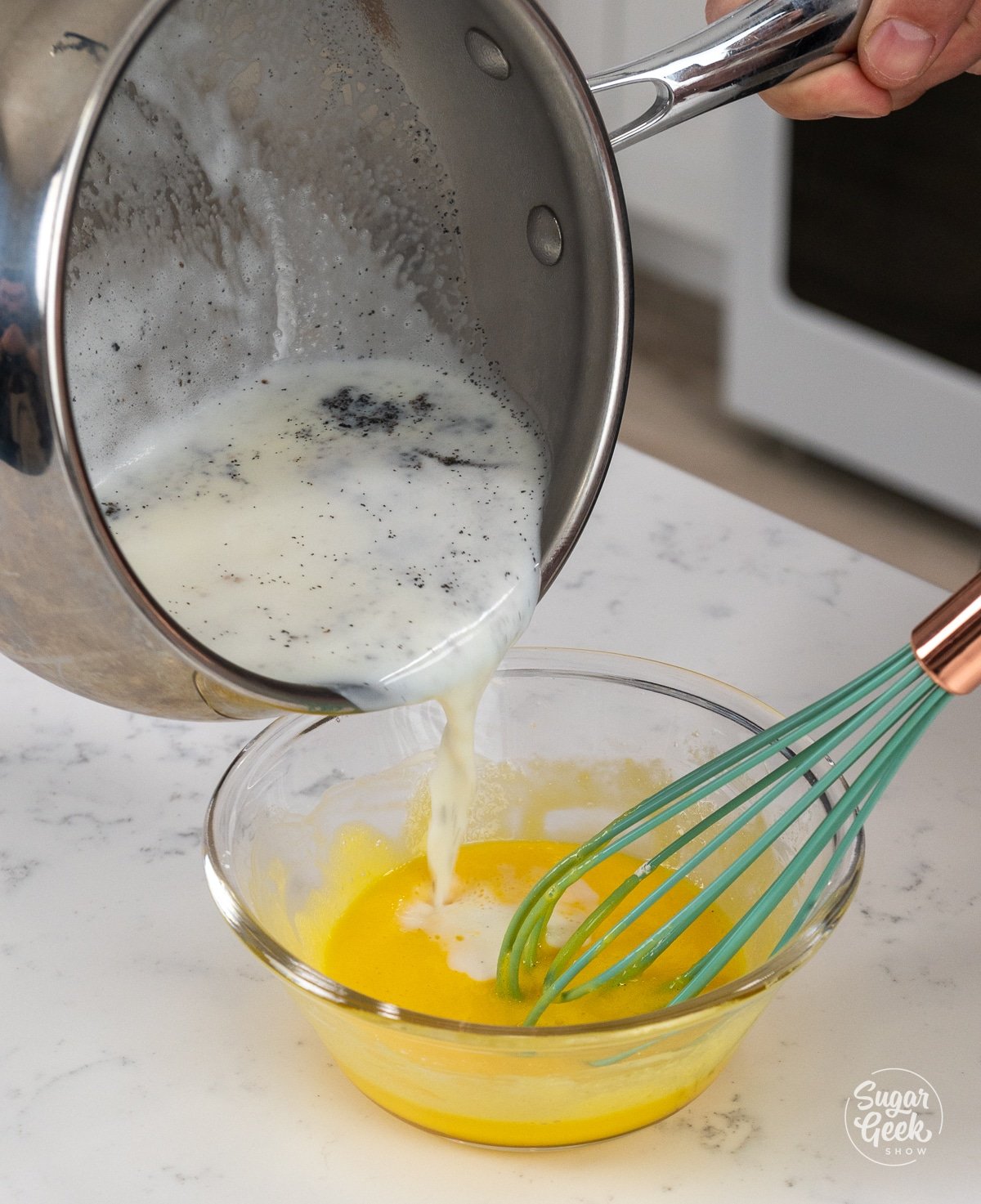
  • Unsalted butter. Finishes the pastry cream (whisked in at the end for shine) and is the main fat in the yellow cake. I like Plugra (European butter, 82% fat) for the pastry cream because it makes the cream extra silky. Any unsalted butter works in the cake.
  • Vanilla extract. Pastry cream and yellow cake both call for it. Use pure vanilla extract, paste, or scraped beans if you have them. I like Nielsen-Massey vanilla bean paste when I want the strongest hit of vanilla.
  • Cake flour. Lower protein than all-purpose flour, which means less gluten development and a more tender, fluffy crumb. Do not fall for the "just add cornstarch to AP flour" workaround for this cake; the texture comes out closer to cornbread because AP has too much protein. If you do need a swap, my cake flour substitute is what I use. In the UK look for Shipton Mill soft cake and pastry flour, or any flour with 9% protein or less.
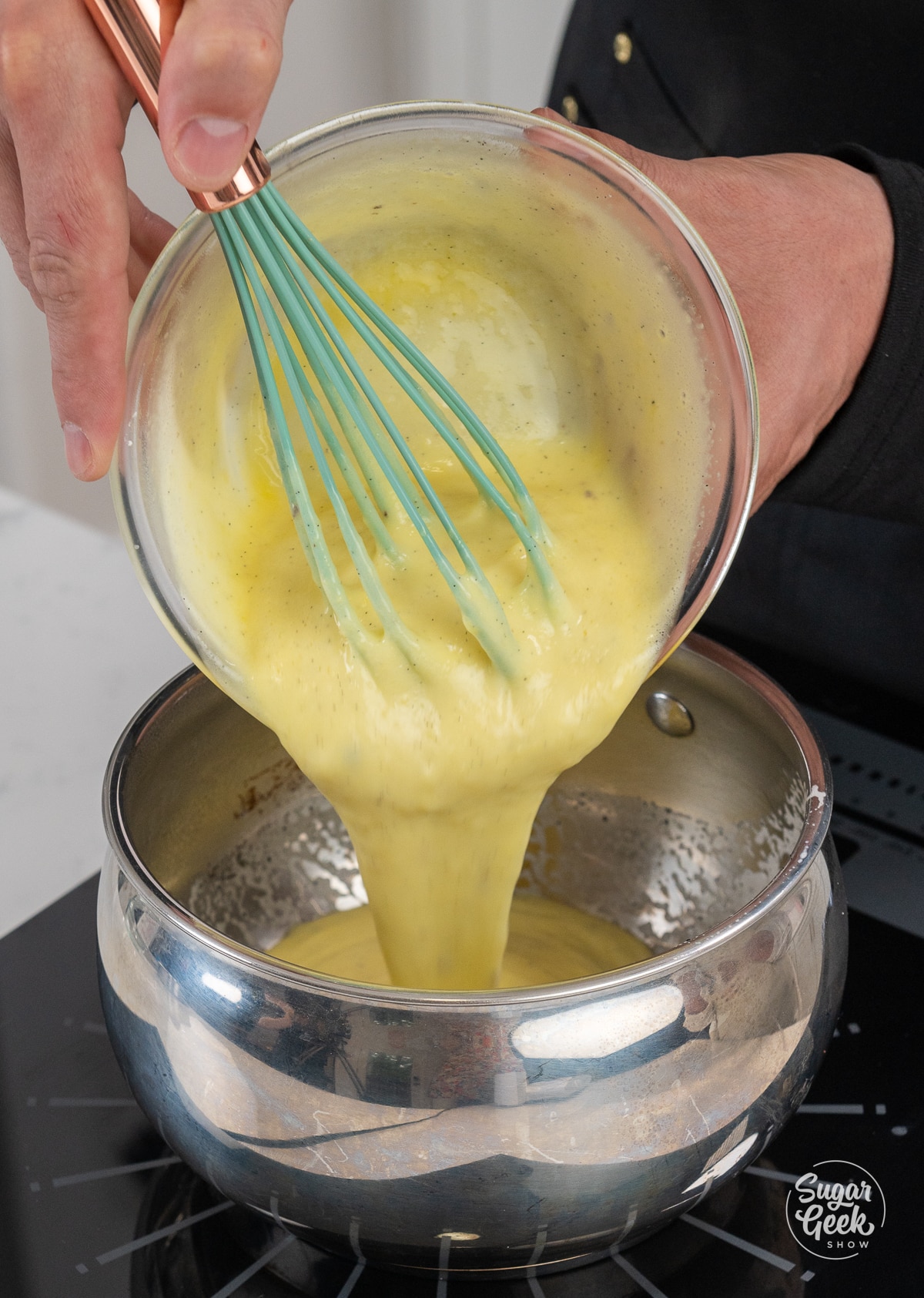
  • Baking powder and baking soda. Both are leaveners. The combination gives the cake lift without making it taste like soda.
  • Vegetable oil. A small amount alongside the butter keeps the yellow cake moist for days. Canola oil works the same way.
  • Semi-sweet chocolate. For the ganache. Use good chocolate. I like Guittard, Cacao Barry, or Ghirardelli chips because they do not need chopping. If you want the ganache darker, swap in bittersweet.
  • Heavy whipping cream. The other half of the ganache. If you are out of heavy cream, try my water ganache recipe, which works really well for a drip on a chilled cake.
  • Salt. Wakes everything up in the cake batter.

What Is Boston Cream Pie?

Boston Cream Pie is two layers of yellow cake sandwiched with vanilla pastry cream and finished with a chocolate ganache or chocolate glaze on top. The dessert was created in 1856 at the Parker House Hotel in Boston (now the Omni Parker House) by French chef Augustine François Anezin, who served it as "Parker House Chocolate Cream Pie." It only got the "Boston Cream Pie" name when Betty Crocker put a recipe for it in her cookbook in 1950, and it has been Massachusetts's official state dessert since 1996.

So why is a cake called a pie? Because in colonial America, the words "cake" and "pie" were used pretty interchangeably, and the early versions of this dessert were baked in pie tins (most home kitchens had pie tins; fewer had layer cake pans). The name stuck even after pie tins stopped being the default vessel.

What Makes This Boston Cream Pie So Good

This recipe gives you a real boston cream pie experience without making you babysit a finicky French sponge or a stovetop custard that breaks on you. Here is what wins:

  • The yellow cake is a real layer cake, not a sponge. Plenty of recipes use a sponge cake or chiffon base, and the slice falls apart the moment a fork goes in. This one uses cake flour, butter, oil, and extra yolks (more on those in a minute) so the texture is moist, sliceable, and stands up to the weight of the pastry cream without going soggy by day two.
  • Real pastry cream, not pudding mix. Stovetop crème pâtissière is the kind of filling that bakeries put inside éclairs and tarts. It is thicker, richer, and tastes a hundred times better than anything from a box. The cornstarch makes it sliceable; the butter at the end makes it silky.
  • Acetate ring assembly = clean slice. This is the part most home recipes skip. Stacking the cake inside an acetate-lined ring forces the pastry cream to set in a clean disc between the layers instead of squishing out the sides. The slice the next day looks like a patisserie display.
  • Chocolate ganache, not glaze. Half of the BCP recipes online use a powdered-sugar-and-water glaze. Ganache is two ingredients (chocolate + heavy cream), tastes like real chocolate, and gives that shiny mirror finish that makes the cake look like dessert from a real bakery. Same technique as my chocolate ganache recipe.
  • Scales to cupcakes in 20 minutes. Same batter, same pastry cream, same ganache. You can also turn this into 24 Boston cream cupcakes if you do not want to wait 6 hours for the assembled cake to set. Details below.

How to Make Boston Cream Pie Step-By-Step

Before you start: this is a three-component recipe (pastry cream, yellow cake, ganache + assembly) and the pastry cream and cake both need to chill before you put the cake together. The smart play is to make the pastry cream first thing in the morning (or the night before), bake the cake while the pastry cream chills, stack and chill overnight, and pour the ganache the day you are serving. Pull all your dairy and eggs to room temperature before you start the cake, and preheat your oven to 350º F.

whisking pastry cream ingredients in stainless steel pot with blue whisk
  1. Cook the pastry cream. Whisk the yolks, the whole egg, sugar, and cornstarch in a bowl until smooth. Bring the milk and vanilla to a simmer in a saucepan over medium heat.
Adding hot milk mixture slowly to cold egg mixture with measuring cup and blue whisk
  1. Temper the eggs by streaming in about a third of the hot milk while whisking. Then pour the whole thing back into the pot and whisk constantly over medium heat until thick and bubbling for a full minute. Strain into a bowl, whisk in the butter, press plastic wrap onto the surface, and chill in the fridge.

PRO TIP: Pour the hot milk into the eggs in a thin, slow stream while whisking aggressively. A fast pour or a paused whisk equals scrambled eggs. If you do get lumps, strain through a fine-mesh sieve while the cream is still warm so the cornstarch network does not break down and turn the cream loose.

closeup of thickened pastry cream in metal pot with blue whisk
  1. Then pour the whole thing back into the pot and whisk constantly over medium heat until thick and bubbling for a full minute. Strain into a bowl, whisk in the butter, press plastic wrap onto the surface, and chill in the fridge.
pastry cream in a square glass container with plastic wrap on top
  1. Strain into a bowl, whisk in the butter, press plastic wrap onto the surface, and chill in the fridge.
hand adding vanilla to milk and oil mixture in a measuring cup.
  1. Mix, bake, and chill the yellow cake. Prep two 8-inch cake pans with cake goop. In a small bowl, combine half the milk, vanilla, and oil; in another bowl, whisk the eggs, yolks, and the rest of the milk.
hand adding egg mixture into mixing bowl..
  1. In the bowl of your KitchenAid stand mixer with the paddle, combine cake flour, sugar, baking powder, baking soda, salt, and butter on low until the mixture looks like coarse sand.

    Stream in the oil mixture, bump speed to medium, and mix for a full 2 minutes (set a timer; this is what builds the structure). Add the egg mixture in a slow stream on low until homogeneous.
picture of two cake pans filled with cake batter.
  1. Divide between the pans, bake 30 to 35 minutes.
finished yellow cake layers in baking pans.
  1. Cool 10 minutes in the pans, then flip out and either flash-freeze for an hour or wrap warm in plastic and freeze overnight.
hands adding second cake layer on top of pastry cream filling.
  1. Assemble inside an acetate ring. Set an 8-inch cake board inside an 8-inch cake ring lined with acetate that stretches about 6 inches above the ring. Trim the cake domes flat, place the first layer at the bottom of the ring, pipe all the chilled pastry cream on top in an even half-inch-thick layer, set the second cake on top, cover with plastic wrap, and chill in the fridge for at least 6 hours (overnight is better).
hand pouring ganache on top of filled cake layers.
  1. Make the ganache and pour. Pour the chocolate chips into a glass bowl, microwave the heavy cream until steaming, pour the cream over the chocolate, wait 5 minutes, then whisk smooth. Let the ganache cool until it is around 92 to 95º F (warm to the touch, not hot). Unmold the cake, peel the acetate, pour the ganache over the top, and nudge it toward the edges so it drips down in clean ribbons. Smooth the top with an offset

PRO TIP: Pouring ganache that is too hot onto a cold cake makes a thin, runny coat that pools at the base. Ganache around 92 to 95º F is thick enough to cling to the chilled cake and form actual drips. If yours is too hot, give it 5 more minutes; if it has firmed up, microwave in 10-second bursts.

Cake Batter, Pastry Cream, and Ganache Calculator

This recipe makes approximately 6 cups of yellow cake batter (enough for two 8-inch layers, two 9-inch layers, three 6-inch layers, or about 24 standard cupcakes), about 2.5 cups of pastry cream filling, and about 1 cup of chocolate ganache for the top. Adjust the servings slider on the recipe card if you need to scale up or down.

Cake Batter and Frosting Calculator

Select an option below to calculate how much batter or frosting you need. Adjust the servings slider on the recipe card to change the amounts the recipe makes.

Choose a pan type

Choose a cake pan size
(based on 2" tall cake pan)

Choose a cake pan size
(based on 2" tall cake pan)

Choose a cake pan size
(based on 2" tall cake pan)

Cupcake Tin Size

Choose number of pans

Cups of Batter Needed

8 cups

Cups of Frosting Needed

5 cups

Note: measurements are estimated based off the vanilla cake recipe using standard US cake pans and sizes. Measurements used are for 2" tall cake pans only. Your results may vary. Do not overfill cake pans above manufacturer's recommended guidelines.

Pan size swaps

PanBatterBake time at 350º F
Two 8-inch rounds (standard)Full batch30 to 35 minutes
Three 6-inch roundsFull batch28 to 32 minutes
Two 9-inch roundsFull batch (thinner layers)22 to 26 minutes
9x13 sheet panFull batch25 to 30 minutes (slice and layer like a trifle)
24 standard cupcakesFull batch15 to 20 minutes
12 jumbo cupcakesFull batch (fill ½ full)20 to 25 minutes

A toothpick in the center should come out with a few moist crumbs, not wet batter. Check on the early end of the range and add 2 to 3 minute increments until set.

Common Boston Cream Pie Problems To Avoid

  • Pastry cream is too thin to slice. You pulled the cream off the heat before it really cooked the cornstarch. Once the mixture starts bubbling, keep whisking for a full minute. Less than that leaves a starchy taste AND a cream that loosens up overnight in the fridge.
  • Pastry cream weeps under the cake top after chilling. Your cream cooled with a skin on top, or it was strained too late and lost its structure. Press plastic wrap directly on the surface of the cream while it cools, and strain it while warm if you need to. Cornstarch sets the cream into a smooth disc only if the starch network stays intact.
  • The slice smears when you cut it. You skipped the acetate ring or did not chill long enough. The 6-hour chill is what lets the pastry cream firm into a clean half-inch layer between the cake. Under 4 hours and the cream is still pourable.
  • Ganache drips run all the way to the bottom and pool. Your ganache was too hot when you poured. Wait until it cools to 92 to 95º F (warm but not hot to the touch). Onto a fridge-cold cake, ganache at that temp grabs and stops.
  • Cake comes out dense or sunken in the middle. Cold eggs or cold milk fought the butter and broke the emulsion. Pull your dairy and eggs to room temp before mixing. The 2-minute medium-speed mix after the oil goes in is also doing the structural work; do not skip it.
  • Slice gets soggy by day three. This is a moisture-heavy cake by design, and the pastry cream will start to migrate into the crumb after about 48 hours in the fridge. Eat within 2 to 3 days for the cleanest texture.

Boston Cream Cupcakes (no chill needed)

I almost like Boston cream pie cupcakes better because of how cute they are and how much faster they are to build. Divide the yellow cake batter into 24 cupcake liners, bake at 350º F for 15 to 20 minutes, cool fully, then carve a small core out of the top of each cupcake (the slit method works best, just cut a 1-inch deep slit, push it open with a small spoon, and pipe in the pastry cream). Replace the top, drizzle a spoonful of ganache over each, and serve. No acetate ring, no 6-hour chill, all the flavor.

picture of Boston cream pie cupcakes with one cut in half.

Boston Cream Pie FAQs

What is the difference between Boston cream pie and Boston cream cake?

There is no real difference. "Boston cream cake" is the more honest name (because it really is a cake), but "Boston cream pie" is the original name from the 1850s and has stuck around because of tradition. They use the same components: yellow cake, vanilla pastry cream filling, and chocolate ganache or glaze on top.

Should I refrigerate Boston Cream Pie?

Yes. The pastry cream filling is dairy-based and needs to stay cold. Cover the assembled cake loosely with plastic wrap and refrigerate the whole time. Pull it out about 20 minutes before serving so the cake softens up and the ganache loses its fridge edge.

Can I freeze a Boston Cream Pie?

The cake layers freeze great on their own (wrapped warm in plastic and stored up to 3 months). The assembled cake does not freeze well because the cornstarch in the pastry cream takes on a grainy, watery texture when it thaws. If you want to get ahead, freeze the layers, hold the pastry cream up to 2 days in the fridge, and assemble the day before serving.

How long will a finished Boston Cream Pie last in the fridge?

About 3 days. The slice tastes best in the first 24 hours, gets a little soft and integrated on day two (still delicious), and starts to feel soggy around day three as the pastry cream migrates into the cake.

Can I make this without a cake ring and acetate?

You can, but the slice will be messier because the pastry cream will spread under the weight of the top layer. If you do not have the gear, I really recommend doing the cupcake version (no ring needed) or just embracing the rustic naked-cake look and accepting that the slice will smear a little.

More Cake Recipes To Try

  • closeup of vanilla cake with vanilla buttercream slice on a white plate
    Vanilla Cake Recipe
  • slice of yellow cake with chocolate frosting
    Yellow Cake Recipe
  • How to make box mix taste homemade! Adding a few ingredients to a white box cake mix makes WASC (white almond sour cream cake) and it's amazing!
    WASC Cake Recipe
  • slice of angel food cake with strawberries on top
    Angel Food Cake Recipe

Watch: How To Decorate A Cake Step-by-Step

Before you start decorating, watch the video below where I show you every step of decorating a cake from start to finish. Seeing the process in action makes it much easier to follow along

- Liz Marek.

Start Learning Now
smiling woman holding a decorated cake in her hands

Recipe

Photo of Boston Cream Pie.
Print Recipe
4.67 from 24 votes

Boston Cream Pie Recipe

The name might be deceiving, but Boston Cream Pie is not a pie at all, it is a cake. Two layers of moist yellow cake stuffed with homemade vanilla pastry cream and crowned with rich chocolate ganache. Make the whole cake or convert it into cupcakes for a faster version.
Prep Time20 minutes mins
Cook Time40 minutes mins
Chill Time6 hours hrs
Total Time7 hours hrs
Course: Dessert
Cuisine: American
Servings: 12 servings
Calories: 569kcal
Author: Liz Marek

Equipment

  • 1 Stand mixer or electric mixer
  • 2 8" cake pans
  • 1 8" cake ring or pan
  • 1 Acetate roll or sheets
  • 1 Wire rack
  • 1 Seive or immersion blender optional

Ingredients

Pastry Cream

  • 16 ounces whole milk
  • 2.5 ounces granulated sugar
  • 1 ounce cornstarch
  • 1.5 teaspoons vanilla extract
  • 3 large egg yolks
  • 1 large egg
  • 2 teaspoons vanilla extract
  • 2 ounces unsalted butter

Yellow Cake

  • 14 ounces cake flour
  • 12 ounces granulated sugar
  • 2 teaspoons baking powder
  • 1 teaspoon baking soda
  • 1 teaspoon salt
  • 6 ounces unsalted butter room temperature
  • 2 large eggs room temperature
  • 3 large egg yolks room temperature
  • 8 ounces whole milk room temperature
  • 2 ounces vegetable oil
  • 1 Tablespoon vanilla extract

Chocolate Ganache

  • 4 ounces semi-sweet chocolate
  • 4 ounces heavy whipping cream
Makes: 8inch0 x 0inch round, 2inch height
US Customary - Metric

Instructions

  • Before you begin: Pull all the dairy and eggs for the yellow cake to room temperature. Preheat the oven to 350º F. Prep two 8-inch cake pans with cake goop or your preferred pan release. Have an 8-inch cake ring, an 8-inch cake board, and acetate ready for assembly.

Making the Pastry Cream

  • In a medium bowl, whisk together the sugar, cornstarch, egg yolks, and whole egg until smooth.
  • In a medium saucepan, combine the milk and vanilla. Bring to a simmer over medium heat.
  • Temper the eggs by streaming about ⅓ of the hot milk into the egg mixture while whisking constantly.
  • Pour the entire mixture back into the saucepan and cook over medium heat, whisking constantly, until thick and bubbling for a full minute.
  • Strain the cream through a sieve into a large bowl while it is still warm (or use an immersion blender for the same result). Whisk in the butter until smooth.
  • Press plastic wrap directly onto the surface of the cream and refrigerate until completely cold (at least 2 hours, overnight is better).

Making the Yellow Cake

  • In a small bowl, combine half the milk (about 5 ounces), the vanilla, and the oil. Set aside.
  • In a separate bowl, whisk together the eggs, yolks, and the remaining 3 ounces of milk. Set aside.
  • In the bowl of a stand mixer with the paddle attachment, combine the cake flour, sugar, baking powder, baking soda, salt, and butter. Mix on low until the mixture resembles coarse sand.
  • With the mixer on low, stream in the oil mixture. Bump the speed to medium (speed 4 on a KitchenAid) and mix for a full 2 minutes. Set a timer; this step builds the cake's structure.
  • Stream in the egg mixture on low and mix until just homogeneous. Scrape the bowl.
  • Divide the batter evenly between the two prepared cake pans (weighing the batter gets you even layers).
  • Bake for 30 to 35 minutes, or until a toothpick inserted in the center comes out with a few moist crumbs.
  • Cool the cakes in the pans for 10 minutes, then flip them onto a wire rack. Flash freeze for an hour for same-day decorating, or wrap warm in plastic and freeze overnight.

Assembling the Boston Cream Pie

  • Line an 8-inch cake ring with acetate (about 6 inches taller than the ring) on top of an 8-inch cake board.
  • Trim the cake domes flat so the layers stack evenly.
  • Place the first cake layer at the bottom of the ring.
  • Pipe the chilled pastry cream over the first layer in an even ½-inch-thick disc.
  • Set the second cake layer on top.
  • Cover the cake loosely with plastic wrap and refrigerate at least 6 hours, preferably overnight.

Making Chocolate Ganache

  • Place the chocolate in a heatproof bowl that pours easily. Microwave the cream in a separate bowl for about 1 minute, until steaming.
  • Pour the hot cream over the chocolate and let it sit for 5 minutes.
  • Whisk together until the ganache is smooth and shiny.
  • Let the ganache cool to about 92 to 95º F (warm to the touch, not hot).
  • Remove the metal ring and peel the acetate from the assembled cake.
  • Pour the ganache over the top of the cake, nudging it toward the edges so it drips down the sides.
  • Smooth the top with an offset spatula and refrigerate until the ganache sets.
  • Slice with a clean, warm knife (run it under hot water and wipe between cuts).

Video

Notes

Ingredient notes
  • Cornstarch (not flour) is what gives the pastry cream its sliceable set. Do not substitute.
  • Whole milk gives the richest pastry cream and the best yellow cake texture, but almond, soy, oat, or coconut milk will work in a pinch.
  • For the ganache, I like Guittard, Cacao Barry, or Ghirardelli chips because the chips do not need chopping. Bittersweet chocolate works for a darker top.
Pan options
  • Two 8-inch rounds: bake 30 to 35 minutes (standard)
  • Three 6-inch rounds: bake 28 to 32 minutes
  • Two 9-inch rounds (thinner layers): bake 22 to 26 minutes
  • 9x13 sheet pan: bake 25 to 30 minutes; slice and layer
  • 24 standard cupcakes: bake 15 to 20 minutes
  • 12 jumbo cupcakes: fill liners halfway, bake 20 to 25 minutes
Make-ahead and storage
  • Cake layers: bake, wrap warm in plastic, freeze up to 3 months
  • Pastry cream: cook, press wrap on the surface, refrigerate up to 2 days (do not freeze, the cornstarch breaks down)
  • Ganache: make day of assembly for the best shine
  • Assembled cake: refrigerate up to 3 days; do not freeze
  • Cupcake version: refrigerate filled cupcakes up to 3 days
Substitutions
  • Heavy cream out for the ganache? Use the water ganache recipe instead.
  • Cake flour out? Use the cake flour substitute (AP flour + cornstarch).
  • Dairy-free pastry cream: full-fat coconut milk works best for richness.
Critical do-nots
  • Do not pour ganache that is hot (the drips will run to the floor); wait for it to cool to 92 to 95º F.
  • Do not skip the 6-hour chill before pouring ganache; the pastry cream needs that time to set.
  • Do not freeze the assembled cake; the pastry cream goes grainy and weepy on thaw.

Nutrition

Serving: 1serving | Calories: 569kcal | Carbohydrates: 69g | Protein: 10g | Fat: 28g | Saturated Fat: 16g | Polyunsaturated Fat: 2g | Monounsaturated Fat: 8g | Trans Fat: 1g | Cholesterol: 197mg | Sodium: 336mg | Potassium: 283mg | Fiber: 2g | Sugar: 41g | Vitamin A: 899IU | Vitamin C: 0.1mg | Calcium: 139mg | Iron: 1mg
Wafer paper, and edible materials made to look like a headdress

August 1, 2022 Course Preview

Edible Headdress Tutorial

Skill level: Intermediate

Liz Marek teaches how to create an edible headdress that looks just like a traditional Haku Lei from Hawaii.

In this tutorial, you will learn how to create edible tea leaves with a variegated pattern, blackberries (part of Liz's Oregon upbringing) and blackberry leaves, plumeria flowers, and orchids. Then we will weave these elements together in a traditional way that Liz learned while making real Haku Leis in Hawaii.

44:15 Minutes of Instruction

What You Will Learn

  • Learn how to create an edible headdress that you can actually wear!
  • How to make edible tea leaves, blackberries and blackberry leaves, orchids and plumerias
  • Learn how to color and dust the edible leaves, flowers and berries
  • How to weave the flowers and leaves together in a traditional way with raffia

Tutorial Chapters

  1. Overview 0:40
  2. Making the orchid petals 2:54
  3. Making the plumerias 10:35
  4. Making the blackberries 15:14
  5. Making the wafer paper leaves 19:08
  6. Dusting the orchids 21:00
  7. Painting the blackberries 25:56
  8. Dusting the blackberries 27:30
  9. Dusting the plumeria 30:07
  10. Painting the striped leaves 31:11
  11. Putting everything together 32:20

Downloads

Materials List

Wafer paper, and edible materials made to look like a headdress

August 1, 2022 Paid Video

Edible Headdress

Skill level: Intermediate

Liz Marek teaches how to create an edible headdress that looks just like a traditional Haku Lei from Hawaii.

In this tutorial, you will learn how to create edible tea leaves with a variegated pattern, blackberries (part of Liz's Oregon upbringing) and blackberry leaves, plumeria flowers, and orchids. Then we will weave these elements together in a traditional way that Liz learned while making real Haku Leis in Hawaii.

44:15 Minutes of Instruction

What You Will Learn

  • Learn how to create an edible headdress that you can actually wear!
  • How to make edible tea leaves, blackberries and blackberry leaves, orchids and plumerias
  • Learn how to color and dust the edible leaves, flowers and berries
  • How to weave the flowers and leaves together in a traditional way with raffia

Tutorial Chapters

  1. Overview 0:40
  2. Making the orchid petals 2:54
  3. Making the plumerias 10:35
  4. Making the blackberries 15:14
  5. Making the wafer paper leaves 19:08
  6. Dusting the orchids 21:00
  7. Painting the blackberries 25:56
  8. Dusting the blackberries 27:30
  9. Dusting the plumeria 30:07
  10. Painting the striped leaves 31:11
  11. Putting everything together 32:20

Downloads

Materials List

cake sculpted to look like a pizza

July 15, 2022 Course Preview

Pizza Cake Tutorial

Skill level: Intermediate

Guest instructor Kristin Eagles is back for another wildly-realistic pizza cake! Kristin breaks down how to carve, decorate, and create this edible extravaganza that looks so much like the real thing, you might catch yourself saying, "Momma mia!"

Learn how to make the crust, cheese, pizza sauce, pepperoni and seasonings that make this cake stand out for the pizza-lover who also likes cake!

46:31 Minutes of Instruction

What You Will Learn

  • How to make a hyper-realistic pizza cake
  • Learn how to create realistic grated and melted cheese, pepperoni, crust, pizza sauce and seasoning
  • How to correctly color-match and get the red, orange and yellow tones right

Cake sculpted to look like a pizza

Tutorial Chapters

  1. Carving The Cake 0:30
  2. Crumb Coating The Cake 7:23
  3. Making The Pizza Sauce 9:39
  4. Making The Fondant Crust 15:03
  5. Rolling Out The Fondant Crust 17:39
  6. Adding The Fondant Crust 20:56
  7. Adding The Pizza Sauce 25:56
  8. Adding The Almond 28:58
  9. Making The Pepperoni 31:04
  10. Adding The Cheese 33:03
  11. Adding The Pepperoni 35:12
  12. Painting The Cake 39:51
  13. Making and Adding The Seasoning 45:08

Downloads

Materials List

cake sculpted to look like a pizza

July 15, 2022 Paid Video

Pizza Cake

Skill level: Intermediate

Guest instructor Kristin Eagles is back for another wildly-realistic pizza cake! Kristin breaks down how to carve, decorate, and create this edible extravaganza that looks so much like the real thing, you might catch yourself saying, "Momma mia!"

Learn how to make the crust, cheese, pizza sauce, pepperoni and seasonings that make this cake stand out for the pizza-lover who also likes cake!

46:31 Minutes of Instruction

What You Will Learn

  • How to make a hyper-realistic pizza cake
  • Learn how to create realistic grated and melted cheese, pepperoni, crust, pizza sauce and seasoning
  • How to correctly color-match and get the red, orange and yellow tones right

Tutorial Chapters

  1. Carving The Cake 0:30
  2. Crumb Coating The Cake 7:23
  3. Making The Pizza Sauce 9:39
  4. Making The Fondant Crust 15:03
  5. Rolling Out The Fondant Crust 17:39
  6. Adding The Fondant Crust 20:56
  7. Adding The Pizza Sauce 25:56
  8. Adding The Almond 28:58
  9. Making The Pepperoni 31:04
  10. Adding The Cheese 33:03
  11. Adding The Pepperoni 35:12
  12. Painting The Cake 39:51
  13. Making and Adding The Seasoning 45:08

Downloads

Materials List

cake flour substitute ingredients

July 11, 2022 Blog

Cake Flour Substitute

Making your own cake flour substitute is incredibly easy. Just take out two Tablespoons of flour from one cup of all purpose flour and add in two tablespoons of cornstarch or arrowroot powder to get one cup of cake flour. Read on for more info about how to make a successful cake flour substitute and why you can and cannot use it.
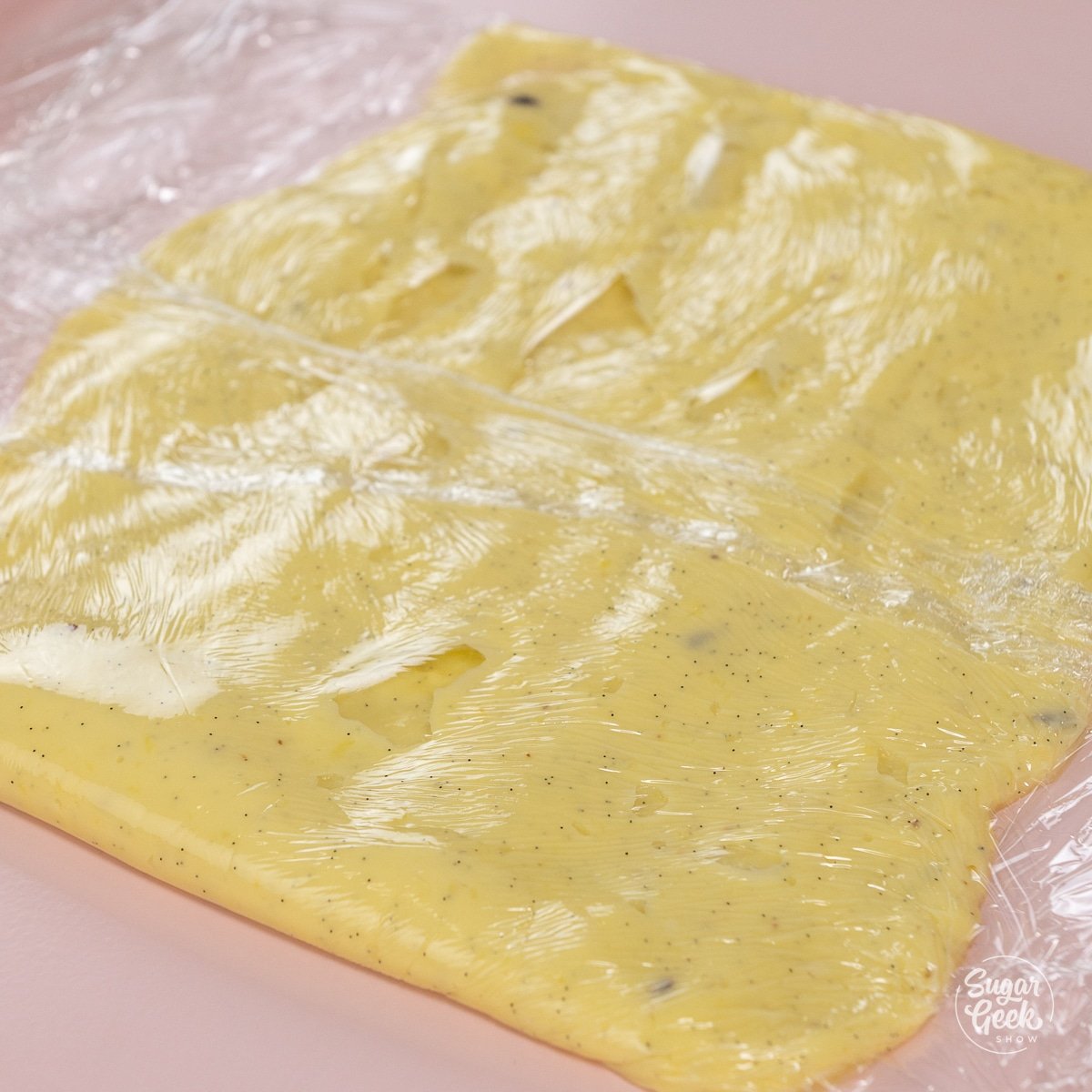
Cake flour is a low-protein flour that contains about 7-9% protein which causes less gluten development than your standard all-purpose flour. The more protein, the more gluten develops. The more gluten development, the chewier and firmer your final product will be. Cake flour has less protein and is used to make delicate cakes and baked goods that are soft, fluffy, and moist.
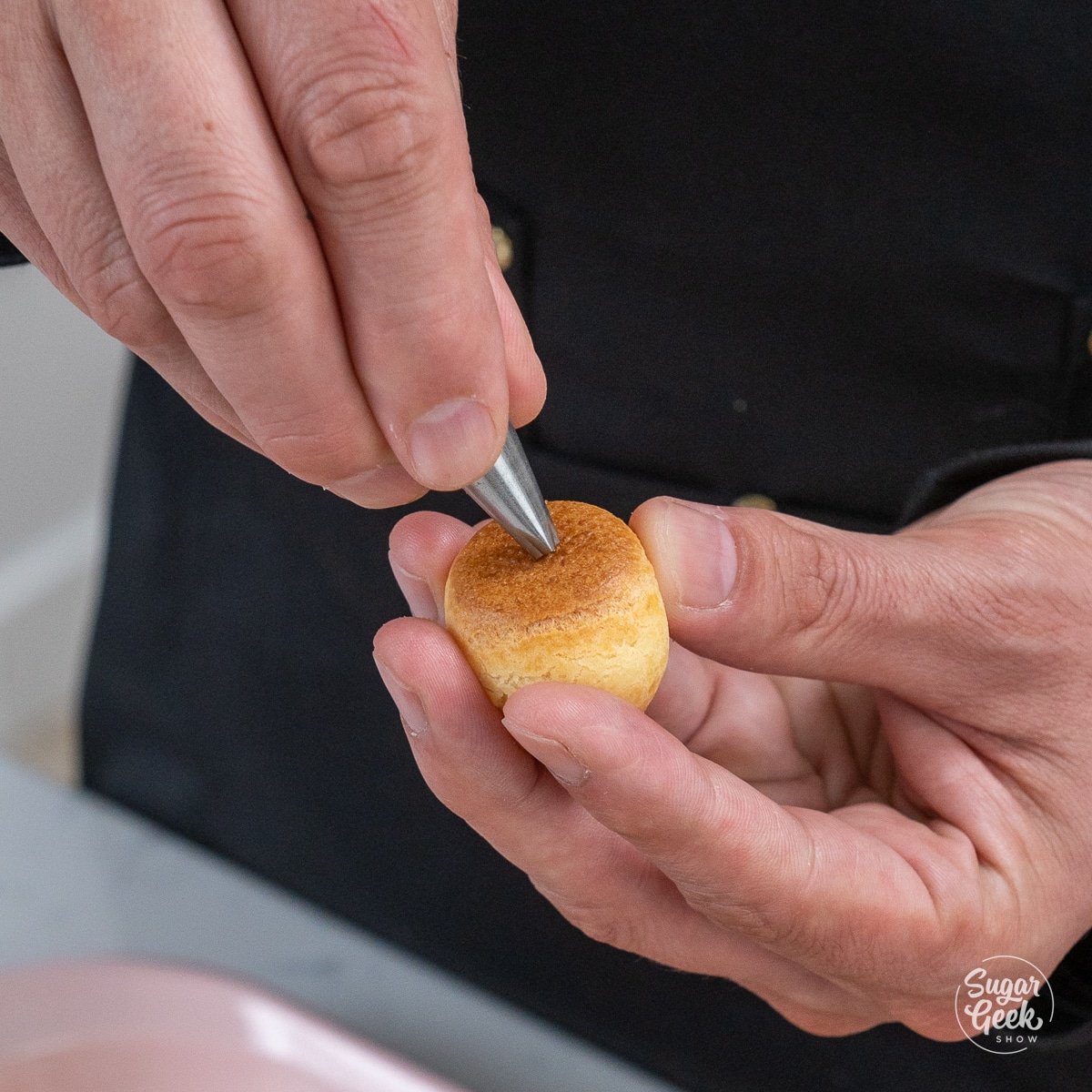
Protein is measured in percentage. Everything outside of the protein content is starch. Starch does not have any structure. If you've ever seen a video of how seitan (vegan chicken) is made, you can see them washing the dough to remove all the starch and all that is left is the protein structure.

Table of contents

  • What Is The Difference Between Different Flours?
    • Bread Flour: 12-15% protein
    • All Purpose Flour: 10-12% protein
    • Cake Flour: 6-8% protein
    • Pastry Flour: 8-10% protein
    • Whole Wheat Flour: 14% protein
  • Specialty Flours
  • How To Make An Easy Cake Flour Substitute
  • What Brands Of Cake Flour Are The Best?
  • No Cake Flour? No Problem... Cake Recipes That Don't Need Cake Flour

What Is The Difference Between Different Flours?

Most people are pretty familiar with AP flour (all-purpose flour) and may have never even thought to use a different kind of flour based on what they are baking. And the truth is, most things CAN be made with an all-purpose flour but if you really want to dial in your recipes to be the best they can be, maybe it's time you started looking at your flours in the grocery store aisle a little more closely.

Flour is often described as "hard wheat" or "soft wheat" depending on how much protein it contains. Bread and pizza flour is "hard" while pastry and cake flour is "soft".

Bread Flour: 12-15% protein

Used for making breads, pizza dough, laminated doughs and other baked goods that require a lot of gluten development to get that chewy texture.

All Purpose Flour: 10-12% protein

A general use flour that is used for some cakes, muffins, quick breads, carrot cake, and other baked goods that do not require a lot of mixing.

Cake Flour: 6-8% protein

Used for delicate baked goods like vanilla cake, angel food cake, white cakes, chocolate cake and other baked goods that need to have a soft texture.

Pastry Flour: 8-10% protein

Best to use for tender biscuits, muffins, cookies, pie crust, pastries, and other baked goods that need a tender crumb.

Whole Wheat Flour: 14% protein

Best used for whole wheat breads or baked goods that need more gluten development and fiber.

Specialty Flours

Almond Flour (or other nut flours): A finely milled flour made entirely of nuts. No gluten content whatsoever so recipes need to be adjusted with gums and leavening agent to recreate the same texture in baked goods.

Gluten-Free Flour: Typically created from a mixture of many types of flours including rice, potato starch, and gums (like xanthum gum). My favorite is Bobs Red Mill Gluten-Free Baking Mix which you can replace in any recipe 1:1.

Self-Rising Flour: Self rising flour can be all purpose flour or cake flour but with the addition of leavening agents like baking powder already added in. I don't recommend using this flour in your cake recipe unless it specifically calls for it.

Plain Flour: Usually similar to an all purpose flour. Check the protein content to see if it's a low protein flour or not.
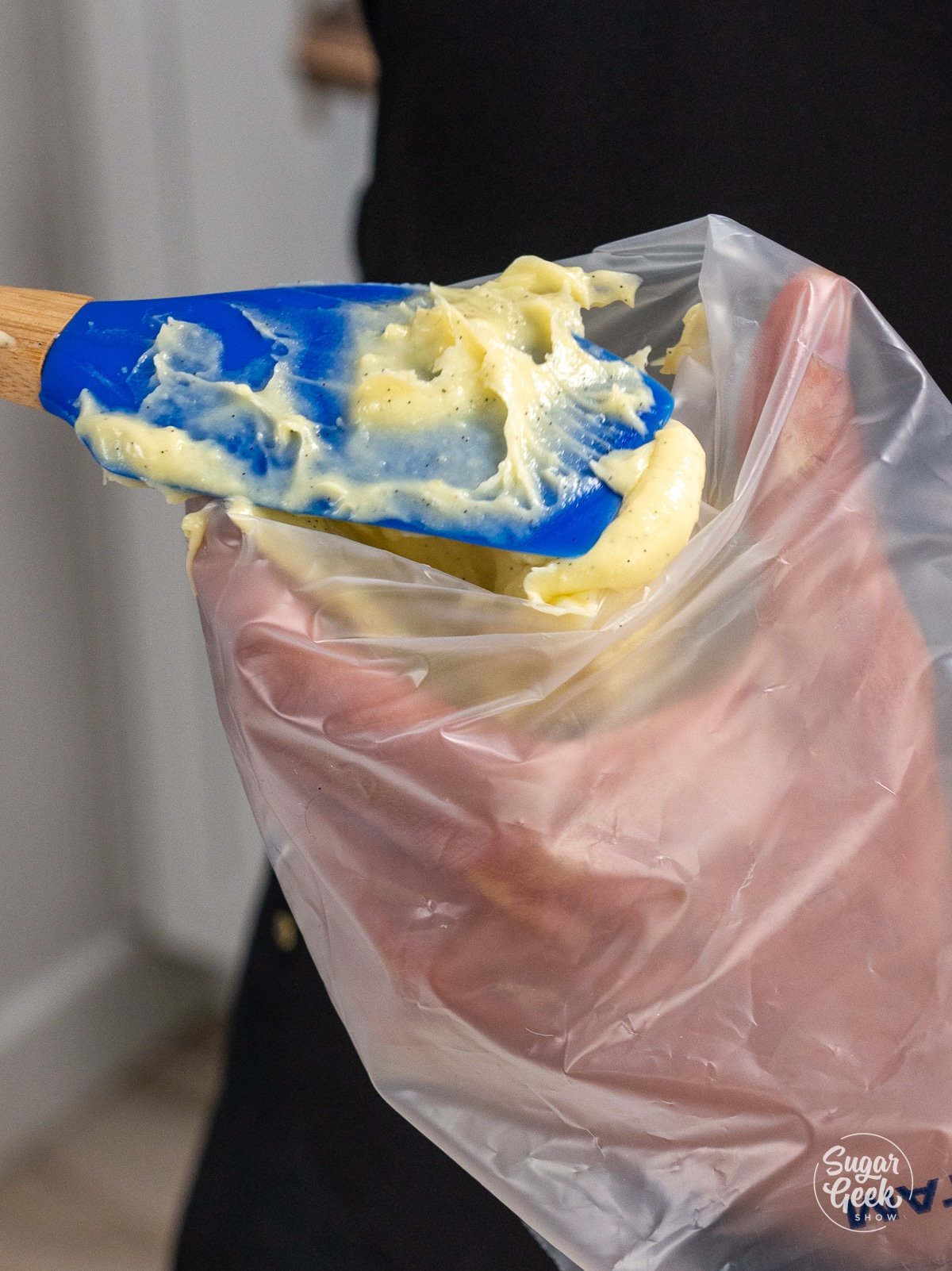
Rice Flour: Can be used in some baked good recipes but the texture is not exactly the same. It's best to use recipes that call for rice flour.
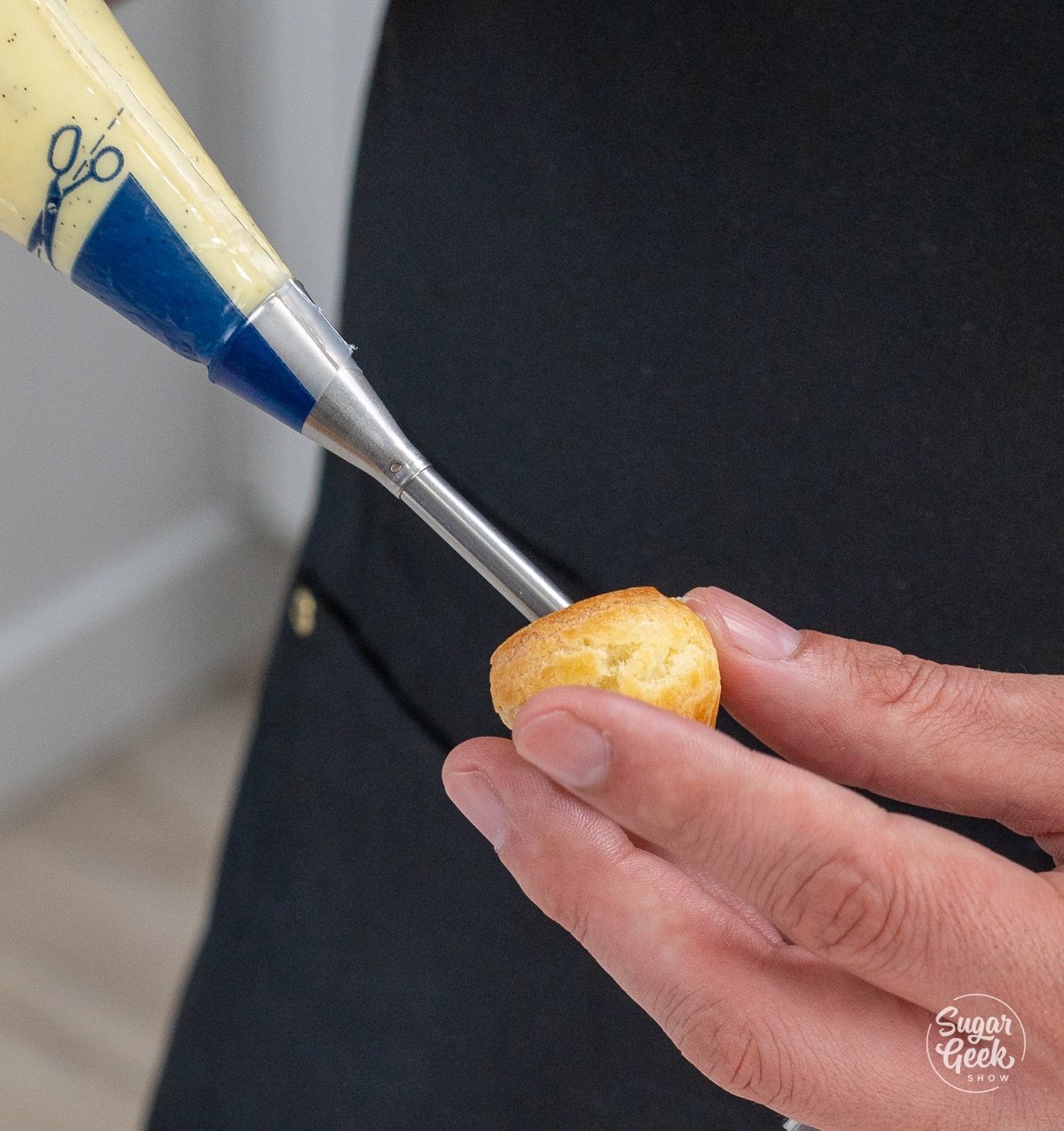
How To Make An Easy Cake Flour Substitute

Measure 1 cup of flour by weight (5 ounces) or by volume using a measuring cup (scoop the flour into the measuring cup with another cup then level off the top).
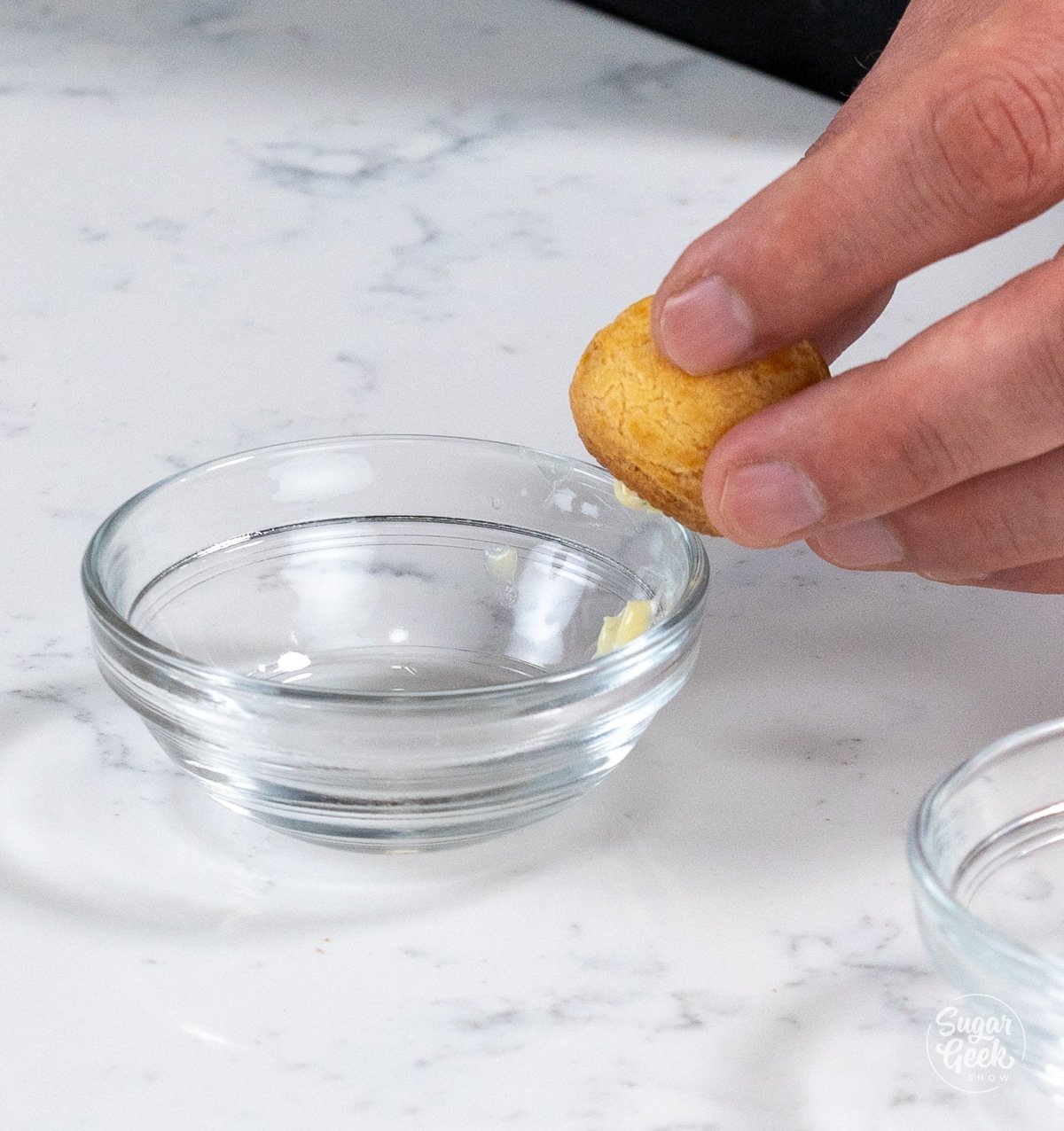
  1. Measure out one cup of all purpose flour (5 ounces) and place it into a sifter over the top of a medium bowl.
  2. Subtract two Tablespoons of the flour (.5 ounces).
  3. Add in two Tablespoons of cornstarch.
  4. Sift the two ingredients together twice to make sure the cornstarch is evenly distributed.

If you're making a large batch of cake flour substitute to have on hand, you can multiply 4.5 ounces as many times as you need and do the same with the cornstarch and do it all by scale instead of having to add and subtract things one Tablespoon at a time. Much easier!

What Brands Of Cake Flour Are The Best?

Depending on where you are located, you will have access to different types of cake flour. I like Swan or Softsilk which is available at most grocery stores and are a bit expensive but come in small amounts. Good for if you don't bake much.

If you're buying in bulk (which I highly recommend) you can get fifty pounds Queen High Ratio cake flour for about thirty bucks from US Foods Chef Store.

If you're in the UK then do a search for Shipton Mills Cake Flour. Not cheap but the real deal!

Most places actually do carry low protein content cake flour but you might have to do some searching or ask some local cake decorating supply stores where to buy it.

No Cake Flour? No Problem... Cake Recipes That Don't Need Cake Flour

White Cake Recipe
Easy Chocolate Cake Recipe
Red Velvet Cake Recipe
Easy Vanilla Cake Recipe
Angel Food Cake
Coconut Cake
Carrot Cake

Recipe

cake flour substitute ingredients
Print Recipe
4.63 from 8 votes

Cake Flour Substitute

The easiest way to make a cake flour substitute and you only need two ingredients plus a sifter.
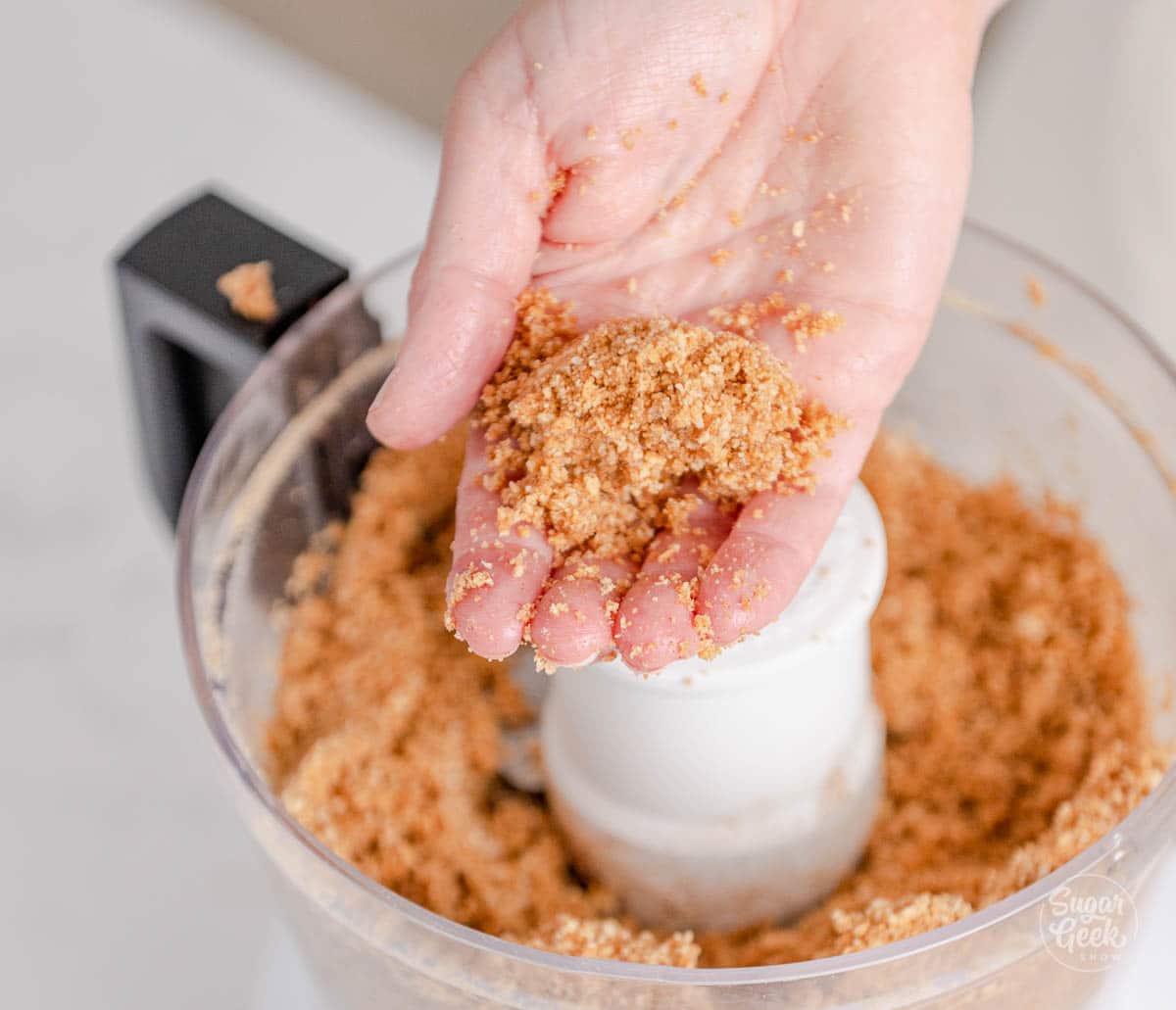
Prep Time5 minutes mins
Total Time5 minutes mins
Course: Dessert
Cuisine: American
Servings: 1 cup
Calories: 516kcal
Author: Liz Marek

Equipment

  • 1 Sifter

Ingredients

  • 1 cup all purpose flour
  • 2 Tablespoons cornstarch
US Customary - Metric

Instructions

  • Measure out your flour and place into a medium bowl
  • Remove two Tablespoons of the flour
  • Add in two Tablespoons of cornstarch
  • Sift the two ingredients together two times to distribute the cornstarch evenly

Video

Notes

You can also use arrowroot powder in place of cornstarch

Nutrition

Serving: 1cup | Calories: 516kcal | Carbohydrates: 110g | Protein: 13g | Fat: 1g | Saturated Fat: 0.2g | Polyunsaturated Fat: 1g | Monounsaturated Fat: 0.1g | Sodium: 4mg | Potassium: 134mg | Fiber: 4g | Sugar: 0.3g | Calcium: 19mg | Iron: 6mg
« Previous Page
Next Page »

Primary Sidebar

Hi, I'm Liz! I'm passionate about creating reliable, foolproof recipes that don't just tell you how to cook, but why things work - so you can skip the guesswork and confidently make the best sweet and savory dishes of your life.
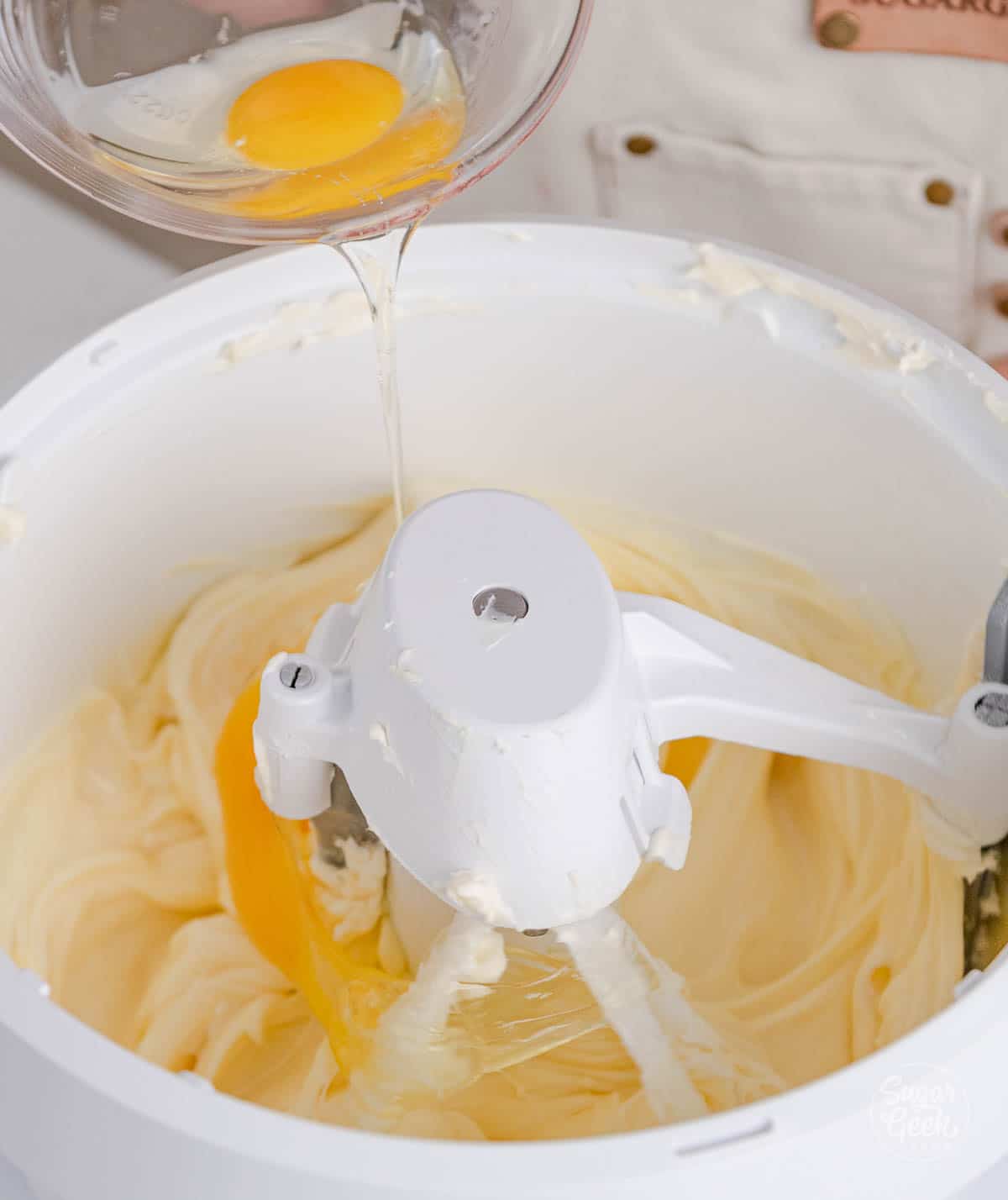
More about me →

Our Cake Greatest Hits

Check out our best cake recipes

👨‍🍼 Celebrate Father's Day

  • Close up of three crispy baked chicken thighs on a plate.
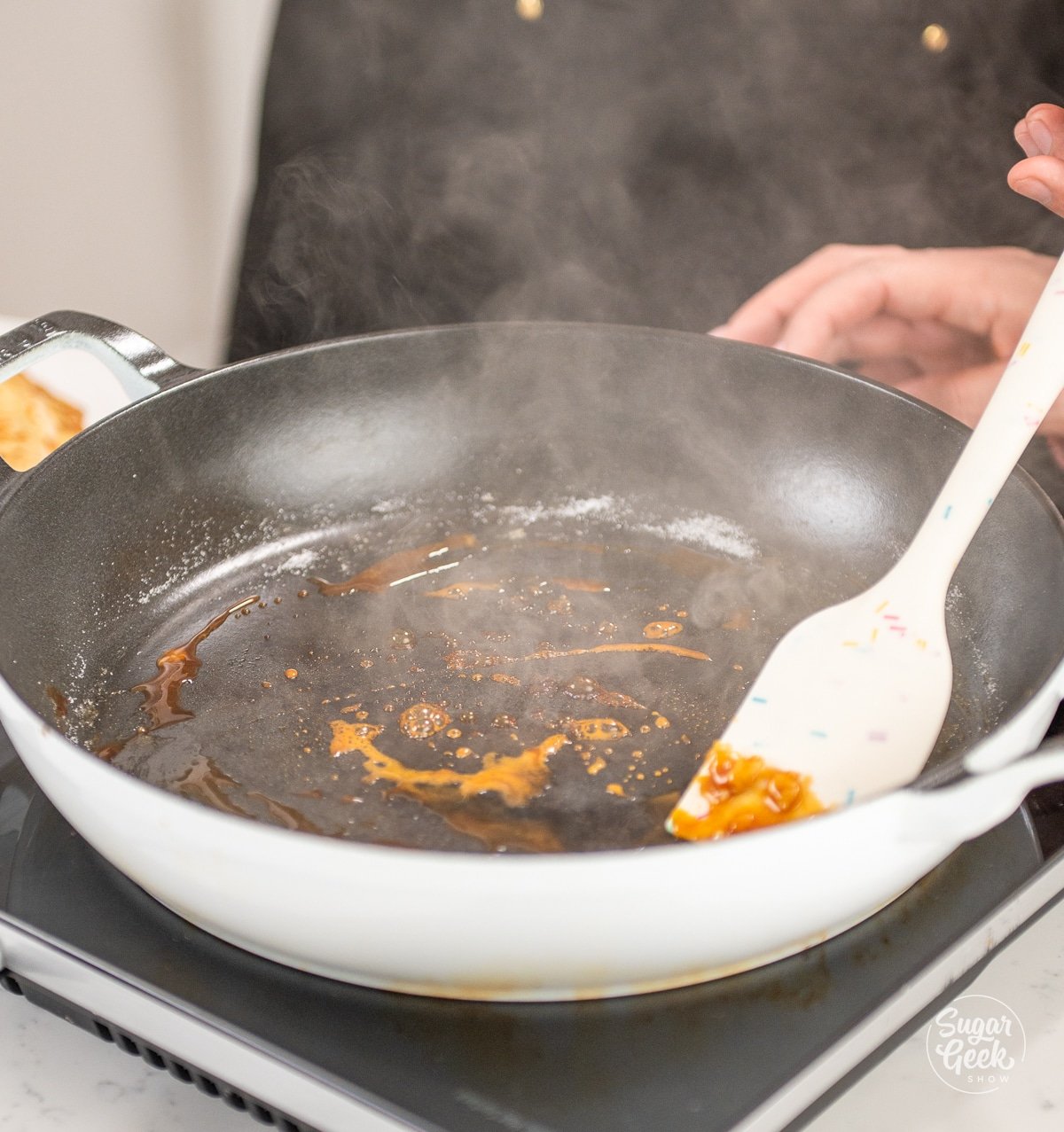
    Crispy Baked Chicken Thighs
    Cook Time50 Minutes
  • close up of a sliced ribeye steak
    How To Cook A Ribeye
    Cook Time24 Hours 14 Minutes
  • close up of creamy mac and cheese on a serving spoon
    Creamy Baked Mac And Cheese
    Cook Time35 Minutes
  • close up of a keto smash burger
    Smash Burgers Recipe
    Cook Time25 Minutes
  • Hawaiian Mac Salad
    Cook Time2 Hours 20 Minutes
  • Smoked Beef Tenderloin
    Cook Time2 Hours 55 Minutes

Popular Recipes

  • close up of ganache drizzling into a bowl
    The Best Chocolate Ganache Recipe
    Cook Time20 Minutes
  • Piping easy buttercream rosettes onto a cake using a 1M star piping tip
    Easy Buttercream Frosting
    Cook Time25 Minutes
  • close up slice of marble cake
    Moist and Fluffy Marble Cake Recipe
    Cook Time40 Minutes
  • Slice of red velvet cake with cream cheese frosting on a white plate.
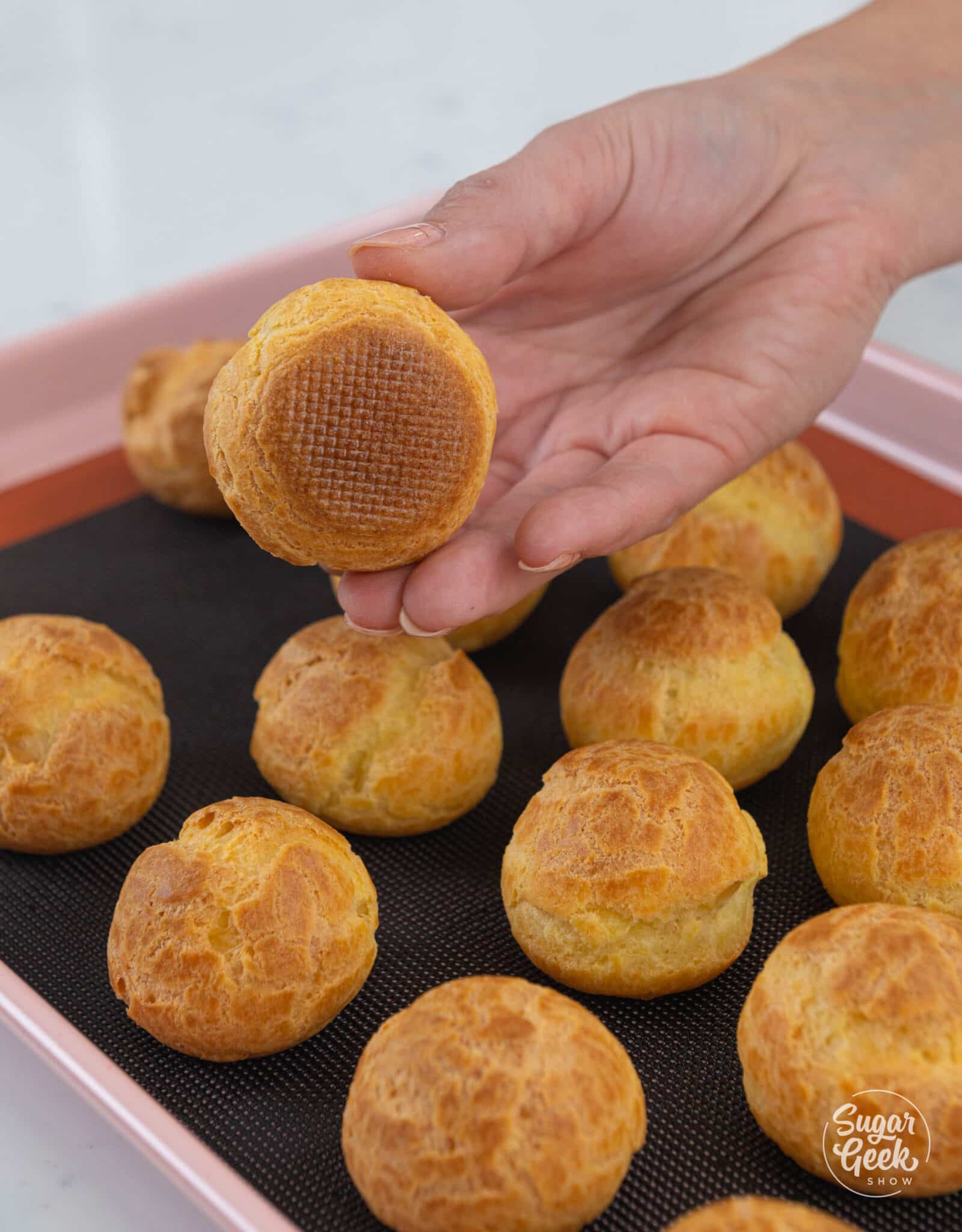
    Red Velvet Cake Recipe
    Cook Time1 Hours 40 Minutes

Footer

↑ back to top

About

  • Privacy Policy
  • Terms of Service

Newsletter

  • Sign Up! for emails and updates

Contact

  • Contact
  • About Us

Copyright © 2024 Sugar Geek Show, Inc. All Rights Reserved.
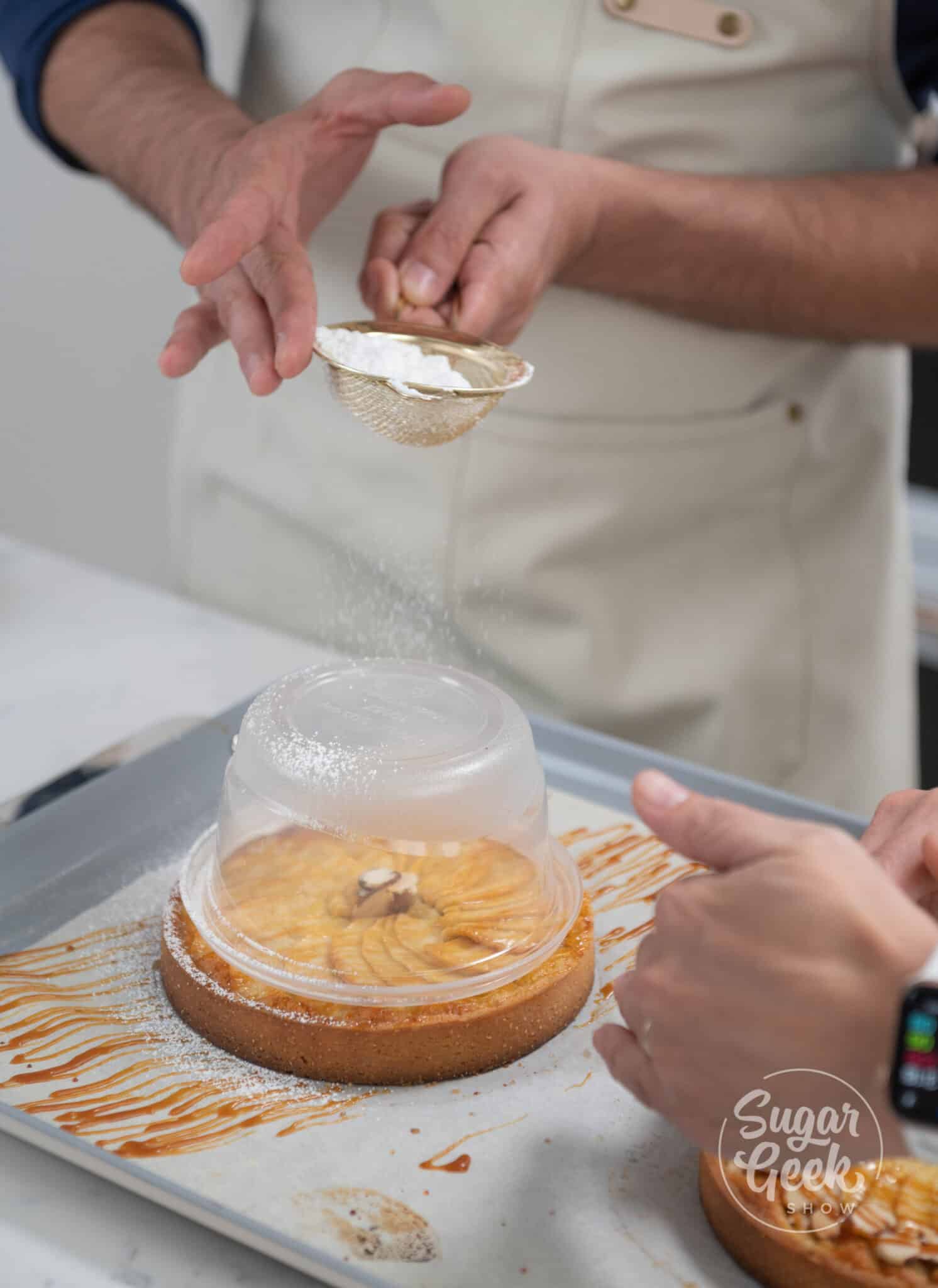
Rate This Recipe

Your vote:


A rating is required
A name is required
An email is required