
• Skip to primary navigation
  • Skip to main content
  • Skip to primary sidebar
  • Father's Day
  • Recipes
  • Free Tutorials
  • Sign Up
  • About Liz

Sugar Geek Show logo

menu icon
go to homepage
  • Father's Day
  • Recipes
  • Free Tutorials
  • Sign Up
  • About Liz
subscribe
search icon
Homepage link
  • Father's Day
  • Recipes
  • Free Tutorials
  • Sign Up
  • About Liz
×
Home

Blog

Cake sculpted to look like a volcano

March 1, 2023 Paid Video

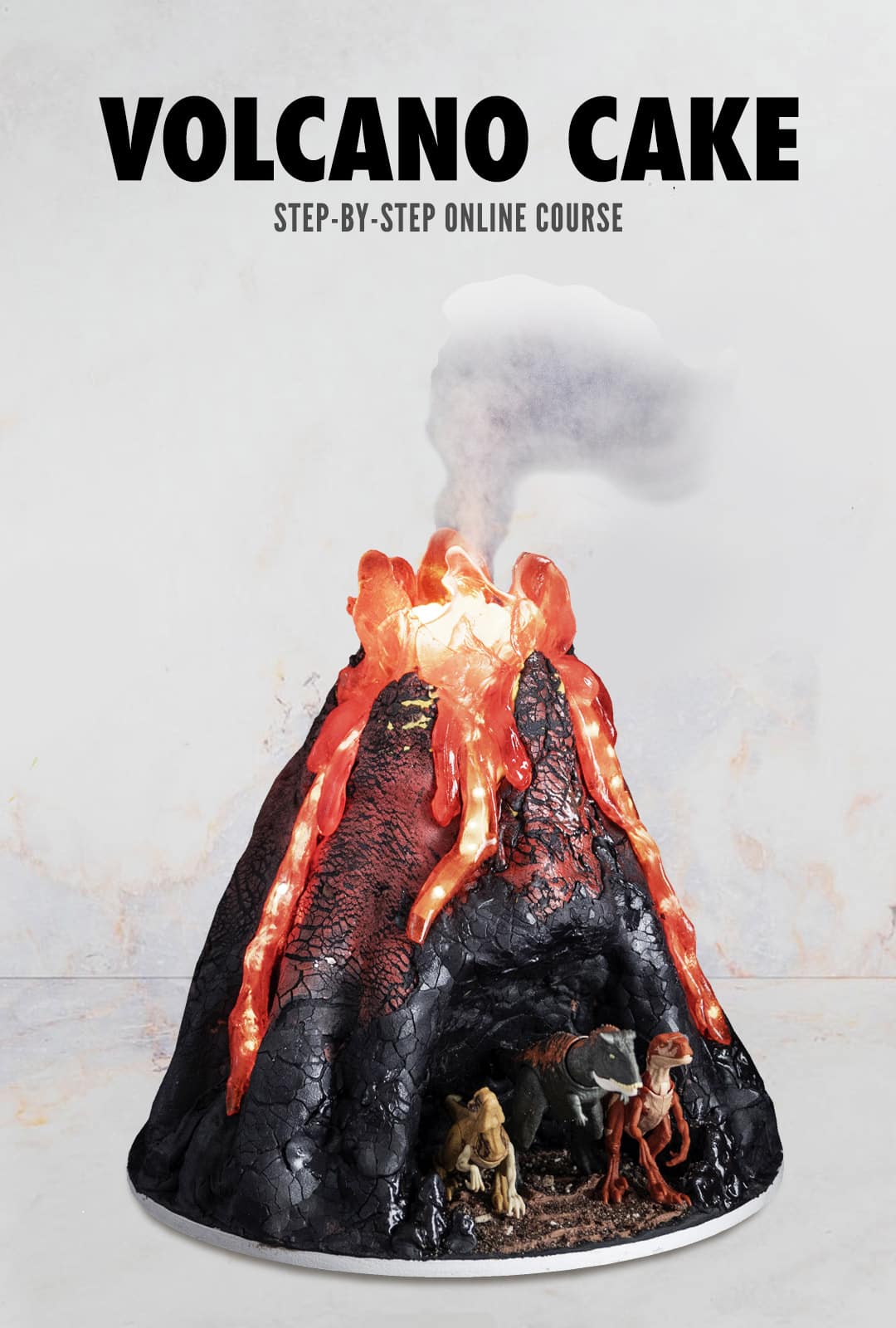
Volcano Cake

Skill level: Intermediate

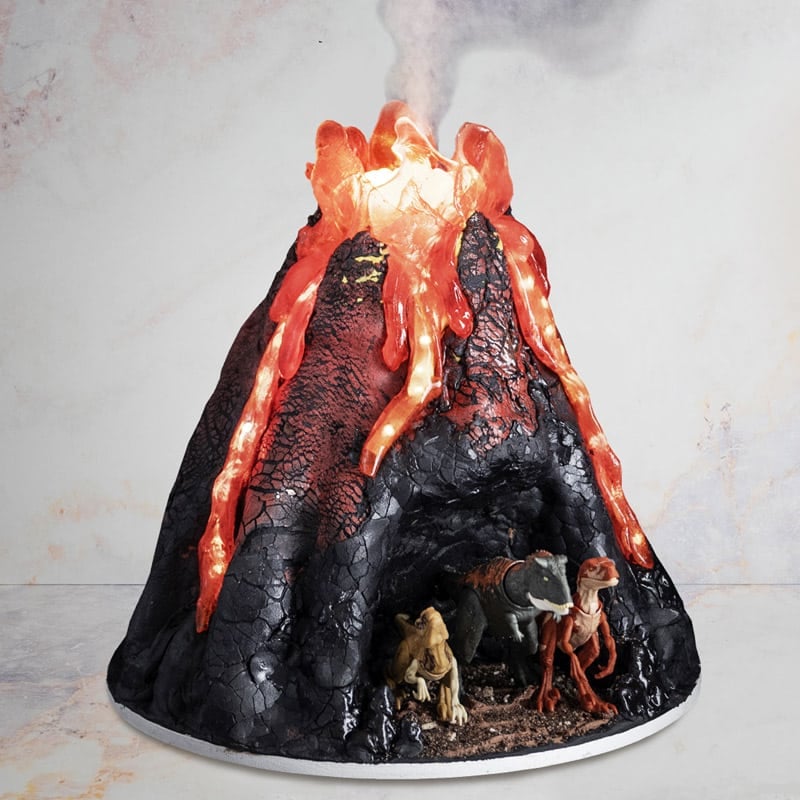
In this tutorial, you will learn how to create a realistic sculpted volcano cake, complete with special effects and a real smoke-like effect!

You will learn how to sculpt and create a realistic looking volcano mountain, how to create the glowing lava effect, how to work with isomalt and incorporate in LED lights, a realistic smoke-like effect and how to carve out the dinosaur cave.

40:43 Minutes of Instruction

What You Will Learn

  • How to create a realistic volcano cake
  • Learn how to work with isomalt and LED lights to create flowing lava
  • How to create a realistic smoke-like effect

Tutorial Chapters

  1. Stacking The Cakes 0:24
  2. Carving The Cakes 4:43
  3. Crumb Coating And Sculpting 7:26
  4. Setting Up The Lights 14:19
  5. Covering The Cake In Chocolate 25:38
  6. Paneling The Cake 27:26
  7. Adding The Isomalt Lava 32:36
  8. Adding The Final Details 38:55

Downloads

Materials List

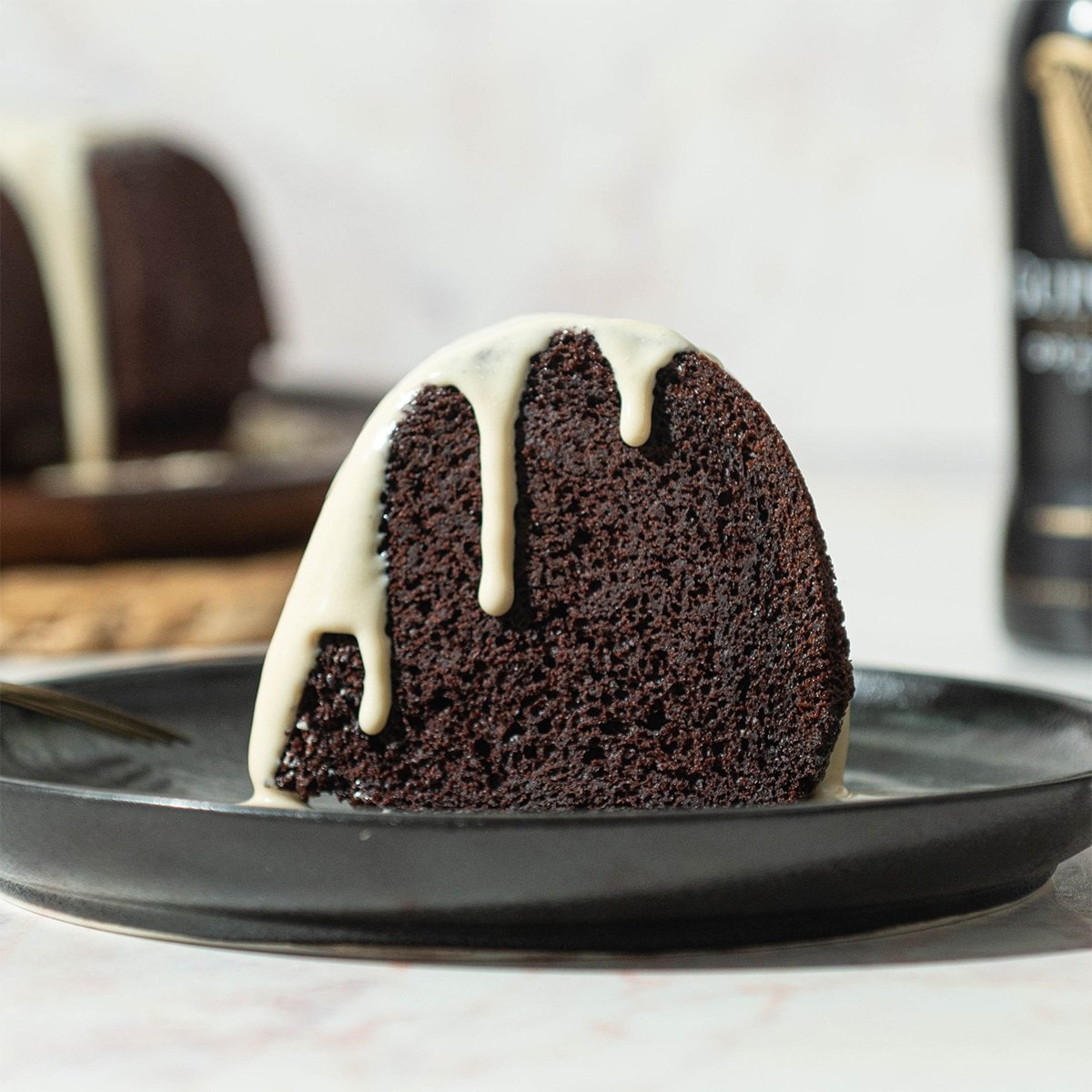
slice of chocolate cake with white frosting and caramel drip on a dark plate

February 24, 2023 Cake

Irish Cream Cake

Chocolate Irish cream cake starts with a dark, rich chocolate cake and while it's still warm, soaked with decadent Irish cream sauce, then frosted with Bailey's Irish Cream and whiskey white chocolate ganache and some homemade caramel sauce. This is a great recipe for St. Patrick's Day!slice chocolate cake with white frosting and caramel drip on a dark plate

Similar to my chocolate Guinness cake recipe, Dark Guinness beer and Irish cream liqueur combined with chocolate bring together a dark decadent dessert worthy of celebrating even if you aren't Irish!

This recipe is more involved than many of my easy cake recipes. It has a lot of ingredients and steps, but its results are worth the time and effort. This chocolate cake recipe is an elevated cake, with more complex flavors and will impress everyone who is lucky enough to get a slice! 

Table of contents

  • Irish Cream Cake Ingredients
  • How to Make Irish Cream Cake
    • Making Death by Chocolate Cake
    • Making the Bailey's Irish Cream Sauce
    • Soaking the Cake Layers with Irish Cream Sauce
    • Making the White Chocolate Ganache
    • Assembling the Irish Cream Cake
  • FAQ
  • More Yummy Recipes for St. Patrick's Day

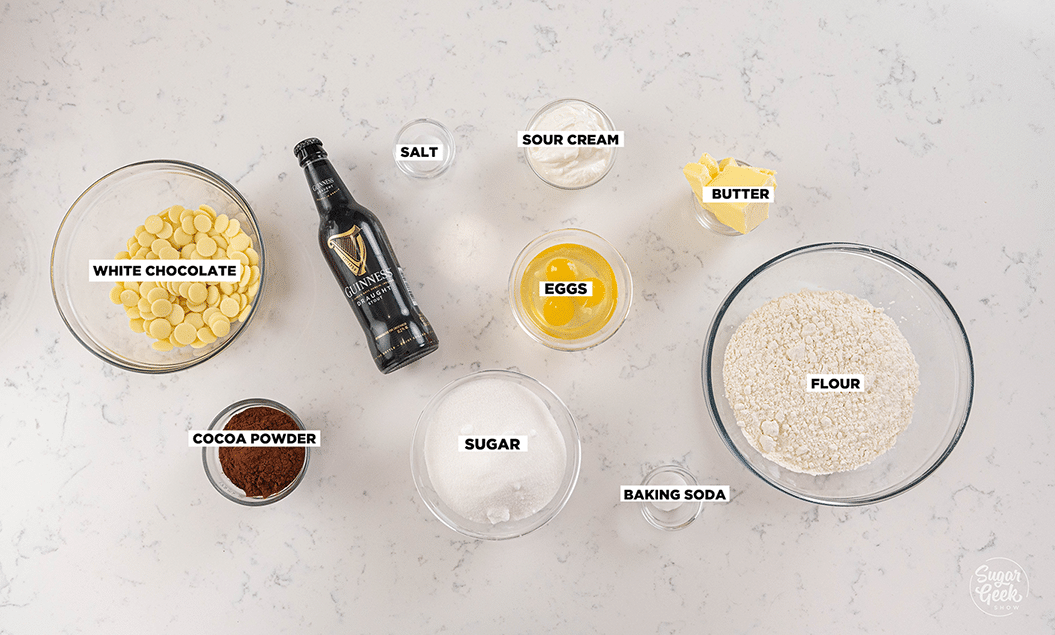
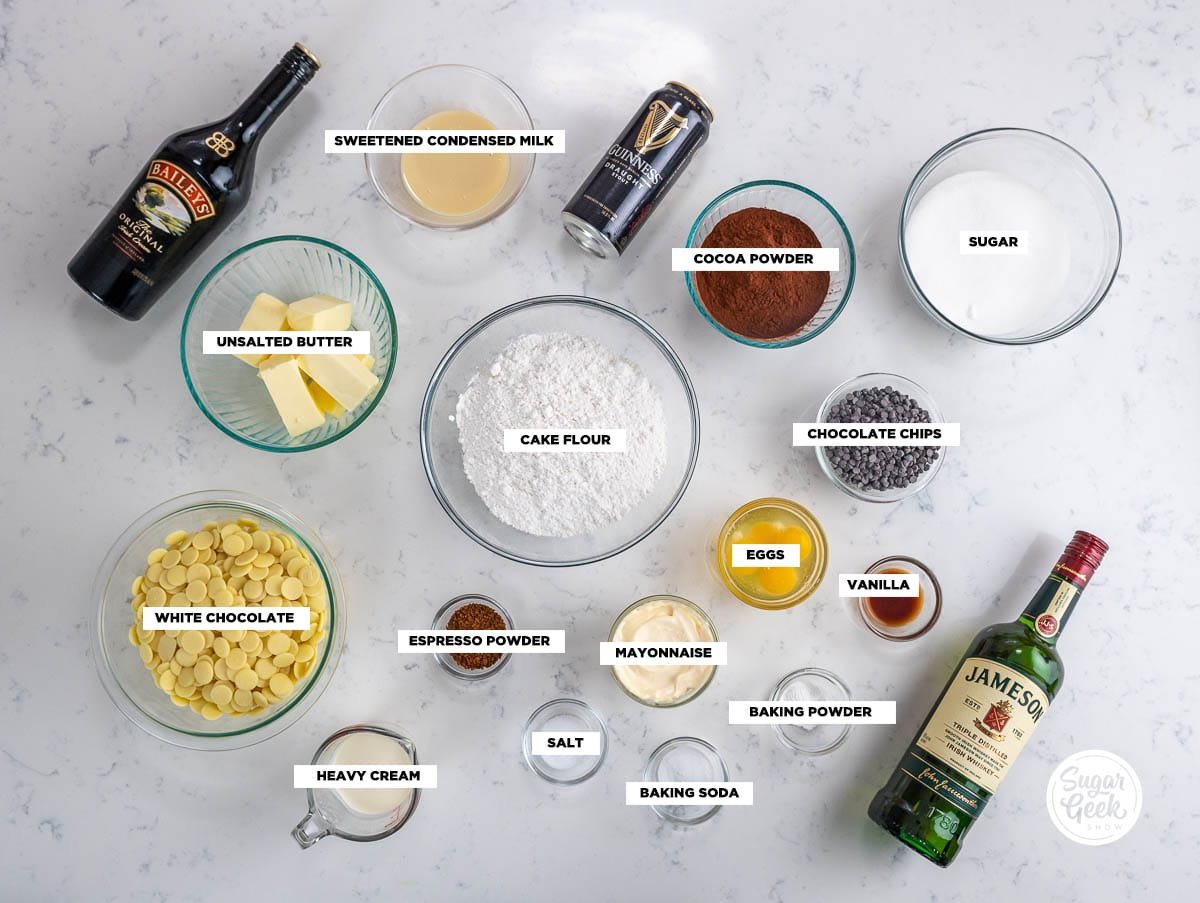
Irish Cream Cake Ingredientsbowls of ingredients for irish cream cake laid out on a table

Guinness is an Irish dry stout that originated in an Irish brewery. It has a dark chocolatey flavor and is slightly bitter. Like coffee, the flavor of this beer adds a rich flavor to chocolate cake, and the alcohol content tenderizes the gluten as well as helps retain moisture in the cake.

Irish Cream is a liqueur made from Irish whiskey, heavy cream, sugar, and a hint of cocoa. It is very sweet, so it lends itself well as a flavoring to other drinks and desserts. I love using it to flavor my frostings and fillings.

Mayonnaise sounds like a strange ingredient for a cake, however, it adds a lot of flavor and moisture. Mayonnaise is an emulsion of eggs, canola oil, salt, and acid, so many ingredients are already included in cake recipes.

How to Make Irish Cream Cake

There are 4 components to this decadent chocolate Irish cream cake, the death by chocolate cake, Irish cream sauce, Bailey's white chocolate ganache, and caramel sauce. It is possible to make this cake in one day, but I recommend making all of the components the day before, and assembling them on the day you're ready to serve. The ganache will take about 4 hours to set up, and the sauce will need to soak in the cakes for 2 hours.

Making Death by Chocolate Cake

  1. NOTE: It is SUPER IMPORTANT that all the wet ingredients listed are room temperature and not cold so that the ingredients mix and incorporate correctly. 
  2. Preheat your oven to 350ºF/177º C.
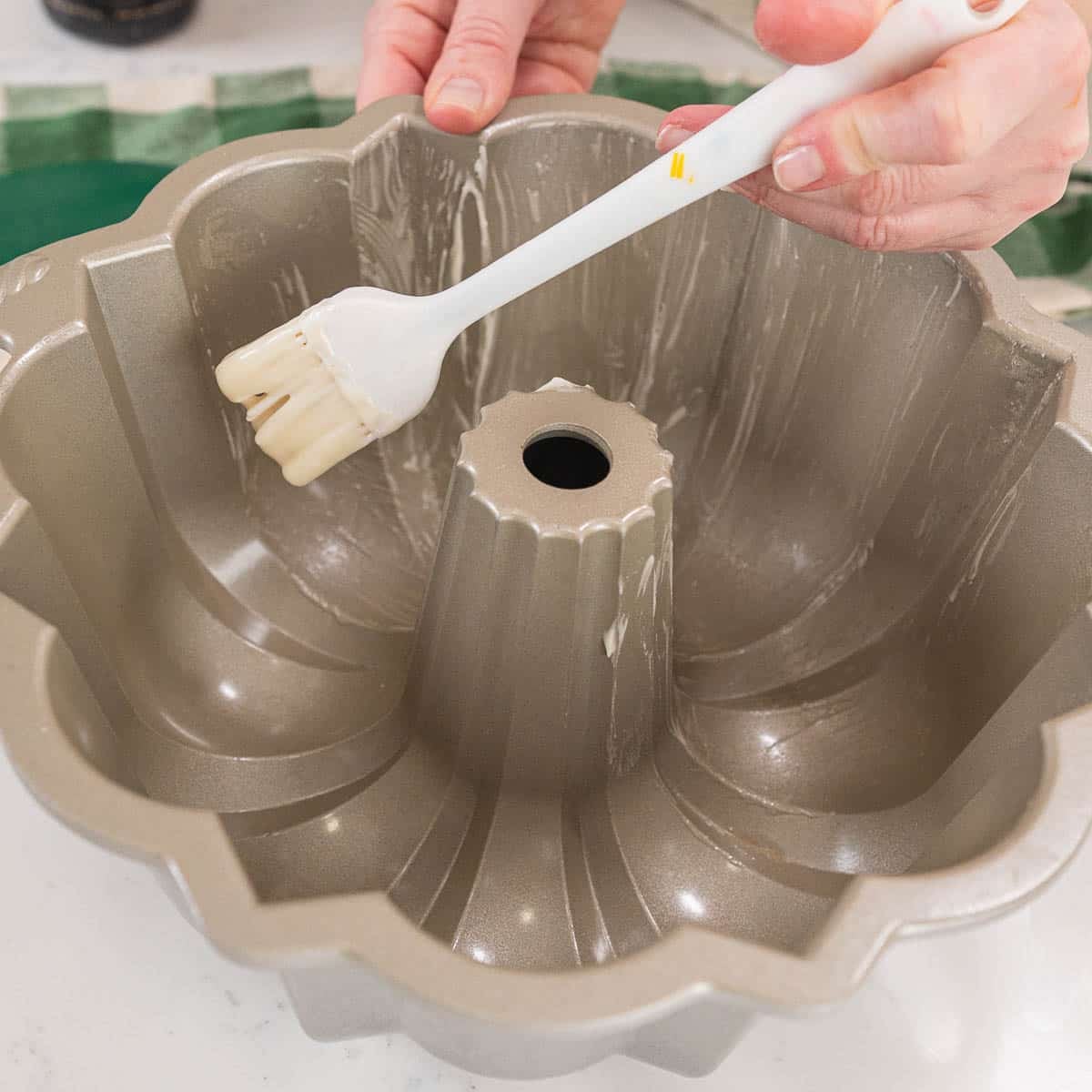
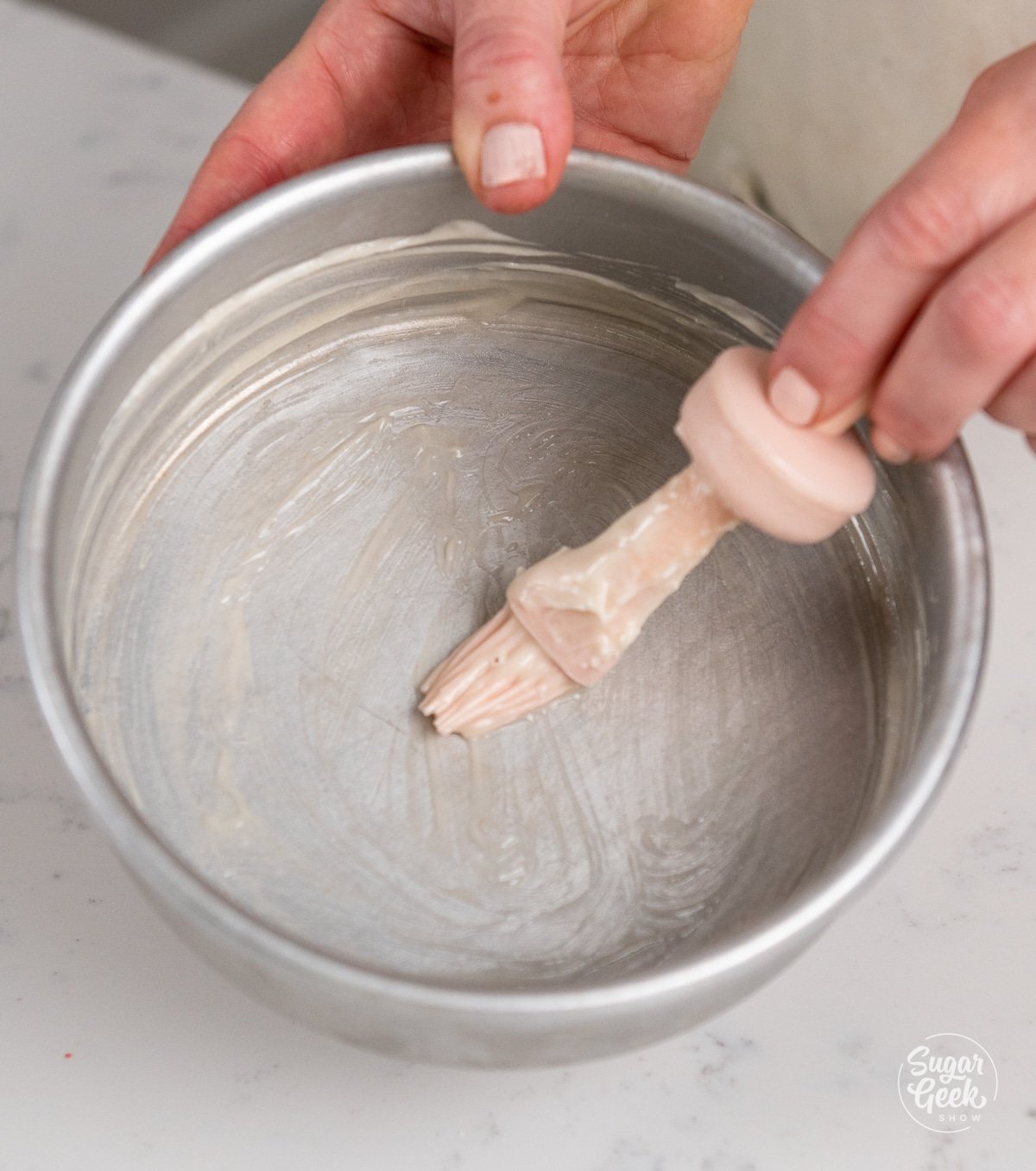
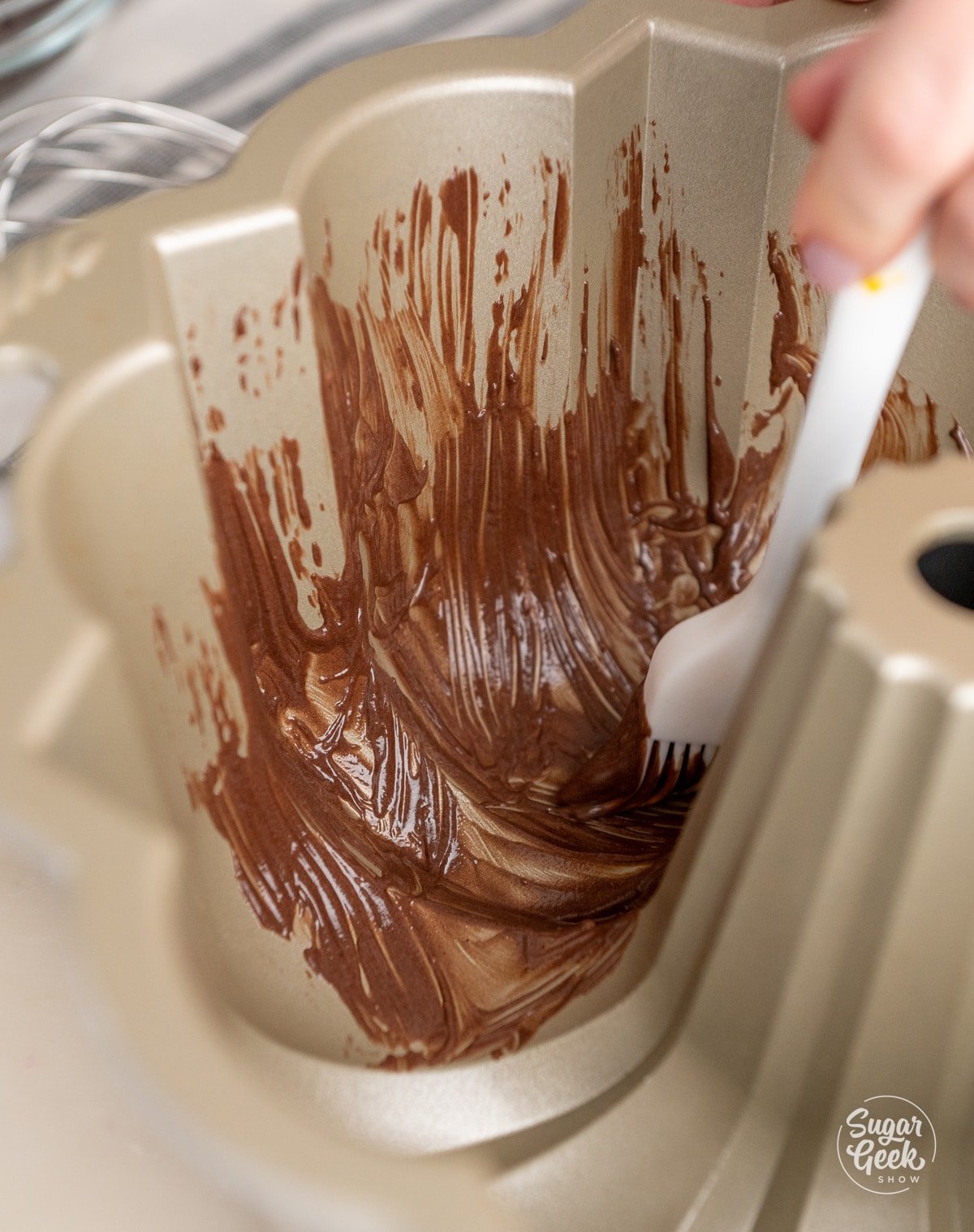
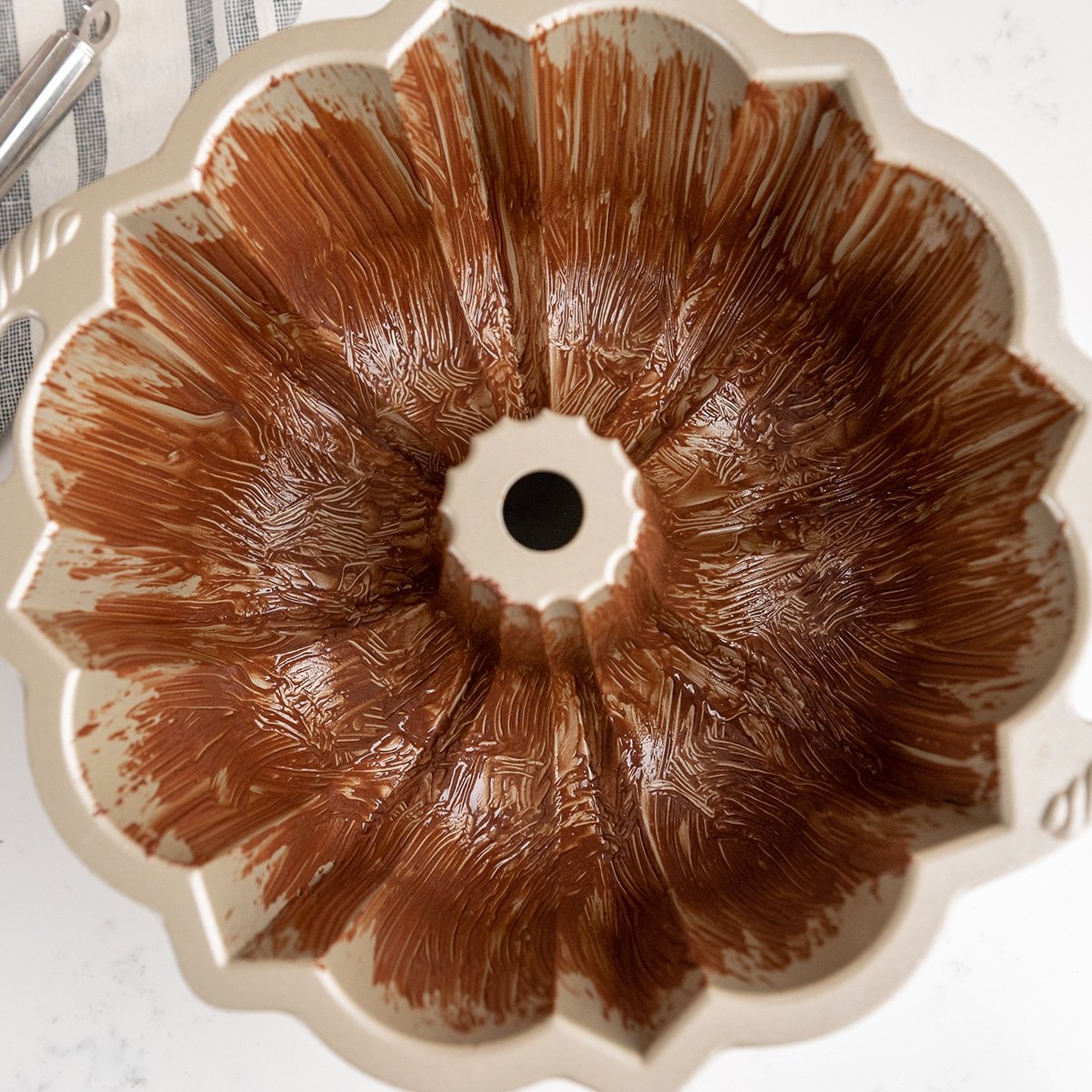
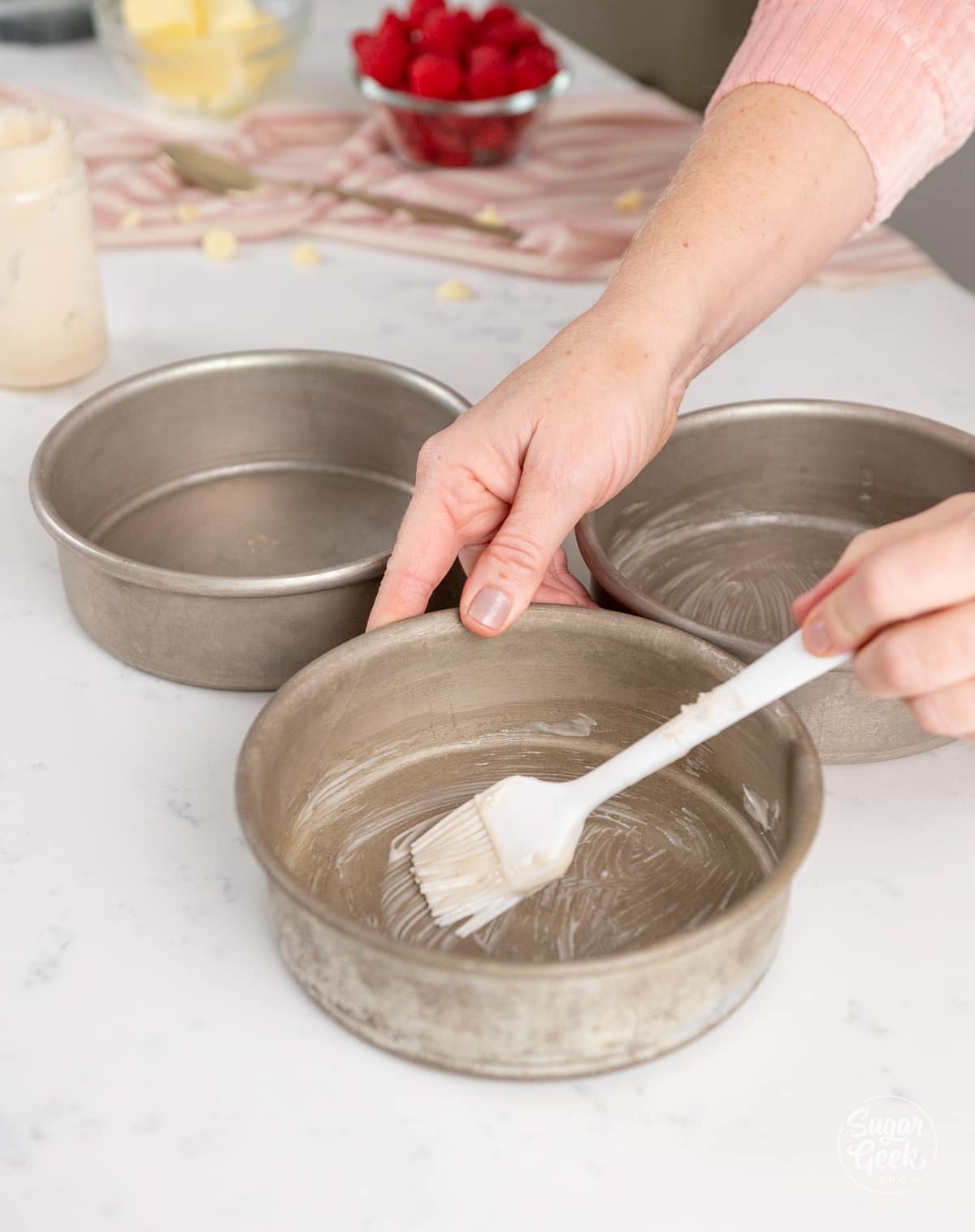
  3. Prepare three 8-inch cake pans with cake goop, parchment paper, or preferred pan release spray.
    hands brushing cake goop into a cake pan with a pastry brush.
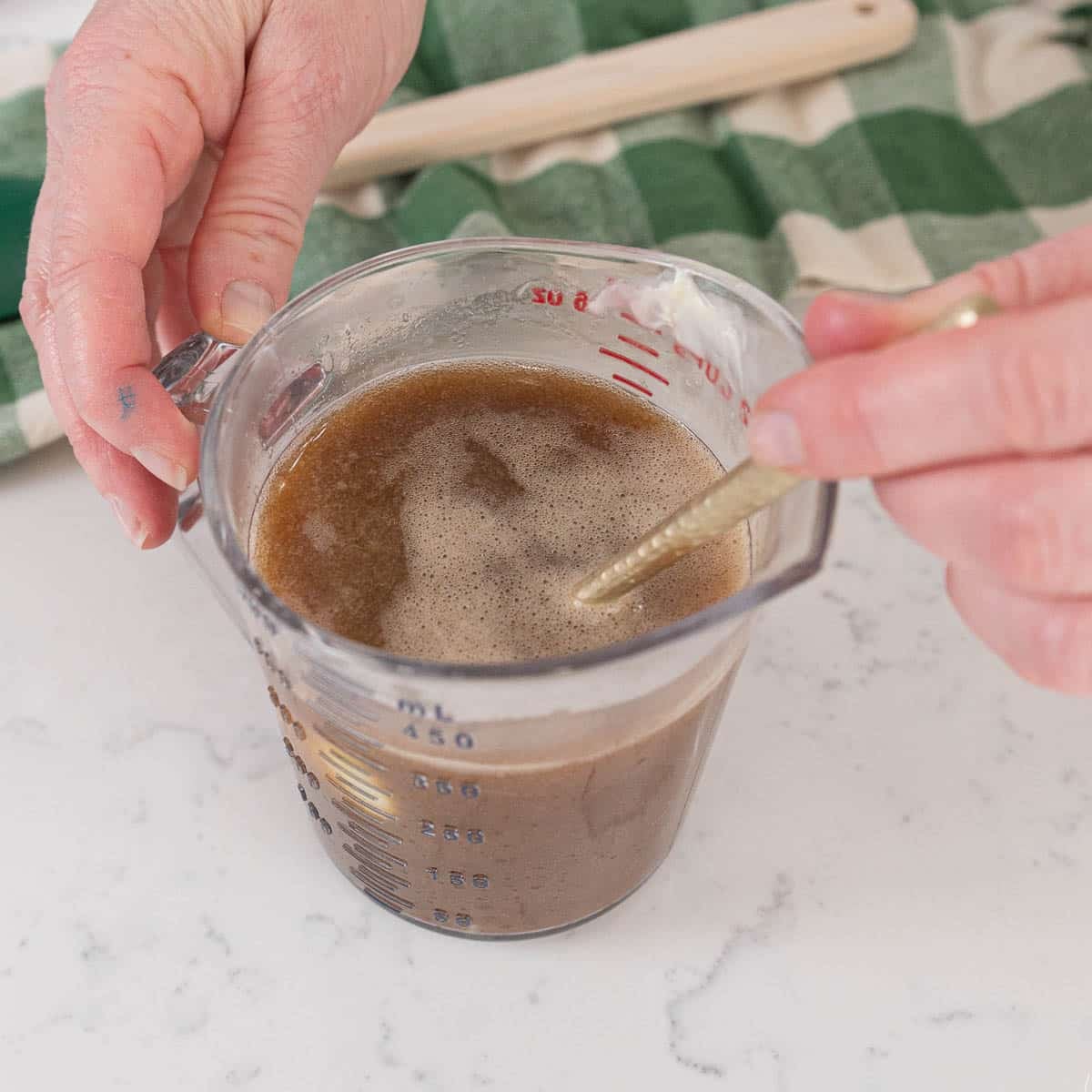
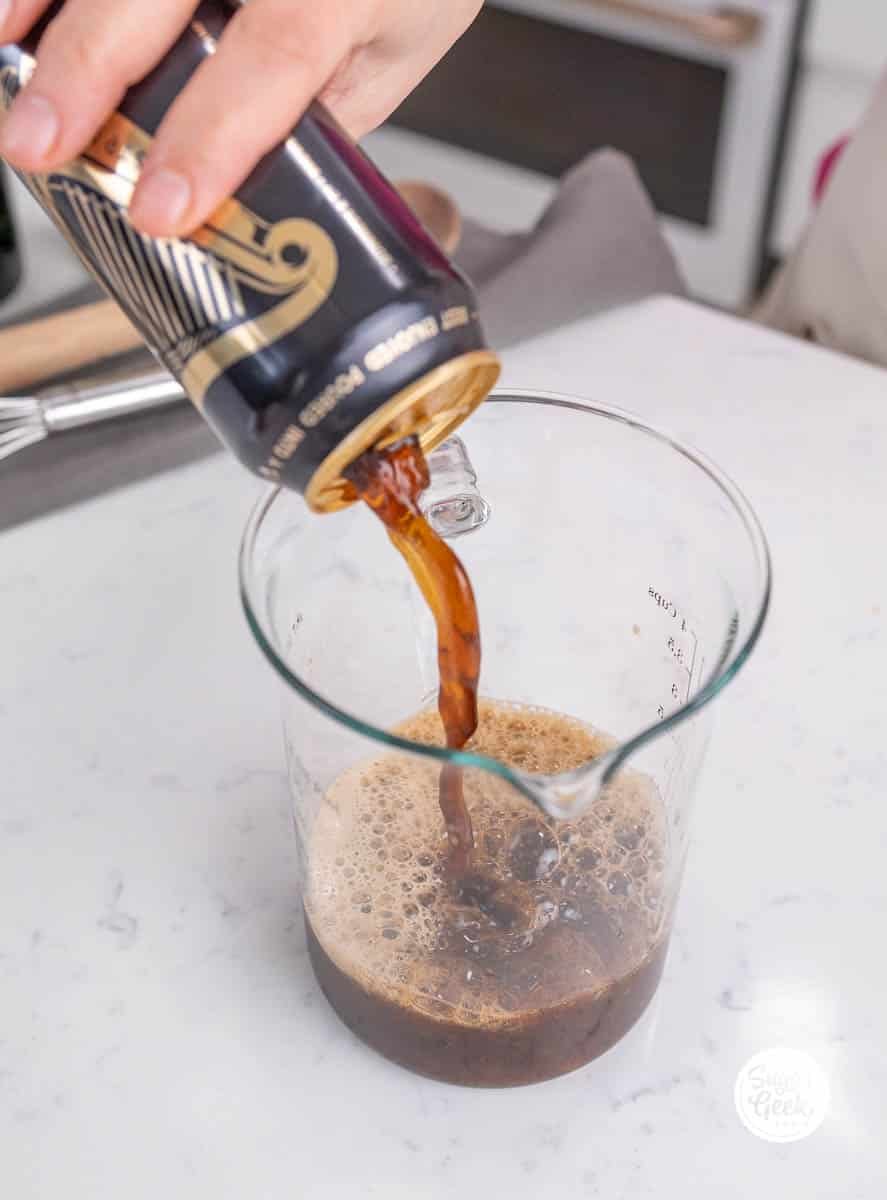
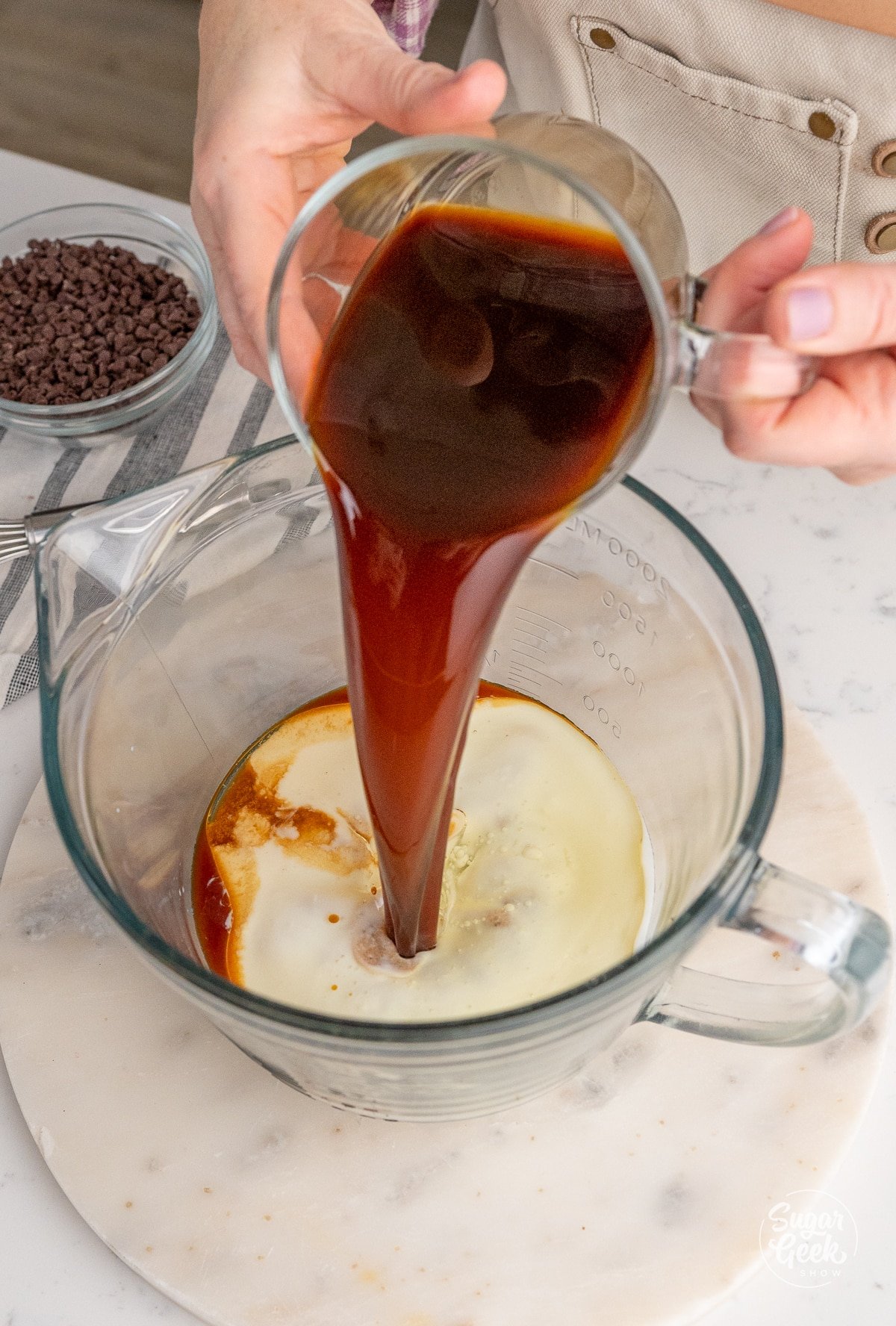
  4. Whisk together the Guinness, espresso powder, and vanilla in a measuring cup and set it aside.
    hand pouring Guinness into a measuring cup
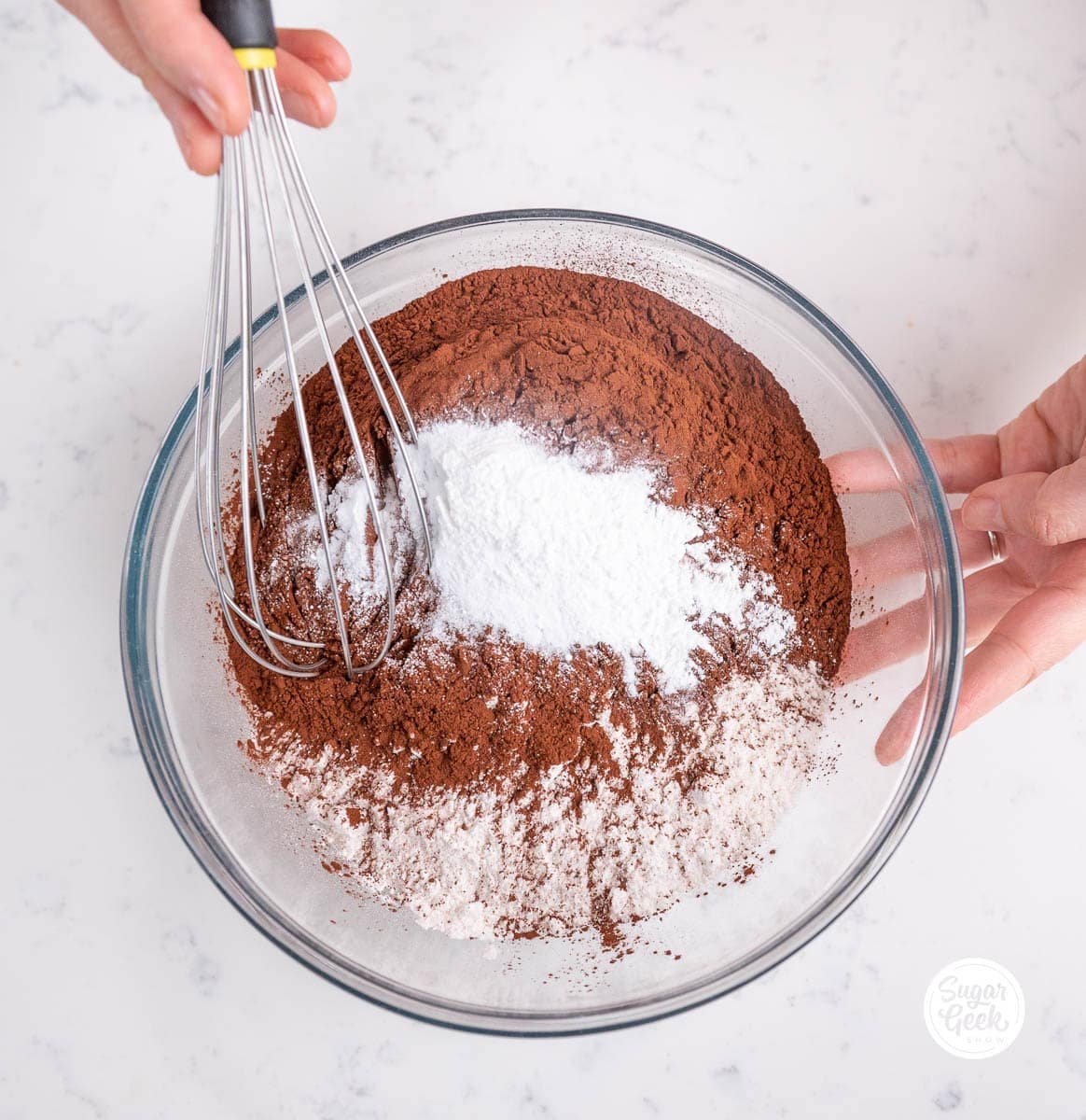
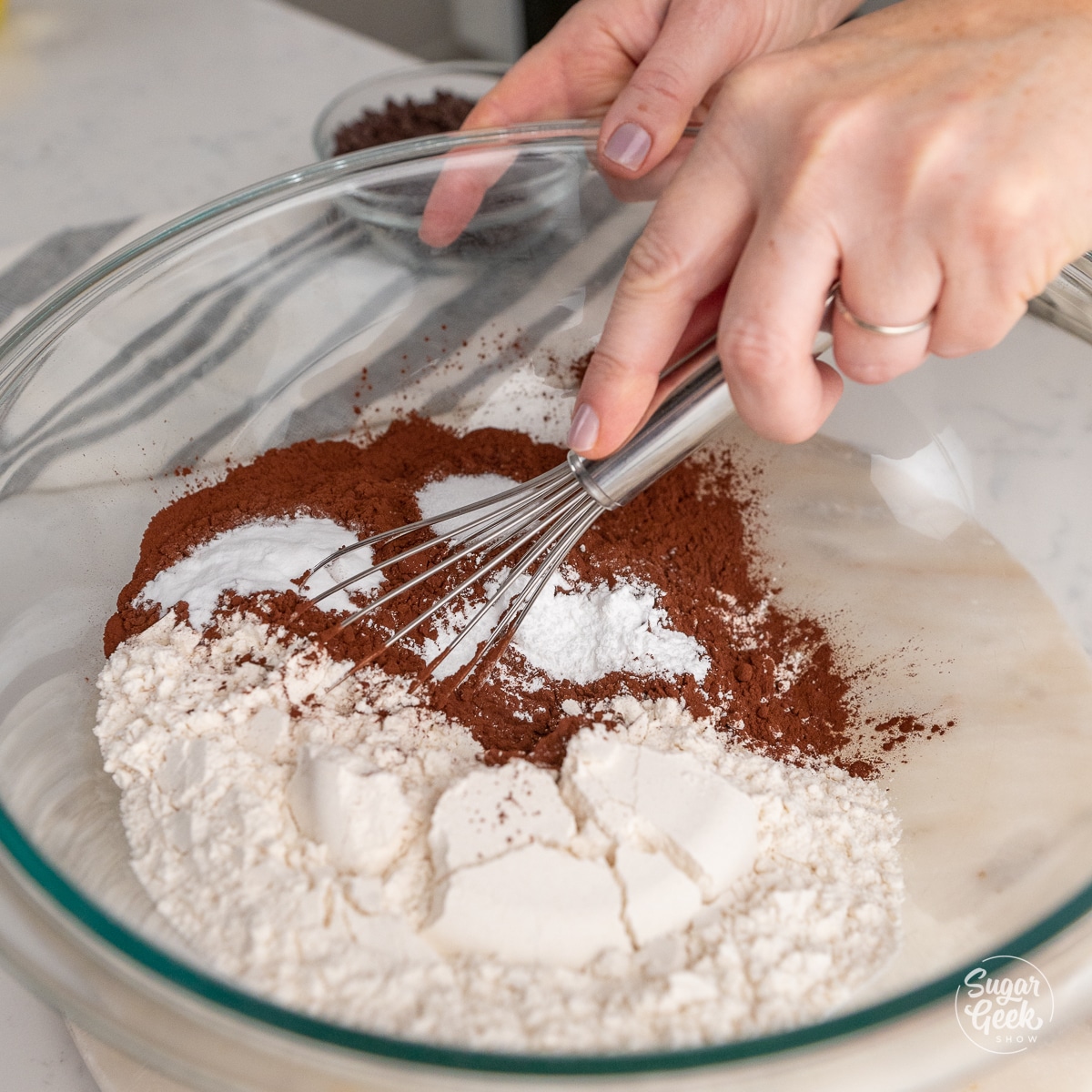
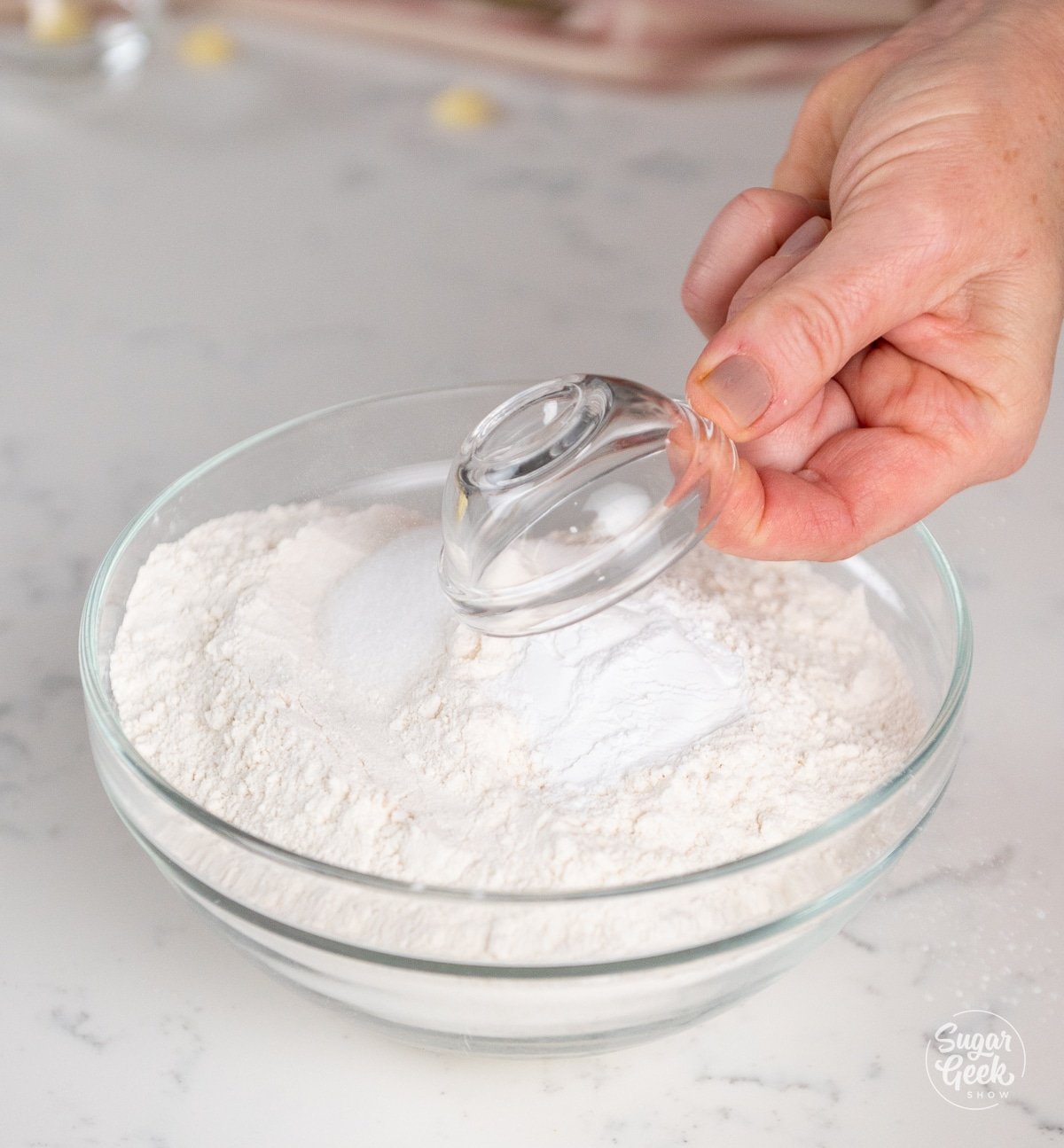
  5. Sift together the cake flour, cocoa powder, salt, baking powder, and baking soda in a large bowl and set it aside. 
    hands whisking a bowl of chocolate cake ingredients
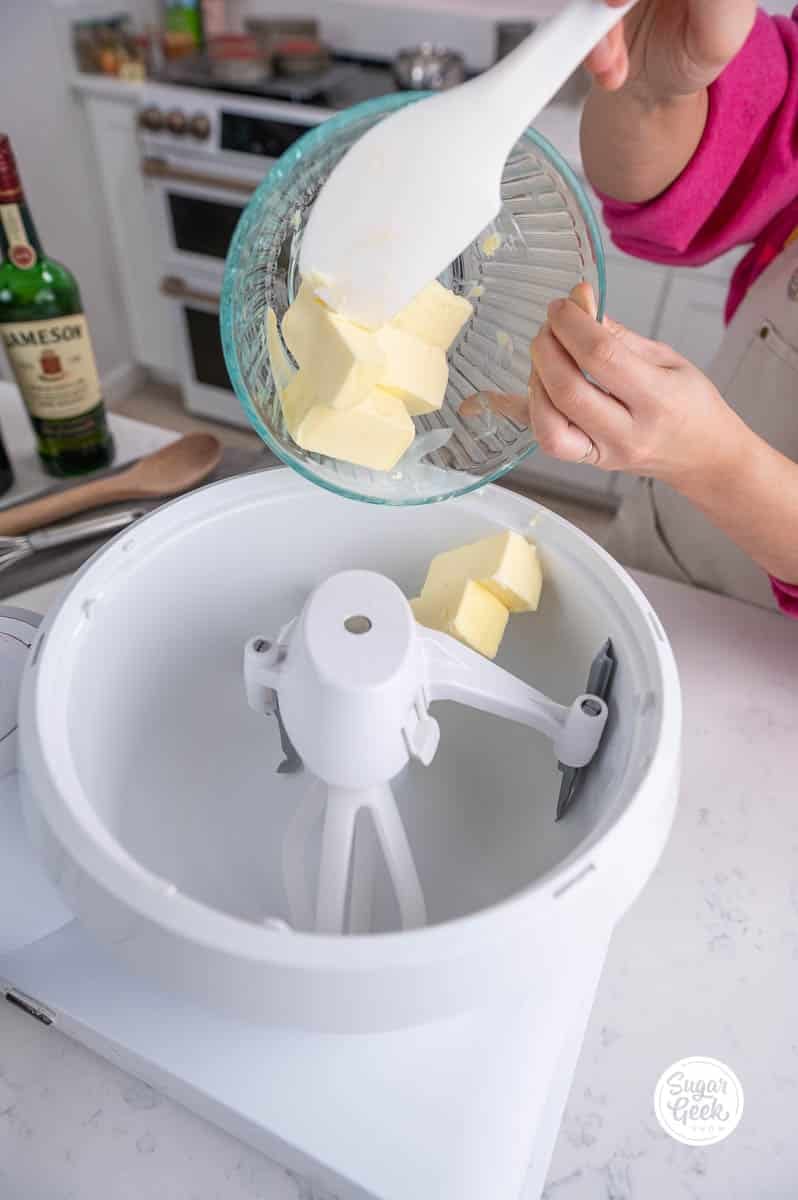
  6. Place the softened butter in the bowl of a stand mixer with the paddle attachment. Cream the butter on medium speed until it's smooth and shiny. I'm using a stand mixer but you can definitely use an electric mixer if that is what you have.
    hand adding a bowl of butter into a stand mixer bowl
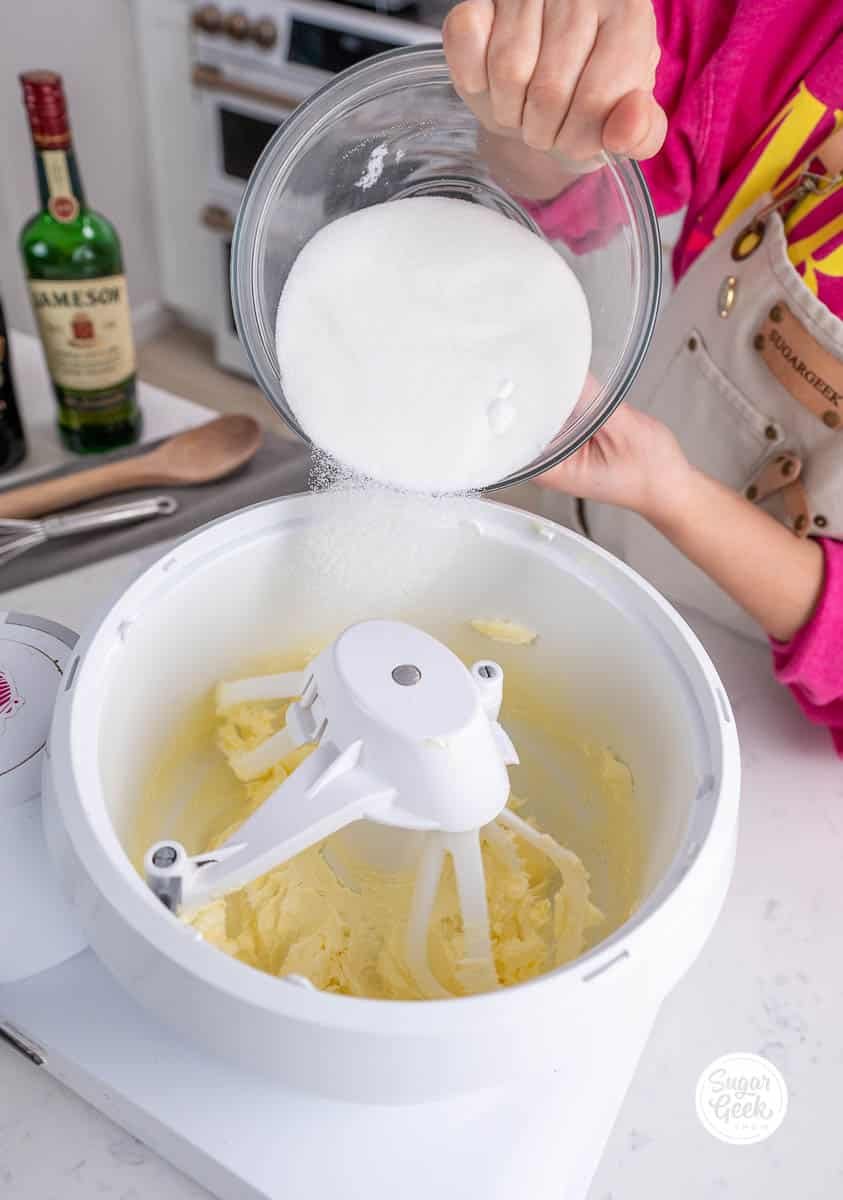
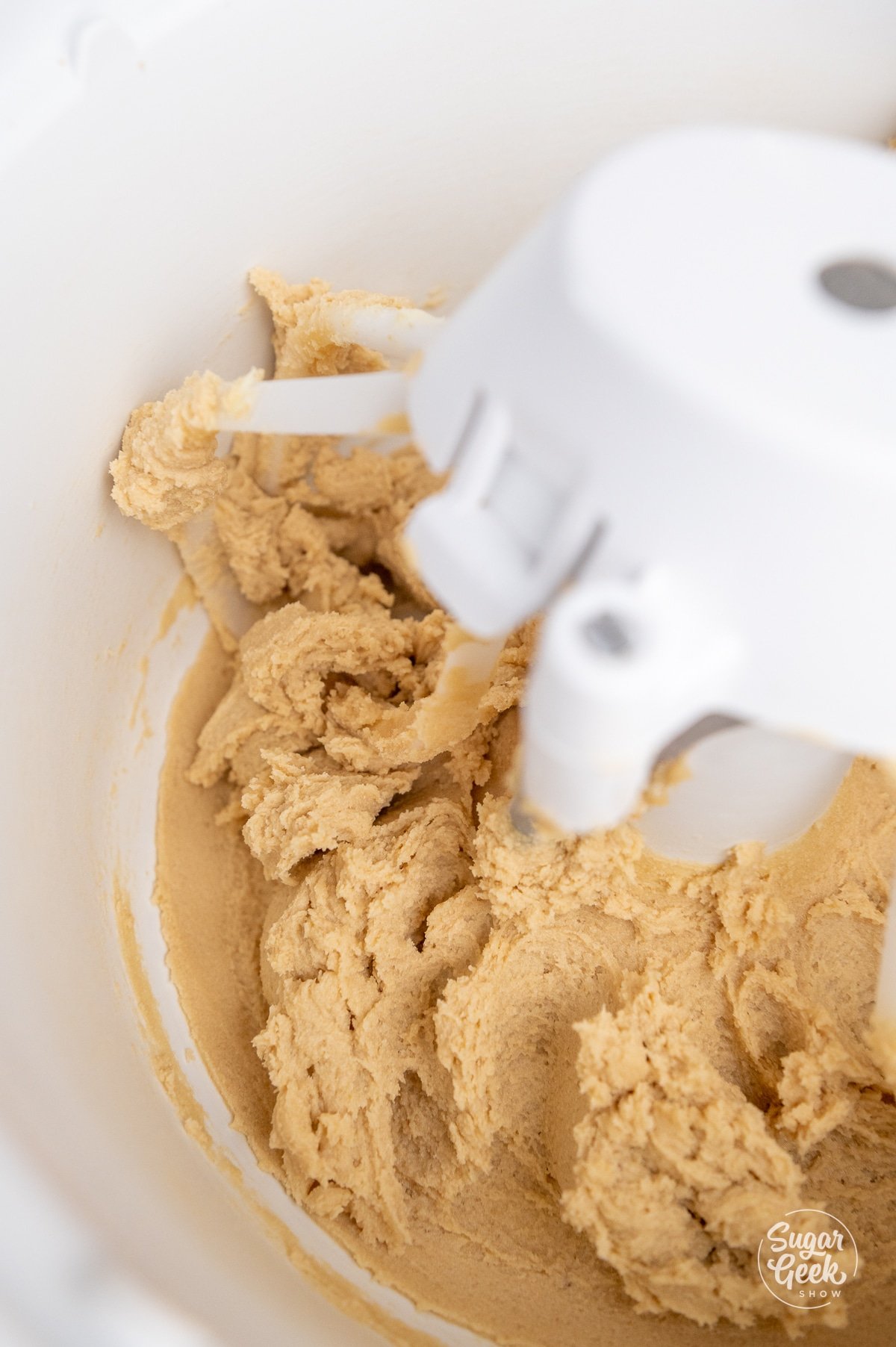
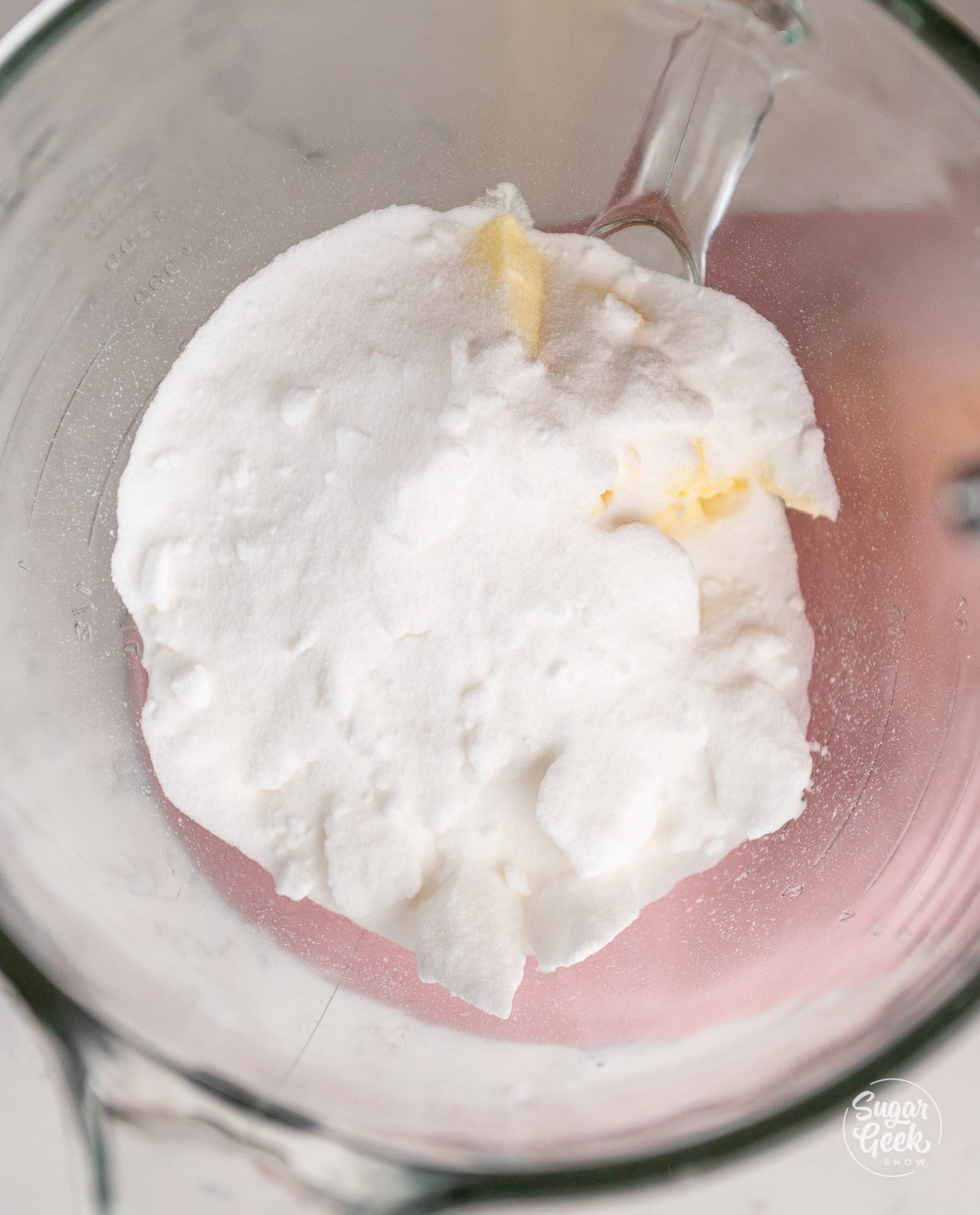
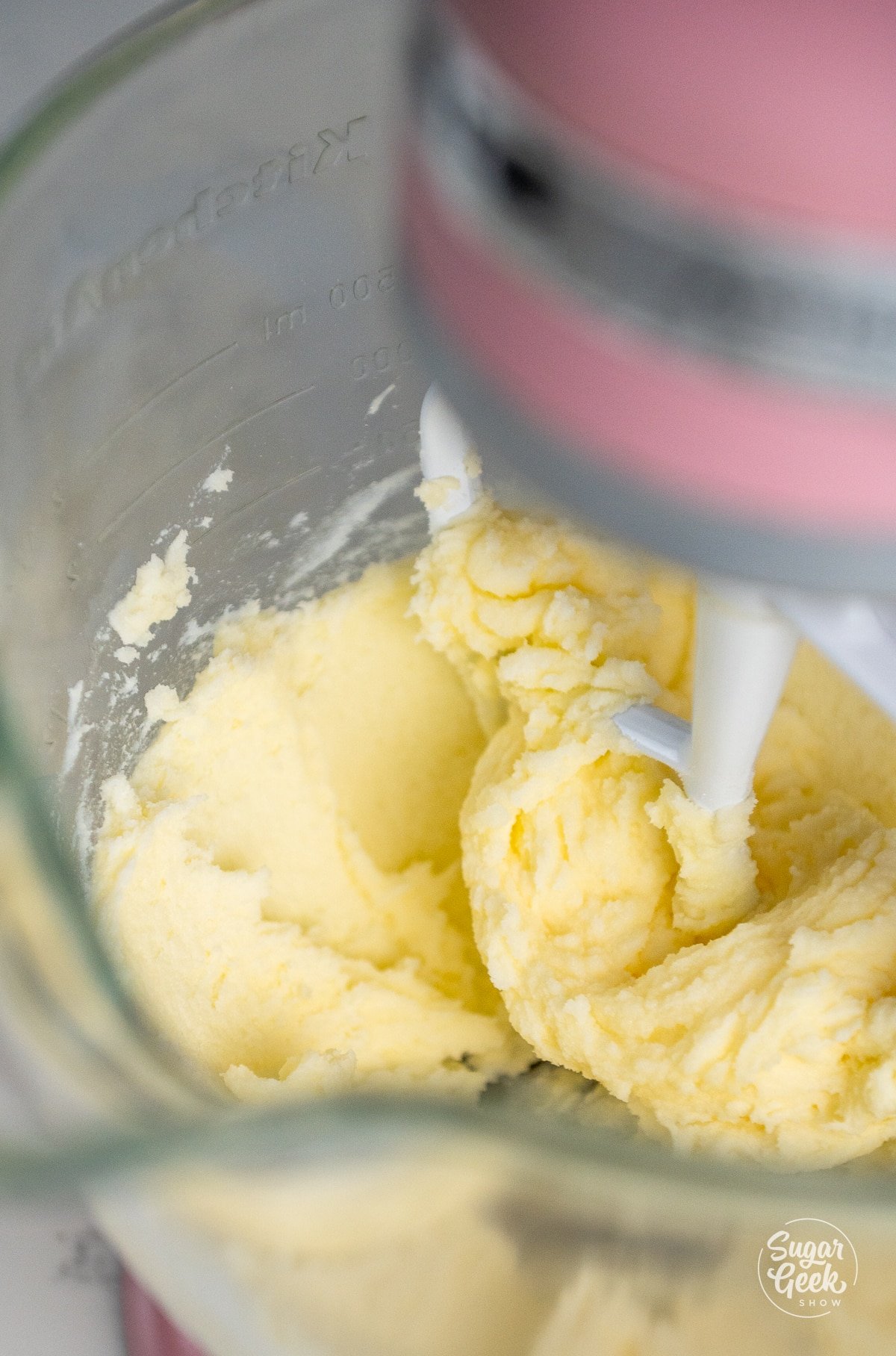
  7. Gradually sprinkle in the sugar on low speed, then bump it up to medium and cream the butter and sugar until the mixture is fluffy and almost white, about 3-5 minutes. 
    hand adding a bowl of sugar into a stand mixer bowl
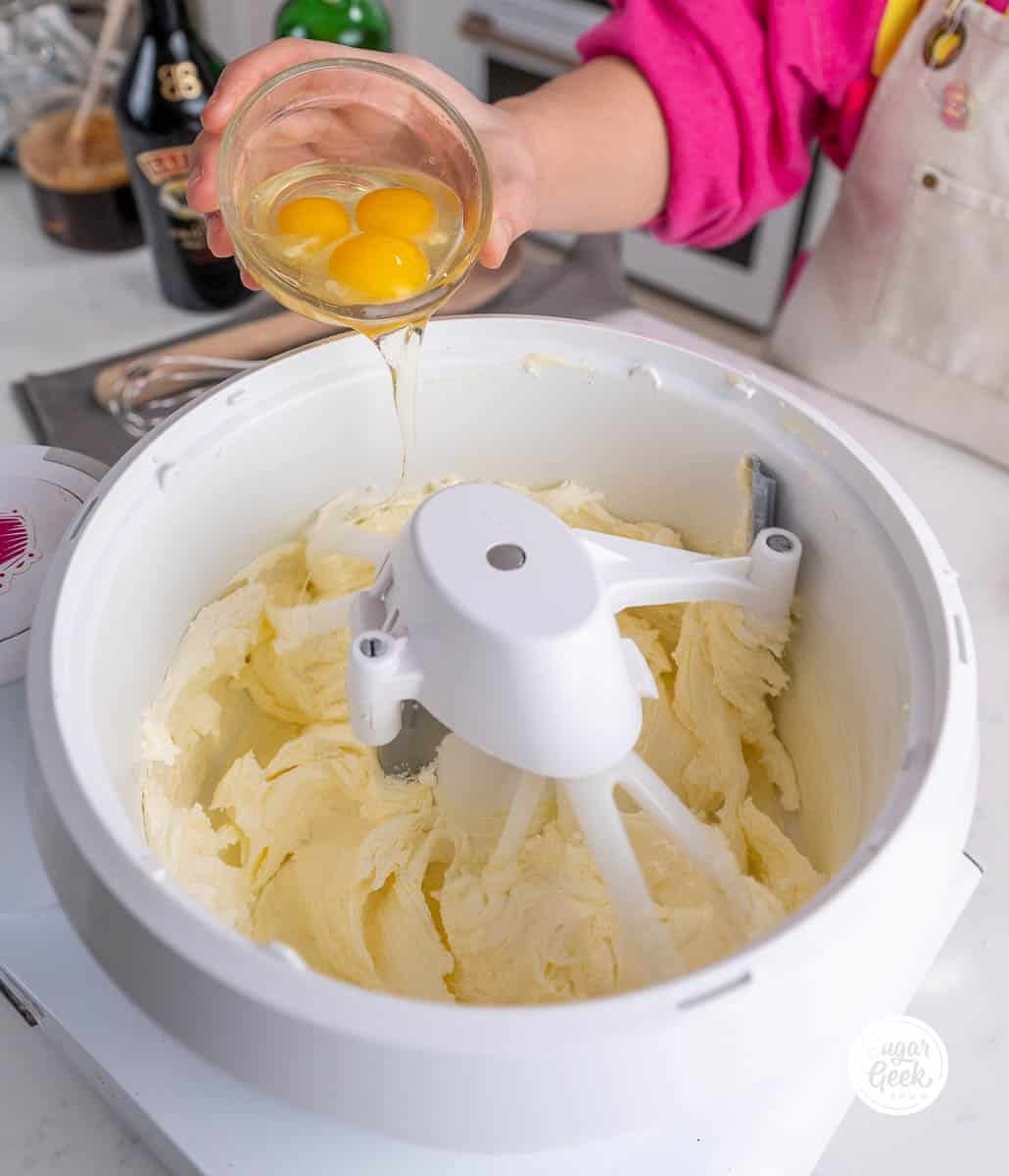
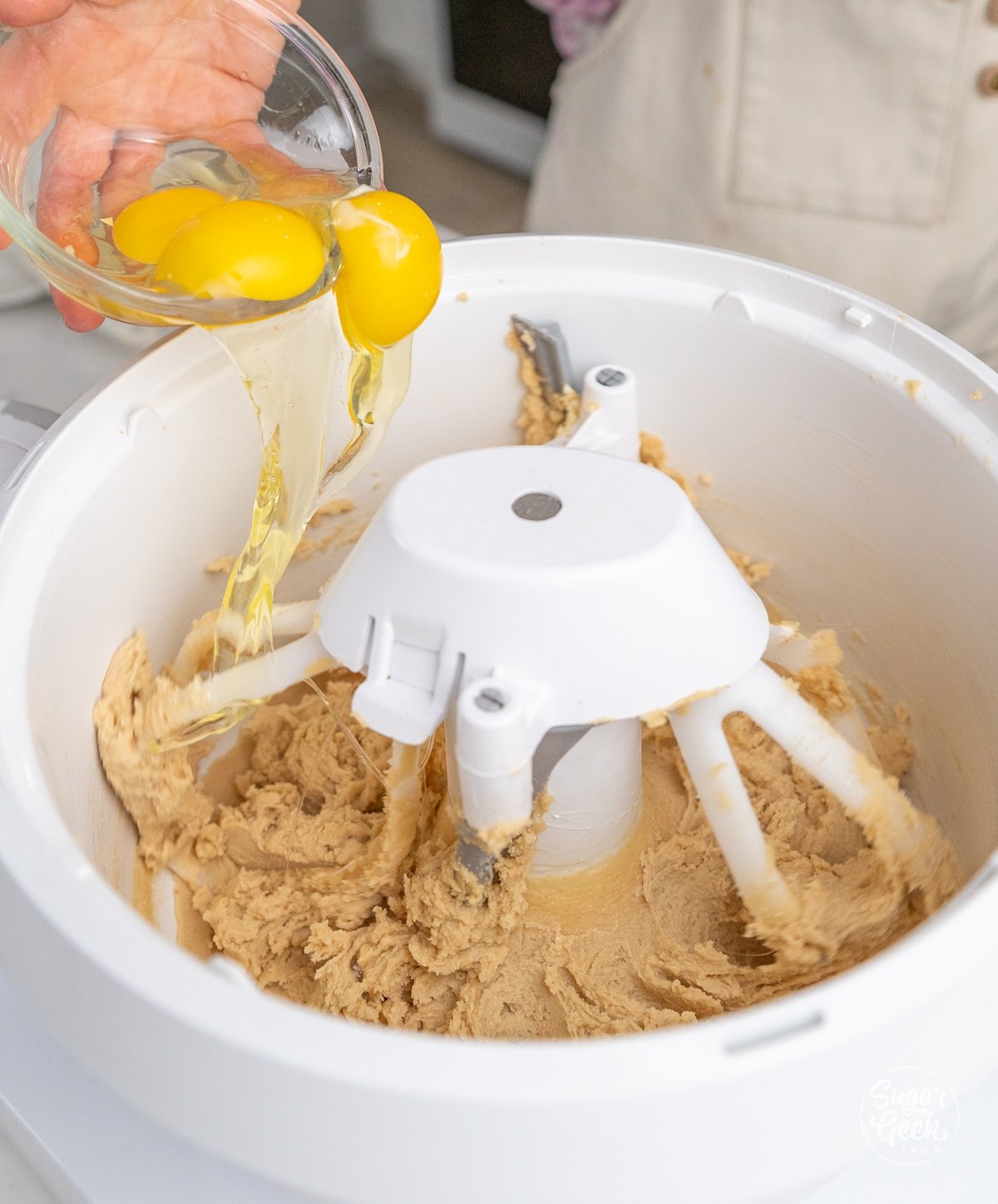
  8. Add the eggs one at a time. Allow each egg to incorporate fully before adding in the next egg to avoid breaking your batter.
    hand adding a bowl of eggs into a stand mixer bowl
  9. Add in the mayo and mix until combined. 
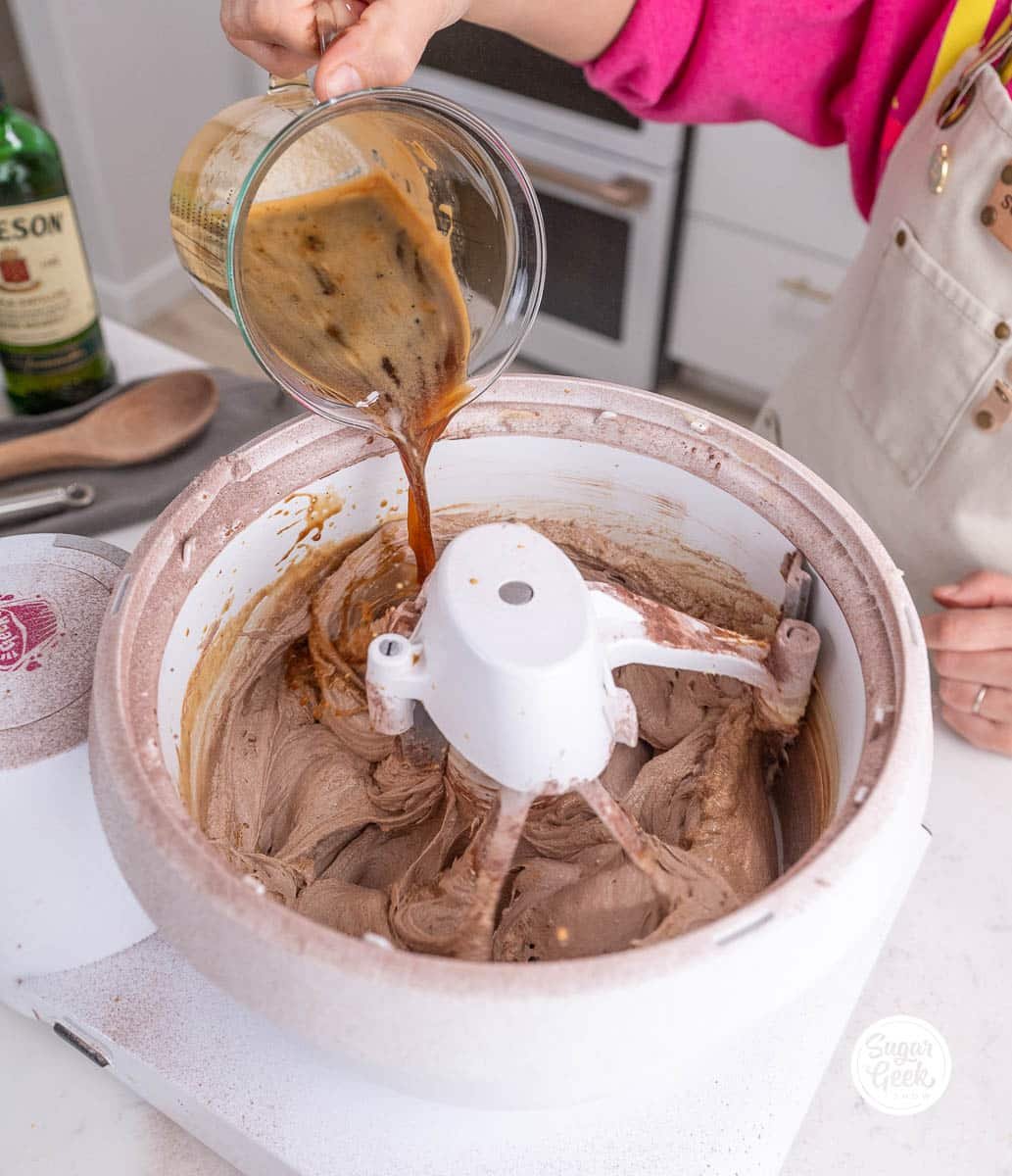
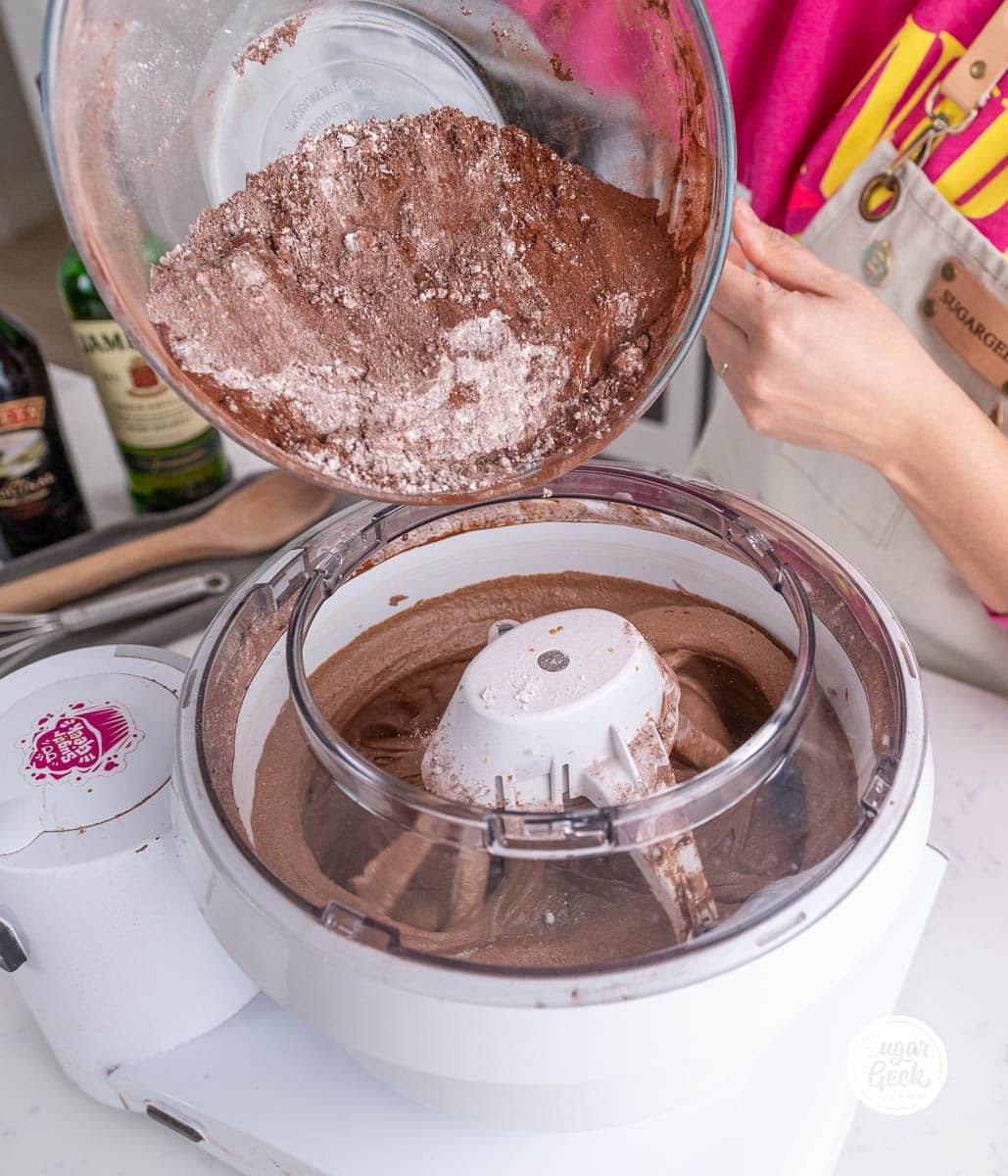
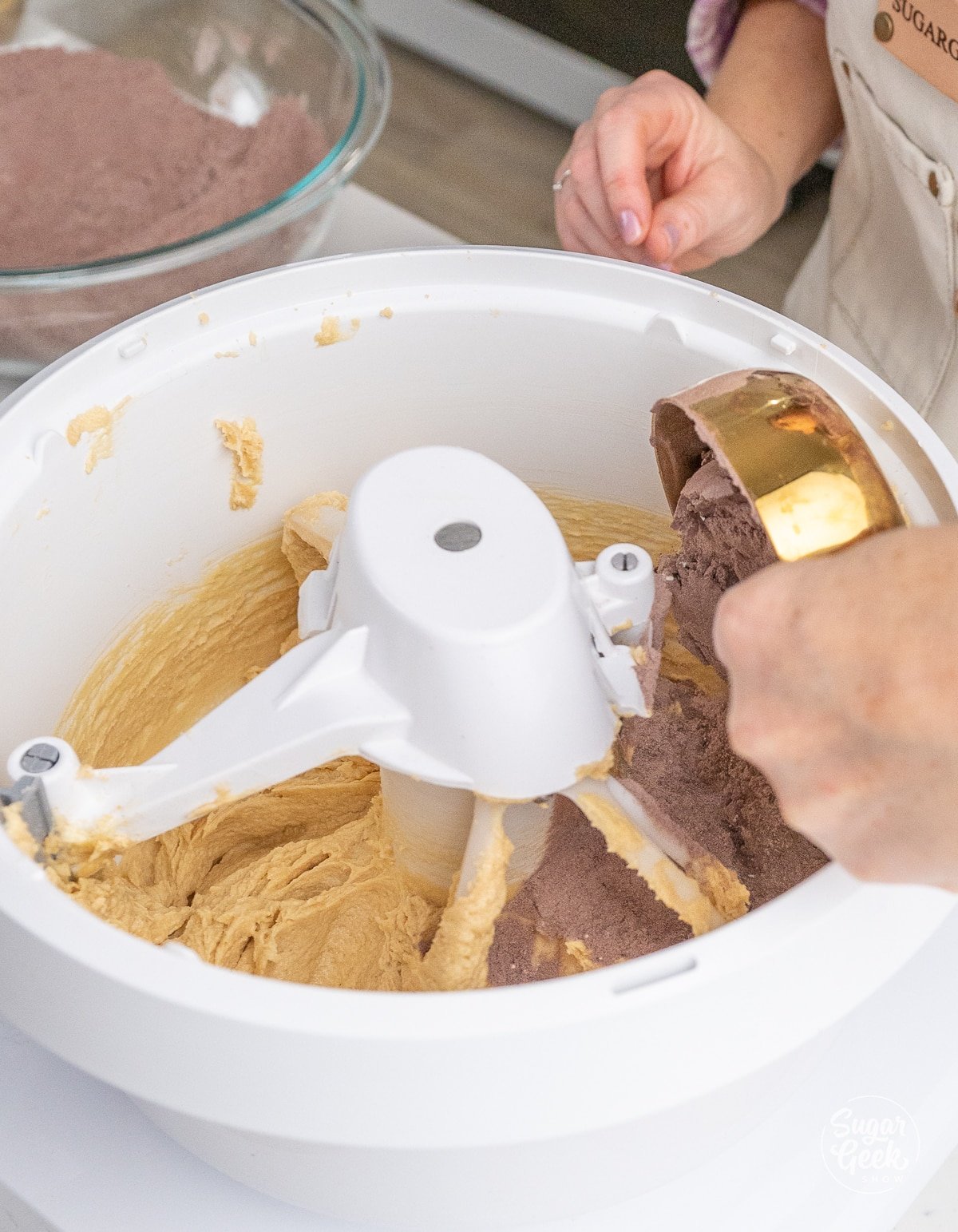
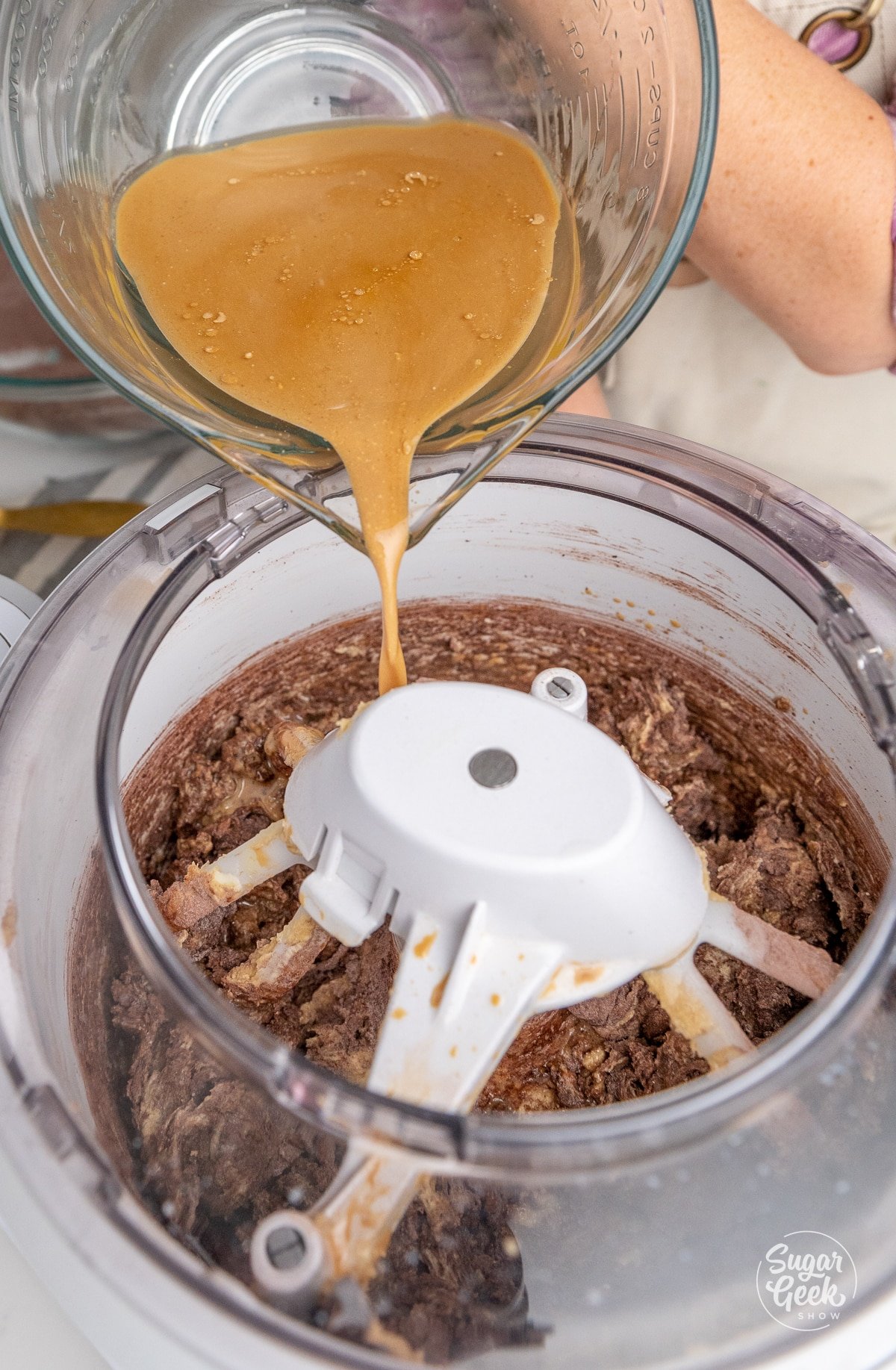
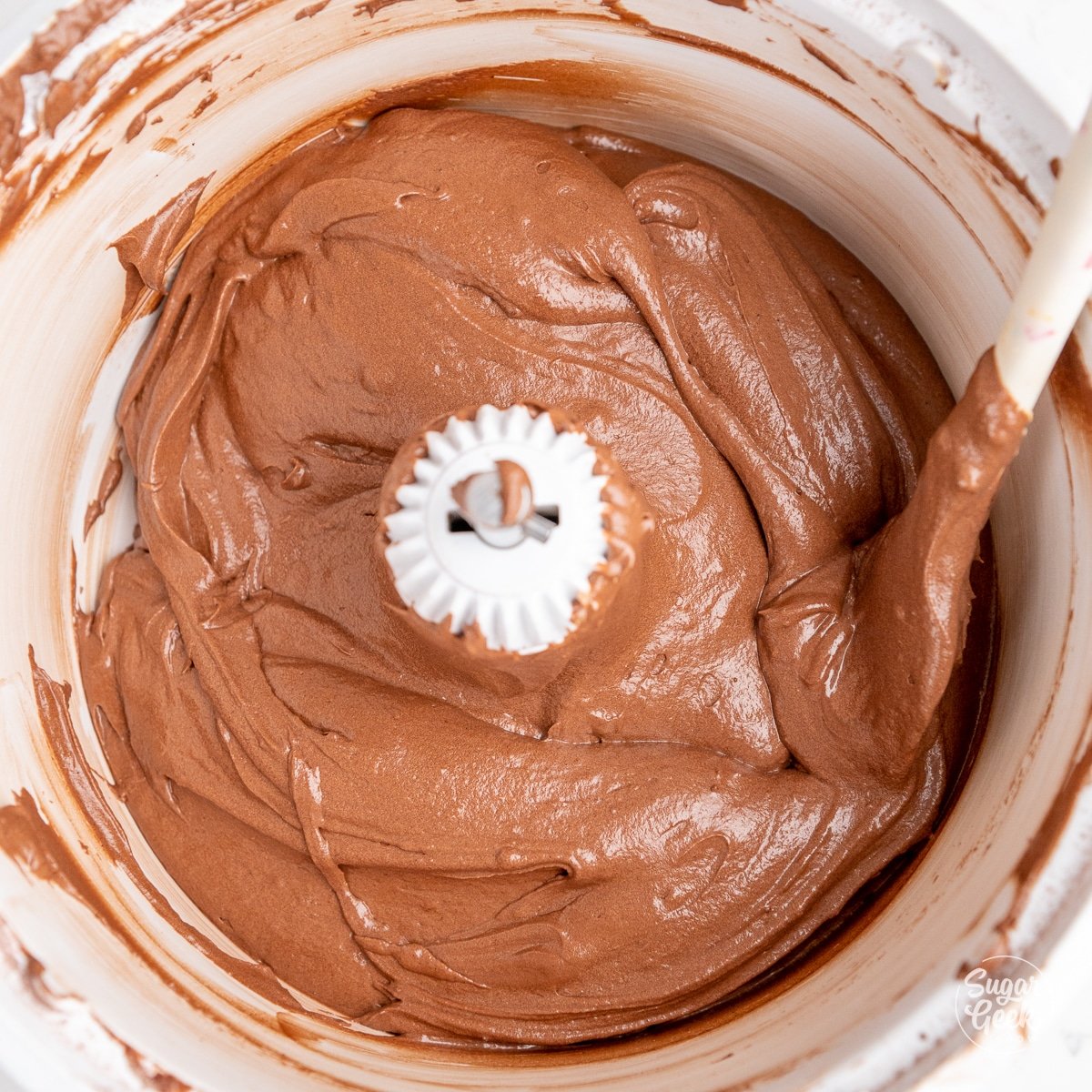
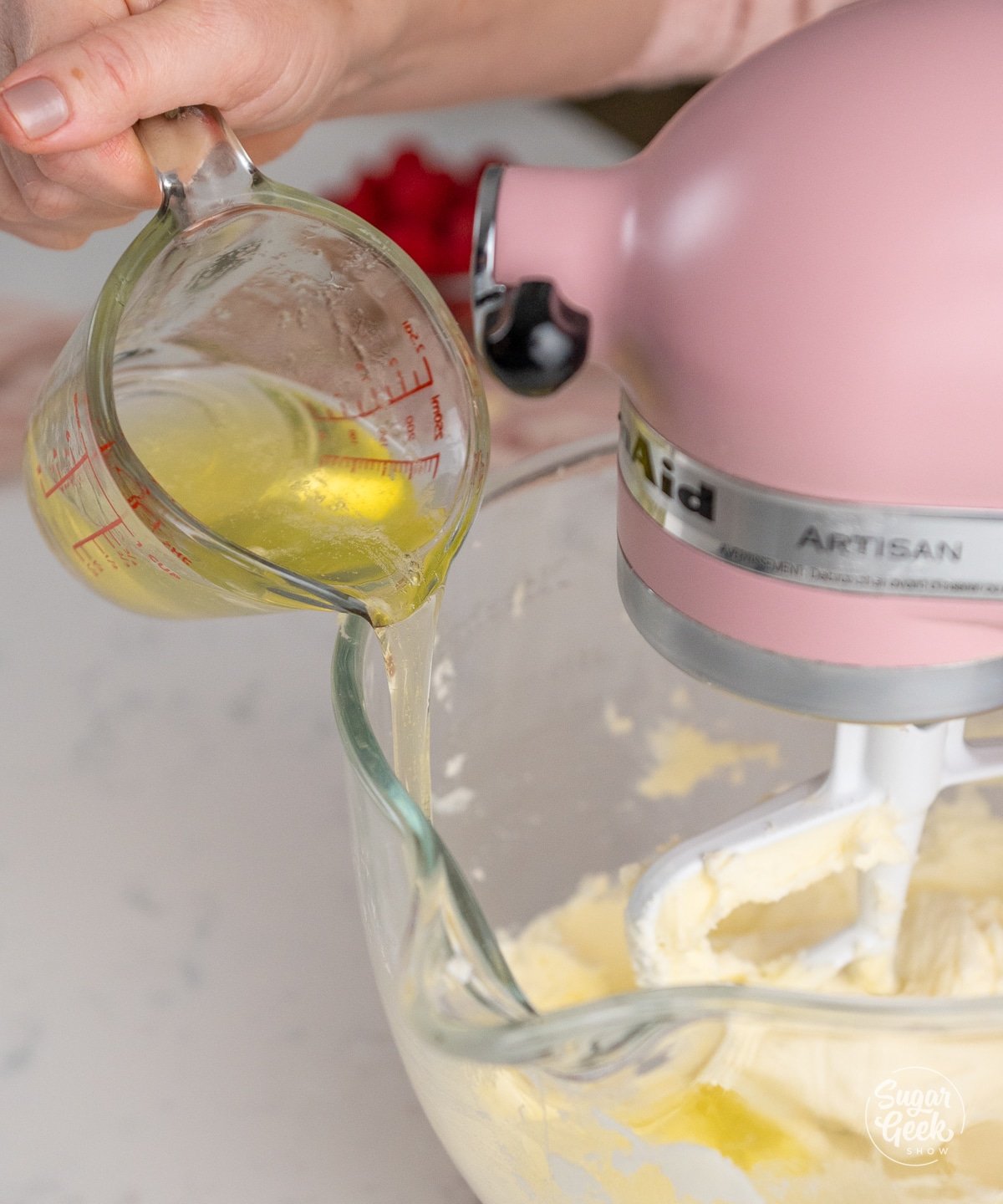
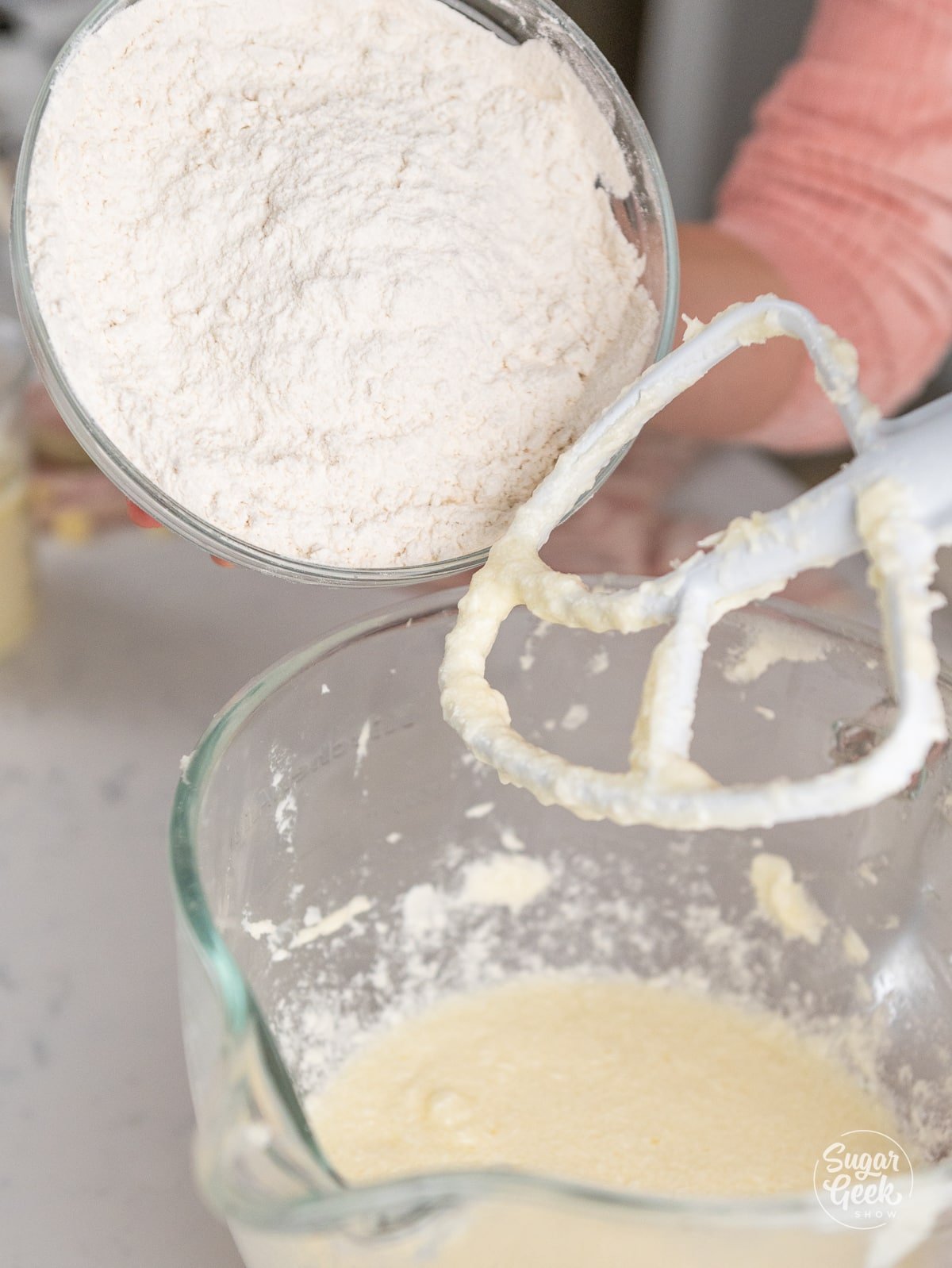
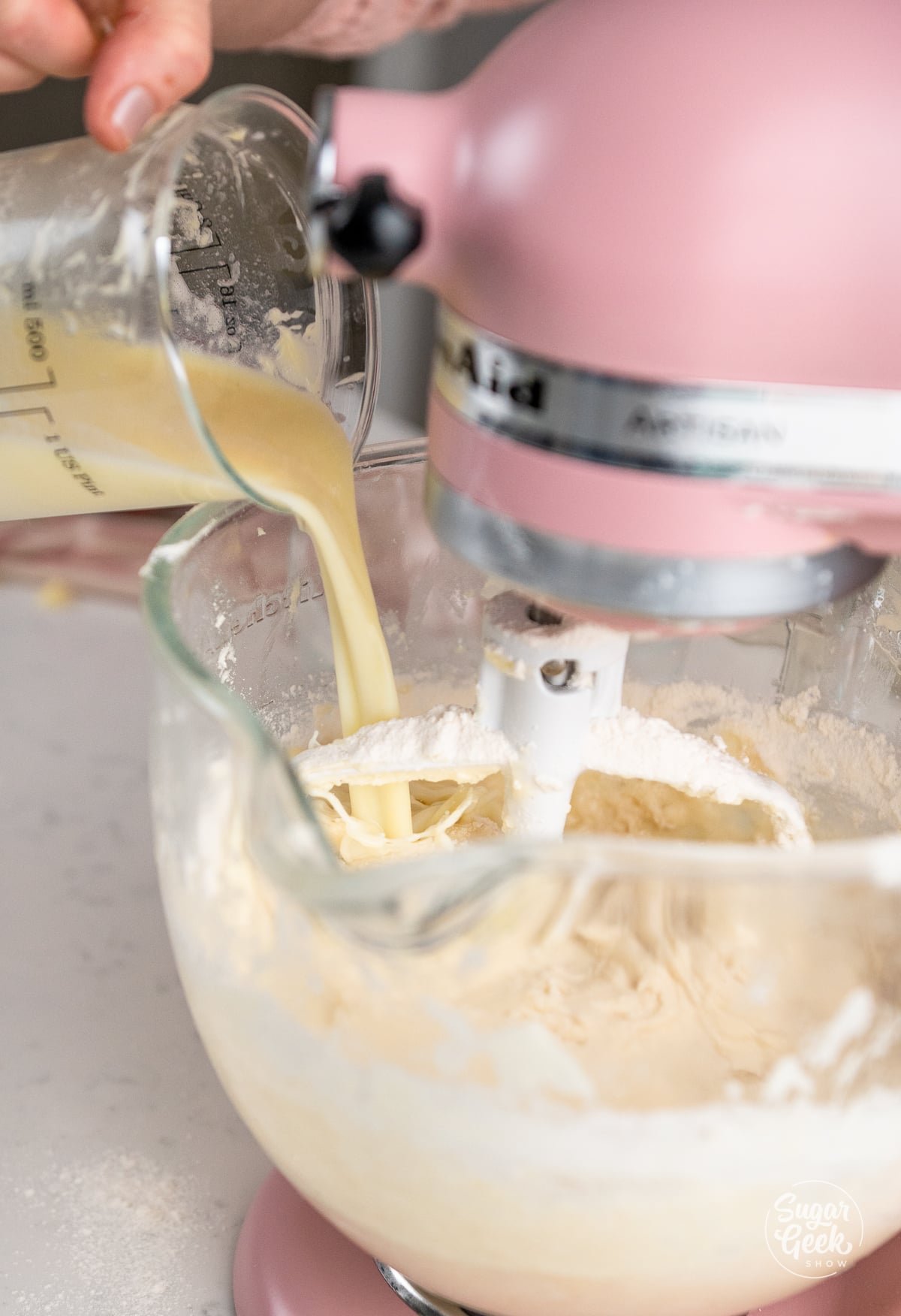
  10. With the mixer on low speed, add ⅓ of the dry ingredients and mix until almost combined. Add ⅓ of the liquid ingredients. Repeat the process with the flour mixture and liquids two more times until everything is fully incorporated.
    hand pouring liquid ingredients from a measuring cup into a stand mixer bowl
    hand adding a bowl of dry ingredients into a stand mixer bowl
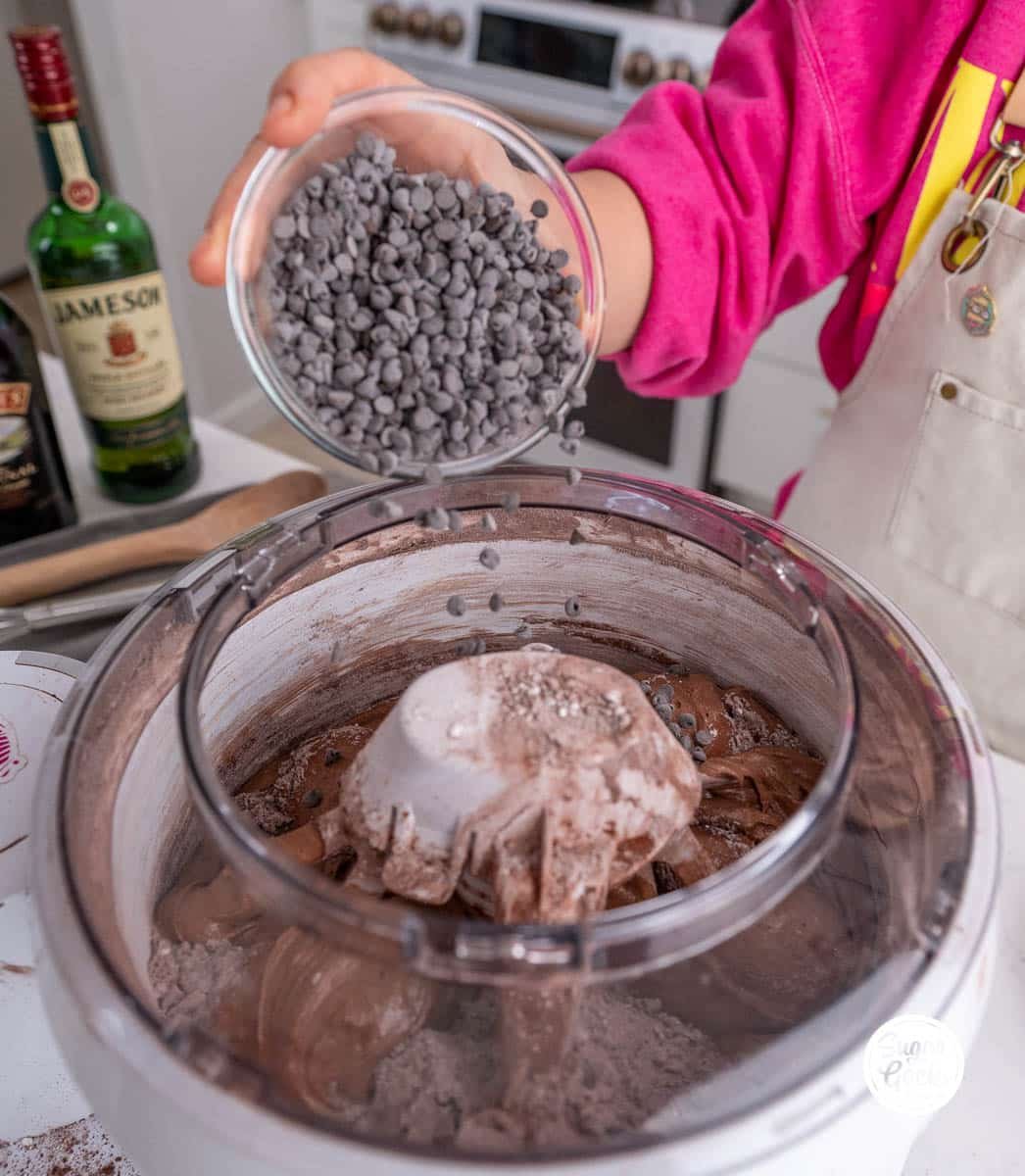
  11. Gently fold in the mini chocolate chips.
    hand adding chocolate chips into cake batter
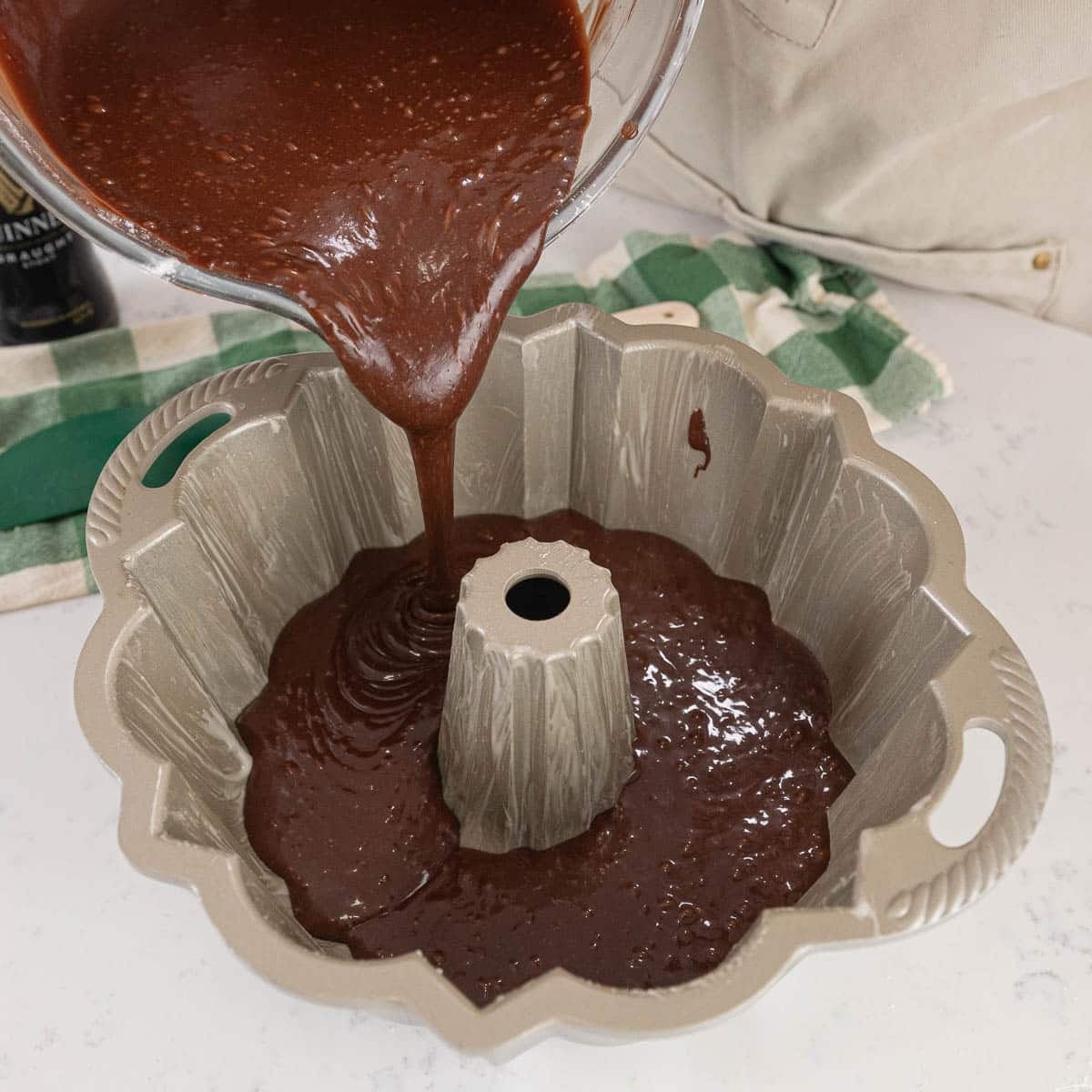
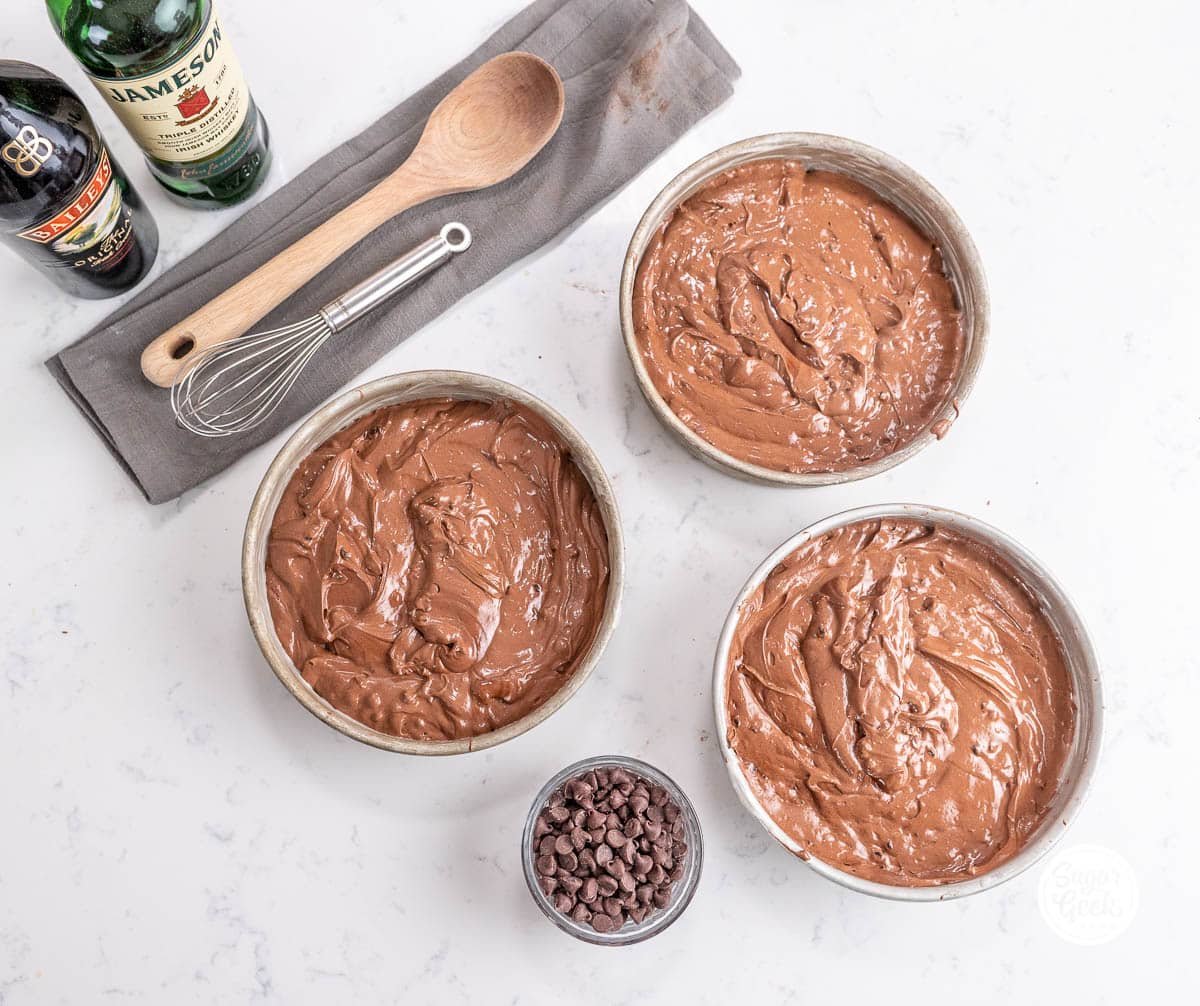
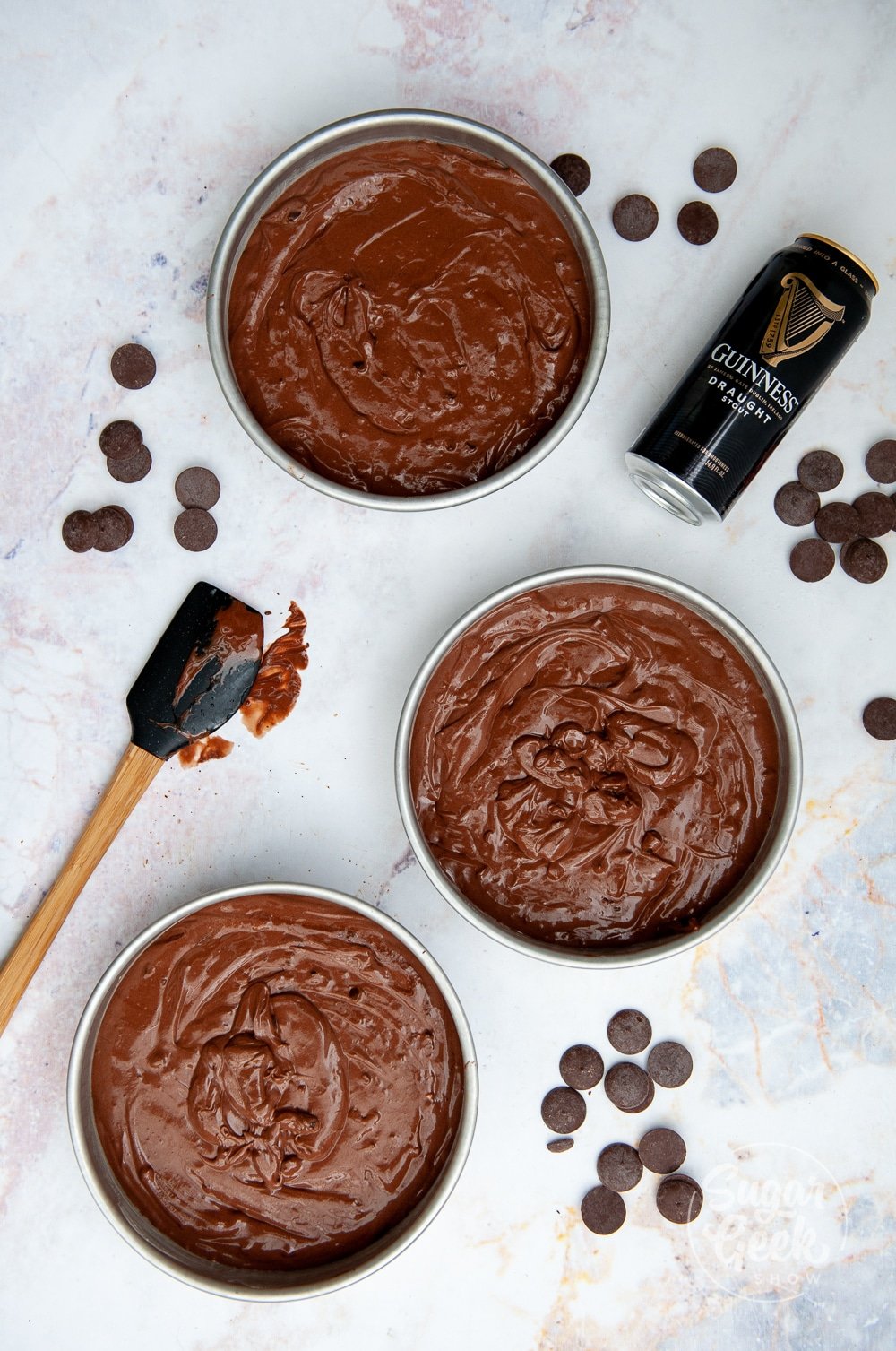
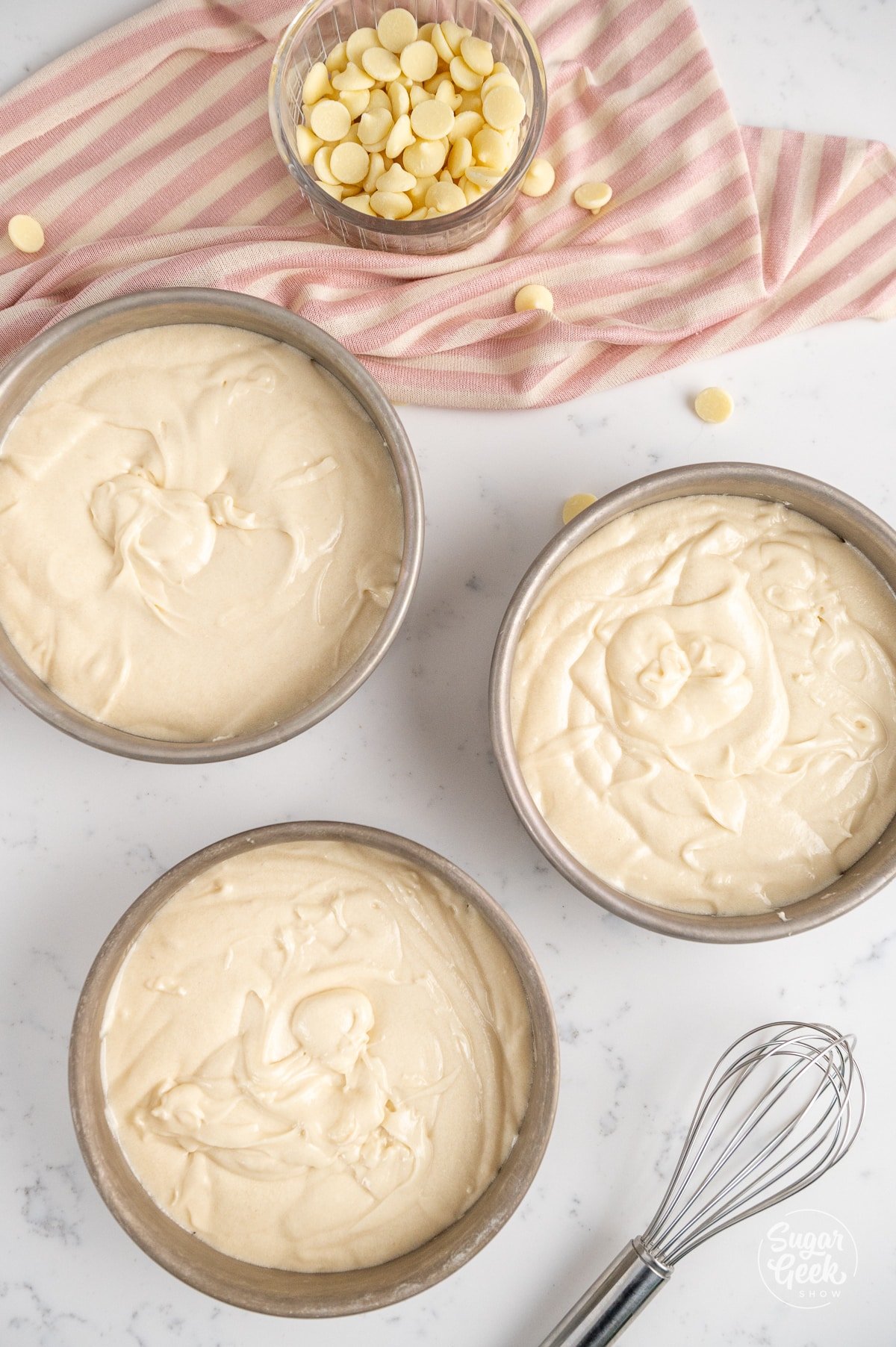
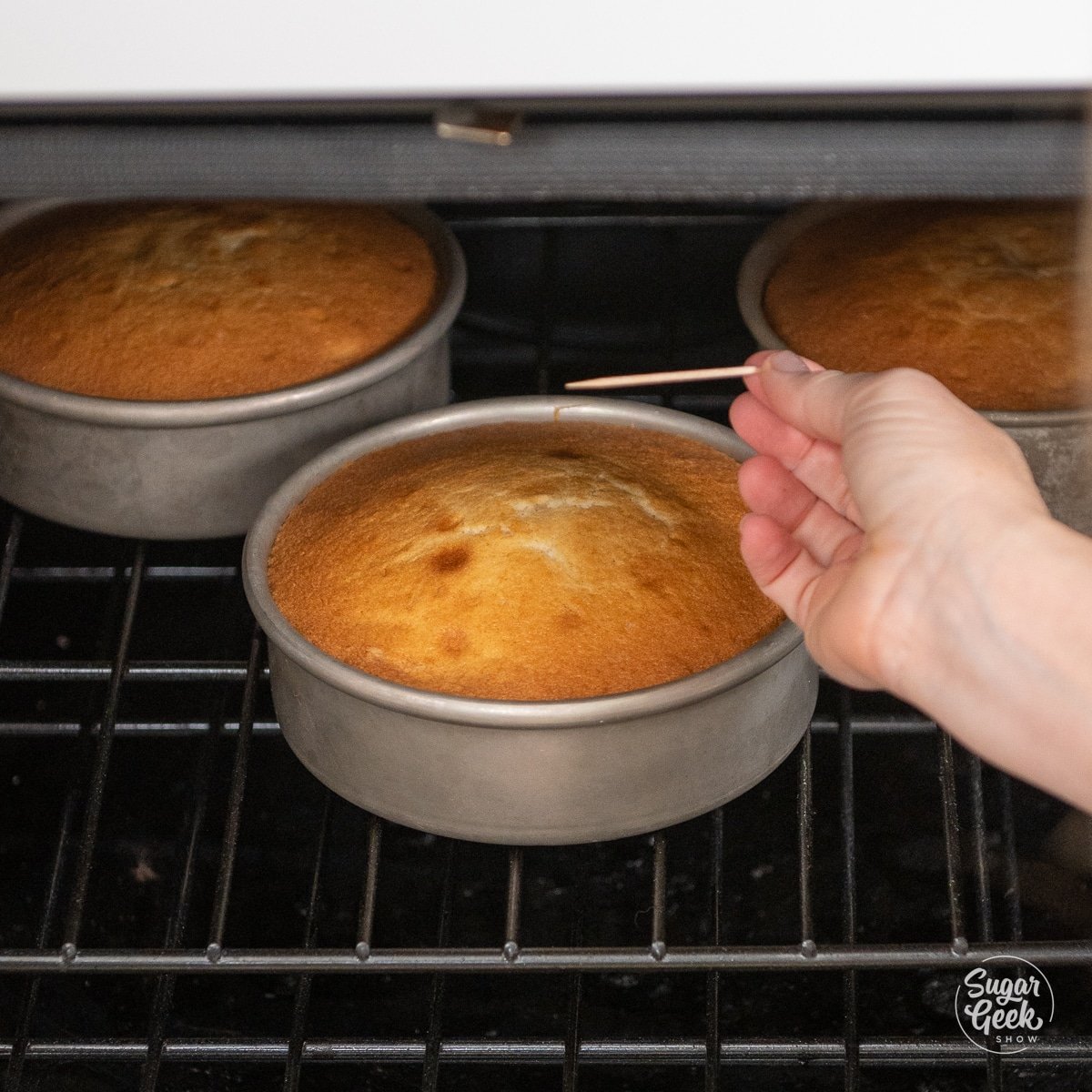
  12. Pour the batter into the prepared pans and bake them for 35-40 minutes until a wooden skewer comes out clean but with a few sticky crumbs.
    three cake pans full of chocolate cake batter
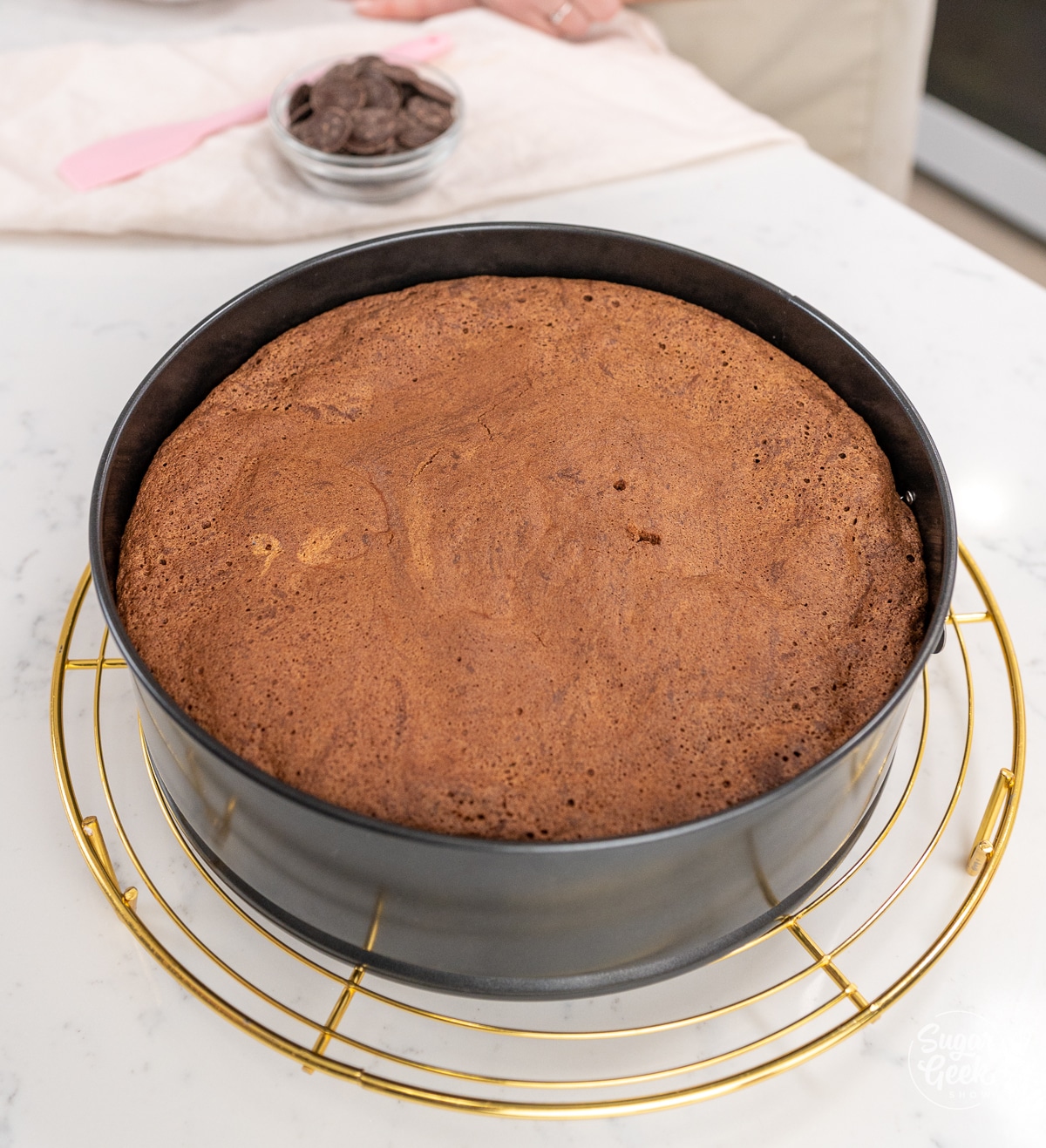
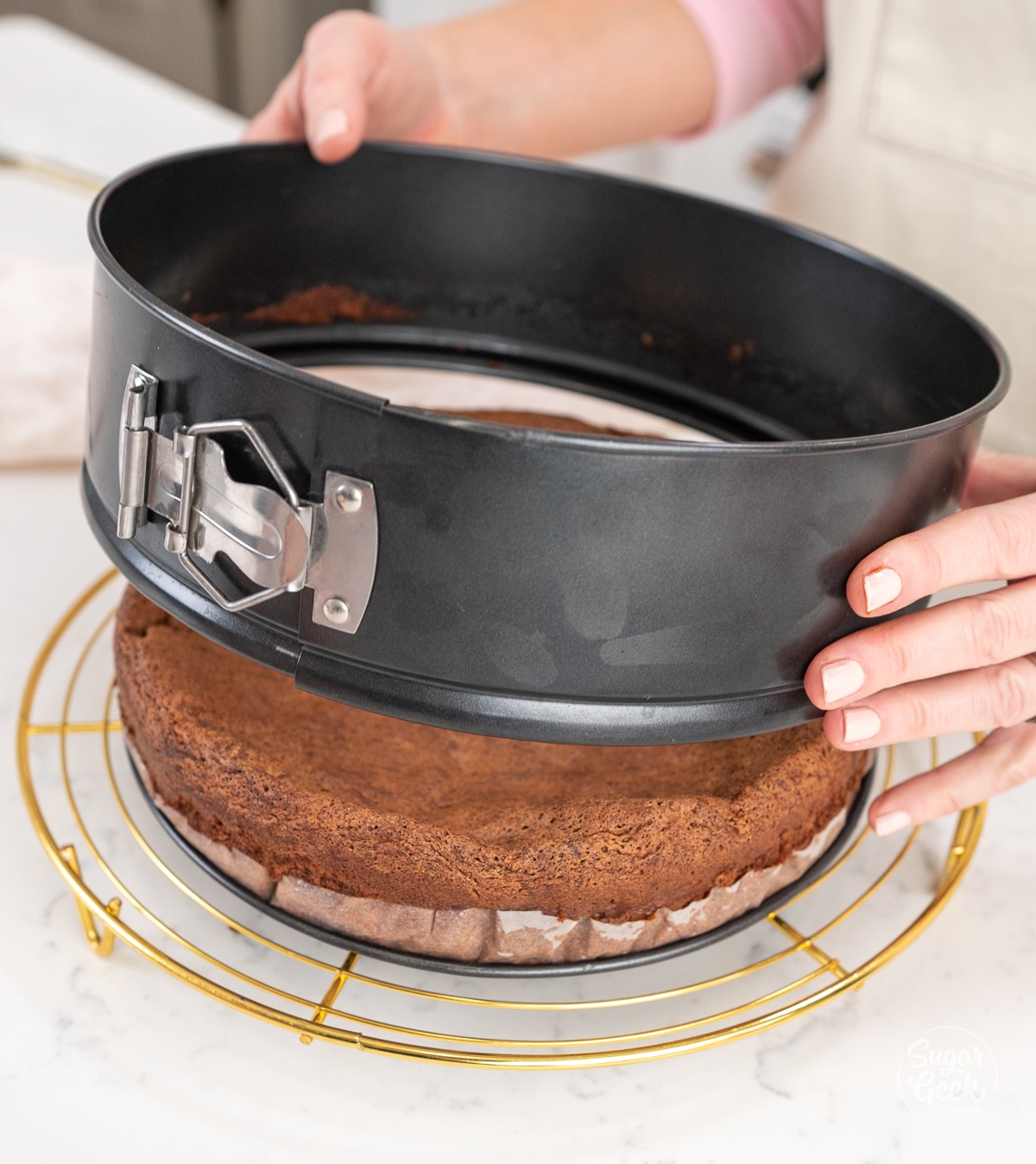
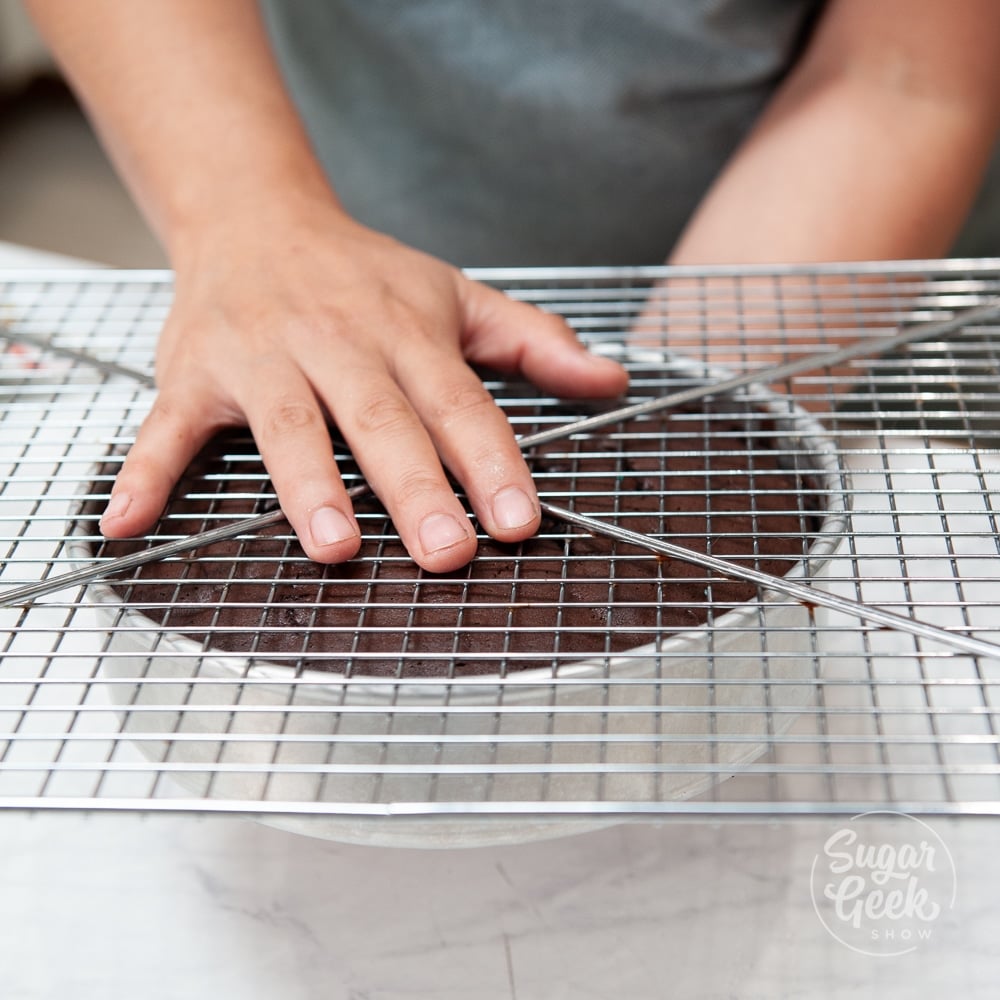
  13. Let the cake cool in the pan for about 20 minutes then remove them and place them onto a wire rack to cool while you prepare the Bailey's drizzle.

Making the Bailey's Irish Cream Sauce

  1. Combine the sweetened condensed milk and Bailey's Irish cream in a measuring cup.
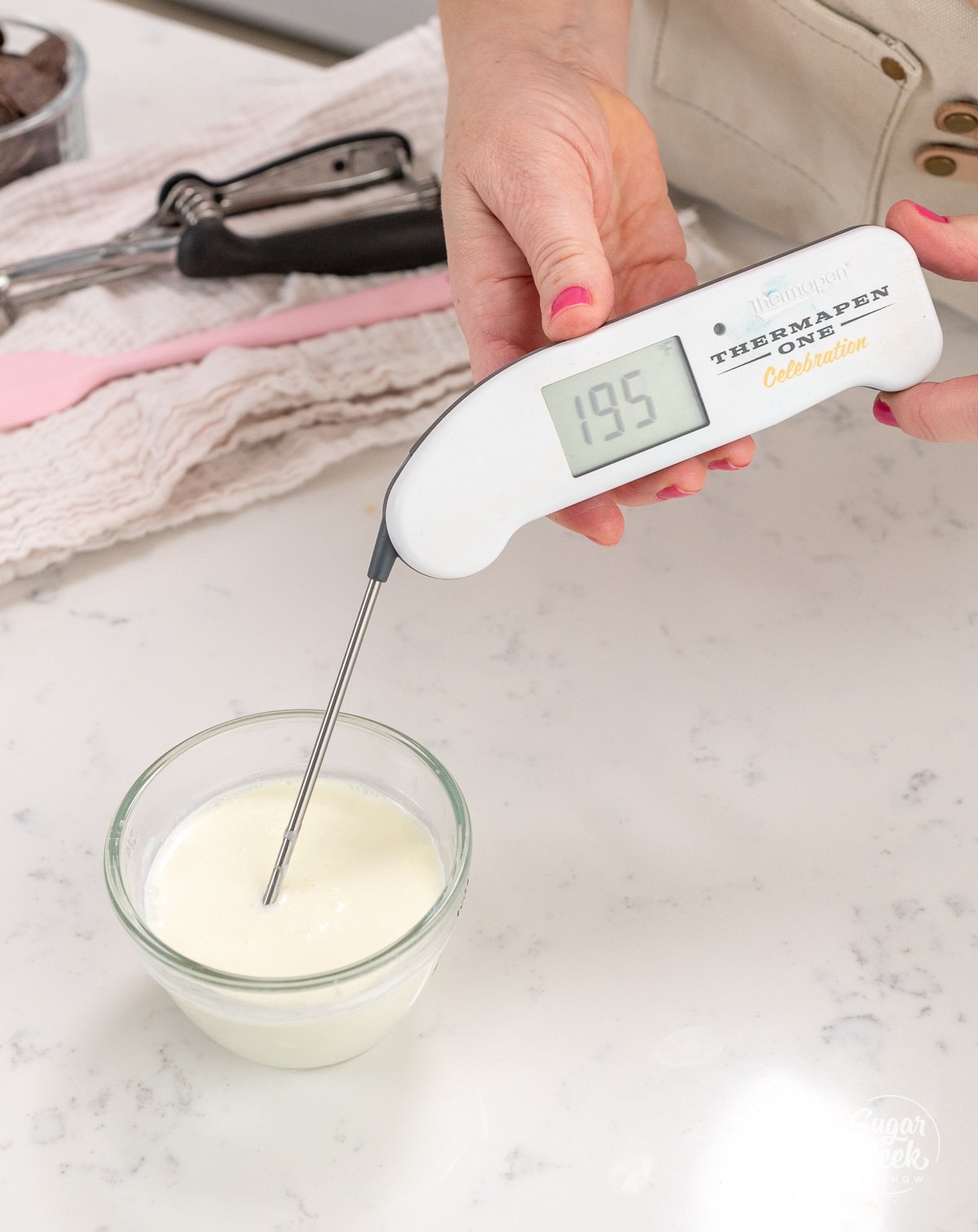
  2. Microwave the cream mixture for 30 seconds and then in 15-second increments until it is just simmering. You can also do this in a pot over the stove.
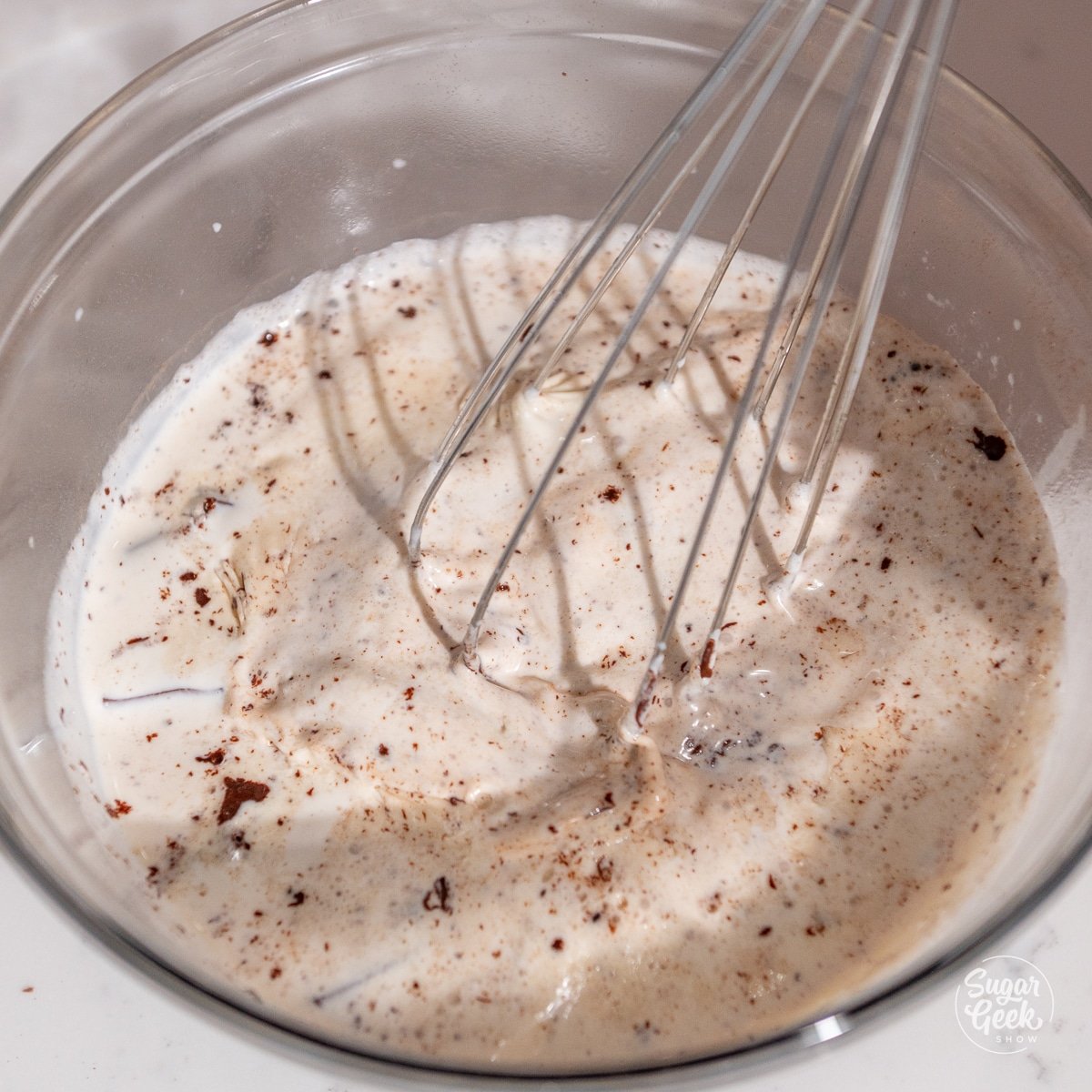
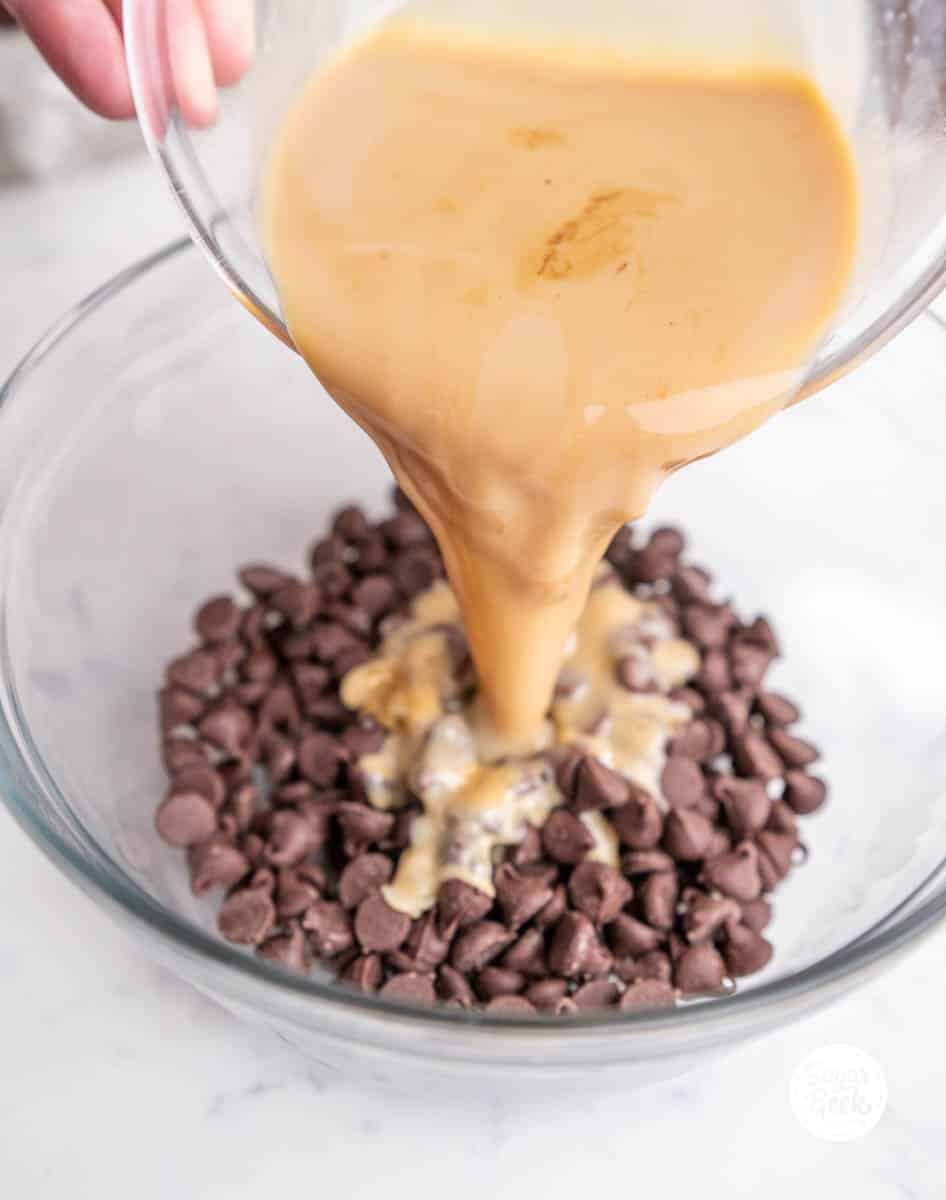
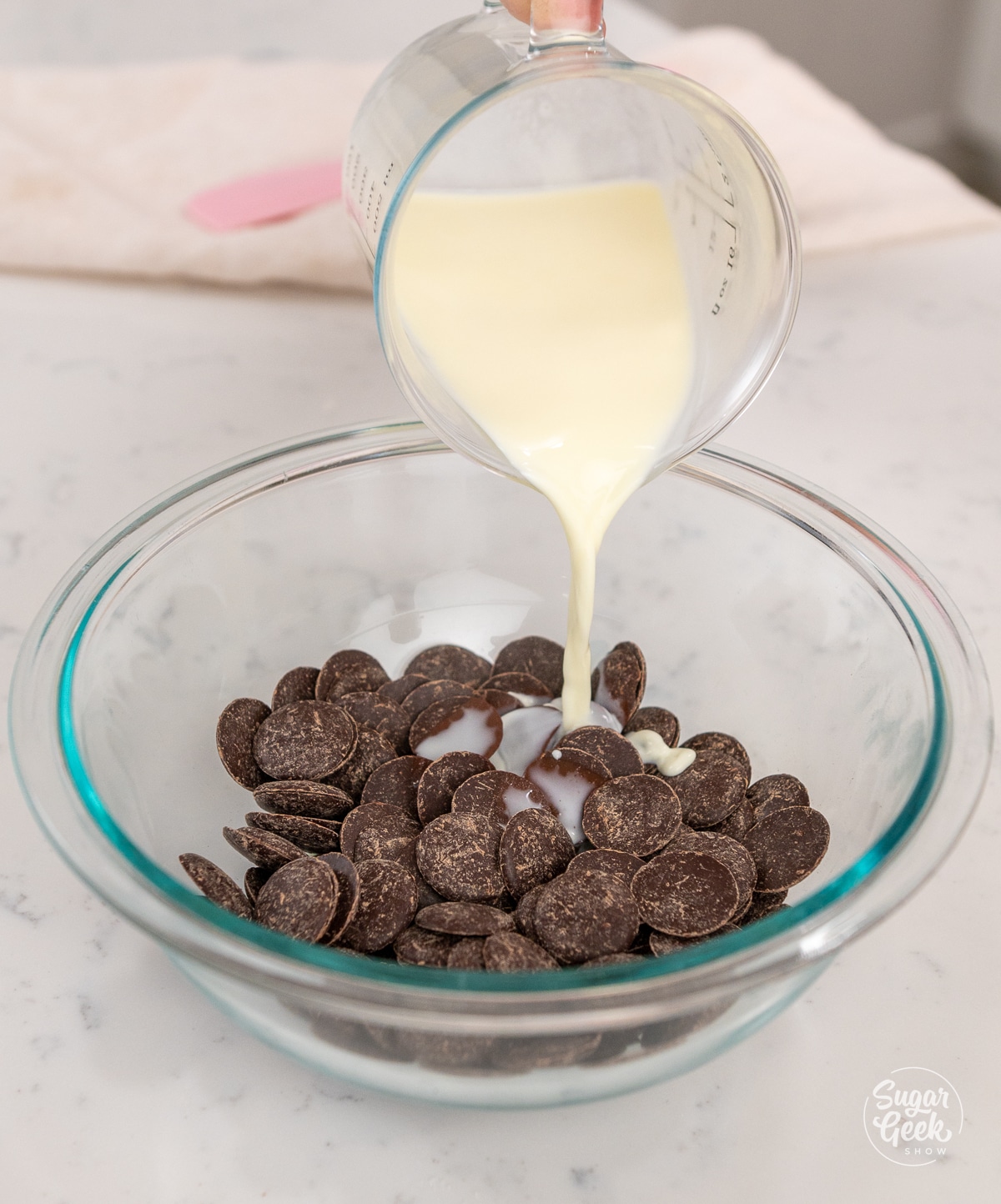
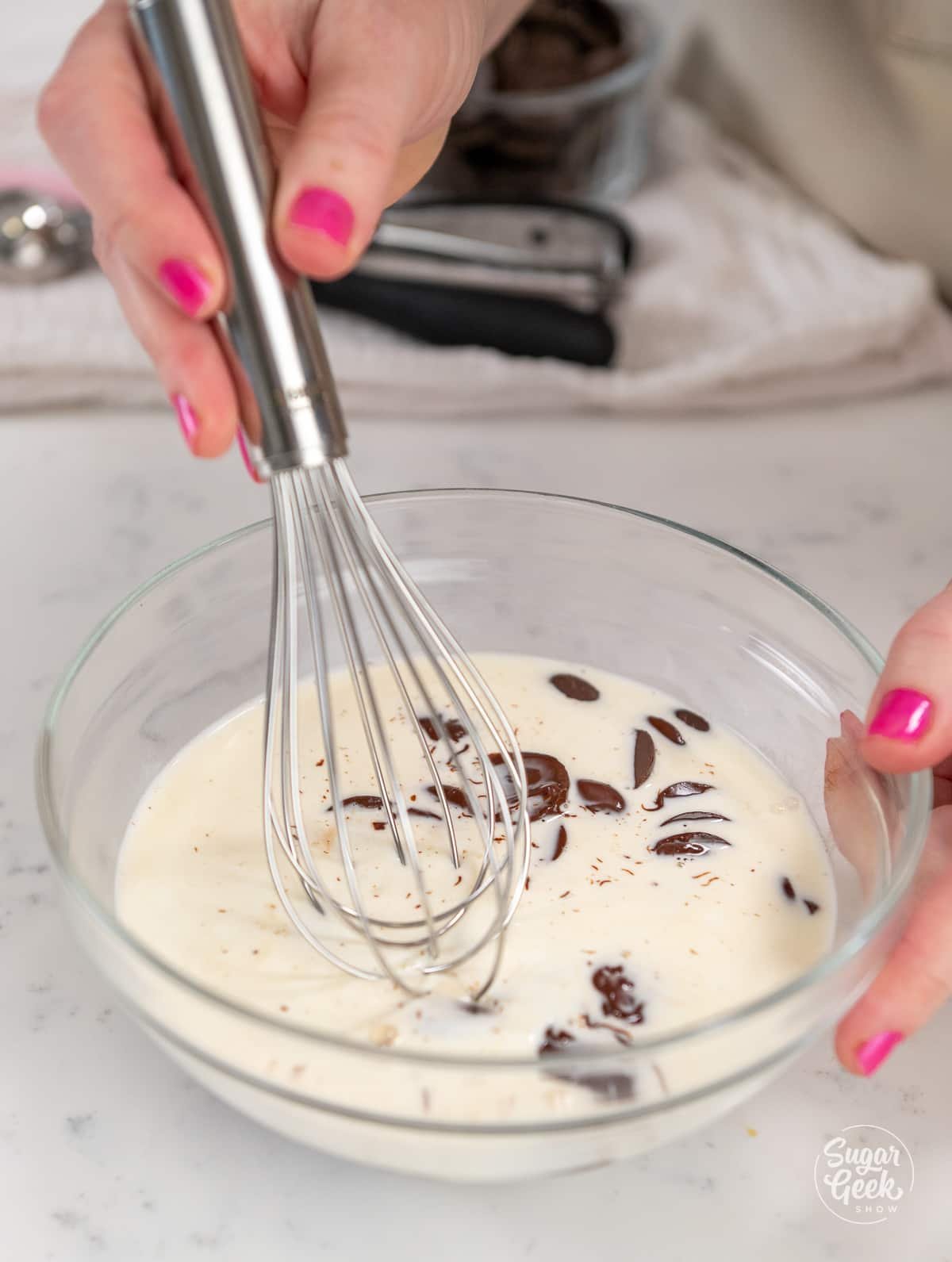
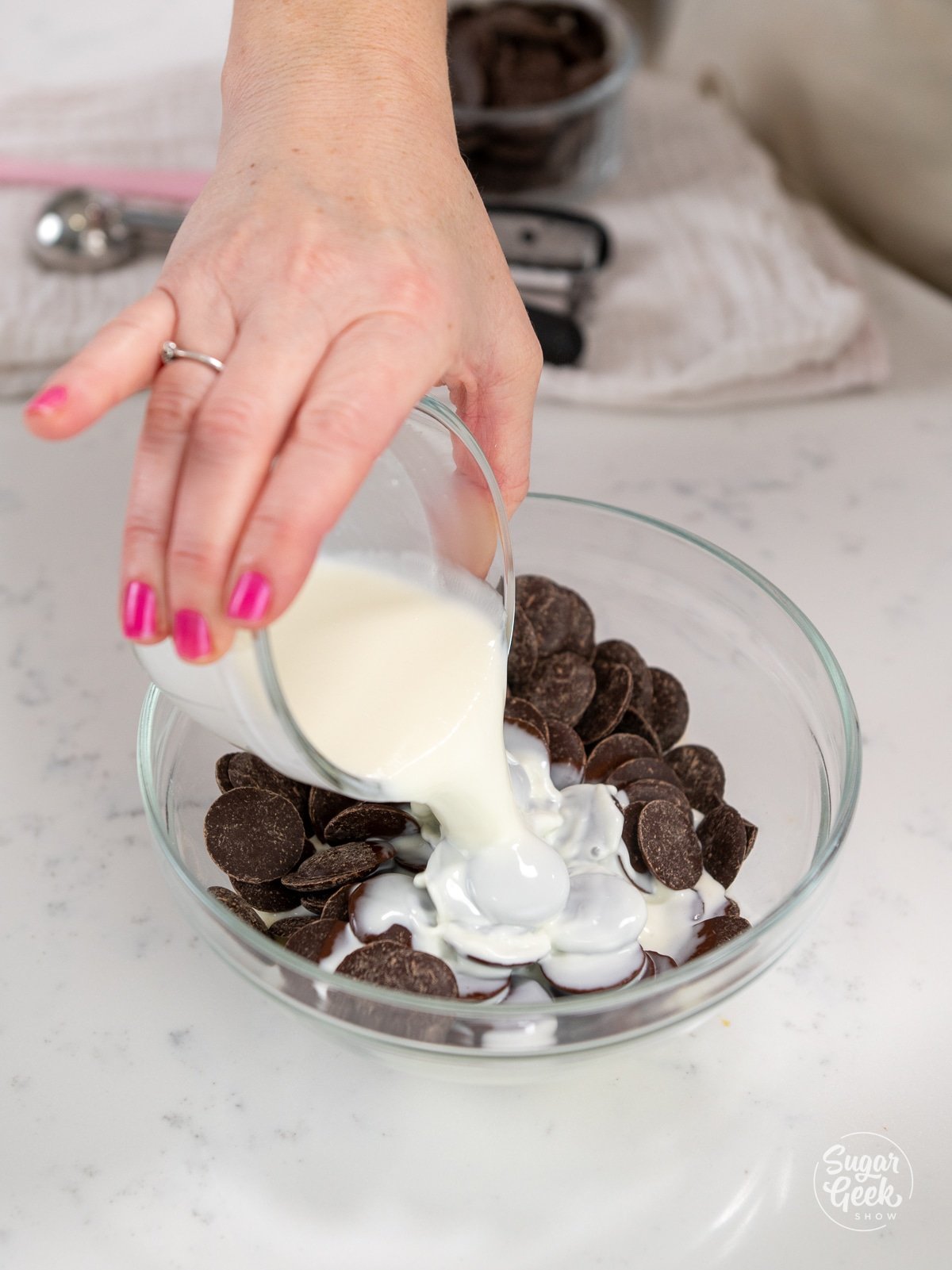
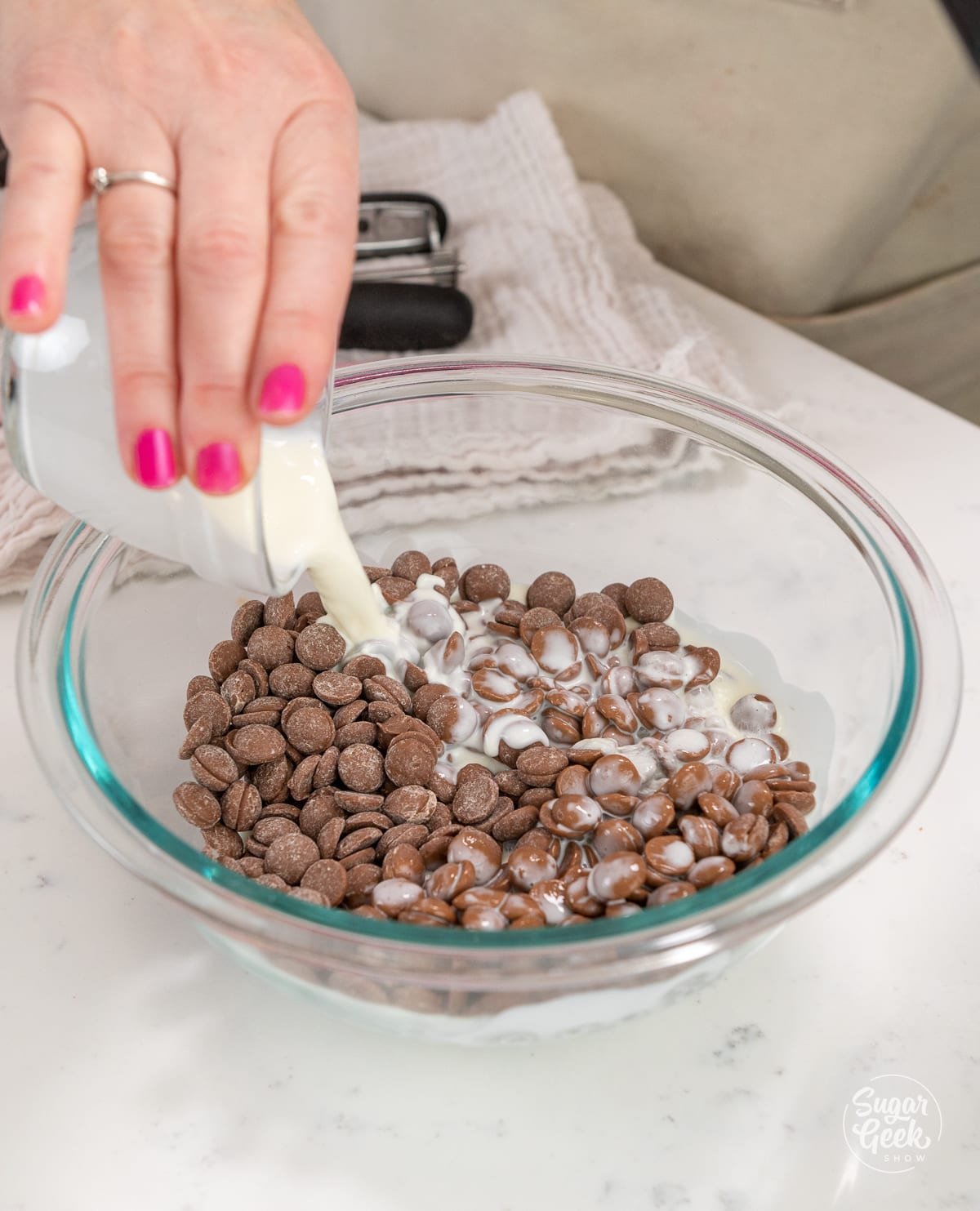
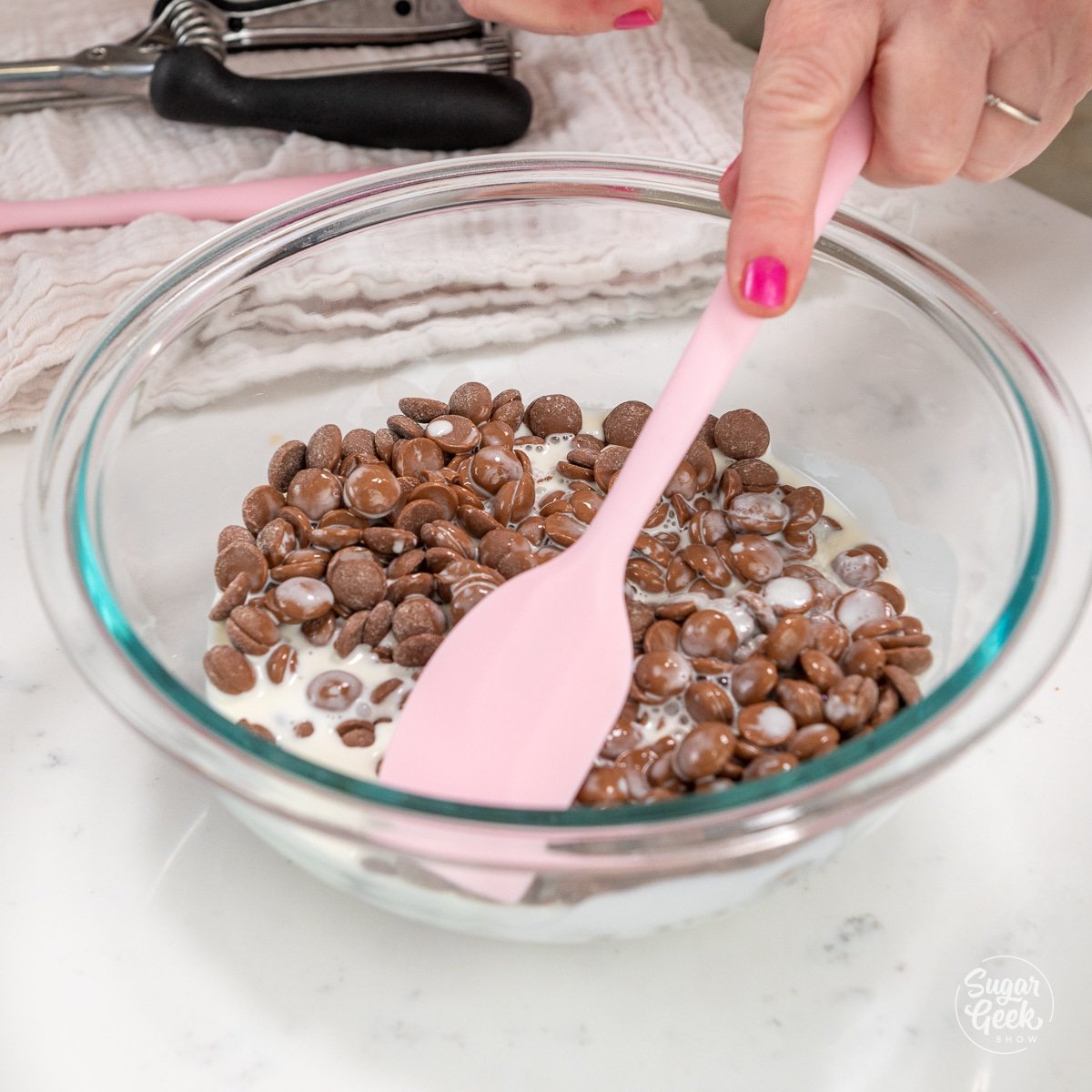
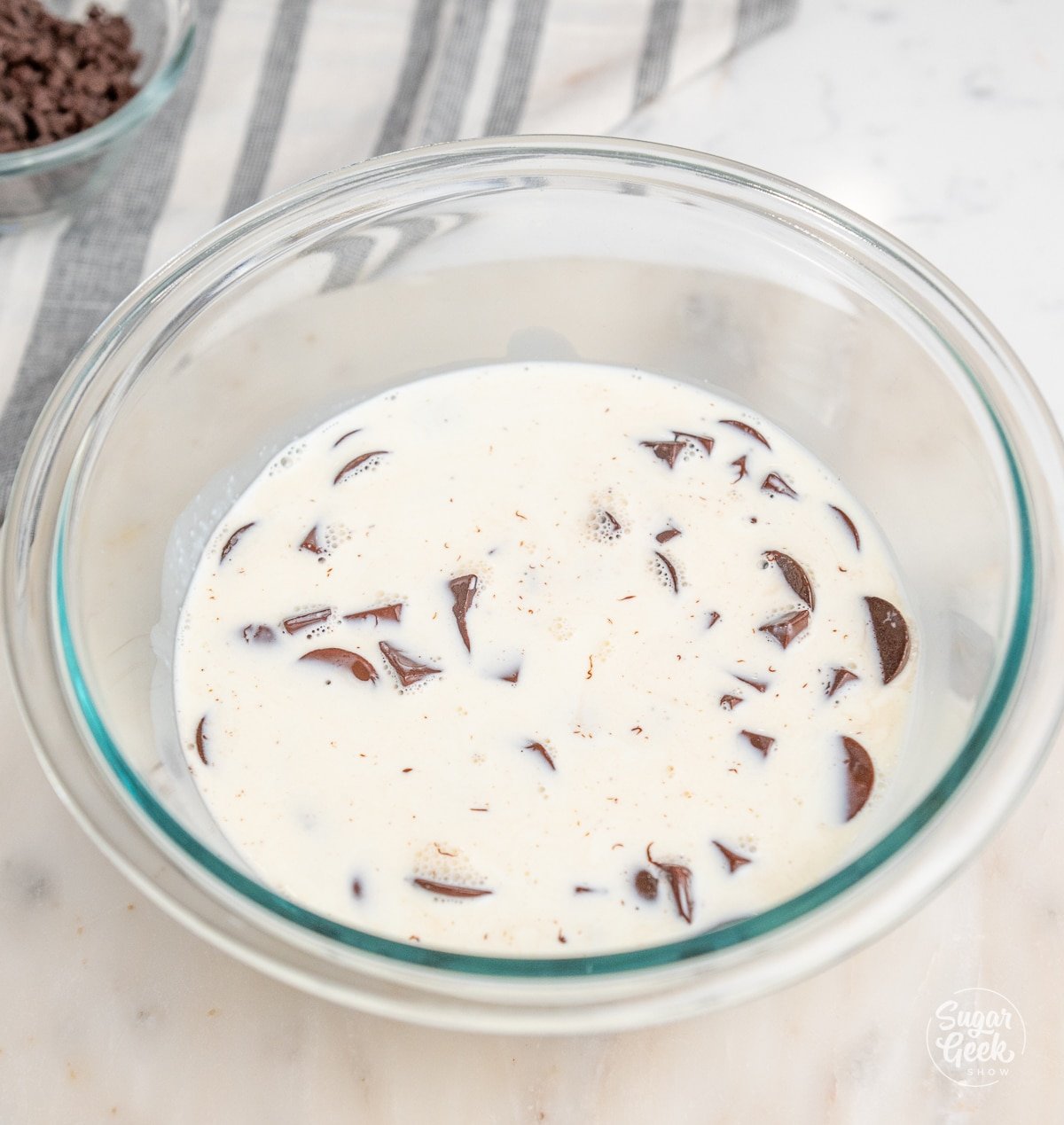
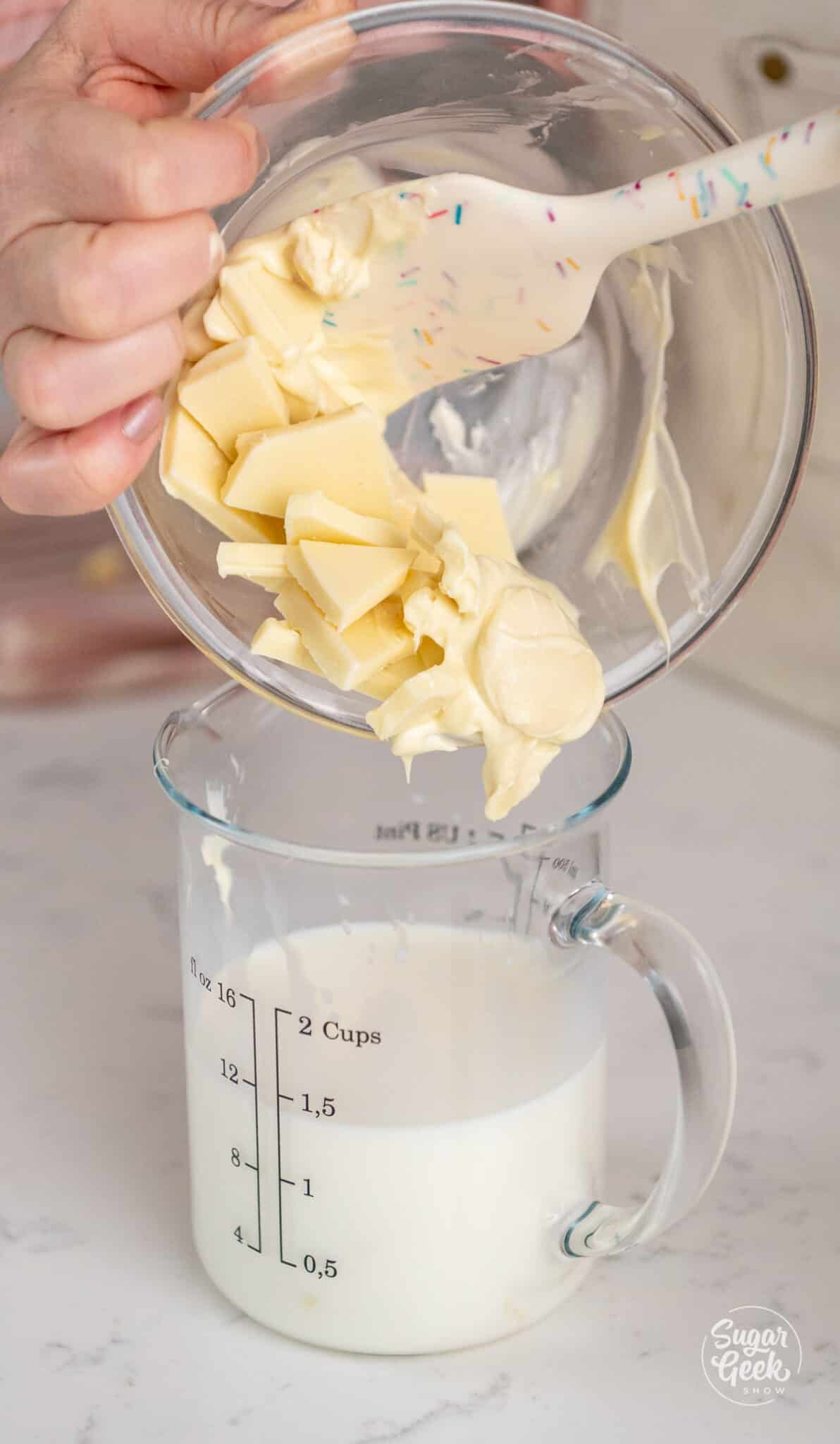
  3. Pour the simmering cream mixture over the chocolate in a medium bowl and let it rest for 5 minutes.
    hot liquid pouring on top of a bowl of chocolate
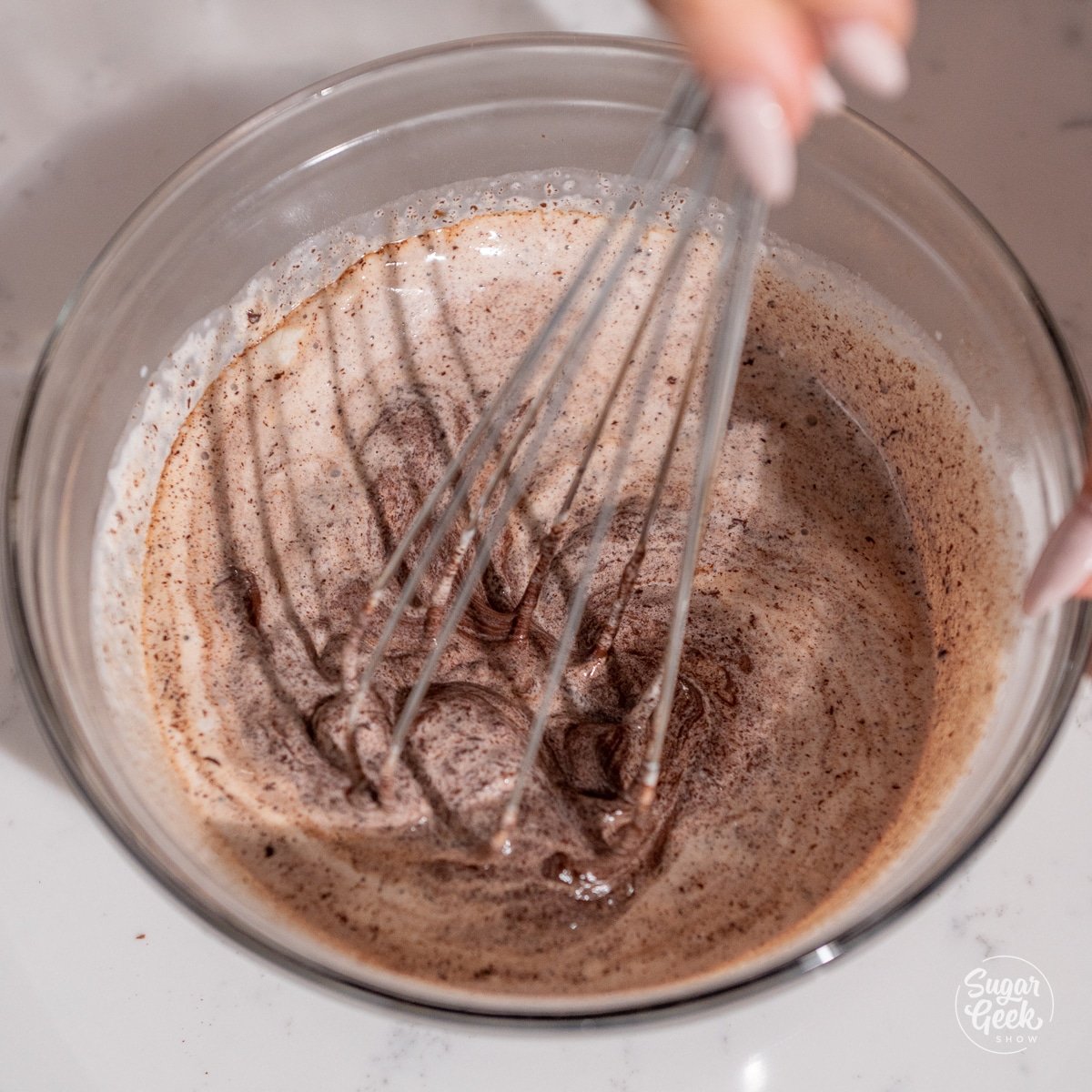
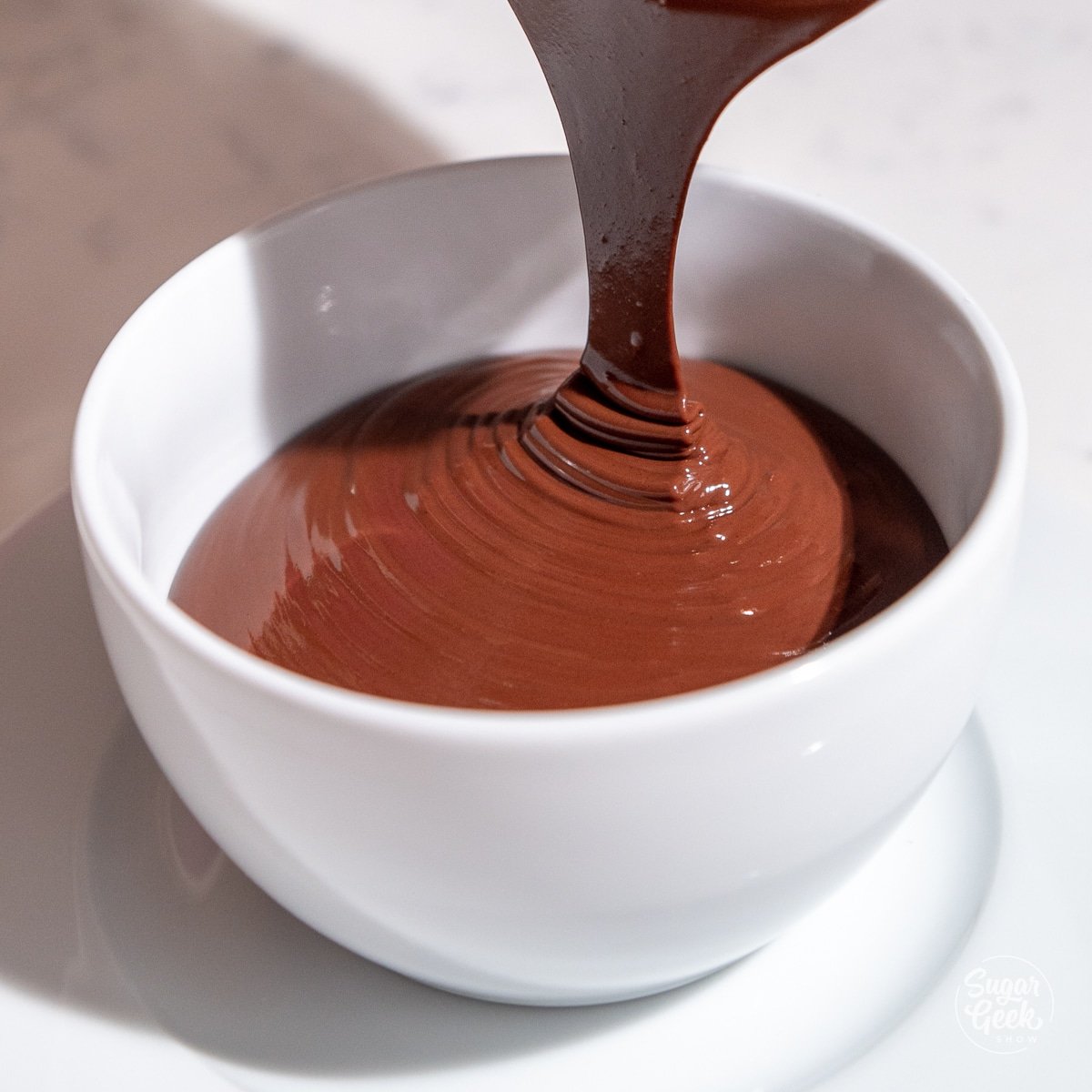
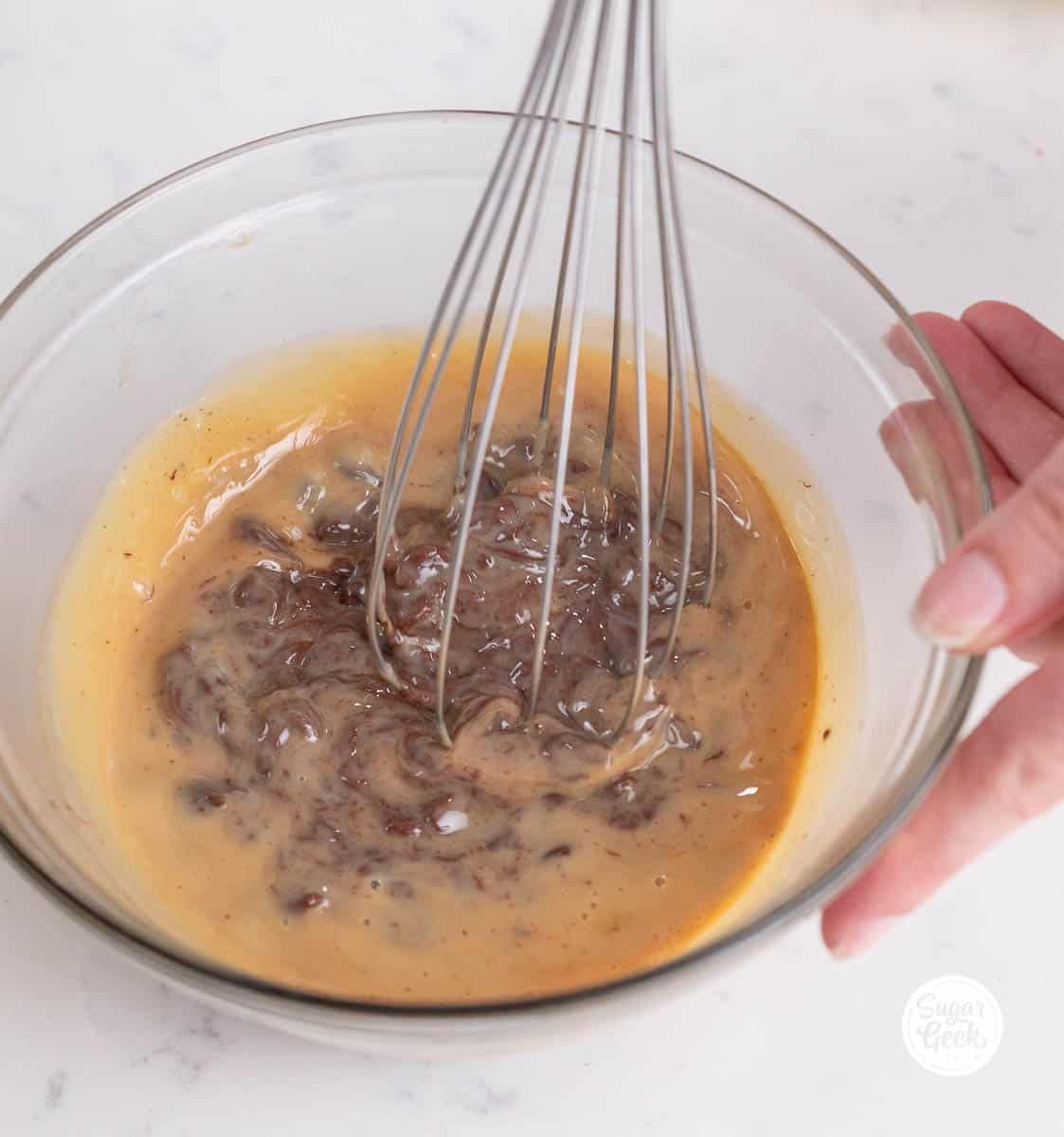
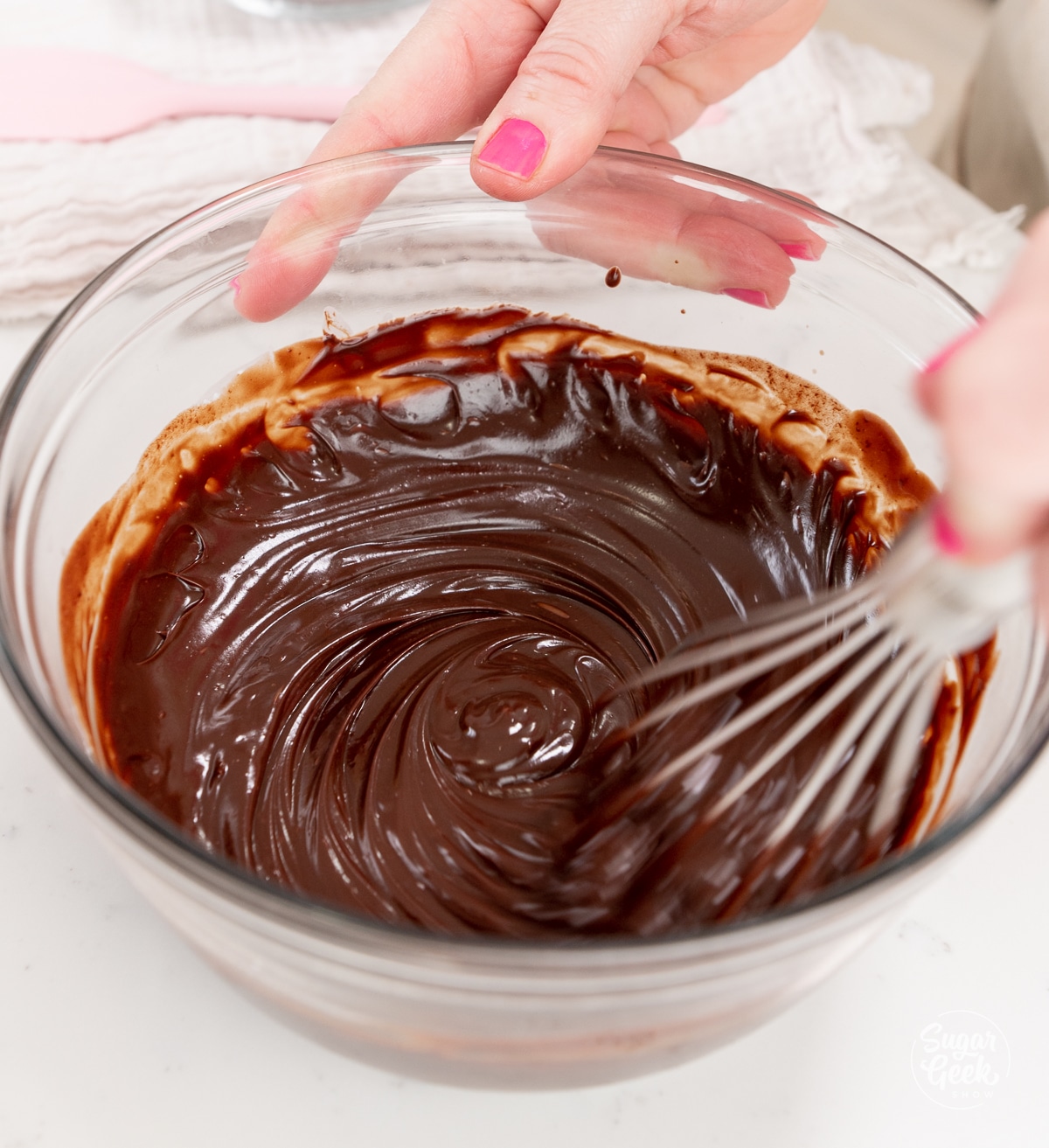
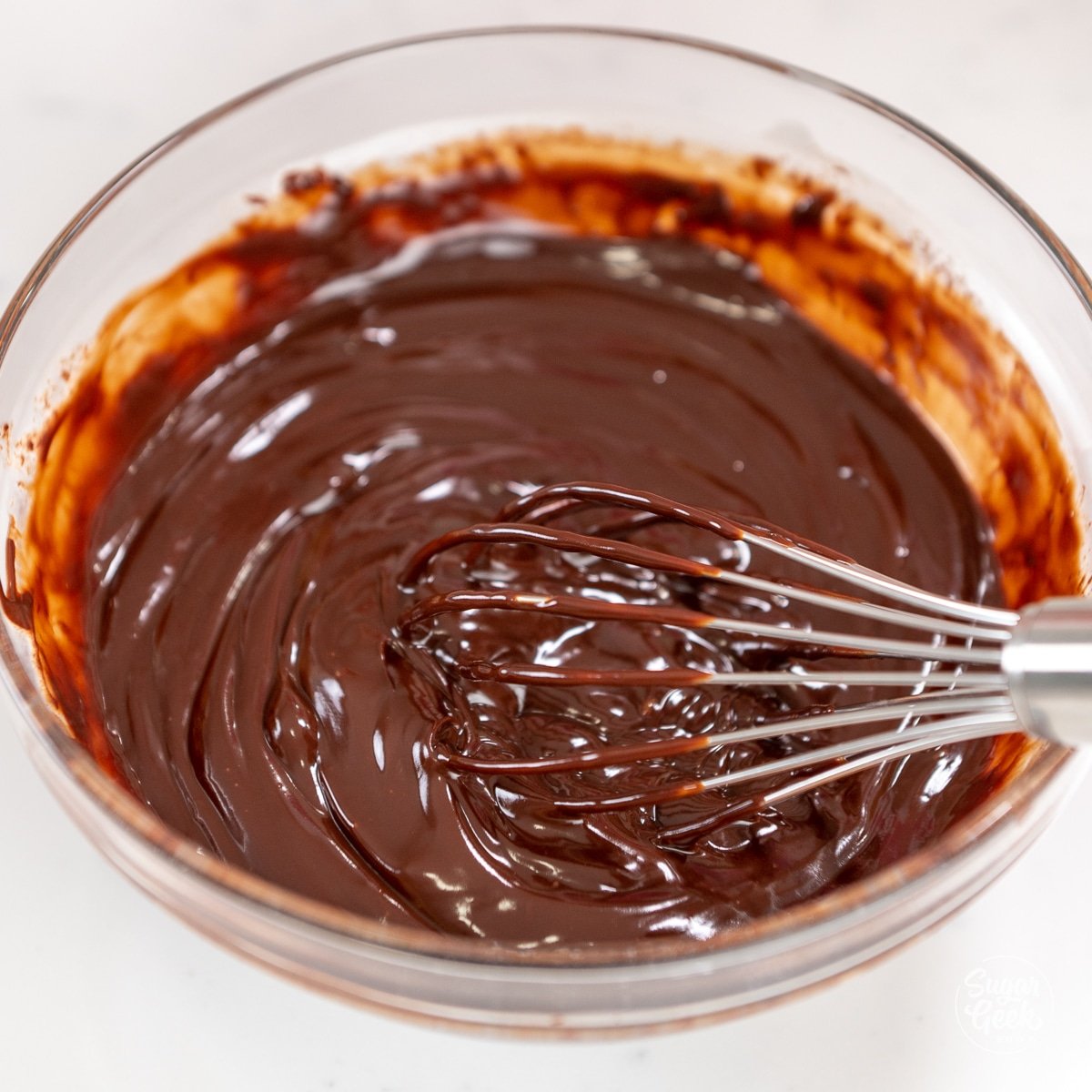
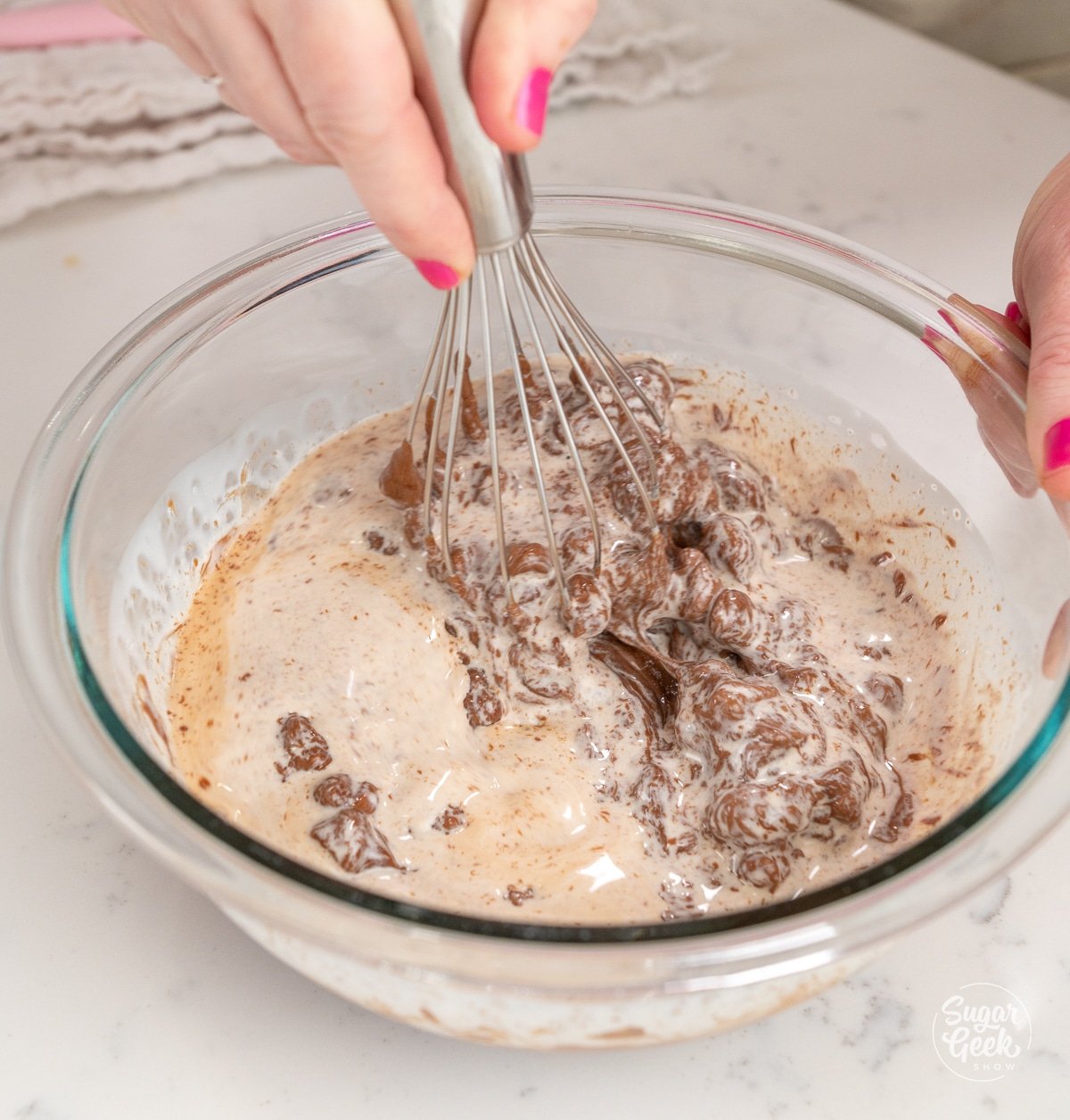
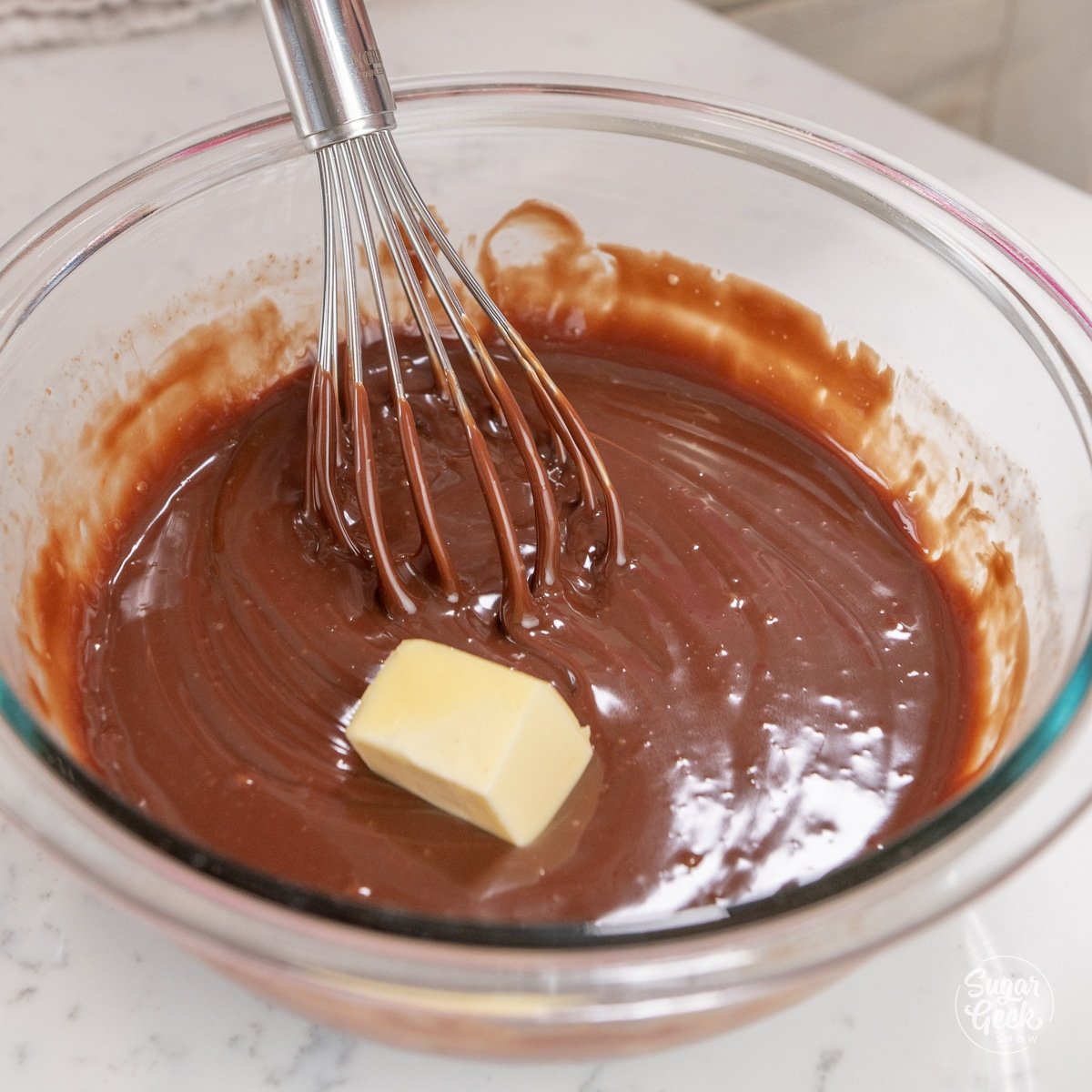
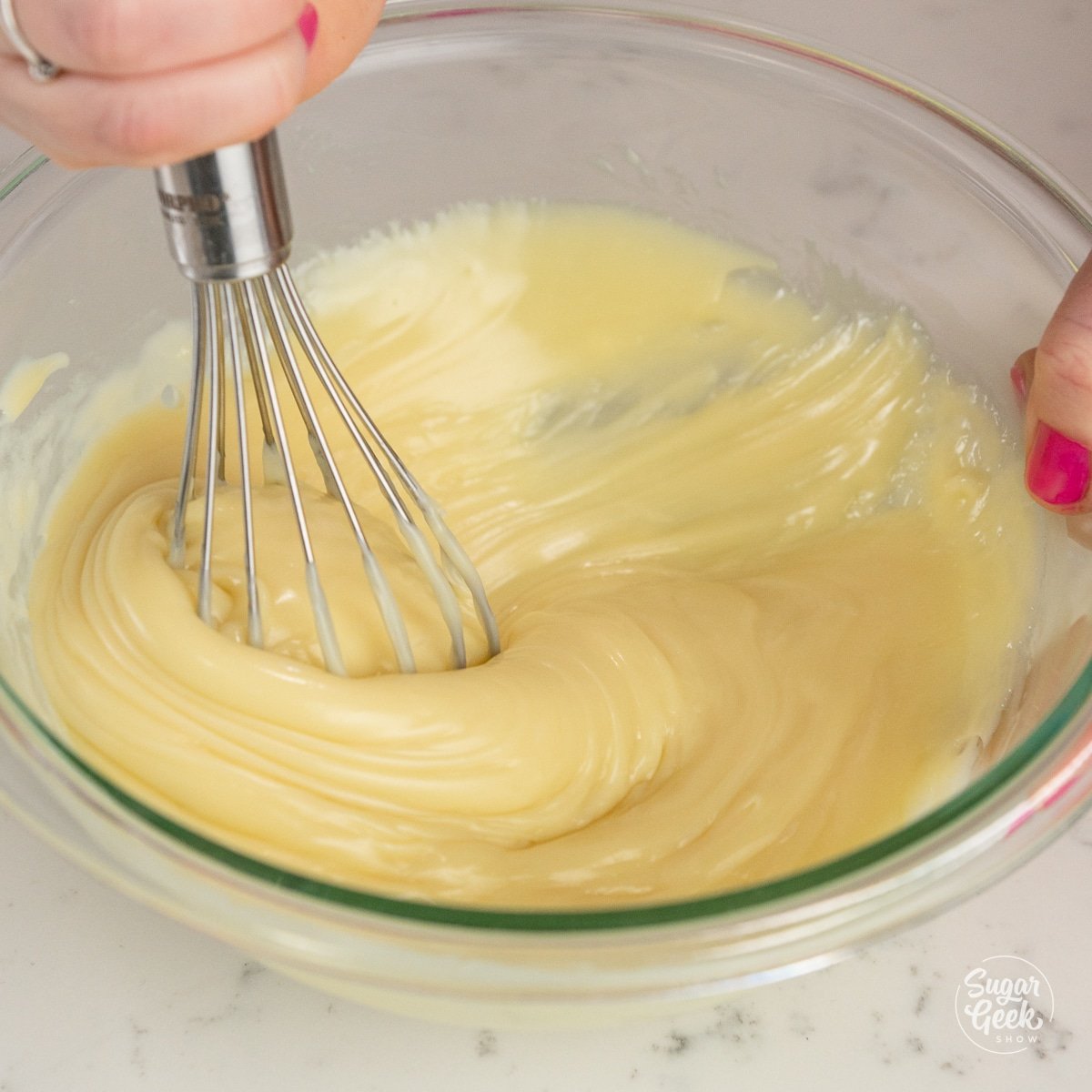
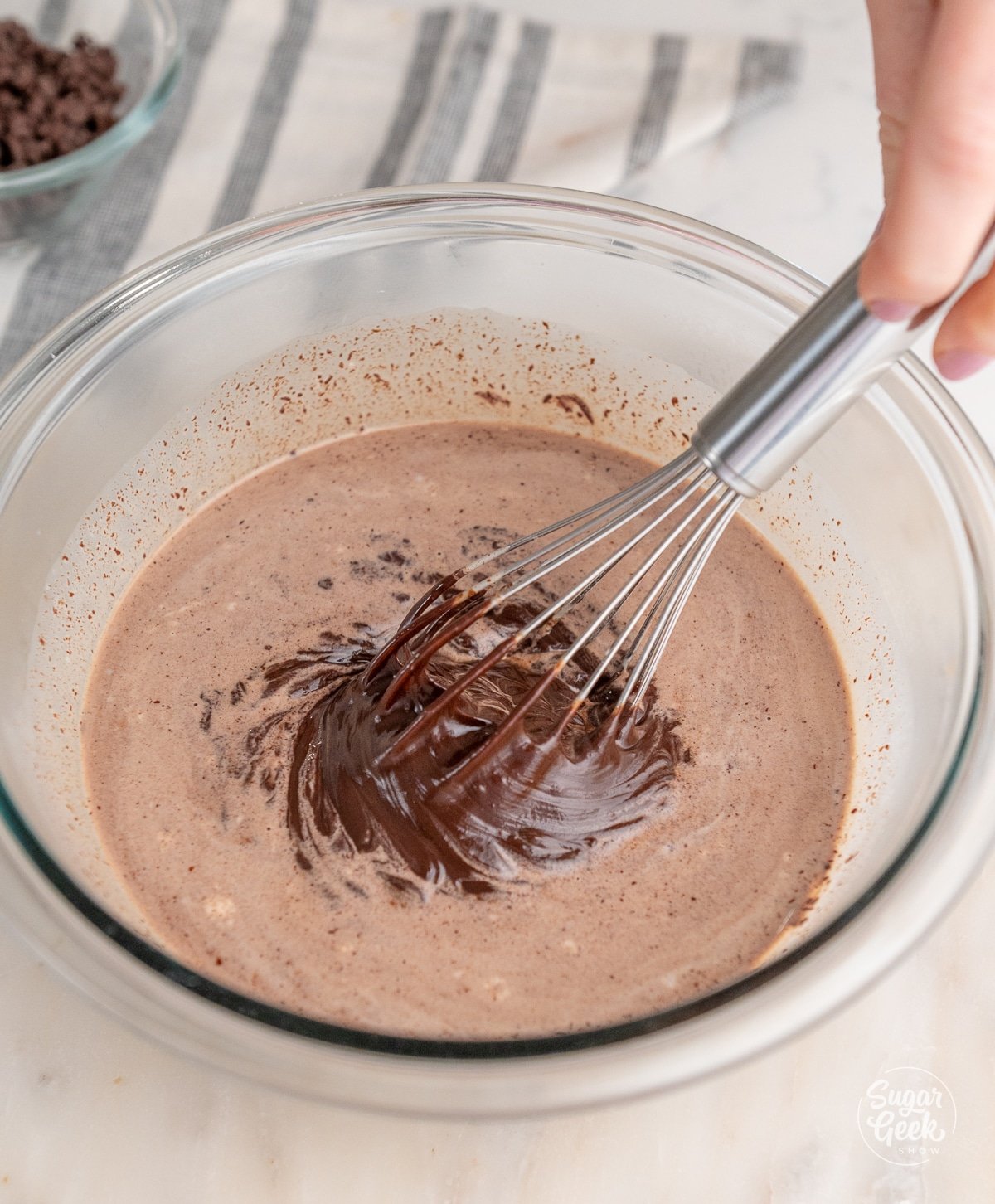
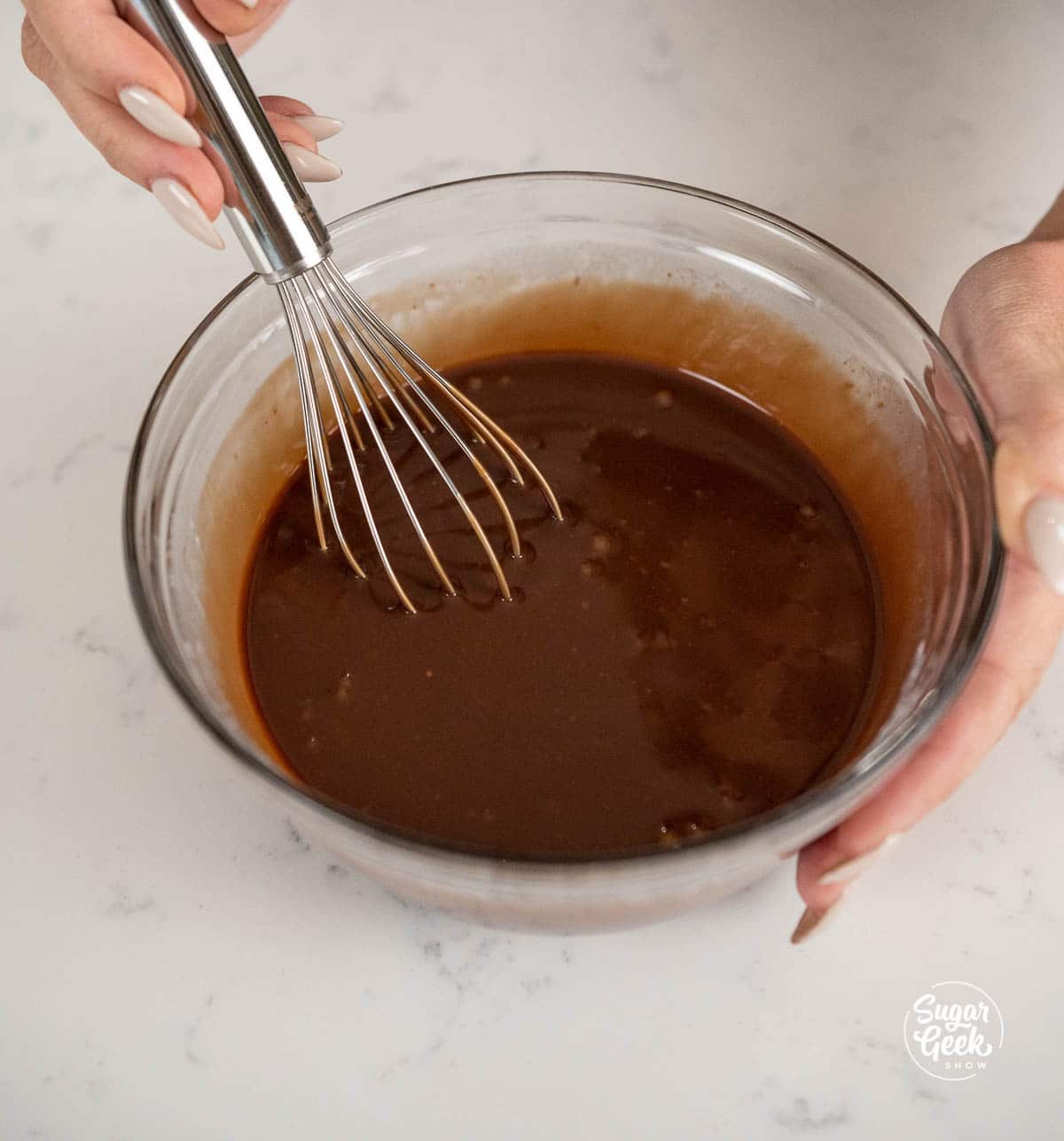
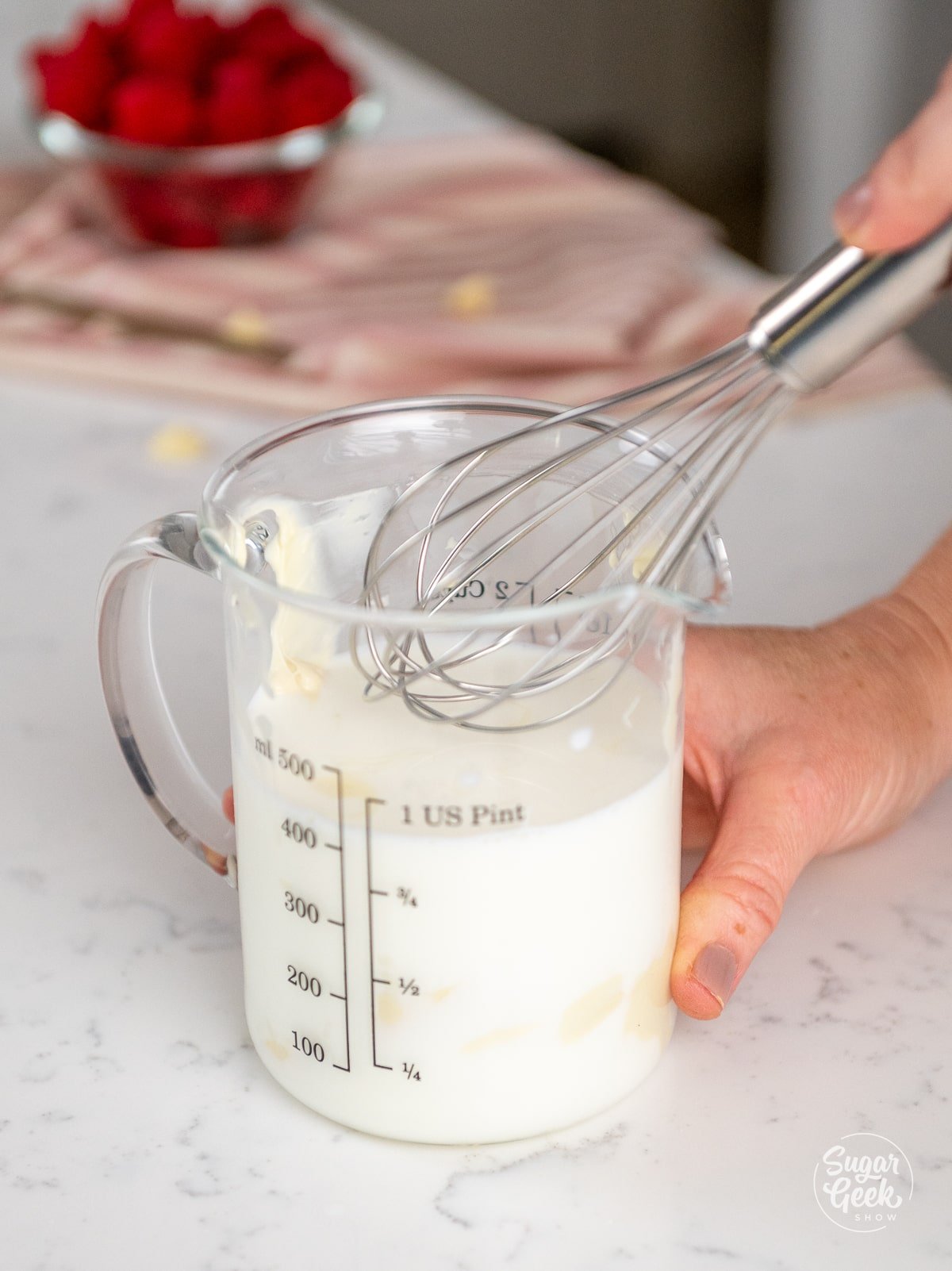
  4. Whisk the sauce mixture until it's smooth and melted.
    hand whisking a bowl of ganache

Soaking the Cake Layers with Irish Cream Sauce

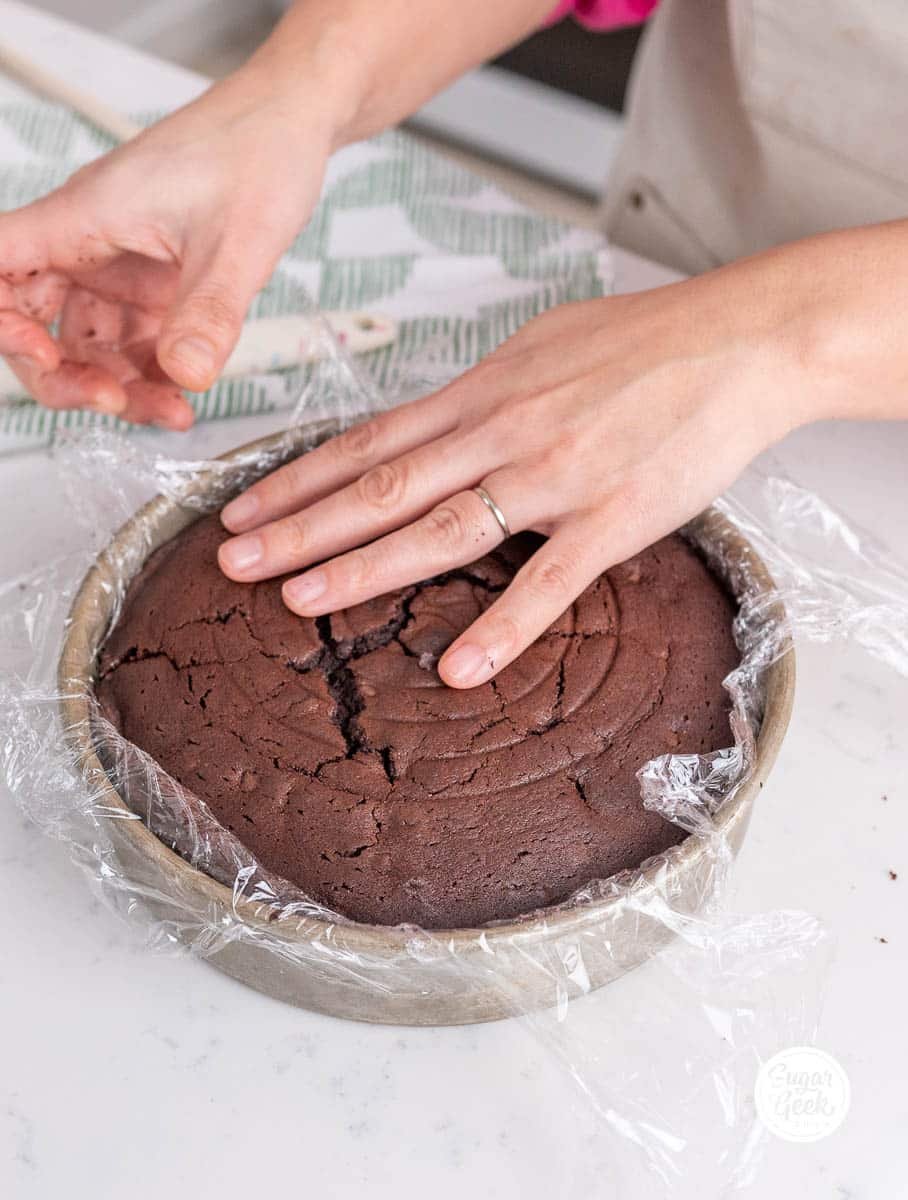
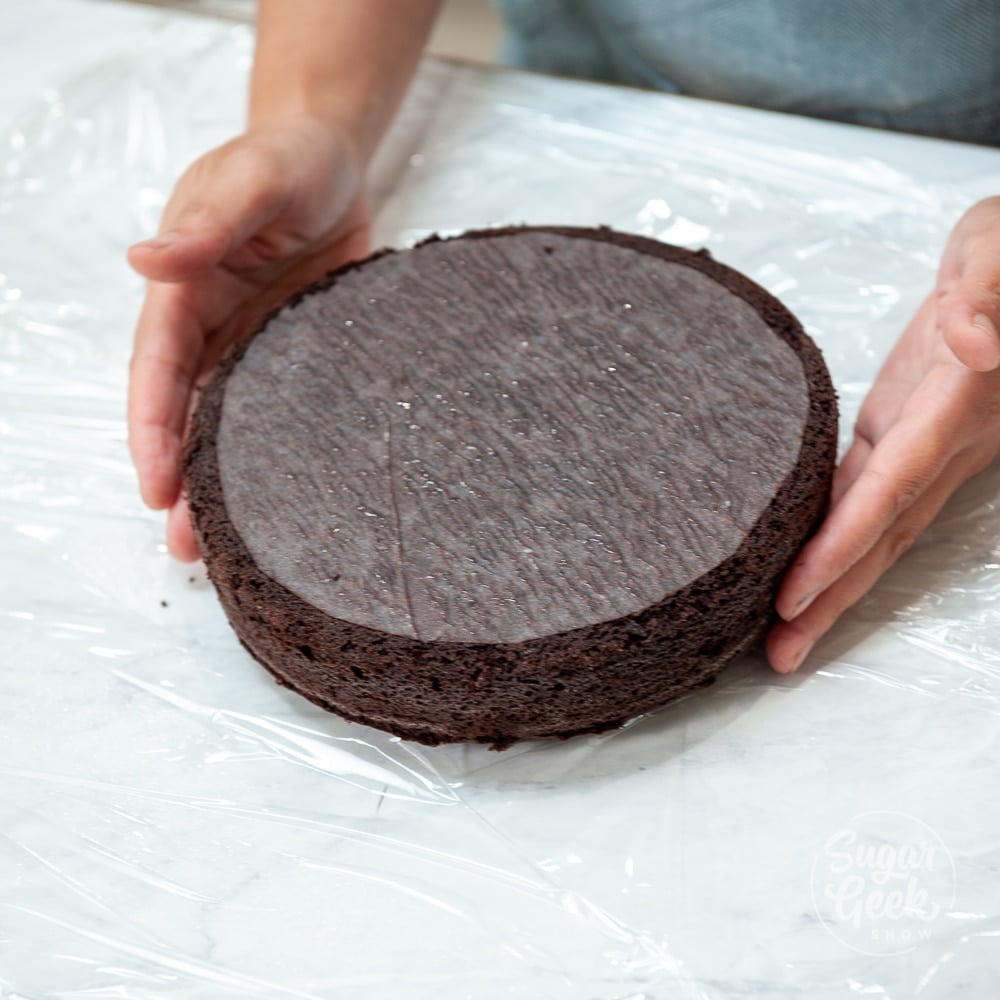
  1. Place plastic wrap into the bottom of your cake pan and set the cooled cake back into the pan. The plastic wrap will keep the cake from sticking when it's time to remove them later on.
    hands placing plastic wrap inside the pan and the cake on top
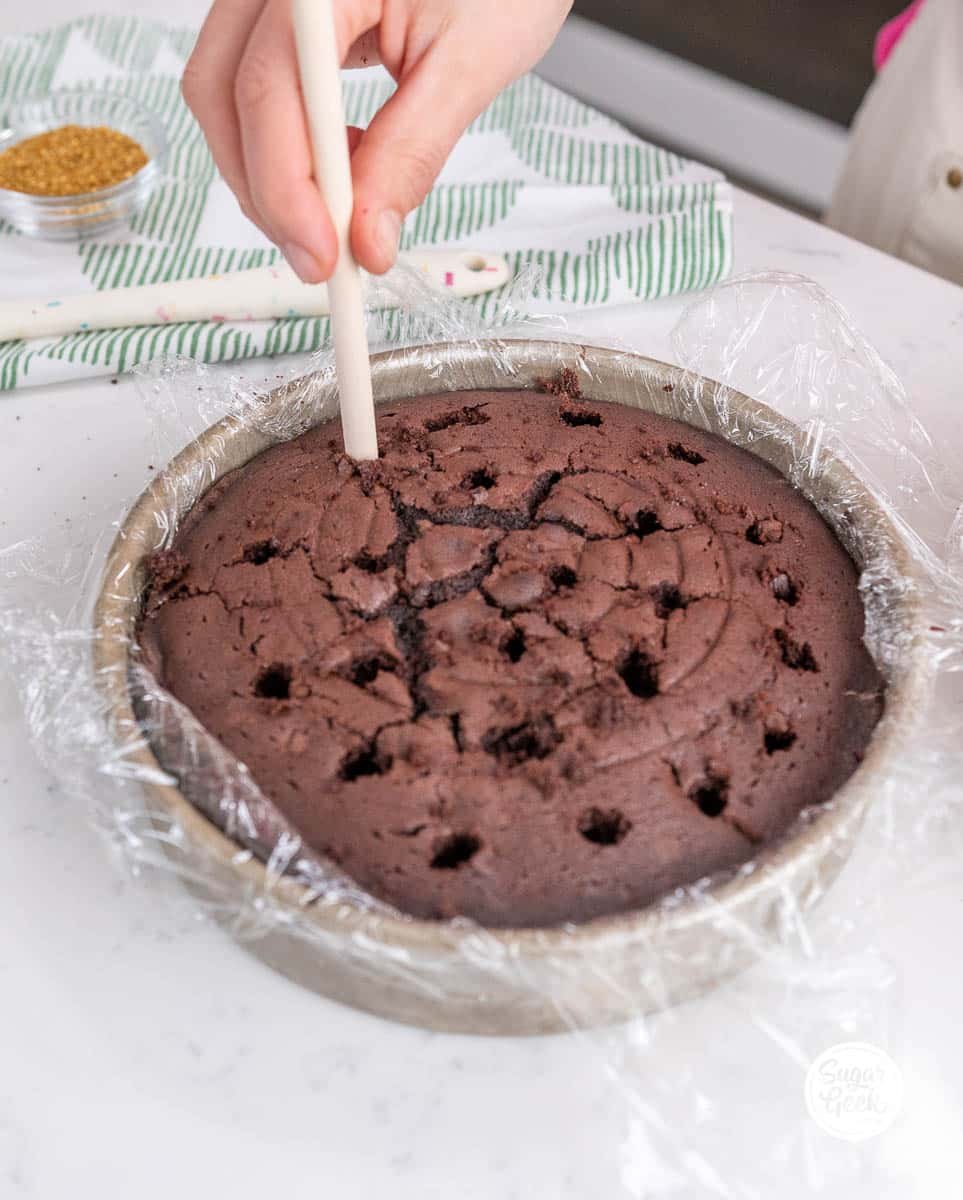
  2. Poke holes into the top of the cake with the end of a wooden spoon or dowel.
    hands poking holes into the top of the chocolate cake
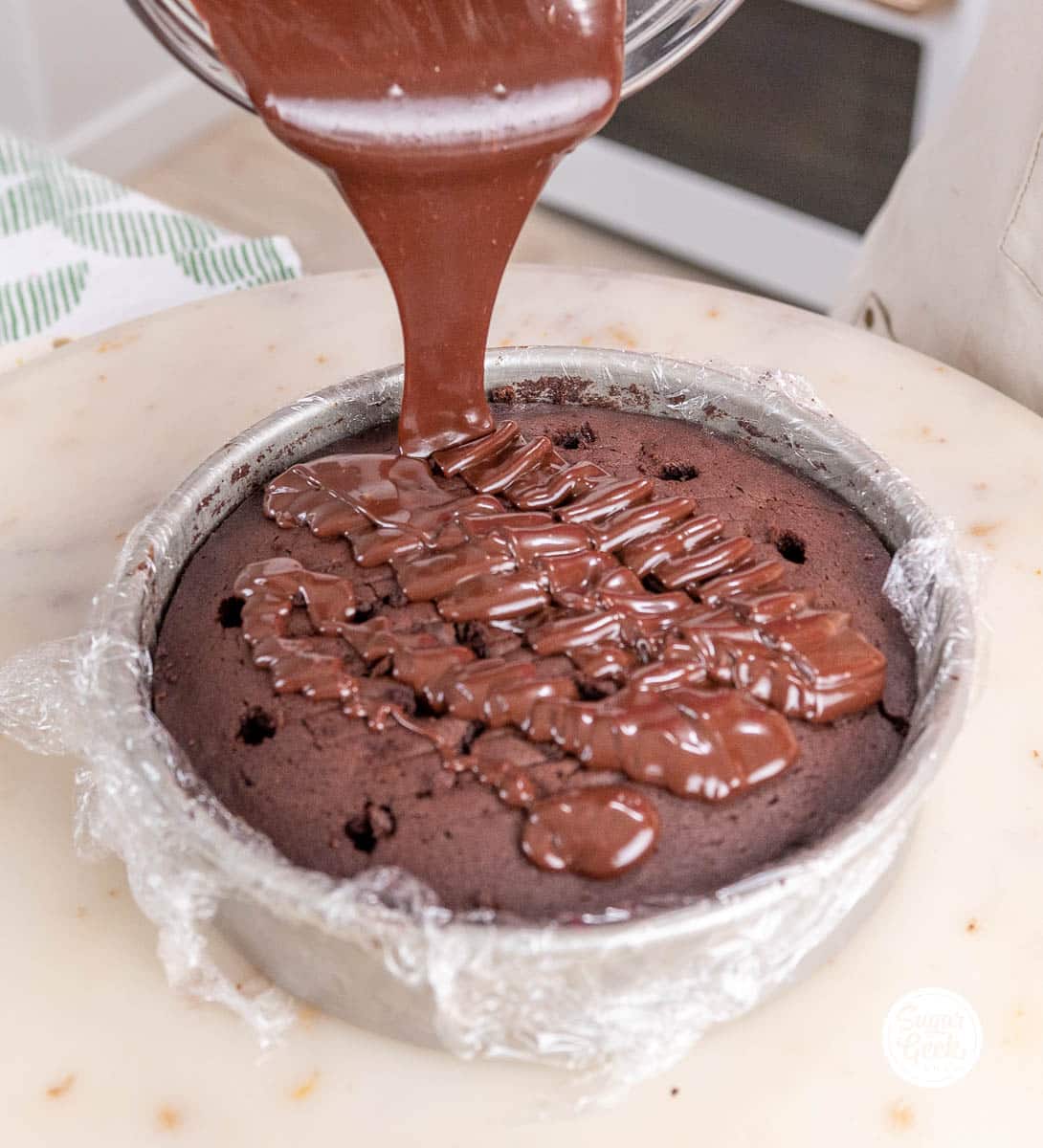
  3. Drizzle the warm sauce all over the cake to soak into the holes and use a spatula to smooth out the top.
    drizzling chocolate sauce into the holes of a chocolate cake
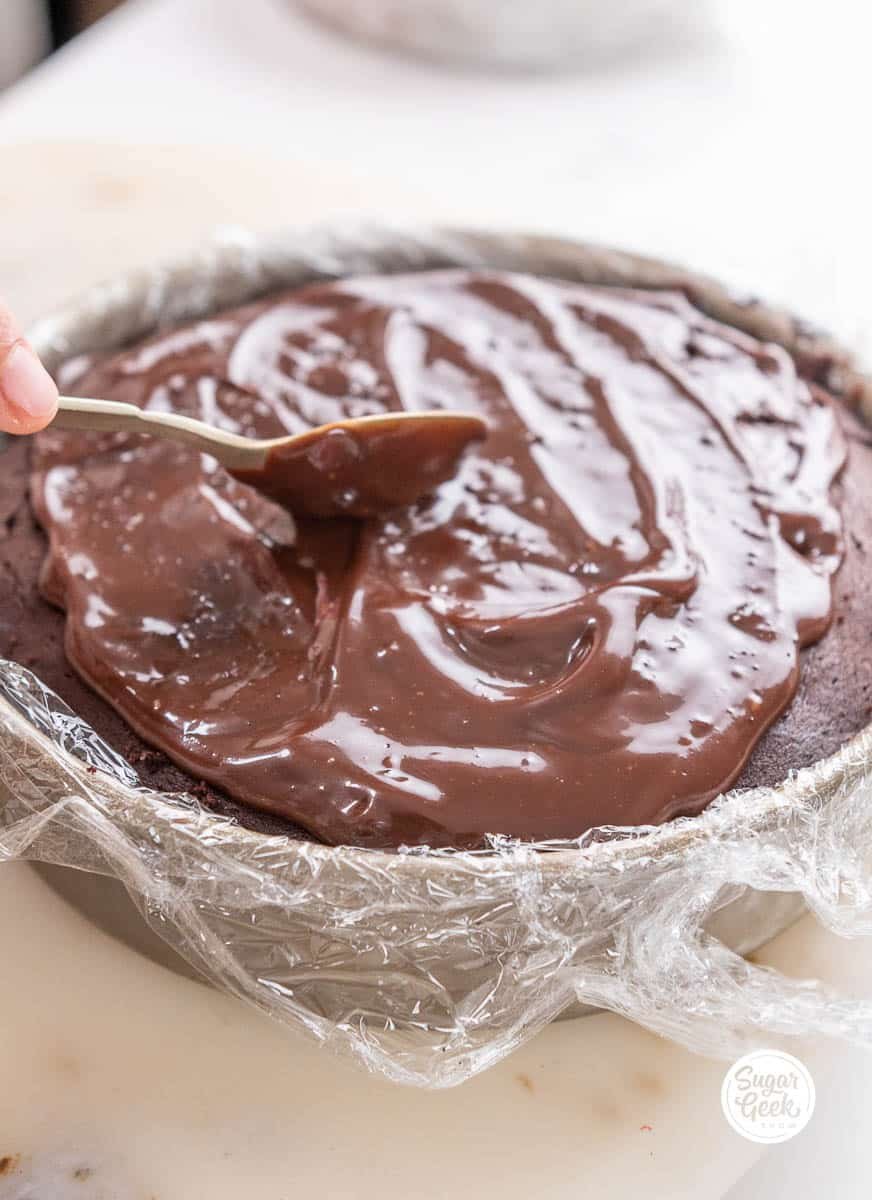
  4. At this point, you need to freeze the cakes for two hours or let them refrigerate overnight to let the cakes fully cool down. This will give you enough time to make the ganache frosting and caramel sauce.
    hand smoothing out the chocolate glaze with a spoon

Making the White Chocolate Ganache

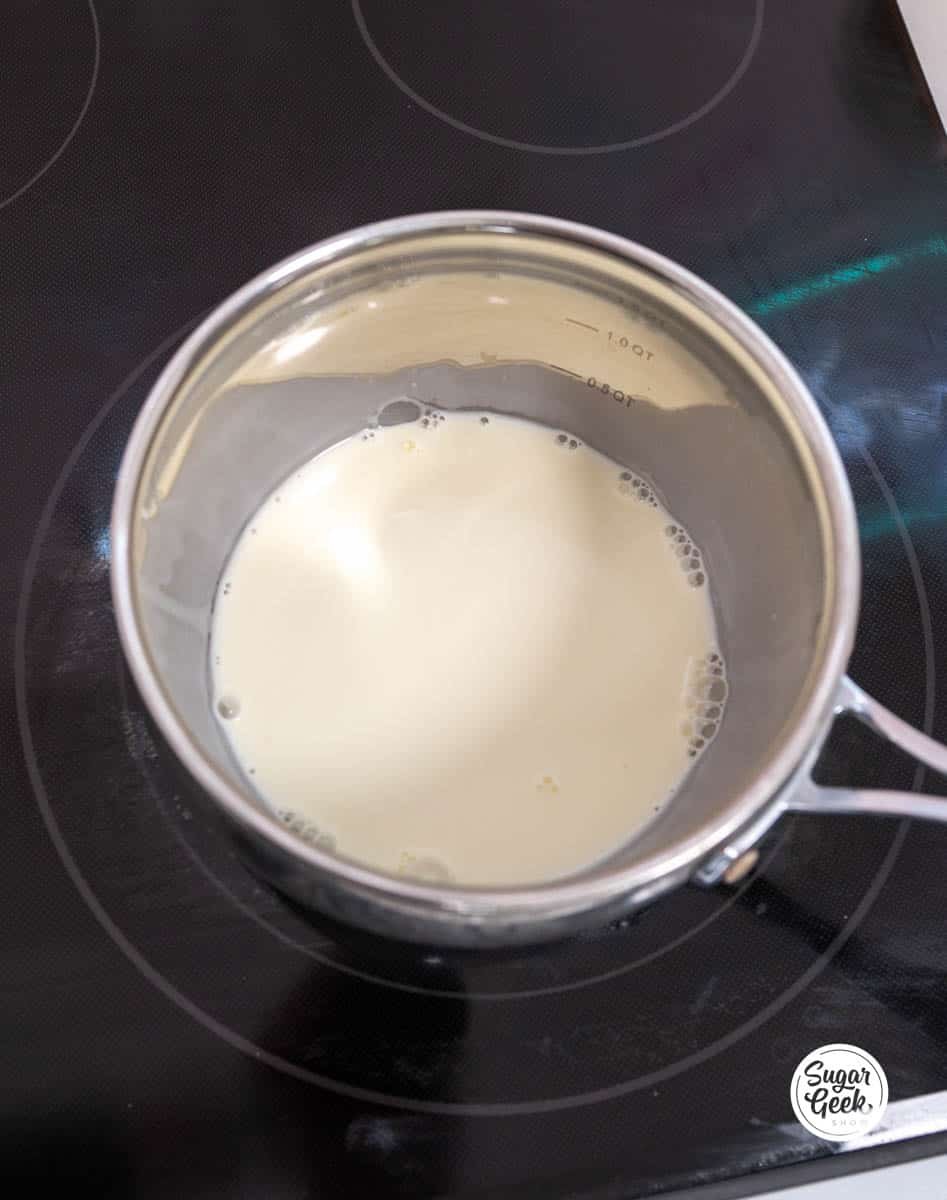
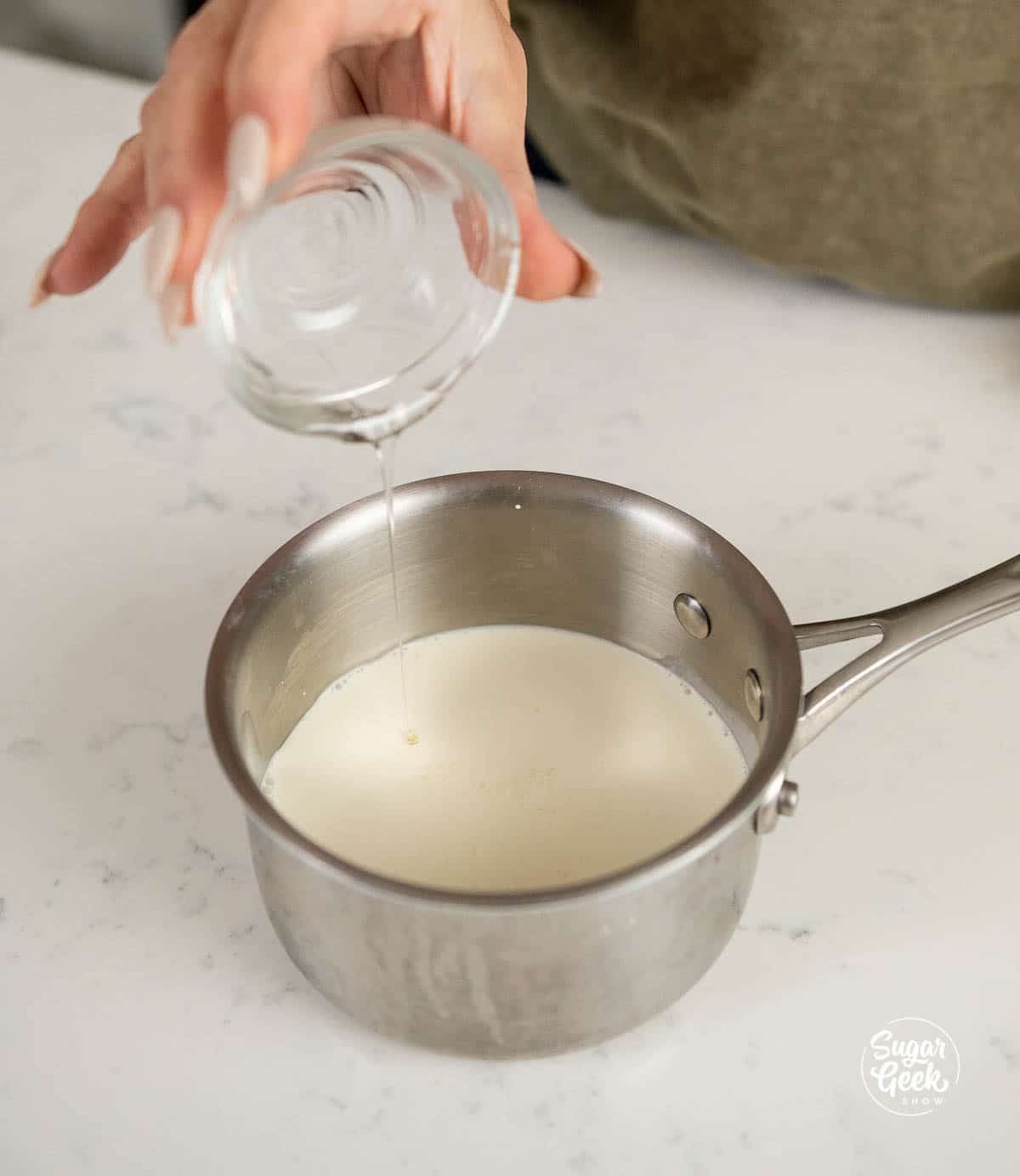
  1. Heat up the heavy cream and Bailey's over medium heat in a saucepan until simmering, but not boiling.
    cream heating up in a pot on the stove
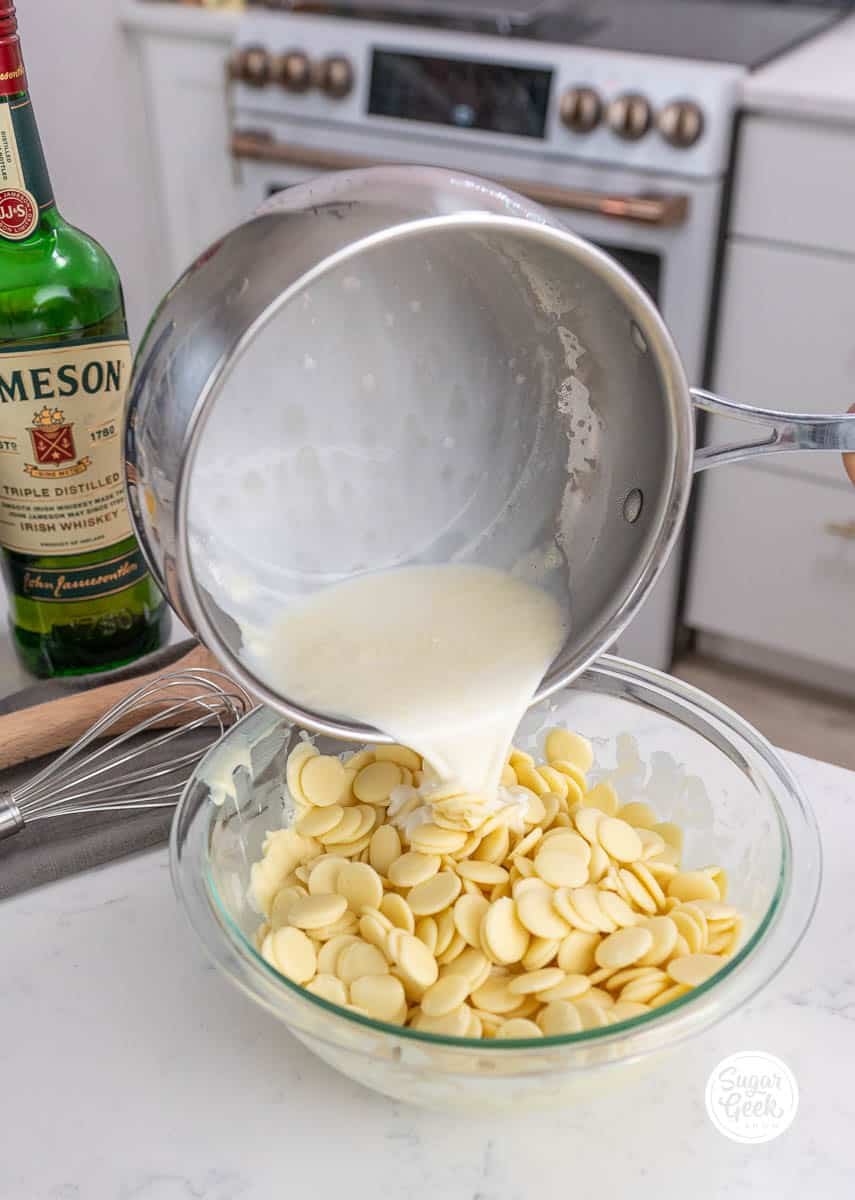
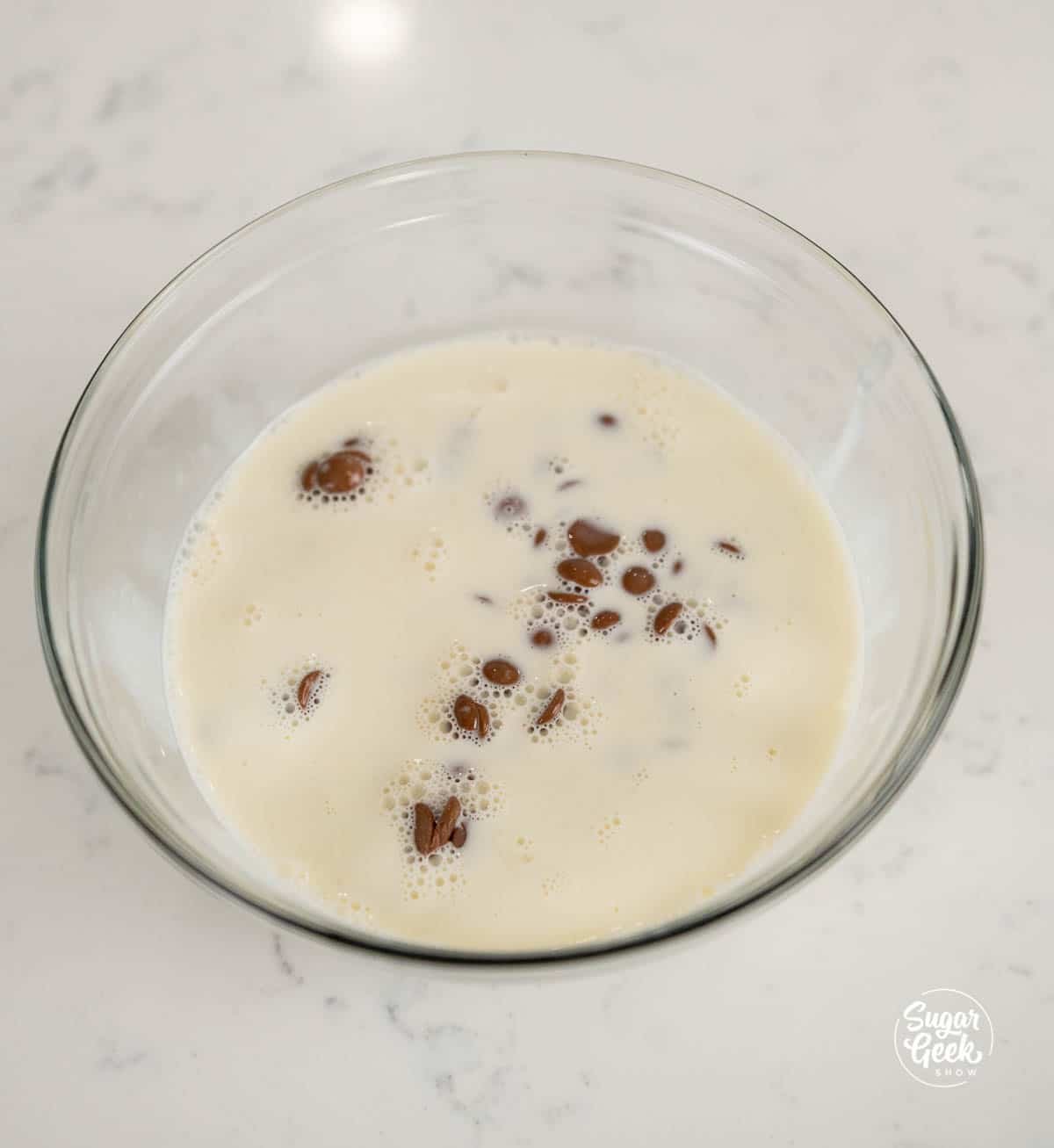
  2. Pour the hot mixture over your white chocolate. Let it sit for about 5 minutes to melt the chocolate.
    hot cream pouring from a saucepan into a bowl of white chocolate
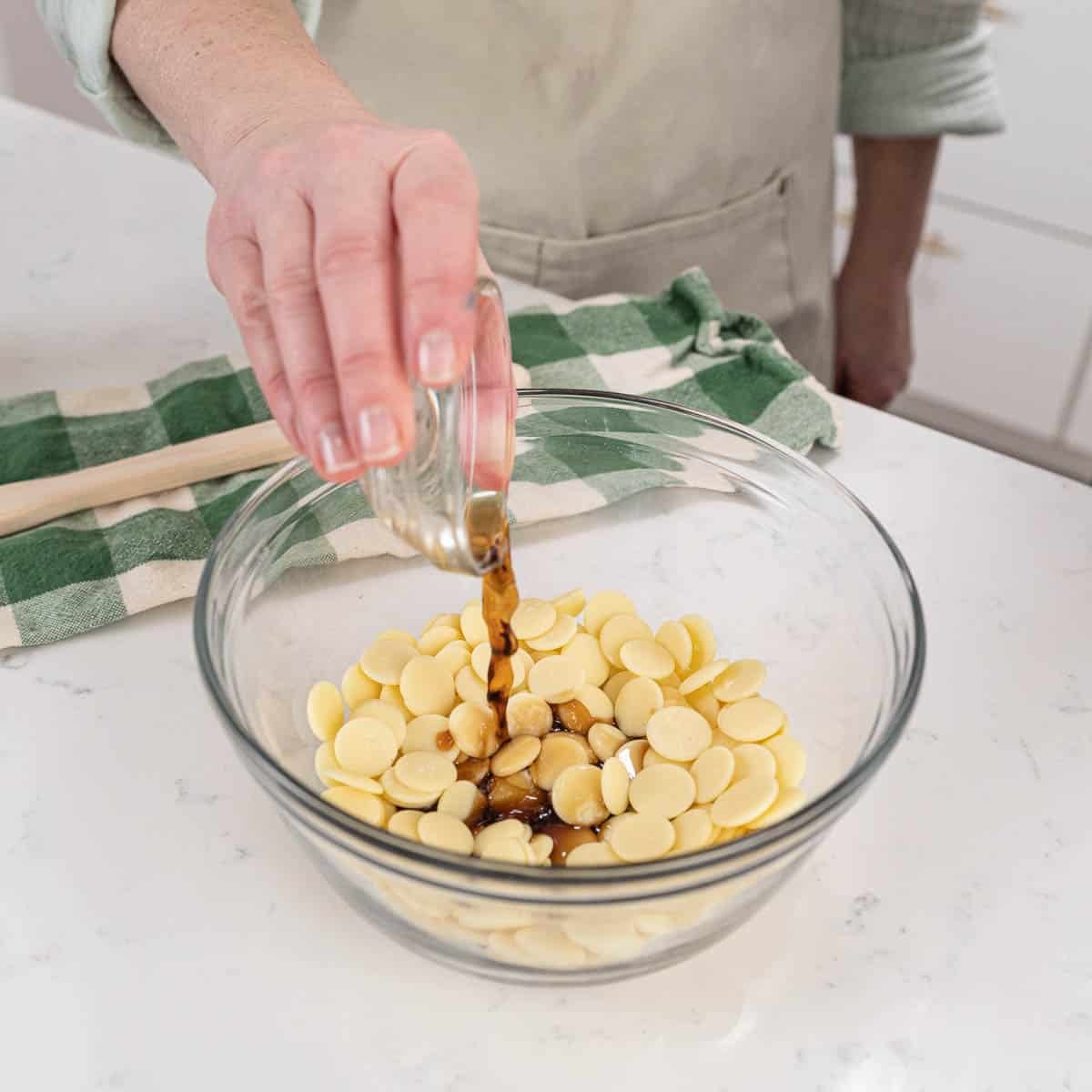
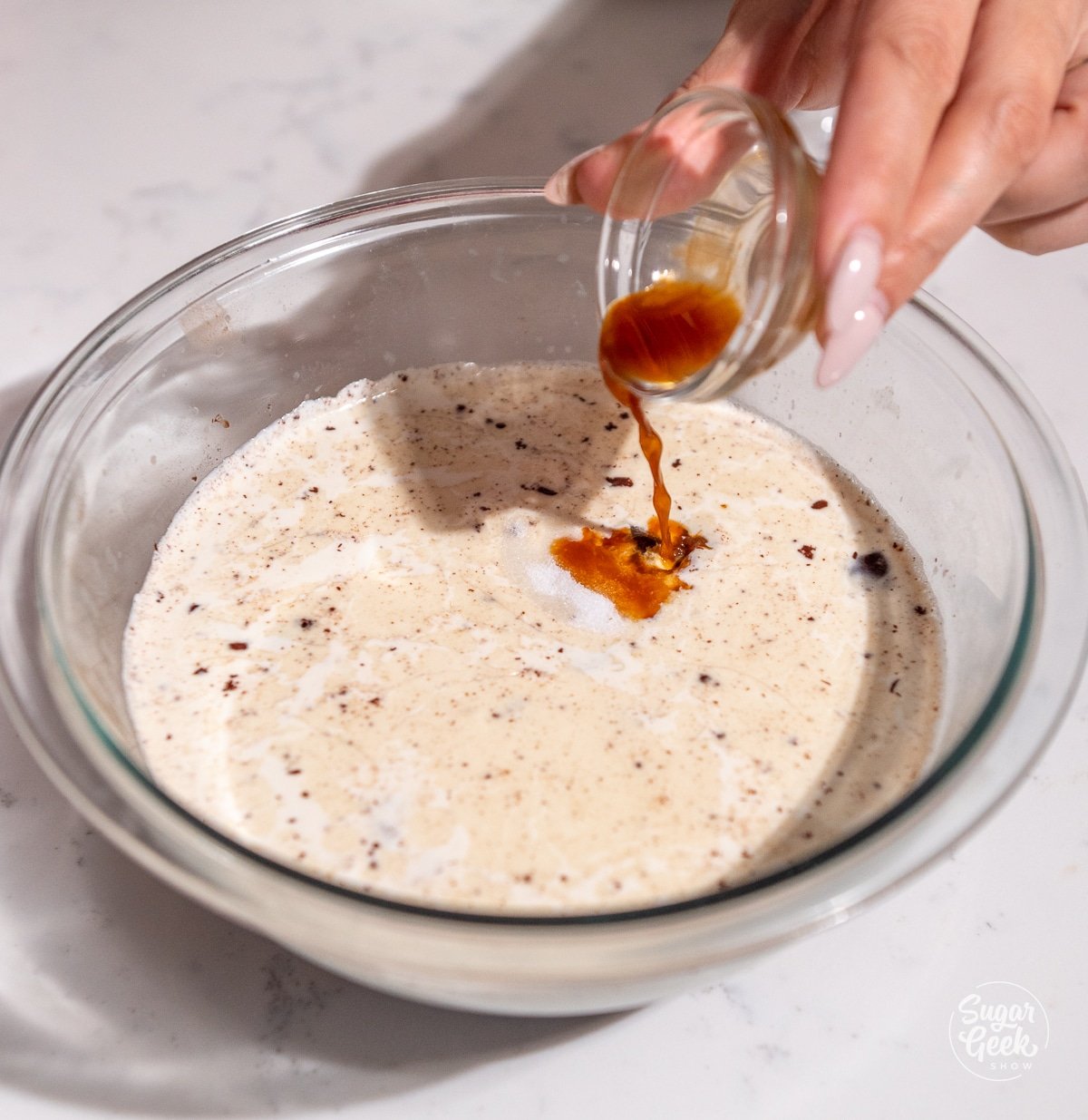
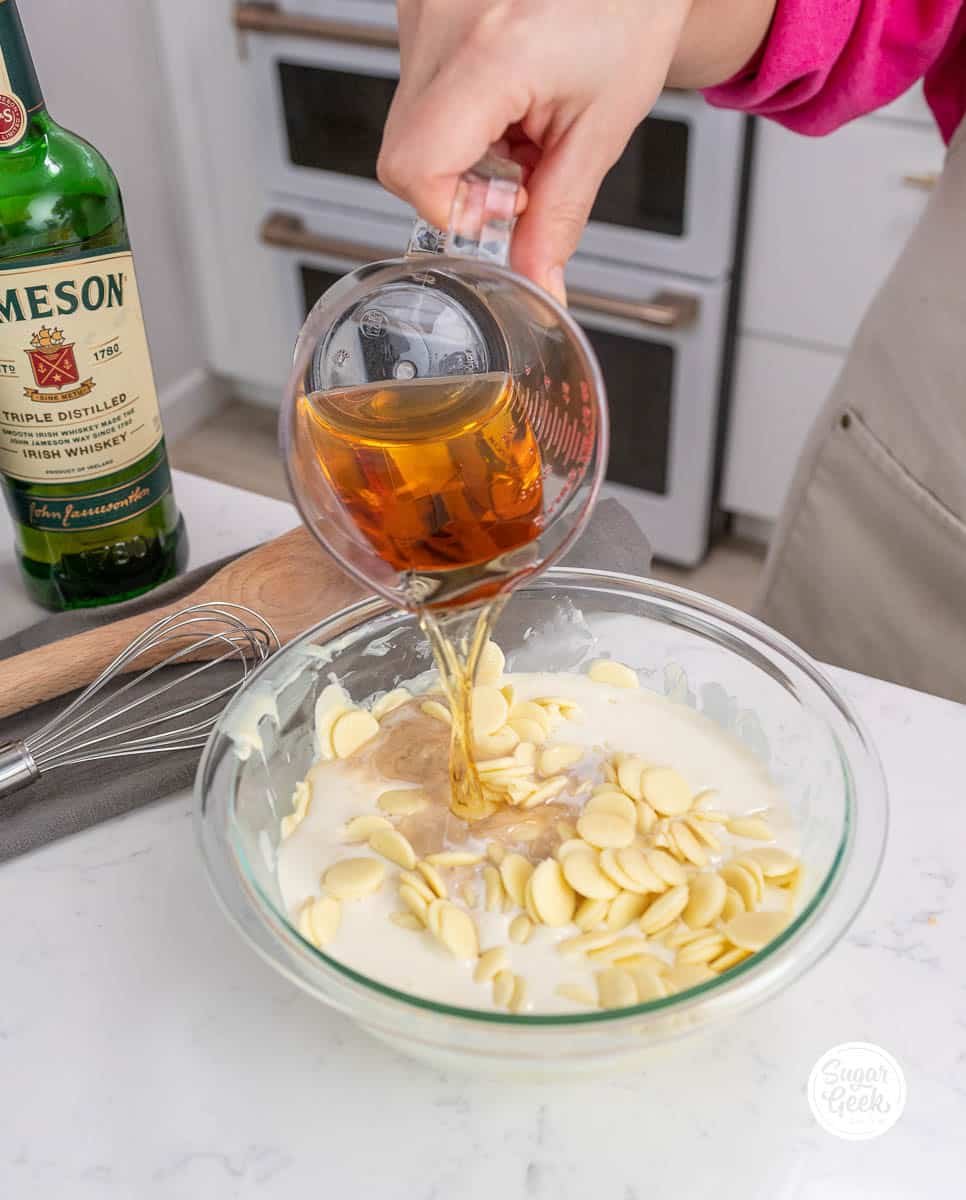
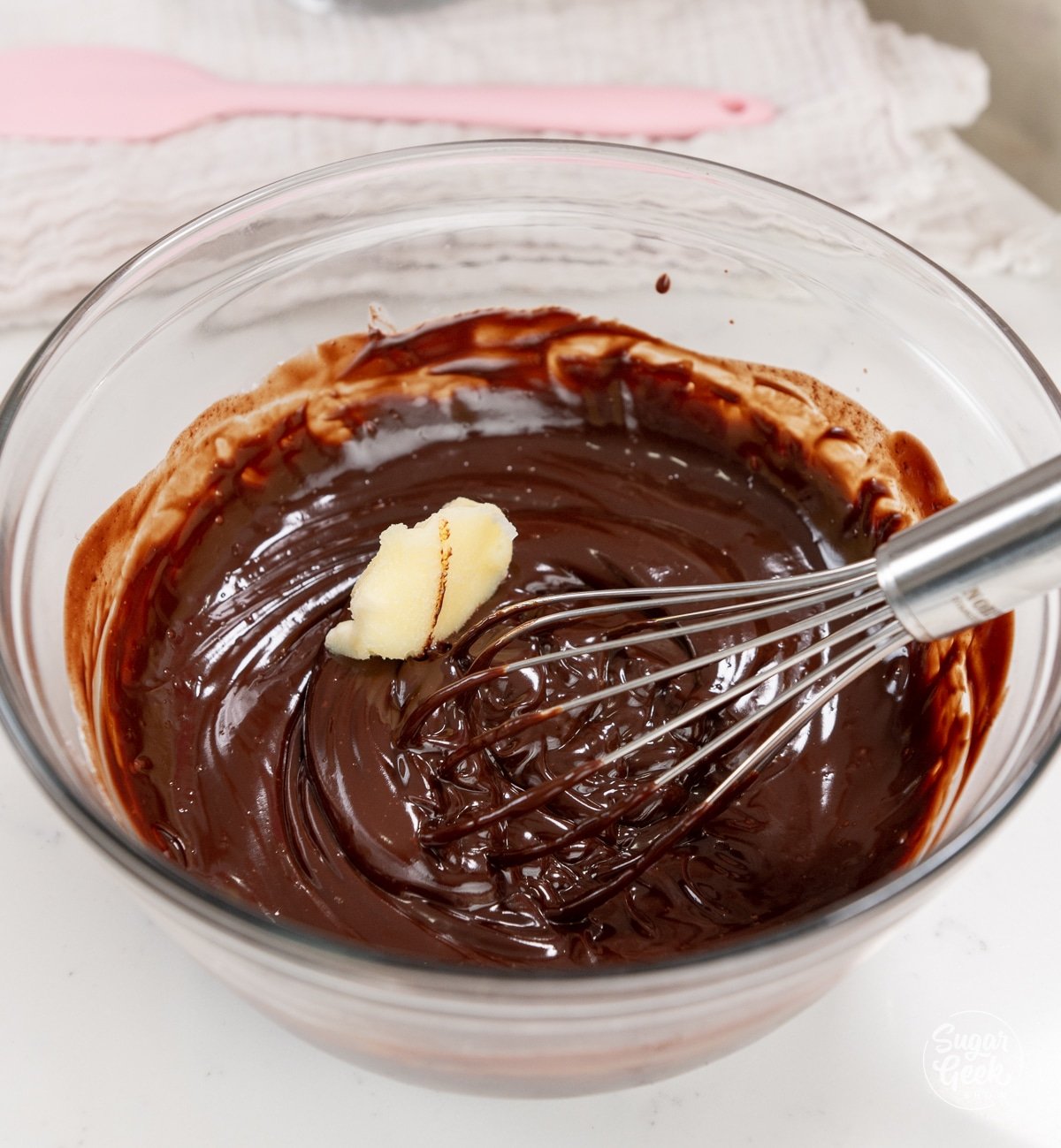
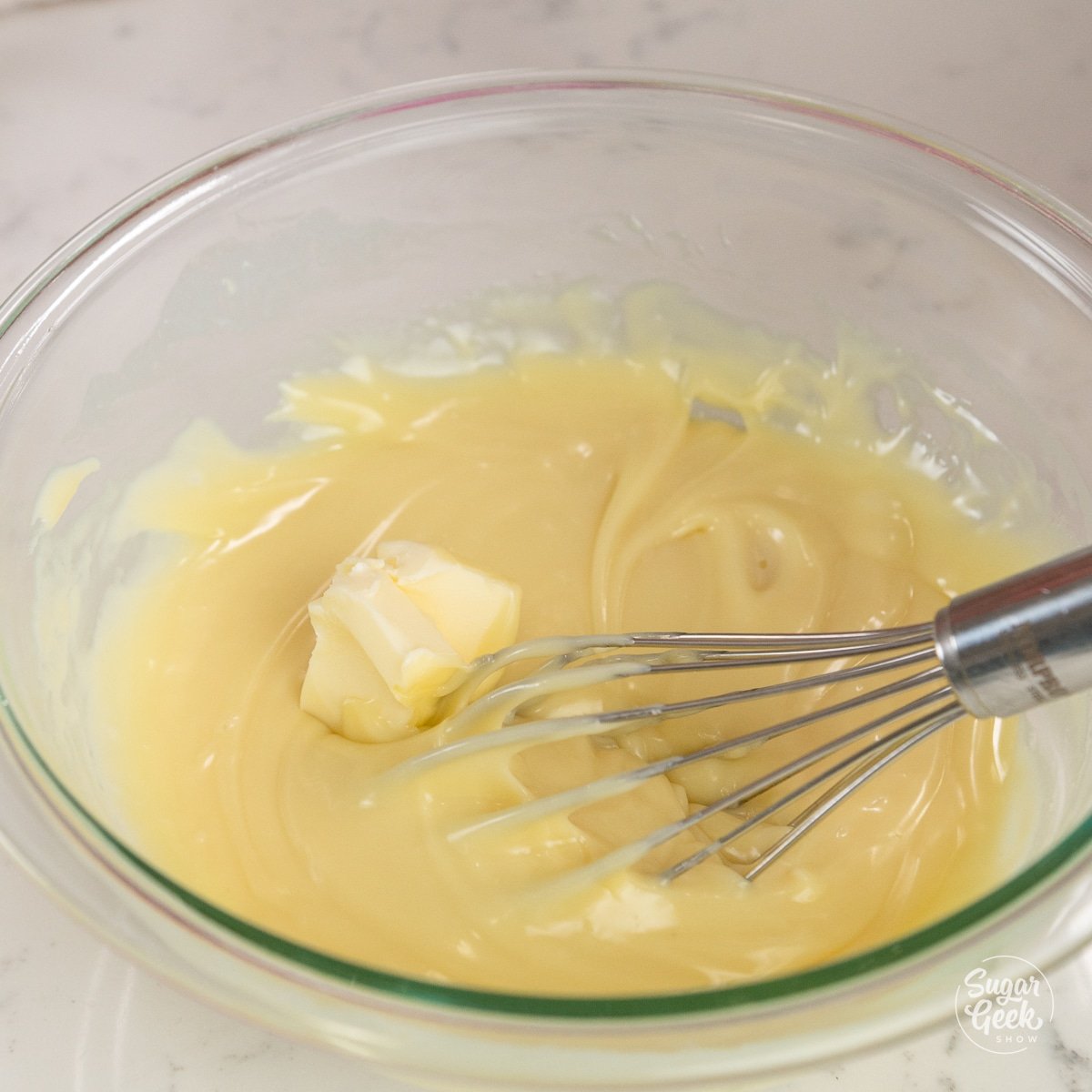
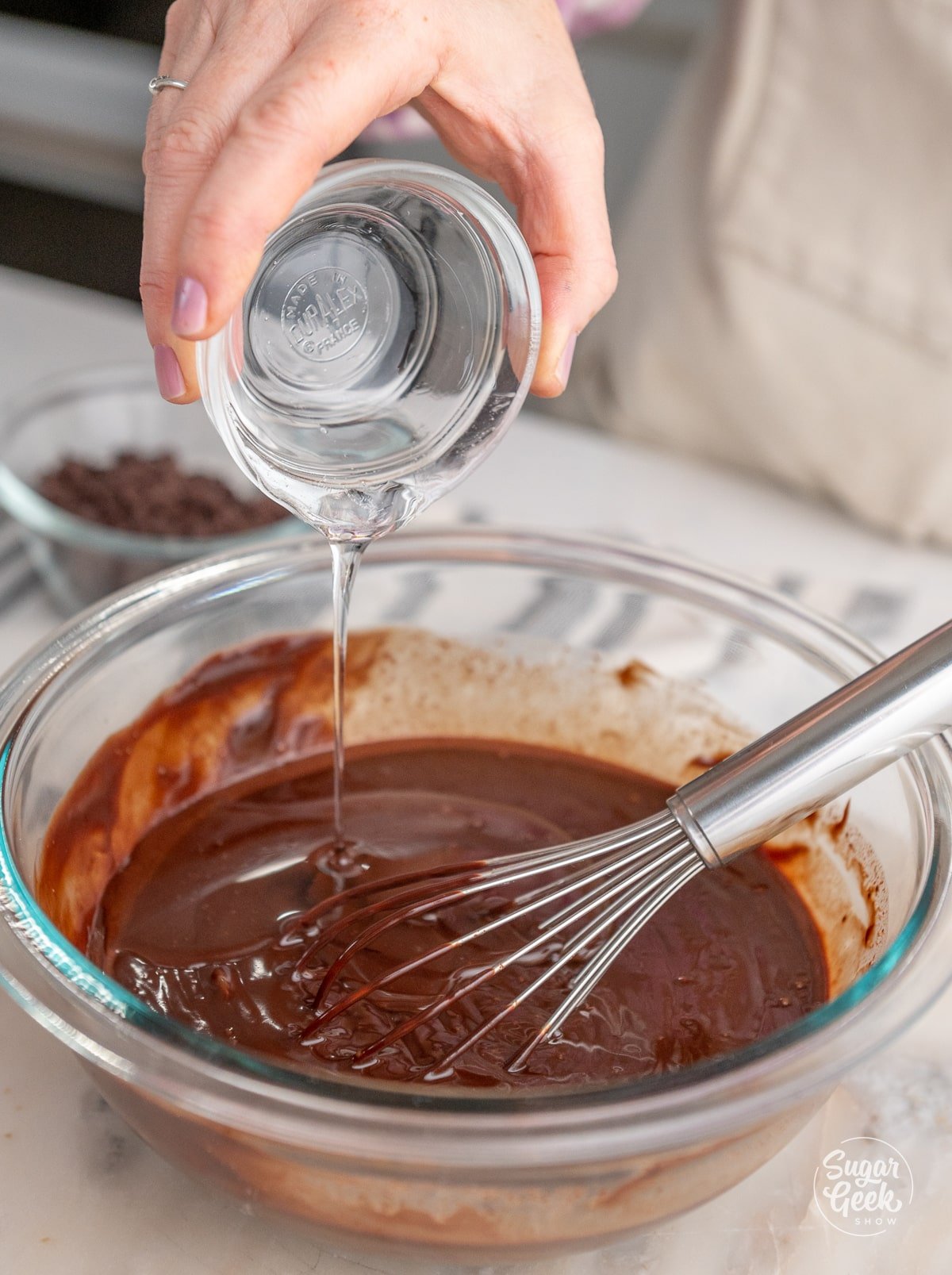
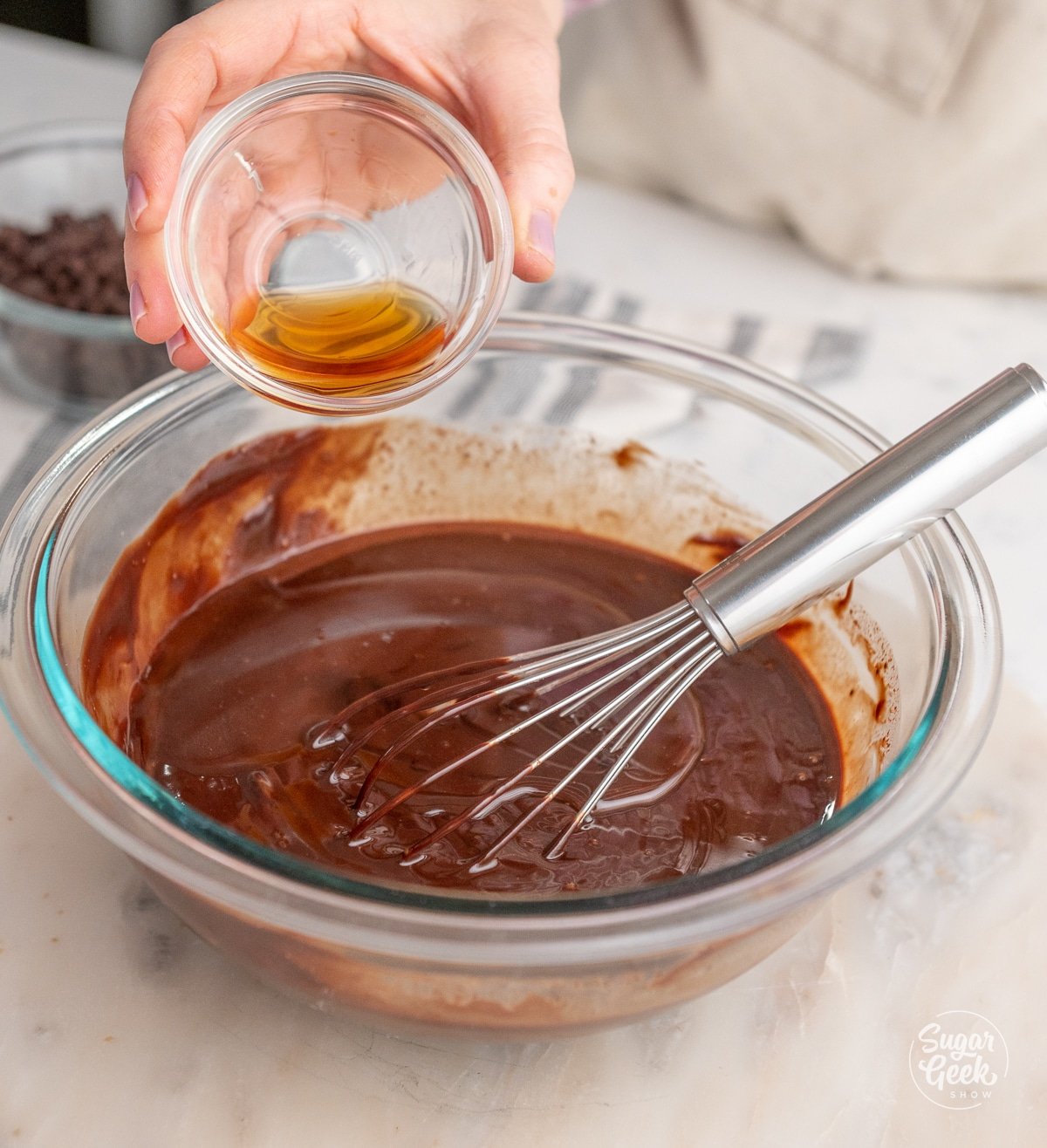
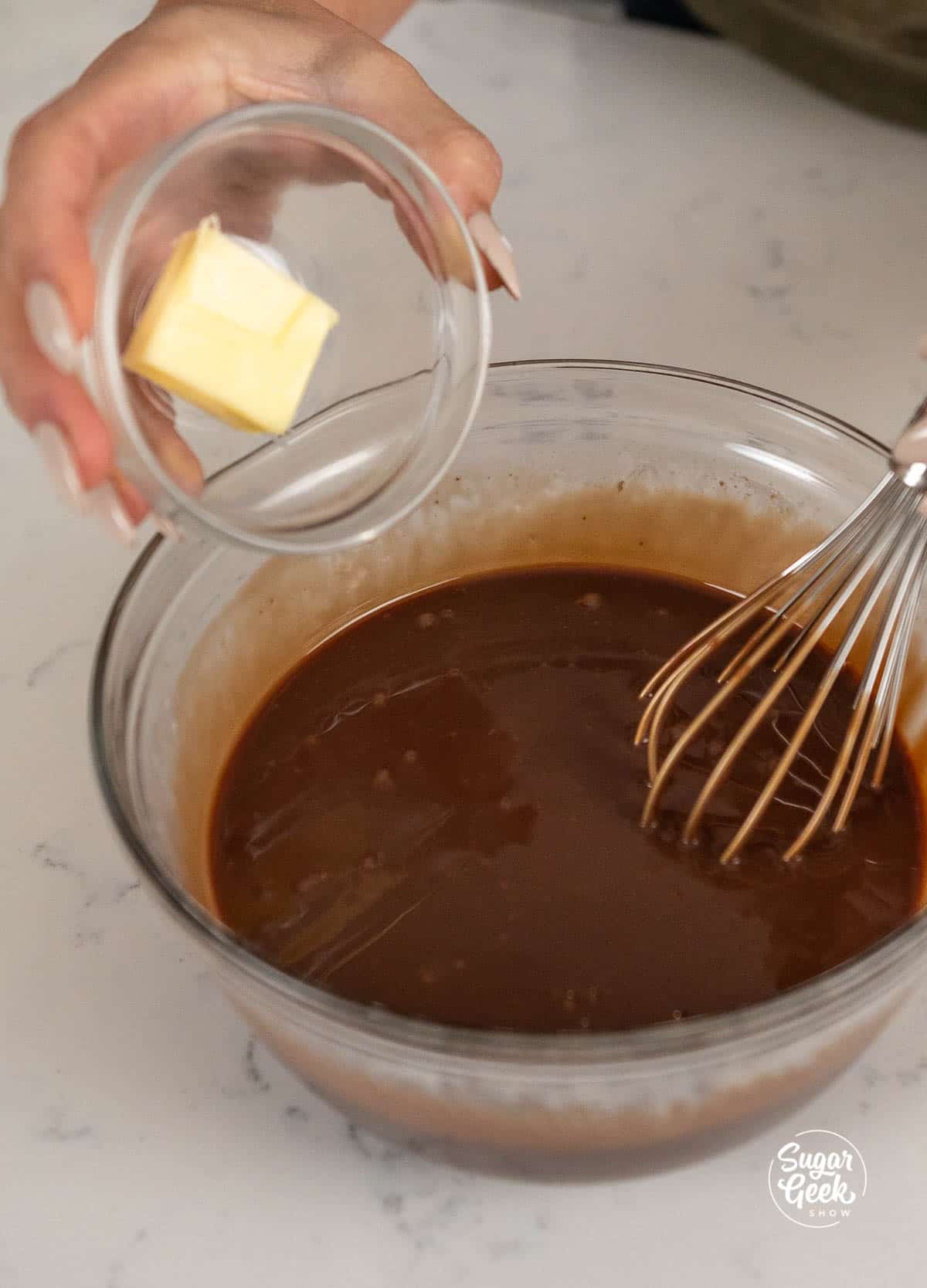
  3. Add in the whiskey, vanilla, butter, and salt then whisk until it's smooth and creamy.
    hand pouring a measuring cup of whiskey into a bowl of ganache
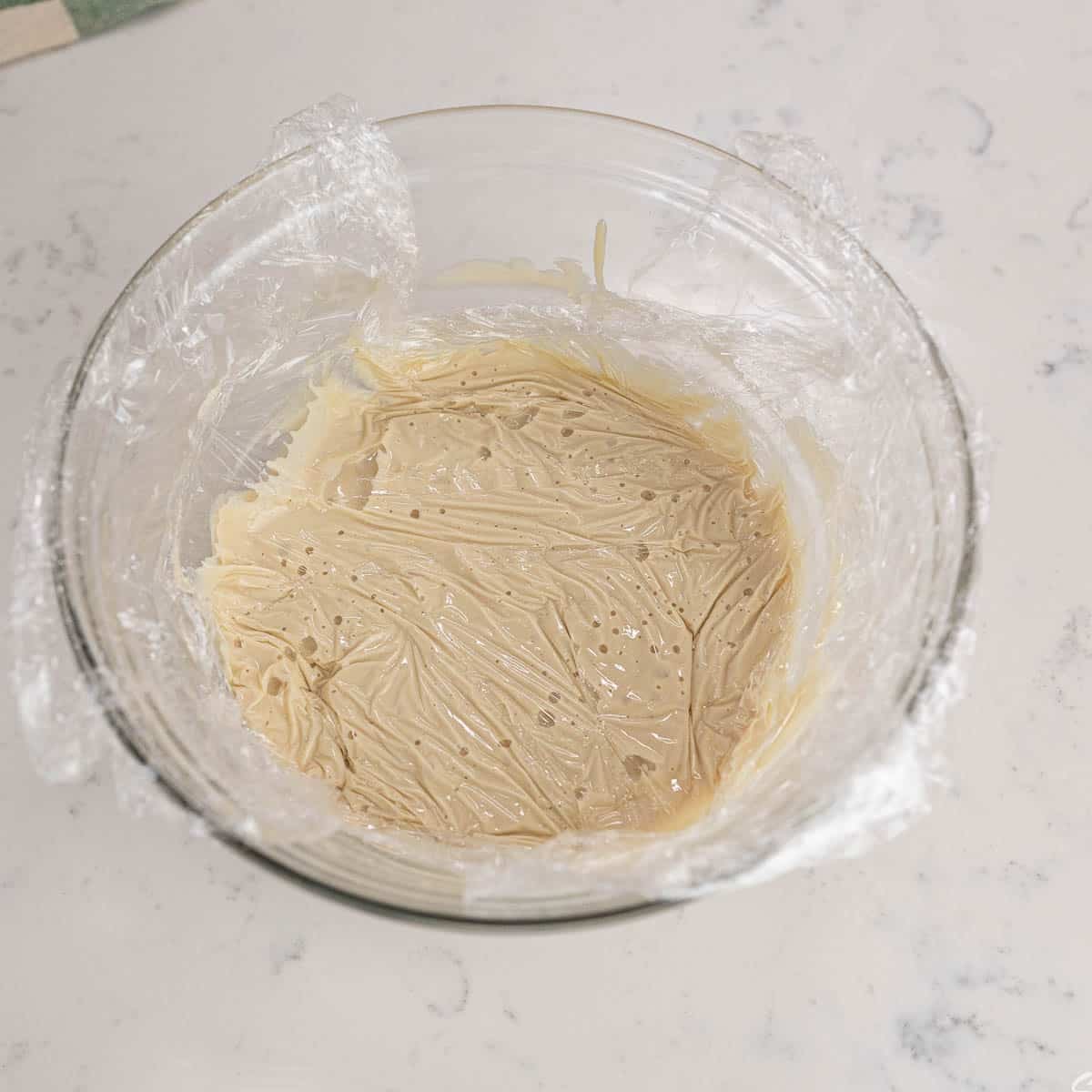
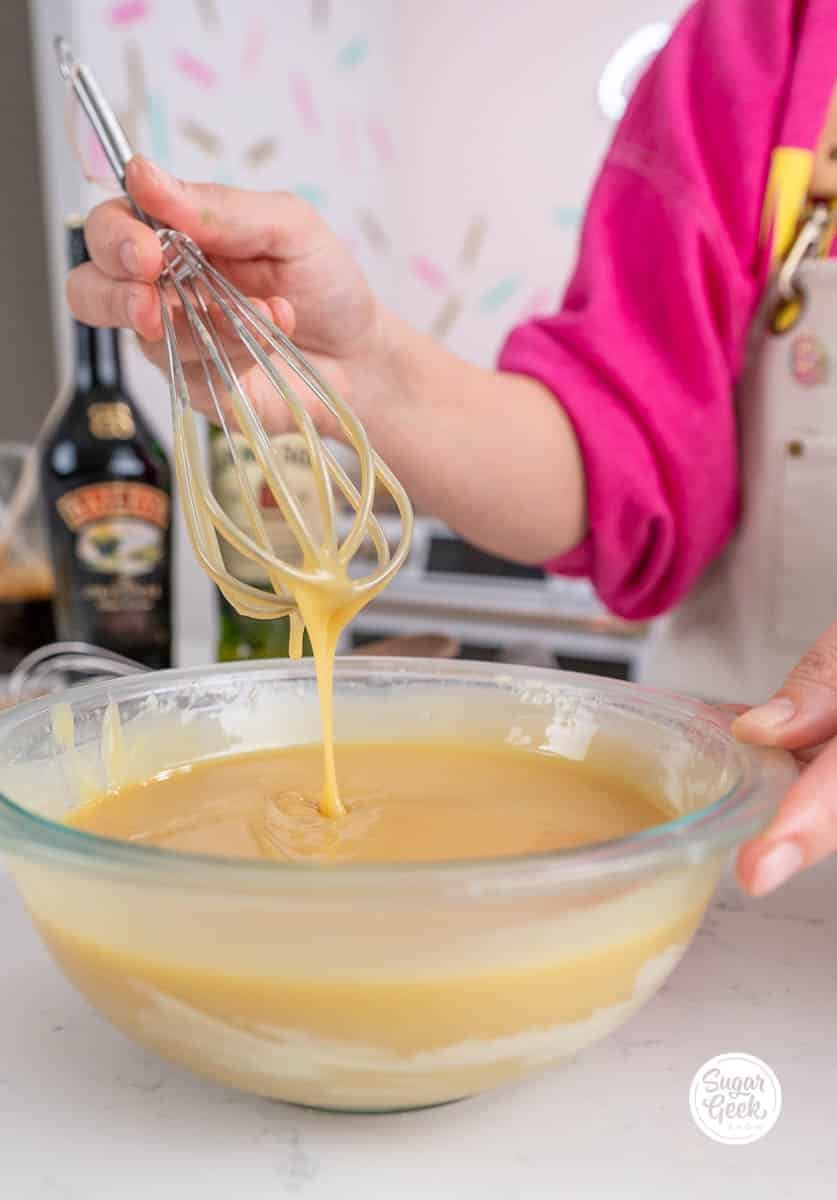
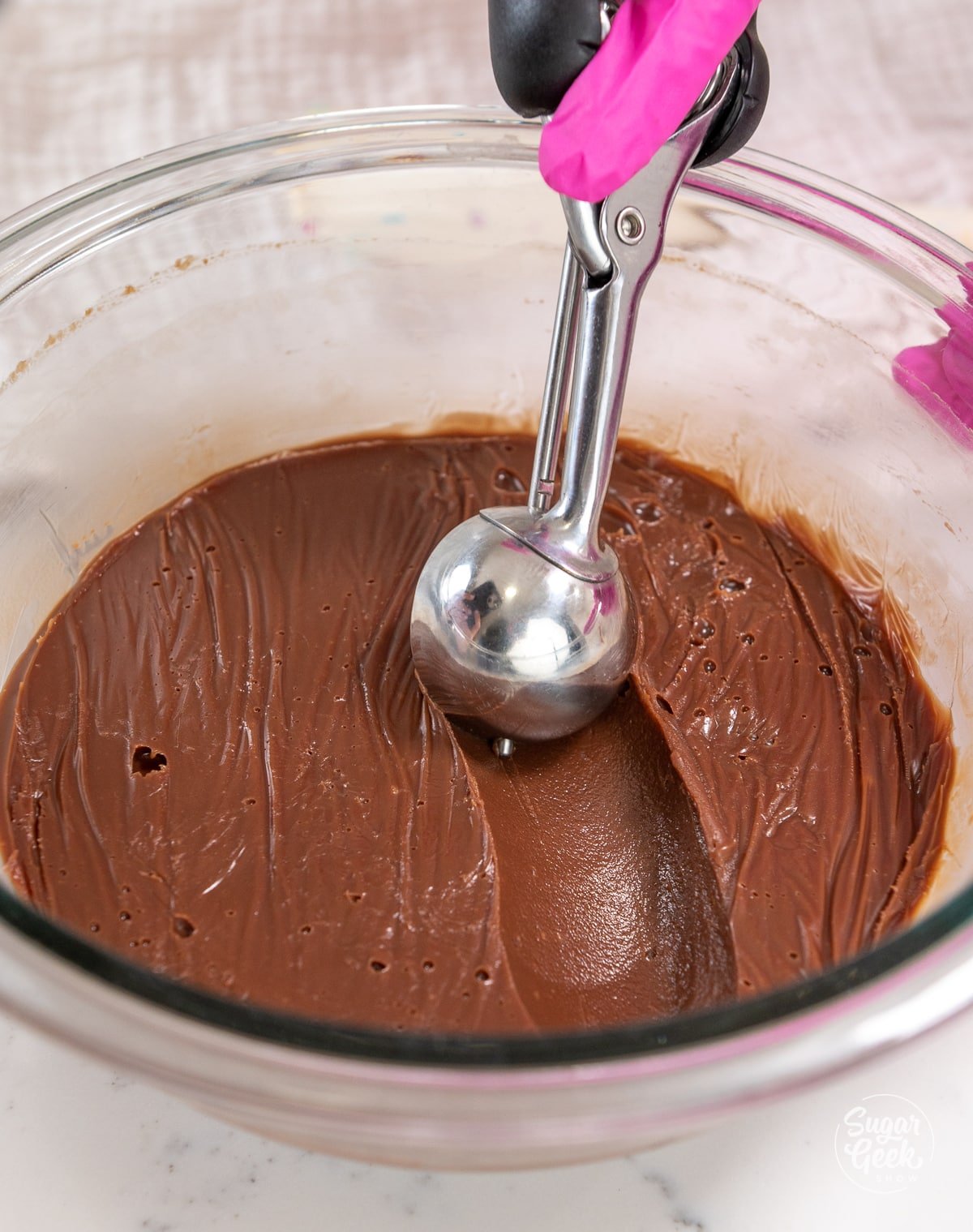
  4. Let the ganache cool until it thickens to a peanut butter consistency, about 4 hours at room temperature. Pro-tip: Pour the ganache into a sheet pan so it cools faster.
    hand holding a whisk above a bowl of white chocolate ganache
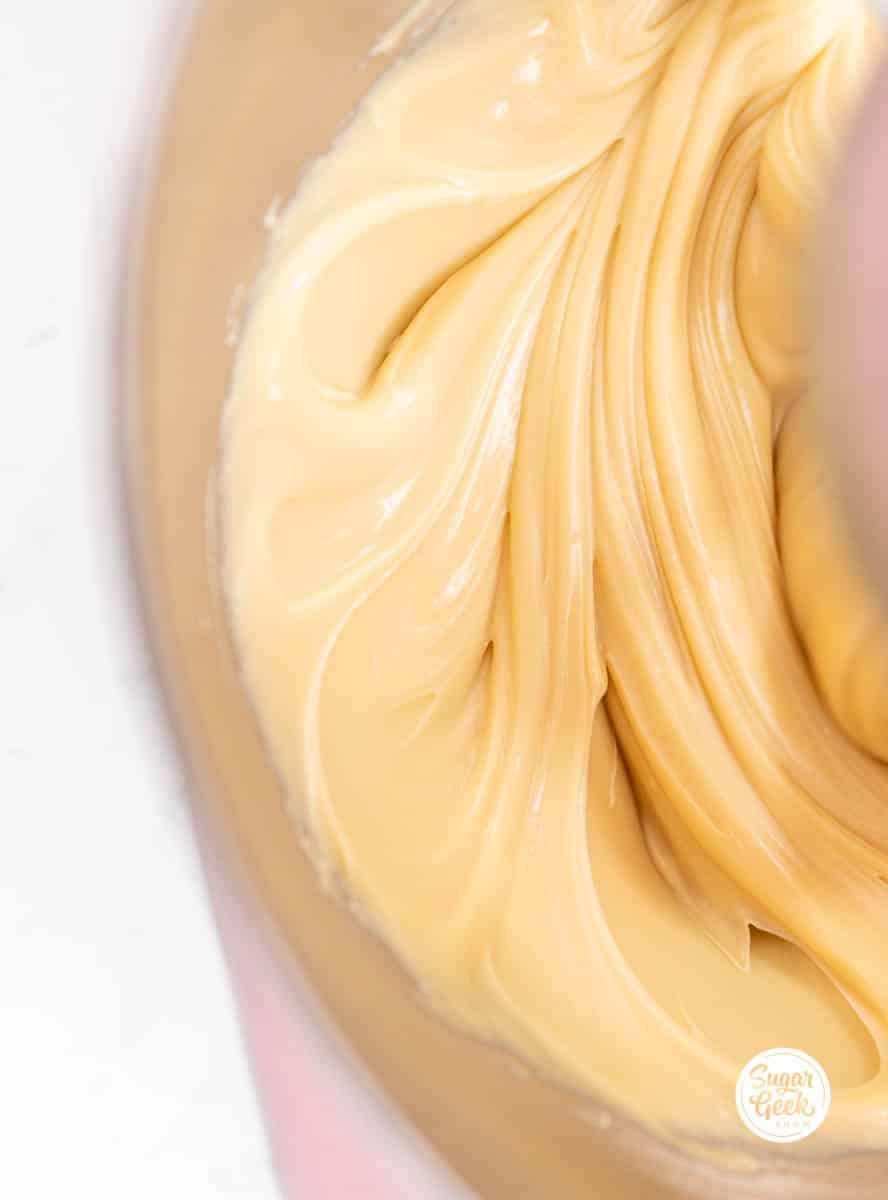
  5. Mix the ganache for a minute in your stand mixer or with an electric hand mixer for the smoothest application on the cake.
    smooth white chocolate ganache in a stand mixer

Assembling the Irish Cream Cake

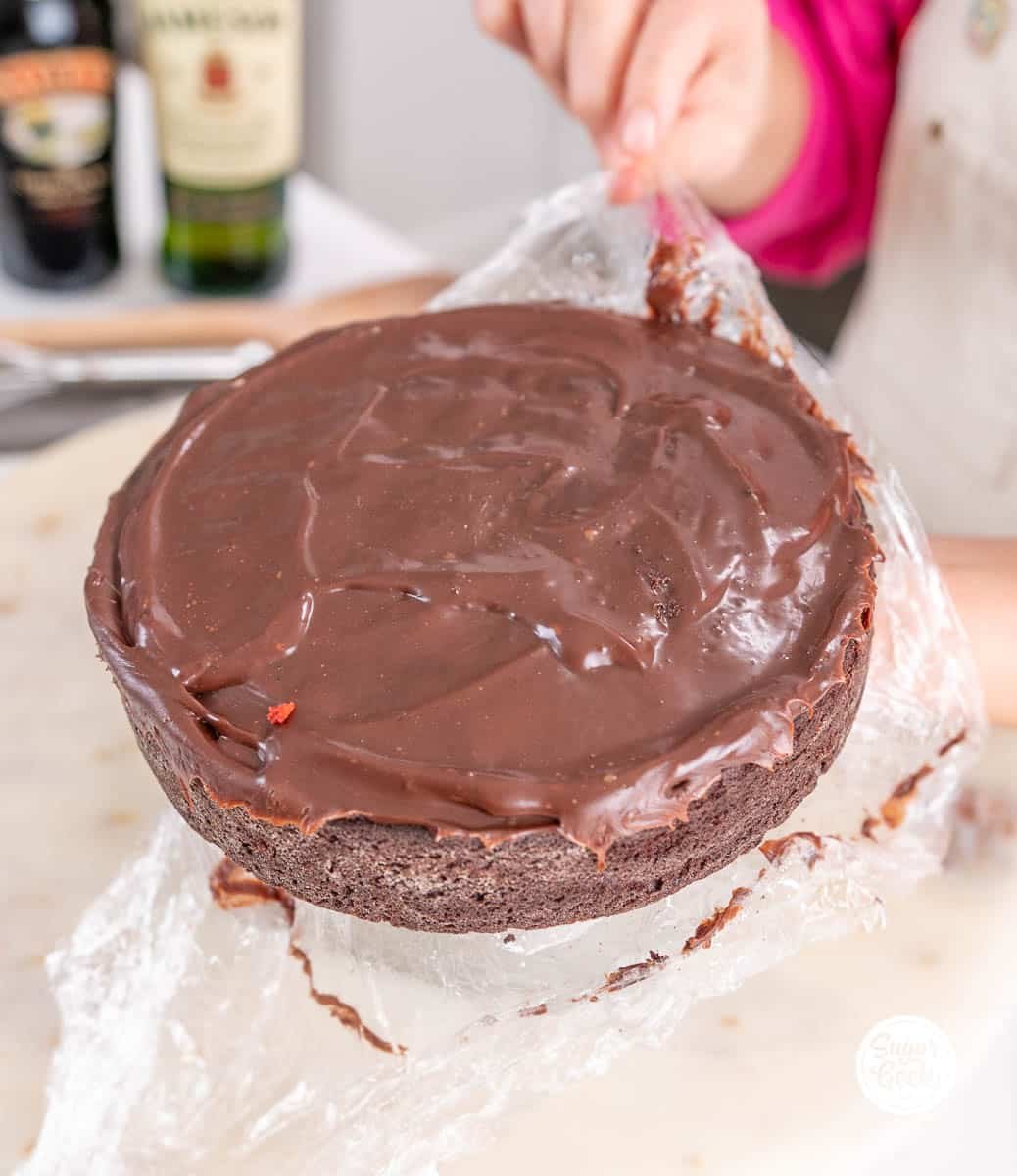
  1. Once your cakes are chilled, remove them from the cake pans and peel away the plastic wrap. They should be firm and easy to handle.
    hands peeling plastic wrap off of a chilled chocolate cake
  2. Place your first layer of cake onto your 8" cake board or a plate.
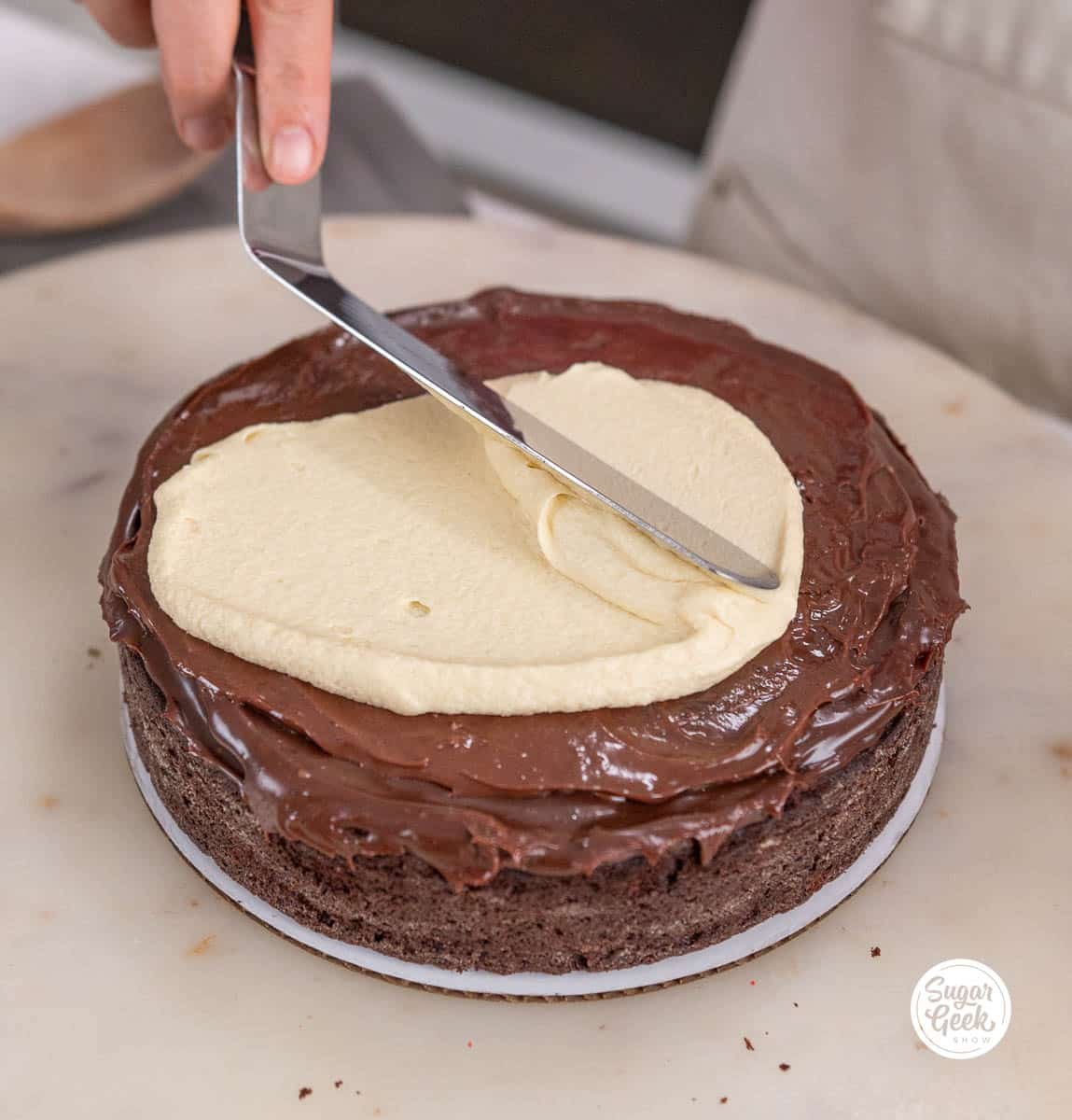
  3. Apply a generous amount of the Irish cream ganache to the cake and distribute it evenly across the cake layer.
    hand smoothing white chocolate ganache with a spatula onto a chocolate cake
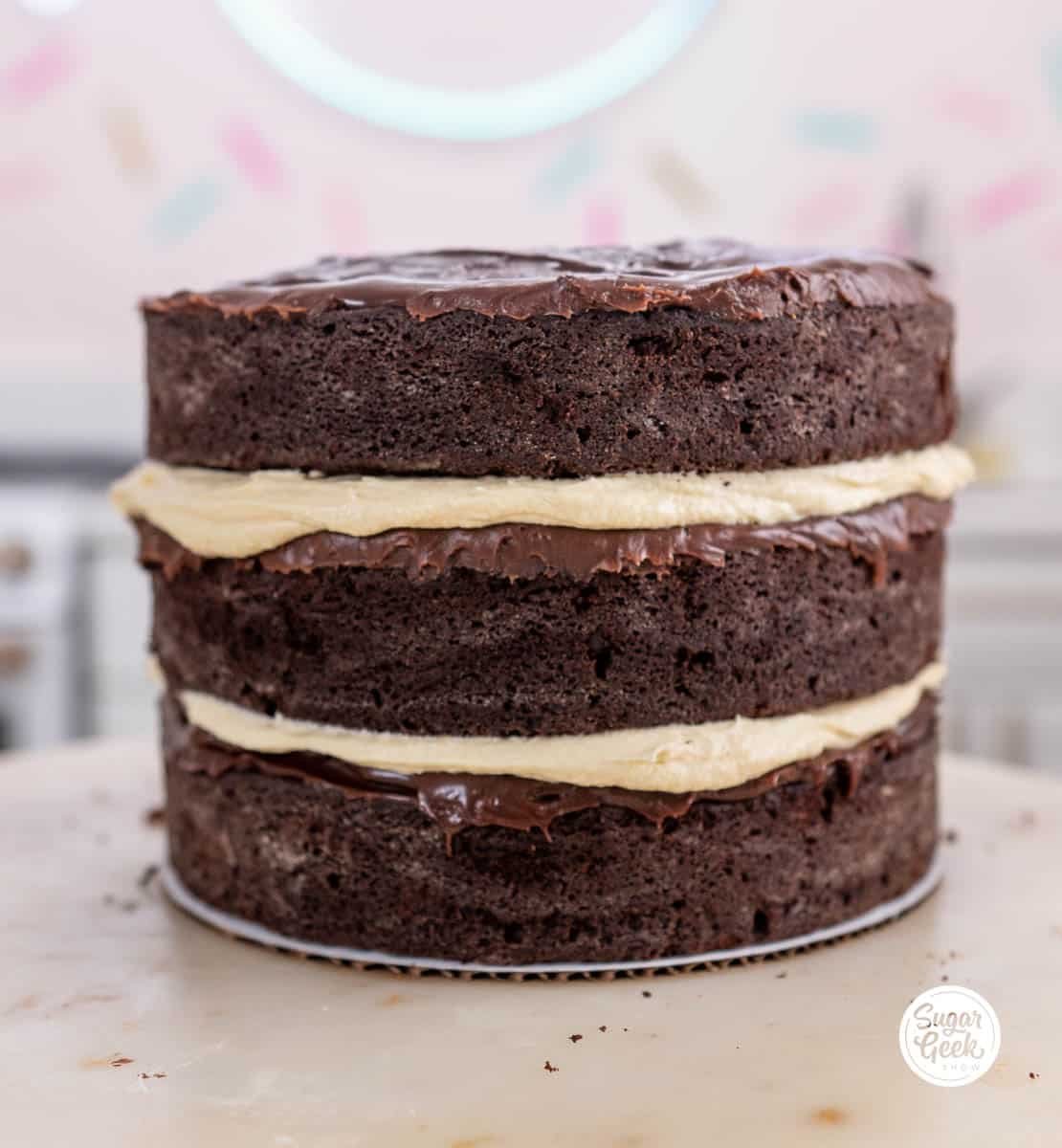
  4. Repeat this process with the other two layers.
    a naked chocolate irish cream cake stacked with three layers
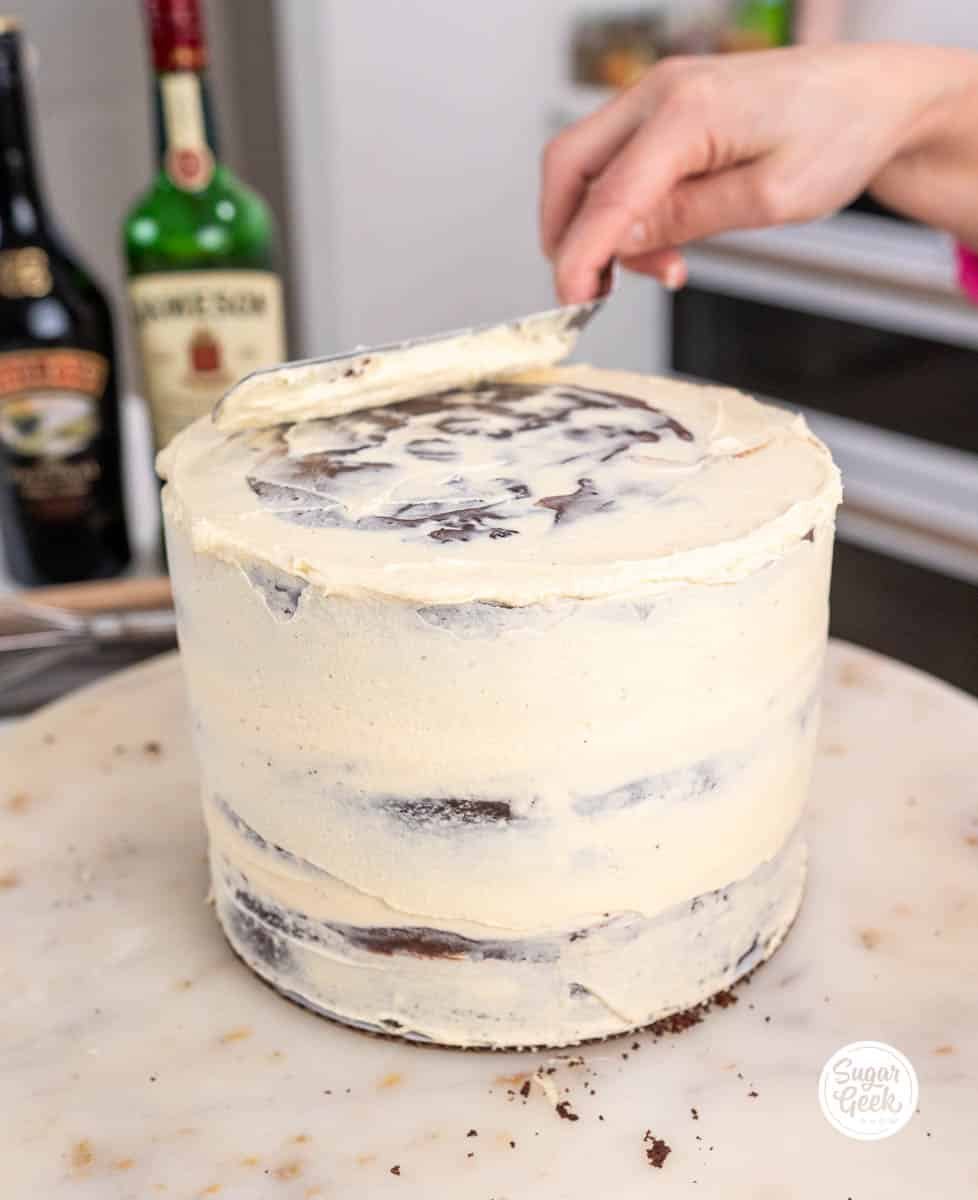
  5. Apply a thin coat of the ganache to the outside of the cake and smooth it out with a bench scraper. I liked this rustic naked cake look so I didn't add a second coat of frosting.
    hand applying a thin coating of frosting on a chocolate cake with a spatula
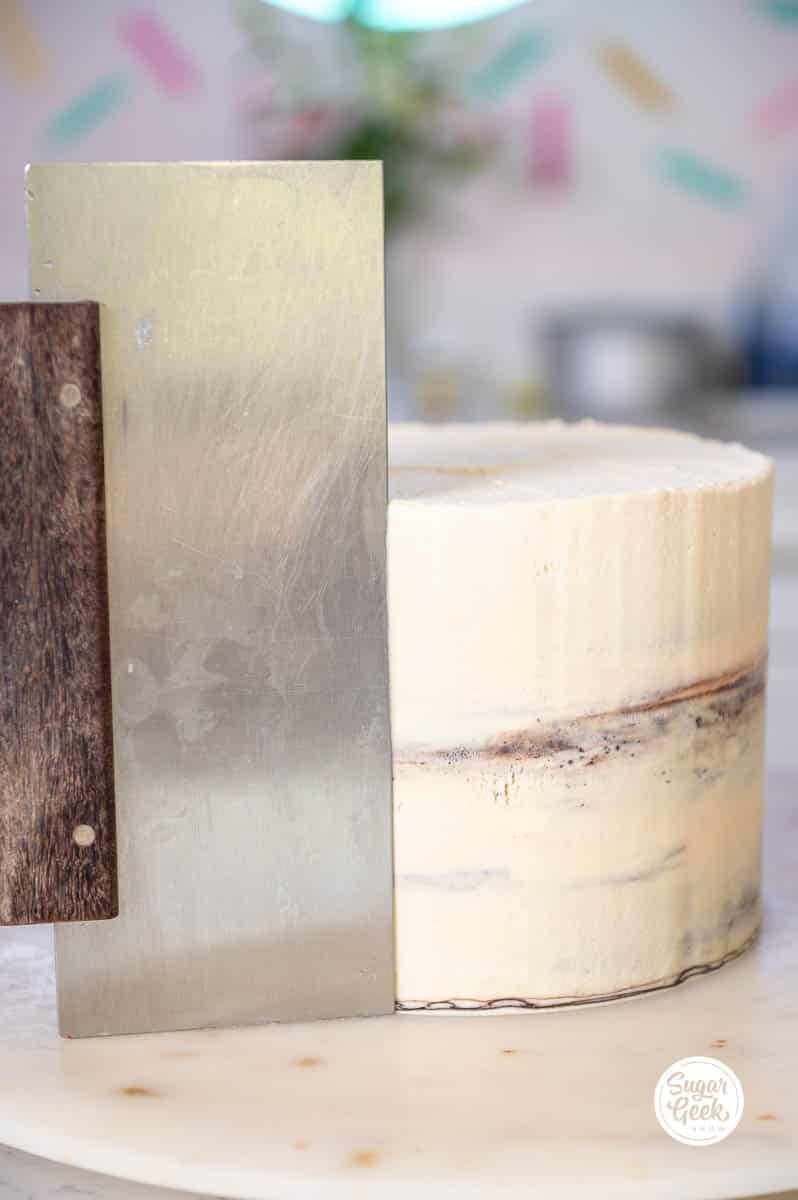
  6. Chill the cake for about 20 minutes. I like to transfer my cake to a serving plate after frosting.
    bench scraper holding up and down next to a chocolate cake
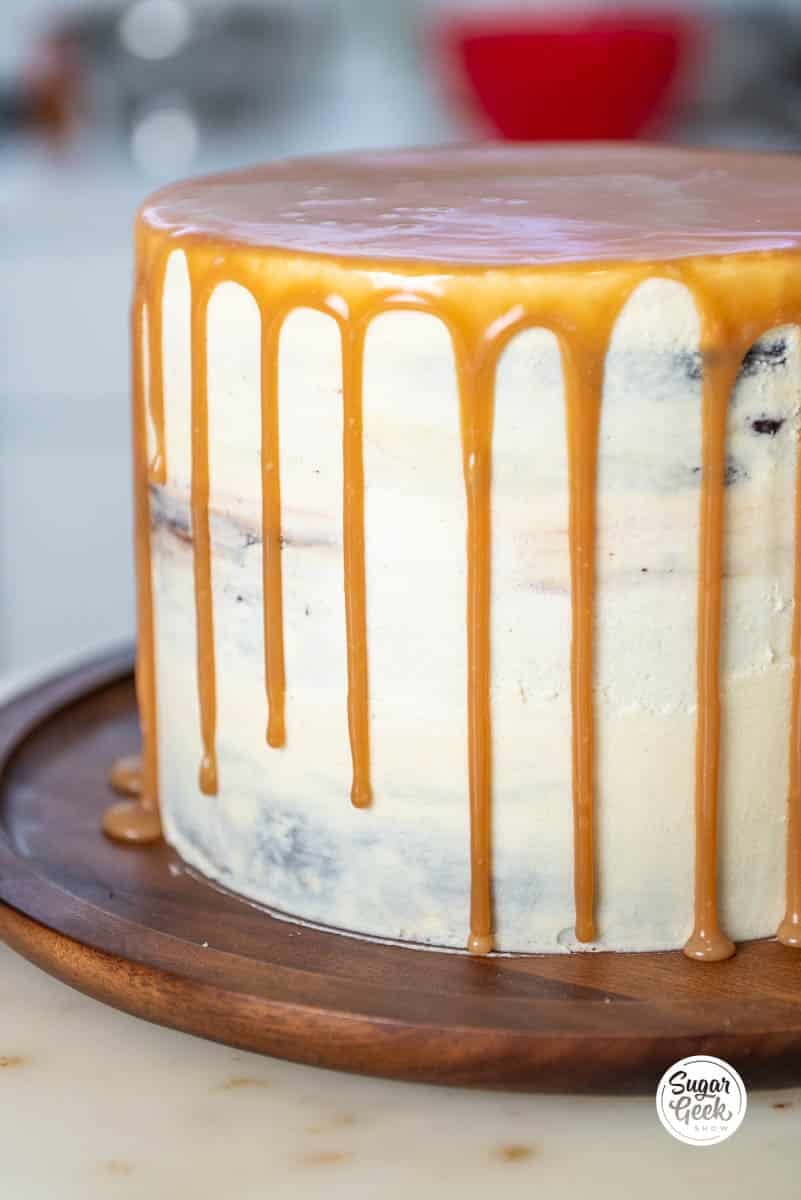
  7. Then add your caramel drizzle on top. I made my own but you can use store-bought caramel.
    fresh caramel sauce dripping down the sides of a cake
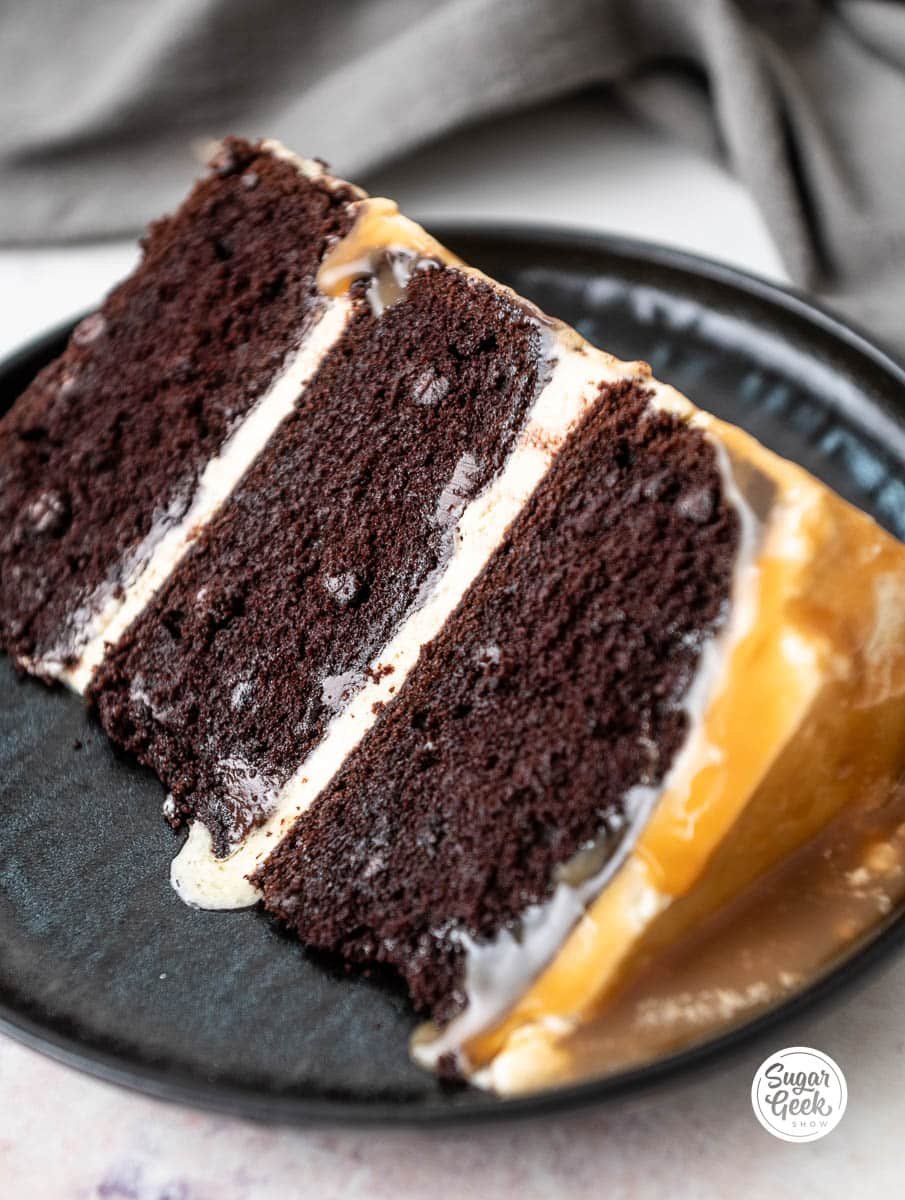
  8. Once your cake is assembled, I recommend leaving it at room temperature to soften up. This cake tastes best warm. Pro-tip: microwave a slice for 10 seconds before eating for maximum gooey-ness!
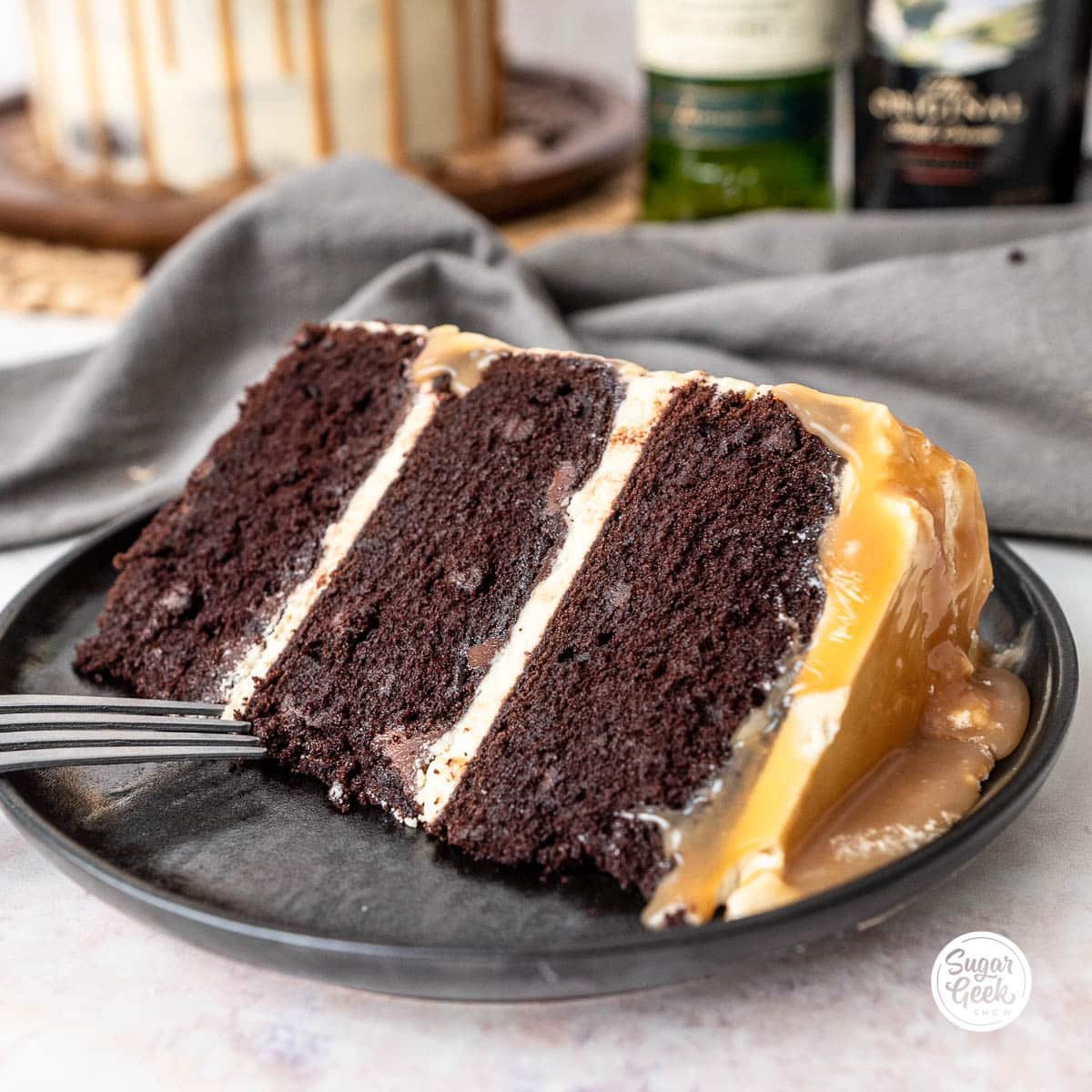
    slice of chocolate Irish cream cake on a dark plate

FAQ

Does Irish Cream Cake Have Alcohol?

Yes, traditionally it has Irish whiskey as an ingredient, however, you can buy non-alcoholic Irish Cream. A lot of the alcohol will cook out during the baking process, but not all of it. An important note if you plan on serving this to children. 

What is Irish Cream Flavor? 

Good Irish Cream should have a smooth, creamy texture and taste like vanilla with hints of chocolate and whiskey. It should also not be overly sweet or alcoholic tasting. Look for brands that use high-quality ingredients such as real cream, whiskey, and natural flavorings to ensure the best flavor possible.

How Do You Store Leftover Cake?

Cover the cake with plastic wrap or in an airtight container to keep the cake from drying out. It can be kept at room temperature for up to 4 days, or in the refrigerator for a week. This cake also freezes well!

Can I use this recipe in a bundt pan?

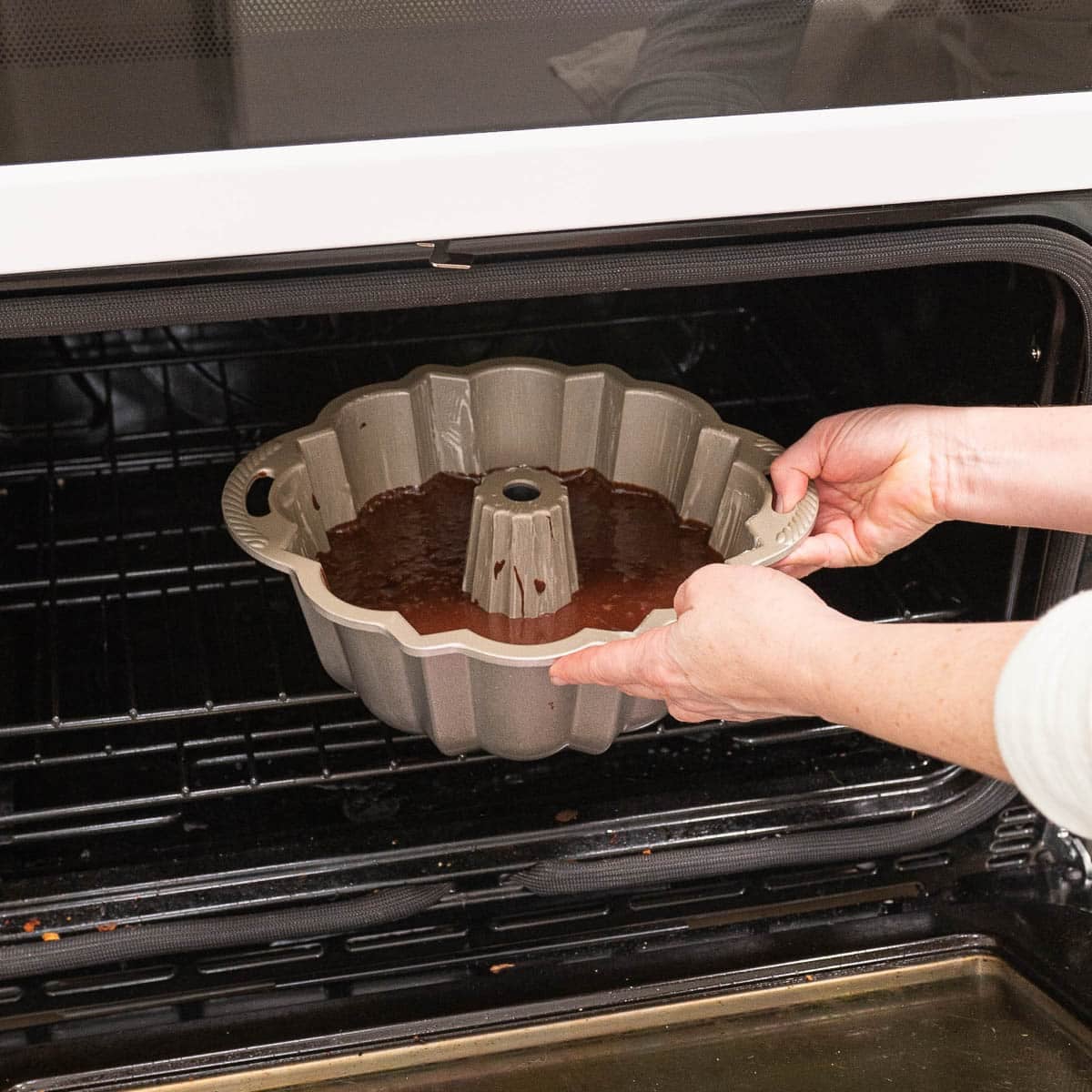
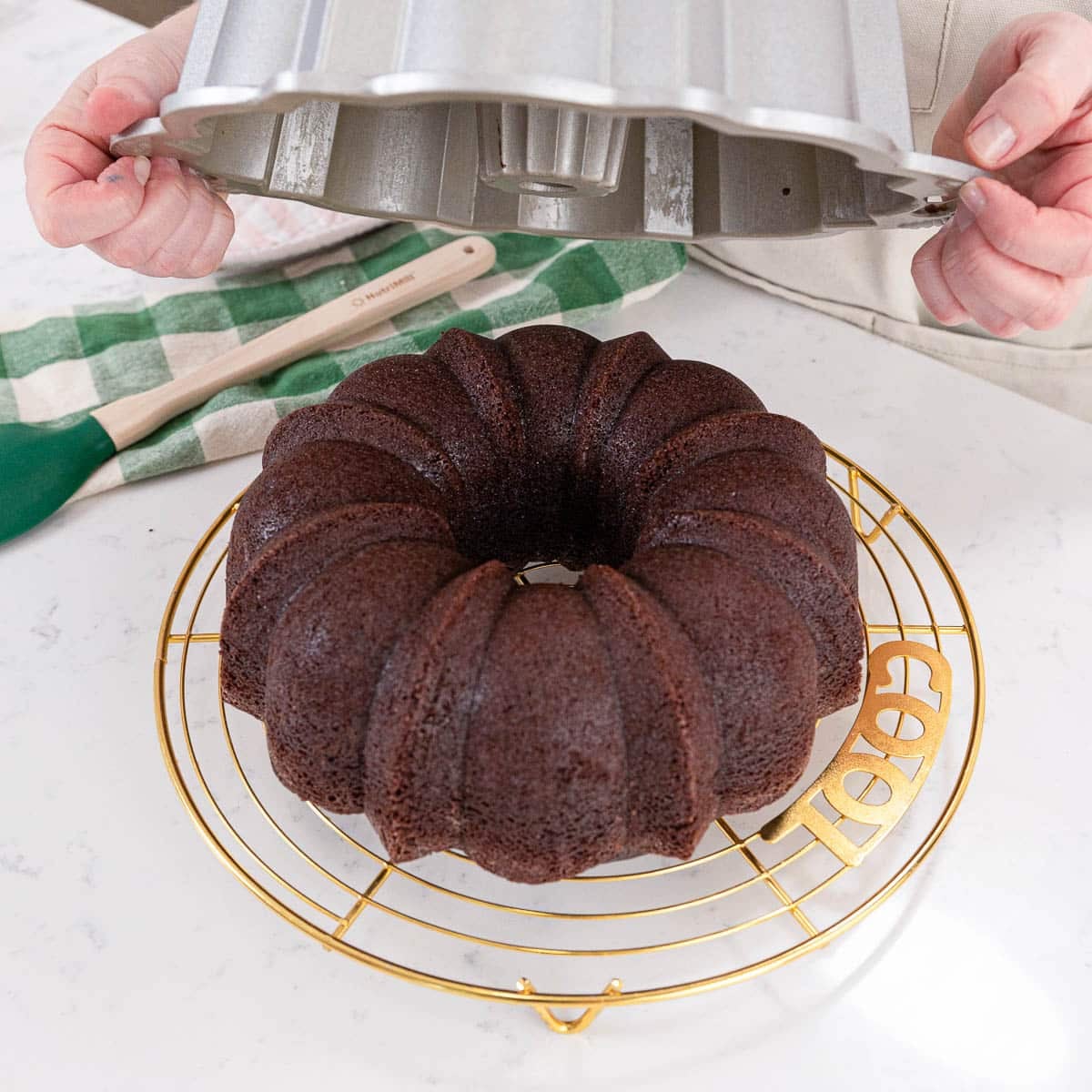
Yes, you can bake this cake into a traditional bundt cake, using a 10-cup bundt cake pan. Once you have cooled and removed the cake from the pan, soak it and pour the warm ganache over the cake. Or you could use my fail-proof chocolate bundt cake recipe and finish it in the same way.

Can I use all-purpose flour instead of cake flour?

Yes, you can substitute AP flour for the cake flour in this recipe. Or you can replace 2 Tablespoons of flour with cornstarch for every cup of all purpose flour.

Do I have to use mayonnaise?

The mayonnaise can be substituted with sour cream. However mayo is an emulsion of eggs and oil, salt, and vinegar, so it is a beneficial ingredient to the overall flavor of the cake. 

More Yummy Recipes for St. Patrick's Day

Grandma's Sweet Irish Soda Bread

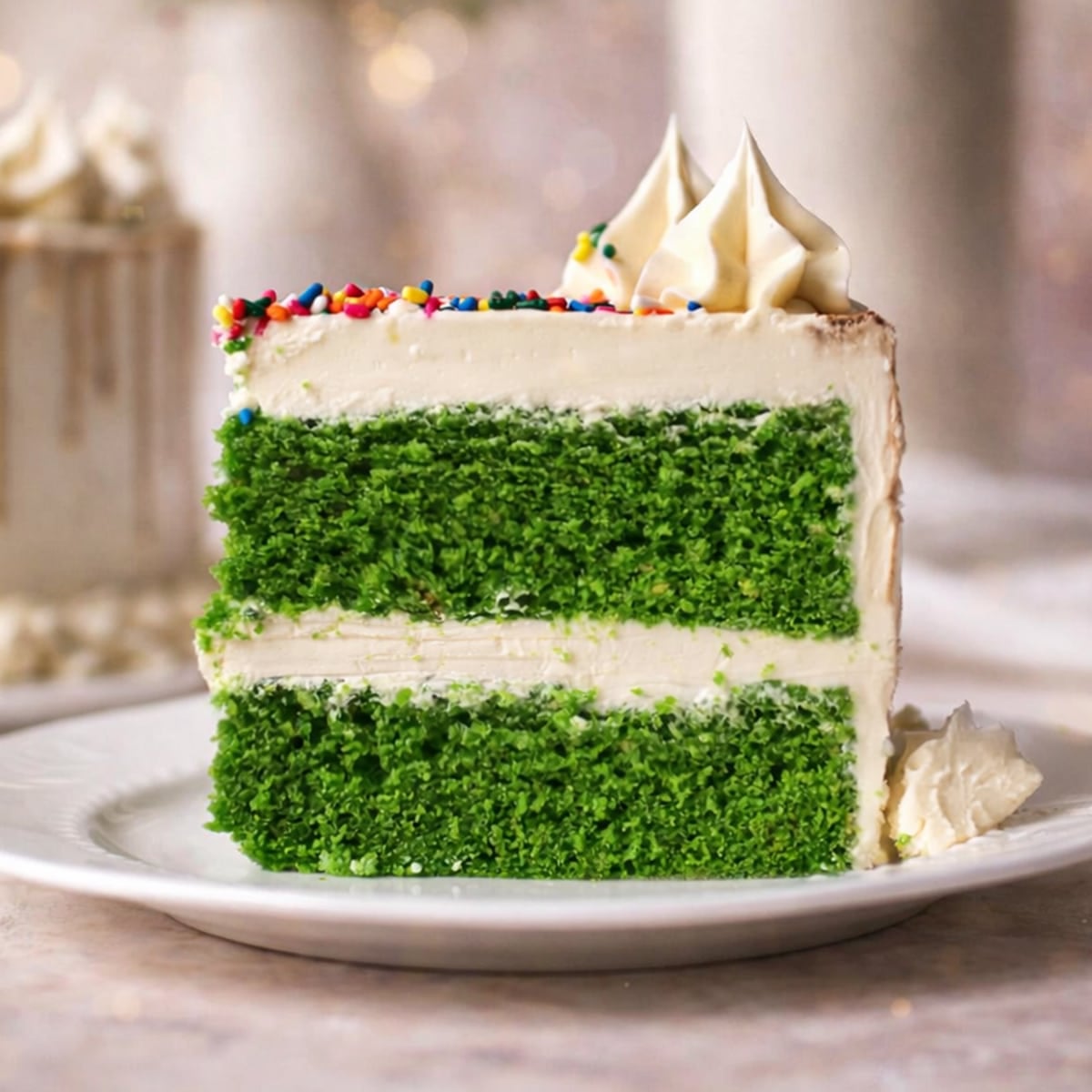
Green Velvet Cake

Traditional Irish Soda Bread

Guinness Beer Cake

Recipe

slice of chocolate cake with white frosting and caramel drip on a dark plate
Print Recipe
4.86 from 35 votes

Irish Cream Cake

This Irish cream cake is three rich chocolate layers of Guinness cake soaked in Bailey's Irish Cream with an Irish Whiskey white chocolate frosting! Drizzle it in homemade caramel for the most perfect St. Patrick's Day cake!
Prep Time40 minutes mins
Cook Time40 minutes mins
Resting Time6 hours hrs
Total Time7 hours hrs 20 minutes mins
Course: Dessert
Cuisine: American, irish
Servings: 25 servings
Calories: 576kcal
Author: Liz Marek

Equipment

  • Stand mixer with paddle attachment
  • 3 8" x 2" cake pans

Ingredients

Death By Chocolate Cake

  • 14 ounces Stout Beer Guinness
  • 1 ½ Tablespoons Espresso Powder
  • 2 teaspoons Real Vanilla
  • 14 ounces Cake Flour
  • 1 teaspoon Baking powder
  • 2 teaspoons Baking soda
  • 1 ½ teaspoons Salt
  • 6 ounces Dutched Cocoa Powder
  • 10 ounces Unsalted Butter
  • 16 ounces Granulated Sugar
  • 4 Large Eggs
  • 6 ounces Mayonnaise
  • 6 ounces Mini chocolate chips

Bailey's Poke Filling

  • 8 ounces Sweetened Condensed Milk
  • 4 ounces Bailey's Irish Cream Liqueur
  • 4.5 ounces Semi-sweet chocolate

Bailey's White Chocolate Ganache

  • 24 ounces White chocolate
  • 4 ounces Bailey's Irish Cream Liqueur
  • 4 ounces Heavy Whipping Cream
  • 1 teaspoon Vanilla Extract
  • 1 Tablespoon Irish Whiskey (Jameson)
  • ¼ teaspoon Salt
  • 4 ounces softened butter unsalted
US Customary - Metric

Instructions

Making Death by Chocolate Cake

  • NOTE: It is SUPER IMPORTANT that all the wet ingredients listed are room temperature and not cold so that the ingredients mix and incorporate correctly. 
  • Preheat your oven to 350ºF/177º C.
  • Prepare three 8-inch cake pans with cake goop, parchment paper, or preferred pan release spray.
  • Whisk together the Guinness, espresso powder, and vanilla in a measuring cup and set it aside.
  • Sift together the cake flour, cocoa powder, salt, baking powder, and baking soda in a large bowl and set it aside. 
  • Place the softened butter in the bowl of a stand mixer with the paddle attachment. Cream the butter on medium speed until it's smooth and shiny. I'm using a stand mixer but you can definitely use an electric mixer if that is what you have.
  • Gradually sprinkle in the sugar on low speed, then bump it up to medium and cream the butter and sugar until the mixture is fluffy and almost white, about 3-5 minutes. 
  • Add the eggs one at a time. Allow each egg to incorporate fully before adding in the next egg to avoid breaking your batter.
  • Add in the mayo and mix until combined. 
  • With the mixer on low speed, add ⅓ of the dry ingredients and mix until almost combined. Add ⅓ of the liquid ingredients. Repeat the process with the flour mixture and liquids two more times until everything is fully incorporated.
  • Gently fold in the mini chocolate chips.
  • Pour the batter into the prepared pans and bake them for 35-40 minutes until a wooden skewer comes out clean but with a few sticky crumbs.
  • Let the cake cool in the pan for about 20 minutes then remove them and place them onto a wire rack to cool while you prepare the Bailey's drizzle.

Making the Bailey's Irish Cream Sauce

  • Combine the sweetened condensed milk and Bailey's Irish cream in a measuring cup.
  • Microwave the cream mixture for 30 seconds and then in 15-second increments until it is just simmering. You can also do this in a pot over the stove.
  • Pour the simmering cream mixture over the chocolate in a medium bowl and let it rest for 5 minutes.
  • Whisk the sauce mixture until it's smooth and melted.

Soaking the Cake Layers with Irish Cream Sauce

  • Place plastic wrap into the bottom of your cake pan and set the cooled cake back into the pan. The plastic wrap will keep the cake from sticking when it's time to remove them later on.
  • Poke holes into the top of the cake with the end of a wooden spoon or dowel.
  • Drizzle the warm sauce all over the cake to soak into the holes and use a spatula to smooth out the top.
  • At this point, you need to freeze the cakes for two hours or let them refrigerate overnight to let the cakes fully cool down. This will give you enough time to make the ganache frosting and caramel sauce.

Making the White Chocolate Ganache

  • Heat up the heavy cream and Bailey's over medium heat in a saucepan until simmering, but not boiling.
  • Pour the hot mixture over your white chocolate. Let it sit for about 5 minutes to melt the chocolate.
  • Add in the whiskey, vanilla, butter, and salt then whisk until it's smooth and creamy.
  • Let the ganache cool until it thickens to a peanut butter consistency, about 4 hours at room temperature. Pro-tip: Pour the ganache into a sheet pan so it cools faster.
  • Mix the ganache for a minute in your stand mixer or with an electric hand mixer for the smoothest application on the cake.

Assembling the Irish Cream Cake

  • Once your cakes are chilled, remove them from the cake pans and peel away the plastic wrap. They should be firm and easy to handle.
  • Place your first layer of cake onto your 8" cake board or a plate.
  • Apply a generous amount of the Irish cream ganache to the cake and distribute it evenly across the cake layer.
  • Repeat this process with the other two layers.
  • Apply a thin coat of the ganache to the outside of the cake and smooth it out with a bench scraper. I liked this rustic naked cake look so I didn't add a second coat of frosting.
  • Chill the cake for about 20 minutes. I like to transfer my cake to a serving plate after frosting.
  • Then add the caramel drizzle on top. I made my own but you can use store-bought caramel.
  • Once your cake is assembled, I recommend leaving it at room temperature to soften up. This cake tastes best warm. Pro-tip: microwave a slice for 10 seconds before eating for maximum gooey-ness!

Video

Notes

Important Things To Note Before You Start
1. Bring all your ingredients to room temperature or even a little warm (eggs, buttermilk, butter, etc) to ensure your batter does not break or curdle. 
2. Use a scale to weigh your ingredients (including liquids) unless otherwise instructed (Tablespoons, teaspoons, pinch etc). Metric measurements are available in the recipe card. Scaled ingredients are much more accurate than using cups and help ensure the success of your recipe. 
3. Practice Mise en Place (everything in it's place). Measure out your ingredients ahead of time and have them ready before you start mixing to reduce the chances of accidentally leaving something out.
4. Chill your cakes before frosting and filling. You can cover a frosted and chilled cake in fondant if you wish. This cake is also great for stacking. I always keep my cakes chilled in the refrigerator before delivery for easy transporting. 
5. If the recipe calls for specific ingredients like cake flour, replacing it with all-purpose flour and cornstarch is not recommended unless specified in the recipe that it’s ok. Substituting ingredients may cause this recipe to fail. 
6. It is possible to make this cake in one day, but I recommend making all of the components the day before, and assembling them on the day you're ready to serve. The ganache will take about 4 hours to set up, and the sauce will need to soak in the cakes for 2 hours.

Nutrition

Serving: 1g | Calories: 576kcal | Carbohydrates: 65g | Protein: 8g | Fat: 32g | Saturated Fat: 17g | Polyunsaturated Fat: 4g | Monounsaturated Fat: 8g | Trans Fat: 0.4g | Cholesterol: 72mg | Sodium: 351mg | Potassium: 307mg | Fiber: 4g | Sugar: 47g | Vitamin A: 448IU | Vitamin C: 0.4mg | Calcium: 120mg | Iron: 2mg
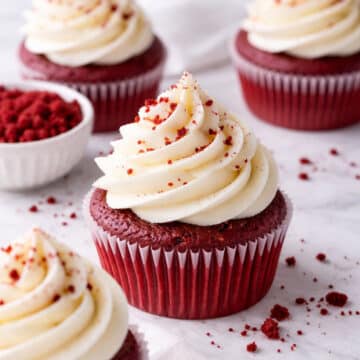
close up of a red velvet cupcake with cream cheese frosting piped on top surrounded by other cupcakes

February 22, 2023 Frosting and Icing

Easy Cream Cheese Frosting

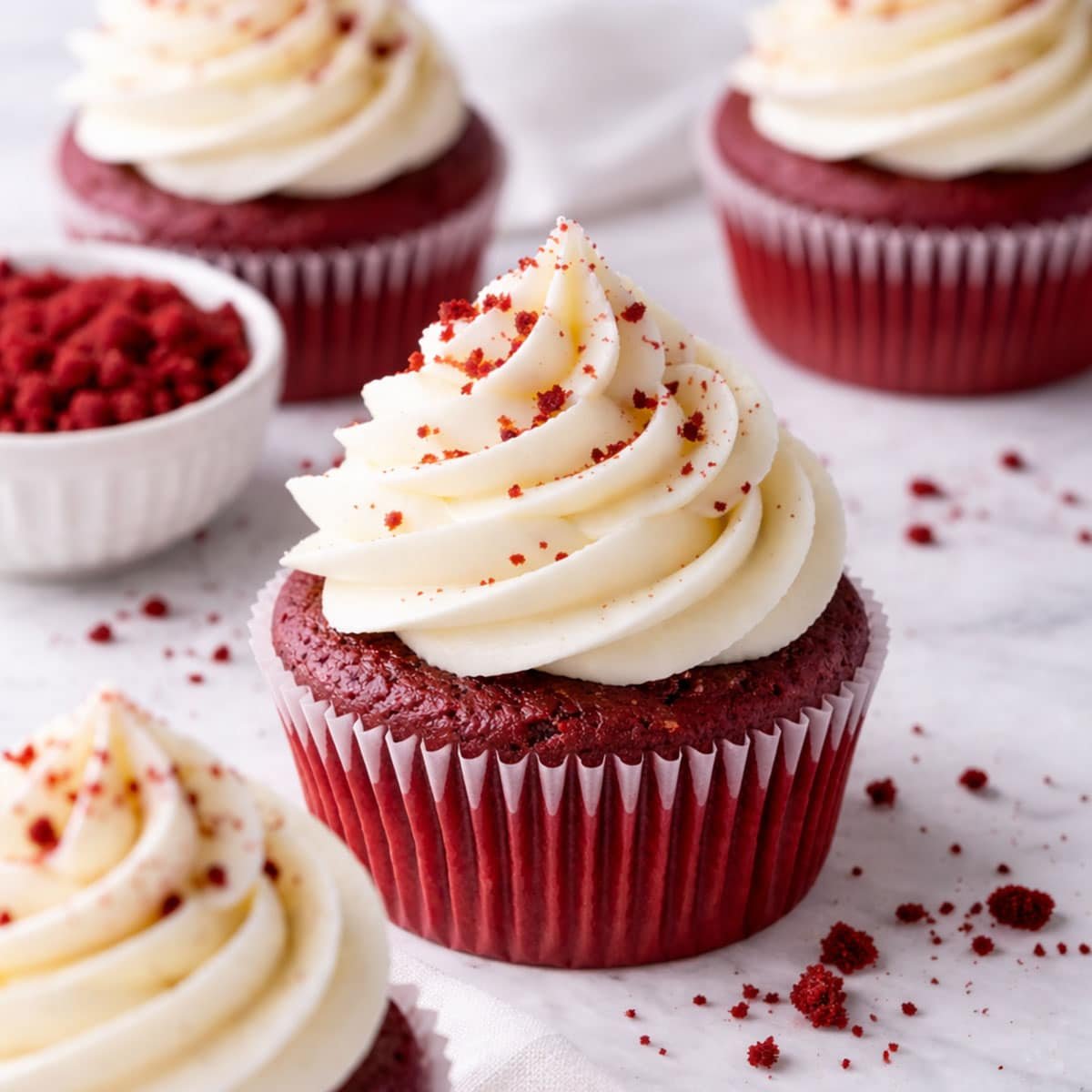
My easy cream cheese frosting is one of the most requested frosting recipes because it's tangy, lightly sweet, and perfect for cakes like carrot cake and red velvet cake to cinnamon rolls and pumpkin cake. This frosting uses simple ingredients, takes less than 10 minutes to make, and uses a mixing method that keeps the texture fluffy and stable. If you've ever struggled with cream cheese frosting being too soft or grainy, these tips will help you get perfect results every time. This pairs really well with my vanilla cake recipe as well.

close up of red velvet cupcakes with cream cheese frosting

Quick Glance: Easy Cream Cheese Frosting

  • Recipe Name: Easy Cream Cheese Frosting
  • Why You'll Love It: Tangy, fluffy frosting that pipes beautifully and won't turn runny
  • Time and Difficulty: 10 minutes - perfect for beginners
  • Main Ingredients: 
  • Method:
  • Texture and Flavor:
  • Quick Tip:
ChatGPT
Google AI
Perplexity
Grok
Add us as a trusted site on Google
[feast_advanced_jump_to]

I've made a lot of buttercream frostings over the years, but cream cheese frosting will always be my favorite frosting for certain cakes. The problem is that it can get runny, grainy, be too thick, too thin, and so on. I've perfected this technique for making the perfect cream cheese frosting so that it's perfectly pipeable every time, never grainy, and the flavors are perfectly balanced.

Cream Cheese Frosting Ingredients

The secret to making cream cheese frosting that stays fluffy and pipeable is using the correct ingredients and making sure all your cold ingredients are softened to room temperature before mixing.

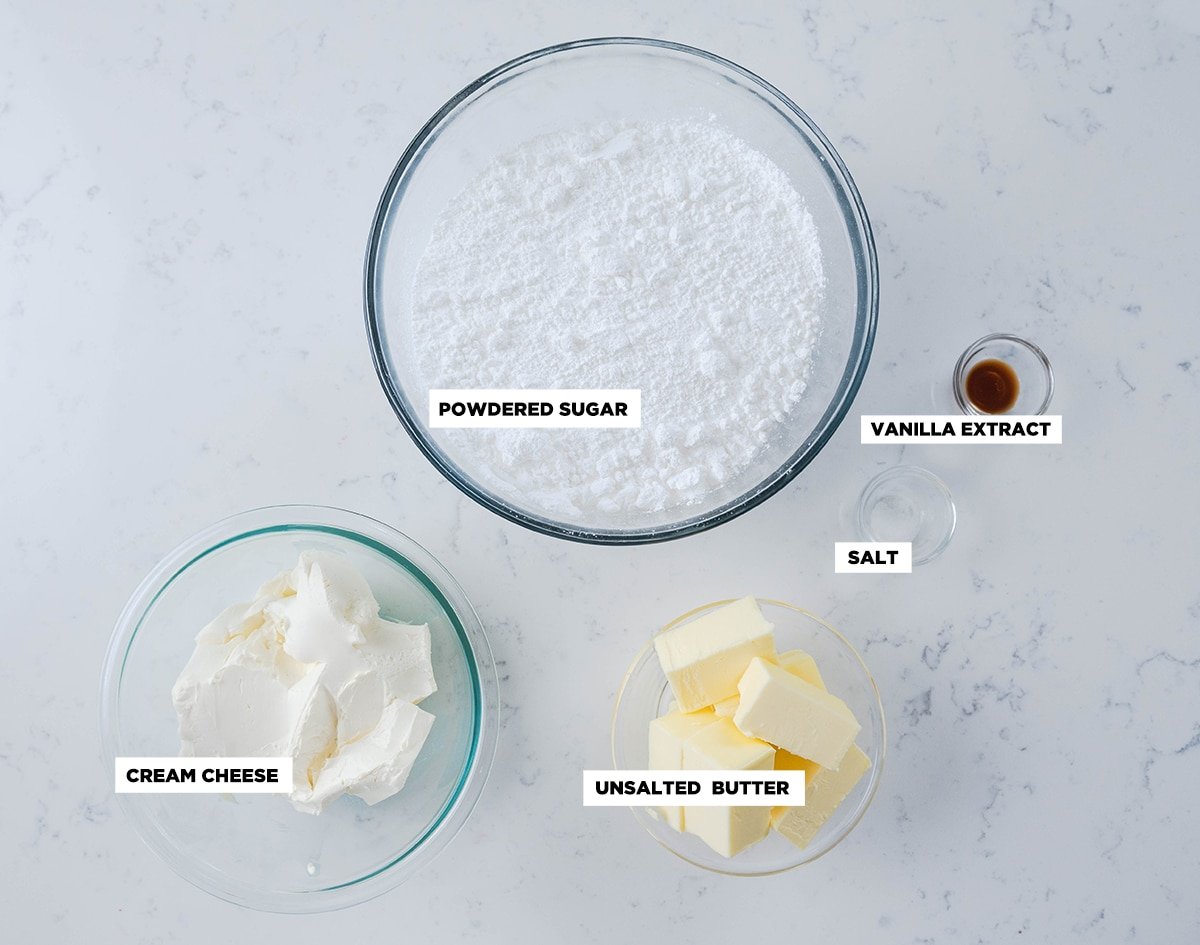
cream cheese frosting ingredients
  • Full-fat brick cream cheese - This provides the tangy flavor and structure of the frosting. Always use block-style cream cheese rather than tub-style, which contains more water and can make frosting runny. I prefer the classic taste of Philadelphia cream cheese.
  • Unsalted butter - Adds richness and helps stabilize the frosting so it holds its shape when piping. Make sure your butter is at room temperature.
  • Powdered sugar (confectioners' sugar) - Sweetens and thickens the frosting. The amount can be adjusted depending on how thick you want the frosting. If you need a thicker frosting, try my crusting cream cheese-style frosting.
  • Vanilla extract - Adds warmth and depth so the frosting tastes balanced rather than overly sweet.
  • Pinch of salt - Balances the sweetness of the cream cheese frosting.
  • Heavy cream (optional) - Can be added in small amounts if you want a softer frosting consistency.

How To Make Cream Cheese Frosting Step-By-Step

This frosting comes together quickly once you have everything prepped and all your ingredients at room temperature! The secret to super smooth cream cheese frosting is to always use the whip attachment on low speed and mix until just combined!

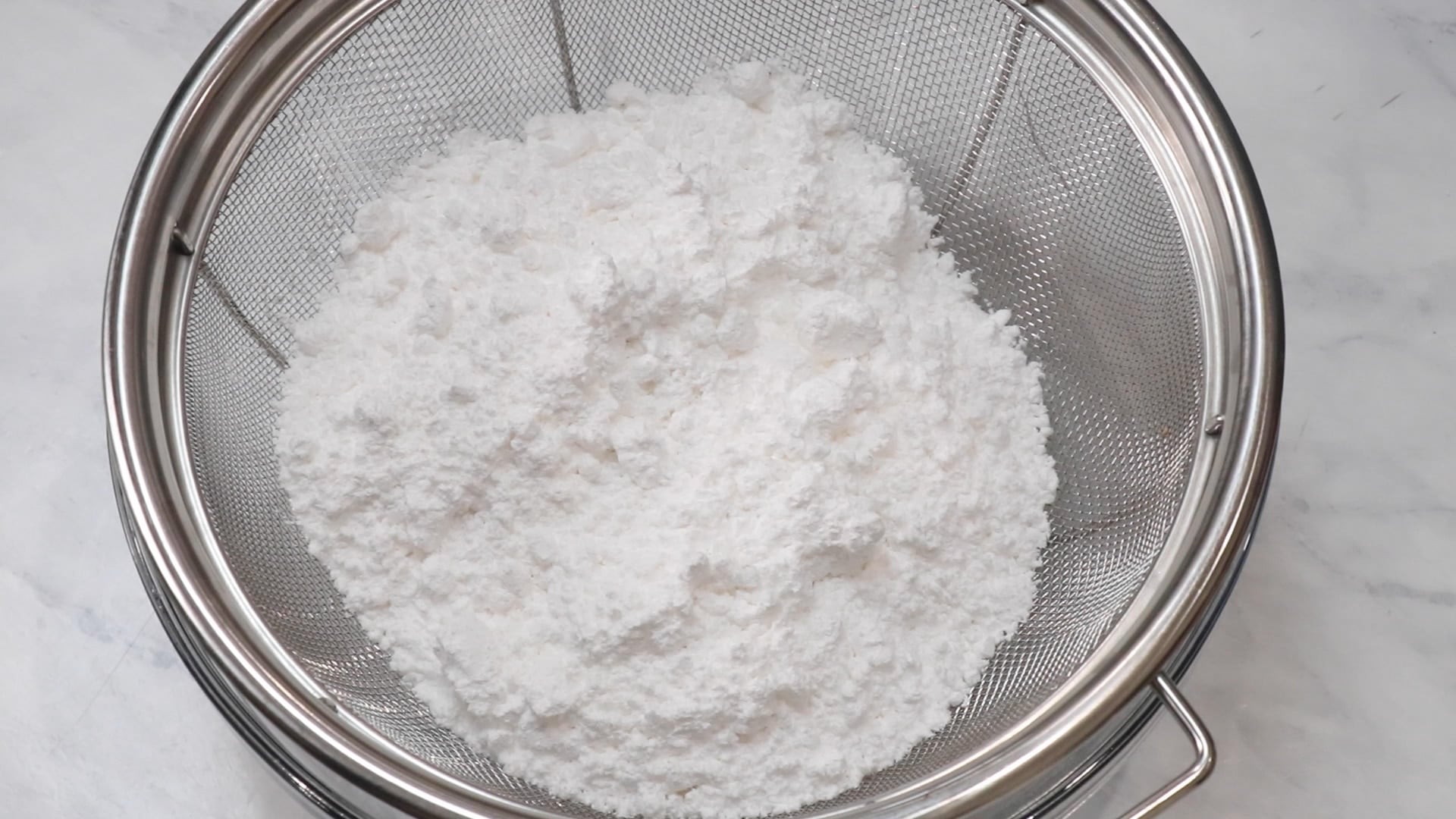
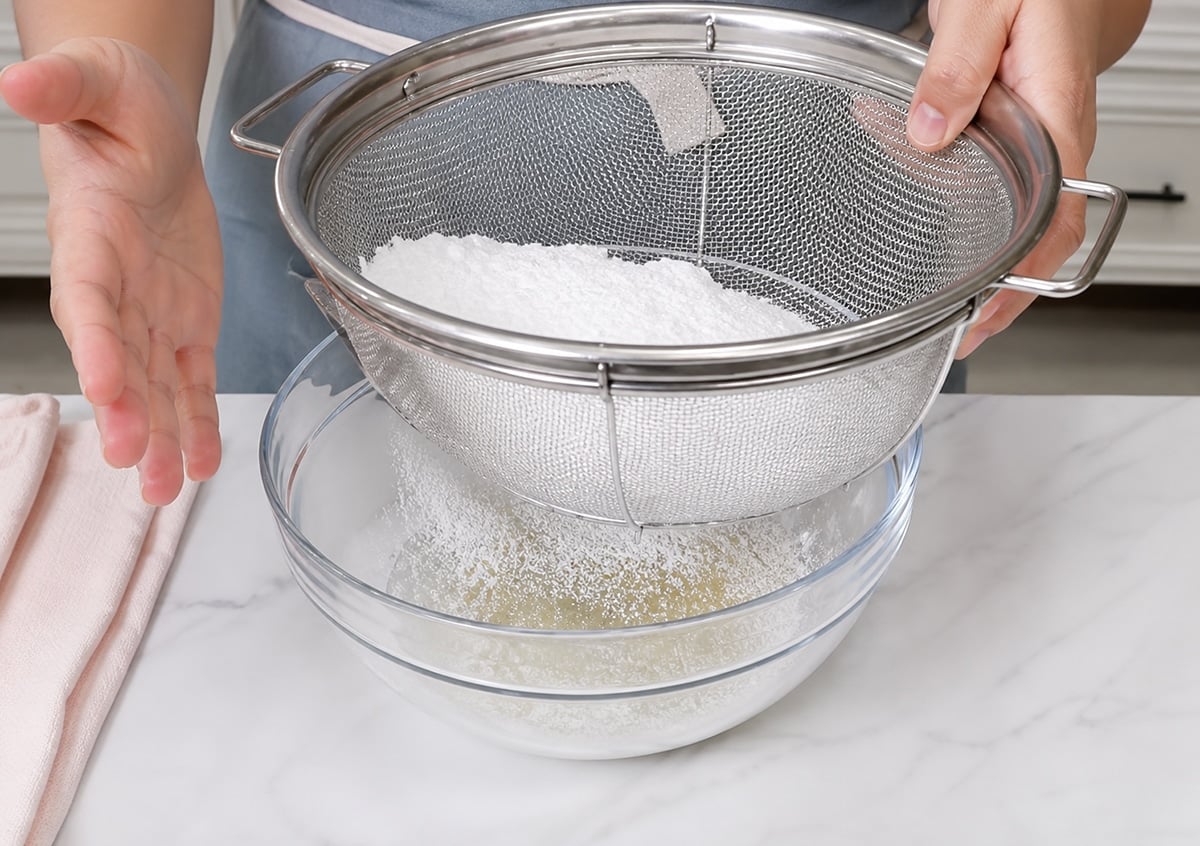
powdered sugar in a sieve
  1. Sift the powdered sugar and set it aside to remove any lumps. If you don't do this you could have little white dots in your cream cheese frosting that do not come out.
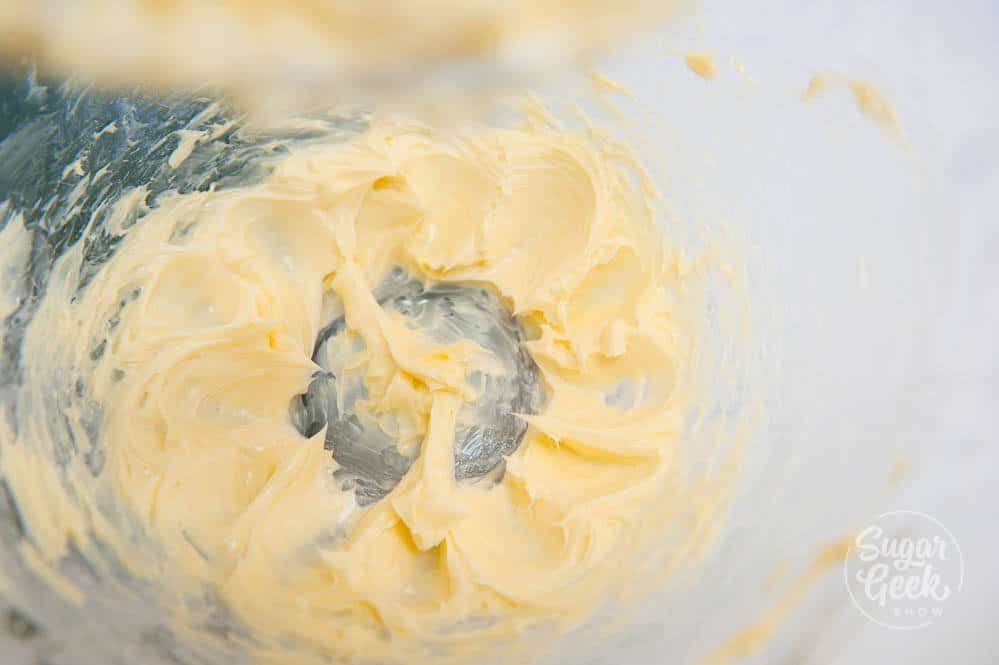
cream softened butter until smooth
  1. Add the softened butter to a stand mixer fitted with the whisk attachment and mix on low speed until smooth.
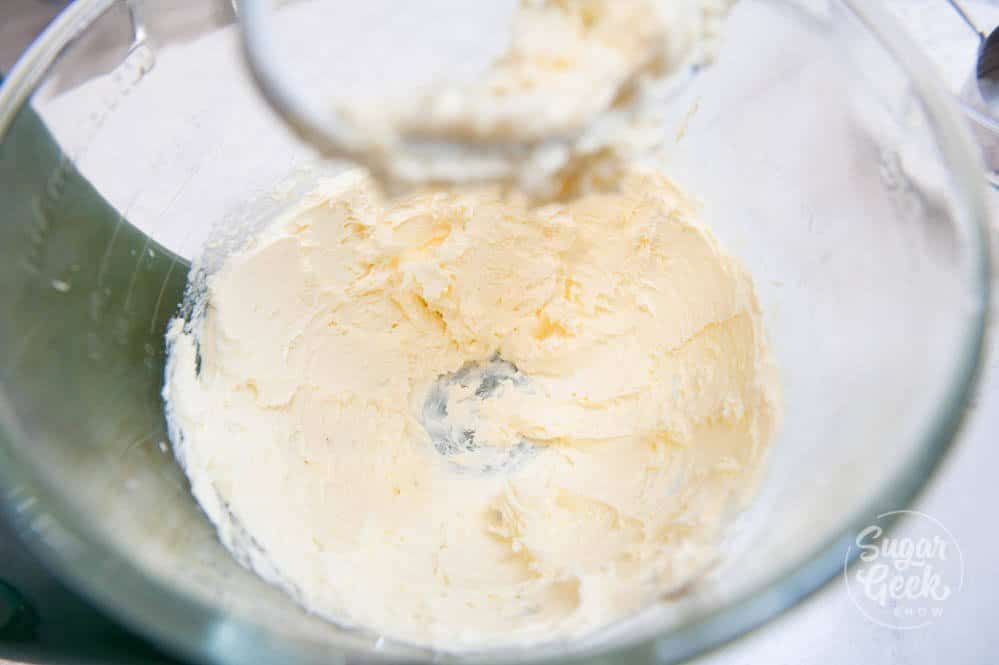
cream cheese mixing with butter in a stand mixer
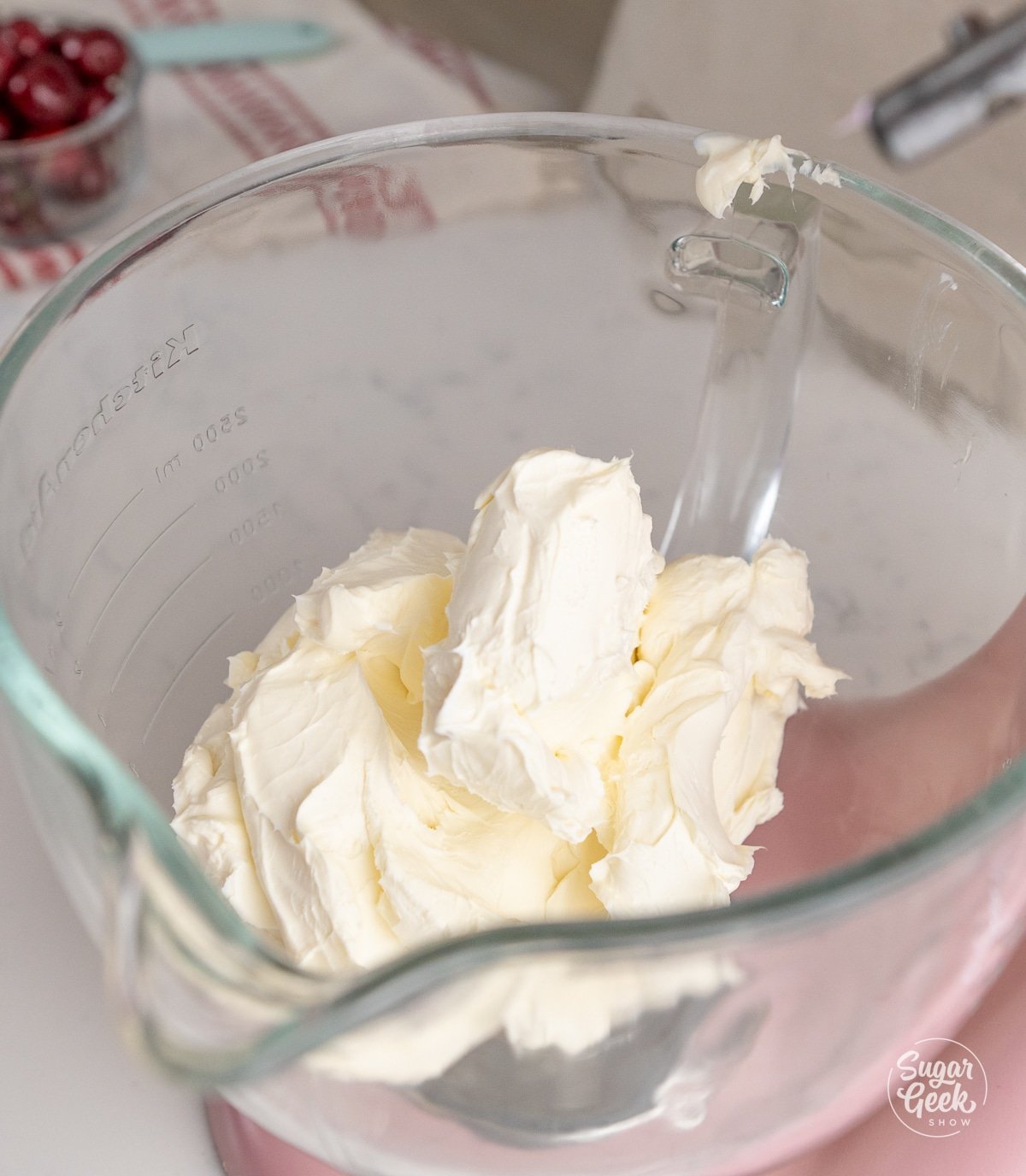
  1. Add softened cream cheese in small pieces while mixing on low speed until fully incorporated.
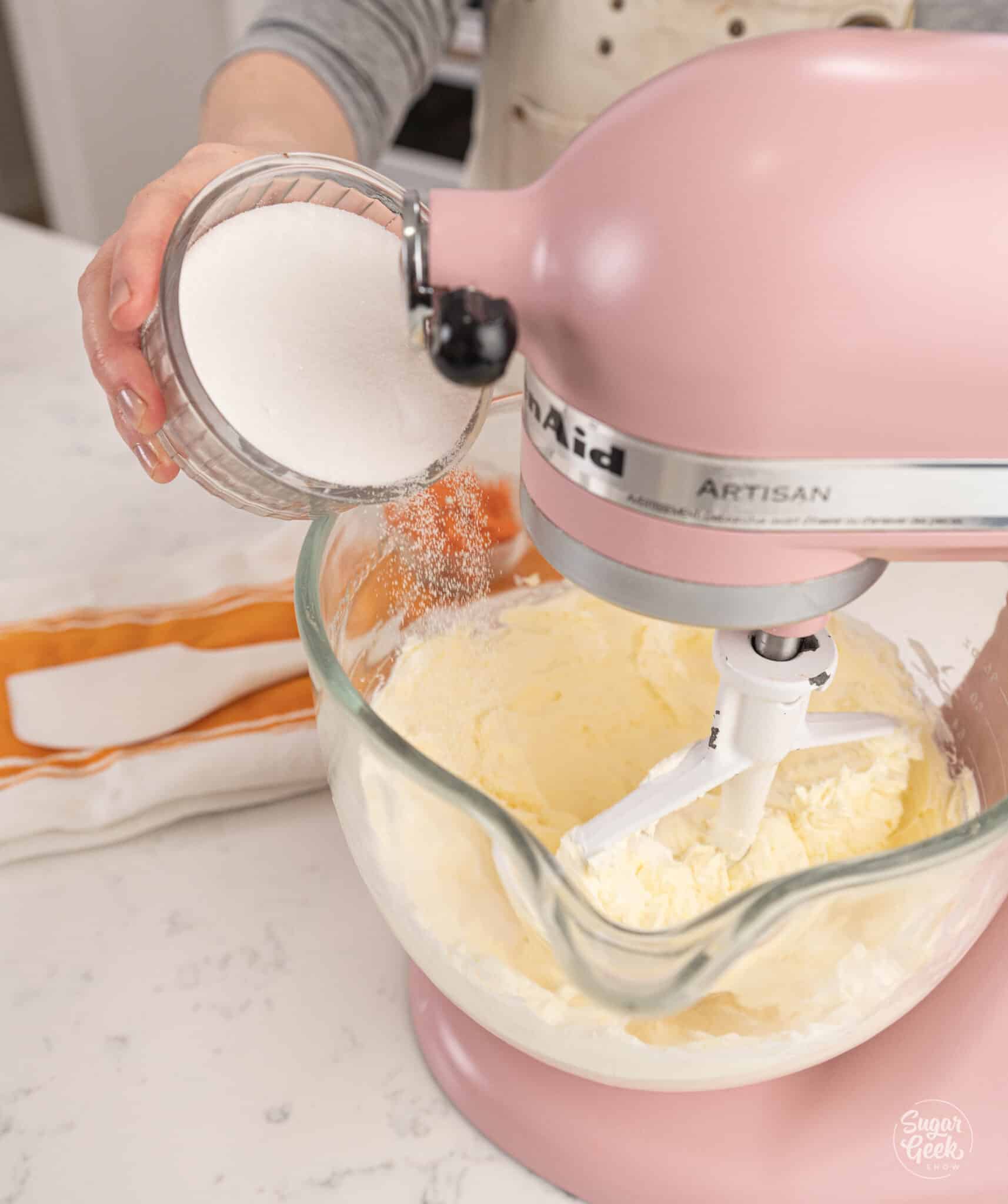
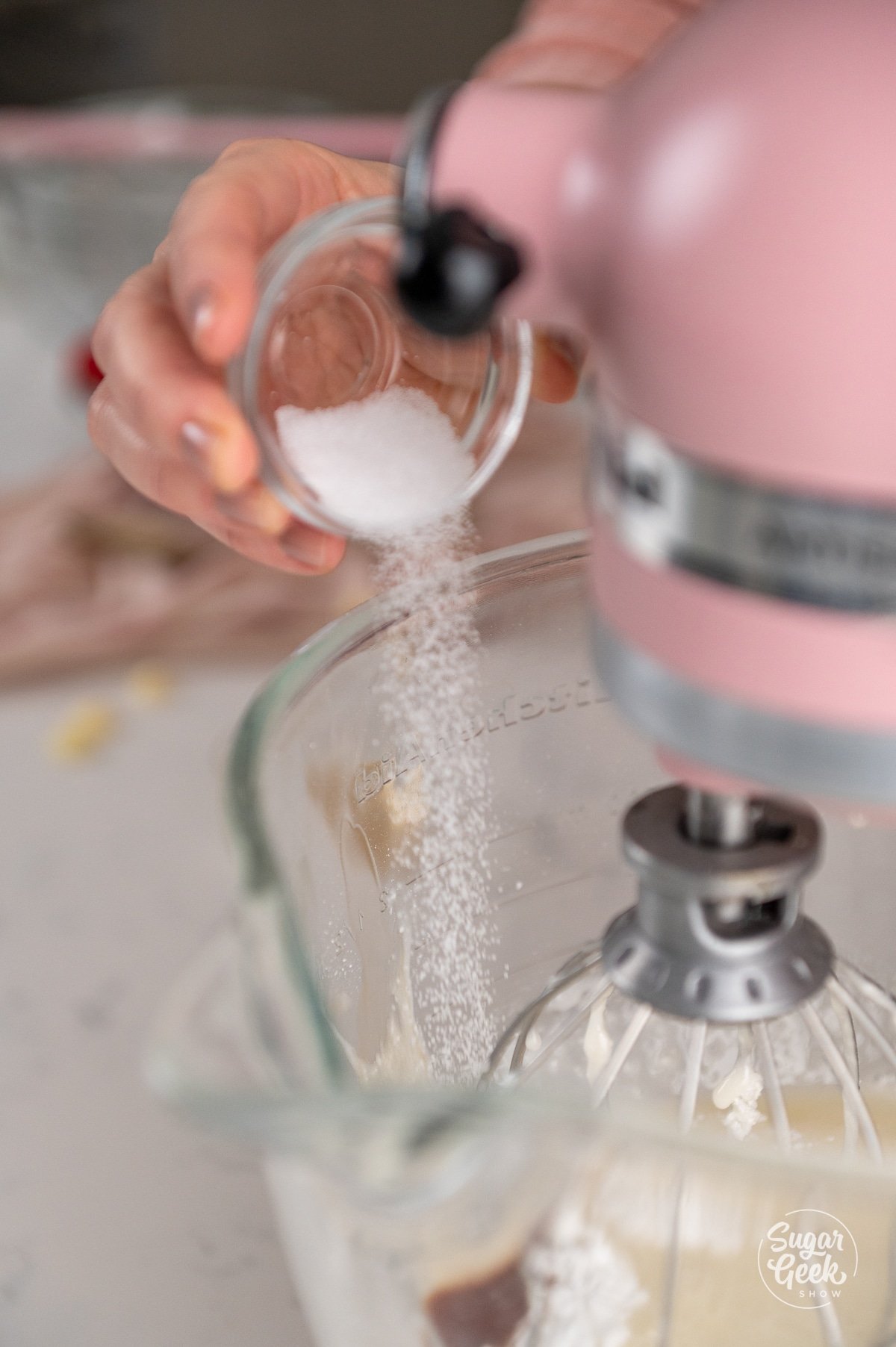
Hand pouring a container of sugar into a stand mixer bowl
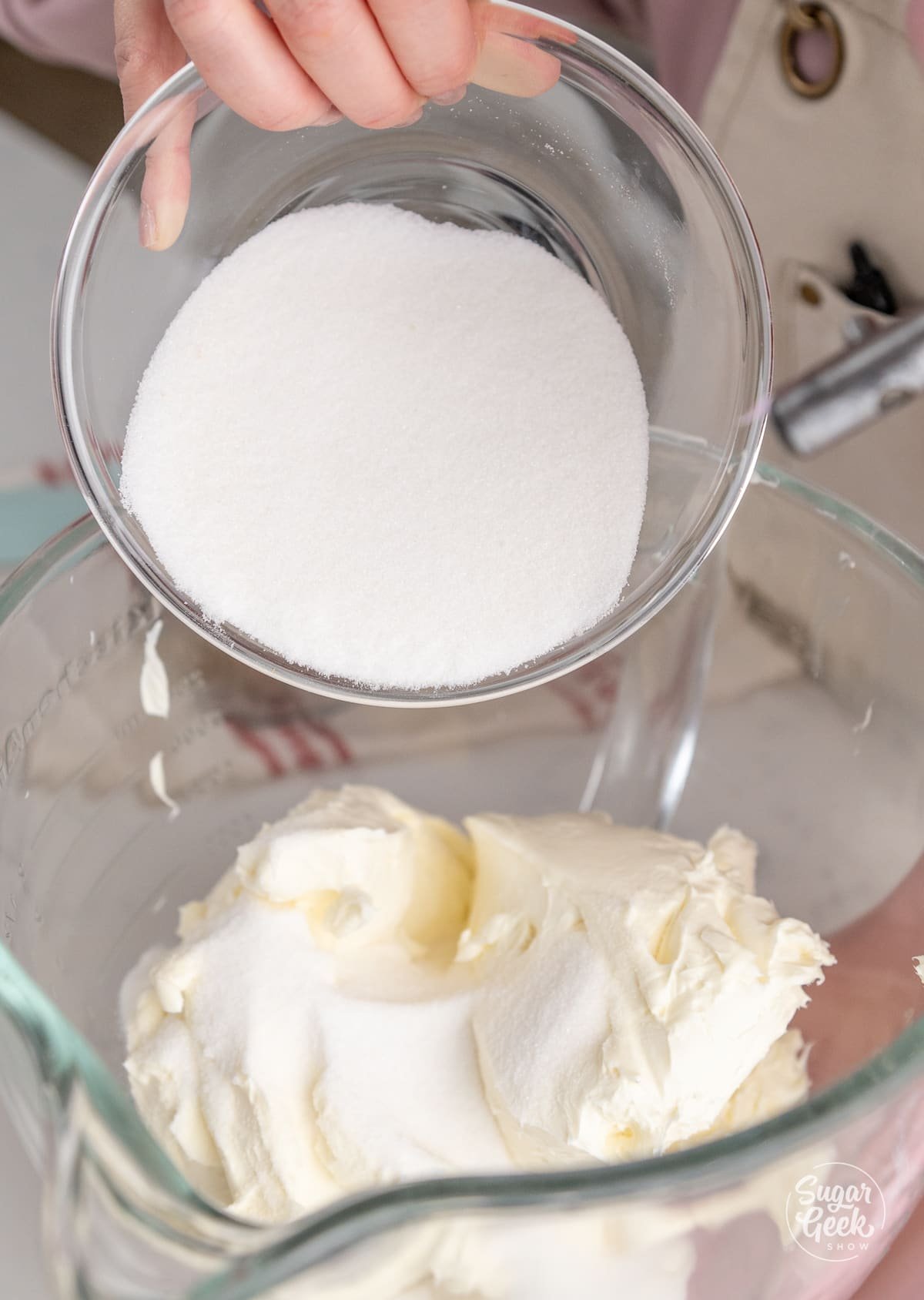
  1. Add powdered sugar one cup at a time while mixing on low speed.
    Add in the vanilla and salt.
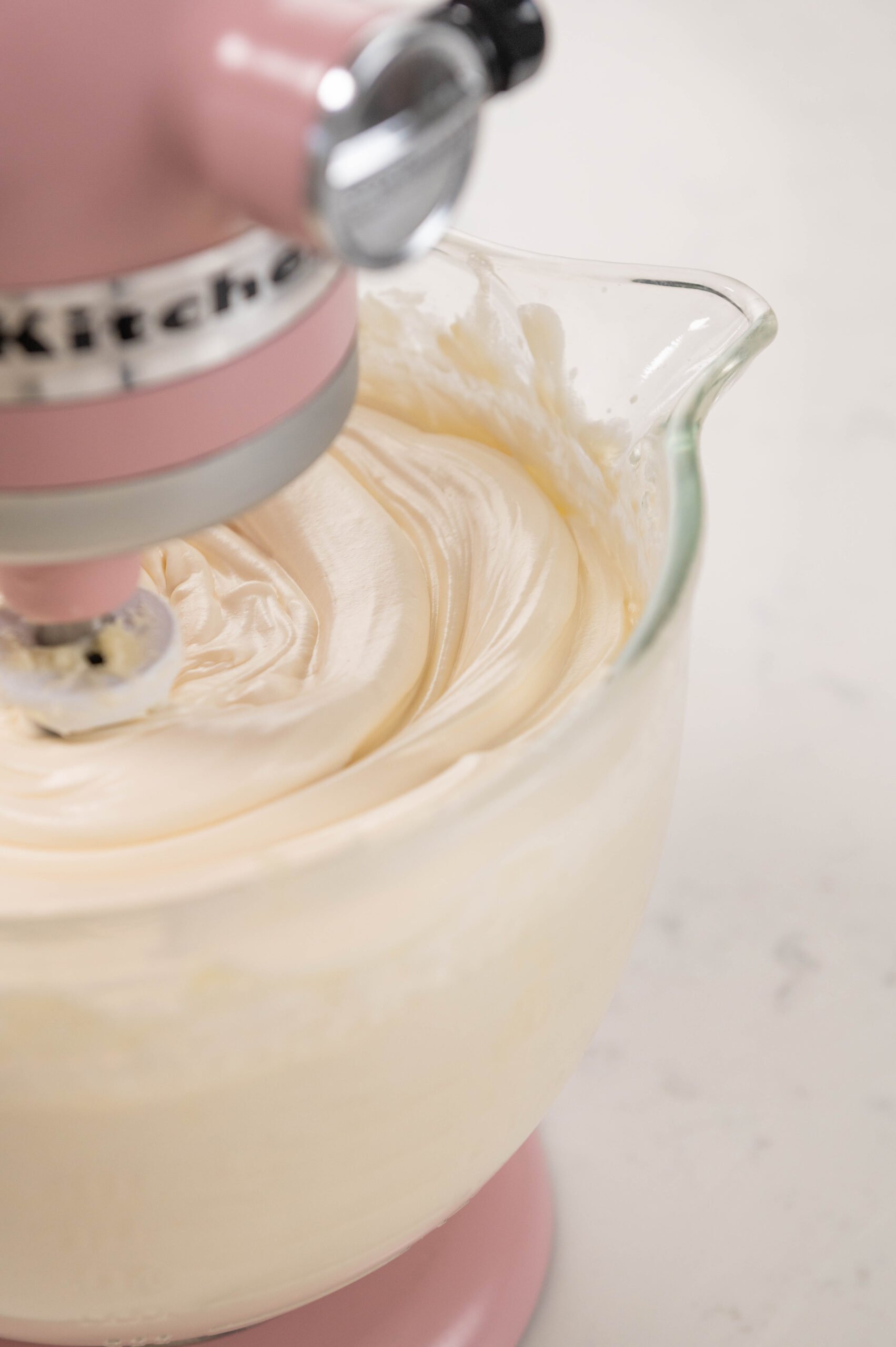
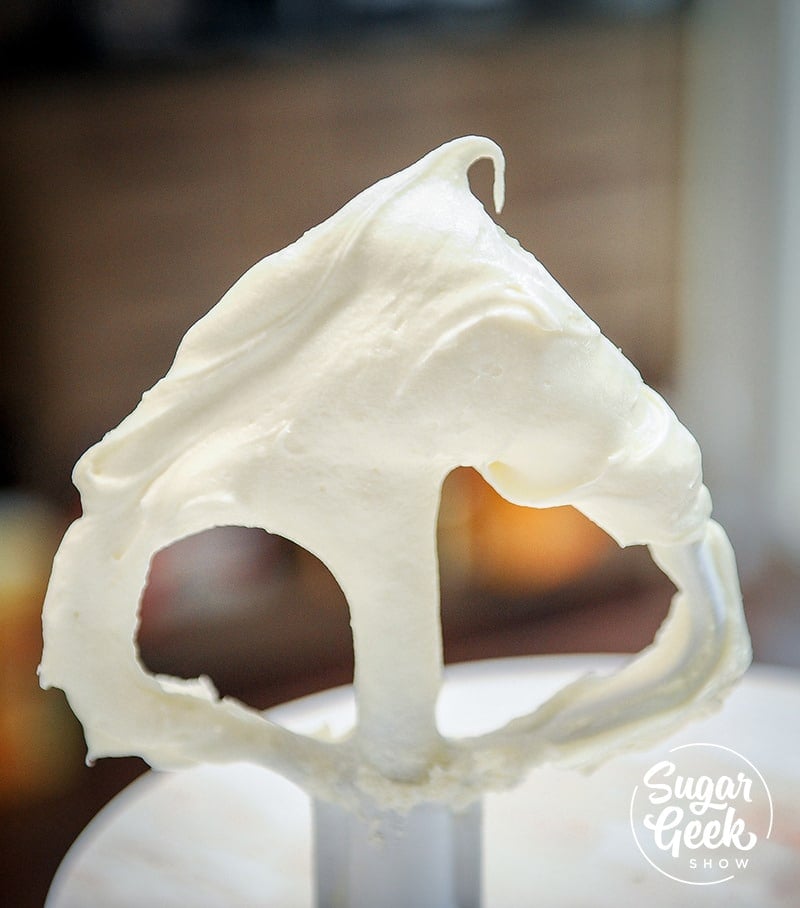
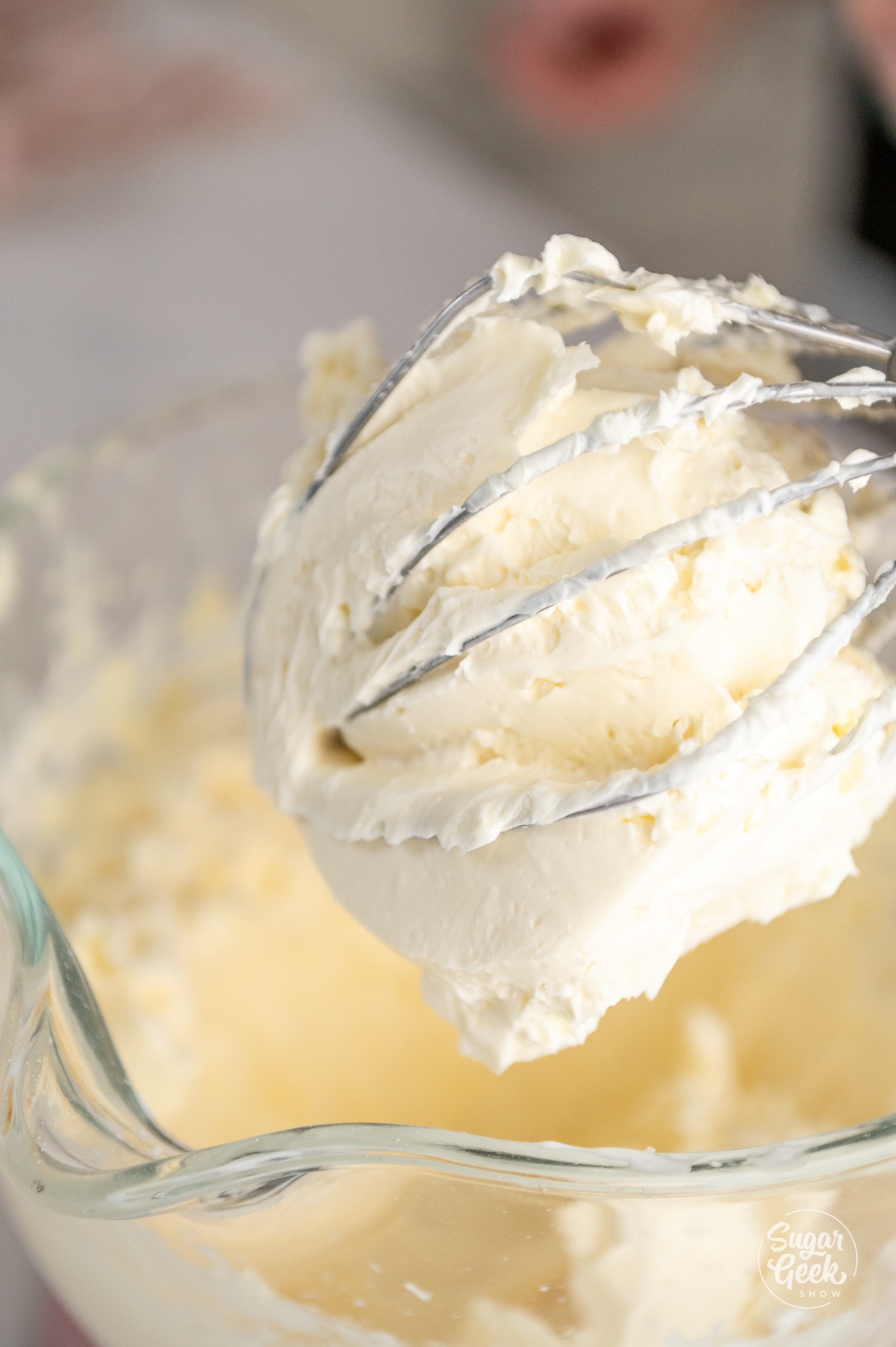
cream cheese frosting on a paddle attachment
  1. If the frosting is too thick, add a small amount of heavy cream. If it's too soft, add additional powdered sugar.
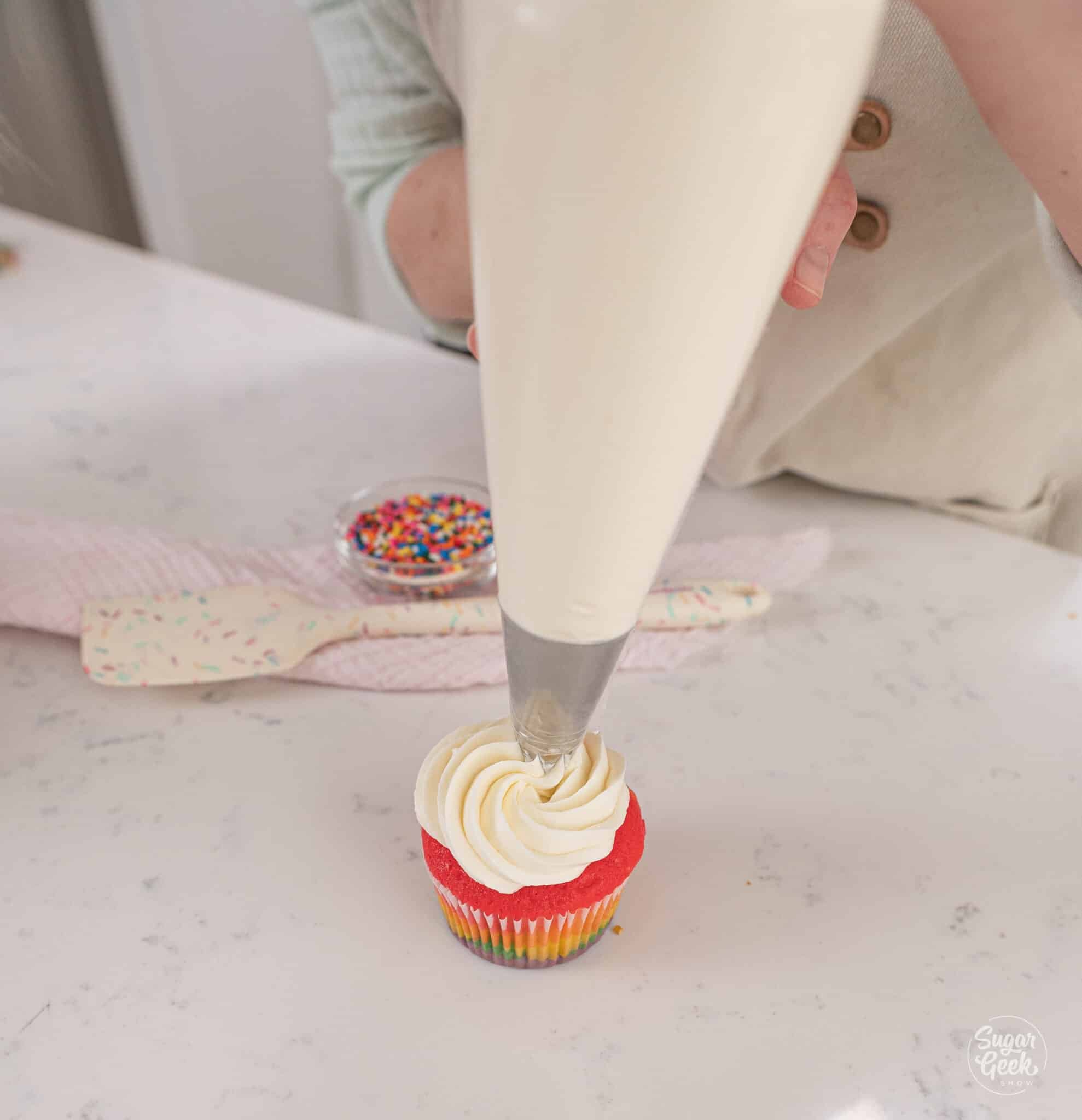
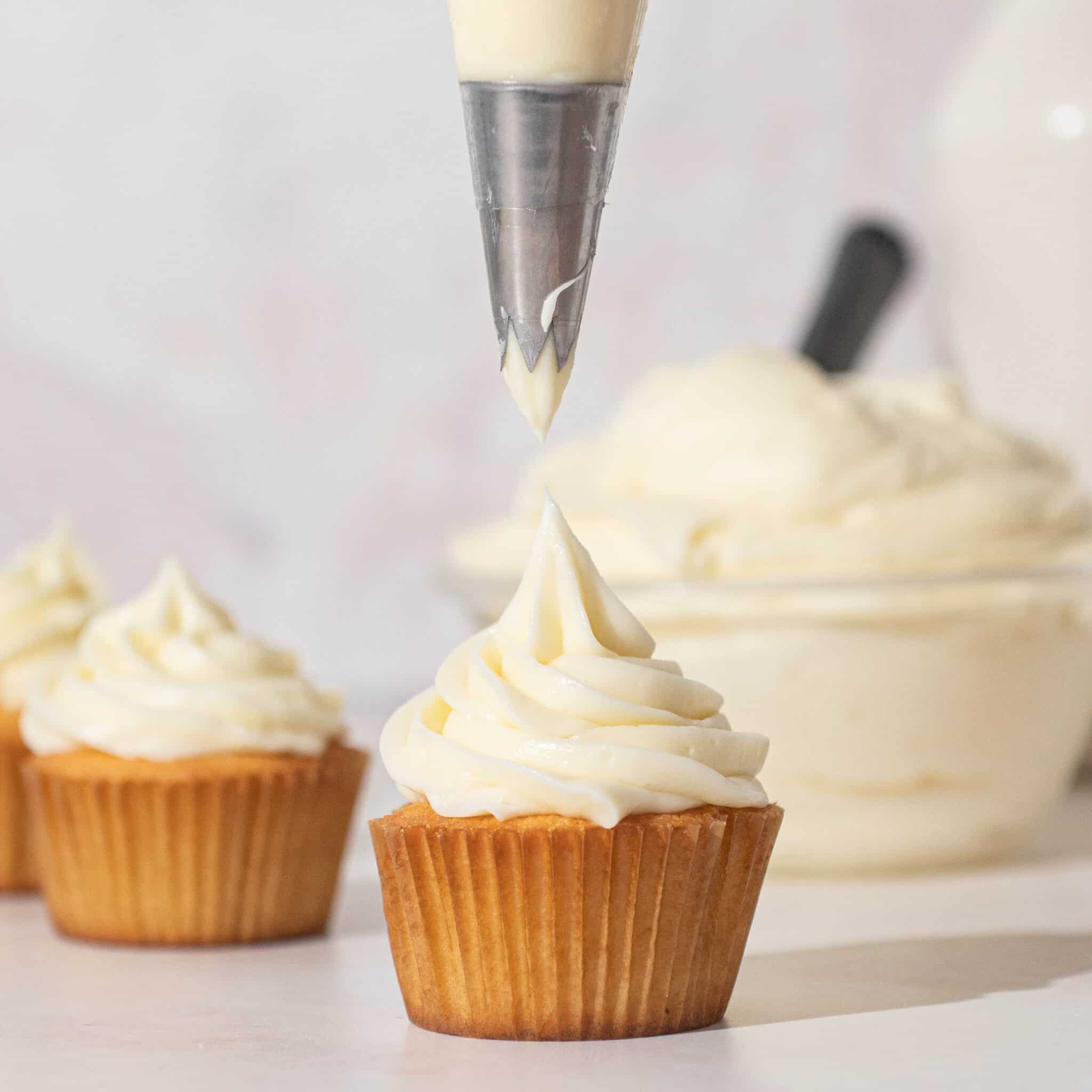
piping bag frosting a cupcake with cream cheese frosting
  1. Avoid overmixing, which can soften the frosting too much.
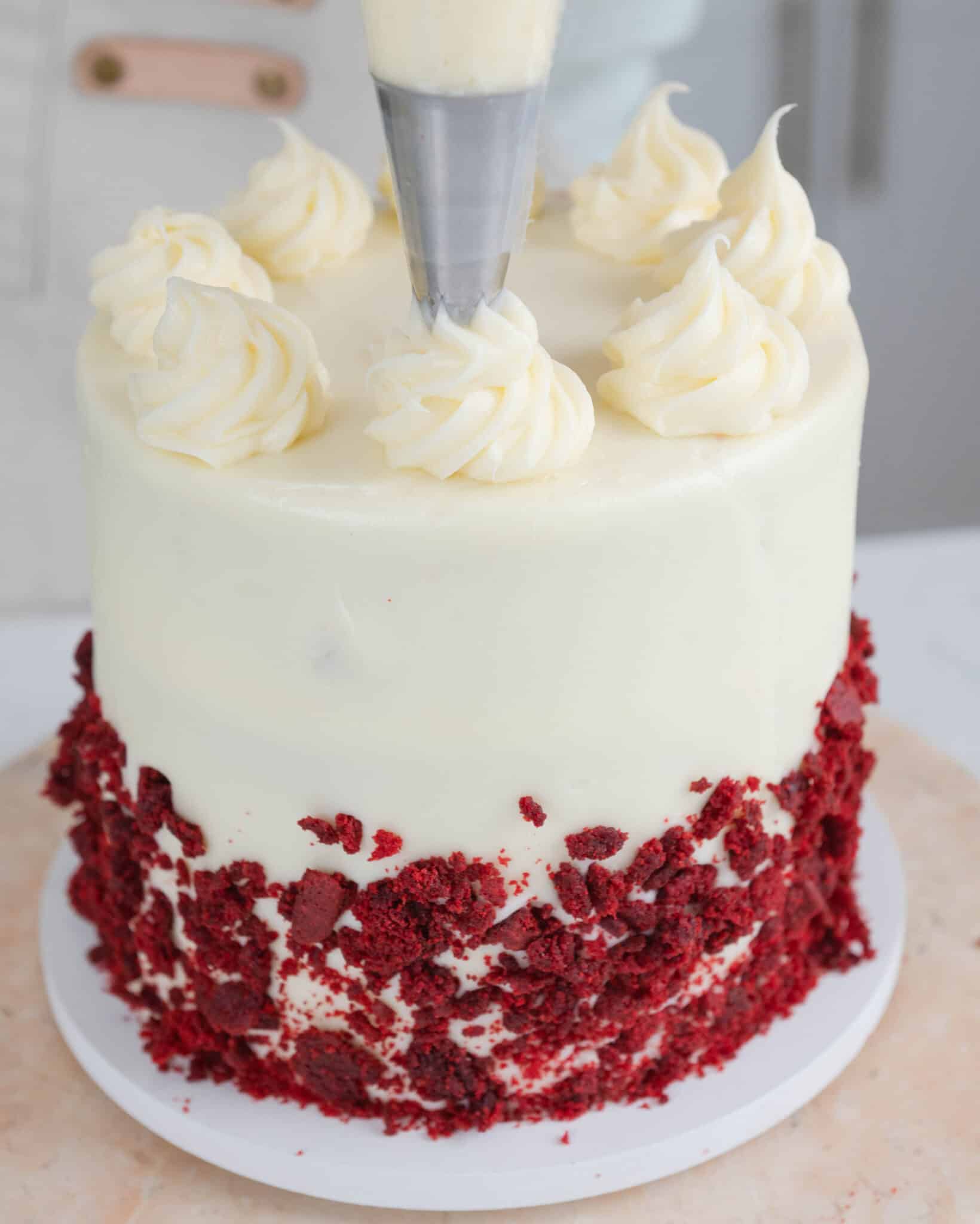
piping dollops of cream cheese frosting on a red velvet cake

Common Cream Cheese Frosting Mistakes

  • Using tub cream cheese
    Spreadable cream cheese contains stabilizers and extra moisture that can make frosting runny.
  • Overmixing the frosting
    Cream cheese softens quickly, so mixing too long can cause the frosting to lose structure.
  • Ingredients not at the right temperature
    Butter and cream cheese should be soft but still cool to the touch.

Tips & tricks for success

  • If your kitchen is warm, chill the frosting briefly to help it firm up before frosting a layer cake.
  • This frosting pipes beautifully with a piping bag and piping tip once it's chilled slightly.
  • For chocolate cream cheese frosting, add cocoa powder to taste after the powdered sugar is mixed in.
  • If you need enough frosting for an entire cake or a double batch for cupcakes, this recipe scales easily.

Final Thoughts

This classic cream cheese frosting is my go-to when I want a frosting that feels special without being fussy. It's an easy recipe made with simple ingredients, delivers that tangy cream cheese flavor every time, and works for just about any favorite cake. Whether you're spreading it with a spatula or piping it onto sweet treats, this is a great recipe to keep in your back pocket.

Easy Cream Cheese Frosting FAQs

Can you add food coloring to this easy cream cheese frosting recipe?


Yes. Gel food coloring works best because it won't thin the frosting.

Can this easy cream cheese frosting be frozen?


Yes. Freeze for up to two months. Thaw overnight in the refrigerator and remix before using.

How do you make chocolate cream cheese frosting?


Add about ¼ cup cocoa powder when adding the powdered sugar.

How do you make cream cheese frosting thicker?


Add additional powdered sugar a little at a time until the frosting reaches the desired consistency.

How do you store cream cheese frosting?

Cream cheese frosting should be stored in an airtight container in the refrigerator for up to 5 days.
Before using, allow the frosting to come to room temperature and mix briefly to restore its smooth texture.
This frosting can also be frozen for up to 2 months. Thaw overnight in the refrigerator and remix before using.

Related Recipes

  • Easy chocolate cake recipe slice on a white plate with cake in the background.
    Easy Chocolate Cake Recipe
  • closeup of vanilla cake with vanilla buttercream slice on a white plate
    Vanilla Cake Recipe
  • Slice of red velvet cake with cream cheese frosting on a white plate.
    Red Velvet Cake Recipe
  • Moist carrot cake with pineapple, toasted coconut, candied pecans and big chunks of carrots. Frosted with brown butter cream cheese frosting
    Carrot Cake With Pineapple Recipe
  • close up slice of pumpkin spice cake
    Pumpkin Spice Cake
  • slice of applesauce cake with cream cheese frosting on black plate
    Applesauce Spice Cake Recipe
  • closeup of fresh apple cake recipe with brown butter buttercream on grey plate
    Fresh Apple Cake Recipe
  • white velvet cake recipe
    White Velvet Buttermilk Cake

Cake Batter and Frosting Calculator

Select an option below to calculate how much batter or frosting you need. Adjust the servings slider on the recipe card to change the amounts the recipe makes.

Choose a pan type

Choose a cake pan size
(based on 2" tall cake pan)

Choose a cake pan size
(based on 2" tall cake pan)

Choose a cake pan size
(based on 2" tall cake pan)

Cupcake Tin Size

Choose number of pans

Cups of Batter Needed

8 cups

Cups of Frosting Needed

5 cups

Note: measurements are estimated based off the vanilla cake recipe using standard US cake pans and sizes. Measurements used are for 2" tall cake pans only. Your results may vary. Do not overfill cake pans above manufacturer's recommended guidelines.


Watch: How To Decorate A Cake Step-by-Step

Before you start decorating, watch the video below where I show you every step of decorating a cake from start to finish. Seeing the process in action makes it much easier to follow along

- Liz Marek.

Start Learning Now
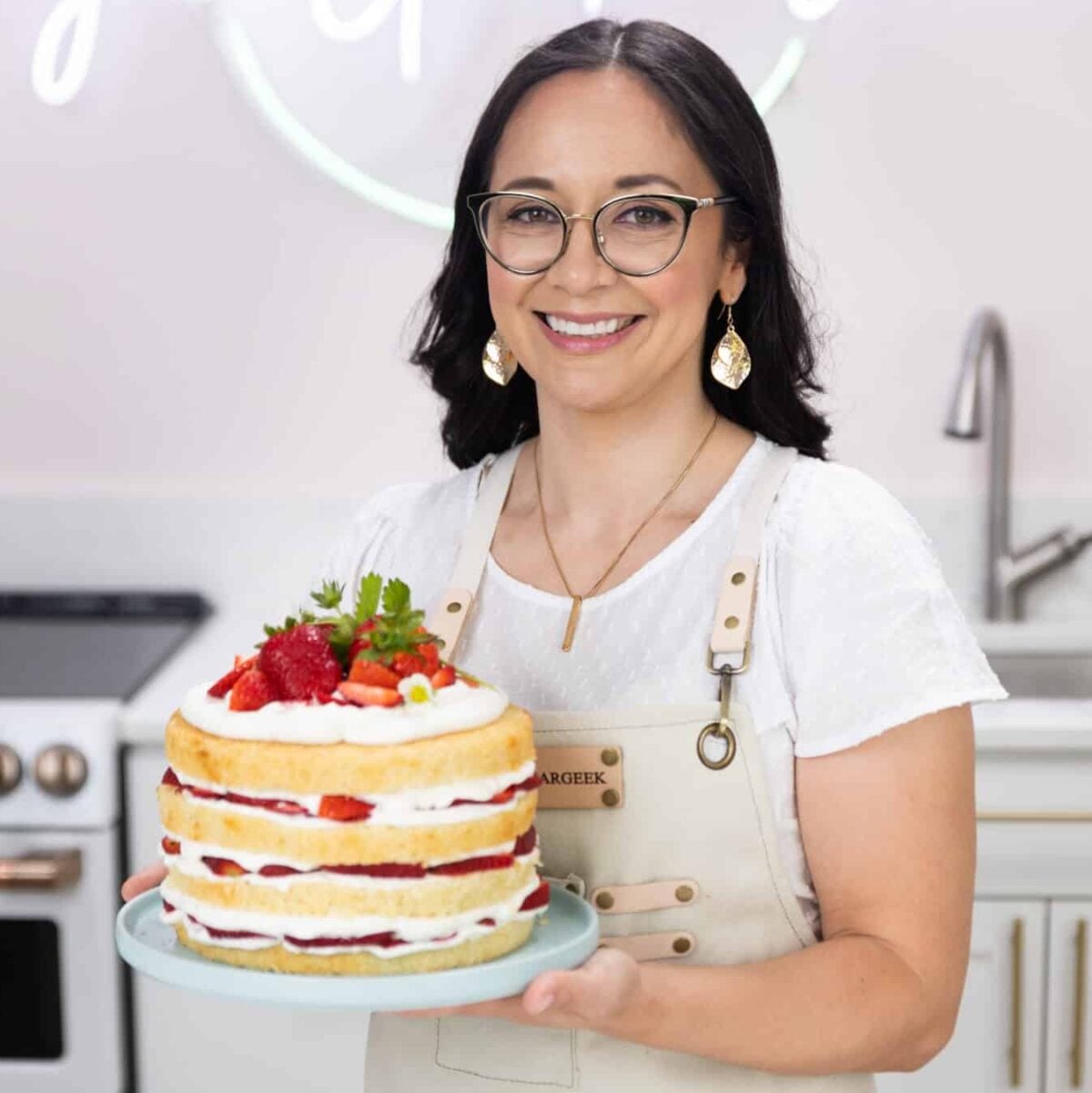
smiling woman holding a decorated cake in her hands

Recipe

close up of a red velvet cupcake with cream cheese frosting piped on top surrounded by other cupcakes
Print Recipe
4.82 from 16 votes

Cream Cheese Frosting

How to make cream cheese frosting that is smooth, tangy, and very easy to make with simple ingredients. This is a sweet frosting compared to some traditional cream cheese frosting recipes, but not as sweet as most buttercream frostings. You can always adjust it to add more or less sugar depending on your preference.
Prep Time10 minutes mins
Cook Time5 minutes mins
Total Time15 minutes mins
Course: Dessert
Cuisine: American
Servings: 6 cups
Calories: 92kcal
Author: Liz Marek

Ingredients

Cream Cheese Frosting Ingredients

  • 8 ounces unsalted butter (1 cup) softened and slightly warm
  • 16 ounces cream cheese (2 cups) softened and slightly warm
  • 36 ounces powdered sugar (8 cups) sifted
  • 1 teaspoon vanilla extract or orange or lemon extract
  • ½ teaspoon salt
US Customary - Metric

Instructions

Warming the Ingredients

  • Cold does not like to mix with warm. So if you've got room temperature butter and cold cream cheese, you'll end up with a lumpy and separated mess.
  • Soften the cream cheese by cutting it into four cubes and microwaving it for about 15 seconds.
  • Soften the butter by leaving it out for a few hours or cutting it into cubes and microwaving it for 10 seconds. Softened butter should be soft enough that you can leave an imprint on the surface of the butter with your finger.

How to Make Cream Cheese Frosting

  • *THE SECRET TO MAKING SMOOTH CREAM CHEESE FROSTING* - Use an electric hand mixer or the whip attachment on your stand mixer, and mix on LOW speed.
  • Sift the powdered sugar into a large bowl and set it aside.
  • Add the softened butter to a large bowl and mix on low with an electric mixer until smooth and lump-free.
  • Next, add the softened cream cheese in small cubes and combine on low until smooth and completely homogenous.
  • Add in your powdered sugar one cup at a time. If you want to make your frosting thicker, add in an extra cup of powdered sugar.
  • Lastly, add in your extract and salt. A traditional vanilla flavor from vanilla extract goes well with cream cheese, but I love using orange extract or lemon extract for a unique taste.
  • This is enough frosting to frost and fill three 8″x2″ layers or 24 cupcakes. I used a piping bag with a 1M piping tip for these cupcakes.
  • Cakes with homemade cream cheese frosting must be refrigerated but can be left at room temperature for up to 4 hours without any risk.
    Leftover frosting can be kept in an airtight container in the fridge for up to three days or frozen for a month or more.

Video

Notes

  • Use high-quality cream cheese (full-fat) and the best butter. The better the cream cheese and the butter you use, the better tasting the cream cheese frosting will taste!
  • Cream cheese frosting cannot be used under fondant, because it will melt the sugar in the fondant.
  • This recipe will not crust, but if you're looking for a more stable frosting suitable for piping flowers or for use in stacked cakes, try my crusting cream cheese frosting recipe.
  • You can add ½ cup of cocoa powder to make this recipe chocolate.
  • You can tint cream cheese frosting using food color gels. Too many added liquids can break your frosting and make it too soft to use.

Nutrition

Serving: 2oz | Calories: 92kcal | Carbohydrates: 17g | Fat: 2g | Saturated Fat: 1g | Cholesterol: 8mg | Sodium: 43mg | Potassium: 10mg | Sugar: 16g | Vitamin A: 100IU | Calcium: 7mg
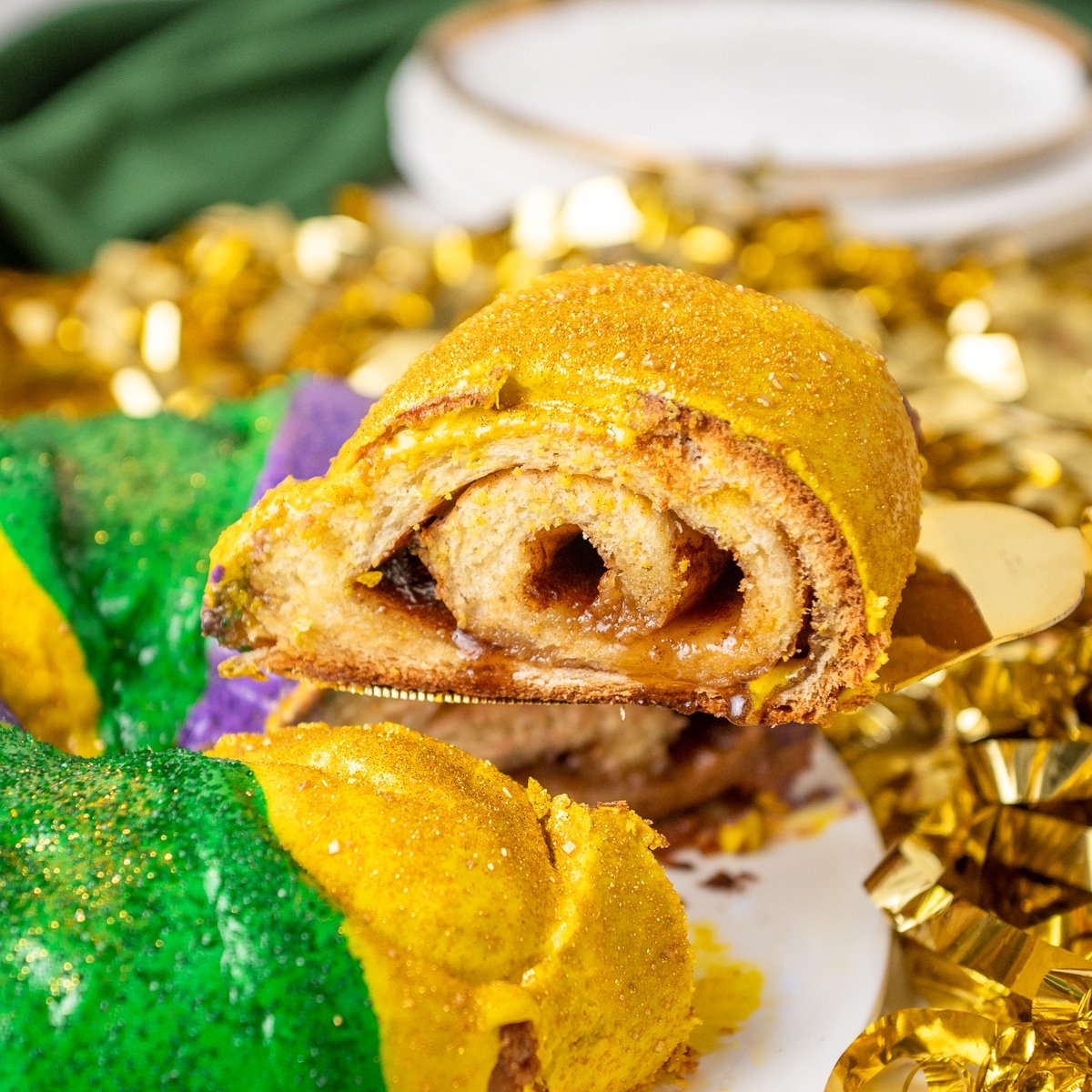
slice of king cake held with a serving knife

February 16, 2023 Bread

King Cake Recipe

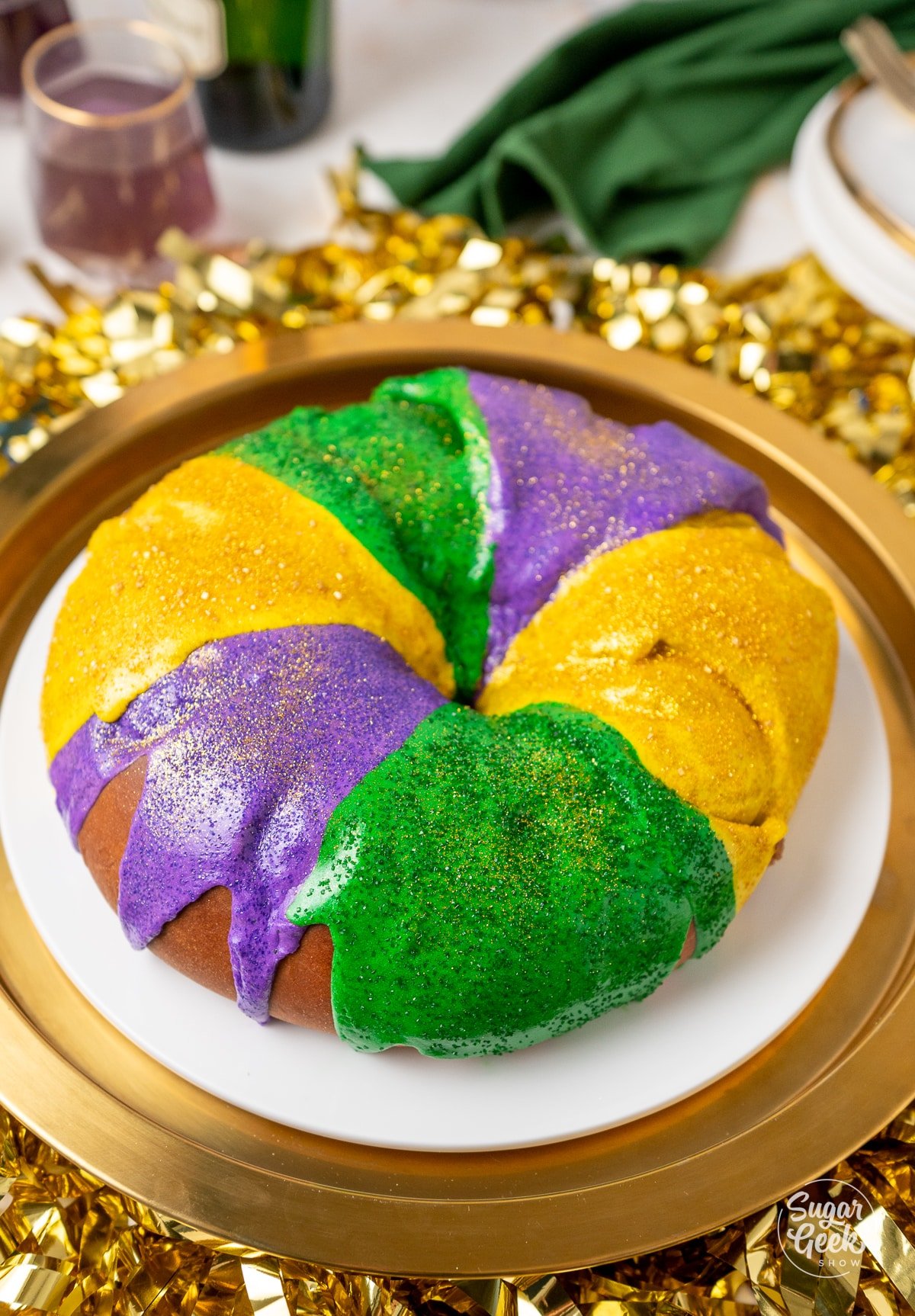
A classic king cake is a festive baked good that is associated with Mardi Gras, Fat Tuesday, and New Orleans. It's a ring-shaped pastry similar to brioche, that is often rolled in cinnamon and sugar, then baked, glazed, and coated with colored sugars. Kind of like a giant festive cinnamon roll!slice of king cake held with a serving knife The traditional king cake has a religious background, so a tiny plastic baby is hidden inside to represent baby Jesus. Whoever gets the slice with the baby in it is said to have good luck, but is also responsible for bringing the king cake next year.gold, green, and purple king cake on a platter

Table of contents

  • King Cake Ingredients
  • How to Make a King Cake
    • Making the Dough
    • Making the Filling
    • Forming the King Cake
    • Baking the King Cake
    • Icing the King Cake
  • FAQ
  • Related Recipes

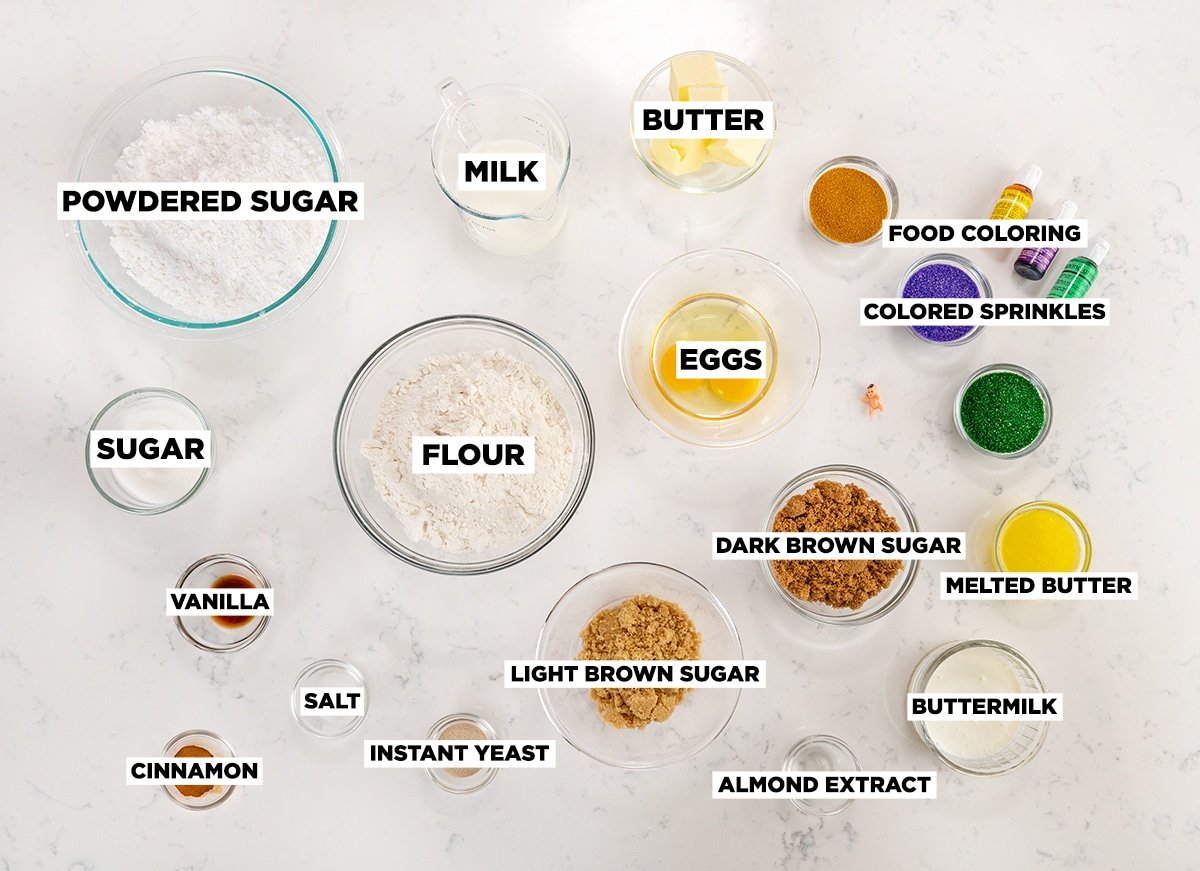
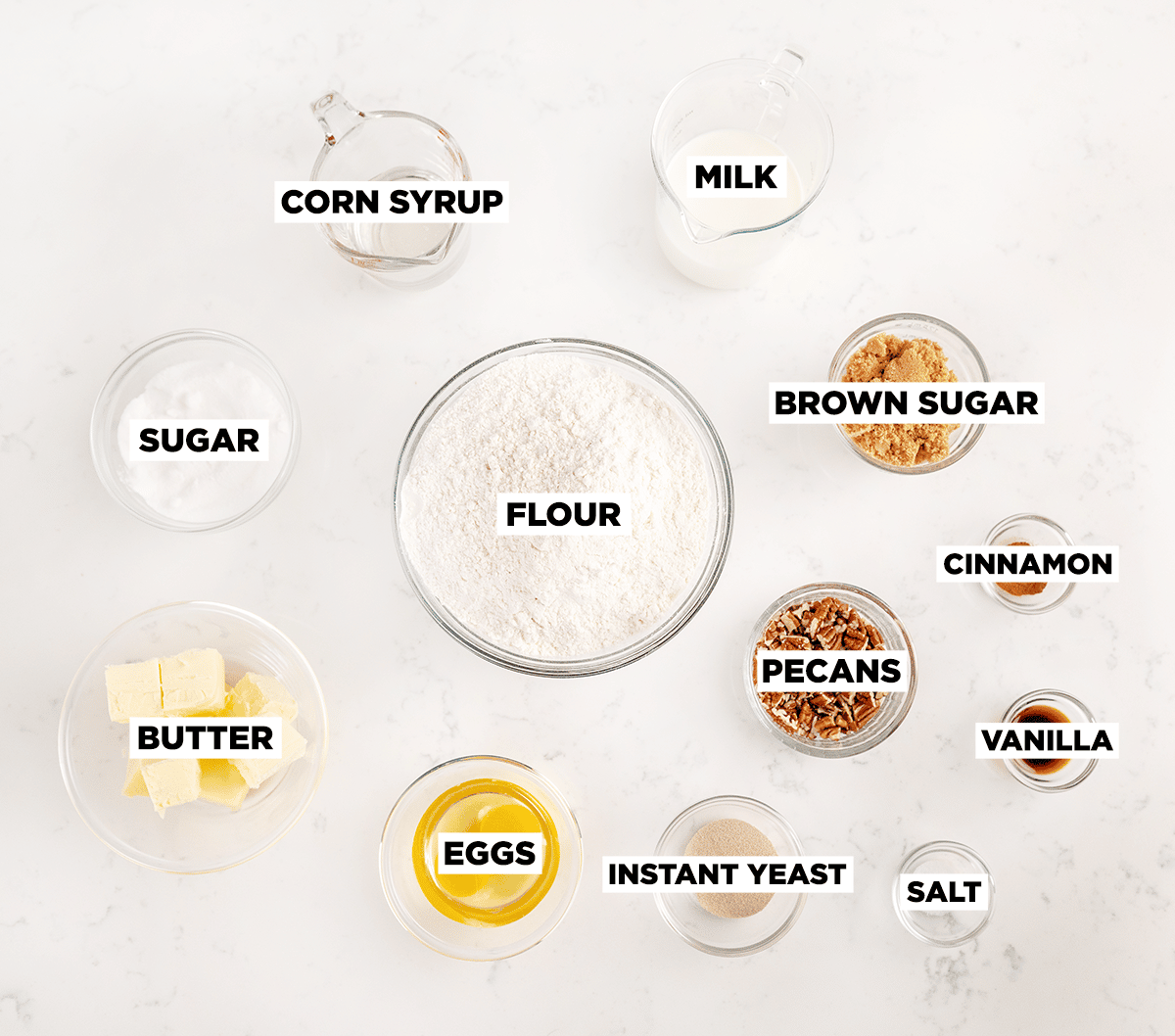
King Cake Ingredientsbowls of ingredients for king cake on a table

Yeast: I am using instant yeast because it is so easy to use and store. It is just added in with your dry ingredients, no need to "bloom it" first. If you do not have instant yeast, you can substitute active dry yeast in the same measurement, just add it to your warm milk with a tablespoon of the measured brown sugar. Then let it dissolve and bubble for a few minutes. 

Butter: King Cake dough is an enriched dough, meaning fat (butter) and sugar have been added to it. This makes the dough extra soft and moist.

Brown Sugar: I chose to use brown sugar to deepen the flavors of the dough and the filling. It also retains moisture because of the added molasses to the brown sugar.

How to Make a King Cake

Making a king cake is just like making cinnamon rolls, but even easier because you don't have to cut them into individual slices before baking. First, make the dough and make the filling while it's proofing, then roll the dough out and fill it, shape it into a ring, proof again, and bake. If you want to make it this king cake ahead, just refrigerate it after shaping it into a ring, then proof and bake the next day.

Making the Dough

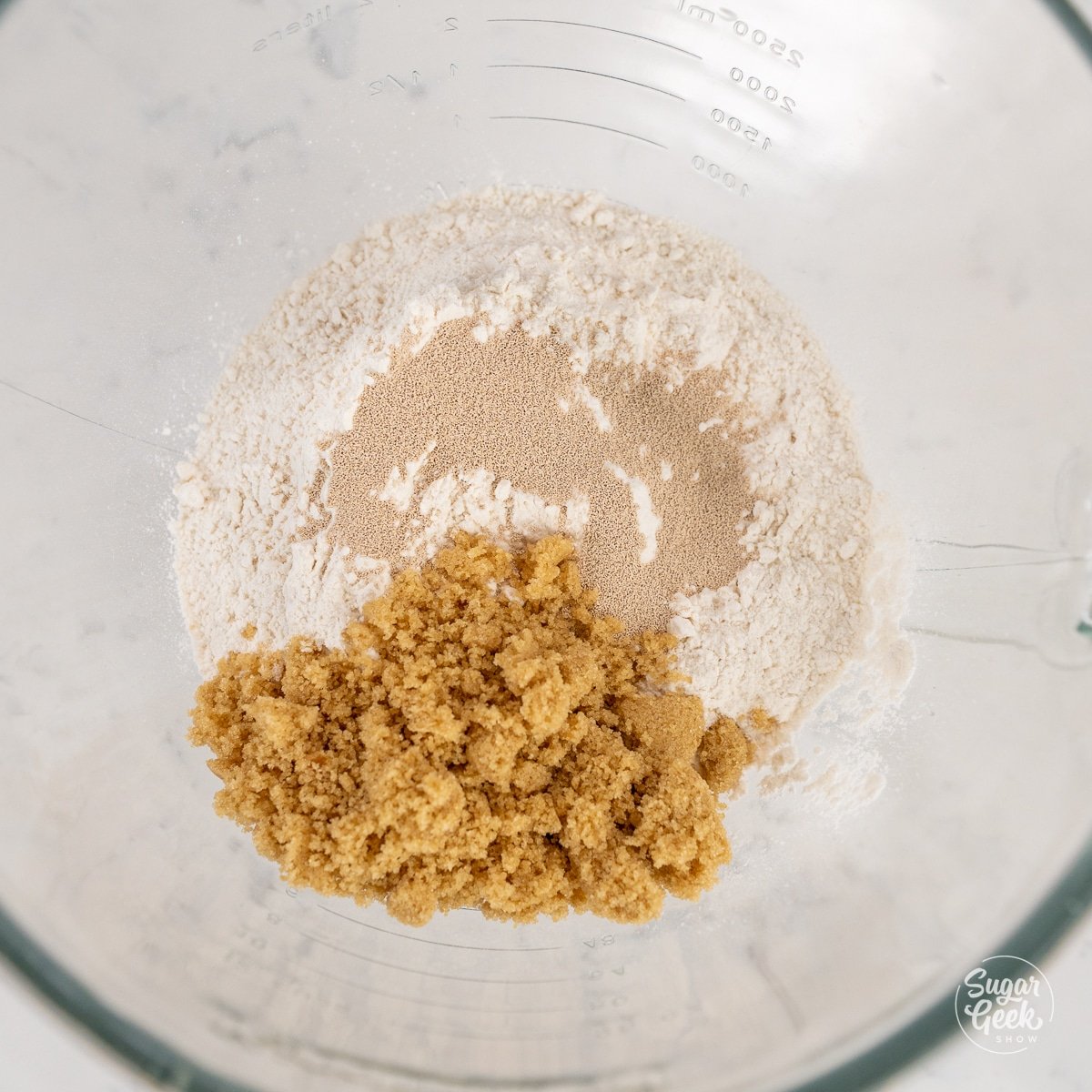
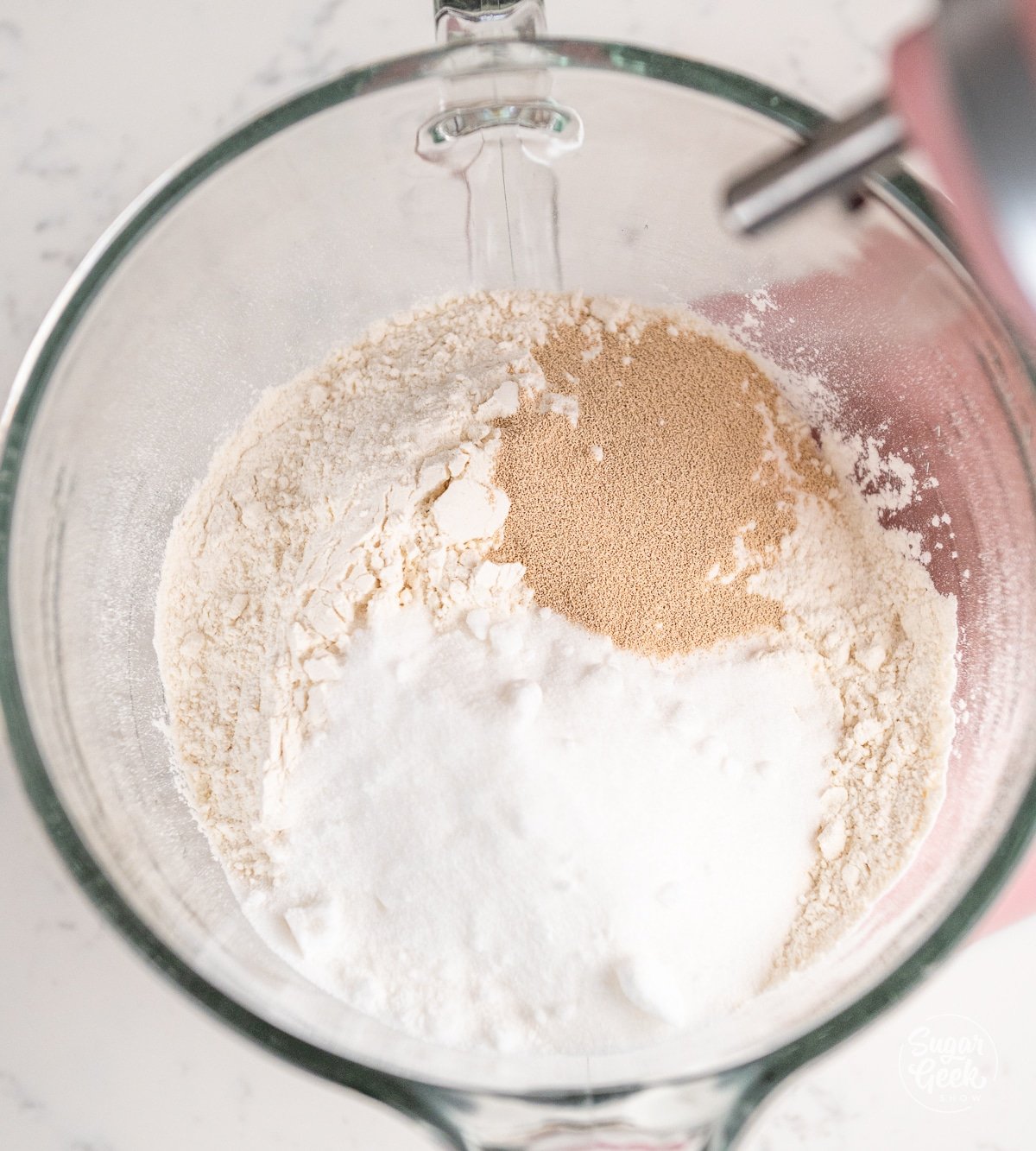
  1. Combine the flour, yeast, and sugar in the bowl of your mixer with a dough hook attachment, mix the ingredients for a few seconds to distribute the yeast evenly.yeast, flour, and sugar in a glass bowl
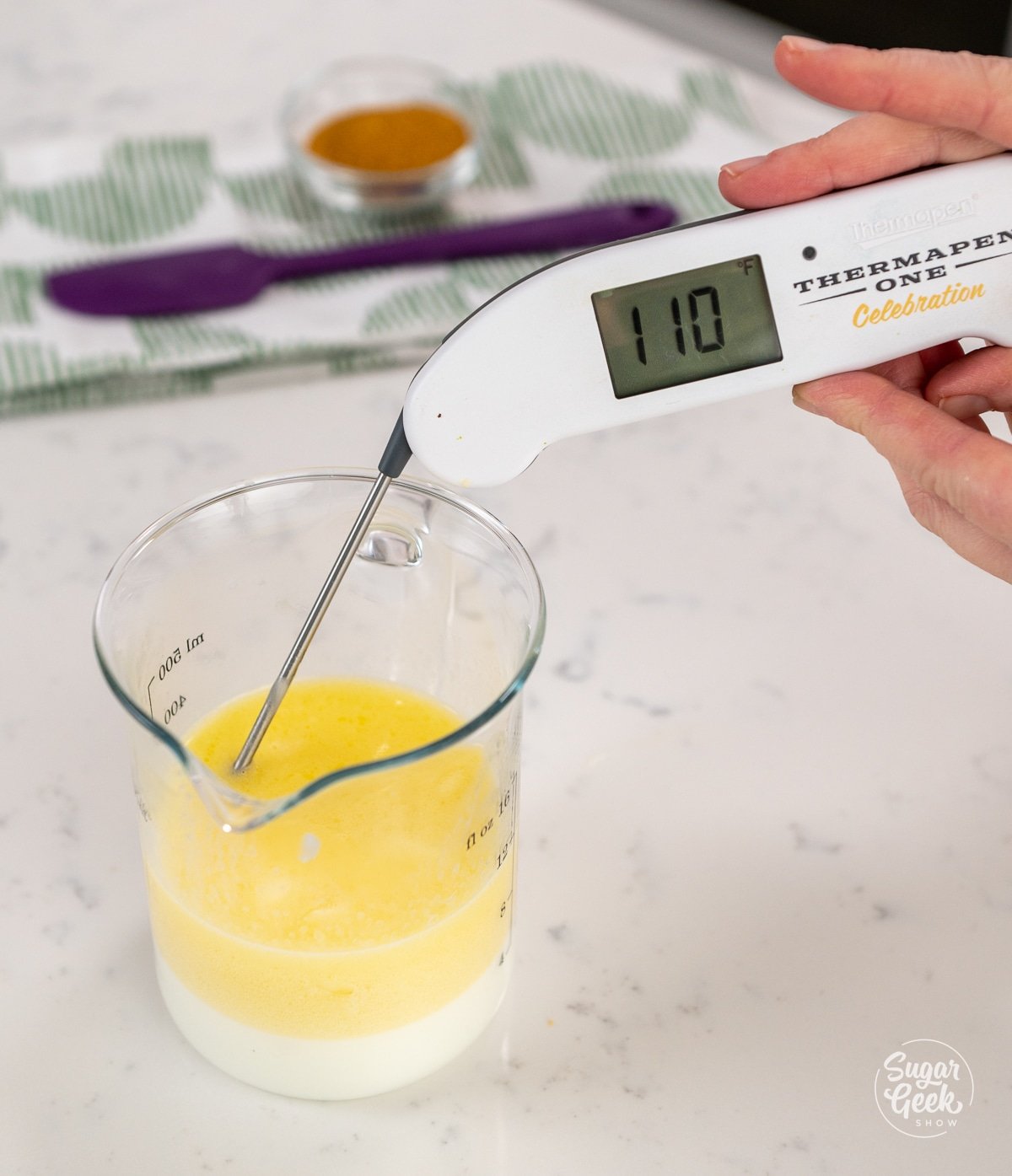
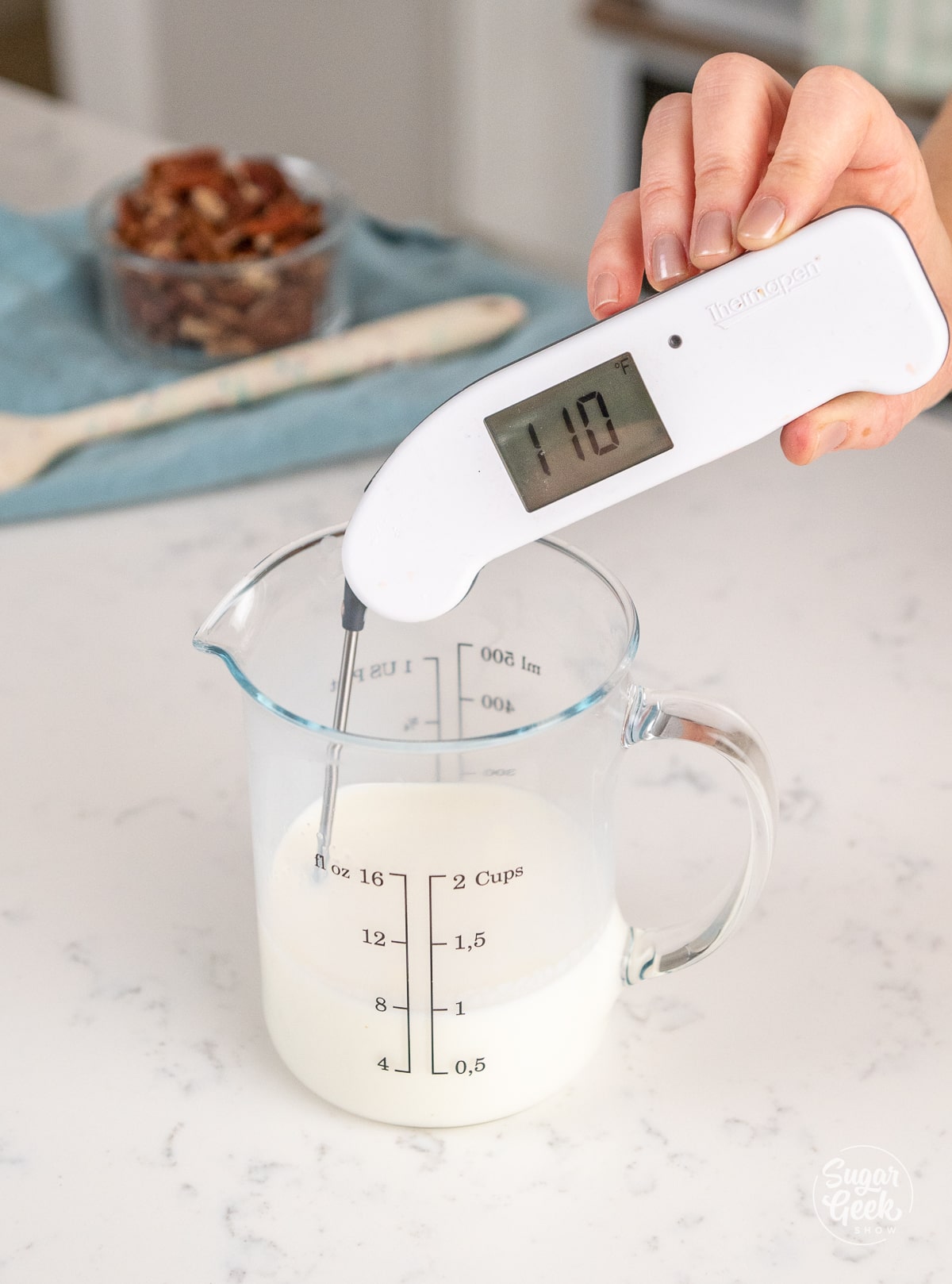
  2. In a heat safe container, combine the milk and butter and heat to 110°F. This can be done in the microwave or in a small saucepan.melted butter and milk in a container with a thermometer reading 110
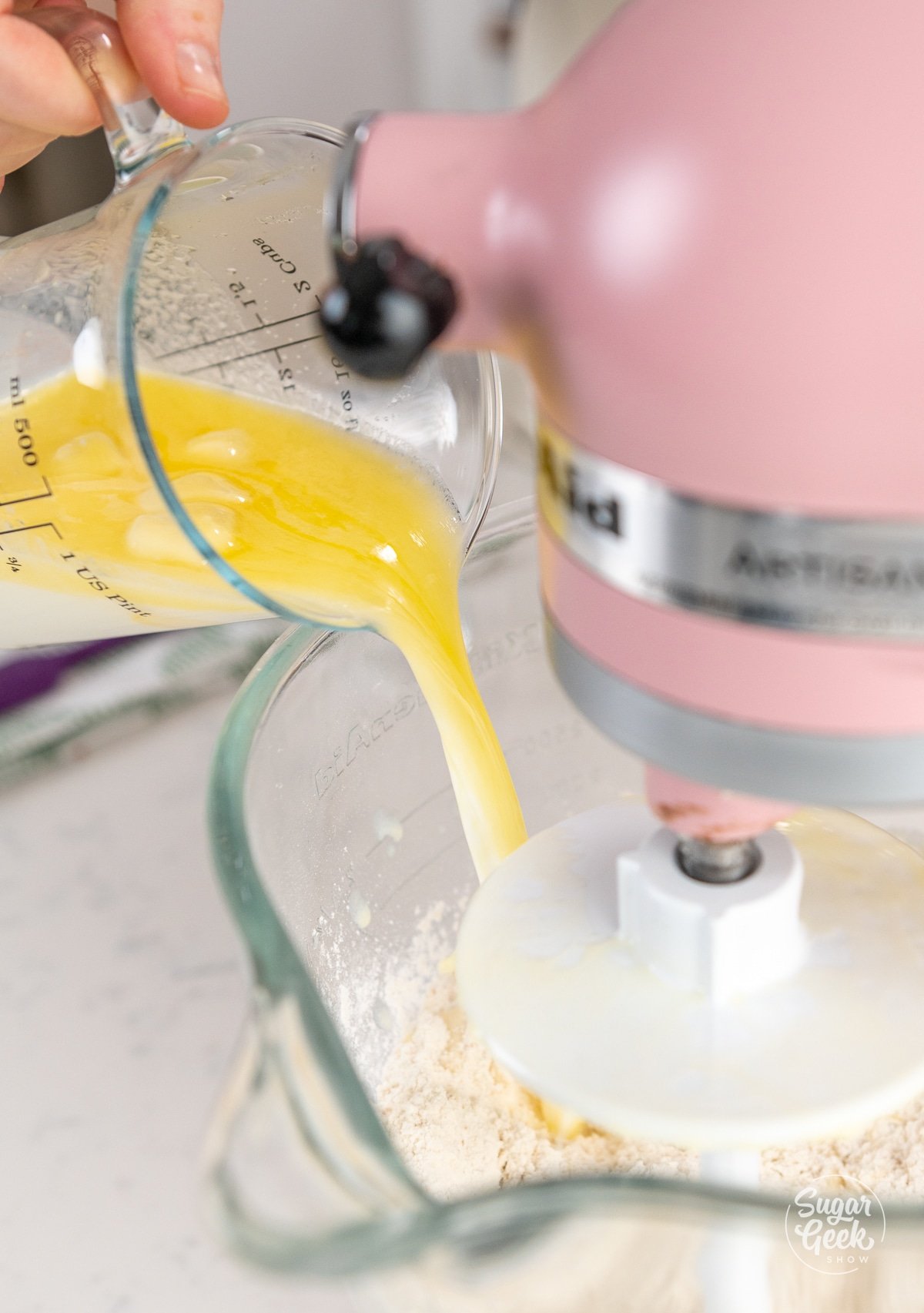
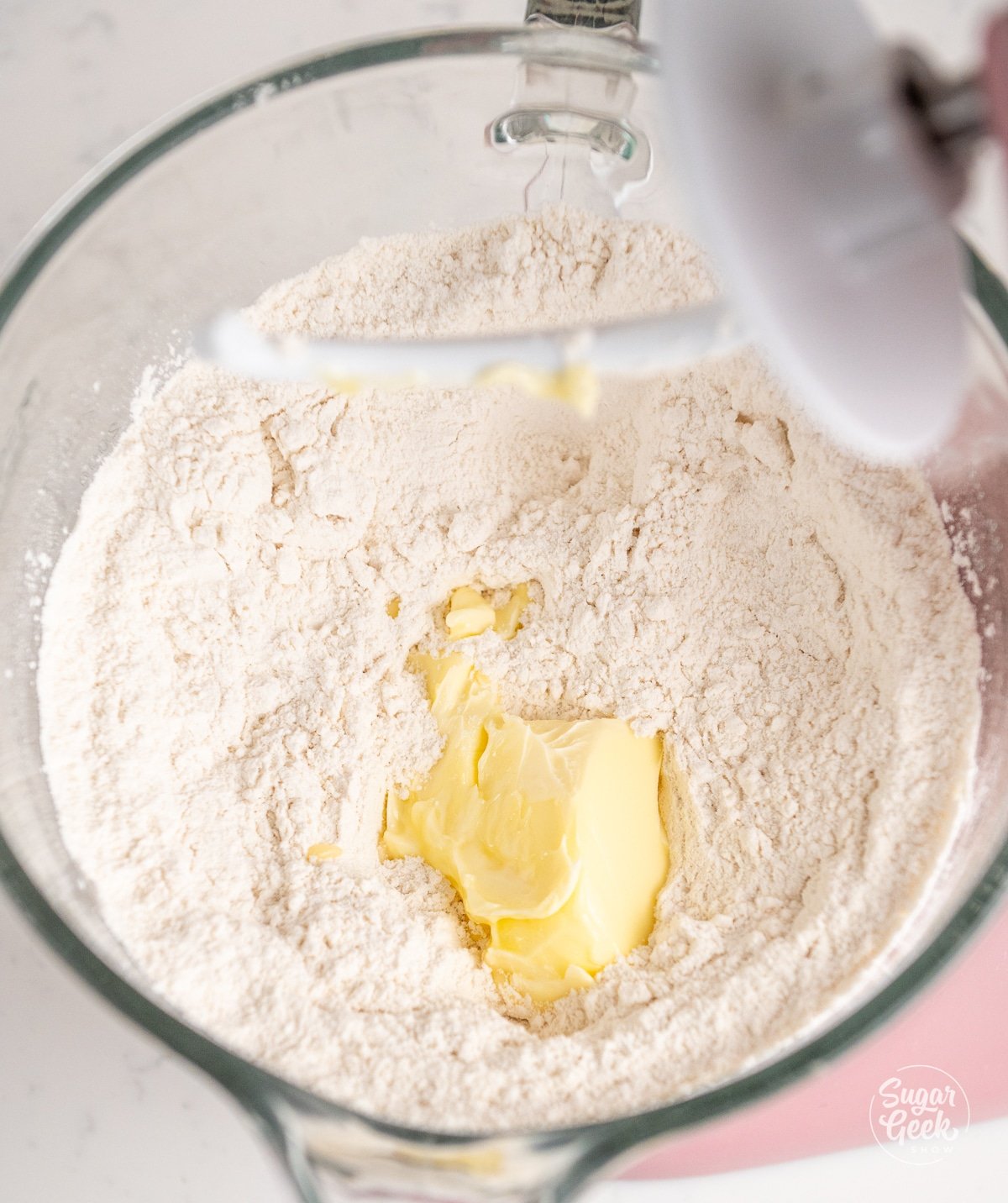
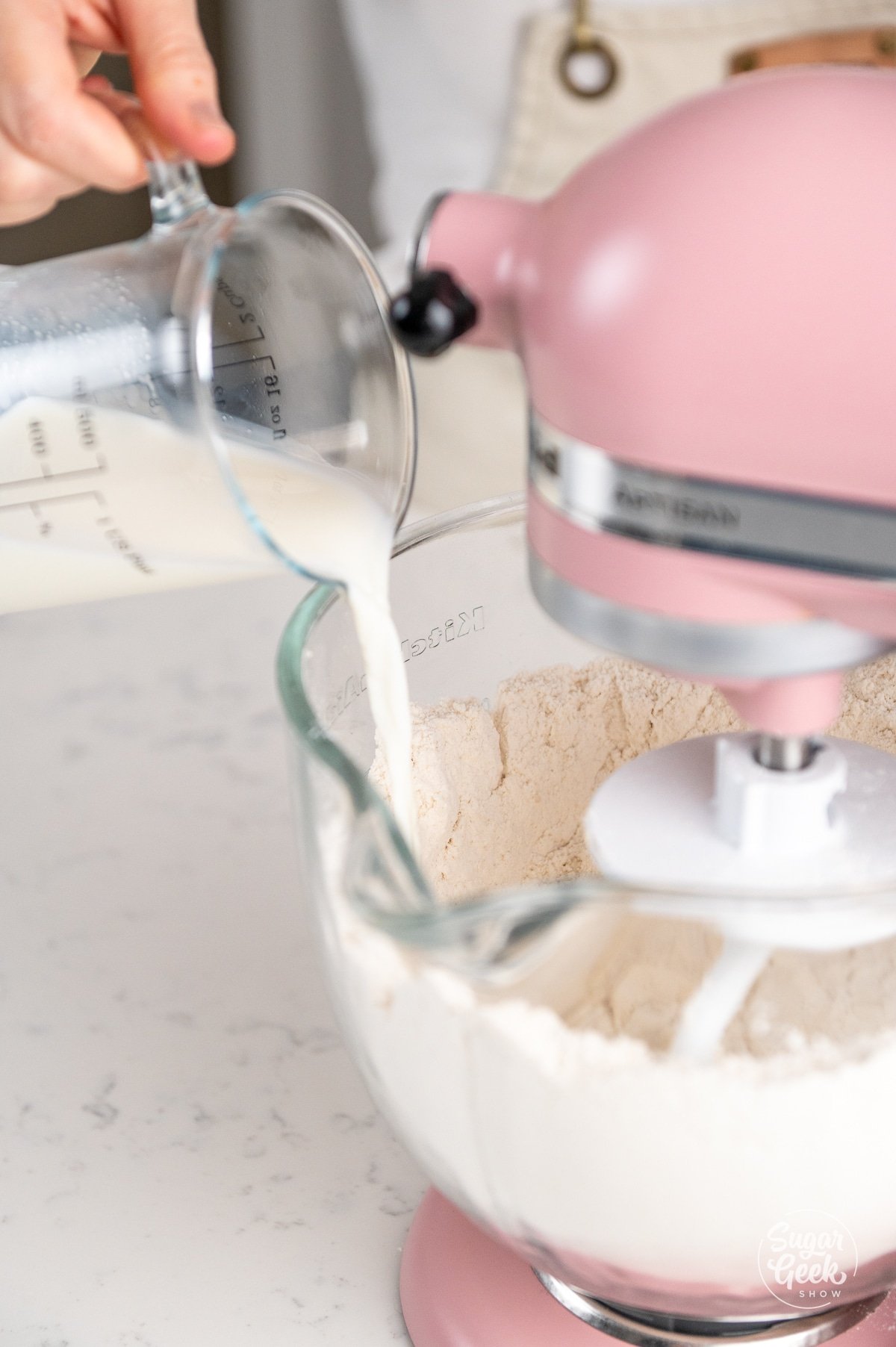
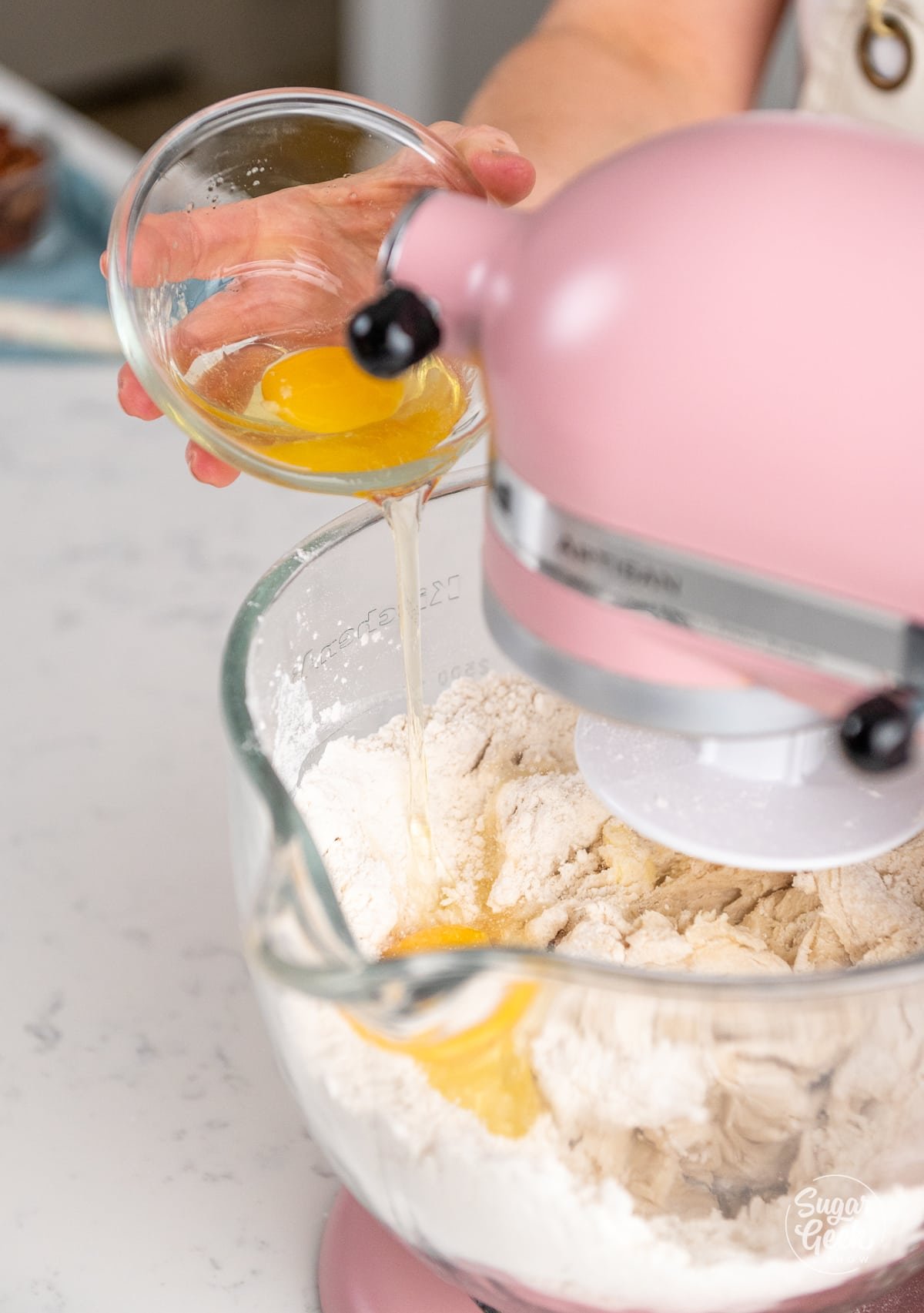
  3. While the mixer is running on low, pour in the milk and butter and then add the eggs, one at a time. hand pouring a container of milk into a stand mixer bowl
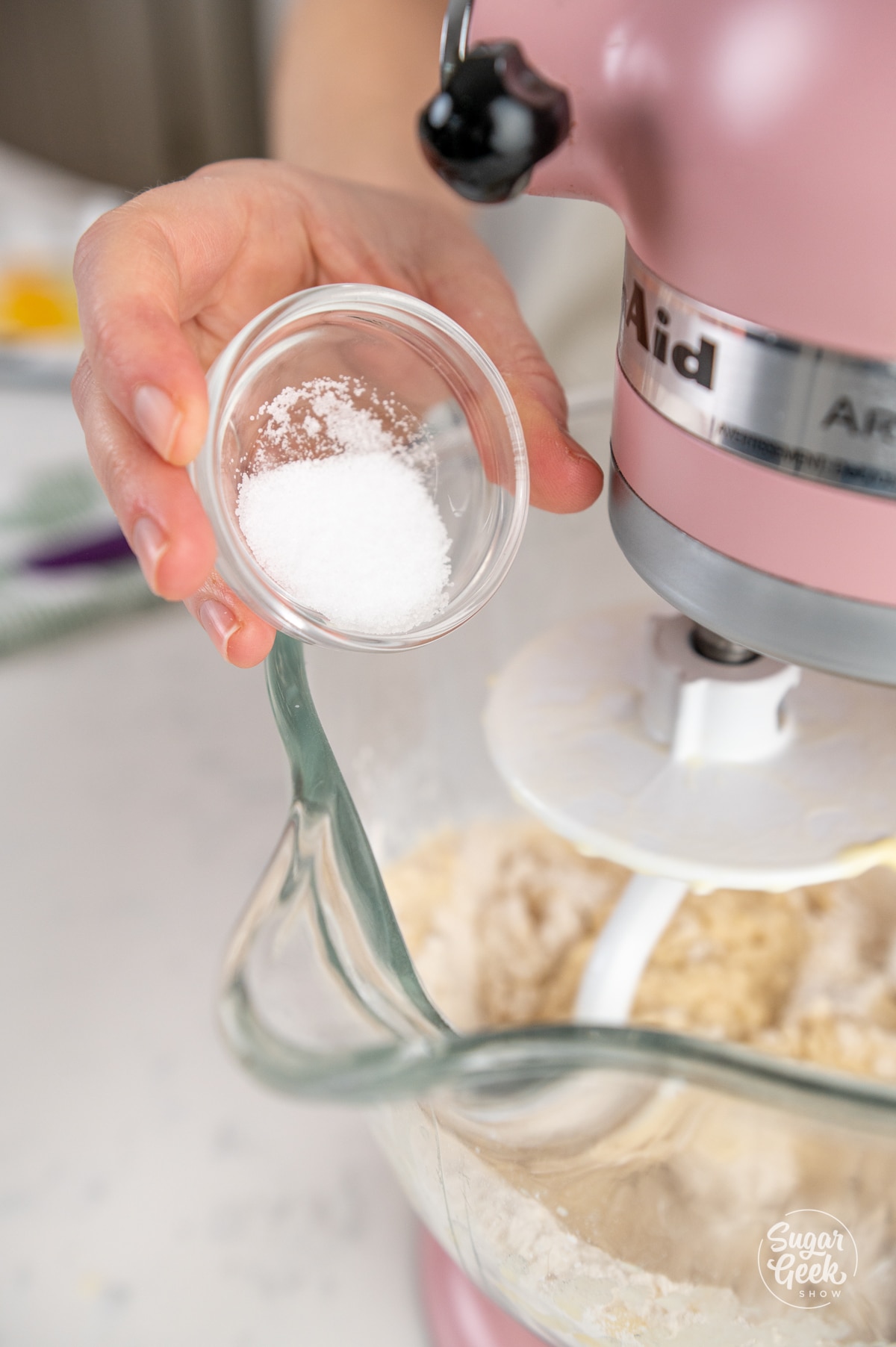
  4. Once the eggs have begun to incorporate, sprinkle in the salt. The salt is added last to give the yeast more of a chance to thrive.hand adding a bowl of salt into a stand mixer bowl
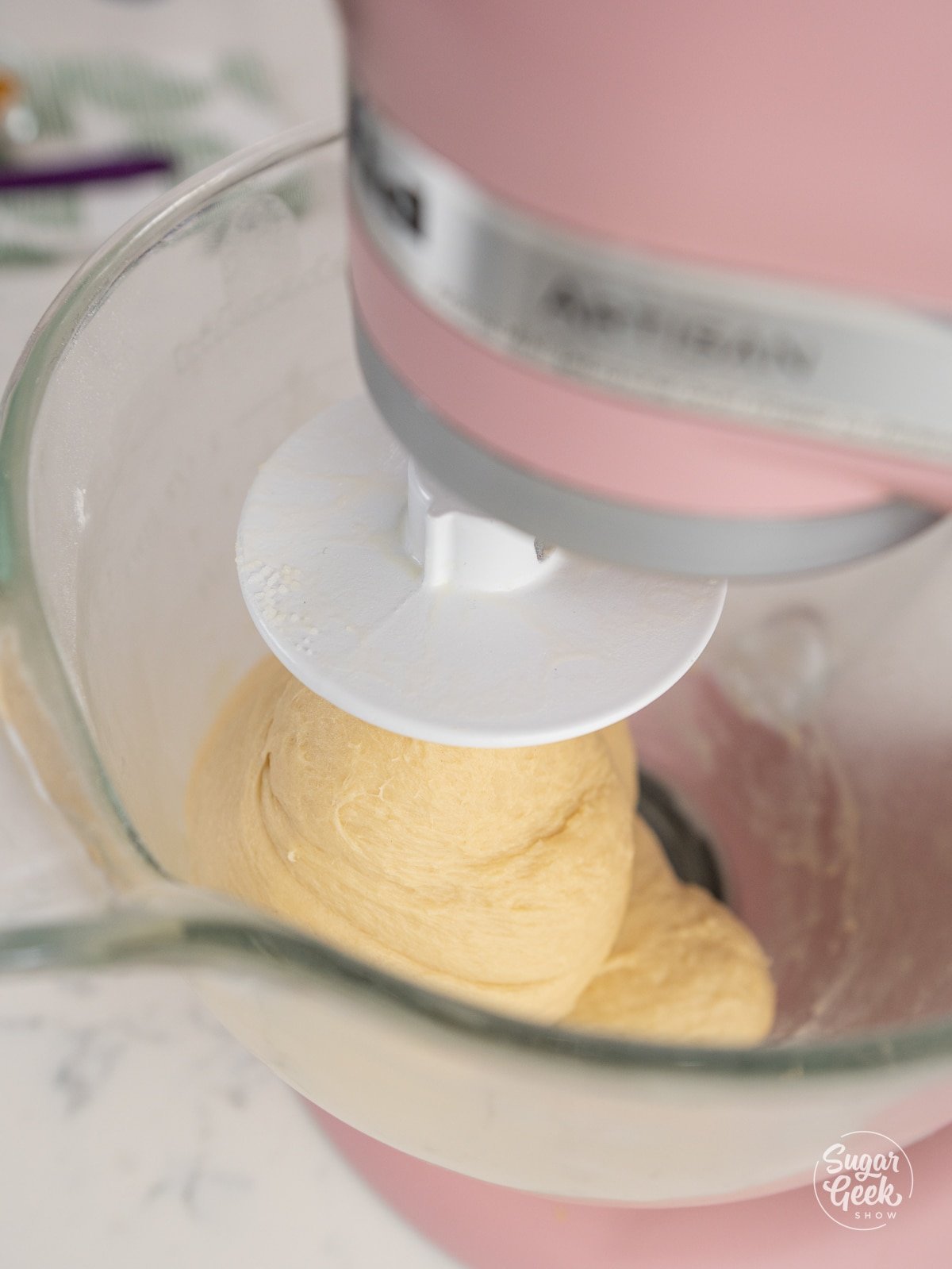
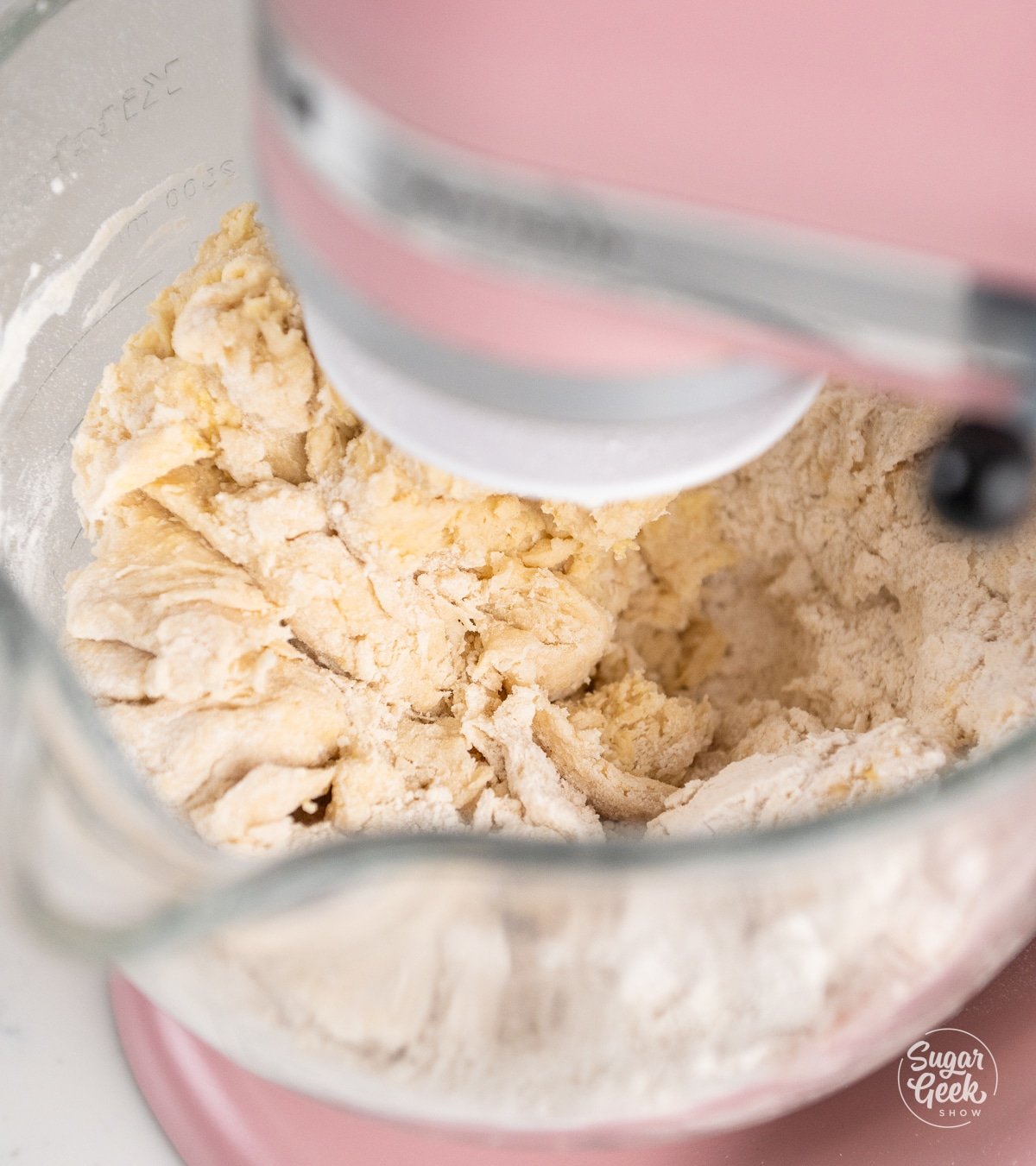
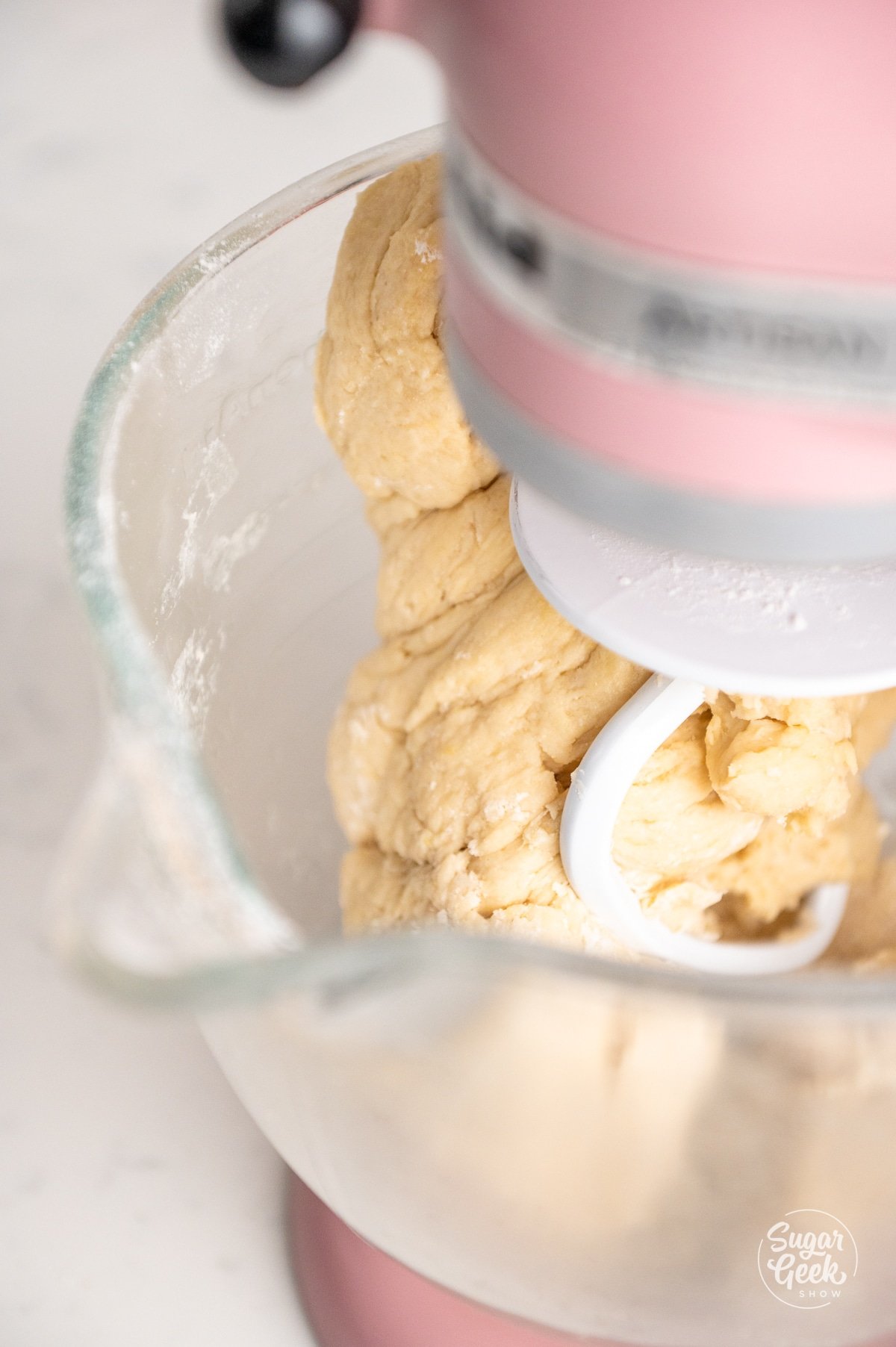
  5. Scrape the sides of the bowl if necessary. Continue to mix on medium-low speed for 10-15 minutes to develop the gluten. dough mixing in a glass stand mixer bowl
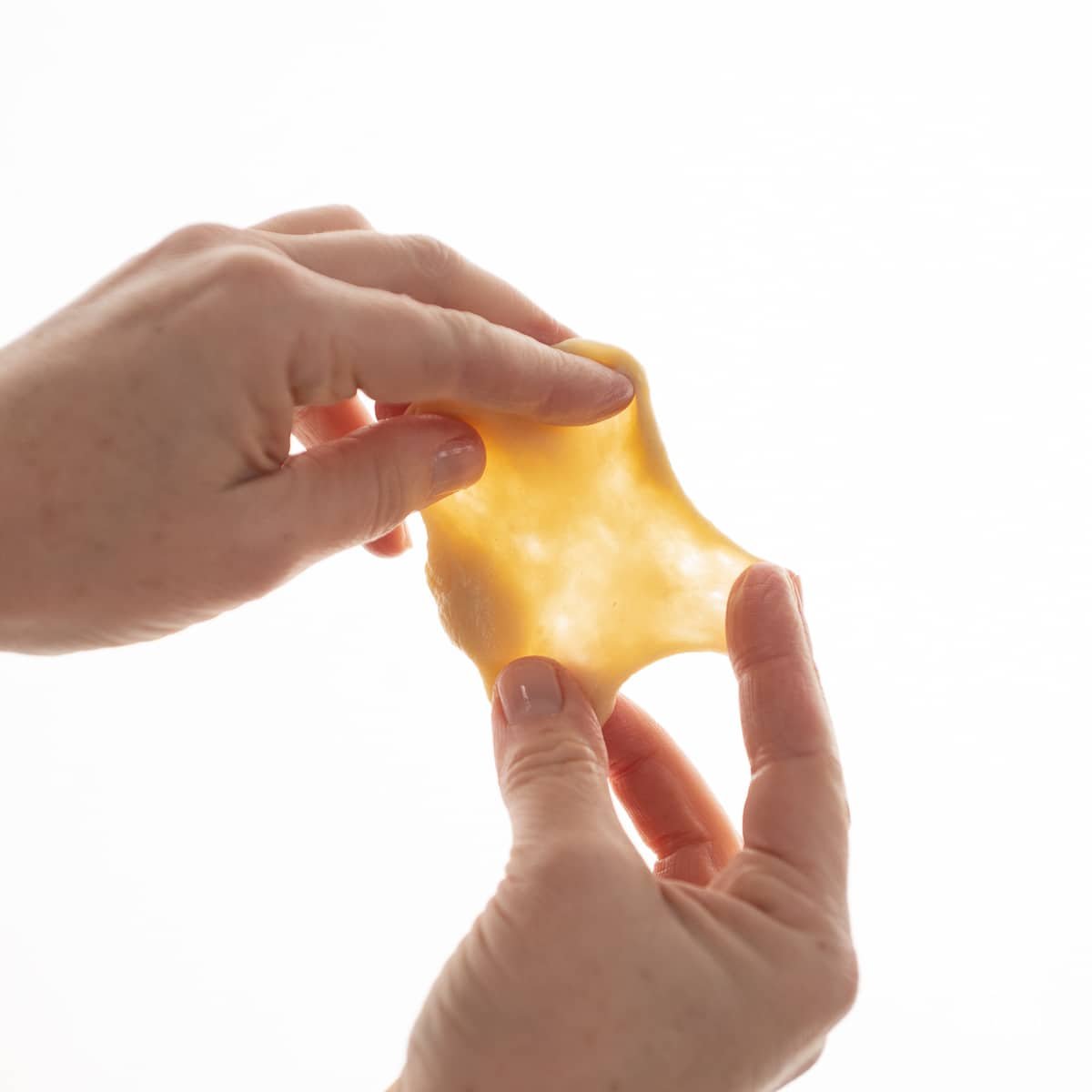
  6. After 10 minutes of mixing, check to see if the gluten is properly developed by using the "window test." Stretch a piece of dough between your fingers and slowly pull it thin enough to see light coming through. If the dough tears, let it continue to mix for another 5 minutes.hands spreading out a piece of dough and holding it up to the light
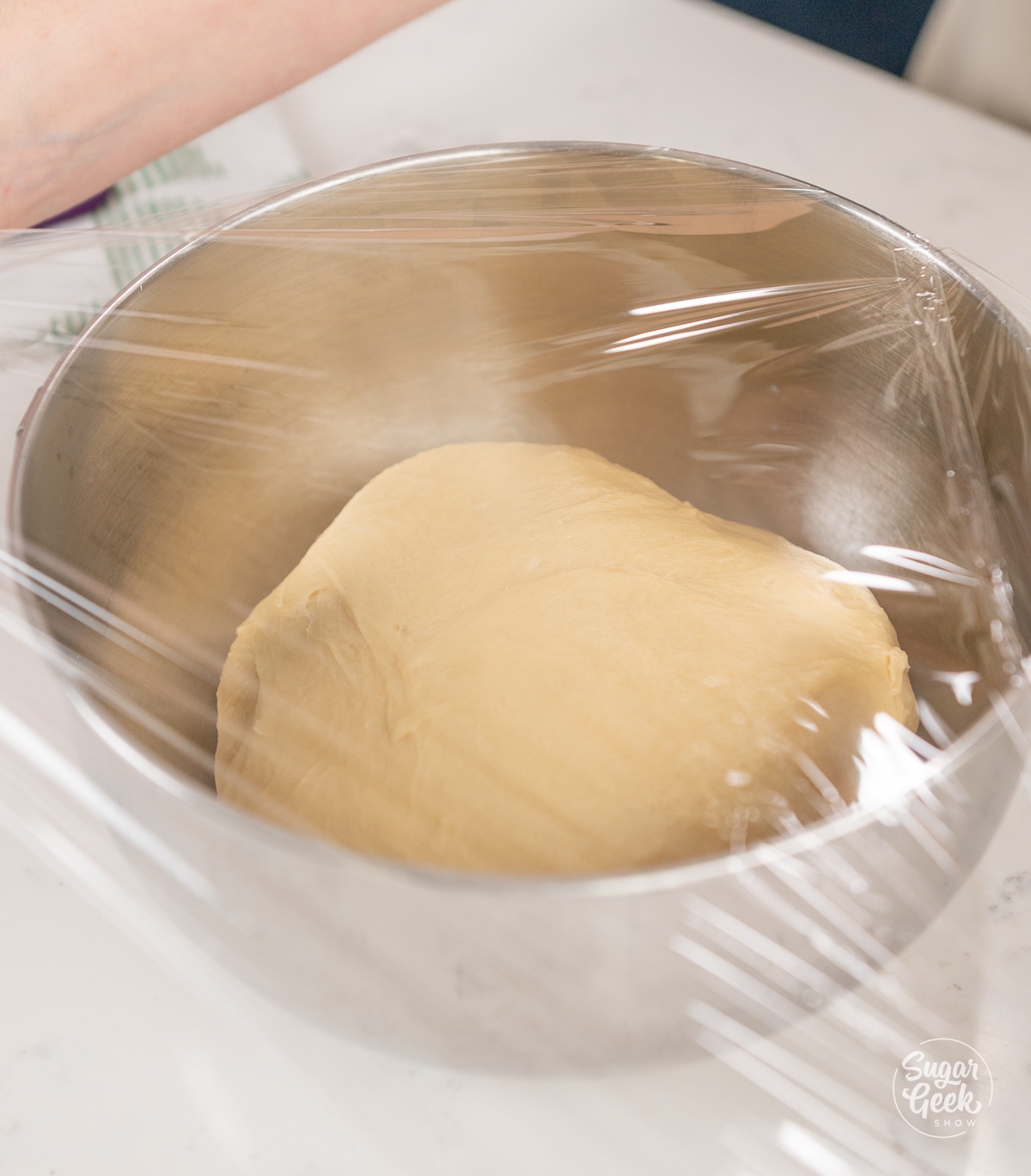
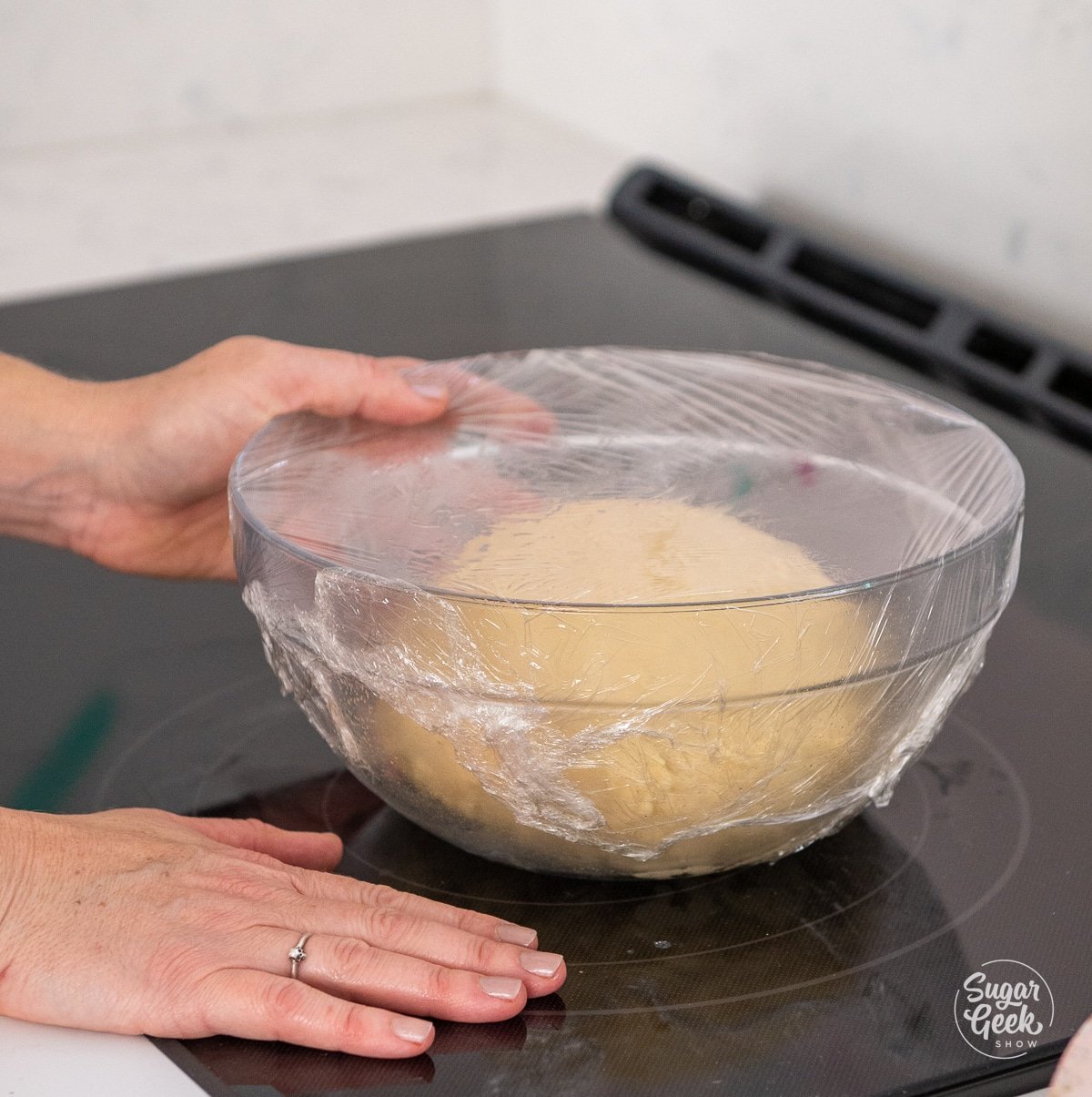
  7. Once the dough is ready, cover it with plastic wrap or a tea towel and let the dough rise in a warm area for about an hour, until the dough doubles in size. Because of the added butter to the dough, it will not stick to the bowl. I like to place mine in my oven (turned off!) with the oven light on and the door cracked open. dough in a metal bowl covered with plastic

Making the Filling

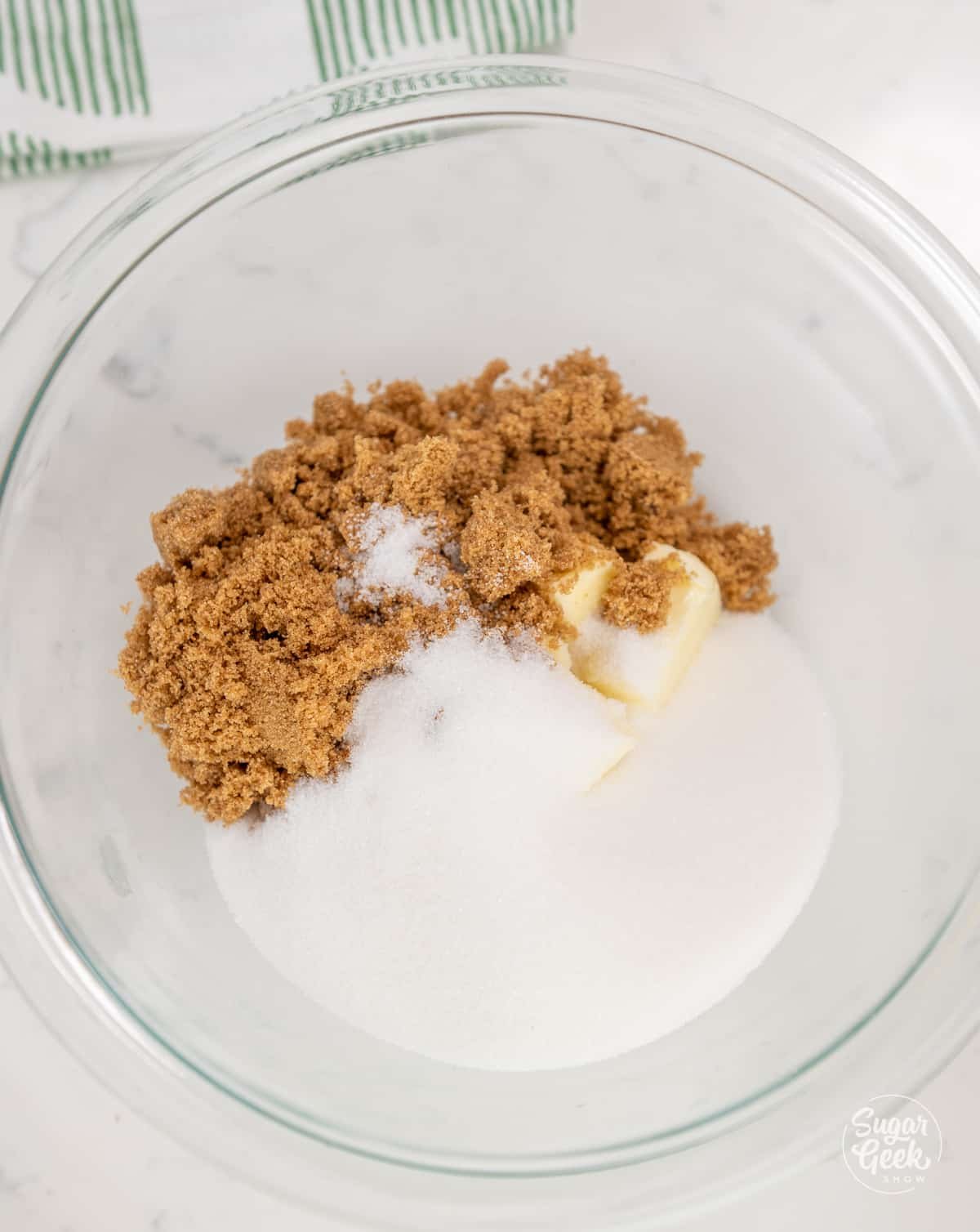
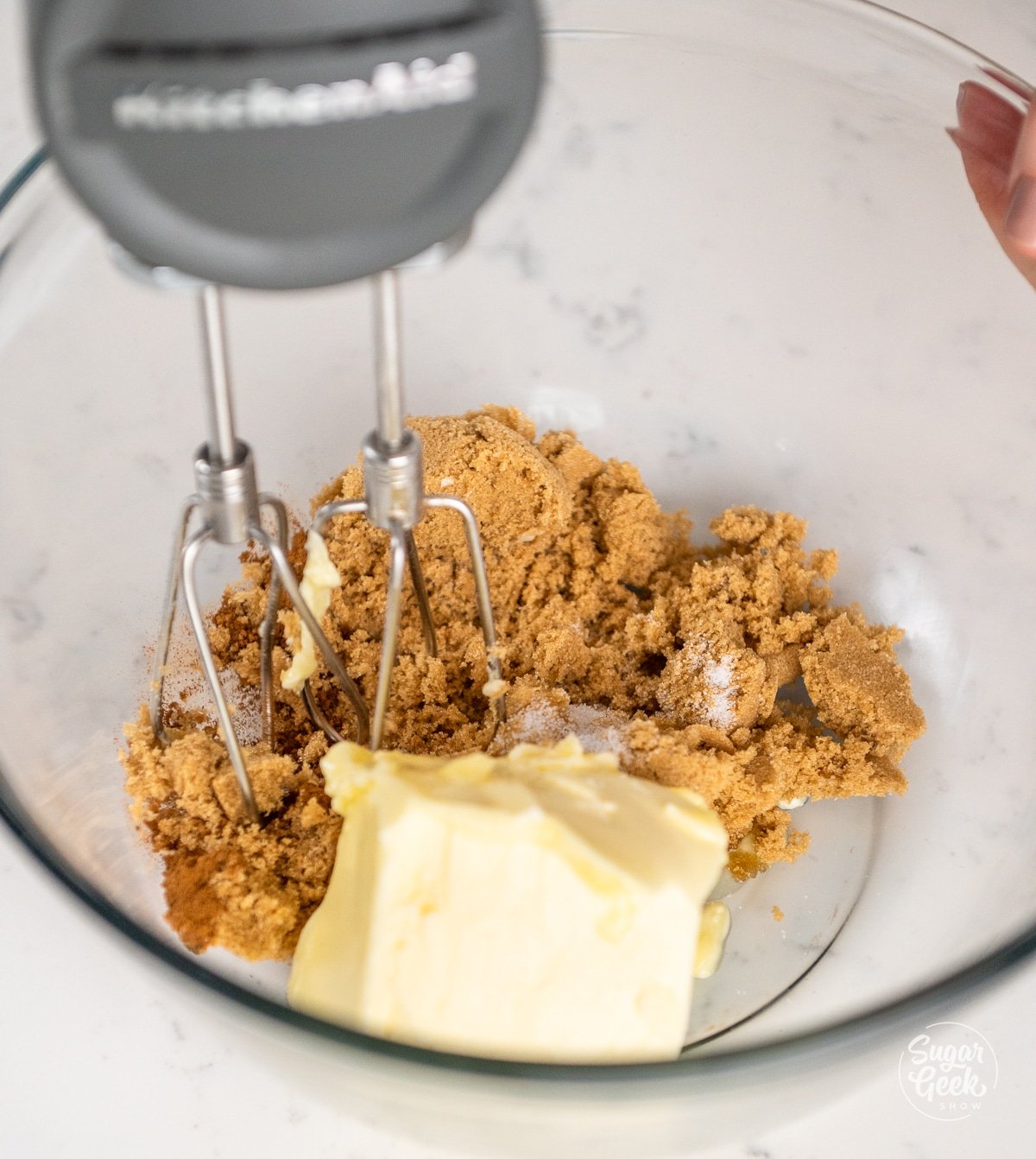
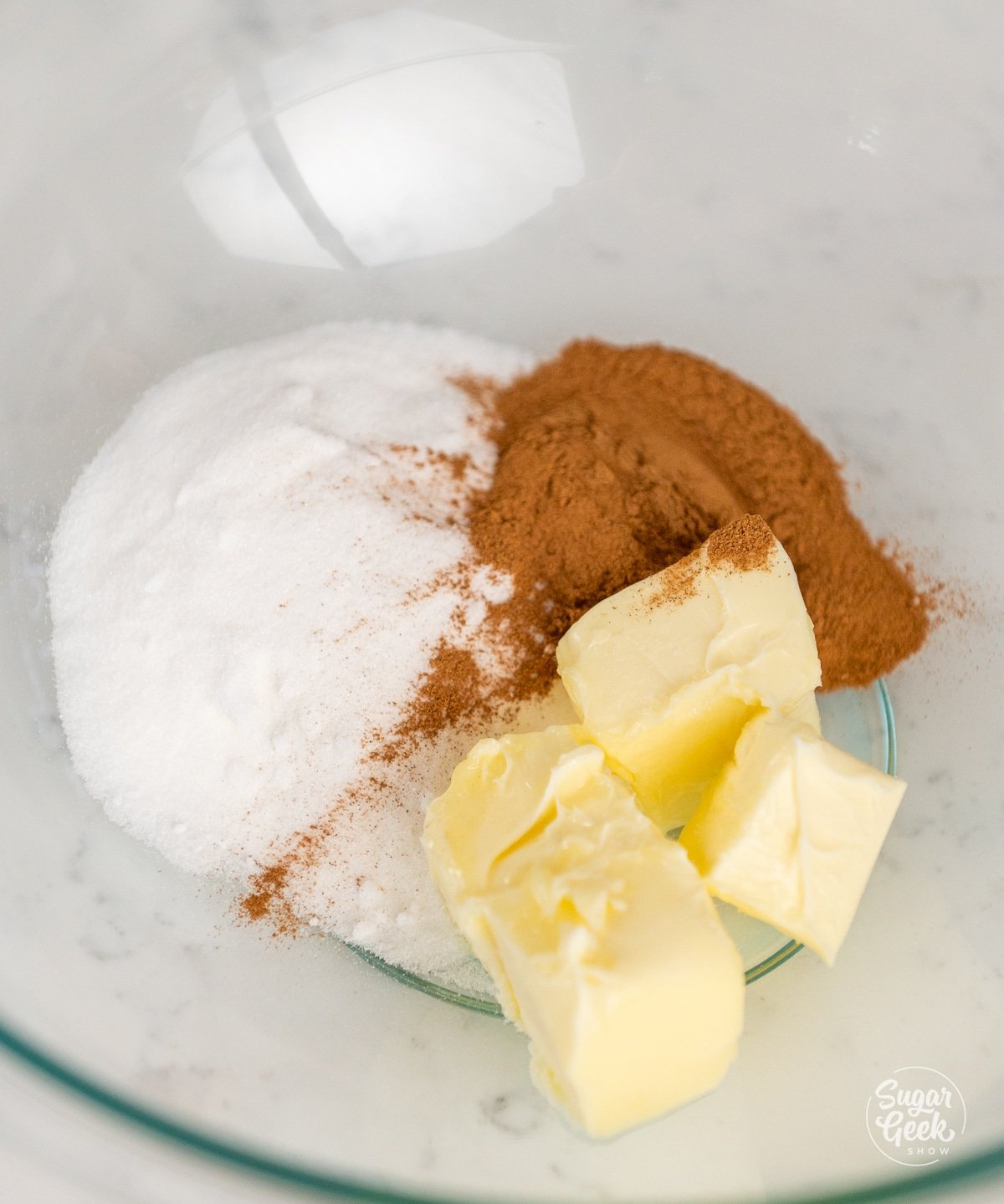
  1. Mix together the softened butter, brown sugar, and granulated sugar until combined.White sugar, brown sugar, and butter in a glass bowl.
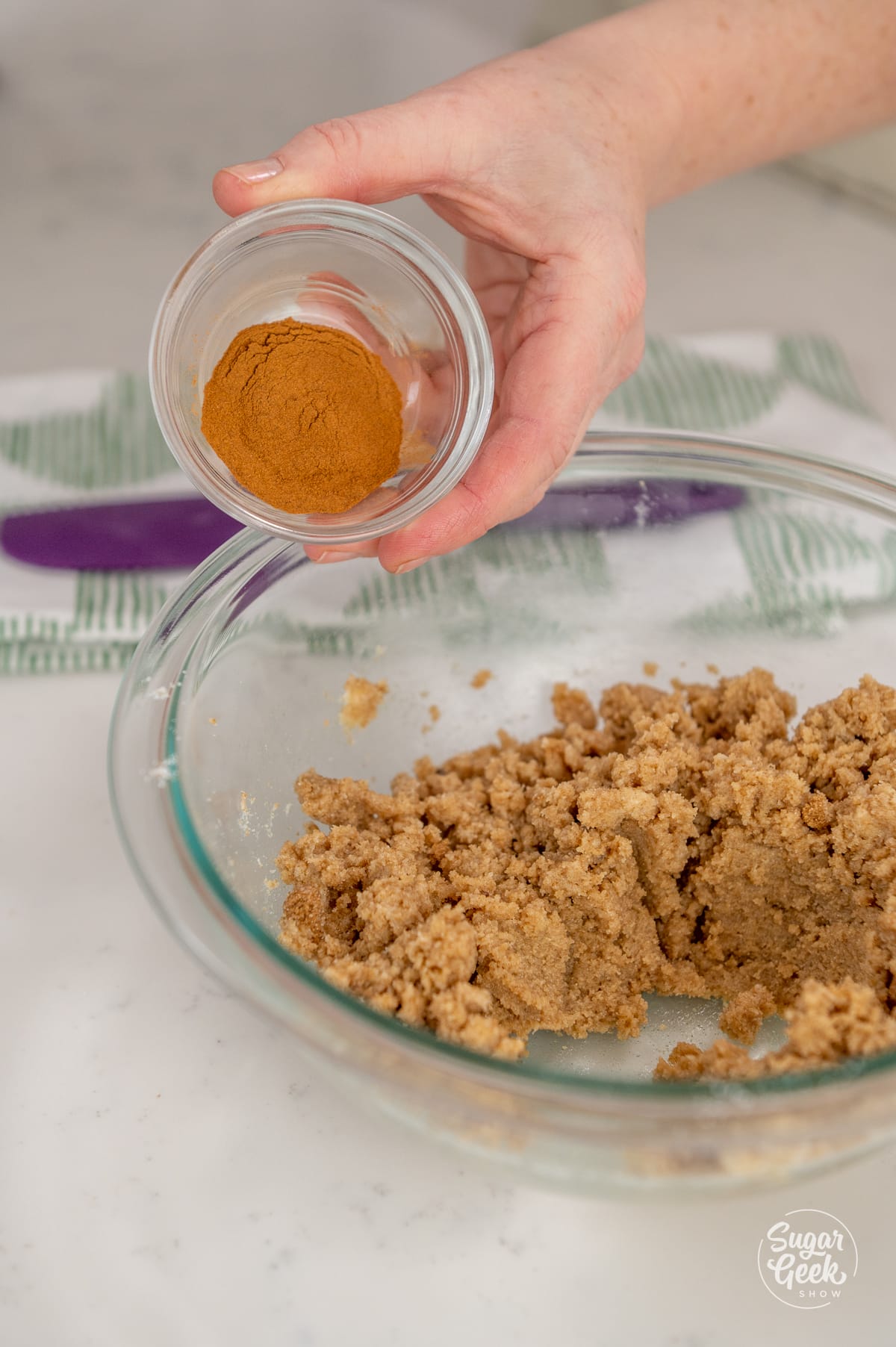
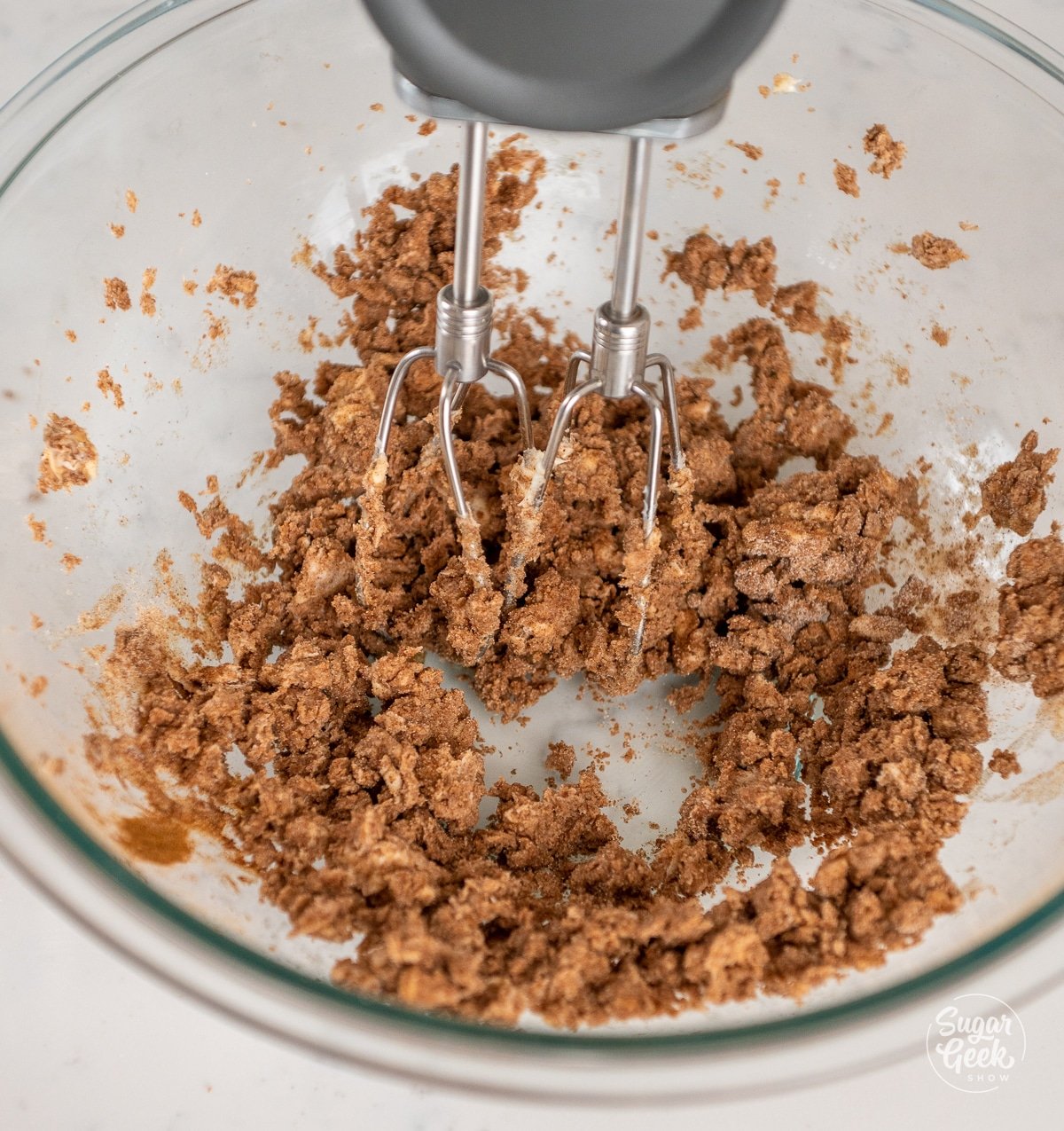
  2. Add the cinnamon and mix slowly until fully combined and smooth.Hand adding a bowl of cinnamon to a glass bowl of sugar and butter.
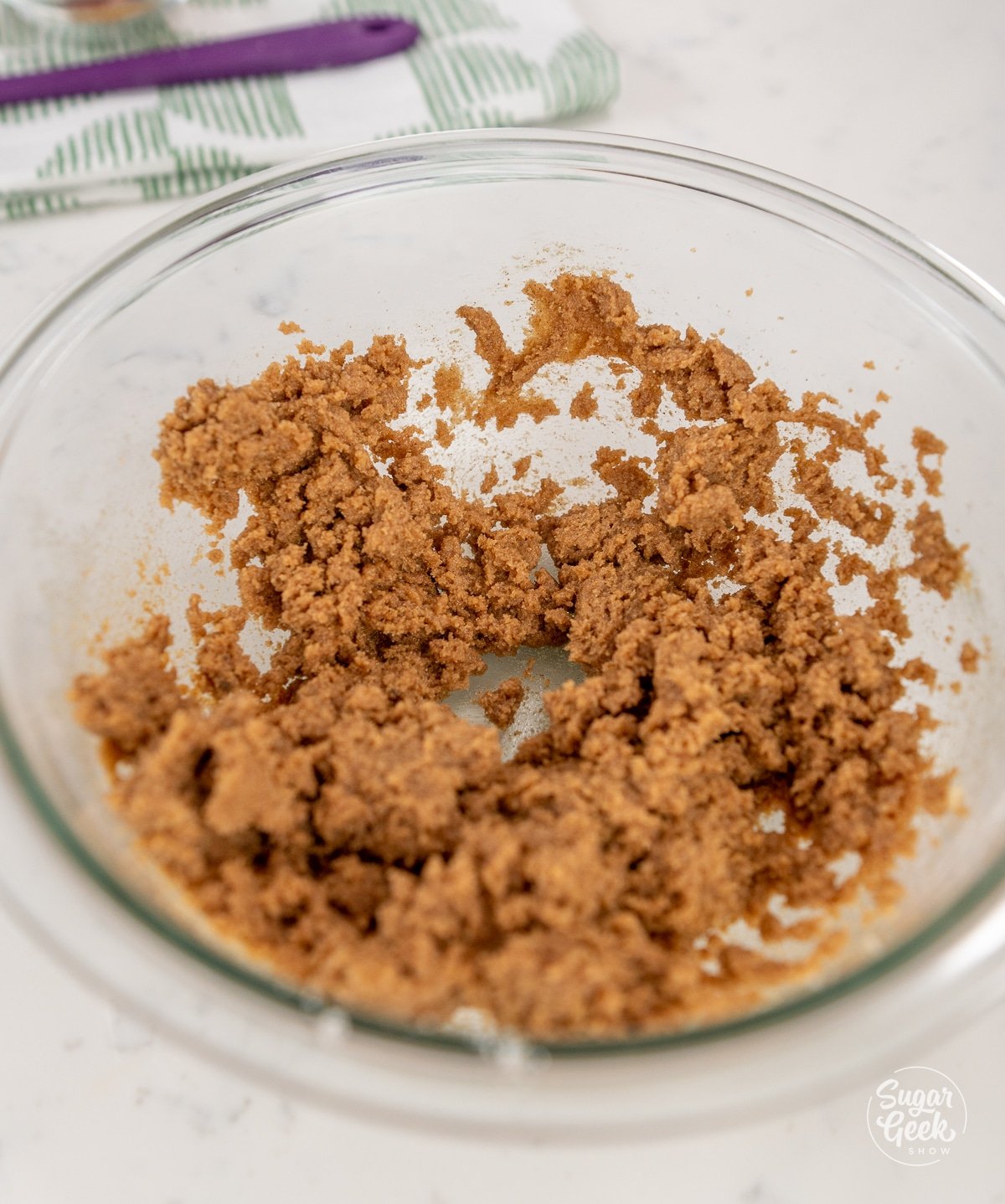
  3. Warm it in the microwave for a few seconds so the mixture is a soft, easily spreadable consistency. If the filling mixture is hot it will warm the dough upon contact making it more difficult to move and shape, so keeping it at a moderate temperature is easier.king cake filling mixture in a bowl

Forming the King Cake

  1. Preheat the oven to 350°F.
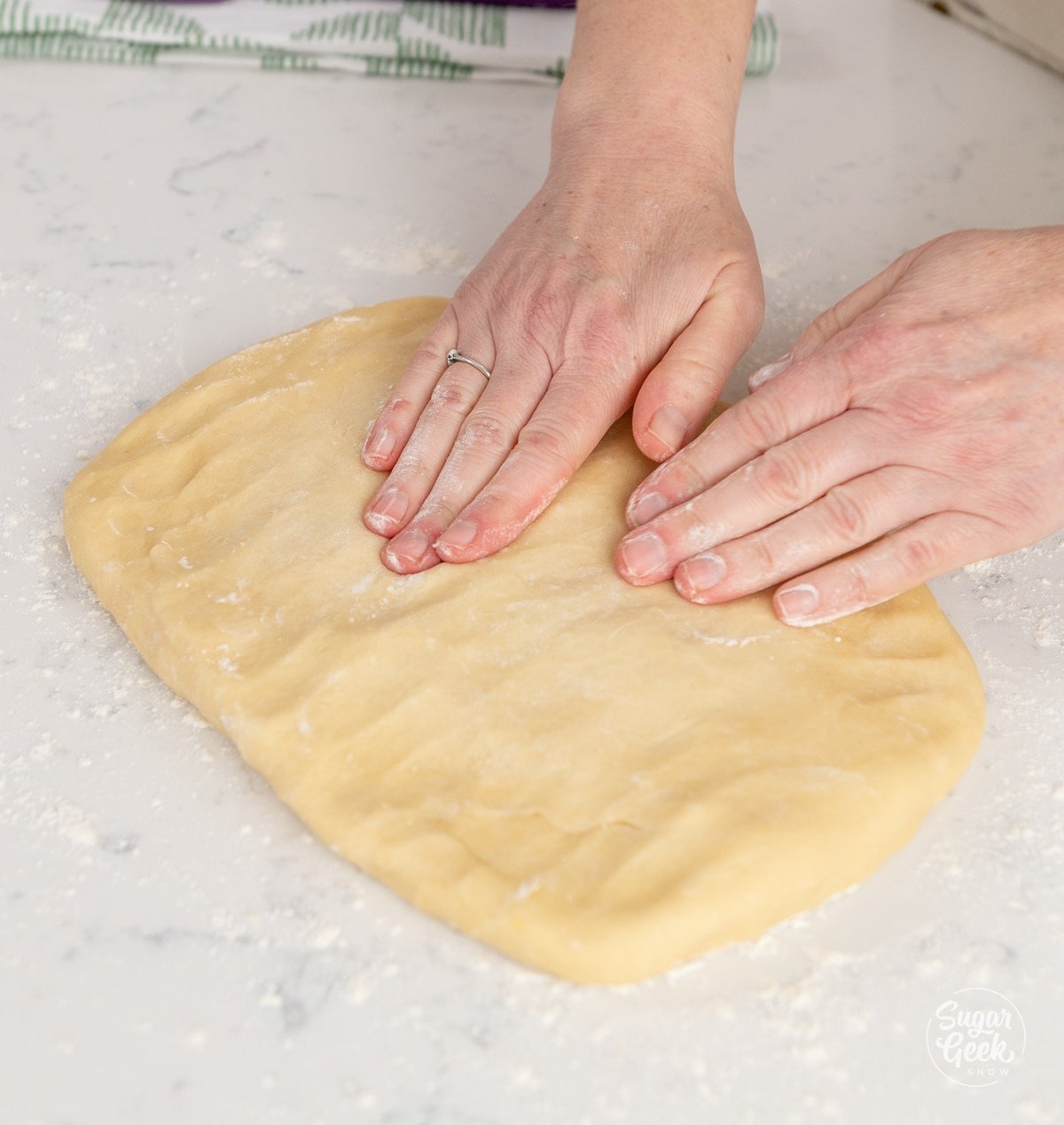
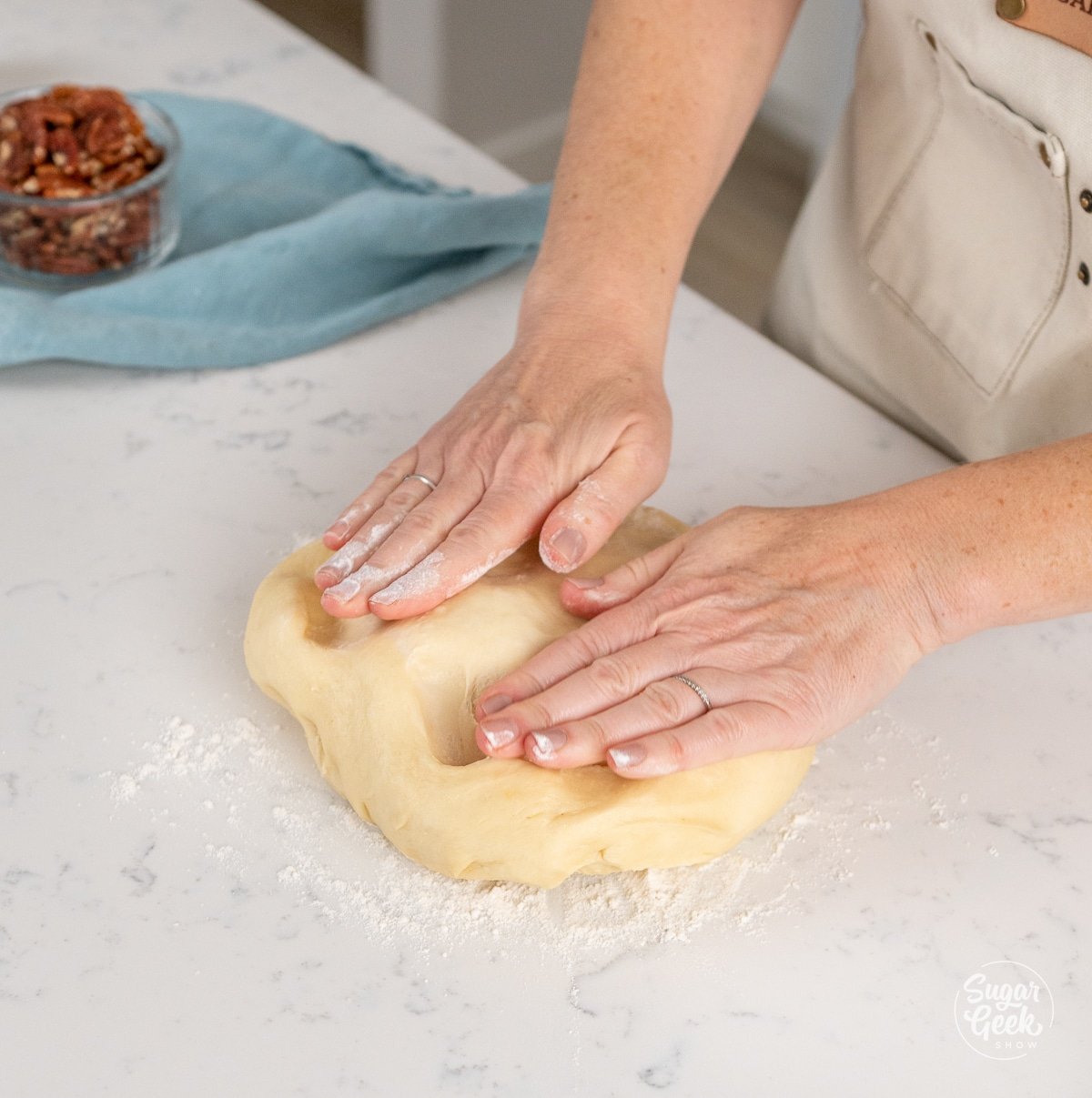
  2. When the dough is ready, dump it out onto a lightly floured surface. You will know your dough is ready because it has doubled in size and also keeps the indentation when you give it a poke.hands pressing down dough on a table
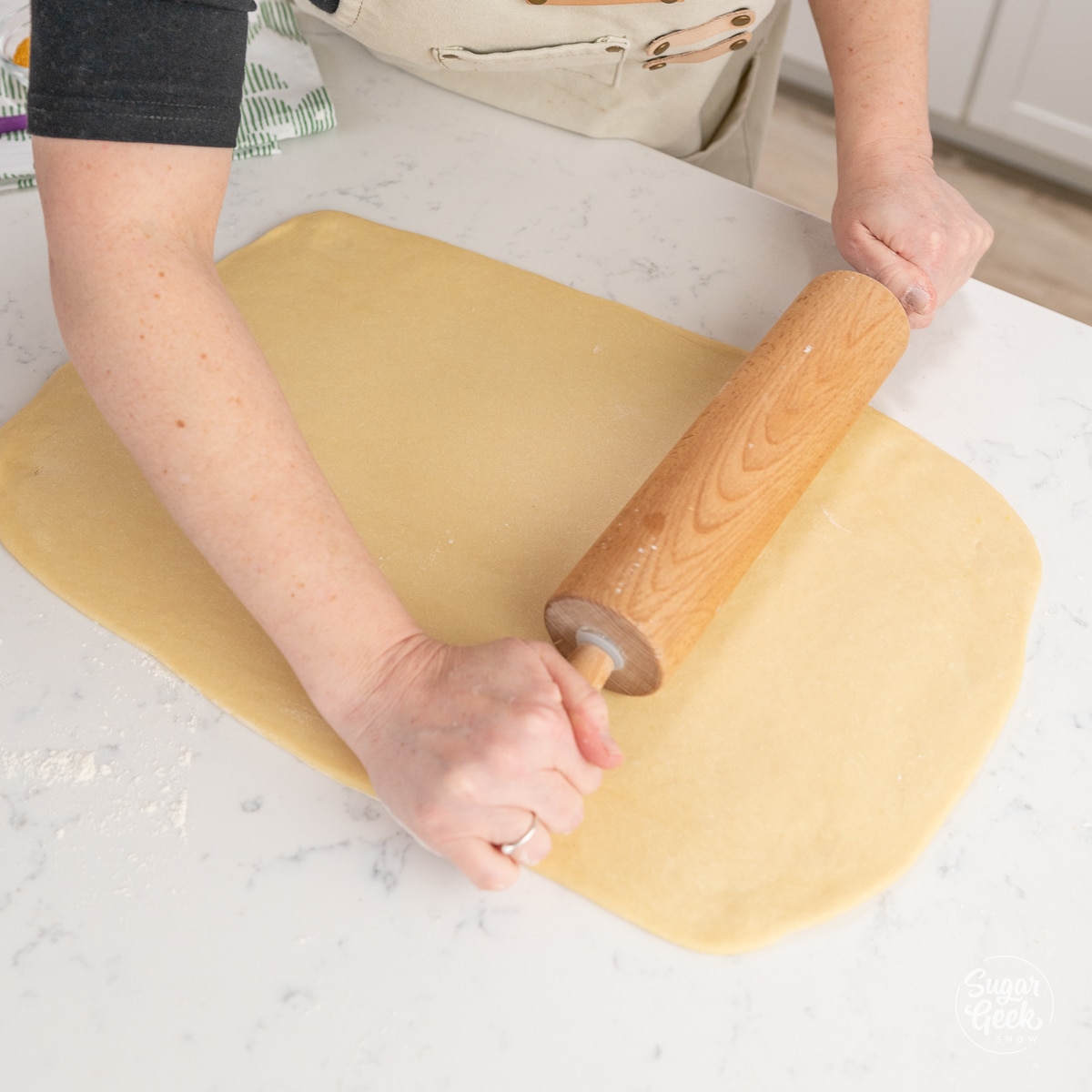
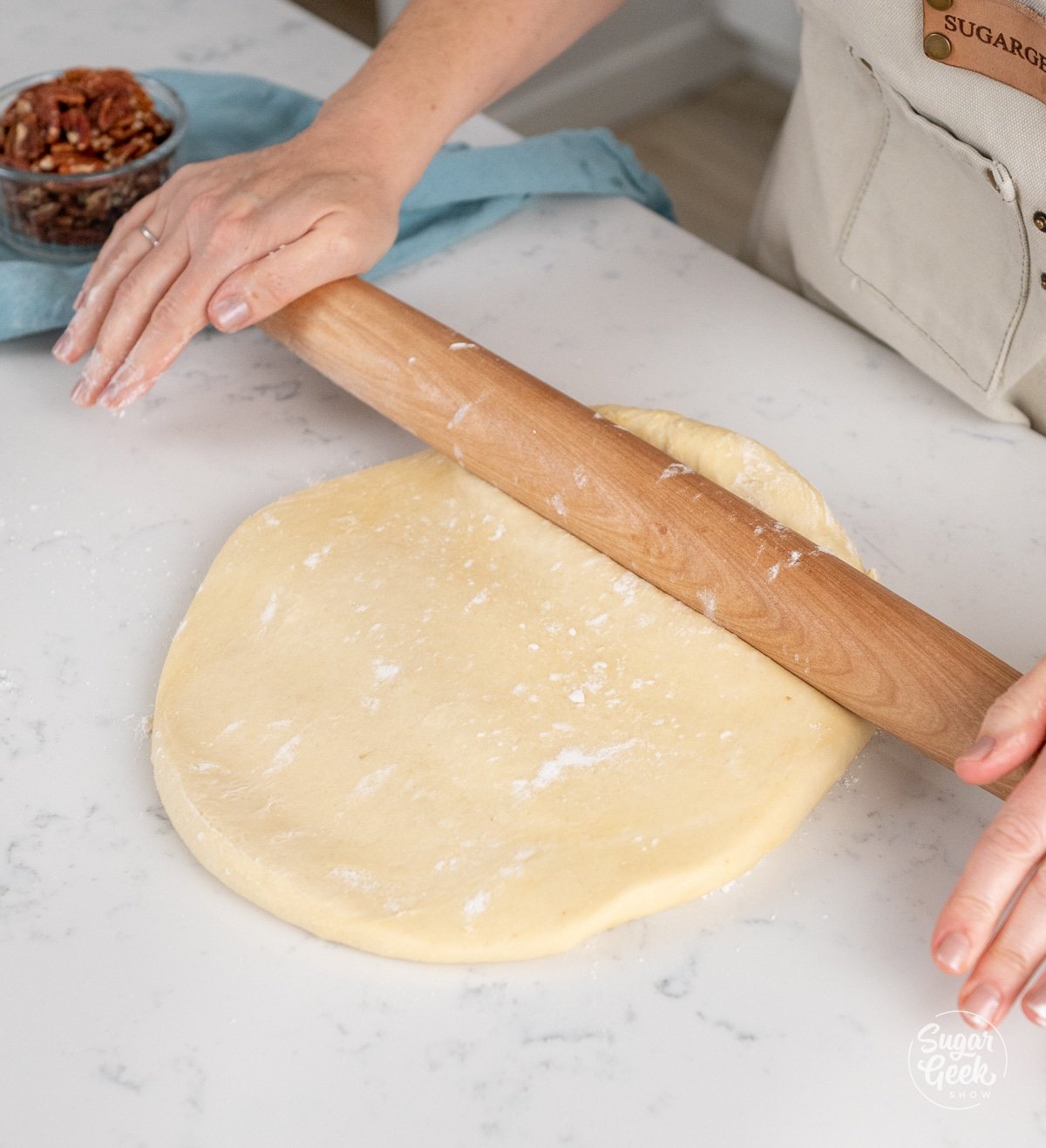
  3. Gently spread the dough with your hands and then begin to roll it out to about a 10"x 20" rectangle with a rolling pin.hands rolling out dough in a rectangle with a rolling pin
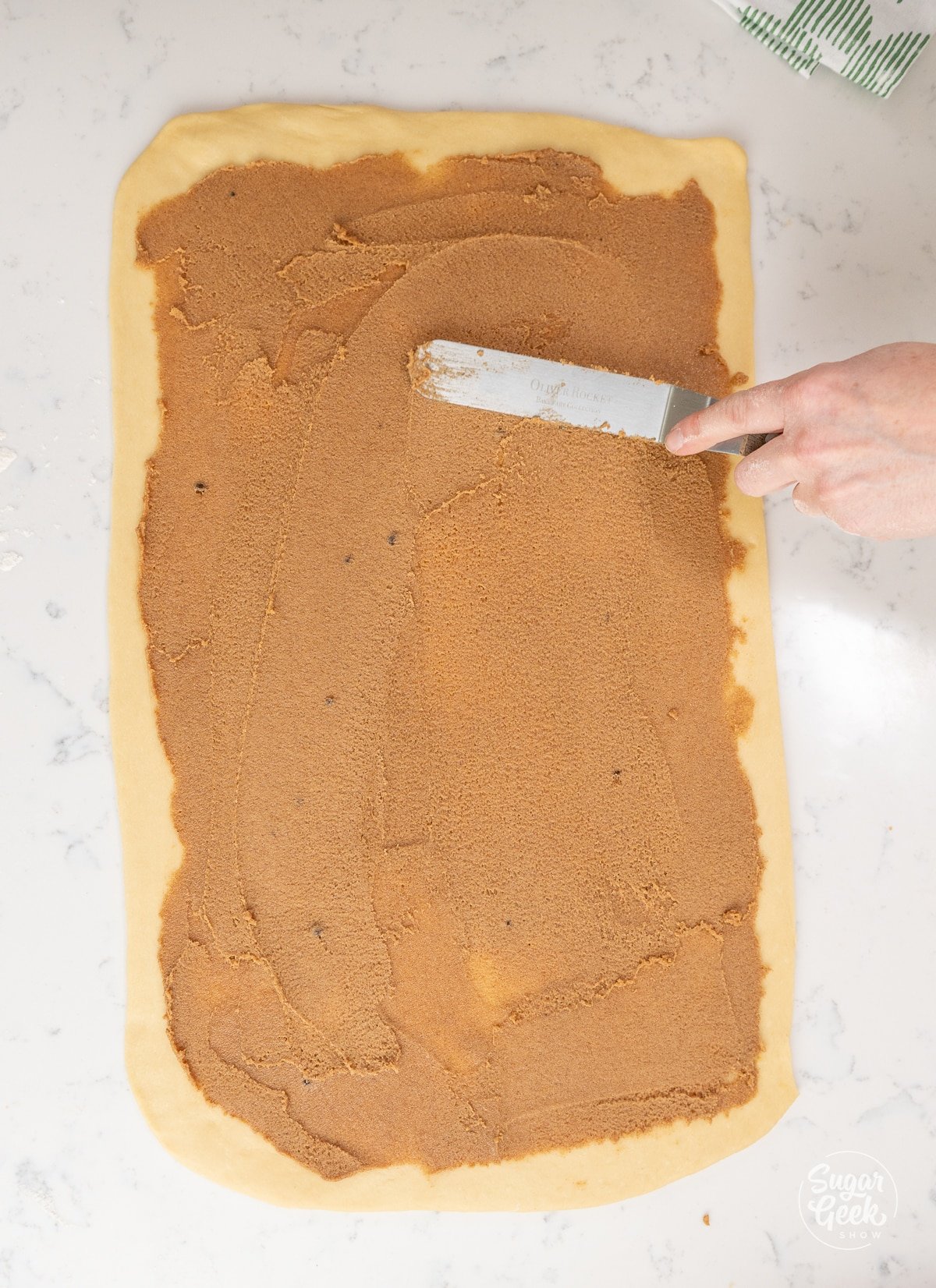
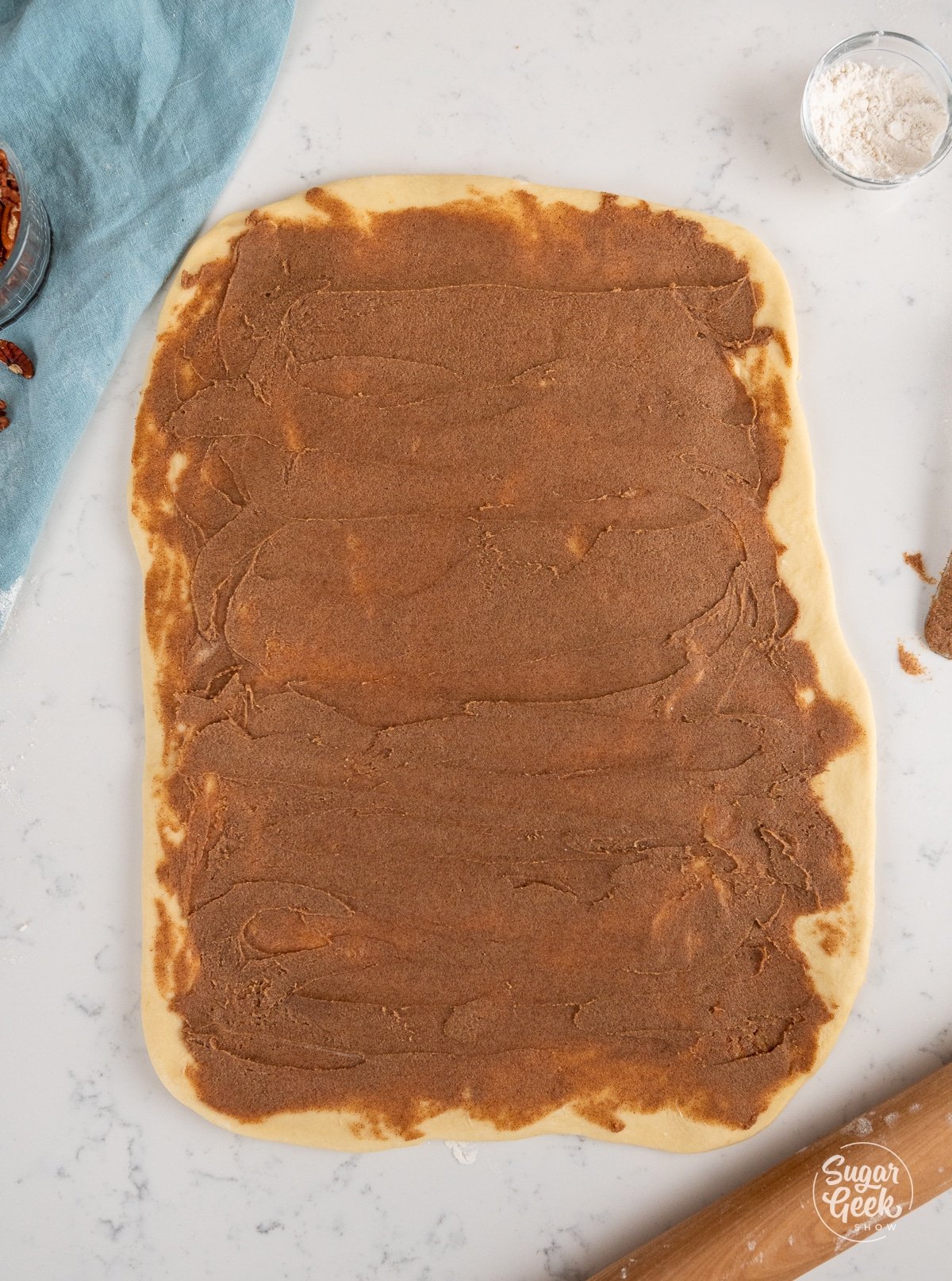
  4. Using an offset spatula, spread the filling on the dough evenly, leaving a border around the edges. If the filling is too thick in some spots it can bake unevenly.hand spreading cinnamon filling onto dough with an offset spatula
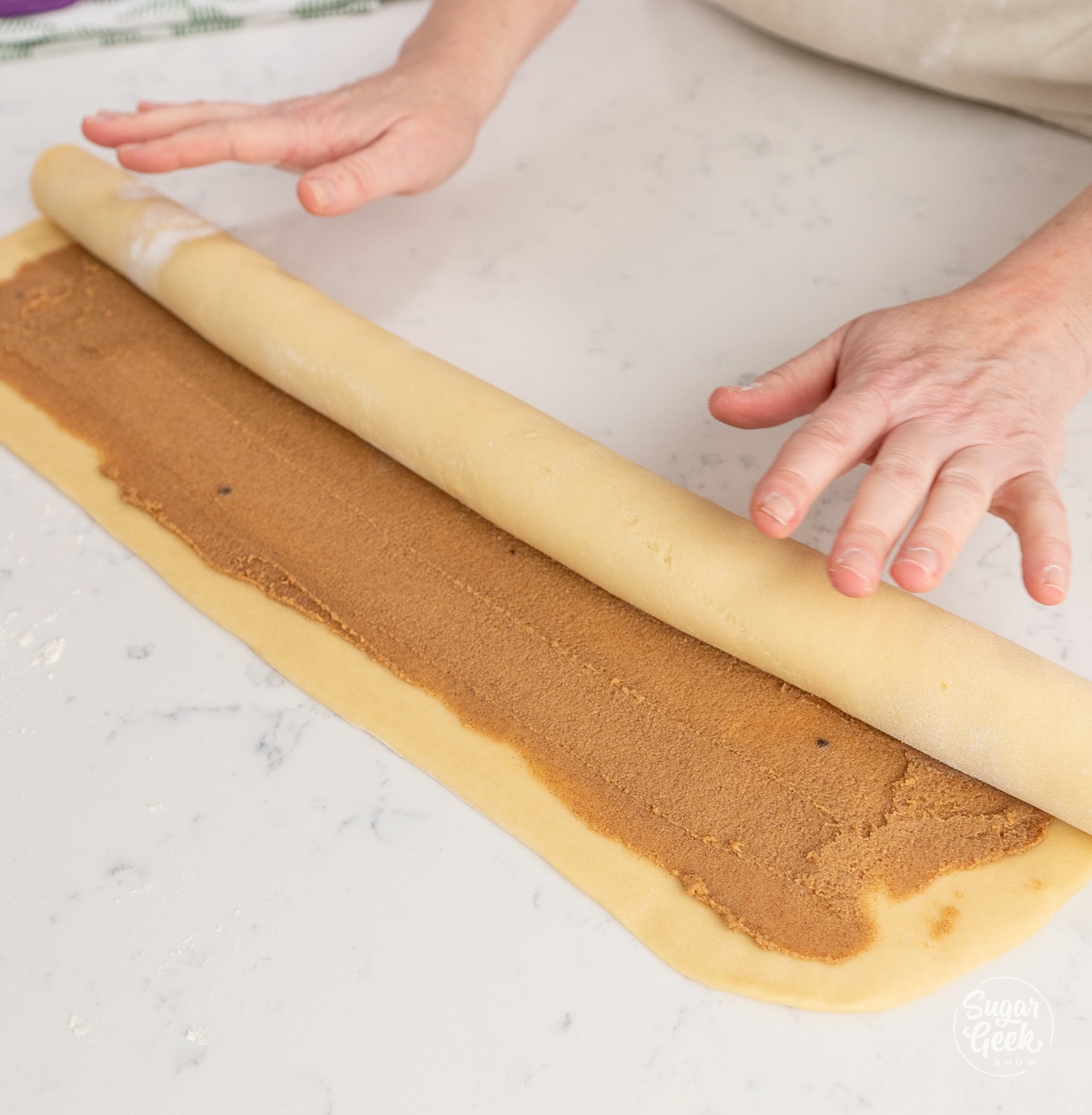
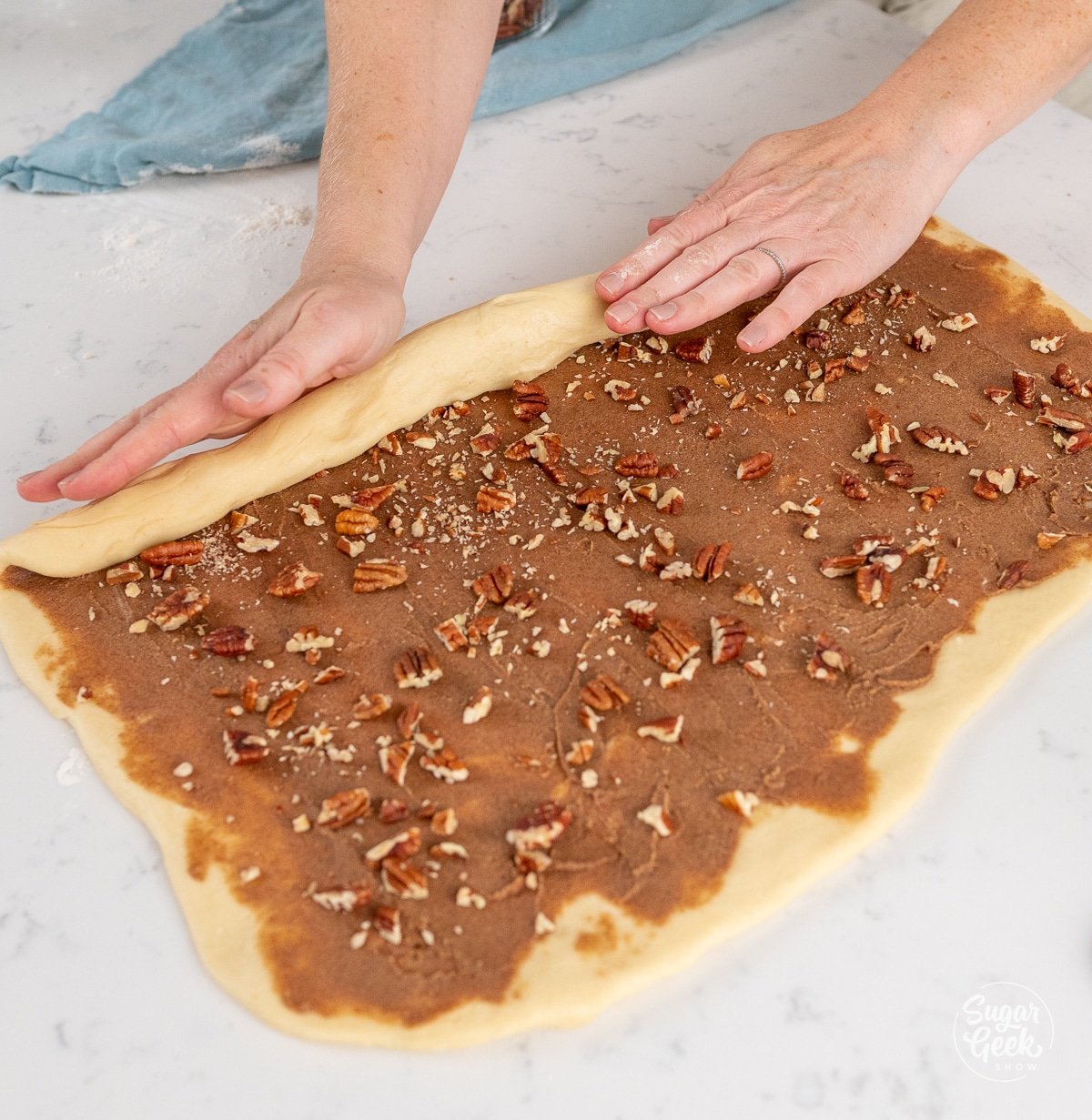
  5. On the long side of the rectangle of dough, begin to roll up the dough evenly forming a long tube. Roll the dough gently and not too tightly, we want the dough to be able to expand while proofing.hands rolling dough with cinnamon filling
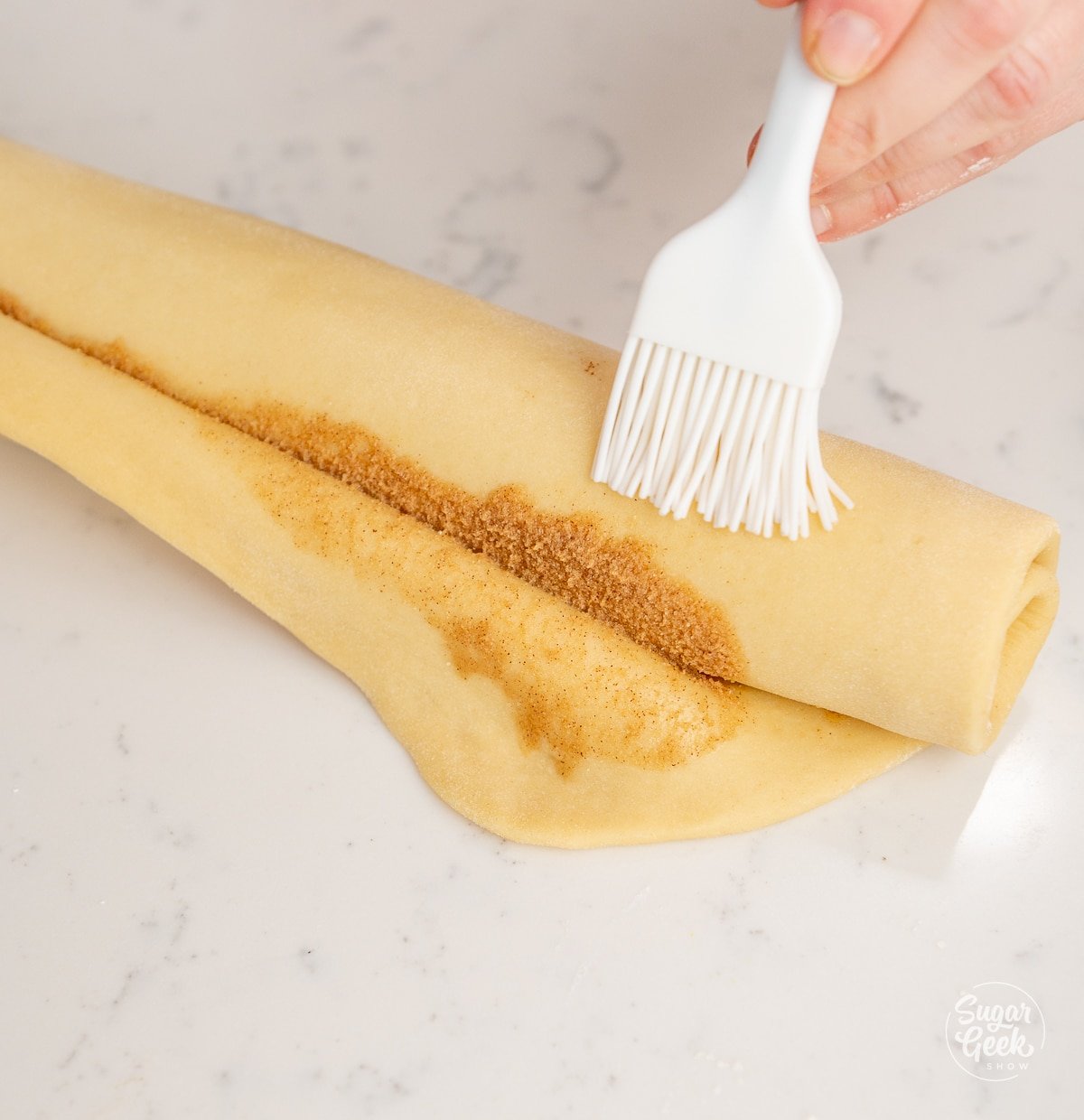
  6. Once you reach the end of the dough roll, pinch the seam of the dough together. Brush a little water on the edge to help it stick to itself.hand brushing water on the edge of dough
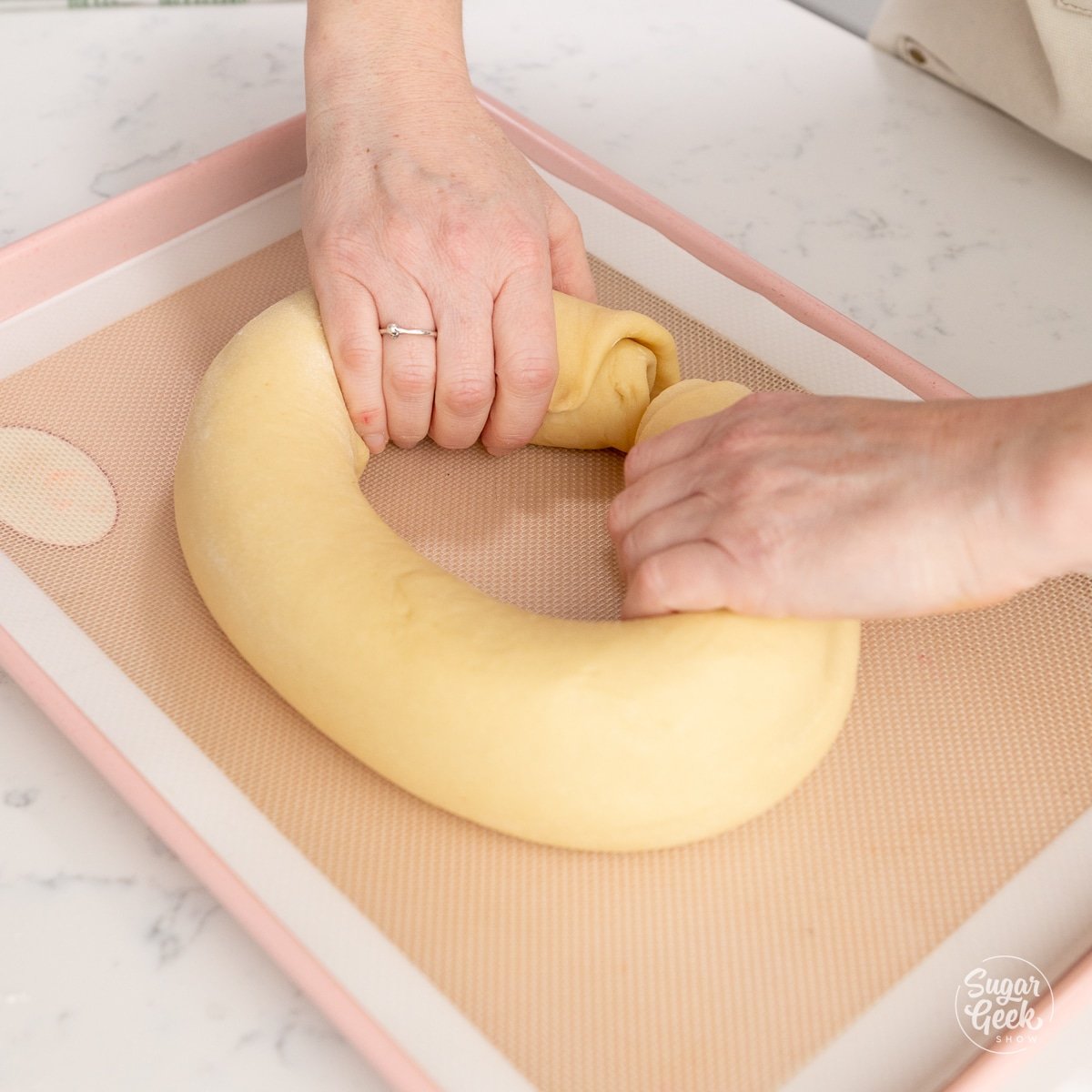
  7. Carefully place the dough onto a sheet pan lined with parchment paper or a silicone mat. hands forming a king cake dough ring on a sheet pan
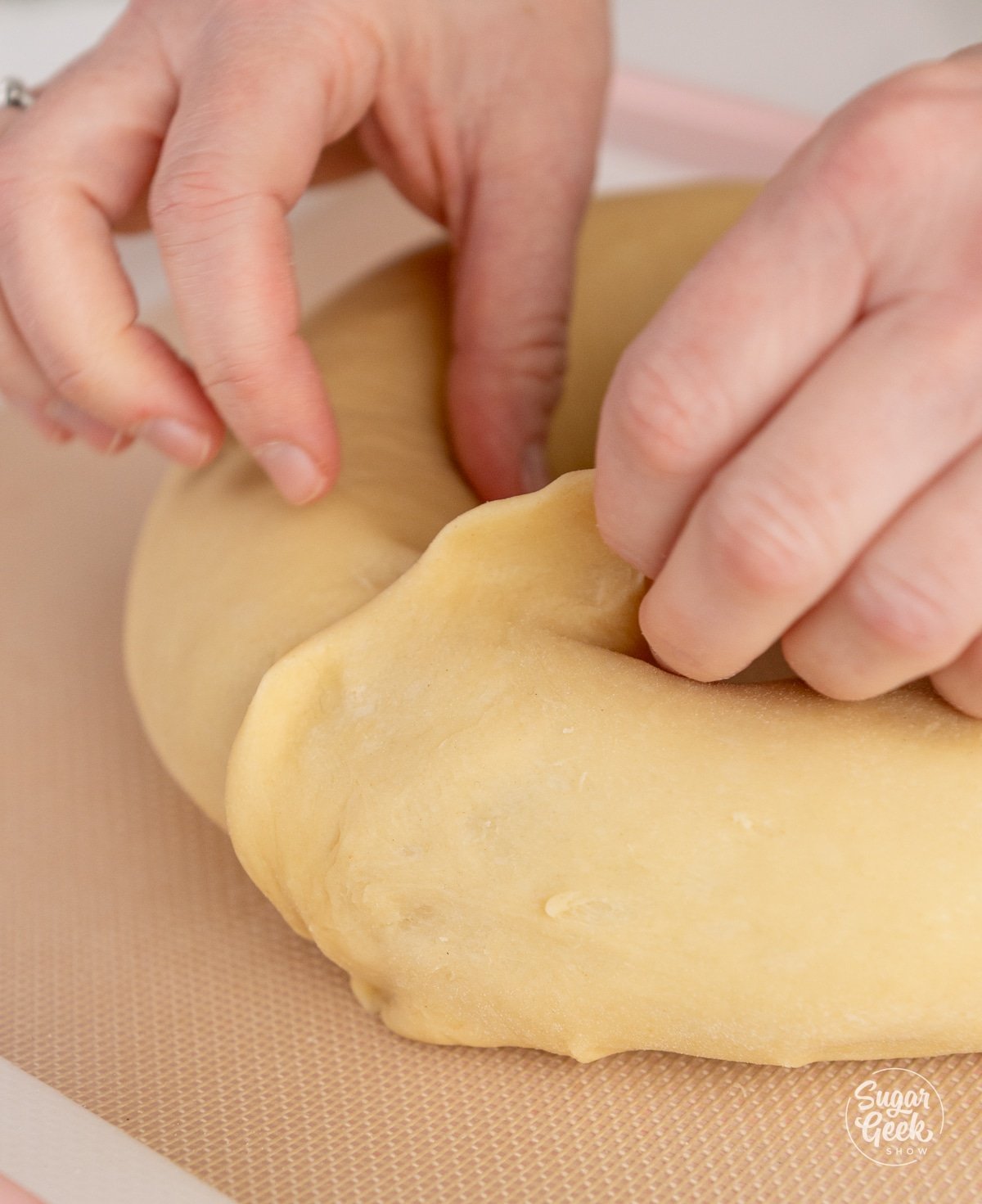
  8. Trim the excess dough with no filling off one end of the dough ring. Stretch back the dough on the other end of the roll and place the other end into it, overlapping to seal off the circle. Use a little water to seal the seam to the dough.hands sealing one edge of the king cake over the other
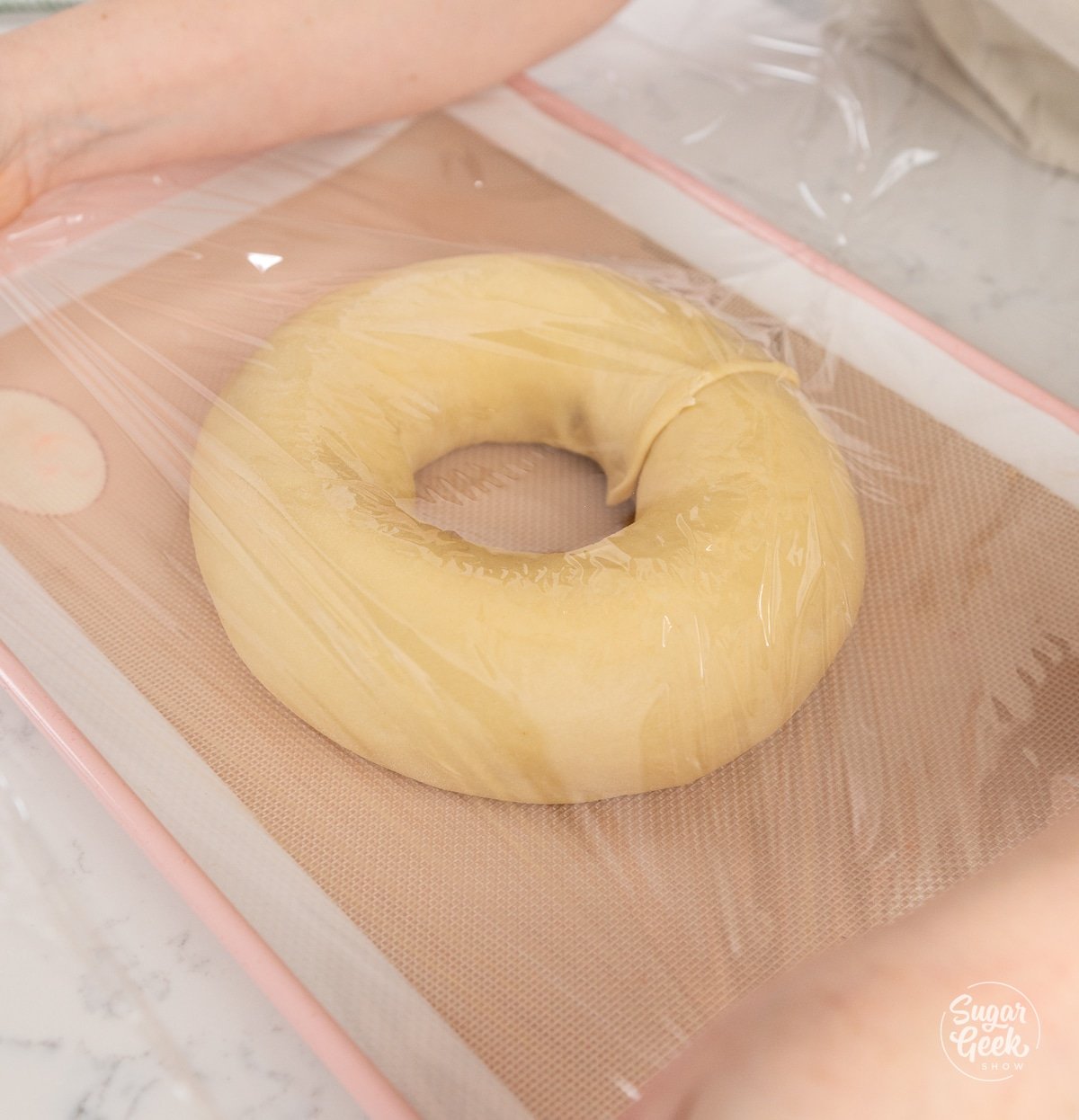
  9. Cover the king cake and place it in a warm spot to rise again for about 30 minutes.king cake on a sheet pan covered in plastic wrap

Baking the King Cake

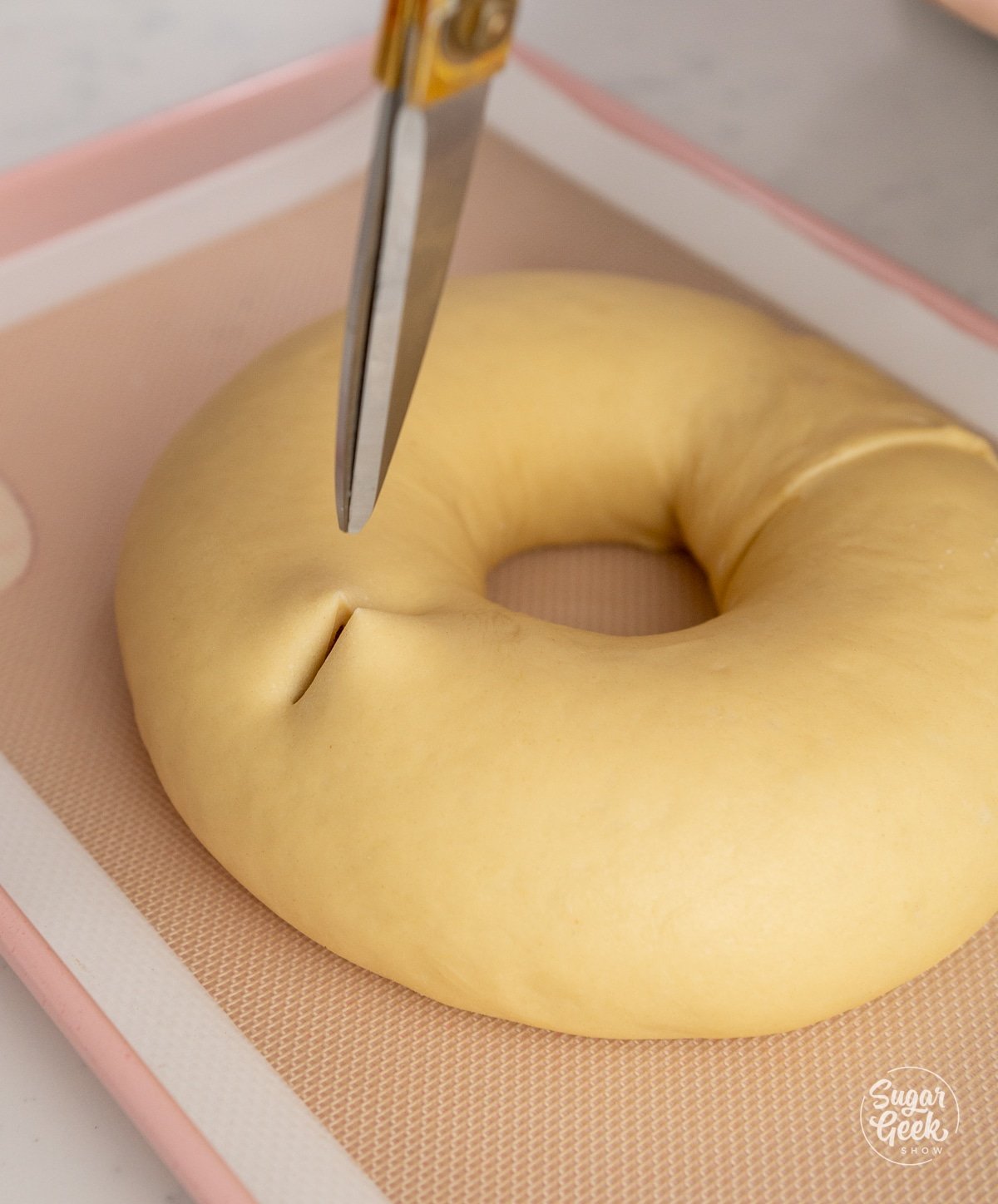
  1. Once the dough has risen and is puffed and soft, it is ready to bake. With a sharp knife or scissors, cut some vents around the top of the cake to allow it to expand. It will explode if you don't. scissors cutting slits in a ring of dough
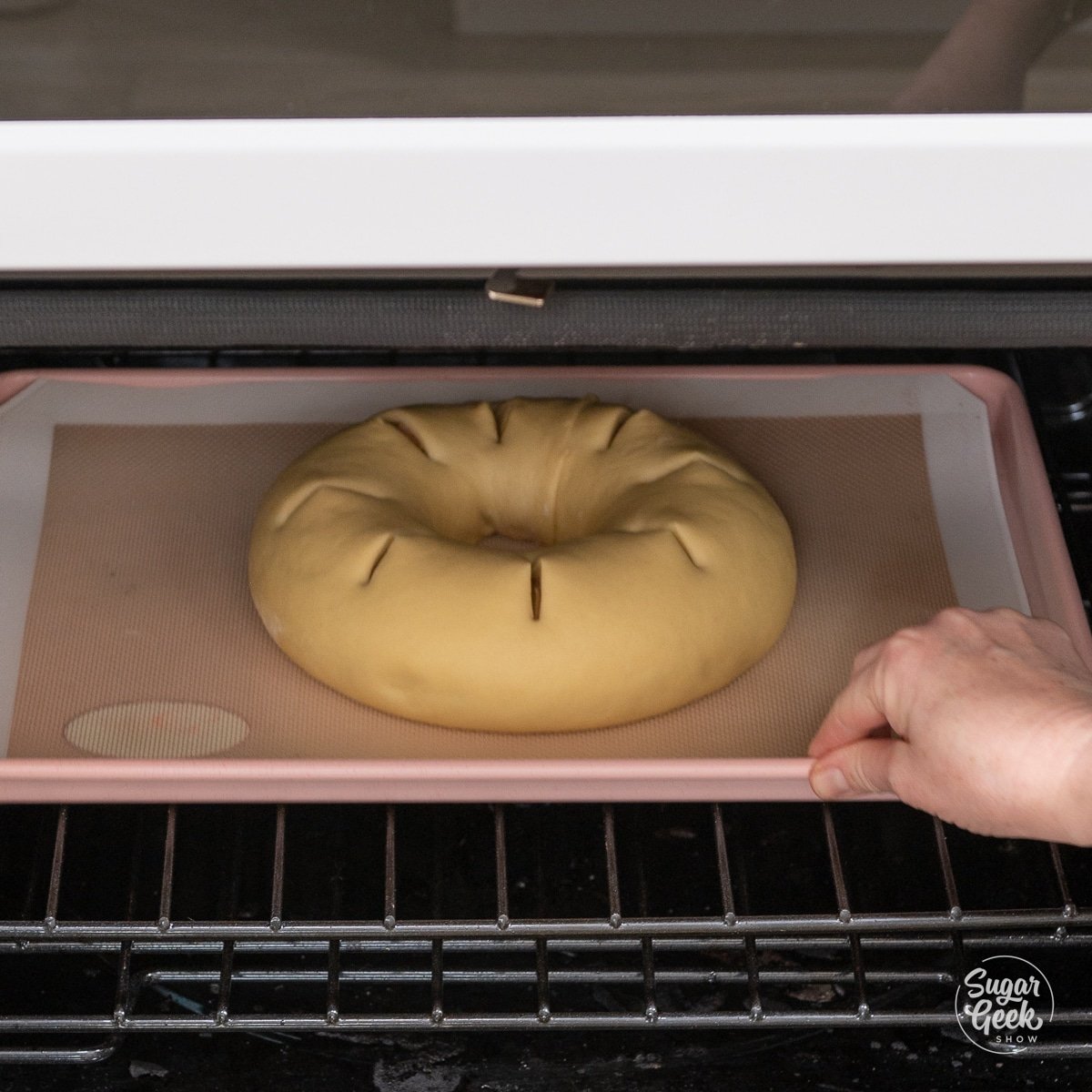
  2. Bake the king cake in a 350°F oven for about 30-40 minutes. hand placing a sheet pan with a king cake on it in the oven
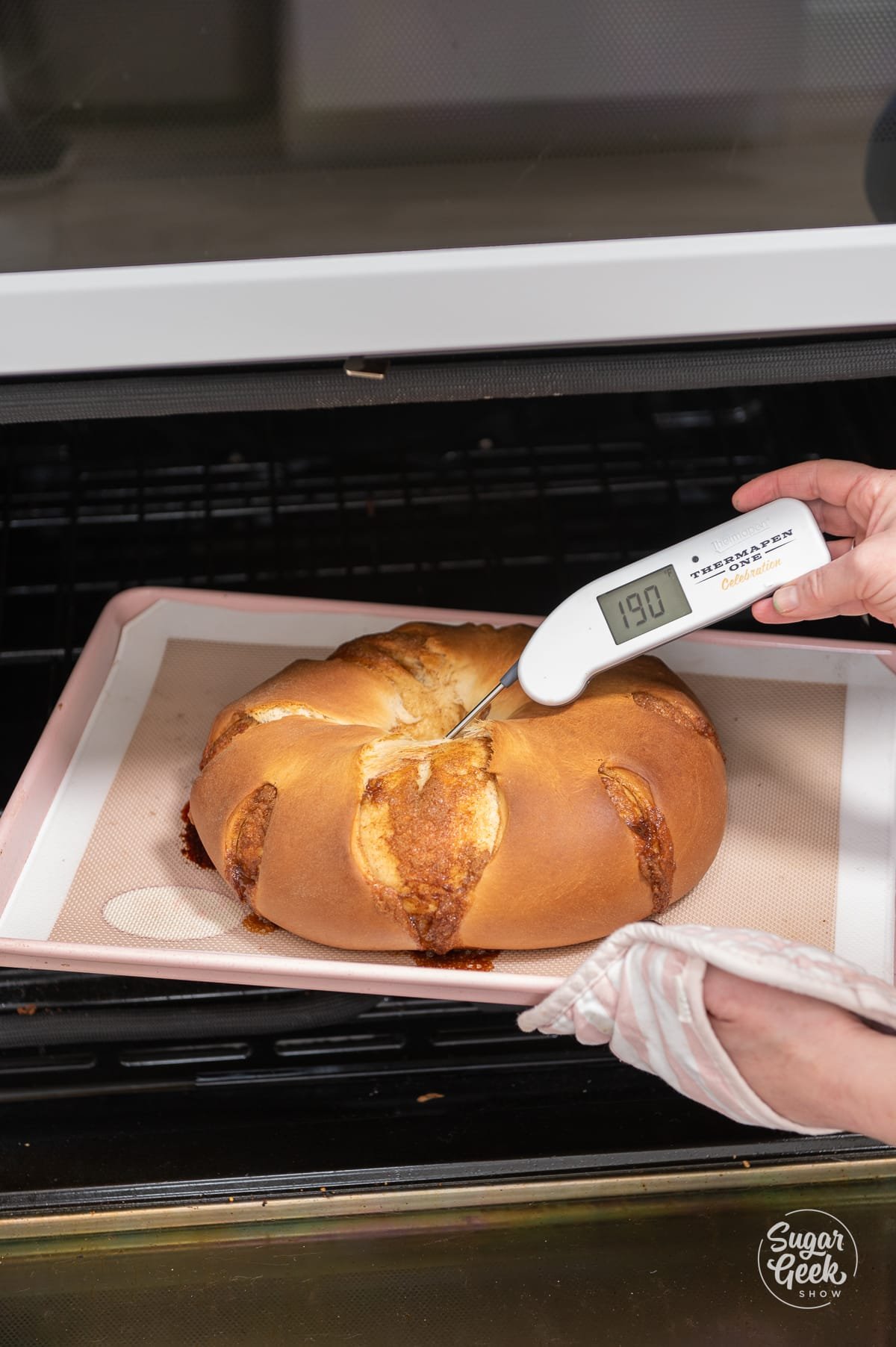
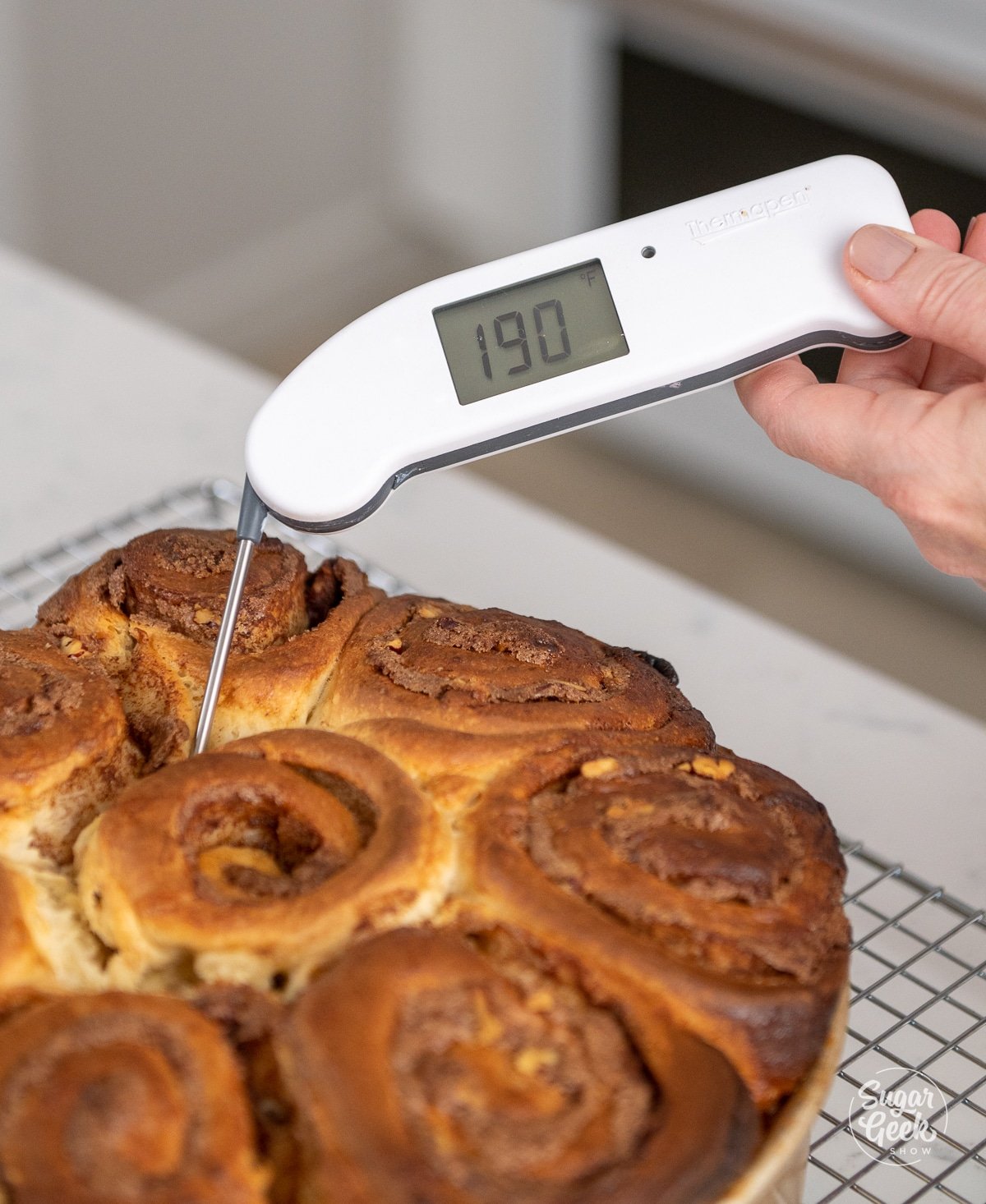
  3. Rotate the cake halfway through baking to ensure even browning. The center of the dough should be near 190°F when it is finished baking, and it should be golden brown. Some filling will have spilled out, but it is okay, there is still plenty inside of the cake.hand holding a thermometer testing the temperature of a baked king cake
  4. Let the cake cool on the pan.
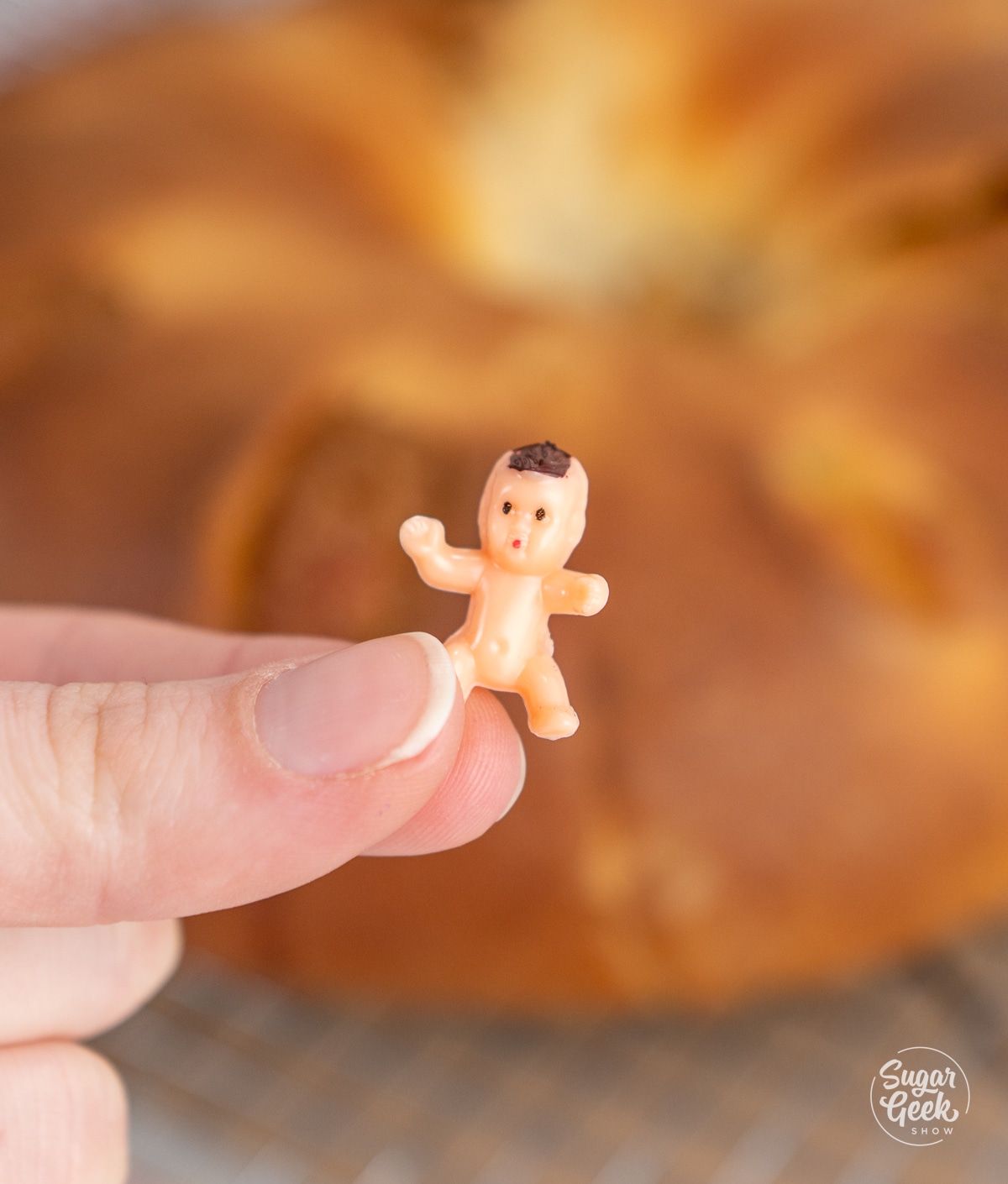
  5. Insert the plastic baby inside the cake. This is completely optional. Cut a small hole and push the plastic baby in. Later you'll cover it with frosting to disguise where the plastic baby is.hand holding a plastic baby in front of a king cake
  6. Once the cake is completely cool, transfer it to a serving plate. 

Icing the King Cake

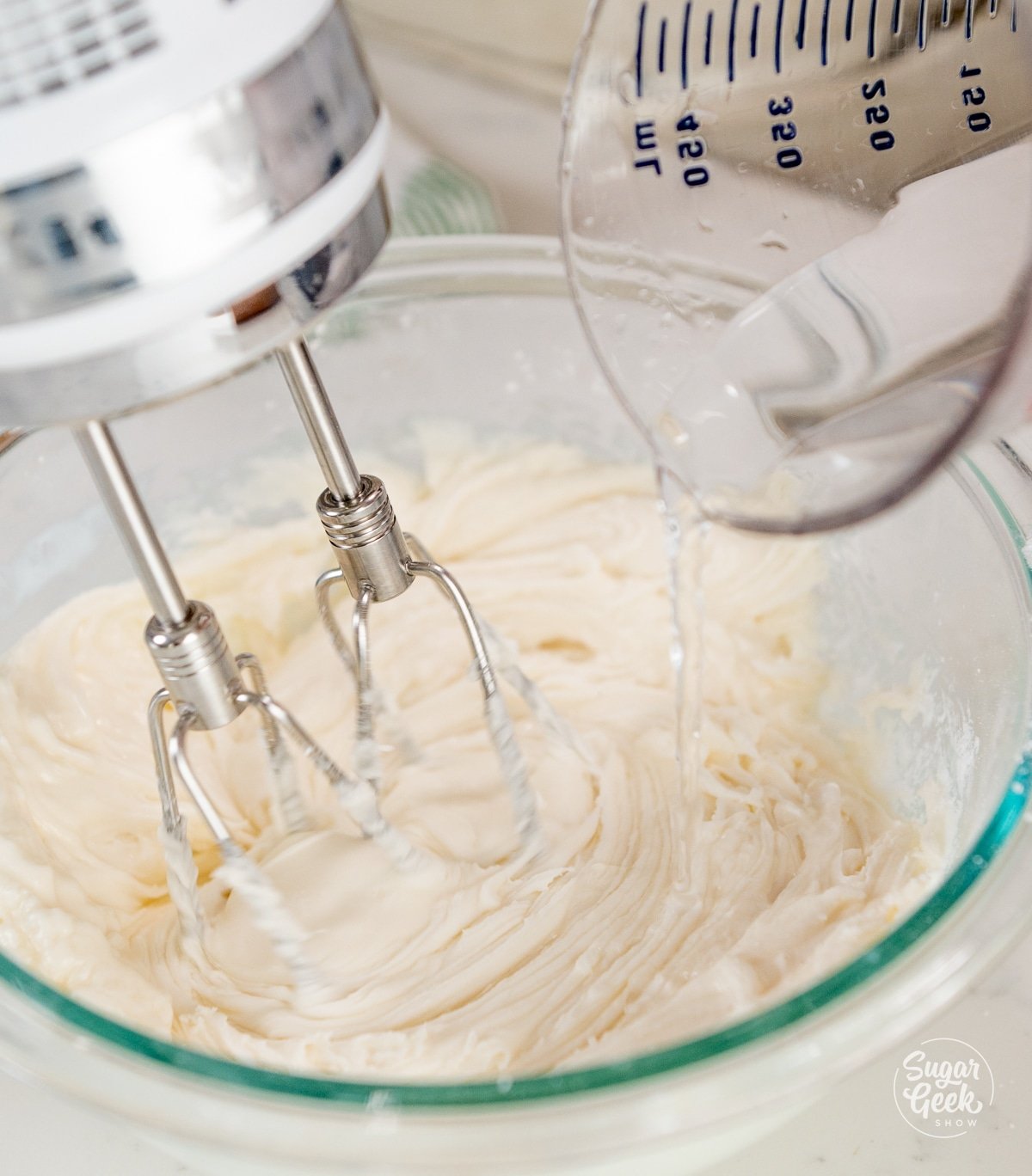
  1. In a large bowl, mix the powdered sugar, buttermilk, melted butter, vanilla extract, and almond extract on high with a whisk attachment for 2-3 minutes. Add a teaspoon of water at a time to thin it out as needed. hand mixer blending white glaze and water in a bowl
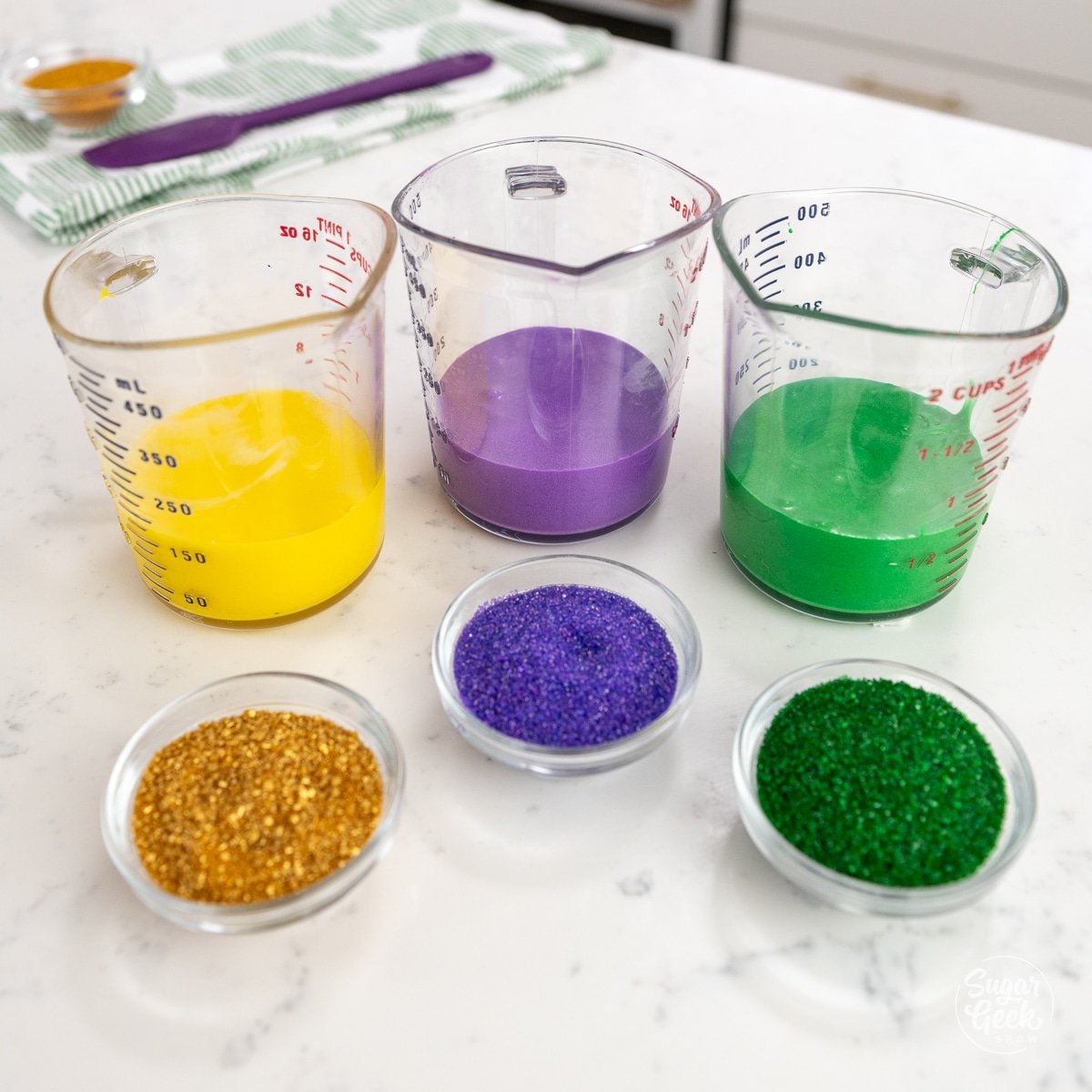
  2. Separate the icing into 3 bowls and add green, yellow, and purple food coloring. One color per bowl. Color the icing to your desired shade of color. The icing can also be left white.containers of gold, purple, and green glaze and sprinkles
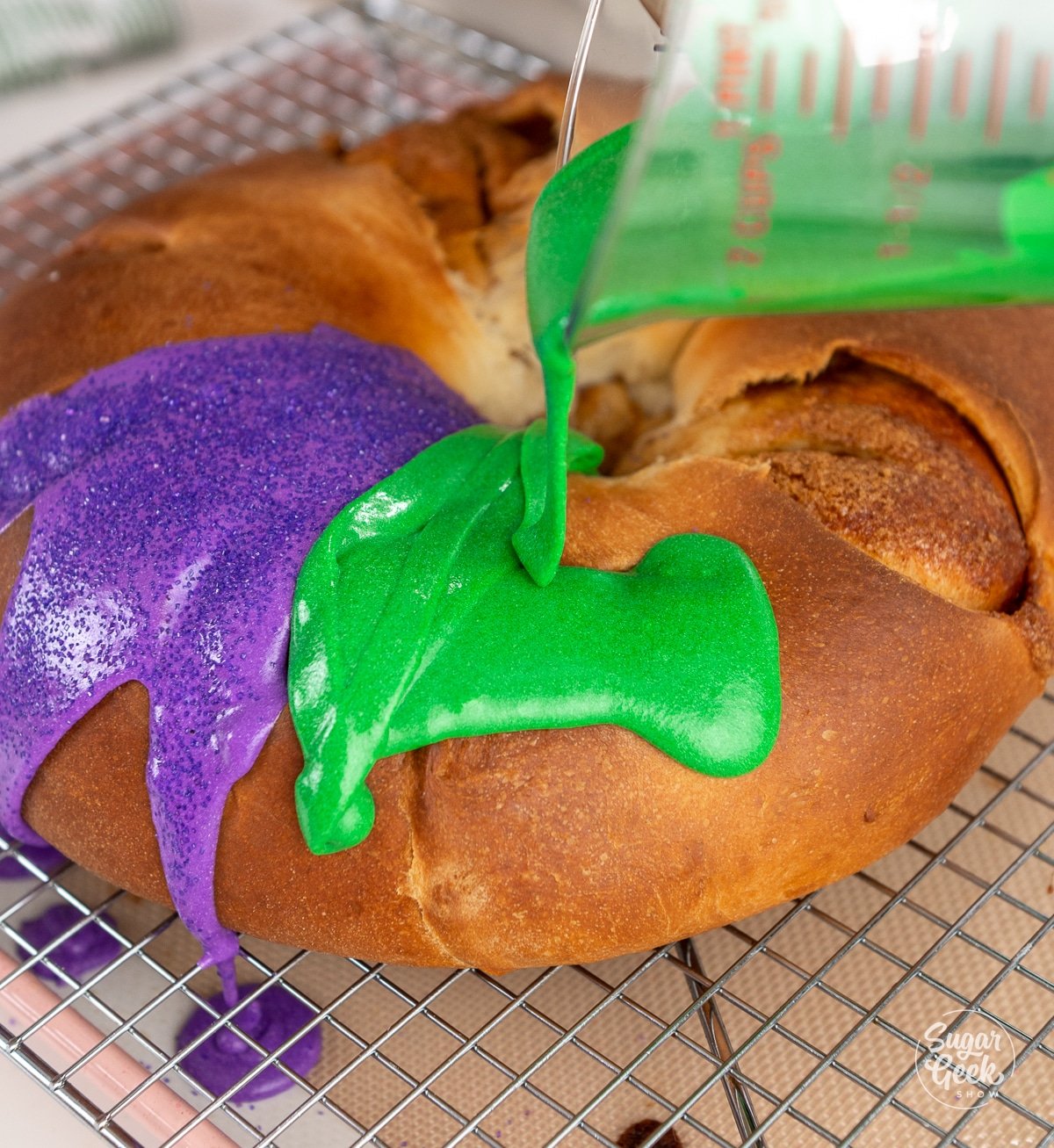
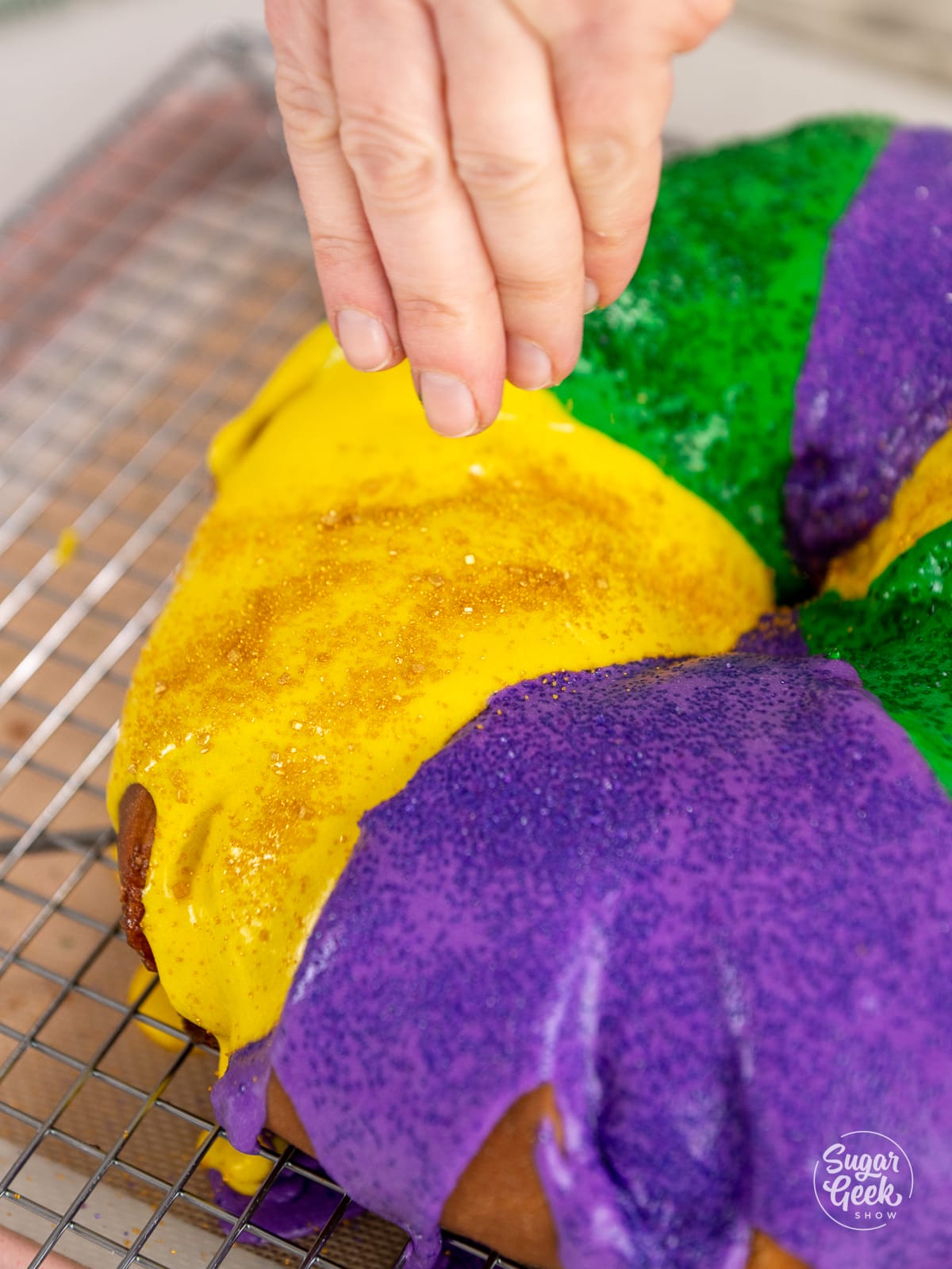
  3. Drizzle the colored icing in sections around the ring of cake, then cover with the corresponding colored sprinkles before the icing dries. green glaze pouring from a measuring cup onto a king cakehand pouring gold sprinkles on top of yellow glaze
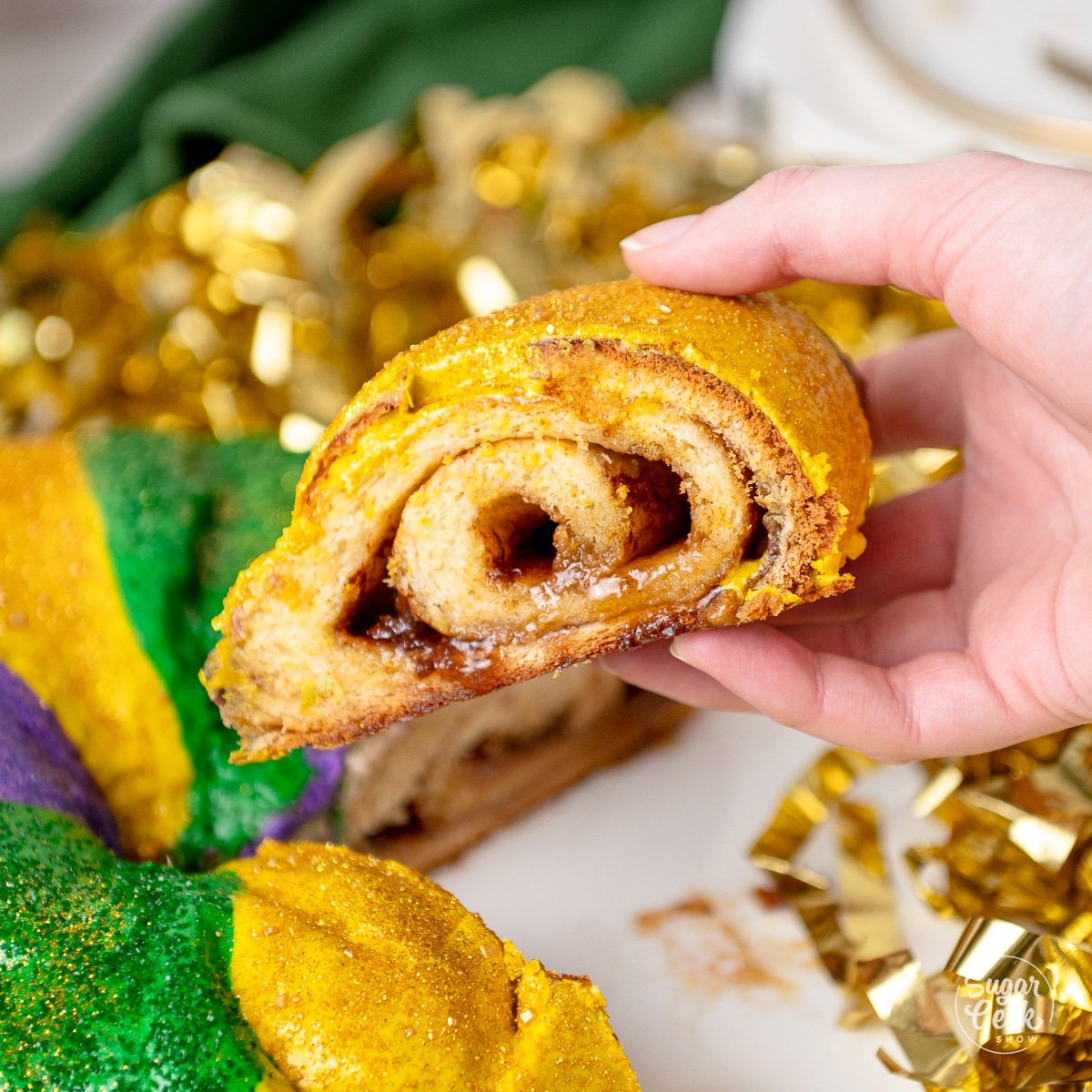
  4. Let the icing set before cutting into the cake. It can be stored at room temperature but sealed in an airtight container. Though this is best eaten the same day, it is just as good days later warmed in the microwave for a few seconds.hand holding a slice of king cake

FAQ

Can I freeze the King Cake?

King cake freezes really well, I recommend you freeze it before it is frosted, and frost it prior to serving. Let the cake cool completely to room temperature, double wrap it tightly with plastic wrap and then wrap it again with aluminum foil. The king cake will keep for up to three months in the freezer. Thaw the cake to room temp then frost, sprinkle and serve.

Why Is There a Baby in the Cake?

Traditionally king cakes have a baby or toy figurine hidden in the cake, this can also be a nut or a bean. The person who gets the slice with the baby is the "king" or "queen" for the day, and is also responsible for bringing the next King Cake or host the next King Cake party. Of course, when serving the cake, make sure your guests are aware of the surprise in the cake, a cracked tooth is not a fun surprise! Often the baby is set on top of the cake to avoid any dangerous situations. I chose to place the baby in the cake after baking it, but this is completely optional.

Is King Cake a Catholic tradition?

The history of the king cake came from European and Roman Catholic roots, which made its way into the New Orleans area in the 1870s. In contrast to the French king cakes, which are flaky puff pastries, the New Orleans style is similar to the Spanish tradition, which is oval-shaped and topped with icing.

What do the 3 Mardi Gras colors in a King Cake mean?

Gold, green and purple is the traditional colors of the sprinkles, which are the traditional colors of Mardi Gras. Gold represents power, green stands for faith, and purple is justice. What is the filling in a King Cake?

What are the different fillings for king cake?

King Cakes come in numerous variations and can be filled with anything from cream cheese filling, almond paste, strawberry jam, chocolate, or coconut. The traditional filling, however, is cinnamon and sugar.

Related Recipes

Sticky Buns Recipe

Easy Bagel Recipe

Strawberry Cinnamon Rolls

Easy Focaccia Bread

Recipe

slice of king cake held with a serving knife
Print Recipe
No ratings yet

King Cake Recipe

Celebrate Mardi Gras with a homemade King Cake, rich sweet dough filled with cinnamon and sugar! If you can't make it to New Orleans make one at home with this surprisingly simple king cake recipe. (Don't forget the small plastic baby!)
Prep Time20 minutes mins
Cook Time35 minutes mins
proofing1 hour hr 30 minutes mins
Total Time2 hours hrs 25 minutes mins
Course: Breakfast, Dessert
Cuisine: American
Servings: 10 servings
Calories: 732kcal
Author: Liz Marek

Ingredients

King Cake Dough

  • 7 grams instant yeast (¼ oz or 1 packet)
  • 3 ounces brown sugar (⅓ cup)
  • 18 ounces all purpose flour  (3 ⅓ cup) (or bread flour)
  • 6 ounces whole milk (¾ cup) warmed to 110°F
  • 5 ounces unsalted butter  (½ cup + 2 Tbsp)
  • 2 large eggs room temperature
  • 1 teaspoon salt

King Cake Filling

  • 4 ounces granulated sugar (½ cup)
  • 4 ounces brown sugar (½ cup)
  • 4 ounces unsalted butter (½ cup) softened
  • 1 pinch salt
  • 3 Tablespoons cinnamon

King Cake Icing

  • 16 ounces powdered sugar
  • 2 ounces buttermilk (¼ cup)
  • 3 Tablespoons unsalted butter melted
  • 1 teaspoon vanilla extract
  • ½ teaspoon almond extract optional
  • 1 teaspoon water as needed
  • gold, green, and purple sprinkles
  • 1 teaspoon yellow gel food coloring
  • 1 teaspoon green gel food coloring
  • 1 teaspoon purple gel food coloring

Instructions

Making the Dough

  • Combine the flour, yeast, and sugar in the bowl of your mixer with a dough hook attachment, mix the ingredients for a few seconds to distribute the yeast evenly.
  • In a heat safe container, combine the milk and butter and heat to 110°F. This can be done in the microwave or in a small saucepan.
  • While the mixer is running on low, pour in the milk and butter and then add the eggs, one at a time. 
  • Once the eggs have begun to incorporate, sprinkle in the salt. The salt is added last to give the yeast more of a chance to thrive.
  • Scrape the sides of the bowl if necessary. Continue to mix on medium-low speed for 10-15 minutes to develop the gluten. 
  • After 10 minutes of mixing, check to see if the gluten is properly developed by using the "window test." Stretch a piece of dough between your fingers and slowly pull it thin enough to see light coming through. If the dough tears, let it continue to mix for another 5 minutes.
  • Once the dough is ready, cover it with plastic wrap or a tea towel and let the dough rise in a warm area for about an hour, until the dough doubles in size. Because of the added butter to the dough, it will not stick to the bowl. I like to place mine in my oven (turned off!) with the oven light on and the door cracked open. 

Making the Filling

  • Mix together the softened butter, brown sugar, and granulated sugar until combined.
  • Add the cinnamon and mix slowly until fully combined and smooth.
  • Warm it in the microwave for a few seconds so the mixture is a soft, easily spreadable consistency. If the filling mixture is hot it will warm the dough upon contact making it more difficult to move and shape, so keeping it at a moderate temperature is easier.

Forming the King Cake

  • Preheat the oven to 350°F.
  • When the dough is ready, dump it out onto a lightly floured surface. You will know your dough is ready because it has doubled in size and also keeps the indentation when you give it a poke.
  • Gently spread the dough with your hands and then begin to roll it out to about a 10"x 20" rectangle with a rolling pin.
  • Using an offset spatula, spread the filling on the dough evenly, leaving a border around the edges. If the filling is too thick in some spots it can bake unevenly.
  • On the long side of the rectangle of dough, begin to roll up the dough evenly forming a long tube. Roll the dough gently and not too tightly, we want the dough to be able to expand while proofing.
  • Once you reach the end of the dough roll, pinch the seam of the dough together. Brush a little water on the edge to help it stick to itself.
  • Carefully place the dough onto a sheet pan lined with parchment paper or a silicone mat. 
  • Trim the excess dough with no filling off one end of the dough ring. Stretch back the dough on the other end of the roll and place the other end into it, overlapping to seal off the circle. Use a little water to seal the seam to the dough.
  • Cover the king cake and place it in a warm spot to rise again for about 30 minutes.

Baking the King Cake

  • Once the dough has risen and is puffed and soft, it is ready to bake. With a sharp knife or scissors, cut some vents around the top of the cake to allow it to expand. It will explode if you don't. 
  • Bake the king cake in a 350°F oven for about 30-40 minutes. 
  • Rotate the cake halfway through baking to ensure even browning. The center of the dough should be near 190°F when it is finished baking, and it should be golden brown. Some filling will have spilled out, but it is okay, there is still plenty inside of the cake.
  • Let the cake cool on the pan.
  • Insert the plastic baby inside the cake. This is completely optional. Cut a small hole and push the plastic baby in. Later you'll cover it with frosting to disguise where the plastic baby is.
  • Once the cake is completely cool, transfer it to a serving plate. 

Icing the King Cake

  • In a large bowl, mix the powdered sugar, buttermilk, melted butter, vanilla extract, and almond extract on high with a whisk attachment for 2-3 minutes. Add a teaspoon of water at a time to thin it out as needed. 
  • Separate the icing into 3 bowls and add green, yellow, and purple food coloring. One color per bowl. Color the icing to your desired shade of color. The icing can also be left white.
  • Drizzle the colored icing in sections around the ring of cake, then cover with the corresponding colored sprinkles before the icing dries. 
  • Let the icing set before cutting into the cake. It can be stored at room temperature but sealed in an airtight container. Though this is best eaten the same day, it is just as good days later warmed in the microwave for a few seconds.

Nutrition

Serving: 1serving | Calories: 732kcal | Carbohydrates: 118g | Protein: 8g | Fat: 26g | Saturated Fat: 16g | Polyunsaturated Fat: 1g | Monounsaturated Fat: 7g | Trans Fat: 1g | Cholesterol: 104mg | Sodium: 275mg | Potassium: 154mg | Fiber: 3g | Sugar: 76g | Vitamin A: 841IU | Vitamin C: 0.1mg | Calcium: 89mg | Iron: 3mg
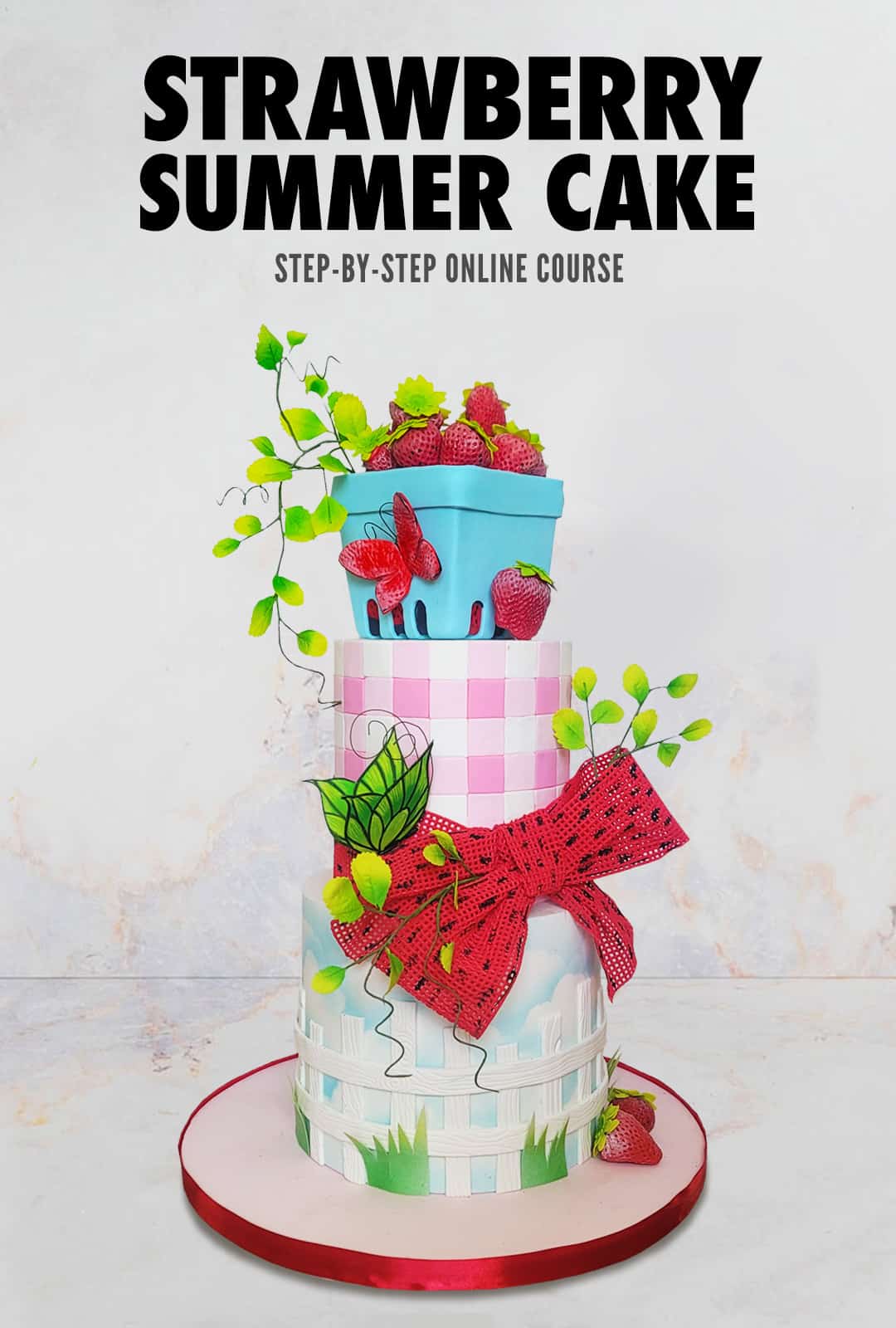
Cake sculpted and decorated to look like strawberries

February 15, 2023 Course Preview

Strawberry Summer Cake Tutorial

Skill level: Intermediate

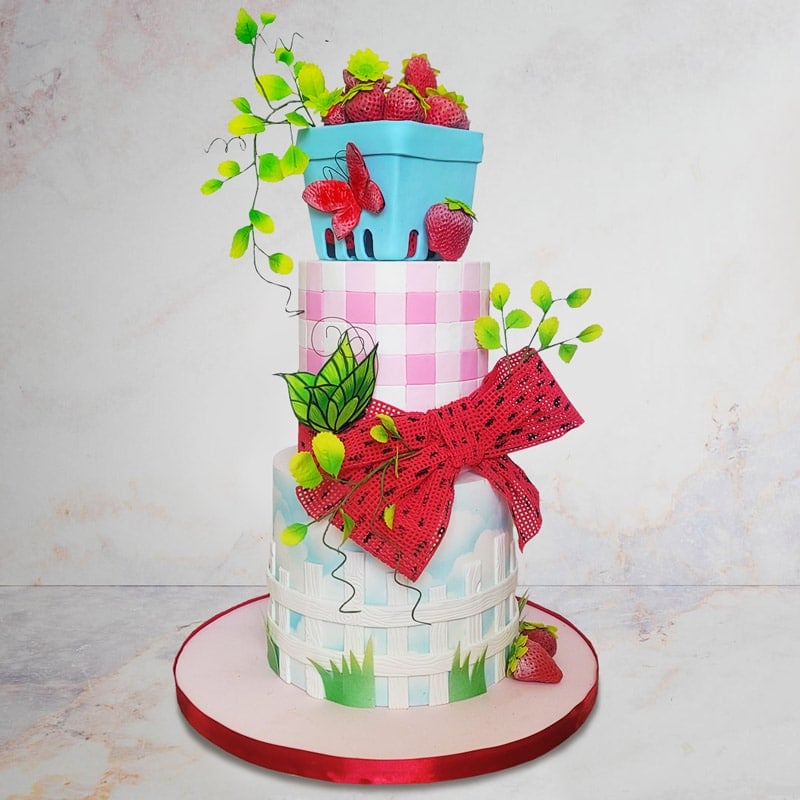
Guest instructor Jennifer Reese is back again for a summer-styled strawberry patch cake! In this tutorial, you will learn how to create a wide variety of looks and textures, from realistic strawberry patch vines, to picket fence patterns, a pink and white gingham thatch, a edible fabric ribbon with a bow and a strawberry carton with real strawberries.

There's a lot to learn in this course, so let's get our tools together and let's get started!

2:19:40 Minutes of Instruction

What You Will Learn

  • Learn how to make a strawberry-inspired summer cake
  • How to create picket fences, gingham thatch, and an edible fabric with bow
  • Learn how to create realistic strawberry vines, a strawberry carton and butterfly

Cake sculpted to look like strawberries

Tutorial Chapters

  1. Making The Strawberry Mold 1:21
  2. Making The Chocolate Strawberries 19:51
  3. Making The Strawberry Butterfly 26:17
  4. Making The Carton Shape 27:12
  5. Paneling The Carton 38:19
  6. Making The Cloud Tier 49:46
  7. Making The Gingham Design 54:35
  8. Adding The Fence 56:10
  9. Making The Wafer Paper Grass 1:00:20
  10. Coloring The Gum Paste 1:02:42
  11. Making The Leaf Butterfly 1:05:13
  12. Detailing The Leaf Butterfly 1:11:25
  13. Making The Calyx 1:14:26
  14. Making The Leaves 1:29:37
  15. Making The Vines 1:40:54
  16. Making The Burlap Bow 1:44:53
  17. Adding The Burlap Bow 2:05:40
  18. Adding The Final Decorations 2:13:24

Downloads

Materials List

Strawberry Cake Reference

Cake sculpted and decorated to look like strawberries

February 15, 2023 Paid Video

Strawberry Summer Cake

Skill level: Intermediate

Guest instructor Jennifer Reese is back again for a summer-styled strawberry patch cake! In this tutorial, you will learn how to create a wide variety of looks and textures, from realistic strawberry patch vines, to picket fence patterns, a pink and white gingham thatch, a edible fabric ribbon with a bow and a strawberry carton with real strawberries.

There's a lot to learn in this course, so let's get our tools together and let's get started!

2:19:40 Minutes of Instruction

What You Will Learn

  • Learn how to make a strawberry-inspired summer cake
  • How to create picket fences, gingham thatch, and an edible fabric with bow
  • Learn how to create realistic strawberry vines, a strawberry carton and butterfly

Tutorial Chapters

  1. Making The Strawberry Mold 1:21
  2. Making The Chocolate Strawberries 19:51
  3. Making The Strawberry Butterfly 26:17
  4. Making The Carton Shape 27:12
  5. Paneling The Carton 38:19
  6. Making The Cloud Tier 49:46
  7. Making The Gingham Design 54:35
  8. Adding The Fence 56:10
  9. Making The Wafer Paper Grass 1:00:20
  10. Coloring The Gum Paste 1:02:42
  11. Making The Leaf Butterfly 1:05:13
  12. Detailing The Leaf Butterfly 1:11:25
  13. Making The Calyx 1:14:26
  14. Making The Leaves 1:29:37
  15. Making The Vines 1:40:54
  16. Making The Burlap Bow 1:44:53
  17. Adding The Burlap Bow 2:05:40
  18. Adding The Final Decorations 2:13:24

Downloads

Materials List

Strawberry Cake Reference

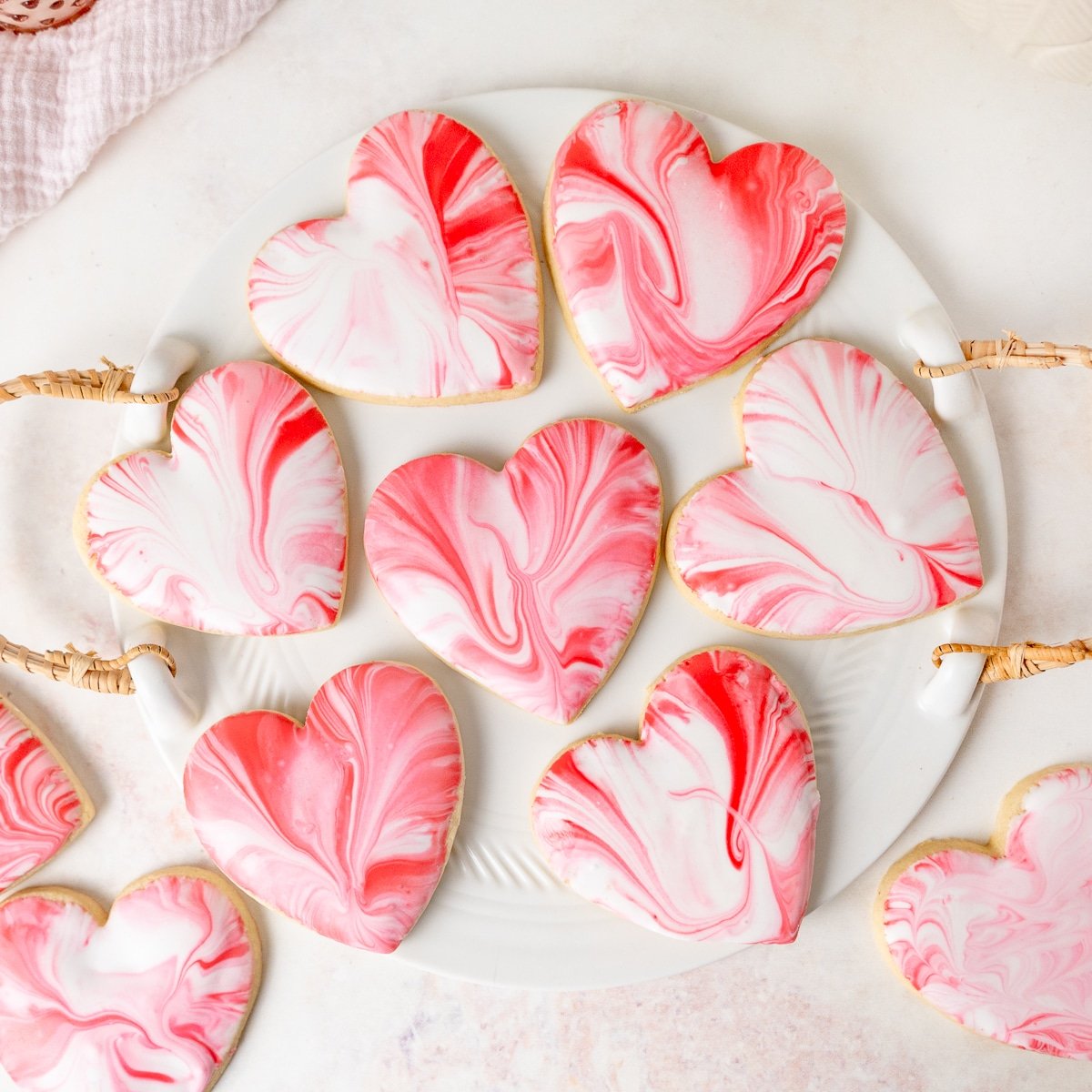
heart shaped cookies on tray.

February 8, 2023 Blog

Heart Shaped Cookies

Show some love with these heart-shaped cookies and make the perfect treats for valentine's day! The dough is one of the most simple recipes that I love to use for almost every holiday. The dough comes together quickly and the decorating is so simple. These are fun cookies to make with your kids too!

heart shaped cookies on tray.

This sugar cookie recipe is so good and so easy! If you've never used a piping bag or made your own royal icing, the idea of making beautiful, decorated cookies can be complicated. We created a cookie design that even beginner decorators and kids could do easily. These simple marbled heart cookies are a great introduction to cookie decorating, they don't require any special supplies or equipment (no pastry bag necessary) and require very little time.

I love using it for these heart sugar cookies, which can be decorated in so many ways. We made 2 colors of pink although you can color the dough or add festive sprinkles, but I am in love with the marbled look of the royal icing. You can use any combination of colors you'd like, or even cut the cookies into a completely different shape. We love this heart-shaped cookie cutter, but with this simple technique, you can make orange marbled pumpkins for Halloween or green marbled clovers for St. Patrick's Day. These are fun festive treats all year. The best part is, it doesn't take a lot of practice or skill to make an impressive professional looking cookie, and they taste so much better than anything you will buy in a clamshell at the store!

What's In This Blog Post?

  • Ingredients
  • Making the Sugar Cookies Step-By-Step
  • Making the Marbled Icing Step-By-Step
  • FAQ
  • More Recipes You'll Love

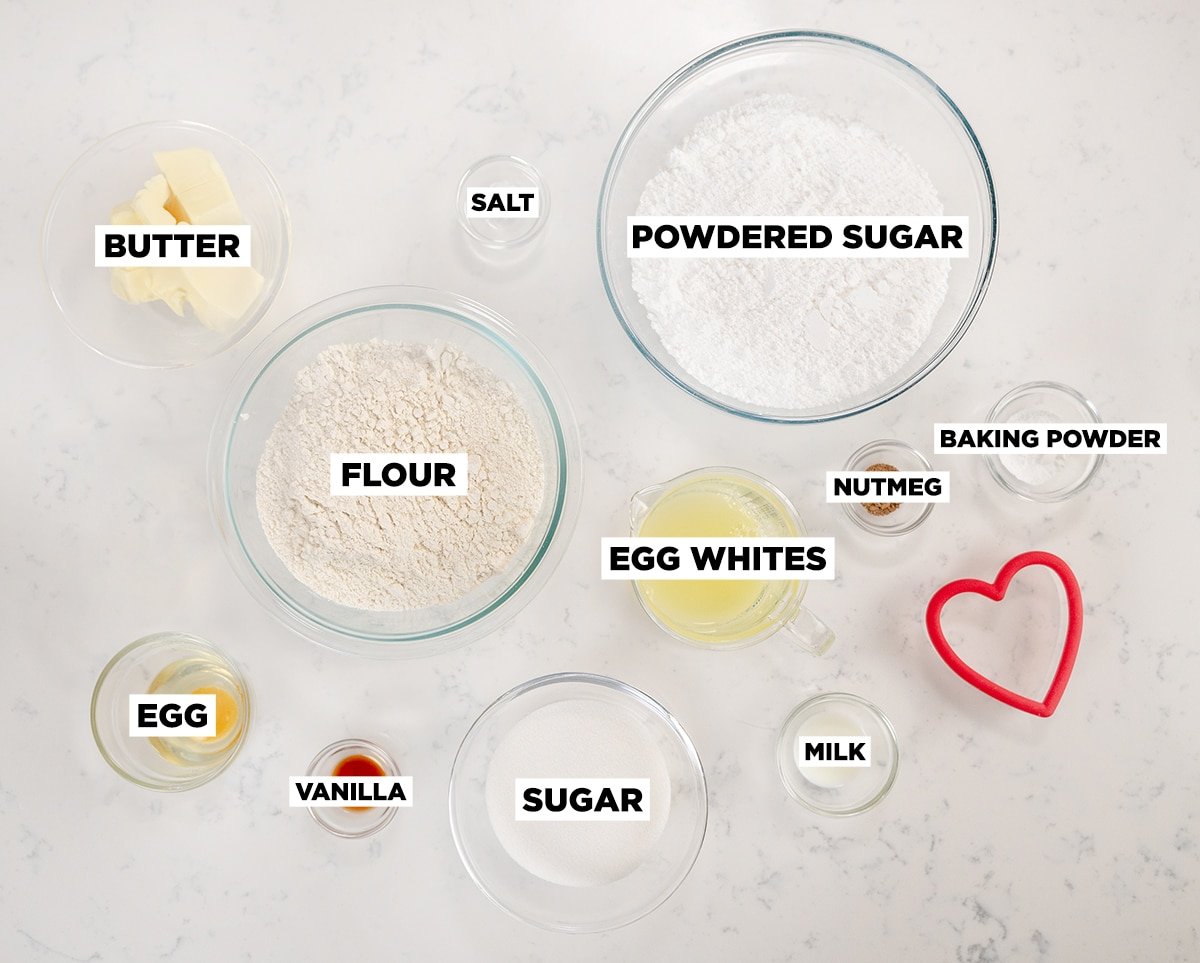
Ingredients

photo of ingredients for heart shaped cookies.

Making the Sugar Cookies Step-By-Step

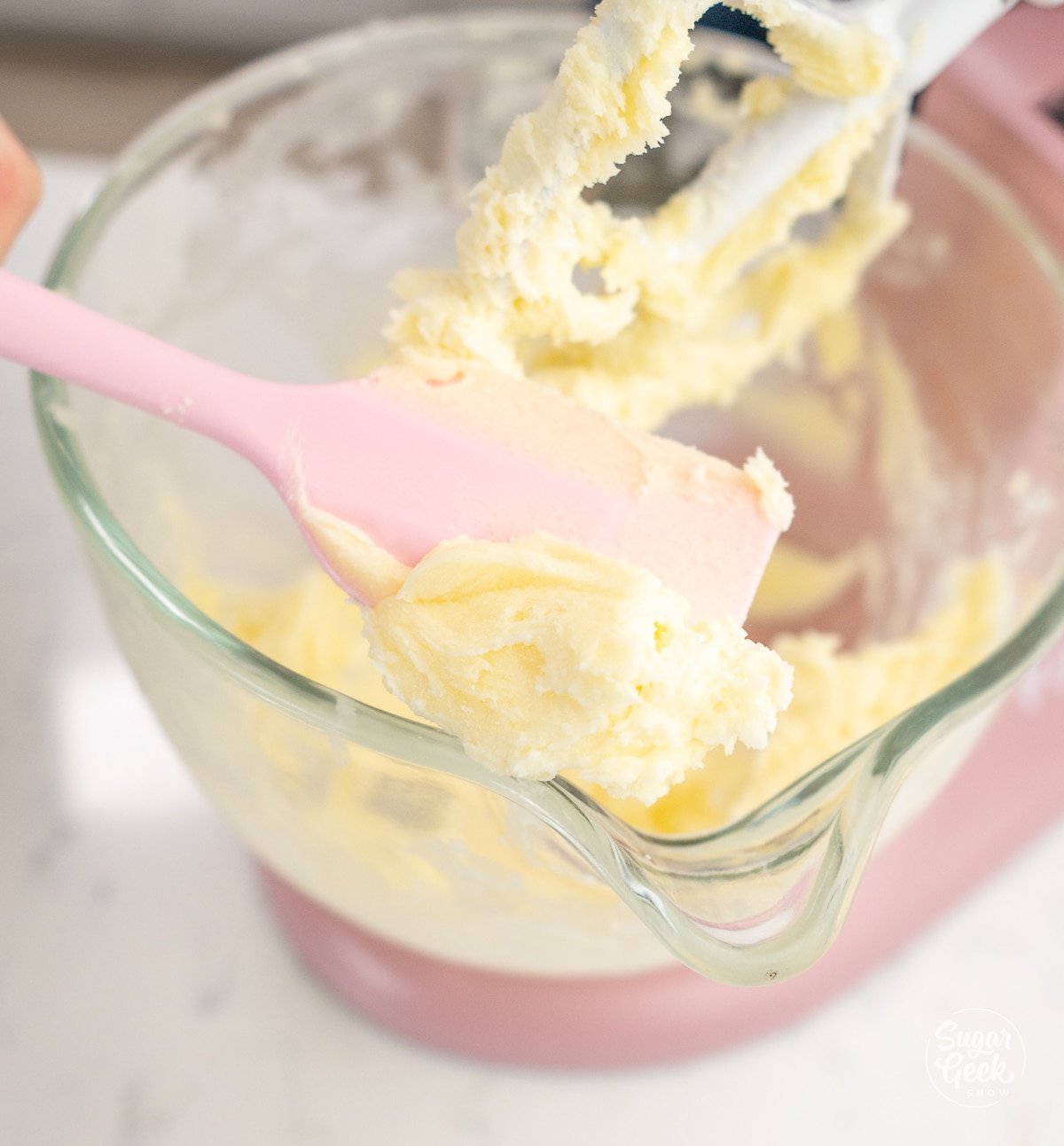
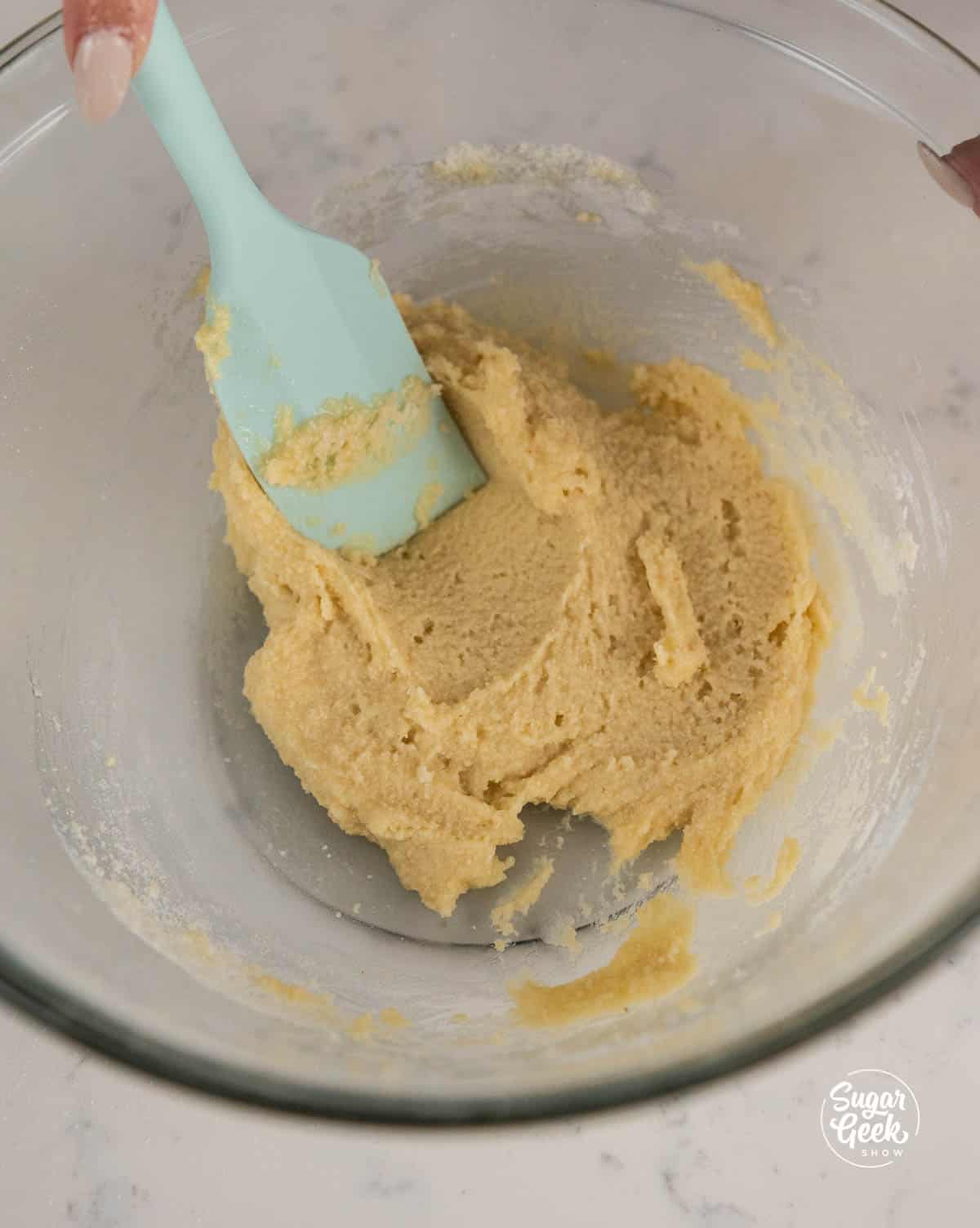
  1. Place room-temperature butter and granulated sugar in the bowl of your mixer with the paddle attachment and mix on low until smooth. The creamed butter should be fluffy and pale yellow in color. Make sure to scrape the bottom of the bowl.spatula with creamed butter and sugar on top.
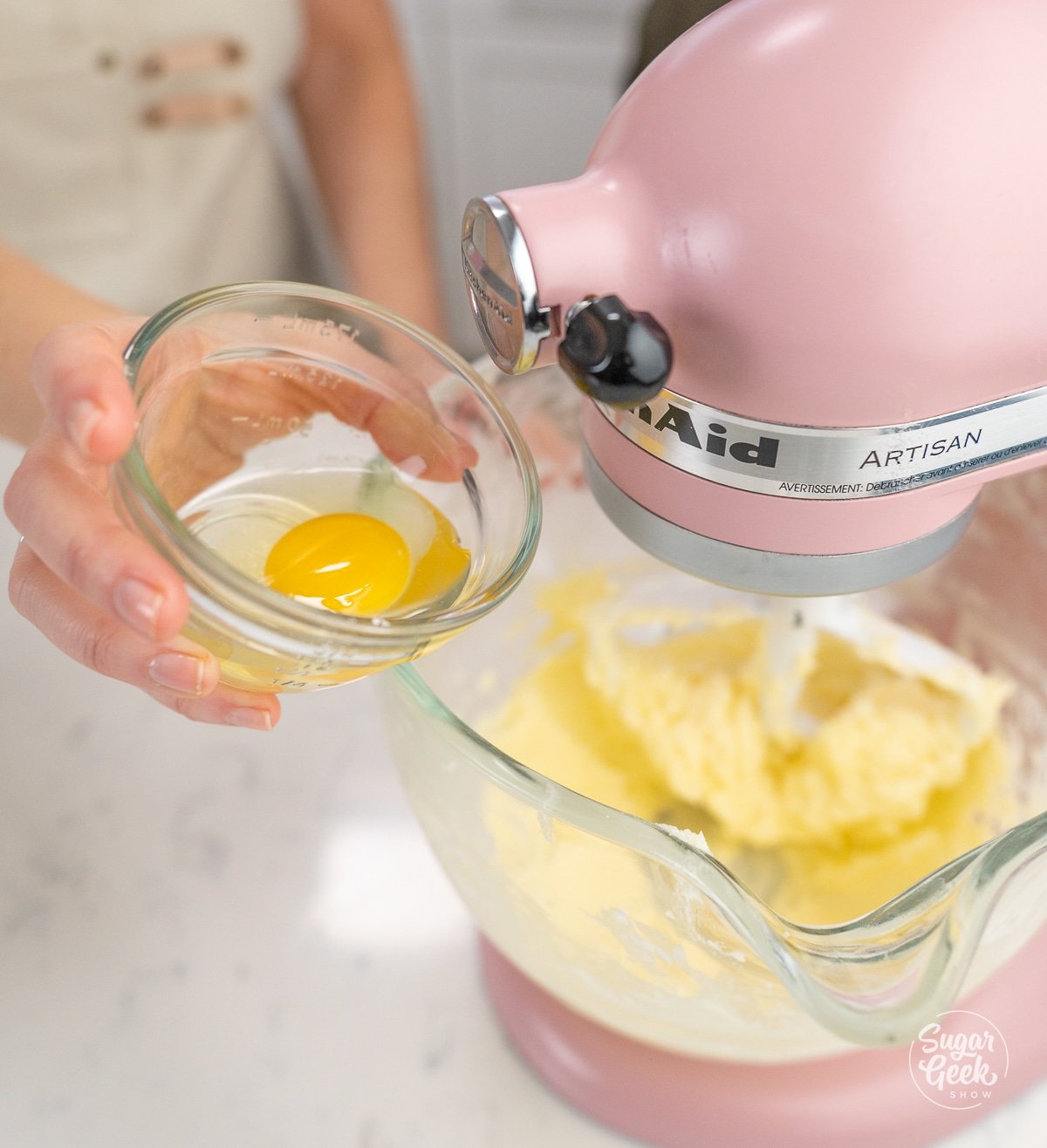
  2. Add the egg and mix on medium (4 on Kitchenaid mixer) in a stand mixer until fully incorporated. Scrape the bowl when necessary to make sure the egg incorporates.hand adding bowl of eggs into dough mixture.
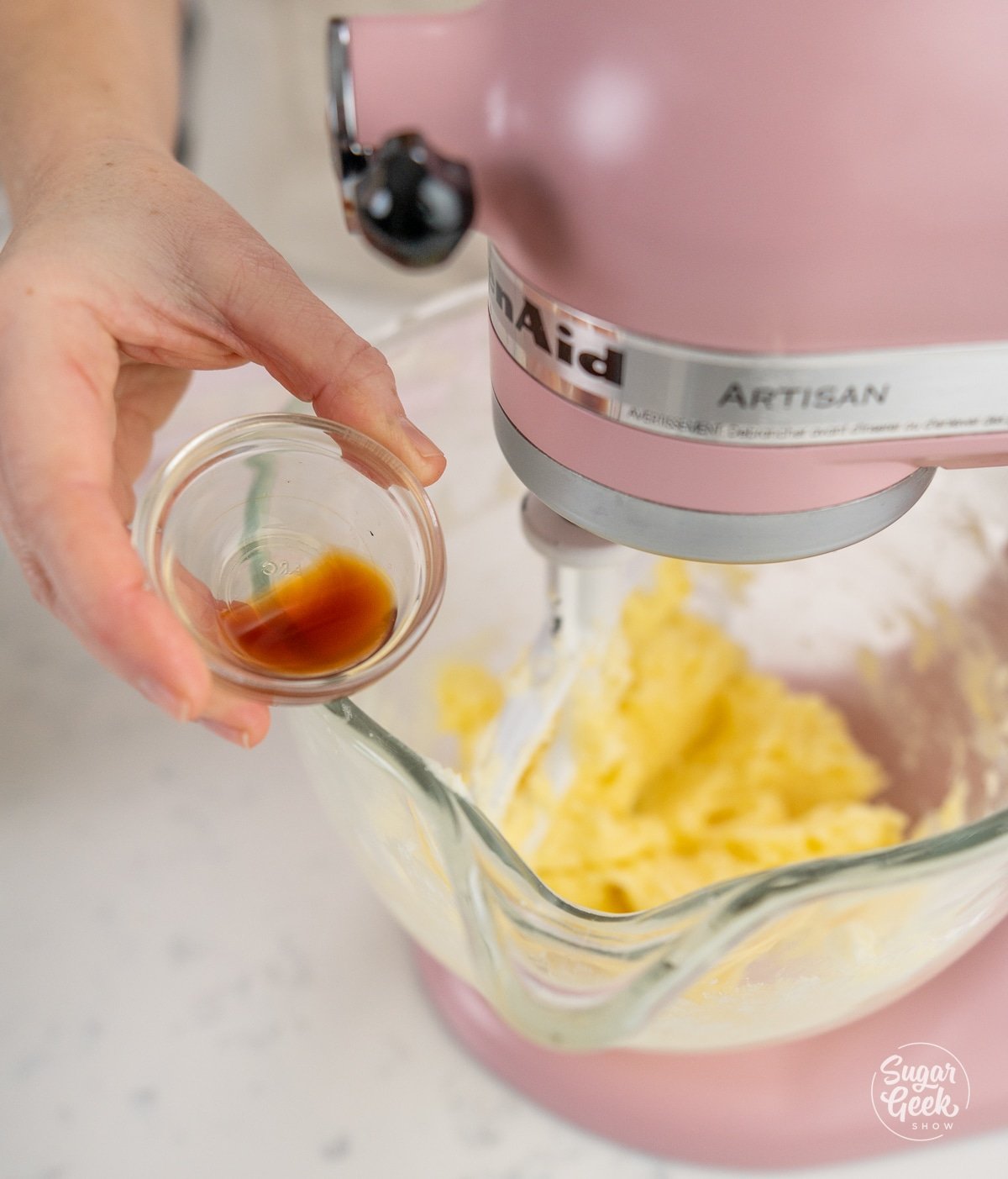
  3. Add the vanilla extract. Mix until just incorporated.hand adding bowl of vanilla into dough mixture.
  4. In a separate large bowl, whisk the flour, salt, baking powder, and spice together. 
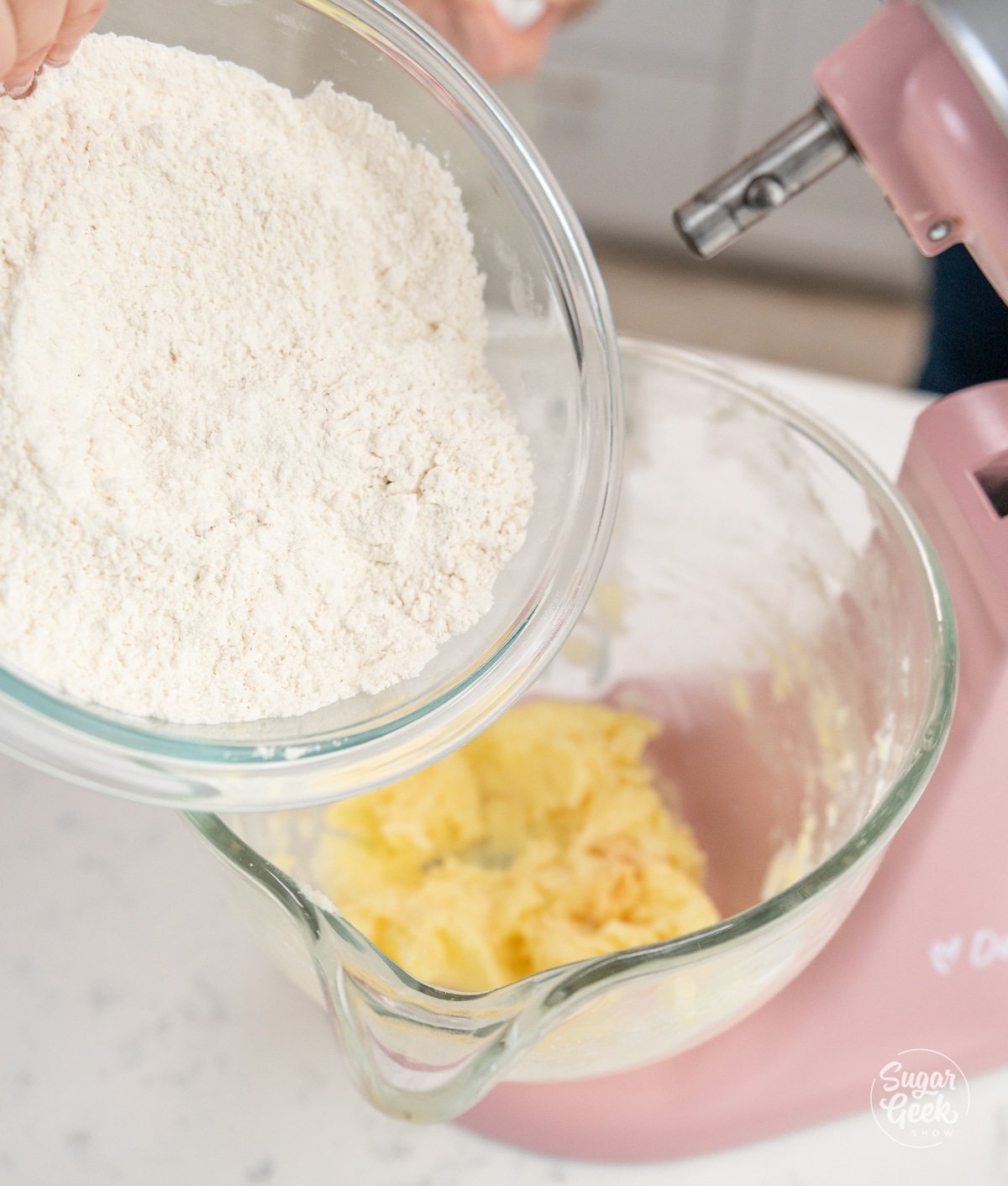
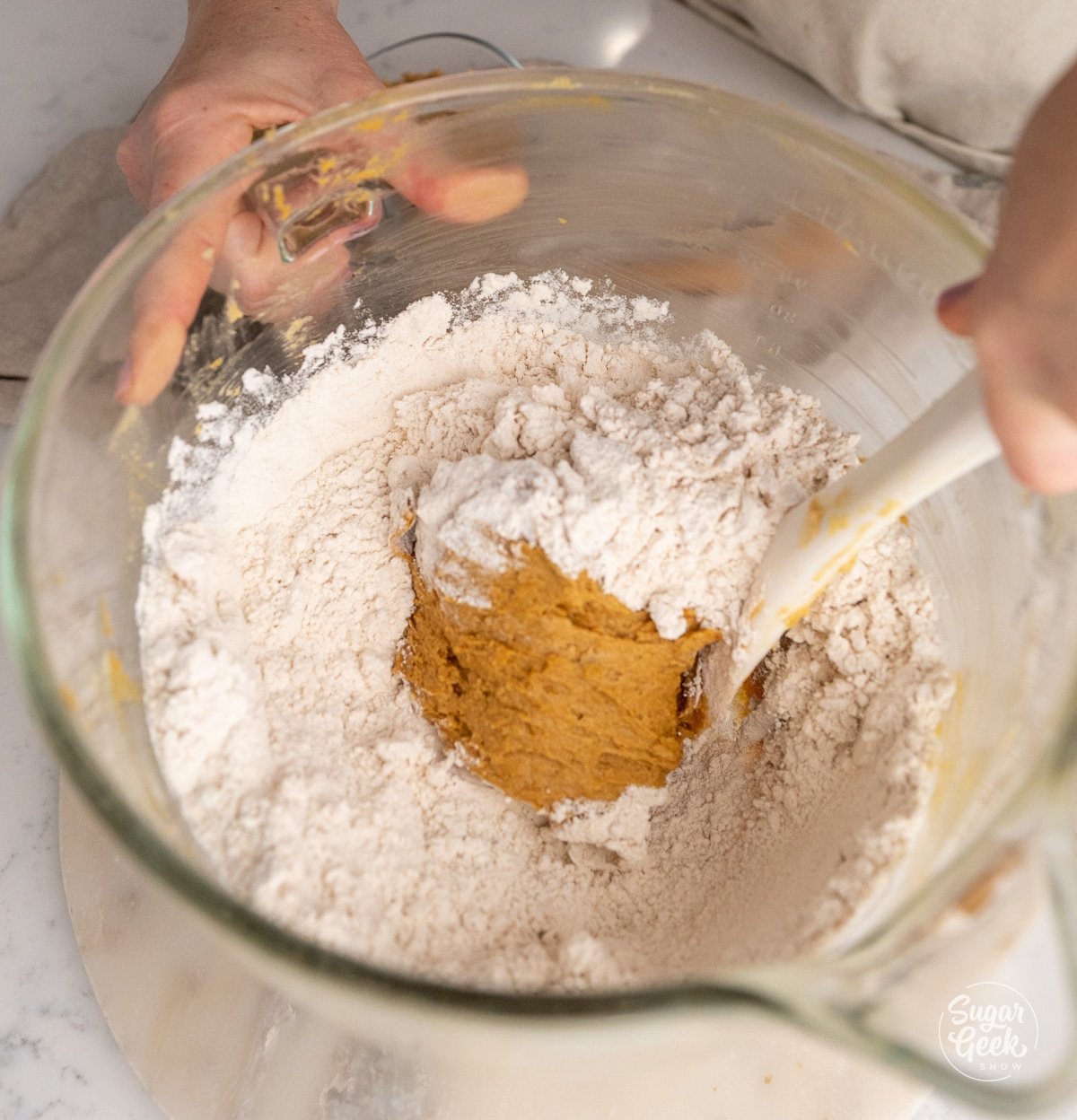
  5. Add the flour mixture into the dough with a scoop (about ⅓ of the total dry ingredients at a time) and mix until fully incorporated. Start the mixer on low until flour starts to incorporate, then turn it up to medium. Scrape the bowl as needed to fully incorporate.bowl with dry ingredients hovering over stand mixer.
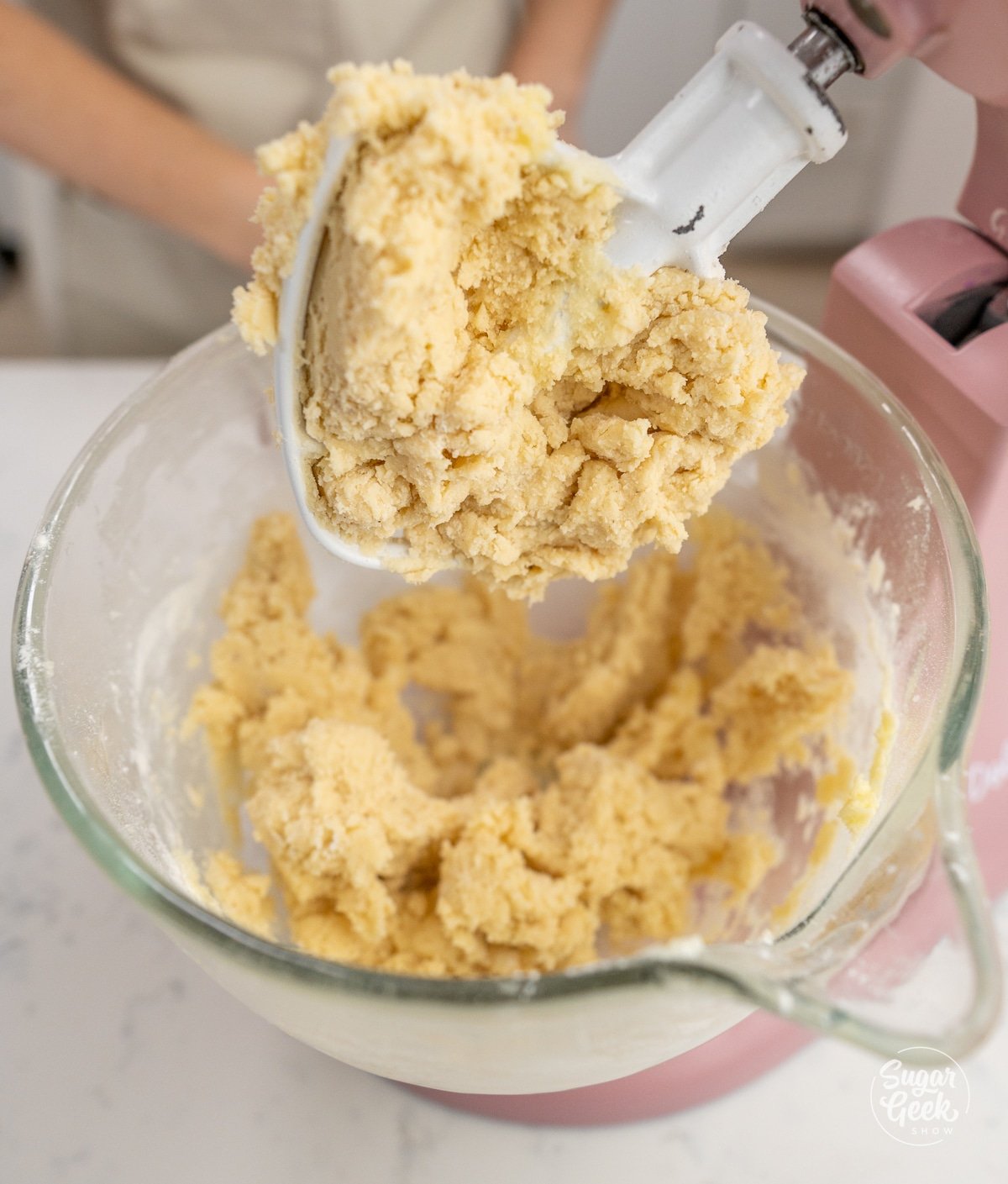
  6. Add the milk once the dry ingredients are fully incorporated. Continue to mix on low until the dough becomes a solid mass. dough on paddle attachment.
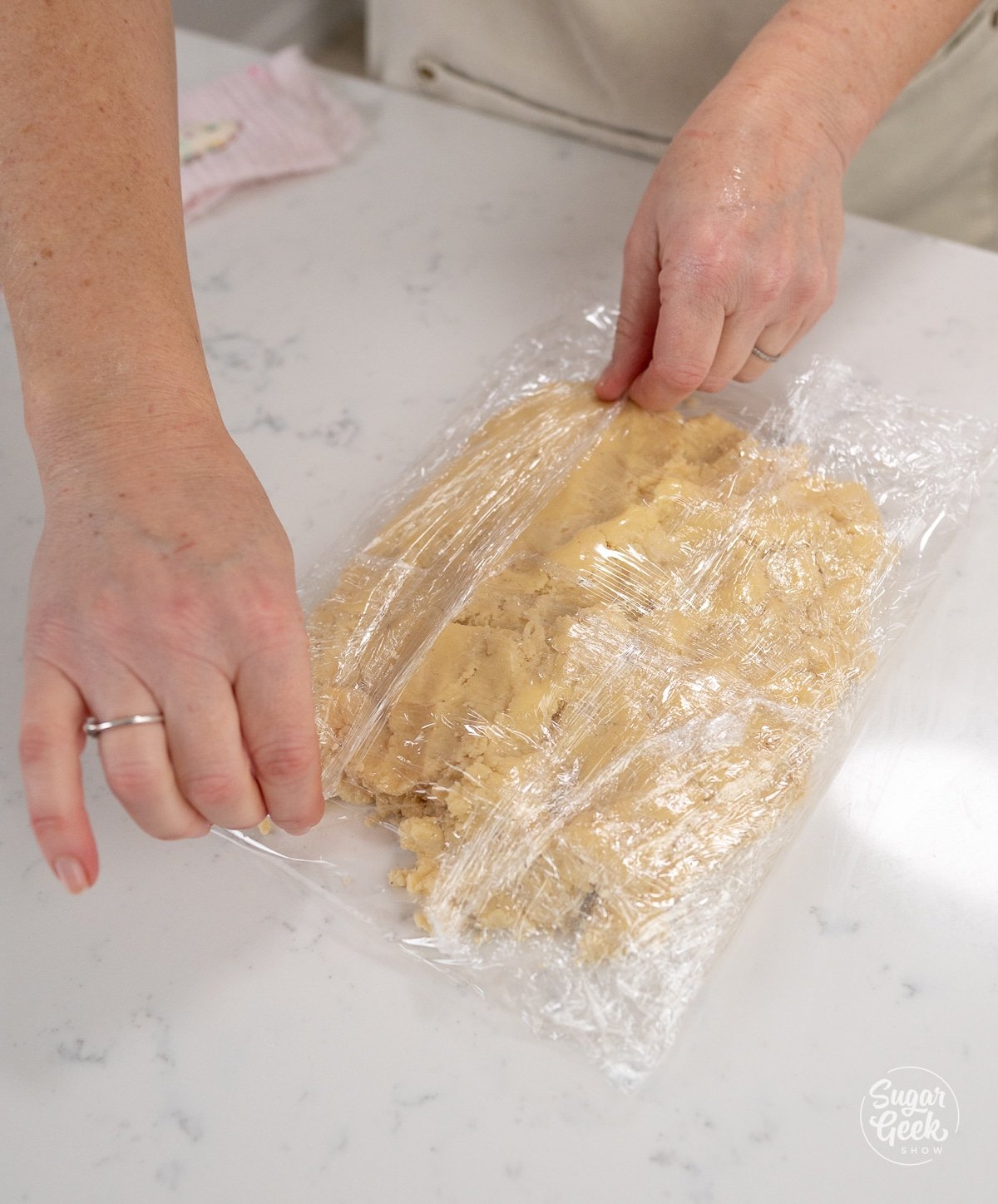
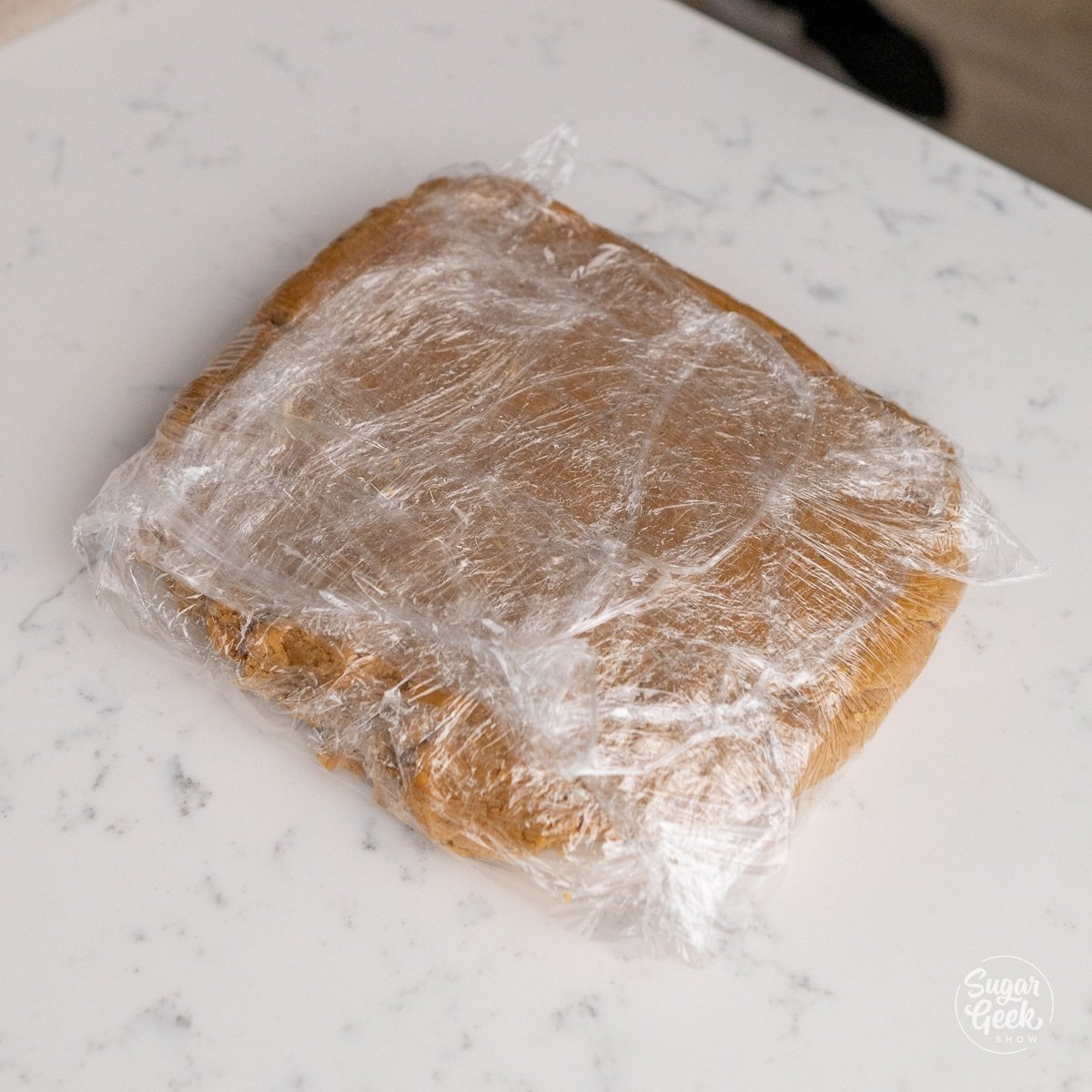
  7. Scrape out the mixer bowl and wrap up the sugar cookie dough in plastic wrap.hand wrapping dough into plastic wrap.
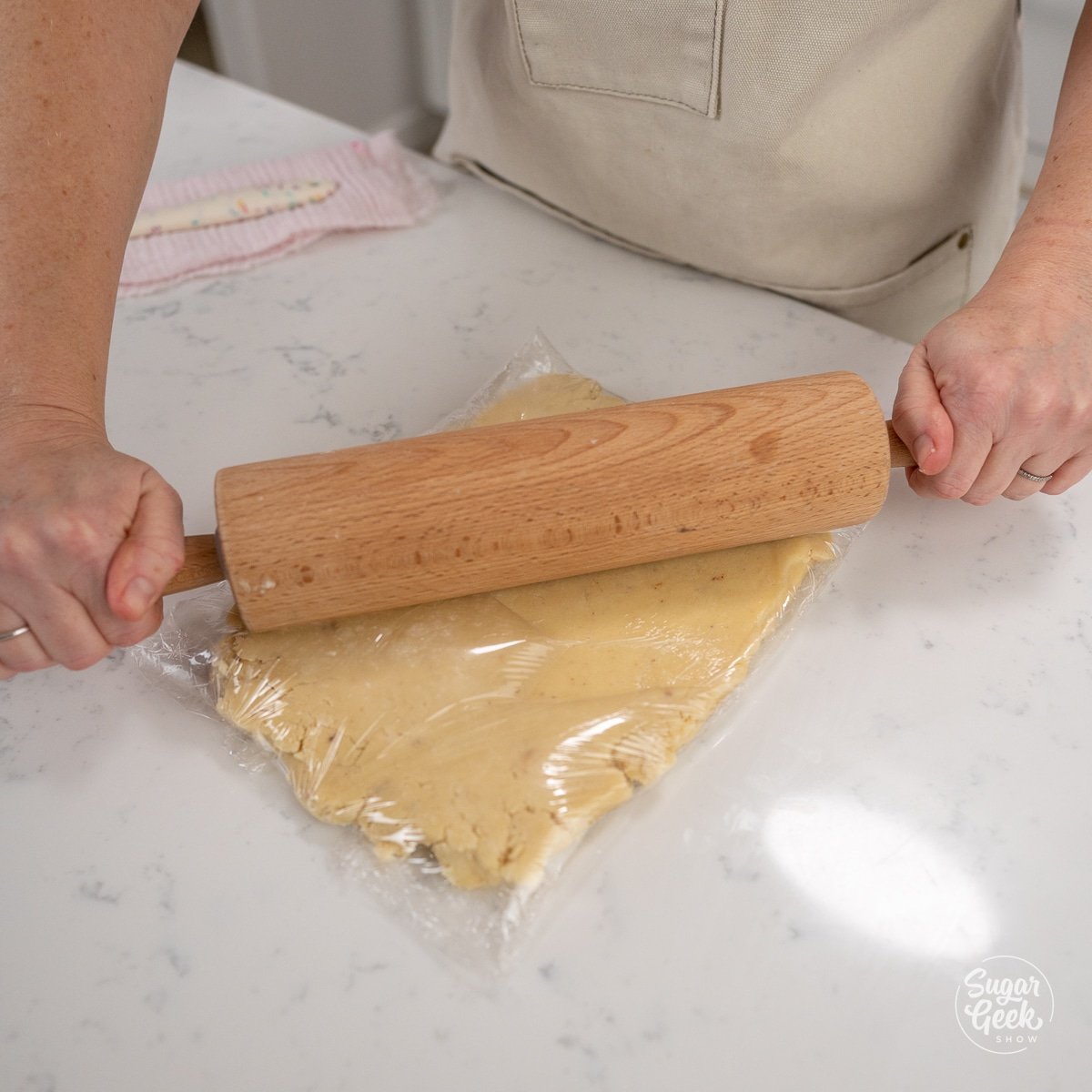
  8. Once the dough is wrapped in plastic, Take a rolling pin and roll the dough into a flat square. ( This helps the dough chill faster and more evenly). hand using rolling pin to roll dough into sqaure.
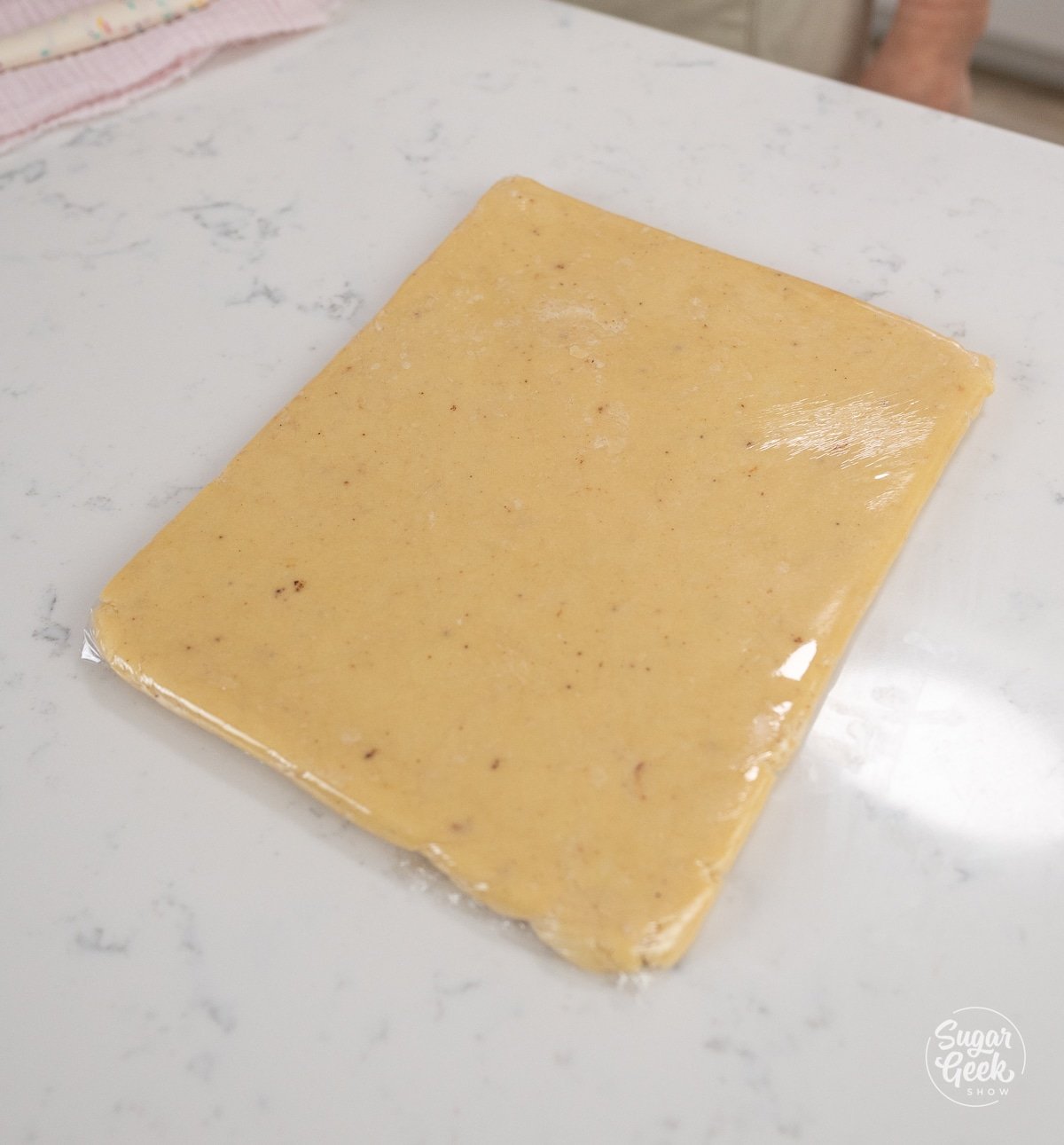
  9. Place your dough in the fridge for about 20 minutes or until the dough is firm to the touch. dough wrapped in plastic wrap on table.
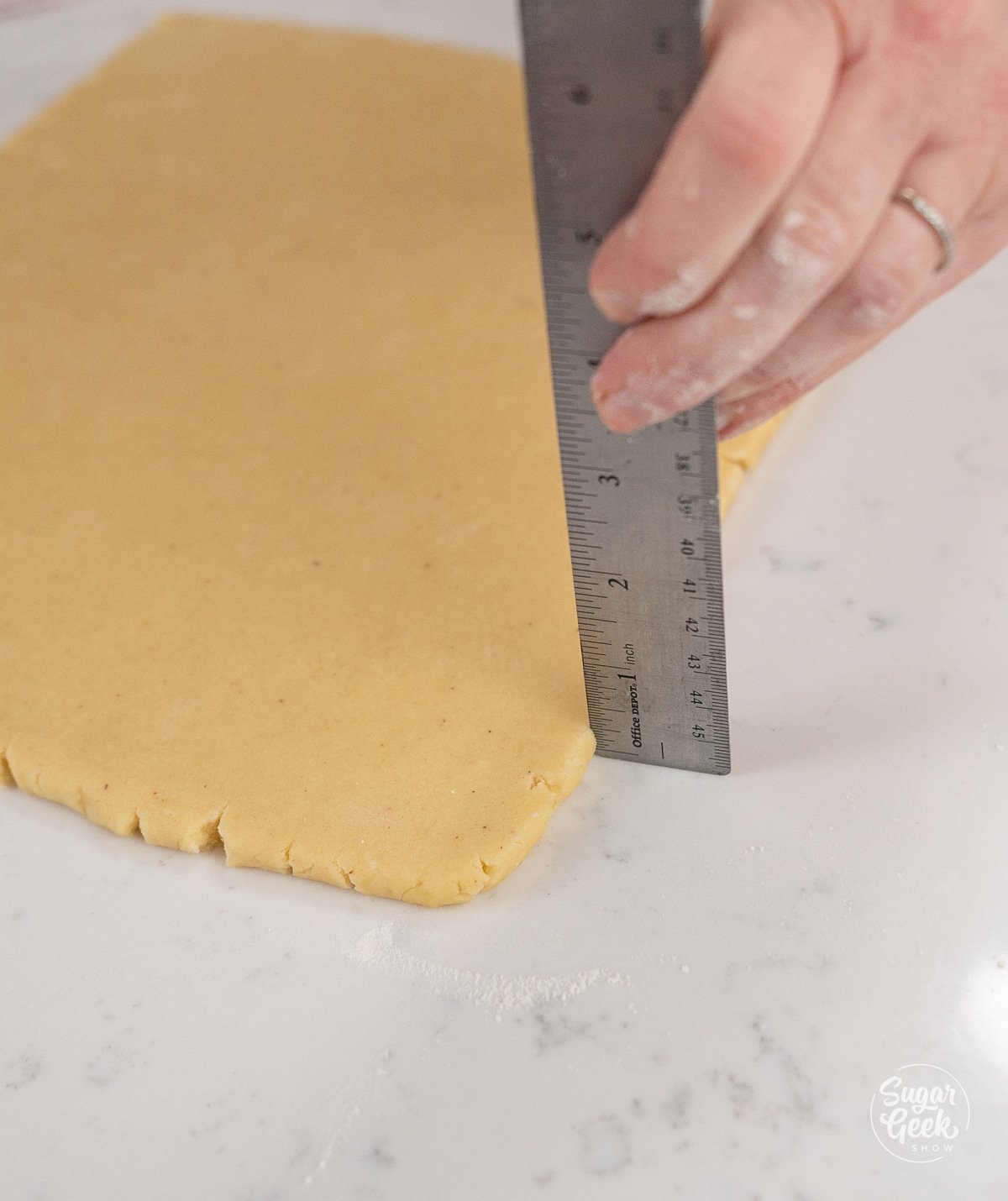
  10. Once the dough has chilled, knead the dough slightly and roll it out with a large rolling pin on a lightly floured surface, about ¼ inch thick.Ruler places along dough to show ¼ inch.
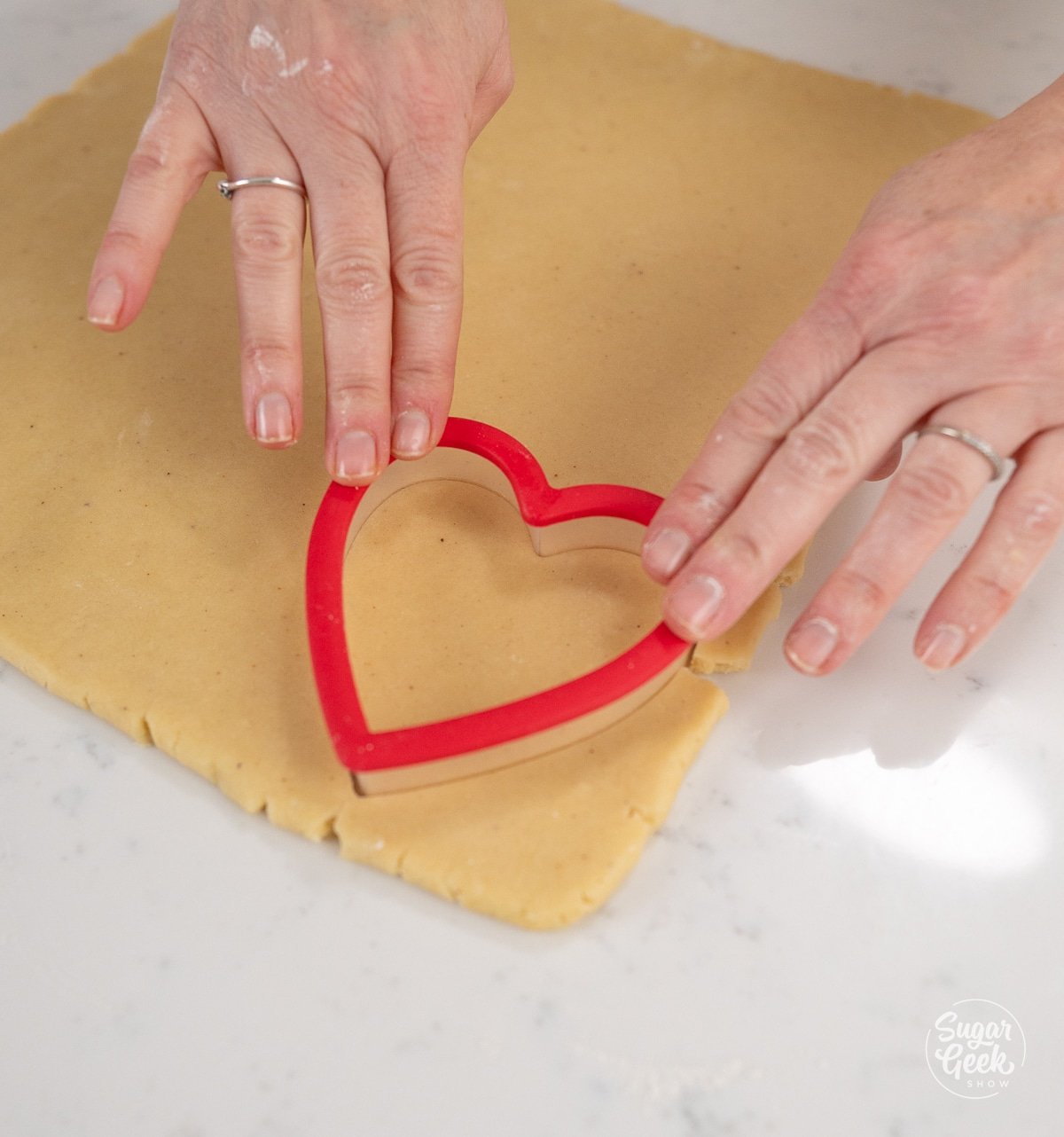
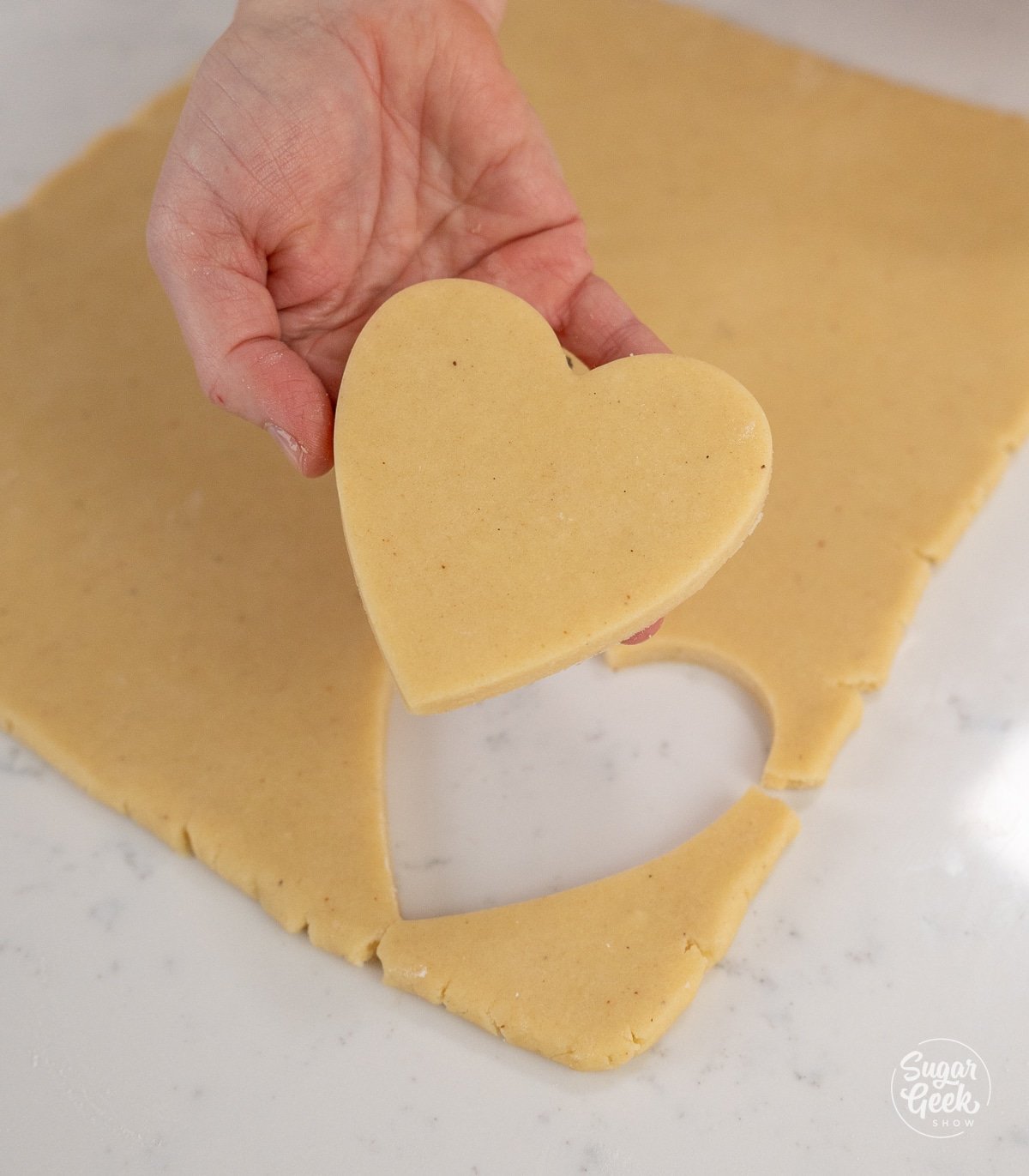
  11. Use heart cookie cutters to cut out uniform heart shapes. Keep the rolled dough chilled if you are not cutting and baking right away. The dough will be more challenging to work with the warmer it is.hands using heart cutter to cut heart shaped cookies.hand holding cut out heart shaped cookies
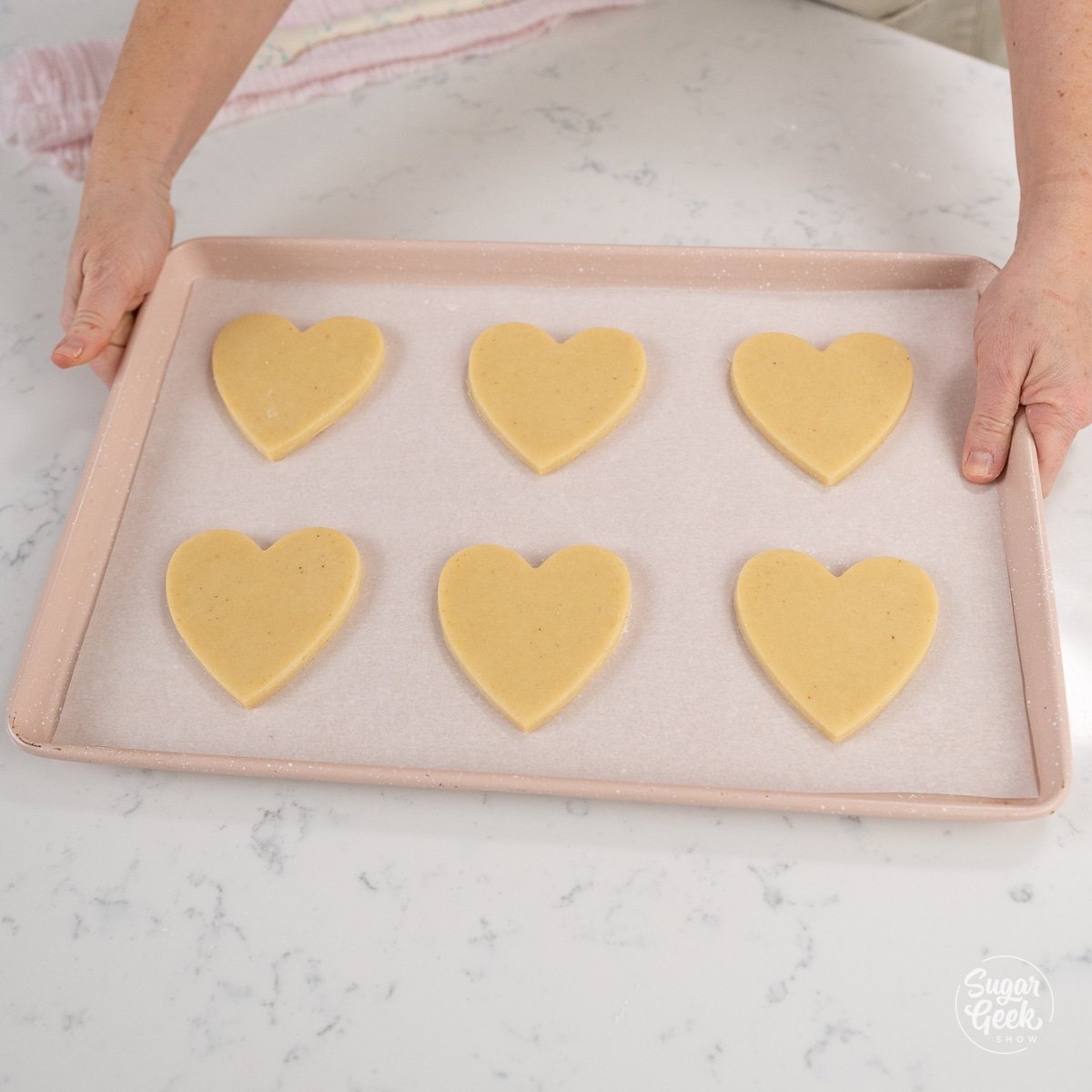
  12. Place the cookies on a baking sheet lined with a piece of parchment paper. Put the cookie sheet back in the refrigerator for 10-15 minutes to chill again. This will help them avoid spreading.hand holding tray of unbaked cookies.
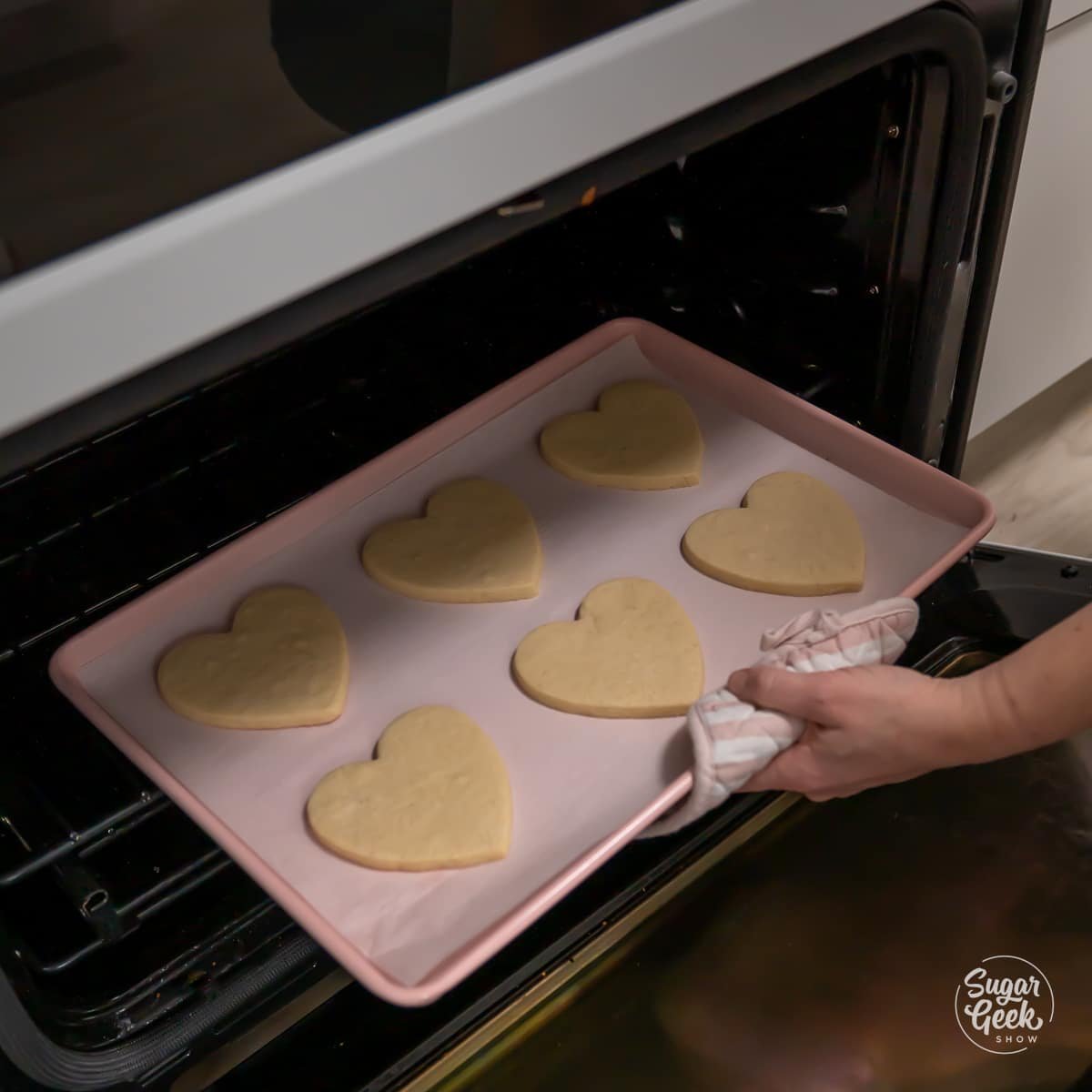
  13. Bake cookies at 350ºF for 10-14 minutes, the bake time is dependent on the size of the cookie. The heart shaped cookies will be slightly golden brown on the edge, but look done in the center.hands holding tray of baked cookies.
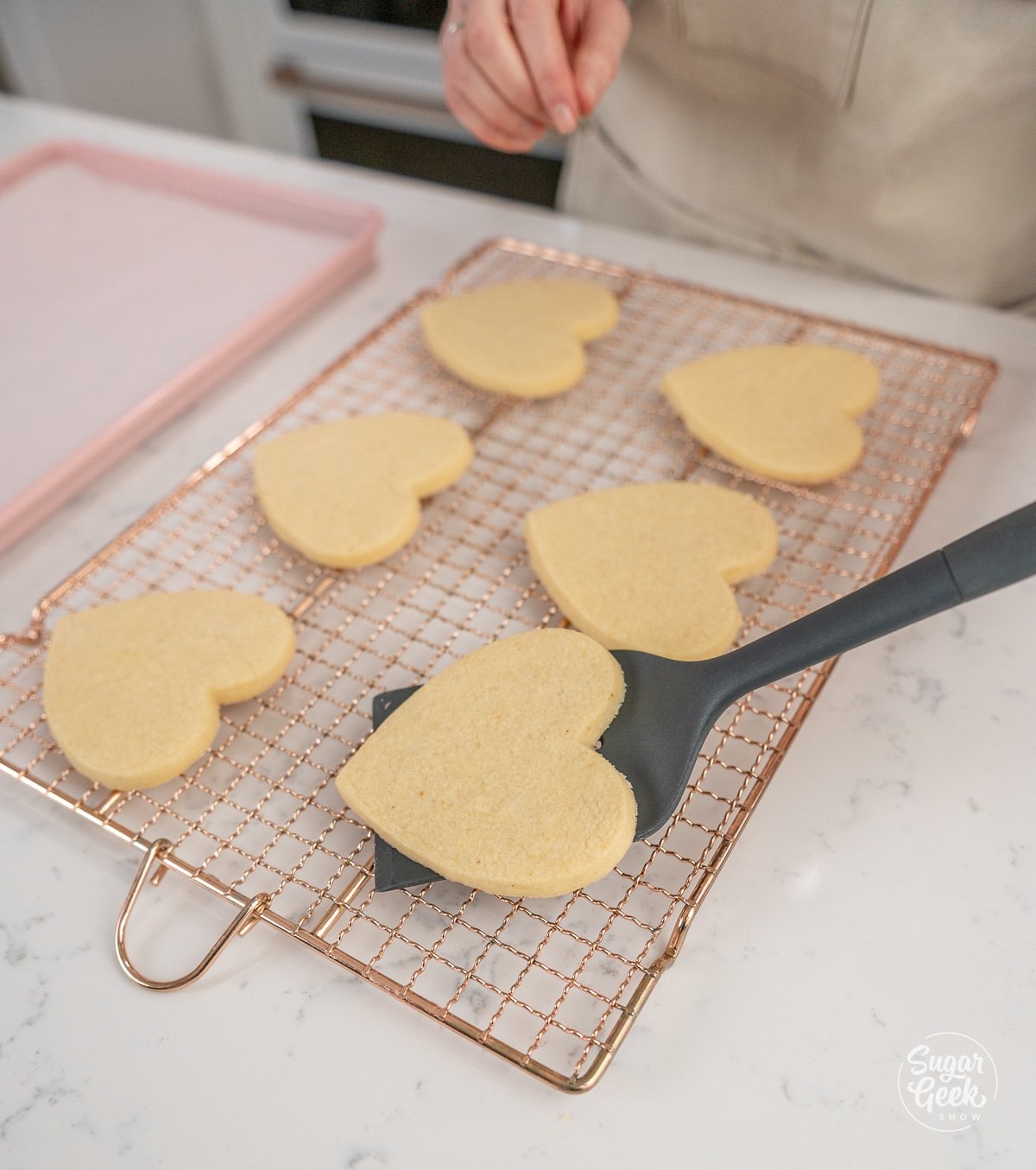
  14. Place the baked cookies on a cooling rack to fully cool before dipping them in the icing.cookies on cooling rack.

Making the Marbled Icing Step-By-Step

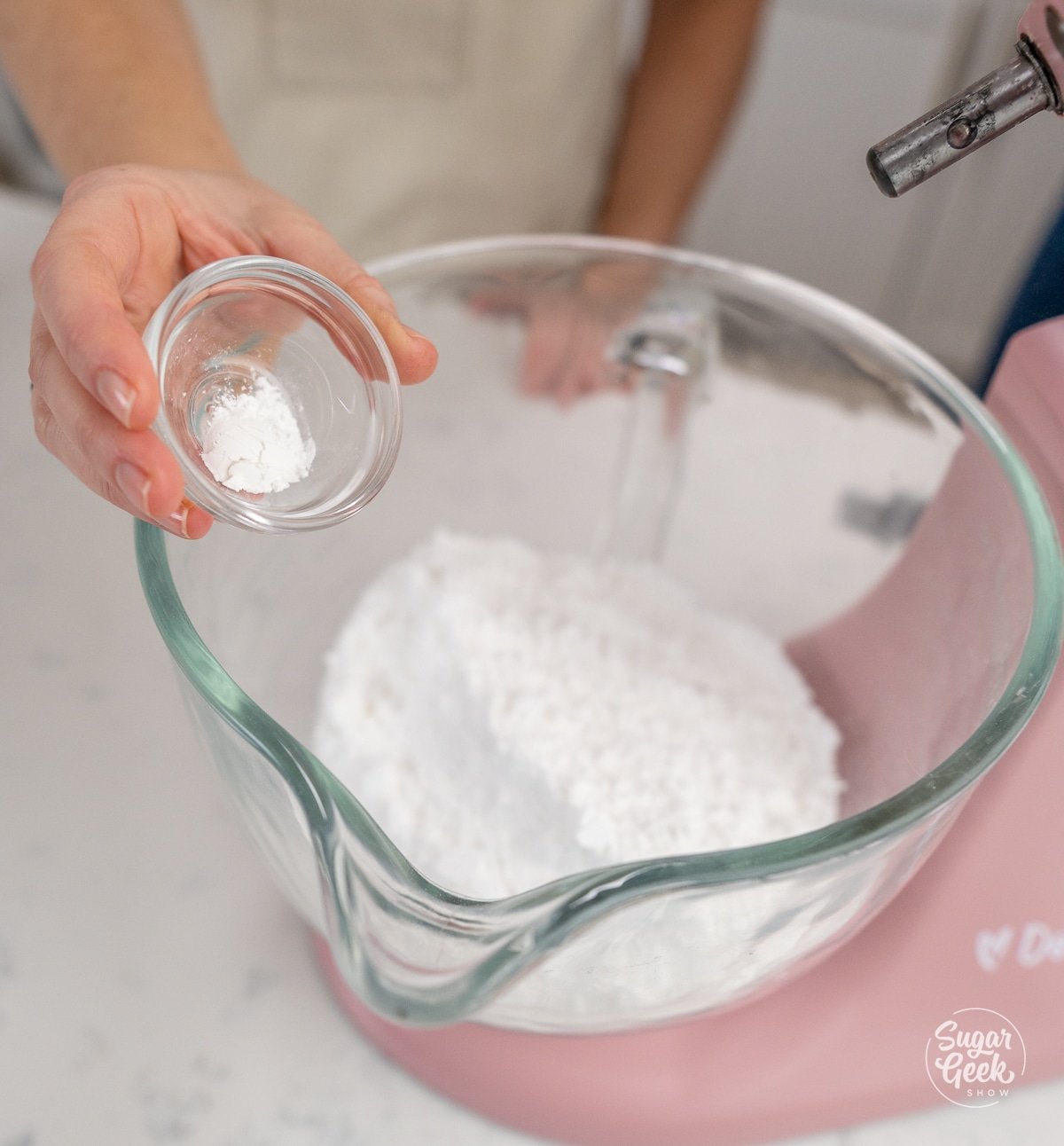
  1. Combine the egg whites, powdered sugar, and cream of tartar in the bowl of your stand mixer with the whisk attachment.hand adding dry ingredients into stand mixer bowl.
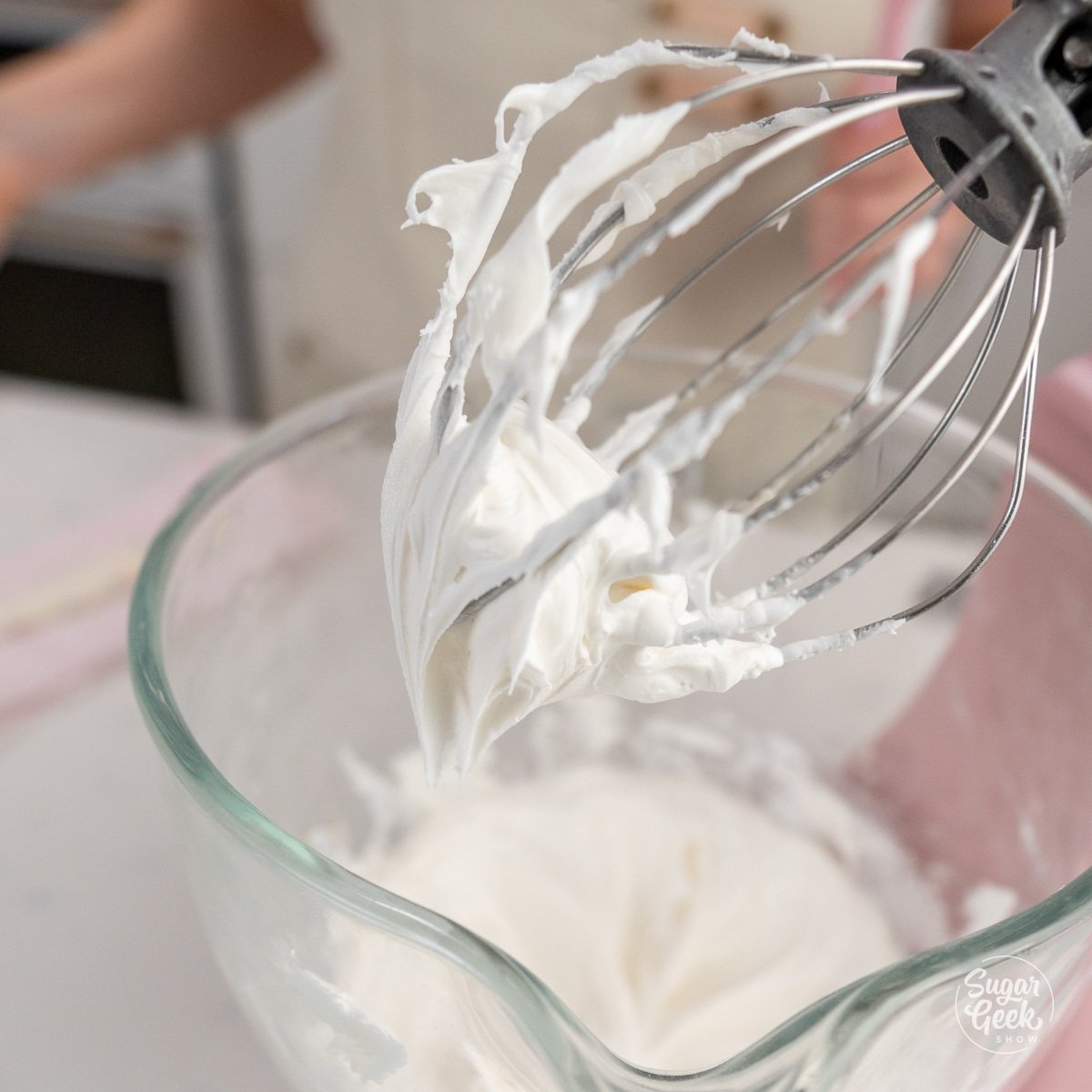
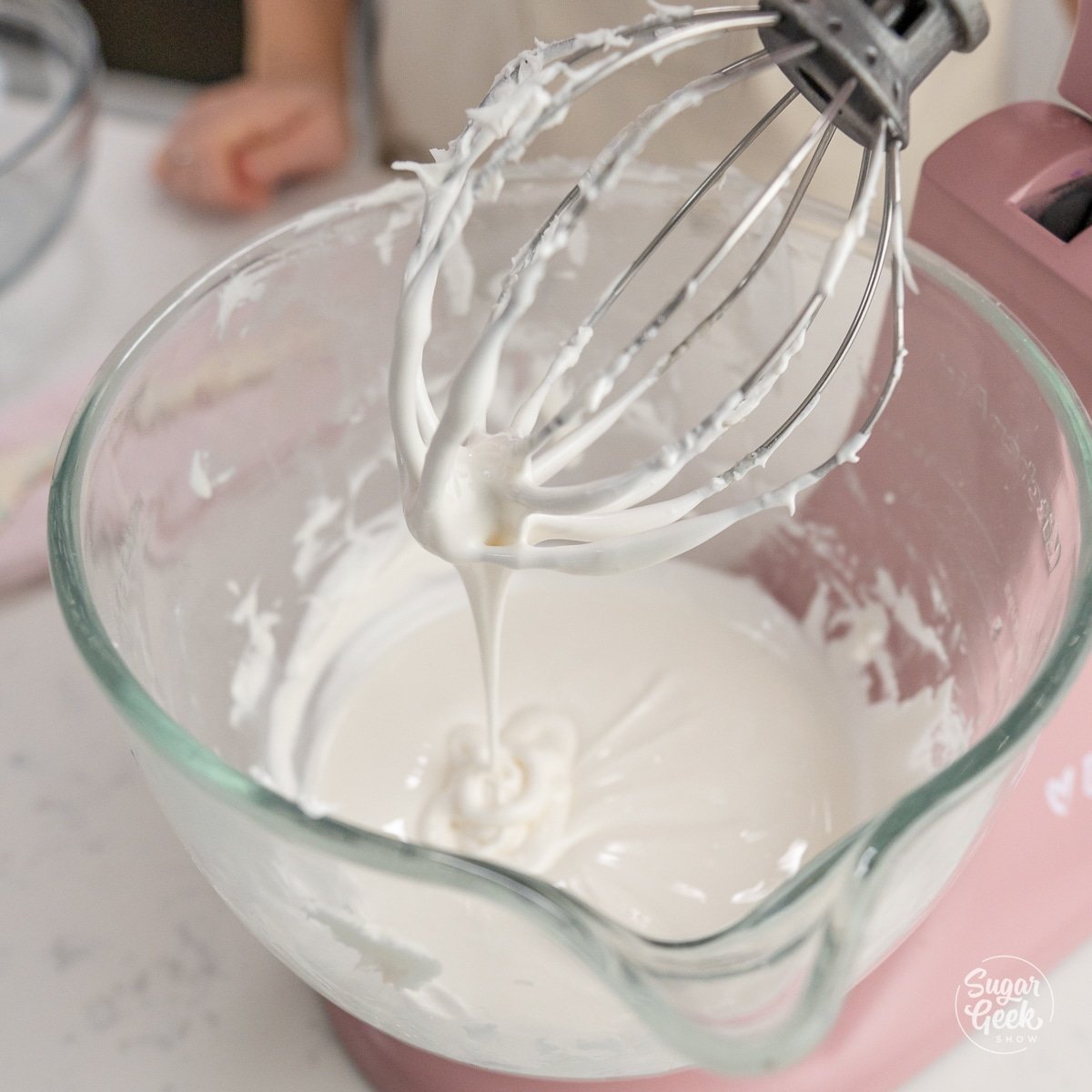
  2. Mix on low to get the ingredients combined then bump it up to high for 1-2 minutes. Add in the vanilla extract and whip until it's white. No need to mix for longer than 5 minutes.royal icing covering whisk attachment.
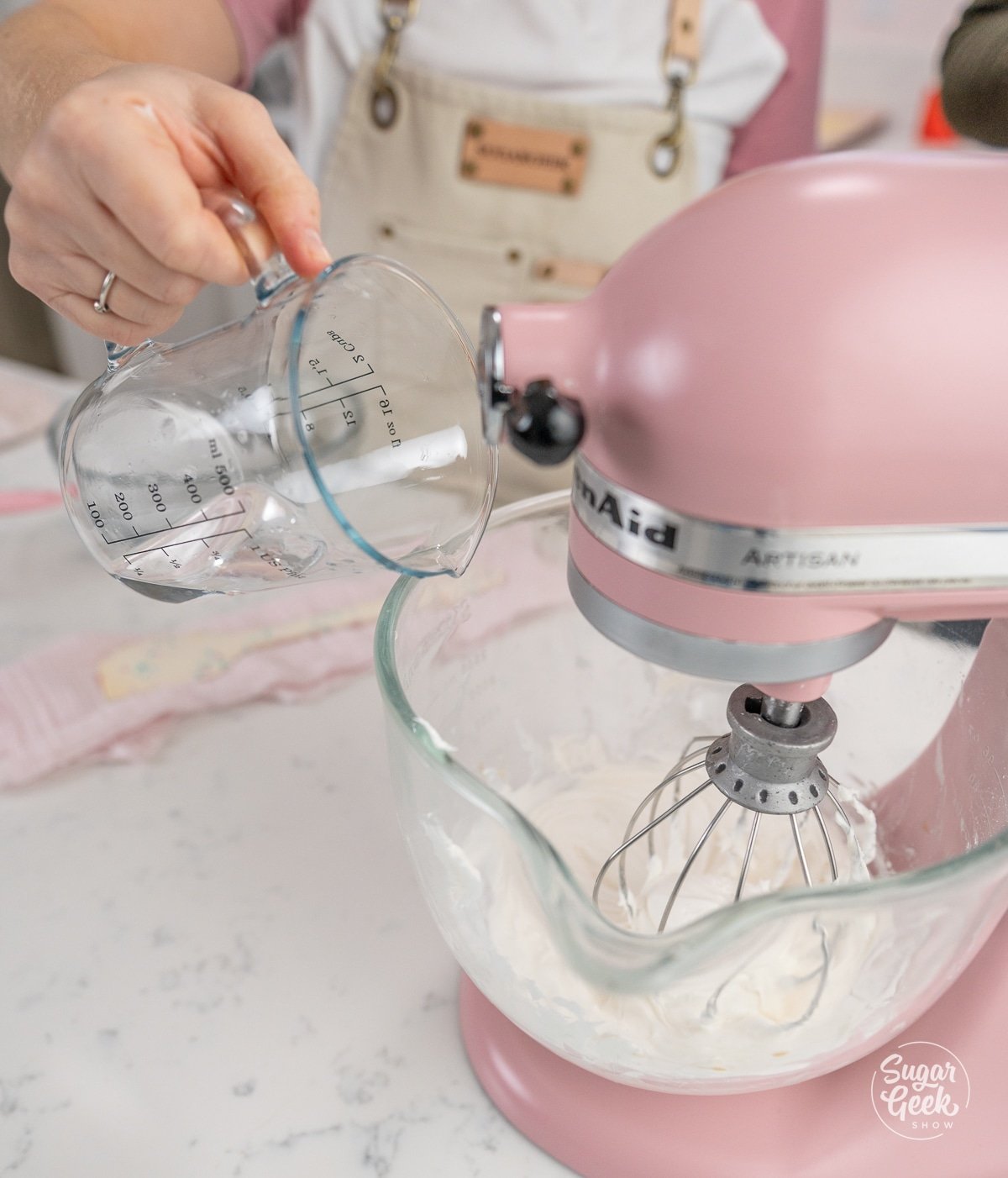
  3. The icing is pretty thick at this stage so we want to thin it down by adding water and mixing on low speed until we get our desired consistency.hand pouring cup of water into icing bowl.
  4. Add water 1 teaspoon at a time until a ribbon of royal icing goes flat in 15 seconds. This is a good consistency for dipping cookies, but not too thin to have it run off the cookies. bowl of royal icing.
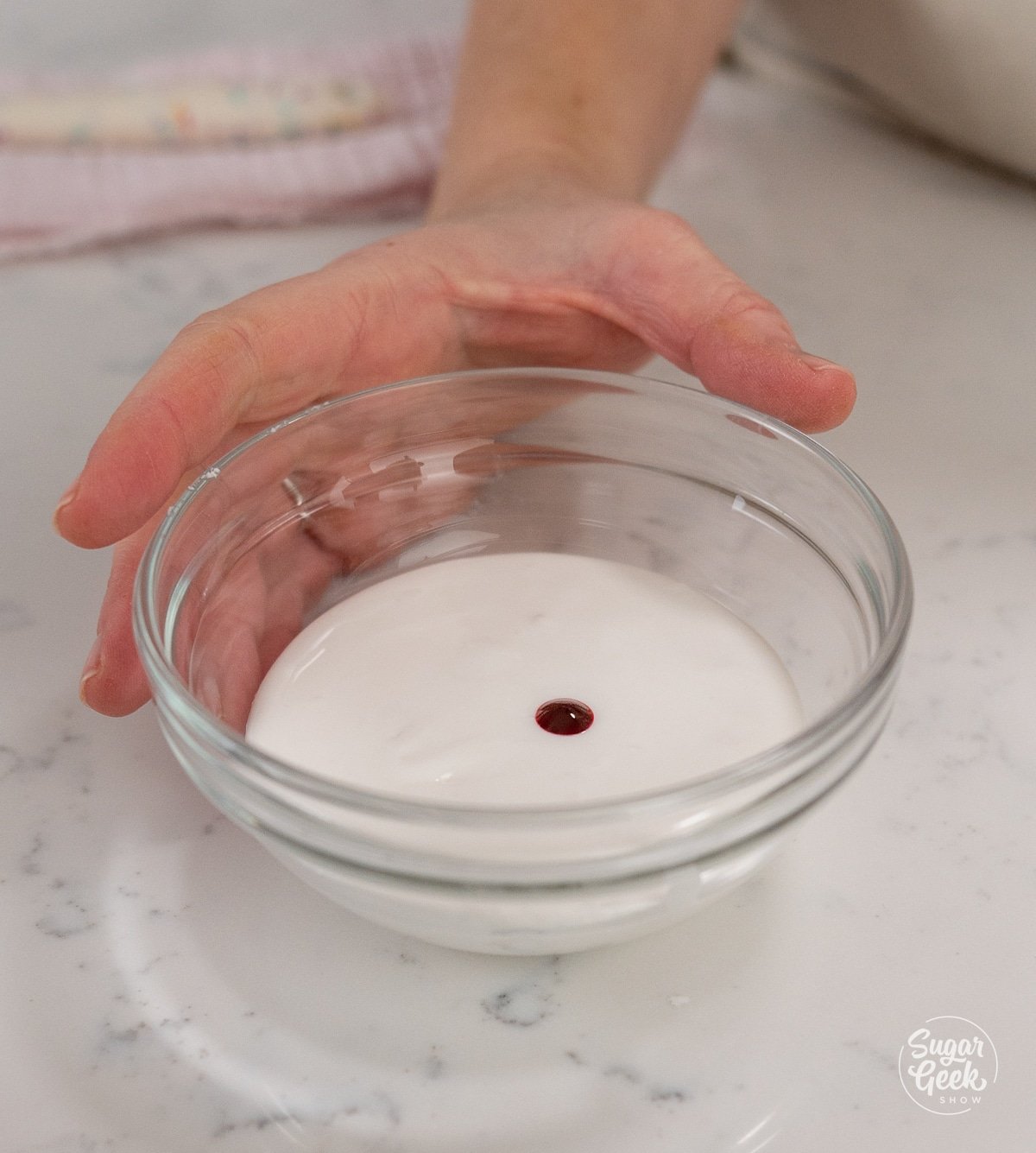
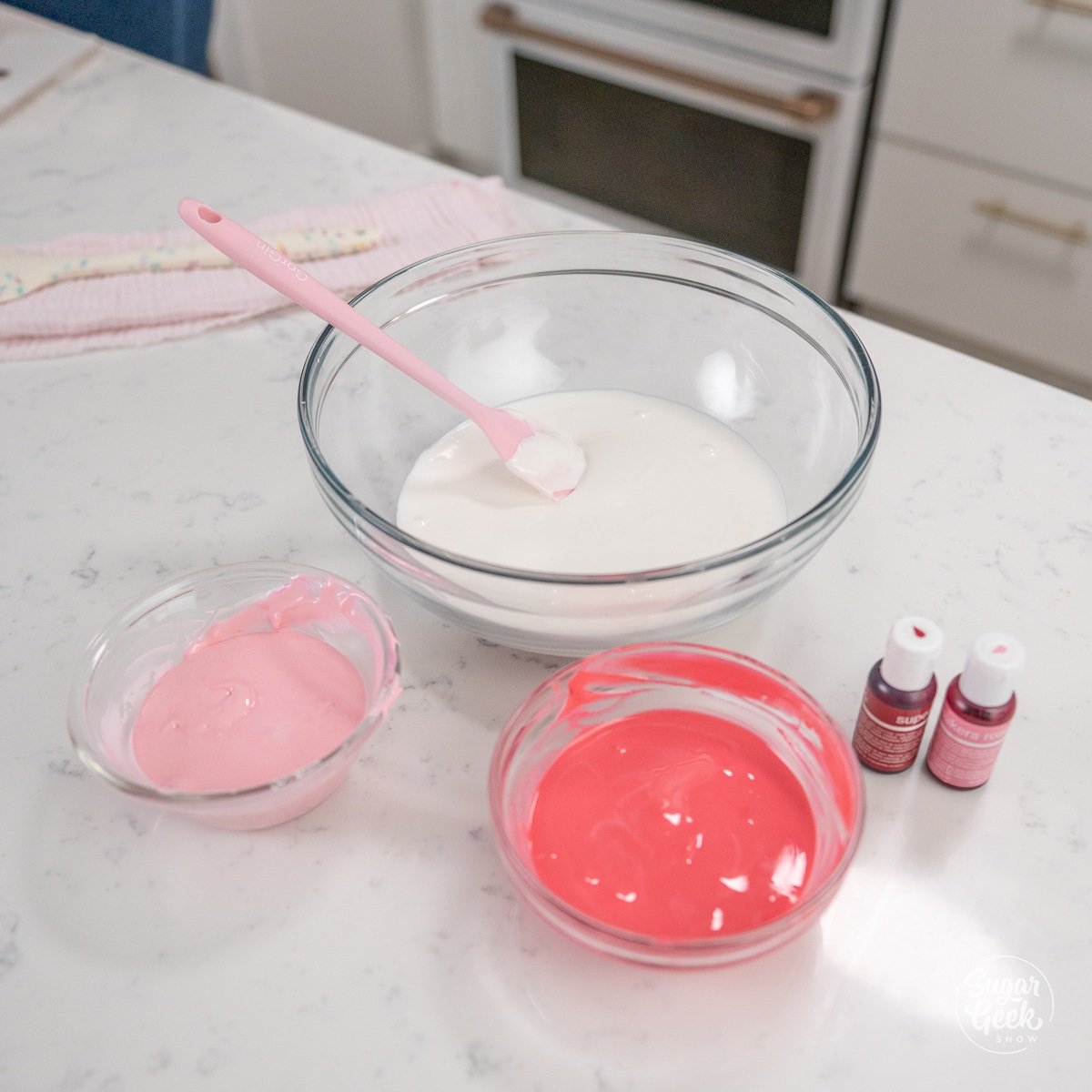
  5. In a small bowl, color ⅓ of your royal icing hot pink and light pink or as many colors as you desire.bowl of royal icing with food color inside. picture of all colors of icing being used to decorate cookies.
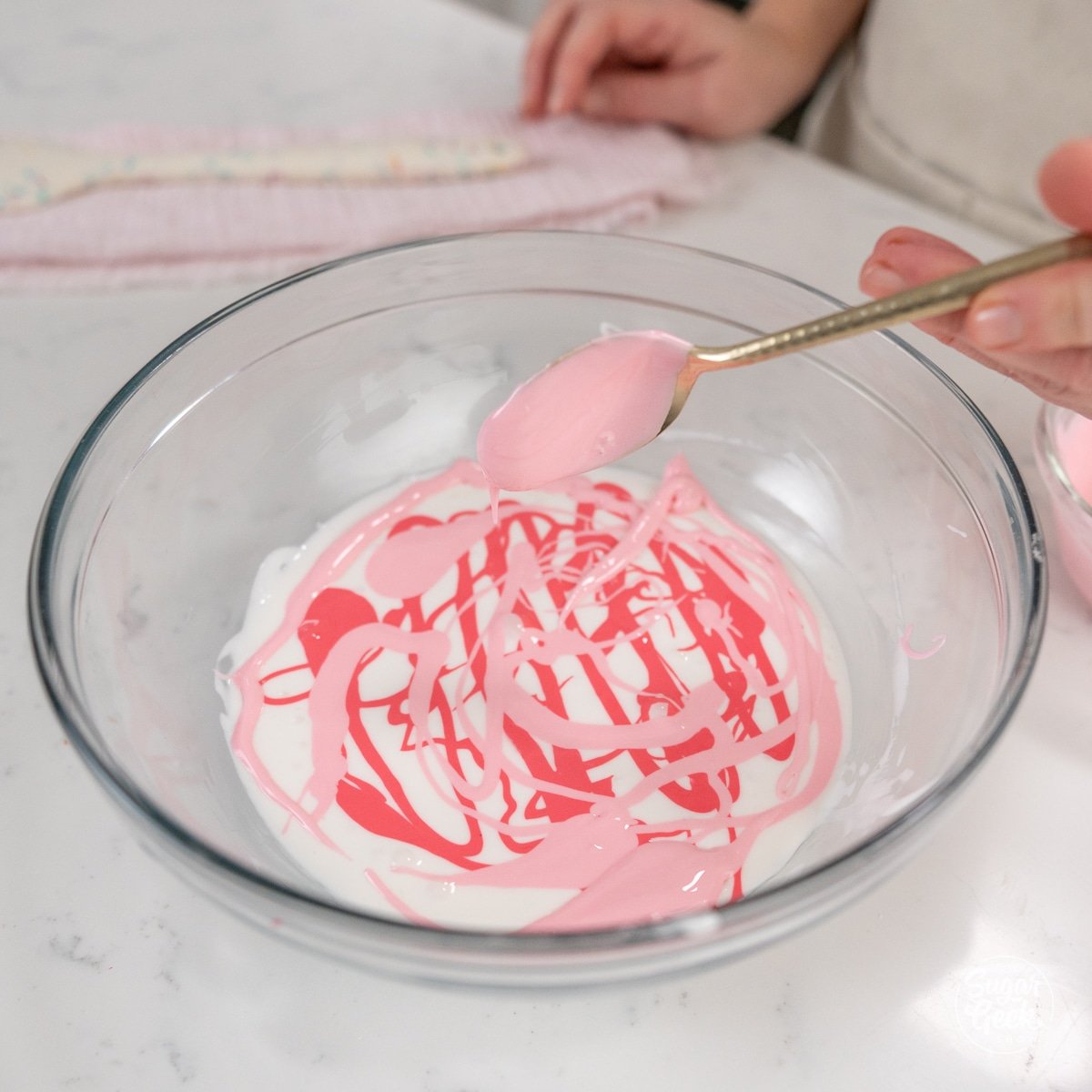
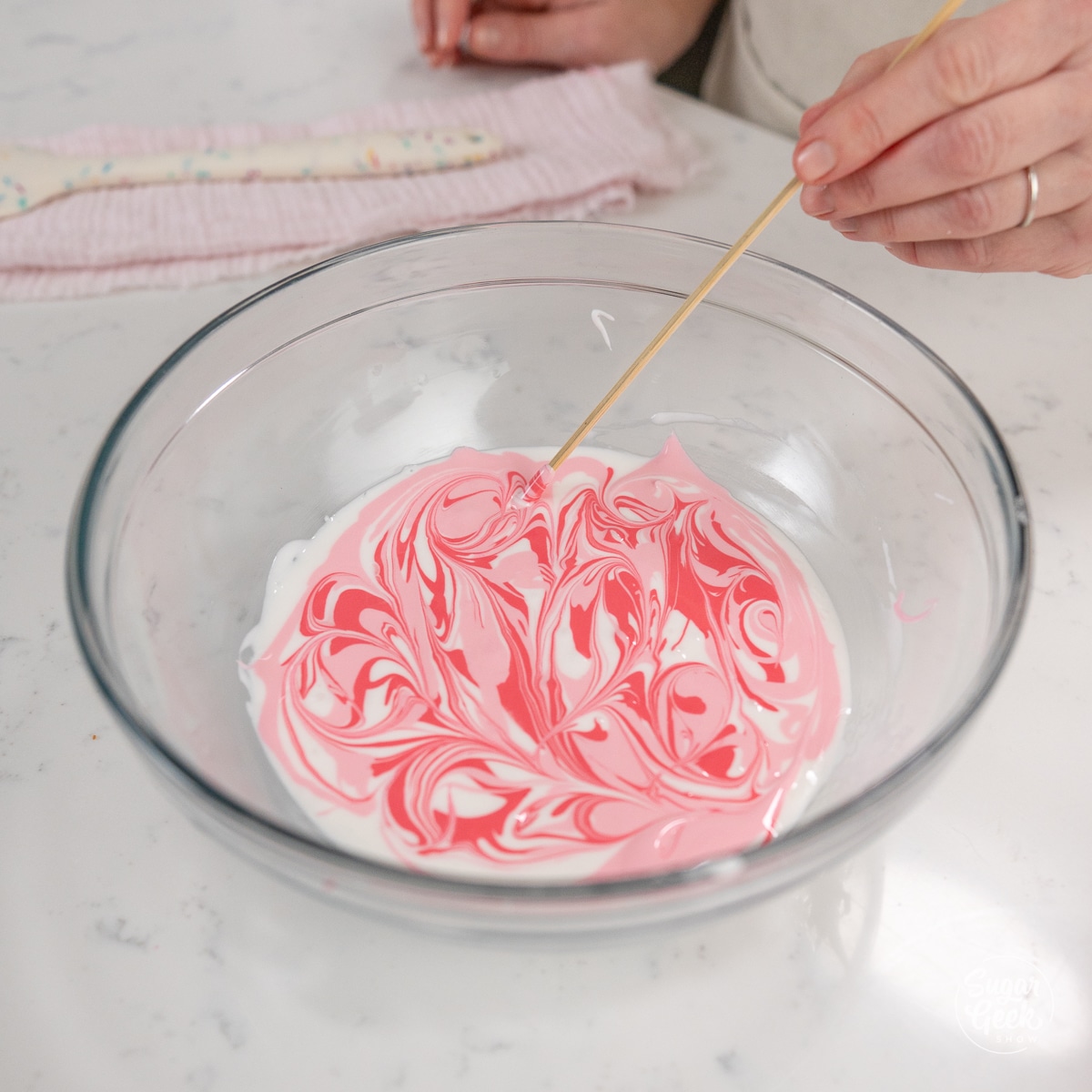
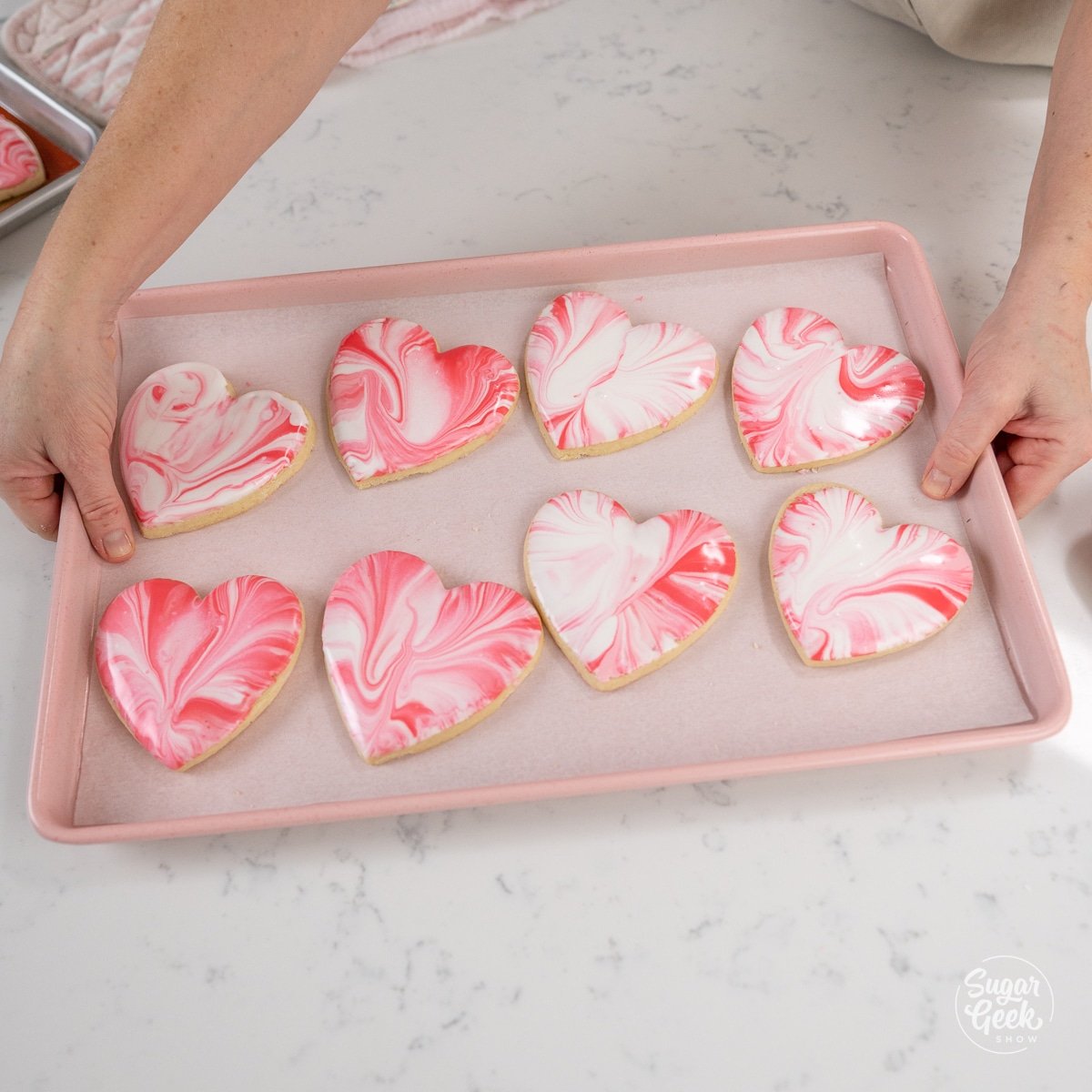
  6. Drizzle the pink and red icing over the top of the white icing. hand using spoon to drizzle colored icing over white icing.
  7. Use a toothpick or skewer and drag up and down the icing creating a marbled effect.hand using skewer to create marble effect into royal icing.
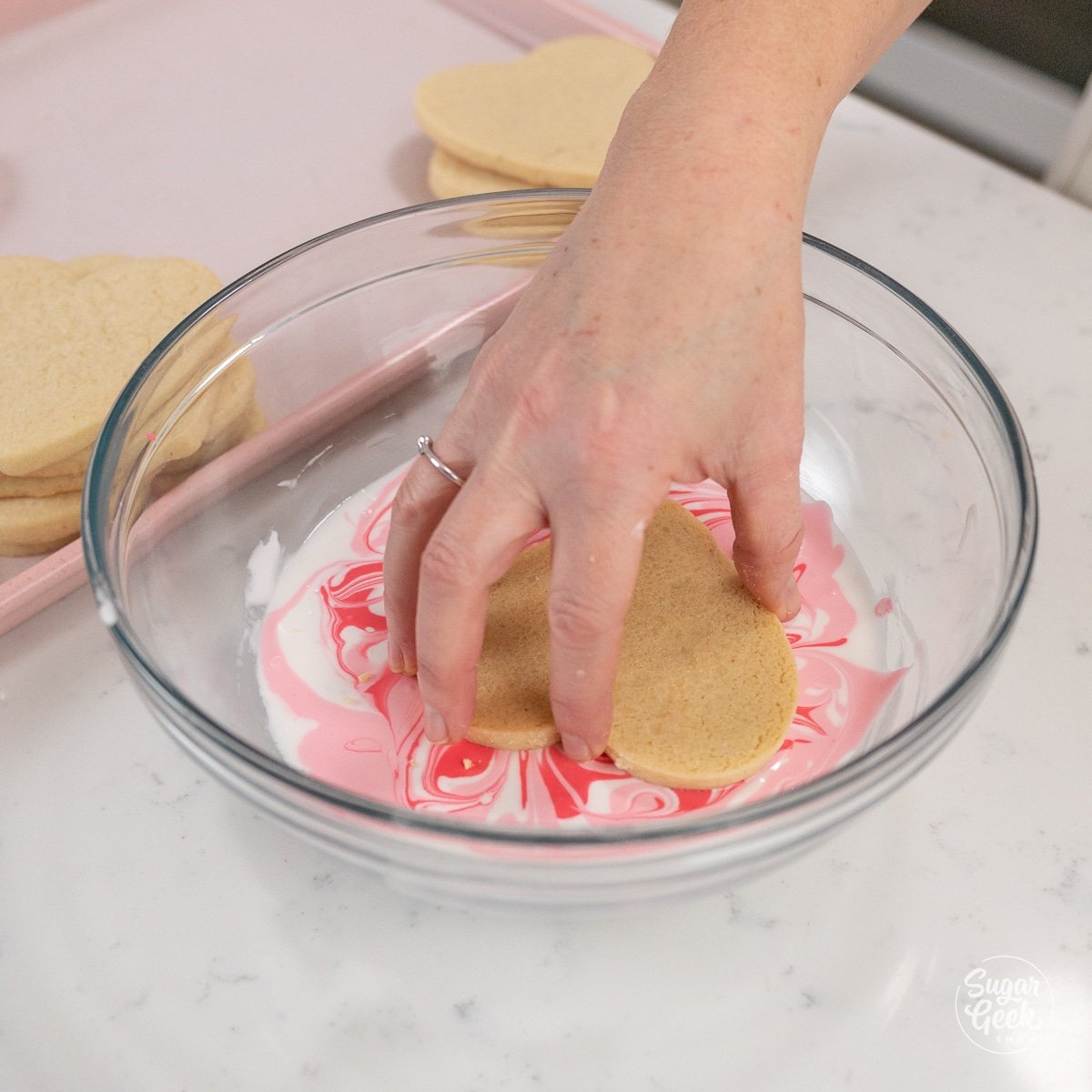
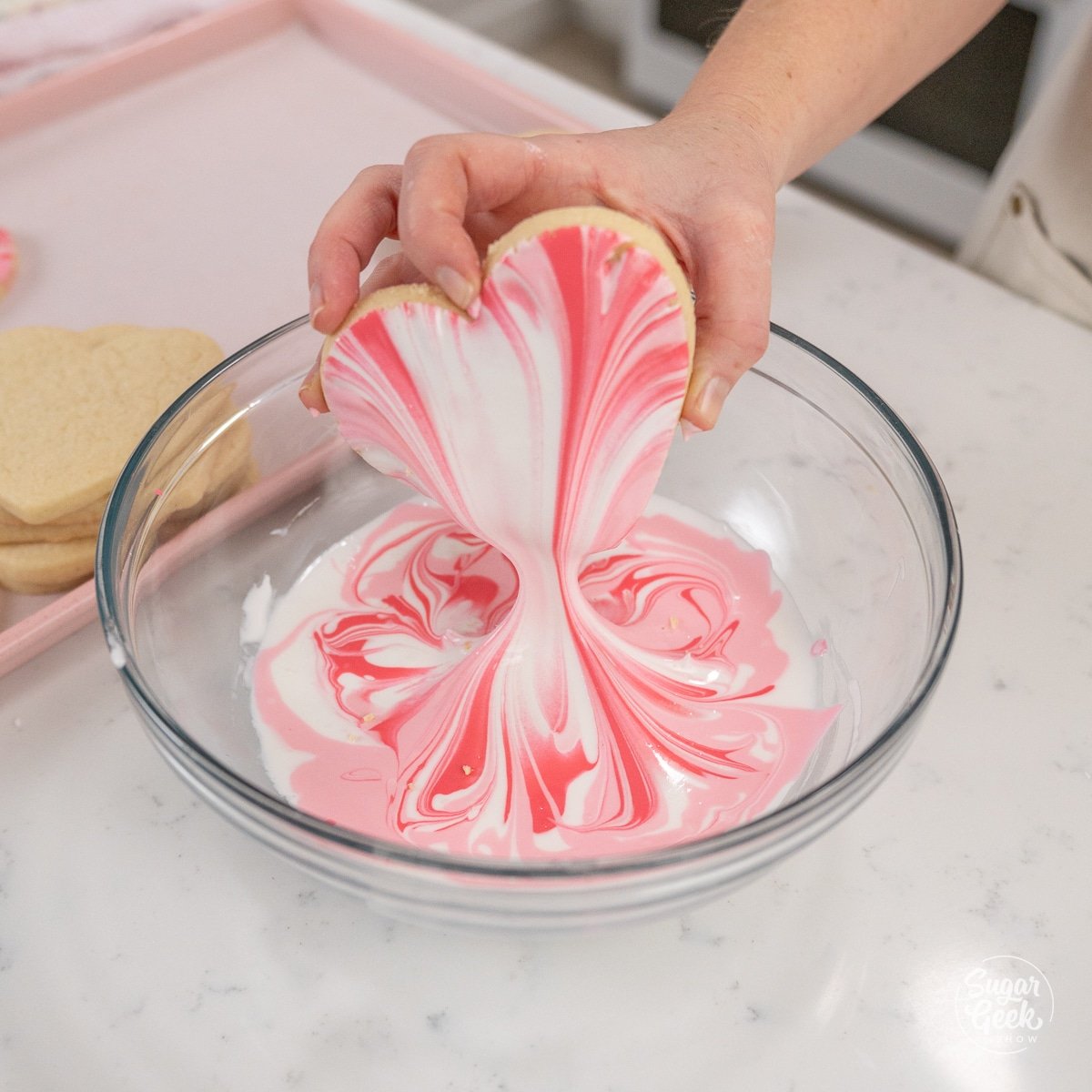
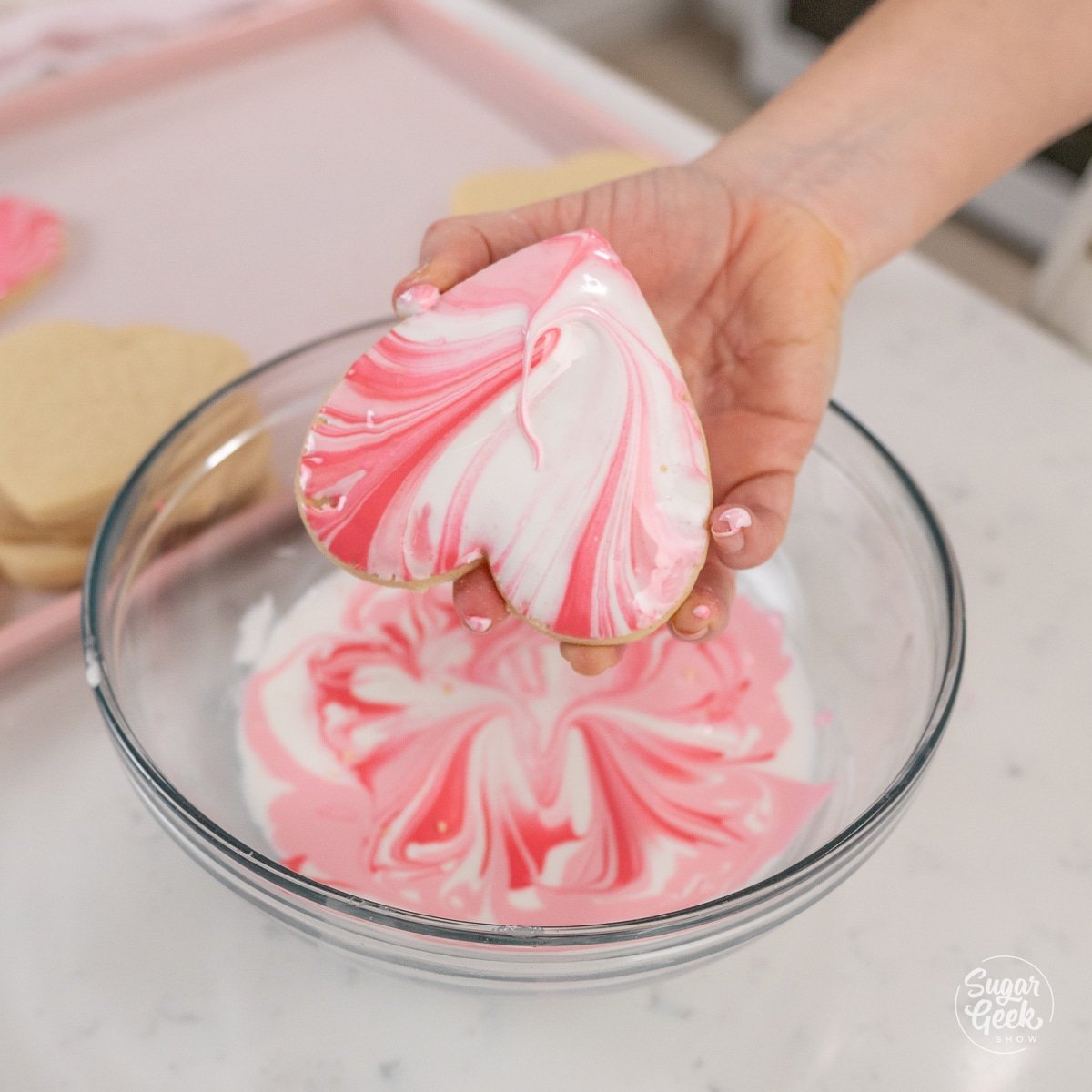
  8. Dip your cooled sugar cookies onto the surface, making sure to get the edges of your cookie dipped evenly. Pull straight up and tap off any excess icing. Pro Tip: I like to let it drip for a second and then twist it to catch the tail of the icing, keeping the edge of my cookie clean. hand dipping cookie into royal icing.hand pulling cookie up from icing.hand holding cookie over icing.
  9. Wipe the cookie edges clean if any icing dripped over the edge. Place the frosted cookie on a wire rack or tray with parchment paper to dry, and watch for drips of royal icing.
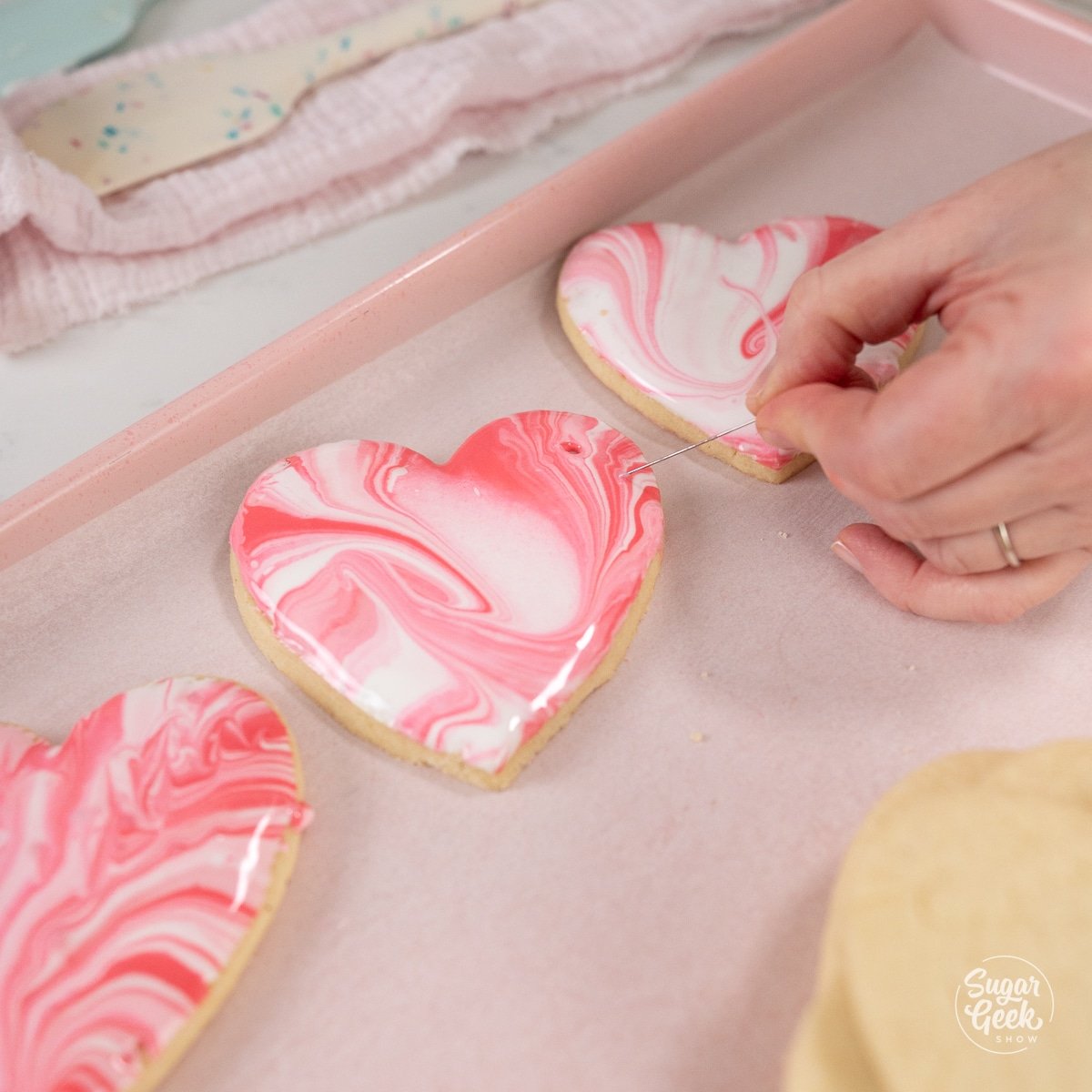
  10. There may be bubbles in the royal icing, use a straight pin or scribe to gently pop the bubbles. Then give the cookie a gentle shake to even out the frosting.hand using pin to pop airbubbles on sugar cookies.
  11. For the best results let your heart shaped cookies dry completely before packaging. This could take up to 16-24 hours for the icing to dry, depending on your environment. The top dries quickly but under the top shell it will still be runny and it can crack if you touch the cookies too soon. Pro-tip: Place the tray of freshly dipped cookies back in the warm (not on) oven with the door open. The warm air from the cooling oven will dry the top of the cookies faster to avoid smudging the royal icing.hand holding tray of oven dried cookies.
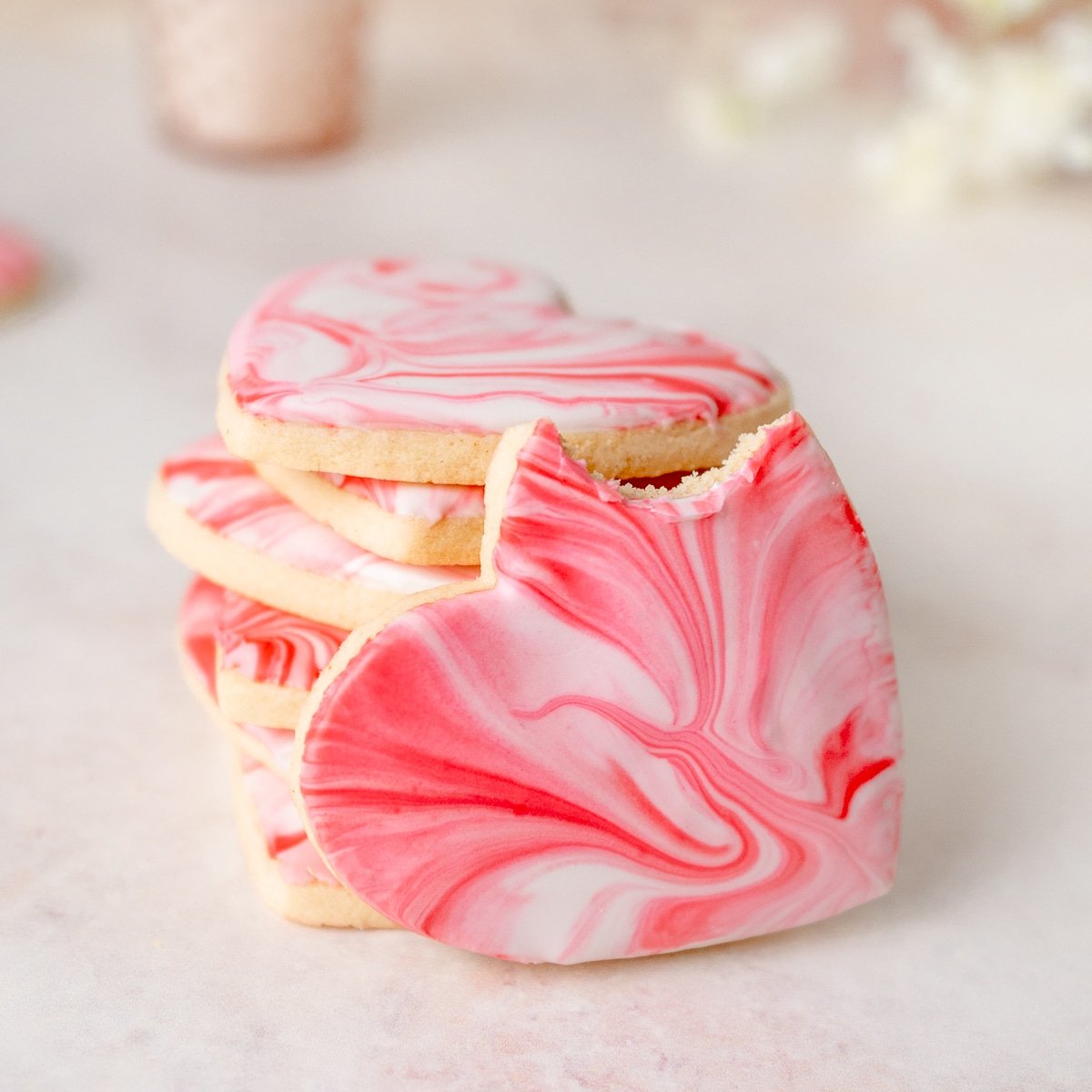
  12. These heart shaped cookies are shelf stable and will stay fresh if they are stored in an airtight container. If you have any remaining dough, wrap the rest of the dough well in plastic wrap and store in the freezer until you are ready to use it.
photo of stacked cookies.

FAQ

How long can I store the unused dough?

The sugar cookie dough stores great in the freezer and thaws pretty quickly. If it is wrapped well it can last up to 3 months in the freezer. Think of all the holidays you can make cookies for in 3 months!

Can I store extra royal icing?

Yes, keep it refrigerated in an airtight container for up to a week. You will need to mix it again and possibly fix the consistency before using it again.

What if my colors all mix together before I'm done dipping the cookies?

Just add more of the darker colors on top of the lighter icing. The fun part of this recipe is that every cookie will be a little different. If you are worried about consistency in the design, reserve some of the icing colors and the white so that you can make a fresh dip for the 2nd half of your cookies. You don't have to dip them all in one session.

What if I don't have boxed egg whites?

You can use meringue powder, just follow the instructions on the side of the container for reconstituting the egg whites.

More Recipes You'll Love

Copycat Lofthouse Cookies

The best cut out sugar cookie

Chewy double chocolate chip cookies

Kate Spade inspired Cookies

Recipe

hand holding heart shaped cookies.
Print Recipe
4.88 from 8 votes

Heart Shaped Cookies

A super soft and flavorful sugar cookie with a sweet bite of beautifully marbled royal icing.
Prep Time30 minutes mins
Cook Time15 minutes mins
Drying time15 minutes mins
Total Time1 hour hr
Course: Dessert
Cuisine: American
Servings: 12 cookies
Calories: 484kcal
Author: Liz Marek

Equipment

  • 1 heart shaped cookie cutter
  • 1 Rolling Pin

Ingredients

Sugar Cookie Dough

  • 8 ounces Unsalted butter (1 cup)
  • 7 ounces Granulated Sugar (1 cup)
  • 1 large Egg Room Temperature
  • 1 teaspoon Vanilla Extract
  • 15 ounces All Purpose Flour (3 cups)
  • 1 ½ teaspoon Baking Powder
  • ½ teaspoon salt
  • ½ teaspoon Nutmeg
  • 1 teaspoon Milk

Royal Icing

  • 16 ounces Powdered Sugar (3 ½ cups)
  • 2.5 ounces Pasturized Egg Whites (¼ cup)
  • ¼ teaspoon Cream of Tartar
  • ½ teaspoon Vanilla Extract any flavor of choice will work
  • 1 teaspoon water (if needed) add 1 teaspoon of water at a time to get the desired consistency
US Customary - Metric

Instructions

Making the Sugar Cookie Dough

  • Place room-temperature butter and granulated sugar in the bowl of your mixer with the paddle attachment and mix on low until smooth. The creamed butter should be fluffy and pale yellow in color. Make sure to scrape the bottom of the bowl.
  • Add the egg and mix on medium (4 on Kitchenaid mixer) in a stand mixer until fully incorporated. Scrape the bowl when necessary to make sure the egg incorporates.
  • Add the vanilla extract. Mix until just incorporated.
  • In a separate large bowl, whisk the flour, salt, baking powder, and spice together. 
  • Add the flour mixture into the dough with a scoop (about ⅓ of total dry ingredients at a time) and mix until fully incorporated. Start mixer on low until flour starts to incorporate, then turn it up to medium. Scrape the bowl as needed to fully incorporate.
  • Add the milk once the dry ingredients are fully incorporated. Continue to mix on low until the dough becomes a solid mass.
  • Scrape out the mixer bowl and wrap up the sugar cookie dough in plastic wrap.
  • Once the dough is wrapped in plastic, Take a rolling pin and roll the dough into a flat square. ( This helps the dough chill faster and more evenly).
  • Place your dough in the fridge for about 20 minutes or until the dough is firm to the touch.
  • Once the dough has chilled, knead the dough slightly and roll it out with a large rolling pin on a lightly floured surface, about ¼ inch thick.
  • Use heart cookie cutters to cut out uniform heart shapes. Keep the rolled dough chilled if you are not cutting and baking right away. The dough will be more challenging to work with the warmer it is.
  • Place the cookies on a baking sheet lined with a piece of parchment paper. Put the cookie sheet back in the refrigerator for 10-15 minutes to chill again. This will help them avoid spreading.
  • Bake cookies at 350ºF for 10-14 minutes, the bake time is dependent on the size of the cookie. Cookies will be slightly golden brown on the edge, but look done in the center.
  • Place the baked cookies on a cooling rack to fully cool before dipping them in the icing.

Making the Marbled Icing

  • Combine the egg whites, powdered sugar, and cream of tartar in the bowl of your stand mixer with the whisk attachment.
  • Mix on low to get the ingredients combined then bump it up to high for 1-2 minutes. Add in the vanilla extract and whip until it's white. No need to mix for longer than 5 minutes.
  • The icing is pretty thick at this stage so we want to thin it down by adding water and mixing on low speed until we get our desired consistency.
  • Add water 1 teaspoon at a time until a ribbon of royal icing goes flat in 15 seconds. This is a good consistency for dipping cookies, but not too thin to have it run off the cookies.
  • In a small bowl, color ⅓ of your royal icing hot pink and light pink or as many colors as you desire.
  • Drizzle the pink and red icing over the top of the white icing.
  • Use a toothpick or skewer and drag up and down the icing creating a marbled effect.
  • Dip your cooled sugar cookies onto the surface, making sure to get the edges of your cookie dipped evenly. Pull straight up and tap off any excess icing. Pro Tip: I like to let it drip for a second and then twist it to catch the tail of the icing, keeping the edge of my cookie clean.
  • Wipe the cookie edges clean if any icing dripped over the edge. Place the frosted cookie on a wire rack or tray with parchment paper to dry, and watch for drips of royal icing.
  • There may be bubbles in the royal icing, use a straight pin or scribe to gently pop the bubbles. Then give the cookie a gentle shake to even out the frosting.
  • For the best results let cookies dry completely before packaging. This could take up to 16-24 hours for the icing to dry, depending on your environment. The top dries quickly but under the top shell it will still be runny and it can crack if you touch the cookies too soon. Pro-tip: Place the tray of freshly dipped cookies back in the warm (not on) oven with the door open. The warm air from the cooling oven will dry the top of the cookies faster to avoid smudging the royal icing.
  • The cookies are shelf stable and will stay fresh if they are stored in an airtight container. If you have any remaining dough, wrap the rest of the dough well in plastic wrap and store in the freezer until you are ready to use it.

Notes

  • Weigh your ingredients to avoid cookie failure. Using a kitchen scale for baking is super easy and gives you the best results every single time. 
  • Practice Mise en Place (everything in its place). Measure out your ingredients ahead of time and have them ready before you start mixing to reduce the chances of accidentally leaving something out.
  • After you prepare your cookie dough, ensure you wrap it up in some plastic wrap and chill it in the refrigerator for 2 hours. 
  • Chilled cookie dough will keep its shape in the oven and not expand or warp.

Nutrition

Serving: 1cookie | Calories: 484kcal | Carbohydrates: 82g | Protein: 4g | Fat: 16g | Saturated Fat: 10g | Polyunsaturated Fat: 1g | Monounsaturated Fat: 4g | Trans Fat: 1g | Cholesterol: 56mg | Sodium: 130mg | Potassium: 112mg | Fiber: 1g | Sugar: 54g | Vitamin A: 496IU | Vitamin C: 0.003mg | Calcium: 35mg | Iron: 2mg
heart shaped cake in a to go box

February 3, 2023 Free Tutorials

Lunchbox Cakes

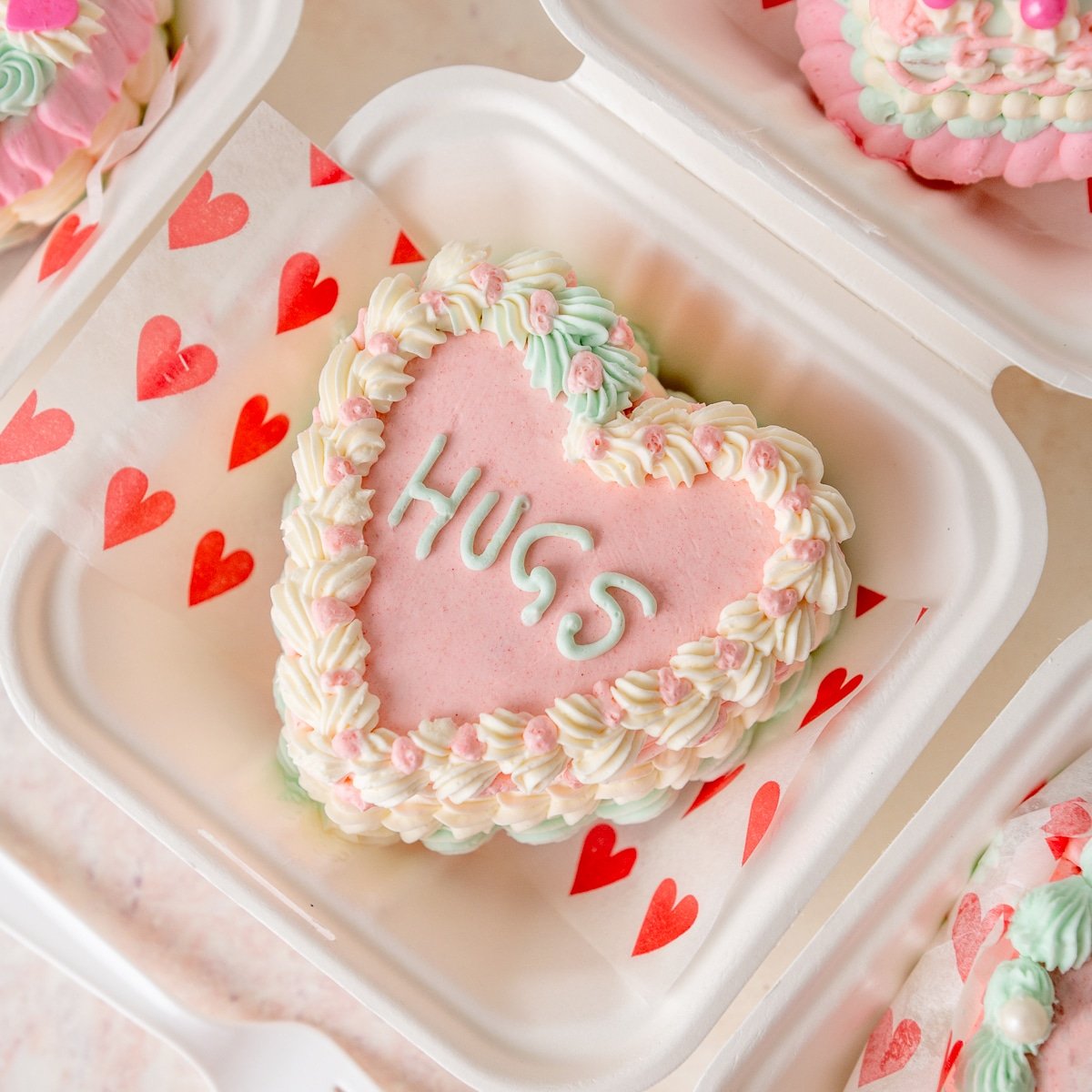
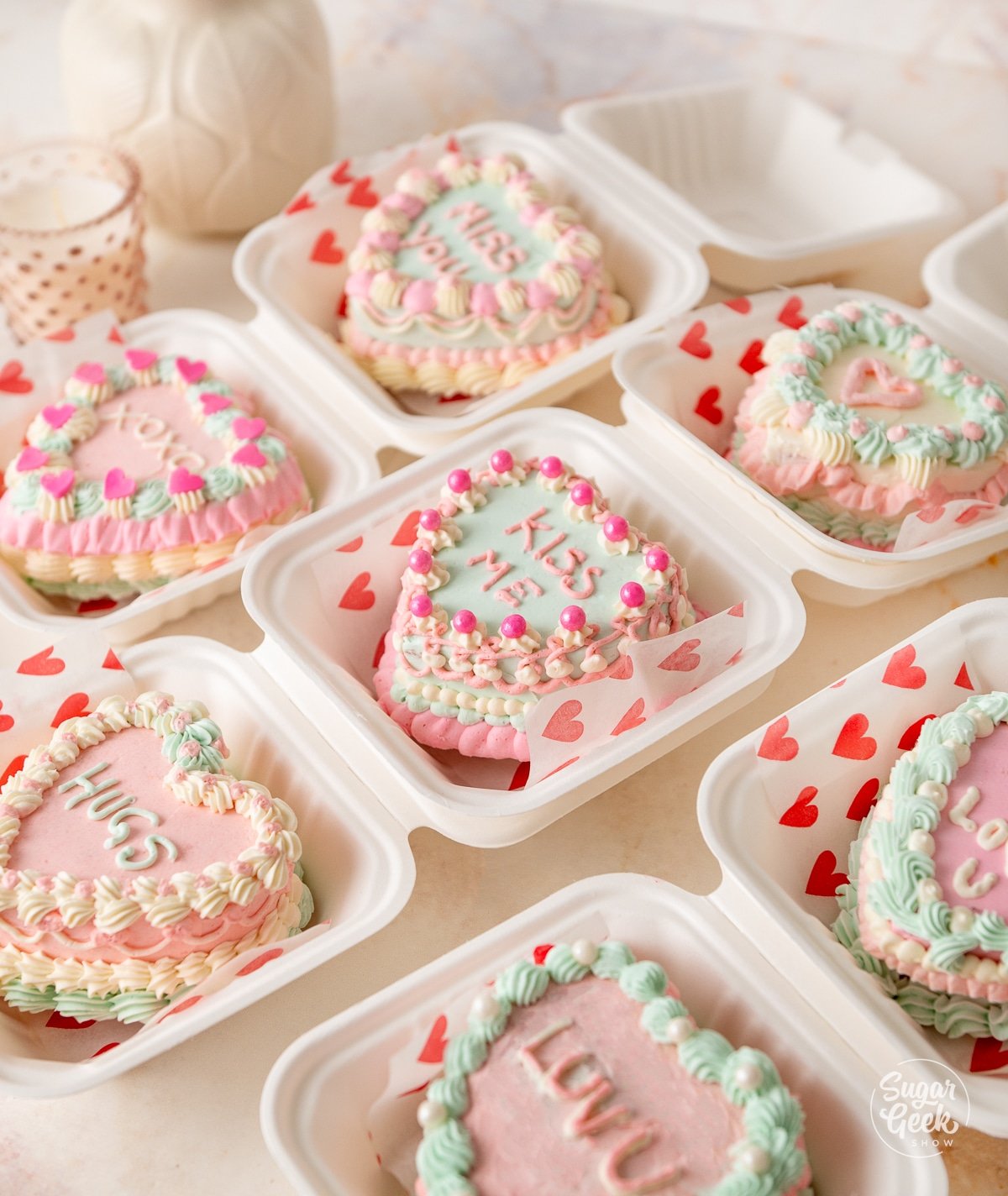
Lunchbox cakes are miniaturized versions of regular full-size cakes, served in a cute little to-go box! You can decorate them just like big cakes, but because they are small, lunchbox cakes are easier to make, decorate, handle, store, pack, and transport. As pretty as they are delicious, these mini versions are perfect for any celebration from a casual picnic to a special occasion.heart shaped cake in a to go box

Lunchbox (bento or Korean lunchbox cake) cakes are mini cakes originating from South Korea. They are packaged and eaten inside takeout boxes, making them perfect for gifts that you don't have to share! The best part is you can use any of your cookie cutters or mini cake pans, however, I found it easier to bake my cake in a sheet pan and cut shapes out.

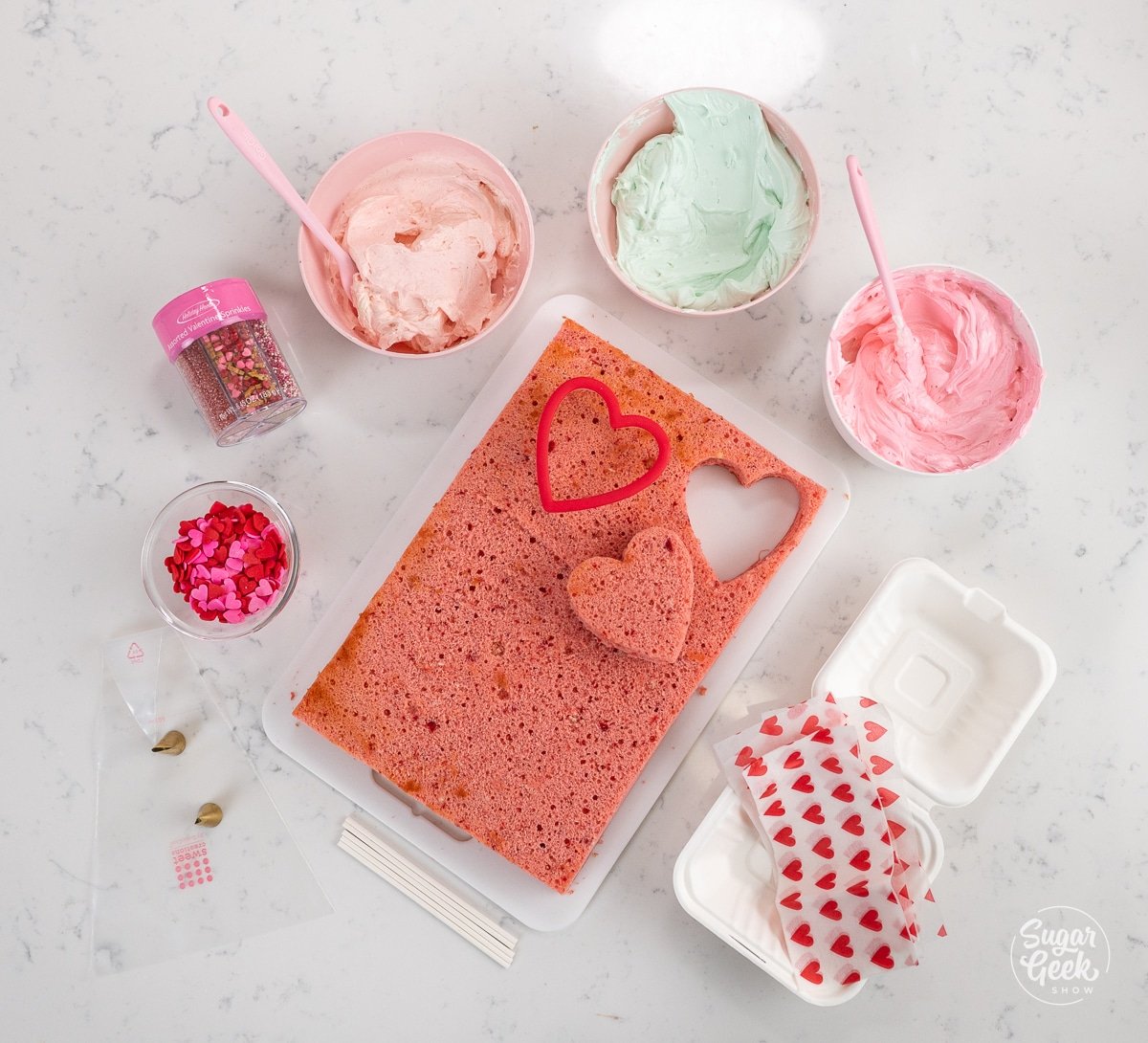
Lunchbox Cake Ingredientsingredients and tools for lunchbox cakes

Cake: You can use vanilla cake, chocolate cake, carrot cake, or any flavor you like, but I am using my doctored strawberry box cake mix to get to the decorating part faster.

Buttercream: My easy buttercream frosting is my favorite recipe because it's super easy to make and like a mock-Swiss meringue buttercream. You can use any type of frosting that you like, although whipped cream frosting and cream cheese won't color as well as American buttercream or Italian buttercream.

Filling: Depending on the type of cake you're using and whether or not you want to torte your lunchbox cakes, a filling can pair nicely and add extra flavor. I used my strawberry puree as a filling with the strawberry box cake, but check out my other filling recipes for more ideas!

How to Make Lunchbox Cakes

Lunchbox cakes are very easy to make, but decorating can be a bit time-consuming depending on how detailed you want to make your cakes. I recommend making your cake the day ahead and freezing it overnight, then making your buttercream, assembling the cakes, and piping on the same day.

Making A Strawberry Box Mix Cake

  1. Place all of the ingredients into a mixing bowl and mix for 2 minutes on medium speed.
  2. Pour the batter into 2 quarter sheet pans that have been prepared with cake goop, pan spray, or parchment paper. The size of your sheet pan may vary, so fill the sheet pan ½ way full. If you have leftover batter, you can freeze it or bake the remaining batter in a smaller cake pan. This recipe will make eight, 3.5" mini cakes, but it will depend on the size of the cutter and shape. 
  3. Bake at 350ºF for 15-20 minutes or until a toothpick inserted comes out clean. 
  4. Allow the cake to cool for 15 minutes in the pan.
  5. Flip out the cake and wrap it in plastic wrap and freeze it until you are ready to start assembling your cake. If you are making your cakes ahead of time, keep them in the freezer for up to 2 months.
    hands pushing a heart shaped cutter into a pink cake

Making Easy Buttercream Frosting

  1. Place the pasteurized egg whites and powdered sugar in the bowl of a stand mixer with the whisk attachment. Mix on low until combined and then bump up to high and whip for 3 minutes until it looks like royal icing. 
    stand mixer bowl filled with meringew
  2. Add in your salt and then your butter in small pieces while mixing on low until combined, then bump up to high. Whip until light, white and fluffy and it doesn't taste like butter anymore. This can take 10-15 minutes.
    hand adding chunks of butter into bowl
  3. Switch to the paddle attachment and mix on low for 15 minutes until it's smooth and bubble-free (optional). 
    smooth buttercream in a stand mixer bowl
  4. Color your buttercream in as many colors as you like. I like ChefMaster gel food coloring over liquid for the best colors. 
  5. Fill piping bags with the colored buttercream, using as many as necessary for your color palate. Pro-Tip: Use a coupler in each of your piping bags so that you can easily switch piping tips for different designs.  

Assembling the Lunchbox Cakes

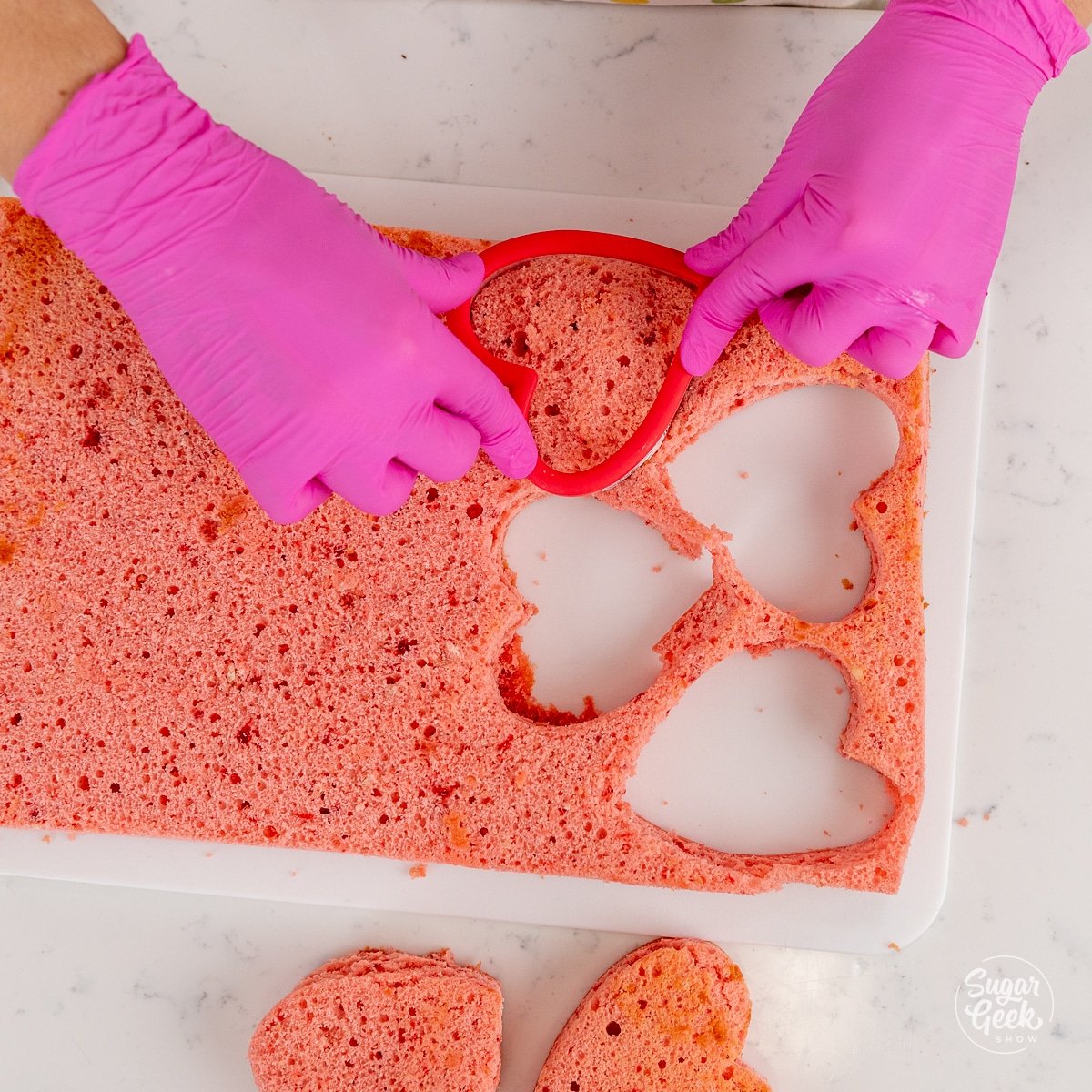
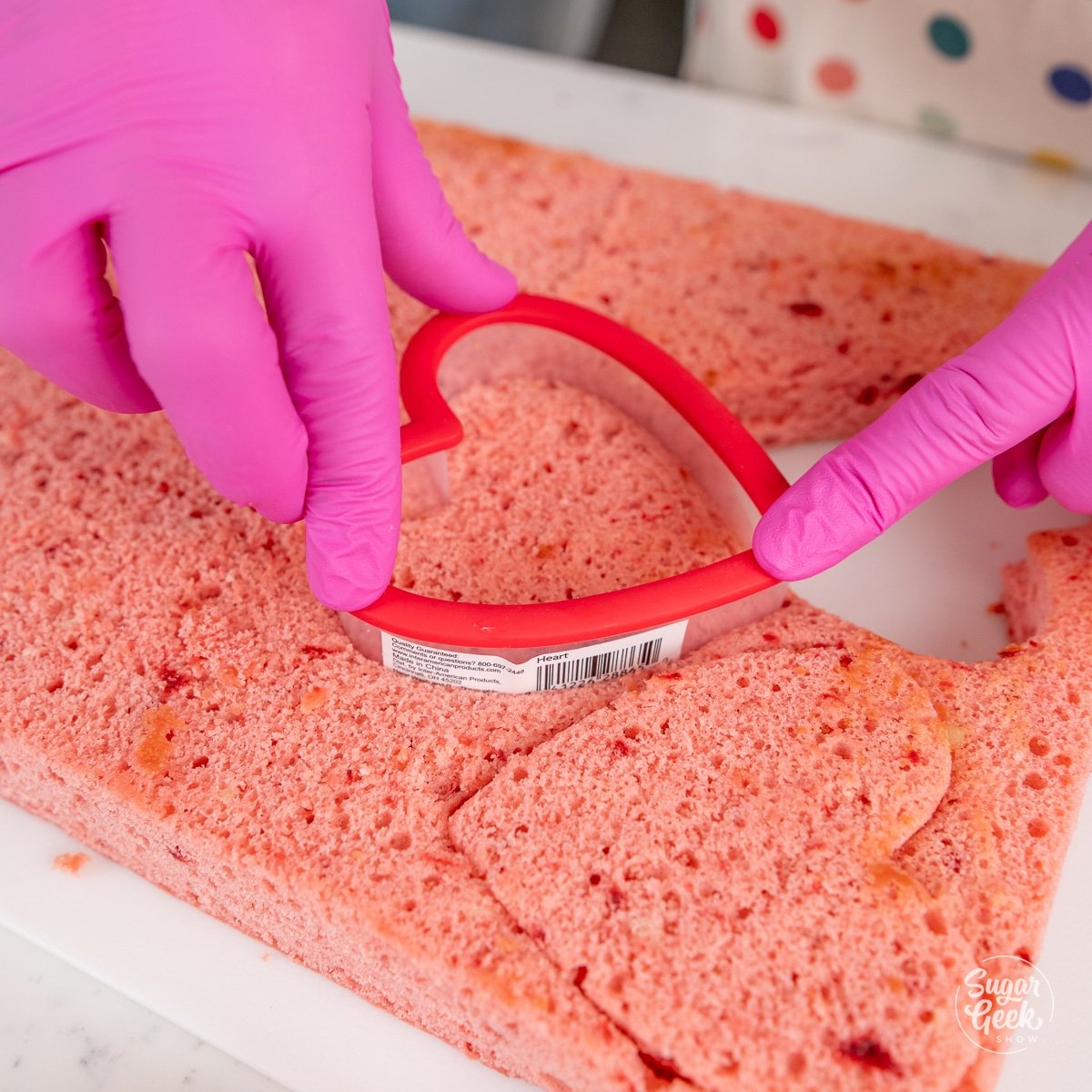
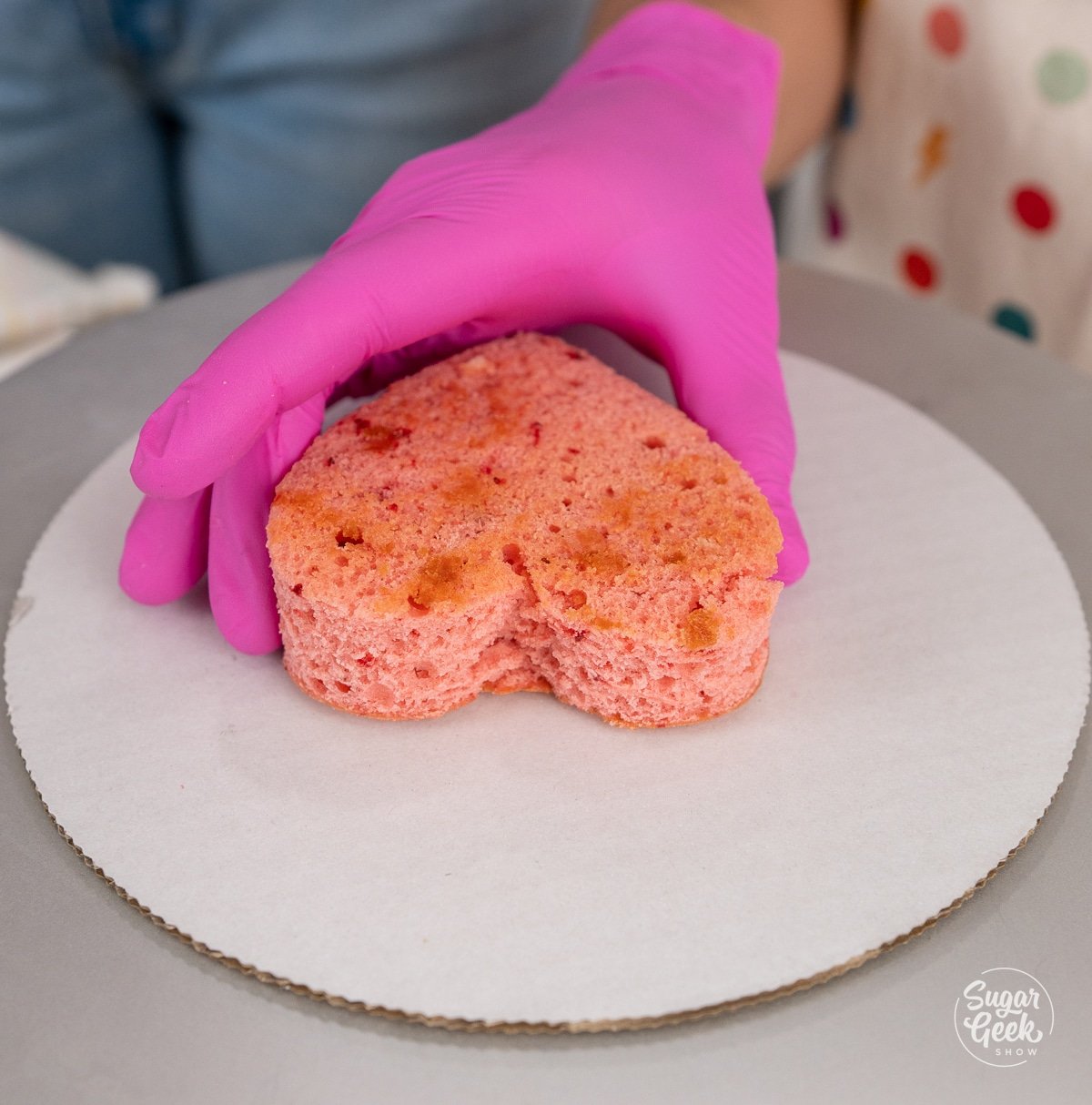
  1. Once your sheet cakes have chilled completely use your desired cutter (I used a 3" heart cutter) to cut out as many cakes as possible, about 16. Cold cakes are easier to cut, and handle and are less crumbly.
    hands pushing a heart shaped cutter into a pink cake
  2. Set the cake on a small cake board so you can easily move it. 
    hand placing a heart cake on a cake board
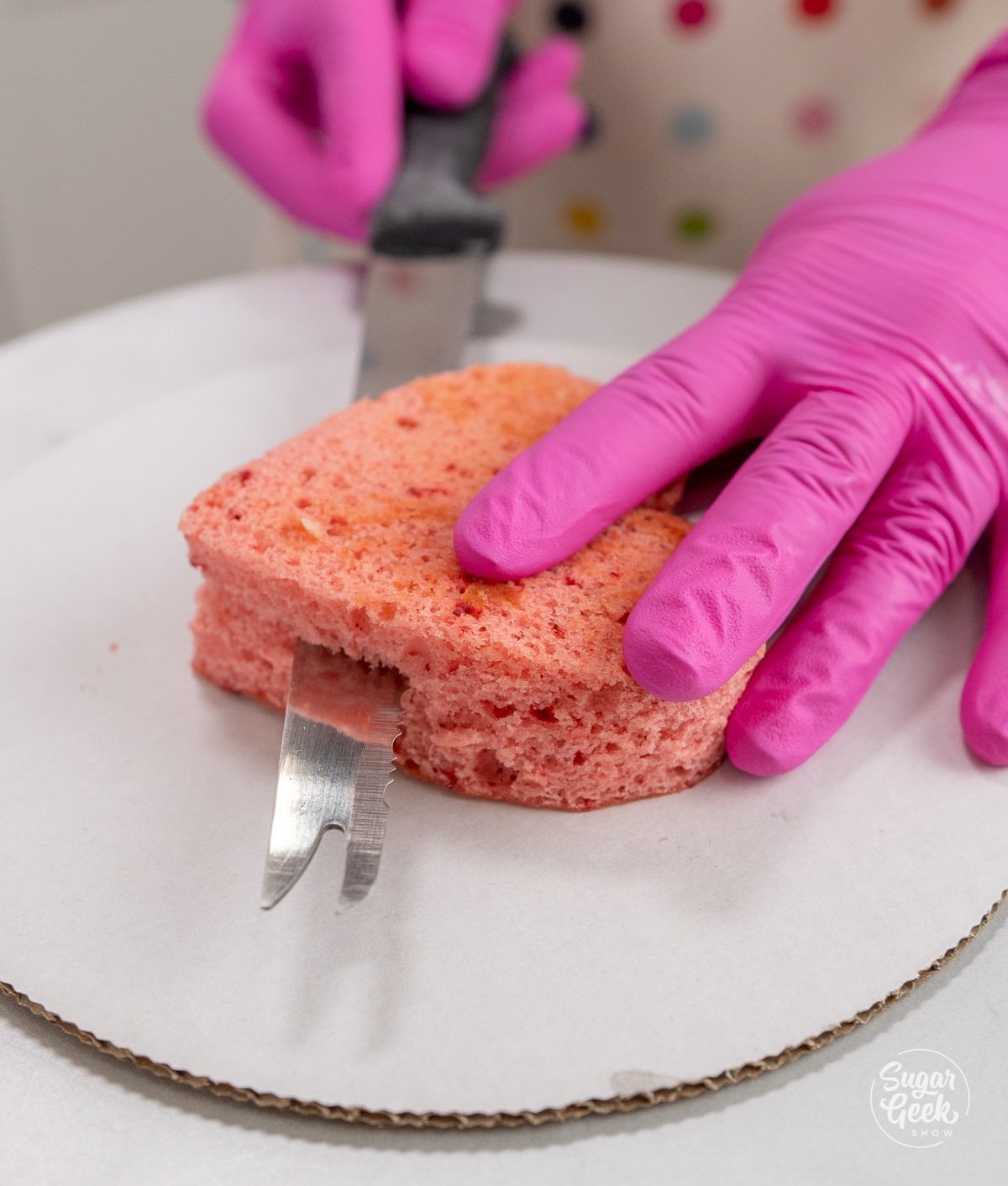
  3. Torte the little cake in half moving slowly with a serrated knife and turning the cake as you cut. You will have a thin cake layer, so handle it gently. (Optional)
    hands torting a heart shaped cake with a serrated knife
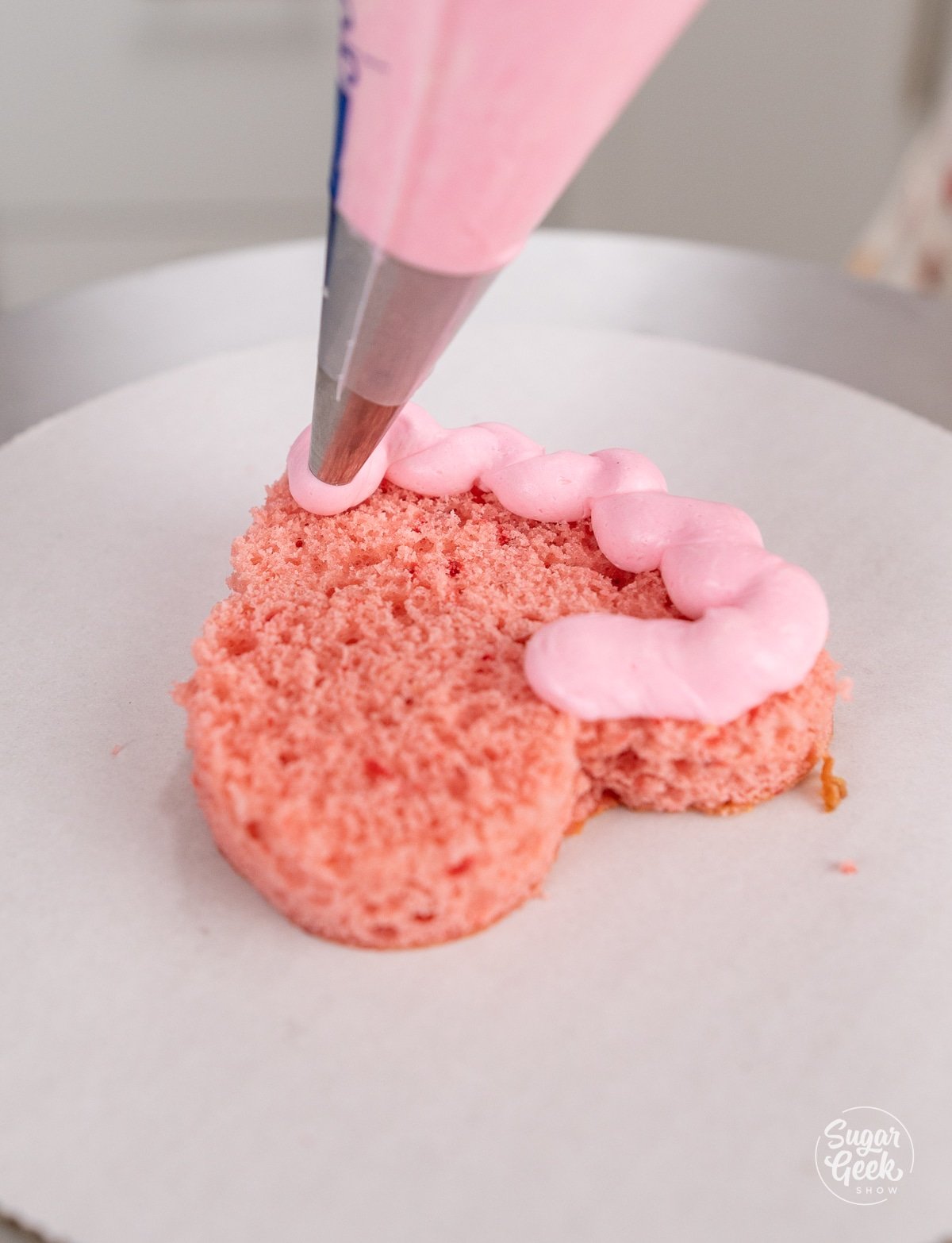
  4. Pipe a dam of buttercream around the edge of the cake.
    piping bag making a dam of buttercream on a heart cake
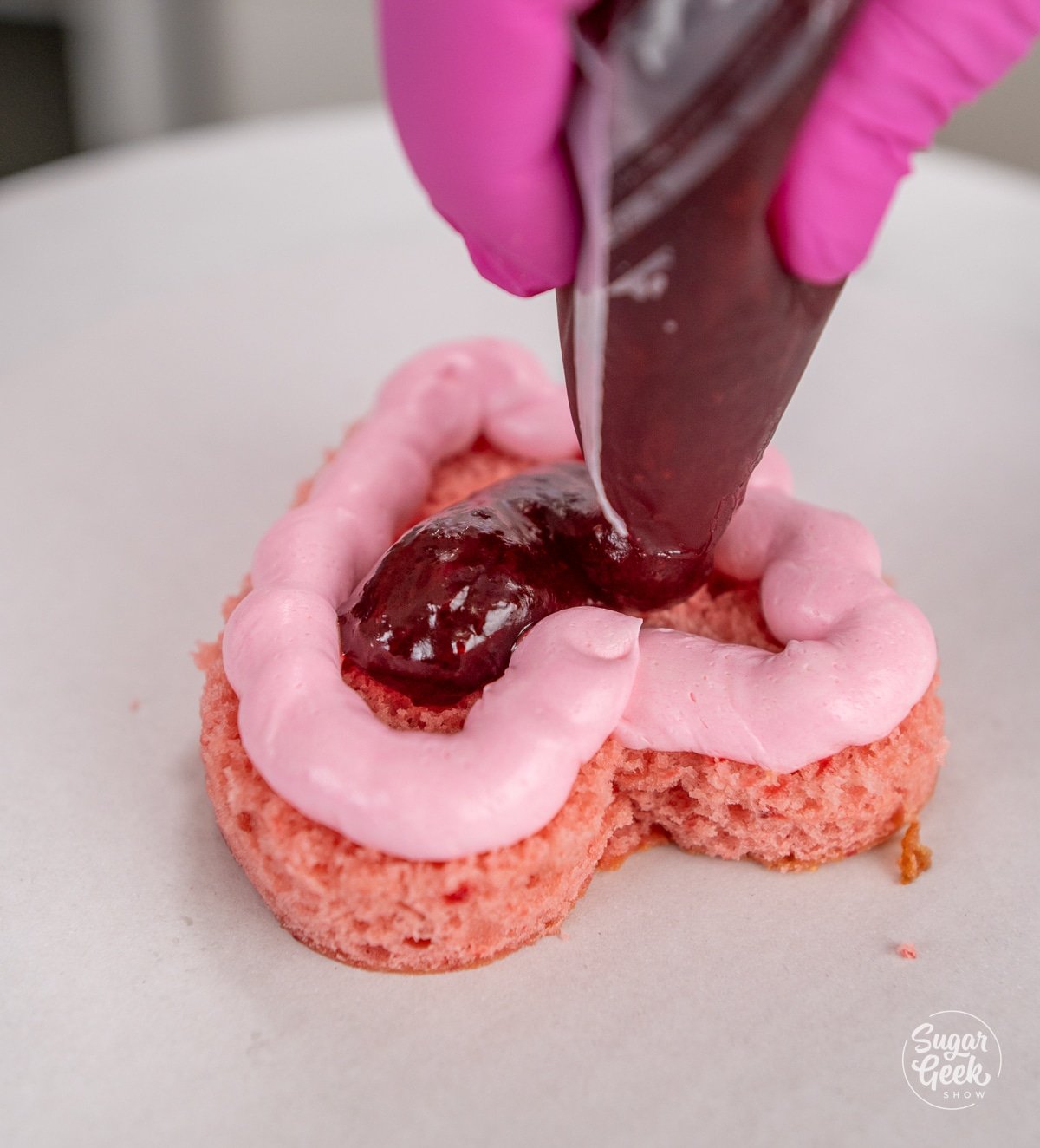
  5. Fill the center of the dam with a few Tablespoons of filling.
    hands squeezing a piping bag of strawberry filling into a cake
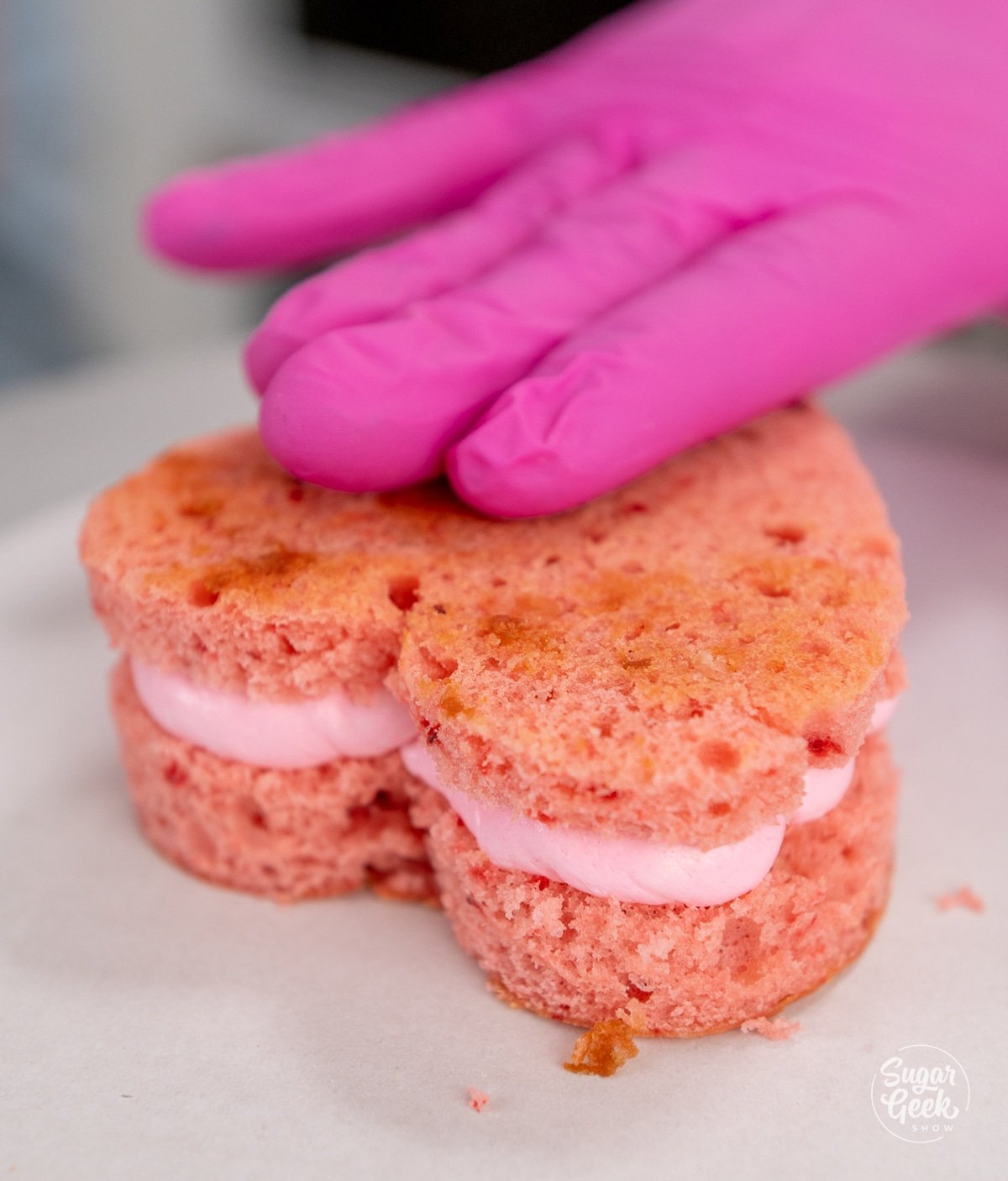
  6. Place the next layer of cake on top. If your cakes are very soft and sliding, let them rest in the freezer for 15-30 minutes to firm up. 
    hand placing a top layer of heart cake
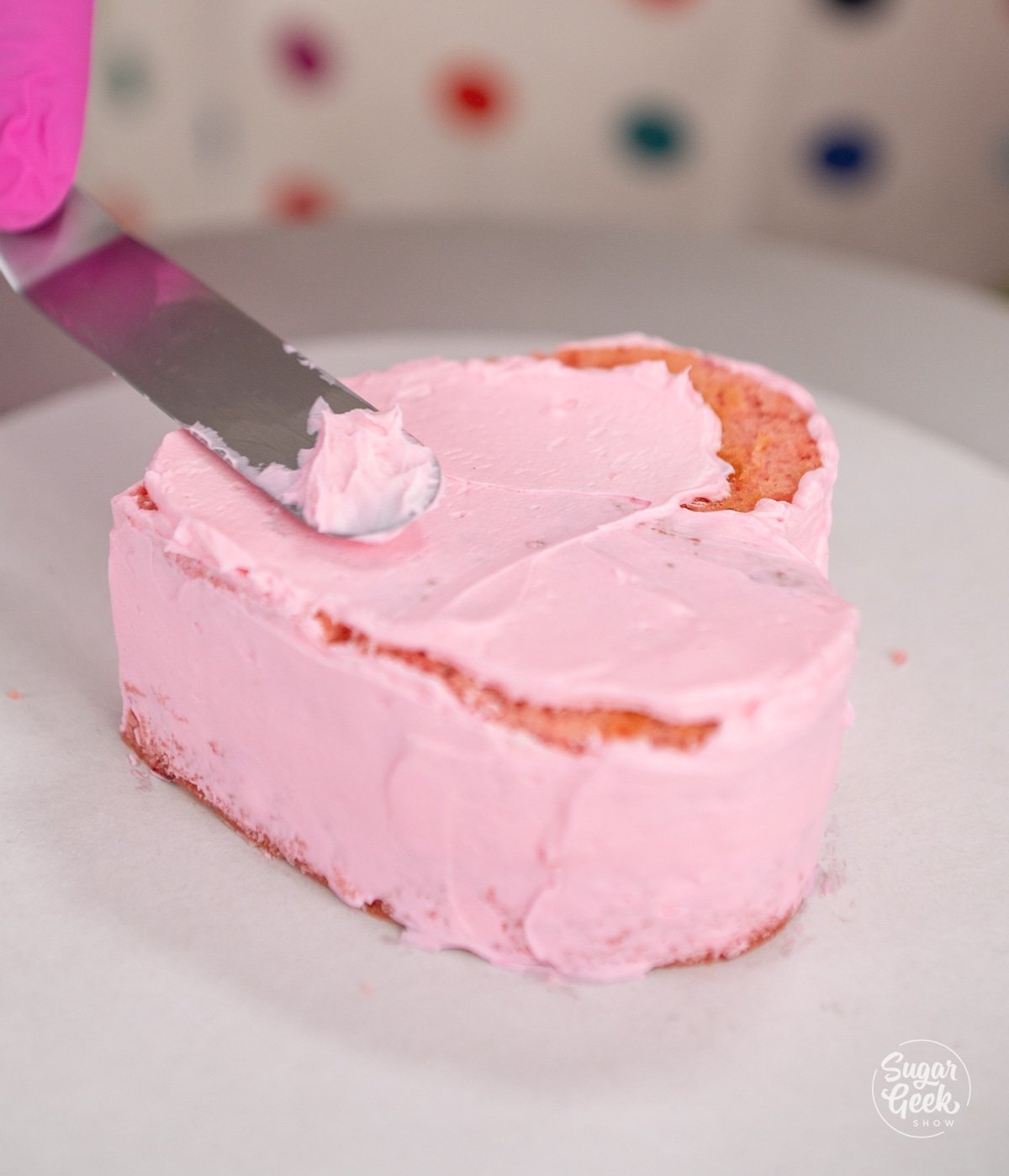
  7. With a small offset spatula, coat the exterior of the cake with your desired base color, then do a second layer of buttercream. Complete all of the buttercream coats before moving on to piping the edges and decor.
    offset spatula spreading buttercream on a small heart cake
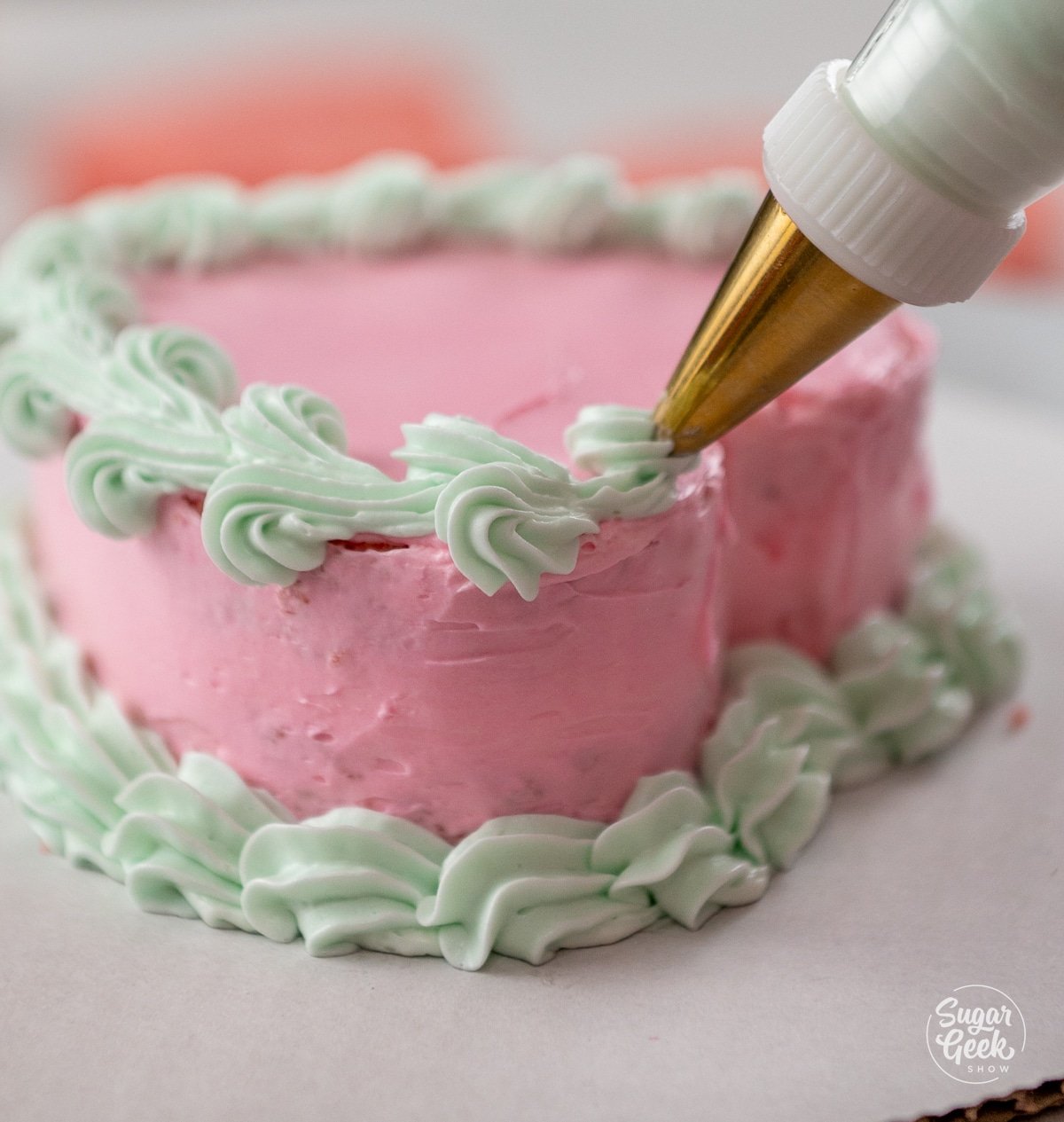
  8. Practice your piping design briefly on a piece of parchment so you know you like it. It will be easier to scrape off the parchment than the cake! 
    hand piping a green border with a piping bag on a pink heart cake
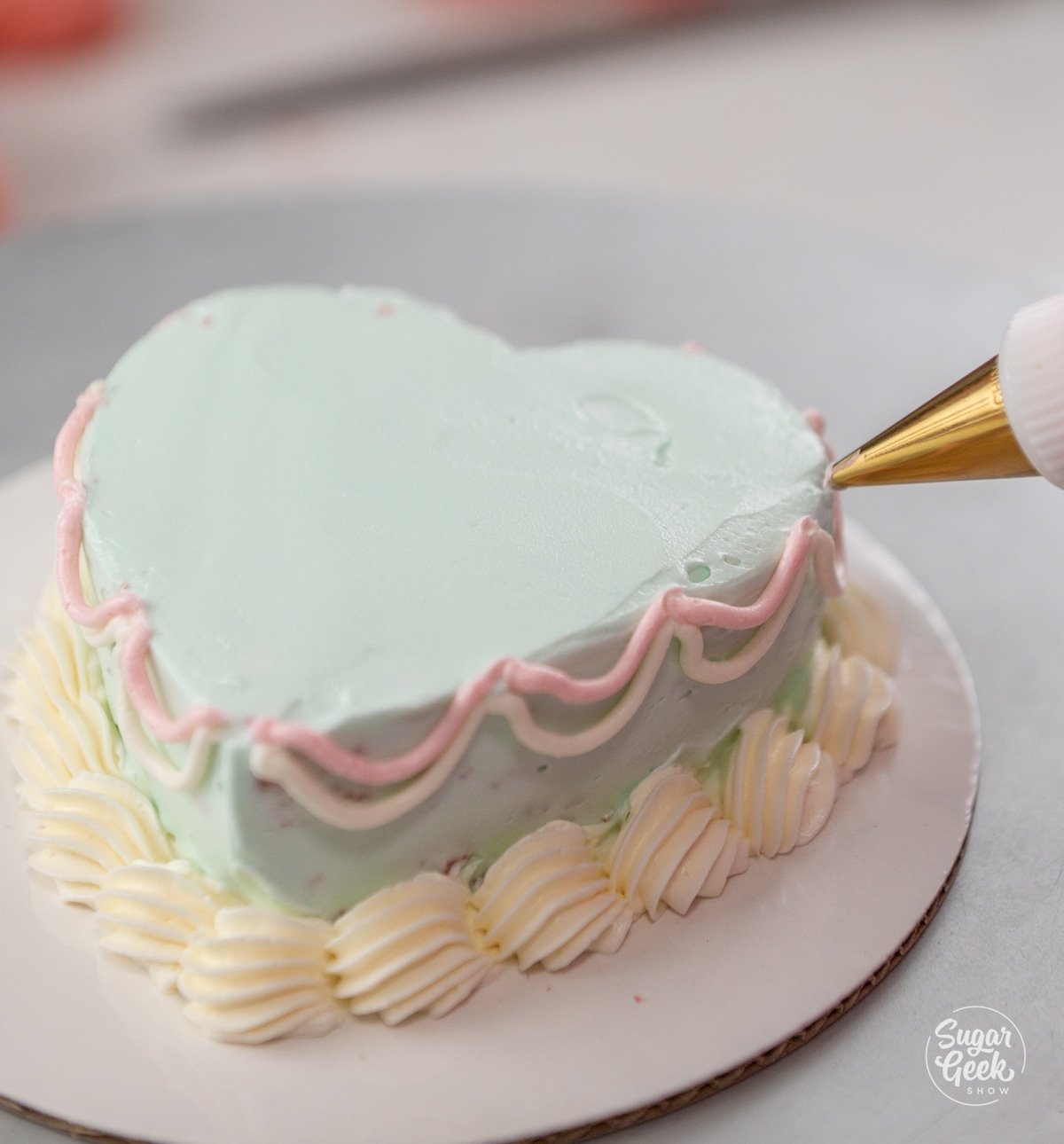
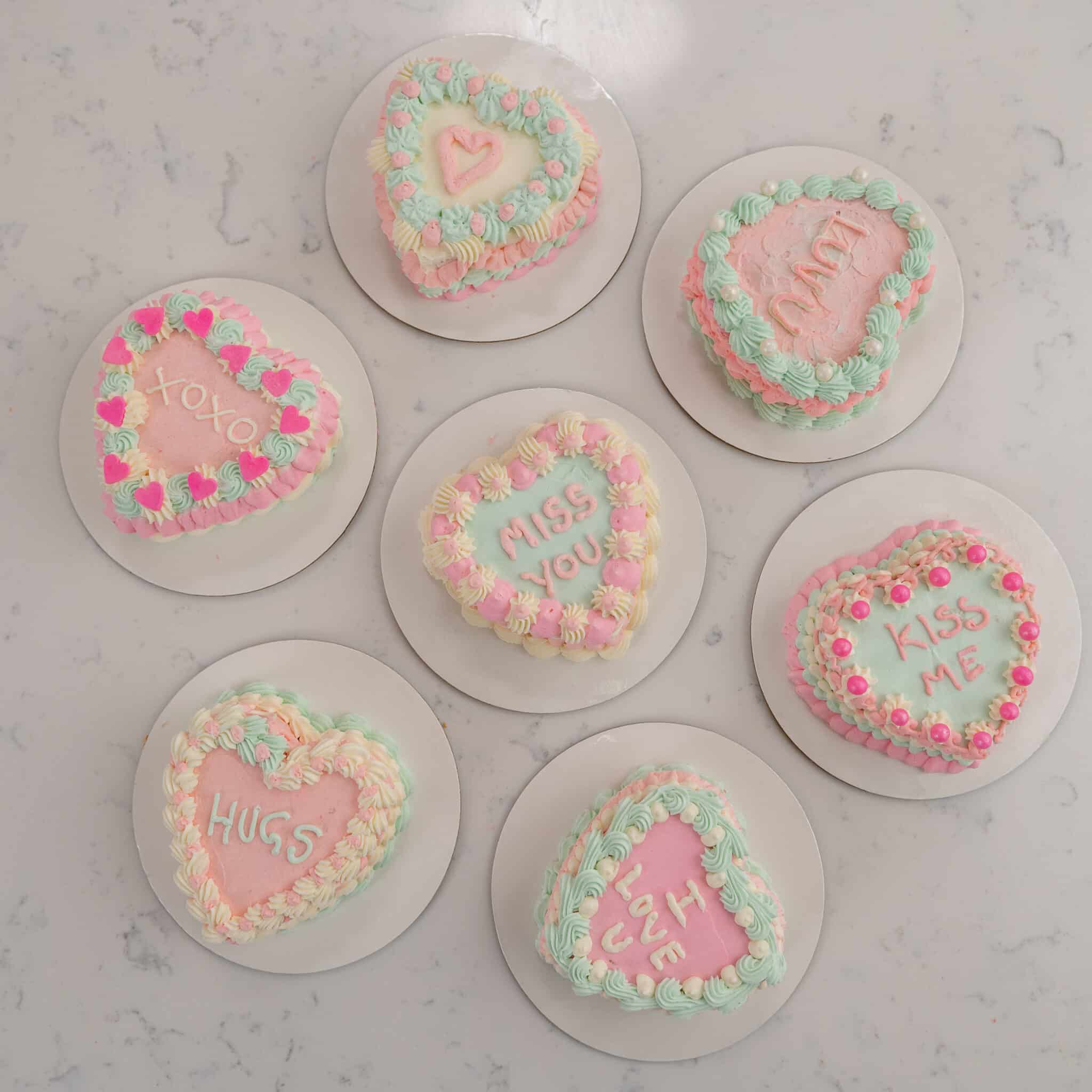
  9. Now you can get creative and make these cakes as ornate or as simple as you like.
    piping bag making a design on the side of a heart cake
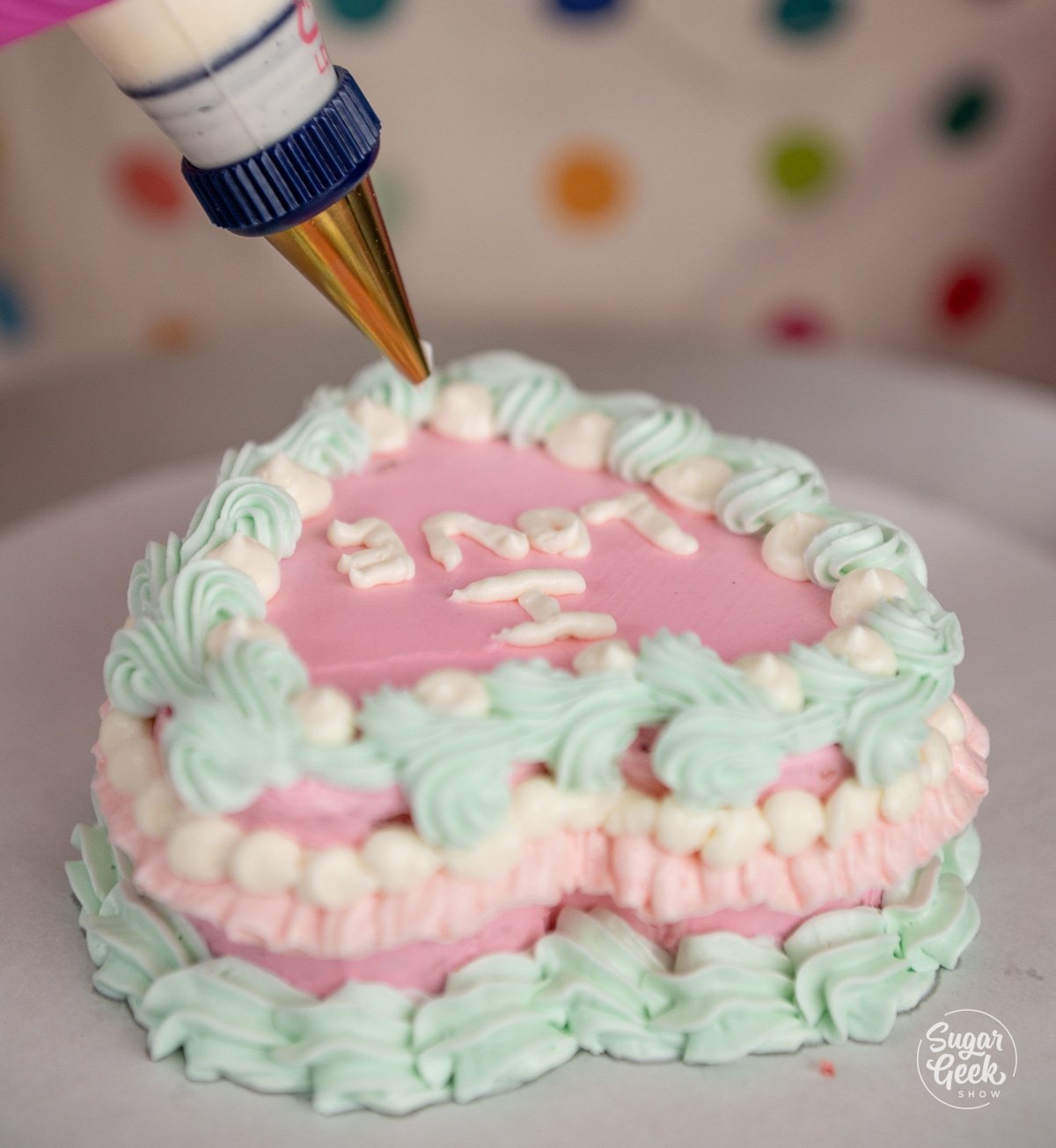
  10. Finish your design with cute messages on top.
    piping bag writing words on top of a heart cake
  11. Once you are finished decorating all of your mini cakes, place them in the freezer to set. It will be much easier to move them without messing up the design if the buttercream is frozen.
    heart shaped lunchbox cakes on cake boards
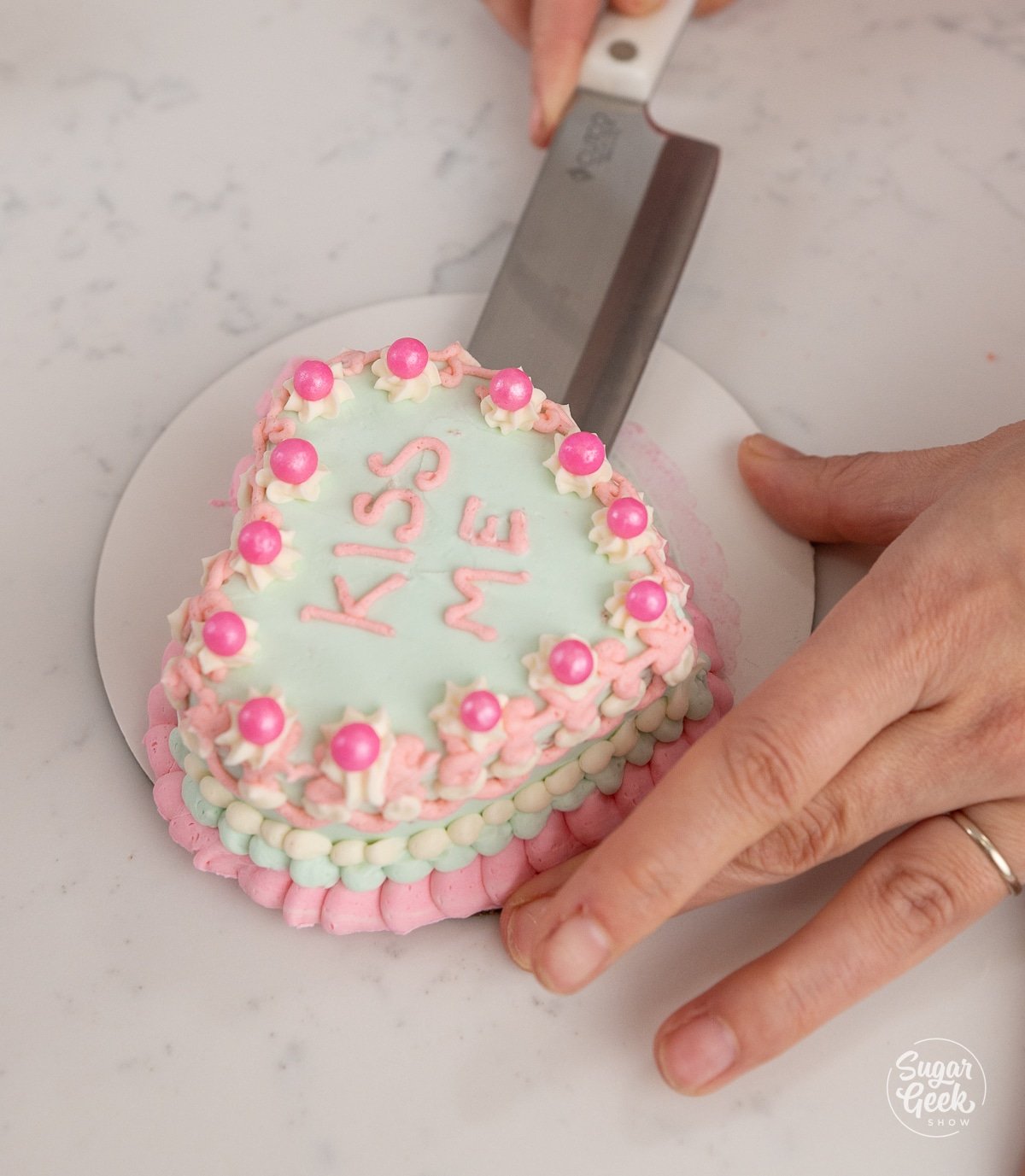
  12. Remove the cake from the cake board with an offset spatula or knife.
    hand removing a heart cake from a cake board with a knife
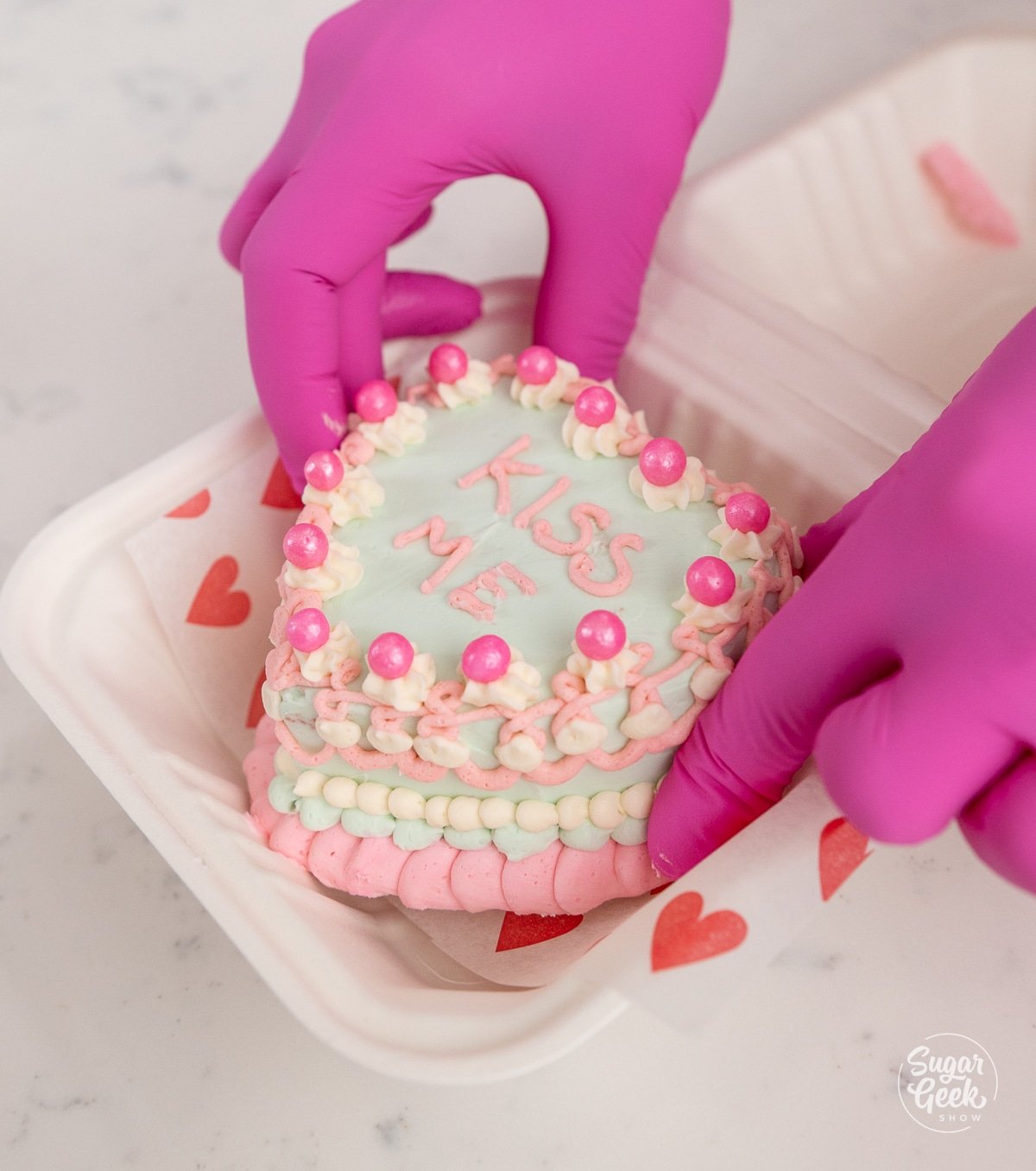
  13. Place a sheet of parchment paper in a little to-go container, add the cake inside, and add a fork on top.
    hands placing a heart shape into a to-go container lined with parchment
  14. If you are not serving these right away, wrap them in plastic wrap and keep them in the freezer until you are ready to package. Also, you could package them, wrap the box in plastic wrap and keep them in the freezer. They will keep up to 2 months in the freezer.
    lunchbox cakes organized in rows on a table

FAQ

What is the difference between a Korean lunch box cake and a bento cake?

Both names refer to a small cake packaged in clamshell containers for easy transport and fun cute cakes. These are a staple in Korean cafes.

Can I use whipped cream to decorate the lunchbox cakes?

You could use my stabilized whip cream to frost the cakes, however, it will be slightly more difficult to pipe designs with the whipped cream, as well as color them. The more you agitate the whipped cream the closer it gets to butter.

How do you pack a cake in a lunch box?

It's important that your cakes are frozen before assembling your lunch boxes. Place a small square of parchment in the container and then the cake on top. Carefully close the box and then tape a fork to the lid.

Related Recipes

Moist Vanilla Cake From Scratch

Eggless Chocolate Cake

Fresh Strawberry Cake

Oreo Cake

Red Velvet Cake

Recipe

heart shaped cake in a to go box
Print Recipe
5 from 3 votes

Lunchbox Cakes

Lunchbox cakes, also known as Bento or Korean lunchbox cakes, are happiness in a box. Dessert-lovers can find joy in the little things like these adorable little cakes. Decorated with dreamy embellishments, this eye-catching confection will surely sweeten up your day.
Prep Time20 minutes mins
Cook Time30 minutes mins
Decorating1 hour hr
Total Time1 hour hr 50 minutes mins
Course: Dessert
Cuisine: American
Servings: 16 cakes
Calories: 868kcal
Author: Liz Marek

Equipment

  • 1 3" heart shaped cutters
  • 1 cupler and pipng tips
  • 16 coated 6" cake boards
  • 16 to-go containers
  • cute parchment paper for lining the boxes

Ingredients

Doctored Strawberry Box Mix Cake

  • 1 box strawberry cake mix or white if you can't find strawberry
  • 1 cup all purpose flour (5 oz)
  • 1 cup granulated sugar (7 oz)
  • ¼ teaspoon salt
  • 1 cup sour cream (8 oz) room temperature
  • ½ cup melted unsalted butter (4 oz)
  • ½ cup milk
  • ¾ cup strawberry puree or preserves (6 oz) strawberry puree recipe
  • 3 large eggs
  • 1 teaspoon strawberry emulsion or extract I like amoretti or LorAnn oils
  • ½ teaspoon lemon extract

Easy Buttercream

  • 24 ounces powdered sugar sifted if not from a bag
  • 6 ounces pasteurized egg whites room temperature
  • 24 ounces unsalted butter room temperature
  • ½ teaspoon salt
  • 2 teaspoons vanilla extract
  • various gel food colors

Filling

  • 1 cup strawberry preserves or any filling you like
US Customary - Metric

Instructions

Making A Strawberry Box Mix Cake

  • Place all of the ingredients into a mixing bowl and mix for 2 minutes on medium speed.
  • Pour the batter into 2 quarter sheet pans that have been prepared with cake goop, pan spray, or parchment paper. The size of your sheet pan may vary, so fill the sheet pan ½ way full. If you have leftover batter, you can freeze it or bake the remaining batter in a smaller cake pan. This recipe will make eight, 3.5" mini cakes, but it will depend on the size of the cutter and shape. 
  • Bake at 350ºF for 15-20 minutes or until a toothpick inserted comes out clean. 
  • Allow the cake to cool for 15 minutes in the pan.
  • Flip out the cake and wrap it in plastic wrap and freeze it until you are ready to start assembling your cake. If you are making your cakes ahead of time, keep them in the freezer for up to 2 months.

Making Easy Buttercream Frosting

  • Place the pasteurized egg whites and powdered sugar in the bowl of a stand mixer with the whisk attachment. Mix on low until combined and then bump up to high and whip for 3 minutes until it looks like royal icing. 
  • Add in your salt and then your butter in small pieces while mixing on low until combined, then bump up to high. Whip until light, white and fluffy and it doesn't taste like butter anymore. This can take 10-15 minutes.
  • Switch to the paddle attachment and mix on low for 15 minutes until it's smooth and bubble-free (optional). 
  • Color your buttercream in as many colors as you like. I like ChefMaster gel food coloring over liquid for the best colors. 
  • Fill piping bags with the colored buttercream, using as many as necessary for your color palate. Pro-Tip: Use a coupler in each of your piping bags so that you can easily switch piping tips for different designs.  

Assembling the Lunchbox Cakes

  • Once your sheet cakes have chilled completely use your desired cutter (I used a 3" heart cutter) to cut out as many cakes as possible, about 16. Cold cakes are easier to cut, and handle and are less crumbly.
  • Set the cake on a small cake board so you can easily move it. 
  • Torte the little cake in half moving slowly with a serrated knife and turning the cake as you cut. You will have a thin cake layer, so handle it gently. (Optional)
  • Pipe a dam of buttercream around the edge of the cake.
  • Fill the center of the dam with a few Tablespoons of filling.
  • Place the next layer of cake on top. If your cakes are very soft and sliding, let them rest in the freezer for 15-30 minutes to firm up. 
  • With a small offset spatula, coat the exterior of the cake with your desired base color, then do a second layer of buttercream. Complete all of the buttercream coats before moving on to piping the edges and decor.
  • Practice your piping design briefly on a piece of parchment so you know you like it. It will be easier to scrape off the parchment than the cake! 
  • Now you can get creative and make these cakes as ornate or as simple as you like.
  • Finish your design with cute messages on top.
  • Once you are finished decorating all of your mini cakes, place them in the freezer to set. It will be much easier to move them without messing up the design if the buttercream is frozen.
  • Remove the cake from the cake board with an offset spatula or knife.
  • Place a sheet of parchment paper in a little to-go container, add the cake inside, and add a fork on top. 
  • If you are not serving these right away, wrap them in plastic wrap and keep them in the freezer until you are ready to package. Also, you could package them, wrap the box in plastic wrap and keep them in the freezer. They will keep up to 2 months in the freezer.

Nutrition

Serving: 1cake | Calories: 868kcal | Carbohydrates: 110g | Protein: 5g | Fat: 47g | Saturated Fat: 28g | Polyunsaturated Fat: 2g | Monounsaturated Fat: 12g | Trans Fat: 2g | Cholesterol: 151mg | Sodium: 396mg | Potassium: 93mg | Fiber: 1g | Sugar: 86g | Vitamin A: 1485IU | Vitamin C: 3mg | Calcium: 101mg | Iron: 1mg
Cake sculpted to look like a woman playing Candy Crush on her phone

February 1, 2023 Course Preview

Candy Crush Bust Cake Tutorial

Skill level: Advanced

It's not every day you get asked to make a Candy Crush cake... by Candy Crush! This piece was created for their social media channels, based on the concept "Candy on my mind."

After collaborating with their team, we settled on a design featuring a bust cake, filled with candy that would spill out when cutting into the hair, revealing layers of cake and candy pieces.

In this tutorial, you will learn how to create a bust cake, featuring an African American bust, ganache hair, molded candies from isomalt, how to make an edible smart phone, how to make the bust and edible clothing and finishing off the design with a decorated cake board.

There's a lot to cover in this tutorial, so let's get our tools together and let's get started!

2:05:18 Minutes of Instruction

What You Will Learn

  • Learn how to create a realistic bust cake
  • How to make the structure to hold up this complicated project
  • Learn how to add candy to the inside of your cake that spills out when cut into
  • How to sculpt and position the facial features, the hands and the arms and shoulders
  • Learn how to add airbrush the skin tones and makeup

Cake sculpted to look like a woman playing Candy Crush on her phone

Tutorial Chapters

  1. Adding The Eyes 0:41
  2. Adding The Chin 3:35
  3. Making The Lips 4:25
  4. Adding & Detailing The Lips 5:14
  5. Making The Candies 15:17
  6. Adding The Nose 20:15
  7. Sculpting The Cheeks 25:28
  8. Sculpting The Eyes & Forehead 31:13
  9. Sculpting The Eyebrows 51:22
  10. Making The Hair Structure 54:04
  11. Stacking The Cakes 1:03:18
  12. Making The Phone 1:09:17
  13. Adding The Candy To The Head 1:16:28
  14. Shaping The Torso And Hair 1:17:40
  15. Covering The Body In Chocolate 1:19:04
  16. Adding The Arms Pt.1 1:22:15
  17. Adding The Clavicles 1:26:30
  18. Airbrushing & Detailing The Face 1:31:03
  19. Adding The Sweater 1:41:35
  20. Adding The Arms Pt.2 1:46:21
  21. Adding The Final Details 1:58:19

Downloads

Materials List

Female Bust Reference - Front 01

Female Bust Reference - Front 02

Female Bust Reference - Side 01

Female Bust Reference - Side 02

Smart Phone Printable Back

Cake sculpted to look like a woman playing Candy Crush on her phone

February 1, 2023 Paid Video

Candy Crush Bust Cake

Skill level: Advanced

It's not every day you get asked to make a Candy Crush cake... by Candy Crush! This piece was created for their social media channels, based on the concept "Candy on my mind."

After collaborating with their team, we settled on a design featuring a bust cake, filled with candy that would spill out when cutting into the hair, revealing layers of cake and candy pieces.

In this tutorial, you will learn how to create a bust cake, featuring an African American bust, ganache hair, molded candies from isomalt, how to make an edible smart phone, how to make the bust and edible clothing and finishing off the design with a decorated cake board.

There's a lot to cover in this tutorial, so let's get our tools together and let's get started!

2:05:18 Minutes of Instruction

What You Will Learn

  • Learn how to create a realistic bust cake
  • How to make the structure to hold up this complicated project
  • Learn how to add candy to the inside of your cake that spills out when cut into
  • How to sculpt and position the facial features, the hands and the arms and shoulders
  • Learn how to add airbrush the skin tones and makeup

Tutorial Chapters

  1. Adding The Eyes 0:41
  2. Adding The Chin 3:35
  3. Making The Lips 4:25
  4. Adding & Detailing The Lips 5:14
  5. Making The Candies 15:17
  6. Adding The Nose 20:15
  7. Sculpting The Cheeks 25:28
  8. Sculpting The Eyes & Forehead 31:13
  9. Sculpting The Eyebrows 51:22
  10. Making The Hair Structure 54:04
  11. Stacking The Cakes 1:03:18
  12. Making The Phone 1:09:17
  13. Adding The Candy To The Head 1:16:28
  14. Shaping The Torso And Hair 1:17:40
  15. Covering The Body In Chocolate 1:19:04
  16. Adding The Arms Pt.1 1:22:15
  17. Adding The Clavicles 1:26:30
  18. Airbrushing & Detailing The Face 1:31:03
  19. Adding The Sweater 1:41:35
  20. Adding The Arms Pt.2 1:46:21
  21. Adding The Final Details 1:58:19

Downloads

Materials List

Female Bust Reference - Front 01

Female Bust Reference - Front 02

Female Bust Reference - Side 01

Female Bust Reference - Side 02

Smart Phone Printable Back

slice of flourless chocolate cake on a plate with raspberries on top

January 31, 2023 Cake

Flourless Chocolate Cake Recipe

The simplicity of this decadent flourless chocolate cake recipe is so elegant. Sometimes called a chocolate torte, it is a Valentine's Day tradition and one of my favorite desserts. With just five simple ingredients this fudgy single-layer dark chocolate cake comes together in a snap.slice of flourless chocolate cake on a plate with raspberries on top

Because the recipe is so simple, the rich chocolate flavor will reflect the quality of the ingredients you use, so be sure to use the best chocolate and butter you can. This flourless cake is elegant served on its own, but you can always take it up a notch by covering it in rich chocolate ganache and a handful of fresh raspberries, toasted nuts, or impressive chocolate curls. It's a perfect gluten-free dessert, so you really can please the whole crowd!

Table of contents

  • Flourless Chocolate Cake Ingredients
  • How to Make a Flourless Chocolate Cake
    • Making the Chocolate Cake
    • Making Chocolate Ganache
  • FAQ
  • Related Recipes

Flourless Chocolate Cake Ingredientsbowl of ingredients for flourless chocolate cake

Dark chocolate shines in this simple cake, the richness of the chocolate balances the light texture of the eggs. Make sure you are using high-quality chocolate so the texture and outcome of this cake are ideal. Lindt, Ghirardelli, and Cacao Barry are some of my favorite brands. 

The whipped egg whites give this cake its structure and the yolk adds a little richness. Make sure your eggs are fresh and at room temperature so they whip to their full potential. 

Chambord is a dark raspberry liqueur. The flavor is surprisingly subtle and not too sweet. It adds just a hint of berry, complimenting the chocolate. The small amount of alcohol added does bake out of this cake, but it can be left out or replaced with vanilla extract, or a different liqueur altogether!

How to Make a Flourless Chocolate Cake

A flourless chocolate cake is very easy to make but does require some specific techniques when mixing the eggs. Similar to a souffle, it should rise in the oven and then will collapse a bit after. It's great by itself, but drizzle a chocolate ganache in the center for a shiny finish. slice of flourless chocolate cake on a plate with raspberries on top lifted out of a cake

Making the Chocolate Cake

  1. Preheat the oven to 350°F and prepare a 9" springform pan with parchment paper and a light layer of cooking spray. You can also bake this in a regular cake pan lined with parchment paper hanging over the sides.
    hands pressing a layer of parchment into a springform pan
  2. Melt the chocolate (chopped into small pieces) and butter together in a large bowl in the microwave in short sessions until it melts together completely. 
    clear bowl full of chocolate and butter
  3. Add the Chambord or flavoring of your choice and stir it in. Set the melted chocolate aside and allow it to cool down to room temperature (but not so cool that it begins to harden). 
    hand adding liquor into a bowl of melted chocolate
  4. Whip the egg yolks in a clean mixing bowl with the whisk attachment until they begin to thicken.
    hand adding a bowl of egg yolks into a stand mixer bowl
  5. Add the 1 ounce of sugar and continue to whip until the mixture reaches the ribbon stage. They will be shiny and drip down on themselves like a ribbon.
    hand adding a bowl of sugar into a stand mixer bowl
    whisk drizzling eggs in the ribbon stage
  6. Whip the egg whites and salt in a separate mixing bowl on medium speed until very soft foamy peaks begin to form. Pro-tip: Make sure you have a clean mixing bowl and whisk, any fat residue can prevent your meringue from forming. 
    hand adding a bowl of egg whites into a stand mixer bowl
  7. Gradually add in the 4 ounces of sugar while the whites are whipping. 
    hand adding a bowl of sugar into a stand mixer bowl
  8. Continue to whip until the whites reach a smooth soft to medium peak. Do not overwhip the whites, as stiff or "chunky" whites will be more difficult to fold into the chocolate and can also cause the cake to collapse more after baking. 
    whisk of meringue in a soft peak
  9. Gently fold the egg yolks into the cooled chocolate mixture with big easy folding movements. I use a bowl scraper for this. 
    spatula pouring egg yolk mixture into melted chocolate
  10. Add a scoop of the egg whites and fold them in to lighten the chocolate mixture. 
    spatula folding egg whites mixture into a bowl of chocolate batter
  11. Using a rubber spatula or bowl scraper, fold in the remaining egg whites until no visible white streaks remain in the batter. Take your time and be gentle, keeping as much volume in the batter as possible. 
    spatula folding egg whites mixture into a bowl of chocolate batter
  12. Pour the batter into the prepared springform pan.
    bowl of chocolate cake batter pouring into a springform pan
  13. Bake the cake in the center of the oven for about 40 minutes. Try not to disturb the cake while it bakes. Like a souffle, it has a fragile structure that's vulnerable to temperature changes and vibrations. 
    hand placing a springform pan of chocolate cake batter in the oven
  14. Test the center of the cake with a skewer to make sure it comes out with no wet batter on it. Remove from the oven and gently place the cake on a cooling rack for about an hour until completely cool. The cake will begin to deflate, creating a smooth and creamy mousse-like texture inside and gorgeous cracks on top.
    baked flourless chocolate cake in the pan on a cooling rack
  15. Remove the springform pan from the chocolate cake.
    hands removing a springform pan from the outside of a flourless chocolate cake

Making Chocolate Ganache

  1. Weigh out the chocolate in a heatproof bowl.
  2. Heat the cream in the microwave until steam starts to rise from the surface but isn't boiling yet. 
    hand getting the temperature of a bowl of cream with a thermometer
  3. Pour hot cream over the chocolate, push the chocolate down so that it's all under the surface of the cream, and let it set for 5 minutes. 
    hand adding a bowl of hot cream to dark chocolate
  4. Whisk everything together until it's smooth. If any lumps remain, put the mixture in the microwave for 30 seconds and whisk again.
    whisk mixing together ganache in a bowl
  5. Add the Chambord or other flavoring and mix. 
    hand adding liquor into a bowl of ganache
  6. If you have an immersion blender you can use it to remove any remaining lumps as well for a super cream ganache.
  7. Pour the ganache over the top of the cake, allowing it to drizzle over the side.
    spoon smoothing out chocolate ganache on top of a flourless chocolate cake
  8. Let the ganache set slightly before adding fresh berries or the garnish you choose.
    flourless chocolate cake with raspberries on top
     

This cake can be stored at room temperature for up to 5 days. After cutting, wrap leftovers in plastic wrap to prevent them from drying out.  If you want to prepare this ahead, you can freeze this cake for up to a month. Let the cake thaw wrapped in plastic wrap to avoid condensation on the surface of the cake. Because of the high chocolate and butter content, it's best served at room temperature.fork holding a piece of flourless chocolate cake

FAQ

Can I make flourless chocolate cake without a springform pan?

You can bake this in a regular cake pan, and line the pan entirely with parchment paper, including the sides, leaving enough overhang to be able to lift the cake out of the pan. Let the cake cool completely so that it does not break when you lift it out.

Why does my flourless chocolate cake fall?

Cakes without flour will collapse slightly as they cool and the cake contracts because there isn't flour structure to hold the cake up. If you fold the cake slowly and gently keeping as much air in the batter as possible, it will not fully collapse. Over-mixed flourless chocolate cake will end up flat, but still delicious, don't throw it out! 

Can I use milk chocolate for flourless chocolate cake? 

Yes, but the result will be sweeter due to the sugar content of milk chocolate, and the final product may look different than using dark chocolate. I do not recommend subbing white chocolate for dark chocolate because, without any cocoa solids, it really needs its own formulated recipe. 

Do I have to use alcohol? 

No, the small amount of liquor used is just to add additional flavor, you can substitute a different liqueur, like orange or whiskey, or just vanilla extract. You can leave it out altogether if you choose! 

Do I have to top the flourless chocolate cake with ganache? 

You can get creative with the topping, but chocolate ganache is my favorite. Even a dusting of powdered sugar, a dollop of whipped cream, or a scoop of vanilla ice cream would be an elegant compliment and let the chocolate flavor shine. Fresh fruit is always a good choice paired with chocolate too.

Related Recipes

Eggless Chocolate Cake

Chocolate Lava Cake

Chocolate Bundt Cake

Chocolate Soufflé

Recipe

slice of flourless chocolate cake on a plate with raspberries on top
Print Recipe
5 from 3 votes

Flourless Chocolate Cake Recipe

This flourless chocolate cake has a smooth and creamy mousse-like texture with silky chocolate ganache. It is rich, decadent, and the perfect dessert for any celebration. This easy recipe is also gluten free, but you would never know by the taste!
Prep Time20 minutes mins
Cook Time40 minutes mins
Resting Time1 hour hr
Total Time2 hours hrs
Course: Dessert
Cuisine: Italian
Servings: 9 servings
Calories: 666kcal
Author: Liz Marek

Ingredients

Flourless Chocolate Cake

  • 8 ounces chocolate (1 ⅓ cups) dark or bittersweet, 64%
  • 3 ounces unsalted butter (⅓ cup)
  • 2 Tablespoons Chambord optional, or vanilla instead
  • 6 Large eggs separated, and room temperature
  • 1 ounce granulated sugar (2 Tbsp) for the yolks
  • 4 ounces granulated sugar (½ cup) for the whites
  • ½ teaspoon salt

Chocolate Ganache

  • 16 ounces chocolate dark or semisweet
  • 8 ounces heavy whipping cream
  • 2 Tablespoons Chambord optional, or vanilla instead

Instructions

Flourless Chocolate Cake

  • Preheat the oven to 350°F and prepare a 9" springform pan with parchment paper and a light layer of cooking spray. You can also bake this in a regular cake pan lined with parchment paper hanging over the sides.
  • Melt the chocolate (chopped into small pieces) and butter together in a large bowl in the microwave in short sessions until it melts together completely. 
  • Add the Chambord or flavoring of your choice and stir it in. Set the melted chocolate aside and allow it to cool down to room temperature (but not so cool that it begins to harden). 
  • Whip the egg yolks in a clean mixing bowl with the whisk attachment until they begin to thicken.
  • Add the 1 ounce of sugar and continue to whip until the mixture reaches the ribbon stage. They will be shiny and drip down on themselves like a ribbon.
  • Whip the egg whites and salt in a separate mixing bowl on medium speed until very soft foamy peaks begin to form. Pro-tip: Make sure you have a clean mixing bowl and whisk, any fat residue can prevent your meringue from forming. 
  • Gradually add in the 4 ounces of sugar while the whites are whipping. 
  • Continue to whip until the whites reach a smooth soft to medium peak. Do not overwhip the whites, as stiff or "chunky" whites will be more difficult to fold into the chocolate and can also cause the cake to collapse more after baking. 
  • Gently fold the egg yolks into the cooled chocolate mixture with big easy folding movements. I use a bowl scraper for this. 
  • Add a scoop of the egg whites and fold them in to lighten the chocolate mixture. 
  • Using a rubber spatula or bowl scraper, fold in the remaining egg whites until no visible white streaks remain in the batter. Take your time and be gentle, keeping as much volume in the batter as possible. 
  • Pour the batter into the prepared springform pan.
  • Bake the cake in the center of the oven for about 40 minutes. Try not to disturb the cake while it bakes. Like a souffle, it has a fragile structure that's vulnerable to temperature changes and vibrations. 
  • Test the center of the cake with a skewer to make sure it comes out with no wet batter on it. Remove from the oven and gently place the cake on a cooling rack for about an hour until completely cool. The cake will begin to deflate, creating a smooth and creamy mousse-like texture inside and gorgeous cracks on top.
  • Remove the springform pan from the chocolate cake. 

Making Chocolate Ganache

  • Weigh out the chocolate in a heatproof bowl.
  • Heat the cream in the microwave until steam starts to rise from the surface but isn't boiling yet. 
  • Pour hot cream over the chocolate, push the chocolate down so that it's all under the surface of the cream, and let it set for 5 minutes. 
  • Whisk everything together until it's smooth. If any lumps remain, put the mixture in the microwave for 30 seconds and whisk again.
  • Add the Chambord or other flavoring and mix. 
  • If you have an immersion blender you can use it to remove any remaining lumps as well for a super cream ganache.
  • Pour the ganache over the top of the cake, allowing it to drizzle over the side. 
  • Let the ganache set slightly before adding fresh berries or the garnish you choose.
  • This cake can be stored at room temperature for up to 5 days. After cutting, wrap leftovers in plastic wrap to prevent them from drying out. If you want to prepare this ahead, you can freeze this cake for up to a month. 

Notes

Dark chocolate shines in this simple cake, the richness of the chocolate balances the light texture of the eggs. Make sure you are using high-quality chocolate so the texture and outcome of this cake are ideal. Lindt, Ghirardelli, and Cacao Barry are some of my favorite brands. 
The whipped egg whites give this cake its structure and the yolk adds a little richness. Make sure your eggs are fresh and at room temperature so they whip to their full potential. 
Chambord is a dark raspberry liqueur. The flavor is surprisingly subtle and not too sweet. It adds just a hint of berry, complimenting the chocolate. The small amount of alcohol added does bake out of this cake, but it can be left out or replaced with vanilla extract, or a different liqueur altogether!
It is normal for flourless chocolate cake to collapse after baking. If you fold the cake slowly and gently keeping as much air in the batter as possible, it will not fully collapse. 
You can bake this in a regular cake pan, and line the pan entirely with parchment paper, including the sides, leaving enough overhang to be able to lift the cake out of the pan. Let the cake cool completely so that it does not break when you lift it out.

Nutrition

Serving: 1serving | Calories: 666kcal | Carbohydrates: 64g | Protein: 8g | Fat: 46g | Saturated Fat: 27g | Polyunsaturated Fat: 2g | Monounsaturated Fat: 14g | Trans Fat: 0.3g | Cholesterol: 173mg | Sodium: 197mg | Potassium: 294mg | Fiber: 4g | Sugar: 58g | Vitamin A: 787IU | Vitamin C: 0.2mg | Calcium: 56mg | Iron: 3mg
dark chocolate rose truffles on a plate

January 26, 2023 Candy

Dark Chocolate Rose Truffles

Dark chocolate rose truffles come together in a snap and make the perfect Valentine's Day or Mother's Day treat. Creamy dark chocolate ganache infused with floral rose petals and rolled in cocoa powder make a decadent and impressive last-minute dessert. Make them white or milk chocolate with my traditional chocolate truffles recipe. dark chocolate rose truffles on a plate

Truffles are made from rolling ganache that has been set for a few hours. To make that ganache extra creamy we add a little butter for texture and flavor. Adding flavors to ganache is easy too, but the complex flavor results make them taste like a complicated process. Including rose flavor in the truffle is as easy as making tea! 

Rose Truffle IngredientsIngredients in bowl for rose flavored truffles

Dark Chocolate that's 64% or more is best for dark chocolate truffles. Semi-sweet and bittersweet chocolate has the most cocoa solids and cocoa butter in it, but typically no milk. This will give you the firmest truffle, but the deepest most intense chocolate flavor. The slight bitter aspects of dark chocolate are what make it so interesting and pair really well with so many things from fruits to spices.

Heavy whipping cream has the highest percentage of fat, and the fat is what emulsifies with the chocolate creating a rich, smooth truffle. Lighter cream can be used, and even milk, however, the ratio of the chocolate will have to be adjusted to accommodate the change in fat content.

Rose is a flavor that can be a wonderful addition or it can totally ruin everything. Floral flavors have the capability to make things taste like perfume, so you want to go slow with the addition of them. I used edible rose petal tea and the addition of Amoretti rose extract to achieve a subtle light but recognizable flavor of the flower. If you choose to use your own rose petals, make sure they haven't been sprayed and have been cleaned. 

Making Dark Chocolate Rose Truffles

  1. Microwave the heavy cream in 20-second sessions until the cream is steaming. Mix between sessions so that it heats evenly. You can also melt the chocolate and cream over a double boiler if you do not have a microwave, or heat the cream in a small saucepan over medium heat. pouring a container of cream into a saucepan
  2. Add the rose petals and let them "steep" for 5 to 10 minutes. hand adding a tablespoon of rose petals to a saucepan of cream
  3. Reheat the cream so it is steaming again, this should only take another 10 seconds in the microwave. rose petal infused cream steaming in a saucepan
  4. Pour the hot cream through a strainer over the bowl of chocolate, making sure that the chocolate is evenly distributed under the cream. Discard the strained rose petals.hands pouring rose petal cream over a bowl of chocolate
  5. Let the chocolate mixture sit for 5 minutes to let the chocolate melt. hands pushing down chocolate and cream with a whisk
  6. Whisk the chocolate and cream together and it should begin to emulsify and smooth out. If there are still some chocolate chunks in it, microwave again for 10 seconds and continue to stir until smooth. whisk mixing together ganache in a bowl
  7. Add in the butter and continue to stir until the butter is fully incorporated and the ganache smooth.cube of butter in a bowl of milk chocolate ganache
  8. Add the rose extract, 1 teaspoon at a time, tasting the ganache between additions. Be careful to not over-flavor the ganache. 
  9. Cover the ganache with plastic wrap, making contact with the surface of the ganache (to prevent a dry skin on top) and let it rest until it has cooled completely and become firm, this could take 1-2 hours. With dark ganache, you can chill it in the refrigerator, but it will be more difficult to scoop if it is cold. hand pressing plastic wrap onto a bowl of ganache
  10. Using a cookie scoop, melon baller, or spoon, measure a scoop of ganache to your desired size. This made about 25, 0.5 oz and about 1-1.5" wide truffles. hand scooping ganache with a cookie scoop
  11. Place the ganache scoop onto a baking sheet lined with parchment and let them sit for 10 minutes in the fridge to set up. scoops of ganache on a sheet tray
  12. While the ganache is resting, set up the bowl of cocoa powder for coating the truffles. 
  13. Roll a scoop of ganache into a smooth round ball. Pro-tip: Wear gloves or make sure your hands are clean and cold. gloved hands rolling a ball of ganache
  14. Roll the truffle in cocoa powder and shake off as much excess as you can.gloved hand rolling a ganache truffle in cocoa powder
  15. Place the truffle back on the sheet pan and let it set up for another 10 minutes. 
  16. Use a small touch of ganache to make a rose petal stick to the top of each truffle. I used what was left in the bowl that held the ganache. rose chocolate truffles lined on a sheet pan
  17. The finished truffles are now ready to eat, package or store. Store them in an airtight container in the fridge if you plan on saving them for longer than 4 days.

FAQ

What makes a chocolate truffle?

The bite-sized chocolate confection called a "truffle" comes from its resemblance to a mushroom-like fungus, considered a delicacy of the same name. The main ingredients are chocolate and cream, but many things can be added to enhance the flavor and texture. 

Can I use a different flower to flavor the chocolate? 

Yes, there are many edible flowers that have wonderful culinary flavors. My favorites are jasmine flowers, lavender, orange blossoms, and many more. I also love using tea, like earl gray, and herbs. Rosemary and milk chocolate make a fun combination! 

What if I don't like dark chocolate? 

You can make truffles with any chocolate, infusing the flavors with the same process. Use my Chocolate truffle recipe to find the ratios for milk and for white chocolate. 

Can I make truffles vegan? 

If you are using dairy-free chocolate you can substitute the heavy cream with heavy coconut milk and omit the butter. Remember when you change ingredients you will also change the outcome of the final product, you may need to experiment with ratios. 

Why won't my truffles set up? 

If your truffles aren't set up, chances are you haven't given the ganache enough time to solidify, and chocolate takes patience. Place the ganache in the fridge for a while. If it still remains loose when it is cold then the measurements were probably off. The nice thing about ganache is it gives you second chances. If it is too loose, warm it slightly and add more melted chocolate to it, if it is too hard, warm it up and add more cream.

How long can I store truffles? 

Truffles can be stored at room temperature for up to 4 days because of the fat and sugar content. But the finished truffle should be stored in an airtight container. They do contain cream, so if you want to store them longer than that I recommend keeping them in the refrigerator for a few weeks or freezer for up to 3 months. Chocolate is going to taste best at room temperature and as fresh as possible. A long time in the fridge could result in a stale flavor and or other flavors absorbed from the fridge. 

Related Recipes

Rose Cake Recipe

Dark, Milk, and White Chocolate Truffles

Chocolate-Covered Strawberries

Kohakutou Crystal Candy

Recipe

dark chocolate rose truffles on a plate
Print Recipe
No ratings yet

Dark Chocolate Rose Truffles

Flavoring your truffles is easier than you may think, and definitely more affordable than a trip to the chocolate shop. Rose-flavored dark chocolate truffles come together in a couple of hours with just 5 ingredients! Roll them in cocoa powder or customize them however you'd like!
Prep Time30 minutes mins
Chilling Time2 hours hrs
Total Time2 hours hrs 30 minutes mins
Course: Dessert
Cuisine: French
Servings: 25 truffles
Calories: 81kcal
Author: Liz Marek

Ingredients

  • 8 ounces dark chocolate (64-72%)  (1 ⅓ cups) Chopped if using a bar
  • 4 ounces heavy whipping cream (½ cup)
  • 1 ounce unsalted butter (2 Tbsp)
  • 2 Tablespoons Edible dry rose petals Or rose petal tea (3 Tbsp)
  • 2 teaspoons Rose extract I like Amoretti
  • ¼ cup cocoa powder
Makes: 1inch0 x 0inch round
US Customary - Metric

Instructions

  • Microwave the heavy cream in 20-second sessions until the cream is steaming. Mix between sessions so that it heats evenly. You can also melt the chocolate and cream over a double boiler if you do not have a microwave, or heat the cream in a small saucepan over medium heat.
  • Add the rose petals and let them "steep" for 5 to 10 minutes. 
  • Reheat the cream so it is steaming again, this should only take another 10 seconds in the microwave.
  • Pour the hot cream through a strainer over the bowl of chocolate, making sure that the chocolate is evenly distributed under the cream. Discard the strained rose petals.
  • Let the chocolate mixture sit for 5 minutes to let the chocolate melt. 
  • Whisk the chocolate and cream together and it should begin to emulsify and smooth out. If there are still some chocolate chunks in it, microwave again for 10 seconds and continue to stir until smooth. 
  • Add in the butter and continue to stir until the butter is fully incorporated and the ganache smooth.
  • Add the rose extract, 1 teaspoon at a time, tasting the ganache between additions. Be careful to not over-flavor the ganache. 
  • Cover the ganache with plastic wrap making contact with the surface of the ganache (to prevent a dry skin on top) and let it rest until it has cooled completely and become firm, this could take 1-2 hours. With dark ganache, you can chill it in the refrigerator, but it will be more difficult to scoop if it is cold. 
  • Using a cookie scoop, melon baller, or spoon, measure a scoop of ganache to your desired size. This made about 25, 0.5 oz and about 1-1.5" wide truffles. 
  • Place the ganache scoop onto a baking sheet lined with parchment and let them sit for 10 minutes in the fridge to set up. 
  • While the ganache is resting, set up the bowl of cocoa powder for coating the truffles. 
  • Roll a scoop of ganache into a smooth round ball. Pro-tip: Wear gloves or make sure your hands are clean and cold. 
  • Roll the truffle in cocoa powder and shake off as much excess as you can.
  • Place the truffle back on the sheet pan and let it set up for another 10 minutes. 
  • Use a small touch of ganache to make a rose petal stick to the top of each truffle. I used what was left in the bowl that held the ganache.
  • The finished truffles are now ready to eat, package or store. Store them in an airtight container in the fridge if you plan on saving them for longer than 4 days.

Notes

  1. If you don't have a microwave, you can melt the chocolate and cream over a double boiler, or heat the cream in a small saucepan over medium heat until it's steaming and then pour it over the chocolate.
  2. High-quality chocolate will result in much better-tasting results and will be much easier to work with than cheaper imitation chocolate. Some of the brands I like are Lindt, Cacao Barry, and Ghirardelli. 
  3. You can make these vegan by using dairy-free chocolate and heavy coconut milk. 
  4. Flavor your truffles by steeping tea or herbs in the cream, adding extracts, or mixing in liquors. 
  5. If your truffles aren't set up, chances are you haven't given the ganache enough time to solidify. Place the ganache in the fridge for a while. If it still remains loose when it is cold then the measurements were probably off. If it is too loose, warm it slightly and add more melted chocolate to it, if it is too hard, warm it up and add more cream.
  6. Use my traditional chocolate truffle recipe to find the ratios for milk and for white chocolate. 

Nutrition

Serving: 1truffle | Calories: 81kcal | Carbohydrates: 5g | Protein: 1g | Fat: 7g | Saturated Fat: 4g | Polyunsaturated Fat: 0.2g | Monounsaturated Fat: 2g | Trans Fat: 0.04g | Cholesterol: 8mg | Sodium: 4mg | Potassium: 83mg | Fiber: 1g | Sugar: 3g | Vitamin A: 99IU | Vitamin C: 0.03mg | Calcium: 11mg | Iron: 1mg
chocolate truffles in different toppings piled on a plate

January 25, 2023 Candy

Chocolate Truffles Recipe

For this chocolate truffles recipe, all you need is good quality chocolate and a few simple ingredients to make delicious, creamy, rich chocolate truffles that will wow everyone who tastes them. Milk, white, or dark chocolate truffles are perfect for a special occasion gift, valentine's day for a chocolate lover, or just a treat for yourself! The best part is that you can customize them with your favorite toppings. chocolate truffles in different toppings piled on a plateThere is no big secret when it comes to making a basic chocolate truffle, it is an emulsion of chocolate and cream. Once you get that down the flavor possibilities are endless! Using 3 types of chocolate and ideas from my pantry we created 18 different flavor combinations to indulge in! half bitten dark chocolate truffle

The truffle gets its name because it looks like the mushroom-like fungus that is highly sought after and difficult to find. Chocolate truffles are easy to make and a fun way to get creative in the kitchen with different flavors. Classic French chocolate truffles are rolled in unsweetened cocoa powder, which is a delicious place to start, but I had a lot of fun looking through my pantry for fun things to pair with chocolate.

Chocolate Truffle Ingredientsbows of ingredients for chocolate truffles

Dark Chocolate that's 64% or more is best for dark chocolate truffles. Semi-sweet and bittersweet chocolate has the most cocoa solids and cocoa butter in it, but typically no milk. This will give you the firmest truffle, but the deepest most intense chocolate flavor. The slight bitter aspects of dark chocolate are what make it so interesting and pair really well with so many things from fruits to spices. 

Milk Chocolate has made by combining cocoa solids and cocoa butter with sugar, and milk. Sometimes an emulsifier, such as soy lecithin, is added to enhance its smoothness. The definition of milk chocolate must contain at least 10% chocolate liquor and 12% milk, this is why it is much sweeter than dark chocolate. 

White Chocolate is typically made of sugar, milk, and cocoa butter, but no cocoa solids. So technically it isn't real chocolate, but a very close cousin. There are many confections out there claiming to be white chocolate, but if there is no cocoa butter in the ingredients, it isn't white chocolate. It will not perform the same as white chocolate when trying to make truffles. 

High-quality chocolate will result in much better-tasting results and will be much easier to work with than cheaper imitation chocolate. If you are going to put in the time and effort to make truffles, don't waste your time or money on lower-end ingredients. Some of the brands I like are Lindt, Cacao Barry, and Ghirardelli. 

Heavy whipping cream has the highest percentage of fat, and the fat is what emulsifies with the chocolate creating a rich, smooth truffle. Lighter cream can be used, and even milk, however, the ratio of the chocolate will have to be adjusted to accommodate the change in fat content.

Making 3 Types of Chocolate Truffles

The process for dark, milk and white chocolate truffles is the same. The only difference is that there is corn syrup added to the dark chocolate ganache to help make an extra-creamy texture.

Making Dark Chocolate Truffles

  1. Measure the heavy cream and corn syrup in a microwave-safe bowl, then mix briefly and microwave in 20-second sessions until the cream is steaming. Mix between sessions so that it heats evenly. hand pouring a bowl of corn syrup into a bowl of cream
  2. Pour the hot cream over the heatproof bowl of measured chocolate, making sure that the chocolate is evenly distributed under the cream.hand adding a bowl of hot cream to chocolate
  3. Let the chocolate mixture sit for 5 minutes to let the chocolate melt. hands pushing down chocolate and cream with a whisk
  4. Whisk the chocolate and cream together and it should begin to emulsify and smooth out. If there are still some chocolate chunks in it, microwave again for 10 seconds and continue to stir until smooth. whisk mixing together ganache in a bowl
  5. Add in the butter and continue to stir until the butter is fully incorporated and the ganache smooth.cube of butter in a bowl of dark chocolate ganache
  6. Cover the ganache with plastic wrap making contact with the surface (to prevent a dry skin on top) and let it rest until the ganache has cooled completely and becomes firm, this could take 1-2 hours. With dark ganache, you can chill it in the refrigerator, but it will be more difficult to scoop if it is cold. hand pressing plastic wrap onto a bowl of ganache
  7. Once the ganache has set, prepare a baking sheet tray with parchment paper.
  8. Using a cookie scoop, melon baller, or spoon, measure a scoop of ganache to your desired size. I chose to make truffles that are 0.5 oz and about 1-1.5" across and this made about 25 truffles. The ganache will warm up quickly in your hands, so handle the chocolate as little as possible. cookie scoop weighing a ball of ganache on a food scale
  9. Place the ganache scoops on the sheet tray and refrigerate them for 10 minutes. scoops of ganache on a sheet tray
  10. While the ganache is resting, set up your desired ingredients for the coating of the truffles. bowl of ganache toppings in bowls
  11. Roll a scoop of ganache into a smooth round ball, and then roll it in the topping of choice. Do one topping at a time so that you do not cross-contaminate the toppings into other bowls. Pro-tip: Wear gloves or make sure your hands are clean and cold. gloved hands rolling a ball of ganachegloved hand rolling a ganache truffle in cocoa nibs
  12. Place the truffle back on the sheet pan and let set up for about another 10 minutes before serving and storing.  chocolate truffles covered in various toppings on a sheet tray

Making Milk Chocolate Truffles

  1. Heat the cream in the microwave or in a saucepan over the stove until the cream is steaming. pouring a container of cream into a saucepan
  2. Pour the hot cream over the milk chocolate, making sure that the chocolate is evenly distributed under the cream. hand adding a bowl of hot cream to milk chocolate
  3. Let it sit for 5 minutes to melt the chocolate. hands pushing down chocolate and cream with a spatula
  4. Whisk the chocolate and cream together and it should begin to emulsify and smooth out. If there are still some chocolate chunks in it, microwave again for 10 seconds and continue to stir until smooth. whisk mixing together milk chocolate ganache in a bowl
  5. Add in the butter and continue to whisk until the ganache is fully incorporated and smooth.cube of butter in a bowl of milk chocolate ganache
  6. Cover the ganache with plastic wrap making contact with the surface of the ganache and set aside for 1-2 hours until the ganache is cooled and firm. You can chill milk ganache in the refrigerator. It is a softer ganache so if it is slightly cool before rolling, it will be less likely to melt in your hands.hand pressing plastic wrap onto a bowl of ganache
  7. Once the ganache has set, prepare a baking sheet with parchment paper to set the scoops of ganache on. 
  8. Scoop the ganache into equal-sized balls. This recipe will make about 25, 0.5-ounce (1 Tablespoon) truffles. hand scooping ganache with a cookie scoop
  9. Place the ganache scoops on the sheet tray and let them sit for 15 minutes in the fridge to set up. 
  10. Roll a scoop of ganache into a smooth round ball, and then roll it in the topping of choice. gloved hand rolling a ganache truffle in coconut
  11. Place the truffle back on the sheet pan and let set up for about another 15 minutes before serving and storing.truffles in different toppings on a sheet pan

Making White Chocolate Truffles

  1. Heat the cream in the microwave or in a saucepan over the stove until the cream is steaming. hand getting the temperature of a bowl of cream with a thermometer
  2. Pour the hot cream over the white chocolate, making sure that the chocolate is evenly distributed under the cream. hand adding a bowl of hot cream to white chocolate
  3. Let it sit for 5 minutes to melt the chocolate. hands pushing down chocolate and cream with a spatula
  4. Whisk the chocolate and cream together and it should begin to emulsify and smooth out. If there are still some chocolate chunks in it, microwave again for 10 seconds and continue to stir until smooth. whisk mixing together white chocolate ganache in a bowl
  5. Add in the butter and continue to whisk until the ganache is fully incorporated and smooth.cube of butter in a bowl of white chocolate ganache
  6. Cover the ganache with plastic wrap making contact with the surface of the ganache (to prevent a dry skin on top) and let rest until it has cooled completely and become firm, this could take up to 1-2 hours. hand pressing plastic wrap onto a bowl of white ganache
  7. Once the ganache has set, prepare a baking sheet with parchment paper to set the scoops of ganache on.
  8. Scoop the ganache into equal-sized balls. This recipe will make about 25, 0.5-ounce (1 Tablespoon) truffles. hand scooping milk chocolate ganache with a cookie scoop
  9. Place the ganache scoops on the sheet tray and let them sit for 20 minutes in the fridge to set up. scoops of ganache on a sheet tray
  10. Roll a scoop of ganache into a smooth round ball, and then roll it in the topping of choice.gloved hand rolling a ganache truffle in freeze-dried strawberries
  11. Place the truffle back on the sheet pan and let set up for about another 20 minutes.

Storing Chocolate Truffles

The finished truffles are now ready to eat, package or store. Store them in an airtight container in the fridge if you plan on saving them for longer than 4 days. If you are giving them as a gift, remind the recipient to eat them within 4 days or keep them in their refrigerator. bitten chocolate truffle on a plate with other truffles in different toppings

How to Flavor Chocolate Truffles

The possibilities are endless when it comes to flavoring truffles. Rolling the truffle in a fun coating is one way, but you can also flavor the ganache itself. hands pouring rose petal cream over a bowl of chocolate

Here are 3 ways to do it:

  1. Steeping the Cream: To make rose-flavored truffles, I chose to use edible dried rose petals to steep in the cream to add flavor to the ganache. You can use teas or different spices like cinnamon, cardamom, or chili powder.
  2. Add Extracts: For rose truffles, I added a teaspoon of the rose extract by Amoretti. Add the extract after you have emulsified the ganache, while it is still warm and liquid. Start slow with a teaspoon and taste the ganache after the addition to get the flavor to where you want it. Lemon extract, vanilla extract, and raspberry extract are also good options.
  3. Flavored Liqueur: Start with adding a teaspoon at a time and tasting, but don't use more than 2 Tablespoons altogether for this recipe ratio. The additional liquid will throw off the ratio and will change the final texture of the ganache. I like using Chambord, Bourbon, or Grand Marnier for boozy truffles.

Check out my rose-flavored dark chocolate truffles blog post for the full recipe. 

FAQ

What makes a chocolate truffle?

The bite-sized chocolate confection called a "truffle" comes from its resemblance to a mushroom-like fungus, considered a delicacy of the same name. The main ingredients are chocolate and cream, but many things can be added to enhance the flavor and texture. 

Can I flavor my ganache? 

Yes, You can steep the cream with any flavors you can think of. I like to use tea or herbs to flavor my cream, and that flavor carries through into the truffle. However, citrus and acids could curdle when added to the cream, so if you are wanting to add lemon, look for it in an extract form, and add just the zest or add a tablespoon of lemon juice to the emulsified ganache at the end. 

Alcohol can also be added to the ganache for flavors. Adding a tablespoon of Chambord or whisky can enhance the chocolate with a boozy delicious finish, picking up the sweet notes of the liqueur. Vanilla extract or vanilla bean is always a classic and a welcomed flavor to all confections as well. 

How far in advance can truffles be made?

Truffles can be stored at room temperature for up to 4 days because of the fat and sugar content. But the finished truffle should be stored in an airtight container. They do contain cream, so if you want to store them longer than that I recommend keeping them in the refrigerator for a few weeks or freezer for up to 3 months. Chocolate is going to taste best at room temperature and as fresh as possible. A long time in the fridge could result in a stale flavor and or other flavors absorbed from the fridge. 

Can I make truffles vegan?

If you are using dairy-free chocolate you can substitute the heavy cream with heavy coconut milk and omit the butter. Remember when you change ingredients you will also change the outcome of the final product, you may need to experiment with ratios. 

Why won't my truffles set up? 

If your truffles aren't set up, chances are you haven't given the ganache enough time to solidify, and chocolate takes patience. Place the ganache in the fridge for a while. If it still remains loose when it is cold then the measurements were probably off. The nice thing about ganache is it gives you second chances. If it is too loose, warm it slightly and add more melted chocolate to it, if it is too hard, warm it up and add more cream.

Related Recipes

White Chocolate Bonbons

Rose-Flavored Truffles

Chocolate-Covered Strawberries

Kohakutou Crystal Candy

Recipe

half bitten dark chocolate truffle
Print Recipe
4.34 from 3 votes

Chocolate Truffles Recipe

Homemade Chocolate Truffles sound so fancy (because they are), but this dark, milk, and white chocolate truffles recipe can be made at home in a snap! Quicker and more affordable than a chocolate shop, whoever is lucky enough to get these rich indulgent treats as a gift will be begging for more.
Prep Time30 minutes mins
Chilling Time2 hours hrs
Total Time2 hours hrs 30 minutes mins
Course: Dessert
Cuisine: French
Servings: 75 truffles
Calories: 90kcal
Author: Liz Marek

Ingredients

Dark Chocolate Truffles (25)

  • 8 ounces dark chocolate (64-72%) (1 ⅓ cups) chopped if using a bar
  • 4 ounces heavy whipping cream (½ cup)
  • 0.5 ounce corn syrup (1 Tbsp) or glucose
  • 1 ounce unsalted butter (2 Tbsp)

Milk Chocolate Truffles (25)

  • 8 ounces milk chocolate (1 ⅓ cups) chopped if using a bar
  • 3 ounces heavy whipping cream (⅓ cup)
  • 0.5 ounce unsalted butter (1 Tbsp)

White Chocolate Truffles (25)

  • 8 ounces white chocolate (1 ⅓ cups) chopped if using a bar
  • 3 ounces heavy whipping cream (⅓ cup)
  • 0.5 ounce unsalted butter (1 Tbsp)

Optional Toppings

  • ½ cup sprinkles
  • ¼ cup cocoa powder
  • ½ cup freeze-dried strawberries crushed
  • ½ cup cocoa nibs
  • ½ cup pistachios crushed
  • ¼ cup shredded coconut
Makes: 1inch0 x 0inch round
US Customary - Metric

Instructions

  • Note: Each recipe makes 25 chocolate truffles at 0.5 oz or 1 Tablespoon in size. You will have the best results by weighing your ingredients with a food scale.

Making Dark Chocolate Truffles

  • Measure the heavy cream and corn syrup in a microwave-safe bowl, then mix briefly and microwave in 20-second sessions until the cream is steaming. Mix between sessions so that it heats evenly. 
  • Pour the hot cream over the heatproof bowl of measured chocolate, making sure that the chocolate is evenly distributed under the cream.
  • Let the chocolate mixture sit for 5 minutes to let the chocolate melt. 
  • Whisk the chocolate and cream together and it should begin to emulsify and smooth out. If there are still some chocolate chunks in it, microwave again for 10 seconds and continue to stir until smooth. 
  • Add in the butter and continue to stir until the butter is fully incorporated and the ganache smooth.
  • Cover the ganache with plastic wrap making contact with the surface (to prevent a dry skin on top) and let it rest until the ganache has cooled completely and becomes firm, this could take 1-2 hours. With dark ganache, you can chill it in the refrigerator, but it will be more difficult to scoop if it is cold. 
  • Once the ganache has set, prepare a baking sheet tray with parchment paper.
  • Using a cookie scoop, melon baller, or spoon, measure a scoop of ganache to your desired size. I chose to make truffles that are 0.5 oz and about 1-1.5" across and this made about 25 truffles. The ganache will warm up quickly in your hands, so handle the chocolate as little as possible. 
  • Place the ganache scoops on the sheet tray and refrigerate them for 10 minutes. 
  • While the ganache is resting, set up your desired ingredients for the coating of the truffles. 
  • Roll a scoop of ganache into a smooth round ball, and then roll it in the topping of choice. Do one topping at a time so that you do not cross-contaminate the toppings into other bowls. Pro-tip: Wear gloves or make sure your hands are clean and cold. 
  • Place the truffle back on the sheet pan and let set up for about another 10 minutes before serving and storing.  

Making Milk Chocolate Truffles

  • Heat the cream in the microwave or in a saucepan over the stove until the cream is steaming. 
  • Pour the hot cream over the milk chocolate, making sure that the chocolate is evenly distributed under the cream. 
  • Let it sit for 5 minutes to melt the chocolate. 
  • Whisk the chocolate and cream together and it should begin to emulsify and smooth out. If there are still some chocolate chunks in it, microwave again for 10 seconds and continue to stir until smooth. 
  • Add in the butter and continue to whisk until the ganache is fully incorporated and smooth.
  • Cover the ganache with plastic wrap making contact with the surface of the ganache and set aside for 1-2 hours until the ganache is cooled and firm. You can chill milk ganache in the refrigerator. It is a softer ganache so if it is slightly cool before rolling, it will be less likely to melt in your hands.
  • Once the ganache has set, prepare a baking sheet with parchment paper to set the scoops of ganache on. 
  • Scoop the ganache into equal-sized balls. This recipe will make about 25, 0.5-ounce (1 Tablespoon) truffles. 
  • Place the ganache scoops on the sheet tray and let them sit for 15 minutes in the fridge to set up. 
  • Roll a scoop of ganache into a smooth round ball, and then roll it in the topping of choice. 
  • Place the truffle back on the sheet pan and let set up for about another 15 minutes before serving and storing.

Making White Chocolate Truffles

  • Heat the cream in the microwave or in a saucepan over the stove until the cream is steaming. 
  • Pour the hot cream over the white chocolate, making sure that the chocolate is evenly distributed under the cream. 
  • Let it sit for 5 minutes to melt the chocolate. 
  • Whisk the chocolate and cream together and it should begin to emulsify and smooth out. If there are still some chocolate chunks in it, microwave again for 10 seconds and continue to stir until smooth. 
  • Add in the butter and continue to whisk until the ganache is fully incorporated and smooth.
  • Cover the ganache with plastic wrap making contact with the surface of the ganache (to prevent a dry skin on top) and let rest until it has cooled completely and become firm, this could take up to 1-2 hours.
  • Once the ganache has set, prepare a baking sheet with parchment paper to set the scoops of ganache on. 
  • Scoop the ganache into equal-sized balls. This recipe will make about 25, 0.5-ounce (1 Tablespoon) truffles. 
  • Place the ganache scoops on the sheet tray and let them sit for 20 minutes in the fridge to set up. 
  • Roll a scoop of ganache into a smooth round ball, and then roll it in the topping of choice.
  • Place the truffle back on the sheet pan and let set up for about another 20 minutes.

Notes

  1. If you don't have a microwave, you can melt the chocolate and cream over a double boiler, or heat the cream in a small saucepan over medium heat until it's steaming and then pour it over the chocolate.
  2. Roll in one topping at a time so that you do not cross-contaminate the toppings into other bowls.
  3. High-quality chocolate will result in much better-tasting results and will be much easier to work with than cheaper imitation chocolate. Some of the brands I like are Lindt, Cacao Barry, and Ghirardelli. 
  4. You can make these vegan by using dairy-free chocolate and heavy coconut milk. 
  5. Flavor your truffles by steeping tea or herbs in the cream, adding extracts, or mixing in liquors. 
  6. If your truffles aren't set up, chances are you haven't given the ganache enough time to solidify. Place the ganache in the fridge for a while. If it still remains loose when it is cold then the measurements were probably off. If it is too loose, warm it slightly and add more melted chocolate to it, if it is too hard, warm it up and add more cream.

Nutrition

Serving: 1truffle | Calories: 90kcal | Carbohydrates: 8g | Protein: 1g | Fat: 6g | Saturated Fat: 4g | Polyunsaturated Fat: 0.3g | Monounsaturated Fat: 2g | Trans Fat: 0.03g | Cholesterol: 7mg | Sodium: 6mg | Potassium: 78mg | Fiber: 1g | Sugar: 7g | Vitamin A: 80IU | Vitamin C: 19mg | Calcium: 13mg | Iron: 1mg
chocolate covered strawberries on a white plate

January 20, 2023 Candy

Foolproof Chocolate Covered Strawberries

Making chocolate covered strawberries couldn't be easier! Melt your chocolate, dip, decorate! Follow my foolproof method for getting your chocolate to stick, how to store your strawberries so they last the longest and more! The perfect DIY recipe for Valentines day.

In this recipe, we will go over how to temper chocolate in a microwave. Tempering chocolate just means we will melt the chocolate to a specific temperature so that the chocolate is shiny and has a delicious SNAP when you bite into it! If you don't temper your chocolate, you may have problems with your chocolate setting up (getting hard) or cooling with white streaks on the surface. Don't worry, it's way easier than you might expect!

Once you master tempering then you can make all kinds of chocolate goodies like heart hot chocolate bombs, homemade chocolate caramel candies, or a viral breakable chocolate heart.


Table of contents

  • Ingredients
  • How to Make Chocolate-Covered Strawberries Step-by-Step
  • Packaging the Strawberries
  • FAQ
  • Related Recipes

Ingredients

chocolate covered strawberry ingredients

Fresh strawberries, delicious chocolate, and 20 minutes are all you really need to make chocolate-covered strawberries. Having a thermometer is also really helpful but not 100% necessary. Before you dive in, be sure to read through this blog post or watch the video for tons of tips and tricks for success.

Chocolate - You need to use the best quality chocolate (real chocolate) you can get your hands on. Cheap/bad quality chocolate that contains palm tree oil or other additives in place of cocoa butter will result in bad tasting final product. Avoid products that say "coating chocolate", "chocolate wafers", or "candy melts". Check the ingredients list. If you see cocoa butter listed, you're good to go. I really like using Ghirardelli semi-sweet chocolate chips which you can get in the baking aisle of most grocery stores for under $5.

Strawberries - Look for strawberries that are firm, shiny and don't have any soft spots. We will be washing our strawberries before we dip them which will kill any lingering mold spores and keep your strawberries from going bad. Make sure you dry the strawberries well and allow them to come to room temperature before dipping. Cold strawberries will make your chocolate set too quickly.

strawberries rinsed in water in white colander

How to Make Chocolate-Covered Strawberries Step-by-Step

  1. Wash and dry your strawberries and bring them to room temperature so they are not cold when you start dipping.
  2. Place your chocolate into a microwave save bowl.
  3. Heat your chocolate for 1 minute and then stir.
  4. Continue heating the chocolate in 15 second increments, mixing in between until your chocolate is about 75% melted.partially melted chocolate in a glass bowl
  5. Continue stirring without heating for few more minutes to allow the chocolate to melt all the way. The chocolate should not get above 86º-90ºF depending on the chocolate you are using. White (86ºF) Milk (88ºF) Semi-sweet and Dark (90ºF). I like to use a thermometer for this.bowl of melted chocolate
  6. Transfer the chocolate to a tall skinny container like a small canning jar or a cup.
  7. (Optional) Place two toothpicks into the top of the strawberry so you have something to hold onto while dipping. Sometimes just holding onto the stem will work but it's not as stable as using toothpicks.
  8. Dip the strawberry into the chocolate all the way to the stem.dipping a strawberry in melted chocolate
  9. Lift the strawberry out of the chocolate while gently shaking off the excess chocolate.
  10. Gently scrape off the excess chocolate from the bottom of the strawberry.dipping a strawberry in chocolate
  11. If you're adding sprinkles or other toppings, now is the time to put them on top of the chocolate before it sets up.dipping chocolate covered strawberry in spinkles
  12. Place the chocolate covered strawberry onto a sheet of parchment paper for a few seconds then lift and transfer to another spot to prevent too much chocolate from pooling around the bottom of the strawberry.strawberry covered in chocolate on parchment paper shot from above
  13. Place the strawberries onto parchment or a silicone mat to allow the chocolate set up.
  14. If you want to do a chocolate drizzle, dip all your strawberries first, let them set, then do the drizzle. The easiest way to do a chocolate drizzle is to put some of your melted chocolate into a piping bag with a small opening cut or use a ziplock bag with the corner cut off. drizzling chocolate over a chocolate covered strawberry

If your chocolate starts getting too cold, re-heat in 5-second increments and stir to prevent over-heating. 

chocolate covered strawberries on a white plate

Packaging the Strawberries

Most professionals place their chocolate-dipped strawberries into cupcake liners and then into a nice box for a special occasion. You can add pretty shredded paper or waxed paper underneath or just leave them as-is. Do not wrap your strawberries in plastic wrap because they will get soggy and discolored quickly.

Chocolate-covered strawberries in cupcake liners

FAQ

How to make strawberries last longer?

Strawberries tend to go bad in the fridge fairly quickly. It can be so frustrating to see that pint of strawberries you got two days ago suddenly growing mold! Don't worry, you can avoid your strawberries going bad pre-maturely by washing them in a diluted vinegar wash. This vinegar wash kills bacteria and mold spores and makes your strawberries last up to a week longer!

How do I store my chocolate-covered strawberries?

Store the chocolate-covered strawberries in the fridge on a cooling rack with paper towels underneath. Lightly cover with plastic wrap to prevent the strawberries from drying out but do not store them in an airtight container or they will mold. Strawberries need air!

How long do chocolate-covered strawberries last?

Chocolate-covered strawberries will last up to 48 hours in the fridge, but taste the best when they are fresh! They are so quick and easy to make, it's best to wash your berries the night before, let them dry in the fridge, and then dip them the day you plan on eating them. They can last up to 12 hours at room temperature.

Should you keep the leaves on your strawberries?


Some people remove the stems when dipping their strawberries but experts say to leave them on. Why? Because when you remove the stem, you are basically opening a big hole in your strawberry. That hold will leak juice, discolor your chocolate, and overall reduce the life of your chocolate-covered strawberries.

Can I add coconut oil to my chocolate to thin it out?

Adding coconut oil will only work if you're using candy melts because they are not technically considered "real" chocolate. Real chocolate has cocoa butter in it, and requires tempering, while candy melts are made using wax or palm kernel oil. Adding oils to melted candy melts will also work great for dipping your strawberries, but it won't work for real chocolate.

Related Recipes

Marbled Valentines Day Sugar Cookies

Valentines Day Mirror Glaze Cake

How To Temper Chocolate in the Microwave

Tempering Chocolate with Cocoa Butter

Pink Velvet Cake

Heart Hot Chocolate Bombs

Recipe

chocolate covered strawberries
Print Recipe
4.91 from 11 votes

Chocolate Covered Strawberries Recipe

How to make beautiful and delicious chocolate-covered strawberries using milk, dark and white chocolate. Get tips on how to melt chocolate flawlessly, color chocolate, and make your chocolate-covered strawberries last as long as possible.
Prep Time15 minutes mins
Cooling10 minutes mins
Total Time25 minutes mins
Course: Dessert
Cuisine: American
Servings: 24 Strawberries
Calories: 83kcal
Author: Liz Marek

Equipment

  • Thermometer
  • Spatula
  • Bowl for melting, glass or silicone

Ingredients

  • 24 medium strawberries 16 ounces
  • 30 ounces chocolate white, milk, semi-sweet or dark
  • 32 ounces cool water
  • 8 ounces white vinegar
US Customary - Metric

Instructions

Preparing the strawberries

  • Combine the water and the vinegar together in a large bowl
  • Add the strawberries and let them soak for 10 minutes
  • Make sure your strawberries are fresh and discard and strawberries with blemishes or bruises. This will cause your strawberries to start weeping after a day.
  • Rinse the strawberries in fresh water, dry them thoroughly, and then transfer them to a cooling rack with paper towels.
  • Lightly cover strawberries in plastic wrap and place them into the fridge if you aren't going to use them right away. Make sure your strawberries are at room temperature before dipping.

Melting the chocolate

  • The process for melting is the same for all the chocolate. Milk chocolate should not be heated higher than 86ºF (30ºC), milk chocolate no higher than 88ºF (31ºC), and semi-sweet and dark no higher than 90ºF (32ºC). I suggest melting and dipping one type of chocolate at a time.
  • Place the chopped chocolate into a microwave-safe bowl.
  • Heat the chocolate on full power in the microwave for 60 seconds and then stir to distribute the heat evenly throughout the chocolate.
  • Continue heating the chocolate in 10-15 second increments until the chocolate is about 90% melted and still below the maximum temperature for the type of chocolate you are using.
  • Continue to stir the chocolate until it's fully melted. If your chocolate begins to cool down 5 degrees and you still have un-melted pieces, you can continue heating in 5 second increments until they are melted but be very careful not to go over your max temp. If you do go over you can still temper your chocolate using the seeding method (see the link in my blog post)

Dipping the strawberries

  • Grasp the strawberry with the green leaves and dip it into the chocolate. You can also insert two toothpicks into either side of the stem to help stabilize large berries and make them easier to dip. Gather the leaves around the toothpicks to keep them from getting into the chocolate.
  • Place the berry onto a baking sheet lined with parchment or wax paper and then after 5 seconds pick it up and move it over a few inches to remove even more of the chocolate. This prevents too much chocolate from pooling around the berry and making a huge flat spot.
  • If adding toppings like sprinkles or chopped nuts, add them now before the chocolate sets up.
  • If adding a drizzle of melted chocolate, wait until the chocolate sets up on all your dipped strawberries first. Place the melted chocolate into a small piping bag with the tip cut off or a ziplock bag with the tip cut off. Hold the chocolate covered strawberry with one hand while drizzling the chocolate over the strawberry with the other.
  • Store your berries in the fridge lightly covered in plastic wrap for up to 48 hours but they are best and freshest the day they are made. If you are eating them the same day you make them, no need to refrigerate them.

Video

Notes

Tips for success
  1. Wash strawberries in the vinegar/water solution to prolong the life of the strawberries
  2. Dry your strawberries thoroughly to prevent them from going bad
  3. Temper your chocolate either in the microwave (small amounts) or by using a double boiler (large amounts) so that your chocolate sets firmly, is shiny, and tastes delicious
  4. Dip your strawberries all the way to the stem to prevent leaking
  5. Use toothpicks in the stem while dipping the strawberries for extra support
  6. Eat your strawberries within 24 hours for the best results!

Nutrition

Serving: 5strawberries | Calories: 83kcal | Carbohydrates: 9g | Protein: 1g | Fat: 5g | Saturated Fat: 3g | Cholesterol: 1mg | Sodium: 8mg | Potassium: 72mg | Fiber: 1g | Sugar: 8g | Vitamin A: 2IU | Vitamin C: 7mg | Calcium: 17mg | Iron: 1mg
Cake decorated to look like a 3D jelly flower cake with astronaut topper

January 15, 2023 Course Preview

Astronaut Gelatin Flower Cake Tutorial

Skill level: Intermediate

I got a chance to make a space-themed floral cake for one of my best friend's for her daughter's birthday. I love trying to mix together seemingly-unrelated themes and this was a real treat.

In this tutorial, you will learn how to pick, flatten and attach edible flowers to a cake, how to coat the flowers in a translucent gelatin that creates this beautiful effect similar to 3D jelly cakes and topped the cake with a hand-sculpted Astronaut.

56:34 Minutes of Instruction

What You Will Learn

  • How to create an artistic space/floral themed cake
  • Learn how to treat, arrange and add edible flowers to a cake
  • How to create the translucent jelly cake for a double-barrel cake tier
  • Learn how to sculpt an astronaut cake topper

cake decorated with gelatin flowers and astronaut cake topper

Tutorial Chapters

  1. Stacking And Covering The Cake 0:45
  2. Pressing The Flowers 4:43
  3. Making The Chocolate Shells 12:53
  4. Adding The Flowers 14:27
  5. Adding The Acetate 21:44
  6. Making The Gelatin 28:25
  7. Adding The Gelatin 30:03
  8. Making The Head And Body 34:27
  9. Decorating The Astronaut 36:52
  10. Finalizing The Cake 52:44

Downloads

Materials List

Cake decorated to look like a 3D jelly flower cake with astronaut topper

January 15, 2023 Paid Video

Astronaut Gelatin Flower Cake

Skill level: Intermediate

I got a chance to make a space-themed floral cake for one of my best friend's for her daughter's birthday. I love trying to mix together seemingly-unrelated themes and this was a real treat.

In this tutorial, you will learn how to pick, flatten and attach edible flowers to a cake, how to coat the flowers in a translucent gelatin that creates this beautiful effect similar to 3D jelly cakes and topped the cake with a hand-sculpted Astronaut.

56:34 Minutes of Instruction

What You Will Learn

  • How to create an artistic space/floral themed cake
  • Learn how to treat, arrange and add edible flowers to a cake
  • How to create the translucent jelly cake for a double-barrel cake tier
  • Learn how to sculpt an astronaut cake topper

Tutorial Chapters

  1. Stacking And Covering The Cake 0:45
  2. Pressing The Flowers 4:43
  3. Making The Chocolate Shells 12:53
  4. Adding The Flowers 14:27
  5. Adding The Acetate 21:44
  6. Making The Gelatin 28:25
  7. Adding The Gelatin 30:03
  8. Making The Head And Body 34:27
  9. Decorating The Astronaut 36:52
  10. Finalizing The Cake 52:44

Downloads

Materials List

Cake sculpted to look like a squishmallow

January 1, 2023 Course Preview

Squishmallow Cake Tutorial

Skill level: Intermediate

Learn how to make a super-cute fluffy-looking Squishmallow cake that will fool party guests into thinking they can get cozy with it!

In this tutorial, you will learn how to create the shape of the Squishmallow, how to make the eyes, ears and face, how to get the edible fuzzy texture, and how to add wrinkles and folds to make it look just like the real thing.

43:28 Minutes of Instruction

What You Will Learn

  • How to create a realistic Squishmallow Cake
  • Learn how to create an edible fuzzy texture
  • How to create realistic fabric folds and wrinkles

Tutorial Chapters

Cake sculpted to look like a squishmallow

  1. Stacking The Cakes 0:39
  2. Carving The Cakes 3:44
  3. Crumb Coating The Cakes 7:06
  4. Covering The Cakes In Modeling Chocolate 11:10
  5. Adding The Creases 16:21
  6. Adding The Ears And Details 19:56
  7. Tempering The Cocoa Butter 27:27
  8. Cutting Out The Face Template 29:31
  9. Airbrushing The Squishmallow 31:04
  10. Painting The Face And Stripes 36:39
  11. Painting The Eyes And Details 39:40

Downloads

Materials List

Squishmallow Face Template

Cake sculpted to look like a squishmallow

January 1, 2023 Paid Video

Squishmallow Cake

Skill level: Intermediate

Learn how to make a super-cute fluffy-looking Squishmallow cake that will fool party guests into thinking they can get cozy with it!

In this tutorial, you will learn how to create the shape of the Squishmallow, how to make the eyes, ears and face, how to get the edible fuzzy texture, and how to add wrinkles and folds to make it look just like the real thing.

43:28 Minutes of Instruction

What You Will Learn

  • How to create a realistic Squishmallow Cake
  • Learn how to create an edible fuzzy texture
  • How to create realistic fabric folds and wrinkles

Tutorial Chapters

  1. Stacking The Cakes 0:39
  2. Carving The Cakes 3:44
  3. Crumb Coating The Cakes 7:06
  4. Covering The Cakes In Modeling Chocolate 11:10
  5. Adding The Creases 16:21
  6. Adding The Ears And Details 19:56
  7. Tempering The Cocoa Butter 27:27
  8. Cutting Out The Face Template 29:31
  9. Airbrushing The Squishmallow 31:04
  10. Painting The Face And Stripes 36:39
  11. Painting The Eyes And Details 39:40

Downloads

Materials List

Squishmallow Face Template

chocolate cake goop in a jar with a silicone brush

December 23, 2022 Culinary Techniques

Chocolate Cake Goop (Pan Release)

This chocolate cake goop pan release is super simple to make and works every time. Store it for months in your pantry to use on any chocolate desserts. This recipe adds cocoa powder to my vanilla cake goop to avoid streaks on your chocolate cakes. So much easier and more consistent than butter and flour!chocolate cake goop in a jar with a silicone brush

Chocolate cake goop is great for complex bundt cakes, traditional chocolate cakes, loaf pans, and more. Seriously, I wish someone had told me about this amazing stuff before. It's stupidly easy and takes only a minute to make and you know what? Your cakes will turn out every single time.

Chocolate Cake Goop Ingredientsbowls of ingredients for chocolate cake goop on a table

Vegetable shortening is my preference because it's cheap, easy to find, and never fails. You can also use margarine if you'd like, just be sure that it's shelf stable if you want to keep it in the pantry.

Vegetable Oil is what I use for all of my cakes so I have it on hand. You can use any type of oil that you'd like.

All purpose flour is my preference for cake goop, but any type of flour will work. You can even make your cake goop gluten-free by replacing the flour with gluten-free flour like bobs red mill 1:1 baking flour. 

Making Chocolate Cake Goop

  1. Add the shortening, oil, flour, and cocoa powder to a large bowl and combine them until smooth with a hand mixer or a whisk.oil pouring from a container into a bowl of pan release ingredients
  2. Store the cake goop in a jar or airtight container at room temperature for a few months or in the fridge for up to 6 months and use it for every chocolate cake. Be careful to not get cake crumbs in the cake goop or it could make it go bad sooner. I like to store my cake goop in this cute little jar with a silicone brush!chocolate cake goop in a jar with a silicone brush
  3. Brush your chocolate cake pans with a pastry brush, evenly coating them with the cake goop. Don't forget to coat the sides, corners, and center dowels if you're using a bundt pan. hand brushing chocolate cake goop into a bundt cake pan
  4. Pour the cake batter in and bake as normal. three pans filled with chocolate cake batter
  5. Let your cake rest in the pan for about 10 minutes, then flip it out onto a cooling rack. Perfect release!hands flipping a cake out of the pan

Tips for Success

  1. Use a pastry brush and do a nice even coat of cake goop, but don't use too much! Early on I got a little crazy with the layers and put a LOT on there. This can actually backfire and cause your cake to stick, not fun!
  2. Cake goop works best for pans 9" and smaller. I like to use cake goop and add an extra parchment layer for cakes that are larger than 10". hands holding a cake with a parchment circle on the bottom
  3. Cakes with higher amounts of sugar like strawberry cake, cinnamon cake, and roll cakes are more likely to stick. Using parchment in addition to cake goop here is a good idea.

More Chocolate Recipes

Death By Chocolate Cake

Easy Chocolate Cake

Vanilla Cake Goop

Chocolate Lava Cake

Recipe

chocolate cake goop in a jar with a silicone brush
Print Recipe
4.67 from 3 votes

Chocolate Cake Goop Recipe

No parchment. No flour and shortening messes. No using a knife to cut around the edges. No more buying pan release spray! All you need is cake goop for perfect chocolate cakes that release every time.
Prep Time5 minutes mins
Total Time5 minutes mins
Course: Dessert
Cuisine: American
Servings: 3 cups
Calories: 718kcal
Author: Liz Marek

Equipment

  • 1 container with a lid for storage
  • 1 Whisk or hand mixer

Ingredients

  • 7 ounces vegetable shortening  or margarine
  • 7.5 ounces vegetable oil  or other oil you liked
  • 2 ounces all purpose flour
  • 3 ounces cocoa powder

Instructions

  • Add the shortening, oil, flour, and cocoa powder to a large bowl and combine them until smooth with a hand mixer or a whisk.
  • Store the cake goop in a jar or airtight container at room temperature for a few months or in the fridge for up to 6 months and use it for every chocolate cake. Be careful to not get cake crumbs in the cake goop or it could make it go bad sooner.
  • Brush your chocolate cake pans with a pastry brush, evenly coating them with the cake goop. Don't forget to coat the sides, corners, and center dowels if you're using a bundt pan.
  • Pour the cake batter in and bake as instructed.
  • Let your cake rest in the pan for about 10 minutes, then flip it out onto a cooling rack.

Notes

  1. You can make your cake goop gluten-free by replacing the flour with gluten-free flour like bobs red mill 1:1 baking flour. 
  2. I like to store my cake goop in this cute little jar with a silicone brush!
  3. Use a pastry brush and do a nice even coat of cake goop, but don't use too much! Early on I got a little crazy with the layers and put a LOT on there. This can actually backfire and cause your cake to stick, not fun!
  4. Cake goop works best for pans 9" and smaller. I like to use cake goop and add an extra parchment layer for cakes that are larger than 10".

Nutrition

Serving: 1cup | Calories: 718kcal | Carbohydrates: 31g | Protein: 8g | Fat: 70g | Saturated Fat: 19g | Polyunsaturated Fat: 19g | Monounsaturated Fat: 29g | Trans Fat: 9g | Sodium: 9mg | Potassium: 451mg | Fiber: 11g | Sugar: 1g | Calcium: 40mg | Iron: 5mg
Tall glass filled with ice cream and cherries jubilee

December 22, 2022 Filling

Cherries Jubilee

This cherries jubilee recipe is an old-fashioned, boozy dessert topping made with sautéed fresh ripe cherries, sugar, and spirits. Ladle this easy cherry sauce over some creamy vanilla ice cream, serve with angel food cake, or spread it over a cheesecake. This is the perfect dessert to make for dinner guests or any celebration!Tall glass filled with ice cream and cherries jubilee

When I first heard of cherries jubilee, I was a little nervous that I wouldn't like it. I mean boozy cherries can sometimes just taste like medicine, but it was a surprisingly delicious dessert! Cherries with a hint of rum flavor in the sweet cherry syrup. Sweet and tart, hot and cold, a bright, fun, and easy dessert! It's now a family tradition to flambé a dessert on New Year's Eve.

If you love jubilee and want a thicker, pie-ready version that holds up under a top crust or on top of a cheesecake, my homemade cherry pie filling recipe is the cousin of jubilee built for spooning into pies, hand pies, and cake fillings.

Cherry Jubilee Ingredientsbowls of ingredients for cherries jubilee on a table

Cherries - If you are able to find fresh cherries in season, late spring around here, then those are a great choice for this dessert. Traditionally the original recipe is made with sour cherries, but those can be harder to find fresh. I opted for frozen cherries because they are easy to find when cherries aren't in season. Frozen cherries are picked and flash-frozen to preserve the fresh seasonal flavor. Sour Cherries, sweet cherries, and bing cherries will all work for this recipe. It would be fun to use many varieties together!

Kirsch and Rum - The alcohol in this recipe is necessary if you want to flambé it. That is the only way to achieve the delightful ending with the beautiful flames in the sauté pan. The kirsch is a cherry liqueur made from distilling morello cherries, originating in Germany. Rum is a liquor made from distilling sugarcane molasses. Both highlight the cherry and caramel sugar flavors in this dessert.

Lemon juice - The acid of the lemon brightens the flavor of the cherry and brightens the color, keeping it a vibrant red. It balances the sweet sauce of sugar and sweet alcohol. Orange juice or another citrus could be used in place of lemon juice.

How to Make Cherries Jubilee

  1. If you're using fresh cherries, remove the pits with a cherry pitter.
    using a cherry pitter to remove the pit from cherries
  2. Add the cherries, brown sugar, and lemon juice to a large pan and begin cooking over medium heat. Stir occasionally while the cherries start to release their juices and the sugar begins to dissolve.
    hand pouring a bowl of lemon juice into a pot with cherries
  3. Once the cherries have created a syrup, add the kirsch and rum to the pan.
    hand pouring a bowl of rum into a pot with cherries
  4. Ignite the cherries with a long lighter or long fireplace match, to keep your hand further from the flame.
    long lighter flambéing cherries in a pan
  5. Gently shake the pan while the flame burns, exposing more of the alcohol to the flame. Keep the cherries moving gently (don't splash them out), until the flame extinguishes itself.
    pan of cherries jubilee on a stove
  6. Stir together and immediately spoon the cherries and syrup over a scoop of vanilla ice cream and serve.
    spoon adding cherries jubilee to a scoop of ice cream
  7. It's best served immediately after making, but leftover cherry jubilee can be refrigerated in an airtight container for 3 to 4 days.

Tips for Flambéing

The flames ignite quickly and can get pretty high. Please prepare your space and clear any flammable things around the cooktop before igniting the cherries. After the large flame dies down, there will be a smaller flame closer to the surface that will continue to burn for a few more seconds. Shake or stir the pan to expose more of the alcohol to the flame.

The longer the flame burns the more of the raw alcohol flavor will cook off and the sugars will caramelize and the entertainment will last a little longer! The flame will eventually extinguish when there is no more alcohol to burn. First and foremost please plan ahead and take safety precautions when working with fire. Nothing ruins a party like a burn on your hand or a kitchen fire.cherries jubilee in a large saucepan resting on a table

FAQ

Where did cherries jubilee originate?

This dessert was created by French chef Auguste Escoffier for Queen Victoria, for her Diamond Jubilee in the late 1800s. It is definitely a dessert for a party! This dessert even has its own day, National Cherries Jubilee Day is September 24th. I guess that's a great day to make it too!

What is cherry jubilee made of?

Cherries jubilee is traditionally made with cherries, sugar, sometimes lemon juice, rum, and Kirsch, which is a type of cherry brandy. It's often served on top of ice cream as a fun party dessert.

Can you make other types of jubilee?

You could use any fruit to flambé, this dessert reminds me of bananas foster and crepe Suzette, which entails sautéing fruit with alcohol and then lighting it with a flame and letting the alcohol cook off. They are a lot of fun to make for a crowd. Often restaurants will serve a flambé dessert table side so the guest can experience the cooking process and eat it while it's still hot over cold ice cream.

Can I leave the alcohol out?

Yes, I know that when serving this dessert to children the addition of alcohol is questionable. When the cherries are flambéd it does cook off most of the alcohol but technically, not all of it. You can leave the alcohol out and substitute ¼ cup of water and ¼ cup of orange juice, apple juice, or cherry juice if you can find it. Add 1 teaspoon of vanilla, and just let the cherries cook in the syrup until softened, the sugar dissolves and the syrup reduces a little.

Related Recipes

Homemade Crepe Suzette

Cherry Cake Filling

Cherry Cheesecake

Chocolate Mousse Recipe

Recipe

Tall glass filled with ice cream and cherries jubilee
Print Recipe
5 from 1 vote

Cherries Jubilee

Cherries jubilee is the easiest classic dessert you'll ever make and is one of my favorites around the holidays. This simple dessert comes together in just 15 minutes and is a great way to add a little something extra to your celebration dessert line up!
Prep Time10 minutes mins
Cook Time10 minutes mins
Total Time20 minutes mins
Course: Dessert
Cuisine: American
Servings: 8 servings
Calories: 192kcal
Author: Liz Marek

Equipment

  • 1 Large saucepan
  • 1 long lighter or match

Ingredients

  • 1 lb cherries fresh or frozen and pitted
  • ½ cup brown sugar
  • 2 Tablespoons lemon juice or orange juice
  • ¼ cup kirsch cherry liquor
  • ¼ cup dark rum
  • vanilla ice cream for serving
US Customary - Metric

Instructions

  • If you're using fresh cherries, remove the pits with a cherry pitter.
  • Add the cherries, brown sugar, and lemon juice to a large pan and begin cooking over medium heat. Stir occasionally while the cherries start to release their juices and the sugar begins to dissolve.
  • Once the cherries have created a syrup, add the kirsch and rum to the pan.
  • Ignite the cherries with a long lighter or long fireplace match, to keep your hand further from the flame.
  • Gently shake the pan while the flame burns, exposing more of the alcohol to the flame. Keep the cherries moving gently (don't splash them out), until the flame extinguishes itself.
  • Stir together and immediately spoon the cherries and syrup over a scoop of vanilla ice cream and serve.
  • It's best served immediately after making, but leftover cherry jubilee can be refrigerated in an airtight container for 3 to 4 days.

Notes

  1. You can leave the alcohol out and substitute ¼ cup water and ¼ cup of orange juice, apple juice, or cherry juice if you can find it. Add 1 teaspoon of vanilla, and just let the cherries cook in the syrup until softened, the sugar dissolves and the syrup reduces a little.
  2. Please prepare your space and clear any flammable things around the cooktop before igniting the cherries. After the large flame dies down, there will be a smaller flame closer to the surface that will continue to burn for a few more seconds. Shake or stir the pan to expose more of the alcohol to the flame.
  3. The longer the flame burns the more of the raw alcohol flavor will cook off and the sugars will caramelize and the entertainment will last a little longer! The flame will eventually extinguish when there is no more alcohol to burn. First and foremost please plan ahead and take safety precautions when working with fire. Nothing ruins a party like a burn on your hand or a kitchen fire.
  4. Fresh or frozen cherries will work for this. Frozen cherries are picked at the peak of ripeness and flash-frozen to preserve the fresh seasonal flavor. Sour Cherries, sweet cherries, and bing cherries will all work for this recipe. 

Nutrition

Serving: 2ounces | Calories: 192kcal | Carbohydrates: 31g | Protein: 2g | Fat: 4g | Saturated Fat: 2g | Polyunsaturated Fat: 0.2g | Monounsaturated Fat: 1g | Cholesterol: 15mg | Sodium: 30mg | Potassium: 214mg | Fiber: 1g | Sugar: 28g | Vitamin A: 175IU | Vitamin C: 6mg | Calcium: 61mg | Iron: 0.3mg
slice of cherry cheesecake on a black plate

December 20, 2022 Cheesecake

Cherry Cheesecake Recipe

This cherry cheesecake recipe has added richness with heavy cream and sour cream, perfectly highlighting the flavor and texture of cream cheese. The crunchy graham cracker crust is the best supporting actor with the ruby red cherries shining on top, truly a trifecta of a perfect dessert for all special occasions!slice of cherry cheesecake on a black plate

A cheesecake without a full water bath? Yes! A boiling hot water bath can be very intimidating, so I use a technique that avoids moving a pan of hot water in and out of the oven, and also avoids the possibility of water seeping into the cheesecake through the springform pan. A water bath on the lower rack keeps the oven humid and allows the cheesecake to bake slowly and evenly, avoiding cracking and too much browning. Baking it low and slow is the secret to the creamiest cheesecake. I don't mind a little browning on the top, but if you want to do a full water bath check out my classic cheesecake recipe.

Table of contents

  • Cherry Cheesecake Ingredients
  • How to Make a Cherry Cheesecake
    • Making the Graham Cracker Crust
    • Making the Cheesecake Filling
    • Baking the Cheesecake
    • Making the Cherry Topping
  • FAQ
  • Why did my cheesecake crack?
  • How do you know when a cheesecake is done baking? 
  • Related Recipes

Cherry Cheesecake Ingredientsingredients for cherry cheesecake in bowls on a counter

Cream cheese is the main ingredient in cheesecake, giving it the signature creamy tangy flavor. It's best to use full-fat cream cheese to achieve the ideal texture, but reduced-fat or fat-free cream cheese will work too. 

Graham crackers balance the flavor of cheesecake perfectly. This crust bakes up quickly and easily with butter and a little extra sugar to make a crust that stays crunchy topped with the moist cheesecake.

The tart and sweet flavor of cherries is a classic pairing for cream cheese. If in season fresh cherries give amazing flavor, however, frozen cherries get the job done as well! They are harvested at the peak of their season and flash-frozen to keep their flavor. Summer fruit in the middle of winter is a welcomed guest in my house! 

A 9" springform pan is also essential. The purpose of a springform pan is being able to remove the sides of the pan so the soft cake can be easily removed for plating and serving. It would be really difficult to remove a cheesecake from a regular cake pan without ruining it. 

How to Make a Cherry Cheesecake

This cheesecake takes at least 6 hours to chill after baking, so I like to make it a day ahead of when I'm going to serve it. The cherry filling can be made ahead of time as well, but making and serving it fresh is always best. A cheesecake with cherry topping on a black plate

Making the Graham Cracker Crust

  1. Preheat your oven to 350ºF. Move the bottom oven rack to the lowest place in the oven. Place the second oven rack in the middle of the oven.
  2. Grind the graham crackers in a food processor or roll them in a large Ziploc bag with a rolling pin until they're finely crushed.
  3. Combine together the graham cracker crumbs, melted butter, and sugar in a medium bowl until it forms together. melted butter pouring into a bowl of graham cracker crust ingredients
  4. Place a parchment paper round in the bottom of the 9" springform pan (optional) to prevent sticking.hands laying a round of parchment onto the bottom of a springform pan
  5. Pour your graham cracker mixture on top of the parchment round and spread it evenly. Press down firmly with a flat measuring cup to compress the crust into the bottom and edges.hand pressing a measuring cup onto the edges of a graham cracker crust
  6. Bake the crust for 5 minutes at 350ºF and then let it cool. You should be able to smell the toasty crust near the end of the baking time. hands placing a springform pan into an oven
  7. Place the 9" cheesecake pan into a 10" cake pan (optional). This is an alternative to placing the pan into a water bath. The added insulation of the cake pan will help the cheesecake to bake slowly and evenly and will help prevent cracking. Baking strips wrapped around the springform pan will achieve the same effect. hands holding a baked and cooled springform pan with a crust at the bottom

Making the Cheesecake Filling

  1. Lower the oven to 335ºF and place a sheet pan or roasting pan on the bottom rack and fill it ¾ of the way with hot water. Your cheesecake will sit on the rack above the water.A rectangular cake pan full of water on the bottom rack of an oven
  2. Place your room-temperature cream cheese into the bowl of your stand mixer with the paddle attachment, or you can use an electric mixer. Beat the cream cheese on low until extra smooth and no longer lumpy.softened cream cheese in a glass stand mixer bowl
  3. Sprinkle in your granulated sugar while mixing on low until combined. Mixing the cream cheese and sugar until super smooth will make your cheesecake texture extra creamy.hand pouring a bowl of sugar into a stand mixer bowl
  4. Add in the room temperature sour cream and heavy cream while mixing on low.spatula adding a bowl of sour cream into a stand mixer bowl
  5. Pour in your room temperature eggs one at a time, on medium speed, letting each one combine fully before adding in the next. hand adding a bowl of eggs into a stand mixer bowl
  6. Next, add the salt and vanilla extract. Scrape the sides of the bowl to ensure all of the cream cheese is incorporated.hand adding a bowl of salt into a stand mixer bowl
  7. Pour the cream cheese mixture into your cooled graham cracker crust.pink spatula smoothing cheesecake batter into a springform pan

Baking the Cheesecake

  1. Bake the cheesecake at 335ºF for about 60 minutes and do not open the oven door during baking. The cheesecake should be set, but still slightly jiggly in the center and have an internal temperature of 150°F. It will continue to firm up as it sits and cools down.hands placing an unbaked cheesecake into an oven
  2. Turn off the oven and crack the oven door open. Let the cheesecake cool inside the oven for 60 more minutes.
  3. Remove the cheesecake from the oven and place it into the fridge to cool for 6 hours or ideally, overnight. Wait to cover the cheesecake with plastic wrap until it is fully cool, so it doesn't condensate and drip moisture onto the top of the cheesecake.
  4. Run a knife around the outside of the cheesecake to separate it from the pan, or use a kitchen torch to lightly warm the outside and remove the springform pan.

Making the Cherry Topping

  1. Combine together the cherries, water, salt, and sugar in a large saucepan and bring it to a simmer over medium-high heat, stirring occasionally. Ingredients for cherry filling in a large saucepan
  2. Combine together the ClearJel (or cornstarch), lemon juice, 2 ounces of water, and lemon zest in a separate cup to make a slurry.hand adding a bowl of cornstarch to a measuring cup
  3. Add the ClearJel mixture to the simmering cherries and cook for 1 minute while stirring constantly until thickened.hand adding a measuring cup of cornstarch slurry to cherry filling
  4. Let the cherry filling cool before placing it on top of your cheesecake in an even layer.black spoon drizzling cherry filling on top of a cheesecake

FAQ

How long does cheesecake need to set before eating? 

It needs to completely cool before eating, so 6 hours or even better, overnight. Cheesecake can't be rushed for the best results. 

Do I need a water bath to make cheesecake?

You don't need a fully submerged water bath for a cheesecake, but you do need some humidity. With the added insulation of an extra cake pan, a low oven temperature, and a pan of water in the bottom of the oven, this slows down the baking process enough to give the cheesecake a creamy texture and a beautiful top. 

Why did my cheesecake crack? 

Most often the cheesecake cracks because of a drastic change in temperature, causing the top layer to dry out and crack. Leaving the cheesecake in the oven while it cools slows down the cooling process enough to avoid drying and cracking.

How do I know when my cheesecake is done? 

Technically, when the cheesecake reaches an internal temperature of 150˚F, it is done baking. However, poking the center of your cheesecake with a probe thermometer could encourage a crack. The top and center of the cheesecake should still have a slight jiggle to it, which will firm as it cools slowly while sitting in the warm oven. It will continue to firm as it chills in the refrigerator as well. 

Can I use a jar of cherry pie filling instead of making my own?

Of course, a can of cherry pie filling is a great way to save time, but this homemade cherry pie filling comes together so quickly that it's really worth the effort.

Why did my cheesecake crack?

cracked cheesecake
  1. Too much air incorporated into the batter - You want to avoid getting air into the batter. Always mix at the lowest speed and stop mixing as soon as the eggs are combined.
  2. Oven too hot - Make sure your oven is not too hot and your cheesecake is as far away from the top element as possible. Hot temperatures cause the cheesecake to inflate too much and then shrink when removed from the oven, causing large cracks.
  3. Drastic temperature change - Your cheesecake will puff up a tiny bit while baking and that is normal. If you remove it from the oven right after it's finished baking, it could deflate too quickly and then crack. That's why you leave it to cool slowly in the oven with the door cracked.
  4. Over-baking - If you over-bake your cheesecake, the eggs will contract and cause the cheesecake to shrink and crack. The texture will also suffer and be very rubbery instead of creamy.

How do you know when a cheesecake is done baking? 

The cheesecake is done when the edges are set but the center is still jiggly but not watery. That can sound a little confusing I know. You can also use a thermometer to check the temperature. The center should read 150ºF at which point you turn off the oven, crack the door and let the cheesecake cool down slowly. This slow cooling keeps the cheesecake from cracking.

Give the cheesecake a little tap at the 150ºF stage so you can see how much it jiggles. Then you will know what to look for next time without having to use a thermometer.

Related Recipes

Classic Cheesecake Recipe

Mini Cheesecake Hearts

Pumpkin Cheesecake Bars

Recipe

slice of cherry cheesecake on a black plate
Print Recipe
4.72 from 35 votes

Cherry Cheesecake Recipe

Take this classic cheesecake to the next level with homemade cherry topping! Rich and creamy, tart and tangy with a buttery graham cracker crust. The perfect combination for the best cherry cheesecake.
Prep Time15 minutes mins
Cook Time2 hours hrs
Cooling6 hours hrs
Total Time8 hours hrs 15 minutes mins
Course: Dessert
Cuisine: American
Servings: 16 servings
Calories: 499kcal
Author: Liz Marek

Equipment

  • 1 Stand mixer with paddle attachment
  • 1 9" springboard pan

Ingredients

For The Cheesecake Crust

  • 6 ounces graham crackers crushed
  • 3 ounces unsalted butter melted
  • 3 ounces granulated sugar

For The Cheesecake Filling

  • 32 ounces cream cheese softened to room temperature
  • 9 ounces granulated sugar
  • 2 ounces sour cream room temperature
  • 2 ounces heavy cream room temperature
  • 4 large eggs warmed to room temperature
  • ½ teaspoon salt
  • 1 Tablespoon vanilla extract

For The Cherry Topping

  • 32 ounces cherries fresh or frozen, and pitted
  • 8 ounces granulated sugar
  • ¼ teaspoon salt
  • 8 ounces water
  • 1 Tablespoon fresh lemon juice
  • 1 Tablespoon lemon zest
  • 3 Tablespoons ClearJel or 3 Tablespoons Cornstarch
  • 2 ounces cool water for the ClearJel
US Customary - Metric

Instructions

Making the Graham Cracker Crust

  • Preheat your oven to 350ºF. Move the bottom oven rack to the lowest place in the oven. Place the second oven rack in the middle of the oven.
  • Grind the graham crackers in a food processor or roll them in a large Ziploc bag with a rolling pin until they're finely crushed.
  • Combine together the graham cracker crumbs, melted butter, and sugar in a medium bowl until it forms together. 
  • Place a parchment paper round in the bottom of the 9" springform pan (optional) to prevent sticking.
  • Pour your graham cracker mixture on top of the parchment round and spread it evenly. Press down firmly with a flat measuring cup to compress the crust into the bottom and edges.
  • Bake the crust for 5 minutes at 350ºF and then let it cool. You should be able to smell the toasty crust near the end of the baking time. 
  • Place the 9" cheesecake pan into a 10" cake pan (optional). This is an alternative to placing the pan into a water bath. The added insulation of the cake pan will help the cheesecake to bake slowly and evenly and will help prevent cracking. Baking strips wrapped around the springform pan will achieve the same effect. 

Making the Cheesecake Filling

  • Lower the oven to 335ºF and place a sheet pan or roasting pan on the bottom rack and fill it ¾ of the way with hot water. Your cheesecake will sit on the rack above the water.
  • Place your room-temperature cream cheese into the bowl of your stand mixer with the paddle attachment, or you can use an electric mixer. Beat the cream cheese on low until extra smooth and no longer lumpy.
  • Sprinkle in your granulated sugar while mixing on low until combined. Mixing the cream cheese and sugar until super smooth will make your cheesecake texture extra creamy.
  • Add in the room temperature sour cream and heavy cream while mixing on low.
  • Pour in your room temperature eggs one at a time, on medium speed, letting each one combine fully before adding in the next. 
  • Next, add the salt and vanilla extract. Scrape the sides of the bowl to ensure all of the cream cheese is incorporated.
  • Pour the cream cheese mixture into your cooled graham cracker crust.

Baking the Cheesecake

  • Bake the cheesecake at 335ºF for about 60 minutes and do not open the oven door during baking. The cheesecake should be set, but still slightly jiggly in the center and have an internal temperature of 150°F. It will continue to firm up as it sits and cools down.
  • Turn off the oven and crack the oven door open. Let the cheesecake cool inside the oven for 60 more minutes.
  • Remove the cheesecake from the oven and place it into the fridge to cool for 6 hours or ideally, overnight. Wait to cover the cheesecake with plastic wrap until it is fully cool, so it doesn't condensate and drip moisture onto the top of the cheesecake.
  • Run a knife around the outside of the cheesecake to separate it from the pan, or use a kitchen torch to lightly warm the outside and remove the springform pan.

Making the Cherry Topping

  • Combine together the cherries, water, salt, and sugar in a large saucepan and bring it to a simmer over medium-high heat, stirring occasionally. 
  • Combine together the ClearJel (or cornstarch), lemon juice, 2 ounces of water, and lemon zest in a separate cup to make a slurry.
  • Add the ClearJel mixture to the simmering cherries and cook for 1 minute while stirring constantly until thickened.
  • Let the cherry filling cool before placing it on top of your cheesecake in an even layer.

Video

Notes

*Note* if you don't have a second oven rack, you can place a cooling rack in the water and place your cheesecake on top so it's not in the water. You can also wrap your cheesecake pan in aluminum foil to prevent water from getting inside.
Important Things To Note Before You Start
1. Bring all your ingredients to room temperature or even a little warm (eggs, buttermilk, butter, etc) to ensure your batter does not break or curdle. 
2. Use a scale to weigh your ingredients (including liquids) unless otherwise instructed (Tablespoons, teaspoons, pinch etc). Metric measurements are available in the recipe card. Scaled ingredients are much more accurate than using cups and help ensure the success of your recipe. 
3. Practice Mise en Place (everything in it's place). Measure out your ingredients ahead of time and have them ready before you start mixing to reduce the chances of accidentally leaving something out.

Nutrition

Serving: 1serving | Calories: 499kcal | Carbohydrates: 58g | Protein: 7g | Fat: 28g | Saturated Fat: 16g | Polyunsaturated Fat: 1g | Monounsaturated Fat: 8g | Trans Fat: 0.2g | Cholesterol: 121mg | Sodium: 379mg | Potassium: 249mg | Fiber: 2g | Sugar: 48g | Vitamin A: 1073IU | Vitamin C: 5mg | Calcium: 87mg | Iron: 1mg
chocolate glaze pouring from a container onto a chocolate bundt cake

December 19, 2022 Bundt Cakes

Chocolate Bundt Cake

This easy chocolate bundt cake is super moist and fudgy. Topped with a shiny chocolate glaze, it's a chocolate cake lover's dream come true. My vanilla bundt cake was so popular, I had to make a chocolate version. The best thing about bundt cakes is that there's no fancy decorating required!chocolate glaze pouring from a container onto a chocolate bundt cake

There is no big secret to this moist cake. The combination of butter, brown sugar, and buttermilk all play a role in the perfectly moist texture and the cocoa powder gives this cake its rich chocolate flavor. The smooth and shiny ganache glaze adds a simple mouth-watering final touch. Chocolate lovers will not be able to resist more than one slice of this cake!

Table of contents

  • Chocolate Bundt Cake Ingredients
  • Tips For Baking From Scratch
  • How to Make a Chocolate Bundt Cake
    • Making Chocolate Cake Goop
    • Making Chocolate Bundt Cake
    • Making the Chocolate Glaze
  • FAQ
  • More Recipes You'll Love

Chocolate Bundt Cake Ingredientsbowls of ingredients for chocolate bundt cake on a table

  • Brown sugar and white sugar - The best of both worlds. The added molasses in the brown sugar adds moisture and a richer flavor
  • Buttermilk - Buttermilk is acidic and breaks down the gluten in the flour, making the cake more tender
  • Coffee - Using coffee with chocolate does not make the cake taste like coffee but it increases the chocolate flavor
  • Vegetable oil - Adds moisture to the cake and keeps it from drying out

Tips For Baking From Scratch

Before you begin baking, bring your butter, milk, and eggs to room temperature. Room-temperature ingredients will create an emulsion properly. If any of your ingredients are cold, then the batter will not mix together properly and you'll end up with a wet layer at the bottom of the bundt cake.

chocolate bundt cake ingredients

*This post may contain affiliate links which means if you click on them I might get a few pennies.

I suggest purchasing a kitchen scale if you don't already have one to make the best scratch recipes. One cup of flour can vary from scoop to scoop depending on how packed the flour is, its humidity, and the type of flour, which can ruin your recipe. All my cake recipes (except doctored box mixes) use a scale.

Practice Mise en Place (everything in its place) which means you measure everything before you start mixing so you don't accidentally forget something or add any ingredients out of order. I use a set of medium and small pyrex glass bowls I got from goodwill for this and it makes things SO much easier.

How to Make a Chocolate Bundt Cake

I like showing how to make chocolate cake goop with this bundt cake recipe because there's nothing more frustrating than your beautiful cake not coming out of the pan. You do not have to make the goop, but make sure to use a really good pan release. fork cutting through a slice of gooey chocolate bundt cake

Making Chocolate Cake Goop

  1. Add the shortening, oil, flour, and cocoa powder to a large bowl and combine them until smooth with a hand mixer or a whisk.
    oil pouring from a container into a bowl of pan release ingredients
    beaters mixing chocolate batter
  2. Brush your chocolate cake pans with a pastry brush, evenly coating them with the chocolate goop. Pour batter and bake as usual.
    hand brushing chocolate cake goop onto a bundt pan with a pastry brush
  3. Store the cake goop in a jar or airtight container at room temperature for a few months or in the fridge for up to 6 months and use it for every chocolate cake.
    chocolate cake goop in a jar with a silicone brush

Making Chocolate Bundt Cake

  1. Preheat your oven to 350ºF (177ºC) and move your oven rack so that it is lower in the oven.
  2. Prepare the bundt pan with cake goop or another preferred pan release. Make sure to grease all of the edges and the center dowel of the pan.
    bundt pan greased with chocolate pan release
  3. Mix together the flour, cocoa powder, baking powder, baking soda, and salt together in a bowl.
    hand whisking dry ingredients in a glass bowl
  4. Combine the room-temperature buttermilk, vegetable oil, coffee, and vanilla together in a separate container and then set it aside.
    hands pouring a container of coffee into a bowl of buttermilk and wet ingredients
  5. Cream the butter, brown sugar, and white sugar in the bowl of your stand mixer with the paddle attachment until light and fluffy, remember to scrape the bottom of the bowl a few times to incorporate all of the butter.
    creamed butter and sugar in the bowl of a stand mixer
  6. Add in the eggs one at a time, mixing to incorporate after each egg. Make sure the eggs are room temperature or your batter may curdle and separate.
    hand adding a bowl of eggs into a stand mixer bowl
  7. While the mixer is on low speed, add ⅓ of your dry ingredients.
    hand using a measuring cup to add dry ingredients to a stand mixer bowl
  8. Mix until almost incorporated, then add ⅓ of your wet ingredients. Repeat two more times until everything is mixed together, and then stop mixing.
    wet ingredients pouring from a bowl into a stand mixer filled with batter
    stand mixer bowl filled with creamy chocolate cake batter
  9. Stir in the mini chocolate chips. These are optional but add yummy gooey chocolate in each bite.
    spatula folding mini chocolate chips into chocolate cake batter
  10. Pour the cake batter into the prepared bundt pan and bake the cake for 45-55 minutes, a skewer test should come out clean, a few moist crumbs are okay.
    bundt cake pan filled with chocolate cake batter
  11. Once you can touch the pan without burning your hands (about 10 minutes), place a wire rack upside down on top of the pan and carefully flip the cake out.
    chocolate bundt cake on a cooling rack
  12. Let the cake cool uncovered for about an hour before glazing it with the ganache.

Making the Chocolate Glaze

  1. In a small saucepan bring the cream to a simmer over medium heat. Be careful not to boil or scald the cream.
    hands pouring a container of cream into a saucepan
  2. Scale the chocolate (chopped in evenly sized pieces) into a heat-safe large bowl.
  3. Pour the hot cream over the chocolate, making sure the chocolate is evenly submerged in the cream, and let sit for 5 minutes.
    cream and chocolate in a glass bowl
  4. Whisk the cream and chocolate until smooth.
    hand whisking cream and chocolate together in a bowl
  5. Warm up the corn syrup in the microwave for 10 seconds, and then pour it into your chocolate mixture.
    hand pouring a bowl of corn syrup into a bowl of ganache
  6. Add in your vanilla or optional liqueur, and then whisk it until it is smooth.
    hand pouring a bowl of vanilla into a bowl of ganache
  7. Let the glaze cool until it is 85ºF (29ºC), and then pour it over your cooled bundt cake.
    hand holding an instant thermometer to check the temperature of ganache
  8. This chocolate bundt cake can be kept at room temperature for 2-3 days. I keep mine in a cake dome to just protect it, but it does not need to be refrigerated. 
    knife lifting a slice out of a chocolate bundt cake

FAQ

Should you take a bundt cake out of the pan immediately?

Do not flip your bundt cake out of the pan immediately after baking. Let it sit in the pan for about 10 minutes until the pan doesn't burn your hands, and then flip it. This allows the sugar in the cake to set and will help it release.

Can chocolate bundt cake be frozen?

Yes, this cake will freeze well. Wrap in plastic wrap and freeze. I recommend waiting to coat with ganache when you are ready to serve. However, freezing the leftovers in an airtight container is a great way to save cake for a treat later!

What's the difference between a bundt cake and a regular cake?

A bundt cake tends to have a denser consistency than a regular layer cake, however, it is just the shape of the cake pan that gives it a special name. It doesn't require much decorating and it's easy to serve. 

How much should you fill a bundt pan?

Fill your bundt pan no more than ¾ of the way up with your cake batter. Otherwise, you will have your cake spilling out and creating a large mess along with an undesirable finished cake.

What do I do if my cake is stuck in the pan? 

Using a generous amount of cake goop will ensure your cake comes out easily. However, if it is stuck after it has cooled, try warming the pan up slightly and gently loosen the edge of the cake around the inside of the pan, then try flipping it again. 

How long does a chocolate bundt cake last?

This chocolate bundt cake can be kept at room temperature for 2-3 days. I keep mine in a cake dome to just protect it, but it does not need to be refrigerated. 

More Recipes You'll Love

Easy Honey Cake Recipe

The Best Vanilla Bundt Cake

Chocolate Mirror Glaze Cake

Easy Chocolate Cake

Recipe

chocolate glaze pouring from a container onto a chocolate bundt cake
Print Recipe
4.88 from 16 votes

Chocolate Bundt Cake

Decadent, soft, and fudgy, this chocolate bundt cake glazed with warm chocolate ganache is sure to cure any chocolate craving. It's everyone's favorite cake for valentine's day, birthdays, or any occasion. Use my chocolate cake goop pan release trick to help it release perfectly out of the pan!
Prep Time15 minutes mins
Cook Time45 minutes mins
cooling time2 hours hrs
Total Time3 hours hrs
Course: Dessert
Cuisine: American
Servings: 12 servings
Calories: 8785kcal
Author: Liz Marek

Equipment

  • 1 Mixer with paddle attachment
  • 1 9" bundt pan

Ingredients

Chocolate Bundt Cake

  • 10 ounces all-purpose flour
  • 4 ounces cocoa powder natural or dutched
  • 2 teaspoons baking powder
  • 1 teaspoon baking soda
  • 1 teaspoon salt
  • 8 ounces unsalted butter room temperature
  • 7 ounces brown sugar
  • 7 ounces granulated sugar
  • 3 large eggs room temperature
  • 8 ounces buttermilk room temperature
  • 8 ounces strong coffee cooled
  • 4 ounces vegetable oil
  • 1 Tablespoon vanilla extract
  • 6 ounces mini chocolate chips optional

Chocolate Ganache Glaze

  • 10 ounces semi-sweet chocolate
  • 6 ounces heavy whipping cream
  • 2 ounces corn syrup
  • 2 teaspoons dark rum or vanilla

Chocolate Cake Goop (pan release)

  • 7 ounces vegetable shortening or margarine
  • 7.5 ounces vegetable oil (or other oil you like)
  • 2 ounces  all purpose flour
  • 3 ounces  cocoa powder
US Customary - Metric

Instructions

Chocolate Cake Goop Instructions

  • Add the shortening, oil, flour, and cocoa powder to a large bowl and combine them until smooth with a hand mixer or a whisk.
  • Brush your chocolate cake pans with a pastry brush, evenly coating them with the chocolate goop. Pour batter and bake as usual.
  • Store the cake goop in a jar or airtight container at room temperature for a few months or in the fridge for up to 6 months and use it for every chocolate cake.

Chocolate Bundt Cake Instructions

  • Preheat your oven to 350ºF (177ºC) and move your oven rack so that it is lower in the oven.
  • Prepare the bundt pan with cake goop or another preferred pan release. Make sure to grease all of the edges and the center dowel of the pan.
  • Mix together the flour, cocoa powder, baking powder, baking soda, and salt together in a bowl.
  • Combine the room-temperature buttermilk, vegetable oil, coffee, and vanilla together in a separate container and then set it aside.
  • Cream the butter, brown sugar, and white sugar in the bowl of your stand mixer with the paddle attachment until light and fluffy, remember to scrape the bottom of the bowl a few times to incorporate all of the butter.
  • Add in the eggs one at a time, mixing to incorporate after each egg. Make sure the eggs are room temperature or your batter may curdle and separate.
  • While the mixer is on low speed, add ⅓ of your dry ingredients.
  • Mix until almost incorporated, then add ⅓ of your wet ingredients. Repeat two more times until everything is mixed together, and then stop mixing.
  • Stir in the mini chocolate chips. These are optional but add yummy gooey chocolate in each bite.
  • Pour the cake batter into the prepared bundt pan and bake the cake for 45-55 minutes, a skewer test should come out clean, a few moist crumbs are okay.
  • Once you can touch the pan without burning your hands (about 10 minutes), place a wire rack upside down on top of the pan and carefully flip the cake out.
  • Let the cake cool uncovered for about an hour before glazing it with the ganache.

Making the Chocolate Glaze

  • In a small saucepan bring the cream to a simmer over medium heat. Be careful not to boil or scald the cream.
  • Scale the chocolate (chopped in evenly sized pieces) into a heat-safe large bowl.
  • Pour the hot cream over the chocolate, making sure the chocolate is evenly submerged in the cream, and let sit for 5 minutes.
  • Whisk the cream and chocolate until smooth.
  • Warm up the corn syrup in the microwave for 10 seconds, and then pour it into your chocolate mixture.
  • Add in your vanilla or optional liqueur, and then whisk it until it is smooth.
  • Let the glaze cool until it is 85ºF (29ºC), and then pour it over your cooled bundt cake.
  • This chocolate bundt cake can be kept at room temperature for 2-3 days. I keep mine in a cake dome to just protect it, but it does not need to be refrigerated. 

Notes

Important Things To Note Before You Start
  1. Make sure all your cold ingredients are room temperature or slightly warm (butter, buttermilk, eggs) to create a cohesive batter. Curdled batter causes cakes to collapse.
  2. If you do not have buttermilk, try one of my preferred buttermilk substitutes.
  3. Use a scale to weigh your ingredients (including liquids) unless otherwise instructed (Tablespoons, teaspoons, pinch, etc). Metric measurements are available in the recipe card. Scaled ingredients are much more accurate than using cups and help ensure the success of your recipe. 
  4. Practice Mise en Place (everything in it's place). Measure out your ingredients ahead of time and have them ready before you start mixing to reduce the chances of accidentally leaving something out.
  5. Make your own pan release (cake goop) to coat your bundt pan before you add in your batter. 
  6. Chill your cake before adding ganache and decorating. 

Nutrition

Serving: 14servings | Calories: 8785kcal | Carbohydrates: 976g | Protein: 108g | Fat: 529g | Saturated Fat: 342g | Cholesterol: 1417mg | Sodium: 4263mg | Potassium: 5223mg | Fiber: 68g | Sugar: 640g | Vitamin A: 9955IU | Vitamin C: 2mg | Calcium: 1558mg | Iron: 50mg
cake sculpted to look like a pool floaty

December 15, 2022 Course Preview

Donut Pool Floaty Cake Tutorial

Skill level: Intermediate

Learn how to make a realistic pool floaty cake just like the one I made for my daughter's birthday party. This course covers how to get the look and plastic texture of a pool floaty, how to add the sprinkle design to the fondant, how to recreate a rippled water effect and how to cut out and sculpt the donut shape from cake layers.

26:19 Minutes of Instruction

What You Will Learn

  • Learn how to make a realistic pool floaty cake
  • How to get the plastic look in edible material
  • Learn how to add sprinkle details to a flat color
  • How to make a rippled water effect using gelatin

Tutorial Chapters

  1. Carving And Stacking The Cake 0:32
  2. Covering The Cake In Buttercream 4:04
  3. Making The Gelatin Base 7:20
  4. Covering The Cake In Fondant Pt.1 10:42
  5. Making The Donut Decoration 12:48
  6. Covering The Cake In Fondant Pt.2 18:16

Downloads

Materials List

cake sculpted to look like a pool floaty

December 15, 2022 Paid Video

Donut Pool Floaty Cake

Skill level: Intermediate

Learn how to make a realistic pool floaty cake just like the one I made for my daughter's birthday party. This course covers how to get the look and plastic texture of a pool floaty, how to add the sprinkle design to the fondant, how to recreate a rippled water effect and how to cut out and sculpt the donut shape from cake layers.

26:19 Minutes of Instruction

What You Will Learn

  • Learn how to make a realistic pool floaty cake
  • How to get the plastic look in edible material
  • Learn how to add sprinkle details to a flat color
  • How to make a rippled water effect using gelatin

Tutorial Chapters

  1. Carving And Stacking The Cake 0:32
  2. Covering The Cake In Buttercream 4:04
  3. Making The Gelatin Base 7:20
  4. Covering The Cake In Fondant Pt.1 10:42
  5. Making The Donut Decoration 12:48
  6. Covering The Cake In Fondant Pt.2 18:16

Downloads

Materials List

molasses cookies piled on a black plate

December 14, 2022 Cookies

Soft and Chewy Molasses Cookies

This molasses cookie recipe is the perfect holiday treat. Dark molasses with butter, warm spices, and a signature crackly top stay true to the recipe from the 1800s, but with a modern twist. Add a tiny bit of coffee to deepen the rich flavors of the spices. A must-make cookie every fall and winter!molasses cookies piled on a black plate

This dough comes together quickly, which is great because you can use your mixer or just a bowl and spoon, but it does take a little time to chill. The chill is what keeps this cookie from spreading too much and keeps the cookie soft. The dough can stay in the fridge or freezer for a few weeks, which I love to prep ahead for the holiday season. It seems like there is always a need for cookies last minute. 

Table of contents

  • Soft and Chewy Molasses Cookie Ingredients
  • How to Make Molasses Cookies
  • FAQ
  • Related Recipes

Soft and Chewy Molasses Cookie Ingredientsingredients for molasses cookies in bowls on a table

Molasses is the key ingredient for a molasses cookie. Molasses is a syrup that is the product resulting from refining sugarcane into sugar. There are a few different types of molasses, dark, light, sulphered, unsulphered and black strap. The kind of molasses you use matters. Sulphered and black strap molasses are very bitter and more often used in savory recipes. I recommend dark or light unsulphered molasses for baking. It is also easiest to find in a grocery store. A little goes a long way, so I am able to keep a jar of molasses for quite a while in my refrigerator. jar of grandma's molasses on a marble platter

Brown Sugar is granulated sugar with molasses added to it. It gives this recipe just that much more deep flavor and chewy texture. You can use light or dark brown sugar, both work well in this recipe. Dark brown sugar has more molasses in it, giving it a darker color. We use white granulated sugar for the exterior to give the cookie a sparkle and a crackly top.

Butter... I can't think of a more delicious ingredient in cookies. The flavor and fat are key to the performance of the cookie as well as the mouthfeel. 

Instant coffee is totally optional, I chose to include it because I really wanted to deepen the warm flavors of this cookie. Coffee can help highlight the flavors of the molasses as well as the spices. I chose instant granules because I didn't want to add any extra moisture to the dough.

How to Make Molasses Cookies

  1. Combine the flour, baking soda, cinnamon, ginger, cloves, salt, and instant coffee in a large bowl with a whisk, then set it aside.dry ingredients for molasses cookies in a large glass bowl
  2. Add the brown sugar and softened butter to a large bowl or the bowl of your stand mixer with the paddle attachment and cream until light and fluffy, about 1 to 2 minutes.butter and brown sugar in the bowl of stand mixercreamed butter and sugar in a stand mixer bowl
  3. Stop the mixer when adding the molasses to avoid the thick syrup from splattering on the sides of the bowl. Mix until the molasses is incorporated, then scrape the bottom of the bowl for the stubborn butter.molasses and creamed butter and sugar in a stand mixer bowl
  4. Mix in the egg until it's fully incorporated. hand adding a bowl of eggs into a cookie dough
  5. Add the dry ingredients and mix until the flour is evenly incorporated. You can briefly mix on low speed in your mixer, or combine by hand with a spatula or wooden spoon.hands mixing together cookie dough with a spatula
  6. Cover the dough with plastic wrap and refrigerate it for 3 hours or overnight. Chilling the dough allows the flour to fully hydrate and stops them from spreading.cookie dough wrapped in plastic on a table
  7. Preheat the oven to 350°F. Prepare a cookie sheet with parchment paper. 
  8. Scoop 1.5-ounce balls of dough (about 2 Tablespoons), roll them in the extra granulated sugar, and place them on the cookie sheet, at least 2 inches apart. Gently press the top of the cookie slightly, to keep the cookie from rolling around. cookie scoop placing a dough ball on a food scalehand rolling a cookie dough ball in sugar
  9. Bake the cookies for 12-15 minutes until the edges are slightly browning and the center is puffed and no longer wet looking. The center might "glisten" a bit, but if the cookie appears set, it is donebaked molasses cookies on a sheet pan
  10. Cool the cookies for 5 minutes before transferring them to a cooling rack. They are very soft due to the sugar so they need a few minutes to set up before being moved. hand holding a molasses cookie above a sheet pan
  11. Keep the cookies in an airtight container at room temperature. You can wrap and freeze the cookies for 2 weeks, or freeze the unbaked cookie dough for up to 3 months. Pro-tip: Pre-roll the cookie dough balls and freeze them, making it even quicker to bake them off fresh. Just roll them in the granulated sugar and pop them in the oven.molasses cookies on a black plate

FAQ

What's the best molasses for cookies?

The flavor of this cookie is distinct because of the star ingredient. I recommend unsulfured molasses. It will be the easiest to find at the grocery store. Sulphered and blackstrap molasses are more bitter and sharper in flavor, so I do not recommend using those types in baking. 

Why are my molasses cookies flat? 

If the dough is not chilled for long enough it will spread in the oven and once it has spread there is not enough structure in the flour to keep it puffed. Molasses is thick and gooey, and it will want to stay in that state if allowed. 
Make sure your butter isn't too soft or warm, even though you will chill it, the consistency of the butter can affect the outcome. To ensure your cookies turn out right, use a scale to measure your ingredients.

Why didn't my cookies crack? 

If the cookies didn't get a good enough layer of sugar before going in the oven, that changes how the exterior bakes. It can be fun to experiment too, with different types of sugar or coating, like cinnamon sugar, powdered sugar or maybe some cocoa powder. 

What if I don't have time to chill my dough? 

The dough is very soft with a high ratio of butter and sugar, also molasses, which is an invert sugar (syrup) and that is what makes chewy cookies. So for the best results chilling the dough gives the flour time to hydrate, the butter to firm, and the syrup time to thicken. Once the cold cookie dough goes into the oven. It will warm and bake slower than warm dough, allowing the baking soda to do its job of puffing up the cookie and forming its shape before it melts out flat. That being said, if you are looking for a flat cookie, go ahead and bake the dough at room temperature. It will remain pretty chewy because of the molasses. 

Is molasses the same as gingerbread?

While gingerbread cookies and molasses cookies both are yummy holiday cookies with spices and molasses, they are not the same. Molasses cookies have cloves for a deep, rich flavor and are soft and chewy compared to snappy and crispy gingerbread.

Related Recipes

Chewy Peanut Butter Cookies

Authentic Soft and Chewy Snickerdoodle Cookies

Chewy Double Chocolate Chip Cookies

Gingerbread Cake

Recipe

molasses cookies piled on a black plate
Print Recipe
5 from 4 votes

Molasses Cookie Recipe

These wonderfully soft and chewy molasses cookies have a deep rich butter and molasses flavor with warm spices. It's impossible to not fall in love with one of my favorite cookies!
Prep Time20 minutes mins
Cook Time12 minutes mins
Chilling Time3 hours hrs
Total Time3 hours hrs 32 minutes mins
Course: Dessert
Cuisine: American
Servings: 24 cookies
Calories: 155kcal
Author: Liz Marek

Equipment

  • 2 sheet pans lined with parchment

Ingredients

  • 2 ½ cups all purpose flour
  • 2 teaspoons baking soda
  • 1 teaspoon cinnamon
  • 1 teaspoon ground ginger
  • ⅛ teaspoon ground cloves
  • ½ teaspoon instant coffee granules optional
  • ½ teaspoon salt
  • ¾ cup unsalted butter softened but not melted
  • 1 cup brown sugar dark or light
  • 1 large egg
  • ¼ cup molasses unsulphered
  • ¼ cup granulated sugar for coating
US Customary - Metric

Instructions

  • Combine the flour, baking soda, cinnamon, ginger, cloves, salt, and instant coffee in a large bowl with a whisk, then set it aside.
  • Add the brown sugar and softened butter to a large bowl or the bowl of your stand mixer with the paddle attachment and cream until light and fluffy, about 1 to 2 minutes.
  • Stop the mixer when adding the molasses to avoid the thick syrup from splattering on the sides of the bowl. Mix until the molasses is incorporated, then scrape the bottom of the bowl for the stubborn butter.
  • Mix in the egg until it's fully incorporated. 
  • Add the dry ingredients and mix until the flour is evenly incorporated. You can briefly mix on low speed in your mixer, or combine by hand with a spatula or wooden spoon.
  • Cover the dough with plastic wrap and refrigerate it for 3 hours or overnight. Chilling the dough allows the flour to fully hydrate and stops them from spreading.
  • Preheat the oven to 350°F and prepare two cookie sheets with parchment paper. 
  • Scoop 1.5-ounce balls of dough (about 2 Tablespoons), roll them in the extra granulated sugar, and place them on the cookie sheet, at least 2 inches apart. Gently press the top of the cookie slightly, to keep the cookie from rolling around. 
  • Bake the cookies for 12-15 minutes until the edges are slightly browning and the center is puffed and no longer wet looking. The center might "glisten" a bit, but if the cookie appears set, it is done
  • Cool the cookies for 5 minutes before transferring them to a cooling rack. They are very soft due to the sugar so they need a few minutes to set up before being moved. 
  • Keep the cookies in an airtight container at room temperature. You can wrap and freeze the cookies for 2 weeks, or freeze the unbaked cookie dough for up to 3 months. Pro-tip: Pre-roll the cookie dough balls and freeze them, making it even quicker to bake them off fresh. Just roll them in the granulated sugar and pop them in the oven.

Nutrition

Serving: 1cookie | Calories: 155kcal | Carbohydrates: 24g | Protein: 2g | Fat: 6g | Saturated Fat: 4g | Polyunsaturated Fat: 0.3g | Monounsaturated Fat: 2g | Trans Fat: 0.2g | Cholesterol: 23mg | Sodium: 148mg | Potassium: 84mg | Fiber: 0.4g | Sugar: 14g | Vitamin A: 189IU | Vitamin C: 0.004mg | Calcium: 21mg | Iron: 1mg
close up of three macarons on a plate

December 12, 2022 Cookies

Italian Macaron Recipe

This is the best way to make Italian macarons (in my opinion). The Italian macaron method is considered the most stable and reliable type of macaron and is used most by professional pastry chefs because the hot sugar makes the macaron shells stronger and shinier.

I tested SO MANY recipes trying to find the best, no-fail Italian macaron recipe. I had everything go wrong from wrinkled tops to exploding volcanos or no feet. I had given up hope until I took this macaron class in Paris and learned how to make the best Italian macarons ever.

After I learned this method, my Italian macarons have been flawless. I really think it's this particular ratio of sugar to egg whites that is the secret to success!plat of pink italian macarons on a white plate

Italian macarons are definitely not as easy as French macarons. So if you are a beginner I definitely recommend you try the French method first. If you're ready to start making more stable and professional macarons, this recipe is going to be perfect for you.

Tips For Success

  • Age your egg whites - Crack your egg whites ahead of time and let them rest in the fridge for a few days. This will relax the egg protein and help reduce the chance of getting hollow macarons. Aged egg whites are also less prone to over-mixing or going grainy.
  • Cook your sugar syrup carefully - The first few times I tried this recipe I accidentally overcooked my syrup which causes your meringue to be too firm and your shells will explode. Make sure your meringue is at soft peaks and ready to go as soon as your syrup is at the correct temperature.
  • Don't over-whip your meringue - With French macarons, you need to really whip your meringue like crazy but with Italian macarons, as soon as you get stiff glossy peaks, you want to stop mixing. Overmixing will cause your macarons to crack.
  • Don't let your macaron shells dry for too long - As soon as you can touch the top and it feels like it has a slight skin, you can bake them. If you let these shells dry for too long they can seal themselves to the mat and they won't have feet.
  • Bake a test cookie - If this is the first time you are trying this recipe, bake a test cookie to make sure your oven temperature and resting times are working. If you have problems skip down to the bottom of this blog post to troubleshoot the issue and test again. Once you have success then you can go ahead and bake your whole tray of macaron shells.
  • Don't be afraid to continue mixing - In my experience, you need to mix the macaron batter much more than you think. For a long time, I was undermixing my batter because I was used to the French method and was afraid of overmixing. Once I really paid attention to how my batter was looking, I had more consistent results.
  • Make the macaron filling ahead of time - I like to make my filling the day before as well so it has a chance to be fully set up.

Italian Macaron Ingredients & Equipment

Almond flour - Make sure you use finely ground almond flour for the shinest macarons. I like this brand from Bobs Red Mill.

Aged Egg whites - Make sure you separate your egg whites carefully. Specks of egg yolk can inhibit the meringue from whipping properly. You can use boxed egg whites for the eggs that you mix into the almond flour mixture but I recommend fresh, aged egg whites for the meringue.

Cream of tartar - A little acid can help stabilize your egg whites and make them easier to whip. It's not 100% necessary but it can help!

Equipment You'll Need to Make These Italian Macarons

To successfully make Italian macarons, you need a few different tools! Below is a list of equipment you'll need:

  • Kitchen scale
  • Stand Mixer or Electric Mixer
  • Candy thermometer
  • Large piping bag
  • Round piping tip
  • Large, flat baking sheets
  • Parchment paper or silicone mats with a template.

Before You Begin

  1. Take your egg whites out of the fridge 2-3 hours in advance. Room-temperature egg whites whip up better than cold egg whites.
  2. Begin by wiping your bowls, whisk, and tools down with some white vinegar. This will remove every trace of oil from the surface and help ensure the perfect macaron.
  3. Preheat your oven to 310ºF
  4. Trim the parchment paper to the size of your pan so that it fits perfectly inside or use a silicone mat with a template.
  5. Measure out all your ingredients carefully using a food scale and set them aside. Having your ingredients ready to go will help ensure success.

Making The Ganache Filling For The Macarons

Macaron filling will take a little bit to set up so it's best to make this first. I love this ganache as a filling because it's not too sweet but you can also use buttercream or even jam filling. You can make so many flavors of ganache by replacing some or all of the cream with fruit puree or even steeping the milk with tea or spices to give it flavor.

  1. Heat your cream and corn syrup together in a small saucepan over medium heat until it begins to steam and you see some small bubbles forming.
    adding corn syrup to cream in a saucepan
  2. Pour the hot cream over your chocolate and let it sit for 3-5 minutes.
    cream and chocolate together in a glass bowl
  3. Whisk the mixture until it's smooth and creamy.
    whisking chocolate ganache
  4. Add in the butter and whisk until smooth.
    adding butter to ganache filling
  5. Cover the ganache with plastic wrap and allow it to sit at room temperature until set. I usually allow 24 hours.
    ganache covered with plastic wrap
  6. This ganache is incredibly smooth and creamy and pipes like a dream!
    closeup of chocolate ganache on a spoon

Making Italian Macaron Shells Step-by-Step

  1. Preheat your oven to 310ºF.
  2. Wipe down your bowl, whisk, and tools with a little white vinegar to make sure they have no fat residue on them.
  3. Place the almond flour, salt, and powdered sugar into the food processor and blend for 20 seconds, shaking the mixer as needed in between bursts to prevent clumping. When you no longer see the powdered sugar streaks, you can stop mixing.
    close up of powdered sugar and almond flour in a food processor
  4. Sift the dry ingredients (almond flour mixture) into a large bowl. Throw out any big chunks of powdered sugar or almond leftover. These lumps will make the surface of the macarons more rough instead of shiny.
    sifting almond flour and powdered sugar into a bowl
  5. Add in the first measurement of egg whites and stir until the mixture is thick and makes a paste.
    mixing almond flour mixture with egg white
  6. Cover the bowl with plastic wrap to keep it from drying out.
  7. Place the second measurement of egg whites and cream of tartar into the bowl of a stand mixer with the whisk attachment attached.
  8. Add your granulated sugar and water in a small saucepan on medium and bring the mixture to a boil.
    sugar and water in a saucepan
  9. Once your syrup starts bubbling, begin mixing your meringue on medium speed.
  10. When your meringue reaches soft peaks, turn the mixer to low but don't turn it off.
    soft foamy peaks
  11. Once your sugar reaches 238ºF/114ºC, add in any food coloring that you would like. Adding the coloring to the hot syrup will help eliminate any extra moisture that may mess up your macaron shells.
  12. Continue heating your syrup to 244ºF then immediately stream the syrup into your meringue (while mixing on medium speed), avoiding the whisk.
    pouring hot sugar into whipping meringue
  13. Once you have added in all the hot sugar syrup, add in the vanilla extract.
  14. Increase the speed to 6 and continue whipping until you reach stiff peaks which should take 6-8 minutes.
  15. The meringue should look glossy, and soft and the tip should have a slight bend in it like the shape of a bird beak when you pull the whisk from the meringue.
    meringue for italian meringue
  16. Add about ⅓ of your meringue into the almond paste mixture and mix it together with a spatula. You don't have to be careful with this part.
    mixing meringue into almond mixture
  17. Add the rest of the meringue on top of the macaron batter and begin "J folding" to incorporate the meringue. This method of mixing is called the macaronage process.
    macaronage using J fold technique
    macaronage using J fold technique
  18. I make three "J" folds, then I gather all my batter back to the center and smooth out the top. Then I repeat this process again.
  19. Continue folding until your macaron batter looks smooth and falls off the spatula in a long ribbon and you can make a figure eight with the ribbon without it breaking. See the video for more details on this process. I also like to take a bit of the batter and spoon it onto the counter and see how long it takes for the bumps to settle. If they smooth out within 2 minutes I know my cookies are ready to bake.
    three macaron batter tests
    mixing italian macaron batter
  20. Place your piping tip into your piping bag.
  21. Push a little of the bag into the tip to prevent dripping.
    preparing a piping bag for macarons
  22. Add your macaron batter to your piping bag and push the batter down so it's all near the piping tip and you eliminate air bubbles.
    macaron batter in a piping bag
  23. Pull the piping tip to remove the bag and immediately begin piping.
  24. Hold your piping bag straight up and down about ½" above the baking tray and begin squeezing the batter into the circle. The piping tip should always be in contact with the top of the batter. When you have reached the dotted line, stop squeezing the immediately make a quick "C" shape with the tip. This quick circular motion can take some practice but is the best way to remove the batter from the piping tip cleanly. If you do get some points you can pat them down with a toothpick but usually, they will settle themselves in the next step.
    how to pipe macarons
  25. After all your macaron shells are piped, lift the tray about 6" from the work surface and drop the pan. This will help any trapped bubbles escape. You can also use a toothpick to remove any trapped bubbles.
    macaron shells on a tray
  26. If you're using parchment, glue the corners of your parchment paper down with a tiny dab of macaron batter to keep the parchment from fluttering around in the oven.
  27. Let your macarons rest for about 10-15 minutes until a thin skin has just formed. Don't let them rest for too long though or they won't raise in the oven.
    macarons going into the oven to bake
  28. Place your macarons into the oven for 10 minutes and then rotate the pan and continue baking for another 4-5 minutes. Once the shell stops wiggling when you touch it, they are ready to come out. Pro Tip: You may have to increase or decrease your oven temperature and baking times based on your oven and environment.
    italian macarons on a sheet pan
  29. Once your macaron shells are done baking, carefully transfer the mat from the baking sheet to a wire rack to cool down.
  30. Do not attempt to remove your cookies from the parchment paper until they have fully cooled down.

Assembling The Italian Macarons

  1. Start matching up your macarons by size and line them up in front of you in rows.
    close up of macaron shells
  2. Pipe a spiral of ganache onto one shell about ⅛" away from the outside edge of the shell.
    macaron shells with ganache piped on them
  3. Place the matching shell on top and press gently until the ganache reaches the edge of the cookie.
    close up of italian macaron on a blue plate
  4. For best results, place the finished macarons onto a baking sheet and put them in the fridge to rest for 24 hours. Rested macarons are much tastier and have a better texture than macarons baked the same day.

How To Store Italian Macarons

Macarons taste even better after they have been refrigerated. The interiors turn wonderfully chewy and the flavors have time to develop. Place your finished macarons into an airtight container and keep them in the fridge for up to a week. You can freeze your macarons for a long time and just take them out of the freezer whenever you have the desire to enjoy your tasty homemade macarons.

Troubleshooting Italian Macaron Problems

If you are having problems with your macarons, take a look at some of these troubleshooting techniques to see if you can fix the issue. Remember to only try one fix at a time so if it works, you know what you changed. Try not to attempt different flavor combinations until you've mastered a base recipe that works for you. All of these suggestions are based on the assumption that you have measured your ingredients properly using a kitchen scale.

If you are having issues because you have converted to cups then the first step is to use a scale because these tricky cookies are virtually impossible to make without one.

Hollow Macarons - One of the most common issues.

  • This can be from egg whites that are not aged, therefore the protein structure is not strong enough to make a proper shell. Age your egg whites for at least 48 hours or be sure to add the meringue powder to strengthen your shells.
  • Another cause could be trapped air before baking. Be sure you bang your tray a couple of times to release any trapped bubbles in the macarons before baking.
  • The oven temperature could be too hot. Decrease the temperature by 25 degrees the next time you bake.
  • Improper mixing. Make sure you are mixing your batter to the correct consistency.

No Feet - One of the main features of a macaron is its delicate feet. If you're missing yours, this might be the issue.

  • Undermixing can be the cause of no development of feet. Make sure you are mixing your batter to the proper consistency before piping.
  • Oven temperature can cause your shells to dry out before they fully bake. Use an oven thermometer to make sure your oven isn't running hot or cold. If the temperature is too low, increase the temperature by 25 degrees the next time you bake.

Cracking - This can happen for a variety of reasons from uneven temperature to improper mixing.

  • The egg whites could have been whipped for too long. Try whipping a little less or use aged egg whites.
  • Overfolding your macaron batter. Stop folding when you can form a figure 8 with the batter.
  • Improper mixing. Make sure you use the "J fold" method and use sifted ingredients.
  • The oven temperature is too hot. Make sure you check your oven temperature with a thermometer and rotate your macarons halfway through baking.
  • Macaron shells did not develop a skin before baking. Make sure you test your macaron shells with your finger to see if a skin has formed before baking.

Wrinkled or Delicate Shells - Not rested long enough or oven temperature too low.

Hot sugar splatters onto the bowl when mixing - Try to drizzle the hot sugar down the side of the bowl so it does not hit the whisk. Make sure the mixer speed is on speed 4 while adding in the hot syrup.

Rough macaron shells - You may have under-mixed your batter or your almond flour was not fine enough.

Dark spots on my macaron shells - This can be from mixing too vigorously or from under-baking.

Uneven Rise - Lower your oven temperature by 10º or it can be from too strong of a fan. Turn off convection baking.

Domed macaron that has cracked like a volcano - The oven temperature is too hot. Make sure you check your oven temperature with a thermometer and rotate your macarons halfway through baking.
Macaron shells did not develop a skin before baking. Make sure you test your macaron shells with your finger to see if a skin has formed before baking.

Misshaped or oval - Macaron batter was over-mixed or piping was uneven.

Recipe

close up of three italian macarons
Print Recipe
4.82 from 49 votes

Italian Macaron Recipe

Smooth and shiny macarons with a silky chocolate ganache. I love the Italian method because my shells come out perfect every time despite the weather or what flavors I make them.
Prep Time20 minutes mins
Cook Time15 minutes mins
Resting15 minutes mins
Total Time50 minutes mins
Course: Dessert
Cuisine: Italian
Servings: 45 cookies
Calories: 123kcal
Author: Liz Marek

Equipment

  • 1 Food processor
  • 1 Sifter
  • 1 Thermometer
  • 3 silicone mats

Ingredients

Macaron Shells

  • 155 grams almond flour
  • 155 grams powdered sugar
  • ¼ teaspoon salt
  • 60 grams aged egg whites this is first measurement
  • 155 grams sugar
  • 40 grams water
  • 60 grams aged egg whites for the meringue
  • ⅛ teaspoon cream of tartar
  • 1 teaspoon vanilla extract or any kind of extract

Macaron Ganache

  • 260 grams heavy whipping cream
  • 36 grams corn syrup
  • 400 grams semi sweet chocolate
  • 20 grams unsalted butter softened

Instructions

  • If you haven't aged your egg whites, you should do it now so they have time to relax and let some of the water evaporate.

Ganache

  • I make my ganache 24 hours in advance to give it time to set up.
  • Bring the cream and corn syrup to a simmer over medium heat.
  • Place your chocolate into a heat proof bowl
  • Pour the hot cream over your chocolate and let stand for 5 minutes.
  • Whisk the chocolate and cream together until it's smooth.
  • Add the butter and continue whisking until it's smooth.
  • Cover the bowl with plastic wrap touching the surface of the ganache and let it set up at room temperature for 24 hours.

Macaron Shells

  • Preheat your oven to 310ºF (154ºC)
  • Place your almond flour and powdered sugar into the food processor and blend for 30 seconds to combine.
  • Sift the mixture to remove any lumps.
  • Add in your first measurement of egg white and mix until you get a thick paste. Cover it with plastic wrap to prevent it from drying out.
  • Add your second measurement of egg white and cream of tarter to the bowl of your stand mixer with the whisk attachment attached.
  • Add your sugar and water to a small saucepan and bring it to a boil over medium-high heat.
  • Once the sugar starts boiling, begin whisking your egg whites on medium speed until they reach soft peaks then reduce the speed to low but do not turn them off.
  • Once your sugar mixture reaches 236ºF you can add in any coloring you want.
  • When the sugar mixture reaches 244ºF immediately stream it into the mixing egg whites on medium speed. Avoid hitting the whisk.
  • Continue whipping on medium speed for 5 minutes then increase to medium high until you reach stiff glossy peaks that have a slight bend in them.
  • Add in the vanilla extract.
  • Add ⅓ of your meringue into the almond paste mixture and mix it in to lighten the paste. You don't have to be careful.
  • Add the rest of the meringue and fold it using the "J" folding technique in my video until the batter can make a figure eight and settles into itself after 2 minutes.
  • Put the macaron batter into a piping bag with a medium round tip
  • Pipe the macaron batter onto the silicon mat on top of the cookie sheet. Hold the piping bag straight up and down, about ½" from the mat, and squeeze the batter until it goes just past the first circle. Stop squeezing then make a quick "c" motion with the tip to detach the batter from the cookie.
  • Hold the pan above the counter about 6" and drop it to remove bubbles from the batter. You can also use a pin or toothpick to pop any bubbles you see.
  • Allow the shells to form a thin skin for about 15 minutes. Don't let them sit too long or they will not rise.
  • Bake your macarons for 15-16 minutes or until the shell doesn't wiggle anymore when you touch it.
  • Remove the silicone mat from the pan and let it cool on a wire wrack. Don't remove the shells until they are fully cooled.

How To Assemble The Italian Macarons

  • Match your shells up so that they are similar sized and line the tops and bottoms up in a row.
  • Pipe the ganache onto the shell about ⅛" away from the edge with a piping bag.
  • Press the top shell on and repeat with the rest of the shells.
  • After you fill your shells, refrigerate them for 24 hours so they become soft and chewy. You can even freeze them to eat later!

Video

Notes

Make your ganache 24 hours in advance to give it time to set up
Age your egg whites at least 24 hours in advance for a more stable and flexible meringue
 

Nutrition

Serving: 1cookie | Calories: 123kcal | Carbohydrates: 13g | Protein: 1g | Fat: 8g | Saturated Fat: 4g | Polyunsaturated Fat: 0.2g | Monounsaturated Fat: 2g | Trans Fat: 0.02g | Cholesterol: 8mg | Sodium: 16mg | Potassium: 58mg | Fiber: 1g | Sugar: 11g | Vitamin A: 100IU | Vitamin C: 0.03mg | Calcium: 17mg | Iron: 1mg
hand separating eggs from above

December 12, 2022 Culinary Techniques

How To Age Egg Whites

If you're making French Macarons or Italian Macarons, you may need to age your egg whites. Aging your egg whites just means you allow the egg whites to dry out a bit for a few days in the fridge. Aging your egg whites reduces the amount of water in the egg whites and makes the egg proteins looser, resulting in a stronger, more stable macaron.
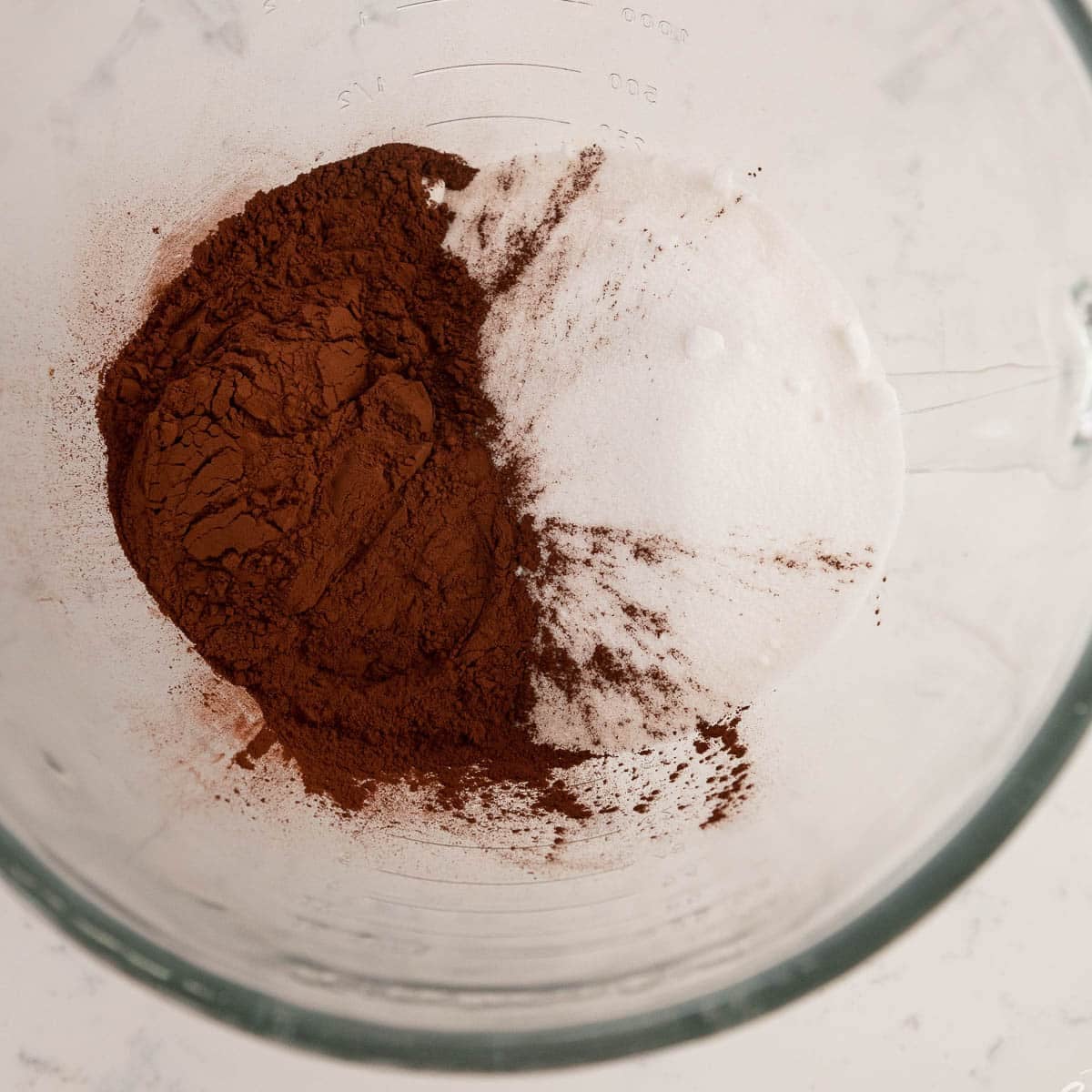
Table of contents

  • Do You Have To Age Egg Whites?
  • How To Age Egg Whites
  • What If I Forgot To Age My Egg Whites?

Do You Have To Age Egg Whites?

There are many people who say you do not need to age egg whites but if you are just starting out, this small step can help with success. Aging egg whites give you a little wiggle room in the mixing stage and are less prone to being over-mixed. With a little practice, you can stop using aged egg whites.

The famous pastry chef, Pierre Herme recommends aging your egg whites.

How To Age Egg Whites

  1. Wash and dry two small glass bowls or measuring cups.
  2. Wipe the bowl with some white vinegar or lemon juice to remove all traces of oil or fat.
  3. Separate your eggs using an egg separator or your hands, being sure not to get any egg yolk into the egg whites. Never crack your eggs directly into the final bowl, crack them over a small bowl and then transfer them to the final bowl. That way if you get some egg yolk in the bowl you don't contaminate the whole batch. hand separating eggs from above
  4. Place some plastic wrap over the top of the bowl.
  5. Poke a few holes in the top of the plastic wrap to allow the moisture to evaporate. plastic wrap covering egg whites in a measuring cup
  6. You can let the eggs stay in the fridge for up to four days.
  7. Allow your egg whites to come to room temperature before you use them. Room-temperature egg whites whip up better than cold egg whites.

What If I Forgot To Age My Egg Whites?

If you need aged egg whites right now, you can add ½ teaspoon of meringue powder (powdered egg whites) to your fresh egg whites. This will increase the amount of egg white protein and reduce the overall amount of water. The meringue is also already "relaxed" in its powdered form so it works pretty well in a pinch. Some pastry chefs work 100% with meringue powder when making macarons but I have not tried this method yet.

Recipe

hand separating eggs from above
Print Recipe
5 from 4 votes

How To Age Egg Whites

How to age egg whites to make macarons
Prep Time5 minutes mins
Cook Time0 minutes mins
Refrigeration1 day d
Total Time1 day d 5 minutes mins
Course: Dessert
Cuisine: French
Servings: 100 grams
Calories: 1kcal
Author: Liz Marek

Equipment

  • 2 glass bowls
  • 1 plastic wrap

Ingredients

  • 100 grams egg whites
US Customary - Metric

Instructions

  • separate your egg yolks from your egg whites carefully
  • place your egg whites into a small glass bowl or container
  • Cover your egg whites with plastic wrap
  • Poke a few holes in the top of the plastic wrap
  • Allow the egg whites to age for a minimum of 24 hours (up to four days).
  • Allow your egg whites to come to room temperature before use them.

Notes

aging your egg whites allows the protein in the egg whites to relax which makes a more flexible macaron batter that is less prone to over- folding

Nutrition

Serving: 10z | Calories: 1kcal | Carbohydrates: 0.01g | Protein: 0.1g | Fat: 0.002g | Sodium: 2mg | Potassium: 2mg | Sugar: 0.01g | Calcium: 0.1mg | Iron: 0.001mg
close up of french macarons on a plate

December 5, 2022 Cookies

French Macaron Recipe

This French macaron recipe is written for beginners. If you have ever wanted to make perfect French macarons with crispy shells, puffy feet, and no hollows, this is the post for you. I have been making macarons since pastry school, and I have packed in every tip, troubleshooting note, and trick I have learned along the way. Read the whole post before you start. It is your best chance at perfect macarons on the first try. If you want a slightly more advanced version once you have the technique down, my Italian macaron recipe uses cooked sugar syrup for a more stable meringue.

Quick Glance: French Macaron Recipe

  • Recipe Name: French Macaron Recipe
  • Why You'll Love It: Crisp shells, soft chewy centers, puffy feet, no hollows. The classic Parisian cookie made foolproof for the home baker.
  • Time and Difficulty: Intermediate. About 20 minutes prep, 15 minutes bake, 20 minutes resting.
  • Main Ingredients: Almond flour, powdered sugar, egg whites, granulated sugar, and cream of tartar.
  • Method: French meringue (raw egg whites whipped cold with sugar) folded into sifted almond flour and powdered sugar, piped, rested, and baked at 300°F.
  • Texture and Flavor: Crispy on the outside, soft and slightly chewy in the middle, sweet, delicate, and nutty.
  • Quick Tip: Wipe every tool and bowl with white vinegar before you start. The slightest trace of grease will keep your meringue from whipping properly.
ChatGPT
Google AI
Perplexity
Grok
Add us as a trusted site on Google
[feast_advanced_jump_to]

What Is A Macaron (Mack-UH-RONE)

The very first time I tried a macaron (not a macaroon) was back in pastry school. I had never eaten a cookie like that in my life. Crispy on the outside, soft and chewy in the middle, and that little bite of creamy filling sandwiched between two delicate, round shells. French macarons instantly became one of my favorite cookies to make because they seem SO fancy, but once you nail the technique, they are easy to make.

There are two main kinds of macarons, French and Italian. The names refer to the type of meringue used, not the country the cookie is from. (I once posted a video explaining the difference, and it went crazy viral with people arguing macarons were invented in France or Italy. The cookie's origin is a different story from the meringue method.)

French meringue is made by whipping raw egg whites cold with sugar added gradually until you reach stiff peaks. It is the simplest of the three classic meringues. No heat, no cooked sugar syrup, just whipping. That is what we are doing in this recipe.

Italian meringue is made by streaming hot sugar syrup into whipping egg whites. It is more stable than French meringue and can produce more reliable macarons, but the hot sugar step intimidates a lot of beginners. If you want to graduate to that method later, my Italian macaron recipe walks through the whole thing.

(Note: Swiss meringue is the third classic meringue. It is made by warming egg whites and sugar over a bain marie until the sugar dissolves, then whipping cold. People sometimes confuse Swiss with French. They are not the same thing, and you do not need a bain marie for this recipe.)

The whipped meringue then gets folded into sifted powdered sugar and almond flour. The water from the egg whites turns into steam during the bake and lifts the piped batter to create those tiny feet. That folding process is called macaronage, and it is the most important step. The one that decides whether your shells come out smooth or cracked, full or hollow, perfect or close-but-not-quite.

After making thousands of these, I can tell you that even pastry chefs mess up macarons sometimes. They are sensitive. Oven temperature matters. Your bowl matters. Even the humidity in your kitchen matters. So take a deep breath. Making macarons is not about getting them perfect on the first try. It is about understanding what is happening in the bowl and learning from each batch.

⭐️⭐️⭐️⭐️⭐️ Reader Review

I used your recipe, and the shells came out fantastic. It ended up taking about 15/16 minutes to finish baking. I also didn't age the eggs in the fridge, but they were still fantastic. The first time, my shells grew perfectly. Thanks for spending the time building this.- Emily Dean

Why This French Macaron Recipe Works

Three things make this recipe beginner-friendly without sacrificing the result.

Aged egg whites build a stronger meringue. Egg whites that sit in the fridge for 2 to 4 days lose a small amount of water through the shell, which concentrates the proteins and lets them whip into a more stable, stronger foam. Stronger meringue means more forgiving macaronage. You can fold a few extra strokes without the batter collapsing on you.

Cream of tartar plus optional meringue powder protects the meringue. Cream of tartar is an acid that stabilizes egg-white foam, slowing the proteins from over-whipping into a dry, broken meringue. Meringue powder (the optional ingredient in this recipe) is dried egg whites with stabilizers built in. It is the safety net for beginners. Add it and you can practically over-whip the meringue without it falling apart.

Whipping on medium speed, not high. Most people crank the mixer too high to get to stiff peaks fast. Medium speed is better for macarons because it produces smaller, stronger air bubbles that hold their shape through the macaronage. High speed makes big, weak bubbles that pop during folding and contribute to hollow shells.

The technique that ties it all together is macaronage, the folding step. The goal is to deflate the meringue just enough that the batter flows in a slow, lazy ribbon when you lift the spatula, but still holds its shape on top of itself for a few seconds before melting back in. Too much fold, and your shells spread flat with no feet. Too little fold and your shells crack and develop hollows. There is a sweet spot, and finding it is the whole game.

French Macaron Ingredients

This recipe is one of the rare ones where you really cannot substitute anything except the flavor, filling, and color. Every ingredient does specific structural work. For a full list of the brands and tools I use, check out my macaron essentials storefront.

bowls of ingredients and tools for macarons

Almond flour. Not almond meal. Almond flour is finer, blanched (skin removed), and gives macaron shells their structure and signature smooth top. If large pieces remain after sifting, discard them and add back the same weight of fresh flour so your ratios stay accurate.

Powdered sugar. Sifted with the almond flour, it gives sweetness, smoothness, and a glossy finish to the shells. The cornstarch in store-bought powdered sugar also helps absorb extra moisture.

Granulated sugar. Whipped into the meringue to stabilize and sweeten. Some pastry chefs prefer superfine (caster) sugar because it dissolves faster, but regular granulated sugar works perfectly.

Egg whites. Aged in the fridge 2 to 4 days, then brought to room temperature before whipping. Fresh egg whites work but are less stable. Avoid carton egg whites from the grocery store; they rarely whip well. Room-temperature whites whip faster and to a greater volume than cold ones.

Cream of tartar. An acid that stabilizes the meringue and slows over-whipping. Not strictly required, but it gives beginners a wider margin for error.

Meringue powder (optional). Dried egg whites with stabilizers. A safety net that makes the meringue almost impossible to over-whip. Highly recommended for your first few attempts.

Salt. A pinch sharpens the flavor and balances the sweetness.

Vanilla extract. Or any other extract you want to flavor the shells with.

Gel or powdered food coloring. Liquid food coloring will throw off the batter consistency. Use gel or powder for vibrant color without adding water.

Before You Begin

A few setup steps that matter as much as the recipe itself.

baking tray lined with parchment paper and macaron templates
Hands wiping down tools with vinegar.
  • Age your egg whites. Crack and separate 2 to 4 days ahead, store the whites in a covered container in the fridge. Take them out 2 to 3 hours before mixing so they reach room temperature.
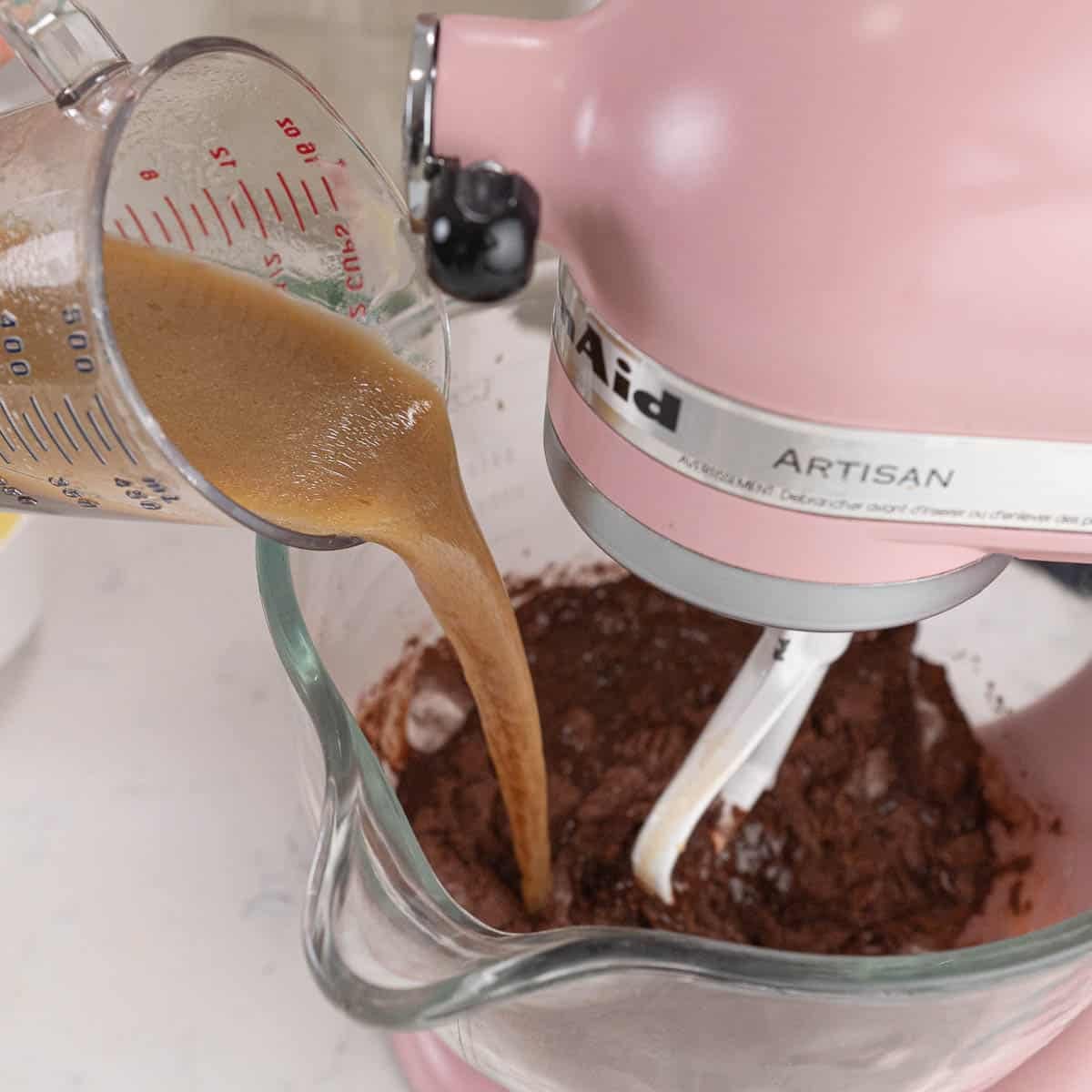
  • Wipe every tool with white vinegar. Bowl, whisk, paddle, spatula, even the inside of the mixer bowl. Vinegar removes any trace of grease that would keep your meringue from whipping. This is the step beginners skip and then wonder why their meringue won't form peaks.
  • Preheat your oven to 300°F (148°C).
  • Trim your parchment to fit the pan exactly. Or use silicone mats with pre-printed macaron templates. If you use my free macaron template, place it under the parchment, trace the circles, then flip the parchment so the marker side is down.
  • Measure every ingredient with a kitchen scale. Macarons are not a recipe where cup measurements work. Weight is non-negotiable.

How To Make Macaron Batter Step-By-Step

Refer to the recipe card for exact weights and timing.

powdered sugar and almond flour in a food processor bowl
  1. Process the dry ingredients. Pulse the almond flour, powdered sugar, and a pinch of salt in a food processor in 5-second increments, three times. This breaks down any clumps and gives you a finer mixture for smoother shells.
Woman sifting macaron dry ingredients into a clear glass bowl.
  1. Sift the dry mixture. Sift through a fine-mesh strainer into a large bowl to remove any large bits of almond. If you remove a lot, weigh what was removed and add back the same weight of fresh almond flour to keep your ratios right.
foamy egg mixture in a metal bowl
  1. Whip the meringue to soft peaks. Place egg whites, cream of tartar, and meringue powder (if using) into your stand mixer with the whisk attachment. Whisk on medium speed until foamy and you reach soft peaks. Medium speed gives you smaller, stronger air bubbles than high speed.
hand sprinkling a bowl of sugar into a bowl of whipping egg whites.
  1. Add the granulated sugar gradually. Sprinkle in the granulated sugar slowly while whisking on slow until all of it is added.

PRO TIP: Stay on medium the whole time. The temptation is to crank it up to speed things up, but high speed produces big, weak bubbles that pop during macaronage and lead to hollow shells.

Close up of thick meringue batter on a whisk attachment over a mixing bowl.
  1. Whip to stiff peaks: Continue whisking on medium until you reach stiff, glossy peaks. The meringue should hold a sharp tip when you lift the whisk and not flop over.
Lightly pink meringue on the whisk attachment above a mixing bowl.
  1. Add flavor and color. Add the vanilla and your gel or powdered food coloring. Mix briefly just to combine.

PRO TIP: This is THE step. Macaronage deflates the meringue just enough that the batter flows. Too much and your shells spread flat. Too little and they crack and hollow out.

spatula folding macaron batter in a bowl
  1. Macaronage: fold in the dry ingredients. Add ⅓ of the almond flour mixture to the meringue. Fold by scooping the spatula down to the bottom, up the side, and over the top. Rotate the bowl a quarter turn and repeat. Add the next ⅓, fold. Add the final ⅓, fold.

    Watch the video in the recipe card below for a full demonstration on macaronage.
Macaron batter flowing off a pink spatula in a "V" shape.
  1. Test the batter. When the batter flows off the spatula in a "V" shape, and the V settles back into itself within 10 to 20 seconds, you are done. Another good test: bang the bowl firmly onto the counter once. If the batter settles into itself, it is ready. If it stays mounded, keep folding. If it spreads instantly into a puddle, you have overmixed (next time will be better, that batch will still bake, but will be flat).
macaron batter in a piping bag
  1. Prepare your piping bag. Fit a pastry bag with a #12 round piping tip (or a similar Ateco 804-806). Cut the bag, insert the tip, twist the tip and bag together to seal the bottom and prevent leaks.

    Fold the top of the bag down over your hand or set the bag in a tall glass for stability. Scoop the batter in with a rubber spatula. Lay the bag flat on the counter and push all the batter to the bottom to remove air, then twist the top.
pastry bag full of macaron batter piping circles on a baking sheet
  1. Pipe the shells. Hold the bag straight up and down, about 1 inch above the parchment. Center the tip over a circle on your template. Squeeze without rotating until the batter reaches just inside the circle line, then stop squeezing. Make a small quick "C" motion with the tip to release without leaving a peak.
hand holding a needle above unbaked macarons
  1. Tap the trays. Once all shells are piped, lift the pan about 6 inches and drop it onto the counter a few times. This pops any air bubbles that would crack your shells in the oven. Use a toothpick to pop any visible bubbles that survived.

    Carefully remove the template from under the shells.
finger touching the top of a rested unbaked macaron
  1. Rest the shells. Let them sit at room temperature for 15 to 30 minutes until they form a skin. They should be dry to the touch and not stick to your finger when you press lightly. This drying step is what creates the puffy feet and prevents cracking. Do not rest longer than 30 minutes or the shell can get too thick to expand properly.
hands piping a dot of macaron batter in the corner of a baking sheet
  1. Anchor the parchment. Place a small dab of macaron batter under each corner of the parchment so it does not blow around in the oven.
knife lifting a macaron off a baking tray
  1. Bake at 300°F (148°C). Bake for 10 minutes, then rotate the pan front to back. Continue baking another 2 to 5 minutes (most batches finish at 12 to 15 minutes total). Bake time depends on your oven and humidity. I usually test to see if a shell is done by gently lifting with a knife and if it releases easily they are done. If it sticks give it another minute and check again.
close up of pink macarons
  1. Fill and sandwich. Fill the cooled shells with your filling of choice. Some great options: easy buttercream, white chocolate ganache (recipe in the card below), raspberry filling, lemon curd, chocolate ganache, or pretty much any cake filling.

Common French Macaron Problems To Avoid

Macarons are one of those bakes where the issue is right there on the cookie. Cracks, hollows, missing feet, lopsided shells, all of them tell you something specific about what went wrong. Here's how to read the signs and fix them on the next batch.

Different macaron shells on a sheet pan.
  • Cracked shells. Too many trapped air bubbles, the oven was too hot, or you skipped the resting step before baking. Tap the pan harder before resting, drop the oven temp by 10°F, or rest longer until truly dry to the touch.
  • Hollow shells. Most often caused by overmixed batter or an unstable meringue. Whip on medium (not high) for stronger bubbles. Stop folding the second the batter flows in a slow ribbon, not a fast one.
  • No feet. The batter was too wet (overmixed) or the shells did not rest long enough to form a skin. Always rest until the surface is dry to the touch.
  • Lopsided shells. Uneven piping, or your oven has hot spots and uneven airflow. Pipe straight down (not at an angle) and rotate the pan halfway through baking.
  • Wrinkled or pitted tops. Usually undermixed batter. The meringue was too stiff and trapped uneven amounts of air. Continue folding until the batter is smooth and lava-like.
  • Browned shells. Oven is too hot or they baked too long. Check at the 10-minute mark and pull as soon as a shell releases cleanly.
  • Sticky shells stuck to parchment. Underbaked. Bake another 1 to 2 minutes. The release test is your best doneness signal.
  • Meringue won't whip to stiff peaks. A trace of grease on the bowl, whisk, or yolk in the whites. Re-wipe everything with white vinegar and start over with a clean batch of whites.

Final Thoughts

Macarons are one of those recipes where the first batch teaches you more than the recipe ever can. They are sensitive, but they are not magic. Once you understand what macaronage is doing (deflating the meringue just enough to let it flow without breaking it), and you trust your kitchen scale, the technique becomes second nature.

The biggest piece of advice I can give beginners: do not try to combine a complicated flavor with your first attempt. Make plain shells with a vanilla buttercream filling first. Once you have nailed the shells, then play with flavors like chocolate, strawberry, or pistachio. Adding cocoa powder or pistachio paste changes the batter chemistry, and you do not want to be debugging both your technique and your flavor on the same batch.

Keep notes on each batch. Time of year, humidity, oven temp, batter consistency, what your feet looked like. Within three or four batches you will start to see your own patterns and adjust. That is the secret of every pastry chef who makes these look easy.

French Macaron FAQs

Can I convert this recipe to cups?

No. Macarons are one of the few recipes where weight measurements are non-negotiable. Even a small variation in the almond flour or sugar amount can throw off the batter and cause cracked, hollow, or footless shells. Use a digital kitchen scale.

How do I fix hollow macaron shells?

Hollow shells are almost always caused by overmixing the batter or by an unstable meringue. Three fixes: whip your meringue on medium speed instead of high (smaller, stronger bubbles), stop folding the moment the batter flows in a slow ribbon, and use cream of tartar plus meringue powder for extra stability. Make sure your shells are fully baked, an underbaked shell can also collapse and look hollow.

Why don't my macarons have feet?

Usually, it was because the batter was too wet (overmixed) or the shells did not rest long enough to form a skin before baking. The skin is what holds the surface in place while the steam below pushes up to create the feet. Rest at room temperature for 15 to 30 minutes until the surface is dry to the touch and does not stick to your finger.

Why are my macarons delicate and wrinkled?

Wrinkled or pitted tops usually mean the batter was undermixed. The meringue was too stiff and trapped uneven amounts of air, which causes the surface to sink unevenly as it cools. Continue folding until the batter is smooth and flows like slow-moving lava off the spatula.

Why did my macarons crack on top?

Cracking comes from trapped air bubbles, an oven that is too hot, or skipping the resting step. Tap the pan firmly on the counter several times after piping to release big bubbles, use a toothpick on any visible ones, and always rest the shells until truly dry to the touch before baking. If the cracks persist, drop your oven temperature by 10 to 15°F and try again.

How do you store macarons?

Filled macarons keep best refrigerated in an airtight container for 3 to 5 days. The flavor and texture actually improve after 24 hours of "maturing" in the fridge as the filling moistens the shell slightly. To freeze, place filled macarons on a tray to freeze solid first, then transfer to a zip-top bag for up to 3 months. Thaw in the refrigerator overnight before serving.

Why does my meringue keep collapsing or refusing to whip?

Almost always grease. Even the smallest trace of fat on the bowl, whisk, or in the egg whites will keep them from whipping properly. Wipe every tool with white vinegar before you start, and crack each egg into a separate small bowl before adding the whites to your mixer so a stray bit of yolk does not contaminate the whole batch.

Can I age my egg whites at room temperature instead of in the fridge?

It is not recommended. Aging egg whites at room temperature is a food safety risk because raw eggs can develop bacteria. The fridge slows that while still letting moisture evaporate through the shell, which is what makes the proteins stronger. Two to four days in the fridge is the sweet spot.

Do I have to use a food processor on the dry ingredients?

It helps a lot. Pulsing the almond flour and powdered sugar together breaks up clumps and creates a finer, more uniform mix that gives you smoother shells. If you do not have a food processor, sift the dry ingredients twice through a fine-mesh strainer and discard any large pieces.

More Macaron Recipes To Try

  • close up of three macarons on a plate
    Italian Macaron Recipe
  • close up of three pistachio macarons
    Pistachio Macaron with White Chocolate Buttercream
  • closeup of chocolate macarons in metal bowl
    Chocolate Macaron Recipe
  • strawberry macaron
    Soft and Chewy Strawberry Macarons

Leave Me A Review
⭐️⭐️⭐️⭐️⭐️

If you tried this French Macaron Recipe or any other recipe on my blog, please leave a 🌟 star rating and let me know how it goes in the comments. I love hearing from you!

Recipe

close up of french macarons on a plate
Print Recipe
4.94 from 186 votes

French Macaron Recipe

How to make crispy, crunchy, chewy french macarons! Follow this recipe for tips on how to properly fold macaron batter, avoid hollow shells and other problems.
Prep Time20 minutes mins
Cook Time15 minutes mins
Resting time20 minutes mins
Total Time1 hour hr 8 minutes mins
Course: Dessert
Cuisine: American
Servings: 36 cookies
Calories: 99kcal
Author: Liz Marek

Equipment

  • Kitchen Scale
  • Stand Mixer
  • Parchment Paper
  • Piping Bag
  • 802 Round Piping Tip
  • Food processor

Ingredients

  • 4 ounces almond flour
  • 8 ounces powdered sugar
  • ¼ teaspoon salt
  • 4 ounces egg whites aged overnight in the fridge and brought to room temperature
  • ¼ teaspoon cream of tartar
  • ½ teaspoon meringue powder optional
  • 2 ounces granulated sugar super fine
  • 1 teaspoon vanilla extract
  • 1 drop gel food coloring optional

White Chocolate Ganache Filling

  • 7 ounces white chocolate
  • 4 ounces heavy cream
  • 1.5 ounces unsalted butter
  • 1 whole vanilla bean or 1 teaspoon extract
US Customary - Metric

Instructions

Before you Begin

  • Age your egg whites 2-4 days ahead of making your macarons. Crack and separate the eggs and store the whites in a container covered in plastic wrap.
  • Take your egg whites out of the fridge 2-3 hours in advance. Room-temperature egg whites whip up better than cold egg whites.
  • Begin by wiping your bowls, whisk, and tools down with some white vinegar. This will remove every trace of oil from the surface and help ensure the perfect macaron.
  • Preheat your oven to 300ºF (148ºC).
  • Trim the parchment paper to the size of your pan so that it fits perfectly inside or use silicone mats with pre-printed macaron templates on them.
  • Place the macaron template under the parchment or make your own template by tracing circles that are roughly 1.5" wide and spaced about 1" apart. Turn the parchment over so that the marker does not transfer to your cookies.
  • Measure out all your ingredients carefully using a food scale and set them aside. Having your ingredients ready to go will help ensure success.

Making the Macaron Batter

  • Place your dry ingredients (almond flour, powdered sugar, and salt) into your food processor. Process for 5-second increments, three times. Shake the container as needed to ensure even mixing.
  • Place your strainer over a large bowl.
  • Sift the almond flour mixture to remove any large bits of almond. If you have to remove a lot, make sure to add the same amount of almond flour back in so that your batter ratio is not thrown off.
  • Place your egg whites, cream of tartar, and meringue powder (optional) into the bowl of your stand mixer with the whisk attachment attached.
  • Begin whisking your egg whites on medium speed until you reach soft foamy peaks. Medium speed will produce smaller, stronger air bubbles than whipping at high speed.
  • Sprinkle in the granulated sugar slowly while whisking on slow until it's all added and continue whisking on medium until you reach stiff peaks.
  • Add in your food coloring and vanilla. Mix until just combined.
  • Add ⅓ of your almond mixture into your meringue and fold together by scooping up under your batter, running along the side and bringing the batter up and over the top. Rotate the bowl and repeat with the the second and third portion of the almond mixture. .
  • Continue folding until the batter flows off the spatula in a "V" and sits on the top of the batter for a few seconds before it dissolves back into the batter.
  • Another test you can do is to firmly bang your bowl onto the counter to see if the batter settles into itself. If it does, it's ready. If it doesn't move it still needs more mixing.
  • Prepare your piping bag with a #12 round piping tip by cutting the end of the piping bag off and inserting the tip into the bag.
  • Twist the piping tip and bag together to seal the bottom of the piping bag and then press the bag into the tip so that the filling does not leak out of the piping bag.
  • Fold the top of the piping bag down over your hand and scoop the macaron batter into the piping bag with a rubber spatula. Or you can place the piping bag into a tall glass so both your hands are free.
  • Lay the bag flat on the counter and push all the batter to the bottom of the piping bag so there are no air bubbles and then twist the top to prevent leaking. Tie the top into a knot if desired.
  • When ready to pipe, pull the piping tip out and move the batter down into the piping tip by squeezing the batter gently. Pro-tip: When you are not piping, hold the piping bag straight up to prevent leaking. When ready to pipe turn the bag over and immediately begin piping.

Piping the Macarons

  • Hold the piping bag straight up and down over a circle, about 1" away from the prepared baking sheets.
  • Begin squeezing, do not rotate or move your bag.
  • The piping tip opening should be touching the macaron at all times.
  • Stop piping just inside the circle.
  • Make a small quick "C" circular motion with the tip to remove it from the piped cookie. Try not to just lift up because this will leave little peaks on top of your cookies.
  • After all your macarons are piped, lift your pan up about 6" and drop it onto your work surface a few times. This helps pop any large bubbles that may have got trapped in your batter pop so they don't crack your macarons.
  • Use a needle or toothpick to fix any bubbles if you still have some.
  • Don't forget to remove the templates under the parchment paper before baking.
  • Allow the macarons to sit at room temperature for 15-30 minutes to develop a "skin" on them before baking. You should be able to lightly touch the top of the cookie and the batter will not stick to your finger. Do not leave your macarons out to dry for longer than 30 minutes or the shell can get too thick and your macaron shells won't develop feet.
  • Remove the template and place a small dab of macaron batter under the corner of each piece of parchment paper to keep it from blowing all over the place in the oven.
  • Bake the macarons in the oven at 300ºF for 10 minutes. Rotate the pan after 5 minutes to promote even baking as well as let some of the steam out of the oven which helps to prevent cracking.
  • Test one macaron by gently lifting it from the parchment paper with a knife. If it releases, your macarons are done. If it's sticking, continue baking and check every minute until they release.
  • Remove the baking tray from the oven and pull the parchment off the pan by sliding it gently onto a wire rack so that your macarons do not continue to bake.

Making White Chocolate Ganache

  • Combine your chocolate and cream together in a microwave-safe bowl.
  • Heat the mixture for one minute then whisk together.
  • Continue heating the mixture in 30-second increments until the chocolate is melted and everything is mixed together smoothly.
  • Add the butter and vanilla, then stir together until it's melted and combined.
  • Place the ganache into a piping bag and flatten the mixture out until it is pretty thin.
  • Place the ganache into the freezer for about 10 minutes to help it set up.
  • Push the ganache to the end of the piping bag with a bowl scraper.
  • Cut a small ⅛" hole in the bottom of the piping bag and begin filling your macaron shells with the ganache.
  • Place a second shell on top and now your macarons are complete!

Video

Notes

About the egg whites
  • Age 2 to 4 days in the fridge for a stronger meringue.
  • Bring to room temperature before whipping.
  • Avoid carton egg whites, they rarely whip well.
About the equipment
  • Glass or metal bowls only. Plastic holds onto trace grease that breaks meringue.
  • Silicone mats with pre-printed templates are the easiest setup for beginners.
  • A kitchen scale is required. Cup measurements do not work for this recipe.
Substitutions and add-ins
  • Cream of tartar is optional but stabilizing. Replace with 1 teaspoon of lemon juice if needed.
  • Meringue powder is optional but highly recommended for first-timers.
  • Sub vanilla for almond, lemon, peppermint, or any extract you like.
  • Use gel or powdered food coloring only. Liquid colors throw off the batter.
Make-ahead and storage
  • Filled macarons keep 3 to 5 days refrigerated in an airtight container.
  • Freeze filled macarons up to 3 months. Thaw overnight in the fridge.
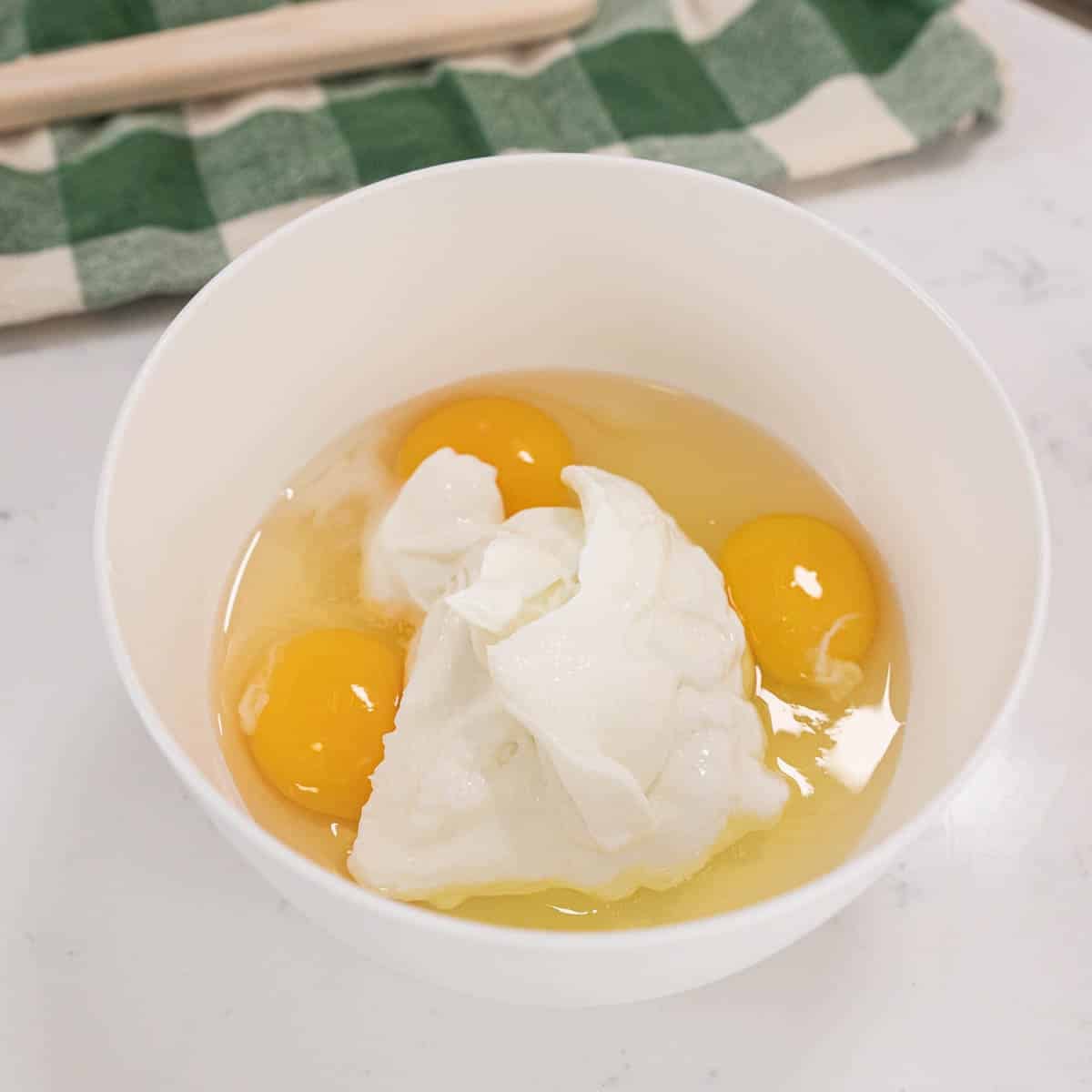
  • Unfilled shells keep 1 week at room temperature in an airtight container.
Critical do-nots
  1. Don't substitute almond meal for almond flour. Almond meal is coarser and gives gritty shells.
  2. Don't whip the meringue on high speed. Medium produces stronger, smaller bubbles.
  3. Don't skip wiping every tool with vinegar. Trace grease will keep the meringue from whipping.
  4. Don't overmix the batter past the slow ribbon stage. Hollow, flat shells.
  5. Don't open the oven door during the first 10 minutes of baking. The shells will collapse.
  6. Don't use carton egg whites. Use fresh whites aged in the fridge.
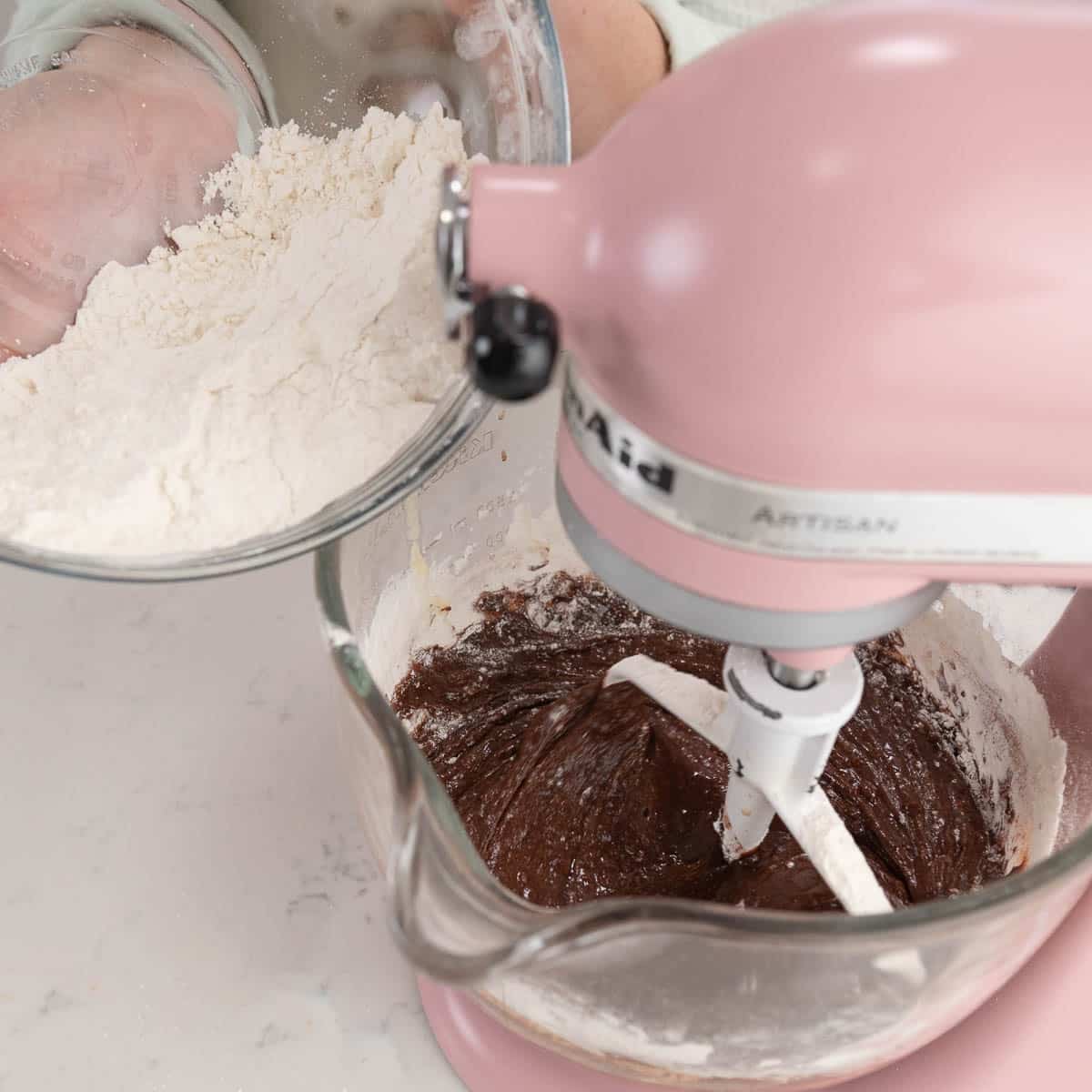
Nutrition

Serving: 1cookie | Calories: 99kcal | Carbohydrates: 12g | Protein: 1g | Fat: 5g | Saturated Fat: 3g | Polyunsaturated Fat: 0.1g | Monounsaturated Fat: 1g | Trans Fat: 0.04g | Cholesterol: 7mg | Sodium: 27mg | Potassium: 28mg | Fiber: 0.3g | Sugar: 11g | Vitamin A: 77IU | Vitamin C: 0.05mg | Calcium: 20mg | Iron: 0.1mg

isomalt sculpted to look like succulents in a terrarium

December 1, 2022 Course Preview

Isomalt Succulent Terrarium Tutorial

Skill level: Intermediate

Guest instructor Sidney Galpern is back for another isomalt extravaganza.

In this tutorial, Sidney breaks down how to make a 100% isomalt succulent terrarium. Sidney shows how to form and pull 3 different kinds of succulents, along with creating the terrarium with super-clear, bubble-free glass panes. Sidney offers a ton of tips and tricks on getting your isomalt this clear and how to work with it.

Sidney also shows hand-painting techniques and airbrushing on the succulents and which color products can actually paint onto isomalt and how to seal the color in.

There's a lot to cover in this tutorial, so let's get our tools together and let's get started!

1:44:49 Minutes of Instruction

What You Will Learn

  • How to create a 100% isomalt succulent terrarium
  • Learn how to form and pull 3 different isomalt succulents
  • How to create super-clear no-bubbles isomalt glass panes
  • Learn how to paint and airbrush onto the succulents and seal in the color

Isomalt pulled and sculpted to look like succulents in a terrarium

Tutorial Chapters

  1. Making The Clear Isomalt Walls 3:15
  2. Coloring The Isomalt 16:07
  3. Pulling The Isomalt 20:50
  4. Making The Zebra Succulent 28:16
  5. Reheating The Isomalt 44:37
  6. Making The Echevaria 46:48
  7. Making The Burro's Tail 59:25
  8. Cutting Off The Corners 1:16:36
  9. Assembling The Terrarium Pt.1 1:19:18
  10. Shading The Succulents 1:22:20
  11. Adding The Secondary Colors 1:31:18
  12. Hand Painting The Zebra Succulent 1:37:41
  13. Assembling The Terrarium Pt.2 1:41:19
  14. Arranging The Succulents 1:42:33

Downloads

Materials List

Isomalt Terrarium Template

isomalt sculpted to look like succulents in a terrarium

December 1, 2022 Paid Video

Isomalt Succulent Terrarium

Skill level: Intermediate

Guest instructor Sidney Galpern is back for another isomalt extravaganza.

In this tutorial, Sidney breaks down how to make a 100% isomalt succulent terrarium. Sidney shows how to form and pull 3 different kinds of succulents, along with creating the terrarium with super-clear, bubble-free glass panes. Sidney offers a ton of tips and tricks on getting your isomalt this clear and how to work with it.

Sidney also shows hand-painting techniques and airbrushing on the succulents and which color products can actually paint onto isomalt and how to seal the color in.

There's a lot to cover in this tutorial, so let's get our tools together and let's get started!

1:44:49 Minutes of Instruction

What You Will Learn

  • How to create a 100% isomalt succulent terrarium
  • Learn how to form and pull 3 different isomalt succulents
  • How to create super-clear no-bubbles isomalt glass panes
  • Learn how to paint and airbrush onto the succulents and seal in the color

Tutorial Chapters

  1. Making The Clear Isomalt Walls 3:15
  2. Coloring The Isomalt 16:07
  3. Pulling The Isomalt 20:50
  4. Making The Zebra Succulent 28:16
  5. Reheating The Isomalt 44:37
  6. Making The Echevaria 46:48
  7. Making The Burro's Tail 59:25
  8. Cutting Off The Corners 1:16:36
  9. Assembling The Terrarium Pt.1 1:19:18
  10. Shading The Succulents 1:22:20
  11. Adding The Secondary Colors 1:31:18
  12. Hand Painting The Zebra Succulent 1:37:41
  13. Assembling The Terrarium Pt.2 1:41:19
  14. Arranging The Succulents 1:42:33

Downloads

Materials List

Isomalt Terrarium Template

slice of white chocolate raspberry cake on a plate

November 29, 2022 Cake

White Chocolate Raspberry Cake

In this delicious white chocolate raspberry cake recipe, three white chocolate cake layers are paired with white chocolate ganache and white chocolate buttercream frosting balanced with bright raspberry filling. Pair this cake with cream cheese frosting, lemon curd, or really any combination of frostings and fillings.slice of white chocolate raspberry cake on a plate

White chocolates' signature flavor is a combination of sweet cocoa butter, milk, and vanilla. It's rich and creamy, and extra sweet, but that balances perfectly with tart fruits. This layer cake is perfect for a holiday table, wedding cake, bridal shower, baby shower, or just for fun! 

Table of contents

  • Ingredients
  • How to Make White Chocolate Raspberry Cake
    • Making White Chocolate Cake
    • Making Raspberry Filling
    • Making White Chocolate Ganache
    • Making White Chocolate Buttercream
    • Assembling and Decorating the Cake
  • Tips for Baking From Scratch
  • FAQ
  • Related Recipes

Ingredientsbowls of ingredients for white chocolate raspberry cake

White chocolate: It is important to find real white chocolate for this recipe to turn out well. Look at the ingredients on the package and make sure cocoa butter is listed as the main ingredient. Most white chocolate chips or candy melts have palm oil instead of cocoa butter. The cocoa butter ensures an authentic flavor, proper melting, and smooth texture. I like Lindt brand of white chocolate bars. 

Raspberries: I was lucky to find some tart fresh raspberries for the top of the cake, but I chose to use frozen to make the filling. Frozen berries are picked and flash-frozen at the peak of their season, so the fresh flavor is preserved. If you are short on time or effort you can also just store-bought raspberry jam. 

I chose to make a filling to keep my layers neat, but you could absolutely put fresh berries in the center for a fresh flavor and bright pops of color when you cut the cake.

How to Make White Chocolate Raspberry Cake

This white chocolate raspberry cake has four components; white chocolate cake, white chocolate ganache, white chocolate buttercream, and raspberry filling.

Adding a layer of ganache to the cake is not required, but it intensifies the flavor of white chocolate. Plus it's used for making white chocolate buttercream. Real white chocolate adds more structure to this cake and buttercream, making it perfect for decorating and stacking.  fork slicing into a piece of white chocolate raspberry cake

Making White Chocolate Cake

  1. Preheat your oven to 335ºF and prepare three, 6-inch cake pans with cake goop or another preferred pan release. You can also use two, 8-inch cake pans. hands brushing cake release onto cake pans
  2. Heat the milk in the microwave and then add your chopped white chocolate to the milk. Let it sit for 5 minutes. hands pouring a bowl of white chocolate into a container of milk
  3. Microwave in 10-second increments until the chocolate is melted, then whisk until all the chocolate is melted into the milk. whisk mixing together container of milk
  4. Add the vanilla extract and set aside allowing the white chocolate milk to cool down to just above room temperature. It doesn't take a lot of heat to melt white chocolate, so just be patient as it melts into the milk. 
  5. In a large mixing bowl, combine your flour, baking powder, and salt, whisk briefly and set aside.hand adding a small bowl of powder into a large bowl of flour
  6. Place the butter and sugar in a stand mixer with a paddle attachment and cream it until light and fluffy, about 1 to 2 minutes. Scrape the bottom of the bowl. butter and sugar in the bottom of a clear stand mixer bowlcreamed butter and sugar int he bottom of a clear bowl
  7. Add the egg whites one at a time to the butter mixture while mixing on medium speed and let each fully combine before adding the next. Make sure your egg whites are just above room temperature, as cold egg whites will curdle the batter. hand pouring a container of egg whites into a glass bowl
  8. Add ⅓ of your dry flour mixture to the bowl and mix on low speed until just combined. bowl of flour pouring into a glass stand mixer bowl
  9. Then add ½ of your wet ingredients, then alternate adding the rest of the dry and liquids and mix until combined.hand pouring wet ingredients into batter in glass stand mixer bowlfinished cake batter mixed in a stand mixer bowl
  10. Divide the batter into the prepared cake pans. Pro-tip: To get even layers, use a food scale to make sure the batter is divided evenly. three cake pans on a granite table filled with batter
  11. Bake the cakes at 335º F for 25-35 minutes or until a toothpick comes out clean when poked in the center. clean toothpick coming out of a baked cake in the oven
  12. Let the cake layers cool for ten minutes and then turn them out onto a wire cooling rack. Wrap the cakes in plastic wrap while they're still warm and place them into the freezer to flash chill. This locks in the moisture. oven mitts lifting a cake pan off of a cake layer
  13. Once they're cold but not frozen you can then trim off the brown edges of your cakes. This is optional but makes for really pretty layers.knife cutting the dome off of a cake

Making Raspberry Filling

  1. Add the raspberries and sugar to a medium-sized saucepan over medium heat.hand pouring sugar onto raspberries in a pot.
  2. Heat the raspberry puree until it begins to bubble. Increase the heat to medium-high heat if needed.cooked raspberries in a pot with a spatula.
  3. In a small bowl, combine the water and the Clear-Jel (or cornstarch) and mix until smooth. Don't just add the Clear-Jel (or cornstarch) directly to the hot liquid or you'll end up with lumps of thickener in your filling.hands whisking water and cornstarch together.
  4. Add the Clear-Jel mixture (or cornstarch slurry) to the hot liquid and mix for one more minute to thicken the mixture.hand pouring cornstarch slurry into cooked raspberries in a pot while stirring.
  5. Add in the lemon juice and zest and continue cooking for one more minute.hand pouring lemon zest into pot with raspberry mixture.
  6. Transfer the mixture to a heat-proof container and cover it with plastic wrap (so that it's touching the surface) and allow it to cool to room temperature or place it into the refrigerator to cool before using it. raspberry filling being poured into a mason jar.

Making White Chocolate Ganache

  1. If using a bar, chop the white chocolate with a knife into smaller pieces. hand chopping white chocolate with a knife.
  2. Microwave the chocolate in a microwave-safe bowl for 1 minute to soften.
  3. Bring the heavy whipping cream to a simmer in a pot over the stove.
  4. Pour the warm cream over the chocolate and make sure all of the chocolate is fully covered, then set for 5 minutes. heavy cream pouring into a bowl of white chocolatewhisk pushing white chocolate chips underneath cream.
  5. Whisk gently to combine the cream and chocolate until it comes together and is smooth and creamy. If the chocolate isn't fully melted, microwave it in 30-second increments. Set the ganache aside to use in the buttercream and the cake layers.Whisk drizzling white chocolate ganache in a bowl.

Making White Chocolate Buttercream

  1. Place the egg whites and powdered sugar in a stand mixer bowl. Attach the whisk and combine the ingredients on low, then whip on high for 1-2 minutes to dissolve the powdered sugar.egg whites and powdered sugar in a glass bowl.
  2. Add in the salt and vanilla extract.hand adding salt to a bowl of mixing buttercream.
  3. Add the butter in chunks and whip with the whisk attachment for about 8 to 10 minutes until light and fluffy. It will look curdled at first. This is normal. It will also look pretty yellow. Keep whipping. hand adding a chunk of butter to a bowl of buttercream.whisk attachment full of buttercream.
  4. If your buttercream looks curdled, remove about ⅓ cup of buttercream and melt it in the microwave for 10 to 15 seconds until JUST barely melted. Pour it back into the whipping buttercream to bring it all together.
  5. Add in the warm or room temperature ganache, if it's slightly warm it will help emulsify the buttercream. hand scooping a cup of white chocolate ganache with a measuring cup.
  6. Whip the buttercream on high with the whisk attachment for 2 minutes until it's very white, light, and shiny. If it tastes more like white chocolate than butter then it is ready to go!spatula holding fluffy white chocolate buttercream.
  7. Switch to a paddle attachment and mix on low for 15-20 minutes to make the buttercream very smooth and remove air bubbles. This isn't required but if you want really creamy frosting, you don't want to skip it.paddle attachment in smooth buttercream.

Assembling and Decorating the Cake

  1. Once your cake layers are very cold (or partially thawed if frozen) and trimmed, place your first layer on a cake board and coat the layer with a thin layer of white chocolate ganache. hand spreading ganache over a cake layer with an offset spatula
  2. Cover the ganache with a thin layer of white chocolate buttercream and then pipe a dam around the cake edge, making a pool to fill with your raspberry filling. piping bag creating a dam of buttercream on a cake
  3. Carefully fill the pool with raspberry filling, and take it easy on the amount because as you add more layers on top, the weight can squeeze the filling out and cause leaks on the sides of your cake. spoon spreading raspberry filling on a cake layer
  4. Spread a thin layer of buttercream on the next layer of cake that you are going to put on top of the raspberry, I do this so the raspberry doesn't soak into the top layer. It's not totally necessary, I just choose to do this because I like the way it looks when I cut it. spatula spreading buttercream on the bottom of a cake layer.
  5. Repeat the layering process for the next two layers of cake, ganache, buttercream dam, and raspberry filling. spoon spreading raspberry filling on a second cake layer.
  6. Give the cake an even crumb coat with your offset spatula and place it in the freezer to chill and firm up before moving on to the final coating and decorating. cake covered in a crumb coat of buttercream.
  7. Once the cake is firm to the touch, apply the final coating of white chocolate frosting and smooth it with a cake scraper, place the cake on the serving board. hand holding a bench scraper against a cake
  8. Pipe dollops of buttercream around the top edge of the cake alternating with a fresh berry, make sure the dollops and berries are touching, creating a dam to keep the raspberry filling in the center. Then fill in the center with your remaining raspberry filling. spatula spreading raspberry filling on the top center of a cake
  9. Shave leftover white chocolate with a potato peeler to create shavings. potato peeler scraping against a bar of white chocolate
  10. While the buttercream is still somewhat soft press white chocolate shavings into the sides of the cake. hand pressing white chocolate shavings onto the side of the cake
  11. Chill the cake for 30 minutes to allow the buttercream to set. The cake can sit out at room temperature for a few hours until you are ready to serve it. It will cut cleaner slices if it is cold, but the flavor will be better at room temperature, especially the white chocolate!land lifting a slice out of a white chocolate cake

Tips for Baking From Scratch

  1. Weigh your ingredients to avoid cake failure. Using a kitchen scale for baking is super easy and gives you the best results every single time. 
  2. Make sure all your cold ingredients are room temperature or slightly warm (butter, milk, eggs, to create a cohesive batter. Curdled batter causes cakes to collapse.
  3. No buttermilk? You can make your own buttermilk 
  4. Need more help with making your first cake? Check out my how to decorate your first cake blog post. 
  5. Make your own pan release (cake goop!) The best pan release ever! 
  6. Chill your cakes before frosting and filling. You can cover a frosted and chilled cake in fondant if you wish. This cake is also great for stacking. I always keep my cakes chilled in the refrigerator before delivery for easy transportation.

FAQ

What if my white chocolate doesn't have cocoa butter? 

Then it isn't really white chocolate, its candy melts. It will not have the same melting behavior or flavor as real white chocolate, so it is recommended to achieve the best possible outcome for this cake. 

What flavors go well with white chocolate?

You can get creative and use any fruit you like! Just make sure you make a filling that is thick enough to not run out of the layers of your cake. This would be a fun cake to experiment with lemon, lime, passion fruit, or strawberry.

Can I just add white chocolate to my regular white cake batter or a white cake mix?

No, because of the fat and sugar content of white chocolate, it will alter the balance of the ingredients and the results will not be great. The cake will be too sweet and too heavy due to the added fat and sugar, the recipe needs to be balanced to accommodate added ingredients. 

Can I bake this white chocolate raspberry cake in a bundt pan?

Yes, this cake can be baked in any size pan. You will have to adapt the baking time for each pan, with about 45-55 minutes for a bundt.

Related Recipes

Lemon Raspberry Cake

Blackberry Lime Cake

Pistachio Cake with raspberry filling

Orange Creamsicle Cake

Recipe

slice of white chocolate raspberry cake on a plate
Print Recipe
4.79 from 144 votes

White Chocolate Raspberry Cake

The creamy richness of melted white chocolate combined with bright tart raspberries creates a perfect harmony in this white chocolate raspberry cake! Indulge in a soft and buttery cake that's rich in every bite, yet not too sweet.
Prep Time30 minutes mins
Cook Time30 minutes mins
Chilling Time30 minutes mins
Total Time1 hour hr 30 minutes mins
Course: Dessert
Cuisine: American
Servings: 8 cups
Calories: 2201kcal
Author: Liz Marek

Equipment

  • 3 6" x 2" cake pans or two 8"
  • 1 Stand Mixer with the paddle and whisk attachments

Ingredients

White chocolate cake

  • 10 ounces whole milk room temperature
  • 6 ounces white chocolate
  • 1 teaspoon vanilla extract
  • 14 ounces all purpose flour
  • 2 ½ teaspoons baking powder
  • ½ teaspoon salt
  • 6 ounces unsalted butter softened
  • 12 ounces granulated sugar
  • 6 large fresh egg whites not boxed, room temperature

Raspberry filling

  • 12 ounces fresh or frozen raspberries (3 cups)
  • 5 ounces granulated sugar (¾ cup)
  • 2 Tablespoons cornstarch or clear jel
  • 1 ounce cold water (2 Tablespoons)
  • 1 Tablespoon fresh lemon juice
  • 1 whole lemon zest

White chocolate ganache

  • 24 ounces white chocolate
  • 8 ounces heavy whipping cream

White chocolate buttercream

  • 6 ounces pasteurized egg whites
  • 20 ounces powdered sugar sifted if not from a bag
  • 24 ounces unsalted butter softened
  • 2 teaspoons vanilla extract
  • ½ teaspoon salt
  • 1 ½ cups white chocolate ganache either freshly made or warmed up to a pourable consistency
US Customary - Metric

Instructions

Making White Chocolate Cake

  • Preheat your oven to 335ºF and prepare three, 6-inch cake pans with cake goop or another preferred pan release. You can also use two, 8-inch cake pans. 
  • Heat the milk in the microwave and then add your chopped white chocolate to the milk. Let it sit for 5 minutes. 
  • Microwave in 10-second increments until the chocolate is melted, then whisk until all the chocolate is melted into the milk. 
  • Add the vanilla extract and set aside allowing the white chocolate milk to cool down to just above room temperature. It doesn't take a lot of heat to melt white chocolate, so just be patient as it melts into the milk. 
  • In a large mixing bowl, combine your flour, baking powder, and salt, whisk briefly and set aside.
  • Place the butter and sugar in a stand mixer with a paddle attachment and cream it until light and fluffy, about 1 to 2 minutes. Scrape the bottom of the bowl. 
  • Add the egg whites one at a time to the butter mixture while mixing on medium speed and let each fully combine before adding the next. Make sure your egg whites are just above room temperature, as cold egg whites will curdle the batter. 
  • Add ⅓ of your dry flour mixture to the bowl and mix on low speed until just combined. 
  • Then add ½ of your wet ingredients, then alternate adding the rest of the dry and liquids and mix until combined.
  • Divide the batter into the prepared cake pans. Pro-tip: To get even layers, use a food scale to make sure the batter is divided evenly. 
  • Bake the cakes at 335º F for 25-35 minutes or until a toothpick comes out clean when poked in the center. 
  • Let the cake layers cool for ten minutes and then turn them out onto a wire cooling rack. Wrap the cakes in plastic wrap while they're still warm and place them into the freezer to flash chill. This locks in the moisture. 
  • Once they're cold but not frozen you can then trim off the brown edges of your cakes. This is optional but makes for really pretty layers.

Making Raspberry Filling

  • Add the raspberries and sugar to a medium-sized saucepan over medium heat.
  • Heat the raspberry puree until it begins to bubble. Increase the heat to medium-high heat if needed.
  • In a small bowl, combine the water and the Clear-Jel (or cornstarch) and mix until smooth. Don't just add the Clear-Jel (or cornstarch) directly to the hot liquid or you'll end up with lumps of thickener in your filling.
  • Add the Clear-Jel mixture (or cornstarch slurry) to the hot liquid and mix for one more minute to thicken the mixture.
  • Add in the lemon juice and zest and continue cooking for one more minute.
  • Transfer the mixture to a heat-proof container and cover it with plastic wrap (so that it's touching the surface) and allow it to cool to room temperature or place it into the refrigerator to cool before using it. 

Making White Chocolate Ganache

  • If using a bar, chop the white chocolate with a knife into smaller pieces. 
  • Microwave the chocolate in a microwave-safe bowl for 1 minute to soften.
  • Bring the heavy whipping cream to a simmer in a pot over the stove.
  • Pour the warm cream over the chocolate and make sure all of the chocolate is fully covered, then set for 5 minutes. 
  • Whisk gently to combine the cream and chocolate until it comes together and is smooth and creamy. If the chocolate isn't fully melted, microwave it in 30-second increments. Set the ganache aside to use in the buttercream and the cake layers.

Making White Chocolate Buttercream

  • Place the pasteurized egg whites and powdered sugar in a stand mixer bowl. Attach the whisk and combine the ingredients on low, then whip on high for 1-2 minutes to dissolve the powdered sugar.
  • Add in the salt and vanilla extract.
  • Add the butter in chunks and whip with the whisk attachment for about 8 to 10 minutes until light and fluffy. It will look curdled at first. This is normal. It will also look pretty yellow. Keep whipping. 
  • If your buttercream looks curdled, remove about ⅓ cup of buttercream and melt it in the microwave for 10 to 15 seconds until JUST barely melted. Pour it back into the whipping buttercream to bring it all together.
  • Add in the warm or room temperature ganache, if it's slightly warm it will help emulsify the buttercream. 
  • Whip the buttercream on high with the whisk attachment for 2 minutes until it's very white, light, and shiny. If it tastes more like white chocolate than butter then it is ready to go!
  • Switch to a paddle attachment and mix on low for 15-20 minutes to make the buttercream very smooth and remove air bubbles. This isn't required but if you want really creamy frosting, you don't want to skip it.

Assembling and Decorating the Cake

  • Once your cake layers are very cold (or partially thawed if frozen) and trimmed, place your first layer on a cake board and coat the layer with a thin layer of white chocolate ganache. 
  • Cover the ganache with a thin layer of white chocolate buttercream and then pipe a dam around the cake edge, making a pool to fill with your raspberry filling. 
  • Carefully fill the pool with raspberry filling, and take it easy on the amount because as you add more layers on top, the weight can squeeze the filling out and cause leaks on the sides of your cake. 
  • Spread a thin layer of buttercream on the next layer of cake that you are going to put on top of the raspberry, I do this so the raspberry doesn't soak into the top layer. It's not totally necessary, I just choose to do this because I like the way it looks when I cut it. 
  • Repeat the layering process for the next two layers of cake, ganache, buttercream dam, and raspberry filling. 
  • Give the cake an even crumb coat with your offset spatula and place it in the freezer to chill and firm up before moving on to the final coating and decorating. 
  • Once the cake is firm to the touch, apply the final coating of white chocolate frosting and smooth it with a cake scraper, place the cake on the serving board. 
  • Pipe dollops of buttercream around the top edge of the cake alternating with a fresh berry, make sure the dollops and berries are touching, creating a dam to keep the raspberry filling in the center. Then fill in the center with your remaining raspberry filling. 
  • Shave leftover white chocolate with a potato peeler to create shavings. 
  • While the buttercream is still somewhat soft press white chocolate shavings into the sides of the cake. 
  • Chill the cake for 30 minutes to allow the buttercream to set. The cake can sit out at room temperature for a few hours until you are ready to serve it. It will cut cleaner slices if it is cold, but the flavor will be better at room temperature, especially the white chocolate!

Notes

Cake:
  • Make sure the white chocolate you're using has cocoa butter as an ingredient in it. (I like Lindt chocolate bars!)
  • Bring all your ingredients to room temperature or even a little warm (eggs, buttermilk, butter, etc) to ensure your batter does not break or curdle. 
  • Use a scale to weigh your ingredients (including liquids) unless otherwise instructed (Tablespoons, teaspoons, pinch etc). Metric measurements are available in the recipe card. Scaled ingredients are much more accurate than using cups and help ensure the success of your recipe.
  • Practice Mise en Place (everything in it's place). Measure out your ingredients ahead of time and have them ready before you start mixing to reduce the chances of accidentally leaving something out.
  • Chill your cakes before frosting and filling. You can cover a frosted and chilled cake in fondant if you wish. This cake is also great for stacking. I always keep my cakes chilled in the refrigerator before delivery for easy transporting. 
Buttercream: 
  • Pasteurized egg whites are heat treated, often come in a box, and are safe to eat without cooking. If you only have access to fresh egg whites, try making Swiss meringue buttercream instead and adding white chocolate ganache to that. 

Nutrition

Serving: 1cup | Calories: 2201kcal | Carbohydrates: 242g | Protein: 20g | Fat: 133g | Saturated Fat: 83g | Polyunsaturated Fat: 5g | Monounsaturated Fat: 35g | Trans Fat: 3g | Cholesterol: 287mg | Sodium: 507mg | Potassium: 700mg | Fiber: 4g | Sugar: 197g | Vitamin A: 3362IU | Vitamin C: 13mg | Calcium: 375mg | Iron: 3mg
close up of sticky buns on a blue plate

November 21, 2022 Bread

Sticky Buns Recipe

Homemade sticky buns recipe made from soft, sweet dough, a cinnamon sugar filling, and a sticky glaze. Flip them out onto a plate and let that ooey-gooey sticky glaze drip. Soft, sticky, and oh-so-addictive!

close up of sticky buns on a blue plate

Making your own sticky buns from scratch is SO much better than a can. It's not hard at all to do. This sweet dough is so versatile for all types of desserts like cinnamon rolls and danish! Prep these sticky buns the day before and pop them in the oven for the most amazing fresh sticky buns right out of the oven. Enjoy them with your morning coffee.

What's in this blog post

  • Sticky Buns Ingredients
  • How to Make Sticky Buns
    • Making the Sweet Dough
    • Making the Caramel Pecan Glaze
    • Assembling the Sticky Buns
    • Baking the Sticky Buns
  • FAQ
  • Related Recipes

Sticky Buns Ingredientsbowls of ingredients for sticky buns

Instant yeast is my preference when making bread because it will rise SO much faster than active dry yeast.

All-purpose flour or bread flour will work for this sweet dough recipe. Bread flour has a higher protein content and will give a slightly better texture to your buns. Either is okay.

Corn syrup adds that gooey texture to the glaze on top of the sticky buns. You can add more if you want a more "ooze" to your sticky buns. Use less for a more set caramel on top.

Pecans are the traditional topping for sticky buns, but you can use any type of nut that you prefer. Or just leave them out entirely!

How to Make Sticky Buns

Sticky buns have three components: the sweet dough, the cinnamon sugar filling, and the caramel pecan glaze. I find it easiest to make all three and assemble my sticky buns in one day, then refrigerate them overnight. Then, proof and bake them the next morning for breakfast.

Making the Sweet Dough

  1. Warm the milk to 110ºF.
    hand holding a thermometer in a container of milk reading 110 degrees
  2. Add the flour, yeast, and sugar to the bowl of your stand mixer with the dough hook attachment and mix the dry ingredients briefly. You can make this dough without a stand mixer, you'll just have to knead by hand for 10 to 15 minutes.
    dry ingredients for sticky buns in a glass stand mixer bowl
  3. Add the softened butter in chunks and mix on low speed until it is broken up and distributed amongst the flour.
    butter added to a glass bowl with dry ingredients for sticky buns
  4. Slowly drizzle in the warm milk while mixing on low, and mix until the flour starts to stick together.
    container of milk pouring into a glass stand mixer bowl
  5. Then add in your eggs one at a time and mix until combined.
    hand pouring a bowl of eggs into a stand mixer bowl
  6. Finally, add your salt. Salt is added last to give the yeast a chance to get a little coating in flour and butter. Salt kills yeast, so this gives the yeast an upper hand in the battle. 
  7. Mix the dough on medium speed with the dough hook until the dough pulls away from the sides of the bowl and bounces back when you touch it. Once it forms a smooth ball, turn off the mixer. This can take 5-10 minutes. 
    dough mixing in a stand mixer bowl
    dough mixing in a stand mixer bowl
  8. Remove the dough from the mixing bowl and knead it for a few minutes on the counter.
    hands pressing down on a ball of dough
  9. Roll the dough into a nice tight ball.
    smooth dough ball on a counter top
  10. Place the dough ball in a large bowl greased with oil and cover it with plastic wrap.
    hands covering a ball of dough in a glass bowl with plastic wrap
  11. Place the bowl in a warm place and let the dough rise until it doubles in size. This can take anywhere from 30 to 60 minutes but will vary depending on the temperature of your room. 80°F is the best temperature for proofing, so I like to put it in my turned-off oven with the light on or on top of my dishwasher while it's running.
    hands placing a glass bowl of dough on top of a cool stove

Making the Caramel Pecan Glaze

  1. Add the softened butter, brown sugar, and cinnamon to a large bowl and mix with a whisk or electric mixer until it's light and fluffy.
    electric hand mixer combining a butter mixture
  2. Drizzle in the corn syrup and vanilla and mix until combined. Use less corn syrup if you want a thicker consistency for your glaze.
    pouring a container of corn syrup into a glaze mixture
  3. Spread the glaze paste into a 9" or 10" round cake pan (or baking dish of your choice) around the sides and the bottom of the pan.
    spatula spreading a glaze paste around the sides of a cake pan
  4. Sprinkle pecans over the top of the glaze and set the pan aside. We're going to flip this upside down and it will become the gooey, caramelized top of the sticky buns.
    hand sprinkling pecans onto the bottom of a cake pan

Assembling the Sticky Buns

  1. Make the cinnamon sugar filling by adding the softened butter, sugar, and cinnamon to a large bowl and mixing until smooth with a whisk or hand mixer.
    butter, cinnamon, and sugar in a glass bowl
    electric hand mixer blending a cinnamon sugar filling
  2. When your dough has doubled in size, remove it from the bowl onto a lightly floured surface.
    hands pressing dough on a counter
  3. Roll out the dough with a rolling pin into a large rectangle, ½ inch thick, about 12" wide, and 15" long.
    hands rolling out dough with a wooden rolling pin
  4. Smear the cinnamon-sugar mixture on top of the rolled-out dough, leaving about ½ inch of space along the outside edges of the dough.
    cinnamon sugar filling spread out on a rectangle of dough
  5. Sprinkle pecans on top of the dough, making sure to evenly space them out.
    hand sprinkling pecans on top of a rectangle of dough
  6. Tightly roll from the long side of the dough into a log shape.
    hands rolling the long side of dough into a log
  7. Score 8 evenly-spaced sections in the top of the dough with a sharp knife, then carefully cut them into buns. The dental floss trick unfortunately won't work because it can't cut through the pecans, so a serrated knife works best.
    serrated knife cutting through a log of dough
  8. Assemble the cinnamon buns in your prepared pan on top of the glaze mixture. It's okay if they are almost touching, just make sure that your pan is big enough to easily fit all of the buns. They will proof again before baking.
    hands assembling sticky buns into a cake pan
  9. Cover the pan with a clean kitchen towel and place them in a warm area for 30 to 60 minutes until the buns are crowded in the pan and poofy. They don't have to be fully doubled in size, but your rise time will also be determined by the size of your pan.
    covering unbaked sticky buns in a cake pan with a tea towel

Baking the Sticky Buns

  1. Bake at 350°F for 45-60 mins until the tops are golden brown and the internal temperature in the center reads 190°F. Use a thermometer to check, as the baking times will vary depending on what size pan you use.
    hand pushing a cake pan of sticky buns into an oven
  2. Make sure you place a sheet pan on the rack under the rolls to catch the drips, or it will burn on the bottom of your oven. I had to switch my sheet pans out a few times to avoid a lot of smoke from the burning sugar. This was a lot easier to clean a sheet pan than the bottom of my oven! 
    hand pushing a blue sheet pan underneath sticky buns in an oven
  3. If the top is getting too brown and the center is not done, lightly cover it with a piece of foil to slow down the browning on top. 
  4. Remove the finished sticky buns from the oven and cool in the pan for 5 minutes. We want the caramel glaze to set slightly, but still be hot so that it comes out of the pan.
    thermometer inserted in baked sticky buns reading 190 degrees
  5. Place a large serving plate on top of your pan and carefully flip the sticky buns upside down.
    hands placing a blue plate upside down over sticky buns in a pan
    oven mitts lifting a cake pan off of baked sticky buns
  6. If there is any remaining caramel in the pan, put it back in the oven for 5 minutes then drizzle the caramel on top of the sticky buns.
    hand lifting a sticky bun

FAQ

What's the difference between sticky buns and cinnamon rolls?

Sticky buns and cinnamon rolls are quite similar. They are both made with a sweet enriched dough and filled with cinnamon and sugar. The dough is rolled up and then cut into slices. The main difference is that cinnamon rolls are glazed with cream cheese frosting, while sticky buns are covered in pecans and caramel glaze.

How do you store sticky buns?

Sticky buns can be kept at room temperature for 2 days or refrigerated for up to a week. They need to be kept in an airtight container to prevent the sticky buns from drying out.

Can you reheat sticky buns?

Yes! Sticky buns are best eaten warm, so microwaving them for 30 seconds to 1 minute will make the caramel gooey and the bread soft again.

Are honey buns and sticky buns the same thing?

Yes, honey buns and sticky buns are both a type of sweet bread filled with cinnamon and topped with nuts and caramel sauce. They're often called Chelsea buns in the UK, although these are more closely compared to cinnamon rolls.

How do you keep sticky buns soft?

Sticky buns can dry out by using too much flour, over-baking, or not storing them in an airtight container. Using a scale to weigh out your ingredients is important because you could accidentally be adding extra flour by using cups. Measuring by weight is much more accurate than volume.

Related Recipes

Cinnamon Rolls

Strawberry Cream Cheese Rolls

Christmas Panettone Recipe

Brioche Bread Recipe

Recipe

homemade sticky buns on a blue plate on top of a natural woven placemat
Print Recipe
4.88 from 8 votes

Sticky Buns Recipe

The best homemade sticky buns recipe from scratch with a gooey caramel pecan glaze and homemade sweet dough. Don't be intimidated by making bread at home, this recipe breaks it all down step by step. Make sure to eat them warm for the best soft and fluffy texture.
Prep Time20 minutes mins
Cook Time25 minutes mins
Proofing2 hours hrs 30 minutes mins
Total Time4 hours hrs 15 minutes mins
Course: Dessert
Cuisine: American
Servings: 8 Rolls
Calories: 945kcal
Author: Liz Marek

Equipment

  • 1 Stand mixer with dough hook
  • 1 9" or 10" cake pan or casserole dish
  • 1 Sheet pan (13"x18") or similar sized pan

Ingredients

Sweet Dough

  • 4 ounces milk 110ºF
  • 5 grams dried instant yeast
  • 14 ounces all-purpose flour or bread flour
  • 4 ounces unsalted butter softened
  • 2 ounces sugar
  • ½ teaspoon salt
  • 1 large egg room temperature

Cinnamon Filling

  • 4 ounces unsalted butter softened to almost melted
  • 4 ounces granulated sugar
  • 10 grams cinnamon
  • 2 ounces pecans chopped

Pecan Caramel Glaze

  • 8 ounces unsalted butter softened
  • 4 ounces granulated sugar
  • 4 ounces brown sugar light or dark
  • ½ teaspoon cinnamon
  • ½ teaspoon salt
  • 4 ounces corn syrup
  • 1 teaspoon vanilla extract
  • 3 ounces pecans chopped
US Customary - Metric

Instructions

Making the Sweet Dough

  • Warm the milk to 110ºF
  • Add the flour, yeast, and sugar to the bowl of your stand mixer with the dough hook attachment and mix the dry ingredients briefly. You can make this dough without a stand mixer, you'll just have to knead by hand for 10 to 15 minutes.
  • Add the softened butter in chunks and mix on low speed until it is broken up and distributed amongst the flour.
  • Slowly drizzle in the warm milk while mixing on low and mix until the flour starts to stick together.
  • Then add your eggs one at a time and mix until combined.
  • Finally, add your salt. Salt is added last to give the yeast a chance to get a little coating in flour and butter. Salt kills yeast, so this gives the yeast an upper hand in the battle. 
  • Mix the dough on medium speed with the dough hook until the dough pulls away from the sides of the bowl and bounces back when you touch it. Once it forms a smooth ball, turn off the mixer. This can take 5-10 minutes. 
  • Remove the dough from the mixing bowl and knead it for a few minutes on the counter.
  • Roll the dough into a nice tight ball.
  • Place the dough ball in a large bowl greased with oil and cover it with plastic wrap.
  • Place the bowl in a warm place and let the dough rise until it doubles in size. This can take anywhere from 30 to 60 minutes but will vary depending on the temperature of your room. 80°F is the best temperature for proofing, so I like to put it in my turned-off oven with the light on or on top of my dishwasher while it's running

Making the Caramel Pecan Glaze

  • Add the softened butter, brown sugar, and cinnamon to a large bowl and mix with a whisk or electric mixer until it's light and fluffy.
  • Drizzle in the corn syrup and vanilla and mix until combined. Use less corn syrup if you want a thicker consistency for your glaze.
  • Spread the glaze paste into a 9" or 10" round cake pan (or baking dish of your choice) around the sides and the bottom of the pan.
  • Sprinkle pecans over the top of the glaze and set the pan aside. We're going to flip this upside down and it will become the gooey, caramelized top of the sticky buns.

Assembling the Sticky Buns

  • Make the cinnamon sugar filling by adding the softened butter, sugar, and cinnamon to a large bowl and mixing until smooth with a whisk or hand mixer.
  • When your dough has doubled in size, remove it from the bowl onto a lightly floured surface.
  • Roll out the dough with a rolling pin into a large rectangle, ½ inch thick, about 12" wide, and 15" long.
  • Smear the cinnamon-sugar mixture on top of the rolled-out dough, leaving about ½ inch of space along the outside edges of the dough.
  • Sprinkle pecans on top of the dough, making sure to evenly space them out.
  • Tightly roll from the long side of the dough into a log shape.
  • Score 8 evenly-spaced sections in the top of the dough with a sharp knife, then carefully cut them into buns. The dental floss trick unfortunately won't work because it can't cut through the pecans, so a serrated knife works best.
  • Assemble the cinnamon buns in your prepared pan on top of the glaze mixture. It's okay if they are almost touching, just make sure that your pan is big enough to easily fit all of the buns. They will proof again before baking.
  • Cover the pan with a clean kitchen towel and place them in a warm area for 30 to 60 minutes until the buns are crowded in the pan and poofy. They don't have to be fully doubled in size, but your rise time will also be determined by the size of your pan.

Baking the Sticky Buns

  • Bake at 350°F for 45-60 mins until the tops are golden brown and the internal temperature in the center reads 190°F. Use a thermometer to check, as the baking times will vary depending on what size pan you use.
  • Make sure you place a sheet pan on the rack under the rolls to catch the drips, or it will burn on the bottom of your oven. I had to switch my sheet pans out a few times to avoid a lot of smoke from the burning sugar. This was a lot easier to clean a sheet pan than the bottom of my oven! 
  • If the top is getting too brown and the center is not done, lightly cover it with a piece of foil to slow down the browning on top. 
  • Remove the finished sticky buns from the oven and cool in the pan for 5 minutes. We want the caramel glaze to set slightly, but still be hot so that it comes out of the pan.
  • Place a large serving plate on top of your pan and carefully flip the sticky buns upside down.
  • If there is any remaining caramel in the pan, put it back in the oven for 5 minutes then drizzle the caramel on top of the sticky buns.

Video

Notes

  1. The best investment you can make when you're getting started with baking is a digital kitchen scale! Weighing your ingredients will help you avoid baking failure. Using a kitchen scale for baking is super easy and gives you the best results every single time. 
  2. Practice Mise en Place (everything in its place). Measure out your ingredients ahead of time and have them ready before you start mixing to reduce the chances of accidentally leaving something out.
  3. Make sure all of your cold ingredients (e.g. butter, eggs, milk) are at room temperature or a little warm. Why? Because we want to create an emulsion and allow the ingredients to fully mix together. 
  4. Sticky buns can be kept at room temperature for 2 days or refrigerated for up to a week. They need to be kept in an airtight container to prevent the sticky buns from drying out.
  5. Sticky buns are best eaten warm, so microwaving them for about 30 seconds will make the caramel gooey and the bread soft again

Nutrition

Serving: 1roll | Calories: 945kcal | Carbohydrates: 98g | Protein: 8g | Fat: 60g | Saturated Fat: 31g | Polyunsaturated Fat: 6g | Monounsaturated Fat: 20g | Trans Fat: 2g | Cholesterol: 147mg | Sodium: 326mg | Potassium: 195mg | Fiber: 4g | Sugar: 62g | Vitamin A: 1488IU | Vitamin C: 0.2mg | Calcium: 82mg | Iron: 3mg
stack of peanut butter cookies with a cut open one on top

November 16, 2022 Cookies

Chewy Peanut Butter Cookies

The perfect chewy peanut butter cookies with the classic criss-cross on top. A rich, buttery, soft, and chewy texture makes it a favorite at every cookie swap! The best part is that the dough freezes really well, so you can bake off a few cookies at a time and keep the rest in the freezer until you're ready to use it. Fresh-baked peanut butter cookies on demand! stack of peanut butter cookies with a cut open one on top

Pressing a criss-cross into each cookie ensures this dough will flatten out and bake evenly. This has been the traditional look of the best peanut butter cookies for more than 80 years. Personally, I don't think the cookie tastes the same without it! You can even add chocolate chips or peanuts to the top for some extra flavor.

Chewy Peanut Butter Cookies Ingredientsbowls of ingredients for peanut butter cookies

Peanut Butter: Crunchy peanut butter or smooth is a personal choice, but everyone in my house voted for creamy. I don't recommend using natural peanut butter because the separation in the jar makes it difficult to mix evenly in the dough, and we want to have a consistent perfect texture in each cookie. 

Brown Sugar: This is the key to making chewy cookies, and you can use light or dark brown sugar. The added molasses makes the best soft cookies. Using both kinds of sugar keeps the cookie soft and chewy but crisps up the exterior enough to keep it from spreading too much. 

Making Chewy Peanut Butter Cookies

  1. Combine the flour, baking soda, baking powder, and salt in a large bowl, whisk it briefly and set it aside.hand holding a whisk inside of a glass bowl of flour
  2. Add the butter and brown sugar to a large bowl and mix with an electric hand mixer on medium speed until it's smooth and light in color. Make sure you scrape the sides of the bowl. You can also use a stand mixer with a paddle attachment. large glass bowl filled with butter and sugarselectric mixer in a glass bowl of creamed butter and sugar
  3. Then, add the peanut butter and mix until it is smooth.bowl of peanut butter being added into a bowl of creamed butter and sugar
  4. Pour in the eggs one at a time and mix until they are combined.hand adding a bowl of eggs to a large bowl
  5. Add the dry ingredients to the bowl and fold them in with a spatula (or mix on low speed) until they're just combined.hand folding dry ingredients into peanut butter dough with a spatula
  6. Cover the dough with plastic wrap and chill cookie dough in the refrigerator for at least 3 hours or overnight. Pro-tip: Chilling is essential to getting that chewy texture in the cookies. If you don't chill the dough enough, your cookies will spread and become crispy in the oven.bowl of peanut butter cookie dough covered in plastic wrap
  7. Preheat your oven to 375°F and prepare a baking sheet with parchment paper.
  8. Scoop the cookie dough with a #2 scoop (or a ¼ measuring cup) into 2-2.5 ounce balls. This will make 24, 3" cookies.cookie scoop placing a ball of cookie dough onto a food scale
  9. Form the dough into balls with your hands and place them at least 2 inches apart on the cookie sheet. You will need a few cookie sheets if you're making a full batch.hands rolling peanut butter dough into a ballhand placing a ball of peanut butter cookie dough onto a baking sheet
  10. Using an extra large fork, press down once in each direction to give the cookie its signature criss-cross pattern on top. This is done so the cookie bakes and spreads evenly, and it's cute. large fork pressing indents into a peanut butter cookie dough balllarge fork pressing indents into a peanut butter cookie dough ball in the opposite direction
  11. Bake the cookies at 375°F for 13-15 minutes. The baking time may vary on your oven, but cookies shouldn't appear to be too browned when finished, just slightly golden and crisp on the edges. Take them out when they are set and look a little soft in the center. If they appear too wet in the middle give them 1-2 minutes more. Baked cookies will keep their soft texture if you store them in an airtight container.baking sheet with unbaked peanut butter cookies on topbaked peanut butter cookies piled on a cooling rack
  12. Use a large metal cookie cutter to form your warm peanut butter cookies into perfect circles. This is optional but will make them extra pretty!hand holding a metal circle cookie cutter on top of a peanut butter cookie
  13. Rest the cookies on the baking pan for 5 minutes, then place them onto a cooling rack. These chewy peanut butter cookies will last a room temperature stored in an airtight container for 4-5 days. You can also freeze the baked cookies or freeze the dough to have them at any time. They're delicious when served with a glass of cold milk!hand holding a large peanut butter cookie over a glass of milk

FAQ

How do I know when my peanut butter cookies are done? 

They will be slightly golden brown and look "set" on the edges, but soft in the center. 

Why do I need to refrigerate the dough before baking? 

This gives the flour time to fully hydrate. These cookies have a lot of fat in them between the butter and the peanut butter, so they will spread easily in the oven if they are not chilled. We want to even out the baking reaction time so that it all happens at the same time resulting in a perfect cookie.

Why is my cookie crispy and not soft and chewy? 

First make sure you weigh your ingredients, if the sugar or flour is off it can change the final outcome of your cookie. Too much flour will create dry cookies. Second, it could have baked a little too long, resulting in a crunchier cookie. Third, the dough might not have been chilled for long enough. 

Related Cookie Recipes

Nutella-stuffed chocolate chip cookies

Chewy double chocolate cookies

Snickerdoodle cookies

Red velvet-stuffed cookies

Recipe

stack of peanut butter cookies with a cut open one on top
Print Recipe
4.67 from 9 votes

Chewy Peanut Butter Cookies

These chewy peanut butter cookies are soft in the center, crispy on the edges, and have lots of peanut butter flavor. I dare you to eat one without milk! An easy recipe with simple ingredients that comes together in a snap.
Prep Time20 minutes mins
Cook Time15 minutes mins
Chilling Time3 hours hrs
Total Time35 minutes mins
Course: Dessert
Cuisine: American
Servings: 24 cookies
Calories: 265kcal
Author: Liz Marek

Ingredients

  • 3 cups all purpose flour
  • 1 teaspoon baking soda
  • ½ teaspoon baking powder
  • 1 teaspoon salt
  • 2 cups brown sugar dark or light
  • 1 cup unsalted butter softened
  • 1 cup smooth peanut butter
  • 2 large eggs
US Customary - Metric

Instructions

  • Combine the flour, baking soda, baking powder, and salt in a large bowl, whisk it briefly and set it aside.
  • Add the butter and brown sugar to a large bowl and mix with an electric hand mixer on medium speed until it's smooth and light in color. Make sure you scrape the sides of the bowl. You can also use a stand mixer with a paddle attachment.
  • Then, add the peanut butter and mix until it is smooth.
  • Pour in the eggs one at a time and mix until they are combined.
  • Add the dry ingredients to the bowl and fold them in with a spatula (or mix on low speed) until they're just combined.
  • Cover the dough with plastic wrap and chill cookie dough in the refrigerator for at least 3 hours or overnight. Pro-tip: Chilling is essential to getting that chewy texture in the cookies. If you don't chill the dough enough, your cookies will spread and become crispy in the oven.
  • Preheat your oven to 375°F and prepare a baking sheet with parchment paper.
  • Scoop the cookie dough with a #2 scoop (or a ¼ measuring cup) into 2-2.5 ounce balls. This will make 24, 3" cookies.
  • Form the dough into balls with your hands and place them at least 2 inches apart on the cookie sheet. 
  • Using an extra large fork, press down once in each direction to give the cookie its signature criss-cross pattern on top. This is done so the cookie bakes and spreads evenly, and it's cute. 
  • Bake the cookies at 375°F for 13-15 minutes. The baking time may vary on your oven, but cookies shouldn't appear to be too browned when finished, just slightly golden and crisp on the edges. Take them out when they are set and look a little soft in the center. If they appear too wet in the middle give them 1-2 minutes more. Baked cookies will keep their soft texture if you store them in an airtight container.
  • Use a large cookie cutter to form your warm peanut butter cookies into perfect circles. This is optional but will make them extra pretty!
  • Rest the cookies on the baking pan for 5 minutes, then place them onto a cooling rack.

Notes

  1. These chewy peanut butter cookies will last a room temperature stored in an airtight container for 4-5 days. You can also freeze the baked cookies or freeze the dough to have them at any time. They're delicious when served with a glass of cold milk!
  2. Freeze these peanut butter cookie dough balls for up to 2 months and bake them off when you want fresh cookies.
  3. Bring your butter to room temperature before creaming it with your sugars. Sugar will push through softened butter easier than cold butter. 

Nutrition

Serving: 1cookie | Calories: 265kcal | Carbohydrates: 32g | Protein: 5g | Fat: 14g | Saturated Fat: 6g | Polyunsaturated Fat: 2g | Monounsaturated Fat: 5g | Trans Fat: 0.3g | Cholesterol: 36mg | Sodium: 201mg | Potassium: 118mg | Fiber: 1g | Sugar: 19g | Vitamin A: 259IU | Calcium: 31mg | Iron: 1mg
Two cakes decorated for the holidays

November 15, 2022 Course Preview

Holiday Cake Techniques Tutorial

Skill level: Intermediate

Guest instructor Jennifer Reese from Good Gosh Ganache is back with another set of awesome cake tutorials. In this course, Jennifer breaks down how to use techniques that could be applied to Thanksgiving or Christmas cakes, featuring a checked fondant design, edible raffia, pumpkin and ornament decorations, two different kinds of bows, and plenty of other fun details.

2:00:43 Minutes of Instruction

What You Will Learn

  • How to make two different kinds of cakes using similar techniques
  • Learn how to make a checked fondant design covering cake tiers with tips and tricks on how to line up and execute the design flawlessly
  • How to make Christmas ornaments and pumpkins and two different kinds of bows

Poster of two cakes decorated for the holidays

Tutorial Chapters

  1. Making The Thanksgiving Pattern 1:42
  2. Paneling The Thanksgiving Cake 10:22
  3. Adding The Cakeboard 24:24
  4. Making The Christmas Ornaments 28:44
  5. Making The Pumpkins 44:56
  6. Making The Thanksgiving Bow 1:02:15
  7. Making The Holiday Bow 1:11:07
  8. Color Correcting The Bows 1:17:57
  9. Making The Raffia Pt.1 1:24:26
  10. Making The Maple Leaves 1:29:35
  11. Making The Raffia Pt.2 1:31:56
  12. Decorating The Leaves & Pumpkins 1:34:52
  13. Making The Snowflakes 1:36:13
  14. Assembling The Bows 1:37:09
  15. Decorating The Thanksgiving Tier 1:41:00
  16. Making The Maple Leaves 1:50:47

Downloads

Materials List

Two cakes decorated for the holidays

November 15, 2022 Paid Video

Holiday Cake Techniques

Skill level: Intermediate

Guest instructor Jennifer Reese from Good Gosh Ganache is back with another set of awesome cake tutorials. In this course, Jennifer breaks down how to use techniques that could be applied to Thanksgiving or Christmas cakes, featuring a checked fondant design, edible raffia, pumpkin and ornament decorations, two different kinds of bows, and plenty of other fun details.

2:00:43 Minutes of Instruction

What You Will Learn

  • How to make two different kinds of cakes using similar techniques
  • Learn how to make a checked fondant design covering cake tiers with tips and tricks on how to line up and execute the design flawlessly
  • How to make Christmas ornaments and pumpkins and two different kinds of bows

Tutorial Chapters

  1. Making The Thanksgiving Pattern 1:42
  2. Paneling The Thanksgiving Cake 10:22
  3. Adding The Cakeboard 24:24
  4. Making The Christmas Ornaments 28:44
  5. Making The Pumpkins 44:56
  6. Making The Thanksgiving Bow 1:02:15
  7. Making The Holiday Bow 1:11:07
  8. Color Correcting The Bows 1:17:57
  9. Making The Raffia Pt.1 1:24:26
  10. Making The Maple Leaves 1:29:35
  11. Making The Raffia Pt.2 1:31:56
  12. Decorating The Leaves & Pumpkins 1:34:52
  13. Making The Snowflakes 1:36:13
  14. Assembling The Bows 1:37:09
  15. Decorating The Thanksgiving Tier 1:41:00
  16. Making The Maple Leaves 1:50:47

Downloads

Materials List

half open croissant laying on top of two other croissants on a plate

November 10, 2022 Breakfast

Croissant Recipe

This classic French Croissant Recipe will help you conquer your fears in making your own at home! The crisp flaky layers and soft buttery center will have you making these regularly. A classic French staple recipe that's perfect for breakfast, brunch, or any occasion. half open croissant laying on top of two other croissants on a plate

The key to a flaky croissant is proper lamination, but you don't need a fancy dough sheeter or bread proofer to make these. If this is your first time making a homemade croissant recipe, don't worry. Learn from Chef Christophe how to make the puff pastry dough and laminate it all by hand! Make these delicious croissants ahead of time and freeze them before baking to save time.

Table of contents

  • Croissant Ingredients
  • How to Make Homemade Croissants
    • Making Croissant Dough
    • Making the Butter Block
    • Laminating the Dough
    • Assembling the Croissants
    • Proofing the Croissants
    • Baking the Croissants
  • FAQ
  • Related Recipes

Croissant Ingredientsbowls of ingredients for croissants laying on a table

High Gluten Flour is important when making bread because bread flour has more proteins which will develop more gluten. This is important for the croissants to hold their shape. 

Milk Powder is basically dehydrated milk. This is important for the croissants because the milk powder will help create super soft layers without adding extra moisture. 

European Butter has a higher fat percentage, which means the croissants will have amazing flavor and super flakey layers. Plugra or President are great brands you can find at the store and they have fat percentages over 80%.

Instant Yeast is fast acting and will help our croissant dough rise quickly and is easier to use than fresh levain. You can also use active dry yeast, but it will take about double the amount of time to proof.

How to Make Homemade Croissants

Making homemade croissants is a labor of love, and can be fairly time-consuming with all of the proofing and chilling. You can make them all in one day, but if you want to serve them for breakfast I recommend making the croissant dough, proofing it, making and chilling the butter block, laminating the dough, chilling that, then rolling out the croissants, placing them on a sheet pan and chilling them overnight. Then proof the croissants and bake them on the morning you're ready to serve.

Making Croissant Dough

  1. Add the cold water and instant yeast into the bowl of a stand mixer and gently whisk it to break up any lumps.hand adding a bowl of yeast into a white stand mixer bowl
  2. Next, add the milk powder, flour, sugar, and salt to the bowl of your stand mixer with the dough hook attachment and mix on low for a few seconds to combine.hand adding a bowl of sugar into a white stand mixer bowl
  3. Add the cold melted butter and mix on low speed for about 4 minutes.hand adding a bowl of melted butter into a white stand mixer bowl
  4. Mix for another 4 minutes on medium speed. If you don't have a stand mixer, you can knead by hand until the dough bounces back when you touch it.croissant dough in the white bowl of a stand mixer
  5. After the dough is done mixing, take it out and knead it by hand. Shape the dough into a ball by cupping both of your hands around your dough and moving the dough in small circular formations while the bottom of the dough is still touching the table. Repeat this over and over until your dough ball is tight, smooth, and well combined. hands holding a ball of croissant dough with the rough edges up
  6. Place your dough into a medium-sized bowl, cover it with plastic, and let it rise until it doubles in size. At room temperature (72°F) this will take about 2 hours to proof. In a warm environment (90°F), it will take about 1 hour. I like to place it in my oven with the light on and leave the door open.hands holding a glass bowl with a ball of croissant dough inside

Making the Butter Block

  1. Make sure to soften your butter before creating your butter block so that it's easy to roll out. You should be able to press a finger into the surface of the butter and easily make an indent.
  2. Lay out a large sheet of plastic wrap and place the butter in the center.rectangle of butter laying on top of sheet of plastic wrap
  3. Fold the plastic wrap to make an 8" by 8" square. This is the size that we'll want our butter block to be.hands holding a ruler over a square piece of plastic wrap and butter
  4. Roll the butter with a rolling pin into the corners of the plastic wrap until it is about ¼" thick.hands holding a wooden rolling pin over a butter block
  5. Refrigerate the butter block until your dough is ready.ruler measuring the thickness of a butter block

Laminating the Dough

  1. Once your dough has doubled in size, place it onto a lightly floured work surface and gently press it down with your hands.glass bowl with a ball of proofed croissant doughtwo hands pressing down croissant dough in a large circle
  2. Roll the dough into an 8" by 16" rectangle.rolling pin pressing on croissant dough
  3. Place the dough onto a sheet pan, wrap it in plastic wrap, and freeze it until it is firm for about 15 minutes.hands pressing plastic wrap over croissant dough on a sheet pan
  4. Take the cold butter block and dough out of the freezer and unwrap them.
  5. Place the butter block in the center of your dough.hands placing a butter block on top of croissant dough
  6. Fold the bottom and top of the croissant dough into the center of the butter block until they are touching.half a rectangle of croissant dough folded over half of a butter squarecroissant dough folded with a seam down the center
  7. Enclose the butter in the dough by pinching the edges of the dough with your fingers.two hands pinching the edge of a block of croissant dough and butter
  8. Tap the edges of the butter block with your rolling pin to make sure they have been pressed into the corners.wooden rolling pin on top of a block of croissant dough and butter
  9. Rotate the croissant dough 90 degrees so that the seam is down the middle. Pro-Tip: Work quickly so that the butter doesn't melt.hands holding a rolling pin on top of croissant dough
  10. Flour the bottom and top of the dough and roll it out to be ¼" thick, about an 8" by 22" rectangle.rolled out croissant dough on a table
  11. Do a book fold by folding the top and bottom to the center of the dough again.hands folding half of the dough towards the center
  12. Then fold the entire dough in half and do another 90-degree turn.hands folding croissant dough towards the centercroissant dough folded in half with a wooden rolling pin on top
  13. Gently roll the dough a little bit into a rectangular shape so that it is easier to cut out after chilling. You will feel your dough starting to get stretchy.rectangle of croissant dough
  14. Wrap the dough in plastic wrap and freeze it for 10 to 15 minutes.hands placing plastic wrap over the top of croissant dough on a baking sheet
  15. Do a second book fold by repeating steps 10 through 13. Brush off any excess flour.wooden rolling pin rolling croissant doughhands holding croissant dough in half
  16. Wrap the dough in plastic wrap and freeze it for another 15 to 30 minutes. Pro-Tip: If you want to make your croissant dough a day ahead, this is a good place to stop. Refrigerate the dough overnight, then proof and assemble them the next day.croissant dough covered in plastic wrap

Assembling the Croissants

  1. Take the croissant dough out and place it on a lightly floured surface with the short side of the folds facing to the side.
  2. Roll the dough lengthwise into a long rectangle. Roll until it is 4mm (1/32") thick and about 9" wide. Pro-Tip: Fold and unfold the dough as you're rolling it to flour the surface and keep it from sticking. If your gluten is very stretchy and not rolling out, let it rest for 15 minutes.rolled out croissant dough
  3. Cut out about 12 small triangles at an angle that are each 4" wide and about 9" long with a sharp knife or a pizza cutter. Pro-Tip: Mark the cuts first and use a ruler before cutting them.hands cutting triangles out of croissant dough with a knifetriangles of croissant dough
  4. Roll each triangle into a crescent shape by holding the wide base of the dough with your fingers and slowly rolling it tightly toward the point, making sure to tuck the dough in as you go. If you roll the croissant too loose, it will fall apart in the oven.two hands rolling a triangle of dough
  5. Set the rolled croissants onto a baking sheet lined with a piece of parchment paper and cover it with plastic wrap. If you're making these ahead of time, you can refrigerate the croissants at this stage and proof them in the morning before baking.hand placing rolled croissants onto a baking sheet

Proofing the Croissants

  1. Place the shaped croissants on a large sheet pan lined with parchment paper so that they are about 2" apart and are facing the same direction. You might need two sheet pans if your pans are small.evenly spaced unbaked croissant on a baking sheet
  2. Create a water bath by pouring some hot water (not boiling) into a large bowl or a small rectangular pan. hand placing a measuring cup of water onto a baking sheet inside an oven
  3. Stick the bowl or pan at the bottom oven rack to create steam.
  4. Place your croissants (uncovered) on the highest oven rack above the water bath. The ideal temperature for proofing croissants is between 76°F and 78°F.
  5. Make sure to turn your oven light on, then close the oven. (Do not open your oven too often to check on the croissants. This will let the humidity out and the croissants won't rise.)
  6. Proof for about 1 hour or until the croissants double in size and are jiggly. proofed and fluffy unbaked croissants

Baking the Croissants

  1. Preheat the oven to 370°F (190°C) in the convection mode of your oven.
  2. Create an egg wash by whisking together 3 egg yolks with 2 Tablespoons of water. Pro-tip: Pour the egg wash into a clean spray bottle to get a more even coating over your croissants.hands whisking a bowl of egg wash
  3. Brush a thin layer of egg wash all over each croissant, making sure to get the sides and bottom edges. Pro-Tip: Fill a clean spray bottle with the egg wash and spray the croissants for an even layer. croissants covered in egg wash on a baking sheet
  4. Bake your croissants for about 20 minutes until they are golden brown and flaky.golden brown baked croissants on a baking sheet
  5. These croissants are best eaten within 24 hours of baking, but they're best kept fresh by freezing them in an airtight container until serving. hands holding open a croissant to show the flaky inside layers

FAQ

Do you have to brush egg wash before baking croissants? 

Egg-washing your croissants will produce a really nice golden color along with a little extra crispness. An all-egg yolk wash will give an even better color than full eggs.

Can you substitute butter with margarine in Croissants?

Yes, you can use margarine or any vegan butter you would like and the process will still work for croissants. The high fat in regular butter is important to create the crispy layers, therefore using vegan butter will not produce super flakey layers, but margarine can still produce good puff pastry. 

What can I fill my croissant with?

You can fill them with anything you'd like, some popular ways of serving croissants are with different jams, filling them with Nutella or almond cream to make almond croissants, or serving them with ham or cheese. Just add them in when rolling your croissant dough. The possibilities are endless.

Can you color croissants?

Yes, you just need to add your coloring to the dough. If you want to be extra fancy, you can color specific layers of your dough to have alternating colors throughout your croissants. 

Can I make croissants ahead of time and freeze them?

Yes, to make croissants ahead of time, you can assemble them, freeze the unbaked croissants, then proof and bake them when you're ready to serve. Frozen croissants will last for up to 3 months.

Related Recipes

Apple Turnover Recipe From Scratch

Classic French Apple Tart Recipe

Flaky Cheese Danish Recipe

Homemade Apple Galette

Recipe

half open croissant laying on top of two other croissants on a plate
Print Recipe
5 from 7 votes

Croissant Recipe

Learn how to make these super flakey butter croissants from scratch! Get that beautiful "spider web" look on the inside with layers of butter and croissant dough. This is a great recipe for beginners to learn how to make croissant dough, proof it at home, laminate, assemble, and bake!
Prep Time1 hour hr 30 minutes mins
Cook Time20 minutes mins
Chilling and Proofing3 hours hrs 35 minutes mins
Total Time5 hours hrs 25 minutes mins
Course: Breakfast
Cuisine: French
Servings: 12 croissants
Calories: 433kcal
Author: Liz Marek

Equipment

  • 1 Stand mixer with the hook attachment
  • 1 pastry brush

Ingredients

Croissant Dough

  • 290 grams cold water
  • 14 grams instant yeast
  • 560 grams high-gluten flour (bread flour) all purpose flour is okay too
  • 60 grams granulated sugar
  • 10 grams salt
  • 16 grams milk powder
  • 70 grams unsalted butter European butter like "plugra"

Lamination

  • extra flour for sprinkling
  • 300 grams unsalted butter European butter like "plugra"

Egg Wash

  • 3 large egg yolks
  • 2 Tbsp water

Instructions

Making Croissant Dough

  • Add the cold water and instant yeast into the bowl of a stand mixer and gently whisk it to break up any lumps.
  • Next, add the milk powder, flour, sugar, and salt to the bowl of your stand mixer with the dough hook attachment and mix on low for a few seconds to combine.
  • Add the cold melted butter and mix on low speed for about 4 minutes.
  • Mix for another 4 minutes on medium speed. If you don't have a stand mixer, you can knead by hand until the dough bounces back when you touch it.
  • After the dough is done mixing, take it out and knead it by hand. Shape the dough into a ball by cupping both of your hands around your dough and moving the dough in small circular formations while the bottom of the dough is still touching the table. Repeat this over and over until your dough ball is tight, smooth, and well combined. 
  • Place your dough into a medium-sized bowl, cover it with plastic, and let it rise until it doubles in size. At room temperature (72°F) this will take about 2 hours to proof. In a warm environment (90°F), it will take about 1 hour. I like to place it in my oven with the light on and leave the door open.

Making the Butter Block

  • Make sure to soften your butter before creating your butter block so that it's easy to roll out. You should be able to press a finger into the surface of the butter and easily make an indent.
  • Lay out a large sheet of plastic wrap and place the butter in the center.
  • Fold the plastic wrap to make an 8" by 8" square. This is the size that we'll want our butter block to be.
  • Roll the butter with a rolling pin into the corners of the plastic wrap until it is about ¼" thick.
  • Refrigerate the butter block until your dough is ready.

Laminating the Dough

  • Once your dough has doubled in size, place it onto a lightly floured work surface and gently press it down with your hands.
  • Roll the dough into an 8" by 16" rectangle.
  • Place the dough onto a sheet pan, wrap it in plastic wrap, and freeze it until it is firm for about 15 minutes.
  • Take the cold butter block and dough out of the freezer and unwrap them.
  • Place the butter block in the center of your dough.
  • Fold the bottom and top of the croissant dough into the center of the butter block until they are touching.
  • Enclose the butter in the dough by pinching the edges of the dough with your fingers. Tap the edges of the butter block with your rolling pin to make sure they have been pressed into the corners.
  • Rotate the croissant dough 90 degrees so that the seam is down the middle. Pro-Tip: Work quickly so that the butter doesn't melt.
  • Flour the bottom and top of the dough and roll it out to be ¼" thick, about an 8" by 22" rectangle.
  • Do a book fold by folding the top and bottom to the center of the dough again.
  • Then fold the entire dough in half and do another 90-degree turn.
  • Gently roll the dough a little bit into a rectangular shape so that it is easier to cut out after chilling. You will feel your dough starting to get stretchy
  • Wrap the dough in plastic wrap and freeze it for 10 to 15 minutes.
  • Do a second book fold by repeating steps 10 through 13. Brush off any excess flour.
  • Wrap the dough in plastic wrap and freeze it for another 15 to 30 minutes. Pro-Tip: If you want to make your croissant dough a day ahead, this is a good place to stop. Refrigerate the dough overnight, then proof and assemble them the next day.

Assembling the Croissants

  • Take the croissant dough out and place it on a lightly floured surface with the short side of the folds facing to the side.
  • Roll the dough lengthwise into a long rectangle. Roll until it is 4mm (1/32") thick and about 9" wide. Pro-Tip: Fold and unfold the dough as you're rolling it to flour the surface and keep it from sticking. If your gluten is very stretchy and not rolling out, let it rest for 15 minutes.
  • Cut out about 12 small triangles at an angle that are each 4" wide and about 9" long with a sharp knife or a pizza cutter. Pro-Tip: Mark the cuts first and use a ruler before cutting them.
  • Roll each triangle into a crescent shape by holding the wide base of the dough with your fingers and slowly rolling it tightly toward the point, making sure to tuck the dough in as you go. If you roll the croissant too loose, it will fall apart in the oven.
  • Set the rolled croissants onto a baking sheet lined with a piece of parchment paper and cover it with plastic wrap. If you're making these ahead of time, you can refrigerate the croissants at this stage and proof them in the morning before baking.

Proofing the Croissants

  • Place the shaped croissants on a large sheet pan lined with parchment paper so that they are about 2" apart and are facing the same direction. You might need two sheet pans if your pans are small.
  • Create a water bath by pouring some hot water (not boiling) into a large bowl or a small rectangular pan. 
  • Stick the bowl or pan at the bottom oven rack to create steam.
  • Place your croissants (uncovered) on the highest oven rack above the water bath. The ideal temperature for proofing croissants is between 76°F and 78°F.
  • Make sure to turn your oven light on, then close the oven. (Do not open your oven too often to check on the croissants. This will let the humidity out and the croissants won't rise.)
  • Proof for about 1 hour or until the croissants double in size and are jiggly. 

Baking the Croissants

  • Preheat the oven to 370°F (190°C) in the convection mode of your oven.
  • Create an egg wash by whisking together 3 egg yolks with 2 Tablespoons of water. Pro-tip: Pour the egg wash into a clean spray bottle to get a more even coating over your croissants.
  • Brush a thin layer of egg wash all over each croissant, making sure to get the sides and bottom edges. Pro-Tip: Fill a clean spray bottle with the egg wash and spray the croissants for an even layer.
  • Bake your croissants for about 20 minutes until they are golden brown and flaky.
  • These croissants are best eaten within 24 hours of baking, but they're best kept fresh by freezing them in an airtight container until serving.

Video

Notes

Using a Scale: I suggest purchasing a kitchen scale if you don't already have one to make the best scratch recipes. One cup of flour can vary from scoop to scoop depending on how packed the flour is, its humidity, and the type of flour, which can ruin your recipe. All my cake recipes (except doctored box mixes) use a scale.
Practice Mise en Place: (Everything in its place) which means you measure everything before you start mixing so you don’t accidentally forget something or add any ingredients out of order. I use a set of medium and small pyrex glass bowls I got from goodwill for this and it makes things SO much easier.
High Gluten Flour is important when making bread because bread flour has more proteins which will develop more gluten. This is important for the croissants to hold their shape. 
Milk Powder is practically dehydrated milk. This is important for the croissants because the milk powder will help create super soft layers without adding extra moisture. 
European Butter has a higher fat percentage, which means the croissants will have amazing flavor and super flakey layers. Plugra or President are great brands you can find at the store and they have fat percentages over 80%.
Instant Yeast is fast acting and will help our croissant dough rise quickly and is easier to use than fresh levain. You can also use active dry yeast, but it will take about double the amount of time to proof.

Nutrition

Serving: 1croissant | Calories: 433kcal | Carbohydrates: 40g | Protein: 7g | Fat: 27g | Saturated Fat: 17g | Polyunsaturated Fat: 1g | Monounsaturated Fat: 7g | Trans Fat: 1g | Cholesterol: 113mg | Sodium: 336mg | Potassium: 88mg | Fiber: 1g | Sugar: 6g | Vitamin A: 845IU | Vitamin C: 0.1mg | Calcium: 33mg | Iron: 1mg
pumpkin chocolate chip loaf slices on a wooden cutting board

November 9, 2022 Quick Breads

Pumpkin Chocolate Chip Bread

Pumpkin chocolate chip bread takes homemade pumpkin bread to the next level. Fall flavors pair so well with melted dark chocolate chunks to create two beautiful pumpkin loaves. One for you, and one to share! It can even be made into pumpkin chocolate chip muffins and topped with a delicious cream cheese frosting.pumpkin chocolate chip loaf slices on a wooden cutting board

This easy pumpkin chocolate chip bread recipe comes together in a snap. Each slice is deliciously moist and can be eaten for dessert, or even breakfast! Your friends and family will love the warm pumpkin pie spice flavors and melty chocolate chips.

Table of contents

  • Pumpkin Chocolate Chip Bread Ingredients
  • Making Pumpkin Chocolate Chip Bread
  • Making Pumpkin Chocolate Chip Muffins
  • FAQ
  • More Pumpkin Recipes

Pumpkin Chocolate Chip Bread Ingredientsbowls of ingredients for pumpkin bread

When I was testing this recipe, I had some trouble with a sunken and soggy center. It's formulated very specifically with the perfect ratio between the wet and dry ingredients, so I wouldn't recommend making any substitutions.

Buttermilk is easy to find at the store, but if you want to make your own you can follow my buttermilk substitute blog post.

Dark chocolate chips pair SO well with pumpkin flavors. It may sound a bit strange if you haven't had these two flavors together before, but I promise it's worth it. I actually like chopping up bars of dark chocolate instead of using chocolate chips, but either will work great.

Pumpkin puree is the main ingredient in this recipe, so it's important to have a good quality puree. I have tested a lot of brands and find that Libby's has the best flavor and is not too watery. During pumpkin season I like to make homemade pumpkin puree and freeze it.

Making Pumpkin Chocolate Chip Bread

  1. Bring the buttermilk and eggs to room temperature and preheat your oven to 350°F.
  2. Prepare a 9-inch by 5-inch loaf pan with cake goop or your preferred pan release. Don't forget to grease the sides and corners if you're not using parchment paper. This recipe makes two loaves of bread, so make sure to prepare two pans or half the recipe to make one. You can refrigerate half the batter while baking if you only have one pan.hand holding a pastry brush inside of a white loaf pan
  3. Chop your chocolate into small chunks and set it aside. You can use chocolate chips of course, but I love the look and gooey-ness of chocolate chunks.hands holding a chefs knife cutting a bar of chocolate on a cutting board
  4. Add the flour, baking soda, baking powder, salt, cinnamon, nutmeg, cloves, and ginger to a large bowl and whisk it together to combine, then set aside.bowl of dry ingredients in piles for pumpkin bread
  5. Whisk together the oil, vanilla, and eggs in a measuring cup and set it aside.hand pouring a small bowl into a measuring cup of eggs
  6. Pour the pumpkin puree, granulated sugar, and brown sugar into the bowl of your stand mixer with the paddle attachment. Mix on low speed until the ingredients are smooth and combined, then scrape the bowl. I'm using a stand mixer, but a large mixing bowl and electric mixer or whisk will work too.stand mixer bowl with piles of pumpkin, brown sugar, and white sugarstand mixer with a paddle attachment mixing orange pumpkin mixture
  7. Pour in the egg mixture and mix on low until fully combined.stream of egg mixture pouring into a clear glass stand mixer bowl
  8. Add half of the dry ingredients into the wet ingredients while mixing on low, then add half of the buttermilk and mix until combined.pile of dry ingredients in a stand mixer bowl on top of pumpkinbuttermilk pouring into a stand mixer bowl of pumpkin mixture
  9. Alternate adding the rest of the flour mixture and buttermilk and mix on low until your pumpkin batter is smooth and lump-free.stand mixer bowl of pumpkin bread batter
  10. Gently fold in the chocolate chunks with a spatula.spatula folding a pile of chocolate chips into pumpkin bread batter
  11. Pour half the pumpkin batter into your prepared loaf pan and spread out the top. Repeat with the second pan.two loaf pans filled with pumpkin bread batter
  12. Bake the loaves at 350°F for 50-60 minutes until a skewer comes out clean. It's dense so the center will take a while to bake. Add more chocolate chips to the top of the bread about halfway through baking so they don't sink in.hand sprinkling chocolate chips onto a half baked pumpkin bread in the oven
  13. Cool the pumpkin loaves on a wire rack for about 10 minutes.two pumpkin bread loafs in baking pans
  14. Carefully flip the pumpkin loaves out of the pans and cool them completely.hand holding a baked loaf of pumpkin bread over a wire rack
  15. This pumpkin chocolate chip bread will last for 3-5 days. Wrap it in aluminum foil and store it in an airtight container at room temperature. Or wrap it in plastic wrap to refrigerate for a week, or freeze it for a month.three slices of pumpkin bread laying down next to a loaf on top of a wooden board

Making Pumpkin Chocolate Chip Muffins

This pumpkin bread recipe can also be made into muffins. Line and fill your muffin tins about ⅔ of the way full and bake at 350°F for 15 to 20 minutes until the centers are set. It can make about 24 muffins and 1 loaf, or 48 muffins.

FAQ

Is pumpkin puree the same as a canned pumpkin?

Pumpkin puree and canned pumpkin are the same things, cooked and pureed pumpkin. The terms are often used interchangeably in baking and cooking. You don't want to use pumpkin pie filling though, as that often has other spices mixed in.

How long is pumpkin bread good for?

This pumpkin chocolate chip bread will last for 3-5 days. Wrap it in aluminum foil and store it in an airtight container at room temperature. Or wrap it in plastic wrap to refrigerate for a week, or freeze it for a month. Chilling it will extend the life of the bread, but it's best eaten at room temperature.

Why is my pumpkin bread dry?

Overbaking, over-mixing, too much flour, or too hot of an oven could all contribute to your pumpkin bread drying out. It's best to store your baked pumpkin bread in plastic wrap or aluminum foil and put that in an airtight container. Freezing it can also help lock in moisture.

What does pumpkin bread taste like?

This chocolate chip pumpkin bread recipe is moist, soft, and great for the holiday season. The pumpkin flavor is subtle and not overwhelming, and the warm spices pair perfectly with the dark chocolate chunks.

More Pumpkin Recipes

Pumpkin Pie

Easy Pumpkin Cheesecake Bars

Moist Pumpkin Spice Cake

Pure Pumpkin Puree

Pumpkin-Shaped Bread Loaf

Recipe

pumpkin chocolate chip loaf slices on a wooden cutting board
Print Recipe
5 from 2 votes

Pumpkin Chocolate Chip Bread

This pumpkin chocolate chip bread is the perfect fall treat packed with warm spices, gooey chocolate chunks, and subtle pumpkin flavor. The best part about this recipe is that it makes not just one, but two pumpkin loaves.
Prep Time20 minutes mins
Cook Time1 hour hr
Total Time1 hour hr 20 minutes mins
Course: Breakfast, Dessert
Cuisine: American
Servings: 16 cups
Calories: 321kcal
Author: Liz Marek

Equipment

  • Two 9" x 5" loaf pans or muffin tins

Ingredients

  • 3 cups all purpose flour
  • 2 teaspoons baking soda
  • 2 teaspoons baking powder
  • 3 teaspoons cinnamon
  • ½ teaspoon nutmeg
  • ½ teaspoon ginger
  • ¼ teaspoon cloves
  • 1 teaspoon salt
  • 4 large eggs room temperature
  • ¼ cup vegetable oil
  • 1 teaspoon vanilla extract optional
  • 2 cups pumpkin purée one, 15 oz can
  • 1 cup granulated sugar
  • 1 cup dark brown sugar
  • 1 ½ cups buttermilk room temperature
  • 1 ½ cups dark chocolate chips
US Customary - Metric

Instructions

  • Bring the buttermilk and eggs to room temperature and preheat your oven to 350°F.
  • Prepare a 9-inch by 5-inch loaf pan with cake goop or your preferred pan release. Don't forget to grease the sides and corners if you're not using parchment paper. This recipe makes two loaves of bread, so make sure to prepare two pans or half the recipe to make one. You can refrigerate half the batter while baking if you only have one pan.
  • Chop your chocolate into small chunks and set it aside. You can use chocolate chips of course, but I love the look and gooey-ness of chocolate chunks.
  • Add the flour, baking soda, baking powder, salt, cinnamon, nutmeg, cloves, and ginger to a large bowl and whisk it together to combine, then set aside.
  • Whisk together the oil, vanilla, and eggs in a measuring cup and set it aside.
  • Pour the pumpkin puree, granulated sugar, and brown sugar into the bowl of your stand mixer with the paddle attachment. Mix on low speed until the ingredients are smooth and combined, then scrape the bowl. I'm using a stand mixer, but a large mixing bowl and electric mixer or whisk will work too.
  • Pour in the egg mixture and mix on low until fully combined.
  • Add half of the dry ingredients into the wet ingredients while mixing on low, then add half of the buttermilk and mix until combined.
  • Alternate adding the rest of the flour mixture and buttermilk and mix on low until your pumpkin batter is smooth and lump-free.
  • Gently fold in the chocolate chunks with a spatula.
  • Pour half the pumpkin batter into your prepared loaf pan and spread out the top. Repeat with the second pan.
  • Bake the loaves at 350°F for 50-60 minutes until a skewer comes out clean. It's dense so the center will take a while to bake. Pro-Tip: Add more chocolate chips to the top of the bread about halfway through baking so they don't sink in.
  • Cool the pumpkin loaves on a wire rack for about 10 minutes.
  • Carefully flip the pumpkin loaves out of the pans and cool them completely.
  • This pumpkin chocolate chip bread will last for 3-5 days. Wrap it in aluminum foil and store it in an airtight container at room temperature. Or wrap it in plastic wrap to refrigerate for a week, or freeze it for a month.

Notes

  1. The best investment you can make when you're getting started with baking is a digital kitchen scale! Weighing your ingredients will help you avoid baking failure. Using a kitchen scale for baking is super easy and gives you the best results every single time. 
  2. Practice Mise en Place (everything in its place). Measure out your ingredients ahead of time and have them ready before you start mixing to reduce the chances of accidentally leaving something out.
  3. Make sure all of your cold ingredients (e.g. butter, eggs, milk) are at room temperature or a little warm. Why? Because we want to create an emulsion and allow the ingredients to fully mix together. 
  4. Make your own pan release (cake goop!) The best pan release ever! 
  5. This pumpkin bread recipe can also be made into muffins. Line and fill your muffin tins about ⅔ of the way full and bake at 350°F for 15 to 20 minutes until the centers are set. It can make about 24 muffins and 1 loaf, or 48 muffins.
  6. Use canned pumpkin or make your own pumpkin puree! 

Nutrition

Serving: 1ounce | Calories: 321kcal | Carbohydrates: 58g | Protein: 6g | Fat: 8g | Saturated Fat: 6g | Polyunsaturated Fat: 0.4g | Monounsaturated Fat: 1g | Trans Fat: 0.01g | Cholesterol: 49mg | Sodium: 348mg | Potassium: 314mg | Fiber: 2g | Sugar: 34g | Vitamin A: 4874IU | Vitamin C: 1mg | Calcium: 133mg | Iron: 2mg
photo of finished marzipan log

November 3, 2022 Candy

Easy Marzipan Recipe

All you need to make this Marzipan recipe is almond flour, powdered sugar, extract, and corn syrup (or honey). You can grind your own almond flour with a food processor or buy it from the grocery store. This easy recipe makes delicious marzipan perfect for Christmas cake or decorative shapes.photo of finished marzipan log

Marzipan is a sweet almond paste made of ground almonds similar to fondant or modeling chocolate. It can be colored and shaped into marzipan fruit, used for marzipan cookies, or even rolled out to cover a cake. It's commonly used in the UK, Italy, and Germany and is like a really good-tasting smooth dough. Store-bought marzipan is super fine and smooth, so people often buy it because they want an extra smooth texture.

Table of contents

  • Marzipan Ingredients
  • How to Make Homemade Marzipan
    • Making Almond Flour
    • Making Marzipan
  • How to Use Marzipan
  • FAQ
  • Related Recipes

Marzipan Ingredients

Marzipan ingredientsBlanched (peeled) almonds or finely ground almond flour are the main ingredient in homemade marzipan and will result in a smoother texture than raw (unpeeled) almonds. It's more cost-effective to grind your own whole almonds but to save time you can buy finely ground almond flour.

Powdered sugar adds sweetness without adding grit.

Almond extract or vanilla extract is used to bring out that yummy almond flavor. Rose water is also commonly used to add flavor but it is totally optional.

Corn syrup or honey is used as a binder to hold the almond mixture together. Any liquid sweetener like simple syrup, agave, or maple syrup will work.

How to Make Homemade Marzipan

Making Almond Flour

  1. Use blanched almonds without the skin so that your flour is nice and pale.
  2. Grind your almonds in a food processor by pulsing in bursts.
  3. Sift your almonds through a strainer to remove any large bits of almond.
  4. Return the larger pieces to the food processor to grind up again.
  5. Repeat the process until you have enough finely ground almond flour.

Making Marzipan

  1. Place the almond flour and powdered sugar in the bowl of your stand mixer with the paddle attachment and mix until combined. You can also mix this by hand with a spatula.
    mixing powdered sugar and almond flour in a stand mixer.
  2. Add the corn syrup and extract and mix on low for about 1 minute until the dough starts sticking together. If it comes together when you squeeze it with your hand, it's done mixing. If your marzipan seems dry, add another teaspoon of corn syrup and keep blending.
    hands adding corn syrup to the almond flour mixture.
    hand showing what the almond flour mixture should look like.
  3. Place the butter on top of the marzipan and knead it together on the counter. The butter is optional but it will help make your marzipan smooth.
    hand placing butter on top of marzipan dough.
  4. Wrap the marzipan in plastic wrap and seal it in a Ziploc bag. Refrigerate for at least an hour before forming it into shapes. Fresh marzipan keeps in the fridge for 6 weeks or freezer for 6 months or more.
    hands rolling marzipan into a log shape.
    hands wrapping marzipan in plastic wrap.
    hands placing wrapped marzipan in a Ziploc bag.
    Marzipan log with slices cut.

How to Use Marzipan

  • Tear the marzipan dough into pieces and use a modeling tool to form it into fun shapes like pears, apples, or pumpkins.
    hands sectioning marzipan into balls for making decorations.
  • Coloring marzipan is pretty easy as long as you use gel food coloring instead of liquid. I like to wear gloves when I'm coloring marzipan so that it doesn't stain my hands.
    hands spreading green gel food color on marzipan with a toothpick.
    hands working food coloring into marzipan.
  • You can also dust the marzipan with edible food powder to add some realism.
    making marzipan pear candy
  • To color the marzipan dark brown, I add a bit of cocoa powder to the marzipan and then my brown food gel.
  • To keep the marzipan from sticking to my hands, I put some butter on my fingertips and kneaded it through the marzipan until it wasn't sticky anymore.
  • You can cover your cakes with marzipan as an excellent alternative to fondant. Keep in mind that marzipan is not as stretchy as fondant but it tastes really good. You'll need about two batches of this recipe to cover a three-tiered wedding cake.
    photo of 3 marzipan apples with a marzipan log in the background.

FAQ

What is marzipan for?

Marzipan is most commonly used for marzipan candy, for coloring and shaping into fun designs, and for covering cakes like fruit cakes. It is similar to almond paste but contains more sugar so it is sweeter. Marzipan is a sweet paste similar to fondant in that it can be shaped, colored, and used for covering cakes but fondant is more elastic and doesn't contain any almonds.

Do you have a marzipan recipe without egg whites?

This marzipan recipe does not have egg whites. Traditional marzipan recipes use egg whites but I prefer corn syrup or honey as the binder. The shelf life of the marzipan is longer and there is no risk of eating raw egg white. If you prefer to use egg white, replace half the corn syrup with pasteurized egg white. If you use honey keep in mind that the marzipan will have a slight honey flavor. The great thing is that this recipe can be vegan, paleo, and keto-friendly.

Is marzipan just almond paste?

Although very similar (both are made with almonds and sugar) marzipan and almond paste are different. Almond paste is not very sweet and is typically not flavored. Marzipan is very fine in texture, sweeter and firmer than almond paste so it can hold its shape. The term almond paste is more commonly used as filling in pastries like frangipane tarts and bear claws.

Can you eat raw marzipan?

Many marzipan recipes use raw egg whites as a binder, but this recipe uses corn syrup instead. Either recipe is safe to eat raw as long as you are not allergic to raw eggs or nuts.

Should I refrigerate marzipan?

Marzipan can last for 6 months in the fridge or 6 months in the freezer if you wrap it in plastic wrap and store it in a Ziploc bag or an airtight container. It will start to harden and develop bacteria if you leave it out at room temperature for too long.

Can you use almond meal instead of almond flour?

Almond flour is made from blanched (peeled) almonds and has a finer texture, while almond meal is made from raw (unpeeled) almonds. You can grind your own raw almonds to make almond meal for this recipe, but your marzipan will have a slightly coarser texture.

Related Recipes

Almond Paste Recipe

Apple Tart

Almond Sable Recipe

French Macaron Recipe

Joconde Recipe

Recipe

photo of finished marzipan log
Print Recipe
5 from 38 votes

Easy Marzipan Recipe

The best homemade marzipan recipe comes together in 10 minutes with only 4 ingredients! This recipe is very cheap to make and has less sugar than store bought. Traditional recipes use egg whites, but this vegan marzipan recipe uses corn syrup as a binder instead
Prep Time10 minutes mins
Total Time10 minutes mins
Course: Dessert
Cuisine: French
Servings: 14 ounces
Calories: 65kcal
Author: Liz Marek

Equipment

  • 1 Food processor

Ingredients

  • 5 ounces fine almond flour
  • 6 ounces powdered sugar
  • 1 teaspoon almond extract or vanilla or rose water
  • 3 ounces corn syrup
  • 1 Tablespoon butter (optional for kneading)
US Customary - Metric

Instructions

Making Almond Flour

  • Use blanched almonds without the skin so that your flour is nice and pale.
  • Grind your almonds in a food processor by pulsing in bursts.
  • Sift your almonds through a strainer to remove any large bits of almond.
  • Return the larger pieces to the food processor to grind up again.
  • Repeat the process until you have enough finely ground almond flour.

Making Marzipan

  • Place the almond flour and powdered sugar in the bowl of your stand mixer with the paddle attachment and mix until combined. You can also mix this by hand with a spatula.
  • Add the corn syrup and extract and mix on low for about 1 minute until the dough starts sticking together. If it comes together when you squeeze it with your hand, it's done mixing. If your marzipan seems dry, add another teaspoon of corn syrup and keep blending.
  • Place the butter on top of the marzipan and knead it together on the counter. The butter is optional but it will help make your marzipan smooth.
  • Wrap the marzipan in plastic wrap and seal it in a Ziploc bag. Refrigerate for at least an hour before forming it into shapes. Fresh marzipan keeps in the fridge for 6 weeks or freeze for 6 months or more.

Video

Nutrition

Serving: 1ounce | Calories: 65kcal | Carbohydrates: 17g | Fat: 1g | Sodium: 4mg | Sugar: 17g | Calcium: 1mg
Finished mini apple pie with ice cream.

November 2, 2022 4th of July

Mini Apple Pies

These mini apple pies are so easy to make! All you need is pie crust (homemade or store-bought), apples, and a couple of muffin tins (or you can use mini aluminum pie tins). These mini pies are perfect for individual desserts at Thanksgiving, Christmas, or even fall-themed parties like bridal showers.

I have made a different version of this apple pie recipe for many events over the years and they are only getting more and more popular. Recently a friend asked me for my recipe and I realized I didn't have one. I just adapted my classic apple pie recipe to mini pies but there are a few extra tips in this recipe for baking times and making the mini pie crusts.

Table of contents

  • Ingredients and Equipment
  • How to Make Mini Apple Pies
    • Making Pie Crust for Mini Pies
    • Making Homemade Apple Pie Filling
    • Assembling the Mini Apple Pies
    • Making a Lattice Crust
    • Baking the Mini Apple Pies
  • FAQ
  • Related Recipes

Ingredients and Equipment

Apple pie filling ingredients. pie crust ingredients. This recipe includes a homemade pie crust recipe from scratch, but there is nothing wrong with using a store-bought pie crust! Especially if you have to make a bunch of pies, this can be a real time saver. The great thing about pie crust is you can make it ahead and freeze it, you can freeze rolled and cut rounds or press it into a disc shape and wrap it in plastic wrap. 

I also highly recommend a circle cutter for quickly cutting your pie dough but you can get away with using a jar lid or cup that is a similar size. For the size of the muffin tin, I used a 6" round cutter. This allows enough dough to line the tin and fold under to create a nice size lip. 

How to Make Mini Apple Pies

This recipe comes together very quickly, but there is some waiting time involved to let the dough and filling cool before assembling your mini pies. I like to make my filling a day ahead, but if you don't, you can cool it quickly by spreading the hot filling on a sheet pan and refrigerating it. 

Making Pie Crust for Mini Pies

This is the easiest pie crust you'll ever make. I like to make mine in the food processor or stand mixer because it's faster and keeps the butter cold. In my classic apple pie recipe, I use this mealy pie dough recipe for the bottom of my pies and a flaky pie crust for the top but when you're making mini pies, it's not as important and you can just use one.

  1. Combine the flour and salt in the bowl of your stand mixer with the paddle attachment.
  2. Grate your cold butter directly into the flour mixture.flour, butter and salt in a stand mixer bowl.
  3. Mix on low until the flour and butter resemble a sandy mixture.photo of mixed butter and flour mixture
  4. Add the egg and slowly pour in the cold water while the mixer is on, and mix on low until the dough begins to form a ball. If it's still dry, slowly add in drizzles of cold water until it comes together.photo of dough after eggs have been added and mixed.
  5. Remove the dough from the bowl and place it onto a piece of plastic wrap.photo of finished pie dough.
  6. Flatten the ball of pie dough to about 1". Wrap the plastic wrap over the dough and place it into the fridge to rest for 20 minutes (you can also do this the day before). hands holding pie dough wrapped in plastic wrap.
  7. Remove the dough from the fridge 20 minutes before you need to use it so the dough is more pliable and easier to roll out.

Making Homemade Apple Pie Filling

The best apples to use are tart apples that hold their shape during baking. Granny smith apples are a classic choice but I also love the taste and texture of Jonagold, Honeycrisp apples, Braeburn, Mutsu, pink lady, and gala apples.

  1. Peel, core, and cube your apples into ¼" pieces. Mini pies need mini pieces of apple so the filling can fall into the small spaces in the crust. hands peeling an apple. hands dicing apples into 1" pieces.
  2. Combine your apples and butter in a large saucepan over medium heat until the apples are warmed through.hands dicing apples into ¼" pieces.
  3. Add in your lemon juice, brown sugar, cinnamon, cloves, salt, the smaller measurement of apple juice, extracts, and honey.  hand adding honey to apples with sugar and spices in a saucepan.
  4. Saute the apple mixture on medium heat until the apples are soft but still a little firm in the middle (al dente).hand stirring apple mixture to sauté.
  5. Combine the cornstarch with the larger measurement of apple juice in a measuring cup to make a slurry.combining apple juice with corn starch in a measuring cup with a whisk.
  6. Add the mixture to the apple filling and continue cooking and stirring for 2-3 minutes until thickened.adding the apple juice slurry to the sautéing apple mixture.
  7. Allow your mixture to cool fully before you fill your pie crusts. picture of apple filling cooling in a sheet pan.

Assembling the Mini Apple Pies

  1. Preheat your oven to 400ºF
  2. Roll your pie dough to ⅛" thick on a lightly floured surface.
  3. Use a 6" cookie cutter to cut out 12 - 6 inch circles, you will use 2 muffin tins, alternating spots so the pies don't touch each other. Roll your scraps back up, flatten them and place them back in the fridge to use again.
  4. Place a round of dough in the muffin tin, gently forming it to the shape of the tin, making sure the dough is pressed snugly against the bottom edge. Smooth out the folds on the sides so it is smooth and has a uniform width of the dough. Gently roll under the top edge of the dough to make the edge crust. picture of muffin tin with pie dough pressed into every other cup.
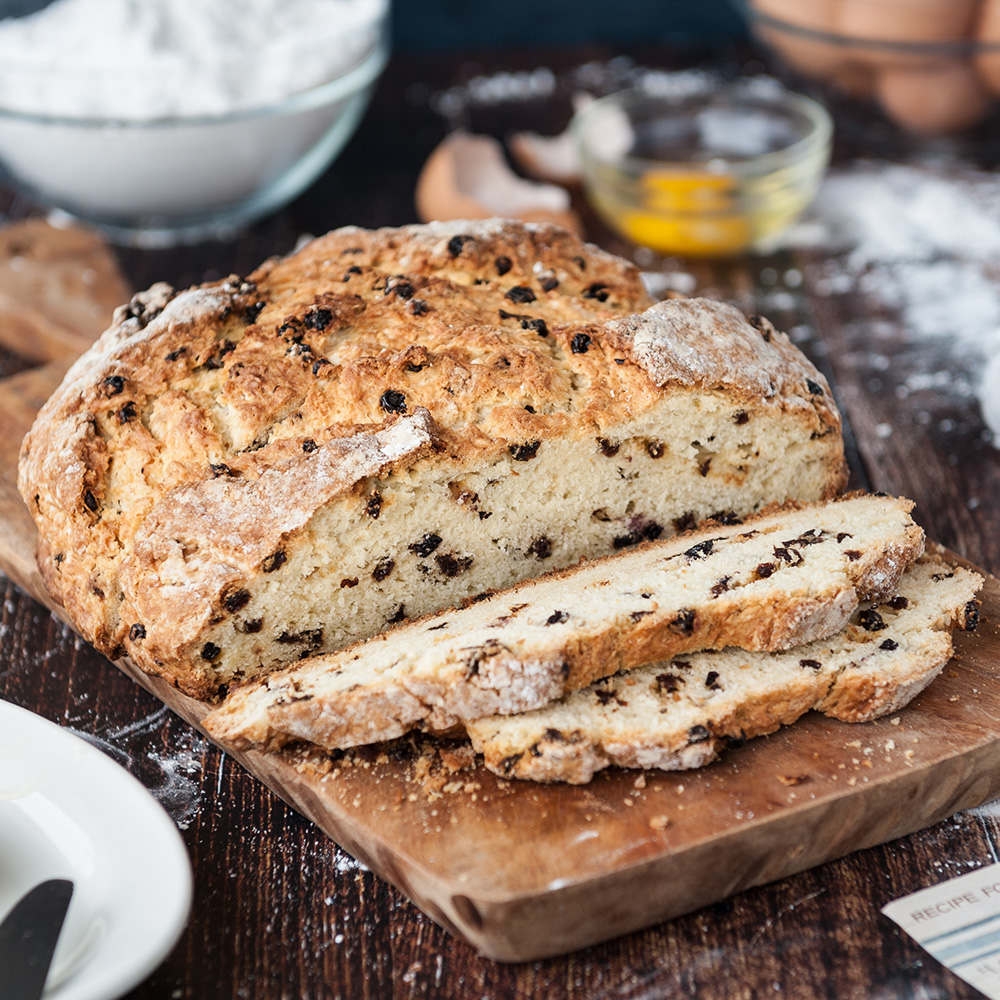
  5. Lightly dock the bottom of the mini pie shells, this will help prevent big bubbles from happening in the dough when it begins to bake. 
  6. Place the pans into the freezer for 20 minutes. This step is very important to keep your mini pies from shrinking during baking.
  7. Fill your pie pans with the filling to the top of the crust (do not be tempted to over-fill, but if you under-fill they could collapse a bit once the apples cook down.)hand spooning pie dough filling into prepared pie dough cups on a cupcake pan.

Making a Lattice Crust

  1. Roll out your leftover dough to ⅛" thick and cut out ¼" strips of dough.hand cutting pie dough into ¼" strips.
  2. Place the strips on top of your filled pie crusts. You can weave them or just crisscross them for the sake of time. They will look cute either way!hands starting a lattice pie top. hands laying down the next section of a lattice pie top. hands adding the final section of lattice pie top.
  3. Press the lattice top dough onto the bottom dough and trim off the excess to create a clean, round top. You can flute them with your fingers or use a fork to seal the edges. This gives those mini apple pies that real pie look.  Pro-tip: If you want to skip the top crust, you can just add some crumbled-up bits of the leftover dough tossed with some brown sugar to the top of the pies or make a little leaf and place it on top of each pie which also looks super cute.cutting off the excess dough from creating a lattice top on the mini piefinished lattice top on a mini pie.

Baking the Mini Apple Pies

  1. Brush the crust with your egg wash (one egg whisked together with 1 Tablespoon of water) carefully with a pastry brush. You can sprinkle some coarse sanding sugar on top to make them extra cute. brushing the top of the pie with an egg wash. hand sprinkling coarse sugar on top of egg washed pie.finished mini pies ready to bake.
  2. Bake the pies at 400°F for 20-25 minutes until the pie crust is a nice golden brown. Most people under bake their pies so don't be afraid!
  3. Place your apple pies in the muffin tin onto a cooling rack and allow them to come to room temperature for about 30 minutes. 
  4. You can then remove your pies carefully from the muffin tin and serve. If you choose to store the pies for later, store them in an airtight container, or wrap them in plastic wrap in the muffin tin to hold their shape. They can be stored at room temperature for a day or in the refrigerator for up to 4 days.finished mini apple pies.finished apple pie with a bite taken.

FAQ

Can you make mini apple pies ahead of time?

Yes, you can make mini apple pies up to four days in advance. Refrigerate them in an airtight container before serving.

Do I need to bake my apples before putting them into the pie? 

I like to cook my apple pie filling first so that the filling is nice and thick and not watery. It also breaks the apples down slightly so they don't collapse as much when they bake in the pie. 

Do I have to cube my apples or can I slice them?

Mini individual apple pies are pretty small, it's best to cube your apples into small pieces so you can fit as much apple filling as possible. 

Can I use this pie crust for other kinds of mini pies?

Yes! This crust is great for making mini pumpkin pies, berry pies, pecan pies, etc.

Related Recipes

Classic Apple Pie Recipe

Pumpkin Pie

Pumpkin Cheesecake Bars

Honey Cake Recipe

Chocolate Coconut Haupia Pie

Recipe

Finished mini apple pie with ice cream.
Print Recipe
5 from 2 votes

Mini Apple Pies

The best Mini Apple Pies with tender apples, a thick spiced caramel sauce (not watery), and a crunchy buttery crust. All of the warmth and flavor of a full pie but you don't have to share! Serve warm with stabilized whipped cream or a scoop of ice cream.
Prep Time1 hour hr
Cook Time20 hours hrs
Chilling Time30 minutes mins
Total Time1 hour hr 50 minutes mins
Course: Dessert
Cuisine: American
Servings: 12 3" pies
Calories: 560kcal
Author: Liz Marek

Equipment

  • 1 Stand mixer with the paddle attachment optional
  • 2 Muffin tins

Ingredients

Mealy Pie Dough

  • 24 ounces all-purpose flour (5 ¼ cups)
  • ½ teaspoon salt
  • 12 ounces unsalted butter grated, and cold (1 ½ cups)
  • 2 large eggs cold
  • 4 ounces ice water (½ cup)

Apple Pie Filling

  • 2 pounds apples about 6 medium-sized, diced in ¼ inch cubes
  • 1 ounce unsalted butter (2 Tablespoons)
  • 1 Tablespoon lemon juice
  • 4 ounces brown sugar (½ cup)
  • 2 teaspoons cinnamon
  • ¼ teaspoon cloves
  • ¼ teaspoon salt
  • 2 ounces apple juice (¼ cup)
  • 1 Tablespoon vanilla extract
  • 1 teaspoon almond extract optional
  • 1 Tablespoon honey
  • 1 ounce cornstarch (2 Tbsp)
  • 12 ounces apple juice (1 ½ cups)

Egg Wash

  • 2 large egg
  • 1 Tablespoon water
US Customary - Metric

Instructions

Pie Crust for Mini Pies

  • I like to make this pie crust in the food processor or stand mixer because it's faster and keeps the butter cold. You can also use a large bowl and a pastry cutter or a whisk.
  • Combine the flour and salt in the bowl of your stand mixer with the paddle attachment.
  • Grate your cold butter directly into the flour mixture.
  • Mix on low until the flour and butter resemble a sandy mixture.
  • Add the egg and slowly pour in the cold water while the mixer is on, and mix on low until the dough begins to form a ball. If it's still dry, slowly add in drizzles of cold water until it comes together.
  • Remove the dough from the bowl and place it onto a piece of plastic wrap.
  • Flatten the ball of pie dough to about 1". Wrap the plastic wrap over the dough and place it into the fridge to rest for 20 minutes (you can also do this the day before). 
  • Remove the dough from the fridge 20 minutes before you need to use it so the dough is more pliable and easier to roll out.

Apple Pie Filling

  • Peel, core, and cube your apples into ¼" pieces. Mini pies need mini pieces of apple so the filling can fall into the small spaces in the crust. 
  • Combine your apples and butter in a large saucepan over medium heat until the apples are warmed through.
  • Add in your lemon juice, brown sugar, cinnamon, cloves, salt, the smaller measurement of apple juice, extracts, and honey.  
  • Sauté the apple mixture on medium heat until the apples are soft but still a little firm in the middle (al dente).
  • Combine the cornstarch with the larger measurement of apple juice in a measuring cup to make a slurry.
  • Add the mixture to the apple filling and continue cooking and stirring for 2-3 minutes until thickened.
  • Allow your mixture to cool fully before you fill your pie crusts. 

Assembling the Mini Apple Pies

  • Preheat your oven to 400ºF
  • Roll your pie dough to ⅛" thick on a lightly floured surface.
  • Use a 6" cookie cutter to cut out 12 - 6 inch circles, you will use 2 muffin tins, alternating spots so the pies don't touch each other. Roll your scraps back up, flatten them and place them back in the fridge to use again.
  • Place a round of dough in the muffin tin, gently forming it to the shape of the tin, making sure the dough is pressed snugly against the bottom edge.
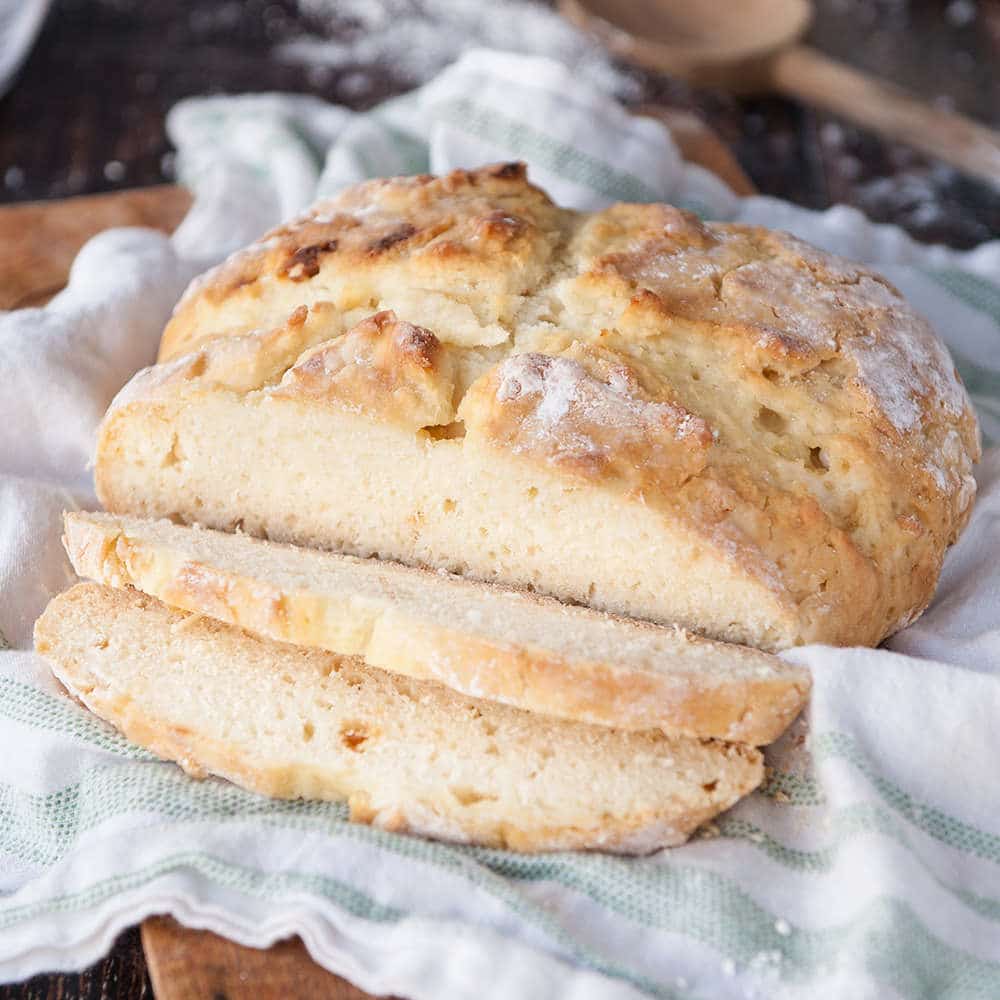
    Smooth out the folds on the sides so it is smooth and has a uniform width of the dough. Gently roll under the top edge of the dough to make the edge crust. 
  • Lightly dock the bottom of the mini pie shells, this will help prevent big bubbles from happening in the dough when it begins to bake. 
  • Place the pans into the freezer for 20 minutes. This step is very important to keep your mini pies from shrinking during baking.
  • Fill your pie pans with the filling to the top of the crust (do not be tempted to over-fill, but if you under-fill they could collapse a bit once the apples cook down.)

Making a Lattice Crust

  • Roll out your leftover dough to ⅛" thick and cut out ¼" strips of dough.
  • Place the strips on top of your filled pie crusts. You can weave them or just crisscross them for the sake of time. They will look cute either way!
  • Press the lattice top dough onto the bottom dough and trim off the excess to create a clean, round top. You can flute them with your fingers or use a fork to seal the edges. This gives those mini apple pies that real pie look. 
    Pro-tip: If you want to skip the top crust, you can just add some crumbled-up bits of the leftover dough tossed with some brown sugar to the top of the pies or make a little leaf and place it on top of each pie which also looks super cute.

Baking the Mini Apple Pies

  • Brush the crust with your egg wash (one egg whisked together with 1 Tablespoon of water) carefully with a pastry brush. You can sprinkle some coarse sanding sugar on top to make them extra cute.
  • Bake the pies at 400°F for 20-25 minutes until the pie crust is a nice golden brown. Most people underbake their pies so don't be afraid!
  • Place your apple pies in the muffin tin onto a cooling rack and allow them to come to room temperature for about 30 minutes. 
  • You can then remove your pies carefully from the muffin tin and serve. If you choose to store the pies for later, store them in an airtight container, or wrap them in plastic wrap in the muffin tin to hold their shape. They can be stored at room temperature for a day or in the refrigerator for up to 4 days.

Notes

  • The best apples to use are tart apples that hold their shape during baking. Granny smith apples are a classic choice but I also love the taste and texture of Jonagold, Honeycrisp apples, Braeburn, Mutsu, pink lady, and gala apples.
  • This is a great recipe to get some little hands to help you out! Cutting the dough, filling the pies with the filling, and fluting the pie edges can be a lot of fun for kids, and skipping to the fun part makes it less stressful for the parents.

Nutrition

Serving: 1pie | Calories: 560kcal | Carbohydrates: 71g | Protein: 8g | Fat: 27g | Saturated Fat: 16g | Polyunsaturated Fat: 2g | Monounsaturated Fat: 7g | Trans Fat: 1g | Cholesterol: 128mg | Sodium: 179mg | Potassium: 224mg | Fiber: 4g | Sugar: 22g | Vitamin A: 900IU | Vitamin C: 4mg | Calcium: 45mg | Iron: 3mg
Cake decorated to look like bear, owl and deer faces

November 1, 2022 Course Preview

Woodland Baby Shower Cake Tutorial

Skill level: Intermediate

Learn how to create this wonderful woodland animal baby shower cake! Liz Marek breaks down all the steps in the process of making each tier, including how to make the bear, owl and deer's details, how to create the cake topper ears and how to trim and arrange the foliage.
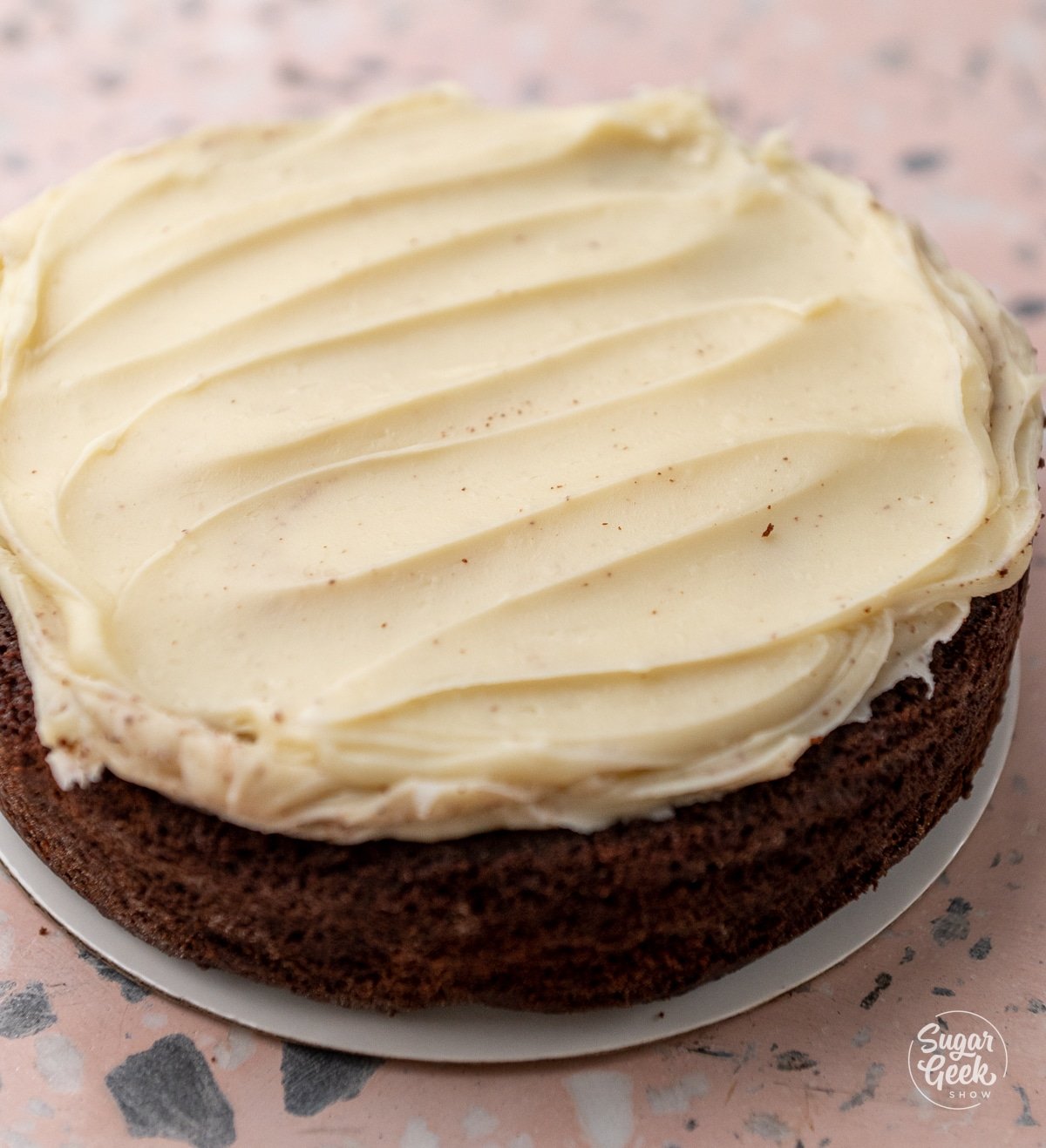
40:20 Minutes of Instruction

What You Will Learn

  • How to make a Woodland-themed baby shower cake
  • Learn how to easily sculpt and detail the bear, owl and deer faces
  • How to trim and arrange artificial foliage and how to work with cake dummies

Tutorial Chapters

  1. Covering The Bottom Tier In Fondant0:37
  2. Making The Bear Ears 6:34
  3. Painting The Bear Tier 7:24
  4. Adding The Bear Ears 9:39
  5. Making The Bear's Face 11:01
  6. Covering The Owl Tier In Fondant 14:00
  7. Making The Owl Ears And Face 14:49
  8. Decorating The Owl Tier 18:43
  9. Making The Deer Ears 21:04
  10. Decorating The Deer Layer 22:56
  11. Making & Adding The Antlers 29:03
  12. Making The Spacer 30:51
  13. Stacking & Decorating 36:28
  14. Finishing Touches 38:36

Downloads

Materials List

« Previous Page
Next Page »

Primary Sidebar

Hi, I'm Liz! I'm passionate about creating reliable, foolproof recipes that don't just tell you how to cook, but why things work - so you can skip the guesswork and confidently make the best sweet and savory dishes of your life.
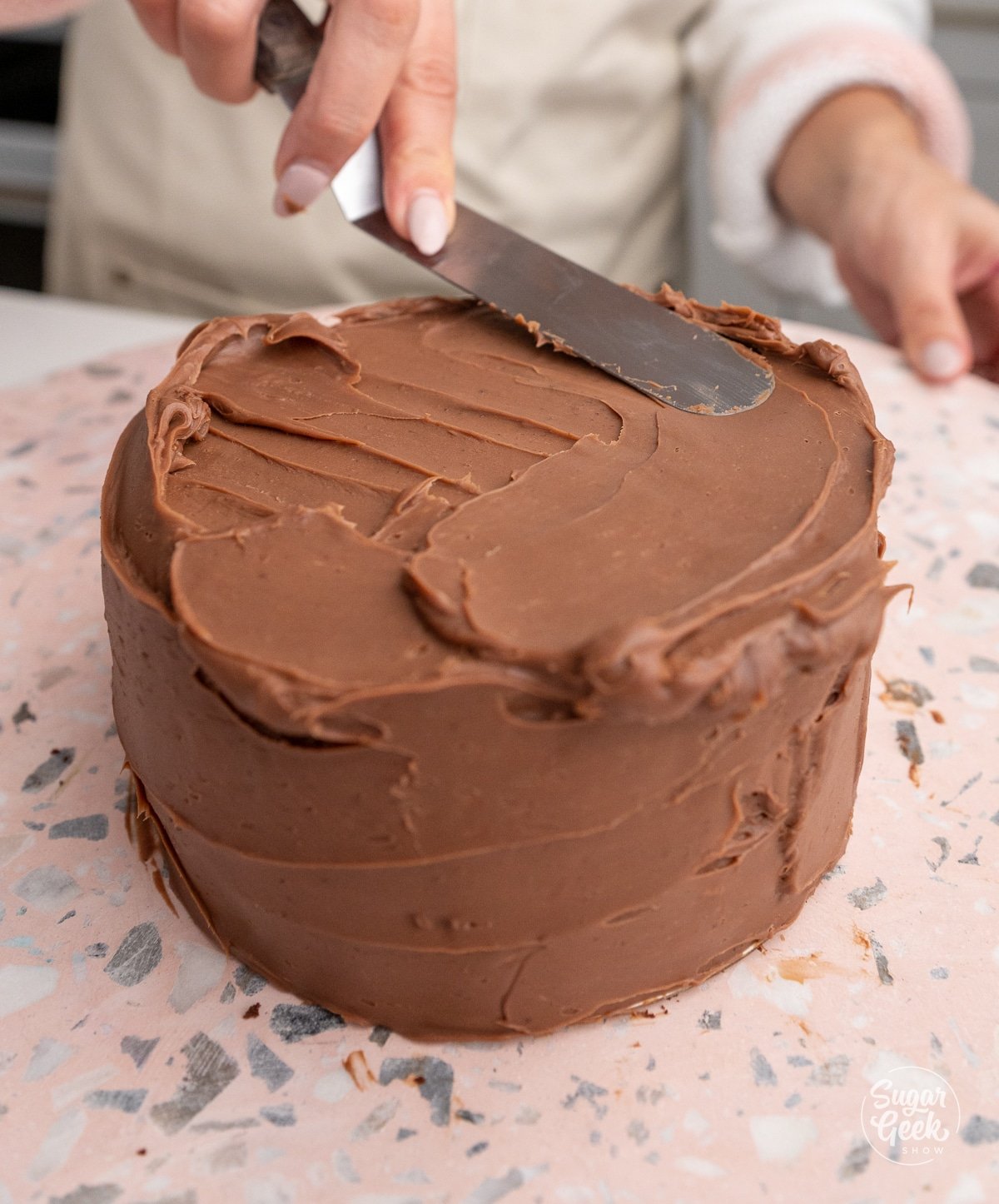
More about me →

Our Cake Greatest Hits

Check out our best cake recipes

👨‍🍼 Celebrate Father's Day

  • Close up of three crispy baked chicken thighs on a plate.
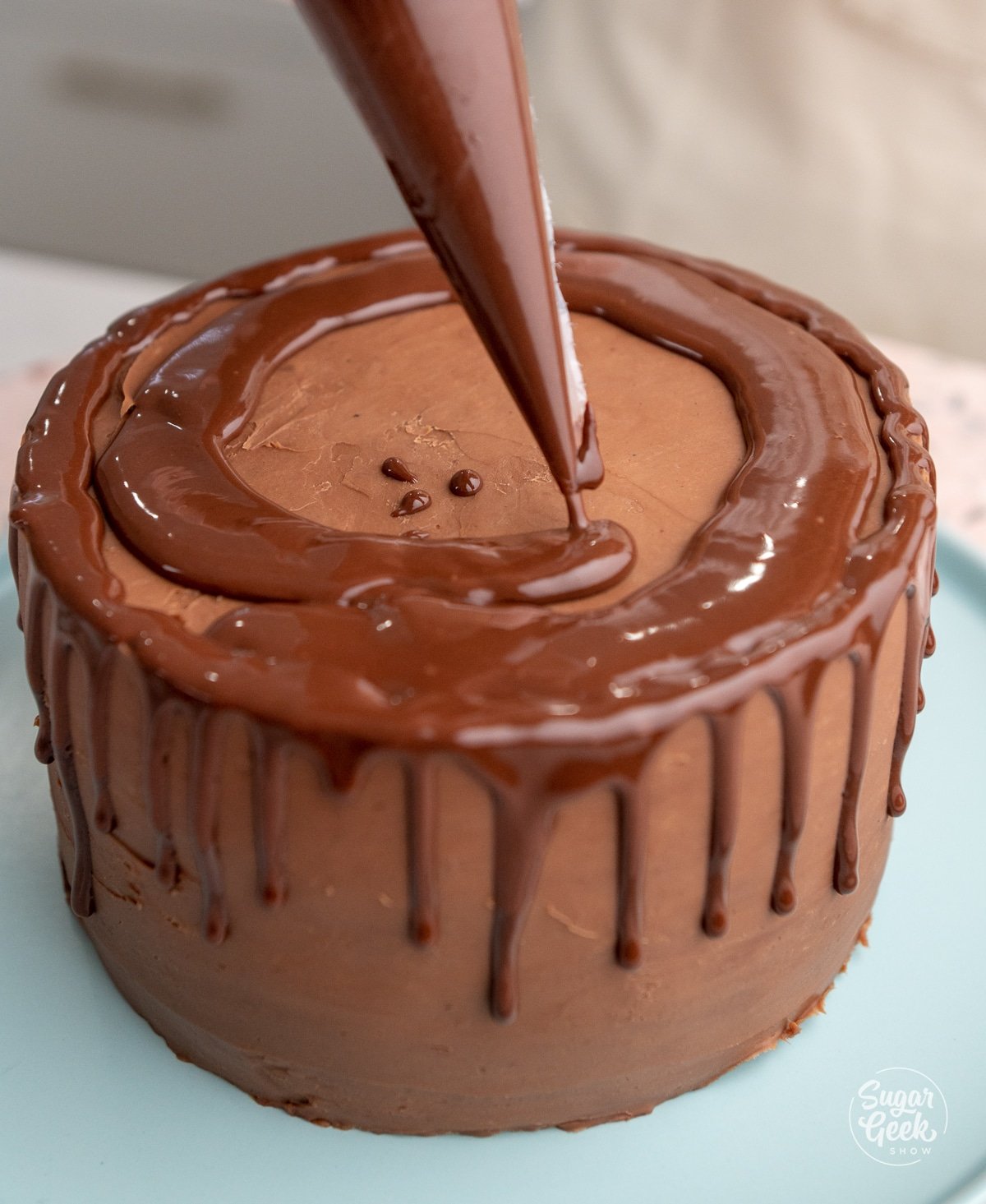
    Crispy Baked Chicken Thighs
    Cook Time50 Minutes
  • close up of a sliced ribeye steak
    How To Cook A Ribeye
    Cook Time24 Hours 14 Minutes
  • close up of creamy mac and cheese on a serving spoon
    Creamy Baked Mac And Cheese
    Cook Time35 Minutes
  • close up of a keto smash burger
    Smash Burgers Recipe
    Cook Time25 Minutes
  • Hawaiian Mac Salad
    Cook Time2 Hours 20 Minutes
  • Smoked Beef Tenderloin
    Cook Time2 Hours 55 Minutes

Popular Recipes

  • close up of ganache drizzling into a bowl
    The Best Chocolate Ganache Recipe
    Cook Time20 Minutes
  • Piping easy buttercream rosettes onto a cake using a 1M star piping tip
    Easy Buttercream Frosting
    Cook Time25 Minutes
  • close up slice of marble cake
    Moist and Fluffy Marble Cake Recipe
    Cook Time40 Minutes
  • Slice of red velvet cake with cream cheese frosting on a white plate.
    Red Velvet Cake Recipe
    Cook Time1 Hours 40 Minutes

Footer

↑ back to top

About

  • Privacy Policy
  • Terms of Service

Newsletter

  • Sign Up! for emails and updates

Contact

  • Contact
  • About Us

Copyright © 2024 Sugar Geek Show, Inc. All Rights Reserved.

Rate This Recipe

Your vote:


A rating is required
A name is required
An email is required