

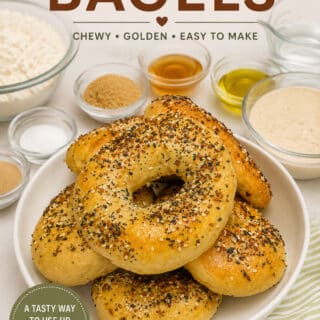
These sourdough discard bagels are everything I love about my easy homemade bagel recipe, with the added tangy depth that only sourdough discard can give you. Chewy crust from the boil, soft, slightly dense interior, and a creamy sourdough background note that makes everything you put on the bagel taste better. Ready in under 2 hours.
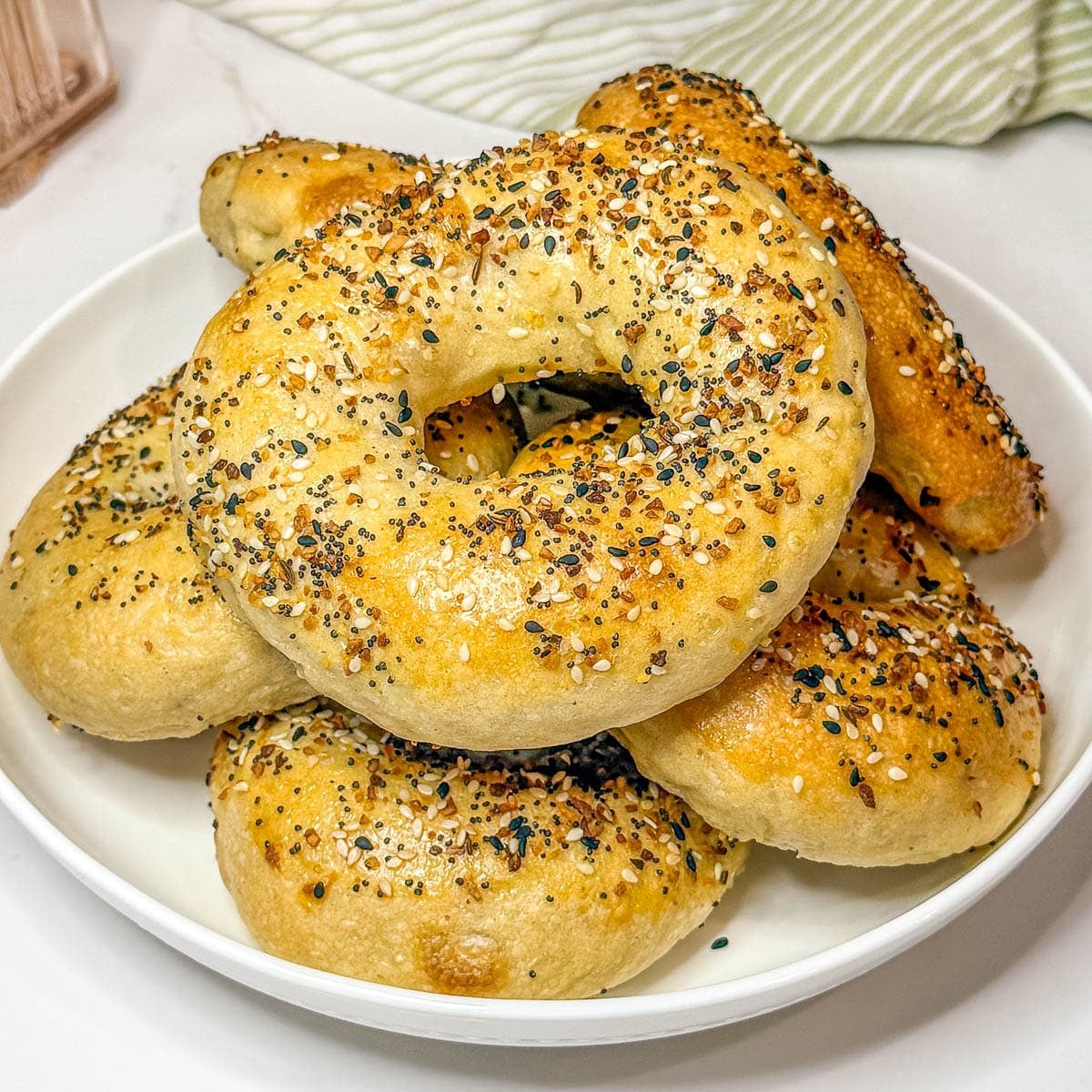
I have been baking bread professionally for years and bagels are one of the recipes I come back to most often. The boil-and-bake method is what gives bagels their signature shiny, chewy crust, and once you understand the process, it's surprisingly forgiving. Bagel making is also one of the most kid-friendly bread projects. Avalon's favorite part is poking a hole in the center and stretching it open. Adding sourdough discard to the dough is what takes these from really good homemade bagels to bagels with the kind of depth you usually only get from a long-fermented New York-style shop.
Quick Glance at the Recipe: Sourdough Discard Bagels
- Recipe Name: Sourdough Discard Bagels
- Why You'll Love It: Chewy bakery-style bagels with a creamy sourdough tang from a full cup of discard. 18 bagels per batch. Under 2 hours start to finish. Freezer-friendly so you can make once and eat all month.
- Time and Difficulty: 10 min prep + 30-60 min proof + 10 min rest + boil + 20-25 min bake. Intermediate but very forgiving.
- Main Ingredients: Sourdough discard, bread flour, warm water, brown sugar, instant yeast, olive oil, salt, plus honey for the water bath and an egg wash.
- Method: Mix dough with discard, proof until doubled, shape, rest, boil briefly in sweetened water, brush with egg wash, top, bake at 425º F until golden.
- Texture and Flavor: Shiny, crisp exterior and a wonderfully soft and chewy interior.
- Quick Tip: The hole shrinks during boiling and baking. Make it bigger than you think (2 inches wide minimum) or you'll end up with bread rolls instead of bagels.
Jump to:
- Quick Glance at the Recipe: Sourdough Discard Bagels
- Why This Sourdough Discard Bagel Recipe Works⭐⭐⭐⭐
- What Makes This Sourdough Discard Bagel Recipe Different
- Sourdough Discard Bagel Ingredients
- How To Make Sourdough Discard Bagels Step-By-Step
- Same-Day Vs Overnight Ferment
- Sample Bake Schedule
- Common Sourdough Discard Bagel Problems To Avoid
- Make This Sourdough Discard Bagel Recipe Your Own
- Make-Ahead, Storage, And Reheating
- Final Thoughts
- Sourdough Discard Bagel FAQs
- More Sourdough Discard Recipes To Try
- Leave Me A Review⭐️⭐️⭐️⭐️⭐️
- Recipe
If you don't have a sourdough starter yet, my sourdough starter for beginners guide walks you through making one in 5 to 7 days. Or if you'd rather skip the discard for now, my easy homemade bagel recipe is the same method without the discard addition.
Why This Sourdough Discard Bagel Recipe Works
⭐⭐⭐⭐
What Makes This Sourdough Discard Bagel Recipe Different
This recipe layers sourdough discard into my tested bagel formula, so you get the chewy crust and tight crumb of a proper bagel, plus a creamy tang in the background that makes everything you spread on it taste better.
A full cup of discard. This recipe is a great way to use up that discard you've been keeping in the fridge all week. The flavor from the discard really enhances the bagel's taste and texture.
Bread flour for proper bagel chew. Bread flour's higher protein develops more gluten during mixing, which is what gives bagels their dense, chewy texture. AP flour works in a pinch, but the texture will be softer.
The boil is what separates a bagel from a bread roll. 30 seconds per side in sweetened water gelatinizes the starch on the surface, creating the shiny, chewy crust that bagels are known for. Honey or maple syrup in the water adds the molasses depth you'd normally get from barley malt syrup.
Same-day or overnight ferment. Mix, proof, shape, boil, bake. Overnight method shapes the bagels at night and cold-retards them in the fridge, which deepens the sourdough flavor and gives you fresh bagels straight from the oven at breakfast.
Sourdough Discard Bagel Ingredients
A few pantry staples plus the discard from your starter. I always recommend weighing your ingredients with a digital kitchen scale for the most accurate results because flour packs differently depending on humidity.
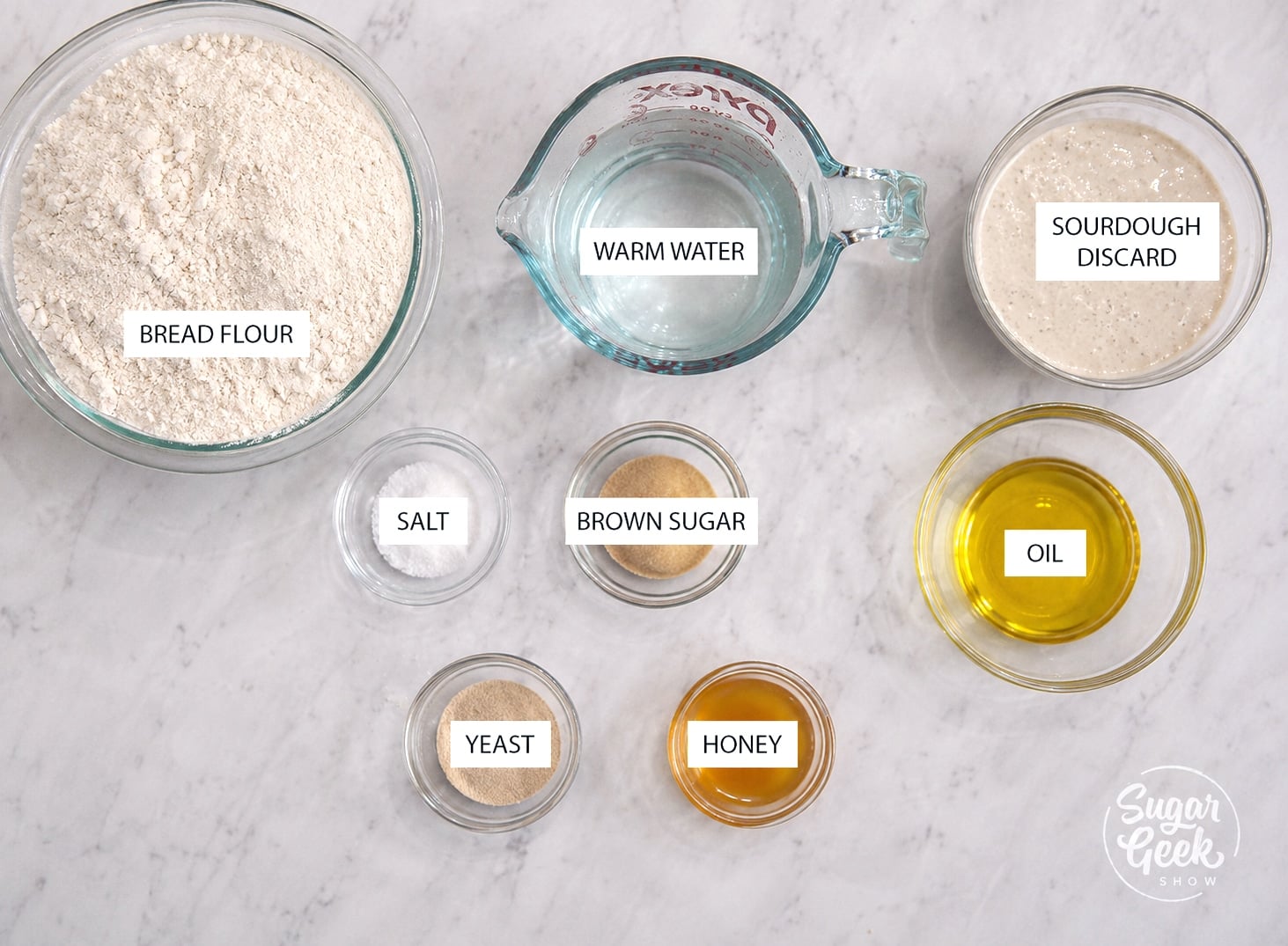
- Sourdough discard. A full cup of unfed sourdough starter straight from your jar. Cold discard from the fridge works perfectly.
- Bread flour or all-purpose flour. Bread flour's higher protein content is what gives bagels their signature chewy texture. I love Caputo bread flour for consistent results, but King Arthur bread flour or any standard bread flour works great. AP flour gives you a softer, less chewy bagel. (If you have leftover bread flour, my brioche bread recipe is the next bread-flour project worth tackling.)
- Warm water. 110º F to 115º F. Hot enough to activate the yeast, cool enough not to kill it. Water (not milk) is what keeps bagels lean and chewy instead of soft and rich.
- Brown sugar. A small amount feeds the yeast and adds a faint molasses depth that mimics traditional barley malt syrup. An easy way to get classic bagel flavor without needing specialty ingredients.
- Instant yeast. Mixed directly into the flour, no blooming needed. If you only have active dry yeast, use the same amount but let the dough proof 90 minutes instead of 30 to 60. SAF Instant is my go-to brand.
- Olive oil. Two Tablespoons keep the dough workable and add a little richness without making the bagel soft. Neutral oil works too if you don't want any olive flavor.
- Salt. Two teaspoons for flavor and dough strength.
- Honey or maple syrup (for the water bath). Two ounces in the boiling water bath. This is what creates the classic shiny crust and adds molasses depth. Don't skip.
- Egg (for the egg wash). One large egg whisked with a Tablespoon of water. Brush on each boiled bagel before baking so the toppings stick, and the crust shines.
Why Sourdough Discard Works So Well In Bagels
Sourdough discard has a pH between 3.5 and 4.5, about as acidic as orange juice. Adding a cup of it to a bagel dough sounds like it should mess up the bagel's signature dense, chewy texture, but it doesn't. Here's why.
Bread flour has gluten to spare. The acid in the discard does weaken gluten slightly, the same as it does in my discard cookies, discard pancakes, and discard cinnamon rolls. The difference is that bread flour starts with so much gluten that the small amount of weakening barely makes a dent. The dough still develops a strong, elastic gluten network during mixing, and the bagel still has the chew you'd expect.
The boil is doing most of the chewy-crust work. The 30-second boil per side gelatinizes the starch on the bagel's surface, which is what creates the signature shiny, dense crust. That mechanism doesn't care whether you used discard or not. As long as you don't skip the boil, you get the bagel crust regardless.
The discard adds flavor without changing the bagel's character. The 1 cup of discard contributes about 4 ounces of liquid that the master recipe doesn't have, so we drop the added water from 16 oz to 14 oz to compensate. Total hydration ends up at 53%, identical to the master recipe. The dough feels the same to shape, the boil works the same way, and the finished bagel has the same dense chewy crumb plus the creamy sourdough flavor.
The boil neutralizes surface acidity. When the shaped bagels hit boiling water for 30 seconds per side, the heat denatures some of the acid on the surface. What's left in the crumb is the creamy fermented flavor without the sharp tang. The bagel reads as deeply flavored, not sour.
How To Make Sourdough Discard Bagels Step-By-Step
For exact measurements, see the recipe card below.
Before you start: warm your water to 110º F to 115º F (use an instant-read thermometer; water that's too hot kills the yeast). Pull your discard out of the fridge. Have your stand mixer ready with the dough hook.
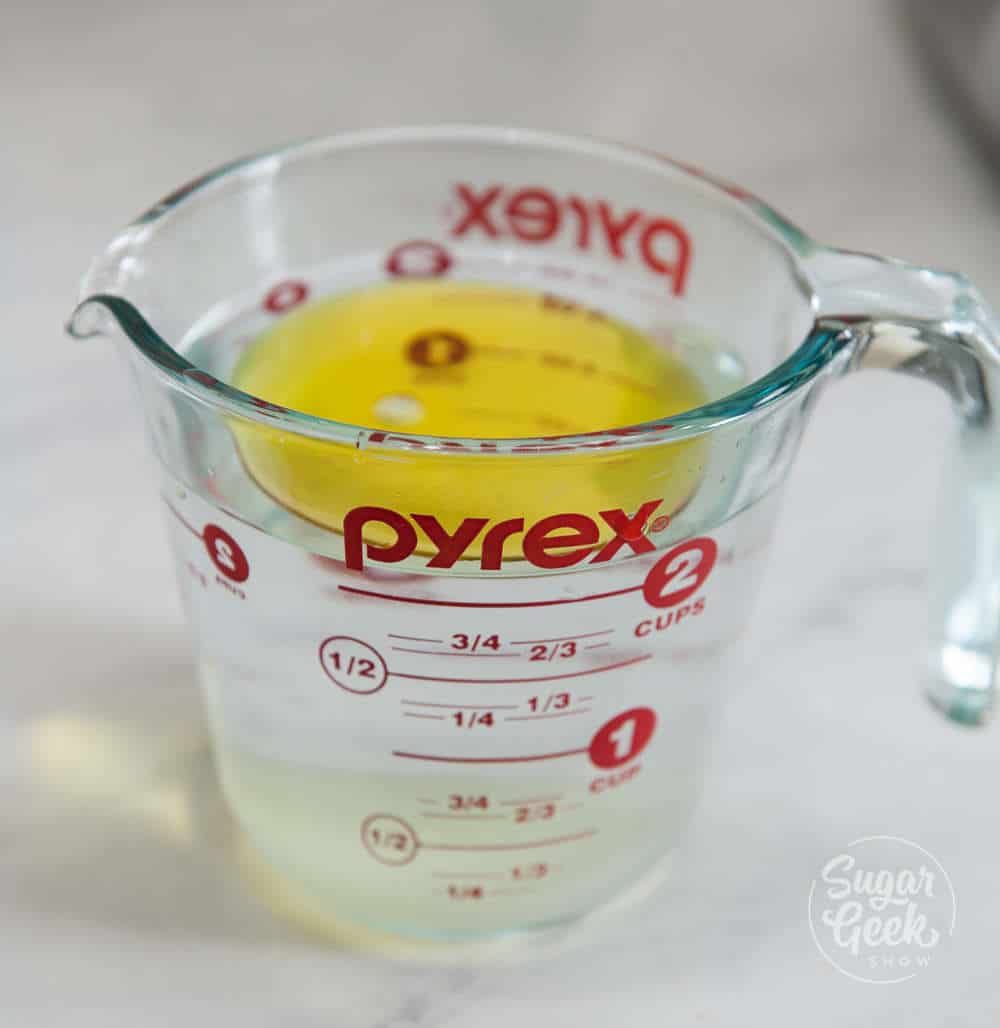
- Combine the warm water, brown sugar, and olive oil in a measuring cup. Stir to dissolve the brown sugar. Set aside.
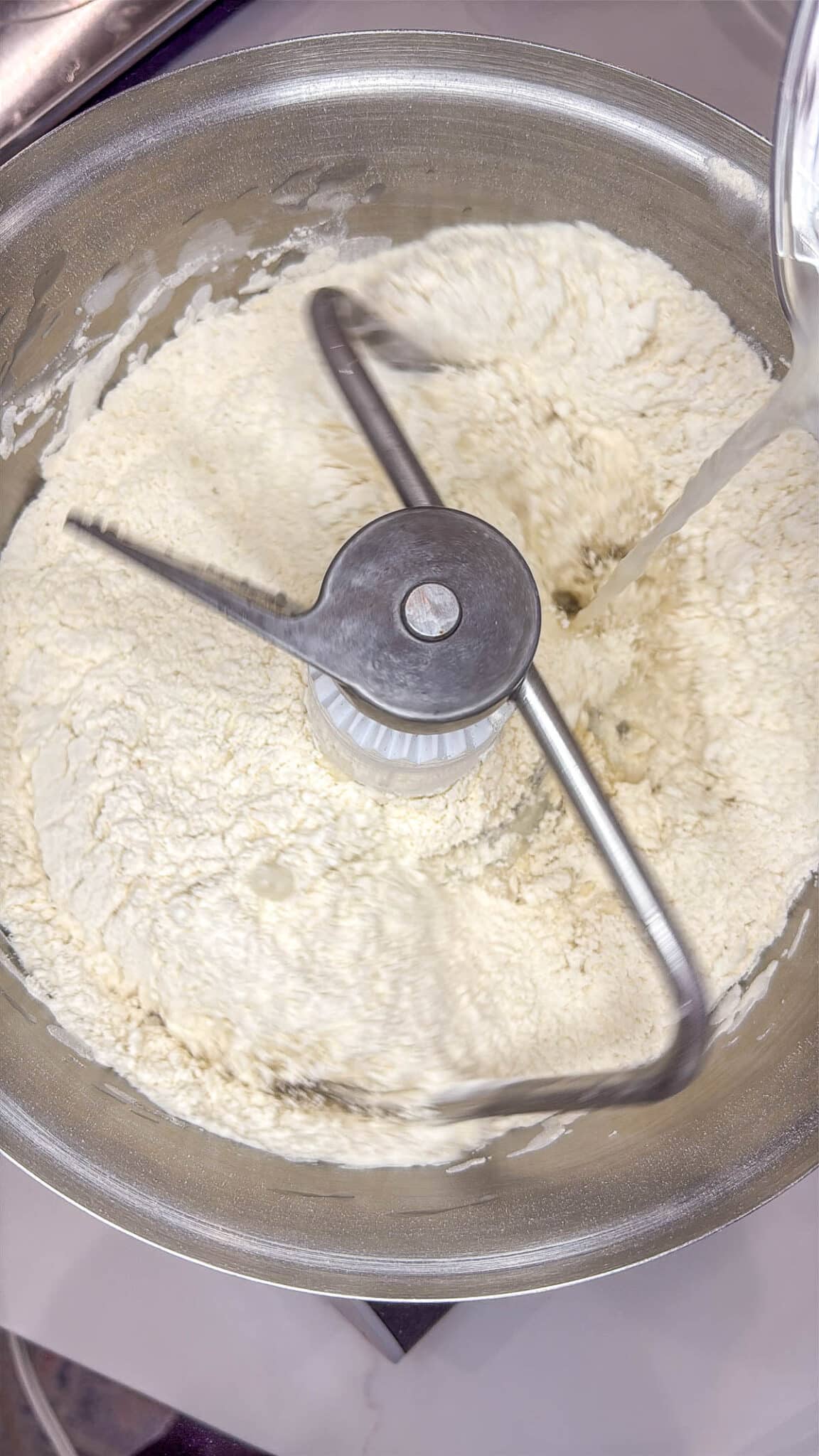
- Place the bread flour and instant yeast into the bowl of your stand mixer with the dough hook attached. Mix on low for 5 seconds to distribute the yeast through the flour.
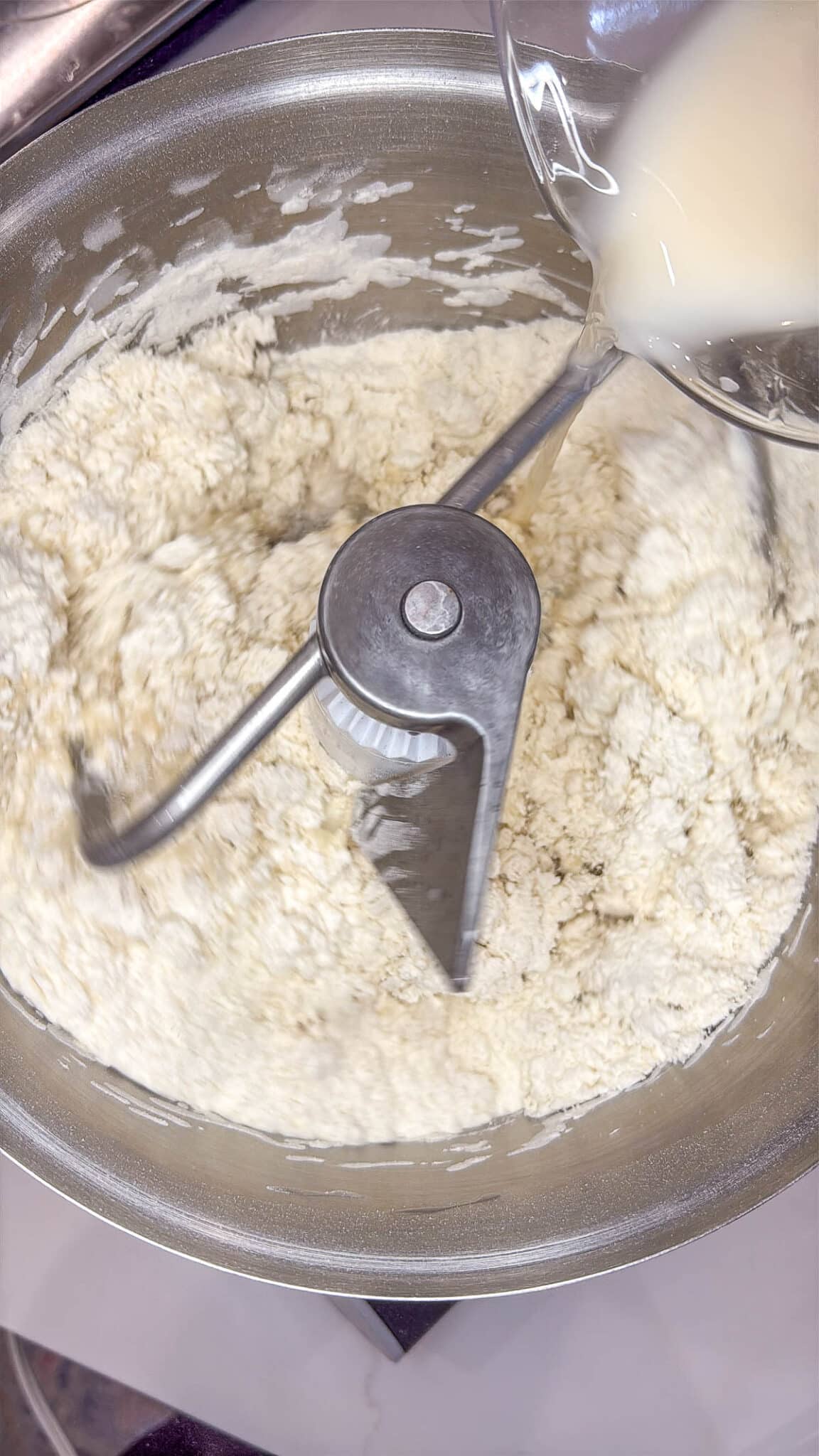
- Add the warm water mixture and the sourdough discard to the flour bowl. Mix on low until everything is moistened and starts to come together, about 30 seconds.
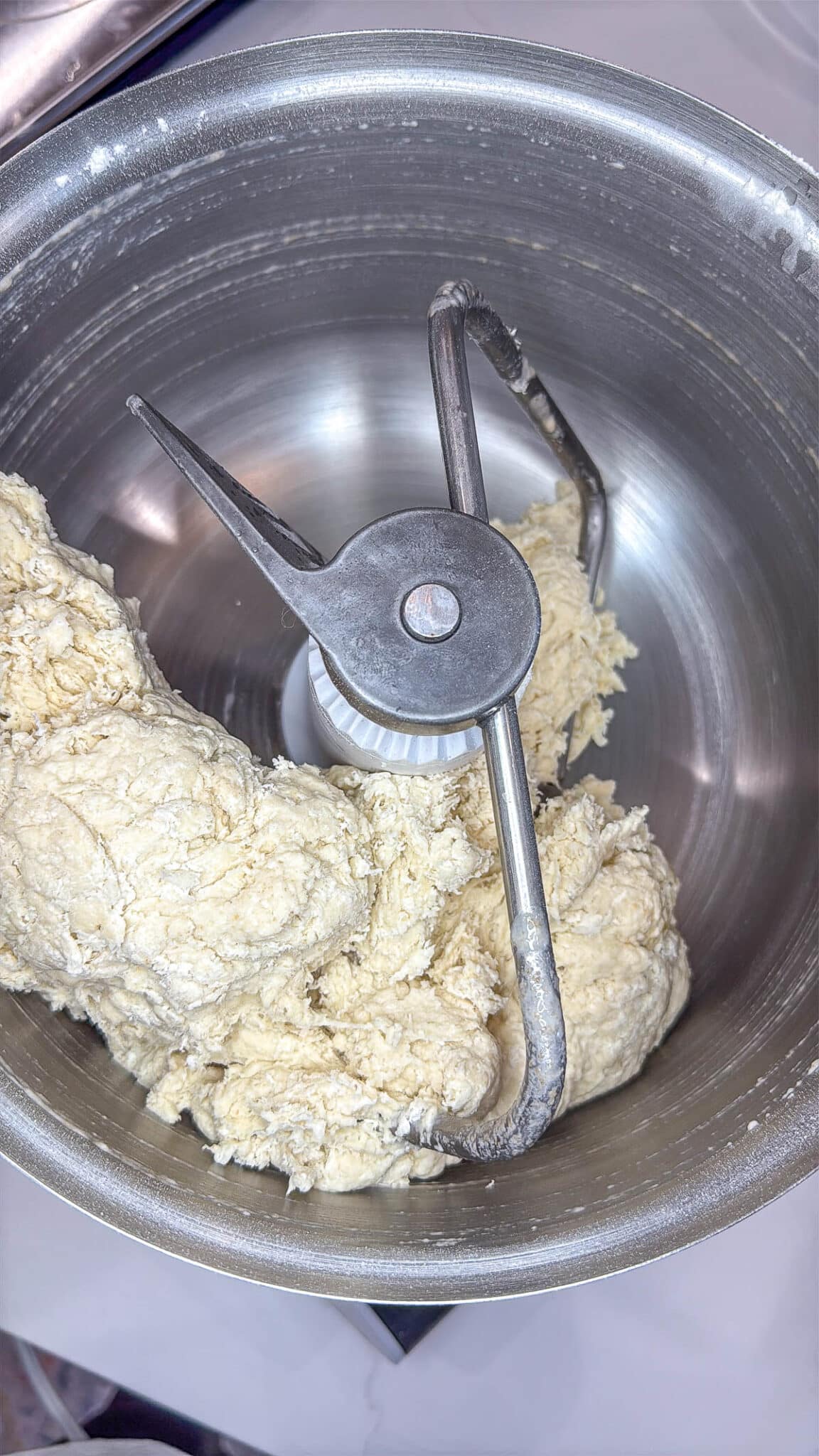
- Sprinkle in the salt while the mixer runs on low.
PRO TIP: Bagel dough is much stiffer than most bread doughs. Don't worry if the dough looks dry and rough at first. The mixer pulls it together over the next 6 minutes.
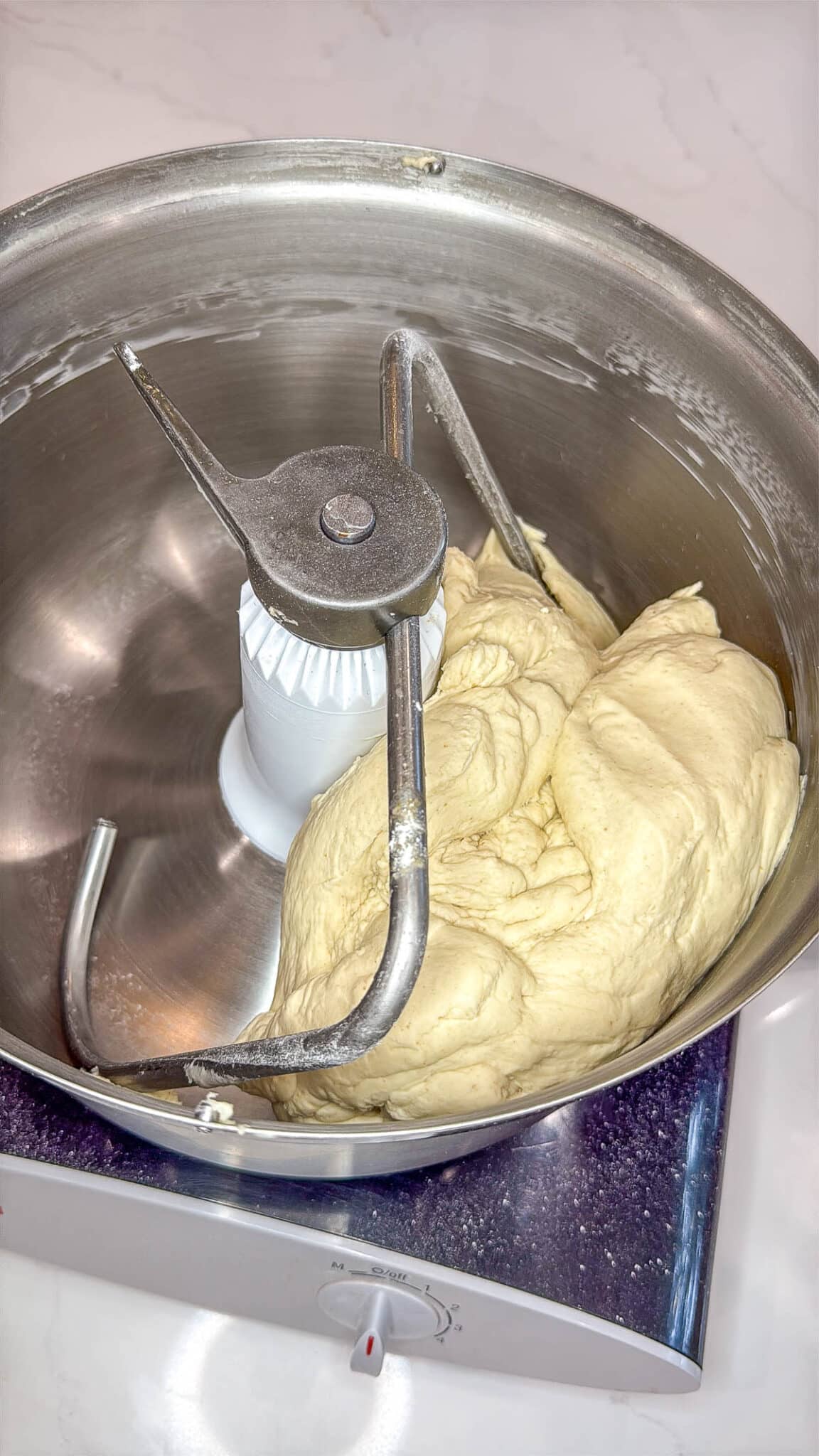
- Increase the mixer to medium-high speed (speed 4 on a KitchenAid, speed 2 on a Bosch). Mix for 6 minutes. The dough is ready when it forms a smooth ball, cleans the sides of the bowl, and feels firm but slightly tacky to the touch. If the dough looks too wet, add a Tablespoon of flour at a time. If too dry, add a Tablespoon of water.
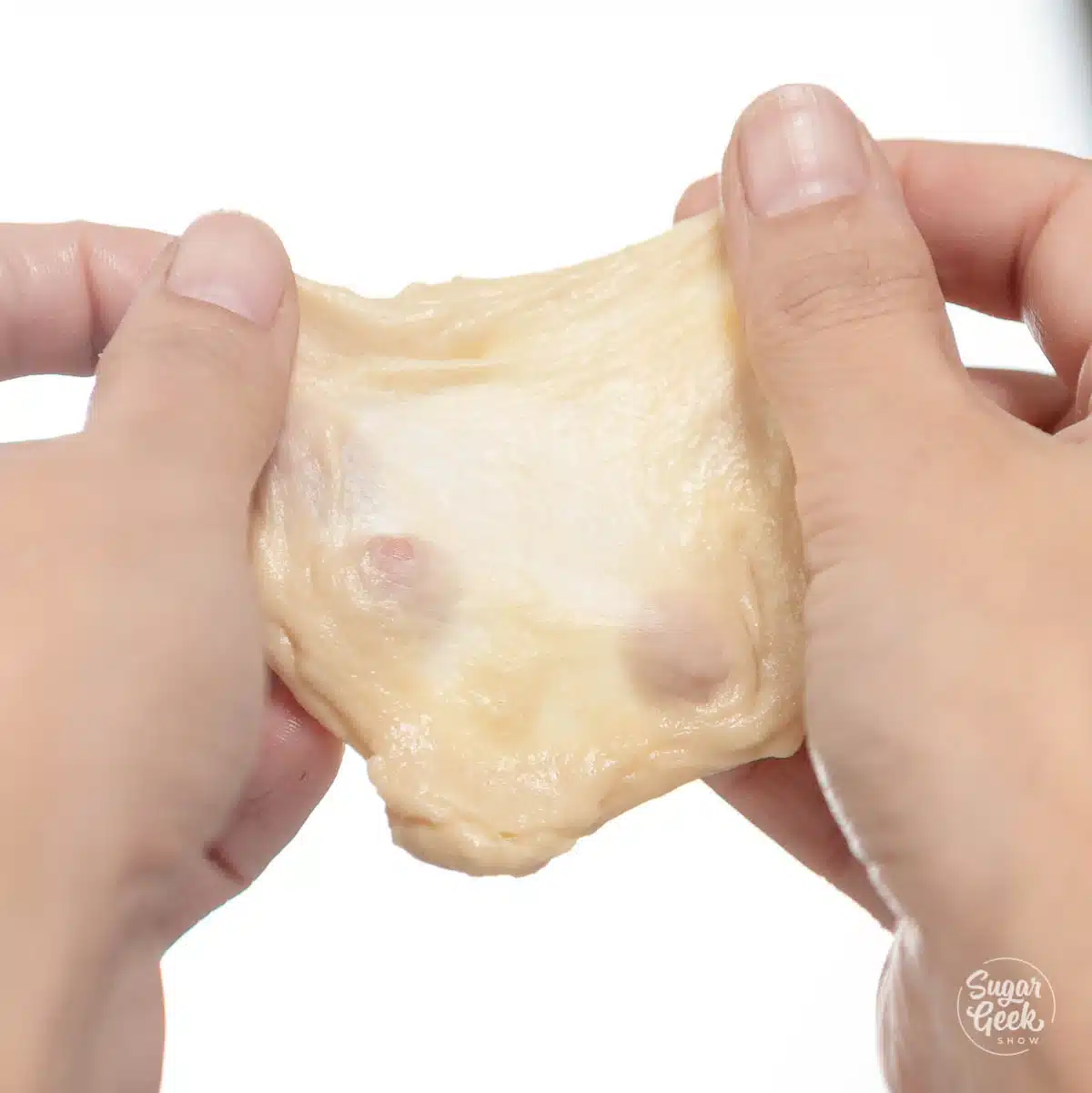
- Perform the window pane test for bread to confirm that the gluten has developed properly. Stretch a small piece of dough between your fingers. If it stretches thin enough to see light through without tearing, you're done. If it tears, mix for another 1 to 2 minutes.
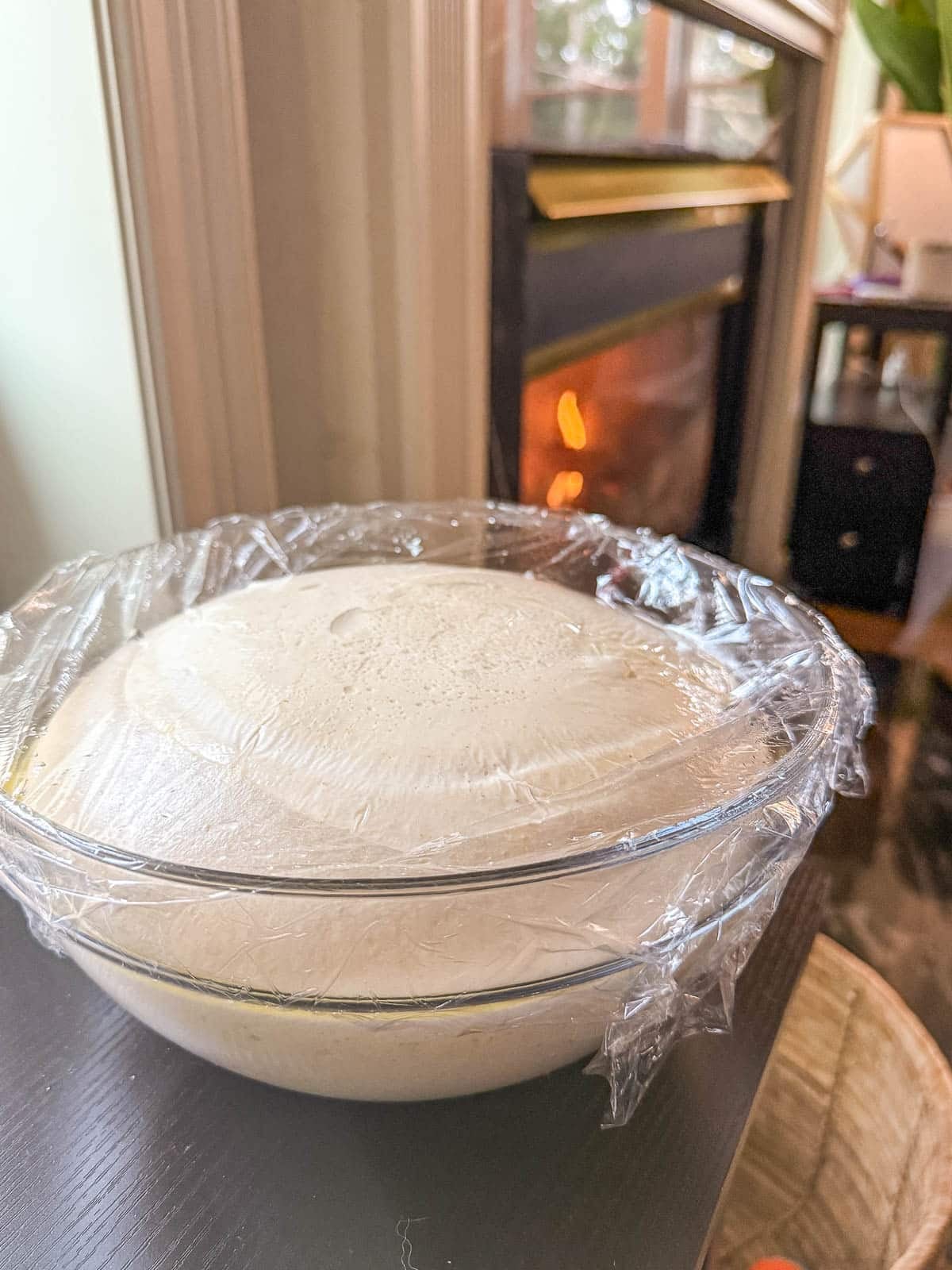
- Form the dough into a tight ball and place it in a lightly oiled bowl. Cover with plastic wrap or a tea towel. Let it proof in a warm place for 30 to 60 minutes, or until doubled in size. Warmer kitchens proof faster.
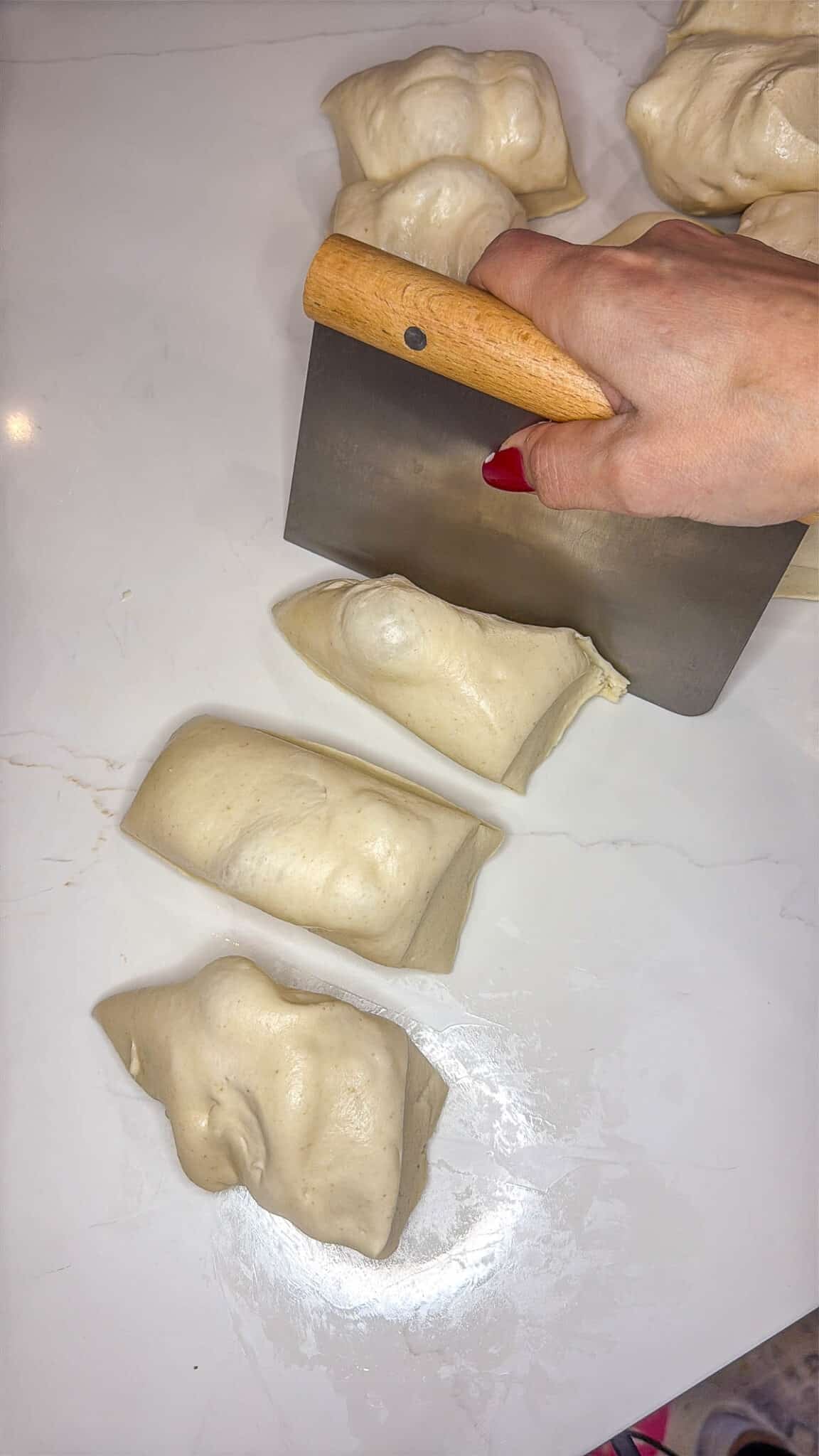
- Divide the proofed dough into 18 equal pieces. Use a scale for accuracy (each piece should be roughly 3 ounces), or eyeball it. Don't stress about perfection; rustic bagels still taste incredible.
PRO TIP: The warmest spot in most kitchens is the oven with the light on and the oven OFF. Preheat the oven to 170º F for 5 minutes, turn it off, then place your dough bowl in. Creates a steady 80º F to 90º F environment for fastest proof.
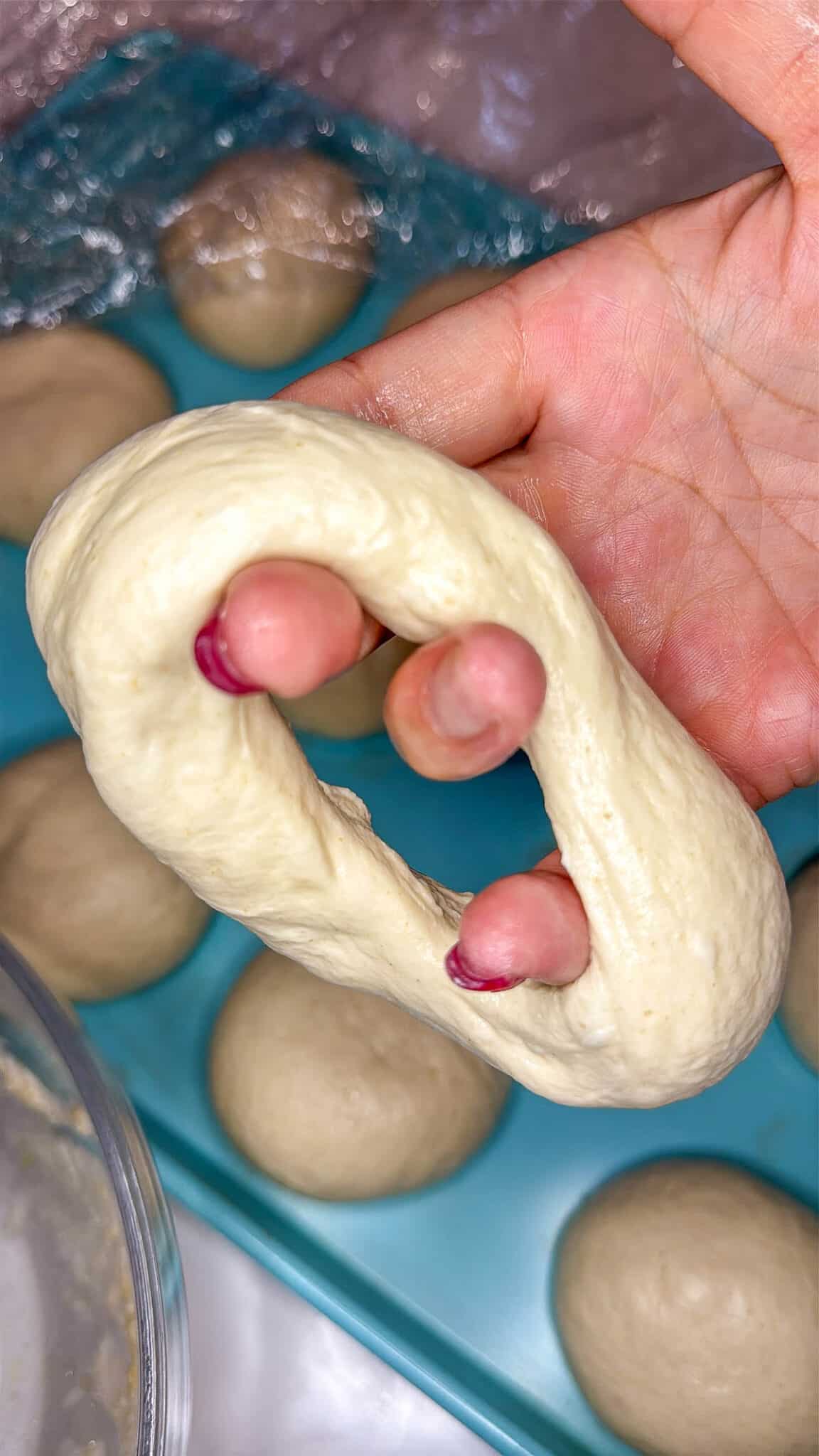
- Shape each piece into a tight ball, then poke a hole in the center with your finger and gently stretch the hole to about 2 inches wide. The hole shrinks during boiling and baking, so make it bigger than you think.
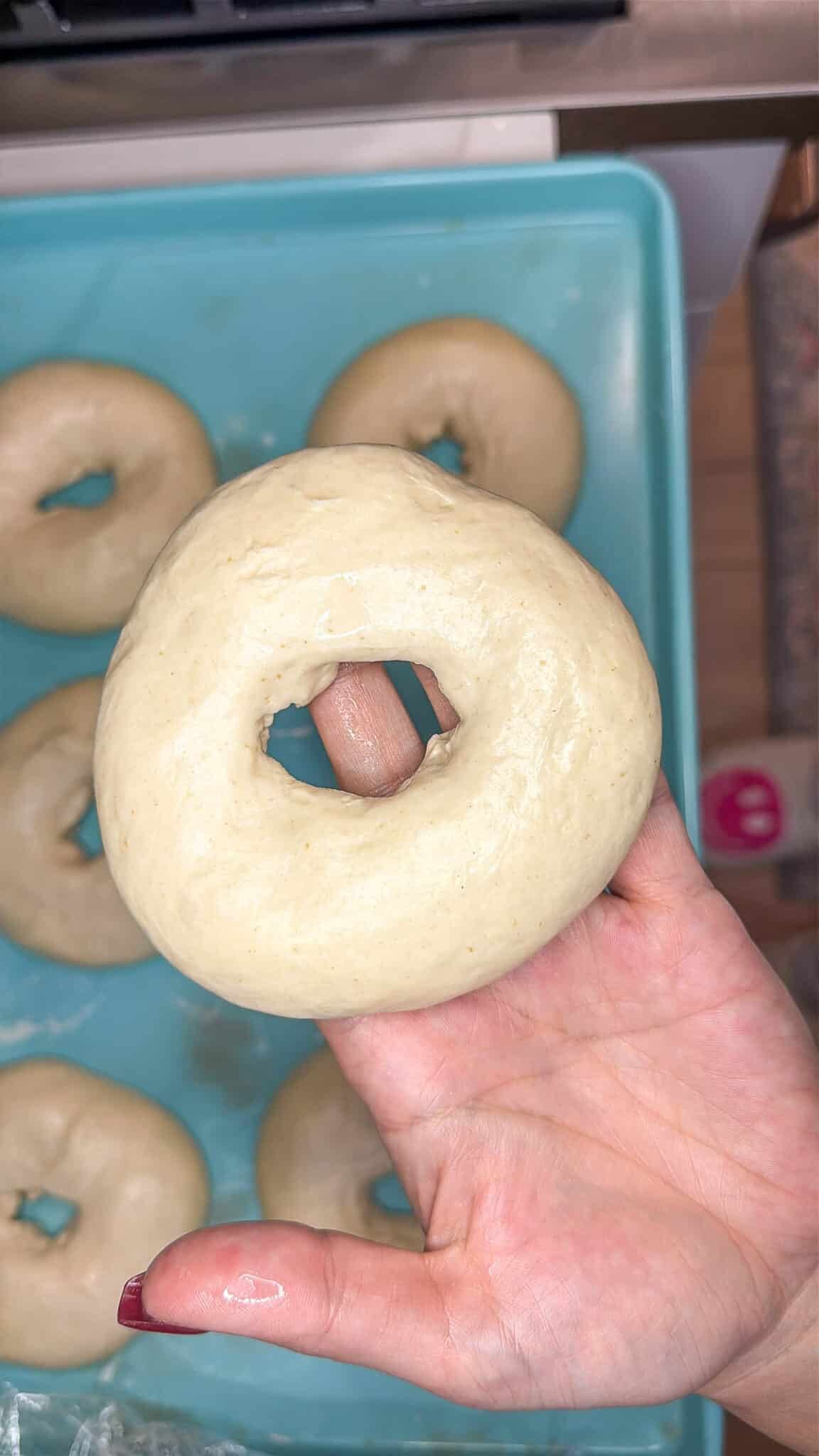
- Cover the shaped bagels with a tea towel and let them rest for 10 minutes while you bring the water bath to a boil.
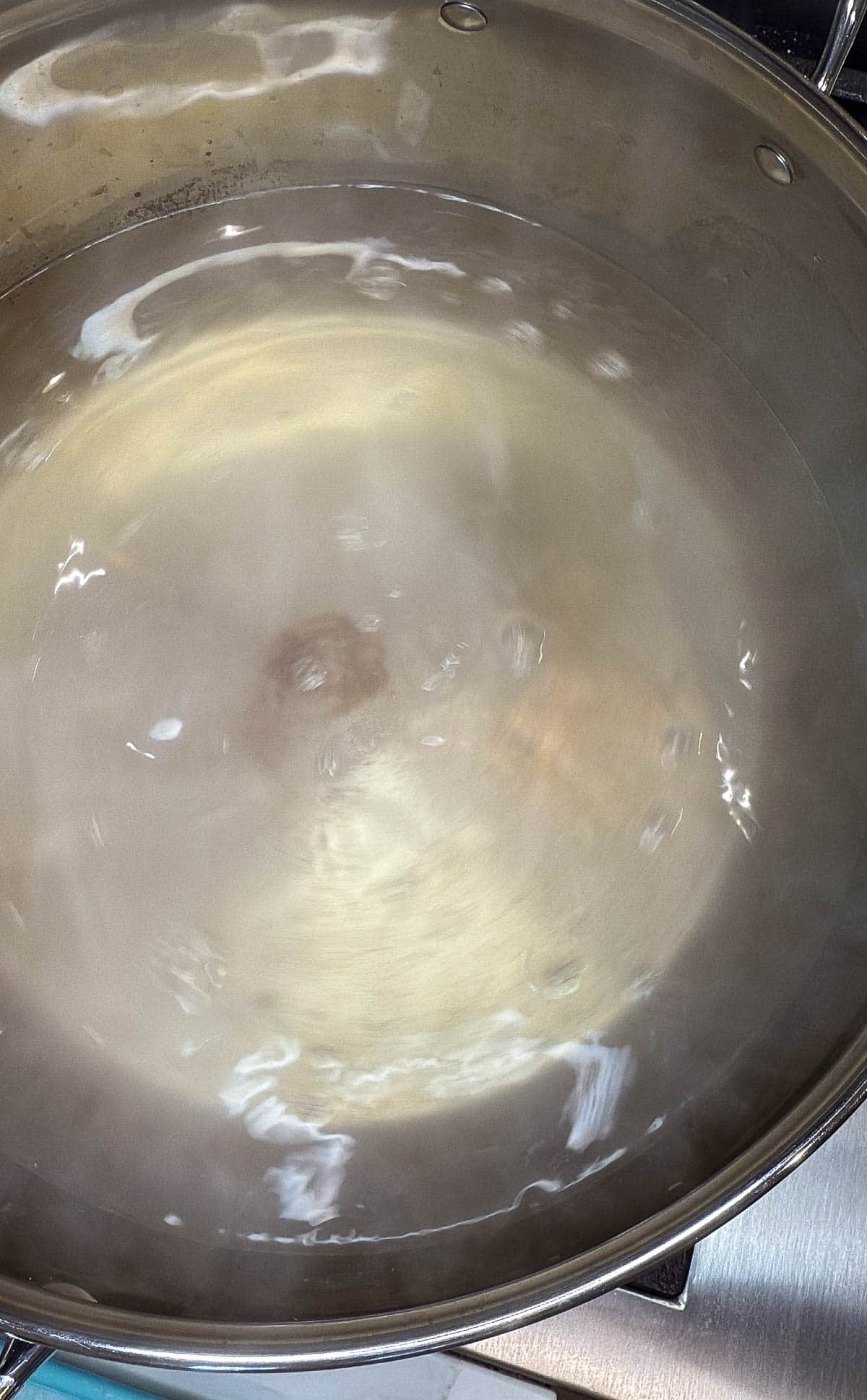
- Bring 64 ounces of water to a boil in a wide pot. Add 2 ounces of honey or maple syrup plus 1 Tablespoon of salt. While the water heats, preheat your oven to 425º F.
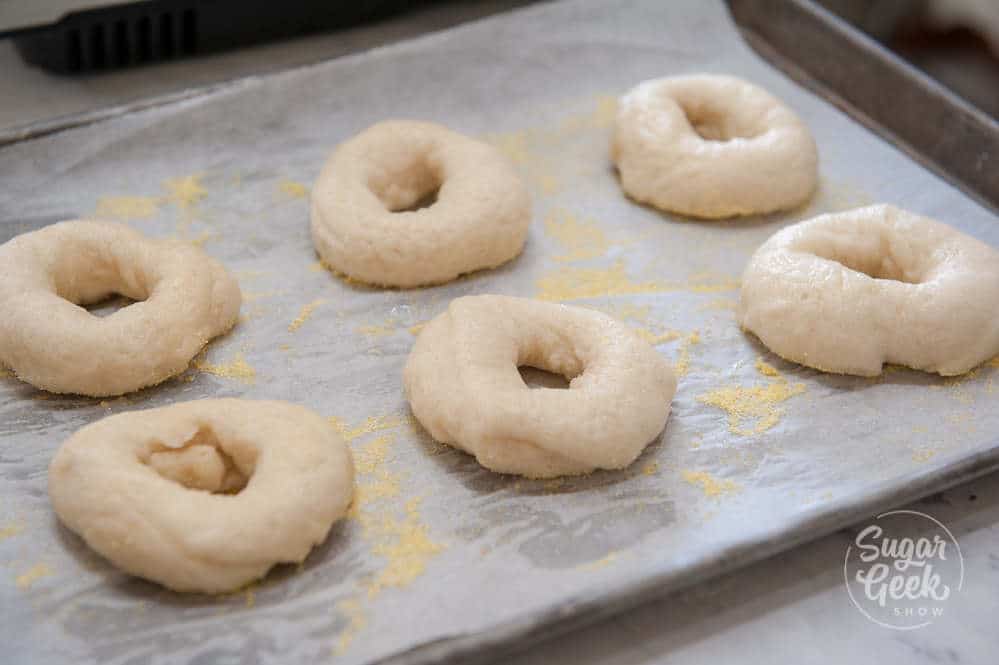
- Line two sheet pans with parchment paper. Sprinkle the parchment with semolina or cornflour to prevent sticking.
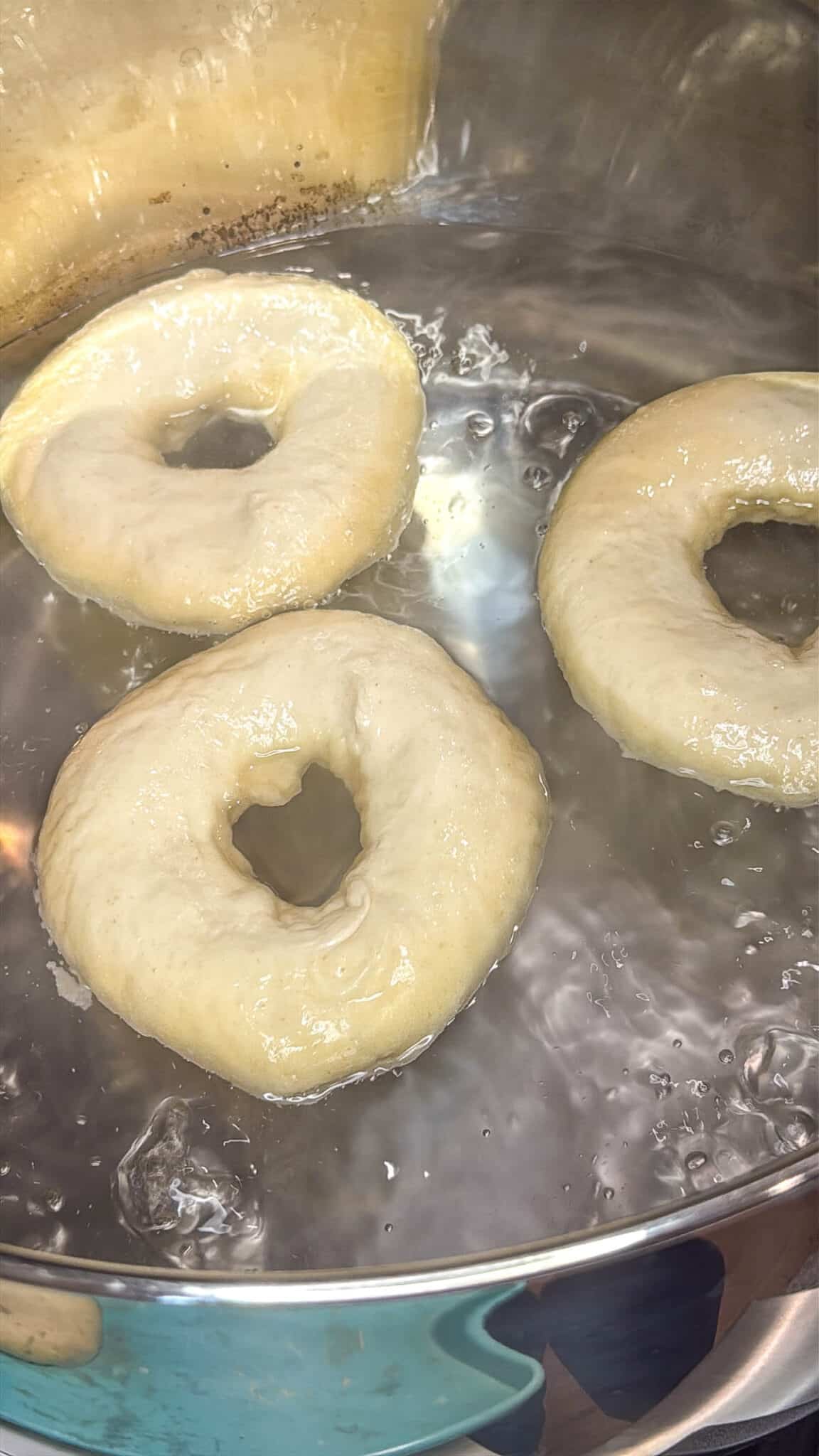
- Boil the bagels 3 to 4 at a time for 30 seconds per side. Use a slotted spoon to flip them and lift them out. Let them drain for a few seconds, then transfer to the parchment-lined sheet pans.
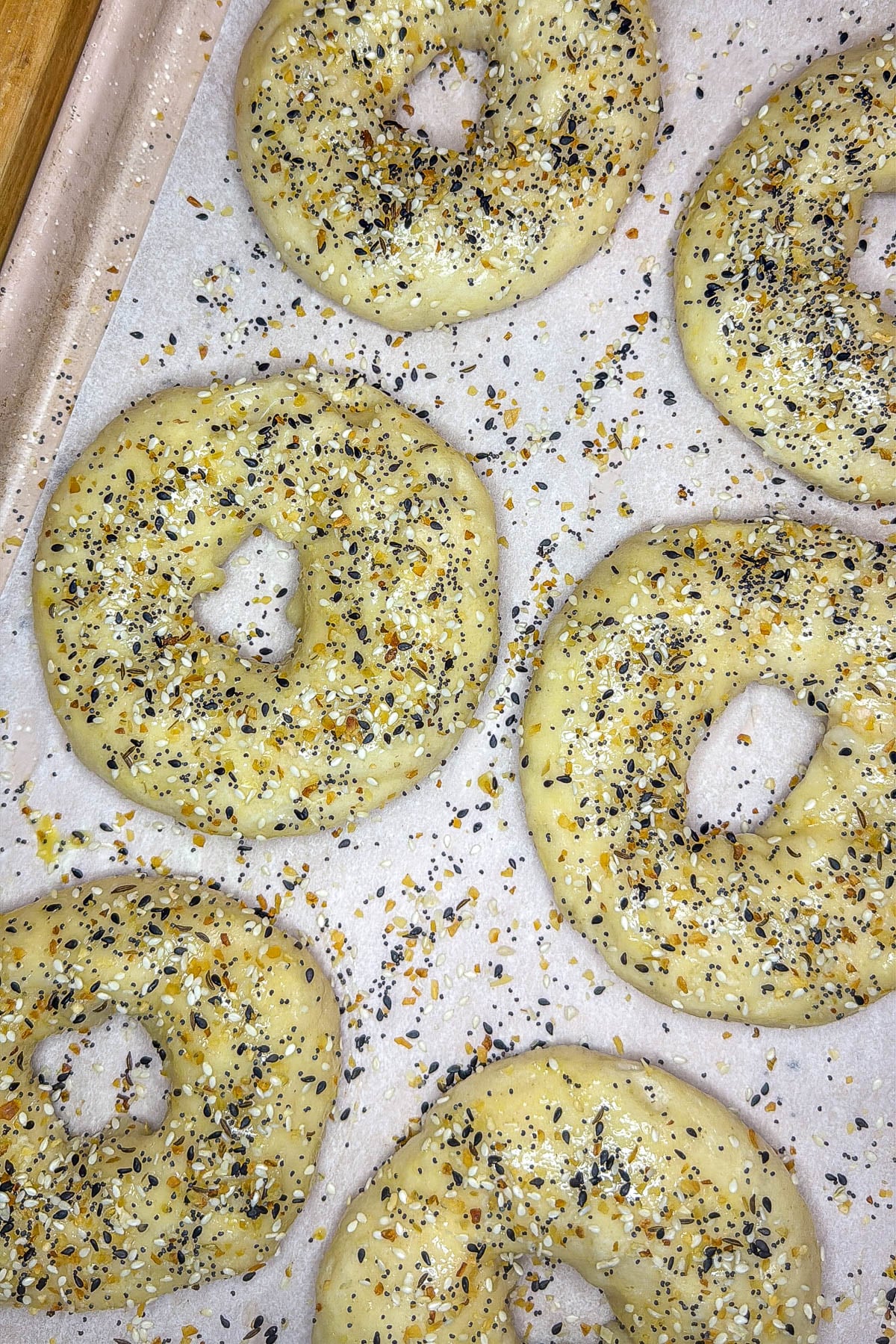
- Whisk the egg with 1 Tablespoon of water. Brush each boiled bagel with the egg wash using a pastry brush, then sprinkle on your favorite toppings (everything seasoning, sesame seeds, poppy seeds, flake salt, dried garlic, etc.).
PRO TIP: Boil longer for a thicker, chewier crust. Up to 1 minute per side gives you a really pronounced bakery-style crust. 30 seconds is the everyday default.
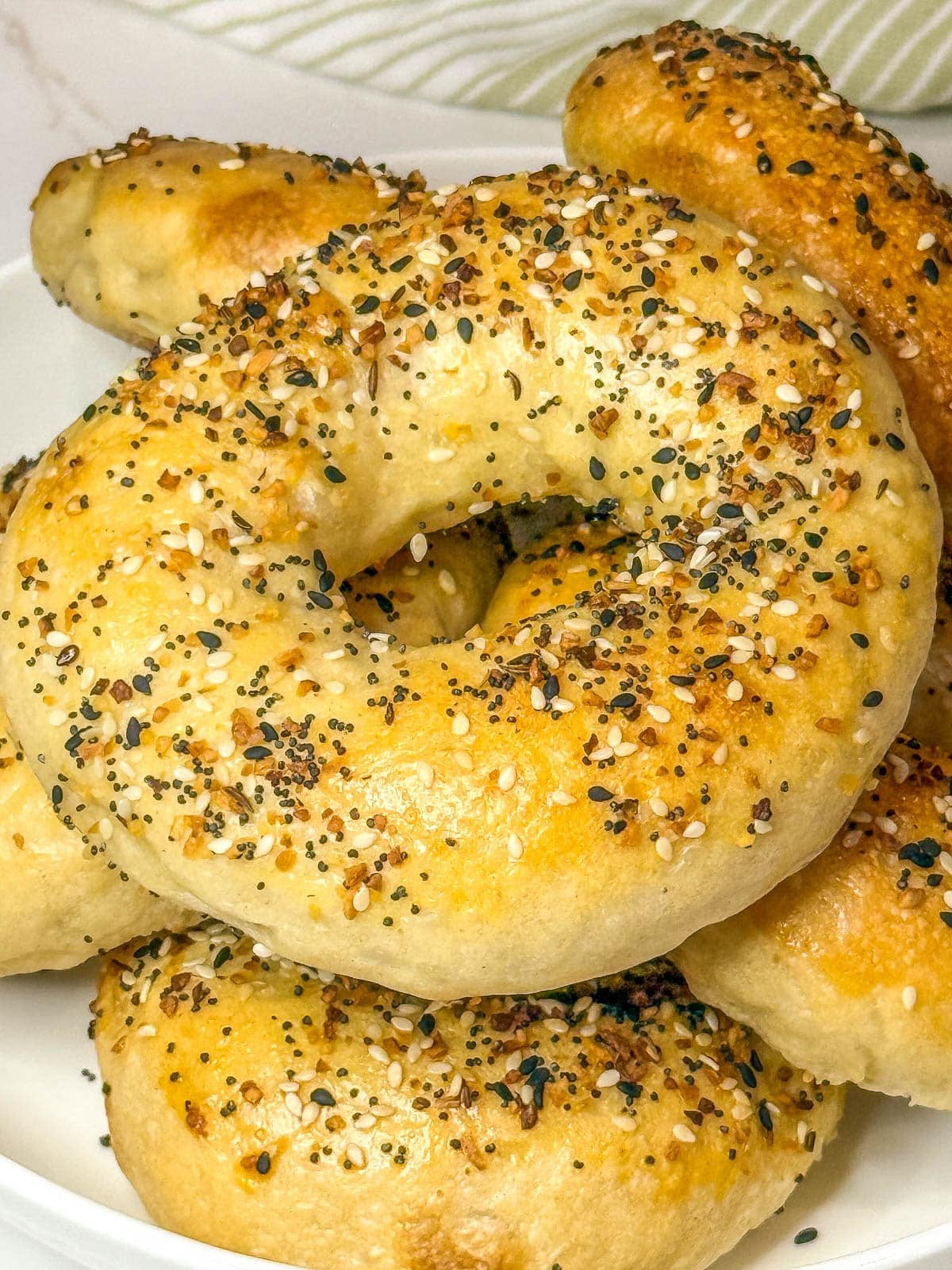
- Bake at 425º F for 20 to 25 minutes or until the bagels are deep golden brown all over. Rotate the pans halfway through for even browning.
- Let the bagels cool on a wire rack for at least 20 minutes before slicing. Cutting in too soon traps steam and makes the crumb gummy. Patience here pays off.
Same-Day Vs Overnight Ferment
The same-day method I just walked you through takes about 90 minutes start to finish. Some weekends, you want a deeper sourdough flavor, and you have the time to plan ahead. Here are both options.
Same-day method (the default).
- Mix the dough
- Proof 30 to 60 minutes until doubled
- Shape into bagels
- Rest 10 minutes
- Boil 30 seconds per side
- Egg wash, add toppings, bake
- Total active time: about 25 minutes; total elapsed time: roughly 2 hours
Overnight method: Shaped bagels rest in the fridge.
- Mix the dough
- Proof 30 to 60 minutes until doubled
- Shape into bagels
- Place them on the parchment-lined sheet pan, cover tightly with plastic wrap
- Refrigerate overnight (up to 24 hours)
- In the morning, take the pan out of the fridge
- Bring the water to a boil while the oven preheats
- Boil straight from the fridge, no need to warm the bagels first
- Egg wash, add toppings, bake
- The cold ferment deepens the sourdough flavor noticeably and gives you bagels that taste as if they were made straight from sourdough starter.
A quick word on flavor depth. The overnight ferment lets lactic acid develop further in the dough at fridge temperature, which gives the finished bagel a creamier, more pronounced sourdough background note. If you want maximum tang, this is the version to make. The same cold-retard trick shows up in my sourdough discard cinnamon rolls overnight method if you want to see it applied to a sweet, enriched dough.
Sample Bake Schedule
If you're the type of person who needs a visual schedule for when to start your bagel dough, then here are some sample timelines for you. This is assuming you have a warm environment, ideally 70ºF-85ºF.
Same-day for brunch at 10 AM:
- 8:00 AM, mix dough
- 8:15 AM, first proof (60 minutes)
- 9:15 AM, shape bagels, rest (10 minutes)
- 9:25 AM, boil water and preheat oven
- 9:30 AM, boil bagels, egg wash, top
- 9:35 AM, bake (20 to 25 min)
- 10:00 AM, cool 10 minutes, serve
Overnight for breakfast at 8 AM:
- 7:00 PM (night before), mix the dough
- 7:30 PM, first proof
- 8:30 PM, shape bagels onto sheet pan, cover, refrigerate
- 7:00 AM (morning of), take pan out of fridge, boil water, preheat oven
- 7:15 AM, boil bagels, egg wash, top
- 7:20 AM, bake
- 7:45 AM, cool 10 minutes, serve
Common Sourdough Discard Bagel Problems To Avoid
- The hole closed up, and you got a bread roll. The hole shrinks dramatically during boiling and baking. Make it 2 inches wide minimum when you shape, even if it looks too big.
- Bagels are pale and matte instead of shiny. You skipped the honey or maple syrup in the water bath, or the water wasn't at a full boil. The sweetened water bath is what creates the shiny crust.
- Bagels are tough and dense instead of chewy. The most common cause is using AP flour expecting bread-flour chew; the lower protein content gives you a softer, less elastic bagel. The second most common is under-proofing; the gluten needs time to relax during the rise, or the bagel comes out tight. Third is over-boiling (more than a minute per side toughens the crust). Bread flour + full proof until doubled + 30 to 60 seconds in the boil fixes all three.
- Bagels stuck to the parchment paper. Didn't sprinkle semolina or cornflour on the parchment after boiling. The wet bagels grip plain parchment and tear when you try to lift them.
- Bottoms burned before the tops finished. The pan was sitting too low in the oven, or the oven runs hot. Move the rack to the middle position and rotate the pan halfway through.
- Crumb is gummy when you slice into a warm bagel. You cut too soon. Steam trapped in the crumb hasn't released yet. Let bagels cool for at least 20 minutes before slicing.
- Bagels deflated during the boil. The dough was over-proofed (proofed past doubled). When you poke the dough, it should bounce back slowly. If it stays poked, it's over-proofed. Next time, watch the rise more carefully.
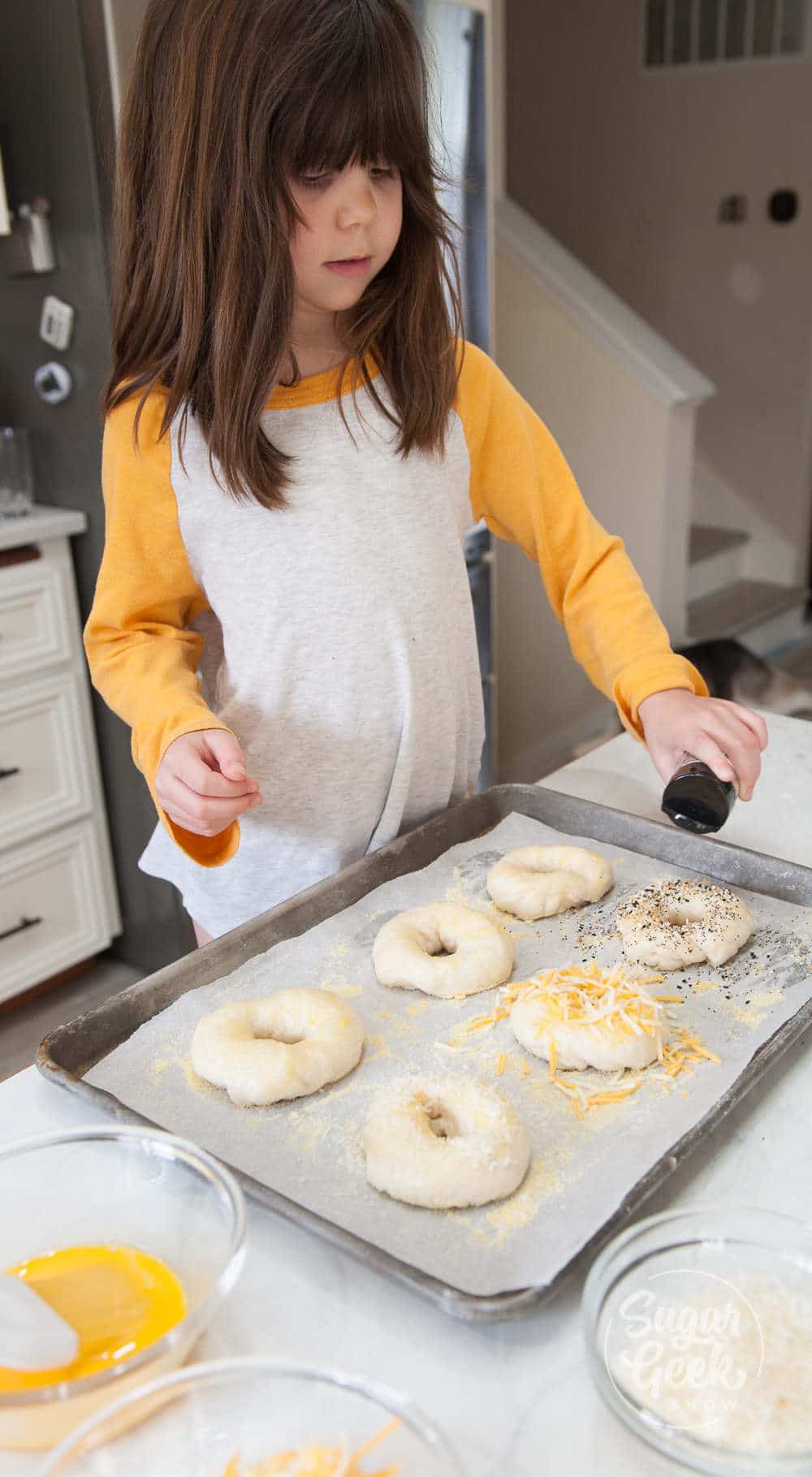
- Toppings fell off during baking. Either you didn't egg-wash heavily enough, or you put the toppings on before the egg wash. Egg wash first, sprinkle toppings on top, and gently press to adhere.
Make This Sourdough Discard Bagel Recipe Your Own
The base recipe is the canvas. Here are the variations I keep coming back to.
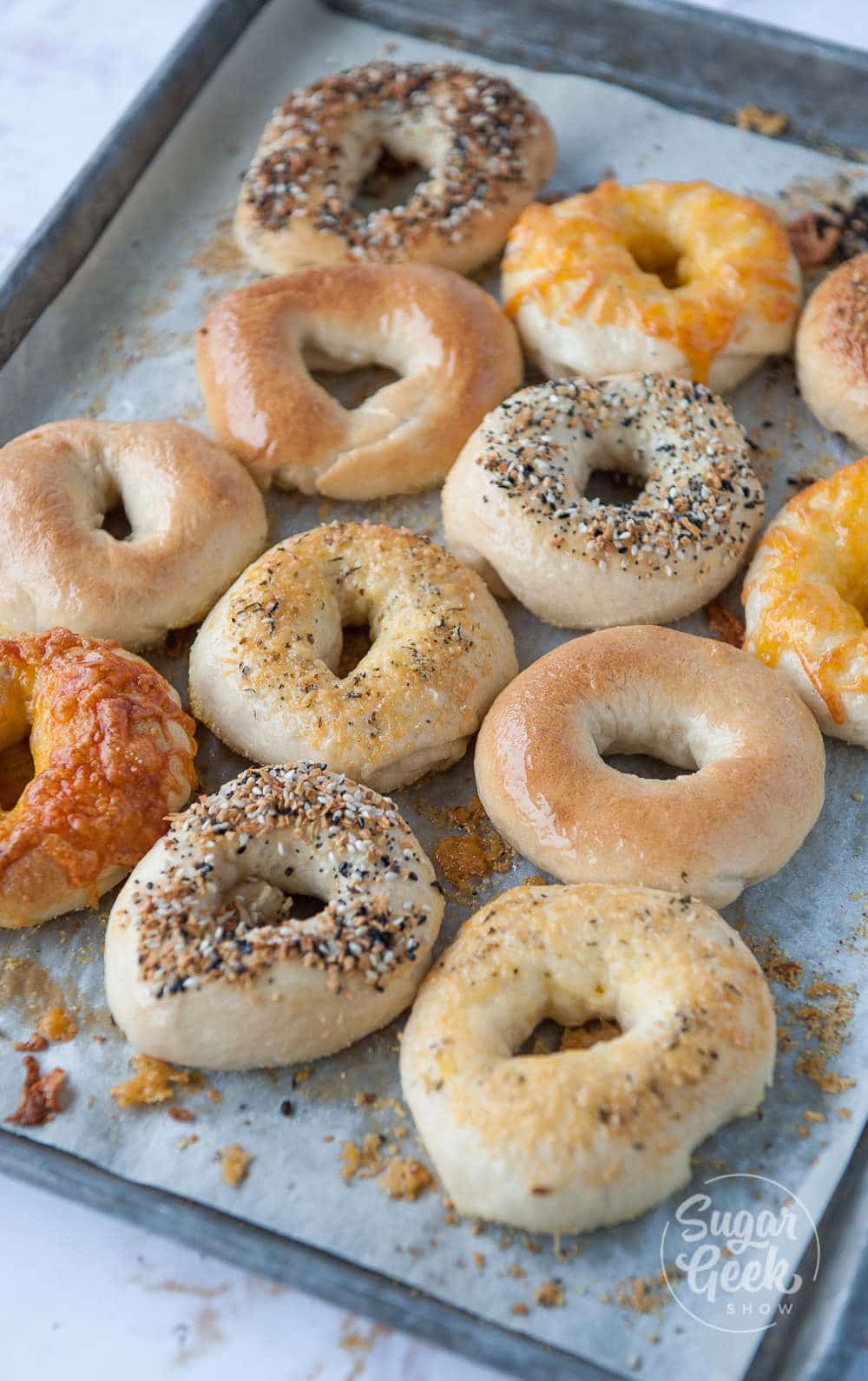
- Everything bagels. Mix sesame seeds, poppy seeds, dried garlic, dried onion, and flake salt in equal parts (or use a store-bought everything seasoning). Sprinkle generously on egg-washed bagels before baking. The classic.
- Cinnamon raisin bagels. Add 1 Tablespoon cinnamon and 1 cup raisins to the dough during the last minute of mixing. The raisins might make the dough feel slightly dry, add a teaspoon of water if needed. Brush with egg wash and sprinkle cinnamon sugar on top before baking for an extra-sweet version. If you love the sourdough + cinnamon flavor combo, my sourdough discard cinnamon rolls take it into enriched dough territory.
- Jalapeño cheddar bagels. Add ½ cup finely diced pickled jalapeños and 1 cup shredded sharp cheddar to the dough in the last minute of mixing. Top with extra cheese after the egg wash for a melty crust. Spicy weekend favorite.
- Cheese bagels. Mix 1 cup grated sharp cheddar or mozzarella into the dough OR sprinkle 1 to 2 Tablespoons of cheese on each bagel after the egg wash. Both methods work; doing both gives you cheese-stuffed cheese-topped bagels which is exactly as good as it sounds.
- Blueberry bagels. Fold 1 cup fresh or dried blueberries into the dough in the last minute of mixing. Fresh blueberries will leak some color into the dough (purple-streaked bagels, kind of fun). Dried blueberries hold their shape and color better.
- Garlic herb bagels. Add 1 teaspoon garlic powder and 1 Tablespoon dried Italian herbs (or fresh chopped rosemary + thyme) to the dough. Sprinkle additional dried garlic on top before baking. The same garlic-herb flavor profile shows up in my easy sourdough focaccia recipe if you want to spread the bread love around.
- Sesame bagels. Brush with egg wash and roll the top of each bagel in white sesame seeds (or a mix of white and black). Toasted sesame gives the bagel a nutty crust.
- Whole wheat bagels. Swap up to half the bread flour for whole wheat flour. Adds nuttiness and fiber; texture is slightly denser. If you go more than half wheat the bagel becomes too dense. If you love whole wheat baking, my honey whole wheat bread is the loaf version of the same flavor family.
- Pumpernickel-style bagels. Replace 1 cup of bread flour with rye flour and add 2 Tablespoons of cocoa powder + 1 Tablespoon molasses to the dough. Dark, dense, classic deli bagel flavor.
- Salt bagels. No egg wash needed. Boil as usual, then sprinkle generously with coarse pretzel salt or flake salt before baking. Pairs beautifully with butter and chives. If salt-finished baked goods are your love language, my sourdough discard crackers are the savory snack version of the same idea.
- Active starter swap. Use 1 cup of active, recently-fed sourdough starter at peak instead of discard, and reduce the instant yeast to 7g (half the amount). The active wild yeast does some of the leavening work. Let the first proof go 60 to 90 minutes instead of 30.
- Half batch. Cut all ingredients in half. Yields 9 bagels. Same bake time, slightly faster proof since less dough to warm up.
Make-Ahead, Storage, And Reheating
Bagels are the perfect make-ahead bread. Here is the full matrix.
- Mixed dough in the fridge (before first proof). Up to 24 hours. Mix the dough, place it in a greased bowl, cover with plastic wrap, and refrigerate. In the morning, take it out and let it come to room temperature for 30 minutes before shaping. The cold ferment deepens the sourdough flavor.
- Shaped bagels in the fridge. Up to 24 hours (see the Overnight method above for the protocol).
- Frozen unbaked bagels. Up to 1 month. Shape bagels, place on a sheet pan, freeze for 2 hours until firm, then transfer to a zip-top freezer bag. To bake, thaw in the fridge overnight, then boil and bake as usual.
- Bake bagels at room temperature. Up to 2 days, in a paper bag or wrapped in a clean tea towel. Plastic bags trap moisture and make the crust soggy.
- Baked bagels in the freezer. Up to 3 months. Slice each bagel in half before freezing (so you can drop them in the toaster from frozen). Wrap individually in plastic, then place in a zip-top freezer bag.
- Reheating from frozen. Toaster works best for half-bagels (2 to 3 minutes from frozen, no need to thaw). For whole bagels, wrap in foil and warm in a 350º F oven for 10 minutes.
- Sourdough discard itself. Up to 1 week in the fridge for this recipe. Older discard gives a sharper tang.
Final Thoughts
Sourdough discard bagels are how you justify spending an afternoon making 18 bagels at once. One batch covers breakfast for a week, freezes beautifully, and uses up a full cup of discard that would otherwise hit the trash. The discard adds the kind of subtle depth that elevates the bagel from "very good homemade" to "almost-bakery-quality." Avalon still claims the hole-poking job every time.
If you love these bagels, my sourdough discard pancakes are the easiest weekday breakfast in the same flavor family, my sourdough discard cinnamon rolls take the discard into enriched dough territory, and the rest of the sourdough discard recipes library has more ways to use your jar.
Sourdough Discard Bagel FAQs
The boil is what creates the bagel's signature shiny, chewy crust. When the shaped dough hits boiling water, the starch on the outside gelatinizes and forms a firm shell. That shell is what gives you the dense, chewy bite when the bagel comes out of the oven. Skip the boil, and you get a bread roll, not a bagel. Honey or maple syrup in the boiling water adds a molasses depth that mimics traditional barley malt syrup.
Yes. Knead the dough by hand on a lightly floured surface for 10 to 15 minutes. Bagel dough is stiff, so expect tired arms. The dough is ready when it passes the window pane test (stretch a small piece thin enough to see light through without tearing).
Three possible reasons. First, you used all-purpose flour instead of bread flour; AP flour gives a softer bite. Second, you under-boiled; try 45 to 60 seconds per side for a more pronounced chew. Third, you under-proofed the dough; the gluten needs time to develop fully.
Yes, this is one of the best things about making bagels in bulk. Shape the bagels, freeze them on a sheet pan for 2 hours until firm, then bag and freeze for up to a month. When ready to bake, thaw the bagels overnight in the fridge, then boil and bake as usual. The boil-and-bake works exactly the same on thawed bagels.
Not for this recipe. Sourdough discard isn't active enough to leaven 30 oz of flour in 30 to 60 minutes. If you want to do a fully yeast-free version, you need to use 1 cup of active starter at peak (see the Active starter swap in Make This Recipe Your Own) AND give the dough 4 to 6 hours to proof. That's a different recipe with a much longer timeline.
More Sourdough Discard Recipes To Try

Leave Me A Review
⭐️⭐️⭐️⭐️⭐️
If you tried this Sourdough Discard Bagel Recipe or any other recipe on my blog, please leave a 🌟 star rating and let me know how it goes in the comments. I love hearing from you!
Recipe
Equipment
- Stand mixer with dough hook
Ingredients
- 30 ounces bread flour or all-purpose flour
- 1 Tablespoon brown sugar
- 2 Tablespoons olive oil
- 1 cup sourdough discard
- 14 grams instant yeast or active dry (see notes below recipe)
- 16 ounces warm water (110ºF)
- 2 teaspoons salt
Waterbath
- 64 ounces water
- 2 ounces honey or maple syrup
- 1 Tablespoon salt
Egg wash
- 1 large egg
- 1 Tablespoon water
Instructions
- Before you begin: Warm the water to 110º F to 115º F (use a thermometer, hotter than 115º F kills the yeast). Pull the discard out of the fridge. Have your stand mixer ready with the dough hook attached.
- Combine the warm water, brown sugar, and olive oil in a measuring cup. Stir to dissolve the sugar. Set aside.
- Place the bread flour and instant yeast in the bowl of your stand mixer. Mix on low for 5 seconds to distribute the yeast.
- Add the warm water mixture and the sourdough discard to the bowl. Mix on low until everything is moistened, about 30 seconds.
- Sprinkle in the salt while the mixer runs on low.
- Increase to medium-high speed (speed 4 on a KitchenAid, speed 2 on a Bosch). Mix for 6 minutes. Adjust with a Tablespoon of water if too dry, or a Tablespoon of flour if too wet.
- Form into a tight ball, place in a lightly oiled bowl, cover, and proof in a warm spot for 30 to 60 minutes or until doubled in size.
Shape and rest
- Divide the dough into 18 equal pieces (about 3 ounces each).
- Shape each piece into a tight ball, then poke a hole in the center with your finger and stretch the hole to 2 inches wide.
- Cover and let rest 10 minutes while you bring the water bath to a boil.
Boil and bake
- Bring 64 ounces of water to a boil in a wide pot. Add 2 ounces of honey or maple syrup and 1 Tablespoon of salt.
- Preheat the oven to 425º F. Line two sheet pans with parchment paper and sprinkle with semolina or cornflour.
- Boil the bagels 3 to 4 at a time for 30 seconds per side. Use a slotted spoon to flip and lift them out. Place on the parchment-lined sheet pans.
- Whisk the egg and water together. Brush each boiled bagel with egg wash, then sprinkle on toppings.
- Bake at 425º F for 20 to 25 minutes, rotating the pans halfway through, until deep golden brown.
- Cool on a wire rack for at least 20 minutes before slicing.
Video
Notes
- Bread flour gives the chewiest classic bagel texture. AP flour works but the bagels are softer.
- The recipe uses 1 cup of sourdough discard added to my master bagel formula. To keep the hydration consistent with the master recipe (53%), the added water is reduced from 16 oz to 14 oz. Dough behaves identically to the master, no shaping or proofing differences.
- For active dry yeast, use the same amount (14g) and proof the dough 90 minutes instead of 30 to 60.
- Two parchment-lined half-sheet pans hold 18 bagels comfortably.
- Sprinkle the parchment with semolina or cornflour after boiling to prevent sticking.
- Mixed dough in the fridge (before first proof): up to 24 hours. Let come to room temperature 30 minutes before shaping.
- Shaped bagels in the fridge (overnight method): up to 24 hours. Boil and bake straight from the fridge.
- Frozen unbaked bagels: shape, freeze on a sheet pan for 2 hours, bag, up to 1 month. Thaw overnight in fridge before baking.
- Baked bagels at room temperature: up to 2 days in a paper bag.
- Baked bagels in the freezer: slice in half first, wrap individually, up to 3 months. Toast straight from frozen.
- Active starter swap: 1 cup active starter at peak instead of discard AND reduce yeast to 7g. Proof 60 to 90 minutes.
- Buttermilk for water swap: not recommended, water is what gives bagels their lean chewy character.
- Whole wheat: up to half the bread flour swapped for whole wheat. More than half makes the bagels too dense.
- Flavor variations: see the Make This Recipe Your Own section above for 12 variations (everything, cinnamon raisin, jalapeño cheddar, blueberry, etc.).
- Don't skip the boil. The boil creates the chewy shiny crust. Skip it and you get bread rolls.
- Don't make the hole too small. It shrinks during boiling and baking. 2 inches wide minimum.
- Don't use water hotter than 115º F. Kills the yeast.
- Don't slice warm bagels. Steam trapped in the crumb makes them gummy. Wait 20 minutes.
- Don't use plastic bags to store baked bagels. Traps moisture and softens the crust. Paper bag or tea towel.

Jackie R says
I made these yesterday and they are so good. Breakfast was a bagel with a sunny side up egg and cheese! They also taste good with cream cheese! These bagels are perfectly moist and came out superb. Next time I make bagels I'll be making this recipe again.