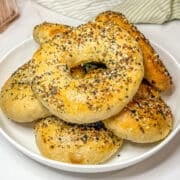
Homemade Sourdough Discard Bagels
Bakery-style sourdough discard bagels with a shiny crust and delightfully chewy center.
Servings: 18 bagels
Calories: 203kcal
Equipment
- Stand mixer with dough hook
Ingredients
- 30 ounces bread flour or all-purpose flour
- 1 Tablespoon brown sugar
- 2 Tablespoons olive oil
- 1 cup sourdough discard
- 14 grams instant yeast or active dry (see notes below recipe)
- 16 ounces warm water (110ºF)
- 2 teaspoons salt
Waterbath
- 64 ounces water
- 2 ounces honey or maple syrup
- 1 Tablespoon salt
Egg wash
- 1 large egg
- 1 Tablespoon water
Instructions
- Before you begin: Warm the water to 110º F to 115º F (use a thermometer, hotter than 115º F kills the yeast). Pull the discard out of the fridge. Have your stand mixer ready with the dough hook attached.
- Combine the warm water, brown sugar, and olive oil in a measuring cup. Stir to dissolve the sugar. Set aside.
- Place the bread flour and instant yeast in the bowl of your stand mixer. Mix on low for 5 seconds to distribute the yeast.
- Add the warm water mixture and the sourdough discard to the bowl. Mix on low until everything is moistened, about 30 seconds.
- Sprinkle in the salt while the mixer runs on low.
- Increase to medium-high speed (speed 4 on a KitchenAid, speed 2 on a Bosch). Mix for 6 minutes. Adjust with a Tablespoon of water if too dry, or a Tablespoon of flour if too wet.
- Form into a tight ball, place in a lightly oiled bowl, cover, and proof in a warm spot for 30 to 60 minutes or until doubled in size.
Shape and rest
- Divide the dough into 18 equal pieces (about 3 ounces each).
- Shape each piece into a tight ball, then poke a hole in the center with your finger and stretch the hole to 2 inches wide.
- Cover and let rest 10 minutes while you bring the water bath to a boil.
Boil and bake
- Bring 64 ounces of water to a boil in a wide pot. Add 2 ounces of honey or maple syrup and 1 Tablespoon of salt.
- Preheat the oven to 425º F. Line two sheet pans with parchment paper and sprinkle with semolina or cornflour.
- Boil the bagels 3 to 4 at a time for 30 seconds per side. Use a slotted spoon to flip and lift them out. Place on the parchment-lined sheet pans.
- Whisk the egg and water together. Brush each boiled bagel with egg wash, then sprinkle on toppings.
- Bake at 425º F for 20 to 25 minutes, rotating the pans halfway through, until deep golden brown.
- Cool on a wire rack for at least 20 minutes before slicing.
Video
Notes
Ingredient notes:
- Bread flour gives the chewiest classic bagel texture. AP flour works but the bagels are softer.
- The recipe uses 1 cup of sourdough discard added to my master bagel formula. To keep the hydration consistent with the master recipe (53%), the added water is reduced from 16 oz to 14 oz. Dough behaves identically to the master, no shaping or proofing differences.
- For active dry yeast, use the same amount (14g) and proof the dough 90 minutes instead of 30 to 60.
- Two parchment-lined half-sheet pans hold 18 bagels comfortably.
- Sprinkle the parchment with semolina or cornflour after boiling to prevent sticking.
- Mixed dough in the fridge (before first proof): up to 24 hours. Let come to room temperature 30 minutes before shaping.
- Shaped bagels in the fridge (overnight method): up to 24 hours. Boil and bake straight from the fridge.
- Frozen unbaked bagels: shape, freeze on a sheet pan for 2 hours, bag, up to 1 month. Thaw overnight in fridge before baking.
- Baked bagels at room temperature: up to 2 days in a paper bag.
- Baked bagels in the freezer: slice in half first, wrap individually, up to 3 months. Toast straight from frozen.
- Active starter swap: 1 cup active starter at peak instead of discard AND reduce yeast to 7g. Proof 60 to 90 minutes.
- Buttermilk for water swap: not recommended, water is what gives bagels their lean chewy character.
- Whole wheat: up to half the bread flour swapped for whole wheat. More than half makes the bagels too dense.
- Flavor variations: see the Make This Recipe Your Own section above for 12 variations (everything, cinnamon raisin, jalapeño cheddar, blueberry, etc.).
- Don't skip the boil. The boil creates the chewy shiny crust. Skip it and you get bread rolls.
- Don't make the hole too small. It shrinks during boiling and baking. 2 inches wide minimum.
- Don't use water hotter than 115º F. Kills the yeast.
- Don't slice warm bagels. Steam trapped in the crumb makes them gummy. Wait 20 minutes.
- Don't use plastic bags to store baked bagels. Traps moisture and softens the crust. Paper bag or tea towel.
Nutrition
Serving: 1bagel | Calories: 203kcal | Carbohydrates: 38g | Protein: 6g | Fat: 3g | Saturated Fat: 0.4g | Polyunsaturated Fat: 1g | Monounsaturated Fat: 1g | Trans Fat: 0.001g | Cholesterol: 10mg | Sodium: 657mg | Potassium: 61mg | Fiber: 1g | Sugar: 3g | Vitamin A: 16IU | Vitamin C: 0.02mg | Calcium: 13mg | Iron: 1mg
