
• Skip to primary navigation
  • Skip to main content
  • Skip to primary sidebar
  • Memorial Day
  • Recipes
  • Free Tutorials
  • Sign Up
  • About Liz

Sugar Geek Show logo

menu icon
go to homepage
  • Memorial Day
  • Recipes
  • Free Tutorials
  • Sign Up
  • About Liz
subscribe
search icon
Homepage link
  • Memorial Day
  • Recipes
  • Free Tutorials
  • Sign Up
  • About Liz
×
Home

Blog
How to cover a cake board

December 13, 2017 Blog
Cake Decorating Basics: Cake Boards

Cake boards. I mean, they're pretty darn important. They are the foundation of every cake. Today we will go over different types of cake boards and how to make them look presentable and professional for any type of cake.

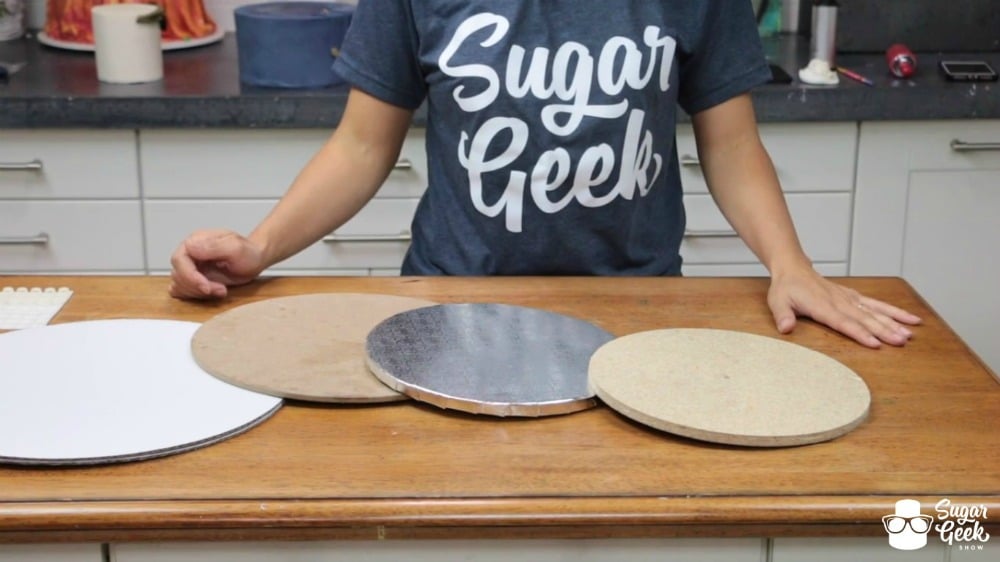
You've got your standard cardboard rounds, your foam core cake drums and your wooden boards. Not pictured in that order. They all work great and some work better than others for certain things.

In general, the cheapest and most widely available option is cardboard rounds. Just one on it's own isn't really enough for your base board, but glue a couple together and you've got yourself a sturdy board that can hold up any tiered cake.

Cake drums are great as they cut out the labor of gluing boards together but if you're like me they aren't available anywhere near you.

Wooden cake boards are a must for any type of cake that requires structure so many sculpted cakes, gravity defying cakes and maybe if you're doing an insanely tall tiered cake.

Whichever board you're using, it really should be covered and finished off with a ribbon to give it a complete and professional look. We're about to show you how to do just that.

How to cover a cake board

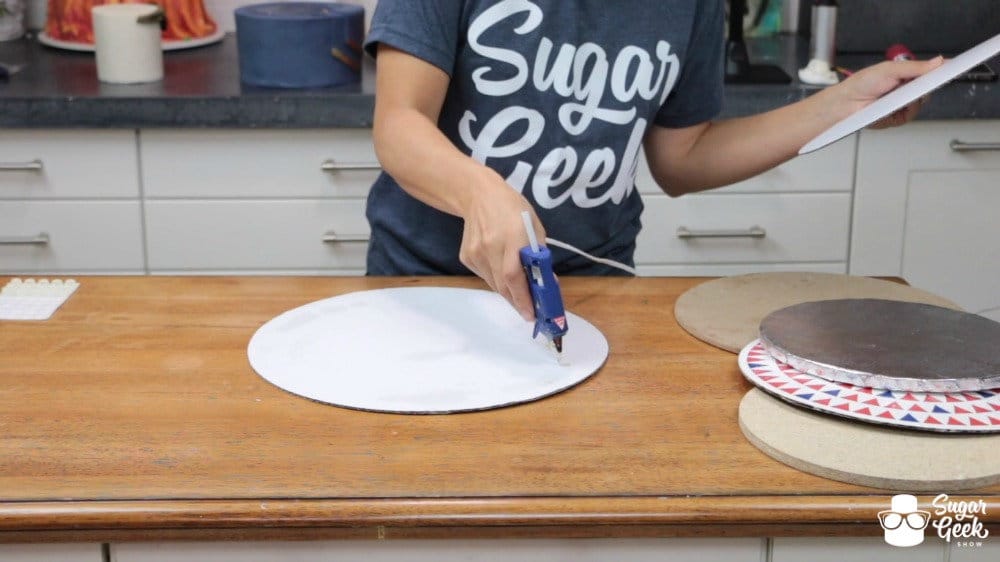
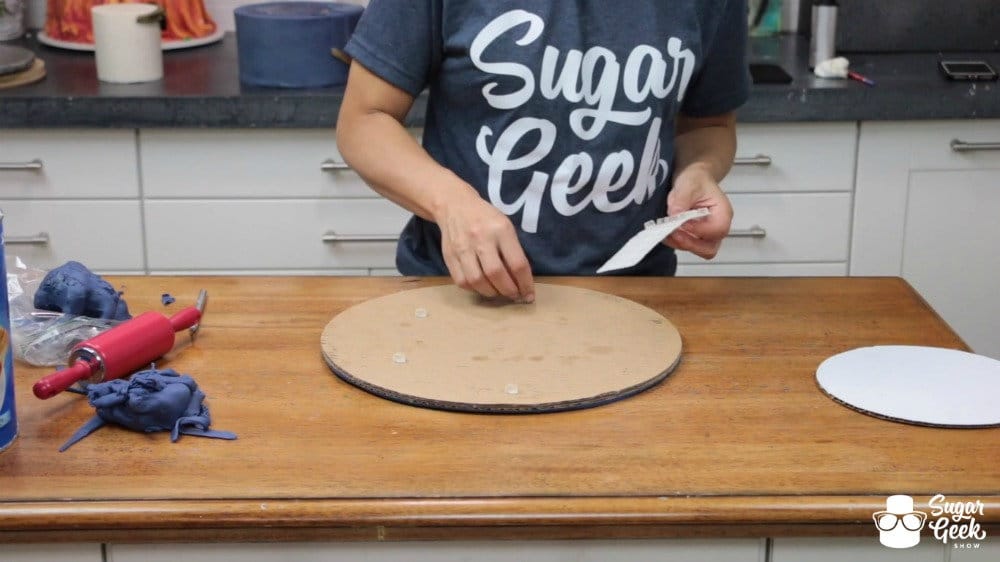
Start by hot gluing two of the same size cardboard rounds together. For added stability glue the boards so that the cardboard "grain" is opposite of the other board. I personally add a cake board for each tier my cake will have to ensure it will be strong enough to hold my cake, so one and two tier cakes get two boards, three tiers get three, four get four and so on.

How to cover a cake board

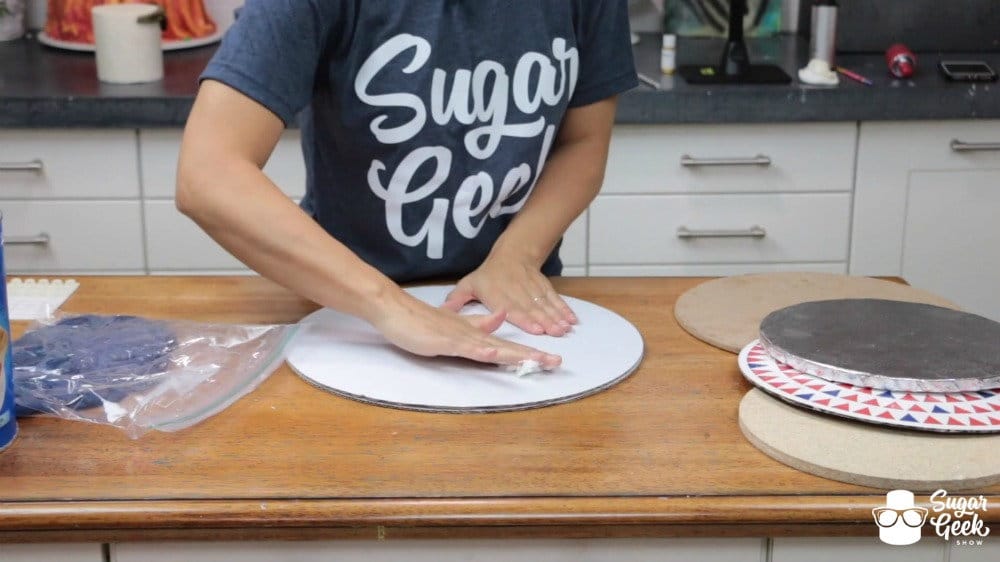
After your boards are glued together, cover the top of the board in a thin layer of shortening.

How to cover a cake board

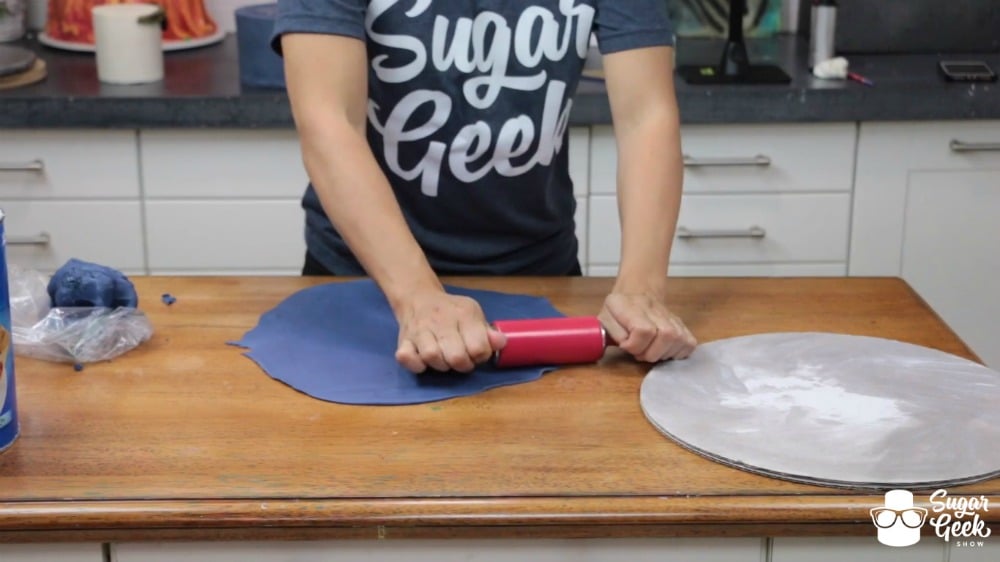
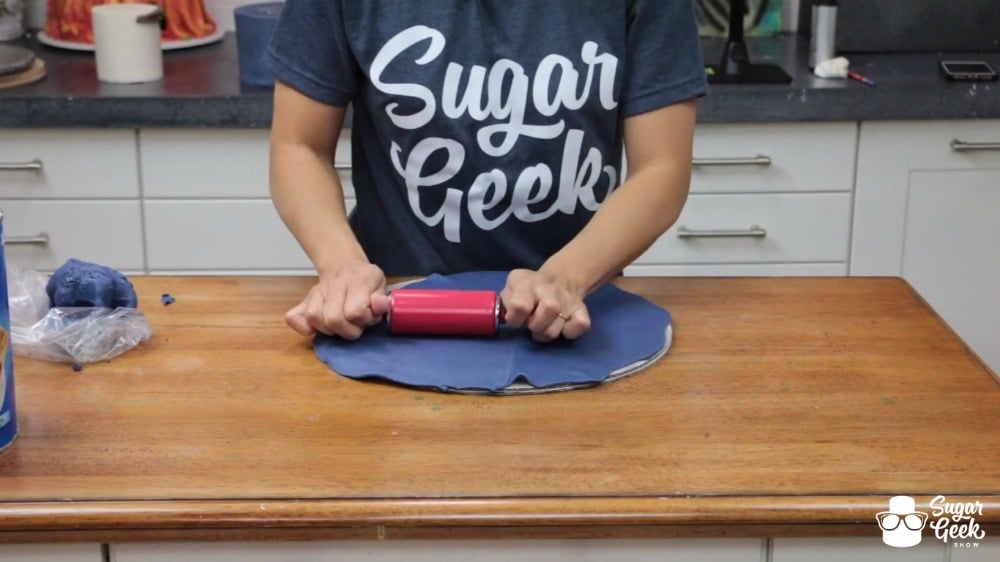
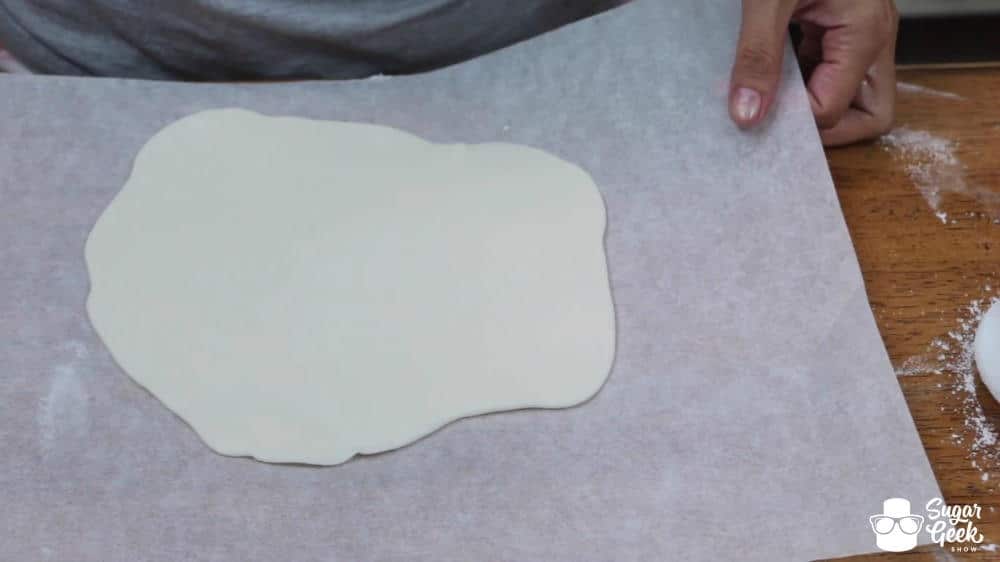
Roll out some leftover fondant nice and thin in your color of choice. Matching some fondant on your cake is always a nice touch.

How to cover a cake board

Place the fondant on the shortening covered board and finish rolling if needed to make sure the entire board is covered.

How to cover a cake board

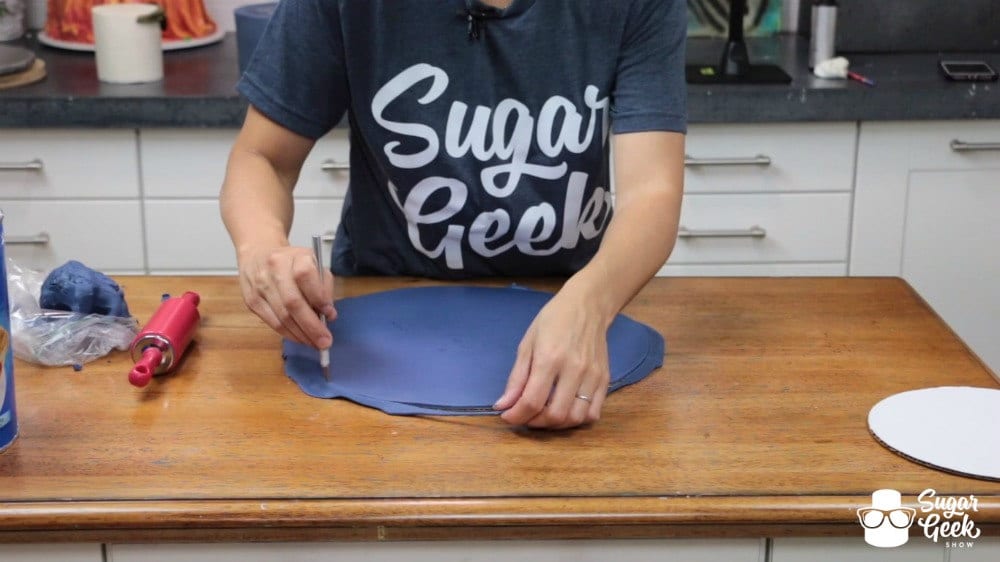
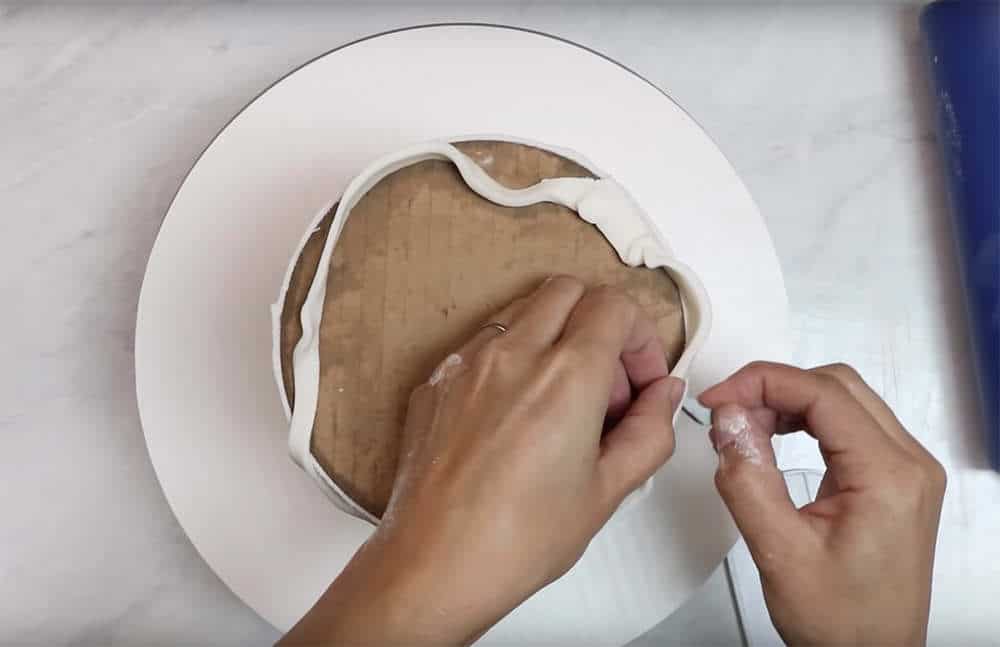
Cut off the excess fondant with an exacto blade.

How to cover a cake board

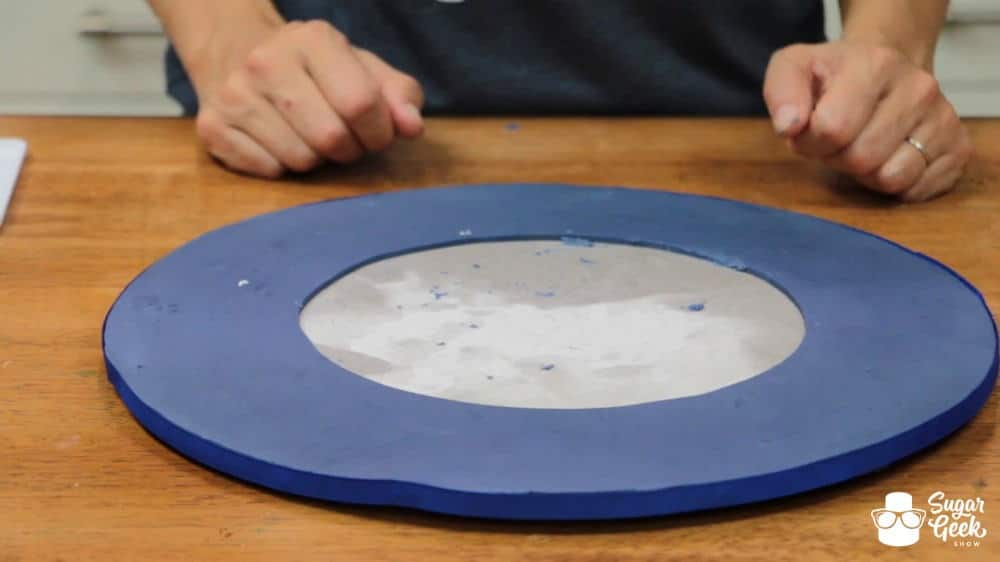
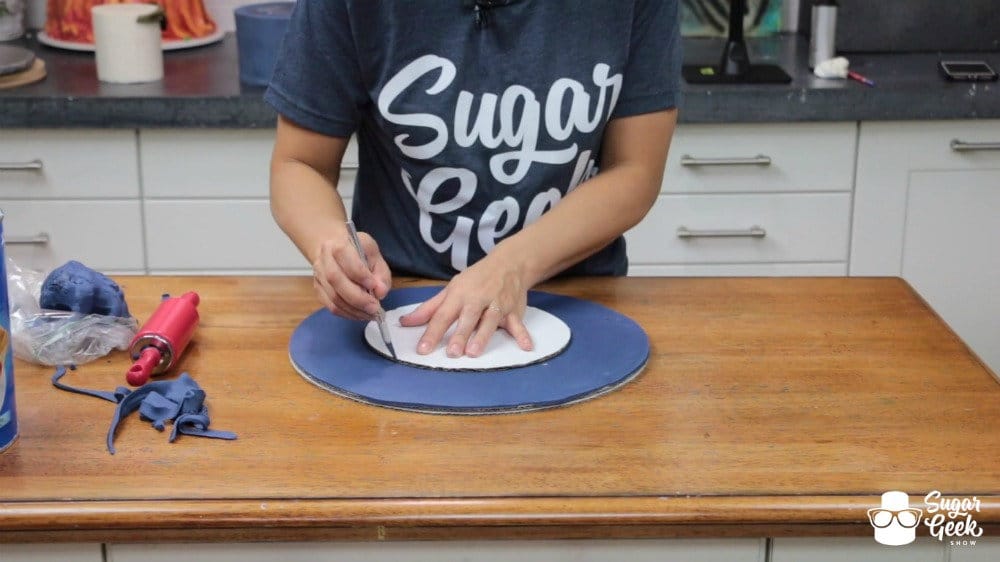
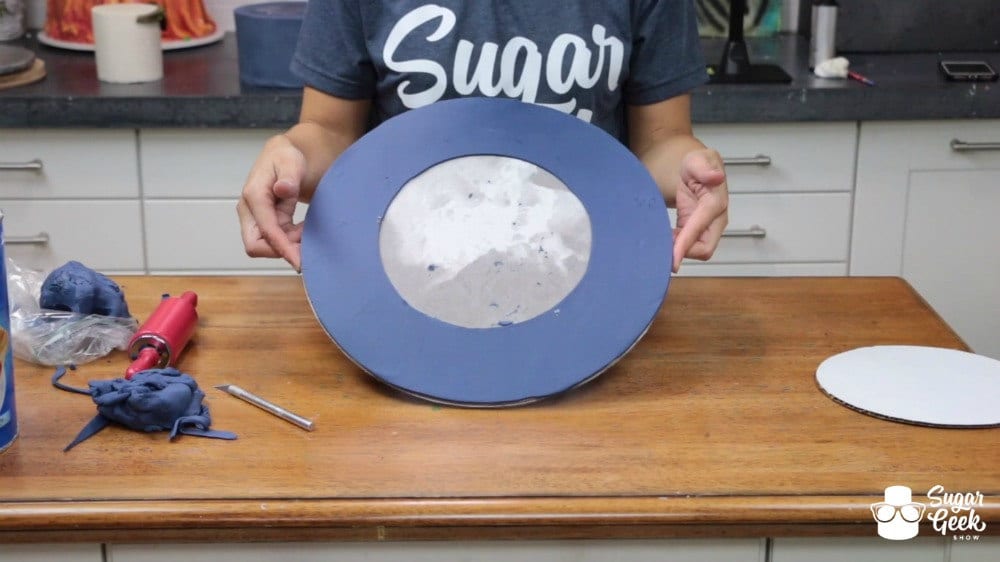
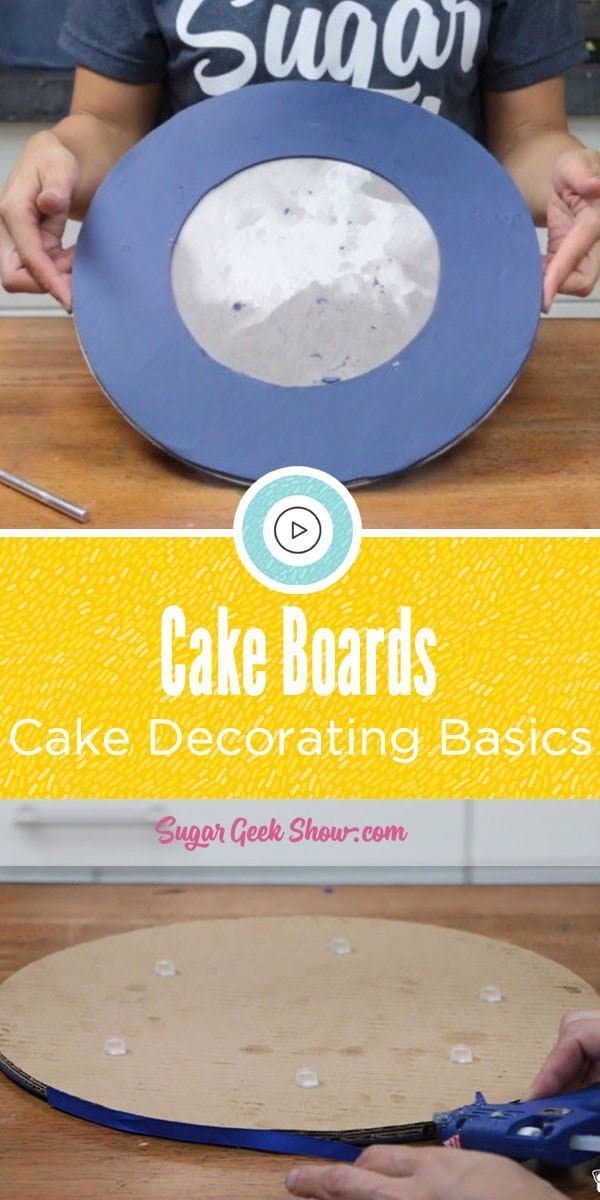
If you're not one for waste, you can take a cake board the size of your bottom tier, center it in the board and cut it out with an exacto knife and remove that fondant.

How to cover a cake board

And there ya go, you have a covered cake board. At this point you may want to bake your cake board to harden up the fondant to keep it from getting damaged if you don't have days to let it dry. Check out the tutorial on how to bake your cake boards at the bottom of this post!

How to cover a cake board

Next, we like to add "feet" to our cake boards to make them easier to pick up and give them another professional touch. In general, cupboard door stops make great feet and are super inexpensive. Occasionally for a wedding cake I will go with something a little fancier. They are self stick so just add some to the bottom and you're good!

How to cover a cake board

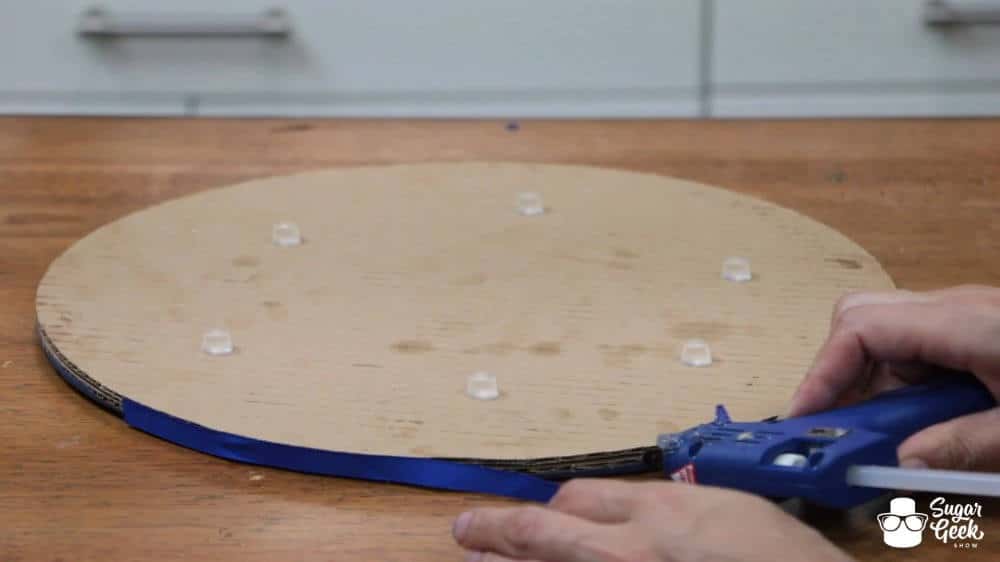
Last but not least, hot glue a ribbon to the edge of your board. Glue every four inches or so. ⅜" grosgrain ribbon is best for two cardboard rounds or a ¼" board covered in fondant.

How to cover a cake board

Isn't it purdy? Well better than a plain old corrugated board right?! For sure, and chances are your customers will even be impressed. Follow these steps for covering any kind of cake board whether it be cardboard, cake drum or wood.

How to cover a cake board

Don't forget to check out the video tutorial below for the how to bake your cake board bit and if you'd like an alternative way to cover your cake board that doesn't use fondant, check out our free tutorial from Shani Christenson on Making Beautiful Custom Cake Boards!

Going over the basics? Check out these!

Cake Decorating Basics: Must Have Tool Review

Cake Decorating Basics: Airless Space Buttercream

Cake Decorating Basics: Leveling and Torting

Cake Decorating Basics: Filling and Crumb Coating

Cake Decorating Basics: Avoiding Cake Blowouts

Cake Decorating Basics: Smooth Final Coat of Buttercream

Cake Decorating Basics: The Upside Down Method

Cake Decorating Basics: The Secret to Small Cakes

Cake Decorating Basics: Covering a Cake in Fondant

Cake Decorating Basics: Easy Double Barrel

Cake Decorating Basics: How to Panel

Cake Decorating Basics: Stacking Cakes

Cake Decorating Basics: Cake Boards

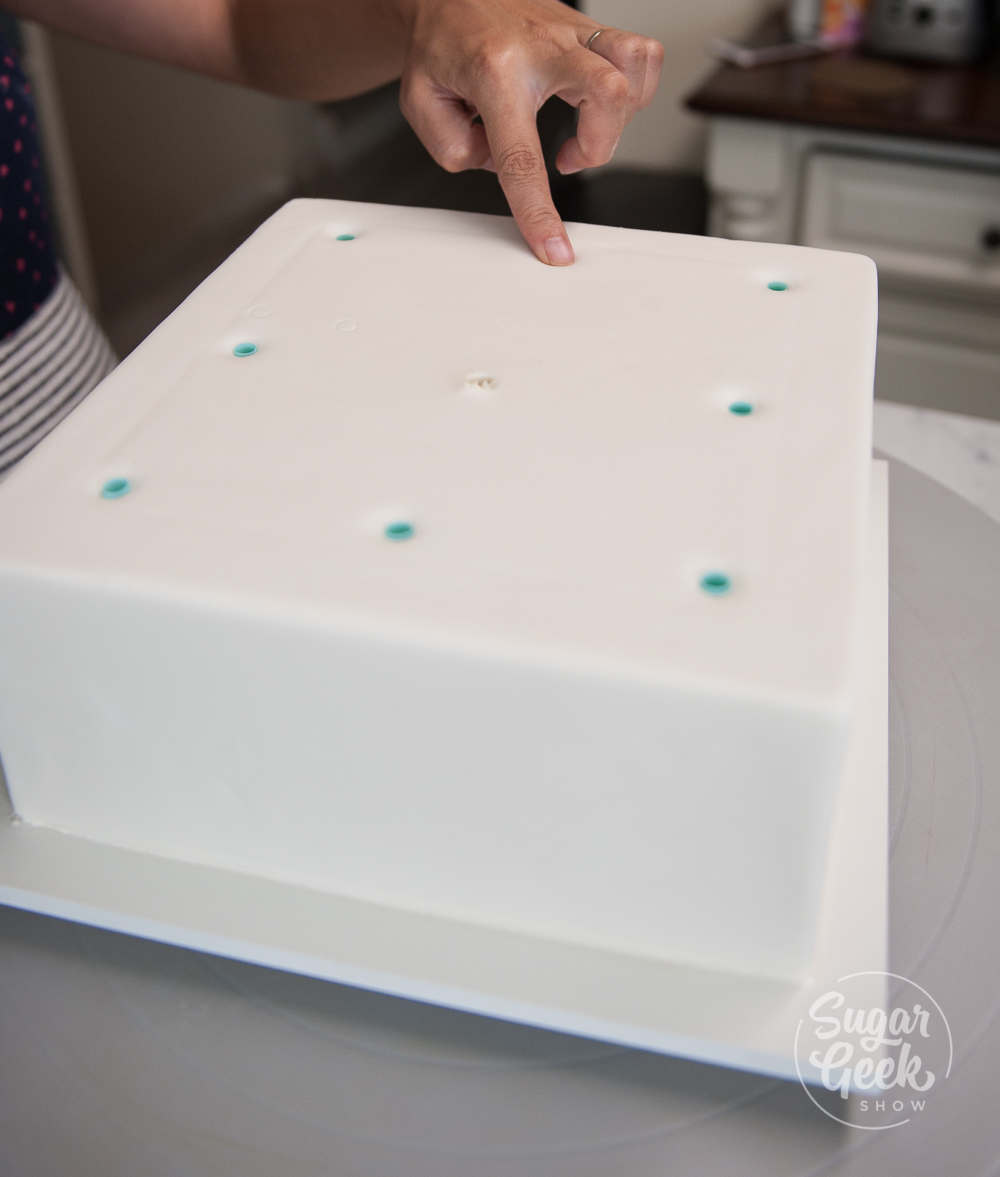
inserting thick milkshake straws into a chilled cake using the straw guide

December 7, 2017 Blog

Cake Decorating Basics: Stacking Cakes With Straws

How to stack a cake with straws

Suppose you do get brave enough to try your first tiered cake. Once all the tiers are completed, how do you safely get one on top of the other? No, it is not a stupid question! If you've never done it before there can be many factors that aren't obvious. Today we will show you just how to stack your cake using straws.

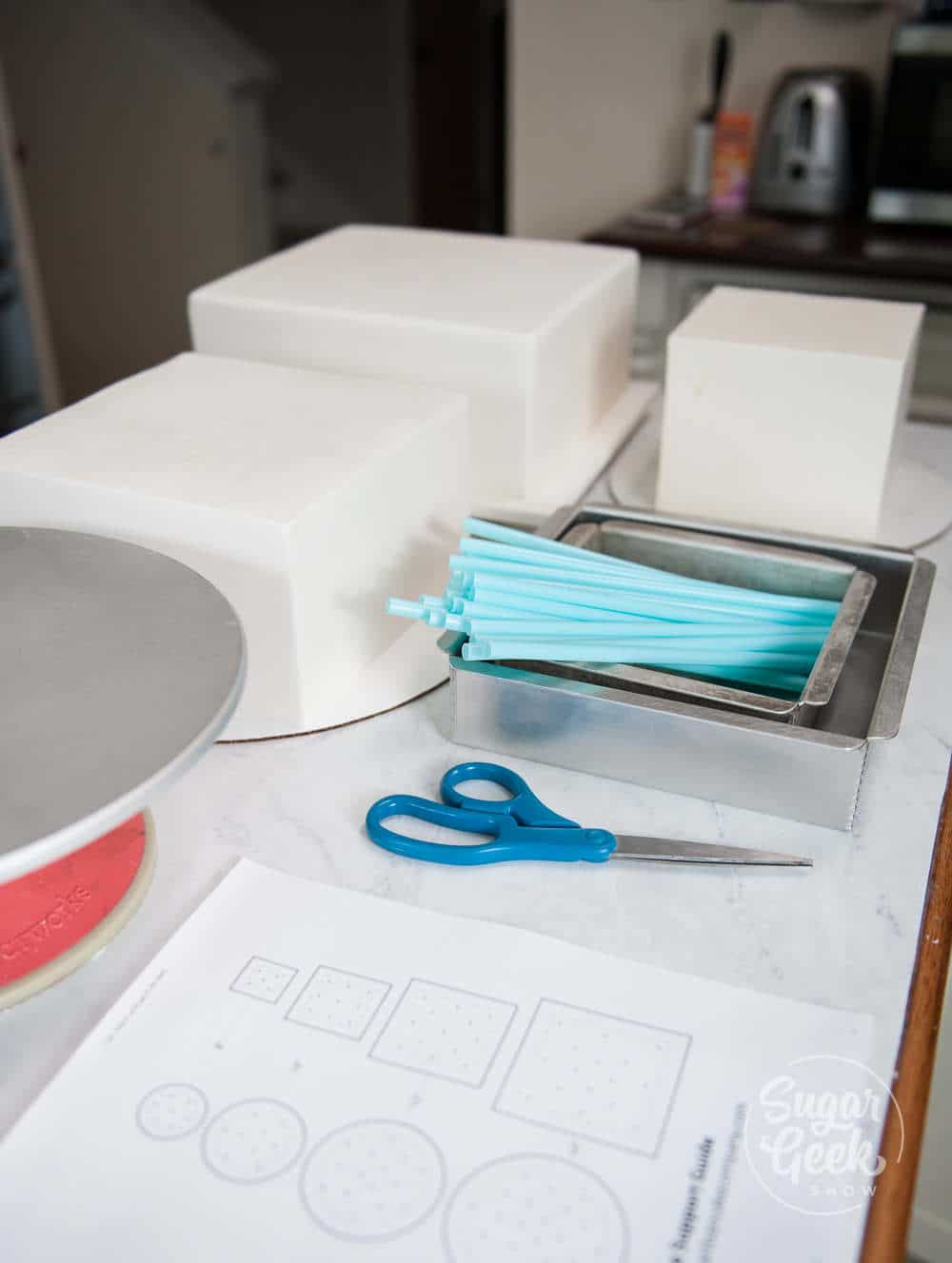
wedding cake supplies - turntable, thick milkshake straws, straw guide, scissors, square cake pans, three tiers of frosted and fondant covered cake

Unless you've used straws before, you might be a little freaked out by the idea but I promise you straws are AMAZING for stacking cakes. I've stacked cakes up to 6 tiers using only straws. The reason I prefer them is that in my experience, dowels are hard to cut so that they are level on the bottom. They are also a pain to cut! Straws are strong, easy to cut and very inexpensive. 

What you need

  1. Milkshake Straws
  2. Scissors
  3. Chilled Cakes On Cardboard 

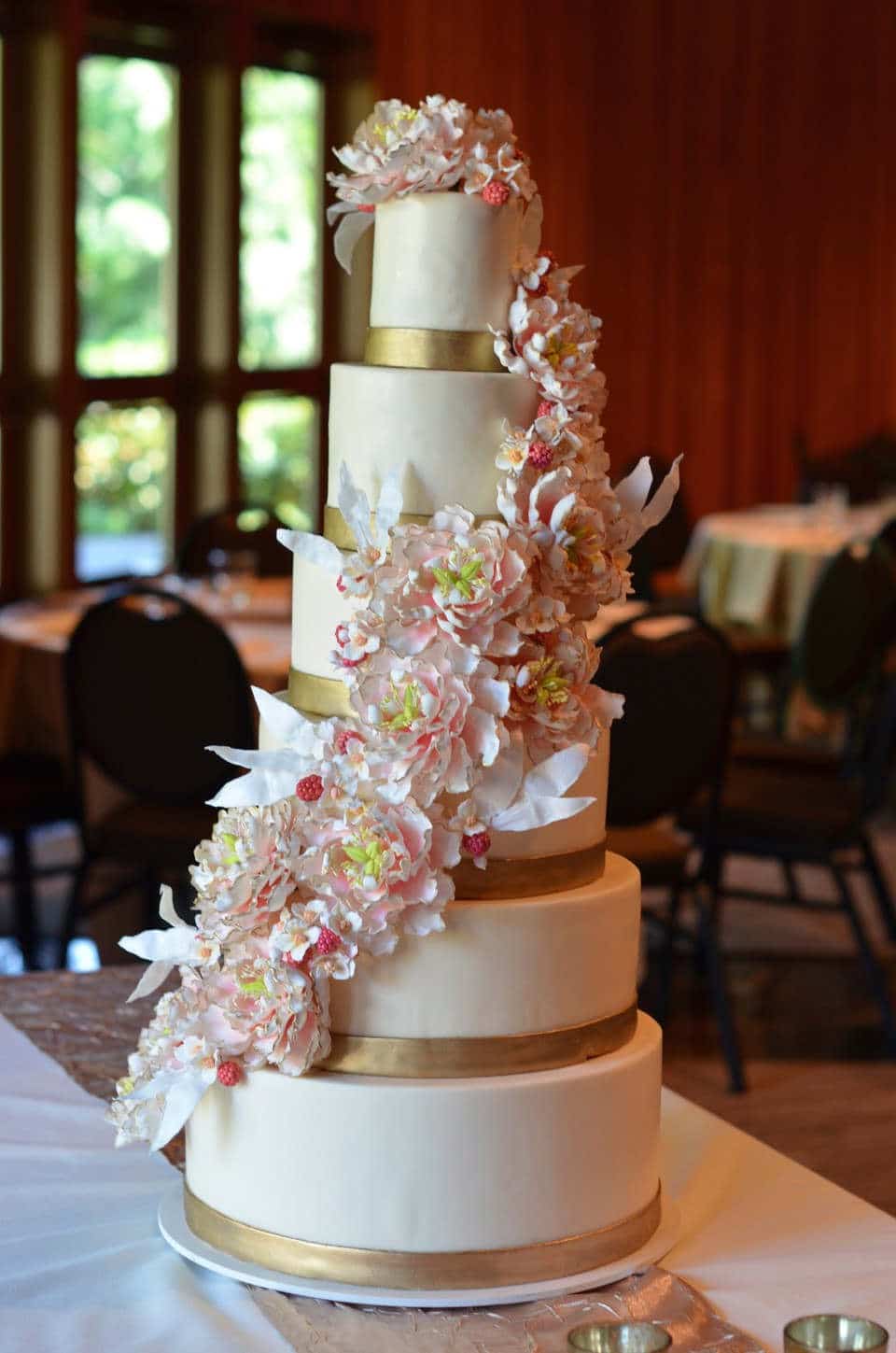
6 tier wedding cake with gold bands and gumpaste peony

What kind of straws work best as cake supports?

When I say straws, I'm actually referring to thick milkshake straws. Some people use bubble tea straws but I have a hard time finding sturdy bubble tea straws. I buy milkshake straws at Cash and Carry but like most things, you can also find them on amazon. 

These milkshake straws are thicker than a typical straw and perfect for pushing into a chilled cake. 

I should also note that recently there has been a lot of press in the media about not using straws because of the risk to sea turtles. Now, sea turtles are my FAVORITE animal so I definitely want to do everything I can to help save them but when it comes to cake decorating, I have to use what's economical and works the best for the stability of my cakes.

You might also find it interesting to note that straws only make up .08% of the world's plastic in the ocean. So while switching to a paper straw might make you feel better and make for some trendy videos on saving the turtles, you're not really having much impact on actual pollution in the ocean IMO. 

The bigger threat to the ocean is actually in the fishing industry (nets and leftover fishing supplies trapping animals in the ocean). You can read more about this in this news article. And that's all I will say about the milkshake straws and pollution politics. Sorry I had to go there!

How do you prepare cakes for stacking?

The first thing you need are some cakes! I typically follow this calendar for baking and decorating when I have a cake that needs to be finished on Saturday. 

  • Tuesday - Review my cake design to see if I need to order anything and make my shopping list. On Tuesdays, I also look at my cake orders for NEXT week to see if I need to order anything online. 
  • Wednesday - Grocery shopping for supplies, make my frosting and fondant. 
  • Thursday - Bake my cakes, chill them in the freezer, fill them and get them crumb-coated and resting in the refrigerator.  
  • Friday - Apply the final coat of buttercream to the cakes and store them in the refrigerator. Make buttercream flowers and put them into the freezer. Assemble and decorate the cake. 
  • Saturday - Deliver cake. Obviously, if your cake is due on another day you can adjust this timeline. 

how to make a cake tutorial

If you are new to decorating and want to know more about baking, trimming, frosting and filling your cakes for the first time, watch my how to make your first cake tutorial. 

Here are some other tutorials that might be helpful for you if you're new to cake decorating. 

How to cover a cake in fondant

How to get sharp edges on buttercream

How to make a square buttercream cake

How to cover a square cake in fondant

How to make a wedding cake

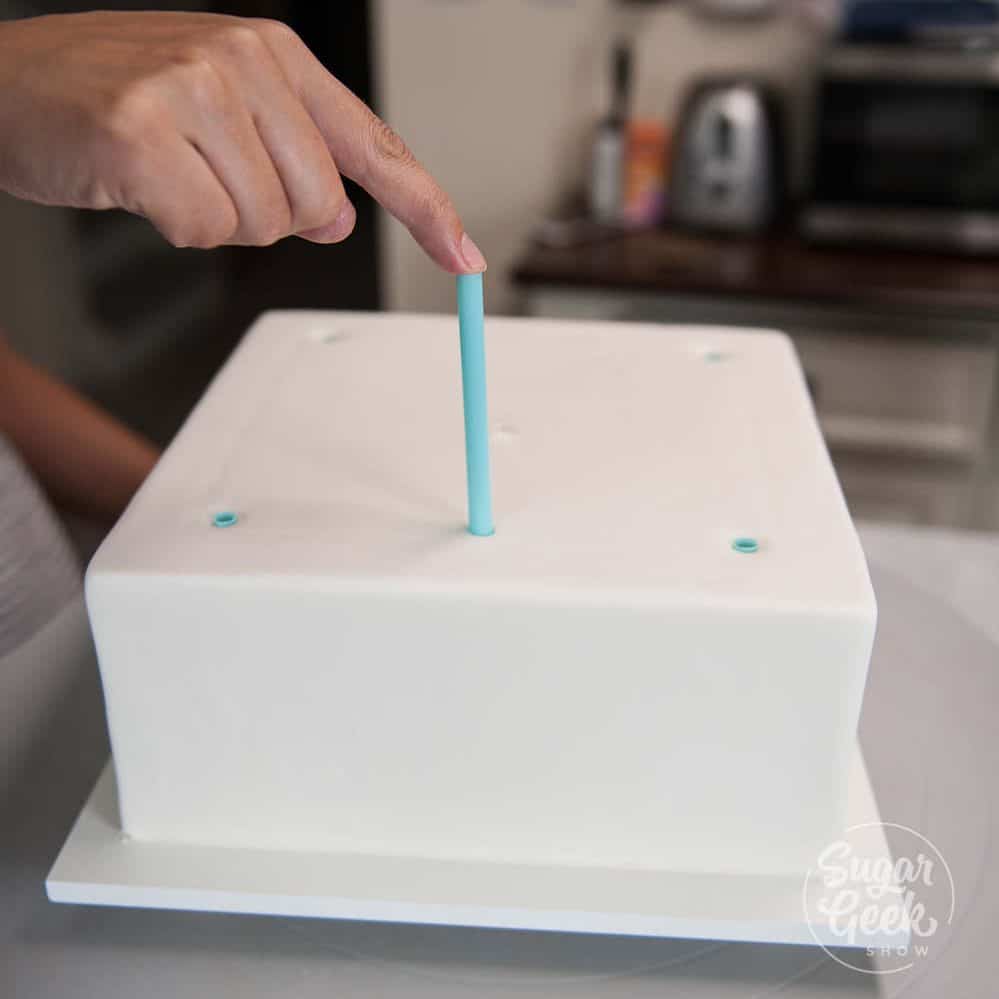
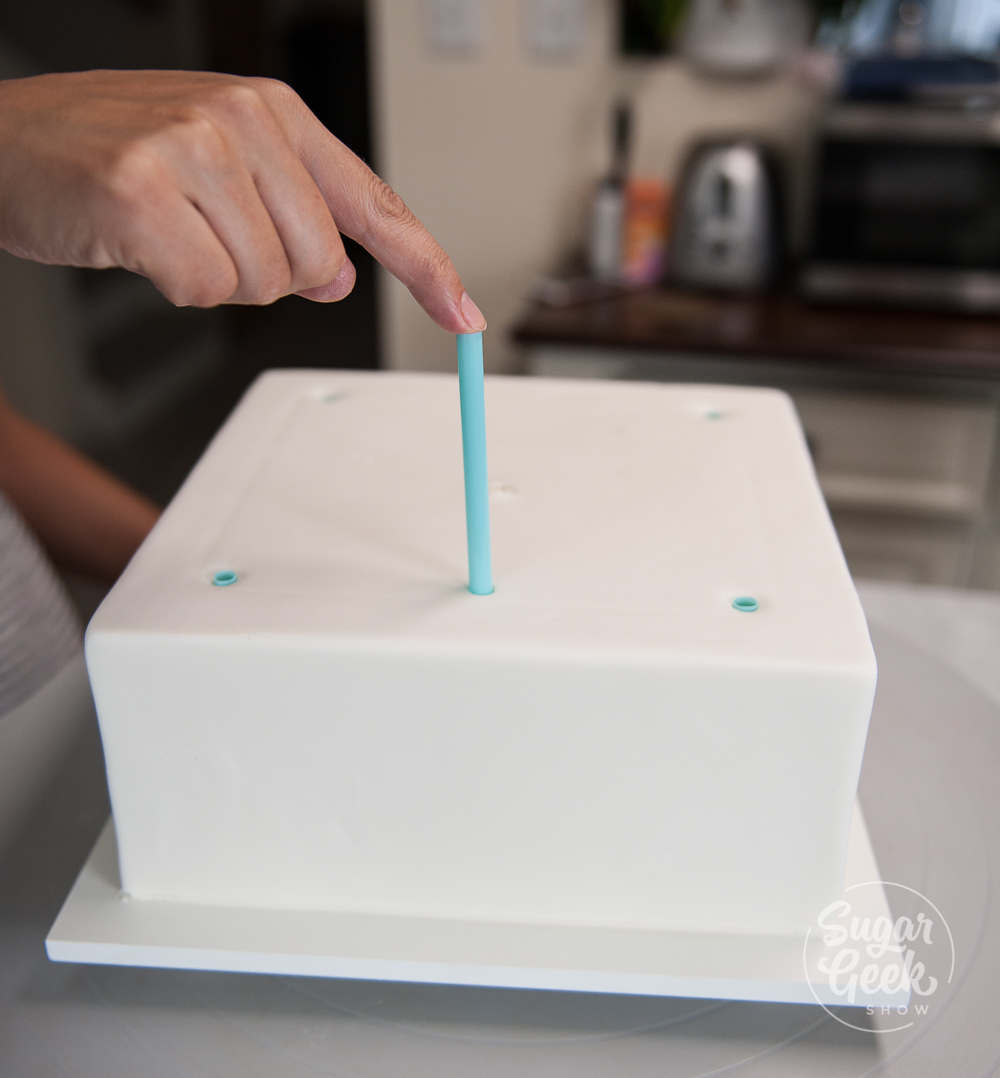
The rule of thumb is to put as many supports in a cake as the size of cake it will be supporting. So say you have an 8" cake for your bottom tier and you will be stacking a 6" cake on top. You will want to put 6 supports into your 8" cake to support the 6" cake. You then would put 4 supports in the 6" cake to add a 4" tier on top.inserting straws into the cake

Where do you place the supports? As close to the edge of the cake they will be supporting as possible without them showing. Putting your supports on the outer most edge of your cake will give you the most stability and keep your cake from caving in. Use a cake pan or cake board the size of the cake you're supporting to trace an indention in the supporting cake so you know exactly where you'll be placing your cake and exactly where the supports should go. If you're supporting a large cake, you will be putting in a lot of supports so adding some of them further in the center is a good idea and putting an extra one in the center for good measure never hurt anyone.

inserting thick milkshake straws into a chilled cake using the straw guide

For a demonstration on exactly how to cut and place the straw supports, check out the Easy Double Barrel Blog Post as it shows how to insert straw supports for any cake.

Okay! So once you have your supports all ready to go you are ready to stack! As always, your cakes should be made with real butter in the cake as well as the buttercream and should be chilled nice and firm.

Whether you are stacking on site or at home before you travel, your bottom cake should already be placed on your base cake board. Slide your next tier to the edge of the table and carefully slide it off. Having your tiers on an additional cake board makes it easier to not damage the cake while moving it.

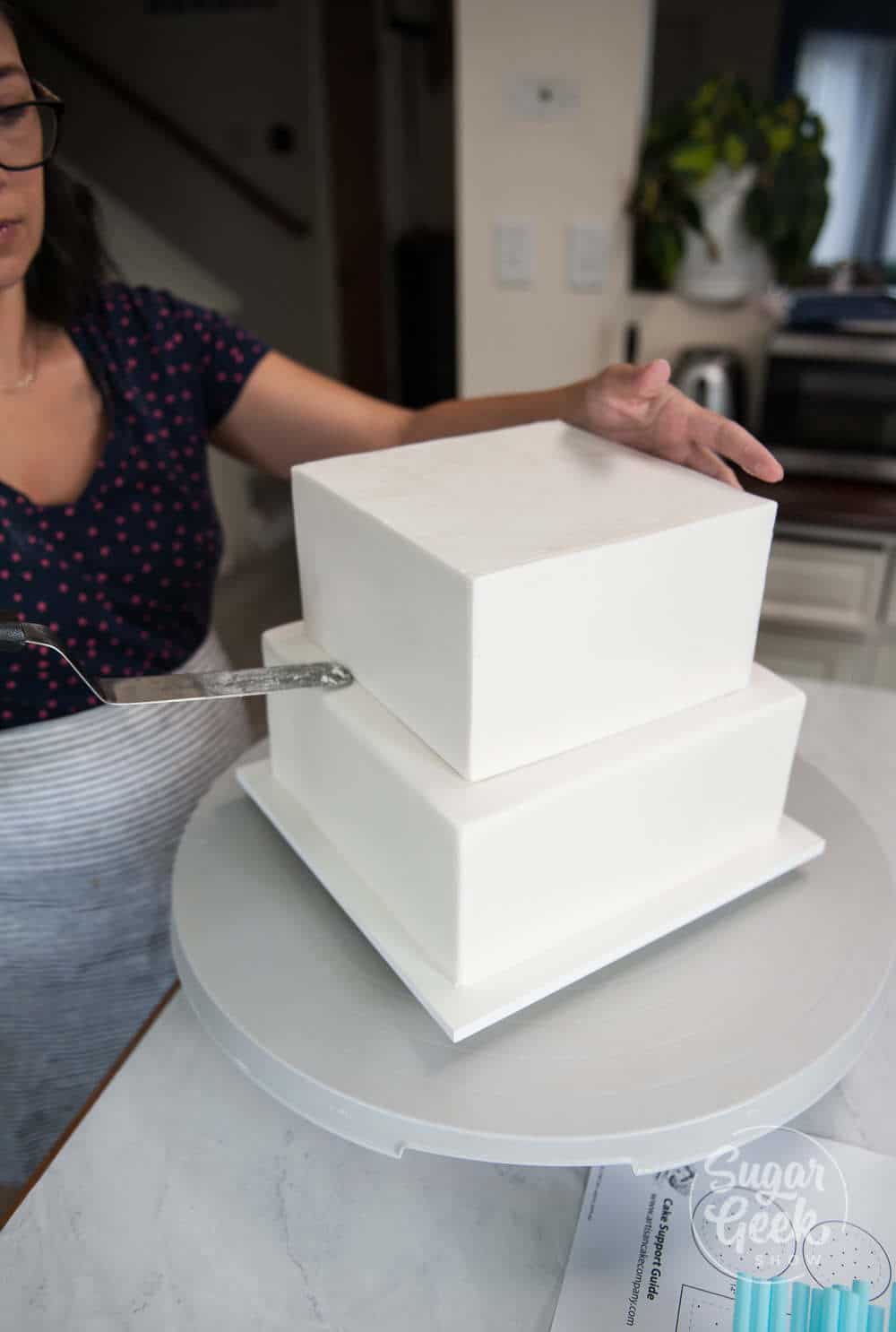
assembling the chilled wedding cake tiers using an offset spatula

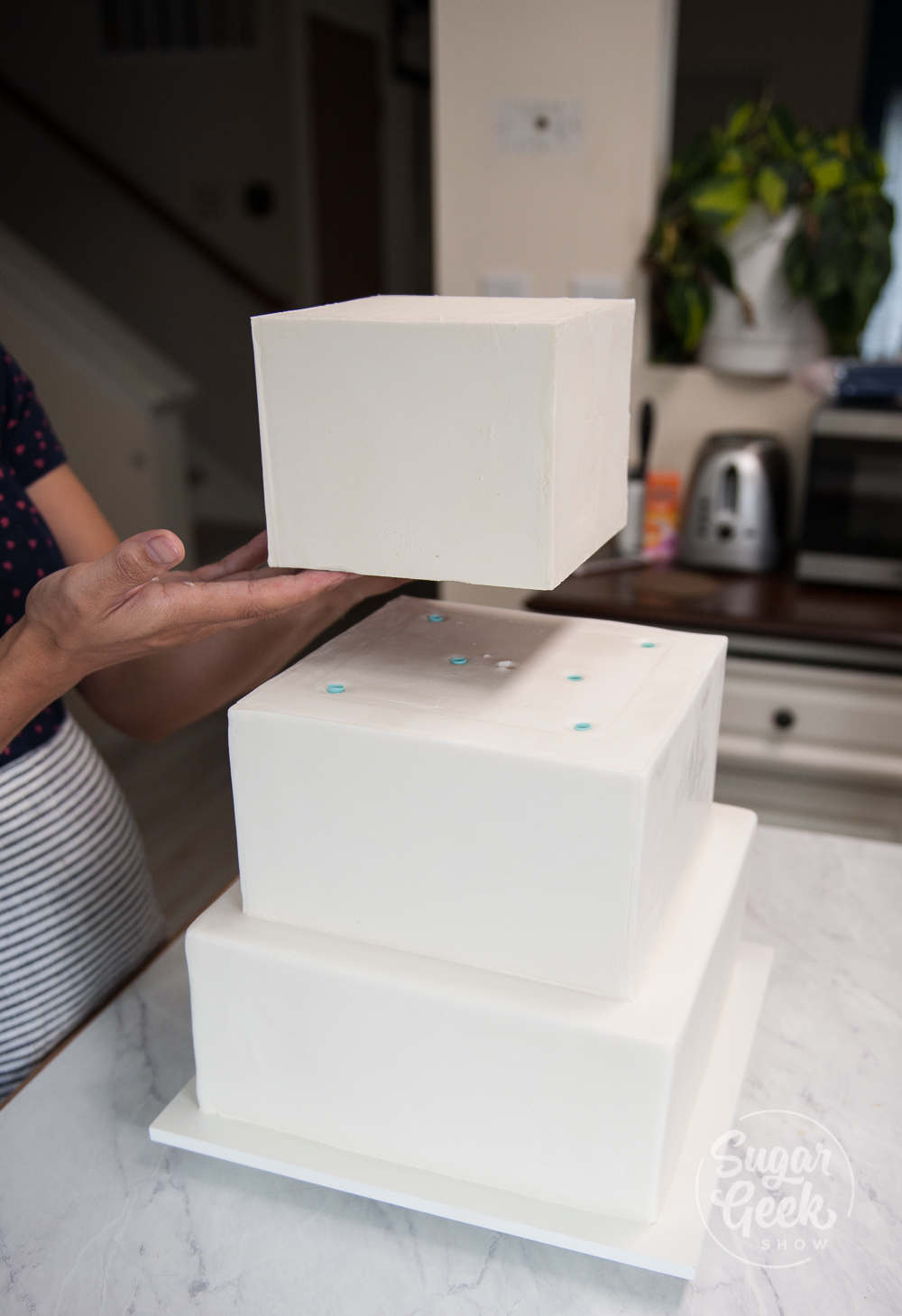
Supporting the cake from the top and bottom, carefully line your cake up with your traced outline and supports. Place a large offset spatula underneath the cake to easily set it down without any damage to the edge.

stacking a square wedding cake with milkshake straws

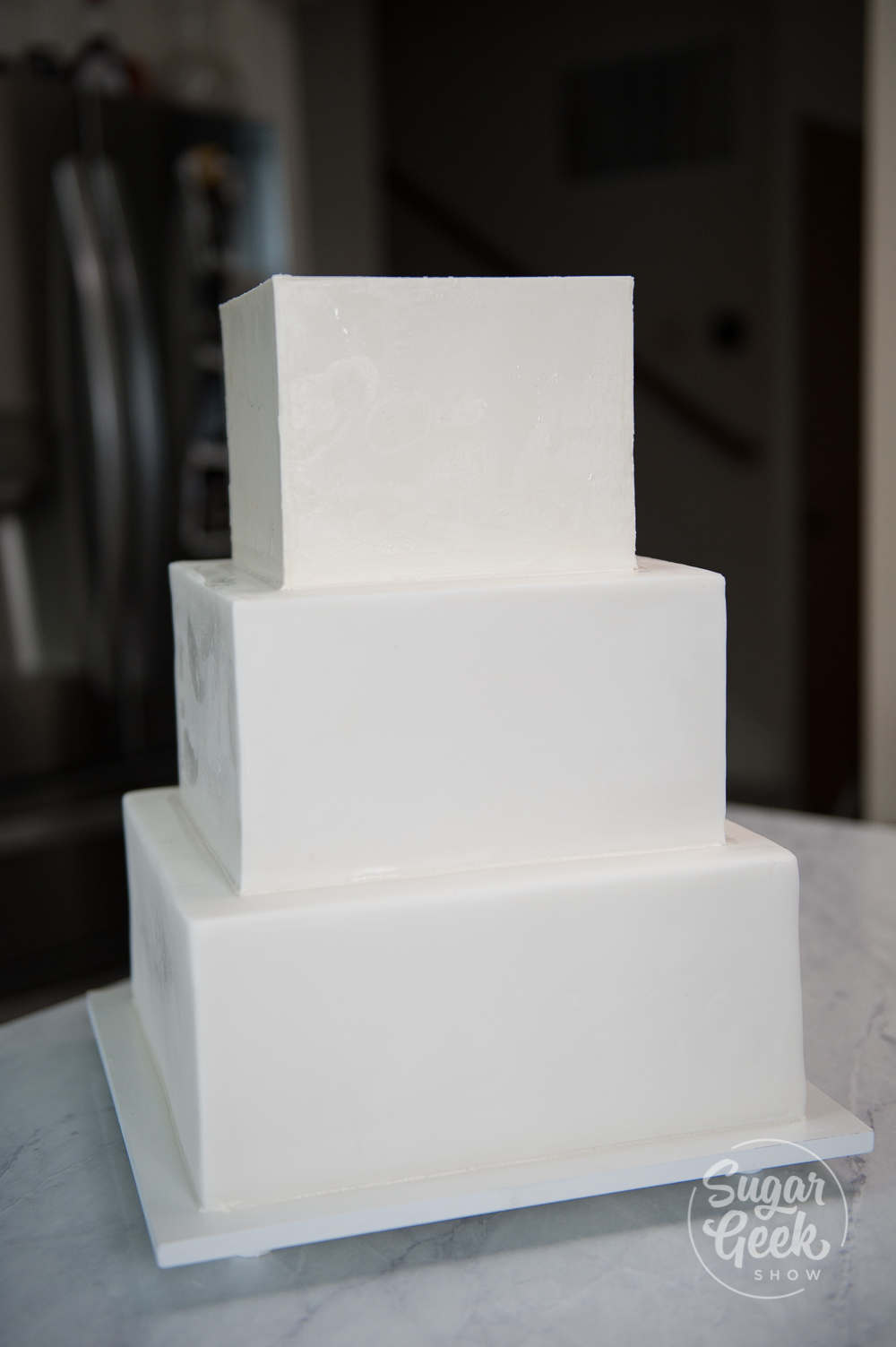
Repeat this process for each tier needing to be stacked. Smaller tiers may not need the spatula because they are so small and light. If you have decided to stack on site, you are done! If you are traveling with a stacked cake you will want to add additional structure support.

finished three tier square wedding cake

Take a ¼" wooden dowel rod cut just under the height of your cake and sharpen one end. A ¼" rod will fit in any standard pencil sharpener. Carefully push the rod through all tiers and cake boards.

How to stack a tiered cake

To get the rod all the way in without damaging the top of your cake, you will want to take another small rod, place it on top of the support dowel rod and finishing pushing it in. I actually like to hammer mine into the bottom cake board for extra stability. We've sharpened the rod so that it can easily pierce through the cake boards.

How to stack a tiered cake

The support rod will leave a hole in the top of your cake that you'll want to fill in with buttercream, fondant, or cover up with a decoration. Now your cake is ready to transport to the venue.

Whether or not you stack on site or travel with your cake stacked is completely up to you and your personal preference. I prefer to stack before hand and travel with the cake that way, whereas Liz prefers to always stack on site. Either way we don't recommend traveling with a cake stacked with more than three tiers. If I have a cake that is more than three tiers I will stack the first three tiers and travel with the others separate in boxes and stack the rest at the venue. I have never had an issue with any of the tiered cakes I've traveled with. They've always made it safe and sound.

Hopefully that has cleared up any questions you might have had about stacking a tiered cake! As always, let us know if you have questions and we will do our best to help! Happy stacking!

stacked wedding cake

Going over the basics? Check out these!

Cake Decorating Basics: Must Have Tool Review

Cake Decorating Basics: Airless Space Buttercream

Cake Decorating Basics: Leveling and Torting

Cake Decorating Basics: Filling and Crumb Coating

Cake Decorating Basics: Avoiding Cake Blowouts

Cake Decorating Basics: Smooth Final Coat of Buttercream

Cake Decorating Basics: The Upside Down Method

Cake Decorating Basics: The Secret to Small Cakes

Cake Decorating Basics: Covering a Cake in Fondant

Cake Decorating Basics: Easy Double Barrel

Cake Decorating Basics: How to Panel

Narnia Lamp Post Cake Tutorial

December 1, 2017 Course Preview

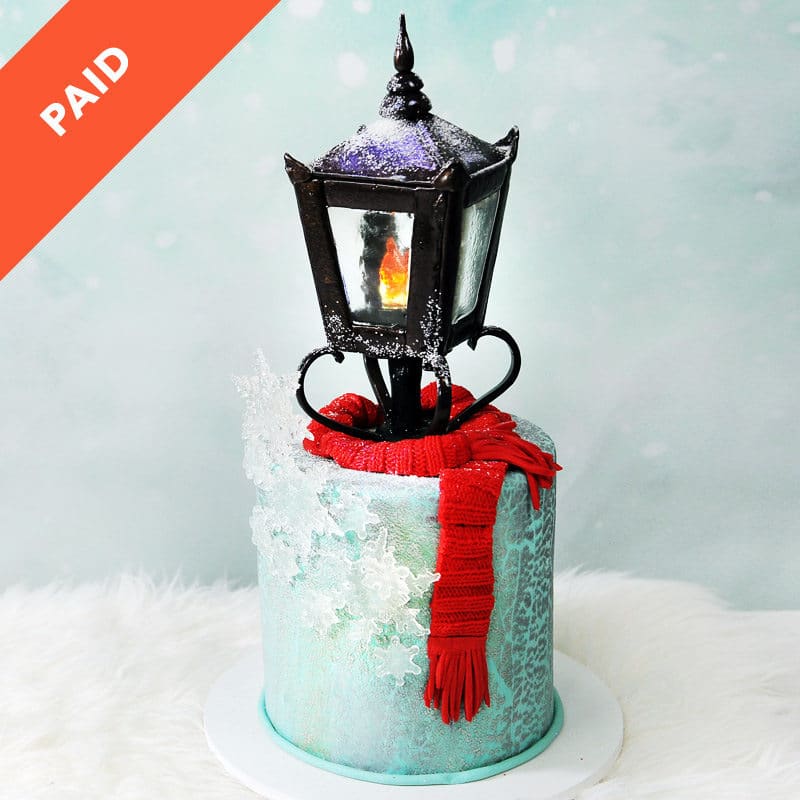
Narnia Lamp Post Cake Tutorial

Skill level: Intermediate

This tutorial was inspired by one of my most beloved winter-time movies, The Lion the Witch and the Wardrobe! I was so inspired by the magical lamp post that Lucy sees after she falls through the wardrobe and enters Narnia for the first time! She looks up at the warmly glowing lamp and realizes she's not just in any forrest... then she meets Mr. Tumnus!

In this tutorial, I will teach you how to build the cake structure, how to use a template to create your isomalt pieces and how to assemble them into a lamp. I'll even show you how to make a flickering flame from isomalt, snowflakes and a pretty crackled fondant texture!

1:02:42 Minutes of Instruction

What You Will Learn

  • How to create a gravity-defying edible lamp
  • Learn how to make a flickering candle flame and beautiful snowflakes
  • How to make a knit scarf
  • Learn how to make a cracked ice design perfect for winter-themed cakes

Tutorial Chapters

  1. Making the lantern 0:15
  2. Prepping the lantern parts4:22
  3. Assembly6:06
  4. Making the flame for the candle31:59
  5. Cake structure35:04
  6. Winter crackle36:42
  7. Adding the lantern to the cake49:35
  8. Making the snowflakes56:04
  9. Making the scarf59:25
  10. Putting it all together 1:01:45

Downloads

Materials List

Lamp Post Template

Narnia Lamp Post Cake Tutorial

December 1, 2017 Paid Video

Narnia Lamp Post Cake

Skill level: Intermediate

This tutorial was inspired by one of my most beloved winter-time movies, The Lion the Witch and the Wardrobe! I was so inspired by the magical lamp post that Lucy sees after she falls through the wardrobe and enters Narnia for the first time! She looks up at the warmly glowing lamp and realizes she's not just in any forrest... then she meets Mr. Tumnus!

In this tutorial, I will teach you how to build the cake structure, how to use a template to create your isomalt pieces and how to assemble them into a lamp. I'll even show you how to make a flickering flame from isomalt, snowflakes and a pretty crackled fondant texture!

1:02:42 Minutes of Instruction

What You Will Learn

  • How to create a gravity-defying edible lamp
  • Learn how to make a flickering candle flame and beautiful snowflakes
  • How to make a knit scarf
  • Learn how to make a cracked ice design perfect for winter-themed cakes

Tutorial Chapters

  1. Making the lantern 0:15
  2. Prepping the lantern parts4:22
  3. Assembly6:06
  4. Making the flame for the candle31:59
  5. Cake structure35:04
  6. Winter crackle36:42
  7. Adding the lantern to the cake49:35
  8. Making the snowflakes56:04
  9. Making the scarf59:25
  10. Putting it all together 1:01:45

Downloads

Materials List

Lamp Post Template

How to panel a cake in fondant

November 30, 2017 Blog

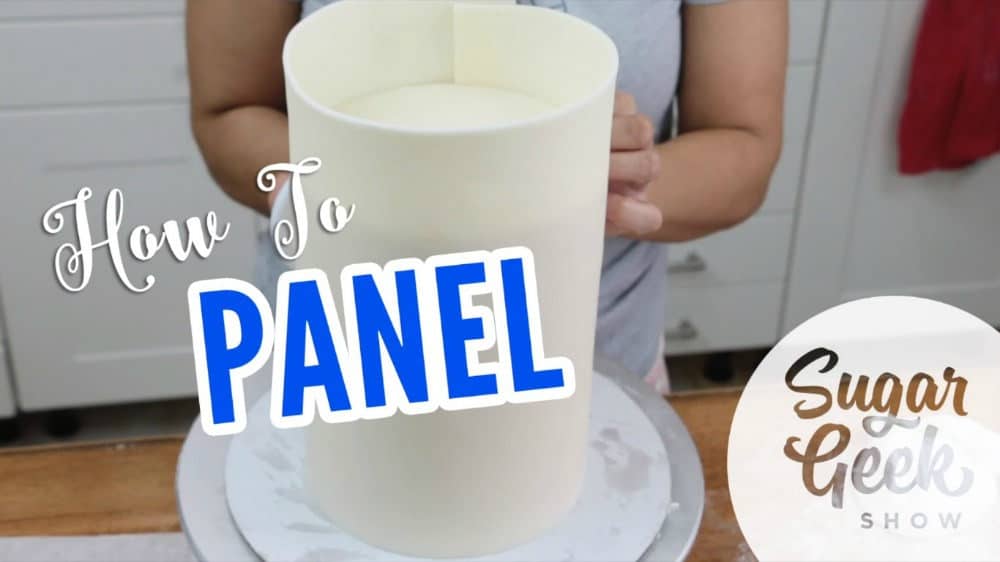
Cake Decorating Basics: How to Panel

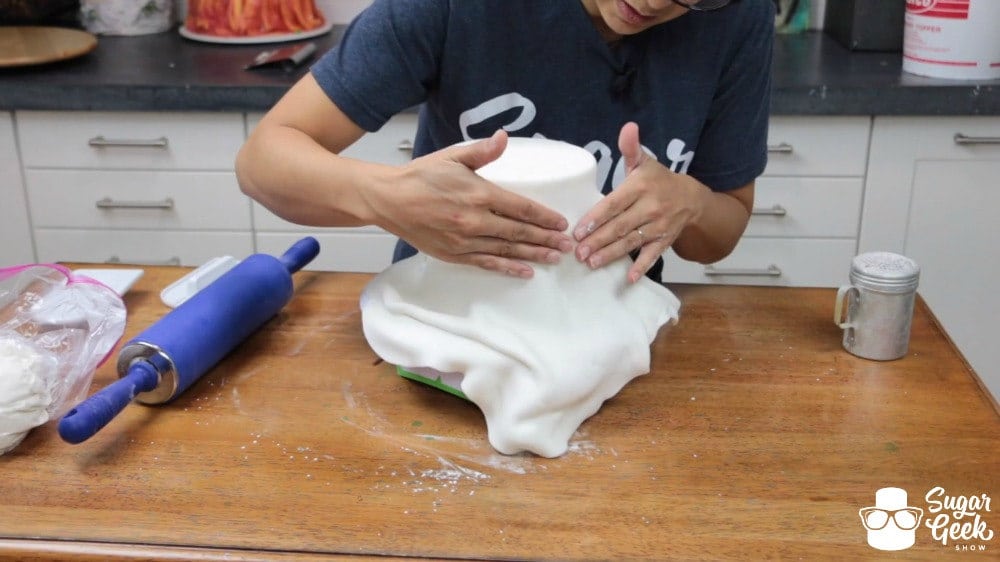
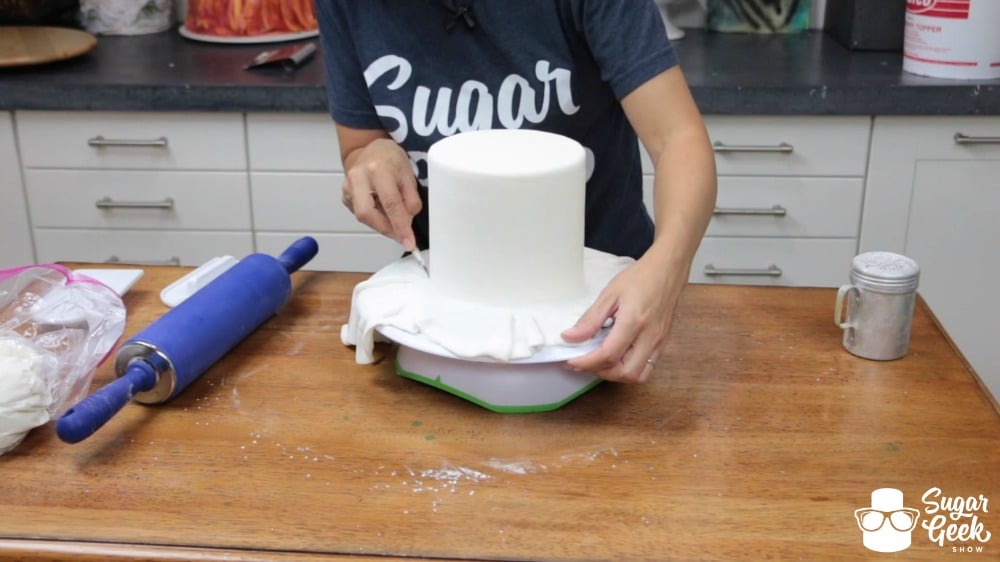
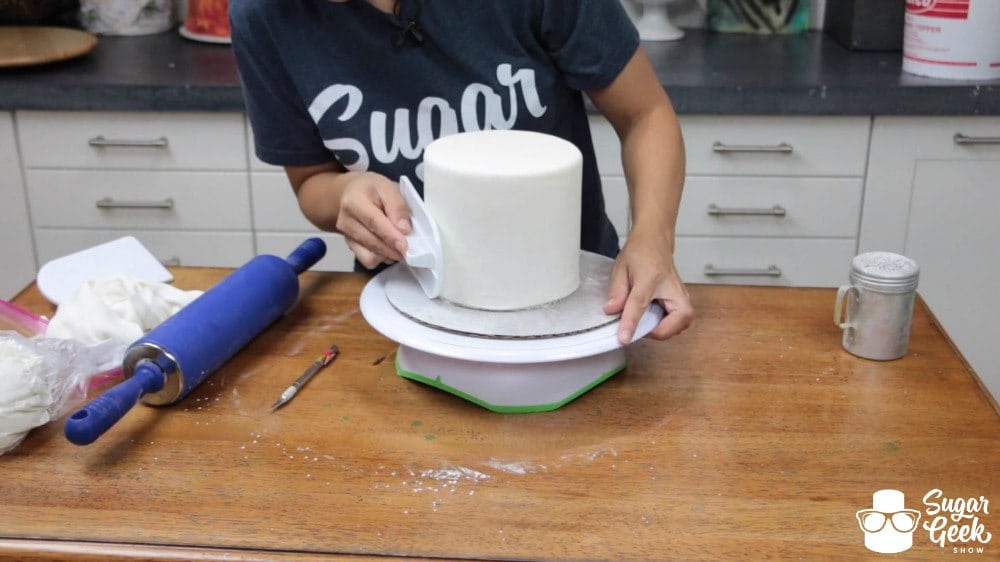
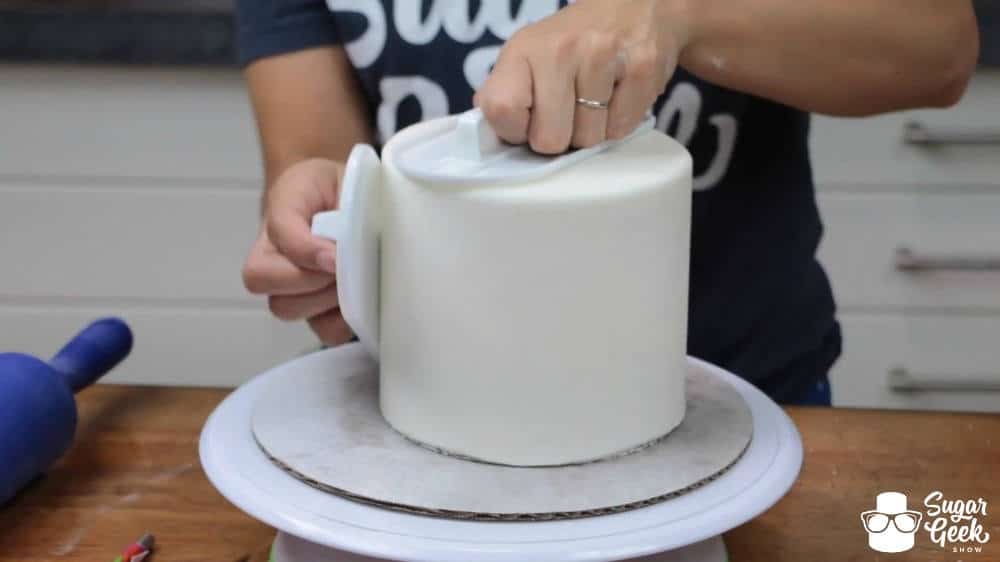
This week we're going to show you an easier way to cover a double barrel cake in fondant. If you've ever tried to drape a double barrel you know exactly what we're talking about. If you have never attempted a double barrel cake or are thinking, "what the heck is a double barrel cake?", we show you exactly how to do one in our Double Barrel Blog Post.

In order to drape a double barrel, you have to roll out a huge amount of fondant into a huge piece to fit the cake. Working with a piece that size is no easy task. Then say you do miraculously get the fondant onto the cake unharmed, the cake is so tall that the fondant really has a long way to fall and often times the weight of it causes tearing quicker then you can do anything about it. After learning the paneling method I will never drape another double barrel cake again, or a square one either for that matter.

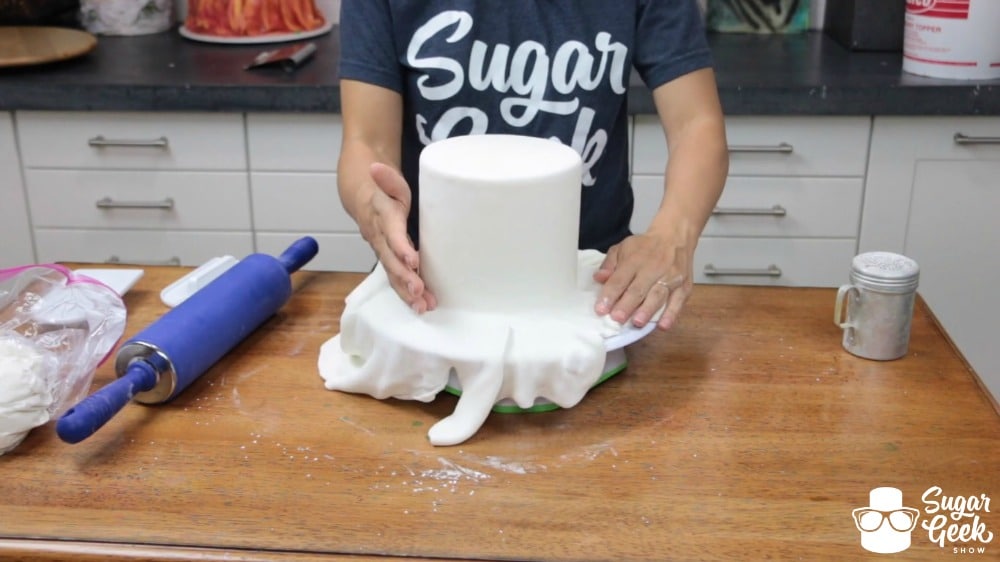
How to panel a cake in fondant

Step 1

Roll out a small piece of fondant large enough to cover the top of your cake with a little to spare. Liz is covering a 6" cake so she rolls the piece out to about an 8" circle.

How to panel a cake in fondant

Step 2

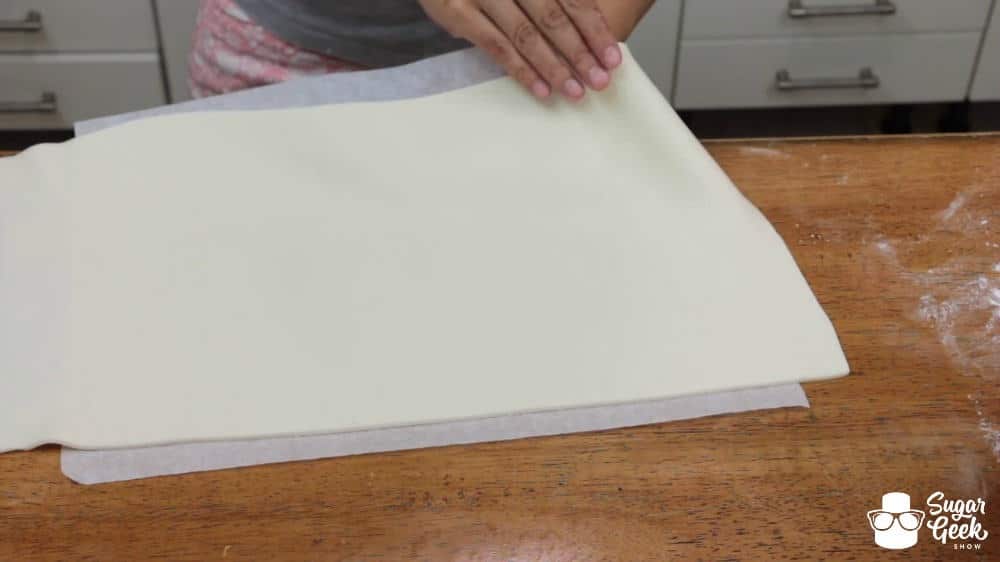
Place the fondant onto some parchment and place in the freezer for 5 minutes to chill. This will make it much easier to cut a nice clean edge.

How to panel a cake in fondant

Step 3

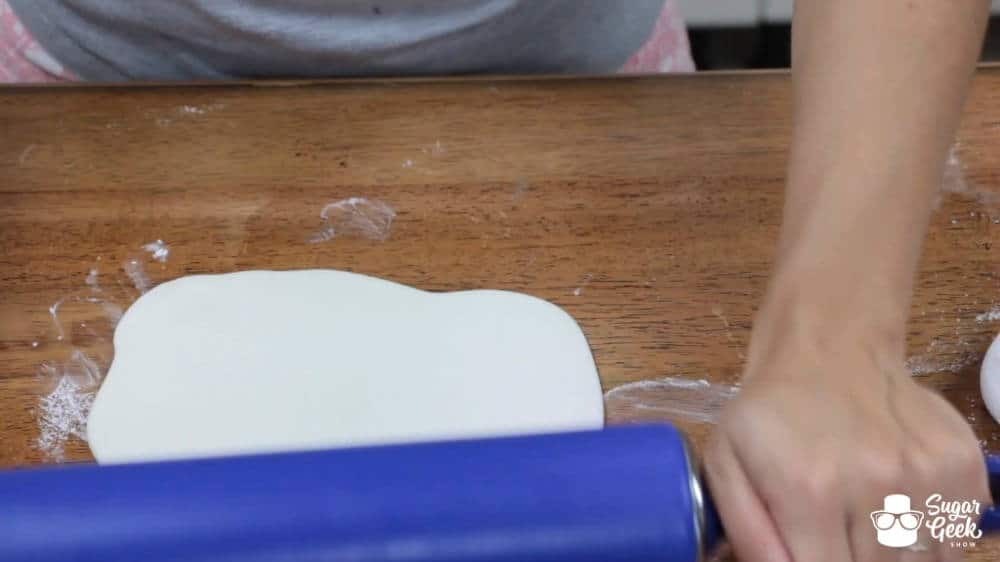
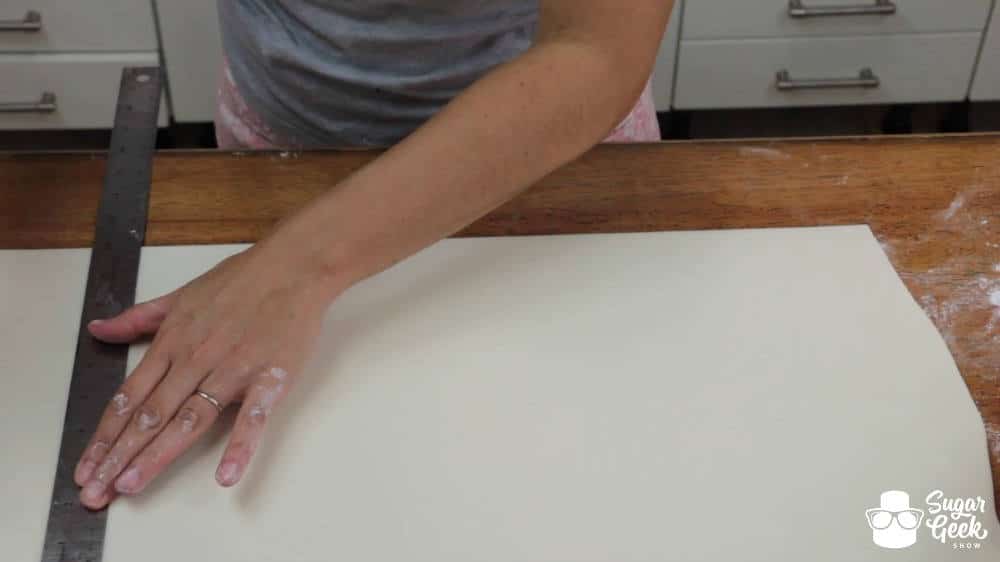
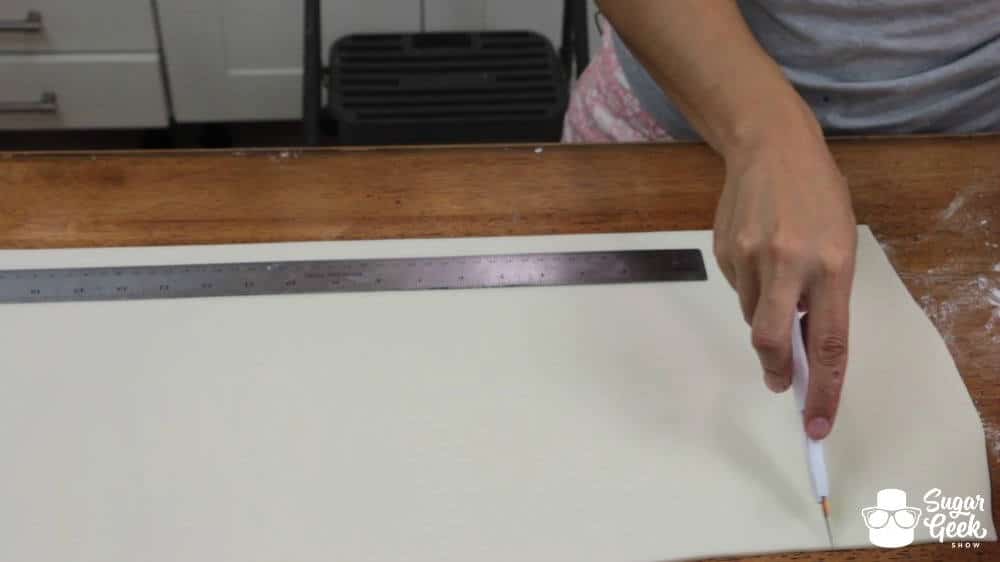
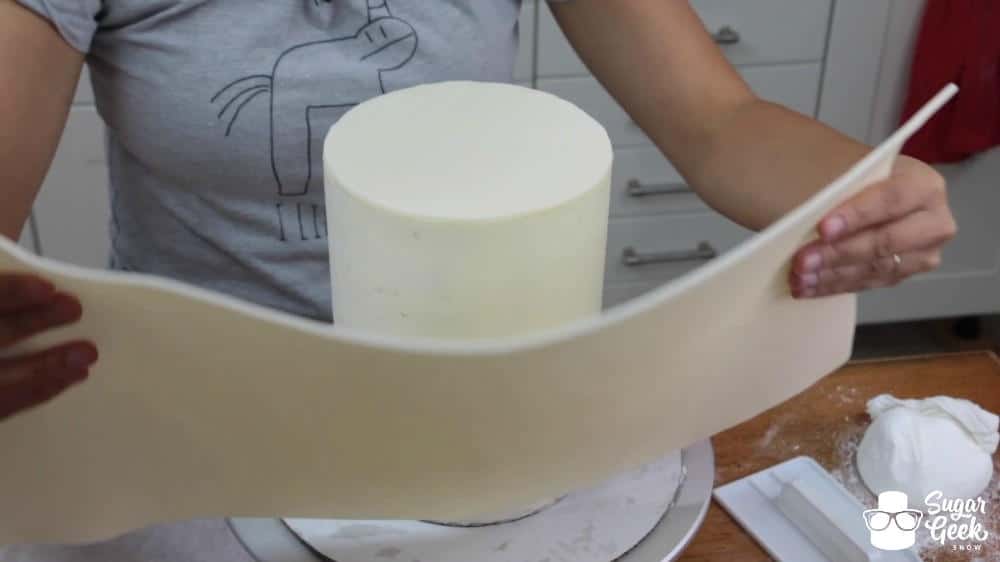
Meanwhile, roll out a piece of fondant wide enough to wrap around your cake and tall enough to cover it with a little to spare. Use a ruler to measure and cut your fondant into a rectangle the correct size for your cake. Make sure the bottom of your panel is nice and straight for the bottom of the cake. Liz's cake is 8" tall and 6" wide so she is cutting her piece approximately 10" tall and 19" wide.

How to panel a cake in fondant How to panel a cake in fondant

Step 5

Transfer this fondant to a piece of parchment to place in the freezer to chill for 5 minutes as well.

How to panel a cake in fondant

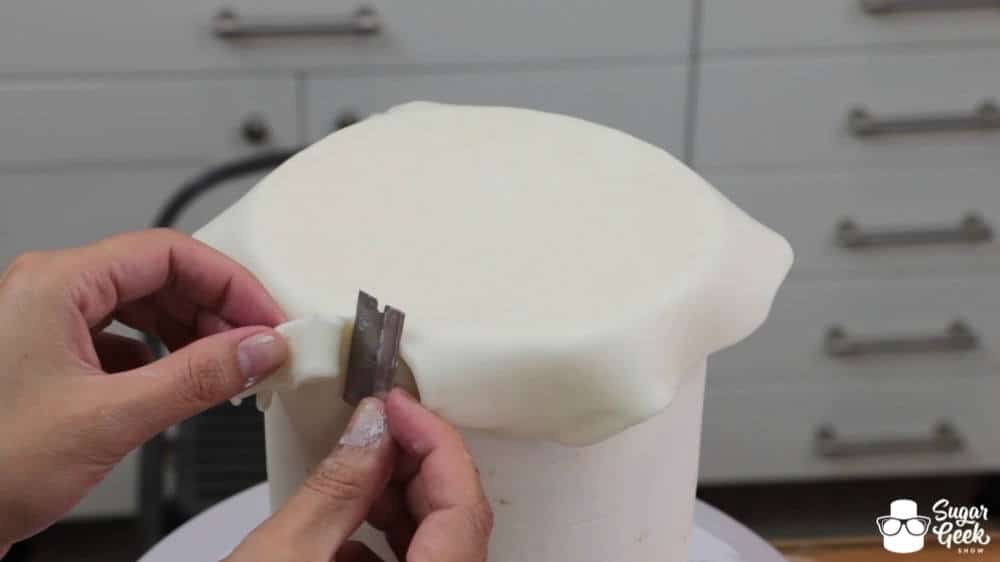
Step 6

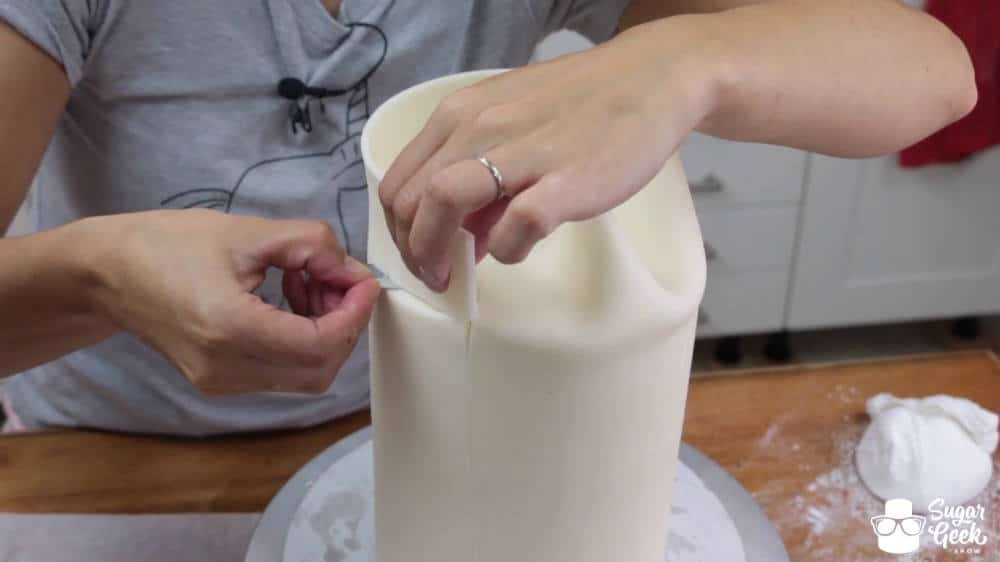
Take the first piece of fondant out of the freezer and place it on top of your cake and smooth it down. Using a super sharp, super clean razor blade cut off the excess fondant to the exact size of your cake top.

How to panel a cake in fondant

Step 7

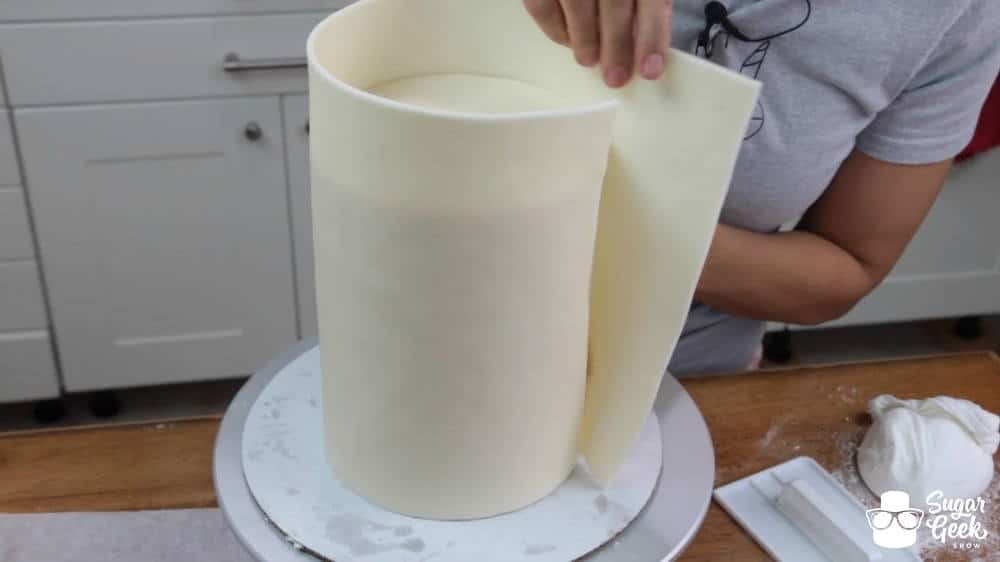
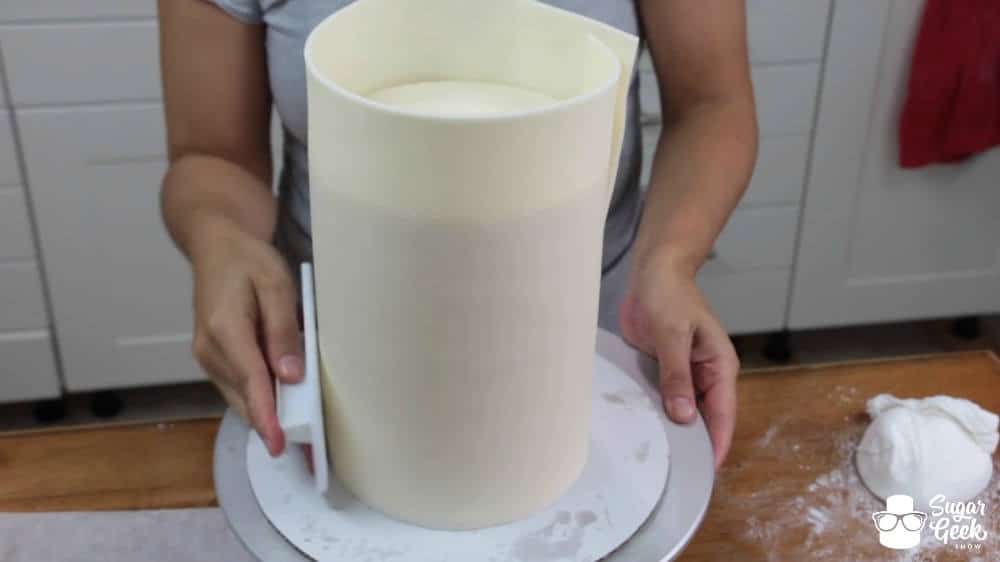
Take your other piece of fondant out of the freezer. It should be very stiff and easy to pick up without distorting or drooping. Wrap the piece around your cake making sure to press it firmly against the cake sticking it to the buttercream all the way around.

How to panel a cake in fondant How to panel a cake in fondant

Step 8

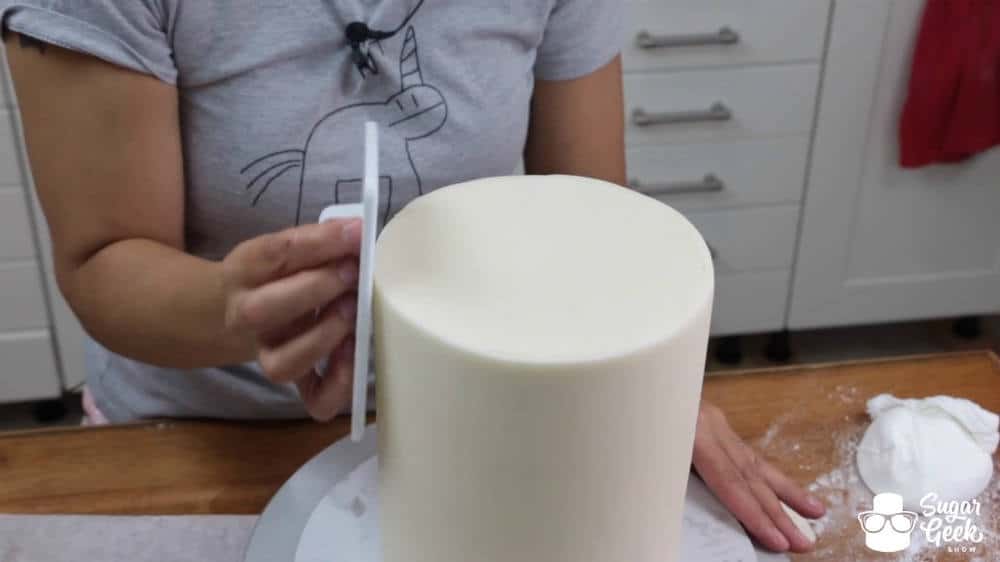
Use a fondant smoother to smooth your fondant to perfection.

How to panel a cake in fondant

Step 9

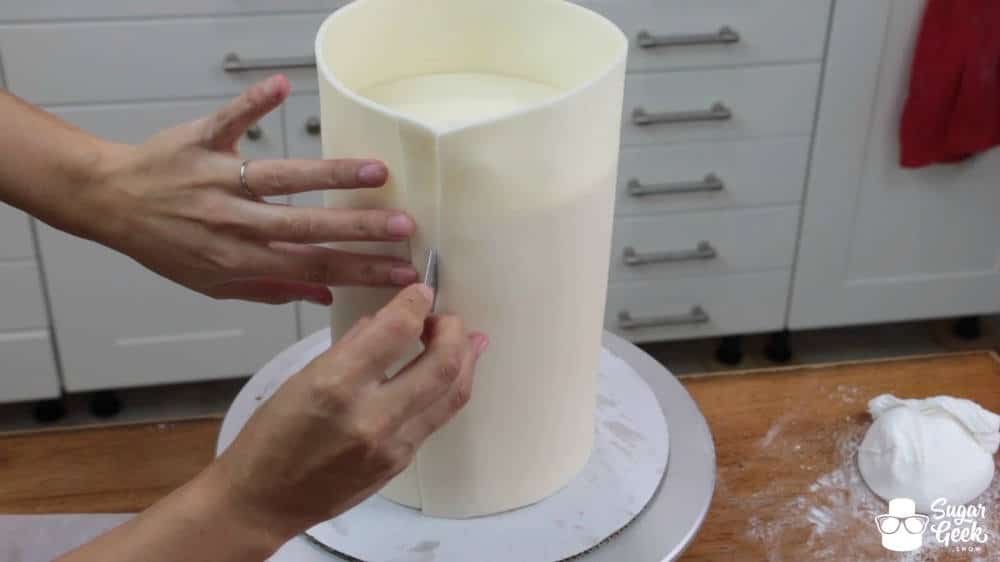
Again with your clean and sharp razor blade cut the fondant where the two ends overlap. Cut a nice straight line through BOTH pieces of fondant.

How to panel a cake in fondant

Step 10

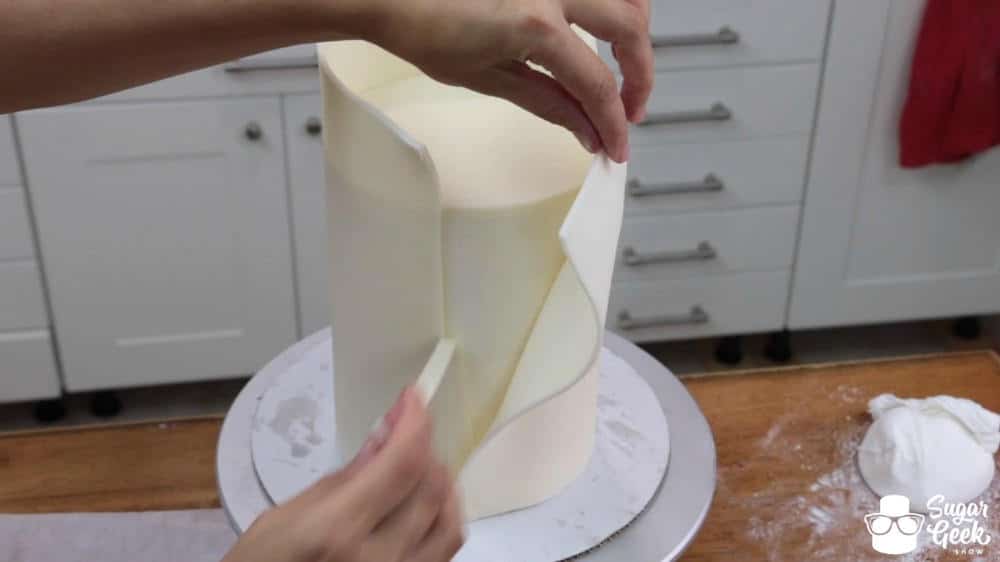
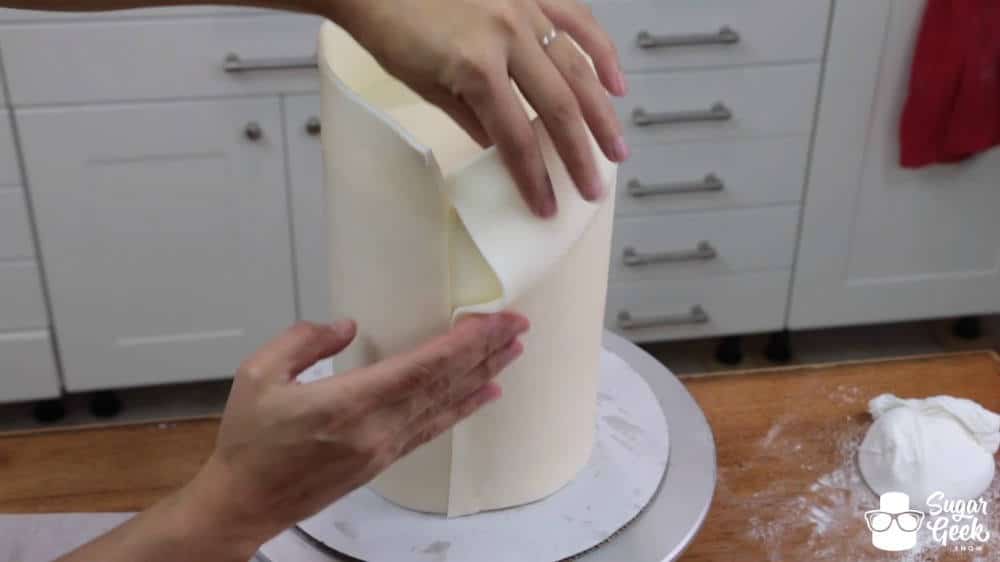
Remove the cut fondant being sure to pull back the overlapped end and remove the cut piece from underneath.

How to panel a cake in fondant

Push the panel ends together, the ends should line up perfectly giving you a nice straight seam.

How to panel a cake in fondant

Step 11

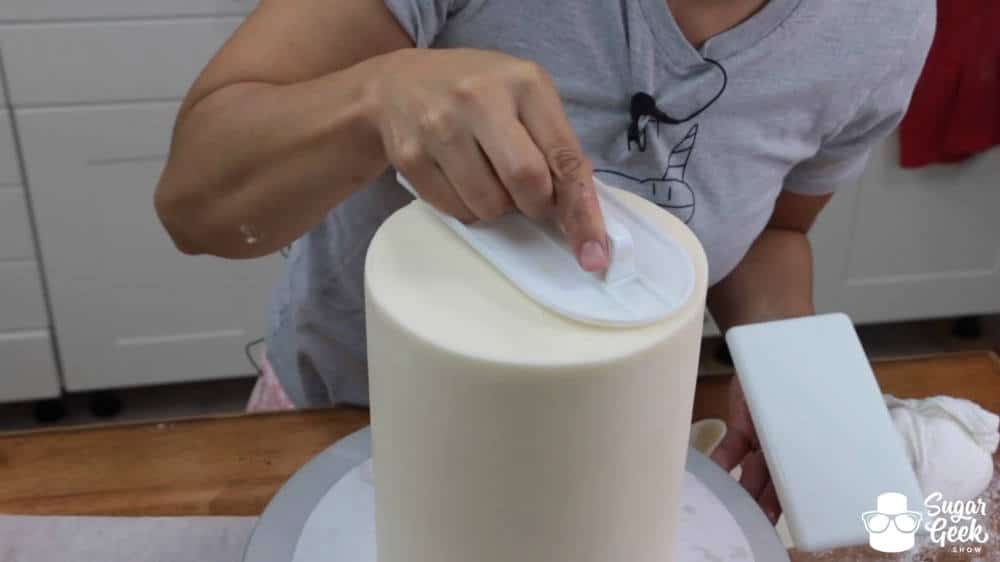
Take your clean, sharp razor blade once again and keeping it flat on top of your cake, cut off the excess fondant from the top.

How to panel a cake in fondant

Step 12

Use a smoother to push the seam together and smooth it until its unnoticeable.

How to panel a cake in fondant How to panel a cake in fondant

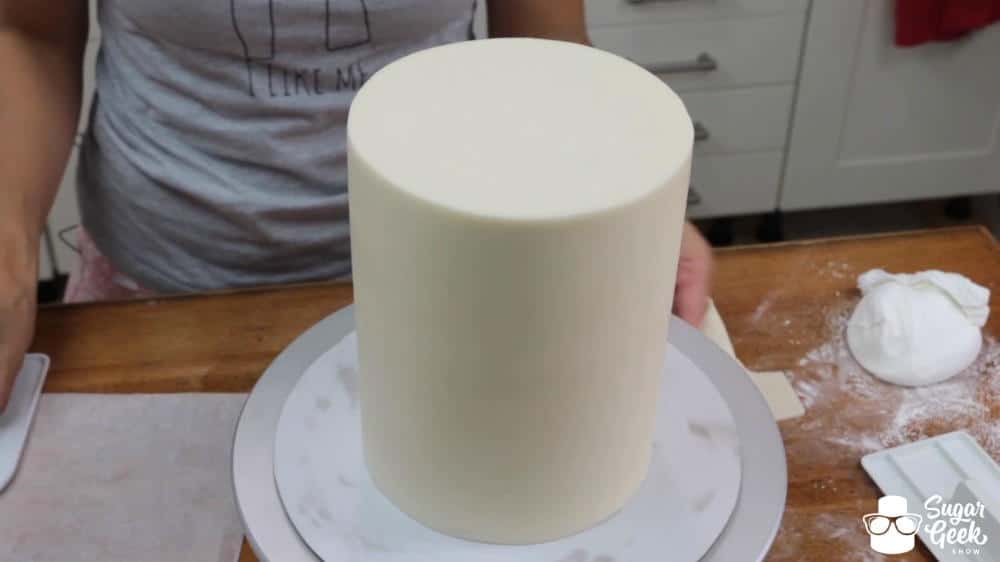
And just like that you have a perfectly paneled cake! A beautiful double barrel with sharp, clean edges, zero tears and zero tears.

How to panel a cake in fondant

Have you tried both methods of covering a cake in fondant? Which do you prefer? Some people use the paneling method all the time. It really is about finding what works best for you! We're here to give you as many options as possible so you can figure it out.

Going over the basics? Check out these!

Cake Decorating Basics: Must Have Tool Review

Cake Decorating Basics: Airless Space Buttercream

Cake Decorating Basics: Leveling and Torting

Cake Decorating Basics: Filling and Crumb Coating

Cake Decorating Basics: Avoiding Cake Blowouts

Cake Decorating Basics: Smooth Final Coat of Buttercream

Cake Decorating Basics: The Upside Down Method

Cake Decorating Basics: The Secret to Small Cakes

Cake Decorating Basics: Covering a Cake in Fondant

Cake Decorating Basics: Easy Double Barrel

Cake Decorating Basics: Stacking Cakes

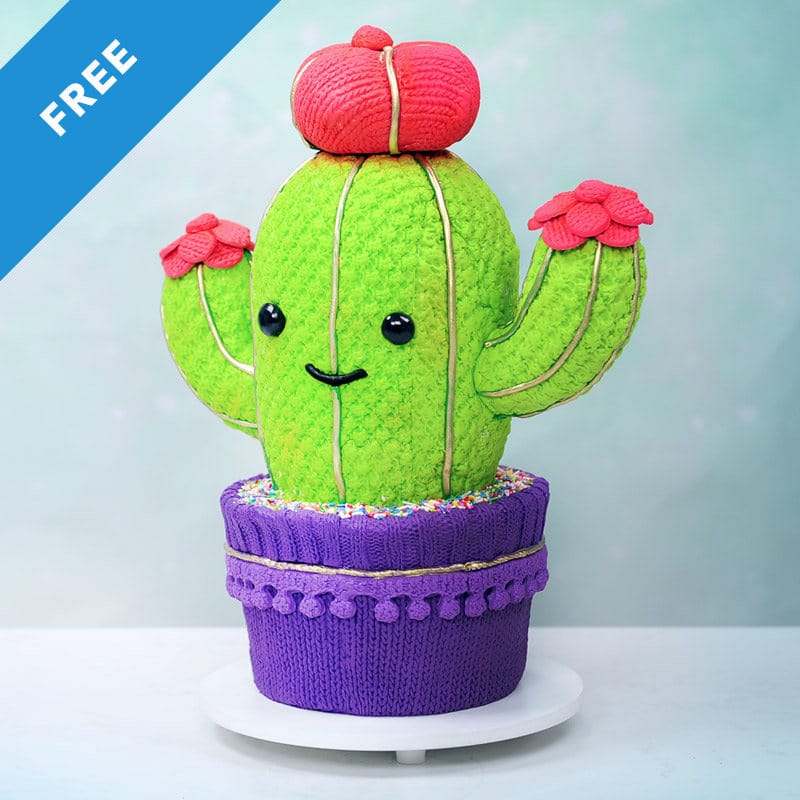
Christmas Cactus Cake Tutorial

November 20, 2017 Blog

Christmas Cactus Cake Tutorial

Skill level: Newb

This tutorial isn't just for Christmas! A must-see tutorial great for beginners who want to learn the very basics of simple cake carving, armatures, food-safe structures and more!

Featuring the new Knit Collection from marvelousmolds.com

36:17 Minutes of Instruction

What You Will Learn

  • How to create a cactus using a food-safe structure
  • Liz's easy tips and tricks to carve down cake into this fun design

Indian Bride Cake

November 20, 2017 Blog

Incredible Indian Bride Cake

Liz recently participated in the international Incredible India Collaboration presented by the Global Sugar Artists Network and hosted by Tina Scott Parashar's Cake Design.

Liz chose to create a beautiful Indian bride bust cake that is nothing short of jaw-dropping. The detail and realism in the piece is incredible! Much of the piece including the signature realistic eyes were made from Simi Cakes Isomalt and the fantastic veil known in India as an odani was created from Flexique Edible Fabric.

Indian Bride Cake

Liz has attended a couple sculpting classes this year which has really helped her up her sculpting game. Her newly honed sculpting skills definitely shine in this piece not only in the face but also in the insanely realistic hand.

Indian Bride Cake

The hand painted henna tattooing is gorgeous and must've taken just short of forever.

Indian Bride Cake

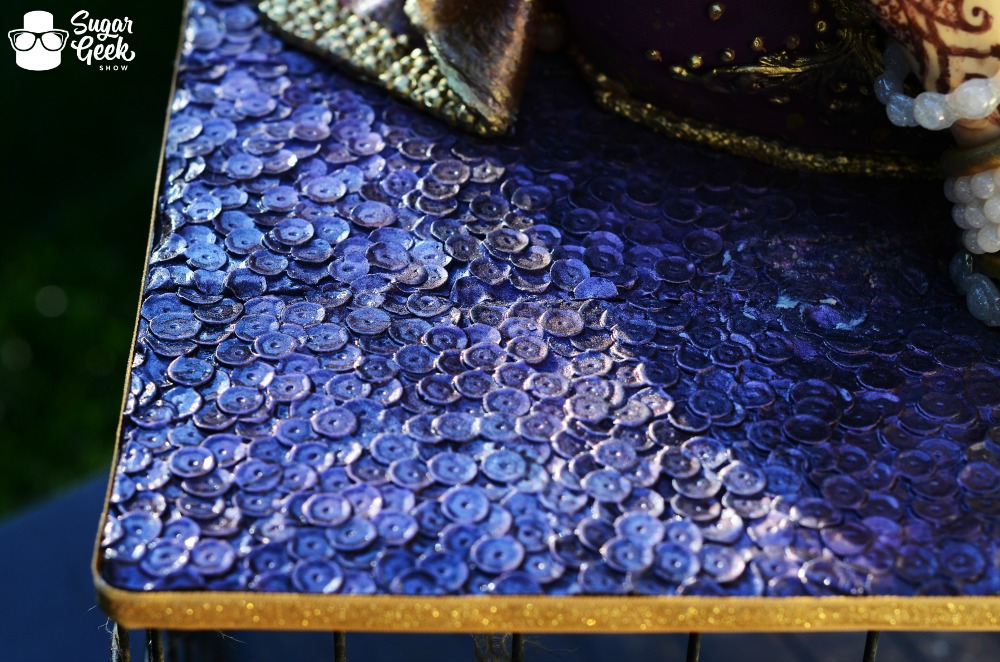
This shimmery sequin board really brings the whole piece together, I absolutely love it! The sequins look as if they were individually cut out and stuck on there and while Liz is crazy enough to do that, she actually used the Marvelous Molds Sequin Jubilee Simpress. That is definitely on my wish list!

Sequin Cake Board

Overall the piece is phenomenal and really added to a brilliant collaboration for a wonderful cause. Check out the timelapse making of this piece in the video at the end of the post!

Indian Bride Cake

When talking with Tina Scott Parashar she explained that Incredible India is an international cake collaboration born out of the collective effort of over a hundred very talented cake artists who have come together to create visual works of brilliance through their favorite medium, sugar. India has been the nurturer of tradition and culture for long. When so many cultures amalgamate together, a rich heritage is born. It is from that heritage that the artists drew their inspiration. This is a collaboration with a cause. They have released a book/ magazine which includes all the collaboration cakes, recipes, interviews and tutorials. It has an interview with our very own Liz Marek and if you'd like to purchase a copy email Tina Scott Parashar at tinaparashar@gmail.com. The e-mag is available now and hard copies will be available December 1st. Every cent that was raised so far through magazine advertisements (Indian Rupees 1,50,000 /€ 1959/ $2313) has been donated to the Prime Minister's National Relief Fund (India). Given all the hard work that was put into this collaboration, it was gratifying to receive such overwhelming response from the industry. They were also very pleased with the significant amount of money they were able to raise for a very worthy cause.

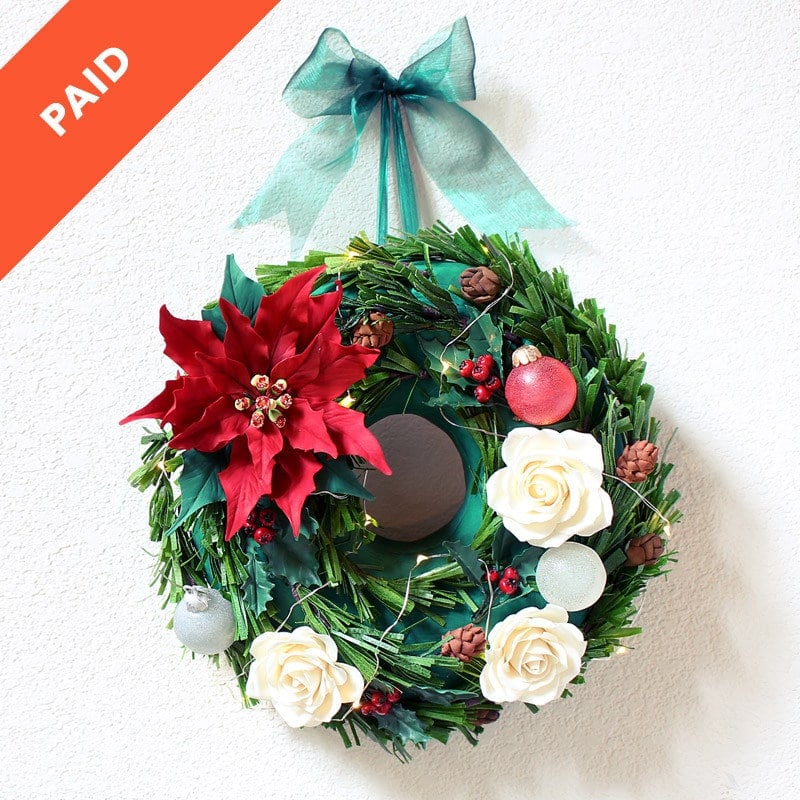
Hanging Christmas Wreath Cake Tutorial

November 15, 2017 Course Preview

Hanging Christmas Wreath Cake Tutorial

Skill level: Intermediate

It's the most delicious time of the year! Celebrate the Holidays in style with this AMAZING hanging Christmas Wreath cake tutorial from guest instructor, Shani Christianson!

Shani shows us how to make some incredible details including beautiful gumpaste poinsettia, edible wafer paper tree branches, realistic berries and even sugar ornaments! As if that wasn't enough, Shani also shows us how to make this cake hang on the wall! Your guests will be in awe! This structure can also be adapted to other types of hanging cakes. A tutorial you won't want to miss!

1:46:57 Minutes of Instruction

What You Will Learn

  • How to create a gravity-defying christmas wreath cake that can hang on a wall
  • Learn how to make pine needle branches, holly leaves and berries, and a poinsettia
  • Shani's cool technique to create translucent edible Christmas ornaments

Tutorial Chapters

  1. Making the pinecones 1:06
  2. Coloring the pinecones 8:08
  3. Making the pine needles 9:23
  4. Making a pine needle branch 17:31
  5. Making holly berries 22:30
  6. Holly leaves 27:13
  7. Making poinsettia stamens 36:53
  8. Poinsettia petals and leaves 42:53
  9. Assembling the poinsettia 52:04
  10. Christmas ornaments 54:57
  11. Making the ornament tops 1:07:36
  12. Making the cake structure 1:10:18
  13. Assembling the cake 1:22:57
  14. Final touches 1:36:41

Downloads

Materials List 01

Materials List 02

Hanging Christmas Wreath Cake Tutorial

November 15, 2017 Paid Video

Hanging Christmas Wreath Cake

Skill level: Intermediate

It's the most delicious time of the year! Celebrate the Holidays in style with this AMAZING hanging Christmas Wreath cake tutorial from guest instructor, Shani Christianson!

Shani shows us how to make some incredible details including beautiful gumpaste poinsettia, edible wafer paper tree branches, realistic berries and even sugar ornaments! As if that wasn't enough, Shani also shows us how to make this cake hang on the wall! Your guests will be in awe! This structure can also be adapted to other types of hanging cakes. A tutorial you won't want to miss!

1:46:57 Minutes of Instruction

What You Will Learn

  • How to create a gravity-defying christmas wreath cake that can hang on a wall
  • Learn how to make pine needle branches, holly leaves and berries, and a poinsettia
  • Shani's cool technique to create translucent edible Christmas ornaments

Tutorial Chapters

  1. Making the pinecones 1:06
  2. Coloring the pinecones 8:08
  3. Making the pine needles 9:23
  4. Making a pine needle branch 17:31
  5. Making holly berries 22:30
  6. Holly leaves 27:13
  7. Making poinsettia stamens 36:53
  8. Poinsettia petals and leaves 42:53
  9. Assembling the poinsettia 52:04
  10. Christmas ornaments 54:57
  11. Making the ornament tops 1:07:36
  12. Making the cake structure 1:10:18
  13. Assembling the cake 1:22:57
  14. Final touches 1:36:41

Downloads

Materials List 01

Materials List 02

How to make a double barrel cake

November 14, 2017 Blog

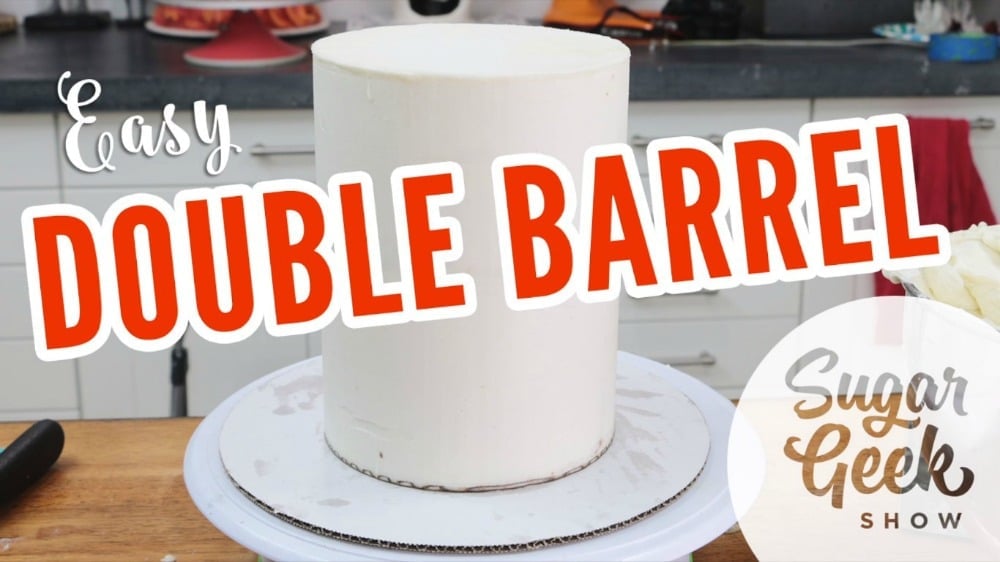
Cake Decorating Basics: Easy Double Barrel

The mystifying Double Barrel Cake. How in the heck do you make a cake SO tall?! With straight sides and a level top nonetheless?! Then always comes the question, "How do you serve a cake that tall? Aren't the slices way too big?!" Alright, settle down. Today we are going to show you exactly how to create this mystical cake creature and I promise all of your questions will be answered.

How to make a double barrel cake

Step 1

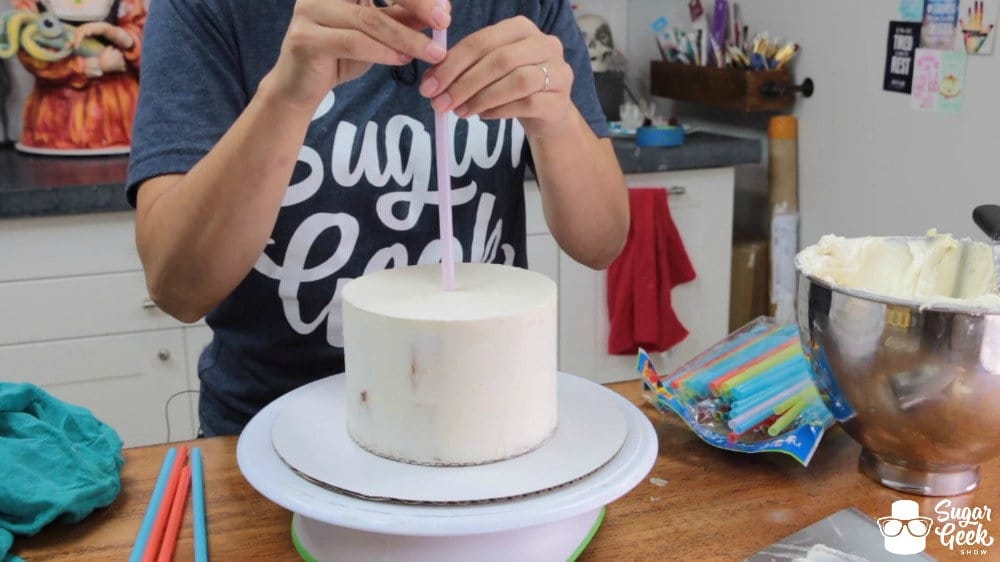
Take one of two (same-sized) cakes you've finished icing using the Upside Down Method and stick a fat milkshake straw STRAIGHT down in the center pushing it all the way to the cake board.

How to make a double barrel cake

Step 2

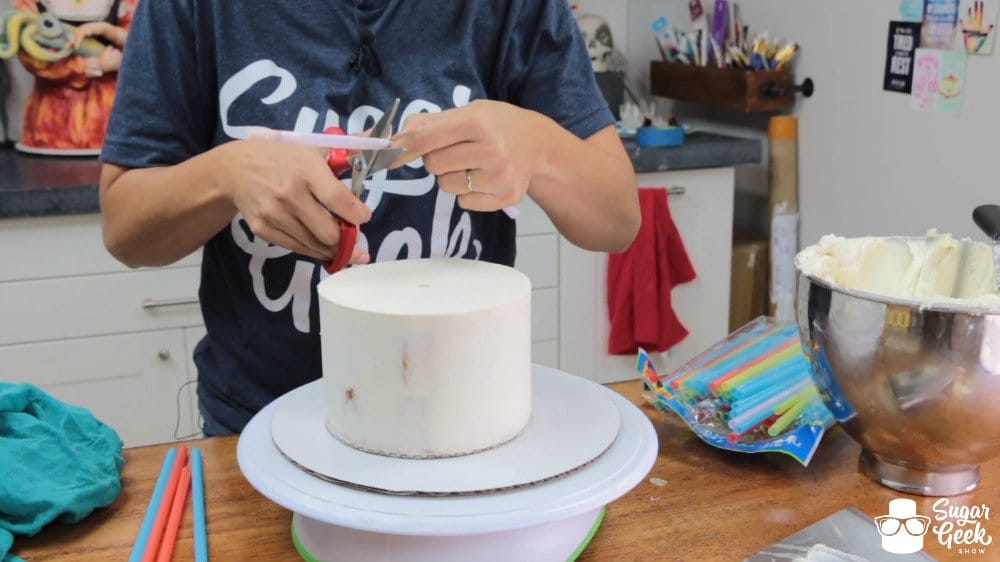
Measure the straw with your thumb at the top of the cake and cut it off at that mark. Be sure to cut as straight as you can.

How to make a double barrel cake

Step 3

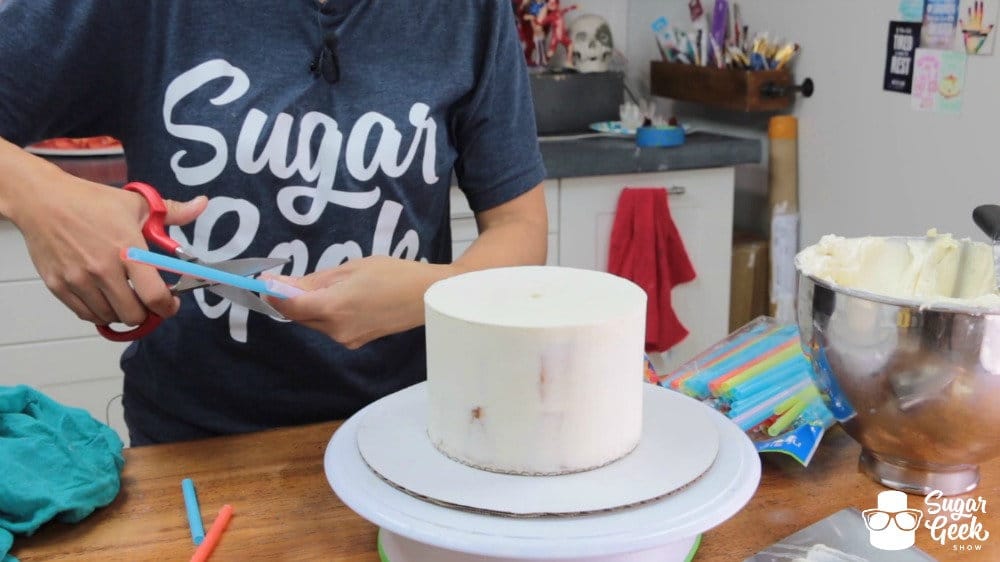
Use that straw to measure and cut your remaining support straws. The general rule of thumb is to put the same number of supports as the size of cake that will be stacked on top of that cake. In this case we are doing a 6" double barrel cake which is two 6" cakes stacked on top of one another so we will be putting 6 support straws in the bottom tier.

How to make a double barrel cake

Step 4

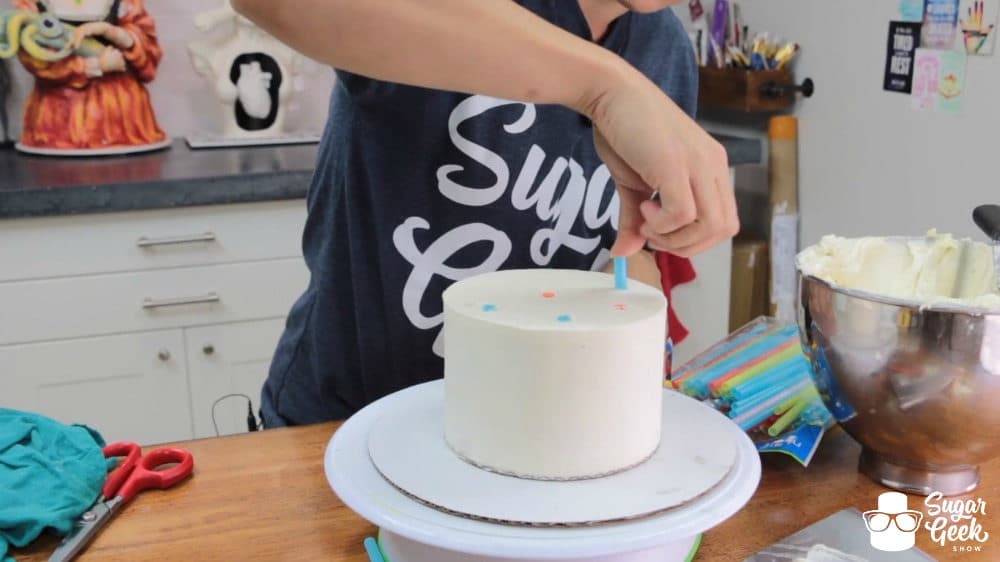
Place all of the support straws into the cake as evenly spaced as possible. You always want to put your supports as close to the edge of the cake it will be supporting as possible to get the most support. A mistake we often see beginners make is putting their supports too far in the center which can still cause the outside of your cake to collapse. About ¼" in from the edge is a good number to shoot for. With a double barrel cake you must be extra sure to place your straw straight down so that it doesn't poke out the side of your cake. Placing one straw in the center is always a good idea.

How to make a double barrel cake

Step 5

Cover your straws with a thin layer of buttercream to glue the next cake board on.

How to make a double barrel cake

Step 6

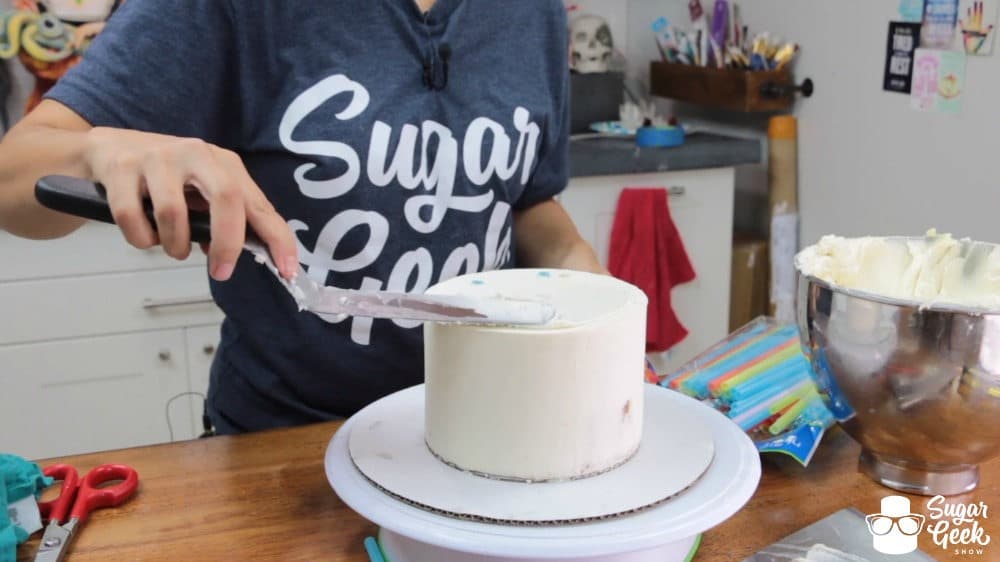
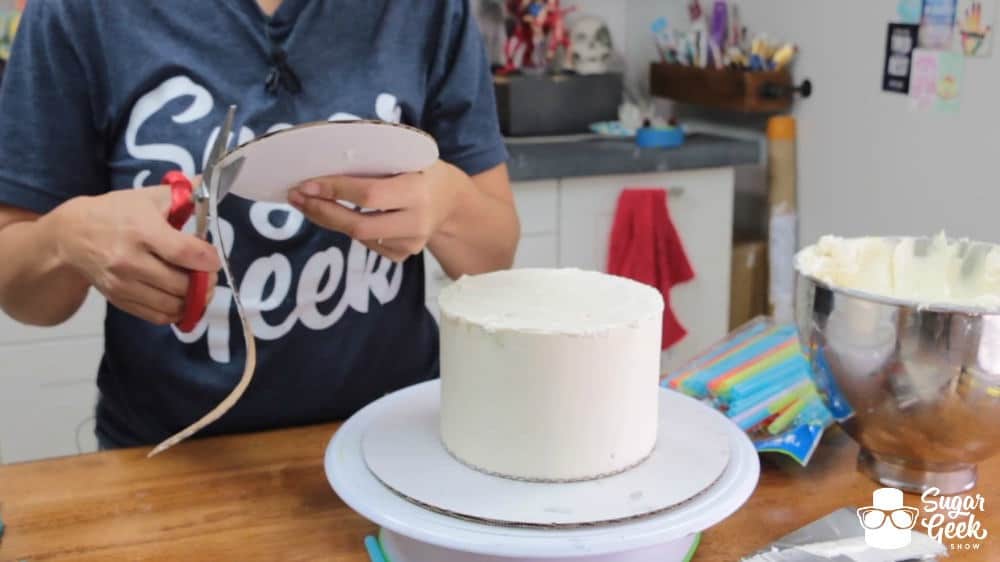
Take a cardboard round the size of the cake you are stacking and cut about ¼" off the edge, this way the board will not stick out or be seen in between the layers.

How to make a double barrel cake

Step 7

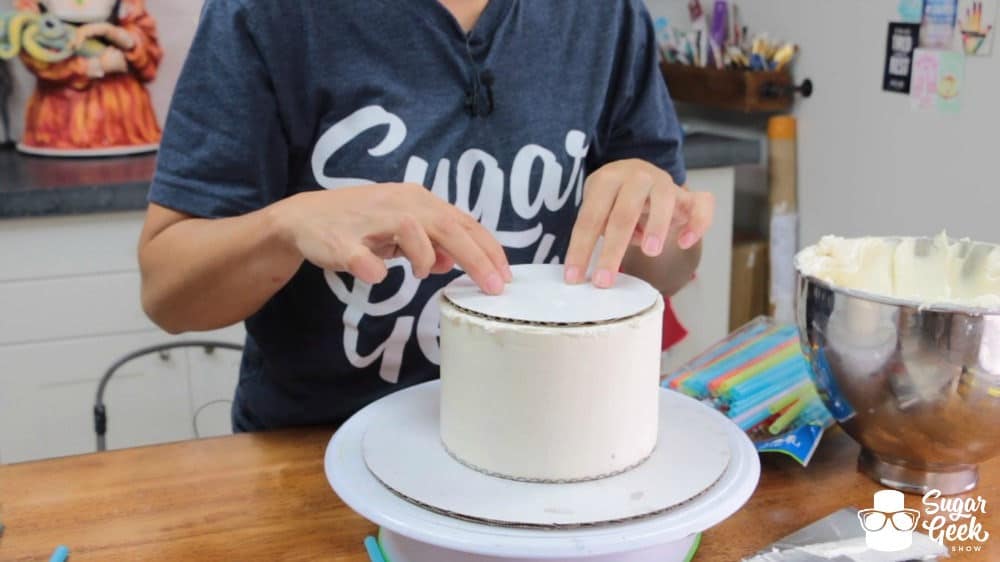
Place the cake board on top of your bottom tier.

How to make a double barrel cake

Step 8

Take your second finished cake and with a knife loosen the cake from the cake board you have iced it on.

How to make a double barrel cake

Step 9

Peel the cake board away from the bottom of your cake. Because shortening and oil do not get firm when refrigerated you must use a butter cake iced with a real butter buttercream that has been chilled in the refrigerator until nice and firm.

How to make a double barrel cake

Step 10

Once your original cake board is removed, place the cake onto the trimmed cake board you've placed on top of the supports in your bottom tier. Make sure the sides are lined up all around. Because we are using two finished cakes using the upside down method, the sides are already nice and straight and line up perfectly.

How to make a double barrel cake

Step 11

Fill in the gap between the cake boards with some more buttercream.

How to make a double barrel cake

Step 12

Using a tall bench scraper, smooth out the excess icing until smooth. Add any additional icing in any areas necessary and continue smoothing until you have one cohesive, straight side and it looks like one ginormous cake.

How to make a double barrel cake

You should end up with something like this. Pretty sweet right? There is something mega cool about a ridiculously tall cake.

How to make a double barrel cake

Now that you've been through the process you know that a double barrel cake is not actually one insanely tall cake that would be impossible to cut and serve but instead it is two regular sized tiers stacked on top of one another. So to answer the question of how you cut and serve this beast, well, you do it just as you would any other stacked cake. Cut and serve the top cake, remove the support board and cut and serve the bottom. No sweat.

Let us know what your experience with double barrel cakes has been. Have you struggled getting them nice and neat? Have you been too afraid to try one altogether? Either way we hope this post helps your double barrel dreams come true! Next week's post will show you how to cover this baby in fondant.

Wanna see the basics in action? Don't forget, the entire set of Cake Decorating Basics Video Tutorials are available to Premium and Elite Members of the Sugar Geek Show!

Going over the basics? Check out these!

Cake Decorating Basics: Must Have Tool Review

Cake Decorating Basics: Airless Space Buttercream

Cake Decorating Basics: Leveling and Torting

Cake Decorating Basics: Filling and Crumb Coating

Cake Decorating Basics: Avoiding Cake Blowouts

Cake Decorating Basics: Smooth Final Coat of Buttercream

Cake Decorating Basics: The Upside Down Method

Cake Decorating Basics: The Secret to Small Cakes

Cake Decorating Basics: Covering a Cake in Fondant

Cake Decorating Basics: How to Panel

Cake Decorating Basics: Stacking Cakes

How to get sharp fondant edges

November 9, 2017 Blog

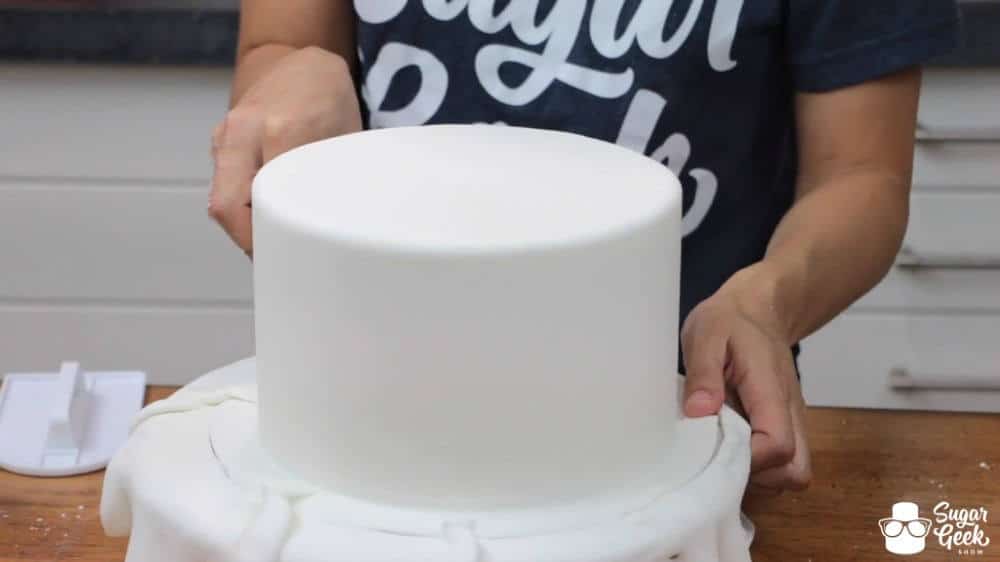
Cake Decorating Basics: How To Get Sharp Fondant Edges

How to get sharp fondant edges on your cakes

So you've gone to all the trouble to do the upside down method to ice your cake with buttercream (because we showed you how to do that in THIS blog post) and you put your fondant on your cake (and we showed you how to do that in THIS blog post) and you notice that all that hard work was a waste because the fondant just gave your cake rounded edges once again. What the heck man?! Don't fret, today's blog post shows you how to continue the upside down method to now get those sharp edges with your fondant.

How to get sharp fondant edges

Step 1

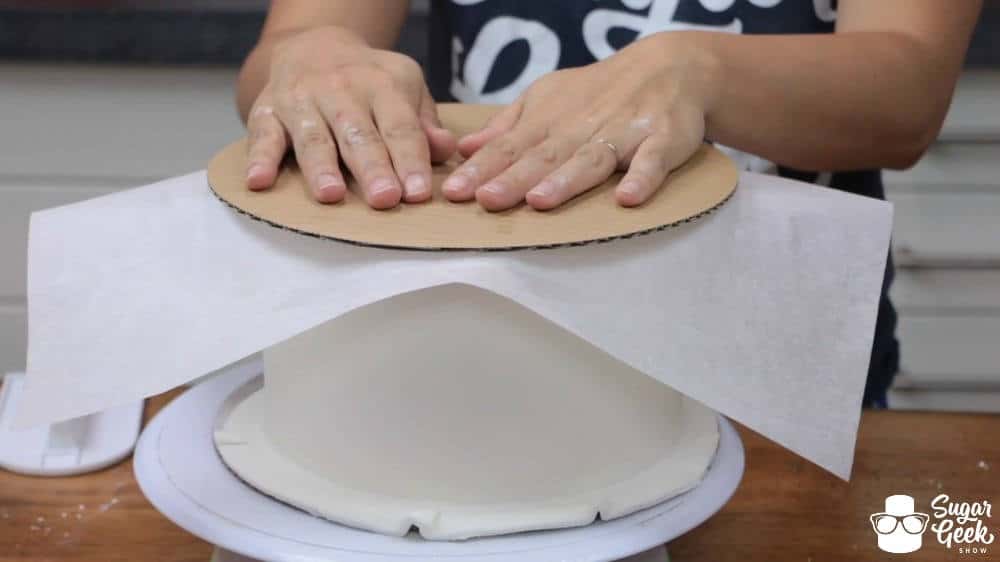
Cover your cake in fondant just as you normally would. Using an exacto blade, instead of cutting the fondant right to the edge of the cake, cut it about 1" long.

How to get sharp fondant edges

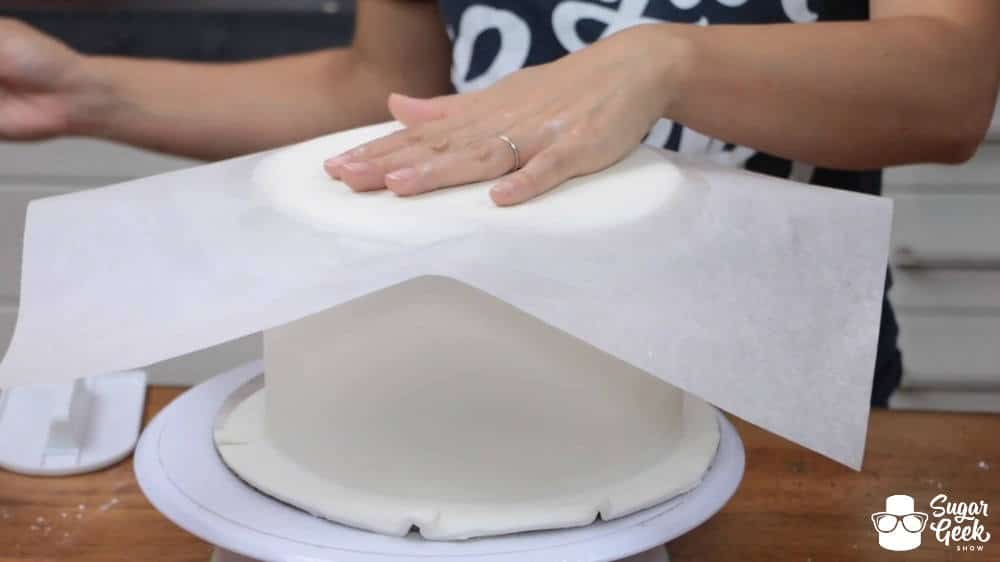
Step 2

Place a piece of parchment paper on top of your cake.

How to get sharp fondant edges

Step 3

Place a cake board at least a couple inches bigger than your cake on top of the parchment paper.

How to get sharp fondant edges

Step 4

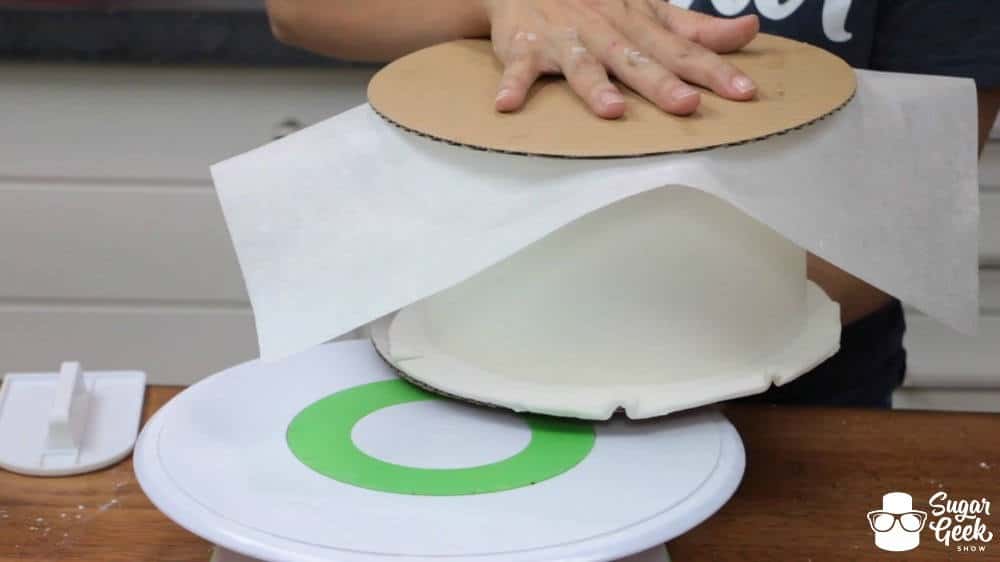
Slide your cake off your turntable being sure to support the top and bottom well.

How to get sharp fondant edges

Step 5

Flip your cake upside down and place it back on your turntable. Once again, this should only be done with a chilled cake that contains butter in the cake as well as the buttercream because they both chill nice and firm. If those two things are in place, this will not hurt your cake at all!

How to get sharp fondant edges

Step 6

Fold those long edges up over the bottom of your cake for now.

How to get sharp fondant edges

Step 7

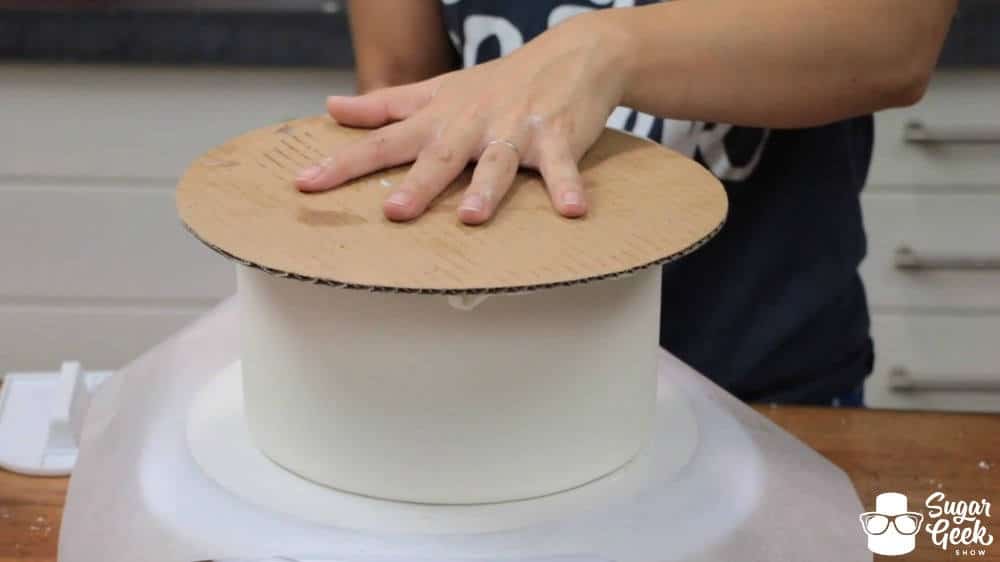
Using your fondant smoother, begin smoothing the top of your fondant down against the board until you no longer see a shadow. You are forming a nice sharp edge against the board.

How to get sharp fondant edges


Tip:

If you notice your fondant starting to sweat a little and it is causing your smoother to stick, dust the cake with a little bit of cornstarch to dry it up so you can continue smoothing without any resistance.

How to get sharp fondant edges

Step 8

Polish and smooth the bottom edge of your cake being sure to get a nice seal.

How to get sharp fondant edges

Step 9

Use an exacto blade to cut off your excess fondant.

How to get sharp fondant edges

Step 10

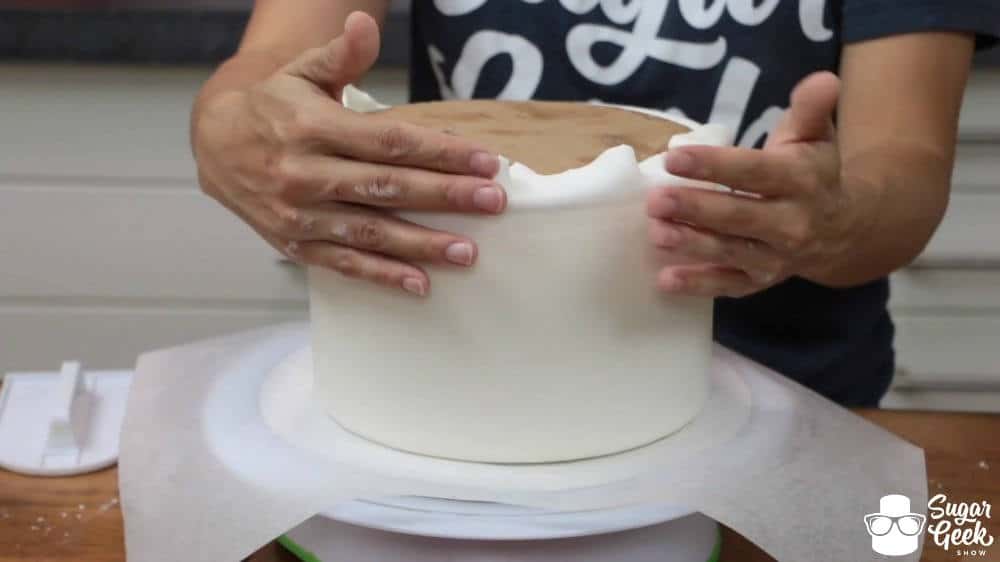
Place another cake board on the bottom of your cake and once again supporting it well, flip your cake back over. Remove the parchment paper and cake board and you will be left with a beautiful, clean sharp cake edge. So fast, so easy, so effective.

How to get sharp fondant edges

I mentioned before that the upside down method literally changed my life and I really meant it. For some, the idea of flipping your cake upside down gives your nightmares but trust us experts when we say, it is totally fine! Use a firm, chilled cake, do it carefully and you genuinely have nothing to lose except that rounded cake edge.

Going over the basics? Check out these!

Cake Decorating Basics: Must Have Tool Review

Cake Decorating Basics: Airless Space Buttercream

Cake Decorating Basics: Leveling and Torting

Cake Decorating Basics: Filling and Crumb Coating

Cake Decorating Basics: Avoiding Cake Blowouts

Cake Decorating Basics: Smooth Final Coat of Buttercream

Cake Decorating Basics: The Upside Down Method

Cake Decorating Basics: The Secret to Small Cakes

Cake Decorating Basics: Covering a Cake in Fondant

Cake Decorating Basics: Easy Double Barrel

Cake Decorating Basics: How to Panel

Cake Decorating Basics: Stacking Cakes

Cake Decorating Basics: How to get Sharp Edges

How to get sharp fondant edges on your cake

November 3, 2017 Free Tutorials

Cake Decorating Basics: Covering a Cake in Fondant

How to cover your cake in fondant and get sharp edges using the upside-down technique

Covering a cake in fondant can be super intimidating and scary if you've never done it or even more so if you have tried it and failed miserably which I can honestly say is probably everyone when they first start out. If you nailed it perfectly the first time you covered a cake in fondant and have ever since, well then you must be a cake witch and should be burned at the stake. I'm kidding obviously, that's jealousy talking.

How to get sharp fondant edges on your cake

For everyone else though, we're here to show you how it's done and even though we're giving the steps and tips for success, covering a cake in fondant takes a certain finesse and a whole lot of practice so don't give up!

What You Need

  • Chilled cake - watch my sharp edges buttercream tutorial
  • Turntable
  • Buttercream
  • Offset spatula
  • Bench scraper
  • Parchment paper
  • Two cake boards larger than your chilled cake
  • Fondant

how to make a cake tutorial

BONUS: Want step-by-step instructions on how to make your first cake? Watch my how to make a cake video tutorial! 

Watch the video below on how to cover a cake in fondant

Step 1

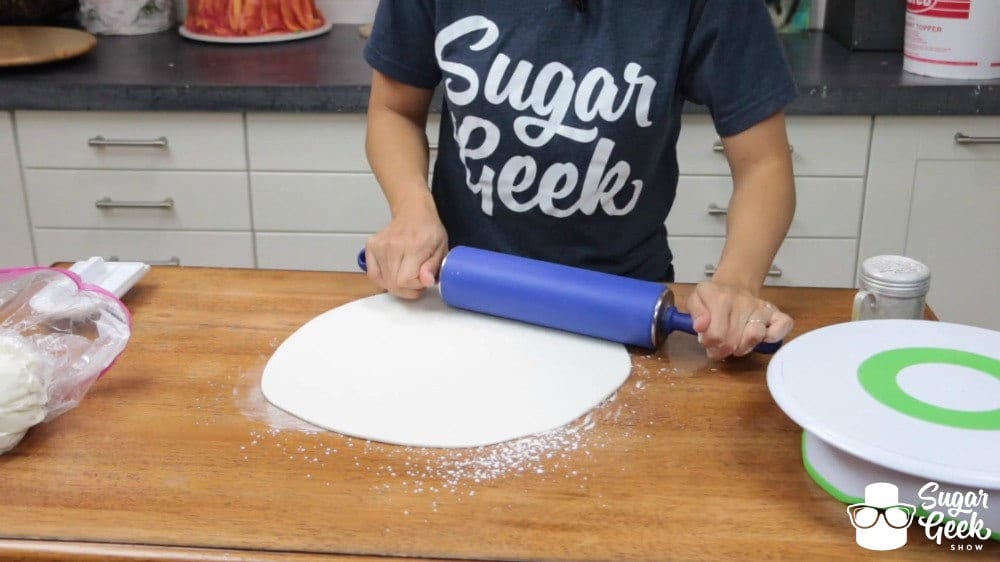
Condition your fondant until smooth and pliable and roll out onto a cornstarch or powdered sugar-dusted (or cornstarch) surface to keep it from sticking. Check out Liz Marek's Fondant Recipe (LMF) for a simple and easy to work with marshmallow fondant that works like high-end store-bought fondant and saves you money!

marshmallow fondant recipe

Tip: Heat your fondant in the microwave for 15-30 seconds when first getting it out to make it easy to work smooth.

Step 2

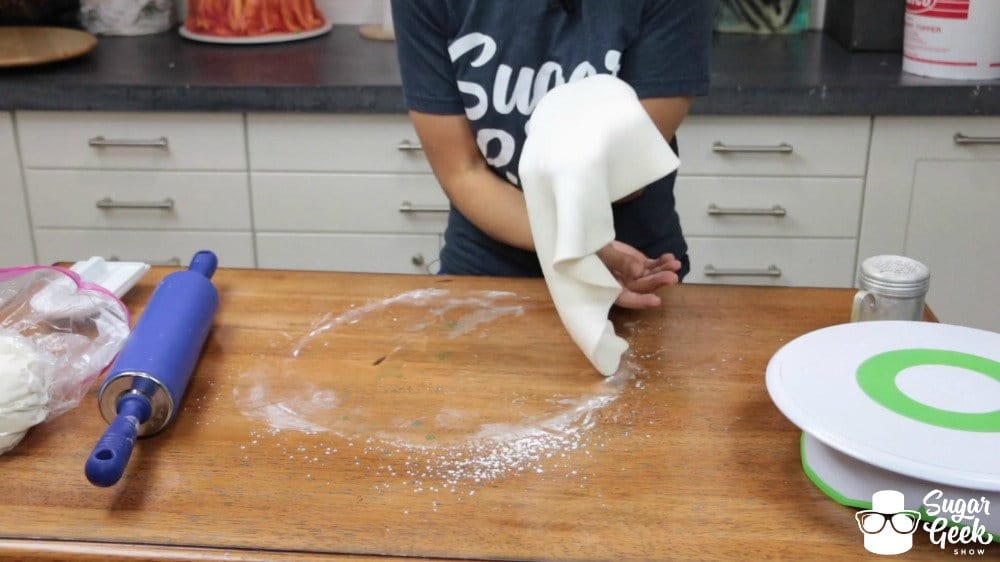
Flip your fondant at least once while rolling out to further ensure it doesn't get stuck to your surface.

How to cover a cake in fondant

Step 3

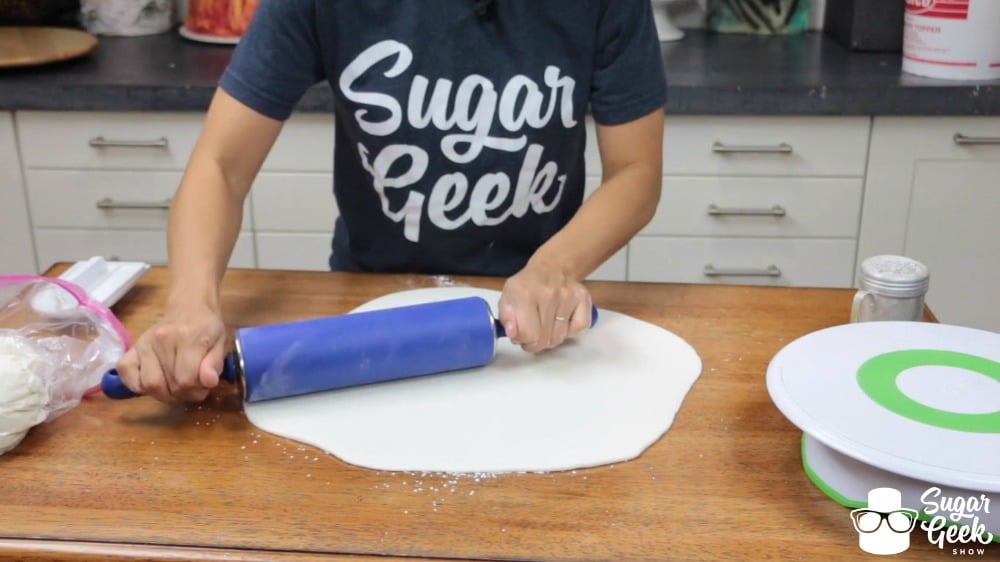
Continue rolling your fondant until it's anywhere from 1/16" to â…›" thick. LMF is really easy to roll thin so 1/16" isn't a problem, if you're using a different kind of fondant try to make it no thicker than â…›" thick. Nobody likes a super thick layer of fondant.

Make sure your fondant is PLENTY big. The rule is to add the height of your sides and top together and add a couple of inches to that so a 5" tall 6" round cake would be 5+5+6+2= 18". That's a good rule of thumb but honestly, the larger the piece of fondant the easier your cake will be to cover. If you barely have enough fondant your wrinkles and pleats will be worse and much harder to open up and smooth out.

How to cover a cake in fondant

Step 4

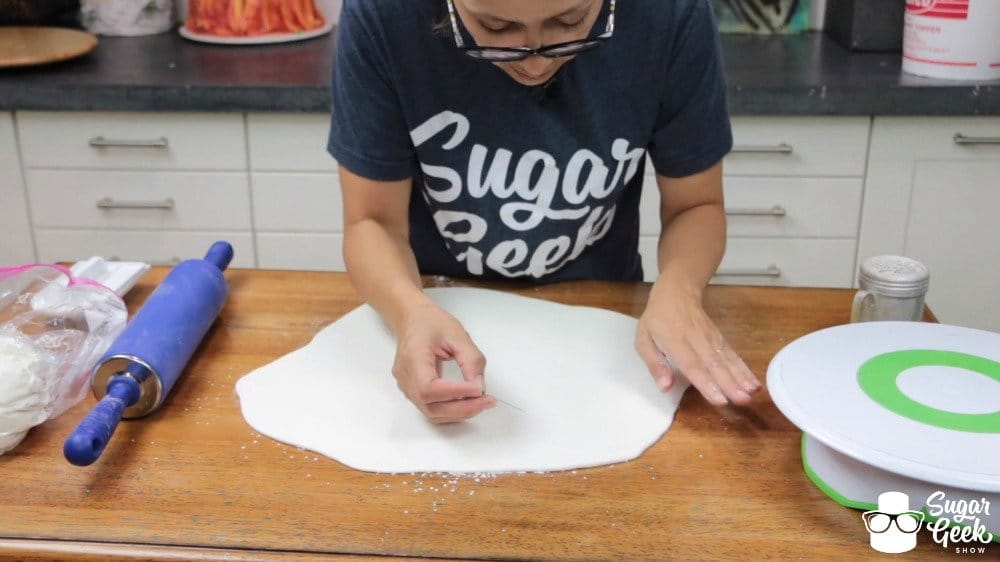
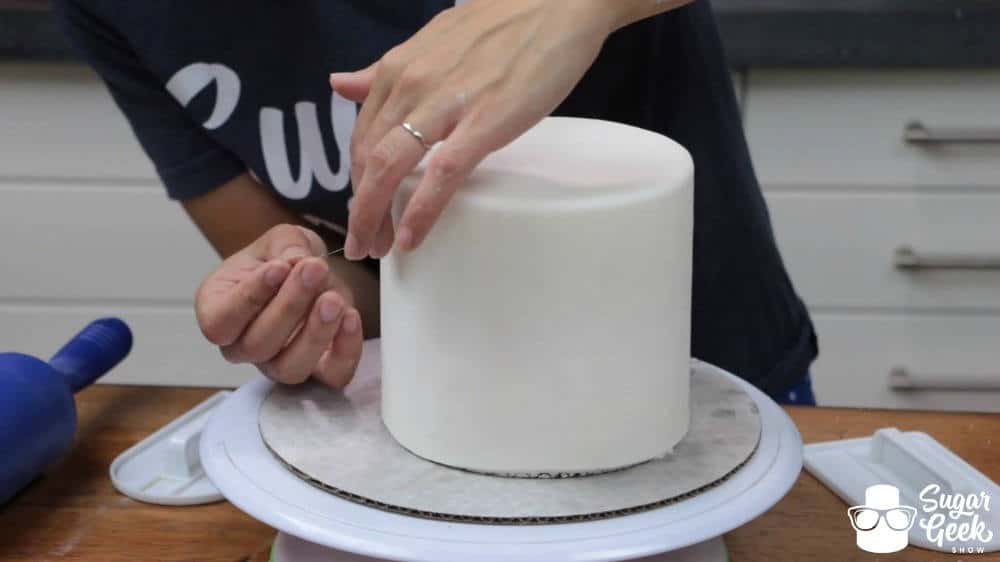
Pop any air bubbles you can see with an acupuncture needle.

How to cover a cake in fondant

Step 5

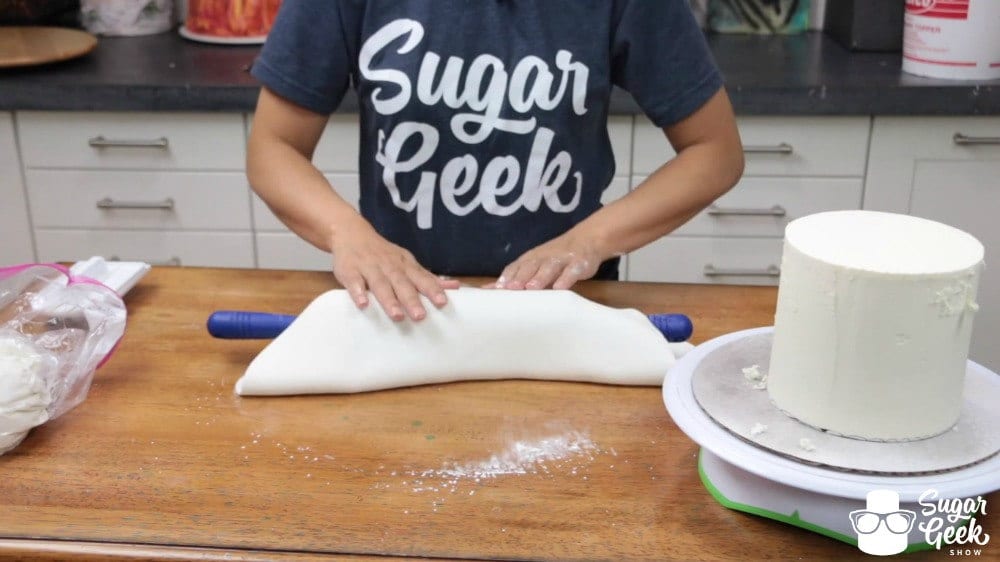
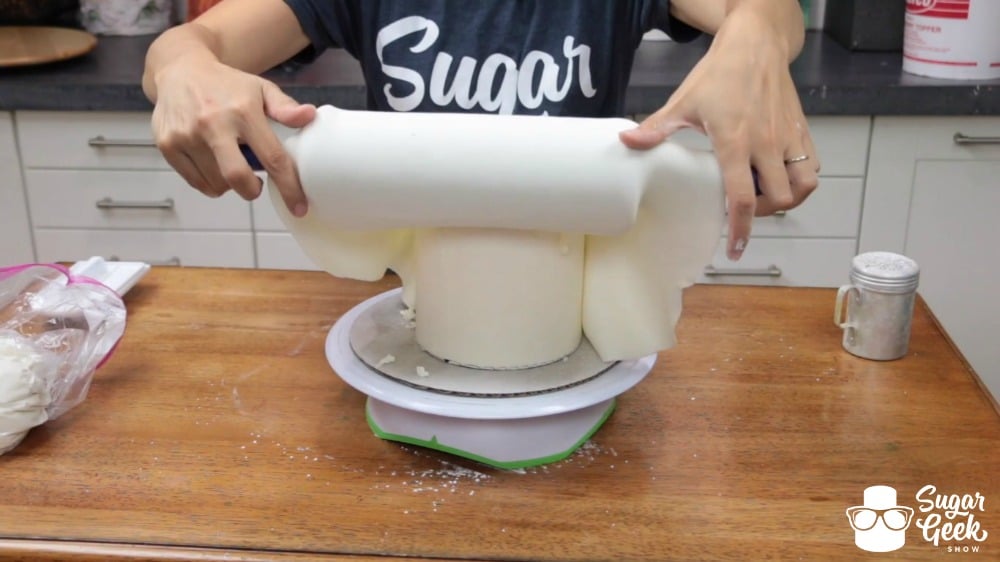
Roll your fondant up onto your rolling pin. You may want to lightly dust the top of your fondant to keep it from sticking to itself.

How to cover a cake in fondant

Step 6

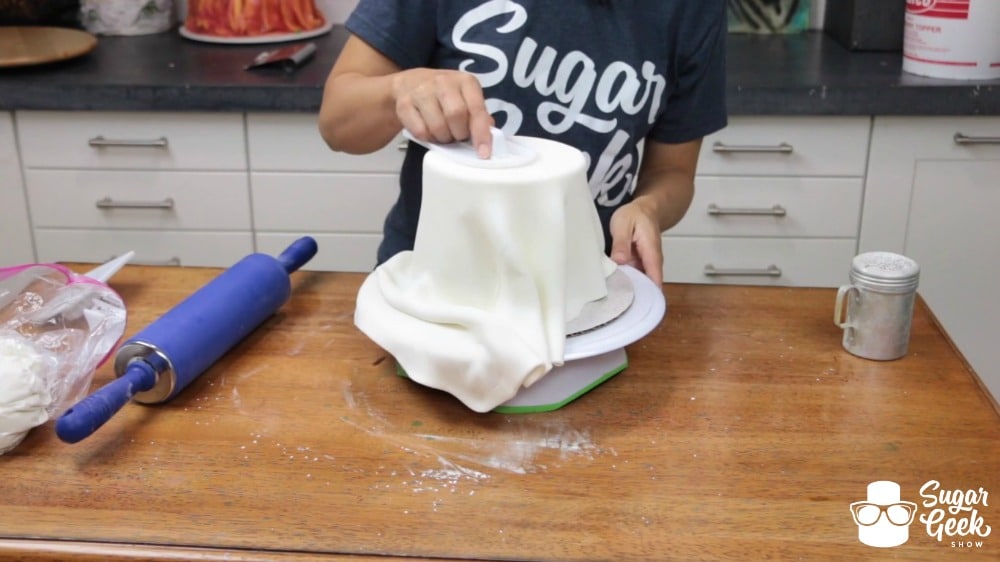
Gently transfer the fondant to the cake and drape it over top.

How to cover a cake in fondant

Step 7

Using a fondant smoother, smooth down the top of your fondant first, pushing out any air from underneath.

How to cover a cake in fondant

Step 8

Quickly smooth down the top edge of the fondant. The quicker you get the top edge adhered to the cake the better so that you don't have any tearing on the edge where it's the most common. Adhering the top takes the weight off of your fondant and keeps it from pulling and tearing.

How to cover a cake in fondant

Step 9

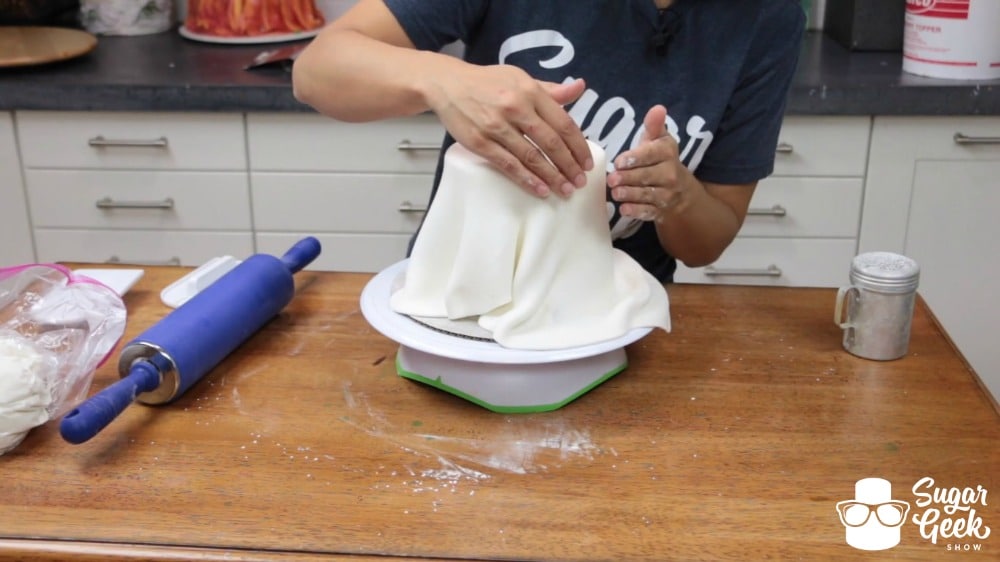
Begin pulling out the pleats and pressing the fondant to the cake. Beginners tend to pull down on the fondant here which is not what you want. You are simply pulling apart the pleats and folds and then pressing the fondant against the cake. Think of fluffing out a dress. If your body was a cake and you wanted to stick the dress to yourself without wrinkles.

How to cover a cake in fondant

Step 10

Once you've smoothed out all the pleats, smooth down all along the bottom of your cake to get a nice seal.

How to cover a cake in fondant

Step 10

Cut off the excess fondant with an Exacto blade. You will likely have a lot of extra fondant if you rolled it out nice and big and by the time it has stretched and that's perfectly normal! Don't throw that fondant away because it can still be used even if it got a little bit of buttercream on it. Just knead it in and it will be fine.

How to cover a cake in fondant

Step 11

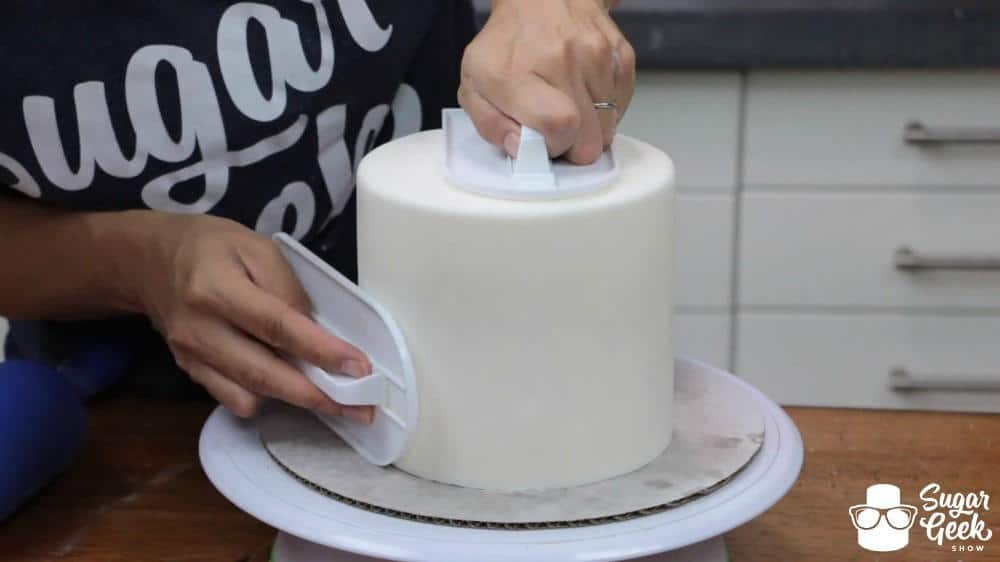
Use your fondant smoother to sort of "polish" your cake. Smooth out any lumps, bumps or wrinkles until it's nice and purdy.

How to cover a cake in fondant

Use two smoothers to help steady your cake so you can apply more pressure to smooth without making a handprint in your cake.

How to cover a cake in fondant

Pop any additional bubbles you see with your acupuncture needle.

How to cover a cake in fondant

Step 12

Smooth the bottom edge of your fondant all the way down to make sure your board is covered.

How to cover a cake in fondant
Now you should have a beautiful, smooth fondant covered cake ready to decorate or put back in the refrigerator until you are ready to decorate or stack it. Easy peasy right?

BONUS - Step 13 - Upside Down Technique

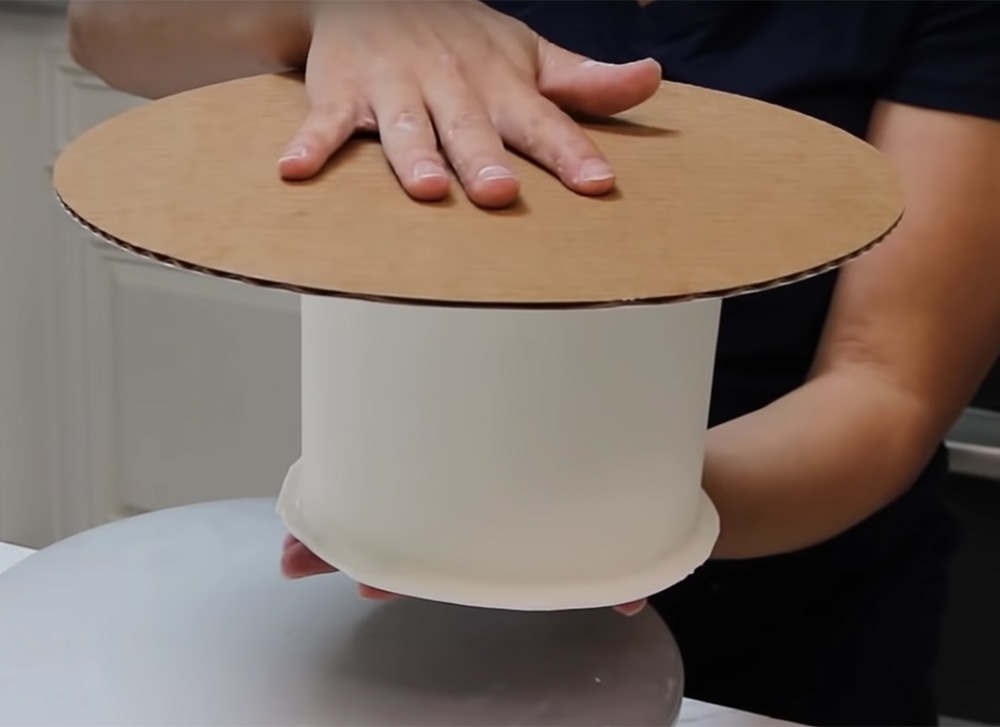
If you want your cake to have SUPER sharp edges, you can flip the cake upside-down (don't worry, this doesn't hurt the cake). Place a piece of parchment paper on top of the cake and then a cake board. 

Slide your hand underneath the bottom of the chilled cake and the top of the cake board and hold firmly and turn over slowly. 

Turn your chilled cake over

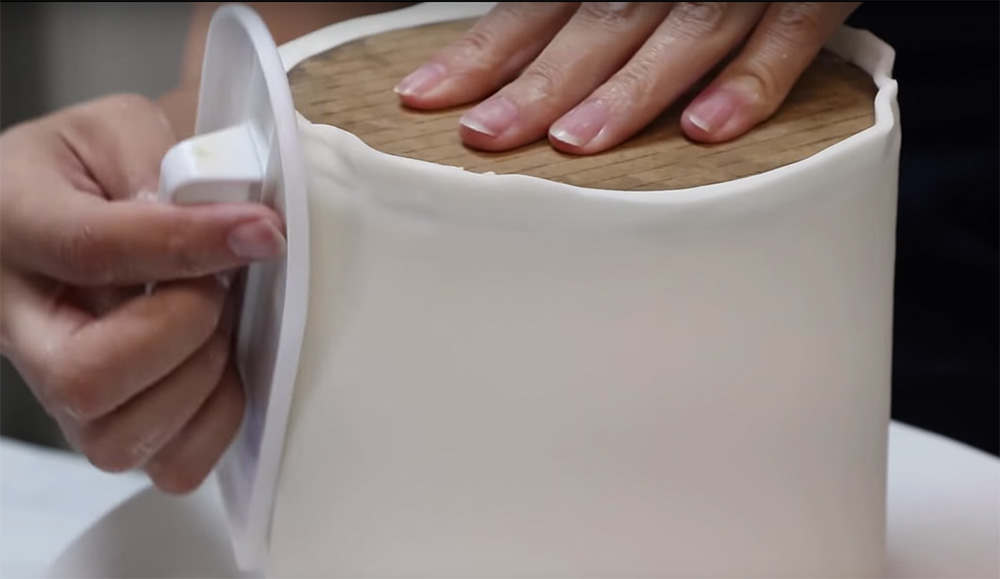
Push the fondant around the base of the cake board up with a fondant smoother and trim off the excess. This helps hide the cake board when you turn it back over. 

trim off the excess fondant

Use the fondant smoother to smooth out the fondant and create a nice sharp edge by moving the fondant smoother in small circles with firm pressure. You should see the shadow from the rounded edge slowly disappear as you smooth. 

smooth the rounded edge of the fondant with fondant smoothers

And that's how you get super sharp edges on your fondant covered cakes! 


Going over the basics? Check out these!

Cake Decorating Basics: Must Have Tool Review

Cake Decorating Basics: Airless Space Buttercream

Cake Decorating Basics: Leveling and Torting

Cake Decorating Basics: Filling and Crumb Coating

Cake Decorating Basics: Avoiding Cake Blowouts

Cake Decorating Basics: Smooth Final Coat of Buttercream

Cake Decorating Basics: The Upside Down Method

Cake Decorating Basics: The Secret to Small Cakes

Cake Decorating Basics: How to get  Sharp Edges

Cake Decorating Basics: Easy Double Barrel

Cake Decorating Basics: How to Panel

Cake Decorating Basics: Stacking Cakes

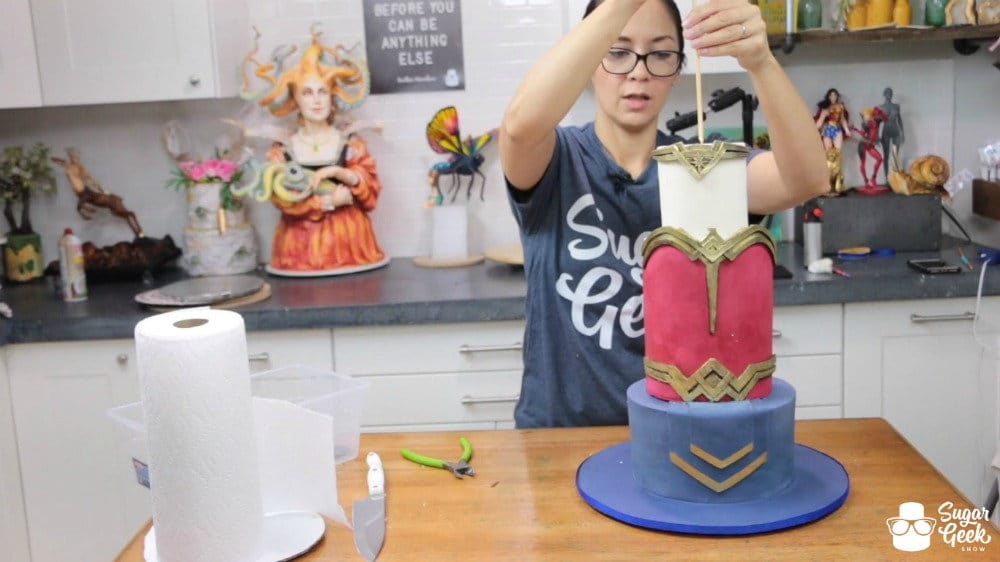
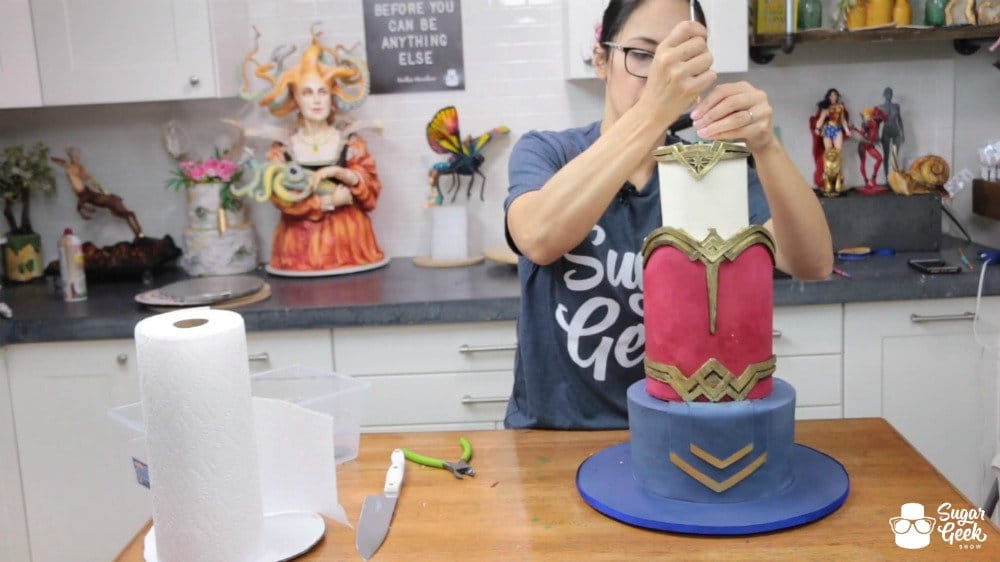
Wonder Woman Tiara Cake Tutorial

November 1, 2017 Course Preview

Wonder Woman Tiara Cake Tutorial

Skill level: Intermediate

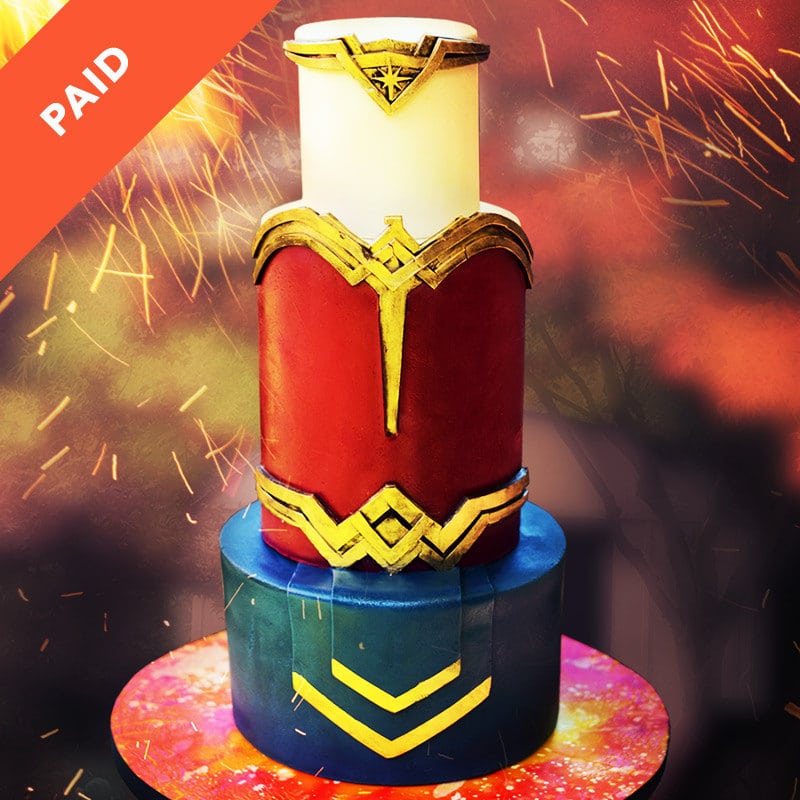
You guys know how obsessed I am with Wonder Woman and after I watched the new movie, I knew I had to create a cake inspired by the strong female lead.

This tutorial is based off the basics series so if you're wanting to perfect your skills from torting, filling, frosting, covering double barrels and getting sharp edges, just follow the basics series and that leads right into this tutorial.

51:00 Minutes of Instruction

What You Will Learn

  • How to create a layered tiara, corset and skirt on a tiered cake
  • Learn how to make a crackled cake board
  • How to hand paint a fiery explosion with edible watercolors

Tutorial Chapters

  1. Making Dark Blue Fondant 0:22
  2. Add Skirt Layers 2:39
  3. Painting Gold Details 5:30
  4. Making Dark Red Fondant 8:15
  5. Creating the Corset 9:31
  6. Modeling Chocolate Details 23:44
  7. Gold Accents 32:45
  8. Applying the tiara 34:50
  9. Painting gold accents 40:42
  10. Creating the cake board 41:11
  11. Crackle board technique 45:12
  12. Finishing the edge 49:06

Downloads

Materials List

Tiara Template 01

Corset Template 01

Breastplate Template 01

Breastplate Template 02

Belt Template 01

Skirt Template 01

Skirt Template 02

Wonder Woman Tiara Cake Tutorial

November 1, 2017 Paid Video

Wonder Woman Tiara Cake

Skill level: Intermediate

You guys know how obsessed I am with Wonder Woman and after I watched the new movie, I knew I had to create a cake inspired by the strong female lead. This tutorial is based off the basics series so if you're wanting to perfect your skills from torting, filling, frosting, covering double barrels and getting sharp edges, just follow the basics series and that leads right into this tutorial.

51:00 Minutes of Instruction

What You Will Learn

  • How to create a layered tiara, corset and skirt on a tiered cake
  • Learn how to make a crackled cake board
  • How to hand paint a fiery explosion with edible watercolors

Tutorial Chapters

  1. Making Dark Blue Fondant 0:22
  2. Add Skirt Layers 2:39
  3. Painting Gold Details 5:30
  4. Making Dark Red Fondant 8:15
  5. Creating the Corset 9:31
  6. Modeling Chocolate Details 23:44
  7. Gold Accents 32:45
  8. Applying the tiara 34:50
  9. Painting gold accents 40:42
  10. Creating the cake board 41:11
  11. Crackle board technique 45:12
  12. Finishing the edge 49:06

Downloads

Materials List

Tiara Template 01

Corset Template 01

Breastplate Template 01

Breastplate Template 02

Belt Template 01

Skirt Template 01

Skirt Template 02

Related Videos


Cake Decorating Basics: Fundamentals


How to Make Dark Purple Fondant

The Dos and Don'ts of Cake Competition

October 31, 2017 Blog

The Dos & Don'ts of Cake Competition

The Dos and Don'ts of Cake Competition

This year has brought us many cake shows including America's Cake Fair, SoFlo, That Takes the Cake, San Diego Cake Show, Show Me Sweets and more! Whether you have been watching via social media or taking part in some of these shows yourself, you have probably noticed the incredible cakes in the cake competition.

For years, I was deep in the cake competition world, my first competition taking place at Austin That Takes the Cake in 2014. That was my first cake show, my first time competing, my first time flying, my first time meeting a lot of my cake heroes! It was thrilling and the icing on top was that I won first place (by a few points). After that, I was hooked. I would say I have done well competing but I have had my ups and downs, and was even disqualified once for not following some basic rules! Stupid mistake on my part but still, I had so much fun.

Competing is a great way to push yourself, to strive for your personal best, to do the best work you've done so far.

Now that I am retired from competition, I really want to focus on teaching the next generation of competitors what it's like to compete. To win, to lose; to learn and grow. There are always a lot of questions coming my way regarding cake competition and I could definitely answer them from my perspective but really, the best person to ask is a judge.

Susan Trianos of Susan Trianos Custom Cakes in Toronto, CA has been competing and judging for 1 million years. She has graciously agreed to give us some insight into what goes into judging, how you can do your best and the most important tips to successfully competing at cake shows.

Cake Competitions, Why we do it?

You're on your way to a cake show, you decided not to enter the cake competition… you get there and spend the entire weekend wishing you did.

Why did you decide not to enter?
Was it fear?
Could it have been a lack of time?

Whatever the reason, you're kicking yourself now. So what is it that draws us in? Why do we do it?

#1: Enter For The Right Reasons

There are many answers to this question… but let me talk about why you should. It shouldn't be about outdoing your fellow competitors, it should be about outdoing yourself. Competing is a great way to push yourself, to strive for your personal best, to do the best work you've done so far. You are competing against your personal best, do it for you and be supportive with the other competitors, they are just as nervous as you are.

There is another great reason to enter. Many of us make cakes for a living, and often we are not making cakes WE want to make. Our clients choose… we may help them come up with a design, but ultimately we are designing cakes to suit their needs, to satisfy their vision. Competing in cake shows allows our creativity to thrive. It is here that we can truly showcase our style, try a new technique and blow the judges away or, we can use those techniques that we never get to use due to lack-of-budget or what your client wants. Creating something you love is almost like chicken soup for the soul, and allows us to be the artists that we are. If you've never competed, don't be afraid… take the plunge!

You want to grab the judges attention right way, with an attractive cohesive design. Remember, you never get a second chance to make a good first impression.

#2: What The Judges Are Looking For

You want to grab the judges attention right way, with an attractive cohesive design. Remember, you never get a second chance to make a good first impression. Once you have their attention, you want to keep it within your techniques, and techniques that have been executed well.

What are your strengths?
Is it painting?
Piping?
Sugar flowers?

Top scoring wedding cake by Sara Laird Weber. Disqualified due to use of wires placed directly into cake. Still a stunning example of what judges look for in an overall cake design. Eye-catching, cohesive design and multiple techniques used.

#3: Multiple Techniques

Whatever your strengths, try and use as many techniques as you can, but remember… they all have to work together, your design needs to be cohesive. Clean work is also at the top of the list when it comes to what judges look for in a cake. For me, this is the magical formulation: an eye pleasing design, that has lots of techniques (it's even better if the techniques are innovative), and clean work.

Judges want to see a design that is eye-catching, cohesive and has multiple techniques.

Following these 3 simple rules will really increase your chances of a ribbon. Let's talk about what judges don't like.

There are so many tools and loads of time saving equipment out there… and I own them all, LOL. I'm talking about: molds, lace mats, flexible lace, stencils, edible printers, cutting machines, embossing mats, the list goes on and on. These tools are amazing, and really help decorators make beautiful cakes for their clients quickly, which earns you more mullah… time is money, after all.

When it comes to competing, I recommend staying away from using too many of these time-saving tools. I'm not saying don't use them at all on your cake, but be careful… they don't earn many points. They can help contribute to the overall look of your cake, which will get you points but that's about it. There's a term out there… "lick-and-stick." Don't make a lick-and-stick cake for a competition.

When it comes to competing, I recommend staying away from using too many of these time-saving tools.

Let me give you an example where one of these items can be used successfully in competition… let's say you want flexible lace draped on your cake. Well, use the edible lace mix, but rather than spreading it on a patterned silicone mat, flip the mat over to the flat side and pipe your own lace design (be sure to write that down in your description so the judges know). When I compete, I make a rule for myself and never use these items, but that's me. It's okay to incorporate some of these things… just don't rely on them. Make sure your hand-made work shines!

#4: Rules

READ THE RULES!!!!!! You can have an amazing cake (a first place contender even) but if you don't follow one of the rules you stand to lose a lot of points, or even worse… be disqualified. I have seen cakes that should have won first place, not place at all. This is so disappointing, for the competitor, and even for the judges… it kills us too.

I once entered a competition (one of my very first), and won first place, not because I had the best cake, but because the winning cake was docked so many points for breaking a rule, it took her right out of the running. A lot of time and effort went into her cake so, to say she was disappointed is an understatement. It's not the way I wanted to win either.

I once entered a competition (one of my very first), and won first place, not because I had the best cake, but because the winning cake was docked so many points for breaking a rule, it took her right out of the running.

The Unwritten Rules

Now, I'm going to talk about a little pet peeve of mine… unwritten rules.

Floral Wire

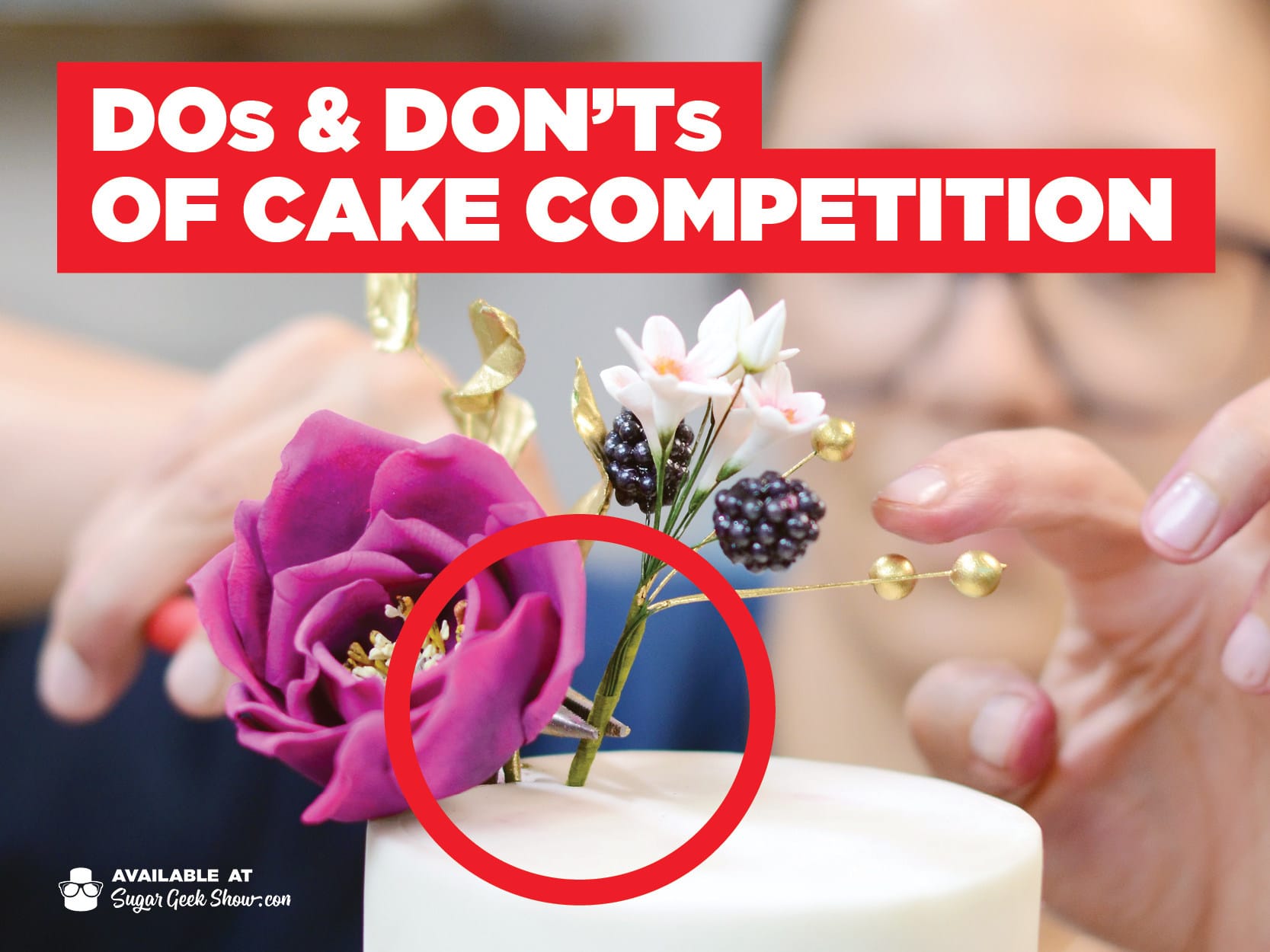
A few classic rules that apply at every competition, and often aren't written in the rules are things like not putting wires directly into the cake, you have to treat your cake as though it's real, so wires should be put into a floral pick or into a straw that's been inserted into the cake. Be sure that the straw or pic is slightly visible… if it's not, be sure to mention that you used them in your description, the judges need to know.

Cover Those Cake Dummies

Another rule that sometimes gets overlooked is to cover the underside of your dummy cake if it's visible. I usually cover the base well in advance with fondant, and allow it to dry. Some judges will be ok with a cake board covering the underside of the dummy, as that is what would be exposed if the cake was real. I play it safe and use fondant, it's also a nice clean look.

Cake Boards

The last one I'm going to mention is to cover your cake board. If you've spent all this time and effort on a beautiful cake, you don't want to spoil it with an exposed cake board.

When these rules aren't noted, it's points that a newbie will lose when they didn't even have a clue the rules existed (which I don't find fair) but, they'll never do it again, lol.

This is an example of a judging form. You can see the categories that are typically rated using a points system. Always read the rules for the cake competition you are entering to see if there are any requirements (height or theme) that you might overlook.

#5: Attitude

Your attitude towards competing is very important. There is no guarantee of a win, or even placement. Judging can be very subjective, and you may have an amazing cake that the judges just don't appreciate in the same way you or others do, for whatever reason.

Be proud of your work, and proud that you even had the guts to enter (it takes a lot of guts). It's very important to keep a positive attitude and understand you are opening yourself up to constructive criticism along with positive feedback. This is part of your growth as a decorator/designer and those comments will help you understand what areas you need to improve or practice.

Be proud of your work, and proud that you even had the guts to enter (it takes a lot of guts).

There are always competitors who disagree with the judging and will voice their opinions in a less than constructive way. It's important to take a step back, take a deep breath, and count to ten. After all, this is what you signed up for, isn't it?

Judges are quite open to discussing the scores and comments they've given, and you don't have to agree… just keep your composure and remember that judging is always final. Be kind and considerate with other competitors and congratulate those who've placed. This is their shining moment, don't be the one to burst their bubble, even if you don't agree. Take a look around… those that are at the top of their game always win with grace, but have just as much grace when they don't place. A positive attitude will bring positive results.

#6: How the Judges Feel

Judging is not easy. Last week, I spoke to someone who had just judged for the first time, she said it wasn't all that it was cracked up to be. Let's face it, judging is hard work. The last thing a judge wants to do is crush someone's spirit. A lot of time and care is taken for this very reason, which is tiring.

Judges do their very best, and really do worry about offending or hurting someone's feelings.

Judging takes a long time… sometimes an entire day, and often with little-to-no-compensation. They do it for the love of cake, to contribute to the community, and to help with the growth of the new up-and-comers in this industry we all love so much. Judges do their very best, and really do worry about offending or hurting someone's feelings.

I have a little story for you… I compete at OSSAS every year, and recently spoke to one of my judges from my most-recent entry. I mentioned that he had judged my cake and I saw first-hand what my face looks like when people say that to me. He winced, put his head down and asked "what did I write"? He looked like he wanted to run and hide, just like I have felt in that same situation. I immediately told him I really appreciated his feedback and that he didn't write anything I didn't agree with. So when you speak to a judge, thank them even if you disagree with some of their comments. They are human too.

I'm very thankful that there are so many shows and competitions available to us, and that I'm able to attend so many. I find the cakes so inspiring, and they make me want to go back home and create. So a big THANK YOU to those who go through all of the hard work making competition cakes, and traveling long distances to get them to shows. To those considering entering a competition, take that plunge… come join the fun!

Chocolate Oyster Shell

October 25, 2017 Blog

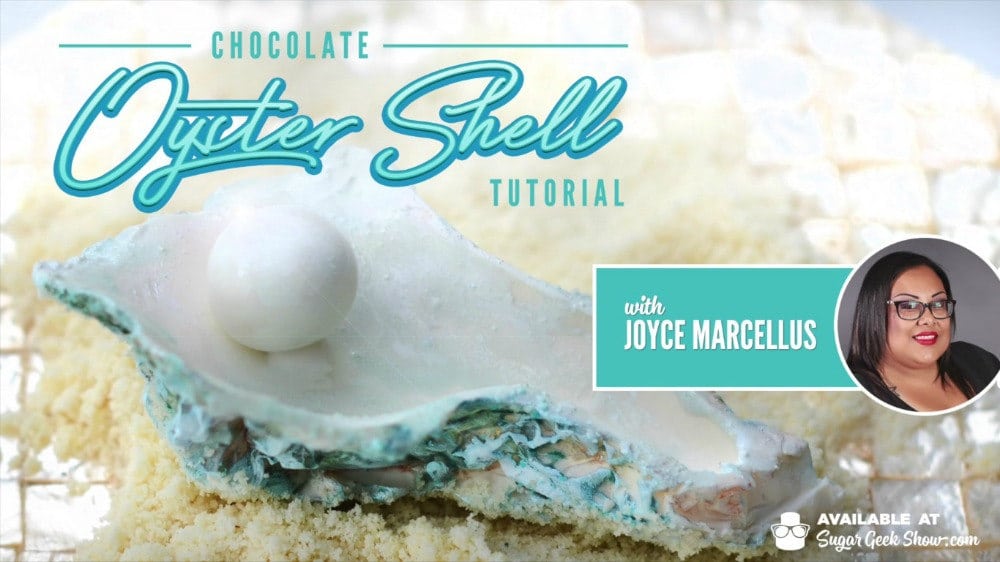
Chocolate Oyster Shell Tutorial

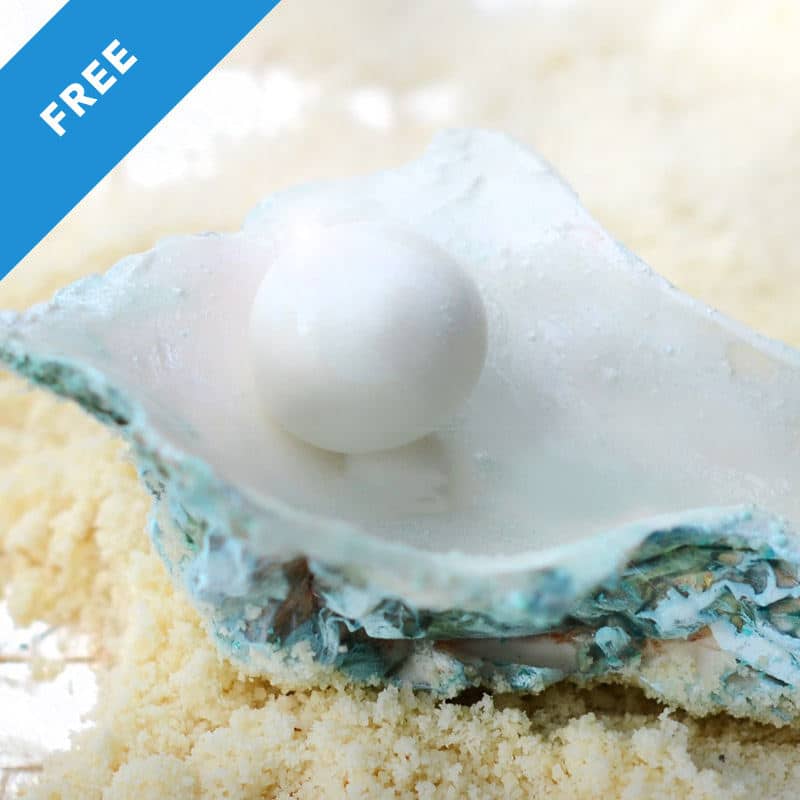
The queen of realistic food cakes, Joyce Marcellus of Toxic Sweets Shop, has graced us with this fabulous Chocolate Oyster Shell Tutorial that requires no special mold! Liz recently used this in the Beachy Wedding Cake Tutorial and it couldn't be easier or more genius!

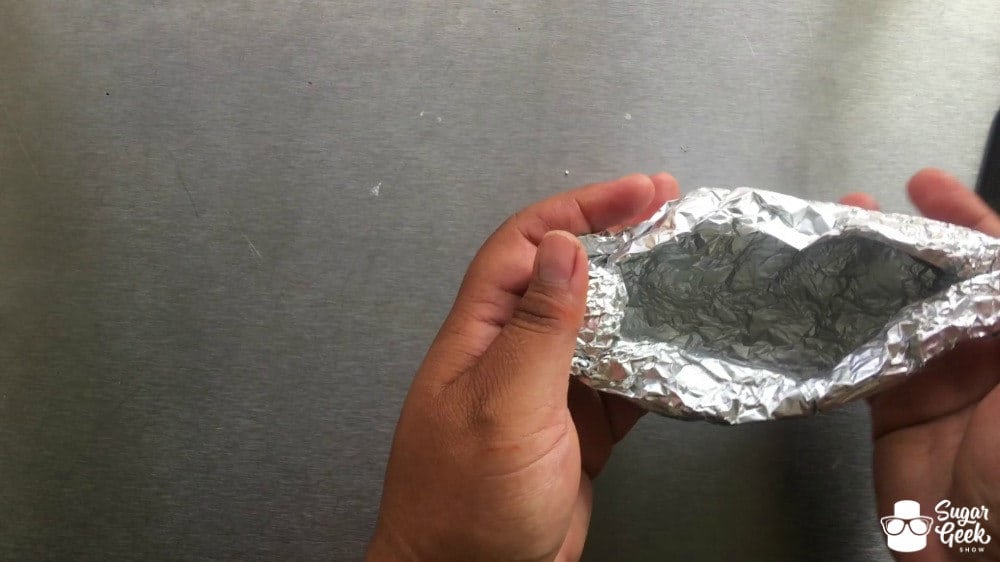
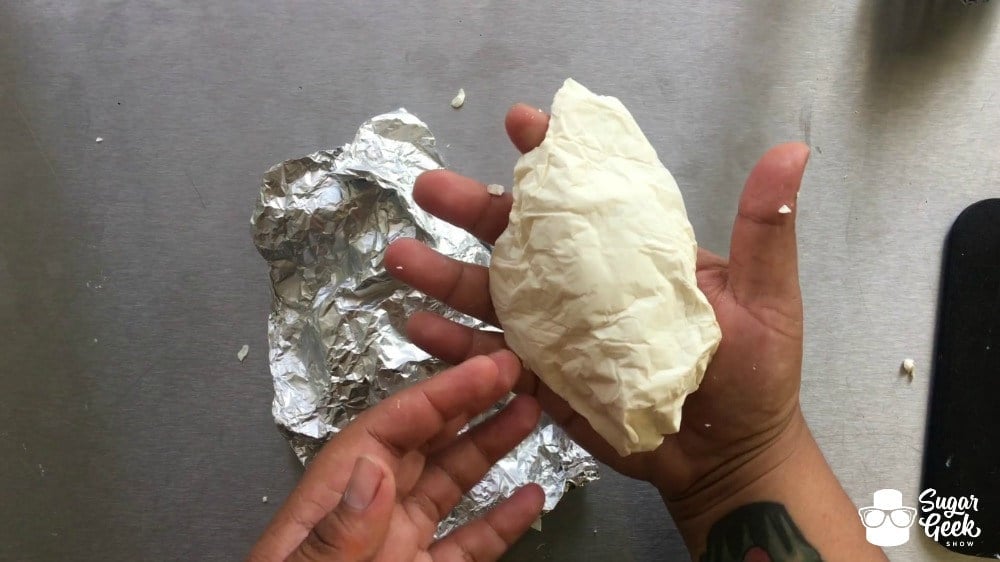
Take a large piece of foil and fold it twice, crumple it up, uncrumple it and spread a thin layer of shortening on it. Then shape the foil into an oyster shell shape.

Chocolate Oyster Shell

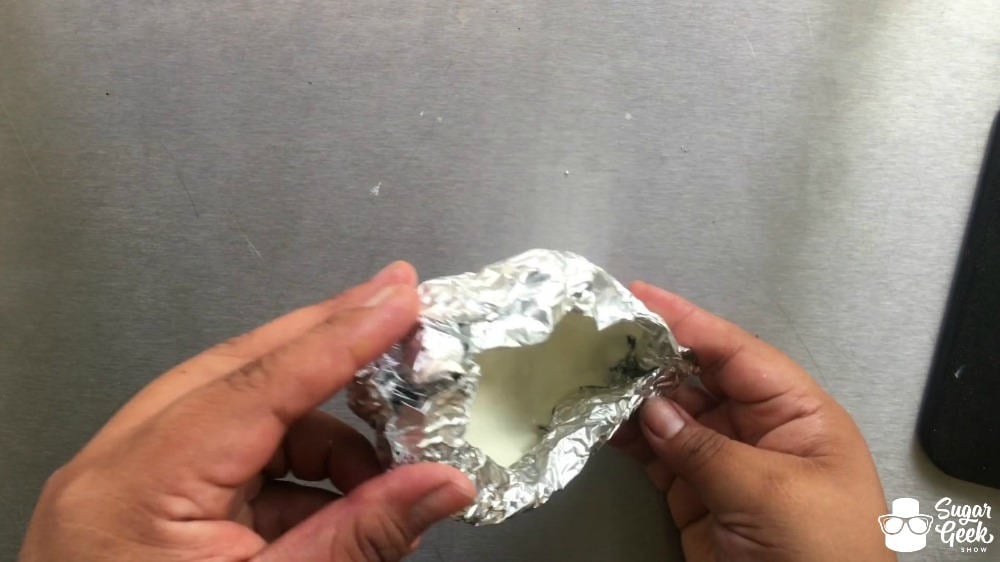
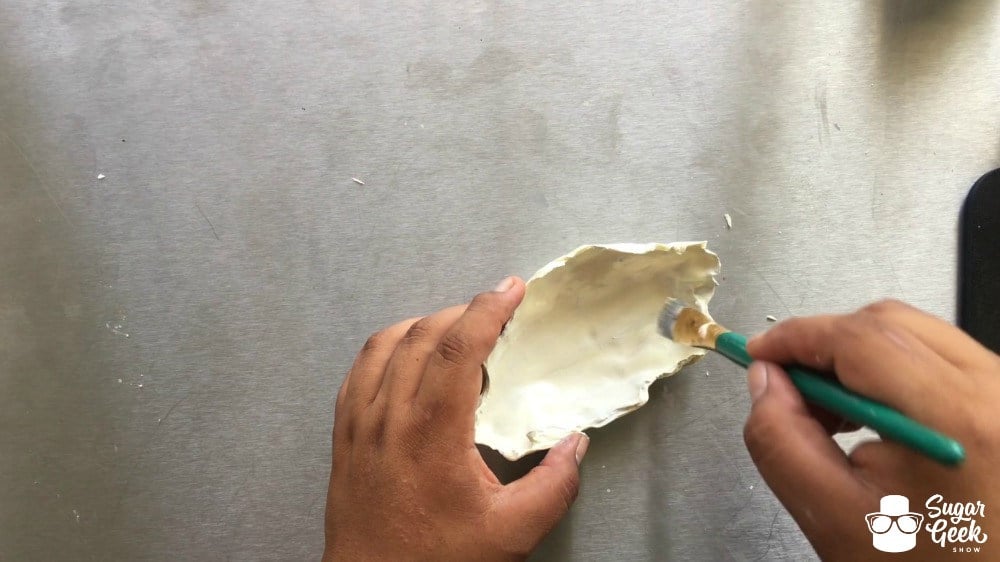
Put a little bit of melted chocolate or candy melts into the foil and coat the foil. You don't want it to be too thick or too thin so try and gauge the amount according to the size of your shell.

Chocolate Oyster Shell

Place it in the freezer until firm. Once firm, you can remove the foil and you're left with a beautifully textured shell! Chocolate Oyster Shell

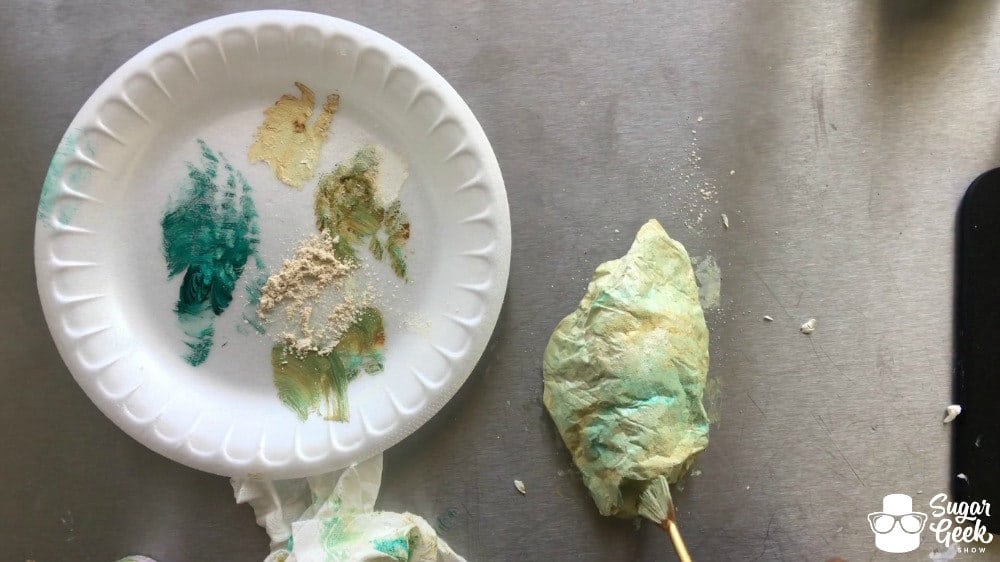
Paint the inside of the shell with some pearl and white color to give it that pretty sheen a real shell has.

Chocolate Oyster Shell

Paint the outside with blue, ivory and more pearl to complete the look!

Chocolate Oyster Shell

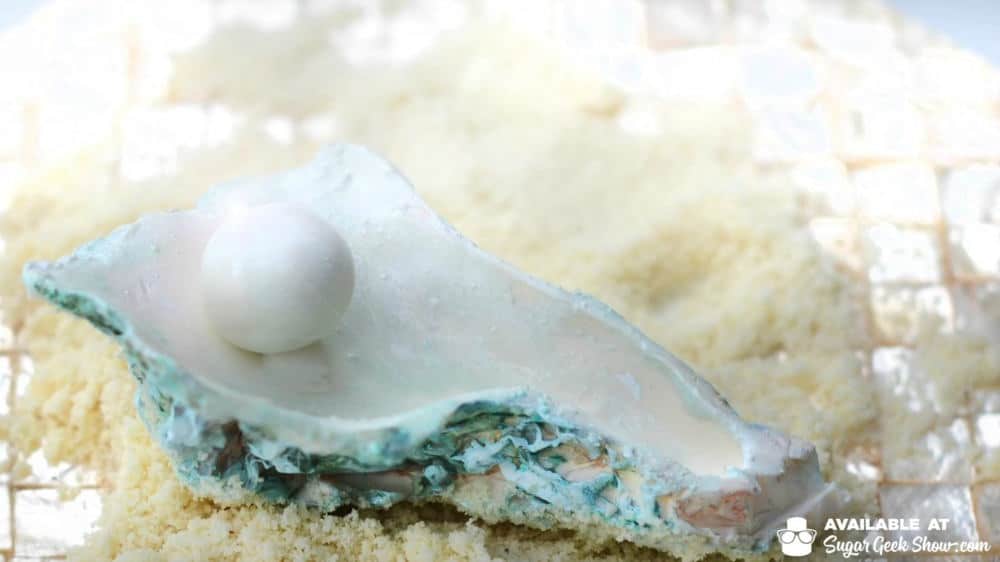
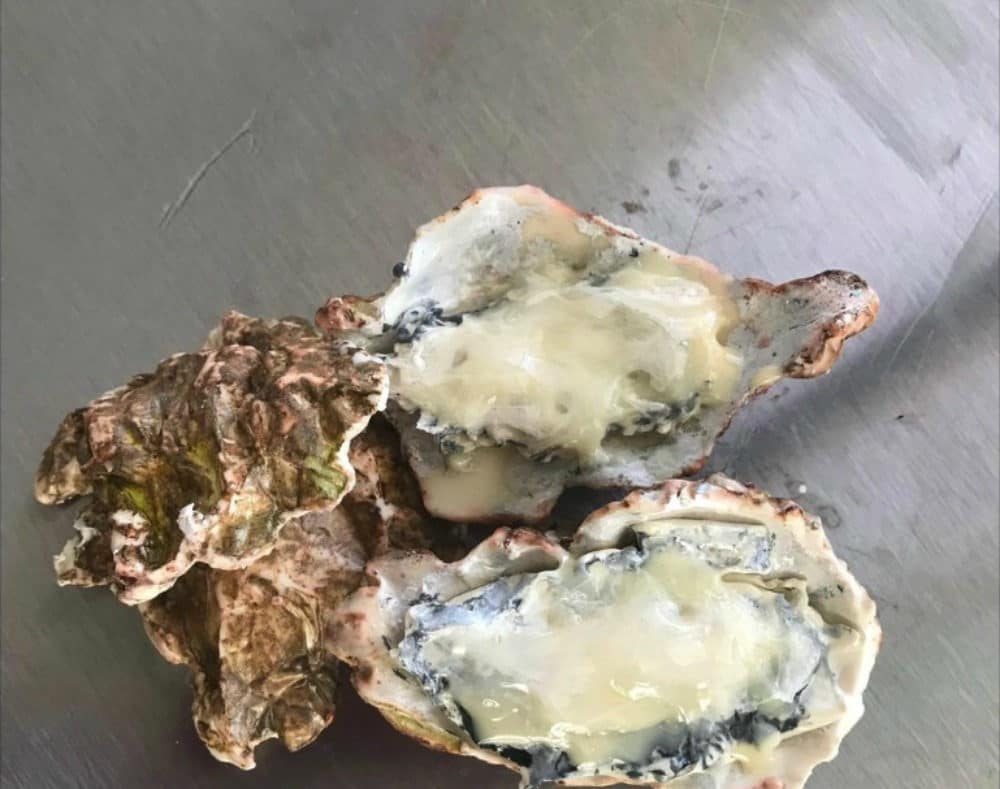
Then you're left with this beautiful realistic oyster shell perfect for all sorts of cakes! Check out the FREE Full Chocolate Oyster Shell Tutorial Video on the website to see the entire process!

Chocolate Oyster Shell

Be sure to check out Joyce's YouTube Channel for her Chocolate Oyster Meat Tutorial to see how she creates the amazing insides you see here!

Chocolate Oyster Shell

We hope you enjoy this tutorial and get a chance to use it in your creations!

Pumpkin Carving Tutorial with Mike Brown

October 24, 2017 Blog

Pumpkin Carving Tutorial

Skill level: Newb

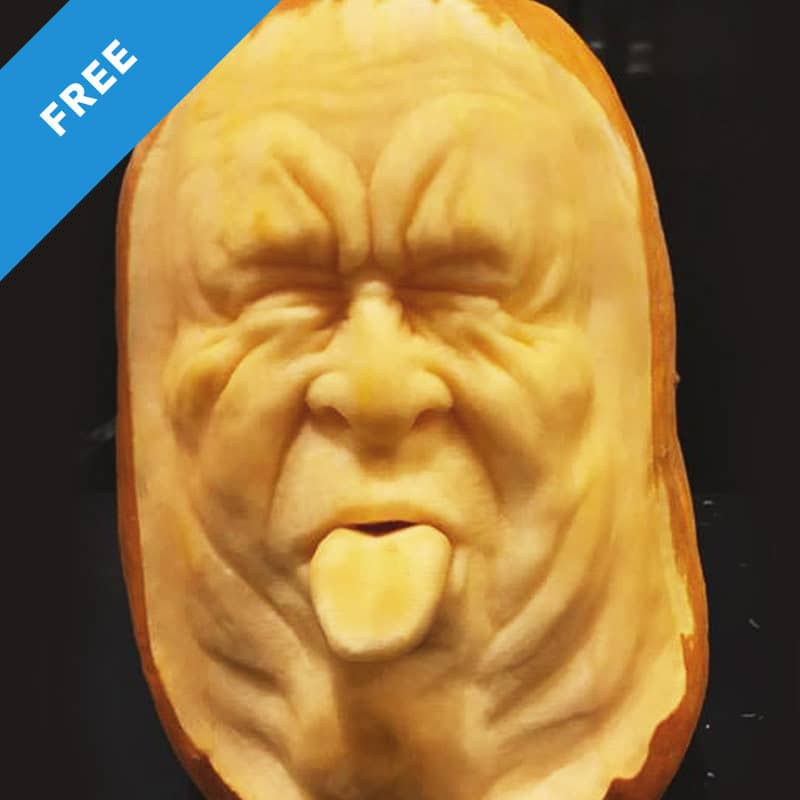
Mike Brown of MB Creative Studio in Springfield, MO shows us 11 tips and tricks to carving his signature style of pumpkin faces!

Tools, techniques and some funny faces in the mirror is all you need! See more of Mike's work on Season 7 of Halloween Wars on Food Network where he competes for a $50,000 prize along with his teammates Liz Marek and Christophe Rull as Team Ghoul'd and on his website www.mbcreativestudios.com

23:19 Minutes of Instruction

What You Will Learn

  • How to carve a pumpkin into a realistic face

Tutorial Chapters

  1. How to pick a perfect pumpkin 1:02
  2. What tools to use 2:10
  3. Starting a face carving 2:56
  4. Defining the face 12:46
  5. Understanding anatomy 15:12

Small Cake Tips

October 24, 2017 Blog

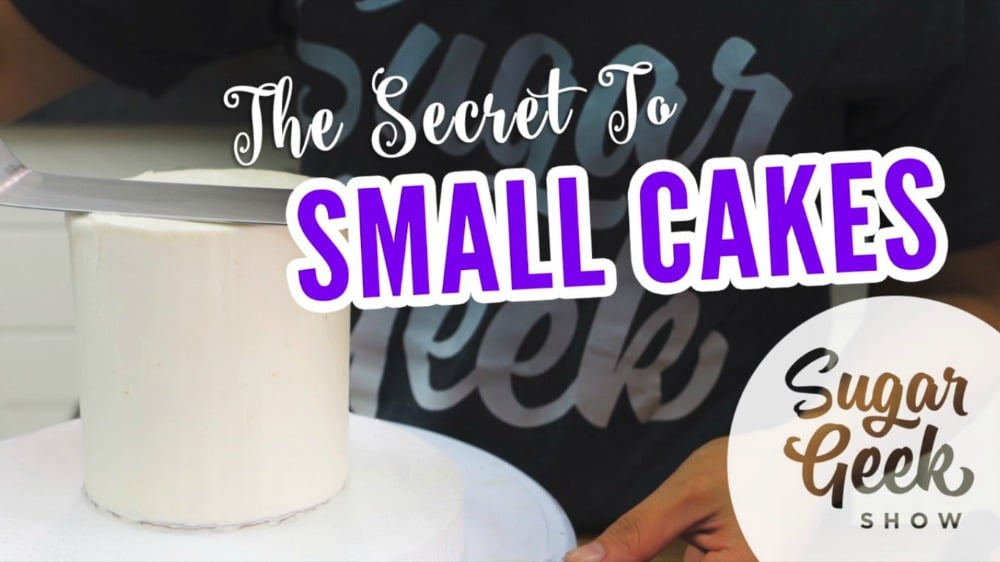
Cake Decorating Basics: The Secret to Small Cakes

Do you find yourself struggling while making little cakes? Do you ever just want to pick it up and throw it across the room? Hey, we've all been there, it's just the nature of small cakes. They don't have enough weight to stand up to being pushed around, it's not their fault. So put down the 4" cake, take a deep breath and read this blog post because we have a pretty amazing tip for you today!

Small Cake Tips

Step 1

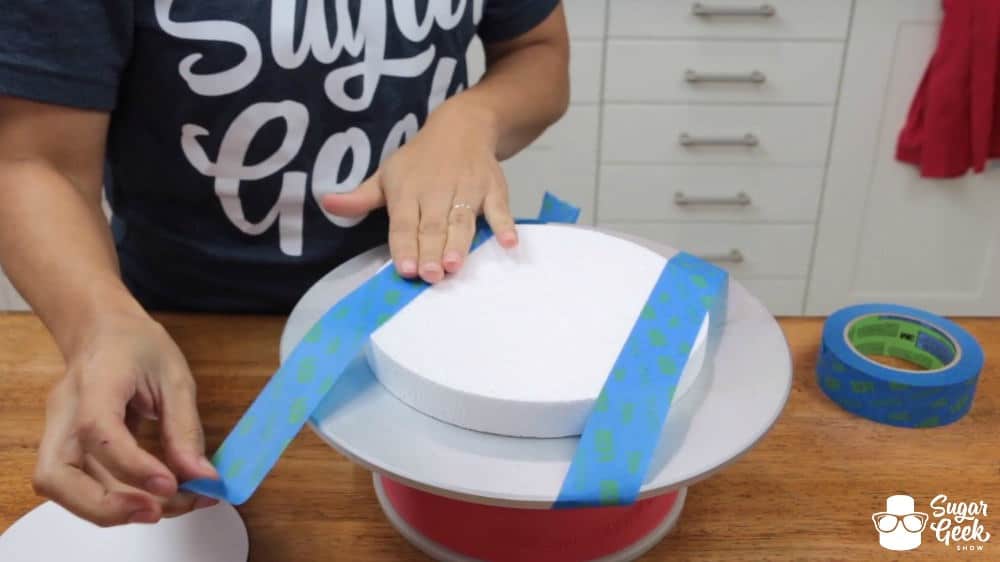
Using some painter's tape, tape down a piece of styrofoam to your turntable, you should be able to find some at your local craft store or you know there's always Amazon.

Small Cake Tips

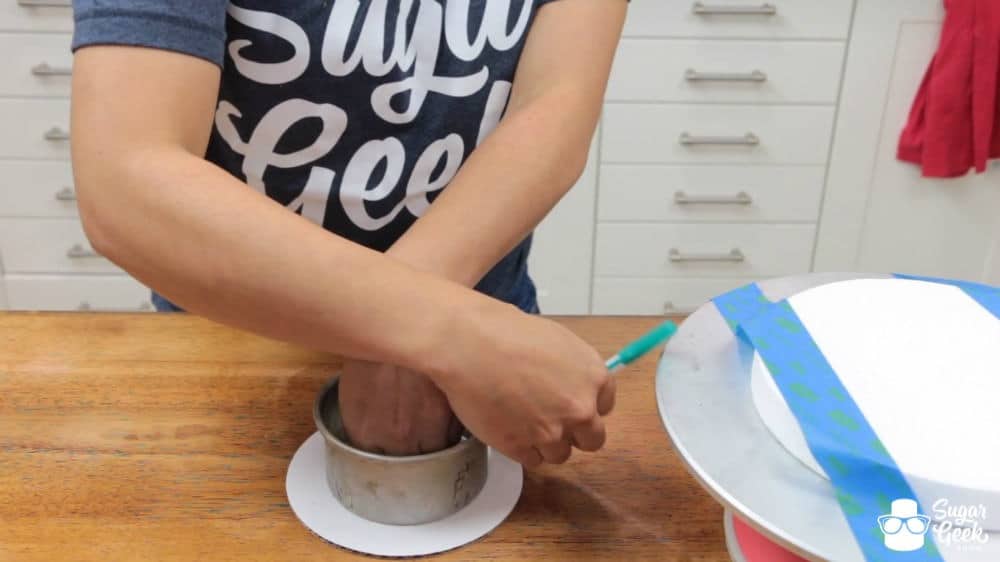
Step 2

Don't have 4" cake boards? Neither do we. Trace your cake pan and cut it out from another board.

Small Cake Tips

Step 3

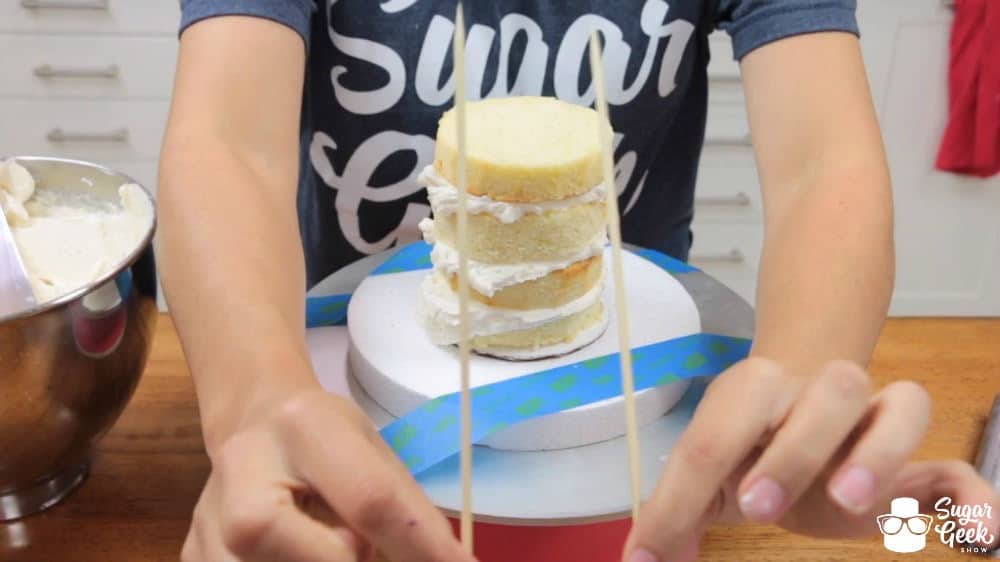
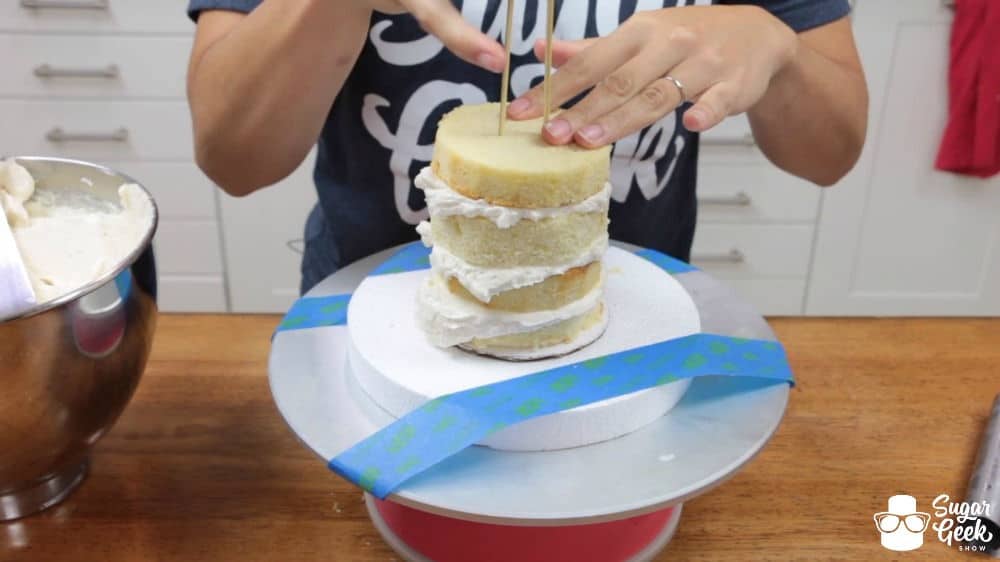
Torte and fill your cake like usual, you will have to hold your cake steady for this part.

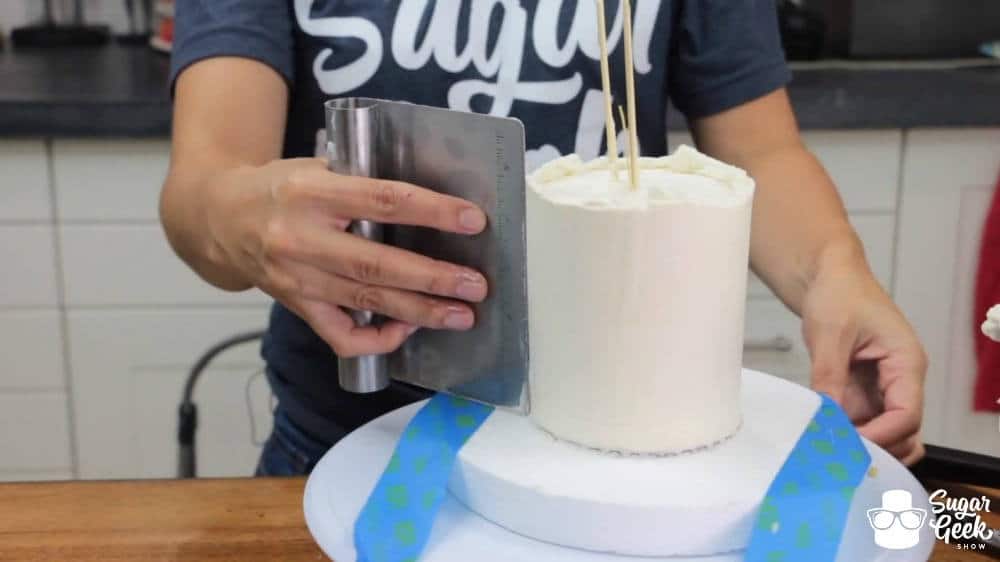
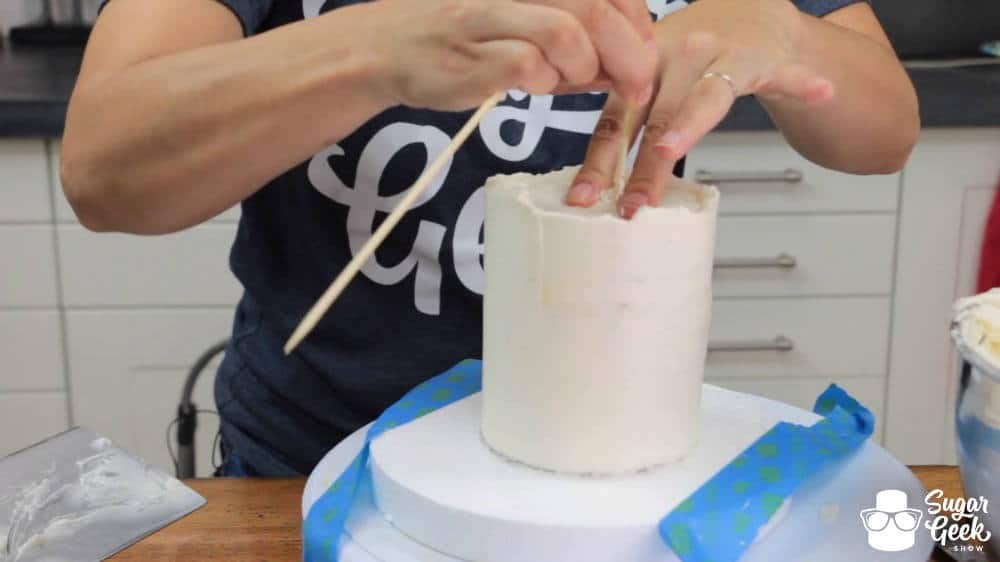
Insert two wooden skewers (like the kind you use for kabobs from the grocery store) through your cake, through the cake board and into the styrofoam. This is going to make that little sucker nice and sturdy and repair your strained relationship.

Small Cake Tips Small Cake Tips

Step 4

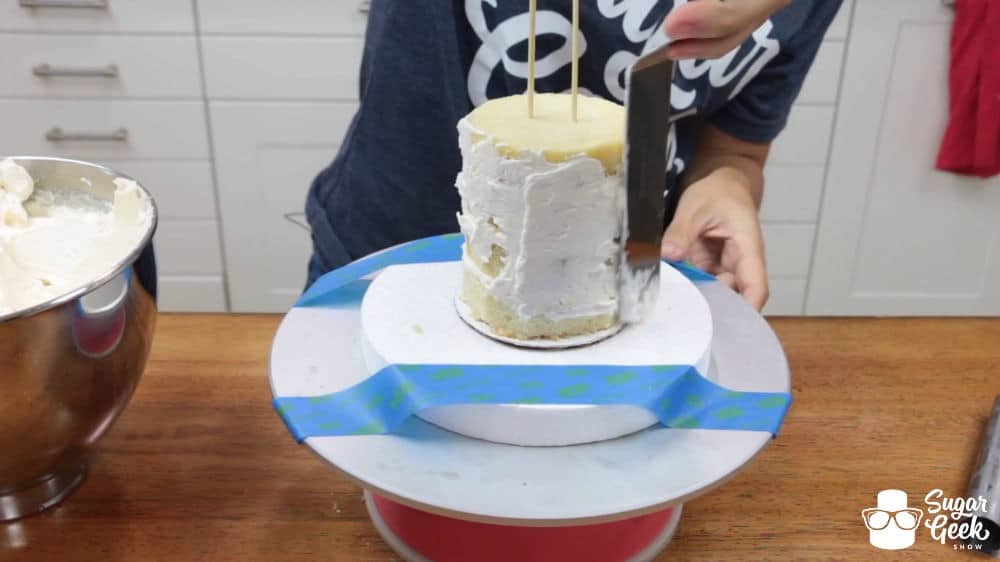
Proceed to crumb coat, chill and final coat your cake. Check out our other Basics Series blog posts if you need more info on the torting, filling and crumb coating steps! All links for the Basics Series can be found at the bottom of the post. That's my tactic to try to get you to finish.

Small Cake Tips Small Cake Tips

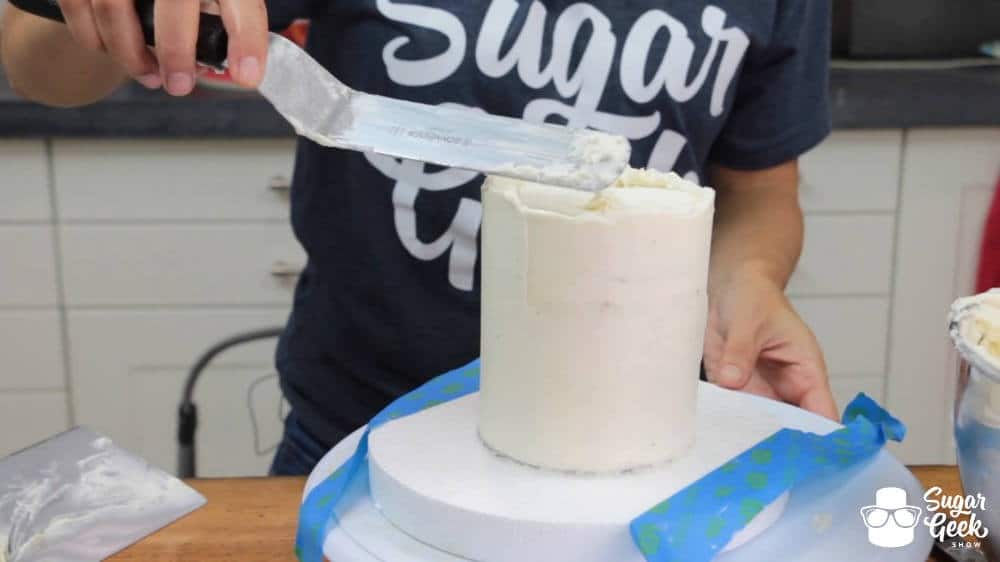
Step 5

Once the side of your cake is complete, remove the skewers from your cake and smooth the edges with your offset spatula. Remember, this should be a chilled, firm cake so removing the skewers will not hurt the cake.

Small Cake Tips

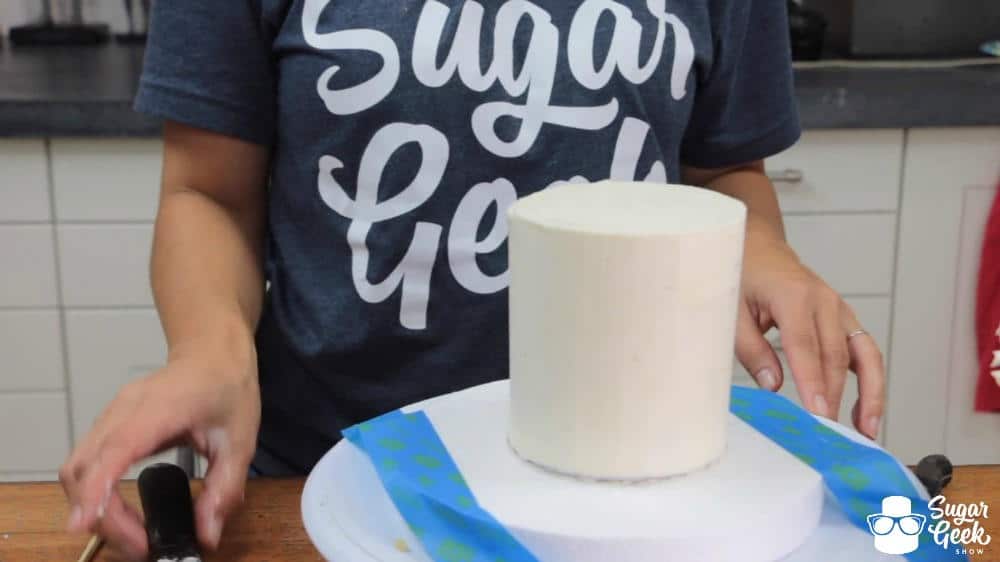
With any luck you will have some buttercream adhering your cake to the styrofoam for this part.

Small Cake Tips

There ya go! You've successfully frosted a 4" round cake without any casualties and your sanity intact.

Small Cake Tips

I would imagine you could also quickly stick a skewer back into the top of your cake after you lay your fondant on and smooth the top to help you keep the cake steady while you also smooth the sides of your fondant. Of course, that will only work if you will be able to cover your hole up with a decoration. We hope this little tidbit helps you with your small cake endeavors because honestly, the struggle is real.

Going over the basics? Check out these!

Cake Decorating Basics: Must Have Tool Review

Cake Decorating Basics: Airless Space Buttercream

Cake Decorating Basics: Leveling and Torting

Cake Decorating Basics: Filling and Crumb Coating

Cake Decorating Basics: Avoiding Cake Blowouts

Cake Decorating Basics: Smooth Final Coat of Buttercream

Cake Decorating Basics: The Upside Down Method

Cake Decorating Basics: Covering a Cake in Fondant

Cake Decorating Basics: How to get  Sharp Edges

Cake Decorating Basics: Easy Double Barrel

Cake Decorating Basics: How to Panel

Cake Decorating Basics: Stacking Cakes

How to do the upside down method

October 20, 2017 Blog

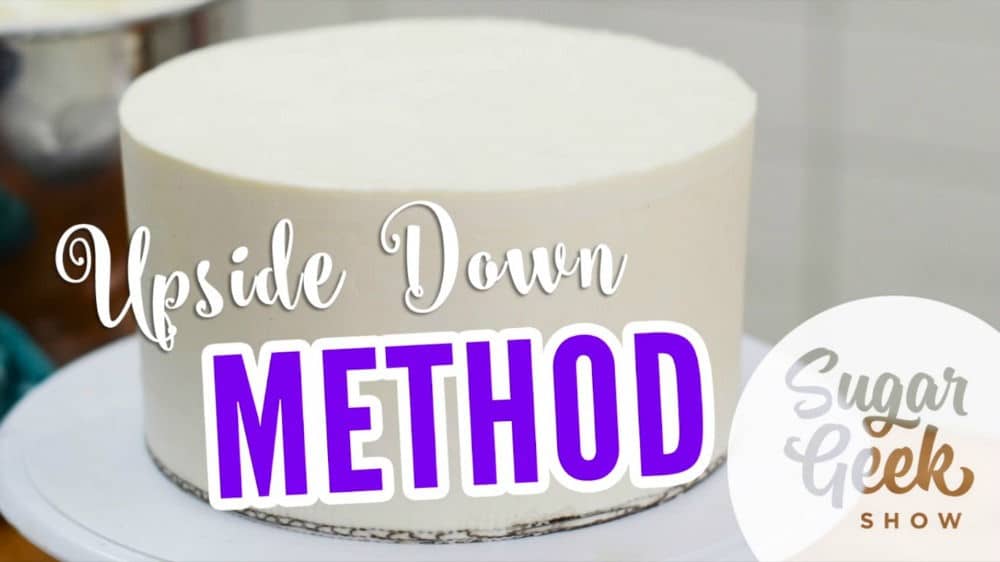
Cake Decorating Basics: The Upside Down Method

How To do the upside down method to get super sharp buttercream edges

If you've been frustrated with the traditional way of icing a cake then you are going to want to give the upside down method a shot. I literally cannot go back. This way yields a PERFECT result so much faster than doing it the regular way. Just as long as you can put aside the fear of flipping your cake upside down, you're golden.

How to do the upside down method

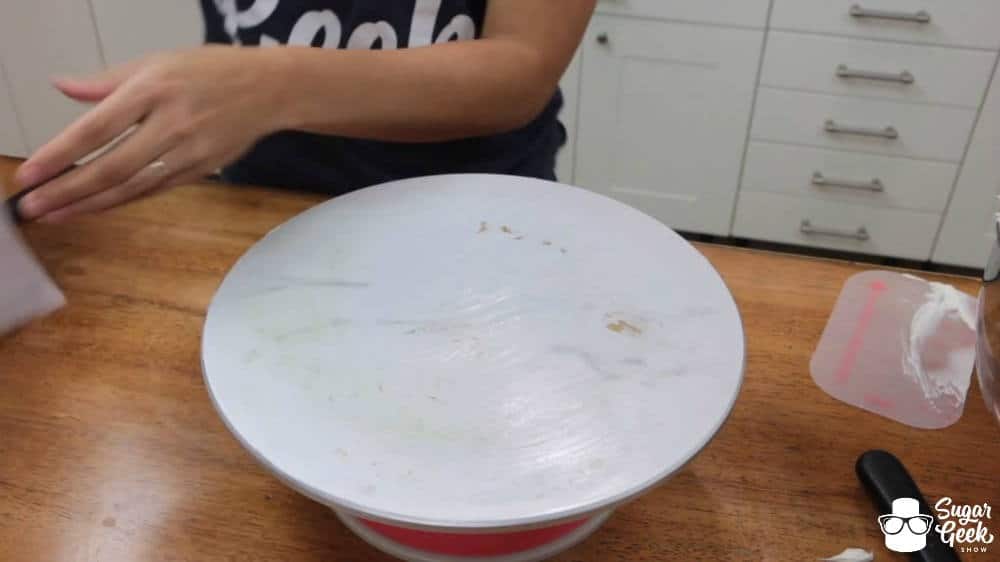
Step 1

Cover a turntable or cake drum with a layer of shortening.

How to do the upside down method

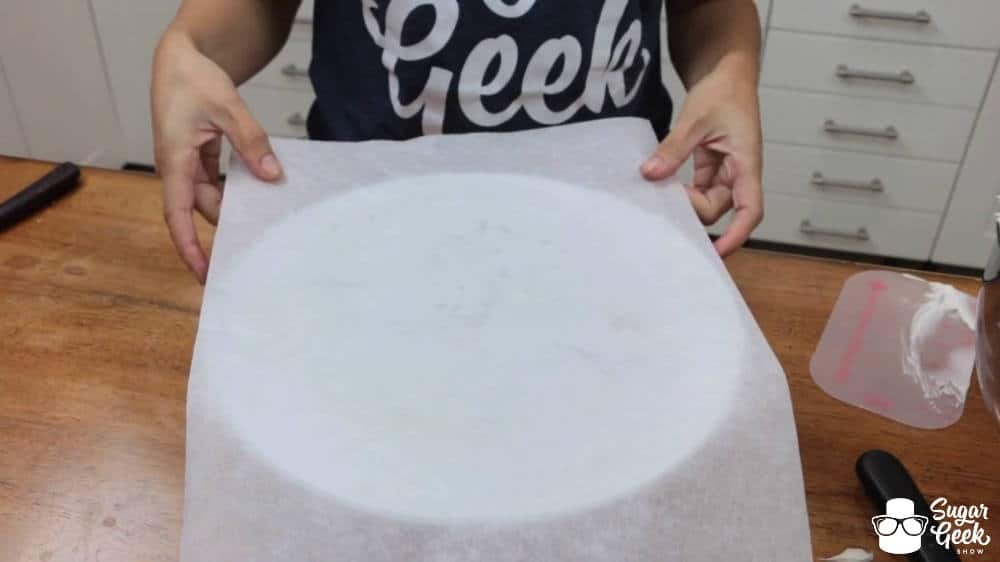
Step 2

Place a piece of parchment paper onto your surface.

How to do the upside down method

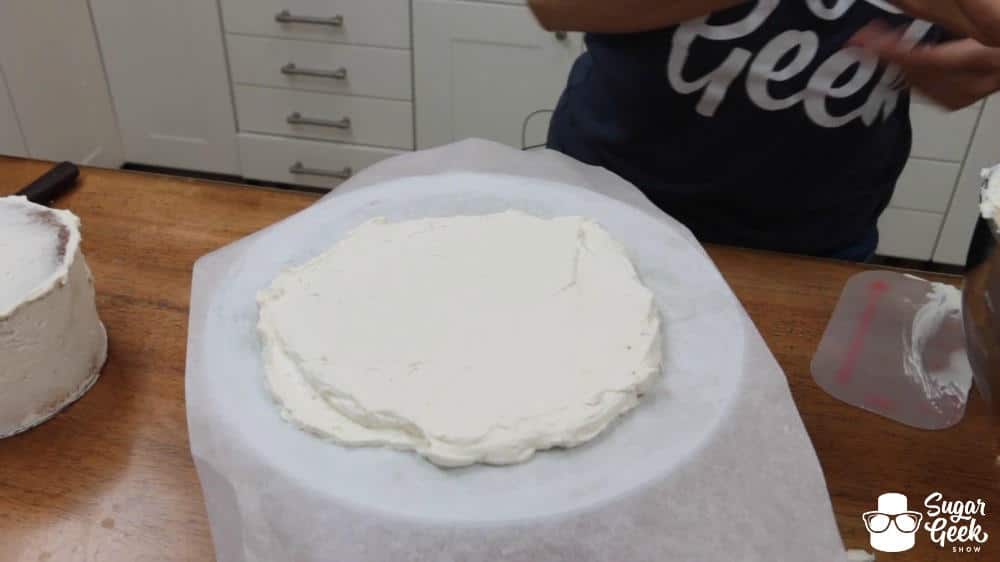
Step 3

Schlop a generous amount of buttercream onto the parchment and smooth it out just as you would a fill layer. You want this to be about a ½" thick to give you some wiggle room for adjusting your cake to be perfectly level.

How to do the upside down method

Step 4

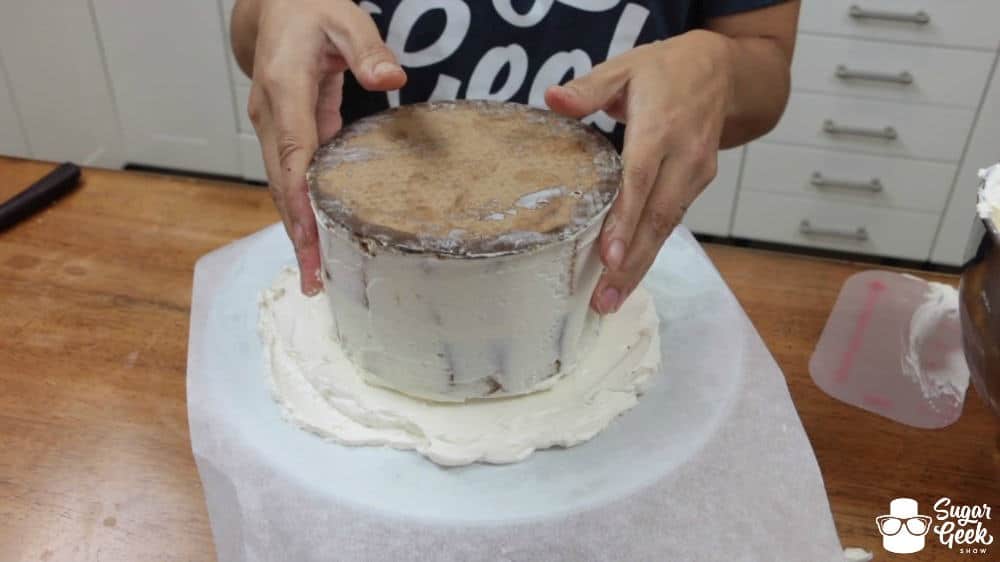
Take your chilled, crumb coated cake out of the fridge and flip it upside down onto your buttercream. CAUTION: Do not attempt this with a room temperature cake! As long as your cake is nice and firm there is absolutely no risk in doing this. You can also just stack the cake directly on the buttercream (see video) to do the upside down method

How to do the upside down method

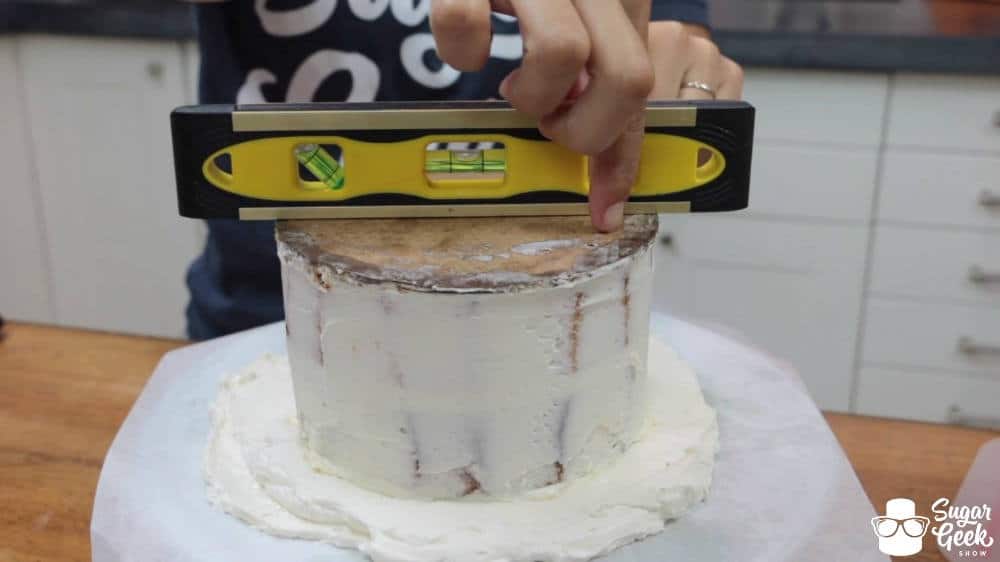
Step 5

Adjust your cake by pushing it down on any side that might need it until it reads level. Be sure to check it one way and then the other to make sure it is level both directions.

How to do the upside down method

Step 6

Scrape any excess buttercream up onto your cake.

How to do the upside down method

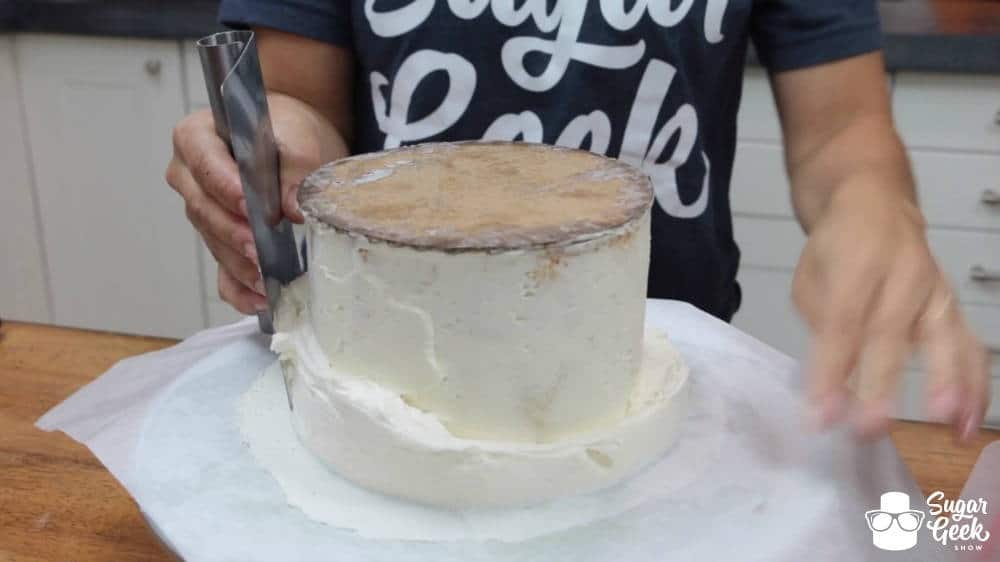
Step 7

Cover the sides in a generous amount of buttercream.

How to do the upside down method

Step 8

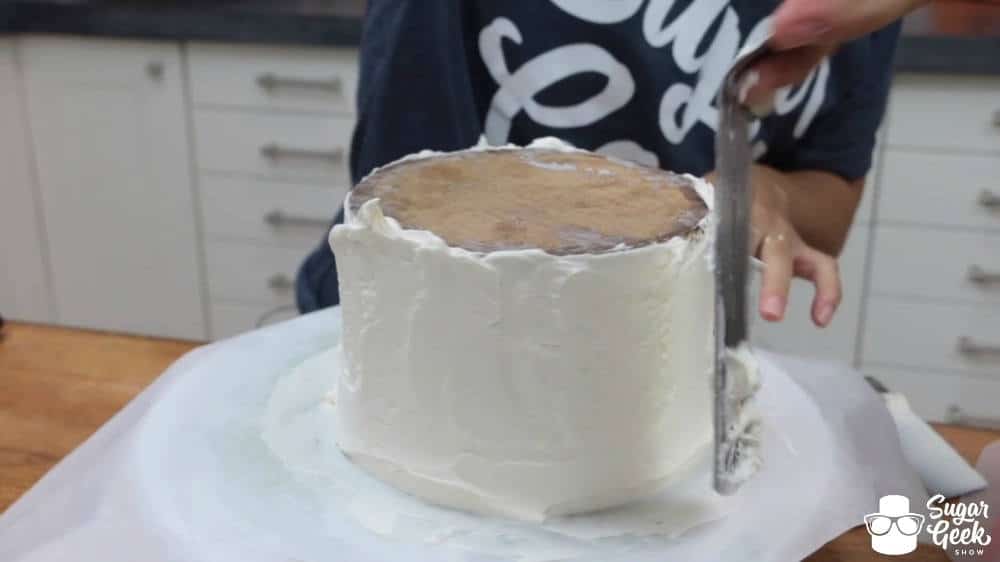
Using a bench scraper, begin scraping the icing away.

How to do the upside down method

Keep the scraper/smoother flat on your surface and straight up and down.

How to do the upside down method

Eventually you will come to your cake board which should mean your sides are perfectly straight.

How to do the upside down method

Once you've got it as smooth as possible place the whole thing in the freezer to chill until firm once again.

How to do the upside down method

Step 9

Fill in any holes you may still have to get a smooth final coat. Chill once more if needed. If you have cake showing through it means you didn't quite trim your cake layers enough. If you're covering in fondant it's not too big of a deal but if you're not covering in fondant you will have to trim your cake down a bit or try to add more buttercream and freehand making the sides even without using the cake board as a guide. Moral of the story is be sure to trim your cakes enough to allow space for a good layer of buttercream.

How to do the upside down method

Step 10

Slide your cake off your turntable and flip it over. Or if you're using a thin turntable or cake drum you can just flip it over. Again make sure your cake is plenty chilled to do this part!

How to do the upside down method

Step 11

Peel off your parchment.

How to do the upside down method

Step 12

Smooth and fill in any gaps that may be on the top.

How to do the upside down method

You should have a pretty dang perfectly level and straight cake with sharp edges.

How to do the upside down method

I love love love LOVE the upside down method. It basically provides tools for getting a level top, straight sides and a sharp edge automatically if you just follow the steps whereas the traditional way is a lot of free handing and guess work and if you're like me it still doesn't come out that perfect. The upside down method has become a commonly used technique nowadays. The original creator posted the tutorial on cake central years and years ago and it has since been taught and used by many. Liz learned it from Jessica Harris and I learned it from Liz. So hey, fear not the flipping of your cake. Once you jump that hurdle you'll be so glad you did.


Going over the basics? Check out these!

Cake Decorating Basics: Must Have Tool Review

Cake Decorating Basics: Airless Space Buttercream

Cake Decorating Basics: Leveling and Torting

Cake Decorating Basics: Filling and Crumb Coating

Cake Decorating Basics: Avoiding Cake Blowouts

Cake Decorating Basics: Smooth Final Coat of Buttercream

Cake Decorating Basics: The Secret to Small Cakes

Cake Decorating Basics: Covering a Cake in Fondant

Cake Decorating Basics: How to get  Sharp Edges

Cake Decorating Basics: Easy Double Barrel

Cake Decorating Basics: How to Panel

Cake Decorating Basics: Stacking Cakes


Beachy Wedding Cake Tutorial

October 15, 2017 Paid Video

Beachy Wedding Cake

Skill level: Intermediate

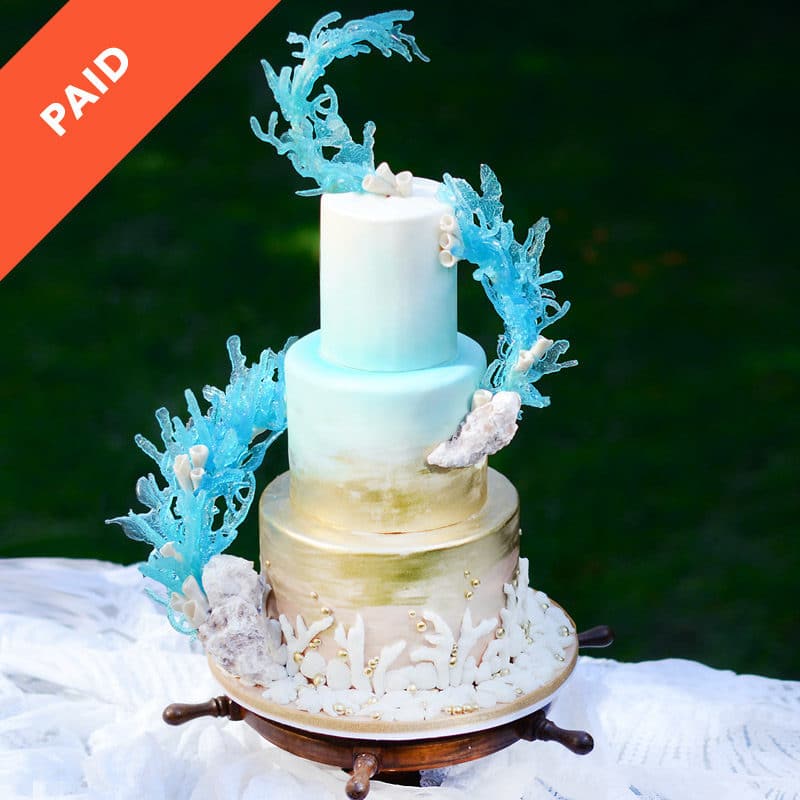
I made the beachy wedding cake almost three years ago thinking it would be fun to just experiment with some gravity-defying waves. Since then, I have had dozens of requests asking/begging me to teach the wave structure! Everyone knows I hate making the same cake twice but for you I made an exception ? learn how to make the unique gravity waves with real cake and bonus bas relief texture!

1:00:18 Minutes of Instruction

What You Will Learn

  • How to make realistic oysters
  • Learn how to create a gravity-defying wave that moves through a cake tier
  • How to create a beachy bas relief

Tutorial Chapters

  1. Making the oyster Shells 0:11
  2. Painting shells 4:32
  3. Creating the coral water splashes 8:58
  4. Alternate water splash method 11:12
  5. Prepping the cake board 14:36
  6. Making the bas relief shell texture 17:48
  7. Attaching wire structure 29:04
  8. Painting tiers 30:34
  9. Attaching wire 35:22
  10. Food safety 36:14
  11. Covering the wire 41:22
  12. Making pulled barnacles 44:13
  13. Attaching coral and shells 47:20

Downloads

Materials List

Related Videos


No-Mold Oyster Shell Tutorial

Beachy Wedding Cake Tutorial

October 15, 2017 Course Preview

Beachy Wedding Cake

Skill level: Intermediate

I made the beachy wedding cake almost three years ago thinking it would be fun to just experiment with some gravity-defying waves. Since then, I have had dozens of requests asking/begging me to teach the wave structure! Everyone knows I hate making the same cake twice but for you I made an exception.

Learn how to make the unique gravity waves with real cake and bonus bas relief texture!

1:00:18 Minutes of Instruction

What You Will Learn

  • How to make realistic oysters
  • Learn how to create a gravity-defying wave that moves through a cake tier
  • How to create a beachy bas relief

Tutorial Chapters

  1. Making the oyster Shells 0:11
  2. Painting shells 4:32
  3. Creating the coral water splashes 8:58
  4. Alternate water splash method 11:12
  5. Prepping the cake board 14:36
  6. Making the bas relief shell texture 17:48
  7. Attaching wire structure 29:04
  8. Painting tiers 30:34
  9. Attaching wire 35:22
  10. Food safety 36:14
  11. Covering the wire 41:22
  12. Making pulled barnacles 44:13
  13. Attaching coral and shells 47:20

Downloads

Materials List

no-mold oyster tutorial

October 15, 2017 Blog

No-Molds Oyster Shell Tutorial

Skill level: Newb

Learn how to make realistic oyster shells without any molds! The realistic sugar foods Queen, Joyce Marcellus shows us how!

To see Joyce's chocolate oyster flesh tutorial, go to her YouTube channel.

10:38 Minutes of Instruction

What You Will Learn

  • How to make realistic oyster shells without molds

Downloads

Materials List

Related Videos


Beachy Wedding Cake

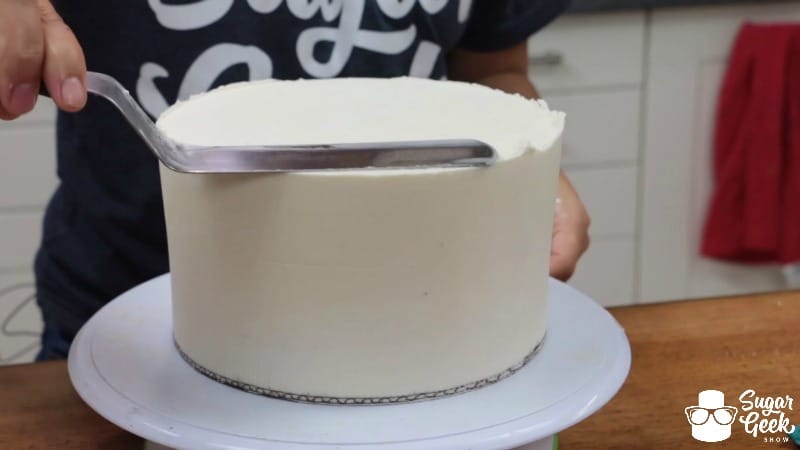
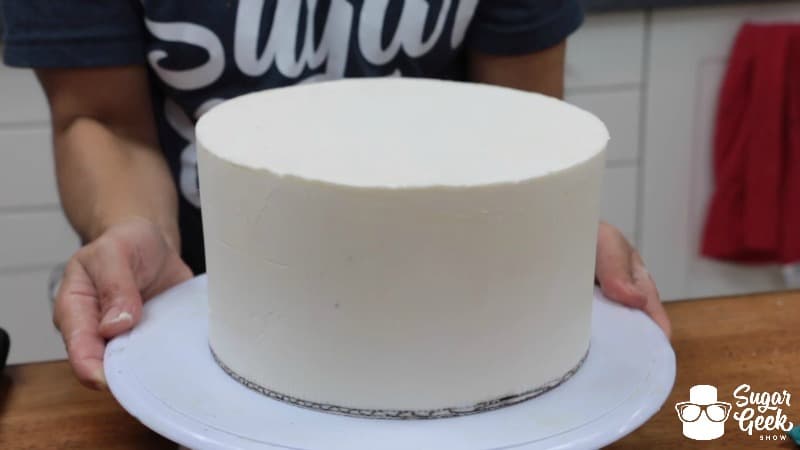
frosted buttercream cake with straight lines and sharp edges

October 11, 2017 Blog

Cake Decorating Basics: Smooth Final Coat of Buttercream

How to get sharp edges on your buttercream

So what comes after all the baking, torting, trimming, filling and crumb coating? The final glorious coat of buttercream! Today we will take you through the steps of how to do a basic smooth final coat of buttercream whether you plan to fondant your cake or not. If you've missed all the previous steps leading to this one, be sure to visit all the other Cake Decorating Basics blog posts to get caught up on how to get to this point!

sharp buttercream edges

What You Need

  • Crumb-coated and chilled cake
  • Turntable
  • Buttercream
  • Offset spatula
  • Bench scraper
  • Parchment paper

Step 1

Have your crumb coated cake chilled firm and ready to go.

How to do a final coat of buttercream

Step 2

Add a generous amount of buttercream to the top of your cake. Here Liz is using her Easy Buttercream Recipe.

How to do a final coat of buttercream

Step 3

Begin using your offset spatula to smooth out the buttercream on top. Try to keep your spatula level and keep working it until your top is also level and as smooth as possible.

How to do a final coat of buttercream

Step 4

Begin adding another generous amount of buttercream to the sides of your cake. Don't worry, we will be taking most of this away soon in the smoothing process.

How to do a final coat of buttercream

Step 5

Use a bench scraper or Innovative Sugarworks firm scraper like Liz is here to start smoothing out the sides of your buttercream. Hold your scraper so that it is slightly angled in toward you and not at a straight 90 degree angle from the cake.

How to do a final coat of buttercream

Step 6

Scrape your buttercream smooth while turning your turntable making sure to keep your scraper level and straight. Scrape excess buttercream into bowl as you go.

How to do a final coat of buttercream

Here you can see the correct angle the scraper should be at from your point of view. Continue scraping until you reach your cake board underneath and the sides look pretty good! If you have a few holes here and there at this point it's okay because we will fix them later.

How to do a final coat of buttercream

Your sides should look something like this.

How to do a final coat of buttercream

Step 7

Take your clean offset spatula and smooth your top edges in. Continue scraping the excess buttercream off your spatula to get a better result.

How to do a final coat of buttercream

Here's what you should have at this point. Now we will chill this in the freezer until firm once again.

How to do a final coat of buttercream

Step 8

Once your cake is nice and firm, add one final thin coat of buttercream to your top and sides to fill in any gaps or holes you might still have.

How to do a final coat of buttercream

Continue scraping and adding until it is as smooth as possible!

MYTH: It doesn't matter what your buttercream looks like if you're putting fondant on your cake.

TRUTH: The smoother your buttercream is, the smoother and better your fondant will look. Take the time to create a nice base for your fondant because it will show large imperfections.

How to do a final coat of buttercream

Using your clean offset spatula once again, smooth in the top edges of buttercream. This final coat process can take quite some time especially if you are new to it. Be patient and practice good techniques and the speed will come later!

How to do a final coat of buttercream

After all that you should have something like this! A cake ready to be covered in fondant. If you aren't covering your cake in fondant, you'll want to take even more time to make sure it is flawless.

How to do a final coat of buttercream

Now was that nearly as scary as you thought it'd be? You can do it! Patience really is the key. If you ever have any questions the Sugar Geek Team is always here to help! Next week we will cover an alternative technique for the final coat of buttercream called The Upside Down Method. This method can save mega time and frustration and yield a better result but it's not for everyone so if you want to stick to the basic method we've shown today, there's nothing wrong with that! No judgement here folks.

Going over the basics? Check out these!

Cake Decorating Basics: Must Have Tool Review

Cake Decorating Basics: Airless Space Buttercream

Cake Decorating Basics: Leveling and Torting

Cake Decorating Basics: Filling and Crumb Coating

Cake Decorating Basics: Avoiding Cake Blowouts

Cake Decorating Basics: The Upside Down Method

Cake Decorating Basics: The Secret to Small Cakes

Cake Decorating Basics: Covering a Cake in Fondant

Cake Decorating Basics: How to get  Sharp Edges

Cake Decorating Basics: Easy Double Barrel

Cake Decorating Basics: How to Panel

Cake Decorating Basics: Stacking Cakes

how to schedule your cake work week

October 10, 2017 Blog

How To Schedule Your Week For Success

You might think that because I'm a self-employed cake decorator, I must have a super flexible schedule.

Well, you're right and you're wrong.

The truth is, I am ruled by one thing (ok maybe two things) My calendar and my daughter.

Everything I do is scheduled. That might sound like a lot of work but really, it takes all the work out of it.

If I need to pay a bill, I put it on the calendar. Birthday party? On the calendar. Project due? Not only do I put that on the calendar but I also schedule out what I'm going to work on every day leading up to the due date so I don't procrastinate and get stressed at the last minute.

Setting Priorities (Big and Little)

So how do I make sense of this crazy calendar full of THINGS TO DO?

I set big priorities and little ones.

When I wake up, I drink my coffee, check my calendar and see what one thing I need to do today. Just one. Then I map out the little things that will help me to get that big thing done. Then I mentally prepare for going shopping, baking, or doing whatever I need to do to get that one task done.

I will also look ahead to see what upcoming due dates are happening like cake shows, classes or tutorial releases to make sure I'm not forgetting something important.

I think the main thing I do that makes me feel the most success is that I plan to get one thing done per day.

I will also think of things that I can get done at the same time that are flexible. Doing dishes, laundry, grocery shopping, trying a new recipe, going to the park with Avalon. Things that need to be done but if they don't get done, no big deal. That's right. If you don't get every little thing on your list done, It's no big deal!

Cutting yourself a break is a BIG deal.

Yes I look at that laundry pile and sink full of dishes and feel like the worst wife/mother too.

But you know what? It's tough being an entrepreneur and sacrifices must be made. Sometimes that sacrifice is getting the household chores done. This goes DOUBLE for if you have a full time job and caking happens at night!

priorities quote

Focus on 1 Goal Every Day

I think the MAIN thing I do that makes me feel the most success is that I plan to get ONE thing done per day. Sure, I might get a ton of other little things done but they are flexible. If I don't get them done, oh well but if I do, hooray! I set my expectations LOW so I feel better when I achieve more than I planned. That one thing I have to get done? Usually something work related. I MUST get my video edited today. I MUST get this tutorial finished filming etc. Everything else is just bonus.

Stop comparing your productivity to others.

I mean it.

Stop it.

I know we all are guilty of it at times. We see someone seemingly getting goal after goal accomplished and we immediately feel bad about our own success story.

But you know what?

Success is not what it seems.

Building Up Your Schedule Train

Every TV appearance, published cake, award or major accomplishment came from someone who has been accomplishing small goals every day. It's like you're the conductor of a train on the railroad to success. You're going to be moving down that track no matter if you work or don't work. Time stops for no man as they say.

30 days to develop a daily habit, 90 days to make it a lifestyle.

So every day, you load your train with a little bit of cargo. Maybe you want to write one blog post a week. So you schedule it as a big goal on the calendar.

Day 1: You wake up, check your calendar and see in three days you need to make a blog post. So your mini goal for the day is to spend some time researching some recipes you want to try on Pinterest. Goal done!

Day 2: You go grocery shopping to get the supplies you need. Goal done! I really recommend you never try to bake the same day as you shop. Shopping drains me and sucks the day away.

Day 3: You make your dessert and take photos and get ready to post. Now while all that was going on, you might have also done the household shopping, picked your kids up from school and dropped off the check for the water bill.

That's how success happens. Little things, mixed in with regular life every day. But you have to show up, every day.

Multi-tasking like a BOSS!

Suddenly your train went from one car to two. Then you make another goal and star working towards that. Maybe you want to start making little videos for your Instagram so the next time you try a recipe, you decide to do a 1 minute time-lapse of piping the buttercream. You gain 50 new followers! Boom!

While working on goal #2, you get contacted by a magazine who sees your yummy recipe and wants you to make a version for their blog! COOL!

Did you catch that?

That's how success happens. Little things, mixed in with regular life every day. But you have to show up, every day.

You can't just work on the days that you "have time" or feel like it.

30 days to develop a daily habit, 90 days to make it a lifestyle.

Let's See it in Action

Below is an example of how I use my Google Calendar to map out my weeks, months and even years.

Step 1. Start with BIG goals like events and due dates.

Step 2. Add in little goals (one per day) leading up to due dates to help spread the work load evenly

Step 3. Don't forget personal appointments and scheduling in FUN! If you don't schedule days off, you won't ever have one.

Actually look at your calendar every day and add in to-do's as you think of them. Sync your calendar to your phone so you can check your schedule at any time.

cake calendar example

If you can stick with this mindset for 90 days you will soon have a stream of "success" stories that other cakers will look at and wonder "HOW does she do it?"

Now that I am self-employed, self-management is key but I also have life that happens to me. Doctors appointments, emergencies or just days where I need to get out of the house and have some family time.

A Day in the Life of Sugar Geek Show

This is an example of how my day usually goes.

I also have a sample of my work week calendar from when I was making cakes full time for clients and how I broke sown my weeks to find a work/life balance between cakes and family.

7:00 - Wake up super energized (thank you keto) still lay in bed (because I like my bed) until 7:30 thinking about the days projects until I can't stand it anymore. Get up, shower, put on work clothes aka yoga pants and sugar geek shirt.

8:00 - Drink coffee, check my calendar to see if I have anything due that day or what the next most important project is that I need to work on getting done (like tutorials, blog posts, class proposals). Write down any new tasks that I think of that I need to get done to get closer to my big goals that week.

9:00-11:00 - I leave this time flexible. Avalon is a late sleeper and is usually up by 9. I get her breakfast and she watches cartoons. I will do dishes or tidy up things and bounce back and forth between what she needs and just doing house stuff. Today I spackled a bunch of holes in the walls because I want to paint my living room. Mind you these walls have needed to be painted since before she was born. Entrepreneur mom problems.

11:00-12:00 - Feed Avalon lunch, usually eggs and sausage (thankfully Dan does this 99% of the time) I'll continue to work on the computer sporadically, check facebook, edit photos and schedule my social media posts for the day.

12:00 - Get Avalon ready for school and drive her there.

12:30 - Get home and it's focus time! Every week day from 1pm to 3pm I turn off my phone notifications, get away from my computer and go into my studio to work on whatever work I need to get done or I work on editing my videos. This is my prime work hours. If the door is closed no one is allowed to bother me. Having time where no one can bother you and you can focus and get into flow is super important to getting work done. You'd be amazed at how much you can achieve in 3 hours if that's all you have and you really focus on getting your task done.

3:00 - Eat a small lunch, usually on the patio outside to get a mental break. Nature is proven to reinvigorate the senses and to help you feel creative.

3:15-5:00 - More focused work, try and wrap things up as much as I can before I need to stop for the day.

5:00 - Dan picks up Avalon, I start dinner.

It may appear that I am working or "on" all the time but really, I stick to the schedule I have set for myself.

6:00 - Eat dinner and hang out/family time.

7:30 - Avalon takes her bath and bedtime routine begins. I usually will do a little more computer work while Avalon is in the bath if I'm extra energetic feeling (like today lol)

9:00 - Down time. Sometimes Dan and I watch a movie together, sometimes we work on art projects or read books. This is more of our personal relaxation time or time to be together. We try to stay off our phones most of the time and just chat and reconnect.

11:30 - Almost always pass out. Very rarely can I stay up passed 11:30 without feeling really tired. I try to go to sleep at the same time every day so my body clock stays on track and I get good sleep. Also avoid eating any food at least 4 hours before you go to bed. Many people experience insomnia or sleeping problems due to eating too late at night.

On weekends we try to do fun things with Avalon, go grocery shopping, work on house projects, go with the flow 🙂

It may appear that I am working or "on" all the time but really, I stick to the schedule I have set for myself. It makes my life easier in the end instead of constantly feeling like I'm behind or not doing enough. Will this exact schedule work for you?

Most likely not.

I have a special situation in where my husband and I both work from home and my kid is in school for 5 hours a day. That helps a lot!

You just need to find what works for you and stick to it.

The first step is just getting into the habit of scheduling your days in your calendar and setting big goals and little goals. Check your calendar first thing in the morning instead of facebook.

I hope this helps! As promised, here is my cheat sheet on how I schedule out my work week for baking cakes. Want one of your own? Download a blank version below!

A little note about Fridays: notice it says decorate! That means I decorate until I'm done. Sometimes that means a very late night depending on how many cakes I have due but as a rule I never EVER finish a cake the day of delivery. Cakes need time to chill and settle before delivery or you can have a cake catastrophe.
PLUS, what if something goes wrong?

No one wants to be panicking 15 minutes before the delivery. Always finish your cakes the day before they are due.


Download Weekly Planner

How to Avoid Blowouts

October 6, 2017 Blog

Cake Decorating Basics: Avoiding Cake Blowouts

You've just finished the basic prep of your cake, the mixing, baking, leveling, torting, filling, crumb coating, final coating and fondanting, yes I am making that a word now, and you think everything is hunky dory and just as you go to add your final decorations you see it... a BLOWOUT, dun dun dunnnn. Or maybe the cake was totally finished and you're getting ready to load it up and you see it... a BLOWOUT, dun dun dunnnn. It is one of the worst feelings any cake decorator can encounter and we want to help you avoid ever having to see that and feel that way if we can. Today, we've got some tips for avoiding this situation because once it happens, well, there isn't much you can do about it so it's best to just never get there.

How to avoid a cake blowout

Tip #1 - Use Scratch Cake

Our first tip is to simply use a scratch cake recipe when you can. Scratch cake is always more dense and sturdier than box cake mix and has a lot less air trapped inside of it naturally. Because of these things it can better hold up to the weight of more cake, buttercream and fondant making it less likely to compress and push out air causing... a BLOWOUT, dun dun dunnnn. Okay, I will stop that now.

How to avoid a cake blowout

Tip #2 - Fix the Mix

If you prefer to use box mix then there are a few things you can do to help avoid a blowout and you will definitely want to do them because box mix is one of the main causes of cake blowouts. It's just so dang light and fluffy and full of air which is delicious but not so great for stability. That doesn't mean however that you can't use them! I've been using doctored cake mix for six years without a single blowout.

As we mentioned in the torting and filling post, you will want to start by replacing the oil with butter and the water with milk. This adds some nice stable fat to your cake that can firm up when chilled in the fridge making it sturdier.

Next, you will want to compress your cake as soon as it comes out of the oven. This will immediately get rid of a lot of that air that has accumulated in your cake during the baking process and create a more dense and sturdy cake. Simply press down on your hot cake (with a towel or glove or something of course) immediately after taking it out of the oven.

Here we have a cake that has not been compressed... How to avoide a cake blowout

And here we have one that has...

How to avoid a cake blowout

Same exact mix but the compressed one definitely has less air bubbles right? So you're off to a good start.

Tip #3 - Chill Man

I don't mean you, I mean your cake. Chill your cakes! The whole point of adding in the butter was so that it could firm up and make your cake more stable and easy to work with. Cakes at room temperature are soft and squishy and, well, just a huge pain. Trying to cut, fill, frost and especially cover them in fondant while at room temperature can cause lots of air release during the process causing...you guessed it, a BLOWOUT. I'll spare you the dun dun dunnnn. I guess I still said it though didn't I, ah I can't help it, dramatics are fun.

Tip #4 - Don't Add Too Much Filling

About ¼" of buttercream or filling is really all you need. Any more than that and the cake loses stability as it comes to room temperature.

How to fill and crumb coat a cake

Tip #5 - Level Filling to the Edge

When adding your buttercream between your cake layers, be sure to make it nice and smooth and level without holes or divots. If you have holes or divots, when you add your next layer of cake on top you are just trapping air inside your cake that may decide it wants to come out later.

How to avoid a cake blowout

You also want to make sure you bring your buttercream clear to the edge of your cake, even spilling out a bit. If you leave gaps you are also trapping air on the very outside of your cake and any little bit of settling or compression from the weight of more buttercream and cake and fondant will cause it to push out. This is what most blowout occur from. So don't be stingy with the buttercream! Fill that sucker out good.

How to avoid a cake blowout

All of that spilled out buttercream can just get pushed back in to the cake for the crumb coat and used to fill in any remaining gaps or bubbles so be sure to smooth it in good.

How to avoid a cake blowout

Tip #6 - Give it Time to Rest

After you've crumb coated your cakes, place them in the fridge to chill overnight if you can. This gives the cakes some time "chill out" and settle releasing some of that air before you've sealed it all in.

Tip #7 - Make an Airhole

After your cakes are all finished one last option for helping to ensure you won't have a blowout is to make a hole in the center of your cake with a straw giving the air somewhere to escape if it needs it.

The photo shows you in an unfinished cake but again you would do this after the cake is finished with it's final coat of buttercream and fondant if it's a fondanted cake. The photo is just for visual stimulation to give you an idea of what to do.

How to avoid a cake blowout

I hope these tips give you an idea of what causes blowouts and how to best prevent them! I mean, let's face it, sometimes the Cake Gods just seem to be angry with us and want something to go wrong no matter what we do, but for all the other times, these extra steps should give you some peace of mind and a better result!

Going over the basics? Check out these!

Cake Decorating Basics: Must Have Tool Review

Cake Decorating Basics: Airless Space Buttercream

Cake Decorating Basics: Leveling and Torting

Cake Decorating Basics: Filling and Crumb Coating

Cake Decorating Basics: Smooth Final Coat of Buttercream

Cake Decorating Basics: The Upside Down Method

Cake Decorating Basics: The Secret to Small Cakes

Cake Decorating Basics: Covering a Cake in Fondant

Cake Decorating Basics: How to get  Sharp Edges

Cake Decorating Basics: Easy Double Barrel

Cake Decorating Basics: How to Panel

Cake Decorating Basics: Stacking Cakes


how to get published in cake magazines

October 5, 2017 Blog

7 Easy Ways To Get Your Cakes Published In Magazines (2017)

how to get published

I love to hear people's goals for their cake careers. Whether it's to open a bakery, start teaching more, compete or get published in a magazine. It's great to have a goal in your mind that drives your daily actions and gives you motivation to work towards something that means something to you AND get's you closer to your other goals.

People ask me all the time how I got noticed early in my career. Honestly, I got really lucky. I did the right thing at the right time without really knowing it! I was noticed by a local wedding vendor at a bridal show. She liked my cakes and approached me with her card asking if I would ever like to collaborate on a photo-shoot (inspiration shoot). I had NO idea what that was, but was thrilled!

How do you get noticed in this day and age of social media EVERYTHING. Instagram, Pinterest, Facebook, twitter, snapchat. How do you even keep up? Well the good news is. You don't have to.

I made my first inspiration cake, the florist took photos, the wedding planner styled the room, the designer laid out the invitations, and the photographer took the photos. A few weeks later, I had some AMAZING photos of my cakes for my portfolio and the photographer submitted the photos to blogs and magazines. Soon other wedding vendors where asking me to make cakes for shoots, then magazines where asking me! In one short year I went from a small photo in the corner of a magazine to being on the cover.

BOY did that increase my customer base! That was the beginning for me.

During that year I learned something super valuable completely by accident. A beautiful cake, plus a great photographer, and a little exposure can change everything!

Now mind you, this is way before the Facebook and Instagram days. I had a website and a flickr page and that was it. I was clueless and was so thankful at the time to have more experienced business-minded folks helping me figure it out.

But what about today? How do you get noticed in this day and age of social media EVERYTHING. Instagram, Pinterest, Facebook, twitter, snapchat. How do you even keep up? Well the good news is. You don't have to.

I spoke with the editor of American Cake Decorating Magazine, Rebekah Naomi Wilbur on how she finds fresh talent for her popular cake magazine. Rebekah has some amazing insight on how to get noticed, get published, and use that recognition to garner more paid work, more cake orders, and publicity.

Liz: So Rebekah, how do you find new cake decorators to feature in your magazine?

Rebekah: I discover people online in cake groups sometimes. I will pop in, as people post in those groups a lot and it's easier to find them there than on their own pages, which I might not follow. If I see someone's work I like, I'll reach out to them and ask them if they want to contribute. I have found people in sugar geeks, cake decorating 101, cake newbs etc.

Tip #1 Posting Your Cakes is Super Important!

I know some are afraid to post their work assuming no one will notice. Or they might post a photo with a messy background or badly lit photo. It's important to always be posting your best work, you never know who's looking!

Liz: That's so great that you are in the groups looking for hidden gems! That actually sounds like a lot of fun. If someone want's to contact a magazine directly to get their cake published, how would they go about doing that?

Cakes with accompanying tutorials are 8 times more likely to be on the cover.

Rebekah: Most websites will list a contribution contact. We have one on our website in the contribute tab along with our 2018 issue themes and deadlines. It's no secret! People always assume it is. It's always better to find out the name of the person in charge- do a bit of research - google, find out who the contact is and personally address them by name. Do a bit of research on the publication- subscribe even, purchase a few issues, find out what the publication style is, what they're looking for, and target your email. I'm always impressed by informed contributors who take the time to do a bit of background work. I'm much more likely to print articles and images from someone who says, "Hi Rebekah, love the magazine, I went online and saw you were looking for cakes for the January issue featuring royal icing, here's a cake I made for the issue. I used the Lambeth technique. I've attached my photos along with my business information. Would love to be featured!" Rather than, "To whom it may concern, I'm interested in being featured...how can I do this?"

Tip #2 Contact the Publication That You Want to be Featured in.

Do some leg work and find out how to submit content and better yet, find out who you are talking to and write a personalized email! Being prepared and professional will get your foot in the door. 

Liz: That seems so easy! I think many people will be surprised that anyone can get published with a little effort. You must have a lot of messages to sift through, do you pay more attention if you recognize the name or is it the photo that grabs your attention?

Rebekah: I'm not a cake snob, no editor is. You don't need to be "a name". You don't need to be previously published. You just need to be passionate about what you do, have confidence in your abilities, and send us a decent photo...that's really it!

Tip #3 Don't Wait Until You're "Famous" to Submit a Photo.

Great cakes speak for themselves! 

Liz: I know a lot of cakers out there who have a bad case of the "negative self-talk" and convince themselves they aren't good or well-known enough to be in a magazine. I hope after reading this they see that's not the case at all!

Rebekah: I think my main message is that people in our industry need to immediately abandon this idea that if you create amazing cakes and wait patiently, someone is going to discover you and make your dreams come true. We facilitate the dreams and goals of talented hard-working people, abso-friggin-lutely. In fact, we actively search for fresh faces to feature.

You don't need to be "a name". You don't need to be previously published. You just need to be passionate about what you do, have confidence in your abilities, and send us a decent photo...that's really it!

Liz: Ok! So I've got a cake photo, I've done my research on themes, I've made a great cake and now I'm going to submit! What can I do to increase my changes of being featured in the magazine or even (gasp) potentially make the cover!

Rebekah: For those who are interested in being on the cover, which let's face it is all of us, there are things you can do to make that more likely. You can send a tutorial with your cake pics. Cakes with accompanying tutorials are 8 times more likely to be on the cover.

Liz: WOW! 8 times more likely! That's really good to know! Should it be a tutorial of the whole cake or just a part of it?

Rebekah: Either, we like both short technique-based tutorials and full cake tutorials. It depends on the theme, some themes are better suited to technique-based tutorials and others, like our upcoming sculpted cakes issue is better suited to longer, more in-depth tutorials. If you reach out and express and interest in creating a tutorial for an issue, I can often assist and direct people to make sure they get featured, after all, no one wants to put in hours of their hard-earned time and walk away without a feature. The best thing to do is to plan ahead, most editorial calendars are planned 3- 6 months ahead, that means if it's September, we're already planning our January issue for the next year. So it's no good submitting a tutorial that is for Christmas, it's already too late.

Tip #4 Plan Ahead.

Think of up-coming holidays or themes listed on the publications website and work a project around that theme or make something specialized to that theme. Christmas cake coming up? Take some well-lit photos of each step of one of the pieces on the cake and submit as a tutorial. 

Liz: What kinds of cakes make it to the cover? It must be so hard to decide!

Rebekah: Our issue cover sells the theme, so a floral issue would feature a gorgeous floral cake, a royal icing issue might feature a cake with piped borders. etc. If you're making a tiered cake for an issue then a  cake three tiers or less is much more likely to be on the cover than a cake over three tiers because it's much harder to place a very tall, elongated cake on a cover. A colorful cake is more likely to be on the cover than a monochromatic one, unless the theme is monochromatic cakes, of course. A cover cake just HAS to be a professional quality photo and it has to sell the theme. White or plain/light backdrops are more likely to be a cover cake. A cake on a black backdrop will almost never make the cover. People always assume they have to go bigger and grander to get a cover, it's not the case. Covers are commercial in nature and have to have broader appeal. So, something a bit less intimidating and more marketable is going to be more popular. Something with New-stand appeal! Something that if you saw on a shelf, you'd immediately want to pick up and read.

Tip #5 KISS (Keep It Simple Silly!)

You don't have to go big to be on the cover! Mass appeal is what cake magazines are looking for. Think about those cakes that everyone tags you in and you've seen a million times. Anyone can appreciate them!

Liz: This information is SO valuable. I really appreciate you giving some insight into how getting published can lead to bigger and better things!

Rebekah: Sure, just a few examples of how it can make a difference: Sue Smith (name changed) pretty much an unknown- 2 years into her career in the industry. She emailed me with a cake, it was stunning and we featured her in the March issue. She emailed me again, another stunning cake, and she got our an issue cover. She wanted to do a tutorial, so I gave her some advice, and after using the advice I gave her, she sent me an incredible tutorial. I was so impressed I commissioned her to write another paid tutorial for the magazine because her first was just so good. Now she is being approached by publications left, right and center.

Tip #6 Build Momentum!

Once you get your foot in the door, keep going! Getting published is not the end, it's the beginning! 

Liz: So we've talked a lot about what to send in to be considered for publication but we haven't talked about quality of content. Of course a cake has to look nice but what are some tips on the photography specifically? Are phone pics OK? Background or no background?

Rebekah: Tammy Jones (name changed) She emailed me last year asking for some advice on how to get published. I like to respond to everyone, even if their cakes aren't quite ready for publication. Sometimes it's something really simple that they actually can fix. My advice was honest, "Your cakes are on point, your photography is terrible, it's the one thing holding you back."  I advised her about cameras, sending her links of affordable DSLR's and lenses, we discussed manual shooting setting and backdrops and lighting...she took that advice, and now she has been featured 4 times in print and was commissioned by a huge company to make and shoot all their cakes for their brochures and advertising. That advice made all the difference.

If you want to write an article, make sure you do your home-work. I often get emails from people with column and article suggestions for columns we already publish. It tells me straight away that they don't read the magazine and they don't know who we are or what we do.

Liz: So basically what you're saying is anyone can get published if they make some great cakes, take a great photo, or have someone take a great photo, do some research on upcoming themes and deadlines, write a warm and professional email with attached photos and stop waiting for magazines to come to them!? Crazy! I wish I had known this information back when I was starting out. Would have saved me a lot of headache. Thank you so much for giving us this super valuable information. Any parting words of wisdom?

Rebekah: If you want to write an article, make sure you do your home-work. I often get emails from people with column and article suggestions for columns we already publish. It tells me straight away that they don't read the magazine and they don't know who we are or what we do. Nine times out of ten times someone will say, I'd like to do a column on product testing, or a business column. We already have both of those in every issue. Lastly, I would implore people in the community to support cake magazines by subscribing. It depresses me how many people we feature in each issue who have never, or have no intention of, subscribing to the magazine they so desperately want to be featured in. Magazines are not safe from closure, if you want publication opportunities, start by supporting publications! And, remember that you're in control of your professional career, and only you can take the first steps to making those dreams a reality.

Tip #7 Be a Professional.

Professional looking cakes with professional photos are much more likely to be chosen. Keep your backdrops clean, preferably white.

Liz: That's such an important piece of info that not a lot people have probably thought about. Magazines are businesses just like everyone else! Their job is to put these cakes front and center, but if no one subscribes, those magazines go away. No more publicity opportunities. Support your favorite magazines and subscribe! Thank you again for your time and I hope people see this article and go out and submit a cake!

american cake decorating magazine

Hipster Zombie Cake Tutorial

October 1, 2017 Course Preview

Hipster Zombie Cake

Skill level: Intermediate

It's that time of the year where we release our annual zombie tutorial! This year, we're doing a slightly cuter version than the Walking Dead Zombie Cake but still full of zombie fun!

In this tutorial, you'll learn how to make a fun gravity-defying structure for the body, carve the cake into a big zombified head, make edible fabric, easy zombie hair and even a pair of isomalt hipster glasses. Portlandia style.

1:42:21 Minutes of Instruction

What You Will Learn

  • How to make a gravity-defying structure
  • Learn how to carve down cake into a zombie head shape
  • How to make edible plaid fabric
  • An easy technique for zombie hair
  • How to make isomalt hipster glasses

Tutorial Chapters

  1. Making the structure 1:04
  2. Creating the head support 4:54
  3. Making the body 7:02
  4. Stacking cake 18:08
  5. Carving cake and creating features 19:14
  6. Crumb coat 24:58
  7. Coloring modeling chocolate 26:48
  8. Sculpting the body and arms 27:22
  9. Making the legs and feet 40:06
  10. Creating pants 44:32
  11. Shoes and foot detailing 47:58
  12. Edible plaid shirt 57:48
  13. Grassy cake board 1:03:53
  14. Detailing the head 1:06:56
  15. Making teeth and tongue 1:16:22
  16. Attaching isomalt eyes 1:22:20
  17. Adding color and airbrushing 1:24:44
  18. Spit and slime 1:31:46
  19. Hair 1:32:18
  20. Making the glasses 1:34:22

Downloads

Materials List

Zombie Structure 01

Zombie Structure 02

Zombie Head Template 01

Zombie Head Template 02

Zombie Head Board Template

Zombie Shirt Template

Plaid Edible Image Template

Hipster Zombie Cake Tutorial

October 1, 2017 Paid Video

Hipster Zombie Cake

Skill level: Intermediate

It's that time of the year where we release our annual zombie tutorial! This year, we're doing a slightly cuter version than the Walking Dead Zombie Cake but still full of zombie fun! In this tutorial, you'll learn how to make a fun gravity-defying structure for the body, carve the cake into a big zombified head, make edible fabric, easy zombie hair and even a pair of isomalt hipster glasses. Portlandia style.

1:42:21 Minutes of Instruction

What You Will Learn

  • How to make a gravity-defying structure
  • Learn how to carve down cake into a zombie head shape
  • How to make edible plaid fabric
  • An easy technique for zombie hair
  • How to make isomalt hipster glasses

Tutorial Chapters

  1. Making the structure 1:04
  2. Creating the head support 4:54
  3. Making the body 7:02
  4. Stacking cake 18:08
  5. Carving cake and creating features 19:14
  6. Crumb coat 24:58
  7. Coloring modeling chocolate 26:48
  8. Sculpting the body and arms 27:22
  9. Making the legs and feet 40:06
  10. Creating pants 44:32
  11. Shoes and foot detailing 47:58
  12. Edible plaid shirt 57:48
  13. Grassy cake board 1:03:53
  14. Detailing the head 1:06:56
  15. Making teeth and tongue 1:16:22
  16. Attaching isomalt eyes 1:22:20
  17. Adding color and airbrushing 1:24:44
  18. Spit and slime 1:31:46
  19. Hair 1:32:18
  20. Making the glasses 1:34:22

Downloads

Materials List

Zombie Structure 01

Zombie Structure 02

Zombie Head Template 01

Zombie Head Template 02

Zombie Head Board Template

Zombie Shirt Template

Plaid Edible Image Template

Related Videos


Edible Zombie Eyeball Tutorial

Edible Zombie Eyeball

October 1, 2017 Blog

Edible Zombie Eyeball Tutorial

Skill level: Newb

Learn how to make a spooky zombie eye, perfect for cupcake toppers for a Halloween party or for use in a sculpted zombie cake. There's several steps when making a realistic eyeball like this, and I show how to build up the layers of edible material you will need to create this fun look!

22:30 Minutes of Instruction

What You Will Learn

  • How to make a realistic, edible eyeball

Related Videos


Hipster Zombie Cake Tutorial
Cake Basics: How to Crumb coat a Cake

September 27, 2017 Blog

Cake Decorating Basics: Filling and Crumb Coating

So last week we torted and trimmed our cake layers and they have been sitting in the fridge for a week waiting to be filled and crumb coated. I'm kidding, these videos were filmed awhile ago but the point is that the next step in the series is filling and crumb coating, woohoo! Liz takes you through the steps to creating a good base ready for a beautiful final coat of buttercream.

How to fill and crumb coat a cake

Each and every cake tier whether it's round, square or some custom carved shape needs to be on it's own cardboard cake round.

Things to Know...

Each and every cake tier whether it's round, square or some custom carved shape needs to be on it's own cardboard cake round. The cardboard round provides stability for the cake and a base for your structural supports to hold up as well as a way for you to pick up, move and transport a cake.

How to fill and crumb coat a cake

It's a good idea to put a little bit of buttercream on your cake board to help keep the cake from sliding off.

How to fill and crumb coat a cake

Filling

Add your first layer of cake to your board and begin adding a layer of buttercream. You want enough buttercream to create about a ¼" layer. Be sure to spread the buttercream clear to the edges of the cake. Keep your spatula level and do your best to make the layer of buttercream as level and even as possible.

How to fill and crumb coat a cake

Add your second layer of cake making sure to line up the edges of the cake. Press the layer of cake down to squash any air bubbles and even it up.

How to fill and crumb coat a cake

Repeat the previous process keeping your layers of buttercream about ¼" thick and everything straight and even.

How to fill and crumb coat a cake How to fill and crumb coat a cake

Add your last layer and give it a final check to make sure it is even, straight and level. Getting down to the level of the cake helps!

How to fill and crumb coat a cake

Crumb Coating

Spread any excess buttercream that has come out from between the layers onto your cake.

How to fill and crumb coat a cake

Add more buttercream until the sides and top are completely covered with a THIN layer of buttercream. Thin being the point of a crumb coat. We just need enough to seal in the crumbs and keep them from getting in the final layer of buttercream. SO, this layer by no means needs to be pretty.

How to fill and crumb coat a cake

Once everywhere is covered just clean it up a little bit by smoothing the edges of buttercream in to the center and you're good! Your cake is ready to place in the refrigerator to chill until it's nice and firm and stable.

How to fill and crumb coat a cake

Using Fruit or Other Fillings

Want to fill your layers of cake with something other than buttercream? Of course you can! There are just a couple things you will want to do differently. Why you ask? Because fruits, custards, mousses and other fillings of the like are much runnier than buttercream and do not set up solid when refrigerated and therefore can cause oozing, bulging and shifting, none of which are on our list of things we want or love, am I right?

How to fill and crumb coat a cake

One option is to add a little buttercream to  your fruit or other filling to give it stability. Once you do this it will set up firm in the fridge and no longer cause the previously mentioned issues, problem solved. Then just proceed to use the filling as you would buttercream.

How to fill and crumb coat a cake

BUT, if you do not want to add buttercream to your filling you're going to want to create what's known as a dam, no that's not the swear word. The dam is simply a buttercream barrier to keep your filling from causing all of the bad things in the world from happening, well, bad cake filling things.

Just put some buttercream into a piping bag with the end cut off and pipe a nice thick line all around the edge of the cake. Remember, we really only want about ¼" of filling so don't get too crazy.

How to fill and crumb coat a cake

Then just add your filling to the center of your cake layer and fill up the circle of buttercream. Keep your filling amount level with or just below your buttercream dam, this way your cake layer has some buttercream to rest on and it can't escape out the sides.

How to fill and crumb coat a cake

Once you're finished adding your filled layers, move and shift things around to make sure they are even and you don't have any leakage.

How to fill and crumb coat a cake

Add your buttercream crumb coat just as before and again place the cake in the refrigerator to chill until completely firm. That's it! That's all there is to filling and crumb coating a cake.

How to fill and crumb coat a cake

Not too bad right? I mean we still haven't even had to care if the cake looked good yet so no sweat. Soon we will delve into the scary realm of adding the final coat of buttercream and the beginnings of the cake looking as professional and perfect as possible. BUT FIRST, we will cover all the ways to avoid blowouts.

In case you were wondering, Liz used her Easy Buttercream Recipe through this tutorial. Thanks for 'chilling' with me today and I hope you will join me next week! Don't judge my corny jokes.

Going over the basics? Check out these!

Cake Decorating Basics: Must Have Tool Review

Cake Decorating Basics: Airless Space Buttercream

Cake Decorating Basics: Leveling and Torting

Cake Decorating Basics: Avoiding Cake Blowouts

Cake Decorating Basics: Smooth Final Coat of Buttercream

Cake Decorating Basics: The Upside Down Method

Cake Decorating Basics: The Secret to Small Cakes

Cake Decorating Basics: Covering a Cake in Fondant

Cake Decorating Basics: How to get  Sharp Edges

Cake Decorating Basics: Easy Double Barrel

Cake Decorating Basics: How to Panel

Cake Decorating Basics: Stacking Cakes

Cake Basics: How to trim and torte a cake

September 20, 2017 Blog

Cake Decorating Basics: Leveling and Torting

What comes after making your airless buttercream? Baking your cakes of course! Well, I mean you could technically bake your cakes then make your buttercream but we had to pick an order so we did. Our next basics tutorial covers baking tips, leveling and torting your cakes.

Baking Tips

Baking Tips

Prefer to use a box mix? Cool, no problem, but there are a couple of things you need to do first to yield a cake that will be workable at a professional level. Follow the instructions on the box EXCEPT replace the water with milk and the oil with butter equal to the amounts on the box.

Baking Tips

This will yield a much sturdier more workable cake because when chilled, butter firms up making the cake easy to move, carve, stack, throw, whatever you're wanting to do with it.

Baking Tips

After the box mix is finished baking, right out of the oven use a towel or oven glove to press down the dome firmly until the cake is flat. This will help the cake be more dense and also easier to work with.

Baking Tips

Right out of the oven...

Baking Tips

After being pressed...

Baking Tips

Scratch cakes are usually dense enough on their own so there is no need to press them down after baking.

Baking Tips

So that's it! Bake, (press if box cake), cool, wrap in plastic wrap and then chill in the fridge until firm. Then your cakes will be ready to level and torte!

Baking Tips

Trimming

Once your cake is cool you are ready to trim it down to a prettier state. Using a serrated bread knife you are first going to trim off the dome of your cake.

Tip: If you've filled your cake pan enough, you should have a bit of a line around your cake where it came up over the pan as it baked. Use this line as a guide for trimming off the dome.

Slowly, make small cuts all around the edge of your cake to establish the even cut line and then gradually make deeper cuts until you have cut all the way through.

Next, you'll want to trim the bottom of your cake. This particular cake recipe, Yolanda Gampp's Vanilla Cake, has a lot of sugar in it and so it yields an extra brown outer layer which is totally normal! We just like to trim off all the brown so that it's a bit purdier when we cut into it.

Again, right at the top (bottom?) of the cake make small cuts all the way around to establish a cut line and then you will basically scalp the cake and cut all the way across.

BOOM.

Now we can cut off all the brown on the side of the cake. Simply trim it off in pieces being careful to just trim off the brown and not any of the cake we want to keep. This also allows enough space for buttercream on the outside of your cake

BOOM AGAIN. Now your cake is ready to torte!

Torting

So typically, cake layers are 1" thick. Here, Liz is working with a 3" tall cake that came out of a 3" tall Fat Daddio's Pan so she will be cutting this cake into (3) 1" cake layers. If you're like me and only have 2" cake pans you're outta luck. Juuusst kidding! The principle is the same, so I bake (2) 2" cake layers and torte them in half giving me an extra layer of cake, extra layer of buttercream and making my cake about an inch to two inches taller. That's just how I like to roll. You do you.

Torting a Cake

Measure your cake layer at one inch placing toothpicks at that mark all the way around your cake. Put a toothpick every couple inches or so. This will give you a straight guideline to go by for torting your first layer. By the way, torting is just a hoity toity way of saying cutting your cake into layers, 'cause we so fancy.

Torting a Cake

Once you've placed all of your toothpick marks, using your serrated knife make a small cut at your guide all the way around your cake, just like when you trimmed the dome and bottom off your cake.

Torting a Cake

Then remove your toothpicks (or leave them in, whichever makes you feel more comfortable) and begin making deeper cuts while keeping your knife in the guideline cut you've made, again, just like before. Do this until you cut clean through the cake.

Torting a Cake

With any luck you will have a perfectly even 1" layer of cake!

Torting a Cake

Repeat these steps once again to separate your final 1" layers of cake.

Torting a Cake

Okay this picture deserves a BOOM more than the other two. How about a bigger boom?

BOOM.

Torting a Cake

Now you have 3 (or 4 if you've used (2) 2" pans) perfectly torted layers of cake ready to fill. Now that wasn't nearly as scary as you thought now was it? I knew you could do it.

Remember! Sign up as a Premium or Elite Sugar Geek Member to get access to the full basics video series along with hundreds of other tutorials!

Going over the basics? Check out these!

Cake Decorating Basics: Must Have Tool Review

Cake Decorating Basics: Airless Space Buttercream

Cake Decorating Basics: Filling and Crumb Coating

Cake Decorating Basics: Avoiding Cake Blowouts

Cake Decorating Basics: Smooth Final Coat of Buttercream

Cake Decorating Basics: The Upside Down Method

Cake Decorating Basics: The Secret to Small Cakes

Cake Decorating Basics: Covering a Cake in Fondant

Cake Decorating Basics: How to get  Sharp Edges

Cake Decorating Basics: Easy Double Barrel

Cake Decorating Basics: How to Panel

Cake Decorating Basics: Stacking Cakes

How to Ship Toppers

September 16, 2017 Blog

How to Ship Cake Toppers

Skill level: Newb

Once upon a time I was a newbie cake decorator with only a few cake orders a year and a lot of down time in the winter.

I started making toppers and selling them on Etsy for extra income. I developed quite the system for shipping toppers safely and even though I don't use Etsy anymore, this technique still works perfectly with fondant toppers.

Note: I made this video a LONG time ago ... not the best video compared to what we do now but the information is still good.

9:57 Minutes of Instruction

What You Will Learn

  • How to ship a cake topper

Nurse Cake Tutorial

September 15, 2017 Course Preview

Nurse Cake

Skill level: Intermediate

I need a nurse cake STAT! Guest instructor Shannon Mayes is back with another lovely cake for the medical professional in your life. Featuring edible candy pills, edible bottles, a realistic syringe, stethoscope, edible band-aids and a cool medical ID badge, there's something in here for every practitioner.

This design was originally created by Sarah Myers of High Five Cakes and we just love it!

1:33:14 Minutes of Instruction

What You Will Learn

  • How to make a gravity-defying bottle with pills
  • Learn how to create a realistic edible stethoscope
  • Shannon's cool technique to create a medical ID badge
  • Learn how to make edible band-aids that stay flexible and soft
  • How to tie everything together to create the perfect nurse cake

nurse cake

Nurse Cake Tutorial Chapters

  1. Making the thermometer mold 0:56
  2. Pouring the syringe and pill bottle molds 4:58
  3. Edible candy pills 20:42
  4. Creating edible band-aids 23:38
  5. Making the ID badge 24:48
  6. Layering the nurse scrubs 26:52
  7. Creating the edible stethoscope 35:08
  8. Demolding 43:02
  9. Creating thermometer and syringe 51:54
  10. Coloring the pill bottle 55:22
  11. Creating the pill bottle 58:12
  12. Making the bottle lid 1:07:36
  13. Painting syringe and thermometer 1:08:22
  14. Finishing the ID card 1:15:32
  15. PhotoFrost labels 1:19:02
  16. Gravity-defying structure 1:21:44
  17. Tying everything together for the nurse cake 1:28:32

Downloads

Materials List

Nurse Cake Tutorial

September 15, 2017 Paid Video

Nurse Cake

Skill level: Intermediate

I need a cake STAT! Guest instructor Shannon Mayes is back with another lovely cake for the medical professional in your life. Featuring edible candy pills, edible bottles, a realistic syringe, stethoscope, edible band-aids and a cool medical ID badge, there's something in here for every practitioner.

1:33:14 Minutes of Instruction

What You Will Learn

  • How to make a gravity-defying bottle with pills
  • Learn how to create a realistic edible stethoscope
  • Shannon's cool technique to create a medical ID badge
  • Learn how to make edible band-aids that stay flexible and soft
  • How to tie everything together to create a cake for the special surgeon in your life

Tutorial Chapters

  1. Making the thermometer mold 0:56
  2. Pouring the syringe and pill bottle molds 4:58
  3. Edible candy pills 20:42
  4. Creating edible band-aids 23:38
  5. Making the ID badge 24:48
  6. Layering the nurse scrubs 26:52
  7. Creating the edible stethoscope 35:08
  8. Demolding 43:02
  9. Creating thermometer and syringe 51:54
  10. Coloring the pill bottle 55:22
  11. Creating the pill bottle 58:12
  12. Making the bottle lid 1:07:36
  13. Painting syringe and thermometer 1:08:22
  14. Finishing the ID card 1:15:32
  15. PhotoFrost labels 1:19:02
  16. Gravity-defying structure 1:21:44
  17. Tying everything together 1:28:32

Downloads

Materials List

italian meringue buttercream

September 14, 2017 Blog

Cake Decorating Basics: Airless Space Buttercream

How to make airless buttercream that is smooth and creamy and has zero bubbles

Do you struggle with having too much air in your buttercream making it hard to get a smooth finish or possibly causing air bubbles under your fondant? Well fret no more! Learning how to make airless space buttercream is the second installment in our basics series! Here we show you just how to solve that issue with this super simple American Buttercream Recipe.

Step 1:

The amounts we are using in this recipe are perfect for a 4.5 quart mixer. If you have a different size mixer you will need to adjust the amounts accordingly. This is very important as it is the main trick to airless buttercream. Don't worry, you'll see why later!

Step 2:

You will need equal amounts of softened room temp butter and vegetable shortening, in our case for the 4.5 quart mixer, 16 oz of each. The shortening adds extra stability in hot weather but if that's not an issue and you'd rather use all butter, go for it!

Step 3:

Being sure to use the paddle attachment, mix these two ingredients on low to combine. This recipe does not use a whisk to prevent lots of air from being incorporated in the first place.

Step 4:

Scrape your bowl with a rubber spatula to ensure it's all mixed up well!

Step 5:

Add in 4 teaspoon of vanilla or any other flavoring of your choice.

Step 6:

Next add in ¼ of liquid coffee creamer or additional liquid for flavoring.

Step 7:

Add in 4 lbs of powdered sugar while your mixer is on the LOW setting. I repeat, THE LOWEST SETTING. It's not a pretty site if you try to put it in when it's on a higher speed. Yes, I do know.

Step 8:

Once you've added in half your sugar, 2 lbs for this recipe, cover your mixer in plastic wrap to keep the sugar dust from coating your entire kitchen.

Step 9:

Add in your salt, ½ teaspoon.

Step 10:

With all of your ingredients in the bowl, the buttercream should be coming up just over the entire paddle but not so high that it's to the edge of the bowl. This is why having the proper amount of ingredients is important! With the buttercream at this level, the paddle attachment is able to completely rid the buttercream of air.

Step 11:

Now just let it mix! On low for 10-20 minutes. Yes, you heard that right. Until it looks creamy and no air is inside.

Tip:

Adding just a touch of violet food coloring to your buttercream will counter act the yellow tint it may have from butter or extracts. Purple and yellow are opposites on the color wheel so they cancel each other out.

Voila!

You have gorgeous, smooth buttercream without any air to ruin your day of caking.

Have your own buttercream recipe you love? You can also rid the air from any recipe by making sure the correct amount of buttercream is in your bowl and mixing on low with the paddle attachment until all the air is gone. Now you have a superb medium to create your edible masterpieces with. You're welcome.

Going over the basics? Check out these!

Cake Decorating Basics: Must Have Tools

Cake Decorating Basics: Leveling and Torting

Cake Decorating Basics: Filling and Crumb Coating

Cake Decorating Basics: Avoiding Cake Blowouts

Cake Decorating Basics: Smooth Final Coat of Buttercream

Cake Decorating Basics: The Upside Down Method

Cake Decorating Basics: The Secret to Small Cakes

Cake Decorating Basics: Covering a Cake in Fondant

Cake Decorating Basics: How to get  Sharp Edges

Cake Decorating Basics: Easy Double Barrel

Cake Decorating Basics: How to Panel

Cake Decorating Basics: Stacking Cakes


Cake Tool Review

September 7, 2017 Blog

Cake Decorating Basics: Cake Decorating Tools

Cake Decorating Tools Every Beginning Cake Decorator Needs To Know About!

Cake decorating tools cake be overwhelming! Are you just starting out as a cake decorator? Do you still struggle with the basics of cake decorating such as getting level cakes, straight edges or even just how to cut the dang things?! Do you know what cake is?! Okay, that was a sarcastic stretch, but DO YOU?!

Well, strap in cake decorators because for the next several blog posts I am going to take you through the basics of cake decorating on a detailed level the likes of which you've never been before! We will go over every tip and trick we have learned to get the most perfect basic cake canvas possible to ensure your cakes look professional and, well yeah, super professional.

Cake Decorating Basic Tool Review

If someone were to ask me the biggest difference between a professional cake and an amateur cake I wouldn't say sculpted shapes or fondant figures, I would say clean basics. If you're looking to be considered a professional, your cakes really need to be level, smooth and clean underneath any decoration or design and that, my friends, will set you apart as a pro.

The first few video tutorials for this series will be available for free in the near future on the Sugar Geek Show YouTube Channel and the rest will be available for Premium and Elite Members as the entire Cake Decorating Basics Series we just released a few days ago.

Okay, let's get to it shall we? To start this series we are starting with a review of the basic tools you will need. I told you we were starting from the very beginning, you didn't believe me did you?

(Pssst. Click on the photos or titles for a direct link to buy each product!)

#1 Pans with Straight Edges

Fat Daddio's Cake Pans

So if you're gonna bake a professional cake you're gonna need some pans. If you're like me when I started out I had never baked a cake in anything but a 9x13 glass baking dish. It helps to invest in good pans that will last you a lifetime and we highly recommend Fat Daddio's! Liz and I both use them religiously and they have nice straight edges (which help you get a nice straight cake, get with the program on that one Wilton) and bake your cakes perfectly through.

#2 A Good Turntable 

Innovative Sugar Works Turntable

If you're gonna decorate like a pro you'll also need a turn table. It's a necessity for icing a cake smooth. Believe me, it's frustrating trying to do it straight on your counter. There are lots of turntables out there that will work but getting one that turns smoothly, doesn't slide around on you and locks in place when needed will definitely make a difference. The Innovative Sugarworks one does all three and looks fabulous doing it. It's like the porsche of turn tables. I personally have several turntables so that I can have several tiers going at once. If you're looking for a less expensive option to start off or as an additional table, this Wilton one will get the job done too, more like a Prius, practical and affordable.

#3 Shelf Liner

shelf liner

So this is one of those tips a pro can offer. It is REALLY annoying when you're trying to ice your cake and it just keeps sliding around all over the place playing hard to get. Save yourself some sanity and get some of this inexpensive shelf liner and cut it into circles just smaller than your cake boards. I've linked to some on Amazon because I said I would but this can actually be found at just about any local grocery store or dollar store for cheaper.

#4 Cardboard Rounds

Cardboard Cake Rounds

When you break into the world of cakes that you take out of the pan, you need to place each one on it's own cardboard round, (or square, or whatever shape your cake is). This is the big secret to stacking more than one cake on top of another, well one of the big secrets.

#5 Offset Spatula

Offset Spatula Set

Offset spatulas are the foundation for icing your cake. They are much more ergonomic then the straight spatula and in time will feel like an extension of your own limb. I, myself, prefer a small spatula for most of my icing, but I also have child sized hands. I've linked to a set of three for you so you have a variety for different jobs! If it is a huge cake, a larger spatula is more practical and I use the large spatula to lift my cakes for stacking or transport.

#6 Bench Scraper

How to get perfect square cakes using acrylics

The offset spatula is the foundation for icing your cake but the bench scraper will give you that smooth even finish. It took me a while before I learned about the bench scraper and it definitely made all the difference. I use a bench scraper to get sharp edges on my square cakes and nice straight sides on my frosted cakes. I prefer the Ateco bench scraper with the rounded handle that helps you keep the bench scraper straight up and down. 

I also use this bench scraper from Fat Girl Cakes quite a bit for tall cakes. This is the 12" tall bench scraper. 

fat girl cakes tall bench scraper

#7 Serrated Knife

Serrated Knive

There are plenty of fancy gadgets out there for leveling your cakes but with a little practice, all you really need is a good serrated knife. These are also a necessity for any sort of carving you might want to do in the future, you know, once you've mastered the basics.

Need to know more about how to trim your cakes and make your very first cake? Check out my how to make your first cake blog post. 

#8 Ruler

Ruler

Yep, a ruler. This will help ensure you have level, even sides to your cake.

#9 Fondant Smoothers

Fondant Smoother

Fondant smoothers, plural because you need two. The name is self-explanatory but you need two to also help you get sharp edges and to keep from making indentations on one side of the cake while you smooth the other.

#10 Exacto Blade

Penblade

Okay, so this is technically a Penblade which I am in love with but any exacto blade will do. Penblades are just insanely sharp, stay that way longer, and have a convenient and safe click and release handle that is easy to use. The blade is to cut nice sharp edges off your fondant.

#11 Corn Starch Pouch


https://www.walmart.com/ip/Great-Value-Corn-Starch-16-oz/54802256?wmlspartner=wlpa&selectedSellerId=0&adid=22222222227053103840&wmlspartner=wmtlabs&wl0=&wl1=g&wl2=c&wl3=153253724539&wl4=aud-310687322322:pla-263416194186&wl5=9029297&wl6=&wl7=&wl8=&wl9=pla&wl10=8175035&wl11=online&wl12=54802256&wl13=&veh=sem

Aright, so you can't actually buy these already pre-made (did I just have a million-dollar idea?) but all it is is corn starch put into a knee-high stocking, tie a knot and cut off the excess. This is one of those cake decorating tools that I use for on every cake! Great for rolling out fondant, gumpaste, modeling chocolate and even for dusting the outside of a cake when it starts sweating too much. 

This isn't one of those dual-purpose situations so don't wear the stockings first. You use this to lightly dust your surface before rolling out fondant to keep it from sticking. While I prefer corn starch, powdered sugar or a 50/50 mixture of the two will also work.

#12 Toothpicks

Toothpicks act as a guide to help level your cakes when you're first starting out and aren't used to eyeballing it yet, but don't worry, you'll get there! I also use them for testing a cake to see if it's done baking and for use as supports in small cupcake toppers! 

#13 Smoothie Straws

Fat straws, smoothie straws, milkshake straws, they go by many names but we aren't talking about Boba or Bubble Tea Straws here. These straws are actually skinnier and stronger. These are used as the supports between tiers for stacking. Who knew such an important cake decorating tool would be straws! Read blog post on how to stack a cake with straws. 

They are secret number two. Liz and I both have used these as supports for up to 4 tier cakes for many years without a single issue. They are plenty sturdy if you use enough and cut them straight.

#14 Kitchen Scale

how to use a digital kitchen scale

If you've used any of my recipes then you know I weigh everything. The reason for this is because of accuracy! Check out my kitchen scale blog post on how to use a digital kitchen scale and which scales work best. 

Going over the Basics? Check out these!

Cake Decorating Basics: Airless Space Buttercream

Cake Decorating Basics: Leveling and Torting

Cake Decorating Basics: Filling and Crumb Coating

Cake Decorating Basics: Avoiding Cake Blowouts

Cake Decorating Basics: Smooth Final Coat of Buttercream

Cake Decorating Basics: The Upside Down Method

Cake Decorating Basics: The Secret to Small Cakes

Cake Decorating Basics: Covering a Cake in Fondant

Cake Decorating Basics: How to get  Sharp Edges

Cake Decorating Basics: Easy Double Barrel

Cake Decorating Basics: How to Panel

Cake Decorating Basics: Stacking Cakes

Cake Tool Review

September 4, 2017 Paid Video

Cake Basics Series

Naked Wedding Cake

August 30, 2017 Blog

Why You Should ALWAYS Serve Cake At A Wedding

We recently came across a post that's entire purpose was to eradicate the existence of cake at weddings. Yes, you read that correctly, a mass genocide of wedding cakes if you will. Some wrongs just have to be righted and so, in this post, I will explain exactly why you should always and forever serve cake at a wedding.

Gorgeous Wedding Cake
marthastewartweddings.com

Liz made a good point in saying how irritating and not to mention unfair it is when someone tries to pass off their own bad experience as "good advice". Is every wedding cake in the world delicious and moist as it should be? Probably not. Does that mean all wedding cake should get a bad rep and be eliminated as a timeless tradition? Absolutely not. That would be like saying because you leave a hair salon with a bad cut, color or manicure that you should never go to one again and they should all be eliminated. I mean really? You can not blame the whole for one small bad piece. As in everything, you have the good and you have the bad. It is outrageous to say that every wedding cake ever has been bad and that is just a fact of wedding cakes.

My first bit of advice is to do some research and make sure you're getting what you want out of your wedding cake. Delicious wedding cakes do exist, you just have to be sure to find them. Checking reputation and doing a taste test yourself are great ways to ensure you will have a delicious cake at your wedding. My second bit of advice? Home bakers or smaller scale bakeries and cake artists may be more likely to yield a moist, delicious cake. I am not saying a large bakery cannot because that also would not be fair, but they are more likely to take on more orders and have the need to make their product further ahead of time and use straight commercial mix and shortening based frosting. Again, no matter where you are thinking of getting your wedding cake from, take the time to know what you're getting before your special day.


Delicious wedding cakes do exist,

you just have to be sure to find them.


Moist slice of wedding cake
curlygirlkitchen.com

The next point I would like to make is what a unique centerpiece and dare I say work of art wedding cakes have become at weddings. Most everyone, especially the bride, looks forward to seeing the wedding cake and it adds a beautiful element of awe to a wedding that cannot be replaced by a chocolate fountain. Just look at the face on this bride as she sees her wedding cake. That, my friends, is irreplaceable. I for one have never been that excited to see a chocolate fountain.

Bride reacts to geode wedding cake
highfivecakes.com

From sculpted masterpieces to perfectly themed pieces of art, wedding cakes can add a personal and/or elegant touch to your wedding that will not be forgotten. I'd like to see anyone do any of the following with pie and ice cream.

Rustic Birch Humminbird Wedding Cake Harry Potter Wedding Cake Gravity Defying Wedding Cake Beach Wedding Cake

It was hard for me to stop at five photo examples but the point is, no, passing around cookies like hors d'oeuvres will not be as memorable as a gorgeous cake that, as I have mentioned, can also be delicious.

Next on the list of wrongs to right is the naked wedding cake. Clearly the writer of the other post is not a baker and does not know what goes into making a naked cake. While she was correct in saying that the frosting keeps in the moisture, it does not automatically mean that naked cakes are dry and insufferable. Some naked cakes are "half dressed" with a thin layer of buttercream which is enough to hold in the moisture and naked cake layers should be treated with a simple syrup to ensure moistness. Once again, make sure to do your research and choose a bakery or cake artist that knows what they're doing and produces a cake that tastes as good as it looks.


Naked Wedding Cake
hitched.co.uk
deeji.com

So hey, if you want to have additional desserts at your wedding as well, by all means go ahead! I've had many brides serve several desserts at their wedding with my cake. I also have renowned reviews for the moisture, taste and artistry of my cakes and my brides have been thrilled with their wedding cakes. Take it from a successful cake artist/baker and not a disgruntled consumer, don't eliminate the wedding cake from your wedding lineup, let them eat GOOD cake.

how to cut wedding cakes

August 28, 2017 Free Tutorials

How to Cut a Cake

Skill level: Newb

Usually a cake decorator is not the one serving the cake at an event but you might have to explain how to cut a massive cake to a caterer.

6:36 Minutes of Instruction

What You Will Learn

  • The different methods used to cut cakes for events
  • How big a wedding cake serving is compared to a birthday cake serving
  • Learn how to cut double barrel cakes

Tutorial Chapters

  1. Taking off the top tier 0:30
  2. Removing the structure 0:46
  3. Ways to cut the cake 1:40
  4. How to cut a double barrel cake tier 3:54

Cake Decorating Basics: Fundamentals

1. Cake Tool Review
2. Airless Space Buttercream
3. Leveling and Torting a Cake
4. Filling and Crumbcoating a Cake
5. Avoiding Blowouts
6. The Final Coat of Buttercream
7. The Upside-Down Method
8. The Secret to Small Cakes
9. Covering a Cake in Fondant
10. Sharp Fondant Edges
11. Easy Double Barrel Cake
12. Paneling a Cake in Fondant
13. How to Stack Cakes
14. All About Cake Boards
15. Boxing Cakes for Delivery
16. Cake Delivery Kit
17. How to Cut Wedding Cakes

Cake Delivery Kit

August 28, 2017 Free Tutorials

Cake Delivery Kit

Skill level: Newb

Okay, you're learned how to make a cake and deliver it, but what happens if something goes wrong? That's what my "Oh SHOOT" kit is for! I bring this cake delivery kit with me to every event and you should too!

2:38 Minutes of Instruction

What You Will Learn

  • The tools you should bring to every cake delivery

Tutorial Chapters

  1. The essential tools I always bring 0:36
  2. Optional tools I bring depending on the cake 1:16

Cake Decorating Basics: Fundamentals

1. Cake Tool Review
2. Airless Space Buttercream
3. Leveling and Torting a Cake
4. Filling and Crumbcoating a Cake
5. Avoiding Blowouts
6. The Final Coat of Buttercream
7. The Upside-Down Method
8. The Secret to Small Cakes
9. Covering a Cake in Fondant
10. Sharp Fondant Edges
11. Easy Double Barrel Cake
12. Paneling a Cake in Fondant
13. How to Stack Cakes
14. All About Cake Boards
15. Boxing Cakes for Delivery
16. Cake Delivery Kit
17. How to Cut Wedding Cakes

« Previous Page
Next Page »

Primary Sidebar

Hi, I'm Liz! I'm passionate about creating reliable, foolproof recipes that don't just tell you how to cook, but why things work - so you can skip the guesswork and confidently make the best sweet and savory dishes of your life.

More about me →

Our Cake Greatest Hits

Check out our best cake recipes

🌺 Celebrate Memorial Day 🇺🇸

  • Close up of three crispy baked chicken thighs on a plate.
    Crispy Baked Chicken Thighs
    Cook Time50 Minutes
  • Vanilla cupcakes on a white stands decorated with white buttercream and pink sprinkles.
    Moist Vanilla Cupcake Recipe
    Cook Time30 Minutes
  • close up of a sliced ribeye steak
    How To Cook A Ribeye
    Cook Time24 Hours 14 Minutes
  • close up of creamy mac and cheese on a serving spoon
    Creamy Baked Mac And Cheese
    Cook Time35 Minutes
  • close up of a keto smash burger
    Smash Burgers Recipe
    Cook Time25 Minutes
  • Hawaiian Mac Salad
    Cook Time2 Hours 20 Minutes

Popular Recipes

  • close up of ganache drizzling into a bowl
    The Best Chocolate Ganache Recipe
    Cook Time20 Minutes
  • Piping easy buttercream rosettes onto a cake using a 1M star piping tip
    Easy Buttercream Frosting
    Cook Time25 Minutes
  • close up slice of marble cake
    Moist and Fluffy Marble Cake Recipe
    Cook Time40 Minutes
  • Slice of red velvet cake with cream cheese frosting on a white plate.
    Red Velvet Cake Recipe
    Cook Time1 Hours 40 Minutes

Footer

↑ back to top

About

  • Privacy Policy
  • Terms of Service

Newsletter

  • Sign Up! for emails and updates

Contact

  • Contact
  • About Us

Copyright © 2024 Sugar Geek Show, Inc. All Rights Reserved.