

Homemade fondant made with marshmallows covers cakes without cracking, tearing, or elephant skin, and it actually tastes good, which is more than you can say for most store-bought versions. I have been making this LMF recipe since 2010 and it is the same fondant I used on every wedding cake and tiered cake throughout my professional career. Pair it with a layer of white chocolate ganache underneath for the smoothest possible surface before you cover. This is the same fondant I use throughout my online cake decorating classes.
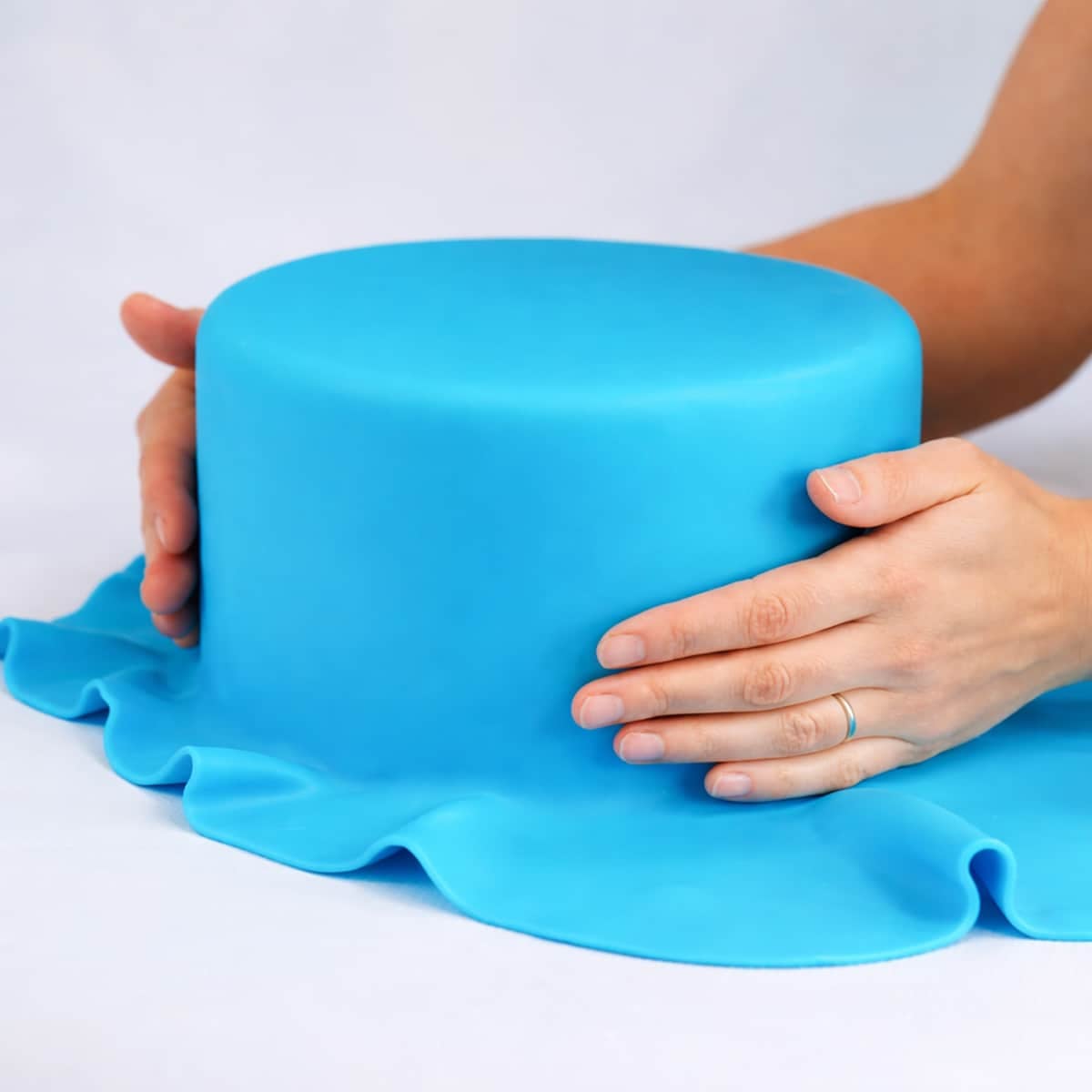
Quick Glance: Fondant Recipe
- Recipe Name: Homemade Fondant Recipe (LMF)
- Why You'll Love It: Stretchy, smooth, and actually delicious, this marshmallow fondant covers cakes without cracking, tearing, or elephant skin and costs a fraction of store-bought.
- Time and Difficulty: 10 minutes | Beginner-friendly
- Main Ingredients: Marshmallows, powdered sugar, vegetable shortening, store-bought fondant.
- Method: Melt marshmallows, mix with powdered sugar and shortening, knead in store-bought fondant until smooth and stretchy.
- Texture and Flavor: Soft, pliable, and taffy-like with a light, sweet vanilla flavor, nothing like the rubbery, bitter fondant you get from the grocery store
- Quick Tip: Always use cheap store-brand marshmallows - name brands like Jet-Puff are too dense and dry.
Jump to:
What Makes This Fondant Recipe Different
Marshmallows are made of sugar and gelatin, which gives LMF its base elasticity and holds everything together. The sugar keeps it sweet and pliable, while the gelatin is what allows it to stretch without breaking. The problem with plain marshmallow fondant is that marshmallow alone does not have enough elasticity to cover a cake cleanly, which is where most homemade fondant recipes fall short.
Adding a small amount of store-bought fondant is what separates LMF from every other marshmallow fondant recipe. Store-bought fondant contains additional gums and stabilizers that give the finished batch a level of stretch and smoothness that marshmallow fondant alone simply cannot achieve. You are essentially using a cheap product to upgrade your homemade batch into something far better than either one would be on its own.
Store-brand marshmallows work better than name brands like Jet-Puff because they have a softer, airier texture that melts down smoothly and incorporates easily. Name brands tend to be denser and drier, which makes the fondant stiffer and harder to work with. This is one of those rare cases where the cheaper option genuinely produces a better result.
Vegetable shortening coats the sugar molecules and slows down moisture loss, which means your fondant stays soft and workable longer without cracking or developing elephant skin on your cake. Warmth is also essential. Heat relaxes the gelatin structure and makes the dough stretchy and forgiving. Cold fondant tightens up and tears, which is why you always knead it well and reheat before using.
My marshmallow fondant has been my secret weapon for years, and now it can be yours, too.
Fondant Ingredients
Making LMF only requires five ingredients, and most of them are easy to find at any grocery or craft store. Check the notes at the bottom of the recipe card for brand recommendations and substitutions.
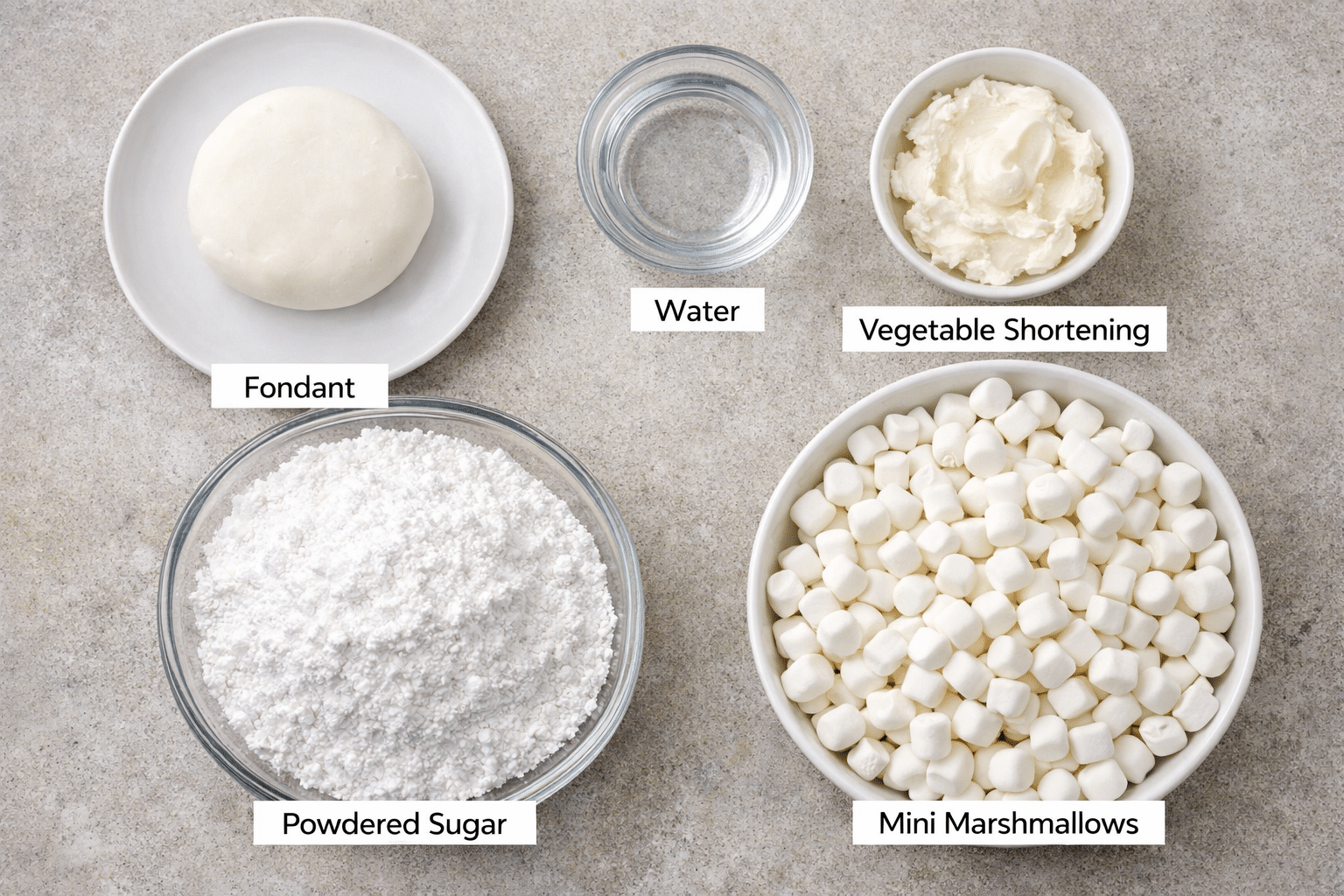
- Marshmallows: Marshmallows are the base of this recipe and do most of the heavy lifting. They are made of sugar and gelatin, which gives the fondant its soft, pliable structure and natural elasticity. Store-brand marshmallows like WinCo, Hy-Top, Aldi, or Campfire work best because they are softer and melt down more smoothly than denser name-brand options like Jet-Puff.
- Powdered Sugar: Powdered sugar is what gives the fondant its body and workable texture. It absorbs into the melted marshmallow mixture and firms everything up into a dough you can knead and roll. You may not need every last bit depending on your climate, so add it gradually and stop when the dough feels smooth and slightly tacky.
- Store-Bought Fondant: This is the ingredient that makes LMF different from every other marshmallow fondant recipe. Adding Wilton or Satin Ice fondant introduces extra gums and stabilizers that dramatically improve stretch and smoothness. You are essentially using a small amount of a cheap product to upgrade your whole batch into something far better than either one would be on its own.
- Vegetable Shortening: Shortening coats the sugar molecules and slows down moisture loss, keeping the fondant soft and pliable. It also lubricates your hands and work surface during kneading so the dough does not stick or tear. Do not substitute butter here because the water content in butter can affect the texture.
- Warm Water: A small amount of warm water helps release the melted marshmallows from the bowl and loosens the mixture just enough to incorporate the powdered sugar smoothly. If you are making a dark-colored fondant, replace one tablespoon of water with one tablespoon of gel food color to get a head start on the color during mixing.
How To Make Fondant Step-By-Step
Before you start, coat your hands and work surface lightly with vegetable shortening. This prevents sticking during kneading and makes the whole process much easier to manage.

- Sift your powdered sugar into a large bowl and set it aside. Sifting prevents lumps in the finished fondant, which can show through on a cake.
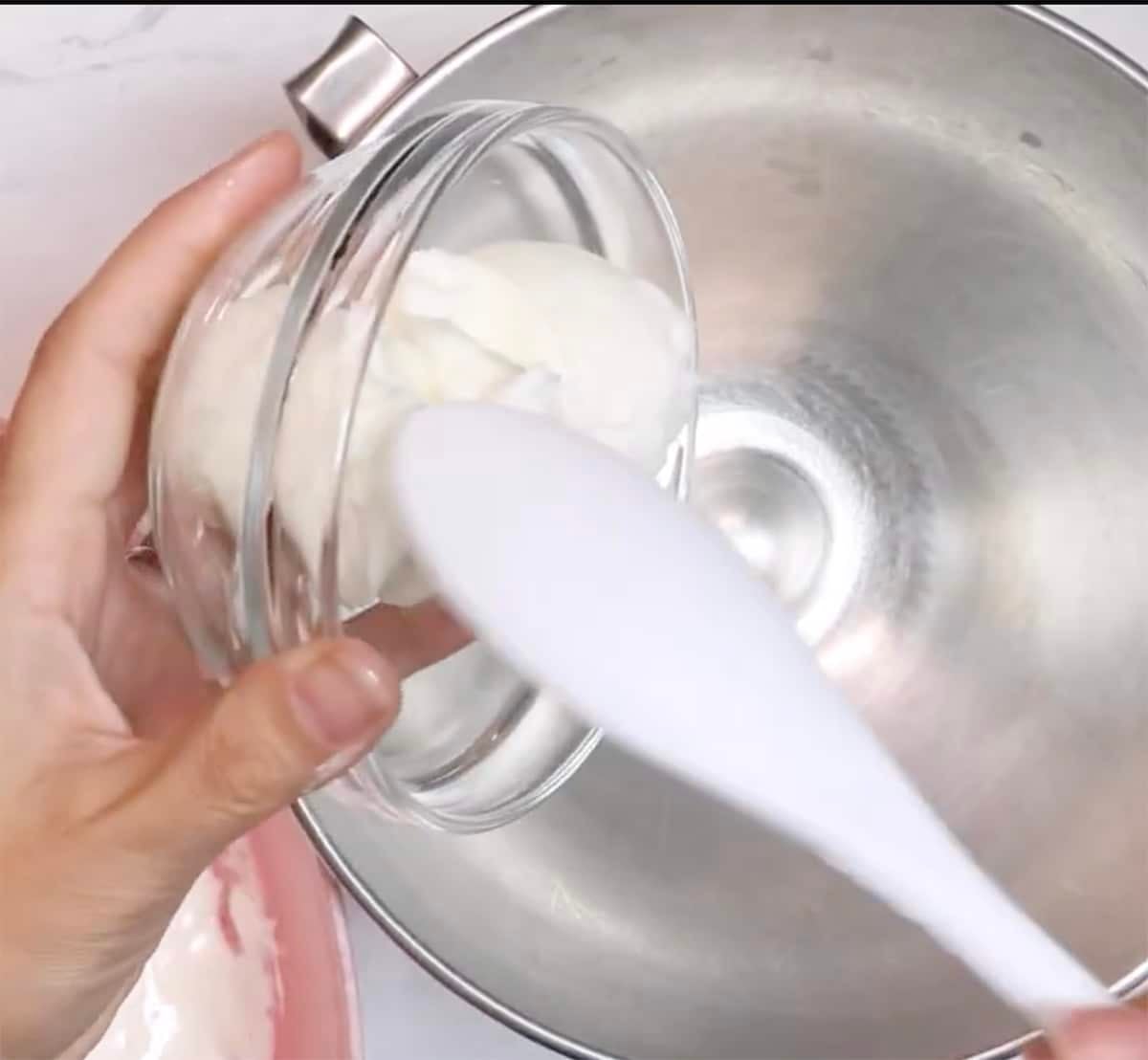
- Place your vegetable shortening into the bowl of your stand mixer fitted with the dough hook. You do not need to mix it yet, it will incorporate on its own once the marshmallows go in.
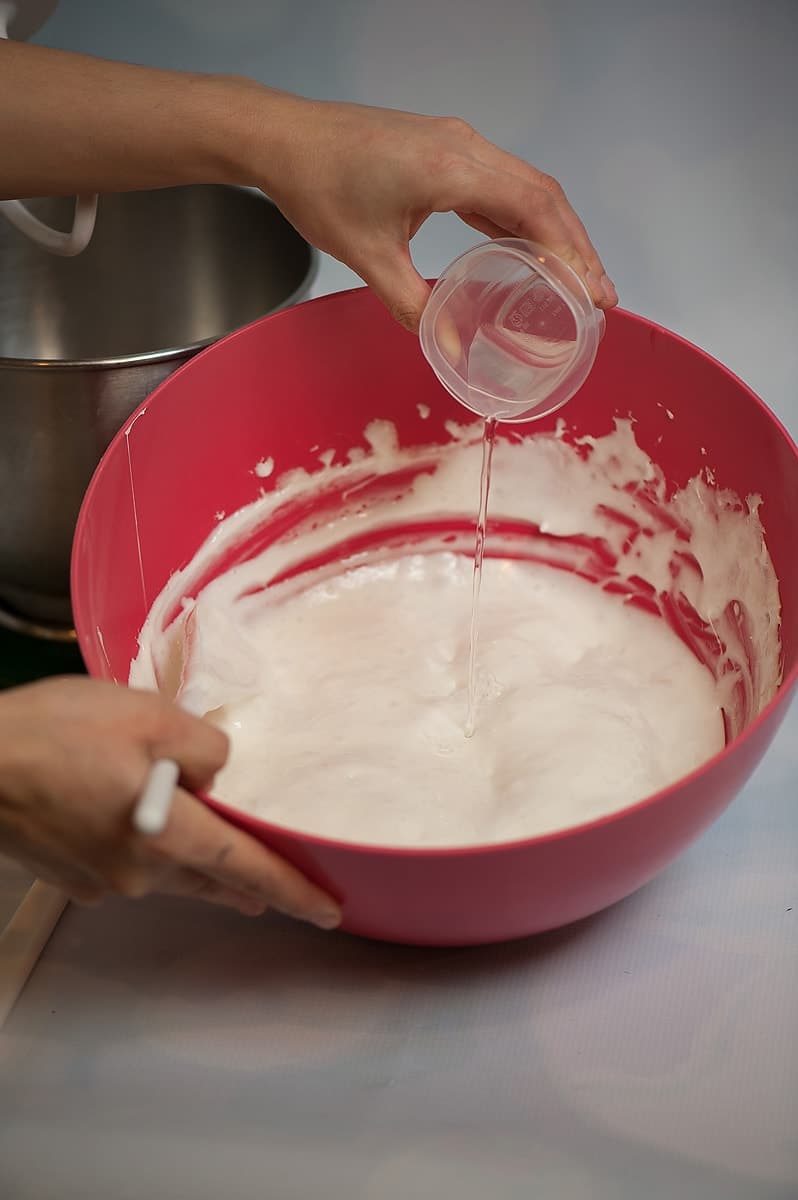
- Heat your marshmallows in a microwave-safe bowl in 30-second bursts, stirring between each burst, until they are completely melted and glossy. They should look like a thick, sticky white lava.
- Pour your warm water over the top to help release them from the bowl, then pour everything into the mixer bowl with the shortening.
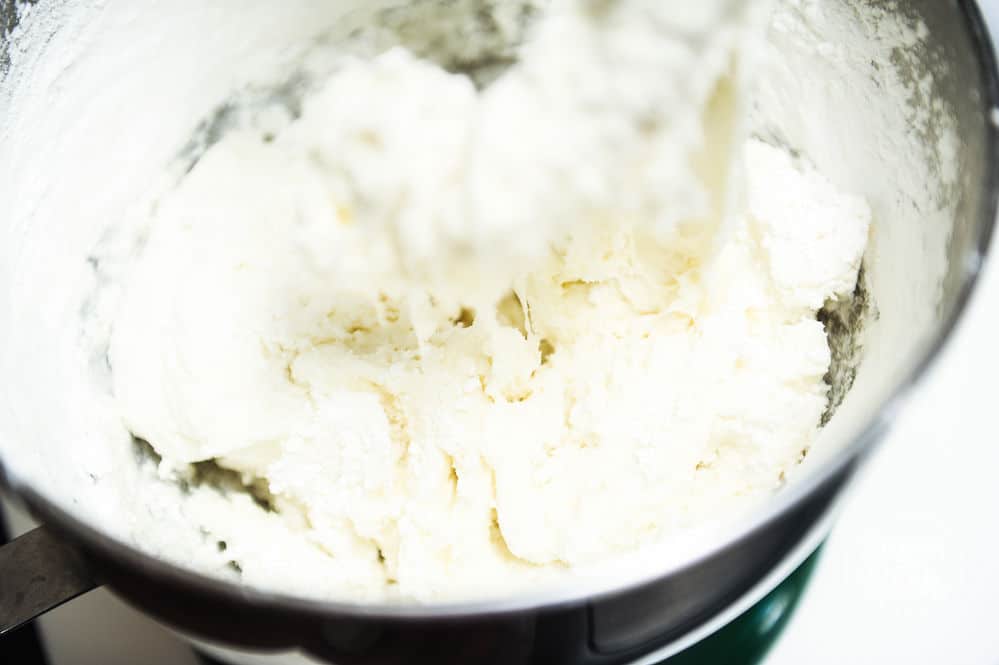
- Immediately add the melted marshmallows to the stand mixer with the vegetable shortening and the hook attachment.
- Turn the mixer to the lowest speed and begin adding your powdered sugar one cup at a time. It will look rough and shaggy at first; that is completely normal. Keep adding sugar and mixing until the dough is pulling away from the sides of the bowl and looks smooth and slightly sticky, about 5 minutes.
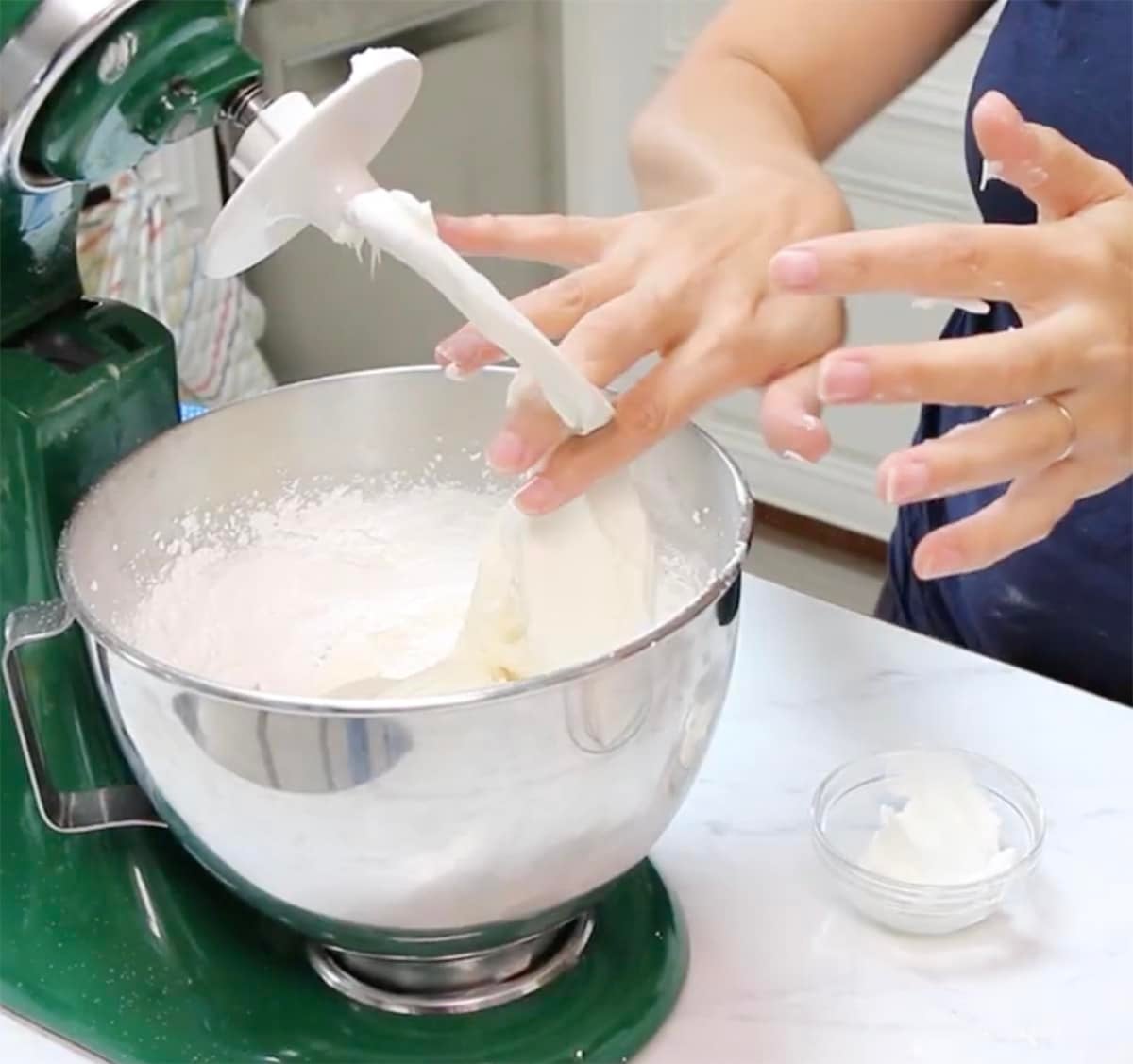
- Coat your fingers in shortening and pull the fondant off the dough hook. Scrape the mixture out of the bowl and into your remaining powdered sugar.
This is also the point you would add in food coloring if you want to color your fondant.
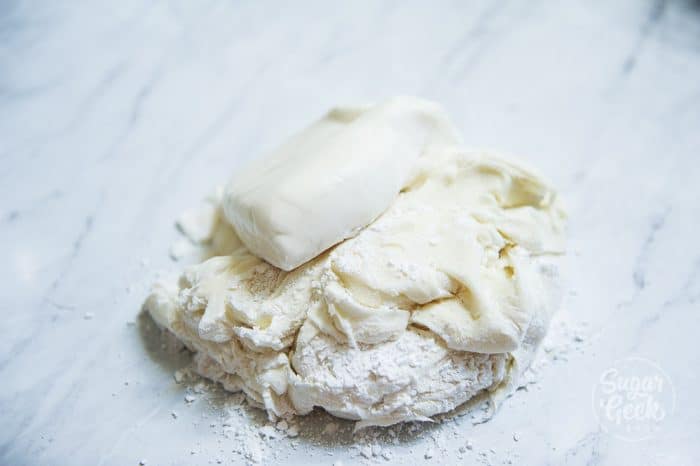
- Microwave your store-bought fondant for 30 to 40 seconds until it is warm and very soft.
- Scoop the fondant mixture out of the stand mixer bowl onto your workbench with extra powdered sugar to prevent sticking.
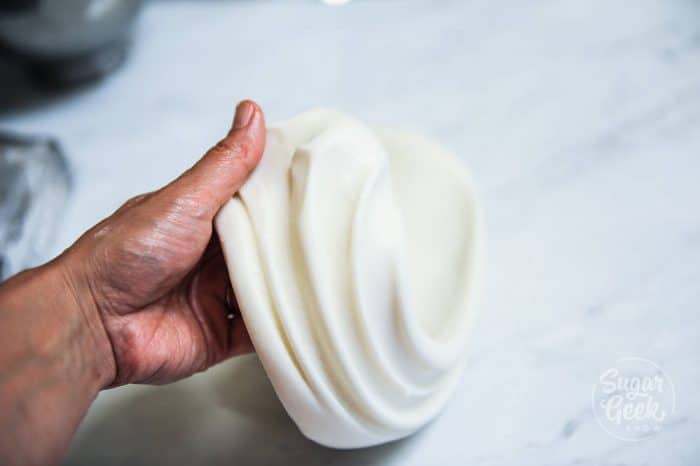
- Knead everything together until the powdered sugar and store-bought fondant are fully incorporated. You may not need every last bit of powdered sugar, stop when the dough feels smooth, pliable, and slightly tacky but not sticky. If it feels too stiff, microwave the whole batch for 20 to 30 seconds to soften it back up.
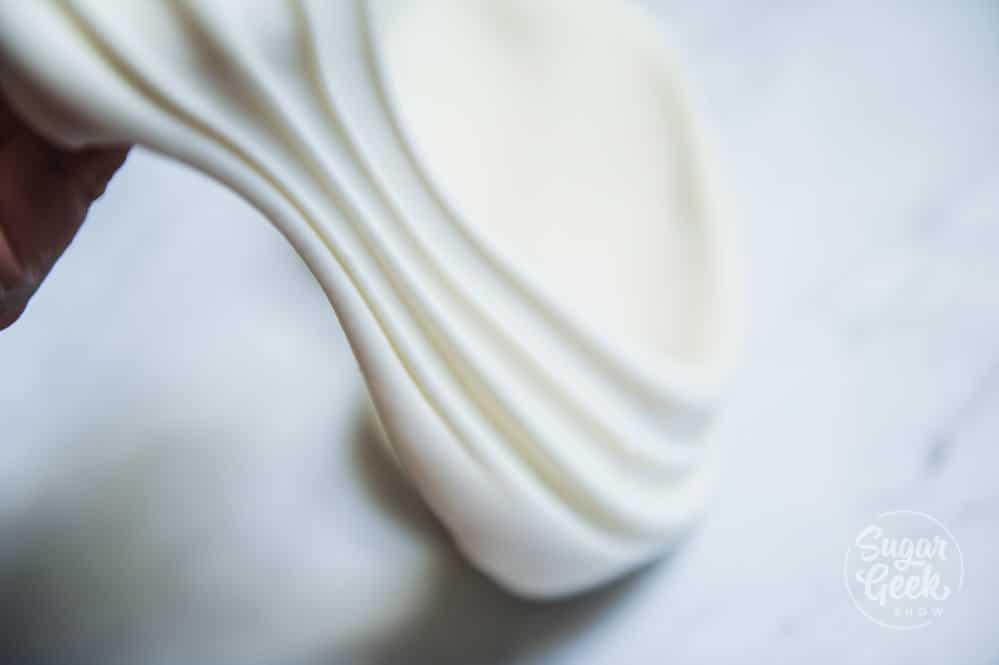
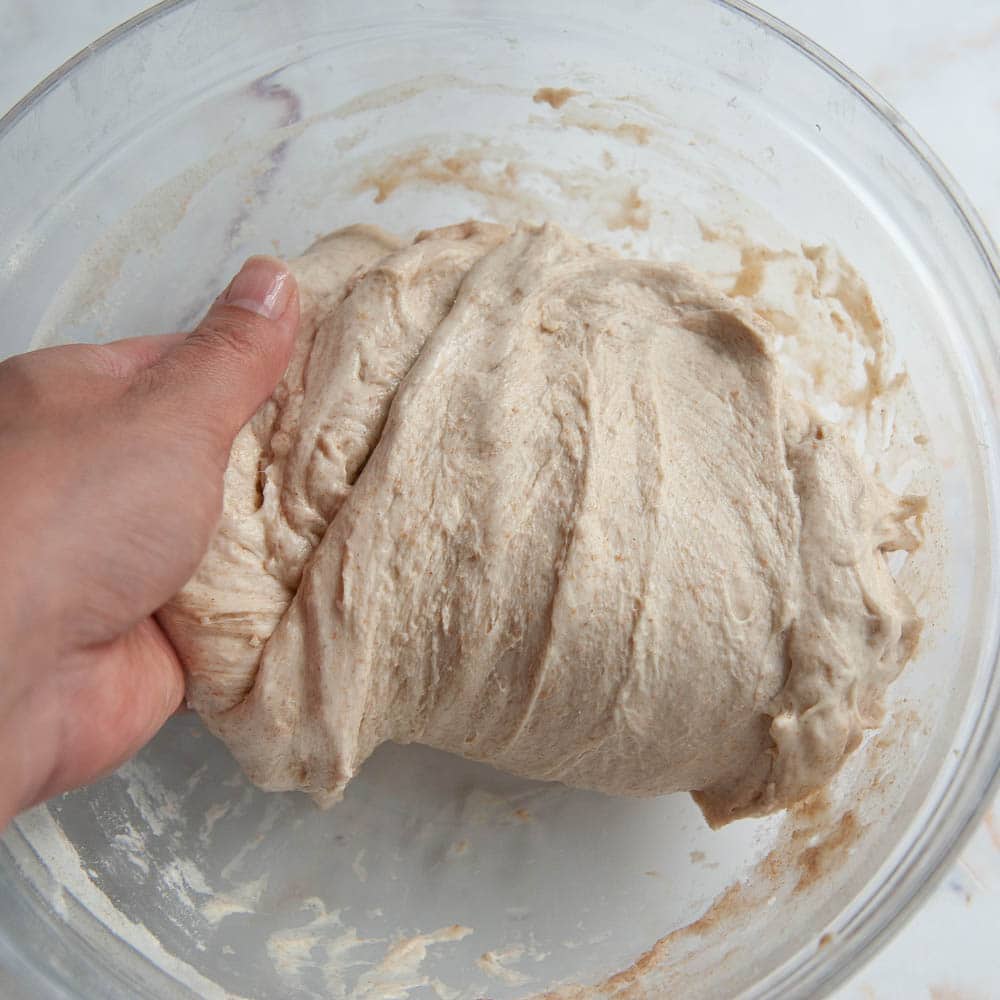
- Once combined, pull the fondant like taffy, stretching it out and folding it back on itself repeatedly. When it is ready, it will stretch several inches without tearing and feel silky and elastic. If it is still tearing, it needs more heat, microwave for 30 seconds and keep pulling.
To store: Wrap tightly in plastic wrap and place in a zip-lock bag at room temperature. LMF will keep for several months. Always reheat and knead well before using again.
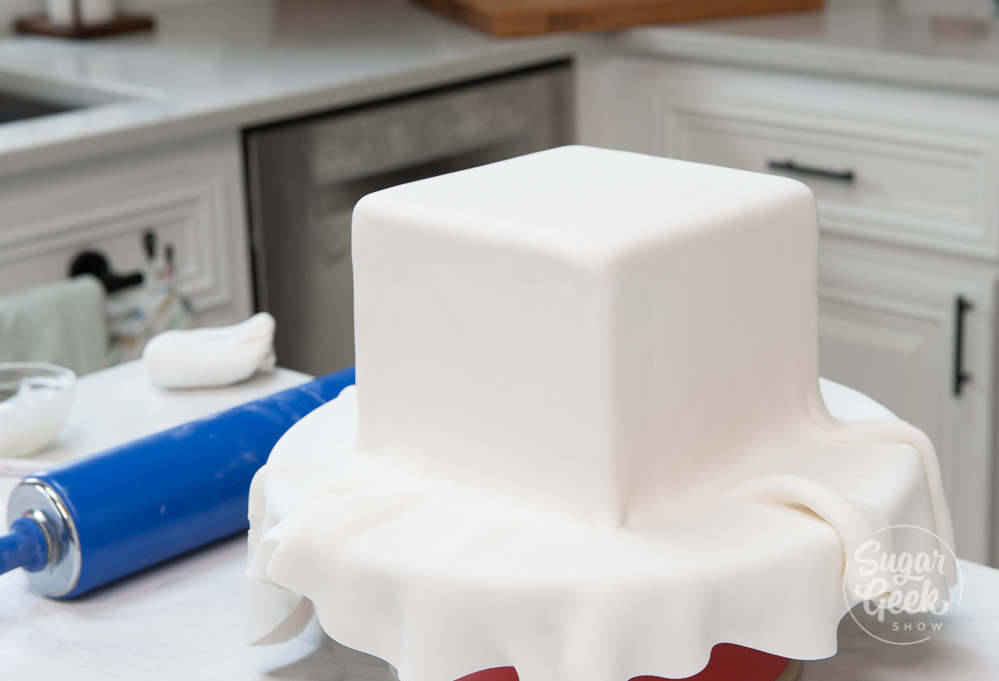
Before applying fondant, frost your cake with a layer of white chocolate ganache - it sets firm enough to give the fondant a perfectly smooth surface to adhere to.
Common Fondant Problems To Avoid
- Using name-brand marshmallows. Brands like Jet-Puff are denser and drier than store-brand marshmallows, which makes the finished fondant stiffer and harder to work with. Stick to WinCo, Hy-Top, Aldi, or Campfire for the best texture and the lowest cost.
- Not heating the marshmallows enough. The marshmallows need to be completely melted and glossy before they go into the mixer. If there are any unmelted lumps, they will create hard spots in your fondant that show up on the surface of your cake. Heat in short bursts and stir between each one until the mixture is fully smooth.
- Adding the powdered sugar too fast. Dumping in all the sugar at once causes it to clump and mix unevenly. Add it one cup at a time on the lowest mixer speed and let it fully incorporate before adding more.
- Skipping the store-bought fondant. This is the step most people want to leave out, but it is the one that makes LMF work. Without it, the fondant will not have enough elasticity and will be more likely to tear when covering a cake. Do not skip it.
- Using cold fondant. Cold fondant is stiff and will crack or tear as soon as you start rolling it. Always microwave and knead your fondant thoroughly before using it, even if you just made it and it has cooled down. It should feel warm and stretchy before it goes anywhere near a cake.
- Covering a warm cake. The cake and its buttercream or ganache coating need to be fully chilled and firm before you cover it with fondant. A soft surface will not support the weight of the fondant and you will get bumps, bulges, and sliding.
- Rolling the fondant too thin or too thick. Too thin and it will tear during application. Too thick and it will look heavy and be hard to get sharp edges. Aim for about ⅛ inch, which gives you enough strength to cover the cake without the fondant looking clunky.
- Using too much food coloring. Liquid food coloring adds too much moisture and can make your fondant sticky and pocked with tiny holes. Always use gel food coloring, and for deep colors like red or black, add the color during the mixing process rather than kneading it in afterward.
If you want something more sculptural, try my modeling chocolate recipe instead, which holds fine details much better for sculpting.
Fondant Recipe FAQs
I know it seems counterintuitive, but this is the step that makes LMF better than any other marshmallow fondant recipe out there. Marshmallow fondant on its own lacks the elasticity you need to cover a cake cleanly. Store-bought fondant contains gums and stabilizers that dramatically improve how the finished batch stretches and handles. By adding it to your homemade batch you are essentially upgrading a cheap, average product into something far better. Think of it like adding a small amount of high-quality chocolate to a basic sauce. It changes everything.
Nine times out of ten, tearing and cracking come down to temperature. Cold fondant is stiff and unforgiving, so always microwave it until it is warm and knead it well before you start rolling. If it is still tearing after that, it may need more shortening worked in. Cracking on the cake usually means the buttercream underneath was too soft or the fondant was rolled too thin. Aim for ⅛ inch thickness and make sure your cake is fully chilled before covering.
Wrap your fondant tightly in plastic wrap, place it in a zip-lock bag, and store it at room temperature. Do not refrigerate it. The moisture in the fridge will make it sticky and affect the texture. Stored properly, LMF will keep for several months. Before using it again, microwave it for 20 to 30 seconds and knead it well until it is warm and stretchy.
Always use gel food coloring, not liquid. Liquid coloring adds too much moisture and can make your fondant sticky or pocked with tiny holes. For light pastel colors, you can knead the color in after the fondant is made. For deep or dark colors like red or black, add the gel color during the mixing process while the marshmallows are still warm. This gives the color time to distribute evenly and prevents you from overworking the fondant trying to knead in a large amount of color later.
Yes, you can make LMF by hand, but it is a workout. Mix the melted marshmallows and shortening together in a large bowl, then add the powdered sugar gradually and knead it in with your hands. Make sure your hands are coated in vegetable shortening throughout the process. It will take about 10 to 15 minutes of kneading to get the same smooth, stretchy result you would get from a mixer.
Yes! My friend Danette developed a version called DKF (Danette's Kosher Fondant) that uses marshmallow fluff instead of regular marshmallows, making it gelatin-free and kosher. It works just as well as LMF and follows a nearly identical process.
Ready To Master Cake Decorating?
Join Sugar Geek University and learn professional techniques through detailed cake decorating courses, tutorials, and real kitchen demonstrations by
award-winning cake decorator, Liz Marek.
Recipe
Ingredients
Ingredients
- 32 oz powdered sugar sifted (also called icing sugar, confectionary sugar)
- 16 oz marshmallows WinCo, Hy-Top, Aldi, and Campfire brands work best
- 20 oz Wilton fondant Satin Ice fondant will also work
- 2 tablespoon warm water For dark colors, use 1 tablespoon warm water and 1 tablespoon food color gel
- 4 oz vegetable shortening Also called white vegetable fat, trex, copha
Instructions
How to make fondant
- Sift the powdered sugar and set aside in a large bowl.
- Place vegetable shortening in a stand mixer bowl.
- Heat marshmallows for 30 seconds in the microwave on high (or on stove top). Stir with spoon.
- Place marshmallows back into microwave and heat for another 30 seconds (or on stove top). Stir with spoon.
- Heat marshmallows (last time!) for 30 seconds in the microwave (or on stove top).Marshmallows should be ooey-gooey at this point and ready to be added to the mixer bowl. Pour your water on top of the marshmallows to get them to release from the sides of the bowl. Pour into bowl with vegetable shortening
- Turn stand mixer on lowest setting (setting 1 on Kitchenaid stand mixers) with dough hook attachmentBegin adding in the powdered sugar one cup at a time.
- Don't stop mixing until it's sticking to the sides of the bowl and looks smooth. Add in another cup of powdered sugar.
- Pull fondant off the dough hook attachment by putting vegetable shortening on your fingers and pulling it off the hook.
- Take the soft mixture out of the bowl and put it into the large bowl with the rest of the powdered sugar.
- Warm the Wilton fondant in the microwave for 30-40 seconds and add to the large bowl with the powdered sugar and marshmallow mix.
- Knead until powdered sugar, marshmallows and Wilton fondant is mostly incorporated. You may not use all of the powdered sugar depending on your climate and that is completely fine.
- Pull fondant like taffy until it is stretchy and smooth. If there are still rough spots or it's tearing, put everything back in the microwave for 30-40 seconds to make it really hot and pull like taffy with shortening on your hands until it pulls without breaking
- Store in a zip-lock bag at room temperature. Fondant will keep for months in a zip-lock bag. To use again, reheat and knead well until stretchy before each use. You can add color as desired but for dark colors, you should add them during the mixing process or you could get a sticky mess.
Video
Notes
- To store: Wrap tightly in plastic wrap and seal in a zip-lock bag at room temperature. Do not refrigerate. LMF keeps for several months stored this way.
- To reuse: Microwave for 20 to 30 seconds and knead well with shortening-coated hands until warm and stretchy before rolling.
- If your fondant is too stiff: Microwave the whole batch for 20 to 30 seconds and pull it like taffy with shortening on your hands until it loosens up.
- If your fondant is too sticky: Knead in a little more powdered sugar a tablespoon at a time until it reaches the right consistency.
- For dark colors like black or red: Add gel food coloring during the mixing process while the marshmallows are still warm for the most even color distribution.
- Coverage: One batch covers approximately a 10-8-6 inch tiered cake when rolled to ⅛ inch thickness.

Janice Helton says
I love this recipe. Great for beginners. But mine is chewy. What do I need to do?
The Sugar Geek Show says
Have you ever had fondant before? It's always chewy 🙂
Laura says
I love this recipe! But now for my next cake I need dark colors but several different ones .. I suppose I’ll just knead the color in after and hope for the best ? Would you add just 1 tbl water and then after kneading split and color with the dark colors? I need three colors as I’m making a book cake. Do you think one batch would fully cover 3 rectangles that are 8x6x3 inches? Thank you so much for this fondant recipe ?
The Sugar Geek Show says
If you need several dark colors then I would make half batches of the dark colors. If you try and knead it in after the the fondant is made then you risk breaking the fondant.
Rae says
So, you recommended adding the coloring to the melted marshmallows before adding the powdered sugar. If I then add the white store bought fondant, won't that "fade" the color? And would I just knead the fondant until color is incorporated through the store bought fondant. I got a week and a day to figure this all out before I need to start working on the cake decorations. LOL My daughter asked for a very complicated birthday cake......I generally just use my mom's frosting recipe, but I need it to be more detailed, smooth edged than what I can do with the frosting.
The Sugar Geek Show says
No, it's kind of added the same time. Yes the color might lighten a bit but then darken over night. The only reason you need to color fondant while making it is if you need a very dark color otherwise you can just add color like you would store bought fondant.
Sal says
What can you sub to replace the store bought fondant? I just don’t want to use it. Tylose? Glycerin?
The Sugar Geek Show says
Nothing 🙂 If you don't want to use the fondant then you'll have to try a scratch fondant recipe. There are many out there.
Abrie says
I have used your LMF for several cake. Now I need to use fluff can you advise How much marshmallow fluff can be used in place of the marshmallows? Can it is used on an ice cream cake and frozen with the cake. What is the recommendation when serving the ice cream cake. Thank you.
The Sugar Geek Show says
I would not recommend covering an ice cream cake with fondant. That is a recipe for a melty disaster lol.
For using the fluff check out the DKF recipe. https://www.theshortcakes.com/single-post/2015/11/05/DKF-Danettes-Kosher-Marshmallow-Creme-Fondant
Deborah Rhodes says
How can I heat the store bought fondant without a microwave?
The Sugar Geek Show says
You can't but you can knead it with your hands, it will take a lot longer.
Karen Knapp says
I found this recipe last year. I'd never used fondant before, so I practiced on my husband's birthday with a camping themed cake. The recipe is so easy & accurate, I was able to use it to make a DC Superhero Girls half Harley Quinn/ half Poison Ivy cake. My family hates the taste of fondant, but they all beg for more of the LMF! The girls are begging for another fondant cake for their birthday this week. I appreciate your willingness to share so I can make cakes my kids love! Thank you.
Sheryl says
Can you add colored fondant
The Sugar Geek Show says
If you read the post you can see I suggest not adding colored fondant since it adds to the overall cost of the fondant which negates making it yourself 🙂
Kerry says
I made my fondant two days ago and it has been sitting wrapped on the counter. I am ready to use it tonight, should I heat it in the microwave, and if so, for how long.
The Sugar Geek Show says
Heat until it's warm 🙂 Every microwave is different. For me I do 45 seconds because I have a very powerful microwave, yours could be more or less.
Carmen Quinquilla says
Hi! How resistant is your mashmallow fondant to humidity-heat? Thanks for answer.
The Sugar Geek Show says
Very resistant and if you use white chocolate ganache under the fondant, your cake won't sweat at all
Barbara Hale says
Just came across your site and am thrilled to have found you. You are very generous am I am anxious to try your fondant. Thanks so much. I have not done cake decorating in some time and am anxious to start again. I love making figures.
Barbara Hale says
Just came across your site and am thrilled to have found you. You are very generous am I am anxious to try your fondant. Thanks so much.
Danielle S says
I have a question. If I needed to put my finished cake in the fridge how would this fondant hold up when it came back out? I live in Australia and am finding fondant difficult to use. I noticed in one of your tutorials (shark on) you had put It in the fridge but everything else I have read on fondant says to never refrigerate. Feeling a bit confused ?
The Sugar Geek Show says
Condensation does not hurt the cake. Just let it dry and it will be fine 🙂 Put a fan on it if it's really humid
Nikki H says
Thank you so much for this, this recipe literally saved my life last night ?? It tastes amazing, I was one of those ‘I don’t like fondant people’ but not any moreeee!!!!!! I will never use ready to roll fondant again! Thank you! ???
The Sugar Geek Show says
Yay! I know how you feel! I was like that too!
Jean Witte says
I have now tried tis twice and each time it goes like elephant skin when I add the store bought fondant. What am I doing wrong please?
The Sugar Geek Show says
Im not sure, maybe your area is a little dry? Try adding a little more water and make sure you're heating the fondant until it's hot and then pulling like taffy 🙂