



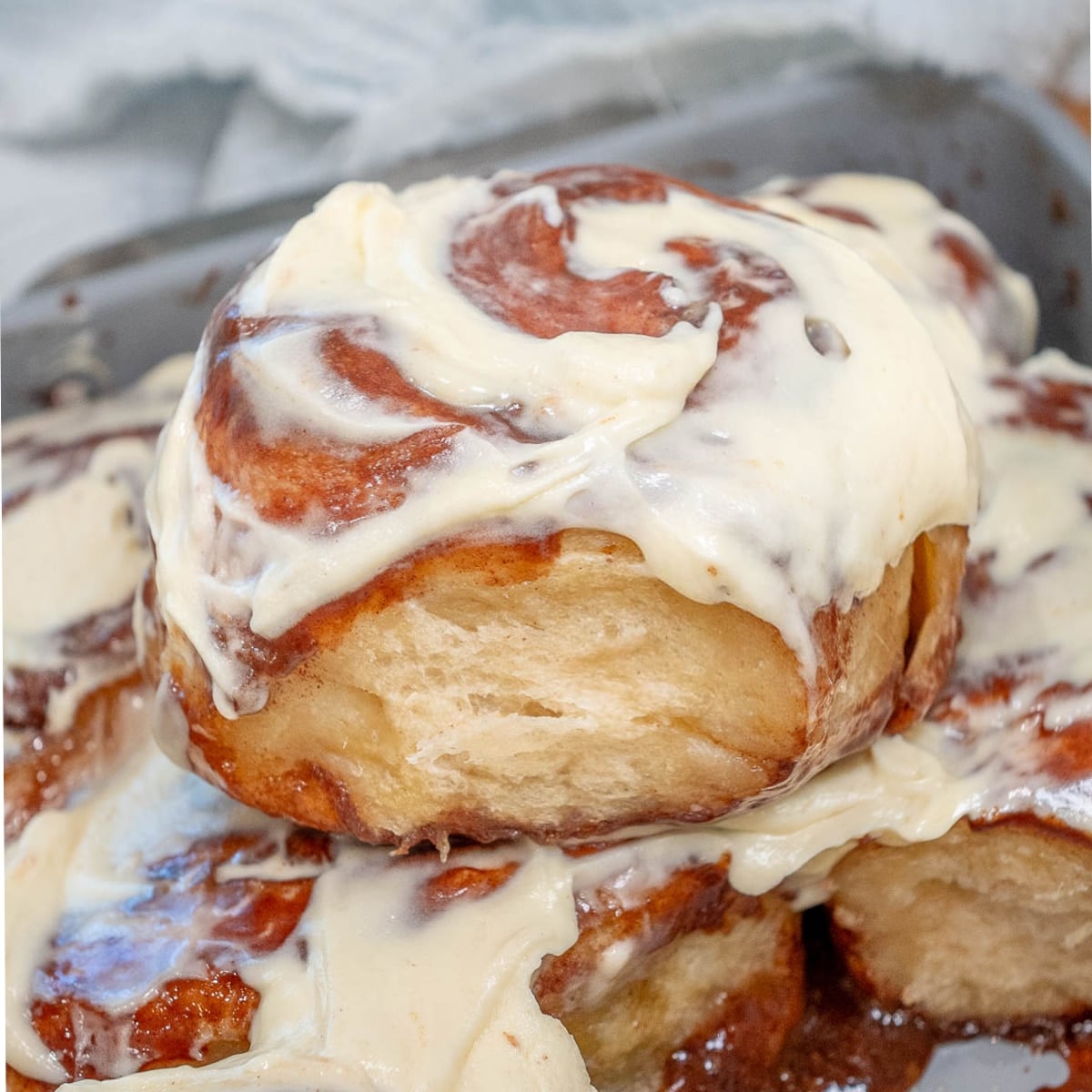
These sourdough discard cinnamon rolls are everything I love about my soft cinnamon rolls with the added tangy depth that only sourdough discard can give you. Fat, fluffy, baked in heavy cream until ooey gooey, and slathered in a not-too-sweet cream cheese frosting. If you've been hoarding discard in the back of your fridge waiting for the right project, this is the project.
Quick Glance at the Recipe: Sourdough Discard Cinnamon Rolls
- Recipe Name: Sourdough Discard Cinnamon Rolls
- Why You'll Love It: Fluffy, tangy, ooey-gooey thanks to a heavy cream pour before baking. Uses a full cup of discard. Make the same day in about 3 hours or shape the night before and bake in the morning.
- Time and Difficulty: 20 min prep + 2.5 hours rise + 25 to 30 min bake. Intermediate but very forgiving.
- Main Ingredients: Sourdough discard, bread flour, milk, instant yeast, butter, eggs, sugar, honey, cinnamon, brown sugar, cream cheese, heavy cream.
- Method: Mix the dough in a stand mixer with the discard added at the beginning with the warm milk and yeast. First rise. Roll, fill with cinnamon sugar and butter, and cut with floss. Second rise. Pour heavy cream over the rolls. Bake. Frost warm.
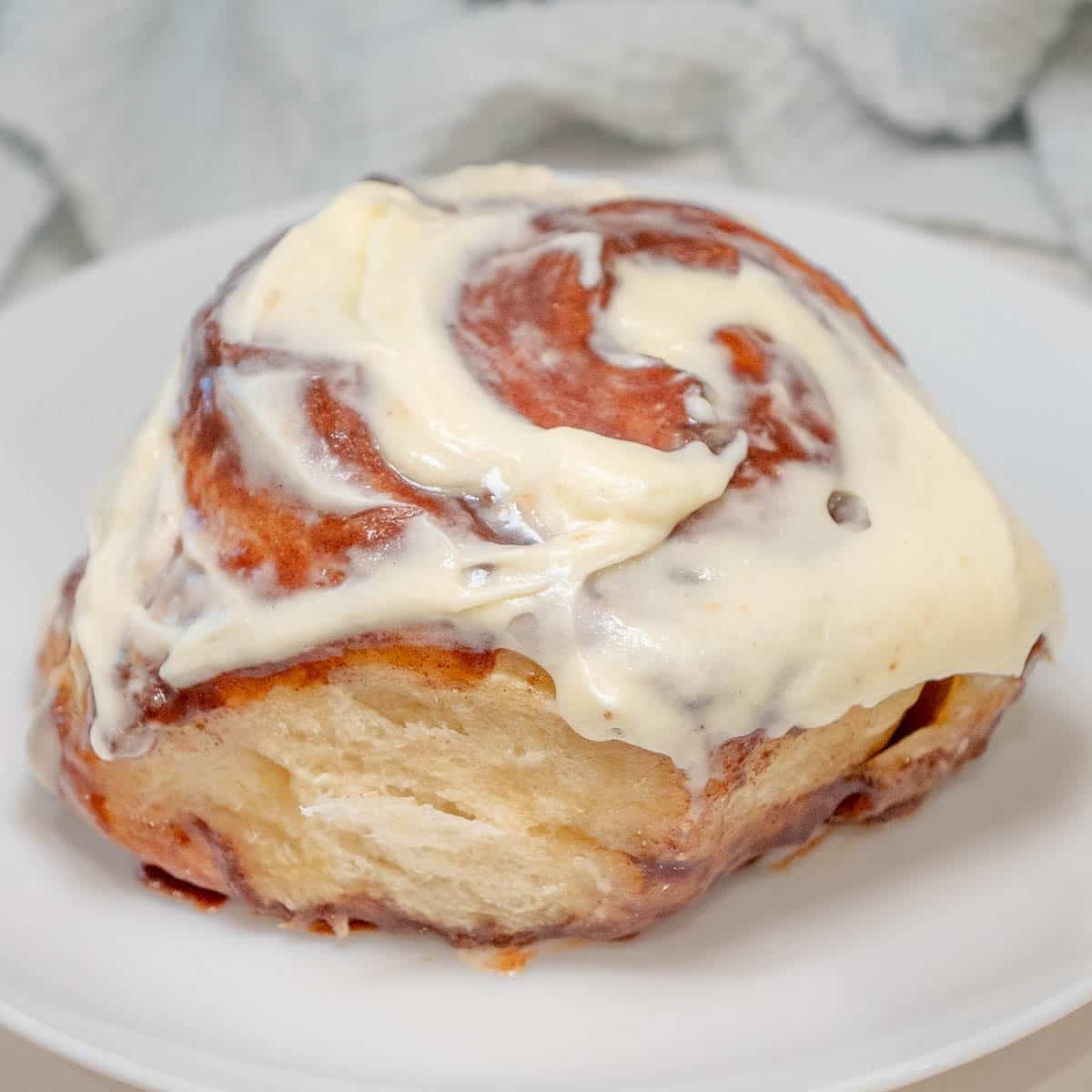
- Texture and Flavor: Pillowy-soft middle, gooey, caramelized bottom, faint sourdough tang beneath the cinnamon and brown sugar. The cream cheese frosting is softer and less sweet than a classic, so the rolls do the heavy lifting on flavor.
- Quick Tip: Don't skip the heavy cream pour before baking. It's the difference between a good cinnamon roll and the kind people text you about for the next three weeks.
I started baking cinnamon rolls every Sunday morning during the pandemic when I went down the sourdough rabbit hole. The kids were home, the smell of cinnamon and cream baking together became our Sunday signal, and pretty soon Avalon was negotiating which weekend they'd get cinnamon rolls vs my sourdough discard pancakes. Once I figured out how to fold a full cup of discard into my classic soft cinnamon roll recipe without changing what made it great, this version became the one I make for every holiday morning. The discard does double duty: it adds a faint creamy tang that cuts through the richness AND it weakens the gluten just enough to give you the most tender, pillowy bite. It's not a different recipe so much as the upgraded version.
If you don't have a sourdough starter yet, my sourdough starter for beginners guide walks you through making one from scratch in 5 to 7 days. Or use my original soft cinnamon rolls recipe, which skips the discard entirely.
What Makes This Sourdough Discard Cinnamon Roll Recipe Different
Most sourdough discard cinnamon roll recipes online treat discard like a flavor garnish, throw in a few Tablespoons, call it sourdough. I treat discard the way it deserves to be treated: as a real working ingredient that changes both flavor AND texture.
A full cup of discard, not a token amount. A full cup of unfed discard gives you noticeable creamy tang and meaningful tenderness in the dough. Less than that, and you're just making regular cinnamon rolls that happen to have starter in them.
Real yeast for real cinnamon roll texture. Most "quick" sourdough discard cinnamon roll recipes online use baking soda and baking powder instead of yeast. Those recipes are technically cinnamon rolls, but structurally they're closer to biscuit-style scones rolled into a spiral, denser, less pillowy, more pastry-like. My version uses instant yeast for the leavening, so you get a true pulled-apart cinnamon roll texture, then the discard does the flavor and tenderness work. Different job, different ingredient. See the FAQ at the bottom for the full breakdown if you've seen the "30-minute discard cinnamon rolls" recipes online and wondered why mine takes 3 hours.
The heavy cream pour stays. This is the move that makes my soft cinnamon rolls famous, and it carries over to the discard version. Right before baking, you pour heavy cream into the bottom of the pan. The cream absorbs into the rolls during the bake and gives you that ooey, gooey, almost-pudding middle that other recipes try and fail to replicate.
Cream cheese frosting that's not too sweet. Softer and less sugary than a classic cream cheese frosting, so the cinnamon and the discard tang come through, not the frosting.
Two ferment methods, same recipe. The same-day method takes about 3 hours total. Overnight ferment lets you shape and chill the rolls the night before, so all you do in the morning is take them out, let them come to room temperature, and bake. Pick the one that fits your week.
A dozen ways to flavor it. Pumpkin, cardamom, orange zest, chai, vanilla bean, lemon, chocolate, and apple. Once you have the base dough down, every season has a variation that uses your discard.
Sourdough Discard Cinnamon Roll Ingredients
This is an enriched dough, which means fat and dairy do a lot of the work. I always recommend weighing your ingredients with a digital kitchen scale for the most accurate results because flour packs differently depending on humidity. The discard portion is also weight-dependent if you want consistent results from one bake to the next.
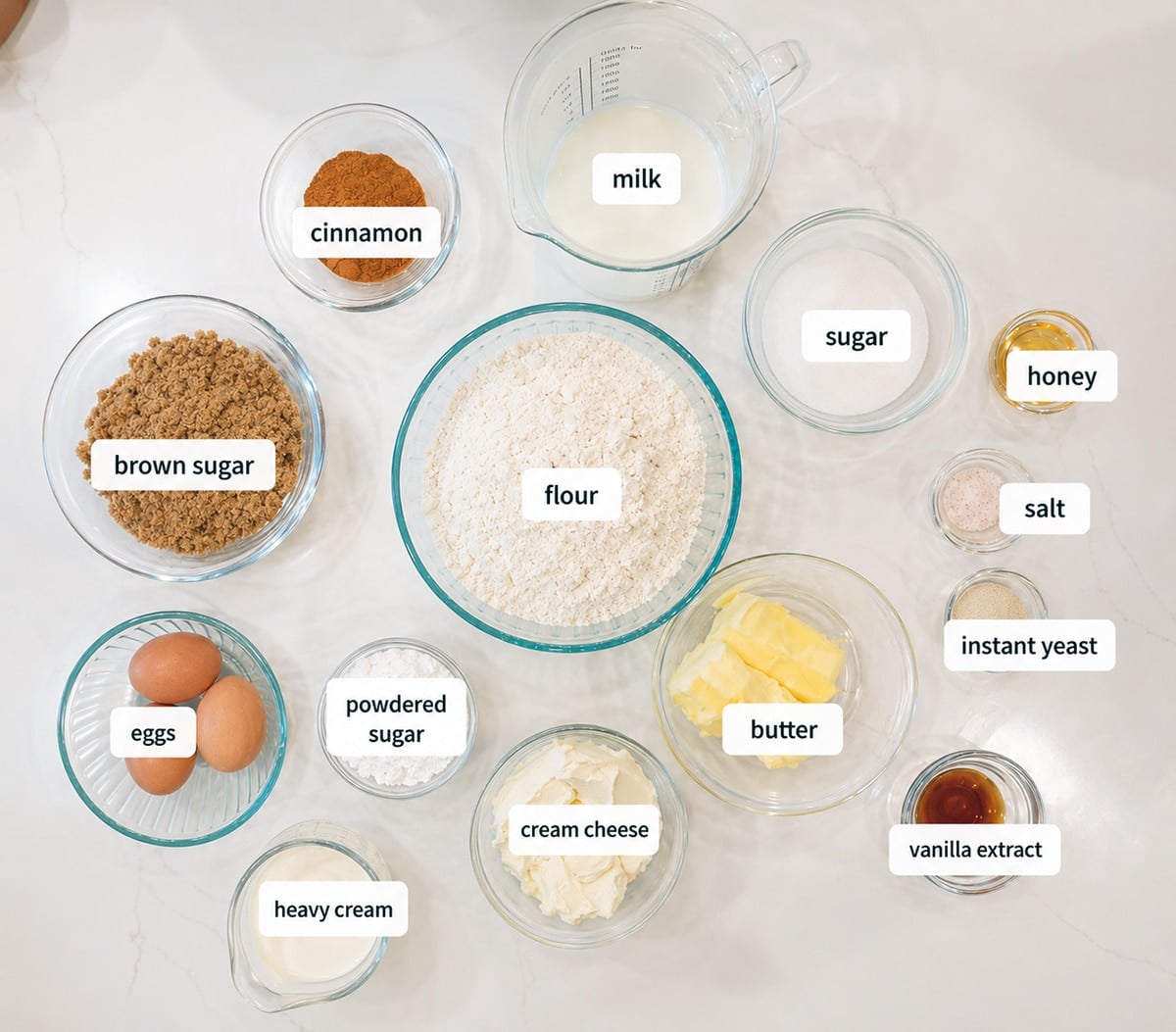
- Sourdough discard. A full cup of unfed sourdough starter straight from your jar. This is the whole point of the recipe. The discard adds creamy tang AND, more importantly, the natural acid in the discard weakens the gluten just enough to give you a more tender roll. Cold discard from the fridge works perfectly.
- Milk. Whole milk warmed to 90º F. The 90º F is critical, cold milk will shock the yeast and stall your first rise. If you don't have whole milk, 2 percent works, just slightly less rich. For an extra-tangy variation, you can use buttermilk instead (see buttermilk substitute if needed).
- Instant yeast. 10 grams of dried instant yeast. Instant yeast goes straight into the warm milk with no separate proofing step. If all you have is active dry yeast, dissolve it in the warm milk with a Tablespoon of sugar first and wait 5 to 10 minutes for it to foam before adding the rest of the ingredients.
- Bread flour or all-purpose flour. Bread flour is what gives you that fluffy, slightly chewy texture. I love Caputo bread flour ever since a trip to Italy, where I noticed the baked goods don't upset my stomach as much. AP flour works too if that's what you have; the rolls will just be a touch less structured.
- Butter. Softened to room temperature for the dough (mixes evenly into the flour without leaving greasy spots) and softened for the frosting (creams smoothly with the cream cheese). For the cinnamon filling, take it one step further to almost melted, soft enough to spread but not liquid, so the cinnamon sugar holds in place when you roll and cut. Softened means you can press a fingertip into it and it leaves a clean dent, not a puddle.
- Sugar. White granulated. Sweetens the dough lightly without competing with the cinnamon filling.
- Brown sugar. Light or dark, either works for the cinnamon filling. Dark gives you a more pronounced molasses flavor.
- Powdered sugar. For the cream cheese frosting. Just enough to sweeten without making the frosting sticky.
- Honey. One Tablespoon. Honey is an invert sugar, which means it ATTRACTS moisture and keeps the rolls softer for longer. It also adds a faint floral note that pairs beautifully with the sourdough tang. Maple syrup or corn syrup works as a 1:1 swap if that's what you have.
- Salt. A teaspoon in the dough and a half teaspoon in the frosting. Balances the sweet and lets the sourdough tang come through. Don't skip either.
- Large eggs, room temperature. Three of them. Cold eggs from the fridge shock the dough and slow the rise. Set them on the counter while you measure your flour, or drop them in a bowl of warm water for 5 minutes.
- Heavy cream. Eight ounces gets poured IN THE PAN over the proofed rolls right before they go in the oven, that's what creates the ooey gooey middle. Another Tablespoon goes into the cream cheese frosting to loosen it to a spreadable consistency.
- Cinnamon. Two Tablespoons for the filling. Don't be shy.
- Cream cheese, softened. Full-fat brick cream cheese, not the spreadable tub kind. Softened the same way as the butter, fingertip-test soft.
- Vanilla extract. Real vanilla, not imitation. The flavor comes through in the frosting, and you'll notice the difference.
Why The Heavy Cream Pour Works
The heavy cream pour is the move that separates fluffy cinnamon rolls from legendary ones.
When you pour heavy cream over the shaped rolls right before they go in the oven, the cream pools at the bottom and starts to absorb into the bottom third of each roll as soon as the heat hits. As the rolls bake, the cream's fat (about 36% in heavy cream) gets emulsified into the dough's starch network. Fat coats the starch granules and slows water from setting into a dry crumb. The result is that the bottom and middle of each roll stay moist and almost custardy even after the top has browned.
The cream also caramelizes with the brown sugar that has melted out of the filling during the bake. That syrupy, golden-brown bottom layer on each roll is the cream-and-sugar reduction happening live in the pan. That is the goo people are tasting when they say "the inside is like pudding."
Without the heavy cream pour, you get a perfectly fine cinnamon roll. With it, you get the kind of cinnamon roll people text you about for the next three weeks.
Why Sourdough Discard Makes Cinnamon Rolls More Tender
Sourdough discard sits between pH 3.5 and 4.5, about as acidic as orange juice (this is the same science I cover in my sourdough discard crackers post). When you add a full cup of it to an enriched cinnamon roll dough, the acid does two things at once.
It weakens the gluten just enough. Strong gluten gives bread its chew. Cinnamon rolls don't want chew, they want pillow. The acid in the discard slightly weakens the gluten network, so the dough still holds shape (you still need structure to roll and cut), but it stays tender after baking instead of going chewy as it cools.
It deepens the flavor as the dough proofs. The discard's acid environment slows the yeast down just a touch and gives the dough more time to develop complex flavor compounds during the rise. You end up with that faint creamy sourdough background note under the cinnamon and brown sugar that you simply can't get from yeast-only cinnamon rolls.
A note on gut comfort. My dad and my uncle both have a gluten intolerance, but they can eat sourdough products with no issues. I have a light intolerance myself; regular bread gives me bloating and stomach pains, but I can eat sourdough with no problems and often feel more satisfied than when I eat regular bread. Sourdough fermentation breaks down some of the gluten, making it easier to digest for a lot of people who otherwise can't tolerate wheat well. That's part of why I started baking with sourdough discard in the first place.
How To Make Sourdough Discard Cinnamon Rolls Step-By-Step
For exact measurements, see the recipe card below.
Before you start: pull your discard, milk, eggs, and butter out of the fridge. Warm the milk to 90º F. Let the eggs and butter come to room temperature; cold ingredients shock the dough and slow the rise. Line your 13"x18" sheet pan with parchment paper. Have your stand mixer ready with the dough hook.
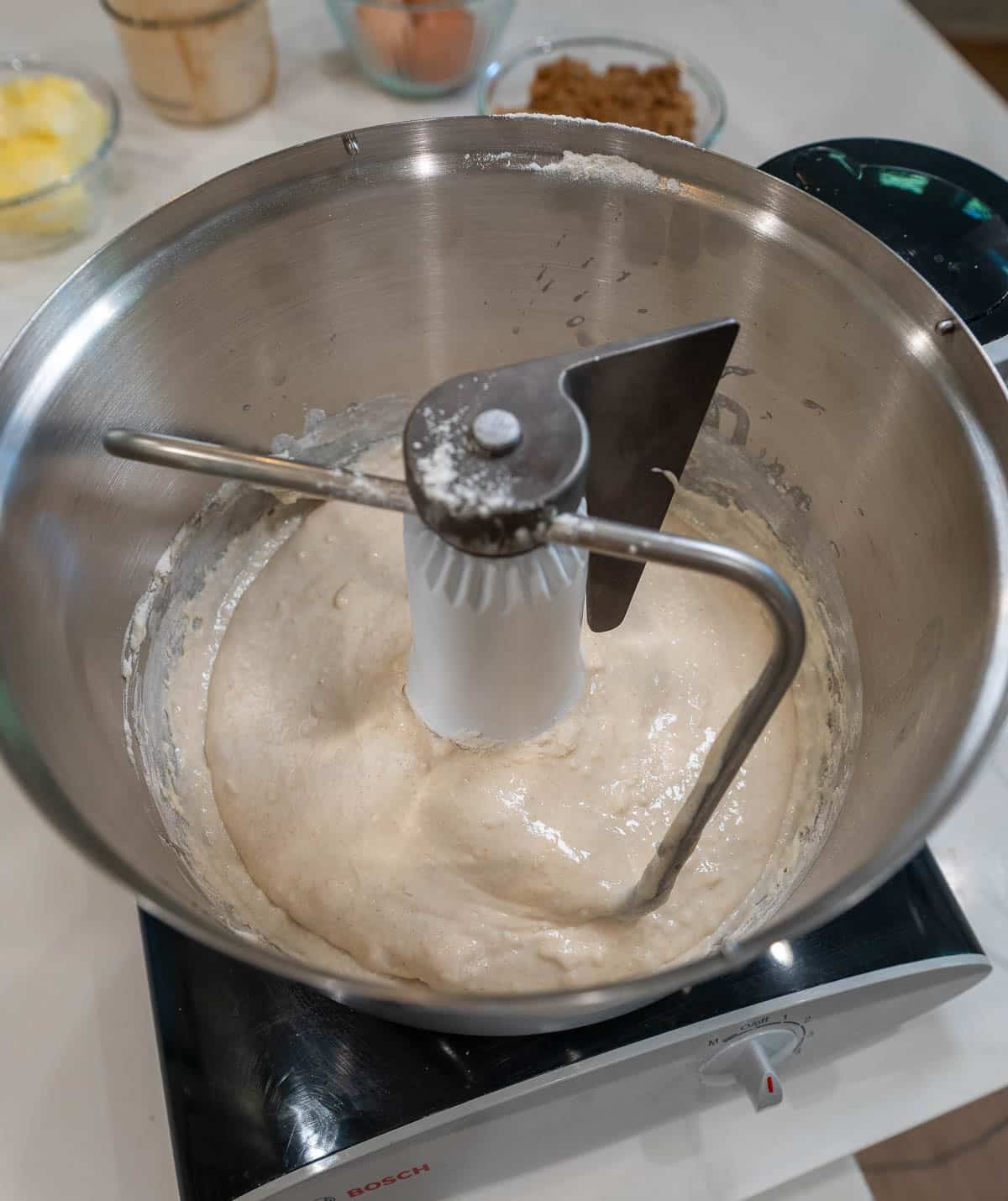
- Combine the warm milk, sourdough discard, instant yeast, and half the flour in your stand mixer bowl. Mix on low until combined. The discard goes in with the wet ingredients, so it fully incorporates from the start.
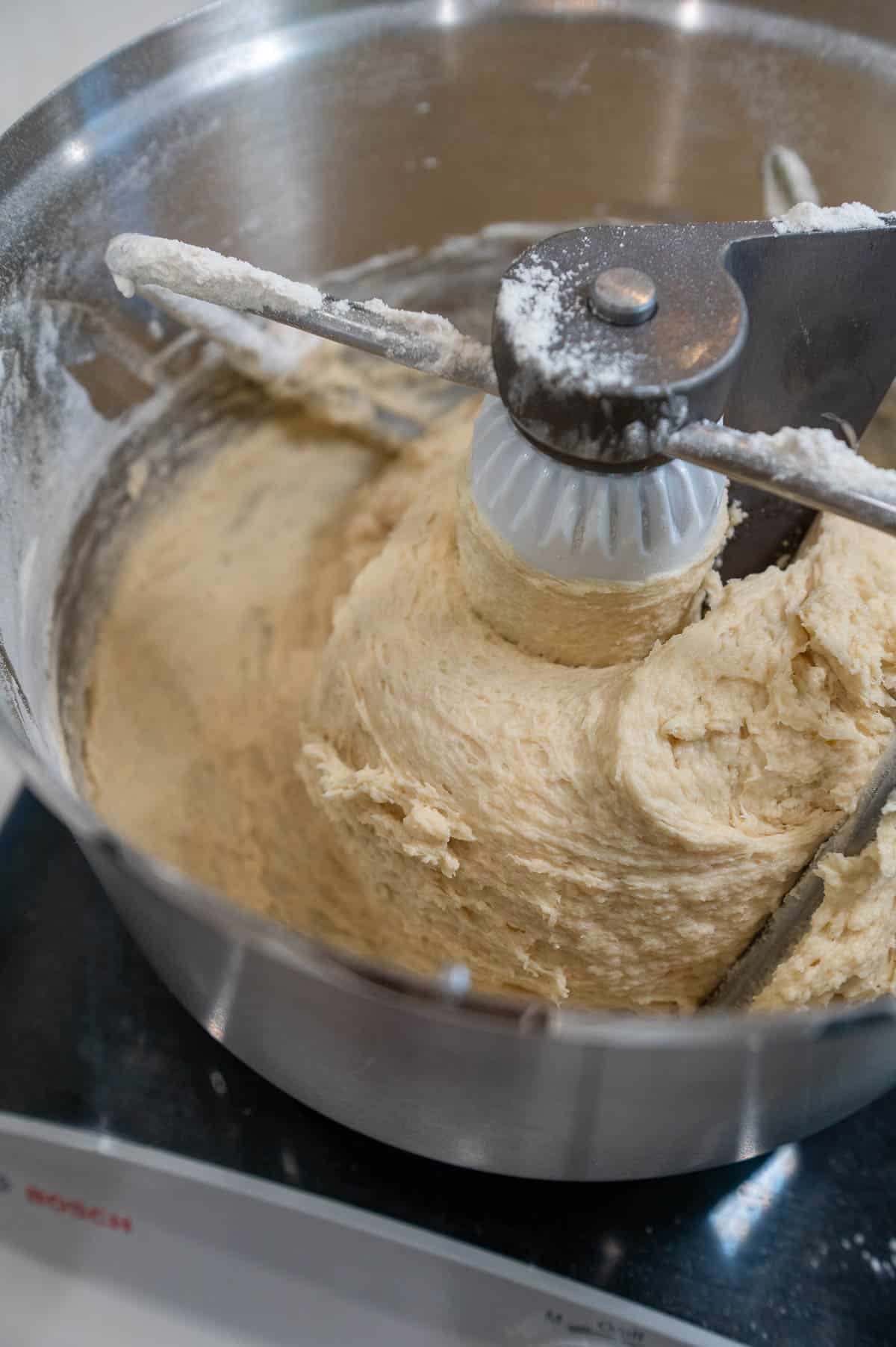
- Add the softened butter, sugar, salt, eggs, honey, and the rest of the flour. Mix on low until combined. The dough will look shaggy and rough, that's fine.
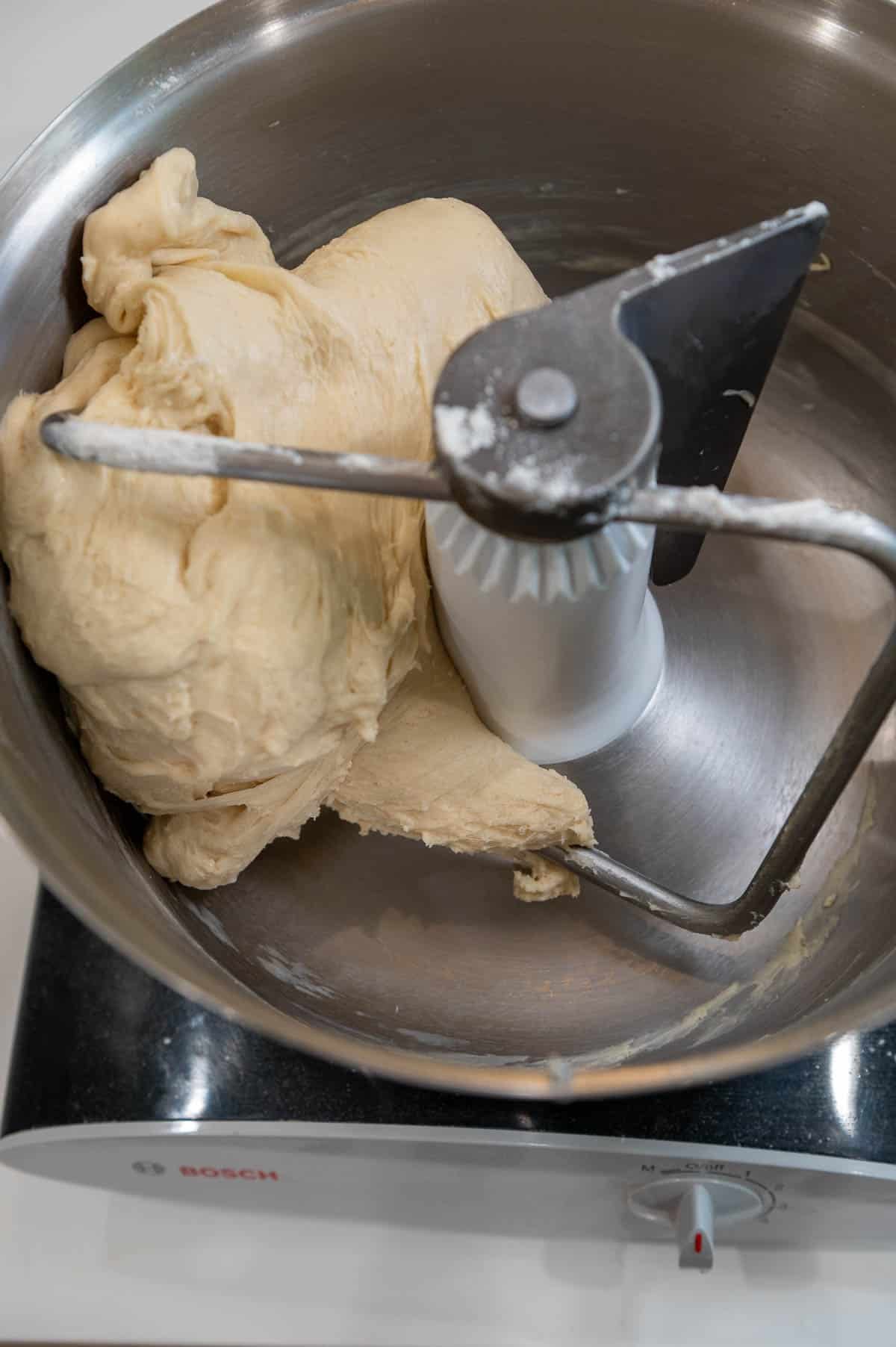
- Increase mixer speed to medium. Continue mixing for 10 to 20 minutes. The dough is ready when it forms a smooth ball and cleans the sides of the bowl. This is a very soft, enriched dough, so don't worry if it feels like a sticky mess at first, especially in warmer kitchens above 75º F. The sticky stage becomes smooth as the gluten develops, don't add more flour, just keep mixing.
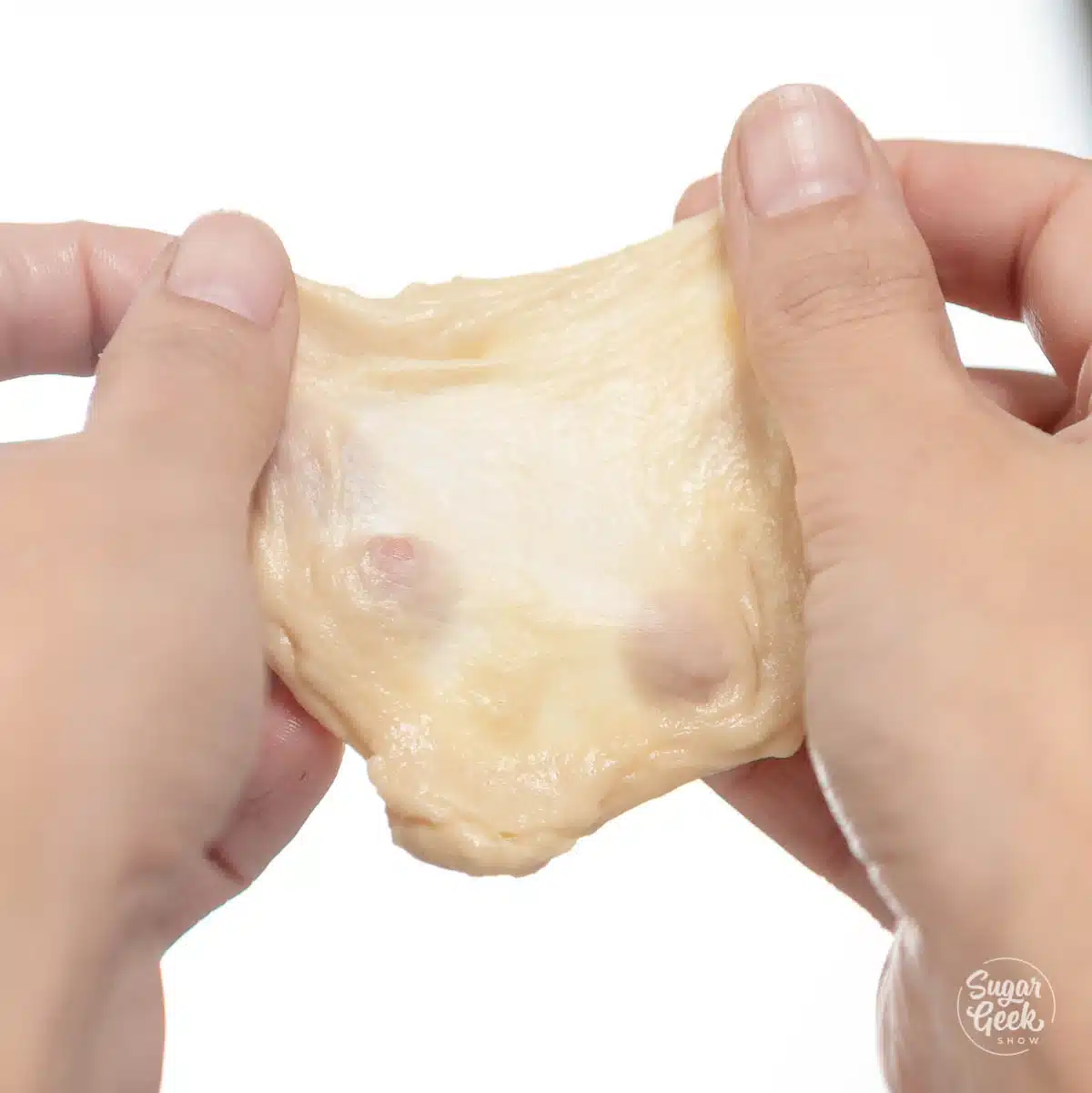
- Run the window pane test for bread to confirm the gluten is developed: pinch off a small piece of dough and stretch it between your fingers. If you can stretch it thin enough to see light through without it tearing, you're done.
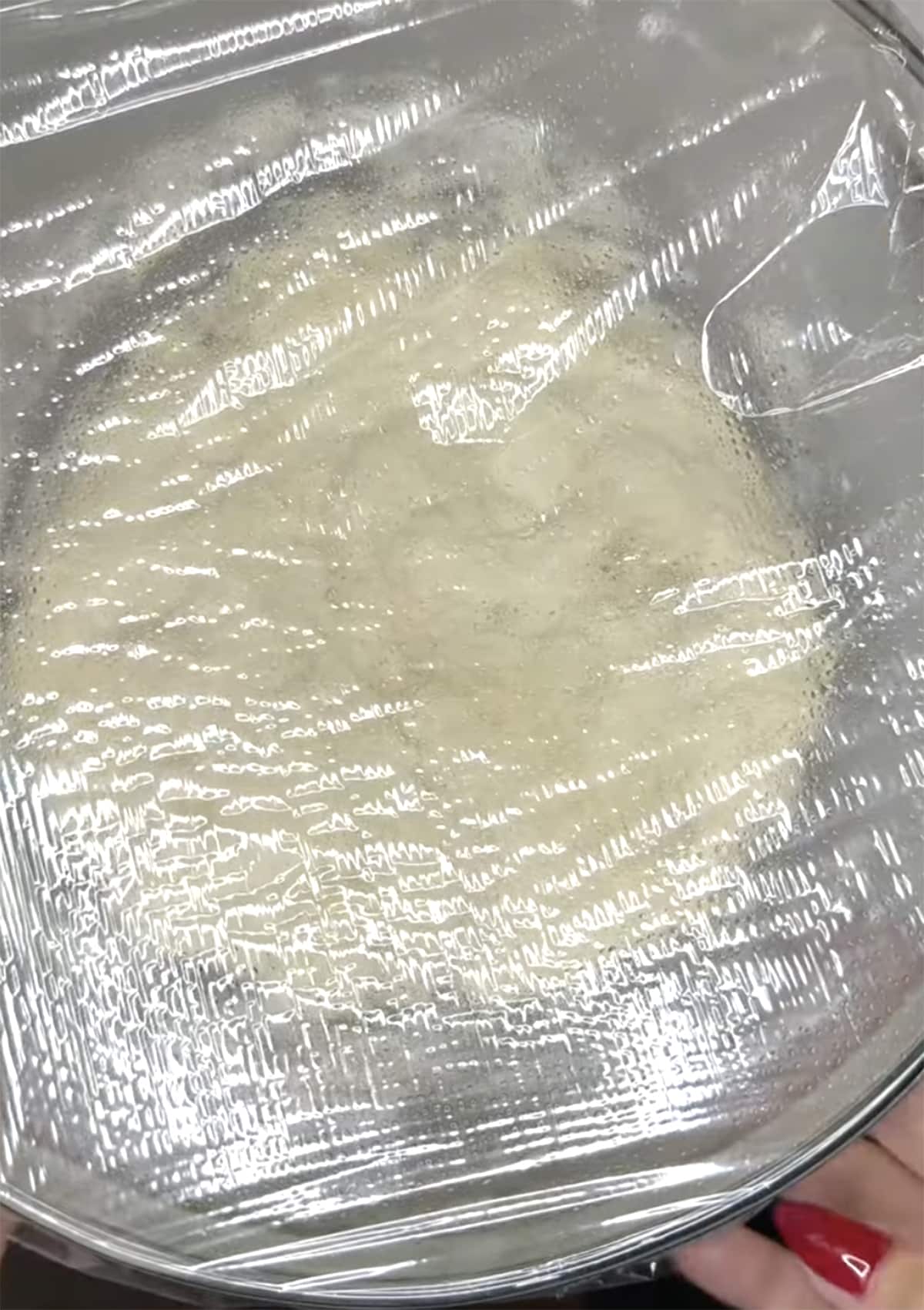
- Shape the dough into a smooth ball and place it in a lightly greased bowl. Cover with a tea towel or plastic wrap. Let it rise in a warm place for 90 minutes, or until doubled in size. If your kitchen is cool, give it more time; don't rush it.
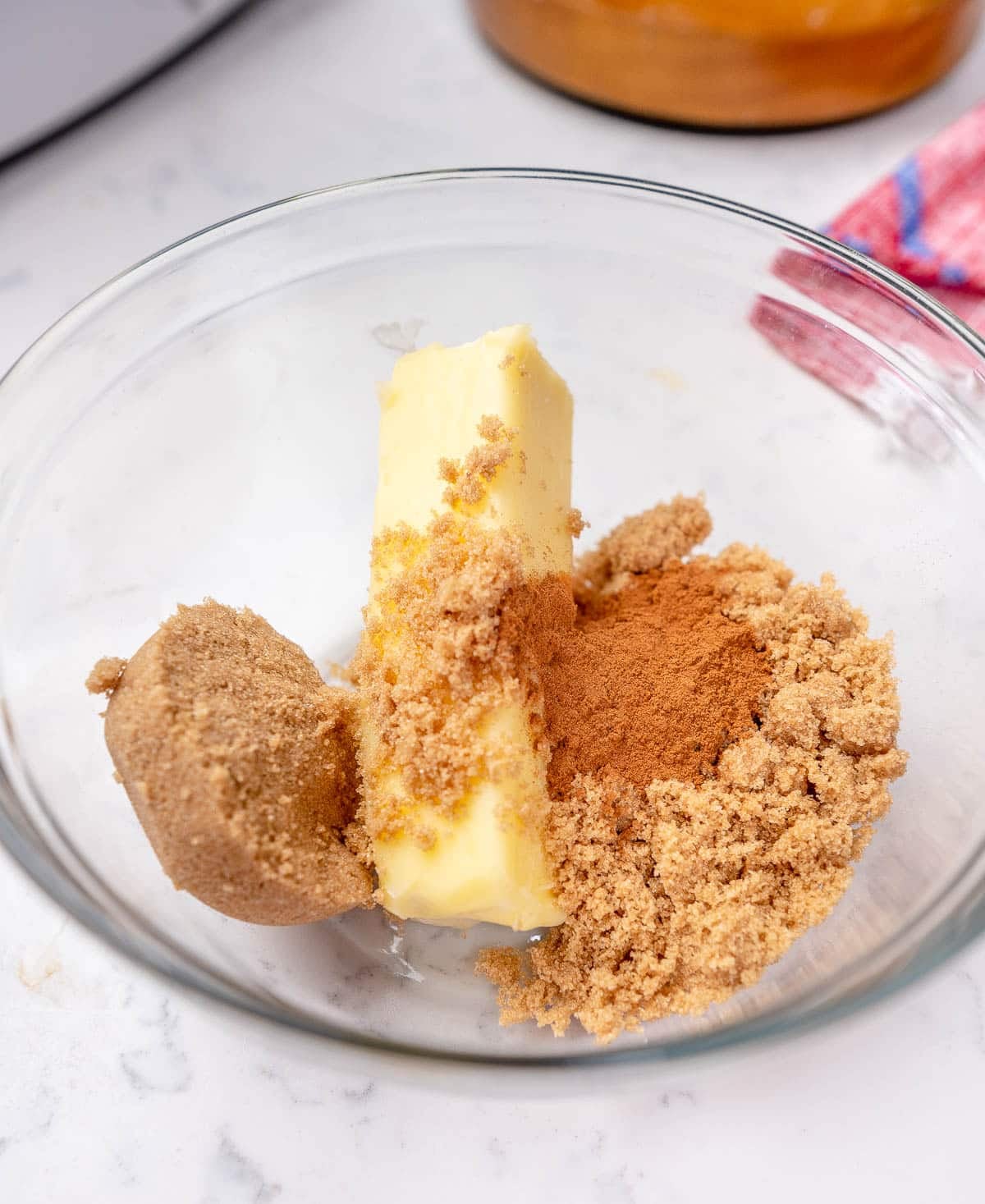
- Make the cinnamon filling while the dough rises. Combine the softened butter, brown sugar, and cinnamon in a small bowl with a hand mixer or spoon until smooth and spreadable. Set aside at room temperature so it stays soft.
PRO TIP: The warmest spot in most kitchens is the oven with the light on and the oven OFF. Preheat the oven to 170º F for 5 minutes, turn it off, place a bowl of warm water in the back, then put your dough bowl in. That creates a steady 80º F to 90º F environment.
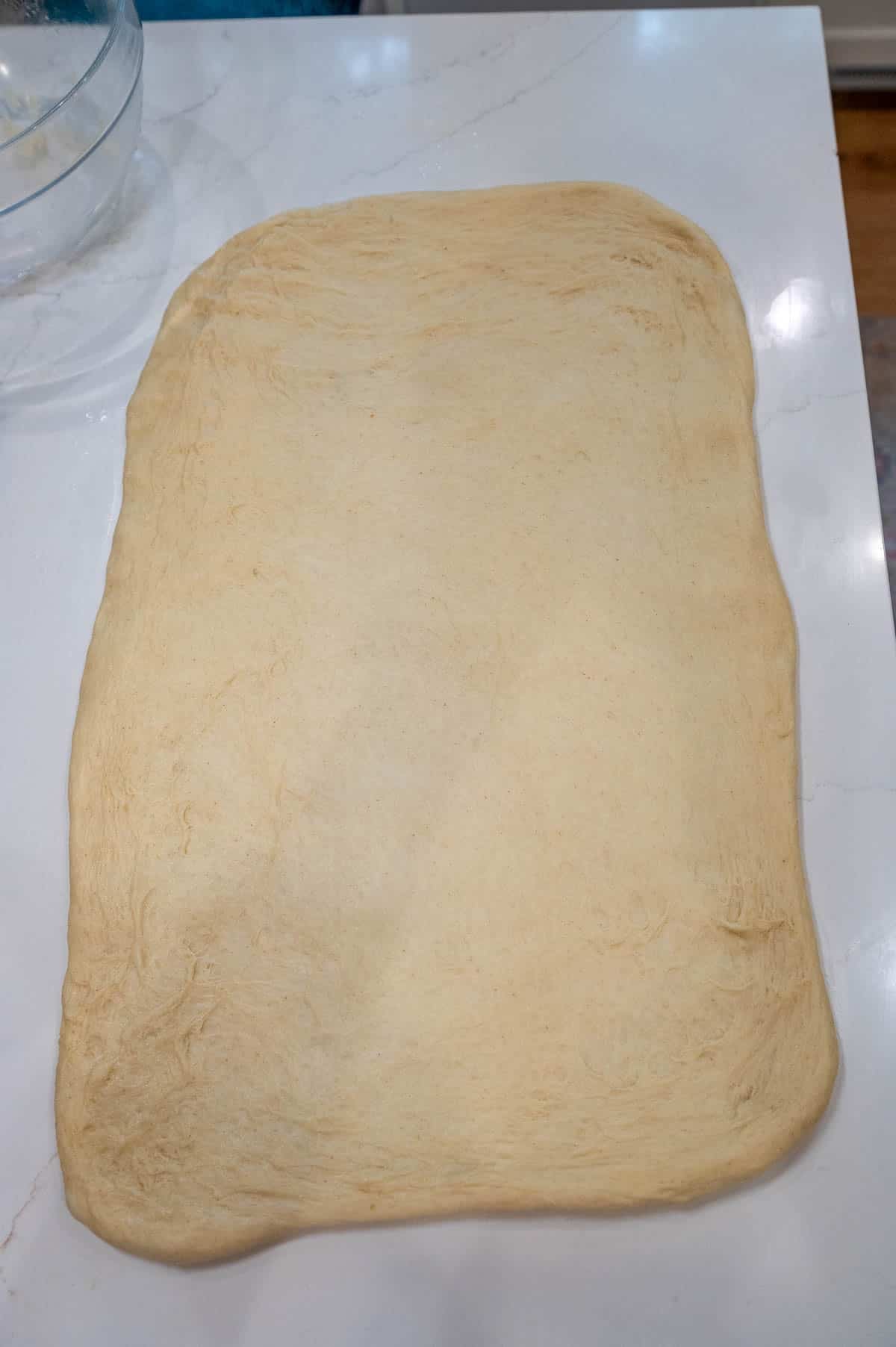
- Turn out the proofed dough onto a lightly floured surface. Roll it into a rectangle 18 inches wide and about 8 inches tall, roughly a quarter inch thick. Don't be afraid to use enough flour to keep the dough from sticking to the surface or the rolling pin.
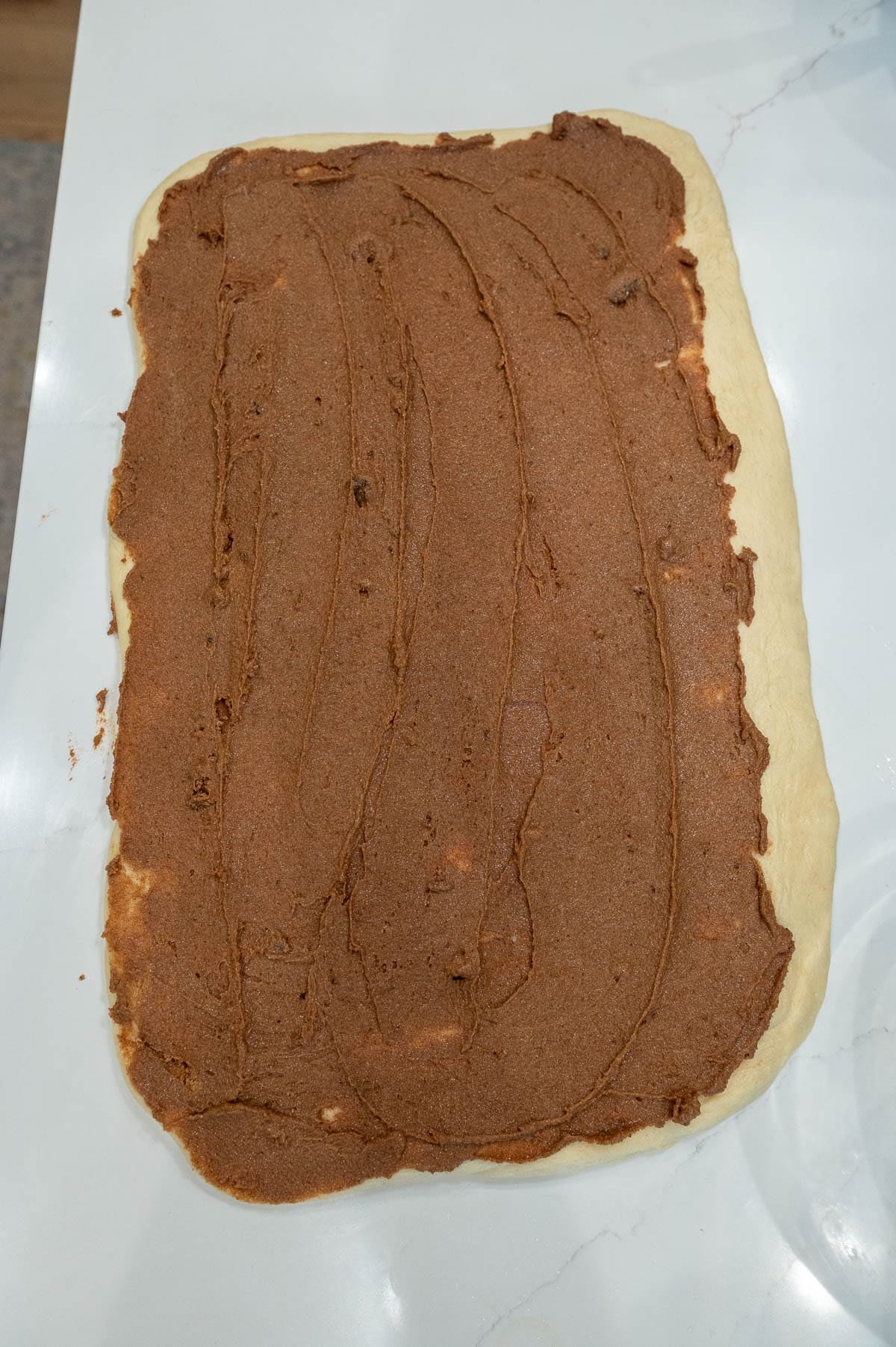
- Spread the cinnamon filling evenly over the surface of the dough, leaving a 1-inch bare strip along the long edge furthest from you. That bare strip is what will seal the roll closed.
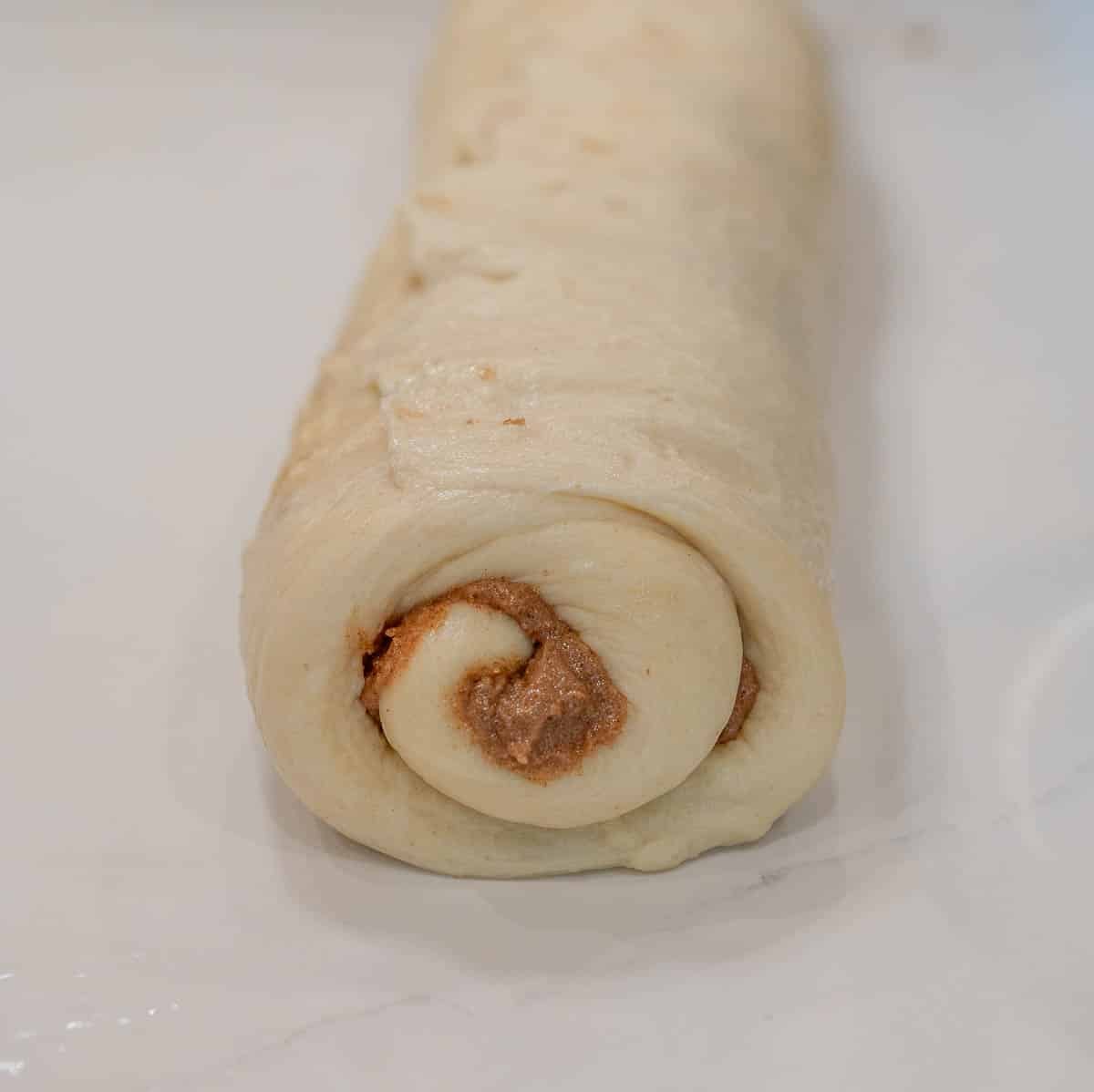
- Roll the dough up tightly into a log, starting from the long edge nearest you. The first roll matters most; get a tight spiral going from the very start. Continue rolling, applying gentle, even pressure, until you reach the bare strip. Brush the strip with a little water or egg wash and press the seam closed.
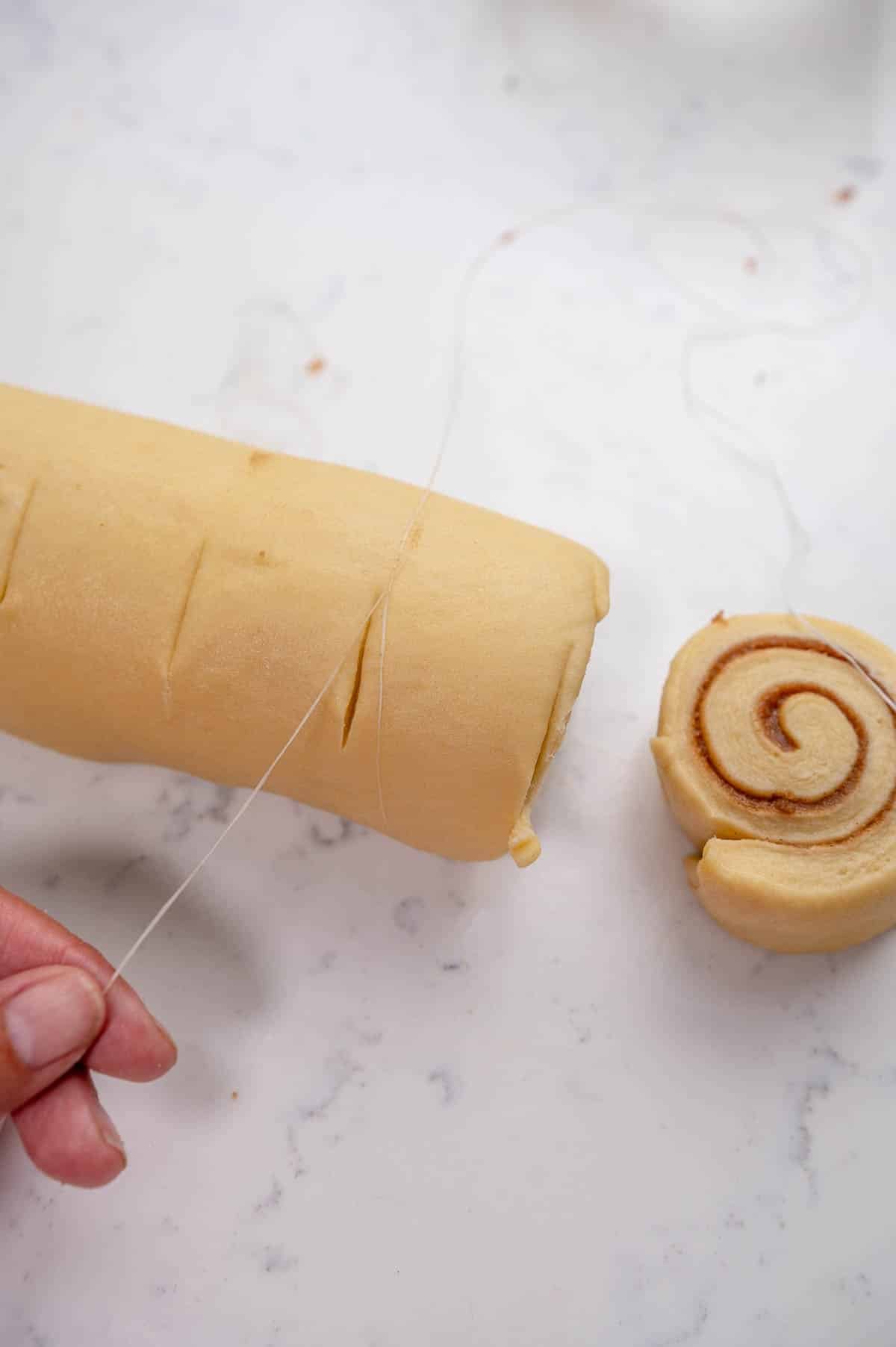
- Cut the log into 12 equal pieces using unflavored dental floss. Slide a long piece of floss under the log, cross the ends over the top, and pull to slice cleanly without squishing. Each roll should be about 1.5 inches wide. A ruler helps if you want consistent sizes.
PRO TIP: Don't use a knife. A knife squishes the spiral and you lose those clean cinnamon lines on top. Dental floss is the move every time. Unflavored only, mint floss will ruin your dough.
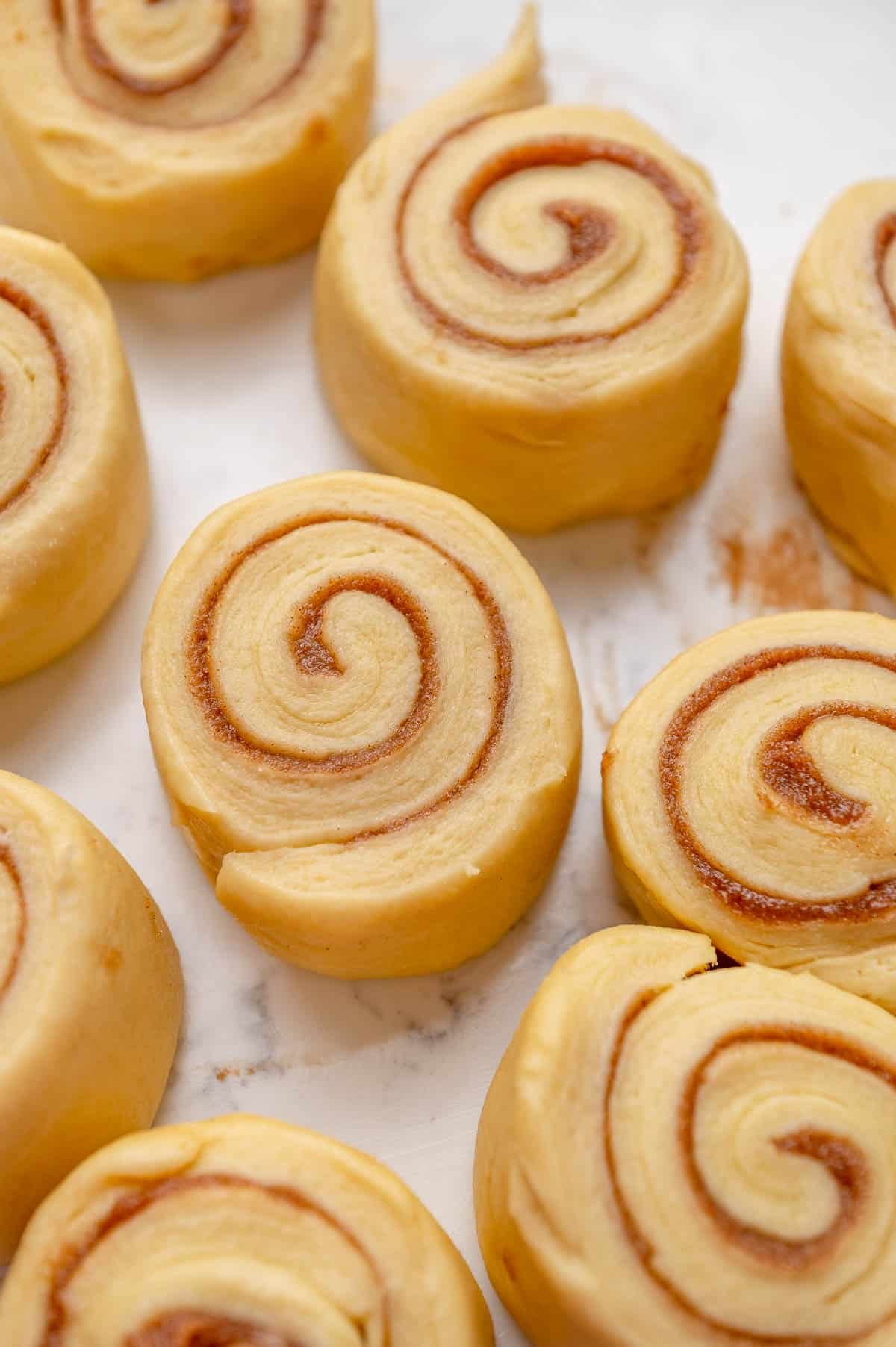
- Place the rolls in your parchment-lined sheet pan, spaced evenly apart so they have room to expand during the second rise. They'll merge slightly as they proof, which is fine and gives you that pull-apart connected edge.
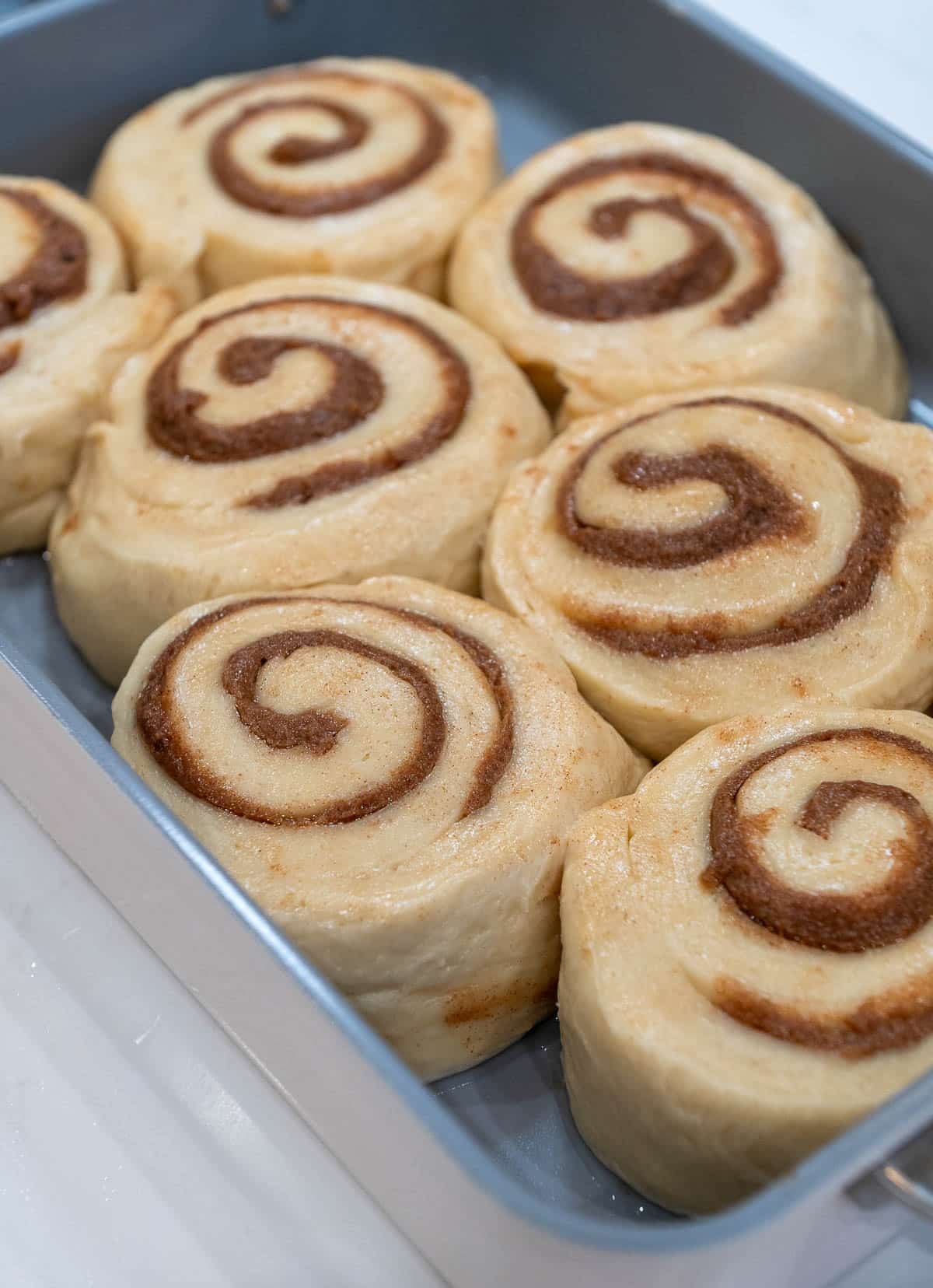
- Cover loosely with a tea towel and let rise in a warm place for about 90 minutes, or until doubled in size. The rolls should look puffy and the spirals should still be visible but expanded.
Preheat your oven to 350º F during the last 30 minutes of the second rise. Make sure the rack is in the middle position.
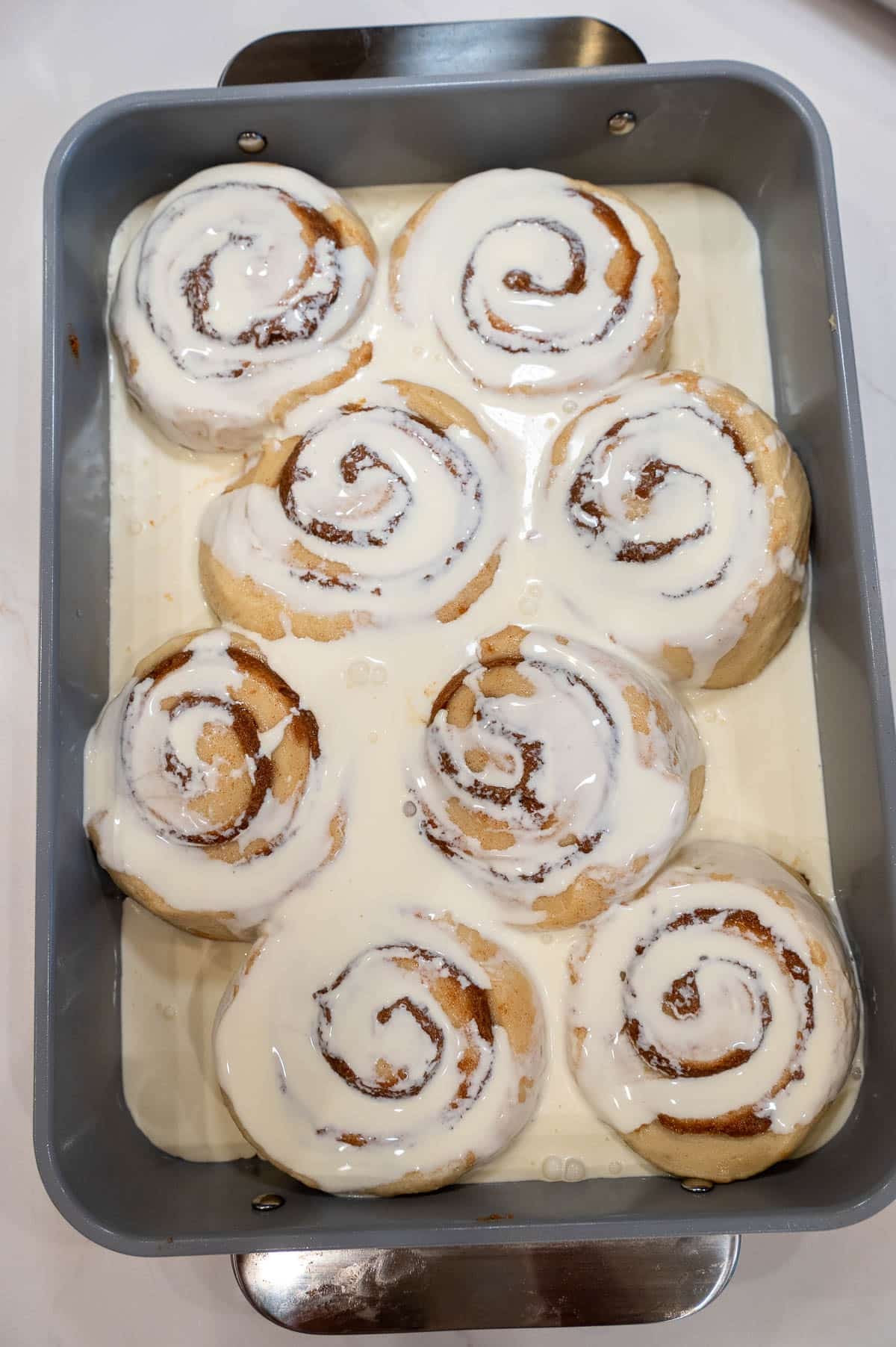
- Right before baking, pour the heavy cream evenly over the proofed rolls. This is the magic step, do not skip it. The cream will pool around the base of each roll and absorb in during the bake.
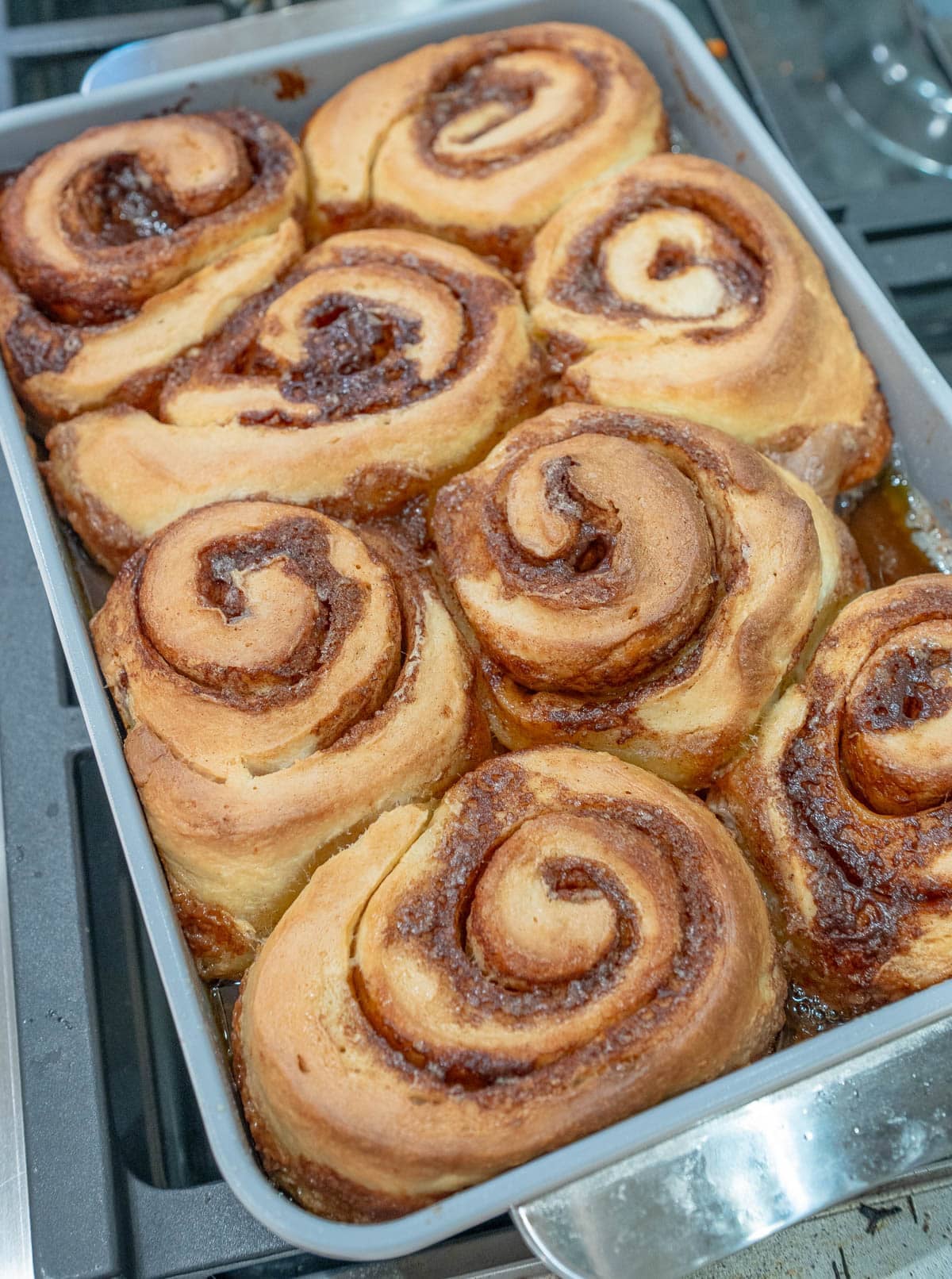
- Bake at 350º F for 25 to 30 minutes, until the tops are golden brown and the internal temperature of the center roll reads 200º F on an instant-read thermometer. Color isn't enough on its own. The outsides can be brown while the centers are still doughy. Use the temperature reading to be sure.
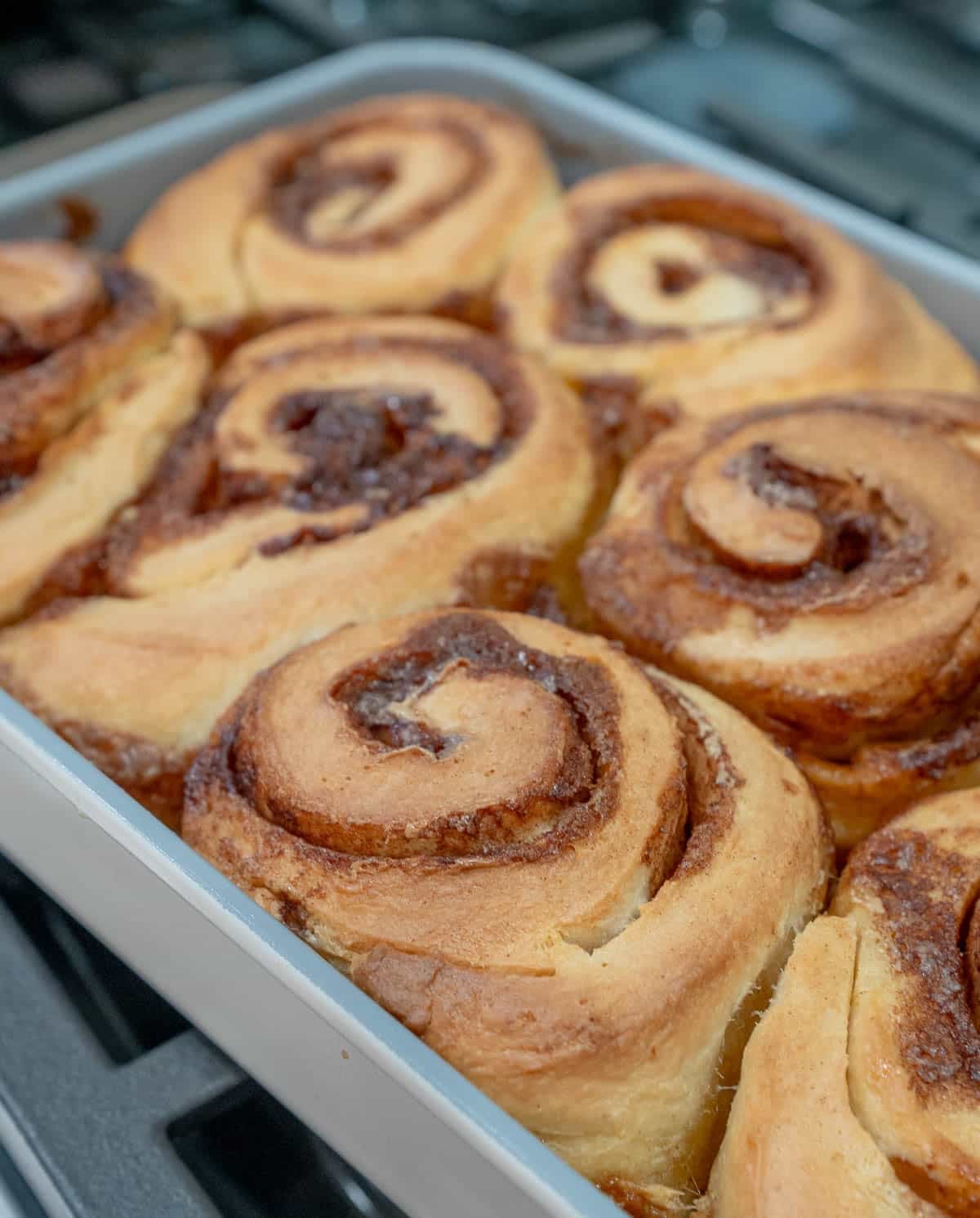
- Let the rolls cool in the pan for 5 to 10 minutes while you make the frosting. They're at peak texture when warm, not piping hot. The cream needs a minute to finish doing its work after the oven.
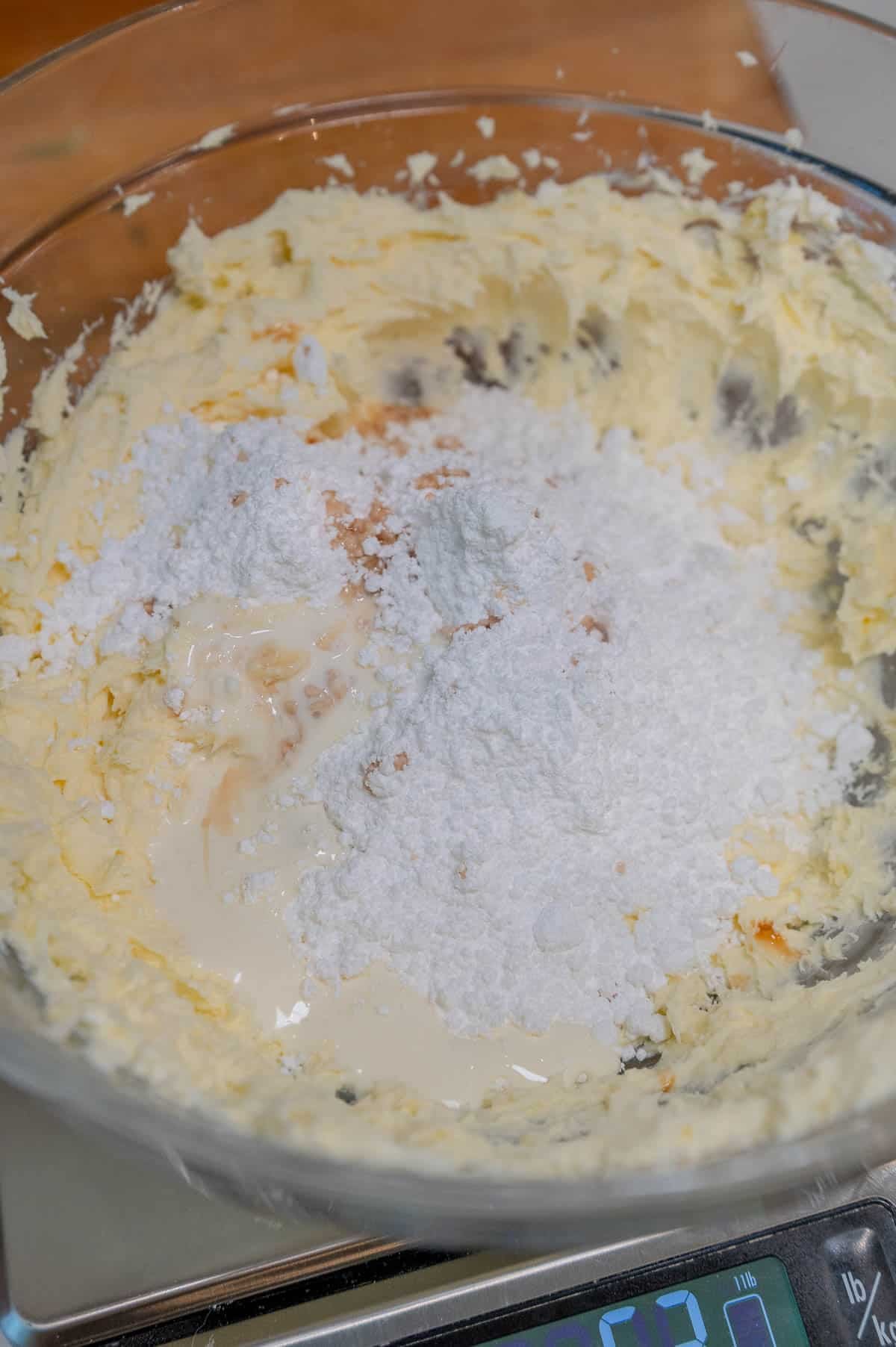
- Make the cream cheese frosting. In a medium bowl, beat the softened cream cheese with a hand mixer until smooth and lump-free. Add the softened butter and beat until smooth. Add the powdered sugar, salt, vanilla, and a Tablespoon of heavy whipping cream. Beat until smooth and spreadable.
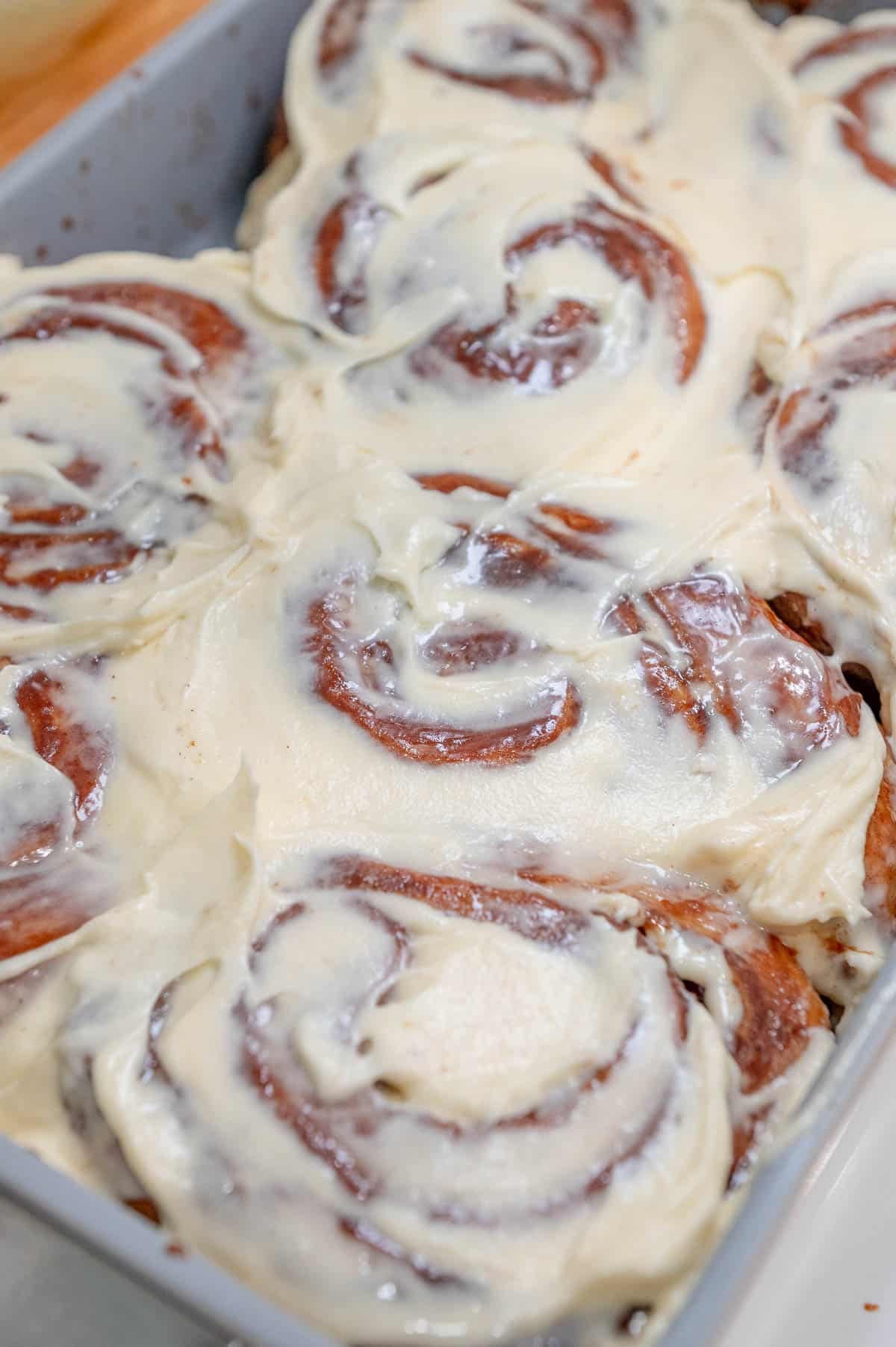
- Spread the frosting over the warm cinnamon rolls while they're still warm so the frosting partly melts into the spirals and partly sits on top. Don't wait until they're cold; the frosting won't hug the rolls the same way.
Same-Day Vs Overnight Ferment
The same-day method I just walked you through takes about 3 hours from start to finish. Some weekends, you don't have 3 hours of attention to give. Here is how to shift the timing without losing what makes these rolls special.
Same-day method (the default).
- Mix the dough
- 90 minutes first rise
- Shape
- 90 minutes second rise
- Bake
- Total active time is about 25 minutes; total elapsed time is roughly 3.5 hours. The standard method when you have a few hours.
Overnight method: the dough rests in the fridge.
- Mix the dough
- 90 minutes first rise on the counter
- Cover and refrigerate overnight (up to 18 hours)
- In the morning, let the dough come to room temperature for 30 to 45 minutes
- Shape
- 90 minutes second rise
- Bake
- The cold ferment deepens the sourdough flavor (more lactic acid develops at fridge temperature) and gives you a tangier roll. The option to reach for when you want to do most of the work the night before.
Overnight method, shaped rolls rest in fridge (easiest method)
The most hands-off morning option, perfect if you want to be in pajamas the entire time you're making breakfast.
- Mix the dough
- 90 minutes first rise on the counter
- Shape the rolls and place in the sheet pan
- Cover tightly with plastic wrap and refrigerate overnight (up to 18 hours)
- In the morning, let the rolls come to room temperature for 60 to 90 minutes until puffy
- Pour the cream over and bake
A quick word on flavor. Sourdough discard's two main acids develop at different temperatures. Lactic acid (the mild, creamy, yogurt-like tang) thrives in the fridge between 40º F and 70º F. Acetic acid (the sharp, vinegar-like tang) thrives at room temperature, around 75º F and up. If you ferment overnight in the fridge, you get more lactic acid, so the rolls taste creamy-tangy. If you ferment longer at room temperature, you get more acetic acid and a sharper tang. For cinnamon rolls, lactic is usually what you want, so the overnight fridge ferment is the sweet spot for deep flavor without going sour.
Sample Bake Schedule
For people who want to plan around when the rolls land on the table.
Same-day for breakfast at 9 AM:
- 5:30 AM, mix the dough
- 6:00 AM, first rise (90 minutes)
- 7:30 AM, shape rolls, second rise (90 minutes)
- 9:00 AM, pour cream and bake
- 9:30 AM, frost and serve
Same-day for brunch at noon:
- 8:30 AM, mix the dough
- 9:00 AM, first rise
- 10:30 AM, shape, second rise
- 12:00 PM, pour cream and bake
- 12:30 PM, frost and serve
Overnight (most hands-off, do the work the night before):
- 7:00 PM (night before), mix the dough, first rise on counter
- 8:30 PM, shape rolls into the sheet pan, cover, refrigerate
- 7:00 AM (morning of), take pan out of fridge, let come to room temperature
- 8:30 AM, pour cream over and bake
- 9:00 AM, frost and serve
Common Sourdough Discard Cinnamon Roll Problems To Avoid
- Dough isn't rising during the first rise. Cool kitchen is the most common cause. The yeast wants 75º F to 85º F to be happy. Move the bowl to the oven with the light on, or near a heating vent. Second most common cause is dead yeast, check the expiration date on your instant yeast. If your dough hasn't doubled in 90 minutes at 75º F or warmer, give it another 30 to 60 minutes.
- Dough is too sticky to roll out. Warmer kitchens lead to softer dough. Sprinkle 2 to 3 Tablespoons of flour on the dough and rolling surface and try again. If it's still too sticky, chill the dough in the fridge for 20 minutes to firm up the butter.
- Dough fights you when rolling, springs back. Gluten is over-relaxed or under-relaxed. Cover the dough with a towel and let it rest for 10 minutes on the counter, then try again. Patience here saves you a fight.
- Spirals fall apart when cutting. You used a knife instead of dental floss, OR you didn't roll the log tightly enough at the start. Both fixable next time. For this batch, just press the cut pieces back together gently and proceed.
- Bottoms burn before the tops are done. Pan is sitting too low in the oven, or your oven runs hot. Move the rack to the middle position and tent the rolls with foil for the last 10 minutes if the tops are getting too brown.
- Centers are doughy after baking. You pulled them too early. Use an instant-read thermometer, the internal temperature should hit 200º F. Color is unreliable, especially with the dark brown sugar filling and the cream pour, you can have golden tops with raw centers.
- Heavy cream didn't fully absorb, rolls are swimming in liquid. The rolls weren't proofed enough at the second rise. Underproofed rolls don't have enough air pockets to soak in the cream, so it just pools. Next time, give them the full 90 minutes (or until they look distinctly puffy).
- Rolls are dense instead of fluffy. Either you under-mixed the dough (window pane test failed, gluten not developed enough), or you over-floured during rolling and the dough lost too much hydration. Mix until window pane passes, and use the minimum flour needed when shaping.
Make This Sourdough Discard Cinnamon Roll Recipe Your Own
The base recipe is the canvas. Here are the variations I keep coming back to.
- Pumpkin spice cinnamon rolls. Add ¼ cup pumpkin puree and 2 teaspoons pumpkin pie spice to the dough. Reduce the milk by 2 Tablespoons to compensate for the moisture. In the filling, add ½ teaspoon pumpkin pie spice along with the cinnamon. Top with maple cream cheese frosting (add 1 Tablespoon maple syrup to the standard frosting).
- Strawberry cinnamon rolls. Use this sourdough discard dough as the base and follow my strawberry cinnamon rolls recipe for the strawberry filling. The sourdough tang plays beautifully with the fresh strawberry flavor, especially in spring and summer.
- Cardamom cinnamon rolls. Add 2 teaspoons ground cardamom to the dough and 1 teaspoon to the filling. The cardamom plays beautifully with the sourdough tang, almost Scandinavian.
- Orange sweet rolls. Add the zest of 2 oranges to the dough and 1 Tablespoon of orange zest to the filling. Add 1 Tablespoon of orange juice to the frosting in place of the heavy cream.
- Chai spice cinnamon rolls. Add 1 teaspoon each ground cardamom, ginger, and allspice to the filling along with the cinnamon. A pinch of black pepper sounds weird and tastes incredible.
- Vanilla bean cinnamon rolls. Scrape the seeds of one vanilla bean into the dough. Add another vanilla bean's worth into the frosting. Pricey, but the flavor is next level.
- Apple cinnamon rolls. Sprinkle 1 cup of finely diced apple (cored, peeled or unpeeled) over the cinnamon filling before rolling. Granny Smith or Honeycrisp both work. Reader-favorite for fall.
- Lemon sweet rolls. Zest of 2 lemons in the dough, no cinnamon in the filling, just 1 cup brown sugar plus 1 Tablespoon lemon zest. Lemon cream cheese frosting (add 1 Tablespoon of lemon juice and zest).
- Chocolate babka cinnamon rolls. Skip the cinnamon and brown sugar filling. Replace with a chocolate filling, melt 4 oz dark chocolate with 4 oz butter, add ½ cup brown sugar and 2 Tablespoons cocoa powder. Spread on the dough and roll.
- Savory cheddar herb rolls (yes, really). Drop the sugar in the dough to 1 Tablespoon. Skip the cinnamon filling. Replace with 1 cup grated sharp cheddar plus 2 Tablespoons each fresh chopped rosemary, thyme, and chives. Skip the frosting, brush with melted garlic butter after baking instead.
- Active starter swap. Use 1 cup of active, recently fed sourdough starter at peak instead of discard AND skip the instant yeast. The active wild yeast will leaven the dough on its own. After cutting and placing the rolls in the pan, let them rise 4 to 6 hours at room temperature until doubled, then bake. This is the traditional sourdough method and gives the most pronounced sourdough flavor.
- Half batch (smaller family or smaller pan). Cut everything in half: 4 oz milk, 5g instant yeast, ½ cup discard, 14 oz flour, 4 oz butter, 2 oz sugar, ½ Tablespoon honey, ½ teaspoon salt, 2 large eggs (or 1.5, round up), 4 oz heavy cream. Yields 6 rolls in a 9x9 or 8x8 baking dish. Same bake temperature, reduce bake time to 22 to 25 minutes.
- Alternative pans. A 9x13 baking dish fits 12 rolls snugly (instead of the 13x18 sheet pan), giving you taller, gooier rolls with a bit less crust. Cast iron 12 inch skillet works for a smaller batch (6 to 8 rolls). 10 inch springform pan works for special occasion presentation, just put a baking sheet under it to catch any drips.
Make-Ahead, Storage, And Reheating
Cinnamon rolls are the perfect make-ahead breakfast. Here is the full matrix.
- Mixed dough in the fridge (before first rise). Up to 18 hours. Mix the dough, place in a greased bowl, cover with plastic wrap, refrigerate. In the morning, take out and let come to room temperature for 30 to 45 minutes before shaping. The cold ferment deepens the sourdough flavor (lactic acid develops in the fridge), so this is actually my preferred method when I have the time.
- Shaped rolls in the fridge (after shaping, before second rise). Up to 18 hours. Cover the sheet pan tightly with plastic wrap and refrigerate. In the morning, uncover, let come to room temperature and finish proofing on the counter (60 to 90 minutes until puffy), then pour cream and bake.
- Frozen unbaked rolls. Up to 2 months. Shape and place rolls in the pan, cover tightly with plastic wrap plus foil, freeze. When ready to bake, transfer to the fridge overnight to thaw, then let come to room temperature and proof on the counter for 90 minutes, pour cream, bake.
- Baked rolls at room temperature. Up to 2 days, covered loosely with a tea towel or foil. The frosting will start to seep slightly after the first day, which is honestly when they're at their best.
- Baked rolls in the fridge. Up to 5 days in an airtight container. Reheat individually in the microwave for 20 to 30 seconds or all together in a 300º F oven for 10 minutes, covered with foil so they don't dry out.
- Frozen baked rolls (best frozen unfrosted). Up to 3 months. Cool completely, wrap individually in plastic, then in a freezer bag. Thaw overnight on the counter, warm in a 300º F oven for 10 minutes, then frost.
- Sourdough discard itself. Up to 1 week in the fridge for this recipe. Older discard gives a sharper tang.
Final Thoughts
Cinnamon rolls are the kind of recipe that becomes a tradition almost on accident. Once you start making them with discard, you'll notice the regular yeast-only version starts to feel a little one-dimensional. The discard does something for the texture and the flavor that you don't fully appreciate until you've had both.
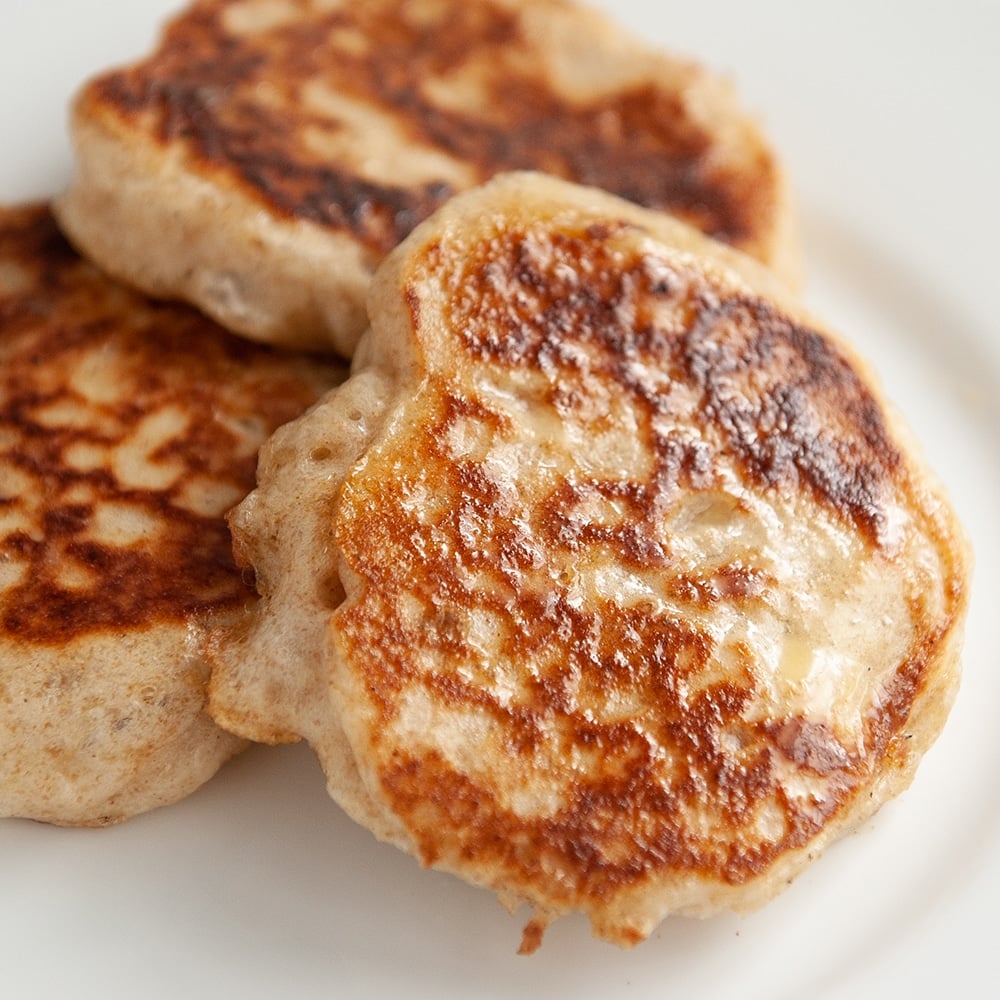
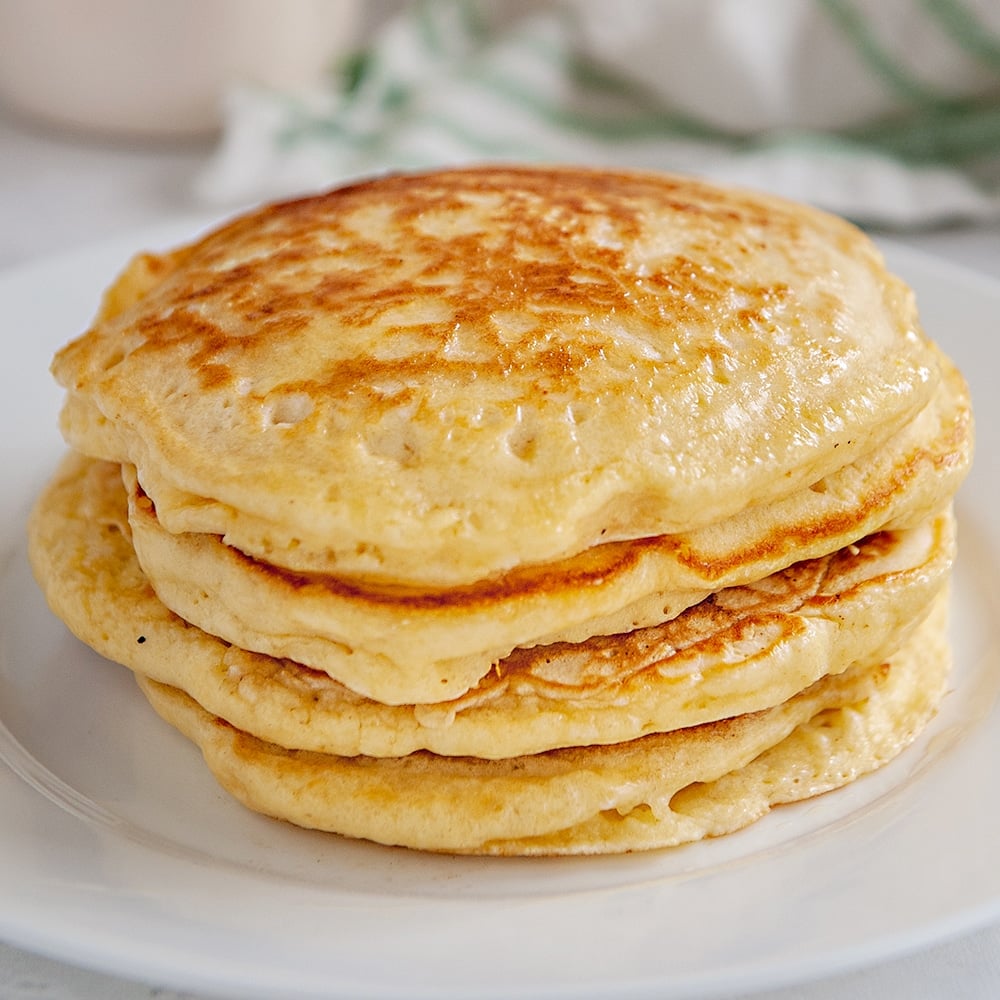
If you've kept reading this far, you're the type of baker who wants to know why before you commit to a recipe. That's my favorite kind of reader. Go make the rolls, and if you want the rest of the discard cluster, my sourdough discard pancakes are the easiest weekday breakfast, my sourdough discard donuts are the weekend showstopper, my sourdough discard blueberry muffins are the bakery-style breakfast meal prep, my sourdough discard crackers are the snack project, and my sourdough pikelets are the 5-minute small bite.
For storage, freezing, the visual aging timeline, and a 5-day rotation calendar that uses every cup of discard you make, see my master discard guide.
Sourdough Discard Cinnamon Roll FAQs
Most quick sourdough discard cinnamon roll recipes online use baking soda and baking powder because the discard's natural acid (pH 3.5 to 4.5, similar to orange juice) reacts with baking soda to create fast chemical lift, the same way buttermilk works in biscuits. Those recipes are fast (often 30 minutes to an hour total) but the rolls come out biscuit-textured and denser because chemical leavening doesn't develop the gluten and air-pocket network that yeast does over a long rise. My version uses instant yeast for the leavening so you get true pillowy, pulled-apart cinnamon roll texture. The discard still handles flavor and tenderness work (the acid weakens the gluten just enough), but the structural lift comes from the yeast. It's a real cinnamon roll, not a biscuit-style shortcut. The heavy cream pour also works much better with yeasted rolls because the air pockets from the yeast act like little sponges for the cream during the bake.
Strongly recommended but not required. The dough mixes for 10 to 20 minutes to develop enough gluten for that pillowy texture, and that's hard work by hand. If you don't have a stand mixer, you can knead by hand on a lightly floured surface for at least 15 to 20 minutes, until the dough passes the window pane test. Expect tired arms. A handheld mixer with dough hooks won't get you there, the motor isn't strong enough to run for that long under that much resistance. If you make these regularly, the stand mixer is the upgrade worth making.
The fat content is the whole reason this trick works. Heavy cream is roughly 36% fat. When you pour it over the rolls and bake, the fat coats the starch granules in the dough and slows water from setting into a dry crumb, that's what makes the centers stay almost custardy. Milk (3 to 4% fat) doesn't have enough fat to do the same job. It would absorb into the rolls but you wouldn't get the ooey gooey middle texture, just slightly moister rolls. Half-and-half (about 12% fat) is the closest substitute if heavy cream isn't available, but the result is noticeably less rich. Don't substitute milk.
Yes. Make the frosting up to 3 days ahead and refrigerate in an airtight container. Take it out 30 minutes before frosting so it softens enough to spread, or microwave it in 5 second pulses, stirring between each, until spreadable. Don't fully melt it or it will run off the rolls.
Fresh discard (under a week old, fridge-stored) gives you a milder, creamier tang. Older discard (one to two weeks, fridge-stored) gives you a sharper, more pronounced sourdough flavor. Both work great. For a first time making these rolls, go with fresh and tweak from there based on how much tang you like.
More Sourdough Breakfast Recipes To Try


Leave Me A Review
⭐️⭐️⭐️⭐️⭐️
If you tried this Sourdough Cinnamon Roll Recipe or any other recipe on my blog, please leave a 🌟 star rating and let me know how it goes in the comments. I love hearing from you!
Recipe
Equipment
- One sheet pan (13"x18") or similar sized pan
Ingredients
Cinnamon Roll Dough
- 8 ounces milk 90ºF
- 1 Cup sourdough discard doesn't have to be exact
- 10 grams dried instant yeast
- 28 ounces bread flour or all purpose flour
- 8 ounces butter softened
- 4 ounces sugar
- 1 teaspoon salt
- 3 large eggs room temperature
- 1 Tablespoon honey optional
- 8 ounces heavy cream (for soaking the rolls)
Cinnamon Filling
- 8 ounces unsalted butter softened to almost melted
- 8 ounces brown sugar
- 2 Tablespoons cinnamon
Cream cheese frosting
- 8 ounces cream cheese softened
- 4 ounces unsalted butter softened
- 4 ounces powdered sugar
- ½ teaspoon salt
- 1 Tablespoon heavy whipping cream or less if you like a thicker consistency
- 1 Tablespoon vanilla extract
Instructions
- Before you begin: Warm the milk to 90º F. Bring the eggs and butter to room temperature. Line a 13"x18" sheet pan with parchment paper. Have your stand mixer ready with the dough hook attached.
For the dough
- Place the warm milk, sourdough discard, instant yeast, and half of the flour into the bowl of your stand mixer with the dough hook attached. Mix on low until combined.
- Add the softened butter, sugar, salt, eggs, honey, and the rest of the flour to the mixer. Mix on low until combined.
- Let the dough mix on medium speed for 10 to 20 minutes, or until the dough forms a ball and cleans the sides of the bowl. The dough will be very sticky at first; just keep mixing.
- Shape the dough into a smooth ball and place it in a lightly greased bowl. Cover with a tea towel and let rise for 90 minutes in a warm place, or until doubled in size.
For the cinnamon sugar filling
- Combine the softened butter, brown sugar, and cinnamon in a small bowl. Mix until smooth and spreadable. Set aside at room temperature.
To make the rolls
- Turn the proofed dough out onto a lightly floured surface. Roll into a rectangle 18 inches wide and 8 inches tall.
- Spread the cinnamon filling evenly over the dough, leaving a 1 inch bare strip along the long edge furthest from you.
- Roll the dough up tightly into a log starting from the long edge nearest you. Make the first roll very tight to start a clean spiral. Brush the bare strip with water or egg wash and press to seal the seam.
- Cut the log into 12 equal pieces (about 1.5 inches each) using unflavored dental floss. Slide the floss under the log, cross the ends over the top, and pull to slice cleanly.
- Place the rolls in the parchment-lined sheet pan, spaced evenly apart.
- Cover loosely with a tea towel and let rise in a warm place for about 90 minutes, or until doubled in size.
Bake
- Preheat the oven to 350º F during the last 30 minutes of the second rise.
- Right before baking, pour the heavy cream evenly over the proofed rolls.
- Bake at 350º F for 25 to 30 minutes, or until the internal temperature reaches 200º F and the tops are golden brown.
- Let the rolls cool in the pan for 5 to 10 minutes.
Make the frosting
- Beat the cream cheese with a hand mixer until smooth and lump-free. Add the softened butter and beat until smooth. Add the powdered sugar, salt, vanilla, and heavy whipping cream. Beat until smooth and spreadable.
- Spread the frosting over the warm cinnamon rolls. Serve warm.
Video
Notes
- Bread flour gives you the fluffiest, slightly chewy texture. AP flour works too, slightly less structured result.
- Use cold discard from the fridge, no need to bring to room temperature.
- Honey is an invert sugar that keeps the rolls softer for longer. Maple syrup or corn syrup work as 1:1 swaps.
- For active dry yeast (instead of instant), dissolve in the warm milk with 1 Tablespoon of sugar for 5 to 10 minutes until foamy before adding the rest of the ingredients.
- 13"x18" half-sheet pan: standard for this recipe, yields 12 rolls with crispy edges.
- 9"x13" baking dish: tighter spacing, taller and gooier rolls. Add 2 to 3 minutes to bake time.
- 12" cast iron skillet: best for a half batch (6 rolls). Bake 22 to 25 minutes.
- 10" springform pan: special occasion presentation. Put a baking sheet under to catch drips.
- Mixed dough in the fridge: up to 18 hours. Let come to room temperature 30 to 45 minutes before shaping.
- Shaped rolls in the fridge: up to 18 hours. Let come to room temperature and proof 60 to 90 minutes before baking.
- Frozen unbaked rolls: up to 2 months. Thaw overnight in fridge, room temperature proof, then bake.
- Baked rolls at room temperature: up to 2 days, loosely covered.
- Baked rolls in the fridge: up to 5 days, airtight container.
- Frozen baked rolls (unfrosted): up to 3 months. Thaw and warm at 300º F for 10 minutes, then frost.
- Active starter swap: 1 cup of active starter at peak instead of discard AND skip the instant yeast. Let shaped rolls rise 4 to 6 hours at room temperature before baking.
- Buttermilk swap: replace the 8 oz milk with 8 oz buttermilk for an extra tangy version.
- Half batch: cut all ingredients in half. Yields 6 rolls in a 9x9 or 8x8 pan. Reduce bake time to 22 to 25 minutes.
- Flavor variations: see the Make This Recipe Your Own section above for pumpkin, cardamom, orange, chai, vanilla bean, apple, lemon, chocolate, and savory cheddar herb versions.
- Don't skip the heavy cream pour. The whole reason this recipe is special.
- Don't use a knife to cut the rolls. Unflavored dental floss only, knives squish the spiral.
- Don't pull the rolls early. Internal temperature 200º F or you'll have raw centers.
- Don't frost cold rolls. The frosting won't hug the rolls and won't melt into the spirals.
- Don't use mint dental floss. Yes, people have done this. The rolls will taste like toothpaste.

Brook says
They turned out amazing!!! Super fluffy, tender, gooey, a tiny bit chewy… my family is so impressed!