
This is the perfect classic white cake recipe. It's light, fluffy, moist, and bright white with a delicate crumb. There is a running joke in the cake world that white is not a flavor, that it is really just a vanilla cake without the yolks, but a true white cake is so much more.
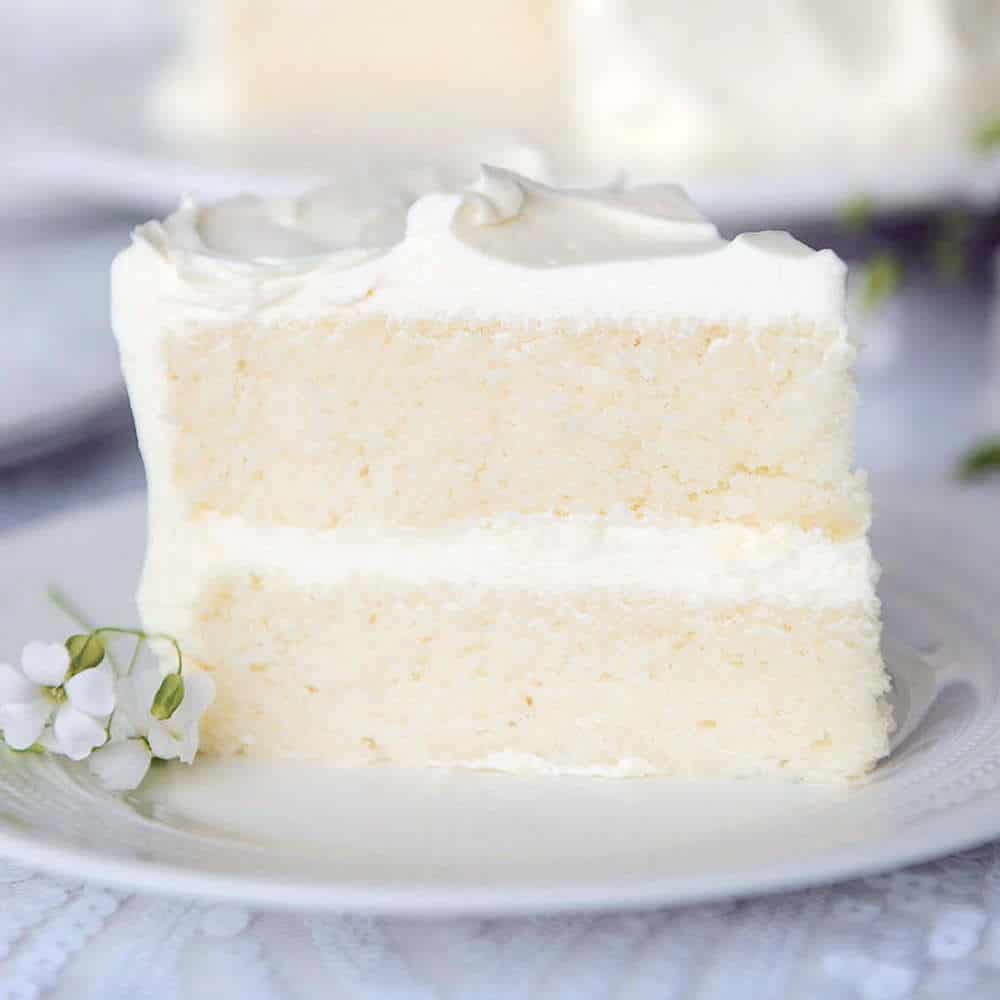
I have been making this white cake for years, and it is the base I reach for more than any other. By dropping the egg yolks and using only egg whites, the crumb bakes up bright white and a little more delicate, which is exactly what you want under a wedding cake or any elegant layer cake. It pairs beautifully with white chocolate ganache, and it is the same sturdy base I use for my Oreo cake and a dozen other flavors. White cake, vanilla cake, and yellow cake are all cousins; the way you use the eggs is what changes the color, flavor, and texture.
Quick Glance at the Recipe: White Cake Recipe
- Recipe Name: White Cake Recipe
- Why You'll Love It: Soft, fluffy white cake with a delicate crumb and bright white color that's perfect for decorating.
- Time and Difficulty: Intermediate. About 15 minutes of active prep and 25 to 35 minutes of baking.
- Main Ingredients: All-purpose flour, egg whites, butter, sugar, milk, oil, baking powder, and vanilla (plus almond if you like a classic white wedding cake flavor).
- Method: Traditional creaming method, egg whites added one at a time to whipped butter and sugar, then dry and wet alternated in.
- Texture and Flavor: Light, tender crumb with a subtle vanilla flavor and moist interior.
- Quick Tip: Wrap the cakes while still warm and flash chill them to lock in moisture.
Jump to:
- Quick Glance at the Recipe: White Cake Recipe
- What Makes This White Cake Recipe Different
- White Cake vs Vanilla Cake vs Yellow Cake
- White Cake Ingredients
- Why I Bake White Cake At 335º F
- Why Isn't My White Cake White?
- How To Make White Cake Step-By-Step
- Cake Batter and Frosting Calculator
- Cake Batter and Frosting Calculator
- Cups of Batter Needed
- Cups of Frosting Needed
- Common White Cake Problems To Avoid
- Final Thoughts
- Make This White Cake Recipe Your Own
- Frosting swaps
- Pan size conversions
- Make-Ahead and Storage
- Baking White Cake At High Altitude
- White Cake FAQs
- More Cake Recipes To Try
- Watch: How To Decorate A Cake Step-by-Step
- Recipe
What Makes This White Cake Recipe Different
This white cake recipe is the one I keep coming back to because it is reliable, bright white, and endlessly adaptable. Here is what sets it apart:
- Vanilla plus a little almond. That vanilla-almond combo is the classic "wedding cake" flavor. It is optional, but it is what makes people say your cake tastes like a bakery.
- Egg whites do not need to be pre-whipped. A lot of white cake recipes make you whip egg whites to stiff peaks and fold them in by hand. Mine skips that. You add the whites one at a time to the creamed butter and sugar, which gives you a light, fluffy crumb without the extra bowl or the risk of deflating your whites.
- All-purpose flour, not cake flour. I use all-purpose here on purpose. It gives the cake a slightly stronger crumb that holds up to stacking, fondant, and filling. If you want the softer, finer crumb that cake flour gives, that is my white velvet cake.
- Baked at 335º F for a reason. Most recipes bake white cake at 350º F and then tell you to ignore the brown top. I bake lower on purpose, and there is real science to it (whole section below).
- A true workhorse base. This is the cake under my Oreo cake, and it flexes into strawberry, funfetti, marble, and more. Learn this one, and you have learned ten cakes.
White Cake vs Vanilla Cake vs Yellow Cake
People mix these up all the time, but the difference really just comes down to how the eggs are used.
- White cake uses only egg whites, which keeps the crumb bright white and the texture delicate.
- Vanilla cake uses whole eggs, which gives a slightly off-white color and a richer flavor.
- Yellow cake uses egg yolks, which make the cake deep golden and give it a richer, more custardy flavor.
People laugh and say "white" and "yellow" are not flavors, but ordering an "all egg yolk cake" just does not have the same ring to it. The names are shorthand so bakers know exactly what they are working with. White and vanilla are both popular bases for flavored cakes, while yellow cake is traditionally paired with chocolate buttercream or chocolate ganache.
White Cake Ingredients
This recipe uses traditional baking ingredients you probably already have. I always recommend weighing your ingredients with a digital kitchen scale for the most accurate results, even the liquids. The one ingredient worth a special trip is clear vanilla if you want the whitest possible cake.
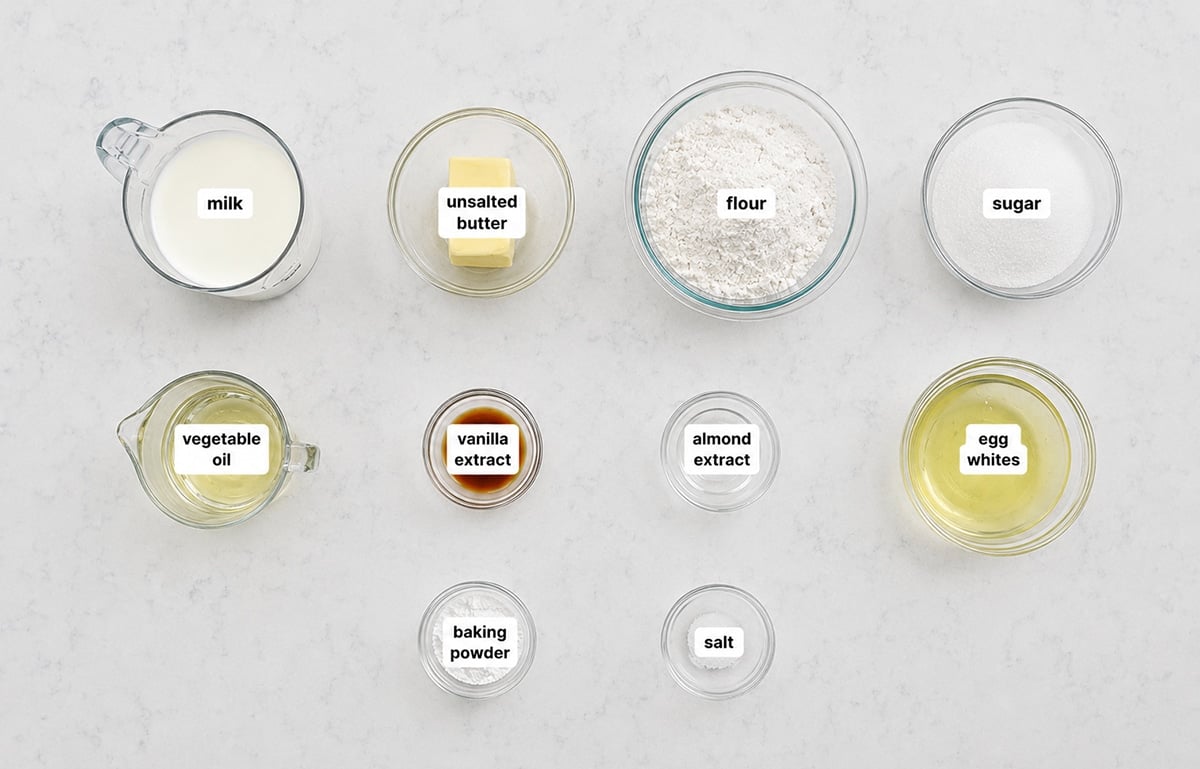
- All-purpose flour provides a slightly sturdier crumb that holds up well for layer cakes. If you prefer a finer, softer crumb, use cake flour, or check out my white velvet cake.
- Egg whites keep the cake bright white while still adding structure and moisture. Fresh egg whites are best here (boxed/carton whites do not always behave the same in a creamed batter).
- Granulated sugar sweetens the cake, and when whipped into the butter, it builds the light, fluffy texture.
- Unsalted butter adds flavor and richness to both the cake and the frosting. It must be soft so it creams properly. If you brown it first, you get my brown butter cake.
- Milk adds moisture and a soft crumb. Warm it slightly so it does not curdle the room-temperature butter.
- Vegetable oil, alongside the butter, keeps the cake moist even after refrigerating.
- Baking powder gives the cake its lift and light texture.
- Salt balances the sweetness and rounds out the flavor.
- Vanilla extract and almond extract. Vanilla is the main flavor, and almond adds that classic wedding-cake note. Use clear vanilla if you want to keep the cake extra white. The almond is optional.
- Pasteurized egg whites and powdered sugar (for the frosting). The Easy Buttercream is a mock Swiss Meringue buttercream that is less sweet than American buttercream and silky smooth.
Why I Bake White Cake At 335º F
The Maillard reaction (the browning that happens when sugars and proteins meet heat) really gets going around 350º F. By baking a little lower, I slow that browning down, which keeps the outside of the cake paler and the crumb closer to true white. Lower and slower also means the cake domes less and bakes flatter, so you have less to trim off the top. It takes a few extra minutes, but you get a whiter, flatter, more level cake, which matters a lot when white and bright is the entire point.
PRO TIP: Every oven is different. If yours runs cool, your cakes may need the full 35 minutes (or a couple more). Go by a toothpick coming out clean and the center springing back, not just the timer.
Why Isn't My White Cake White?
This is the question I get most: "I used egg whites, so why did my cake come out ivory or yellow instead of white?" A few things stack up here:
- Your extract. Regular vanilla extract is caramel-colored and tints the crumb. Clear (imitation) vanilla keeps it bright.
- Your butter. Butter has a natural yellow hue, and it varies by brand. More butter, more tint. There is not much to do about it except know that it is normal. If having a white cake is REALLY important, you can substitute half the butter for vegetable shortening.
- Overbaking and high heat. The longer and hotter the cake bakes, the more the surface browns and the more that color creeps in. This is exactly why I bake at 335º F (see above).
- Crushed or fine add-ins. Fold your add-ins gently so they don't change the color of the cake.
How To Make White Cake Step-By-Step
Before you start: always bring your cold ingredients to room temperature (or even a little warm) so the batter does not break, preheat your oven to 335º F, and prepare two 8"x2" cake pans with cake goop or your preferred pan release. Weigh everything out before you start mixing.
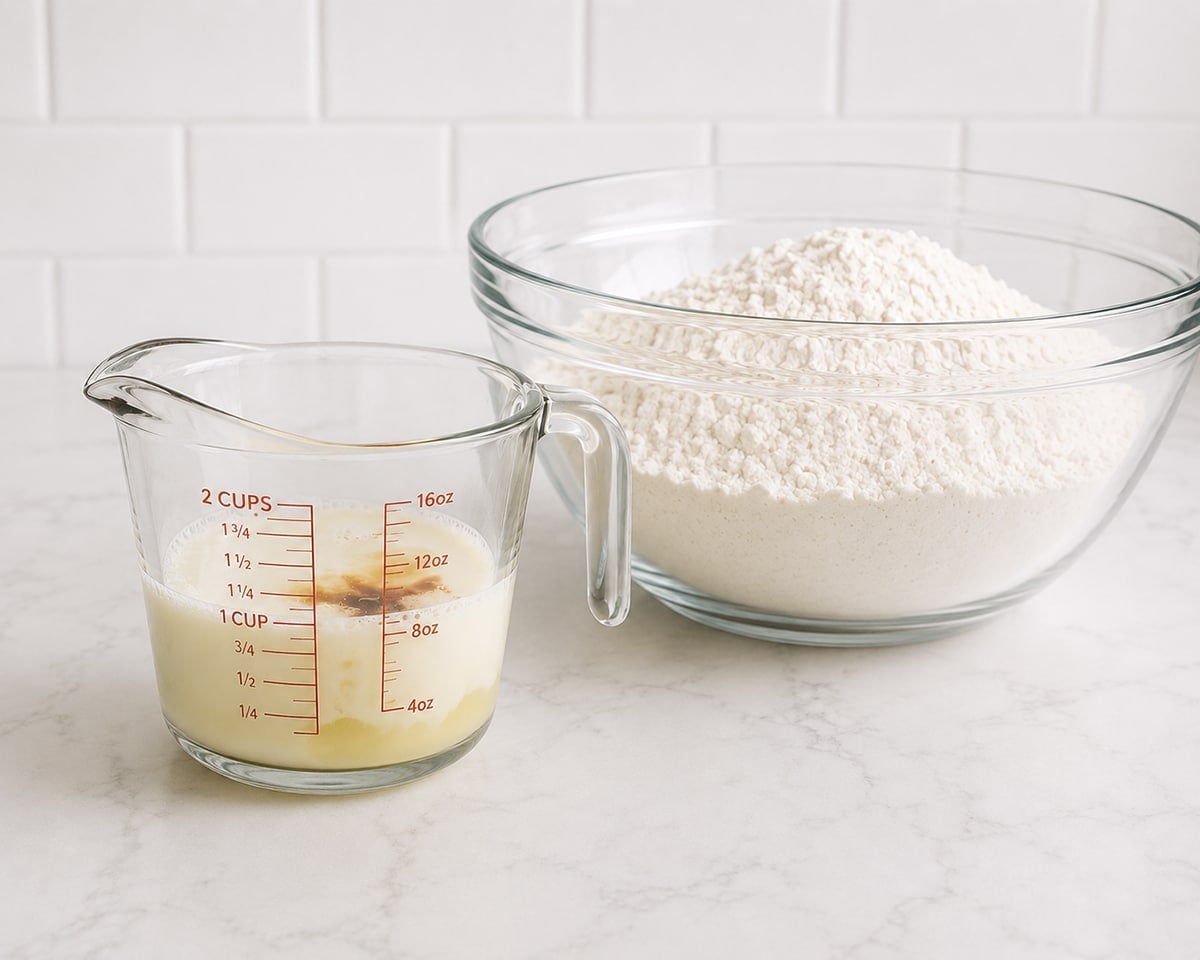
- Combine your wet and dry separately. Stir the warm milk, oil, and extracts together in one cup. In another bowl, whisk the flour, baking powder, and salt. Set both aside.
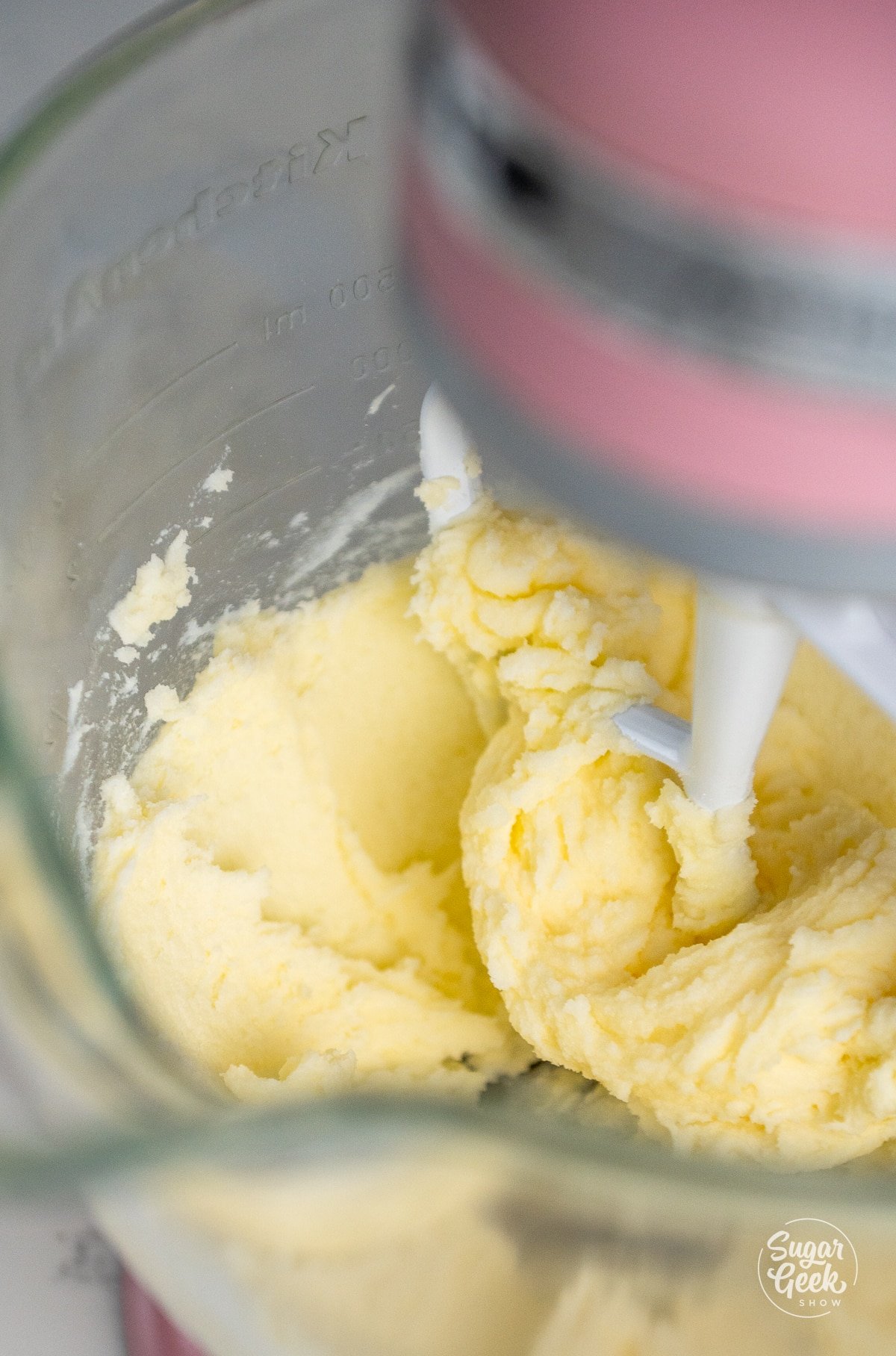
- Cream the butter and sugar. Beat the soft butter smooth with the paddle attachment, then sprinkle in the sugar and whip on high until light and very fluffy, about 5 minutes.
PRO TIP: Do not rush the creaming. That 5 minutes of whipping is where you build the air that makes the cake light. It should noticeably lighten in color and look fluffy before you move on.
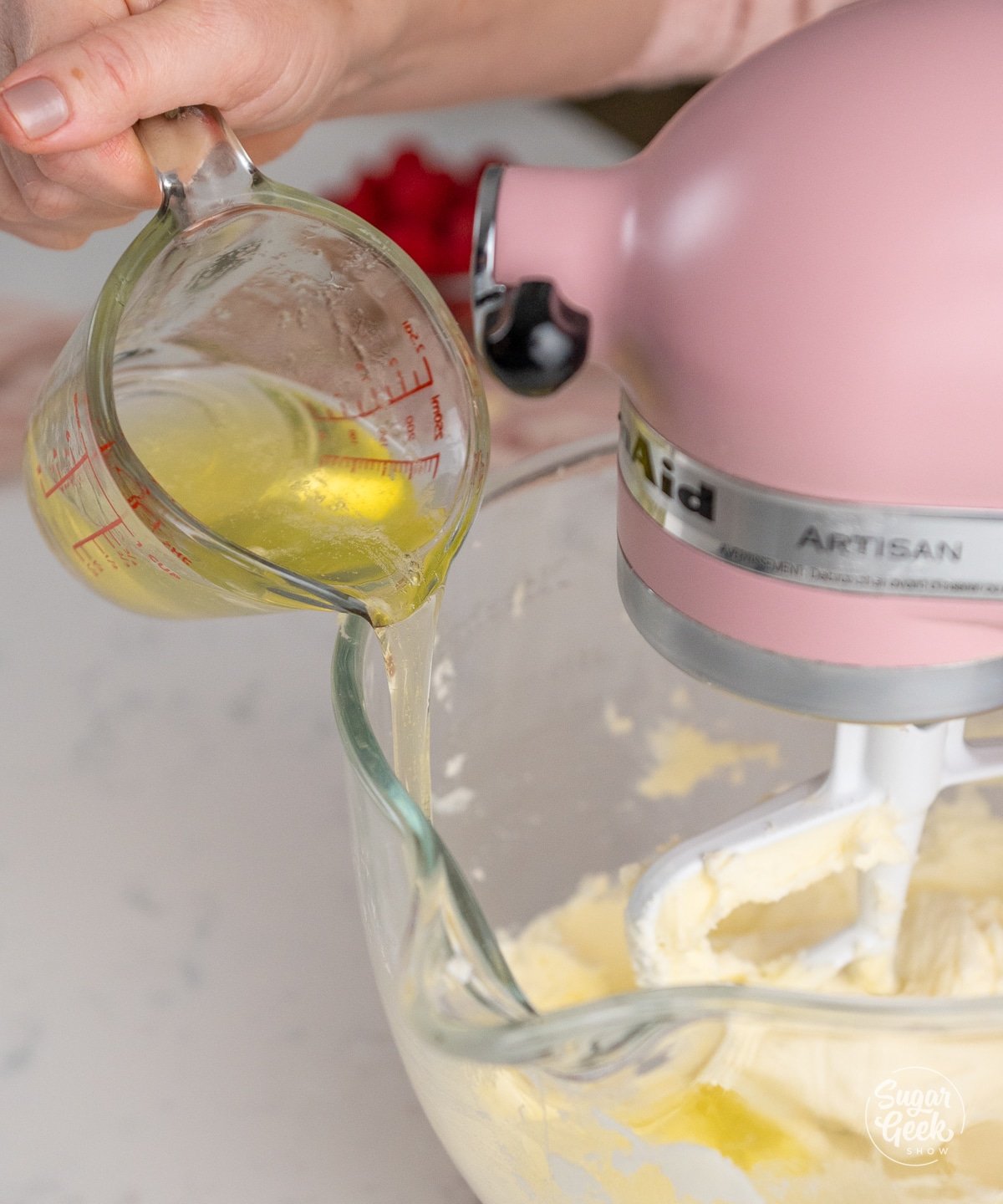
- Add the egg whites one at a time. With the mixer on low, add the egg whites a little at a time, letting each fully combine before adding the next. Mix until smooth.
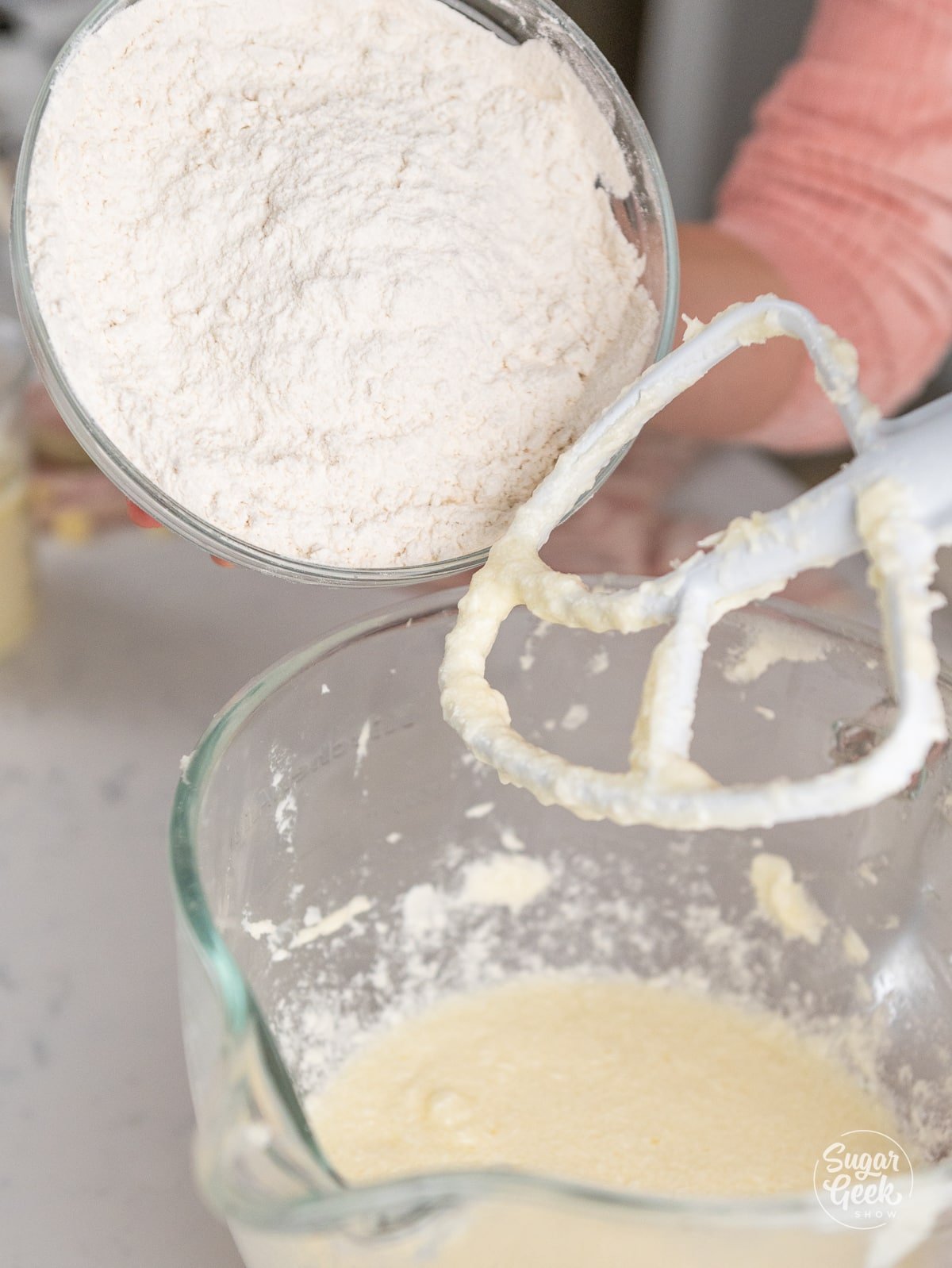
- Alternate the dry and wet. Add ⅓ of the dry ingredients and mix on low until just combined, then ½ the liquids, then dry, then liquids, then the last of the dry. Mix until just combined and stop.
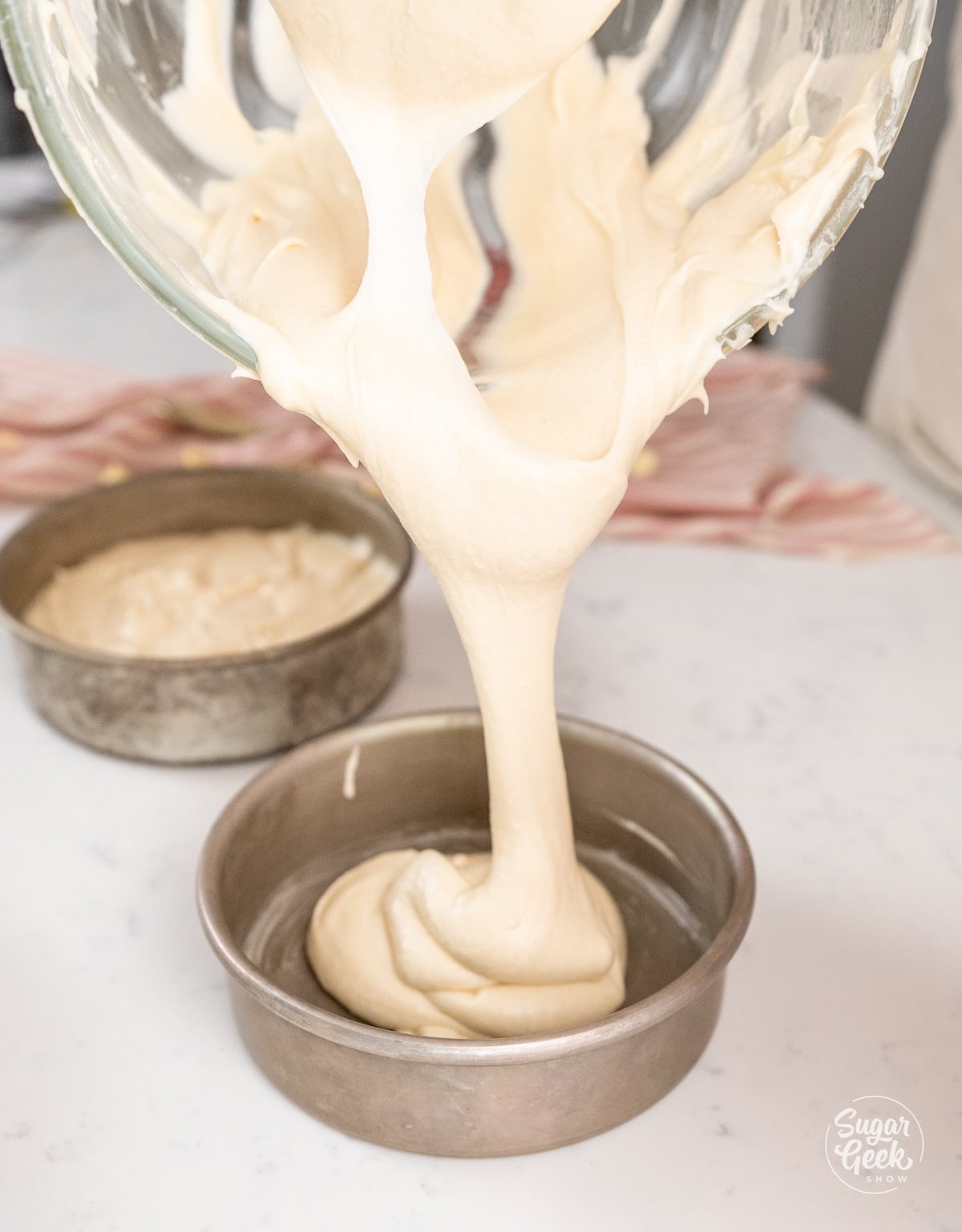
- Bake and chill. Divide the batter into your prepared pans and bake at 335º F for 25 to 35 minutes, until a toothpick comes out clean. Cool 15 minutes, turn out onto a rack, wrap the cakes while still warm, and flash chill in the freezer to lock in moisture. Once cool but not frozen, trim the edges and frost.
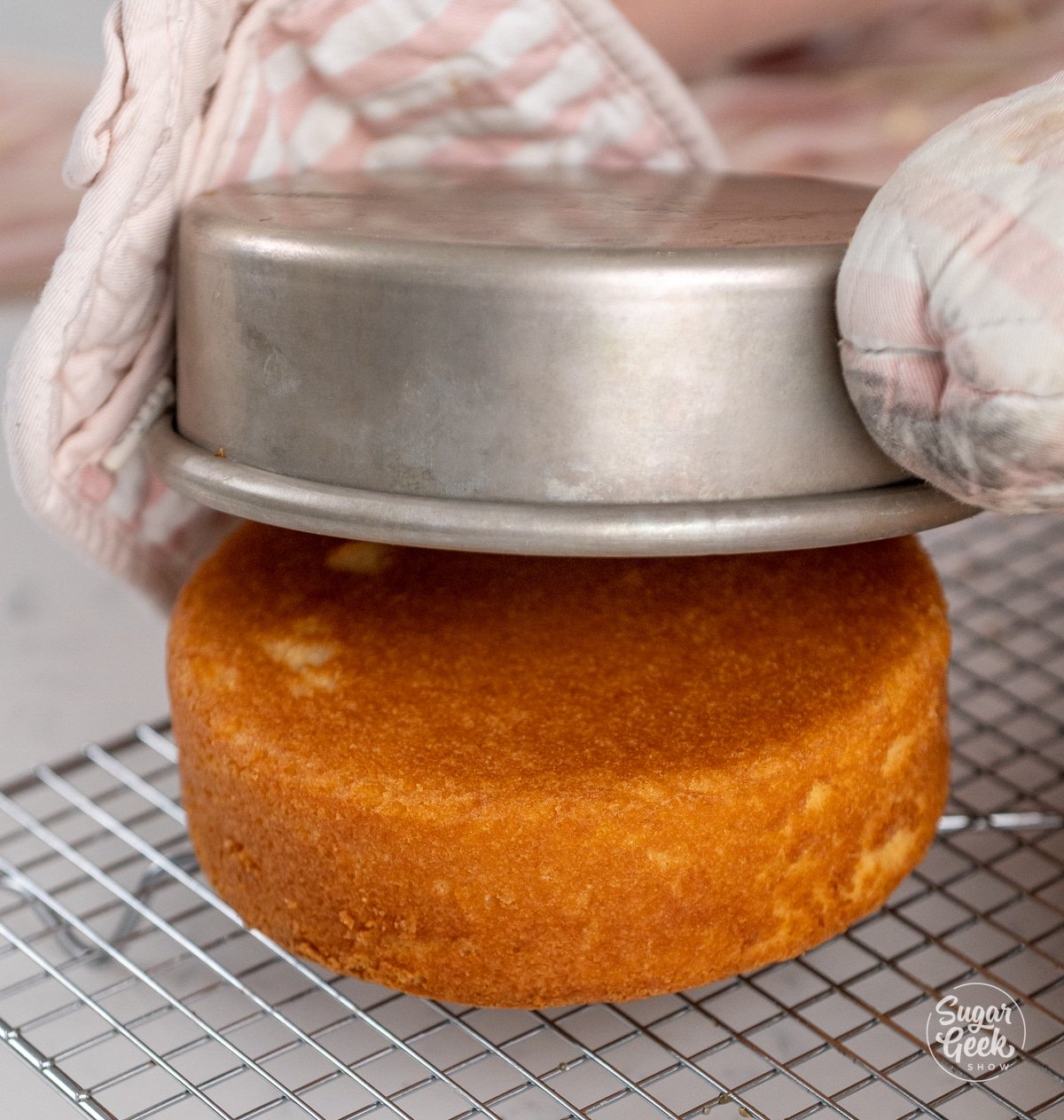
- Cool 15 minutes, turn out onto a rack, wrap the cakes while still warm, and flash chill in the freezer to lock in moisture. Once cool but not frozen, trim the edges and frost.
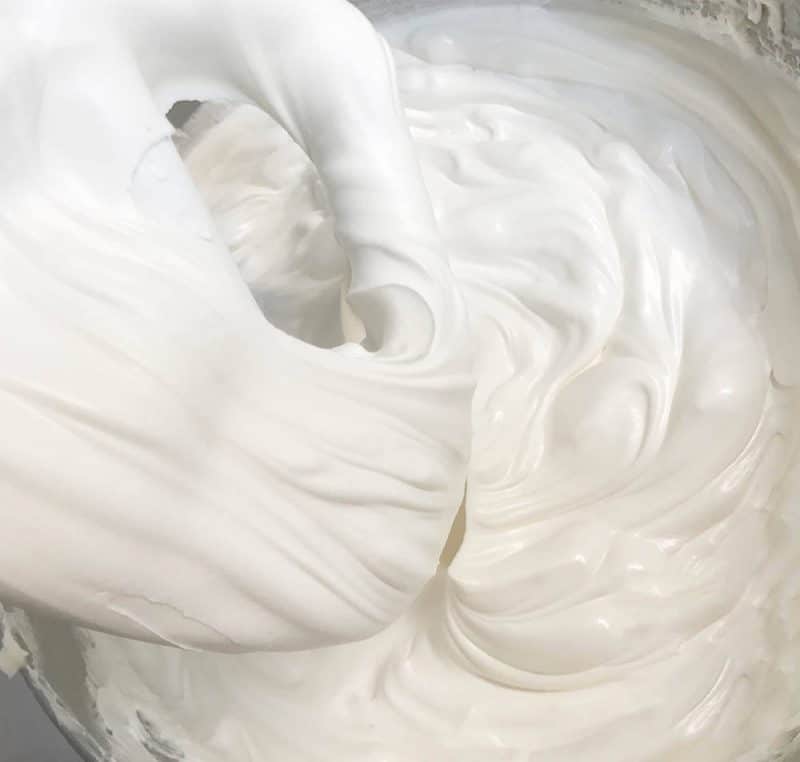
- Make the Easy Buttercream. Combine the pasteurized egg whites and powdered sugar in the bowl of a stand mixer with the whisk attachment and whip on medium until thick and glossy. With the mixer running, add the softened butter a piece at a time (it may look curdled at first, that is normal), then add the vanilla and salt and whip on high until light, fluffy, and it no longer tastes like straight butter. For the smoothest finish, switch to the paddle and mix on low a few minutes to knock out air bubbles. This is my easy buttercream frosting, less sweet and silkier than a standard American buttercream.
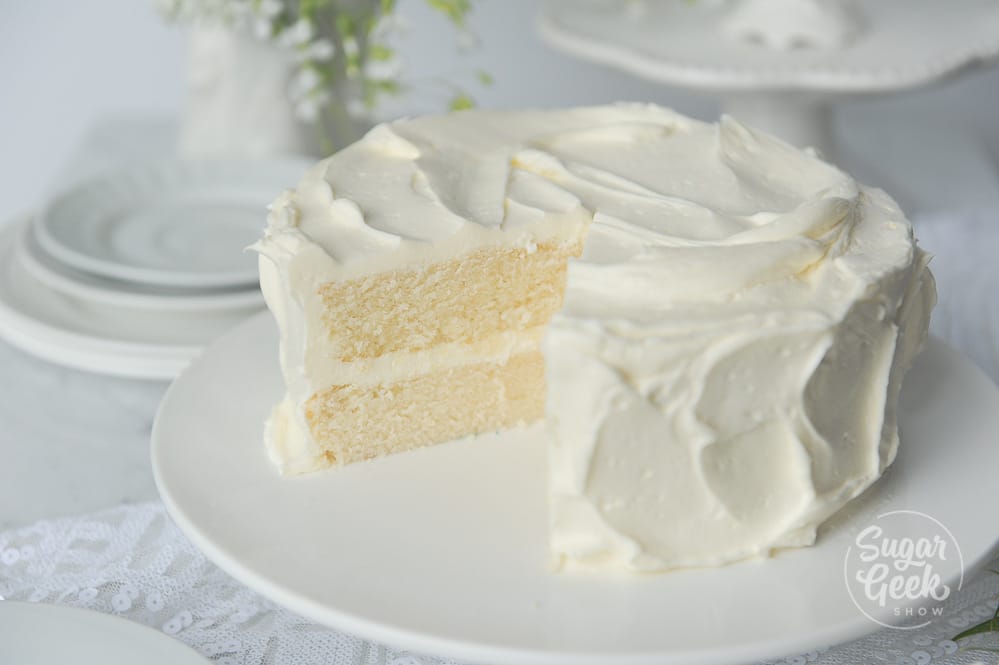
- Stack and assemble. Place your first chilled cake layer on a board or stand, spread an even layer of buttercream on top, then add the next layer. Crumb coat the whole cake in a thin layer of buttercream, chill 15 minutes to set, then apply your final coat and decorate.
PRO TIP: If your buttercream looks soupy, your butter was too warm. Pop the whole bowl in the fridge for 15 minutes and re-whip. If it looks curdled, it is usually too cold, just keep whipping and it will come together.
Cake Batter and Frosting Calculator
This recipe makes about 8 cups of cake batter (enough for two 8"x2" rounds or three 6"x2" rounds) and about 5 cups of Easy Buttercream. Use the slider on the recipe card to scale up or down, and the calculator below to figure out batter and frosting for a different pan size.
Cake Batter and Frosting Calculator
Select an option below to calculate how much batter or frosting you need. Adjust the servings slider on the recipe card to change the amounts the recipe makes.
Choose a pan type
Choose a cake pan size
(based on 2" tall cake pan)
Choose a cake pan size
(based on 2" tall cake pan)
Cupcake Tin Size
Choose number of pans
Cups of Batter Needed
8 cups
Cups of Frosting Needed
5 cups
Note: measurements are estimated based off the vanilla cake recipe using standard US cake pans and sizes. Measurements used are for 2" tall cake pans only. Your results may vary. Do not overfill cake pans above manufacturer's recommended guidelines.
Common White Cake Problems To Avoid
- Cake came out ivory, not white. Usually, the extract or the bake. Use clear vanilla and do not overbake. Baking at 335º F instead of 350º F keeps it paler, too.
- Dense or gummy crumb. It could be too much mixing, or your ingredients were too cold, and they curdled during mixing, which causes a gummy layer to appear at the bottom of your cake layer.
- Dry cake. Overbaked, or too much flour from measuring in cups. Weigh your flour and pull the cakes the moment a toothpick comes out clean.
- The batter curdled, and the cake did not rise. Cold egg whites or cold milk. Everything has to be at room temperature so it emulsifies with the creamed butter instead of breaking it.
- Cake domed and cracked. Oven too hot. This recipe bakes at 335º F for a flatter top, if yours still domes, your oven may run hot, so check it with a thermometer.
- Brown top. Normal, especially at higher temps. Trim it off if you want a pure white look, or bake at 335º F to minimize it.
Final Thoughts
White cake gets dismissed as "plain," but a really good one is anything but. It is the little black dress of cakes; it goes with everything. This is the recipe I have made for more birthdays, showers, and weddings than I can count.
If you only learn one cake from me, make it this one. Once you have the white cake down, strawberry, funfetti, marble, and Oreo are all just a few tweaks away.
Make This White Cake Recipe Your Own
This white cake is the jumping-off point for a ton of flavors. A few of my favorites:
- Oreo cake, chopped cookies folded in plus an Oreo buttercream.
- Marble cake, swirl in chocolate batter for the classic look.
- Fresh strawberry cake, real strawberry flavor on this same crumb.
- Funfetti cake, fold in sprinkles for a birthday classic.
Frosting swaps
The Easy Buttercream is my go-to here, but this cake takes any frosting beautifully. Try a Swiss meringue buttercream for an even silkier, less-sweet finish, a cream cheese frosting for tang, or chocolate buttercream for a black-and-white look.
Pan size conversions
| Pan | Batter | Bake time at 335º F |
|---|---|---|
| Two 8-inch rounds (standard) | Full batch (about 8 cups) | 25 to 35 minutes |
| Three 6-inch rounds | Full batch | 25 to 35 minutes |
| Two 9-inch rounds | Full batch (thinner layers) | 22 to 30 minutes |
| 9x13 sheet pan | Full batch | 30 to 40 minutes |
| About 24 cupcakes | Full batch, fill liners ⅔ full | 16 to 20 minutes |
A toothpick in the center should come out clean. Check on the early end and add a few minutes at a time; larger and deeper pans always take longer.
Make-Ahead and Storage
Frosted cake keeps about 3 to 4 days in the fridge, but always bring it back to room temperature before serving (cold cake tastes dry and stiff). To work ahead, bake the layers, wrap them warm in plastic, and freeze for up to a week. You can also freeze the fully frosted cake; just defrost it in the fridge for 24 hours before bringing it to room temperature so it does not sweat. This cake is sturdy and chills well, which is exactly why it is so good for stacking and decorating.
Baking White Cake At High Altitude
If you are above about 3,500 feet, this cake (like all cakes) needs a few tweaks. The short version from my high altitude baking guide: raise the oven temperature 25º F, reduce the baking powder by ⅛ to ½ teaspoon, reduce the sugar by 2 Tablespoons per cup, increase the liquid by 2 Tablespoons per cup, ease off on whipping the egg whites, and add 1 Tablespoon of flour at 3,500 feet plus another Tablespoon for every additional 1,500 feet. Take notes as you go, what works for one recipe may need tweaking for the next.
White Cake FAQs
No, that is purely for looks. Trimming the thin browned edges and the dome gives you a cleaner, whiter slice and a level cake for stacking, but the cake tastes exactly the same with them left on.
No, it is optional. The vanilla-almond combination is the classic wedding-cake flavor, but if you are not a fan of almond you can leave it out and use the same amount of extra vanilla instead.
I recommend fresh egg whites for this cake. Carton egg whites are pasteurized and processed differently, and they do not always incorporate the same way in a creamed batter, so fresh gives you the most reliable rise and texture.
I use fine sea salt, but regular table salt works just fine here. If you only have coarse or kosher salt, use a little more since it is less dense by volume.
Yes. The all-purpose flour gives it enough structure to stack into tiers and hold up under fondant. Just chill the cake well before stacking and decorating, and keep it cool until you are ready to serve.
More Cake Recipes To Try
Watch: How To Decorate A Cake Step-by-Step
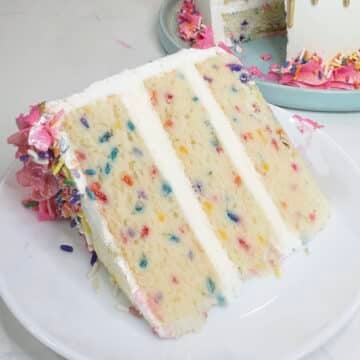
Before you start decorating, watch the video below where I show you every step of decorating a cake from start to finish. Seeing the process in action makes it much easier to follow along
- Liz Marek.
Recipe
Ingredients
White Cake Recipe Ingredients
- 10 oz milk room temp
- 2 oz vegetable oil
- 1 teaspoon vanilla extract
- 1 teaspoon almond extract use clear for a whiter cake
- 14 oz AP flour
- 2 ½ teaspoon baking powder
- ½ teaspoon salt
- 8 oz unsalted butter room temp
- 14 oz sugar
- 6 large egg whites fresh not boxed at room temp
Easy Buttercream Frosting
- 8 oz pasteurized egg whites room temperature
- 32 oz powdered sugar
- 32 oz unsalted butter room temperature
- ½ teaspoon salt
- 1 tablespoon vanilla extract
Instructions
- Before you begin: Bring the milk, butter, and egg whites to room temperature (cold ingredients will curdle the batter). Preheat the oven to 335º F. Prep two 8"x2" cake pans with cake goop or your preferred pan release. Weigh all ingredients before mixing.
White Cake Recipe Instructions
- Combine the milk, oil, and extracts in a cup and set aside.
- Whisk the flour, baking powder, and salt in a separate bowl and set aside.
- Place the butter in a stand mixer with the paddle attachment and cream until smooth. Sprinkle in the sugar and whip on high until light and white, about 5 minutes.
- With the mixer on low, add the egg whites one at a time, letting each fully combine before adding the next. If your egg whites are not at room temperature, microwave them for a few seconds, being careful not to cook them. Cold egg whites will curdle the batter.
- Add ⅓ of the dry ingredients and mix on low until just combined. Add ½ the liquids, then dry, then liquids, then the last of the dry. Mix until just combined. Do not overmix.
- Divide the batter into the prepared cake pans and bake at 335º F for 25 to 35 minutes, or until a toothpick comes out clean. Cool 15 minutes, turn out onto a rack, wrap warm, and flash chill in the freezer to lock in moisture. Once cool but not frozen, trim the edges.
Easy Buttercream Frosting
- Combine the egg whites and powdered sugar in a mixing bowl with the whisk attachment. Whisk on low to combine, then on high, adding the butter in small chunks along with the vanilla and salt.
- Whip on high until light, fluffy, and white. For the smoothest texture, switch to the paddle and mix on low a few minutes to remove air bubbles.
Stack and Assemble
- Place the first chilled cake layer on a board or cake stand and spread an even layer of buttercream on top. Add the second layer.
- Crumb coat the cake in a thin layer of buttercream and chill for 15 minutes to set, then apply the final coat and decorate as desired.
Video
Notes
- Bring all your ingredients to room temperature or even a little warm so the batter does not break or curdle.
- Use a scale to weigh your ingredients, including liquids, unless otherwise instructed (Tablespoons, teaspoons, pinch). Weighed ingredients are far more accurate than cups.
- Practice mise en place. Measure everything out before you start mixing so you do not leave anything out.
- Use clear vanilla (and clear or omitted almond) for the whitest cake. Fresh egg whites are best; carton whites do not always behave the same in a creamed batter.
- All-purpose flour gives a sturdier crumb for stacking. For a softer, finer crumb, use my white velvet cake instead.
- Two 8"x2" rounds: bake 25 to 35 minutes (standard)
- Three 6"x2" rounds: bake 25 to 35 minutes
- Two 9"x2" rounds: thinner layers, bake 22 to 30 minutes
- 9x13 sheet pan: bake 30 to 40 minutes
- About 24 cupcakes: fill liners ⅔ full, bake 16 to 20 minutes
- Frosted cake: refrigerate 3 to 4 days; bring to room temperature before serving.
- Cake layers: wrap warm in plastic and freeze up to a week. Defrost in the fridge 24 hours before decorating.
- Frosted cake freezes well too; defrost in the fridge 24 hours before bringing to room temperature.
- Above ~3,500 ft, adjust per my high altitude baking guide: +25º F oven, reduce baking powder ⅛ to ½ tsp, reduce sugar 2 Tablespoons per cup, add liquid 2 Tablespoons per cup, add 1 Tablespoon flour at 3,500 ft plus 1 Tablespoon per additional 1,500 ft.
- Do not use cold egg whites or cold milk; they will curdle the batter and the cake will not rise.
- Do not overmix once the flour goes in; that is what makes a white cake dense and gummy.
- Do not bake at 350º F if you want it bright white; 335º F keeps it paler and flatter.


Laetitia says
Hi! I am excited to try this for my daughter's birthday. I cannot ger pasteurized eggs in a box where I am. Can I use regular eggs for the buttercream and how many?
Elizabeth Marek says
Use my swiss meringue buttercream recipe instead 😀
Jenny says
Hi! I just made your Moist Vanilla Cake and the flavour and texture was amazing! I've always made WASC cakes for weddings and am looking for a homemade alternative but the Vanilla Cake seemed almost too fluffy and I’m afraid it wouldn’t hold up under 2 tiers and frosting. It also only baked up to about 1” in height - is that normal? I’m curious at the difference between this White Cake and the Moist Vanilla Cake. Does the all purpose flour provide more structure? Also the Moist Vanilla Cake was very yellow (used farm fresh eggs with super orange yolks which I think made the batter very yellow). Is this cake that much different than the vanilla one? Do you think it would hold up as a 3 layer 9” topped with 3 layer 7”? Thanks!
Elizabeth Marek says
Moist vanilla cake is not white and made with whole eggs which provides more flavor to the cake. The texture is very soft and fluffy but can and has been used in wedding cakes. You simply chill them in the fridge to set the butter before stacking.
The white cake recipe is white and only uses egg white so that it stays white. This recipe uses all-purpose flour as an alternative to the vanilla cake recipe for people who cannot find cake flour.
Cake tiers are supported by cake supports, not cake so you can use any cake to make a wedding cake as long as you use proper supports. You should check out my free tutorial on how I go through this process with my recipe.
https://sugargeekshow.com/marbled-fondant-tutorial/
Deb says
Great cake had it for breakfast. Made 4 layers and filled the center with tart cherry fruit spread (like preserves) thickend with 1 tablespoon cornstarch then cooled. Does this cake have to be refrigerated because of the egg whites in the frosting? How does the frosting hold up at an outside event say 75 degrees? Thank you for the great recepie.
Elizabeth Marek says
It does not need to be refrigerated, the amount of butter and sugar in the frosting makes it stable enough to be at room temp for 24 hours. 75 degrees is no problem but keep it in the shade.
Kriz says
Well even though it curdled and I was a bit scared I still baked it n ☺️ Everything baked so beautifully !!!!!!! This cake is amazing!!!!! Definitely making this again!!! thank you so much!!!
Kriz says
Just made the batter and I have to say I tasted it and flavor is great but I didn’t put it in the oven as yet because ... it doesn’t look like the batter on your video... it’s really soft n kinda loose ... my egg wh yes we’re great the first 2 min of mixing and I’m not sure if I over mixed it but after it started to curdle up (yes it was room temp) I don’t put my eggs in the fridge and I live in the Caribbean ...
Elizabeth Marek says
If your batter curdled, something was either cold or you added in the liquids too quickly
Ashley says
Hi! How will the recipe change if I have to use eggs from a carton? Thats all I have and unfortunately since my kids are home and we are under lockdown I can't get out to buy fresh eggs.
Elizabeth Marek says
You can definitely use eggs from a carton, One egg white = 1 ounce.
Sarah says
Hi there I’ve just made the cake and it’s slightly dropped when it came out of the oven, also the sponge is quite dense like Madeira as apposed to fluffy? I’m going to make it again have you got any tips for me please where I may have gone wrong?
Elizabeth Marek says
It's hard to say where you went wrong. I haven't seen your cake or know how you mixed it. I would go back through the recipe to make sure that your ingredients are all the same as mine, all warm and not cold and you're mixing as directed.
Caycee says
how would I make this in a 10inch round cake pan? I want to use the recipe for a two tiered wedding cake with the bottom being three 10 inch layers
Elizabeth Marek says
You must make enough batter for three 10" cake pans. I would start by doubling the recipe and seeing if you need to make more.
KHam says
Which would you say tastes the best; your white cake, vanilla cake, or white velvet? Or any other recipe you have haha
The Sugar Geek Show says
white velvet is my personal favorite.
Eunice says
Hi: I saw your recipe. I used it once and the cake was EXCEPTIONAL!! But, my question is: how do I convert this recipe into a 3 layer cake using 3 9-inch round cake pans?
Thank you, for your recipe and advise.
The Sugar Geek Show says
I would increase the recipe to 1 1/2 times (adjust the servings on the recipe card) then bake in three 9" cake pans
Lynette says
Hey Liz! thank you so much for making these recipes available to us. I'm enjoying making your cakes.
i was scrolling through the comments and someone had asked if they can replace butter with margarine and you discouraged it. I'd like to know, other than flavour, does it affect how the cake comes out? Thank you.
The Sugar Geek Show says
Margarine is too soft, it doesn't behave the same way as butter
Gerben says
Made today.. everybody in the house loves it!...thanx po!...
Paige says
The best!
Sonya says
My quarantine passion: baking cakes! I am so excited to try this recipe and have my ingredients ready to go. In reading through comments, I realized that you said fresh versus boxed eggs, and then the buttercream icing calls for pasteurized eggs. As a baking novice, I want to be sure that I am understanding correctly. By fresh, are you meaning farm fresh, and by boxed are you meaning carton eggs, and by pasteurized are you meaning egg whites ready to go in a carton? Thank you in advance for your response!
The Sugar Geek Show says
Fresh egg whites are from an egg. Carton or pasteurized is the same thing. Pasteurized egg whites come in a carton 🙂
Curt says
I prepared this cake using King Arthur Cake Flour (It was the only KA flour I could get during the Pandemic). The last layer came out of the oven with small caverns from the bottom of the cake. Was this the result of not using AP flour or some other reason?
The Sugar Geek Show says
Hi Curt, the recipe calls for all-purpose flour, not cake flour. There are differences between flour. Always try to use the ingredients the recipe calls for, for the best results. I have a delicious white cake recipe that uses cake flour, it is the white velvet buttermilk cake 🙂 Stay safe.