

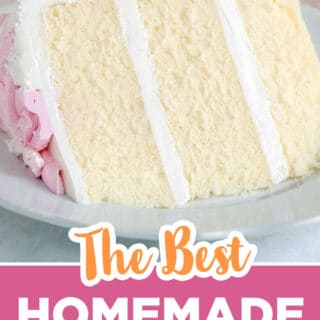
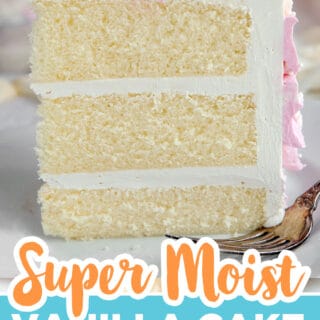
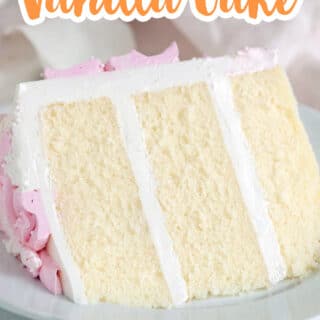
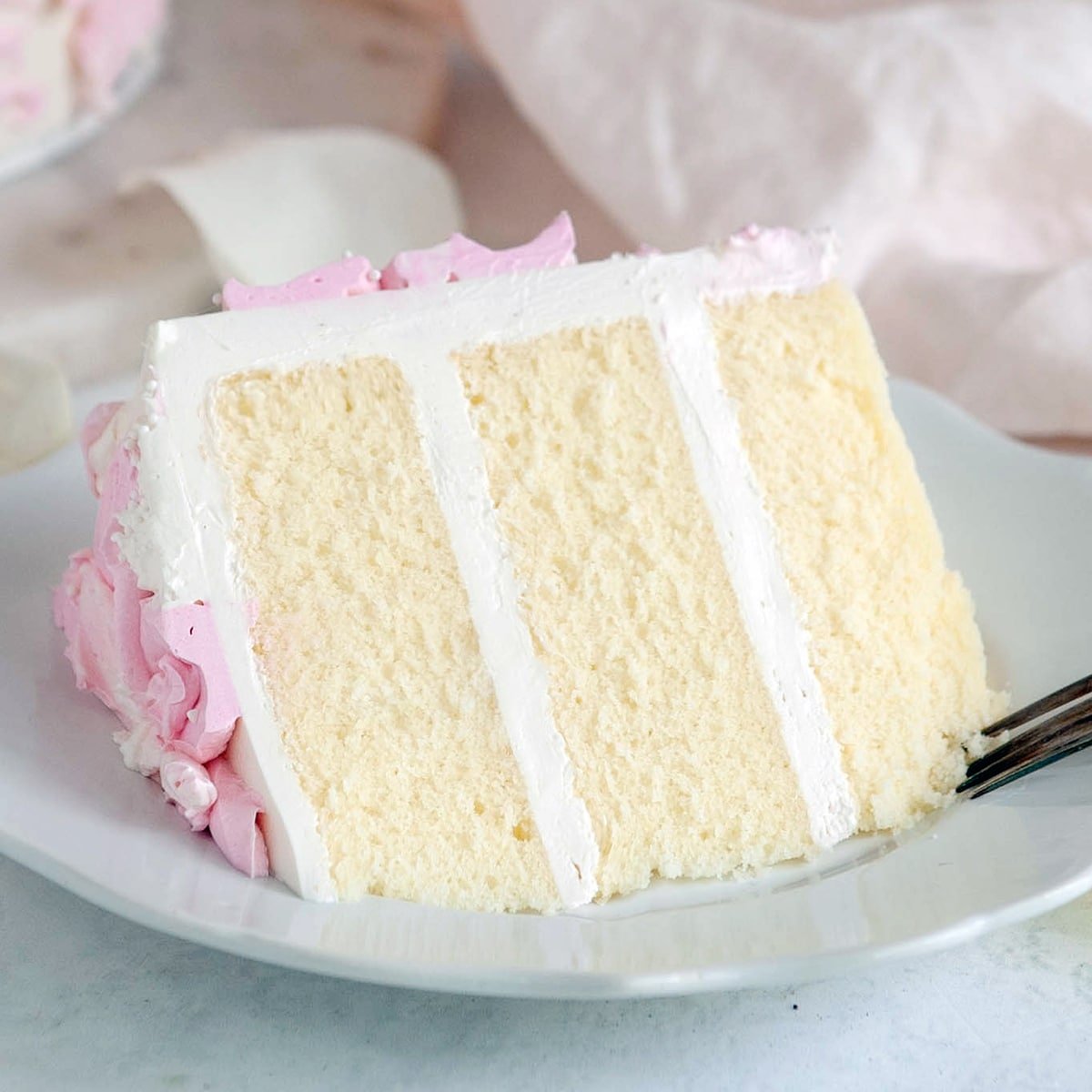
Vanilla cake is one of the most important recipes to have in your baking arsenal, and this version has been my go-to professional recipe for over ten years for weddings, birthdays, and special occasion cakes. The reverse creaming method gives it an incredibly moist, tender crumb that stays soft for days, and it bakes up naturally flat so there is almost no trimming or waste. If you are new to baking layer cakes, my how to decorate a cake guide walks through the entire process step-by-step.
Quick Glance: Vanilla Cake Recipe
- Recipe Name: Vanilla Cake Recipe
- Why You'll Love It: Soft, buttery vanilla cake with an ultra-moist crumb that stays tender for days.
- Time and Difficulty: Prep time: 15 minutes Bake time: 20-30 minutes Difficulty: Intermediate
- Main Ingredients: Cake flour, butter, sugar, eggs, milk, vanilla extract
- Method: Reverse creaming method: Dry ingredients are combined with the butter first, then the liquid ingredients are mixed in.
- Texture and Flavor: Light, fluffy crumb with rich vanilla flavor
- Quick Tip: Mix the batter for the full two minutes during the reverse creaming stage to properly develop the cake's structure.
Jump to:
- Quick Glance: Vanilla Cake Recipe
- What Makes This Vanilla Cake Work So Well
- Vanilla Cake Ingredients
- Tips For Success
- Vanilla Cake Recipe Step-By-Step
- Batter & Frosting Calculator
- Cake Batter and Frosting Calculator
- Cups of Batter Needed
- Cups of Frosting Needed
- Common Vanilla Cake Mistakes To Avoid
- Vanilla Cake FAQs
- More Vanilla Recipes You'll Love
- Watch: How To Decorate A Cake Step-by-Step
- Recipe
Next to my white velvet buttermilk cake, and lemon blueberry cake, this moist vanilla cake is one of our most popular recipes. I have been using this recipe for over ten years for my cake clients with nothing but rave reviews. This is the cake that turns those "I don't even like cake" consultations into OMG we need to book you right now clients! This is perfect for special occasions like weddings, showers, and it makes the perfect birthday cake!
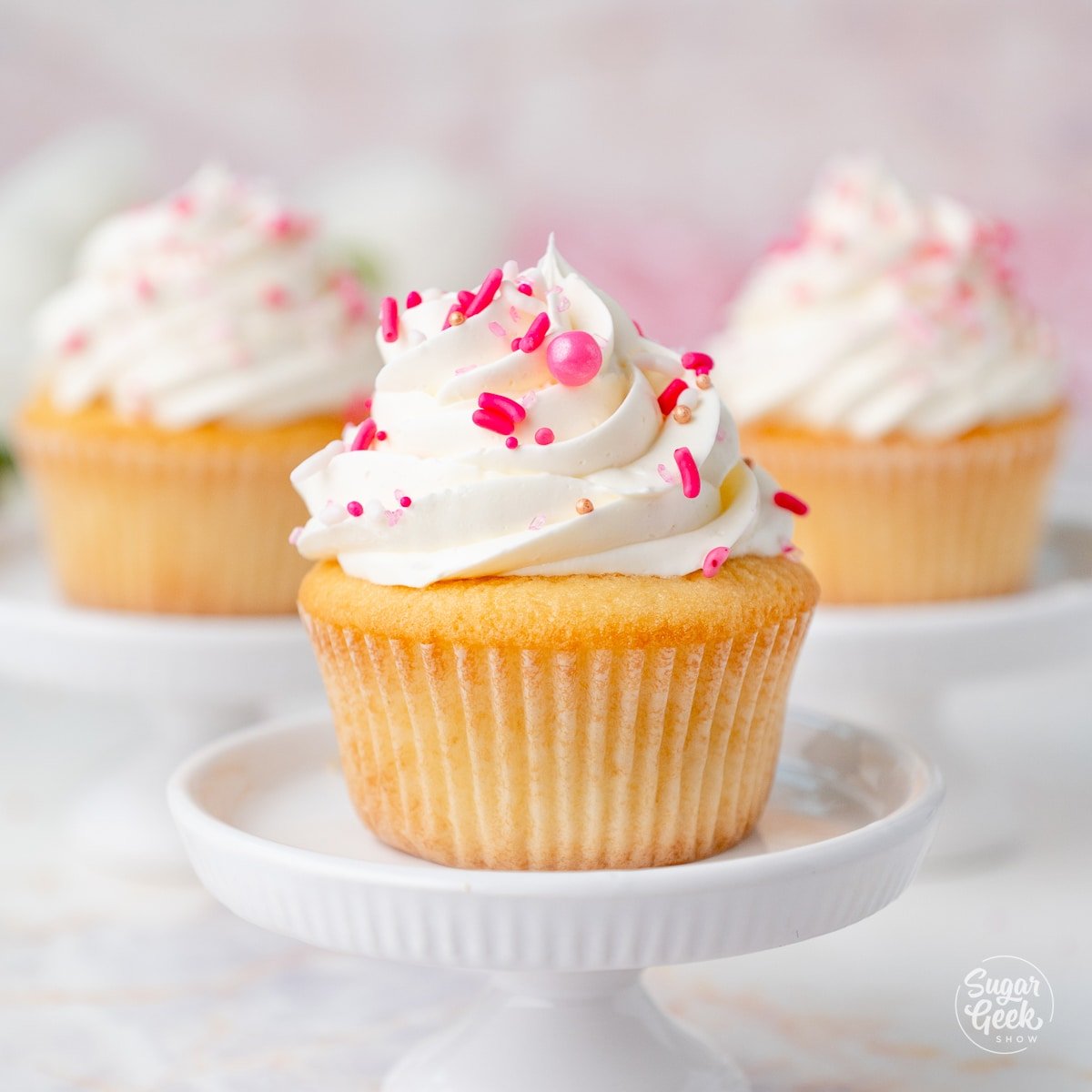
If you want to make these as cupcakes, my vanilla cupcake recipe uses the same reverse creaming method in a perfectly portioned size.
What Makes This Vanilla Cake Work So Well
One of the key techniques used in this recipe is the reverse creaming method. This mixing technique coats the flour in butter before adding liquids, which prevents excess gluten development and results in an incredibly tender crumb.
The texture of this vanilla cake is extremely soft and moist with a delicate crumb. Some bakers are surprised by how tender it is, but that softness is exactly what makes this cake so delicious.
Another reason this recipe works so well is the combination of butter and oil. Butter adds rich flavor while oil keeps the cake moist for several days.
This cake also bakes very flat, which means less trimming and less cake waste. That makes it perfect for layered cakes, wedding cakes, and decorated celebration cakes.
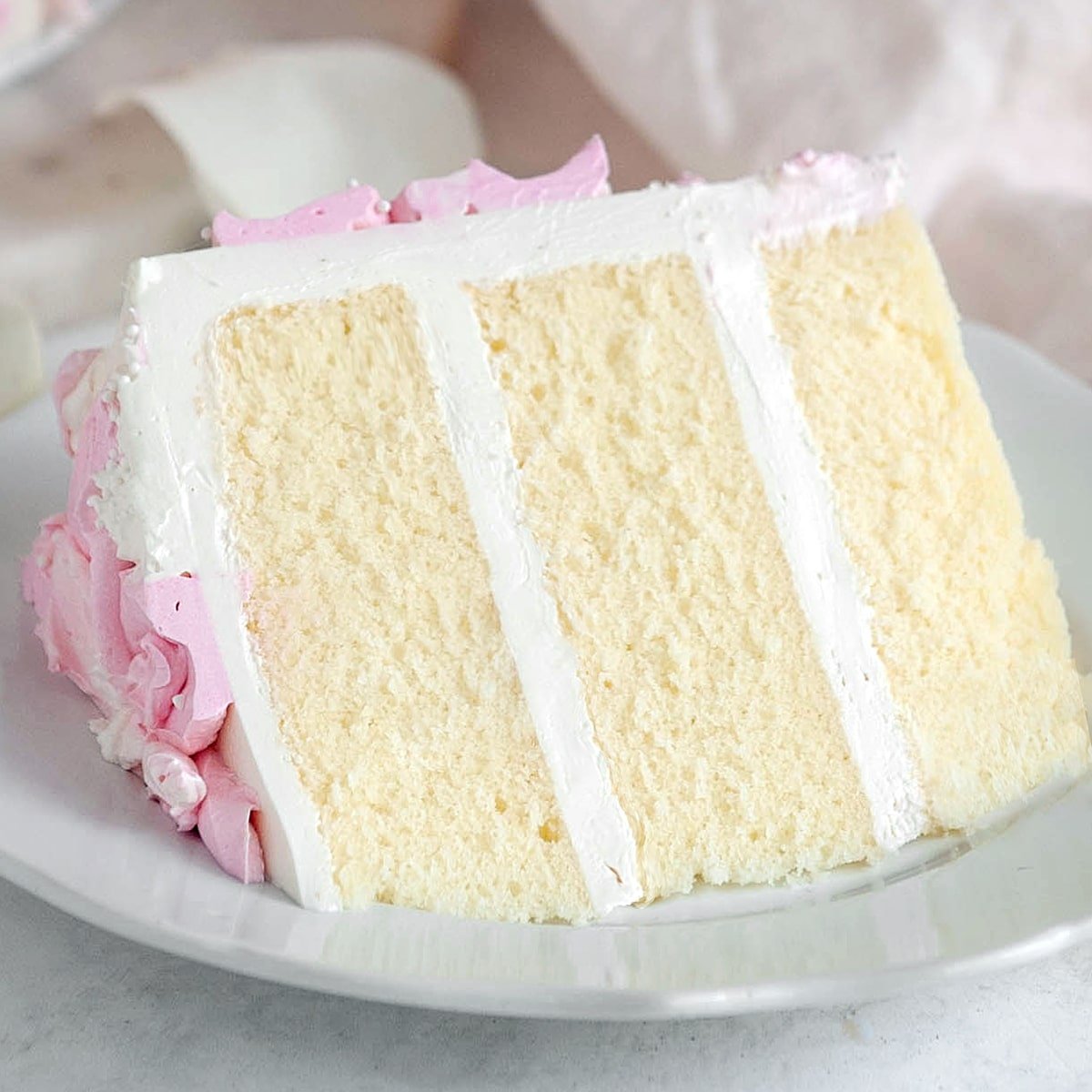
If you want a bright white crumb instead of this golden vanilla one, use only egg whites and make my white cake instead.
Vanilla Cake Ingredients
The secret to this ultra-moist and tender vanilla cake is using cake flour and the reverse creaming method.

Cake flour is used instead of all-purpose flour because it has a lower protein content, which results in a softer and more tender crumb. If you only have all-purpose flour, you can make a substitute by removing two tablespoons of flour per cup and replacing it with cornstarch, but the texture will not be exactly the same.
Sugar adds sweetness, moisture, and structure to the cake. Reducing the sugar may affect the texture and stability of the cake.
Baking Powder and Baking Soda These ingredients provide lift and help the cake rise properly. Baking soda reacts immediately while baking powder reacts during baking.
Vanilla is the primary flavor in this vanilla cake recipe. For the best flavor, use high-quality vanilla extract or vanilla bean paste.
Unsalted butter adds rich flavor and helps create a tender crumb. Unsalted butter is typically used so the salt level in the recipe can be controlled.
Milk adds moisture and helps activate the gluten structure in the cake.
Vegetable oil helps keep the cake moist for several days. Other neutral oils, such as canola or grapeseed oil, can also be used.
Tips For Success
- Measure your ingredients using a kitchen scale. Baking is a science and weight measurements provide the most accurate results.
- Bring your butter, milk, and eggs to room temperature before mixing. Room temperature ingredients help create a smooth batter and proper emulsion.
- Do not skip the mixing stage. The reverse creaming method requires mixing for about two minutes to properly develop the cake structure.
- If you live above 5,000 feet in elevation, you may need to slightly reduce the baking powder so the cake does not collapse.
Vanilla Cake Recipe Step-By-Step
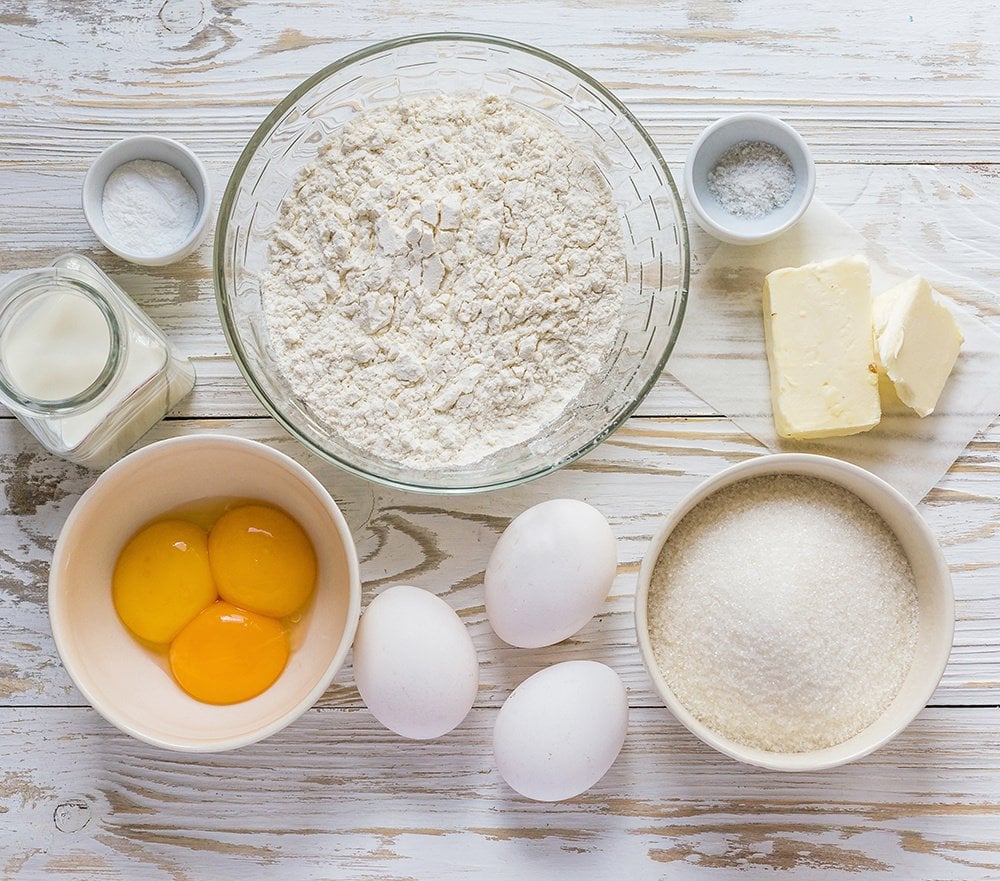
- Bring your butter, milk, and eggs to room temperature. This step is very important because if these ingredients are not all the same temperature, the batter could curdle and separate during baking, leading to bad texture and rise.
Preheat your oven to 335°F. and prepare your cake pans with cake goop or your preferred pan release.
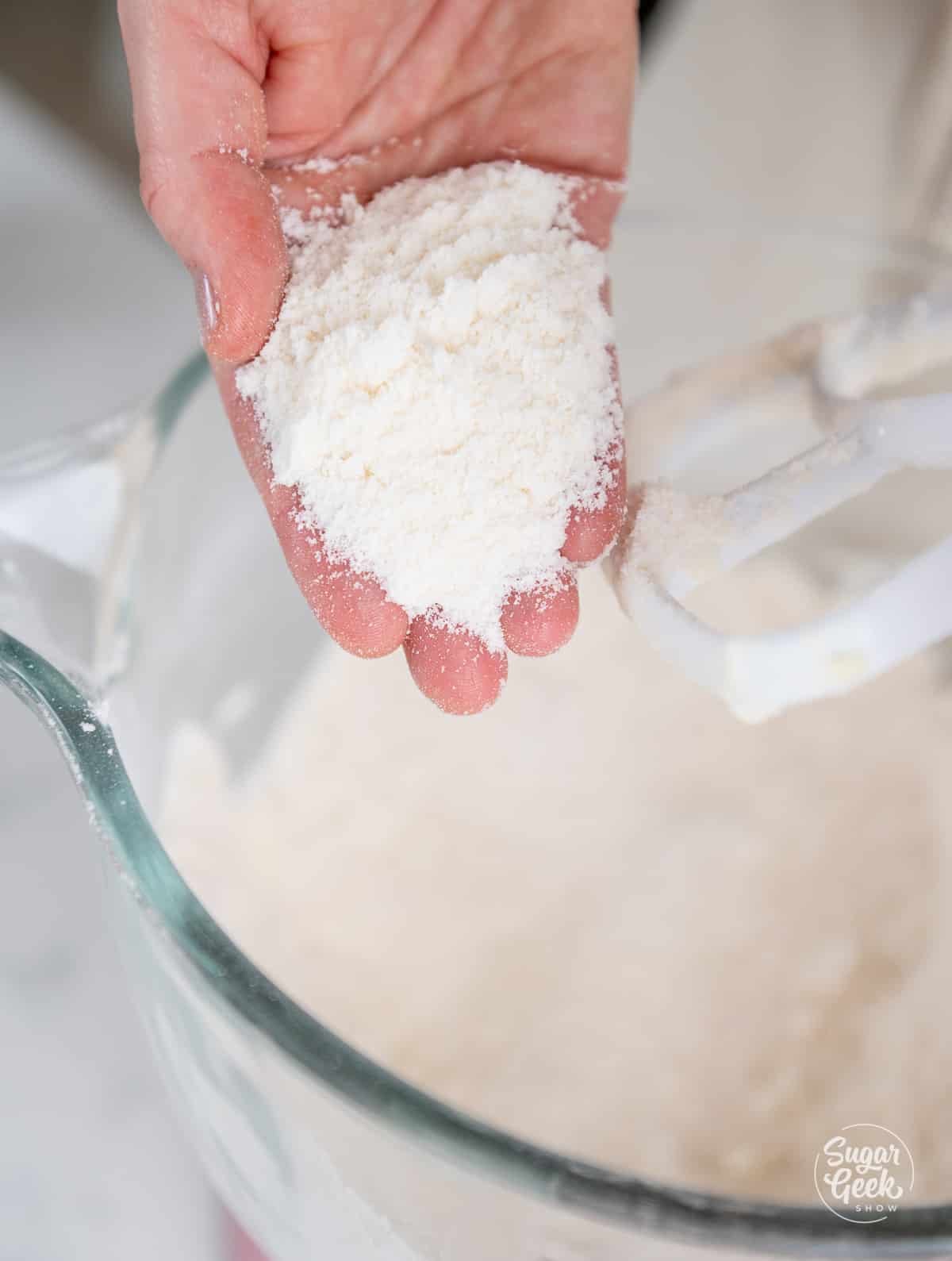
- Combine the cake flour, sugar, baking soda, baking powder, and salt in the bowl of a stand mixer.
While mixing on low, add softened butter in small chunks and mix until the mixture looks like coarse sand.
- Combine half the milk and the oil.
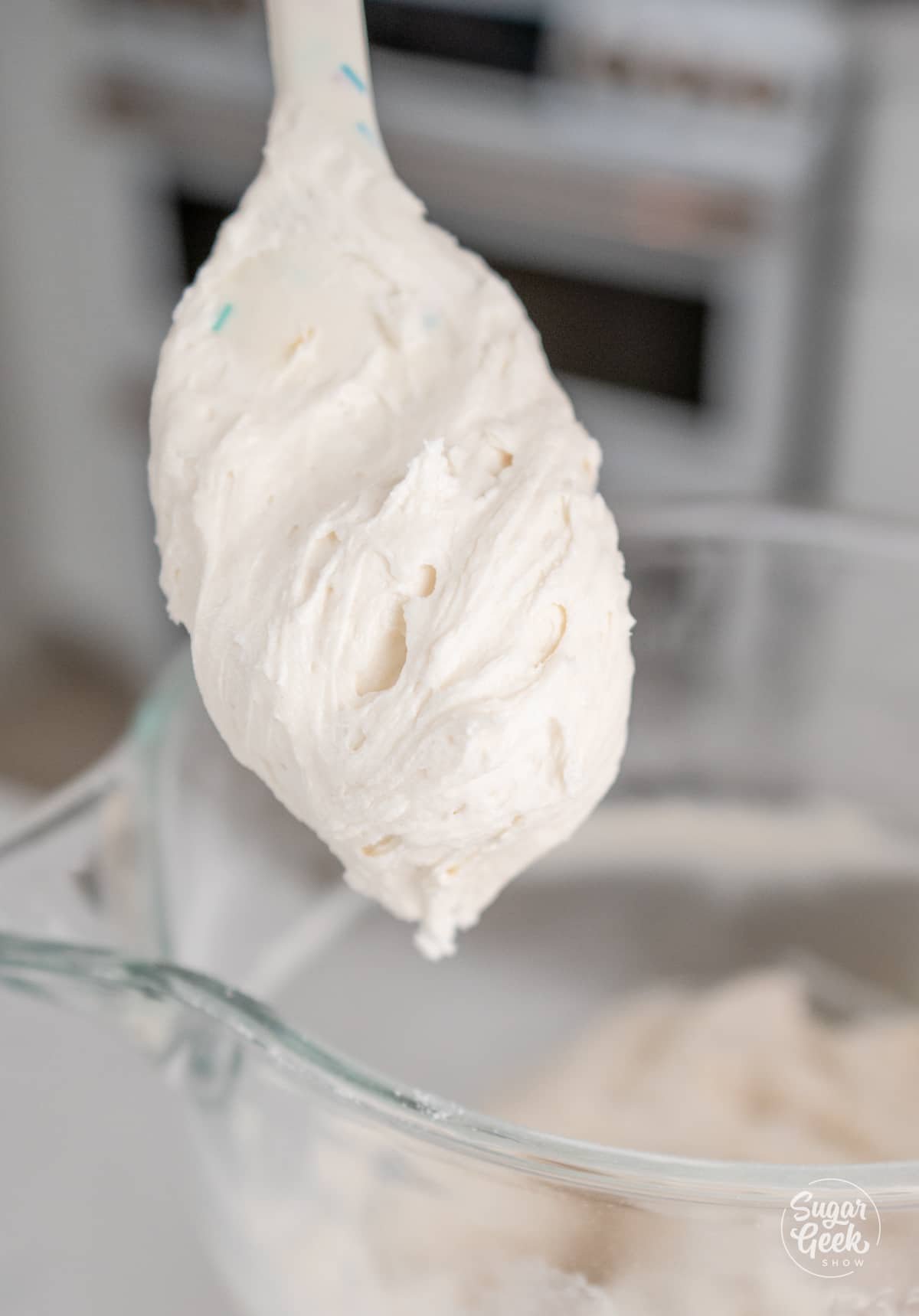
Add the milk and oil mixture all at once to the dry ingredients mixture and mix for two minutes on medium speed. The batter should look thick and not separated.
Scrape the bowl thoroughly after the two-minute mix. If you skip this, hard lumps of flour will stay in the batter and will not mix in fully later.
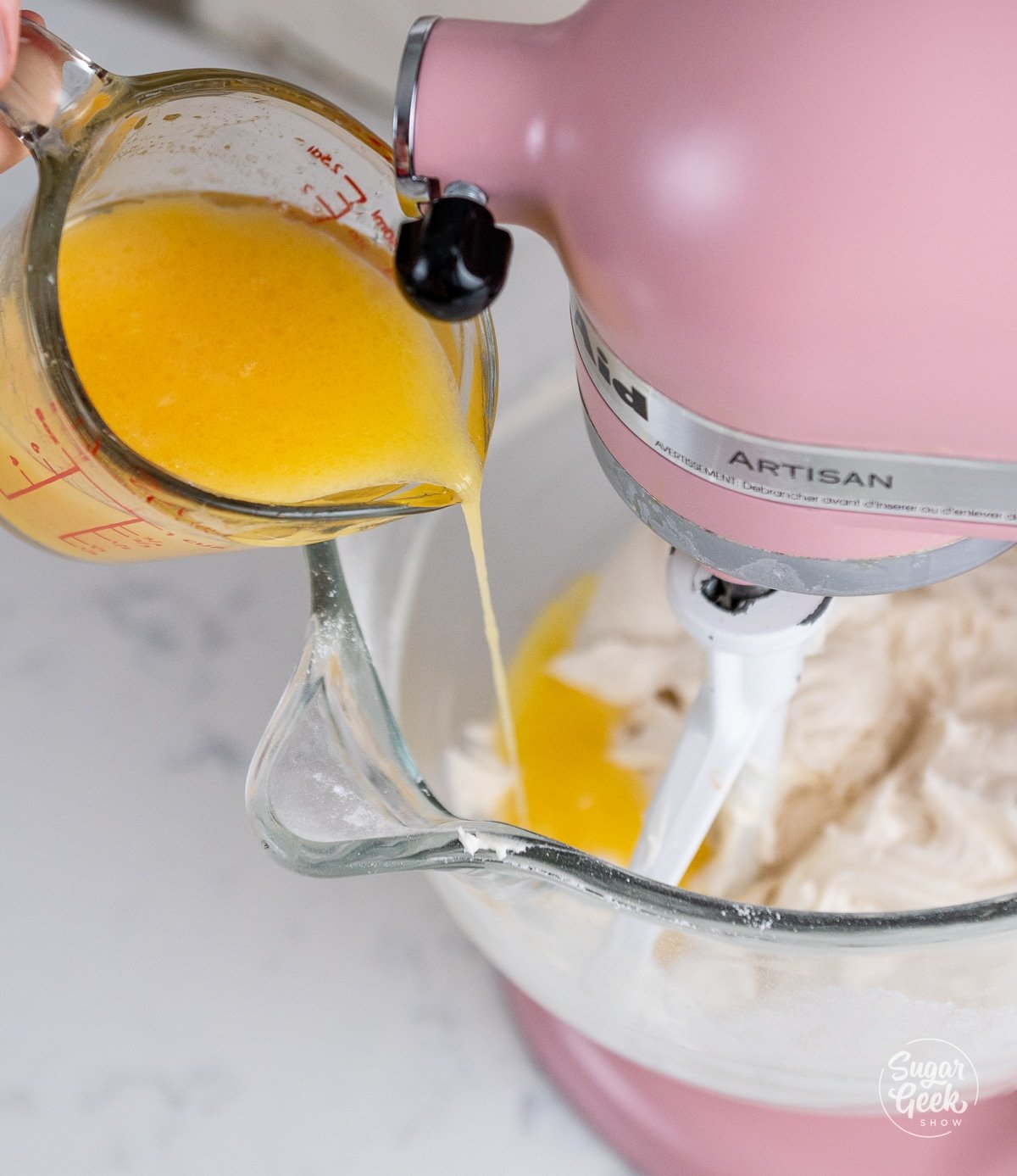
- Whisk the rest of the milk, vanilla extract, and the eggs together to combine.
Slowly add the egg and milk mixture while mixing on low speed just until combined.
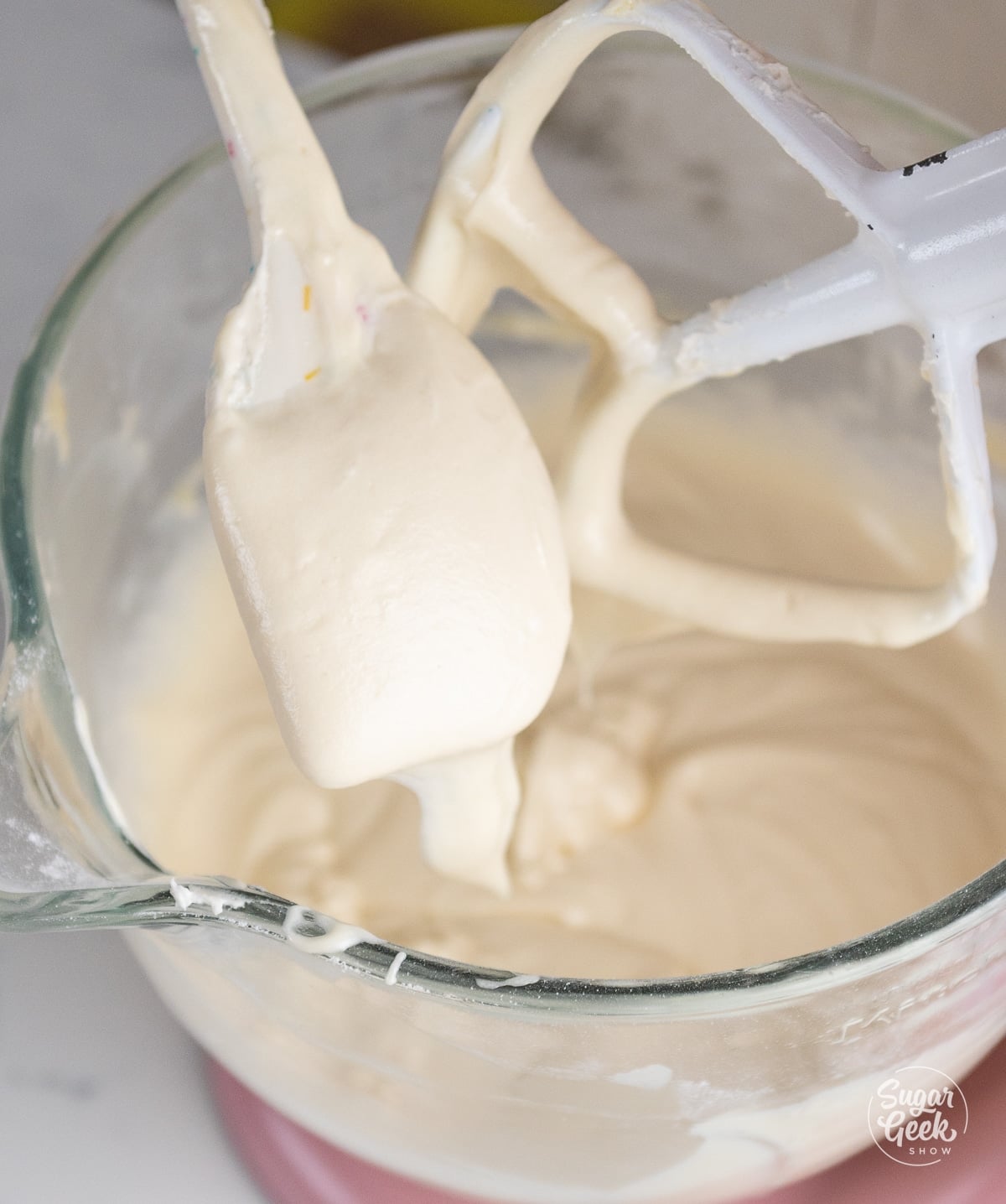
- The finished batter should be thick, smooth, and slightly glossy.
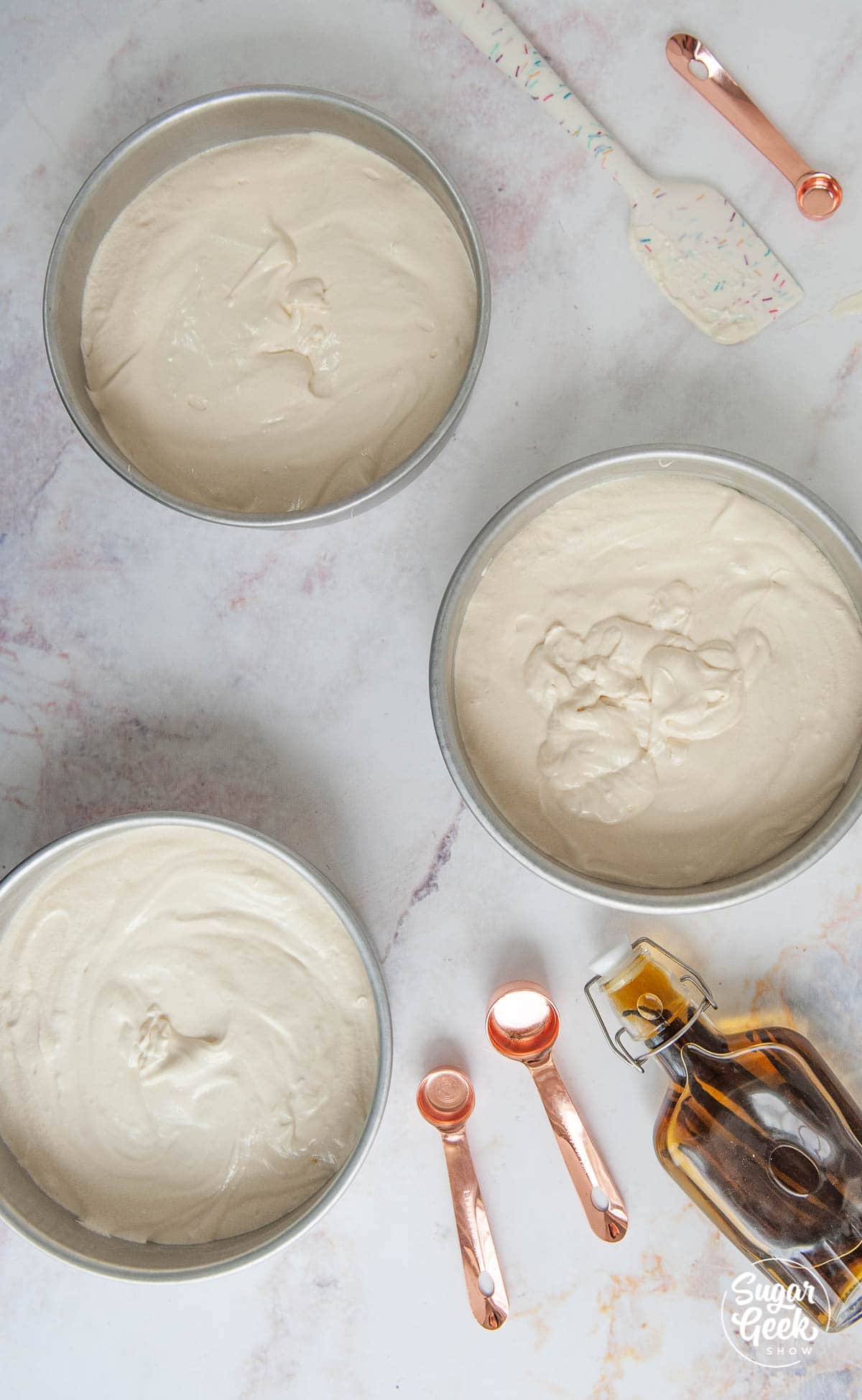
- Divide the batter into three prepared 8-inch cake pans.
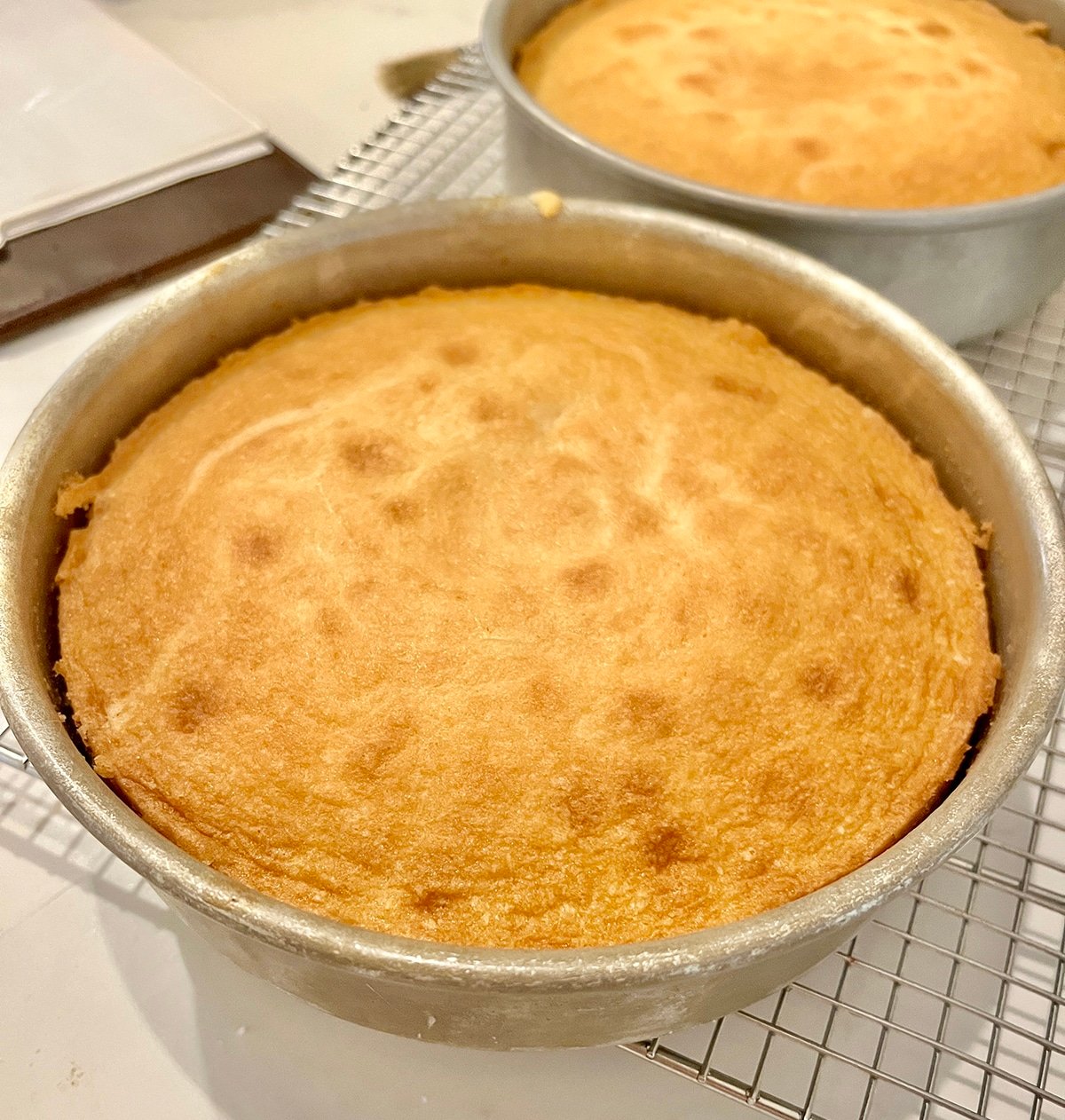
- Bake for 20-30 minutes or until a toothpick inserted into the center comes out clean. Immediately tap the pan on the counter once to release air and reduce shrinking.
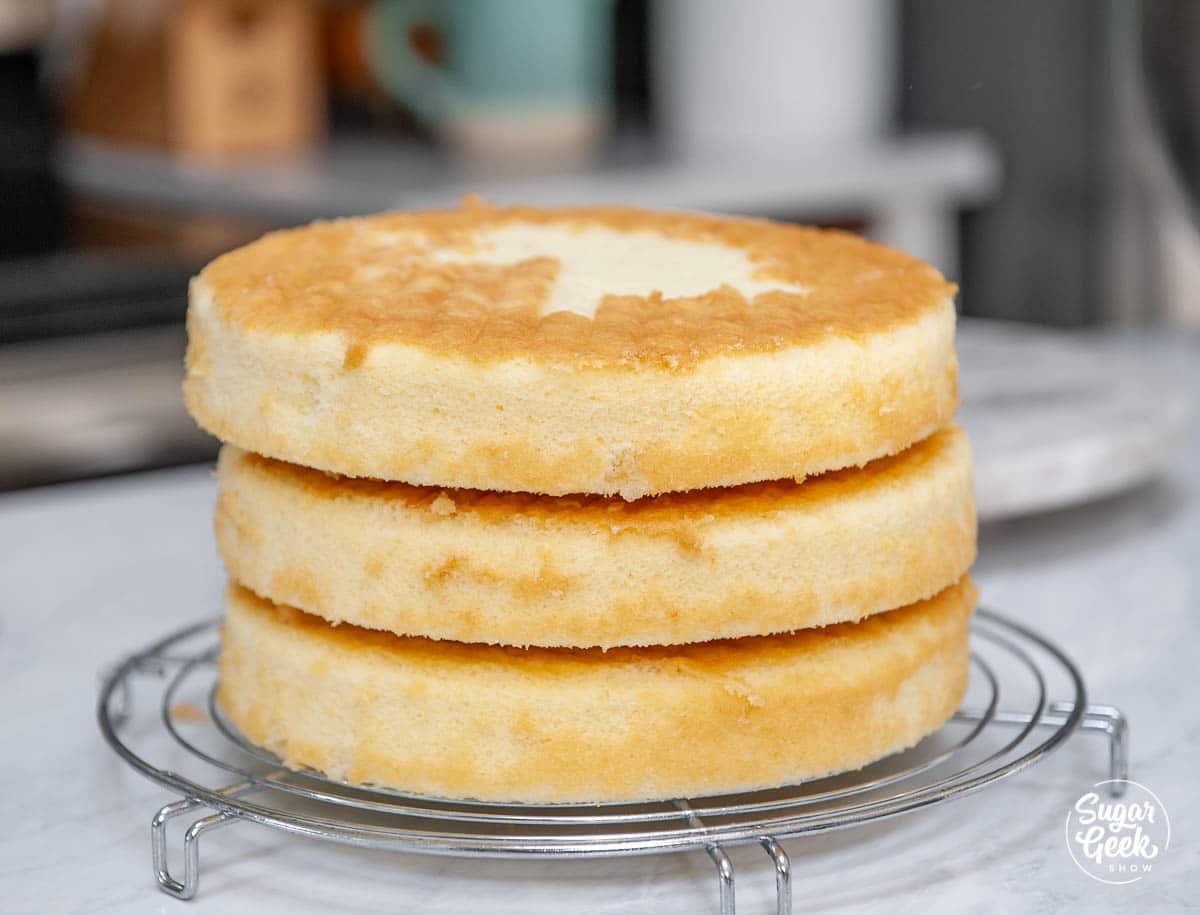
- Cool cakes in the pans until barely warm before removing them onto a cooling rack.
Batter & Frosting Calculator
Cake Batter and Frosting Calculator
Select an option below to calculate how much batter or frosting you need. Adjust the servings slider on the recipe card to change the amounts the recipe makes.
Choose a pan type
Choose a cake pan size
(based on 2" tall cake pan)
Choose a cake pan size
(based on 2" tall cake pan)
Cupcake Tin Size
Choose number of pans
Cups of Batter Needed
8 cups
Cups of Frosting Needed
5 cups
Note: measurements are estimated based off the vanilla cake recipe using standard US cake pans and sizes. Measurements used are for 2" tall cake pans only. Your results may vary. Do not overfill cake pans above manufacturer's recommended guidelines.
This recipe makes three 8-inch cake layers, two 9-inch cake layers, or about 24 cupcakes. The easy buttercream recipe included makes 8 cups of frosting, enough to frost and fill the layered cake. Store leftover frosting in the fridge for up to 1 week or freeze for up to 6 months.
Top it with a batch of my American buttercream recipe for a classic combination that never fails. If you want to skip the buttercream entirely, try frosting this cake with white chocolate ganache instead, which is incredibly stable and has a gorgeous vanilla flavor. Or you can top with a pretty pink drip cake finish
Common Vanilla Cake Mistakes To Avoid
Using cold ingredients. Cold butter, eggs, and milk will not emulsify properly during mixing and can cause the batter to look curdled and broken. Set everything out at least an hour before you start, or warm your eggs in a bowl of warm water for 5 minutes and microwave your milk for 20 seconds.
Overbaking the cake. This recipe bakes at a lower temperature for a reason, but it can still dry out if left in too long. Start checking at 30 minutes with a toothpick and touch the surface gently. If it springs back, it is done. A few moist crumbs on the toothpick are fine. A completely clean toothpick often means it went too far.
Skipping the two-minute mixing stage. The reverse creaming method requires the full two minutes of mixing after the milk and oil go in. This stage is what develops the structure of the cake. Cutting it short results in a weaker crumb that can sink or have an uneven texture.
Not scraping the bowl. Hard lumps of unmixed flour and butter hide at the bottom of the bowl during mixing. If you do not scrape down thoroughly after the two-minute mix, those lumps will stay in the batter and create dense spots in the finished cake.
Using low-quality vanilla extract. Vanilla is the only flavor in this cake, so it has nowhere to hide. Use a good pure vanilla extract or vanilla bean paste. Imitation vanilla will produce a noticeably weaker, more artificial flavor.
Vanilla Cake FAQs
Cake flour has a lower protein content than all-purpose flour, which produces a softer, more tender crumb. The reverse creaming method coats the flour in butter before any liquid is added, and cake flour's lower protein helps prevent excess gluten from forming during the two-minute mixing stage. If you only have all-purpose flour on hand, you can make a substitute by removing two tablespoons of flour per cup and replacing them with cornstarch, but the texture will not be exactly the same.
Yes, this recipe is flexible across several pan sizes. The full recipe makes three 8-inch cake layers, two 9-inch cake layers, or about 24 cupcakes. For a half sheet pan, you will need three full batches of batter to fill the pan properly. Smaller pans bake faster than larger ones, so check for doneness with a toothpick starting at 18 to 20 minutes for cupcakes and 25 to 30 minutes for 8-inch layers.
Yes, this vanilla cake recipe works beautifully as cupcakes. Fill cupcake liners about two-thirds full and bake at 350°F for 18 to 20 minutes, or until the centers spring back when lightly touched. The full recipe yields approximately 24 cupcakes.
Yes, this vanilla cake freezes very well. Wrap each cooled cake layer tightly in plastic wrap and store in the freezer for up to two months. Thaw the layers at room temperature for one to two hours before frosting and decorating. The buttercream frosting can also be frozen separately for up to six months in an airtight container.
Yes, you can use a non-dairy milk like almond, oat, or soy milk in place of regular whole milk in this recipe. Choose an unsweetened and unflavored variety so it does not change the cake's flavor. Some non-dairy milks have a thinner consistency than whole milk, which can slightly affect the cake's final texture, but the recipe will still work.
Yes, this vanilla cake is a great base for many flavor variations. Add lemon zest for a lemon vanilla cake, a teaspoon of almond extract for an almond cake, or sprinkles for a funfetti cake. You can also fold in mini chocolate chips, fresh berries, or a swirl of fruit jam between the layers to customize the flavor without changing the structure.
The slightly lower oven temperature gives the cake a more even rise without doming or cracking on top. At 350°F, the edges of the cake set faster than the center, which often causes the top to dome and the edges to dry out. Baking at 335°F allows the cake to rise slowly and evenly, producing a flat, tender layer that is easier to stack and decorate without trimming.
More Vanilla Recipes You'll Love
Watch: How To Decorate A Cake Step-by-Step
Before you start decorating, watch the video below where I show you every step of decorating a cake from start to finish. Seeing the process in action makes it much easier to follow along
- Liz Marek.
Recipe
Equipment
- Food Scale
- 8" x 2" Cake Pans (3)
Ingredients
Vanilla Cake Recipe
- 4 ounces milk to be mixed with the oil
- 3 ounces canola oil
- 6 ounces milk to be mixed with the eggs
- 1 tablespoon vanilla extract or 1 vanilla bean pod
- 3 large eggs room temperature
- 13 ounces cake flour
- 13 ounces granulated sugar
- 3 teaspoons baking powder
- ¼ teaspoon baking soda
- ½ teaspoon salt
- 8 ounces unsalted butter softened to room temperature but not melted
Easy Buttercream Frosting
- 16 ounces powdered sugar
- 4 ounces pasteurized egg whites
- 2 teaspoons vanilla extract
- 16 ounces unsalted butter softened to room temperature but not melted
- ¼ teaspoon salt
- 1 TINY drop purple food coloring to offset the yellow color (optional)
- 3 drops electric pink food coloring for the flowers
- 1 Tablespoon white sprinkles for decorating
Instructions
Vanilla Cake
- IMPORTANT: This is the BEST vanilla cake because I use a scale so it turns out perfectly 🙂 If you convert to cups I cannot guarantee good results. Make sure all your (cold ingredients) butter, eggs, milk are at room temperature or a little warm. See my post about how to use a scale if you don't know how to measure by weight.
- Heat oven to 335º F/168º C . Prepare three 8"x2" cake pans with cake goop or another preferred pan release.
- Place the 4 oz of milk in a separate measuring cup. Add the oil to the milk and set it aside.
- To the remaining 6 oz of milk, add the vanilla and room temperature eggs. Whisk gently to combine. Set aside.
- Place the flour, sugar, baking powder, baking soda, and salt into the bowl of your stand mixer with the paddle attachment.
- Turn the mixer onto the slowest speed. Slowly add chunks of your softened butter until it is all added then let everything mix until it looks like coarse sand.
- Add your milk/oil mixture all at once to the dry ingredients and mix on medium (speed 4 on kitchenaid, speed 2 on the Bosch) for 2 full minutes to develop the structure. Set a timer! Don't worry, this will not over-mix the cake.
- After 2 minutes, scrape the bowl. This is an important step. If you skip it, you will have hard lumps of flour and unmixed ingredients in your batter. If you do it later, they will not mix in fully.
- Slowly add in the milk/egg mixture while mixing on low, stopping to scrape the bowl one more time halfway through. Mix until just combined. Your batter should be thick and not too runny.
- Divide the batter into your greased cake pans and fill ¾ of the way full. I like to weigh my pans to make sure they're even.
- Bake for 20-30 minutes and check your cakes. Do the "done test". Insert a toothpick to see if it comes out clean. Sometimes wet batter doesn't show up so make sure it's clean and not just wet. Then gently touch the top of the cake, does it spring back? Oven temperatures vary so if it's not done yet, bake for a few more minutes (2-3) and check again until it passes the "done" test.
- Remove the cakes from the oven and give them a tap on the countertop to release air and prevent too much shrinking. Let them cool on a cooling rack until they are barely warm.
- After cooling for about 10 minutes, place the cooling rack on top of the cake, placing one hand on top of the cooling rack and one hand under the pan and flip the pan and the cooling rack over so the pan is now upside down on the cooling rack. Remove the pan carefully. Repeat with the other pan.
- After the cakes are fully cooled, carefully wrap them in plastic wrap and place them into the freezer or fridge for about 30 minutes to firm up the cakes and make them easier to handle for stacking.
Easy Buttercream Frosting
- Place egg whites and powdered sugar in a stand mixer bowl. Attach the whisk, combine ingredients on low and then whip on high for 5 minutes. Add the vanilla extract and salt.
- Add in your softened butter in chunks and whip with the whisk attachment to combine. It will look curdled at first. This is normal. It will also look pretty yellow. Keep whipping.
- Whip on high for 8-10 minutes until it's very white, light and shiny. If you don't whip it enough, it could end up tasting buttery.
- Optional: If you want whiter frosting, add in a tiny drop of purple to counteract the yellow in the butter (too much will make the frosting grey or light purple.)
- Optional: Switch to a paddle attachment and mix on low for 15-20 minutes to make the buttercream very smooth and remove air bubbles. This isn't required but if you want really creamy frosting, you don't want to skip it.
- After your cakes are chilled, fill them with your favorite frosting and frost the outside. If you're not familiar with decorating cakes, check out my how to make your first cake blog post! Watch the video to see how I made the palette knife buttercream flowers.
Video
Notes
Baking is a science, and measuring ingredients by weight ensures consistent results every time. Cup measurements can vary significantly depending on how the flour is scooped. Room temperature ingredients are essential
Butter, eggs, and milk should all be at room temperature before mixing. Cold ingredients can cause the batter to break and may result in a dense or uneven cake. Do not skip the two-minute mixing stage
Because this recipe uses the reverse creaming method, mixing the batter for the full two minutes is necessary to properly develop the cake’s structure. Pan size options
This vanilla cake recipe makes:
• three 8-inch cake layers
• two 9-inch cake layers
• about 24 cupcakes Cupcake baking instructions
Fill liners about two-thirds full and bake at 350°F for 18–20 minutes, or until the centers spring back when lightly touched. Storage
Frosted cakes can be stored at room temperature for up to 24 hours if covered. After that, refrigerate and bring to room temperature before serving. Freezing cake layers
Cake layers freeze very well. Wrap tightly in plastic wrap and freeze for up to 2 months. Thaw at room temperature before decorating. Flavor variations
You can easily customize this recipe by adding:
• lemon zest for lemon vanilla cake
• almond extract for almond cake
• sprinkles for funfetti cake

ozlem says
Where can we buy cake pans similiar to yours? It looks pretty nice material for baking, not all of them distribute the heat evenly...
The Sugar Geek Show says
I love the pans from fat daddios. It's all I use. http://fatdaddios.com/
Meggie says
What temperature should be used for this cake?
The Sugar Geek Show says
I bake all my cakes at 335 F
Krys says
Hi Liz, is this a convection oven? My convection oven usually drops the temperature automatically, so if I set it to 350F, it drops to 325F. So is 335F the initial or final temp for my oven setting?
The Sugar Geek Show says
Sorry I use an electric, I'm not 100% on the setting you should use for convection. Start with 350F and see where you are 🙂 If it browns too much reduce the temp. Odd you can't pick the temperatures.
Dineshi Fernando says
Hi, I love this cake texture. Will this cake hold for 2 tier cake covered with fondant please?
The Sugar Geek Show says
Absolutely! Just make sure you cool your cakes before removing them from the pan and handle gently to place them into the fridge to cool before frosting.
Sara says
Can I use all oil instead of butter? I want to make it dairy free. Also tell me if it makes a difference to use vegan coconut butter vs all oil.
The Sugar Geek Show says
Unfortunately, oil is not the same as butter so you can't just replace one for the other. I would look for a vegan cake recipe rather than trying to make this into a vegan recipe.
Rabiha Y says
I love this recipe... but please check me if I’m wrong.... this isn’t the same as in your book right?
Also can I double it or bake it in a sheet pan?
The Sugar Geek Show says
Nope it is updated. I'm constantly tweaking my recipes to make them better and better as my baking skills get better. Yes you can double it for a 1/4 sheet or triple for a half sheet (2" tall)
Menaka says
Hey sugargeeks,
In my country, we don't get cake flour.. can we make cake flour at home? Please help
Thank you 🙂
The Sugar Geek Show says
Unfortunately you cannot make cake flour. Most countries you can get cake flour but it might be called pastry flour
Ofunne says
You can actually make cake flour! It consists of regular all purpose flour and cornstarch
The Sugar Geek Show says
Actually that's not the same thing at all and the recipe will not come out right if you do that 🙂
Angel Galati says
Hello lovely..? love love your recipes.im wanting to attempt this cake just a couple of questions I make a beautiful perfect sponge cake is that the same as a vanilla cake lol?
And there’s a recipe for cake flour I found ...it’s with every cup of flour you take 2 tbs out and add 2 tbs of cornflour that could work ?
The Sugar Geek Show says
Every recipe is different, there is no way that I would know if the recipe you are using and this recipe are the same. This is a butter cake, a sponge cake is typically a soft and fluffy cake with no fat in it but that's not always the case. Some people just call all types of cake a sponge. For this recipe you have to use cake flour, the cornstarch substitution will result in a cake that has a cornbread texture. If you can't find cake flour or soft flour then I suggest checking out my white cake recipe which uses all purpose flour.
Dineshi Fernando says
Will this cake hold for a 2 tier cake covered in fondant please?
The Sugar Geek Show says
Absolutely, just make sure you chill the cakes before stacking and frosting
Sheryl Mc says
Cake flour isn’t sold in the European market. Can you give another suggestion for flour?
The Sugar Geek Show says
You can get cake flour anywhere but it might be called something else like pastry flour 🙂
Andrea says
In the Uk cake flour is called sponge flour, the cake looks delicious can’t wait to try it ?
The Sugar Geek Show says
Oh really? I never heard that! Thanks for the tip. What brand do you use?
nikky says
McDougalls Premium Supreme Sponge Self Raising Flour or premium sponge flour .
The Sugar Geek Show says
Definitely not self rising, that has leavening built in. You just want a nice soft flour. I am not familiar with sponge flour but it sounds like you're on the right track.
Melissa says
This makes sense afterbwatching the Great British Baking Contest or whatever it is called, they always call the cake part if any dessert "the sponge".
H says
In France I use T45 flour for recipes asking for cake flour.
Trish says
You can use T55 flour, I believe that is like cake flour, just google it and should tell you equivalent flour in UK.
The Sugar Geek Show says
Thanks Trish!
Sheryl Mc says
Cake flour isn’t sold in the European market. Can you give another suggestion for flour?
The Sugar Geek Show says
Try searching for pastry flour or use another recipe that calls for AP flour like my white cake recipe.
LaNae says
I have an old cornstarch recipe book and it suggests 1 cup of all purpose flour with the addition of 1 tablespoon of cornstarch as a substitute for cake flour.
The Sugar Geek Show says
That will not work for this recipe. It will taste like cornbread.
Joylyn says
What is the substitute of cake flour ??
The Sugar Geek Show says
There is no substitute for cake flour unfortunately. If you use the substitute you see online the cake will turn out like cornbread. If all you have is AP flour try my white cake recipe which calls for AP flour instead of cake flour
Andrea says
Can i use pastry flour? That is all i can find here
The Sugar Geek Show says
Pastry flour is not recommended, it's too tender. You can try my white cake or white velvet cake which uses regular flour.
Hillary says
As the proud owner of a trashcan cake I can attest. My cake flour source has discontinued it but claimed their pastry flour was interchangeable with cake flour. Anyway I made a beautiful, sweet, cornbread and tomorrow morning I'll be the proud momma of 50lbs of cake flour. Wassup Cash & Carry!?
Simone says
Hi Liz love your vanilla cake and I would love to make it in 12 inch cake I tried doubling the mixture And followed all the instructions but ended up with a dense cake. Any help please?
The Sugar Geek Show says
It's hard to say what went wrong without knowing how you mixed the cake or seeing the final product. Since you're in the UK I'm guessing maybe you didn't use cake flour which could definitely affect the outcome of the cake. Other problems could come from ingredients not being warm enough so the batter breaks.
Desiree Montanez says
The recipe in ingredients in the video is different then the one on the here which one do you use??
The Sugar Geek Show says
Follow the written recipe 🙂
Helen Bates says
Hi Liz, I love, love, LOVE your tutorials. I’ve been following you for ages now and just wanted to try out your vanilla cake recipe but I have a question..... on the video, the recipe you have pinned up, the amounts on there are different from the above recipe. Which one should I go by? Sorry to seem stupid but I’d rather check first. Many thanks for all of your tutorials and I hope to get a reply and try this out! Take care, H xoxo
The Sugar Geek Show says
Follow the written recipe, it is the most accurate 🙂
Samantha says
Hey lovely! Did you just recently change this recipe? I think the last one you had I used had equal sugar and flour weights I think it was 9oz? Or am I on a different recipe? How would this compare to that one? Xox
The Sugar Geek Show says
Yes I have changed the recipe to be more sturdy because of feedback from users 🙂
Danielle G says
so it stands up well with fondant?
The Sugar Geek Show says
Yes of course 🙂
Hal says
Is it possible to use caster sugar, rather than granulated.
The Sugar Geek Show says
No, you need the grains to develop the correct texture.
Karen says
I read somewhere that your granulated is the same as caster sugar in the UK ?
The Sugar Geek Show says
I'm not sure, it's just regular sugar, not powdered and white
michelle aaron says
In the UK we have caster sugar which is equal to superfine in the US and Granulated sugar which is much coarser.
Maica Larrazabal says
DELICIOUS!
Karla Pereira says
Best vanilla cake, super easy and delicious.
catherine f says
Great crumb texture, not too sweet and works well for cupcakes.
Julie says
Did you follow her recommendations for the cupcakes (no oil, place in hotter oven), or follow recipe as is?
Jesus says
Yeah do we replace the oil with butter or just leave it out?
Krissy Krueger says
I use half the amount of oil
Sharon says
Hi
1.25 egg ? Is that 1and a half egg?
The Sugar Geek Show says
If you're adjusting the recipe then you'll have to just do your best to increase or decrease the eggs as close as possible.
Julie says
Hi! I love this recipe - I made the cake and the family loved it! I have a couple questions. Firstly, can I create a 3-layered cake with it? Secondly, for chilling it, I have made the cake today but want to start ganaching it tomorrow. Do I need to place it in the fridge or just leave it on the counter overnight? If it is to be left in the fridge, do I cover it with clingwrap or foil first?
The Sugar Geek Show says
Here is my tutorial on basic cake stacking/filling. This should answer all your questions https://sugargeekshow.com/how-to-make-a-cake/
Sandra says
Can I used simple syrup to keep cakes from drying out?
The Sugar Geek Show says
Yes you can but just a little or they get soggy 🙂
Cheryl says
If I’m making 3 8x2 cakes and 2 4x3 cakes would I need to make 1 1/2 batch or 2 batches?
The Sugar Geek Show says
I would make a double batch for sure
Cheryl says
I forgot to ask, can I add sprinkles to the batter?
The Sugar Geek Show says
You sure can
ChaReece says
I make this in 3- 8in rounds with no problems!!