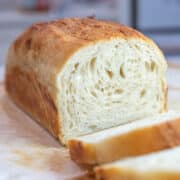
Sourdough Sandwich Bread
A soft, not-too-tangy sourdough sandwich bread that holds up to lunches, French toast, and grilled cheese. Six pantry ingredients, no Dutch oven, no boule shaping.
Servings: 12 servings
Calories: 173kcal
Equipment
- 1 Thermometer
- 1 Food Scale
Ingredients
- 150 grams active sourdough starter
- 325 grams warm water
- 20 grams avocado oil
- 30 grams honey
- 500 grams bread flour unbleached
- 20 grams salt
Instructions
- Before you begin: Confirm your starter is active and bubbly, it should at least double within 4 to 6 hours of its last feeding. Grease a 9x5 loaf pan. Plan backwards from when you want to bake, this is roughly a 12 hour process from first mix to oven.
- In a large mixing bowl, combine the active sourdough starter, warm water, avocado oil, and honey. Whisk until smooth. Add the bread flour and salt and mix until a shaggy dough forms. Cover and rest 1 hour.
- Perform 4 sets of stretch-and-folds, 30 minutes apart. With wet hands, grab one edge of the dough, stretch it up, fold over the center, rotate 90 degrees and repeat on all four sides.
- Cover and let bulk ferment 4 to 8 hours at room temperature (68 to 80º F), until the dough has roughly doubled and looks bubbly and airy. Warmer room = faster ferment.
- Lightly flour your work surface. Shape the dough into a tight log the length of the loaf pan and place seam-side down into the greased pan. The dough should reach halfway up the rim.
- Cover loosely and second-rise 2 hours at room temperature, until the dough is puffy and just crests the top of the pan.
- Preheat your oven to 400º F. Score the top of the loaf with one long shallow slash down the length.
- Bake 30 minutes at 400º F, then reduce to 375º F and bake another 15 minutes, until the crust is deeply golden brown.
- Check the internal temperature with a thermometer. Pull at 198 to 205º F. Lower end of that range = softer crumb, upper end = firmer toast.
- Remove the loaf from the pan immediately onto a wire rack. Cool completely (at least 1 to 2 hours) before slicing.
Video
Notes
Ingredient notes: Bread flour gives the strongest structure. You can replace up to half with whole wheat for a nuttier flavor, beyond that the crumb gets too dense. Honey can be swapped 1:1 for maple syrup, agave, or granulated sugar. Avocado oil can be swapped 1:1 for olive oil, canola oil, or melted unsalted butter.
Pan options: A 9x5 loaf pan is the default. For a softer crust and bigger oven spring, use the "second pan as a lid" technique: spritz the scored dough with water, invert a matching loaf pan (or greased foil) over the top, and bake covered at 400º F for the first 30 minutes, then uncover and finish at 375º F for the final 15 minutes. The trapped steam mimics a Dutch oven.
Make ahead and storage: After the bulk rise, shape into the pan, cover, and refrigerate up to 24 hours. Let it warm up 1 to 2 hours at room temperature before baking. Baked loaf stores airtight at room temperature up to 3 days. Freeze whole or pre-sliced, wrapped in foil + freezer bag, up to 3 months. Reheat slices straight from frozen in a toaster.
Substitutions: Active starter can be swapped 1:1 for sourdough discard, expect a longer bulk rise (8 to 12 hours).
Tangzhong upgrade (optional, advanced): Whisk 25 g of the bread flour with 125 g of the water in a small saucepan. Cook over medium heat, stirring constantly, until it thickens into a pudding (about 3 minutes). Cool, then add to the dough with the rest of the water and flour at step 1. The pre-gelatinized starch gives you Japanese-milk-bread softness without changing the ratios.
Critical do-nots:
- Don't slice into the loaf while it's still hot, the crumb will go gummy.
- Don't skip the second rise, this is where you avoid a dense bottom.
- Don't mix cinnamon directly into the dough (it slows yeast and you'll get a flat loaf). Sprinkle it during shaping instead.
Nutrition
Serving: 1serving | Calories: 173kcal | Carbohydrates: 32g | Protein: 5g | Fat: 2g | Saturated Fat: 0.3g | Polyunsaturated Fat: 1g | Monounsaturated Fat: 1g | Sodium: 647mg | Potassium: 43mg | Fiber: 1g | Sugar: 2g | Vitamin A: 1IU | Vitamin C: 0.01mg | Calcium: 7mg | Iron: 0.4mg
