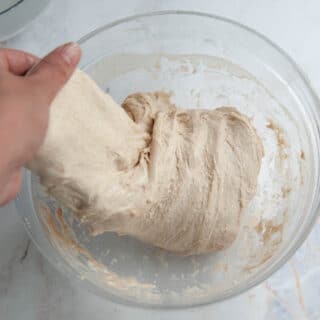
How To Do Sourdough Stretch & Folds
A gentle dough-strengthening technique that develops gluten and layers air evenly into sourdough bread dough during bulk fermentation. 4 sets, 30 minutes apart, cardinal directions. Replaces kneading for high-hydration sourdough.
Servings: 1 loaf
Ingredients
- 1 batch high hydration sourdough dough
- 1 small bowl of water
- 1 piece plastic wrap
Instructions
- Before you begin: Have your dough already mixed and resting in its bulk fermentation bowl. Set a 30-minute timer from the time you finished mixing the dough.
- Lightly wet one hand in the bowl of water nearby. The wet hand glides off the dough instead of sticking.
- Reach the wet hand under the dough on one side (North). Slide your hand between the dough and the bowl, then lift the dough straight up. Stretch it as high as it will comfortably go without tearing.
- Fold the stretched piece over the top of the dough toward the opposite side (South). The piece lands on top, like folding a letter.
- Rotate the bowl 90 degrees.
- Repeat the stretch and fold from the second side (East). Stretch up, fold over.
- Rotate the bowl 90 degrees again. Repeat from the third side (South).
- Rotate one more time. Repeat from the fourth side (West).
- You've completed ONE set of 4 stretches. Cover the bowl with plastic wrap or a damp tea towel. Set the timer for 30 minutes.
- After 30 minutes, repeat the 4-stretch set above for Set 2. Continue until you've completed 4 total sets, spaced 30 minutes apart.
- After Set 4, lightly tap the dough. If it has a bouncy feel, doesn't stretch easily, and is holding its shape, you're done with folds.If the dough is still loose and stretchy and not holding its shape, do one more set and check again 30 minutes later.
- Once the dough passes the doneness test, continue bulk fermentation without any more folds.Let the dough rise 50% to 75% in volume. It should feel light, jiggly, and full of trapped gas. This typically takes another 1 to 4 hours depending on kitchen temperature. Then shape and proof per your recipe.
Notes
Doneness test:
- Lightly tap the dough after 30 minutes of rest. Bouncy feel, doesn't stretch easily, holds its shape = done with folds.
- Still loose and stretchy = do another set, check again in 30 minutes.
- Warm kitchens (75º F and above): you might only need 3 sets.
- Cool kitchens (below 70º F): you may need 5 sets.
- Trust the dough signal over the count.
- Don't tear the dough. Tearing means you're working too aggressively OR the dough didn't get enough rest.
- Wet hand for every set. Dry hands stick to the dough and tear it.
- Stay in the bowl. Don't transfer the dough to the counter for the folds.
- Cover between sets to prevent a dry skin from forming on the surface.
- If the stretches start tearing the dough, switch to coil folds for the last 2 sets. Same timing, same number of sets, gentler handling.
- Don't skip the 30-minute rest between sets. The rest is when the gluten relaxes.
- Don't transfer the dough out of the bowl for stretches.
- Don't continue folding past the doneness signal — over-folded dough gives you a tight crumb instead of the open one sourdough is known for.
