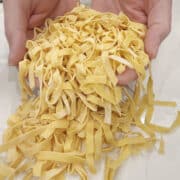
Fresh Egg Pasta
This is how you make easy homemade pasta that you can then roll out and make into any shape you like.
Servings: 4 servings
Calories: 450kcal
Equipment
- 1 Food processor If not making by hand
Ingredients
- 400 grams all purpose flour
- 240 grams eggs about 4 large eggs
- 6 grams salt
Instructions
Handmade Pasta
- Create the flour well on a large, clean work surface (wood or marble is ideal), pile your flour into a mound.
- Use the bottom of a bowl or your fingers to create a wide, deep hole in the center. Make sure the walls are thick and sturdy so the eggs do not leak out.
- Crack the eggs into the center of the well. If you are using salt in the dough, sprinkle it directly onto the eggs now.
- Use a fork to gently beat the eggs in the center of the well. Be careful not to puncture the flour walls yet.
- Once the eggs are blended, begin flicking small amounts of flour from the inner rim of the well into the egg mixture.
- Continue whisking in a circular motion, pulling more flour from the walls until the center becomes a thick, custard-like paste.
- Once the mixture is thick enough that it will not run across the table, use a bench scraper or your hands to fold the remaining outer walls of flour over the center.
- Work the flour and egg together until a rough, shaggy ball forms. If there are dry bits of flour that will not stick to the ball, do not force them in. Simply brush them aside. If the dough is too sticky to handle, add a tiny dusting of extra flour.
- Use the heel of your hand to push the dough away from you, then fold it back over itself, rotate it 90 degrees, and repeat. Do this firmly for 8 to 10 minutes. The dough is ready when it is smooth, elastic, and bounces back slowly when poked with a finger.
- Wrap the dough tightly in plastic wrap to prevent it from drying out. Let it rest on the counter at room temperature for at least 30 minutes. This allows the gluten to relax so the dough does not shrink back when you roll it out.
- After the rest, dust your surface with a little more flour. Cut the dough into four pieces and roll them out one at a time to your desired thickness. Cut into ribbons for fettuccine or leave in sheets for lasagna.
Video
Notes
Troubleshooting Your Dough
Even with a perfect ratio, variables like the humidity in your kitchen or the size of your eggs can throw things off. Here is how to handle the two most common "disasters":1. The Dough is Too Dry (Crumbly/Sandy)
If you’ve been kneading for 5 minutes and the dough still looks like a dry sponge or won't stay in a ball, it needs moisture.- The Fix: Do not pour water directly onto the dough. Instead, dip your hands in warm water and continue kneading. This adds moisture in tiny, manageable increments. Repeat until the dough gathers all the stray flour.
2. The Dough is Too Sticky (Tacky/Stretching)
If the dough is sticking to your hands or the countertop like glue, it’s over-hydrated.- The Fix: Lightly dust your work surface with flour and knead it in. Only add a tablespoon at a time. The goal is a dough that feels like "earlobe" or "play-dough" consistency. Soft but not sticky.
Nutrition
Serving: 1serving | Calories: 450kcal | Carbohydrates: 77g | Protein: 18g | Fat: 7g | Saturated Fat: 2g | Polyunsaturated Fat: 2g | Monounsaturated Fat: 2g | Trans Fat: 0.02g | Cholesterol: 223mg | Sodium: 669mg | Potassium: 190mg | Fiber: 3g | Sugar: 0.5g | Vitamin A: 324IU | Calcium: 49mg | Iron: 6mg
