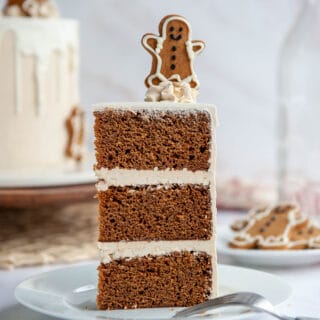
Moist Gingerbread Cake
This super moist spiced gingerbread cake is made with smooth and creamy brown sugar buttercream. The perfect cake for Christmas.
Servings: 12 servings
Calories: 870kcal
Equipment
- Three 6"x2" cake pans
- Stand mixer with whisk attachment
Ingredients
Gingerbread Cake
- 15 ounces all-purpose flour
- 10 ounces dark brown sugar
- 1.5 teaspoons baking soda
- 1.5 teaspoons salt
- 3 teaspoons ground ginger powdered
- 3 teaspoons ground cinnamon
- 3 teaspoons grated ginger fresh, or from a tube
- ¼ teaspoon ground cloves
- 8 ounces buttermilk room temperature
- 4 ounces unsalted butter melted, not hot
- 4 ounces canola oil or vegetable
- 2 ounces coffee room temperature
- 1 teaspoon vanilla extract
- 4 ounces un-sulfured molasses I used Grandma's brand
- 2 large eggs room temperature
Brown Sugar Swiss Meringue Buttercream
- 8 ounces egg whites fresh is better, you can use boxed if needed
- 14 ounces light brown sugar
- ¾ teaspoon salt
- 18 ounces unsalted butter room temperature
- 1 Tablespoon vanilla extract
- 1 Tablespoon ground cinnamon
White Chocolate Water Ganache
- 6 ounces white chocolate I prefer guittard white chocolate wafers
- 1 ounce warm water
Instructions
- Before you begin: Preheat your oven to 335º F (170º C). Bring your buttermilk, eggs, and coffee to room temperature, and measure everything by weight rather than cups.
Gingerbread Cake
- In a large bowl, add your molasses, oil, coffee, vanilla, melted butter, eggs, freshly grated ginger, and buttermilk. Whisk everything together to break up the egg yolks and combine, then set it aside.
- In the bowl of your stand mixer, add the flour, brown sugar, cinnamon, powdered ginger, salt, and baking soda. Attach the paddle and mix on low for a few seconds to combine.
- While mixing on low, add in your wet ingredient mixture and mix until just combined, about 10 to 15 seconds. Mix with a spatula to make sure there are no pockets of flour.
- Prepare three 6" x 2" cake pans or two 8" x 2" cake pans with cake goop or your preferred pan release.
- Divide the batter evenly into your greased cake pans. I like to weigh my pans with a scale to see if I divided the batter evenly.
- Bake at 335º F (170º C) for 35 to 40 minutes (for 6" pans, less for 8" pans).
- Remove your cakes from the oven once the tops are set and a toothpick comes out clean. Let them rest in the pans for 10 to 15 minutes, or until the pans are just barely warm.
- Flip the cakes out onto a cooling rack. Wrap them in plastic wrap to cool at room temperature until ready to stack, or freeze for 30 minutes. Do not stack warm cakes.
Brown Sugar Swiss Meringue Buttercream
- Set up a double boiler: fill a large pot with about 2 inches of water and bring it to a simmer, then reduce the heat to medium-low. Place the metal bowl of your stand mixer on top of the pot. The water should not touch the bottom of the bowl.
- Add your egg whites and brown sugar to the bowl and whisk to combine.
- Whisk continuously until the grains of sugar dissolve. Don't walk away, or you risk cooking the eggs.
- Once you can't feel any grains of sugar left, take the mixture off the heat and attach the bowl to your stand mixer with the whisk attachment.
- Turn the mixer onto high and let your eggs whip until you reach stiff, STIFF peaks. Stiff peaks is when the meringue stands straight up from the whisk. This can take 5-15 minutes depending on the strength of your mixer.
- Because I’m impatient, I like to scoop out my meringue and place it onto a cookie sheet to cool down quickly in the fridge. You can stick the whole bowl in the fridge but it takes much longer. You can’t whip in the butter until the meringue is cool or it will melt the butter and you’ll be left with brown sugar soup!
- After about 10-20 minutes, your meringue shouldn’t feel warm anymore. Scoop it back into the bowl and start mixing on medium speed while adding in your chunks of room temperature butter.
- Add in your salt, vanilla, and cinnamon.
- Increase the speed to high and whip until light and fluffy.
White Chocolate Water Ganache
- Add your chocolate and water in a glass bowl. Microwave for about 1 minute, until the chocolate begins to melt. Stir until smooth.
- Add in 1 teaspoon of white food coloring so the drip looks bright white instead of transparent. Set the ganache aside to cool to about 90º F. Make sure your cake is cold and your ganache has cooled before you drip it, or it will run too far down the sides.
Cake Assembly
- Once your cake layers are completely cool and your buttercream is ready, place your first layer of cake onto a 6" round cake board or directly onto your cake plate. Spread a thin layer of buttercream on top, about ¼" thick.
- Repeat with your second layer, keeping the buttercream layers an even thickness.
- Place your third and final layer on top, upside down so the flat bottom of the cake becomes the top of your stack.
- Cover the entire cake with a thin layer of buttercream, this is the crumb coat. Place the cake in the freezer for about 15 minutes to firm it up.
- Apply your final layer of buttercream and smooth out the sides and top with a bench scraper and an offset spatula. Place your cake in the fridge to chill while you make your water ganache.
- Drip the water ganache down the sides of the cake and fill in the center with the leftover ganache. Smooth out any gaps with a spatula or spoon.
- Wait until the ganache sets, or chill the cake for 10 minutes, before piping buttercream swirls on top.
- I decorated my cake by adding cute little gingerbread cookies. The lines are just piped with melted white chocolate. Super easy and tasty!
Video
Notes
Ingredient notes: Use unsulphured molasses, not blackstrap, which is too bitter for baking. Canola oil has the most neutral flavor, but vegetable oil works too. If a recipe calls for a specific ingredient like cake flour, substituting all-purpose flour and cornstarch isn't recommended unless the recipe says it's fine, this recipe already calls for all-purpose flour specifically. All-purpose flour has a protein level of 10 to 12%, cake flour is 9% or less.
Pan options: This recipe fills three 6" x 2" cake pans or two 8" x 2" cake pans, bake time is slightly shorter for the larger 8" pans. Use the Cake Batter and Frosting Calculator above for other pan sizes.
Make-ahead and storage: Baked, unfrosted cake layers can be wrapped tightly and frozen for a few days without losing much moisture. Chill your cake before frosting and filling, and keep it chilled in the fridge before delivery for easier transporting. You can cover a frosted, chilled cake in fondant if needed. It's also a good cake for stacking.
Substitutions: No buttermilk on hand? Use one of my buttermilk substitutes. Almost any frosting pairs well with this cake, including the brown sugar Swiss meringue buttercream in this recipe, easy buttercream, ermine, whipped cream, or cream cheese frosting.
Critical do-nots: Don't stack warm cake layers. Don't add butter to the meringue until it's fully cooled, or you'll end up with brown sugar soup instead of buttercream. If your buttercream looks broken or is clinging to the sides of the bowl, it's usually just too cold. Remove about 1 cup, microwave it until barely melted (about 30 seconds), then pour it back in and keep mixing until it comes together light and fluffy.
Nutrition
Serving: 1serving | Calories: 870kcal | Carbohydrates: 92g | Protein: 8g | Fat: 53g | Saturated Fat: 28g | Cholesterol: 145mg | Sodium: 662mg | Potassium: 336mg | Fiber: 2g | Sugar: 64g | Vitamin A: 1375IU | Calcium: 124mg | Iron: 3mg
