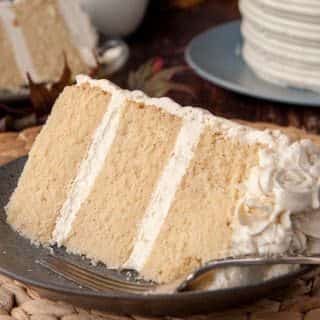
Brown Butter Cake
This brown butter cake is light, fluffy, super moist, and oh so delicious. Brown butter is my favorite way to add a warm and toasty flavor to my baked goodies. Those little brown specks are like gold!
Servings: 12 cups
Calories: 559kcal
Equipment
- Stand Mixer
- Paddle Attachment
- Whisk Attachment
- Three, 8"x2" cake pans
Ingredients
Brown Butter Cake
- 20 ounces cake flour
- 11 ounces granulated sugar
- 6 ounces brown sugar sifted
- 1 ½ teaspoons baking soda
- 1 ½ teaspoons baking powder
- 1 ½ teaspoons salt
- 1 ½ Tablespoons vanilla extract
- 14 ounces buttermilk warmed, and divided
- 4 large eggs room temperature
- 11 ounces brown butter room temperature
- 6 ounces oil
Vanilla Bean Buttercream Frosting
- 24 ounces unsalted butter room temperature
- 24 ounces powdered sugar sifted
- 1 whole vanilla bean or 1 Tablespoon vanilla bean paste
- ½ teaspoon salt
- 5 ounces pasteurized egg white
- 1 TINY drop purple food coloring optional, for whiter frosting
Instructions
Brown Butter Cake
- IMPORTANT: Make sure all your ingredients are at room temperature and you're using a scale to measure. Substituting ingredients may cause the recipe to fail (see notes at the bottom of the recipe).
- Heat oven to 335º F. Prepare three 8"x2" cake pans with cake goop or another preferred pan release.
- Measure out 6 ounces of your buttermilk into a separate container. Add in your oil and set aside (if doubling or tripling the recipe, remember to adjust this amount as well).
- Combine the remaining buttermilk with your vanilla and eggs. Whisk lightly and set aside.
- Measure out the flour, sugar, brown sugar, baking soda, baking powder, and salt and place them into the stand mixer bowl with the paddle attachment.
- Turn the mixer on the slowest speed (setting 1 on Kitchen Aid mixers). Add in your brown butter to the flour mixture. Let it mix until the batter resembles coarse sand.
- Add your buttermilk and oil to the flour mixture.
- Increase mixing speed to medium (setting 4 on Kitchen Aid mixers) and mix for 2 full minutes. Let the mixture whip up until it has thickened and lightened in color. It should look like soft-serve ice cream. If you don't let the batter mix fully, you'll end up with very short, crumbly cakes that don't rise.
- Scrape the bowl. This is an important step. If you skip it, you'll have hard lumps of flour and unmixed ingredients in your batter. If you do it later, they won't mix in fully.
- Add your egg mixture in three parts, letting the eggs incorporate for 5 to 10 seconds between additions. Scrape the bowl halfway through.
- If your batter is curdled and broken at this point, your milk or eggs were too cold, and your cake may not rise.
- Divide your cake batter between your pans. I weigh my pans to make sure there's the same amount of batter in each pan.
- Bake for a minimum of 30 minutes before you check for doneness. Bigger pans take longer to bake than smaller pans. I use a baking core for pans over 12". Cakes are done when a toothpick comes out clean or the tops spring back when you lightly touch them.
- After the cakes have cooled for 10 minutes, or the pans are cool enough to touch, flip the cakes over onto cooling racks to cool completely. Wrap in plastic wrap and chill in the refrigerator, or freeze for one hour to speed up cooling.
Vanilla Bean Buttercream Frosting
- Place egg whites and powdered sugar in a stand mixer bowl fitted with the whisk attachment. Mix on low, then whip on high for 5 minutes.
- Add the butter in chunks while whipping. The mixture will look curdled and a little yellow at first, but that's normal. Keep whipping.
- If using, add the purple food coloring now. Whip on high for 8 to 10 minutes, until the buttercream is very white, light, and shiny.
- Add the vanilla bean paste and salt.
- Switch to the paddle attachment and mix on low for 15 to 20 minutes to make the buttercream smooth and remove any air bubbles. This step isn't required, but it makes the buttercream noticeably smoother.
- Frost and decorate as desired.
Video
Notes
About the video: the video shows an earlier version of this recipe. The recipe has since been updated, so follow the amounts and steps on this recipe card.
Ingredient notes: Use a kitchen scale to weigh your ingredients, including the liquids, for the most accurate results. Practice mise en place and measure everything out before you start mixing so you don't accidentally leave something out.
Pan options: This recipe makes three 8"x2" cake layers, but it also works in two 9" round pans or one 9x13 sheet pan. Bigger pans take longer to bake. For a 9x13, start checking for doneness around 40 minutes and keep baking until the center is set.
Make-ahead and storage: Wrap baked, unfrosted layers tightly in plastic and keep them in the fridge for a few days, or freeze them to use later. Chill a frosted and filled cake in the refrigerator before delivery or stacking. It's also great for covering in fondant if you want to decorate ahead of time. Let slices come to room temperature for about 30 minutes before serving.
Substitutions: This recipe calls for cake flour. Replacing it with all-purpose flour and cornstarch isn't recommended. It can change the texture more than you'd expect. Salted butter can replace the unsalted butter in the buttercream, but leave out the ½ teaspoon of added salt if you do, since the butter will already bring enough.
Critical do-nots: Don't skip bringing your ingredients to room temperature. Cold buttermilk or eggs can cause the batter to curdle and keep the cake from rising properly. Don't rush the 2-minute mix after adding your liquids. This is what gives the cake its light, fluffy texture. Don't skip scraping the bowl after adding the brown butter. Unmixed flour at the bottom won't incorporate later.
Nutrition
Serving: 1serving | Calories: 559kcal | Carbohydrates: 55g | Protein: 4g | Fat: 37g | Saturated Fat: 20g | Polyunsaturated Fat: 3g | Monounsaturated Fat: 11g | Trans Fat: 1g | Cholesterol: 106mg | Sodium: 288mg | Potassium: 85mg | Fiber: 0.4g | Sugar: 43g | Vitamin A: 998IU | Calcium: 41mg | Iron: 0.3mg
